The Weight of White Stone
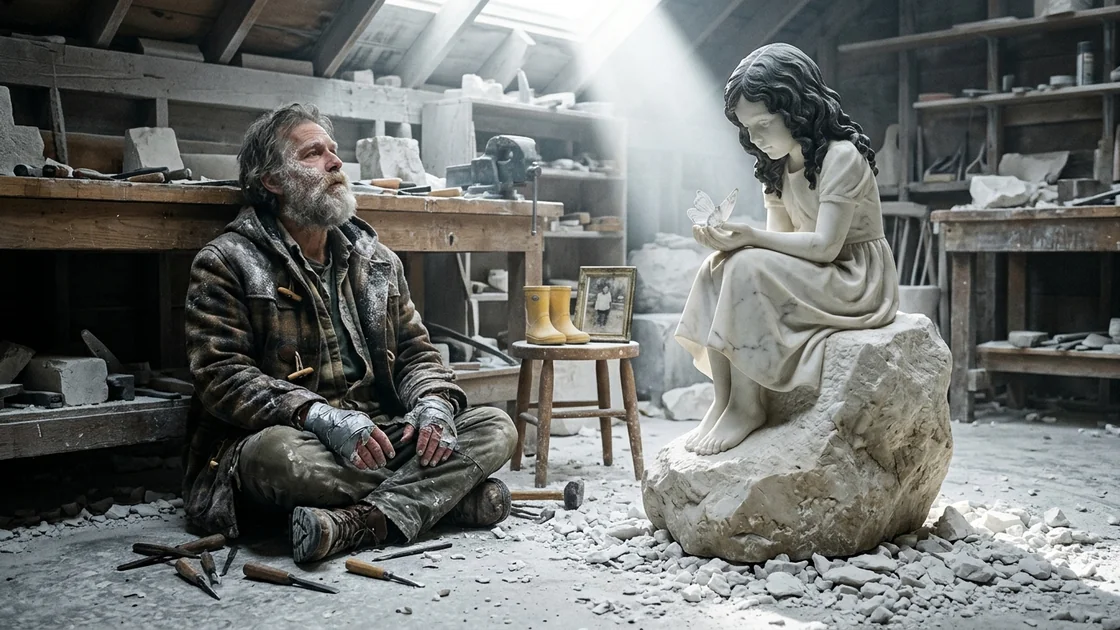
Arthur Pendelton, a once-celebrated master sculptor now crippled by severe rheumatoid arthritis, undertakes the impossible task of carving one final monument from a massive block of Carrara marble. Driven by profound grief over the sudden loss of his young daughter, Lily, Arthur retreats into his freezing studio to immortalize her memory before his rapidly deteriorating hands lose their function entirely. Over the course of several brutal months, he endures excruciating physical agony, broken tools, and the isolation of his sorrow, binding his failing tools to his swollen wrists and bleeding onto the stone as he chips away the excess weight. Through this grueling crucible of pain and devotion, Arthur sacrifices the last of his physical capability to birth a breathtaking masterpiece that captures his daughter’s fleeting spirit, finding peace and release only when the final grain of dust settles.
The morning mist clung to the hills of Vermont like a wet burial shroud, seeping through the cracks of the old barn that served as Arthur’s studio. Before he even opened his eyes, Arthur felt the weather inside his own body. It lived in the capsule of every joint—a dull, throbbing prelude of battery acid and ground glass that awaited his first movement.
He lay beneath three heavy wool blankets, staring up at the water-stained plaster of the ceiling. His hands rested on his chest, though they scarcely resembled hands anymore. The rheumatoid arthritis had spent the last decade remaking them in its own cruel image. The knuckles were swollen to the size of walnuts, the skin stretched tight and shiny with a perpetual, angry redness. His fingers drifted outward in an ulnar deviation, twisted like the roots of an ancient oak tree that had grown through rocky soil.
Slowly, with a sharp intake of breath, Arthur tried to curl his right hand into a fist. The tendons creaked, a sound only he could hear, vibrating up through his radius and ulna. The tips of his fingers stopped a full two inches from his palm. White-hot needles lanced through his wrist, radiating up to his elbow. He let out a long, ragged sigh that turned to a cloud of vapor in the unheated bedroom.
Sixty-two years old, and he was petrified wood. A cruel irony for a man who had spent forty of those years making stone look as soft as flesh, as fluid as water, as weightless as air.
He swung his legs over the edge of the mattress. His knees protested with a dry, snapping sound, followed by the familiar, sickening ache that made him grip the edge of the bed frame with his forearms rather than his hands. He sat there for ten minutes, breathing through the nausea that accompanied the morning stiffness, waiting for the ibuprofen he kept by his bedside to dull the sharpest edges of the agony. It never took the pain away; it merely pushed it into the next room, where it still screamed, muffled only slightly by a closed door.
Downstairs, the house was too quiet. It had been quiet for four hundred and twelve days.
Arthur navigated the narrow staircase one step at a time, leading with his right foot, bringing the left to meet it, leaning his shoulder against the wall for balance. In the kitchen, he didn't bother with coffee. The pot was too heavy to lift when full, and the small plastic button on the machine required a precise thumb pressure he could no longer muster without triggering a spasm. Instead, he drank tap water from a heavy ceramic mug he could cradle between both palms, and ate a piece of cold toast.
Through the kitchen window, across thirty yards of frost-bitten grass and dead goldenrod, stood the barn. And inside the barn stood the ghost.
He pulled on a heavy flannel coat with oversized wooden toggles—zippers and small buttons were relics of his past life—and stepped out into the biting November air. The cold was an immediate shock, clamping down on his hands like iron vices. He shoved them deep into his pockets, hunching his shoulders against the wind as he shuffled down the gravel path.
The heavy sliding door of the studio was already cracked open just enough for a man to slip through. He had wedged it that way in September, knowing that once the frost heaved the ground, he would never have the strength to roll it back on its rusted iron track.
Inside, the smell hit him first. It was the scent of his entire life: damp earth, machine oil, aged pine, and the distinct, metallic tang of pulverized calcium carbonate. Everything was coated in a fine, chalky patina of white dust. It settled on the rafters, on the rusted carcasses of old armatures, on the rows of plaster casts that lined the high shelves like a silent audience of severed limbs and sightless faces.
In the center of the reinforced concrete floor, directly beneath the great northern skylight, sat the block.
It was sixty-four cubic feet of Statuario Carrara marble, quarried from the mountains of Torano in Italy. It weighed nearlyfive tons. He had bought it five years ago, at the absolute peak of his career, just after the Guggenheim retrospective, just before the first morning he had woken up unable to hold a pencil. It had been intended for a commission in Boston—a grand, abstract representation of human resilience. When the disease accelerated, he had returned the advance, canceled the contract, and left the stone sitting on its heavy oak timbers, shrouded in a blue plastic tarp.
Three days ago, he had pulled the tarp off.
The stone was magnificent. Even in its rough, quarry-cut state, with the marks of the diamond wire saws still scoring its flanks, it possessed an inner luminosity. It was a dense, creamy white, almost entirely free of the heavy gray veining of lesser marbles, save for a faint, smoke-like wisp that drifted diagonally across its eastern face. It looked like a captured cloud, frozen and compressed until it achieved the density of bone.
Next to the monolith stood a small wooden stool. On the stool sat a single, faded photograph in a tarnished silver frame, and a pair of small, yellow rain boots, size four, their rubber surfaces cracked and dusted with dried mud that Arthur refused to wash away.
"Morning, Lil," Arthur whispered. His voice was rusty from disuse.
In the photograph, Lily was seven. She was standing on the breakwater at Rockland, her dark curls whipped into a frenzy by the Atlantic wind, her head thrown back in a laugh so wide and unguarded you could practically hear the gulls screaming behind her. She had one arm raised, pointing at something out of frame—a seal, perhaps, or a lobster boat. The sun caught the bridge of her nose and the edge of her chin.
A drunk driver in a rusted pickup truck had crossed the center line on Route 100 on a Tuesday afternoon in October. Martha, Arthur’s wife, had survived the impact, only to have her heart give out four months later from the sheer, crushing weight of an empty house. The doctors had called it cardiomyopathy. Arthur knew better. Martha had simply chosen not to stay in a world that didn't have Lily in it.
Arthur had wanted to follow them. For six months, he had sat in his armchair, watching the light move across the floorboards, waiting for his own heart to stop. He had stared at his ruined hands and cursed whatever god had taken his child and left him with the useless, twisted remnants of his talent.
Then, last week, the town cemetery had called. The ground would be freezing soon. The plot beside Martha and Lily was bare. They wanted to know when the monument would be delivered by the commercial granite company down in Barre.
The thought of a laser-etched slab of gray granite—some factory-produced rectangle polished by a machine and sandblasted through a rubber stencil by a man who had never heard Lily’s laugh—had filled Arthur with a sudden, violent rage. It was a profanity. He was Arthur Pendelton. His work stood in the plazas of Milan, the gardens of Kyoto, the halls of Washington. And his daughter was lying beneath unmarked sod because his hands hurt.
That afternoon, he had walked out to the barn and pulled down the tarp.
Now, standing before the Carrara block, the reality of what he intended to do pressed down on him like the stone itself. He walked over to his workbench, a twelve-foot slab of butcher-block maple scarred by decades of slips, gouges, and spilled solvents. Rolled out across the wood were his tools, arranged by size and function like surgical instruments.
There were the points—thick shafts of octagonal steel tapering to sharp, pyramidal tips, used for roughing out the primary mass. There were the tooth chisels, the gradine, with their serrated edges like iron combs, meant for cross-hatching the stone and bringing the form closer to the skin. There were the flat chisels, the bull-noses, the rondels, the delicate gouges, and the rasps. And beside them lay the hammers: the heavy, stubby mazzuolo made of forged iron, and the soft-iron Roman hammers that absorbed the shock of the blow.
Arthur reached out with his right hand and tried to pick up a two-pound mazzuolo.
His fingers couldn't wrap around the hickory handle. The thumb joint, subluxed and frozen at the base, refused to oppose the index finger with any strength. When he tried to force it, trying to wedge the wood into the crook of his palm, the hammer simply rolled out of his grasp. It hit the workbench with a loud bang, rolled off the edge, and struck the concrete floor, narrowly missing his foot.
Arthur stood frozen, staring down at the hammer. A bead of sweat broke out on his forehead despite the freezing air. His breath came in shallow hitches.
"No," he said aloud. "No, we aren't doing this. You're going to work."
He knelt down. The act of kneeling took thirty seconds of agonizing negotiation with his hips and knees. He picked up the hammer using both hands, cradling it like a dead bird, and placed it back on the bench.
If the hand would not hold the tool, the tool would have to hold the hand.
He hobbled to the back of the shop where he kept supplies for building armatures. He found a roll of heavy leather strapping, a spool of galvanized baling wire, and a roll of silver duct tape. He also found an old pair of heavy canvas welding gloves.
With his teeth and his left hand, he tore strips of duct tape. He took the right-hand glove and slit the seams along the side so he could slide his swollen, misshapen hand inside it. Once his hand was in, he placed the handle of the hammer against his palm. Then, using his left hand and his chin to hold the roll of leather, he began to wrap his right hand around the hickory shaft.
Around and around he went, pulling the leather tight with his teeth. Every tug compressed his inflamed joints. A scream built in the back of his throat, emerging as a high, thin whine through his clenched teeth. Tears of pure, physiological reflex spilled over his lower eyelids, running down the deep crevices of his cheeks and soaking into his gray beard.
When the leather was wrapped, he secured it with duct tape, binding his fingers down over the wood, taping his wrist to the base of the handle so the joint couldn't buckle under the impact. He had turned his right arm into a club with an iron head.
Now for the left hand—the hand that guided the steel.
He selected a heavy point chisel. He couldn't hold it between his fingers, not with the force required to keep it from flying across the room when struck. He took a thick block of high-density foam, carved a groove into it with a utility knife held between his palms, and wedged the shaft of the chisel into the foam. Then, he taped the foam block to his left palm. It was clumsy. It robbed him of the subtle, micro-adjustments of angle that separated a master from a mason, forcing him to aim the chisel by moving his entire elbow and shoulder.
It took him an hour to rig himself to the tools. By the time he finished, his shirt was soaked through with cold sweat, and his hands were throbbing in a synchronized, blinding rhythm that matched his heartbeat.
He turned back to the stone.
He didn't have a bozzetto—a small clay model to take measurements from with calipers and a pointing machine. He didn't have the time, nor the dexterity left to work clay. The statue was entirely inside his head, burned onto the backs of his eyelids. It was Lily, not as an angel with wings—she had been too wild, too thoroughly of the earth for wings—but Lily sitting on a rock at the edge of the tide pool, her knees drawn up, peering down at something small and precious cupped in her hands, her hair spilling over her shoulders, the hem of her dress bunched around her ankles.
To get to her, he had to remove nearly three tons of marble.
Arthur stepped up to the northeast corner of the block. This was the sky above her head. It had to go.
He raised his left arm, placing the tip of the point chisel against the stone, about four inches in from the edge, angled inward to pitch off a large spall. He raised his right arm. The two-pound hammer felt like it weighed fifty.
He brought it down.
Clack.
He missed the head of the chisel entirely. The hammer struck the shaft an inch below the mushroomed crown. The vibration shot through the steel, straight through the foam pad, and detonated in the bones of his left hand. Simultaneously, the off-center blow wrenched his right wrist against the duct tape.
Arthur doubled over, pressing his forehead against the cold, flat surface of the marble. A guttural roar tore out of him, echoing off the high rafters, startling a nesting pigeon that burst from the eaves in a flurry of gray feathers. The pain was absolute. It was a blinding white light behind his eyes, erasing the room, erasing his name, leaving only a vast, howling landscape of nerve endings on fire.
He stayed pressed against the stone for a long time, panting, drool slipping from the corner of his mouth onto the white rock.
"I'm sorry, baby," he gasped to the stone. "Daddy's clumsy. Daddy's broken."
The stone was cold against his feverish skin. As the initial shock wave of pain began to recede into a deep, nauseating ache, he felt the density of the marble against his brow. It was ancient. Formed in the Jurassic period from the crushed shells of trillions of microscopic sea creatures, subjected to tectonic heat and pressure that would vaporize a human being, pushed up into the sky to become a mountain. It had endured for two hundred million years.
What was a little pain to the stone? Nothing. Stone only yielded to force and persistence.
Arthur pushed himself upright. His eyes were bloodshot, his jaw set so hard a muscle twitched violently beneath his ear.
He reset his left arm, locking his elbow against his ribs to stabilize the chisel. He looked only at the striking head of the steel, ignoring the point. He raised his right arm, sighting down his forearm like a rifle barrel.
He struck.
Tink.
Steel met steel, dead center. A tiny white star appeared on the marble, a puff of dust rising into the shaft of sunlight. A shard the size of a walnut sheared away and clattered to the floor.
The pain in his hands was excruciating, a twin lightning strike in both arms.
He raised the hammer again.
Tink.
Another star. A spiderweb hairline fracture appeared in the corner of the block.
Tink.
Tink.
Crack.
With the fifth blow, a piece of marble the size of a loaf of bread split away from the corner with a deep, resonant thud, crashing onto the concrete floor and shattering into three pieces. The freshly exposed interior of the stone gleamed like sugar in the morning light, untouched by air or light since the dawn of the world.
Arthur looked at the raw scar on the block, and then at the chunk of waste stone at his feet. Only five thousand more to go.
He raised his right arm and struck again.
November bled into December, and the world outside the barn shrank to a study in monochrome. The snow came early, piling high against the sliding doors, banking up against the rotting cedar shingles, insulating the studio in a tomb-like silence.
Arthur’s life contracted into a brutal, monastic routine governed entirely by the physics of stone and the pathology of his body.
He stopped sleeping in the house. The walk back and forth through the snow became too perilous as the inflammation spread to his ankles and knees, triggered by the systemic revolt of his immune system against the abuse he was inflicting upon it. He dragged an old army cot into the corner of the studio, setting it up next to a rusted cast-iron woodstove.
His days began in the dark. It took him longer and longer to untangle himself from the blankets. His hands were now permanently grotesque. The skin over his knuckles had split from the constant friction of the leather straps and the dry, caustic marble dust, leaving deep, weeping fissures that refused to heal. Every morning, he would wash them in a basin of warm water heated on the stove, biting down on a piece of leather harness to keep from screaming as he scrubbed the limestone grit out of the raw wounds.
Then came the taping. He had refined his method. He had fashioned a sort of splint out of steamed PVC pipe that he molded to his forearm and palm, creating a rigid cradle for the hammer handle. He used veterinary cohesive wrap now—the kind used on horses’ legs—binding the tools to his flesh until the circulation was nearly cut off, turning his fingertips a dusky, bruised purple.
For four hours in the morning, he pitched and pointed.
It was heavy, violent labor. A younger sculptor would have used a pneumatic hammer powered by an air compressor, or diamond-bladed angle grinders to slice away the waste stone in grid patterns. Arthur had those tools sitting in lockers under the bench. He had tried the angle grinder on the fourth day. The high-frequency vibration of the motor had caused his hands to go into such violent, uncontrollable spasms that he had dropped the spinning diamond blade, which had danced across the floor and chewed a deep gouge into his boot heel before the cord yanked free of the wall.
Pneumatics were the same; the rapid-fire chatter-chatter-chatter of the air chisel was a torture device specifically engineered to destroy arthritic joints.
No, it had to be hand tools. The single, decisive blow of the hammer allowed a fraction of a second for his nervous system to brace before the impact, and a second or two to recover before the next.
Tink. Pause. Breathe. Tink. Pause. Breathe.
It was a slow, agonizing heartbeat of steel on steel.
By noon, the floor around the oak timbers was ankle-deep in white rubble. Arthur would be trembling from head to toe, his muscles depleted of glycogen, his joints swollen so tight against the vet wrap that his hands felt like they were going to explode. Using a knife stuck permanently upright in a vise, he would slice the bindings off.
When the hammer fell away, his hand would remain frozen in the shape of the grip, a rigid, trembling claw. It took twenty minutes of soaking them in hot water mixed with Epsom salts before the fingers would slacken even slightly.
He ate out of cans—stew, beans, soup—heated directly on the top of the woodstove. He used a large wooden spoon with the handle built up with foam and tape. Half the food usually ended up in his beard or on his coat because of the tremors, so he mostly drank the broth straight from the tin once it cooled enough to hold between his forearms.
In the afternoons, the fever usually came. Rheumatoid arthritis was not just a disease of the joints; it was a whole-body fire. His temperature would spike to a hundred and one, making him shiver violently even as sweat carved clean tracks through the white dust caked on his face. He would lie on the cot for an hour, staring at the block, his eyes tracing the rough silhouette emerging from the cube.
It looked like a boulder now. The sharp, geometric quarry edges were gone, replaced by a jagged, faceted mountain. You couldn't see a girl yet. You could only see a mass that leaned slightly forward, wider at the base, tapering toward the top.
At two o'clock, before the winter light began to fail in the northern skylight, he would get back up, re-wrap his ruined hands, and go back to the stone until dark.
One Tuesday in mid-December, a knock sounded at the studio door, followed by the scraping of snow as someone forced the gap wider.
Dr. Aris Thorne squeezed through the opening, knocking snow from his parka. Aris had been Arthur’s physician for fifteen years, and a friend for twenty. He stopped dead just inside the threshold, his breath pluming in the frigid air, taking in the scene.
The studio looked like an explosion in a flour mill. And in the center of it stood Arthur. He had lost thirty pounds since October. His clothes hung off his frame like rags on a scarecrow. His hair and beard were wild, matted with marble dust, making him look like an Old Testament prophet who had wandered out of the desert and into a blizzard.
Arthur didn't stop. He was working on the back of the block, carving out the negative space behind what would be Lily’s shoulders.
Tink.
"Arthur," Aris said softly, stepping over a pile of sharp marble shards. "Dear God, Arthur."
Tink.
"I don't have time for a house call, Aris," Arthur rasped, not looking around. His voice was barely audible over the ring of the steel. "Leave the scrips on the table."
Aris walked closer, his boots crunching on the stone chips. As he drew level with Arthur, his eyes went to the sculptor's hands. He saw the PVC splints, the blood-soaked vet wrap, the purple, swollen tips of the fingers protruding from the ends of the bindings. Even from three feet away, the doctor could smell the faint, sickly-sweet odor of localized infection.
"Stop," Aris said, his voice dropping its friendly tone and taking on the sharp authority of the clinic. He reached out and caught Arthur’s right forearm as he raised it for another strike.
Arthur let out a sharp, animal cry as the sudden stop wrenched his shoulder. He whirled on the doctor, his eyes wide, feral, and rimmed in red.
"Don't touch me!" Arthur snarled, backing up a step, holding the hammer up defensively like a weapon.
"Look at your hands, Arthur!" Aris shouted back, pointing at the bloody bindings. "You're causing permanent, irreversible necrosis! You've got open ulcers packed with rock dust. If that gets into the bone—if you get osteomyelitis on top of the immunosuppression from the methotrexate—you won't just lose the use of your hands, I'll have to amputate them! Look at yourself! You're starving, it's twenty degrees in here, and you're beating yourself to death against a rock!"
"I stopped taking the methotrexate," Arthur said quietly, his chest heaving. "Made me too dizzy to climb the scaffold."
Aris stared at him, horrified. "You stopped... Arthur, your body is eating itself alive."
"Let it," Arthur said. He turned back to the marble. "It just has to leave me enough to finish."
"Finish what?" Aris gestured wildly at the five-ton mass of jagged stone. "You've barely roughed out the primary planes! A healthy thirty-year-old with power tools would take three months to finish a piece this size. You're doing it with a two-pound hammer and hands that are essentially broken! It's suicide, Arthur. Martha wouldn't want this. Lily wouldn't—"
"Don't you say her name!" Arthur roared. The sound was terrifying in the enclosed space. He swung his left arm around, pointing the steel chisel at the doctor’s chest. His entire body was vibrating like a plucked wire. "Don't you tell me what my dead wife and my dead child would want! They're in the dirt, Aris! They're in the cold, dark dirt up on that hill, and there's nothing there to say she ever existed! Nothing to say that for seven years, the sun rose and set in her eyes!"
Arthur’s voice broke. His knees buckled, and he slumped back against the marble block, sliding down until he was sitting in the deep drift of white stone chips. He held his bound, monstrous hands up to his chest, rocking back and forth, sobbing without sound, his mouth open in a silent rictus of grief and physical torment.
Aris’s anger vanished, replaced by a profound, helpless sorrow. He knelt down in the dust beside his friend and placed a gloved hand on Arthur’s bony shoulder.
"I'm a sculptor, Aris," Arthur whispered, staring down at the yellow rain boots sitting on the stool a few feet away. "It's the only thing I know how to be. When she was born, I held her in these hands. She was so light. Like a sparrow. When the police called... when we went to the morgue... I couldn't even stroke her hair because my fingers wouldn't flatten out. I couldn't touch my little girl properly to say goodbye."
He looked up at the towering block of Carrara above him.
"This is how I touch her," Arthur said. "Every time I hit the stone, I'm reaching through the dark to find her. She's in there. I can see her. If I stop, I leave her trapped inside the rock forever. I can't leave her in the dark, Aris. Please. Don't make me leave her in the dark."
Aris looked up at the rough stone, then down at the broken man at its base. As a doctor, every instinct screamed at him to call an ambulance, to have Arthur sectioned under psychiatric hold, strapped to a hospital bed, pumped full of IV antibiotics, steroids, and morphine.
As a man who had known Lily—who had given her lollipops after her vaccinations and watched her dance around Arthur’s studio with marble dust on her nose—he knew that if he took Arthur away from this stone, Arthur would be dead within a week. The pain was the only thing tethering him to the earth.
Aris let out a long breath. He reached into his medical bag.
"Take the bindings off," Aris said softly.
"I'm not going to the hospital."
"I'm not taking you to the hospital," Aris said, pulling out sterile saline, gauze, silver sulfadiazine cream, and a bottle of heavy-duty prescription anti-inflammatories and opioids. "I'm going to clean those wounds so you don't die of sepsis before you reach her shoulders. Then I'm going to show you how to wrap them using proper orthopedic splints so you stop dislocating your carpals with every swing. And I'm bringing you groceries every three days. If you don't eat what I bring, then I call the sheriff. Deal?"
Arthur stared at him for a long moment, then slowly nodded, holding out his arms for the doctor to cut him free.
The weeks that followed were a blur of white dust, firelight, and the relentless, rhythmic ringing of steel.
With the orthopedic fiberglass splints Aris had molded for him, Arthur gained a fraction more stability, though the pain remained a constant, roaring furnace. He refused the opioids during the day; he needed his mind sharp, his spatial awareness absolute. One miscalculated blow with a heavy point chisel could send a shockwave along a hidden cleavage plane in the marble, snapping off Lily’s nose, or an arm, or shattering the entire head before it was even born.
In January, the work shifted. The heavy pitching was done. Roughly two tons of marble now lay in heaps pushed to the walls of the studio. What remained on the timbers was a recognizable human form, though still trapped in a thick cocoon of rough, pitted stone—like a figure seen through heavy frosted glass.
Arthur put away the heavy points and took up the gradine—the tooth chisels.
This was the stage of sculpting he had always loved most. The tooth chisel, with its four or five sharp prongs, didn't shatter the stone; it raked it. Drawn across the surface at a forty-five-degree angle, it left behind parallel tracks, cross-hatching the form, allowing the sculptor to creep up on the final surface millimeter by millimeter, feeling out the musculature, the drape of fabric, the tension of bone beneath skin.
It required less brute force than the point, which was a mercy for his shoulders, which were now developing secondary bursitis from the unnatural swinging motion. However, it required infinitely more control.
He built a crude scaffolding around the block out of two-by-fours and plywood so he could reach the top of the statue where Lily’s head was bowed. Climbing the three steps onto the platform was an expedition that left him gasping for breath. He had to slide up on his rear end, pulling himself backward, and then lever himself onto his knees. He worked entirely on his knees now when on the scaffold; his legs were too unsteady to trust standing four feet off the concrete floor.
Shhh-tink. Shhh-tink. Shhh-tink.
The sound of the studio changed. It was no longer the violent, explosive cracking of rock, but a rhythmic, scraping music.
Beneath the iron teeth of the gradine, Lily began to emerge from the fog of the Jurassic sea.
First came the arch of her back, bent forward in that intense, total absorption that only children possess when looking at a bug or a shiny pebble. Arthur remembered the exact curve of her spine when she was six, squatting at the edge of the pond behind the house, watching a green frog. He remembered the way the shoulder blades pushed up against the thin cotton of her sundress like the buds of wings.
He carved those shoulder blades. He spent four days on them alone. His left elbow, locked against his ribs to guide the chisel, rubbed his side raw through his shirt until he taped a piece of sheepskin to his torso.
When his hands swelled so badly they broke through the fiberglass splints, he simply wrapped more tape over the breaks. He stopped looking at his hands when he unwrapped them at night. He did it in the dark, by feel, plunging them into the basin of antiseptic solution Aris left for him, clenching his jaw until a molar cracked in the back of his mouth, spitting the fragment of tooth onto the floor and continuing to wash.
In late January, a three-day blizzard buried the valley. The temperature inside the studio dropped to ten degrees above zero. The water in his washing basin froze solid two feet from the woodstove. The steel of the chisels became so cold that if they touched his bare skin, they burned like dry ice, sticking to the flesh.
Arthur dragged the stove closer to the block, wiring extra lengths of stovepipe up into the rafters, and wrapped himself in a blanket with a hole cut in the middle like a poncho.
He was working on the hair now, and the sides of the face.
This was the danger zone. Marble was unforgiving, and Statuario, for all its creamy beauty, could be brittle when carved thin. Lily’s curls were a nightmare of undercuts and delicate bridges of stone. In the past, he would have used a traditional Italian violino drill—a hand drill spun by a string wrapped around a wooden bow—to bore holes into the deep recesses of the curls to create shadow without risking the shock of a hammer blow breaking the surrounding stone.
He couldn't use the bow drill; it required two nimble hands moving in opposition.
Instead, he took a simple hand twist-drill, taped the handle into his right palm, leaned his chest against the butt of the tool to apply pressure, and rotated his entire upper torso in small circles to twist the bit into the marble.
For twelve hours a day, he pressed his sternum against the drill and rocked in circles, grinding three-millimeter holes into the stone one grain at a time to hollow out the spaces behind her locks of hair. His ribs bruised, turning black and yellow. His breathing became shallow and sharp—he had cracked a rib from the constant pressure against the hard wooden handle, though he didn't know it and wouldn't have cared if he did.
Grind. Blow the dust away. Grind. Blow the dust away.
He was breathing in too much dust. He knew that, too. A respirator fogged his glasses and felt like suffocation when he was already struggling for air. So he breathed the marble in. He coughed up white paste in the mornings. He was taking the waste of the stone into his own lungs, trading his breath for hers. It felt right. It felt like a fair exchange.
On the night of February fourteenth, the storm was howling outside, shaking the heavy barn doors in their tracks. The single bare bulb hanging over the block swayed slightly as the rafters groaned under the weight of four feet of snow.
Arthur was on the scaffold, using a flat chisel—a scalpello—barely a quarter-inch wide. He was no longer using the iron hammer. For this, the skin of her face, he used a wooden mallet made of dense lignum vitae, and he wasn't swinging from the shoulder anymore. He was simply dropping the weight of his forearm from a height of three inches, letting gravity do the work, shaving off translucent flakes of marble no thicker than tissue paper.
He was carving her left eye.
She was looking down at her cupped hands, so the eyelid was lowered, the lashes brushing the top of her cheek. It was a passage of stone less than an inch square, yet the entire life of the sculpture depended on the precise tension of that thin membrane of marble over the invisible orb of the eyeball beneath.
His hands were numb. Truly numb. Over the past week, the screaming fire in his fingertips had begun to give way to a strange, dead coldness. The swelling in his wrists had crushed the median and ulnar nerves in the carpal tunnels so severely that the signals were no longer getting through. The pain had moved up into his forearms and shoulders, leaving his hands like dead weights of meat and bone hanging at the ends of his arms.
It made the work terrifying. He couldn't feel the chisel. He had to watch it with total, unblinking concentration, using his eyes to tell his brain whether the steel was flat against the stone or digging in at an angle.
He tapped the mallet. A tiny ribbon of white curled away from the crease of the upper lid.
He tapped again. The fullness of the cheek just below the eye socket caught the light from the swinging bulb.
Arthur leaned in, blowing gently to clear the flour-fine dust.
And there she was.
He froze. The mallet stopped mid-air.
It wasn't a rock anymore. In the warm, yellow glow of the incandescent bulb, the Statuario marble seemed to warm from within. The microscopic crystals of calcite scattered the light just below the surface—that miraculous subsurface scattering that made Carrara marble the only material on earth that mimicked the translucency of human skin.
The slight puffiness of a child’s lower eyelid. The soft, rounded slope of the cheek before adulthood planes it down. The tiny, almost imperceptible furrow between her brows that she always got when she was concentrating hard on something.
"Lily," Arthur breathed.
A tear dropped from his cheek and hit the bridge of her marble nose. Instantly, the dry stone drank the moisture, turning a fraction darker, like skin warming to a touch.
For the first time in over a year, the crushing iron band around Arthur’s chest loosened just enough for him to draw a full, deep breath. The memory of the morgue—the cold, blue-white stillness of the stainless-steel table that had haunted every waking second of his life—began to fade, overwritten by the warm, living curve of the stone before him.
He didn't stop that night. He knew that if he lay down on the cot, if he let the adrenaline fade, he might never be able to get back up onto the scaffold. The numbness was creeping up his wrists now. His time was running out. He was in a race against the death of his own nerves.
He moved from the face down to the center of the statue—the focal point toward which her entire body, her bowed head, and her gentle gaze were directed: her cupped hands.
In the photograph, she had been pointing at the sea. Here, Arthur had brought her hands together in front of her knees, resting on the folds of her dress, forming a small, protective bowl.
Inside her hands, he was carving a butterfly. A monarch, with its wings half-open, preparing to lift off from her palms.
It was a technical impossibility for a man in his condition. The wings of the butterfly had to be carved down to a thickness of less than three millimeters so the light would pass through them, while remaining attached to the curve of her fingers for structural support.
For three days and three nights, Arthur barely left the scaffold. When Aris came on the sixteenth, Arthur didn't even look down as the doctor restocked the woodpile and left hot soup on the edge of the platform. Aris took one look at Arthur’s face—gray, sunken, the eyes blazing with a terrifying, transcendent mania—and knew better than to interfere. The sculptor was in the final miles of a marathon that would end only at the tape.
Arthur abandoned the hammers entirely. The risk of shattering the butterfly wings or the delicate fingers of Lily’s hands was too great.
He used rifflers—small, curved steel rasps shaped like spoons and sickles, covered in tiny, diamond-hard teeth. He taped a riffler to his right index and middle fingers, which were now fused together in a permanent, swollen lump, and used his entire arm to rub the steel back and forth in strokes half an inch long.
Scritch-scritch. Scritch-scritch. Scritch-scritch.
Thousands of strokes. Tens of thousands of strokes.
To thin a quarter-inch of marble down to three millimeters using only a fine rasp was like trying to empty an ocean with a thimble. His shoulder joint ground bone-on-bone, the cartilage long since worn away or destroyed by the rheumatoid pannus. Every stroke produced an audible clunk in his rotator cuff, accompanied by a flash of nausea so severe he frequently leaned over the edge of the scaffold to dry-heave onto the rubble below.
When the tape slipped on his deadened fingers, the rough steel handle of the riffler wore straight through his skin. He didn't feel it. He only noticed when the white marble dust in the hollow of Lily’s hands began to turn pink, then bright crimson.
He looked down passively at his hand. The raw flesh of his palm was exposed, bleeding freely down the shaft of the tool and dripping onto the stone butterfly.
Marble was porous. Blood would stain it permanently if left to soak into the crystal lattice.
Arthur reached down with his left arm, grabbed a handful of clean marble dust from the ledge of the scaffold, and packed it directly into the bleeding wound on his right hand, clotting it into a hard, bloody plaster. Then he wrapped a fresh layer of silver duct tape straight over the blood and dust, sealing it inside, and picked up a rag dipped in hydrogen peroxide with his teeth, leaning down to scrub his blood off Lily’s hands until the stone was pure white again.
Scritch-scritch. Scritch-scritch.
He worked through the hallucinations caused by exhaustion and low-grade sepsis.
Sometimes, Martha was sitting on the stool by the yellow rain boots, knitting a blue sweater, smiling up at him cleanly without the oxygen tubes that had marred her last weeks.
"Take your time, Artie," she said softly over the sound of the wind. "Don't forget the little dimple on her left knuckle. She got that from you."
"I won't forget, Marty," Arthur mumbled through cracked, bleeding lips, adjusting the angle of the rasp. "I got it right here. Right here."
Sometimes, the barn wasn't a barn at all, but the breakwater at Rockland. He could smell the salt air and the low-tide stink of rockweed instead of blood and limestone. He could hear the surf booming against the granite blocks outside.
On the twentieth of February, the storm broke.
The morning dawned with that piercing, crystalline clarity that only comes to New England in the wake of a deep winter gale. The sky above the skylight was a blinding, cloudless cobalt blue.
Inside the studio, the woodstove had gone cold hours ago. The fire had died to gray ash, and the frost had crept across the concrete floor, turning the piles of marble chips into miniature mountain ranges of glittering ice.
Arthur was standing at the base of the block. He had kicked the scaffolding away during the night, sending the planks crashing to the floor in a burst of final, frantic energy.
The tools were gone. The points, the gradine, the chisels, the hammers, the rasps—they lay scattered across the floor where he had cut them from his arms, discarded like shed skins.
He was on the final stage. The polishing.
He didn't want a high, glossy, funerary polish. High gloss made marble look like porcelain or plastic; it reflected the light off the surface instead of letting it in. He wanted a pelle d'angelo—angel skin—a matte, satin finish achieved with fine silicon carbide stones, wet sand, and finally, oxalic acid and shammy leather rubbed by hand.
Since he could not hold the small sharpening stones, he had wrapped sheets of wet-dry sandpaper, starting at two-hundred grit and working up to two-thousand, directly around his bandaged, club-like forearms and hands.
He had spent the last six hours embracing his daughter.
He dipped his wrapped arms into a bucket of icy water, leaned against the statue, and rubbed his forearms over her shoulders, down her arms, across the ripples of her dress, over the rough texture of the stone rock she sat upon, leaving that part coarse to contrast with the smoothness of her skin.
He was moving in slow motion now. His legs were no longer responding properly to his brain. He dragged himself around the pedestal, holding himself upright by leaning on the marble, washing her with the friction of his own body.
The sun rose higher, clearing the tops of the pine trees outside.
A single, brilliant shaft of winter sunlight pierced the skylight, slicing through the dusty gloom of the barn and striking the statue squarely from above.
Arthur slumped back against his workbench, sliding down until his back hit the cabinet doors, his legs sprawling out uselessly in front of him among the stone chips.
He looked up.
There she was.
In the shaft of sunlight, the five-ton block of quarry rock had vanished entirely.
Sitting on a rough boulder of uncarved marble was a seven-year-old girl. She was leaning forward, her dark curls—rendered with such deep, shadowed undercuts they looked weightless—spilling over her narrow shoulders and hiding half her cheek. The cotton of her dress clung to the small curve of her back, pulled taut by the way she hugged her knees to her chest. Her bare feet poked out from the hem, the toes slightly curled against the coldness of the rock, the ankle bones delicate and sharp.
Her head was bowed, her expression one of breathless, quiet wonder—a tiny, secret smile playing at the corners of her mouth, her eyes lowered toward her cupped hands.
And there, resting on the lifelines of her palms, was the butterfly. The morning sun hit the three-millimeter-thin marble of its wings, and the stone glowed with a warm, golden translucence, as if blood or sunlight were coursing through the veins of the rock. That single, faint wisp of gray smoke-veining that Arthur had seen on the raw block months ago ran directly through the butterfly's wings, giving them the delicate, mottled pattern of life.
You didn't look at the statue and think of death. You didn't think of a cemetery, or a crushed car on Route 100, or the crushing weight of time. You looked at her and held your breath, afraid that if you made a sound, you would startle the butterfly before she had finished looking at it.
It was the finest thing Arthur Pendelton had ever made. It was the finest thing he had ever seen.
He sat in the freezing dust and looked at his child. The silence in the barn was absolute, yet to Arthur, the room was filled with the sound of gulls and the distant, joyful ring of a little girl’s laugh carried on an ocean wind.
He looked down at his hands resting in his lap.
Beneath the wet, tattered remnants of the sandpaper and the blood-blackened bandages, they were completely still. The tremors had stopped. And strangest of all, the pain was gone. Not dulled, not pushed into the next room, just... finished. The nerves had finally burned through their last reserves, or perhaps his brain had simply decided that the message was no longer necessary. His hands were cold, heavy, and utterly immobile, fused into permanent, useless hooks of bone and scar tissue.
He would never hold a chisel again. He would never hold a pencil, or a fork, or turn a doorknob for the rest of his days.
Arthur looked back up at Lily, illuminated in the blazing white light of the morning, safe forever from the wind and the dark.
He smiled, closed his eyes, and let his head rest back against the wood, waiting for Aris to come and find them.