The Weight of Unspoken Things
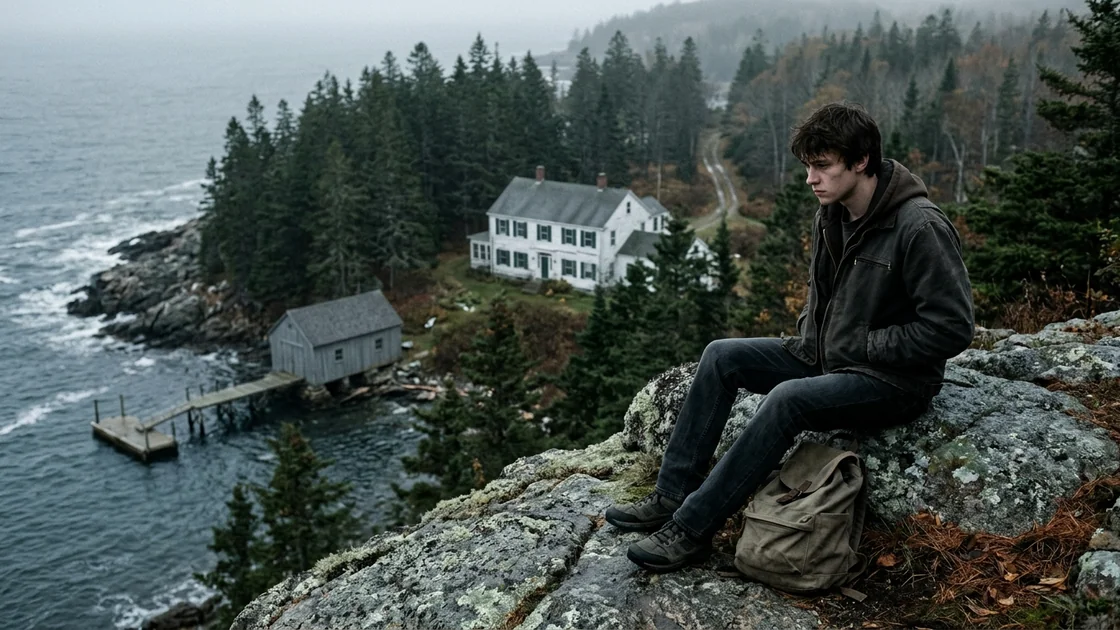
Seventeen-year-old Julian Vance carries the crushing weight of a clandestine truth he stumbled upon three months ago: a series of hidden legal documents and correspondence proving that his younger brother, Leo, who drowned in a boating accident two years prior, died not because of a sudden storm as the family claims, but because Julian’s father was secretly meeting a blackmailer on the docks while Julian’s mother, unaware of the extortion, had left the nine-year-old unattended in the skiff to confront her husband, leading to a silent, mutual cover-up that is now slowly rotting their marriage from the inside out as Julian struggles with the agony of keeping their secret to prevent the complete legal and emotional destruction of what remains of his home.
The floorboards of the Vance house did not creak; they groaned with the low, exhausted resonance of timber that had absorbed too much damp air and too many unspoken words. Julian stood at the top of the landing, his hand resting lightly on the smooth mahogany banister. Below him, in the foyer, the grandfather clock ticked with a steady, metallic rhythm that seemed to measure not time, but the shrinking distance between his parents' civility and their total collapse.
It was a Tuesday in late October. Outside, the Maine coast was surrendering to the gray, salt-heavy chill of autumn. Inside, the radiator in the hallway hissed, a sharp, sibilant sound that filled the vacuum left by his mother and father.
Down in the kitchen, Claire Vance was washing dishes that were already clean. Julian could hear the rhythmic clink of porcelain against the cast-iron sink, followed by the aggressive rush of water. Twenty feet away, in the study, Arthur Vance sat behind a closed pocket door. He wasn't working. Julian knew this because the floorboards beneath the study desk only shifted when Arthur leaned forward to write, and for the past forty minutes, there had been no sound from that room except the occasional, dry cough of a man trying to clear a throat constricted by perpetual dread.
Julian adjusted the strap of his canvas backpack. He was seventeen, tall and slightly stooped, as if he had grown too fast and the ceiling of his own life had forced him to duck. He had his mother’s dark, restless eyes and his father’s squared jaw, though on Julian, the jaw lacked the granite certainty Arthur had once possessed—back before the summer two years ago when the bay had swallowed Leo.
"Julian?" Claire’s voice floated up the stairwell. It had the brittle, high-strung quality of a violin string tuned one turn too tight. "Your eggs are getting cold. You’ll miss the bus if you don't come down."
"Coming, Mom," Julian said. He didn't shout. Nobody shouted in this house anymore. Raised voices carried the risk of echoes, and echoes had a way of knocking loose the things they had spent twenty-six months burying.
He walked down the stairs, his sneakers silent on the runner. When he entered the kitchen, the smell of burnt butter and bleach hit him. Claire stood by the stove, wearing a pale blue cardigan wrapped tightly around her thin frame, despite the heat of the burners. Her hair, once a rich chestnut, was streaked with coarse silver that she no longer bothered to dye. She offered him a smile that didn't reach her eyes—a twitch of muscle memory meant to reassure him that they were still a family, that this was still a normal morning.
"I made toast, too," she said, setting a plate on the wooden table. Her hands trembled slightly, causing the knife on the edge of the plate to rattle. "Rye. The kind you like."
"Thanks," Julian said, sitting down. The chair opposite him was empty. The third chair, the one that used to sit at the end facing the bay window, had been moved to the attic a week after the funeral, though the four small indentations its legs had left in the pine floorboards remained, filled with dark dust.
"Is Dad coming out?" Julian asked, staring at the pale yellow yolks on his plate.
Claire’s back stiffened. She turned back to the sink, picking up a sponge that was already dripping with suds. "He has an early call with the port authority. The lumber shipments from Nova Scotia are delayed again."
It was a lie. Arthur hadn't taken a call from the port authority since August, when he had quietly sold his majority share in the shipping brokerage to his partner, Tom Miller. Julian knew this not because his father had told him, but because Julian had seen the wire transfer receipts and the dissolution papers tucked inside the false bottom of the cedar chest in the boat shed.
That was where everything lived now. In the boat shed, smelling of dry rot, oil, and the brackish water of the cove.
"Right," Julian said softly. He picked up his fork and pushed the eggs around. Every time he looked at his mother’s narrow shoulders, he saw the handwriting on the last page of the statement she had never submitted to the sheriff’s department—the draft written on her stationery, torn in half, yet preserved by his father in a manila envelope alongside three cashier's checks made out to a man named Marcus Vance, Arthur’s estranged half-brother from Boston.
The secret was not a clean, singular thing. It was a tangled knot of fishing line, hooks buried deep in both his parents' flesh, so that whenever one of them pulled away, the other bled.
Three months ago, in the suffocating heat of late July, Julian had gone into the boat shed looking for a wrench to fix his bicycle chain. Arthur had been in Portland for the day, and Claire was asleep upstairs, felled by one of the migraines that visited her twice a week like a dark tide.
The shed was normally locked with a heavy brass padlock, the key kept on Arthur’s ring. Since Leo’s death, the shed had been treated like a mausoleum; the fourteen-foot aluminum skiff Leo had taken out—or rather, drifted out in—had been sold for scrap, and the oars still hung on the rafters like bleached bones. But that afternoon, the padlock had been left hanging open on the hasp. Arthur had been in there the night before, drinking scotch in the dark—Julian had seen the orange glow of his father’s occasional, secret cigarettes through the cracked windowpane at two in the morning.
Inside, the air was thick with the scent of old pine tar. Julian hadn't meant to snoop. He had simply kicked the cedar tool chest by the workbench to shift it toward the light, and the false bottom, warped by two winters of coastal humidity, had sprung loose with a dull thwack.
What Julian pulled from the cavity beneath the trays of rusted bolts and socket wrenches had rewritten his entire history in twenty minutes.
The official story—the one printed in the Camden Herald, the one whispered by the neighbors who brought casseroles covered in foil, the one Julian himself had repeated to his grief counselor until his throat ached—was a tragedy of nature and a boy's restlessness. On June 14th, two years ago, a freak squall had blown in off Penobscot Bay while Arthur was at his office in town and Claire was tending the vegetable garden on the far side of the ridge, where the wind was blocked by the spruce trees. Nine-year-old Leo, obsessed with pirates and convinced he was old enough to handle the skiff alone, had untied the boat from the private jetty. By the time Claire came down from the ridge and saw the empty mooring, the rain had reduced visibility to ten yards. The Coast Guard found the overturned skiff at dusk. They found Leo the next morning, wedged between the granite boulders at Dead Man's Point.
It was a cruel, blameless accident. The town had mourned with them. No charges of negligence were ever whispered; everyone knew how fast the Maine fog and wind could turn, and everyone knew how stubborn Leo was.
Except the ledger in the cedar chest told the truth.
Arthur hadn't been at his office in town. According to the dated notes and a series of furious, frantic letters between Arthur and his half-brother Marcus, Arthur had been at the south end of the property—where the old logging road met the rocky cove—meeting Marcus in person. Years before Julian was born, when the shipping brokerage was failing, Arthur had forged a signature on a maritime insurance claim for a lost barge. Marcus, who had worked for the underwriting firm in Boston at the time, had buried the discrepancy. For fifteen years, Marcus had used that single piece of paper to bleed Arthur dry whenever his gambling debts in Charlestown got out of hand.
On June 14th, Marcus had shown up at the cove, demanding forty thousand dollars cash by Friday, threatening to go directly to the federal prosecutor and to Claire.
And Claire hadn't been in the garden on the ridge.
In the envelope was an unfinished letter from Claire to Arthur, dated three weeks after the funeral, its ink blurred in places where water—or tears—had hit the paper.
I cannot look at Julian anymore without wanting to scream the truth at him, she had written. You think keeping my silence protects me from what I did, just as my silence keeps you out of prison for the fraud and for lying to the sheriff about where you were when the storm hit. You tell yourself we are even. We are not even, Arthur. I saw Marcus’s car on the logging road. I knew you were hiding something—I thought it was a woman. I took Leo down to the dock with me because I didn't want to leave him at the house while I followed you through the woods. I told him to sit in the boat. I told him not to touch the rope while I walked up the path to catch you. I only meant to be gone five minutes. The knot was already loose because you hadn't secured it that morning after checking the bilge. When I heard you shouting at Marcus in the trees, I stayed hidden in the brush, listening to you beg your brother not to ruin us. I stood there for twenty minutes listening to my husband confess to being a thief, and while I was listening, the wind came up. When I ran back to the dock, the skiff was already past the breakwater. I didn't call 911 for forty minutes because you grabbed my arm and told me that if the police came down the logging road, they would find Marcus, and everything would come out, and you swore to me the tide would push Leo back into the marsh Cove. You swore he could swim that far.
Julian had sat on the grease-stained floor of the shed until the sun went down, reading those pages until the words burned themselves into the backs of his eyelids.
His father hadn't secured the boat because he was distracted by his blackmailer. His mother had put Leo in the boat and walked away to spy on her husband. And when the boat drifted out, they had wasted forty crucial minutes arguing in the rain, panicked by the sudden collision of Arthur's crime and Claire's negligence, before Arthur finally drove Marcus off the property and they called the Coast Guard with a fabricated timeline that placed Arthur in town and Claire in the garden.
They had traded alibis over their dead son’s body. Arthur protected Claire from the crushing guilt—and potential criminal neglect charges—of leaving a nine-year-old untied in an approaching gale while she eavesdropped; Claire protected Arthur from federal prison and the revelation that their entire comfortable life was built on a felony and a forty-minute delay that cost Leo his life.
Julian had put the papers back. He had clicked the false bottom into place, walked out of the shed, and locked the brass padlock.
He hadn't said a word. Because if he spoke, the fragile, grotesque pact holding the roof over their heads would shatter. His father would go to prison. His mother, already teetering on the edge of a total psychological break, would likely end her own life if the town—and Julian—knew that she had stood in the bushes fifty yards away while Leo drifted into the gray Atlantic.
So Julian became the third pillar of the lie. The silent one.
The study door slid open with a heavy rumble.
Arthur Vance stepped into the hallway, appearing in the kitchen doorway a moment later. He was fifty-two, a man who had once filled doorframes with a broad, bluff vitality. Now, his suit jackets hung loosely from his shoulders, the wool fabric folding in hollow creases over his collarbone. His face was gray, his eyes permanently bloodshot, carrying the heavy, dark pouches of someone who slept in twenty-minute intervals.
"Morning, Jules," Arthur said. His voice was a low rasp. He didn't look at Claire. It was a choreographed dance; he looked at Julian, then at the coffeepot, then at the window. Never at the woman standing three feet away from him.
"Morning, Dad," Julian said. His throat felt tight, the way it always did when the three of them occupied the same small space. The air in the kitchen seemed to thin out, replaced by the smell of the boat shed. "Mom said the Nova Scotia shipments are held up."
Arthur paused, his hand halfway to the handle of the glass carafe. For a fraction of a second, his eyes flicked toward Claire’s back. A silent communication passed between them—sharp, venomous, and exhausted. Claire had used one of his old business excuses to explain why he was hiding in his study, and Arthur was forced to validate it.
"Yeah," Arthur said, pouring the dark liquid into a mug. "Weather up near Halifax. Nothing moving through the strait."
"It's been clear on the radar all week," Julian said.
The words slipped out before he could stop them. He hadn't meant to push. He was just so tired. He hadn't slept past four in the morning since August. Every time he closed his eyes, he heard the rhythmic slapping of water against aluminum.
The kitchen went dead silent. Even the radiator seemed to hold its breath.
Claire stopped wiping the counter. Her knuckles turned white around the yellow sponge. Arthur set the coffeepot down with deliberate, slow precision. He looked at Julian then, really looked at him, and Julian saw the flicker of terror in his father’s eyes. It was the terror of a man living in a house made of dry kindling, watching his son strike a match just to see the light.
"Well," Arthur said, his voice dropping an octave, "the harbormaster up there has a strike on his hands, too. Logistics. You know how it is."
"Yeah," Julian said, dropping his gaze back to his cold eggs. "I know how it is. I have to go. I’ll miss the bus."
He stood up, scraping his chair back. He didn't touch the toast. As he walked past his father, he caught the faint scent of peppermint and old whiskey—the combination Arthur used every morning to mask the night before.
"Have a good day, sweetheart," Claire said to the wall above the sink.
"I'll be home around four," Julian said. "I have track practice."
Another lie. He had quit the track team three weeks ago because he couldn't stand the sound of the starter pistol, and he couldn't bear the mindless chatter of the locker room. Instead, he spent his afternoons at the town library or walking the rocky perimeter of the harbor, watching the lobster boats come in, wondering how two people could love a child so much and still let him drift away to save themselves.
Camden High School was a sprawling brick building where everyone knew everyone else’s pedigree back three generations. For Julian, walking down the main hallway was an exercise in sensory management. The slamming of lockers, the high-pitched laughter of sophomores, the smell of floor wax and damp wool coats—it all felt like it was happening behind a pane of thick, frosted glass.
People still treated him with that peculiar, fragile deference reserved for the bereaved. Even after two years, teachers gave him extensions he didn't ask for, and girls in his classes smiled at him with a sad, gentle pity that made his skin crawl. Poor Julian Vance. An only child now. And his parents took it so hard, you never see them in town anymore.
At his locker, Julian pulled out his calculus textbook. Beside him, leaning against the adjacent metal door, was Maya Lin. She was the only person in the school who didn't look at him like he was a piece of cracked porcelain. Her father ran the boatyard on the north side of the harbor, and she had known Julian and Leo since they were in diapers.
"You look like hell, Vance," Maya said, adjusting the strap of her camera bag. She was the photo editor for the school paper, perpetually observant, which made her dangerous.
"Thanks," Julian said, spinning his combination lock. "Didn't sleep."
"Again?" She frowned, studying the dark circles under his eyes. "You didn't show up at the darkroom yesterday. Mr. Henderson asked if you were still doing the layout for the winter sports issue."
"I forgot," Julian said. "I had to help my dad with some stuff at the house."
Maya shifted her weight, crossing her arms. "My dad saw your dad yesterday afternoon."
Julian’s hand froze on the locker handle. A cold prickle started at the base of his neck. "Yeah? Down at the brokerage?"
"No," Maya said slowly, lowering her voice as a group of freshmen hurried past. "Out on Route 1, near the Rockland line. At that diner by the cement plant. My dad went in to pick up a takeout order for the crew, and he saw Arthur sitting in a back booth with some guy in a leather jacket. Said they were arguing. Well, the guy was talking, and your dad was just staring at the table looking like he was about to throw up."
Julian felt the floor tilt slightly beneath his sneakers. Marcus.
The ledger in the boat shed had showed payments stopping in May, right around the time Arthur’s liquid savings had dried up. That was why Arthur had sold his share of the brokerage to Tom Miller in August. He must have used the buyout money to pay Marcus off—or so Julian had assumed. If Marcus was back in Knox County, sitting in a diner five miles from their house, it meant the buyout hadn't been enough. Or it meant Marcus had realized that the secret he was holding wasn't just an old insurance fraud anymore.
What if Marcus had figured out the rest of it?
Marcus had been there on the logging road on June 14th. He knew Arthur hadn't been in town. He knew the timeline given to the police was a fabrication. At the time, Marcus probably thought Arthur had only lied to the police to keep Marcus’s presence—and the extortion—out of the official inquiry into the drowning. Marcus was a parasite, not a monster; he might not have known that Claire was in the bushes, or that they had waited forty minutes while the skiff drifted out to sea.
Wait. Did Marcus know about the delay?
In Claire's letter, she had written: When I ran back to the dock, the skiff was already past the breakwater. I didn't call 911 for forty minutes because you grabbed my arm and told me that if the police came down the logging road, they would find Marcus...
Marcus had still been on the property when Claire ran back to the dock screaming. Marcus knew when the boy went missing, and he had read the newspapers the next day stating the 911 call wasn't placed until 4:15 PM.
Marcus wasn't blackmailing Arthur over a fifteen-year-old forged insurance document anymore. He was blackmailing them over Leo.
"Jules?" Maya’s voice cut through the roaring in his ears. She touched his elbow. "Hey. You just went completely white."
"I'm fine," Julian managed to say. He pulled his arm away—not roughly, just enough to break the contact. If someone touched him with actual kindness right now, he was afraid his ribs would give way and the whole wretched story would pour out onto the linoleum floor. "That was probably just one of the independent truckers from the lumber yard. Dad’s been dealing with some contract disputes."
Maya didn't look convinced. Her dark eyes narrowed with genuine concern. "My dad said your dad hasn't been into the brokerage office in two months, Julian. Tom Miller told him Arthur retired early. Because of his heart, or stress, or whatever."
The town was small. Secrets had a half-life here; eventually, the discrepancy between what happened inside the Vance house and what the town observed would grow too wide to bridge.
"He's consulting from home," Julian lied, his voice flat and mechanical. "Look, I have to get to first period. Tell Henderson I'll do the layout tomorrow."
He slammed his locker shut and walked away before she could answer. He didn't go to calculus. He walked straight through the double doors at the end of the hall, down the concrete steps into the crisp October air, and kept walking until the school was out of sight behind the yellowing birch trees.
Julian didn't go to the harbor today. Instead, he took the old bridal path that wound through the woods behind the state park, coming out near the ridge that overlooked his own family's property from the north.
From up here, sitting on a shelf of gray granite covered in dry lichen, he could see the entire layout of his life. There was the white clapboard colonial house, its shutters painted a dark, respectable hunter green. There was the gravel driveway curving down to the road. To the right, nestled against the spruce trees where the land sloped sharply down to the water, was the gray timber boat shed and the private jetty extending into the dark, choppy water of the cove.
And further south, barely visible through the thinning autumn canopy, was the rutted dirt track of the old logging road.
Julian pulled his knees up to his chest, burying his chin in the collar of his jacket. The wind off the bay was sharp, carrying the brine and the rot of low tide.
He remembered that day with terrifying clarity. He had been fifteen. He hadn't been home; he had been at a summer basketball camp in Augusta, sixty miles away. He remembered the camp director walking onto the court at five-thirty in the afternoon, his face ashen, calling Julian over to the sidelines. He remembered the drive back in the state trooper’s cruiser, the radio crackling with coordinates and wind speeds, the trooper refusing to meet his eyes in the rearview mirror.
When Julian had arrived at the house that night, the driveway was choked with emergency vehicles, their red and blue lights slicing through the fog and the rain. He remembered walking into the kitchen. His mother was sitting on the floor by the pantry, wrapped in a wool blanket, staring at the baseboard. She wasn't crying. She looked as though someone had reached inside her chest and unplugged the main wire. His father was standing by the window, his clothes soaked through, a deep scratch across his cheek—from the spruce branches on the logging road, Julian now realized, though at the time Arthur had said he’d fallen on the rocks trying to swim out after the skiff.
When Julian had dropped to his knees beside his mother, sobbing, asking how Leo had gotten out there, Claire had looked at him. The look in her eyes had haunted him for two years before he ever opened the cedar chest. He had thought it was the madness of grief. Now he knew it was terror. And beneath the terror, a desperate, suffocating shame.
I told him to sit in the boat, the letter said.
Leo had been wearing his yellow rain slicker and his red rubber boots—the ones that were a size too big because they had belonged to Julian. Leo had been terrified of deep water unless Julian or Arthur was with him. He never would have untied that boat to play pirate. That had been the part of the official story that always scratched at the back of Julian’s mind, the tiny splinter he had tried to ignore during months of therapy. Leo got seasick outside the breakwater. Leo was afraid of the dark kelp beds near the point.
Leo had stayed in the boat because his mother told him to stay there and be quiet while she went into the trees to catch his father in what she thought was an affair. And when the wind caught the stern and the loose painter slipped off the wet cleat, Leo probably hadn't even yelled at first, because his mother had told him not to make a sound.
Julian pressed the heels of his hands against his eyes until red and purple shapes burst in the darkness. A low, ragged sound tore out of his throat, swallowed instantly by the wind in the pines.
He hated them. God, he hated them both with a ferocity that made his teeth ache.
And yet, when he imagined walking down that hill, walking into the kitchen, and laying those papers on the table between them—when he imagined calling the sheriff—his stomach hollowed out.
Because he saw them every day. He saw his mother at three in the morning, sitting in Leo’s untouched bedroom, holding a folded t-shirt against her mouth to muffle the sounds she made so she wouldn't wake Julian. He saw his father aging ten years every six months, slowly drinking himself to death in the study, enduring Claire’s silent, glacial hatred while simultaneously shielding her from the consequence of her own mistake.
They were already in hell. They had built a prison out of their own house, and they were serving life sentences without parole. The only thing keeping either of them breathing was the belief that Julian didn't know—that Julian still had a normal life ahead of him, untainted by prison records or the town’s horror, and that Leo’s memory remained pure, a tragic boy lost to the sea rather than a casualty of their petty, sordid marriage.
If Julian told the truth, who would it save? It wouldn't pull Leo out from between the boulders at Dead Man's Point. It would only finish the job the bay had started, wiping out the entire Vance family for good.
Down below, a car turned into the gravel driveway.
Julian lowered his hands and squinted through the wind. It wasn't his mother’s Subaru or his father’s Volvo. It was an older model gray sedan with Massachusetts plates, one front fender slightly rusted.
The car stopped right behind Arthur’s Volvo. The driver’s door opened, and a man stepped out. He was shorter than Arthur, thick-set, wearing a dark leather jacket and jeans. He stood by the car for a moment, looking up at the white clapboard house, then flicked a cigarette onto the raked gravel and walked toward the back porch.
Julian didn't think. He scrambled down the granite shelf, sliding on the pine needles, grabbing onto birch saplings to slow his descent down the steep ridge. His heart was hammering against his ribs like a trapped bird.
Marcus had never come to the house before. Not in daylight. Not while Claire was home.
By the time Julian reached the bottom of the wooded slope and ducked behind the stone wall bordering the overgrown vegetable garden, the gray sedan was still idling—no, the engine was off, ticking as it cooled.
Julian stayed low, moving along the blind side of the garage until he reached the breezeway that connected the garage to the kitchen. The kitchen window above the sink was cracked open two inches, the way Claire always left it to clear the smell of bleach.
From inside came the sound of voices. Not shouting. Even in a crisis, the house enforced its terrible, hushed acoustic.
"I told you yesterday at the diner, I don't have it, Marcus," Arthur’s voice sounded scraped raw, devoid of any authority. "The buyout from Tom went to the bank to cover the second mortgage I took out for you in April, and the rest you got in August. Look at the accounts. There is nothing left."
"There's the house, Artie," a second voice said. It was rougher, carrying a flat Boston cadence, casual in a way that made Julian’s blood run cold. "Three acres on the water in Camden? Even in the off-season, you could pull a bridge loan on the equity in forty-eight hours."
"The house is in Claire’s name too," Arthur said quickly. "I can't touch the deed without her signature."
A floorboard shifted. Then came a third voice—Claire’s.
"I'm right here, Marcus."
Julian pressed his back against the cold cedar shingles of the breezeway, his breath fogging in the chill air. His mother hadn't gone upstairs to hide. She was in the kitchen with them.
There was a brief silence inside, followed by the scrape of a wooden chair.
"Claire," Marcus said, his tone shifting into a greasy, theatrical sympathy that was worse than his threats. "Jesus, you look thin. I didn't want to bother you with business. Artie and I were just talking over some old family obligations."
"Don't talk to me like that," Claire said. Her voice didn't tremble now. It was flat, dead, and terrifyingly calm. "How much are you asking for this time?"
"Claire, go upstairs," Arthur pleaded. "Please. I’m handling this."
"You've been handling it for two years, Arthur, and he’s standing on my kitchen rug," she said. "How much, Marcus?"
"Twenty-five grand," Marcus said, dropping the pleasantries. "I got into a hole with some guys in Revere. It’s not my health I’m worried about if I don't pay by Friday—it’s permanent. You help me out this one last time, I go out to Nevada. I got a cousin in Reno. You never see my face again."
"You said that in August," Arthur snapped, a sudden flare of impotent rage in his voice. "You took eighty thousand dollars in August and swore on Mother's grave you were done!"
"Things change, Artie. Bad beats happen," Marcus replied smoothly. "Besides, eighty grand is pretty cheap for a guy who should be doing five-to-ten at Fort Devens for mail fraud, don't you think? Not to mention..." Marcus paused. Julian could hear the faint click of a Zippo lighter being flipped open and shut. "...not to mention perjury. Obstructing an investigation. Reckless endangerment."
"Get out," Arthur whispered. "Get the hell out of my house."
"I'm just saying, Artie," Marcus continued, his voice dropping lower, thick with menace. "I was sitting in my car down on that logging road from two-thirty until four o'clock that day. I saw Claire come running down through the trees at three-fifteen screaming that the kid was on the water. And I sat there watching the two of you lose your minds for forty-five minutes while the rain came down, figuring out how to cover your asses before you picked up a phone. You know what the Coast Guard guy said in the paper? Said the water temp was fifty-two degrees. Said a kid that size has maybe thirty, forty minutes before hypothermia shuts his muscles down and he slips under."
A horrible, choked sound came from Arthur.
"If you had called at three-fifteen when she saw the boat drift past the point," Marcus said softly, "the patrol boat at Curtis Island was ten minutes away. He’d be in seventh grade right now. Instead, you let him drown so I wouldn't get picked up by the sheriff on the road and spill your fraud to the Feds."
"That isn't true!" Claire’s voice cracked like a whip, high and jagged. "He thought the current would take the boat into the marsh! He told me the current always goes into the marsh at high tide!"
"Whatever helps you sleep, sister," Marcus said. "Point is, if I get picked up by my knees in Revere, or if I have to go to the cops for protective custody, I need something to trade. And a double indictment for manslaughter or negligent homicide on a wealthy couple in Camden? The state attorney would love that. And what about your other boy? Julian, right? Seventeen now? How’s he gonna feel when he reads the transcript of what his mom and dad were doing while his little brother was treading water?"
Inside the breezeway, Julian realized he was holding the rusted garden shears that hung on the peg beside the door. He didn't remember picking them up. His knuckles were white, the cold iron biting into his palm.
Thirty, forty minutes before hypothermia shuts his muscles down.
The patrol boat at Curtis Island was ten minutes away.
Julian had known about the forty-minute delay from the letter. He had not known the Coast Guard patrol boat was stationed ten minutes away at Curtis Island that afternoon. He had assumed the storm was too bad, that even forty minutes wouldn't have made a difference once the skiff passed the breakwater. That was the single thread of mercy he had allowed himself to believe over the last three months: that his parents' cowardice was monstrous in intent, but that the ocean had already claimed Leo the moment the rope came undone.
It wasn't true. The patrol boat was ten minutes away. Leo had been alive in the water the entire time Arthur and Claire were screaming at each other in the rain on the logging road.
"I will sign the papers for the house," Claire said. Her voice sounded very far away, as if she were speaking from the bottom of a well. "Tomorrow morning. We will go to the bank in Camden and take out a home equity loan. You’ll have the money on Thursday."
"Claire, no—" Arthur started.
"Shut up, Arthur," she said. There was no heat in it, just an absolute, terminal finality. "Just shut up. Give him what he wants so he leaves before Julian comes home from school."
"Smart woman," Marcus said. "I'll be at the motel in Rockport. Call me when the check clears."
Heavy footsteps crossed the kitchen linoleum toward the back door—the door that opened directly into the breezeway where Julian was standing.
Julian dropped the shears back onto the wooden workbench just as the brass doorknob turned. He didn't have time to run back around the garage. Instead, he stepped out of the shadowed corner of the breezeway and stood squarely in the doorway leading to the driveway, blocking the exit.
The kitchen door swung open. Marcus stepped out, pulling his collar up against the draft, and stopped dead.
For three seconds, nobody breathed.
Marcus was fifty, with thinning gray hair, a crooked nose, and Arthur’s jaw—the same jaw Julian had in the mirror. Behind Marcus, framed in the open kitchen doorway, stood Arthur and Claire.
When Claire saw Julian standing there in his damp canvas jacket, his backpack hanging from one shoulder, her hand flew to her mouth. Her eyes widened until the whites showed all around the dark irises, and she swayed backward, hitting the edge of the kitchen counter with a dull thud.
Arthur froze, the color draining from his face so rapidly he looked like a wax figure. "Jules," he breathed. "You—you have track."
Marcus looked from Julian back to Arthur, then back to Julian. A slow, ugly comprehension dawned on his weathered face. He looked at the open kitchen window two feet above Julian’s head.
"Well," Marcus muttered, shoving his hands into the pockets of his leather jacket. "Kid looks just like you, Artie. Excuse me, nephew."
Julian didn't move. He stared at the man's throat, right where the collar of his flannel shirt met his pale skin. Every muscle in Julian’s body was coiled so tight it vibrated. He smelled the stale tobacco on Marcus’s coat; he saw the tiny burst capillaries on the man's nose. This was the rot. This was the thing that had eaten their lives.
"Move out of the way, Julian," Arthur said, his voice shaking violently as he stepped forward onto the threshold, reaching for Julian’s shoulder. "Please. Go inside."
Julian shifted his gaze from Marcus to his father’s hand. He looked at it with such cold, lethal revulsion that Arthur’s hand stopped mid-air and dropped back to his side.
Slowly, Julian stepped backward onto the gravel driveway, clearing the path.
Marcus brushed past him without another word, his boots crunching loudly on the stones as he hurried toward the gray sedan. Within seconds, the engine coughed to life, gravel spat against the garage doors as he reversed, and the car disappeared down the long driveway toward the main road.
The silence that rushed back into the yard was immense. The wind shook the dry oak leaves overhead, sending a few skittering across the concrete floor of the breezeway.
Julian stood on the driveway, looking up the three wooden steps into the kitchen.
His mother was slumped against the cabinets, her hands gripping the edge of the laminate countertop behind her as if it were the rail of a sinking ship. His father stood in the doorway, one hand bracing himself against the frame, looking down at his son with the expression of a man waiting for the executioner's axe to fall.
"How much did you hear?" Arthur asked. It was barely a whisper.
Julian looked at the two inches of open glass above the sink, then back at his father.
"I didn't need to hear him," Julian said. His voice sounded strange to his own ears—calm, hollow, stripped of the adolescent hesitation he usually carried. "I went into the boat shed in July. I found the false bottom in the tool chest."
Claire made a sound—a sharp, thin keen like a rabbit caught in a snare—and slid down the front of the cabinets until she was sitting on the linoleum, her knees drawn up against her chest, her face buried in her blue cardigan.
Arthur didn't move. The wind blew his thinning hair across his forehead. For a long moment, he just looked at Julian, and something terrible and almost like relief flickered behind the agony in his eyes. The exhausting, soul-crushing theater of the last two years—the cold eggs, the fake phone calls to Nova Scotia, the locked doors—had finally collapsed under its own weight.
"July," Arthur repeated numbly. "You've known since July?"
"Ninety-four days," Julian said. He slipped his backpack off his shoulder and let it drop onto the gravel. "I counted them."
"Jules..." Arthur took a step down into the breezeway, his hands held out slightly, palms up, a pathetic gesture of supplication. "Jules, let me explain how it happened. That letter your mother wrote—she was out of her mind with grief when she wrote that, she blamed herself, she—"
"Don't," Julian said.
The single word stopped Arthur on the bottom step.
"Don't lie to me right now," Julian said, his voice rising for the first time, echoing off the garage rafters. "If you tell me one more lie, Dad, I swear to God I will walk down to the road and flag down the first state trooper I see."
"I'm not lying!" Arthur cried out, tears finally spilling over his lower eyelids, cutting wet tracks through the gray stubble on his cheeks. "It was chaos, Julian! You weren't here, you didn't see the rain! When Claire came through the trees screaming that the skiff was gone, we ran down to the jetty. We couldn't see fifty feet past the rocks! I didn't think he was in the boat! I swear to you, I thought the boat had just slipped its knot and Leo had wandered up toward the ridge looking for your mother! That's why we argued—Marcus was panicking, saying the cops would run his plates if they cordoned off the road, and I told Claire we had to check the woods and the barn first before we brought the police down on us!"
From the kitchen floor, Claire raised her head. Her face was contorted, blotched with red, her eyes wild and fixed on her husband's back.
"Stop it!" she screamed, her voice tearing through the quiet afternoon like breaking glass. "Stop lying to him, Arthur! Stop lying to yourself!"
Arthur spun around, clutching his head with both hands. "Claire, please—"
"We saw the yellow slicker!" she shrieked, scrambling to her knees on the linoleum, gripping the doorframe to pull herself up. She looked directly at Julian, her dark hair hanging in tangled strings around her face. "Julian, we saw the yellow slicker through the binoculars from the deck! It was past the breakwater, bobbing near the channel marker! He was holding onto the seat!"
"Claire, no!" Arthur roared, lunging back up the steps to grab her shoulders, trying to pull her back inside, trying to push the monstrous truth back into her mouth. "You're misremembering! It was the buoy! I told you it was the yellow lobster buoy!"
"It was my son!" She struck out at him, her fists hitting his chest with a frantic, terrifying strength, driving Arthur back against the refrigerator. "It was Leo! I saw his red boots! And I reached for the phone on the wall, and you pulled the cord out of the jack! You pulled it right out of the wall and you held me on the floor and you told me that if I called them while Marcus was still trying to get his car out of the mud on the logging road, our lives were over! You told me the tide was coming in! You told me the current would bring the boat back into the marsh in twenty minutes!"
Julian stood on the gravel, the cold October air filling his lungs like liquid nitrogen.
The letter in the cedar chest hadn't even held the whole truth. Even in her private confession, Claire had softened the edges of what had happened inside the house during those forty minutes.
You pulled the cord out of the jack.
He was holding onto the seat.
Arthur had sunk down against the refrigerator, his hands covering his face, his shoulders heaving with dry, violent sobs that sounded like a man vomiting up his own lungs. "The car was stuck in the mud," Arthur wept into his hands, speaking to the floor. "Marcus’s car was stuck up to the axles on the logging road. I had to take the tractor down to pull him out before I plugged the phone back in. I thought the wind was blowing onshore. I swear to God, Jules, I thought the wind would push the skiff onto the sandbar at the marsh. He had his life vest in the boat, I always kept the vest under the bow..."
"He didn't know how to buckle it by himself," Julian said.
Both of his parents froze.
Julian walked slowly up the three wooden steps into the breezeway, stopping at the threshold of the kitchen. He looked down at his father, huddled against the white enamel of the fridge, and then at his mother, who was leaning against the doorframe, gasping for air as if her ribs were crushed.
"The straps on that orange vest were rusted at the clasp," Julian said softly, remembering the summer afternoons he had spent taking Leo out to look for crabs in the shallows. "His fingers weren't strong enough to pinch the metal clip together. I always had to do it for him. He hated wearing it unless the boat was moving fast because it scratched his neck."
Claire closed her eyes, her head falling back against the wood.
"And you didn't stay on the floor for forty minutes because he held you there, Mom," Julian said, turning his gaze to her.
Claire’s eyes snapped open.
"Dad went down to the logging road with the tractor to pull Marcus out of the mud," Julian said, piecing the timeline together with a cold, surgical clarity that terrified him. "That takes twenty minutes. You were alone in the house while Dad was down in the woods with the tractor. There's another phone in the study. And you had your cell phone in your purse by the front door."
Claire stared at him. Her mouth worked silently, opening and closing, no sound coming out.
"You didn't call either," Julian whispered. "When Dad left the kitchen to go get the tractor... you didn't go to the study and call 911."
"I..." Claire’s hands fluttered to her throat. "Julian, I was in shock. I went down to the rocks... I tried to wade out..."
"You didn't call because if the police came while you were alone, you would have had to tell them why Leo was in the boat by himself in a storm," Julian said, the final, grotesque piece of the puzzle clicking into place. "You left him untied on the water while you went into the woods. If Dad went down for the fraud and the cover-up, and you called the police on him, Dad would have told them that you were the one who put Leo in the skiff and walked away. You waited for Dad to get Marcus off the property so the two of you could get your story straight."
The silence in the kitchen was absolute. Even Arthur had stopped crying. He slowly lowered his hands from his face, looking up at his wife with a dawning, horrified realization that matched Julian’s. For two years, Claire had tortured Arthur with the memory of him pulling the phone cord from the wall—holding it over him like a guillotine—while never admitting what she had done during the twenty minutes he was down in the mud with the tractor.
She hadn't gone to the study phone. She had waited for him to come back so he could invent the lie about the garden on the ridge.
They deserved each other. They were two halves of the exact same monster, bound together not by love or grief, but by mutually assured destruction.
"Jules," Claire whispered, reaching a trembling hand toward his sleeve. "Please. You are all I have left. If you leave—if you hate me—"
Julian stepped back, out of reach of her fingertips, as if her skin carried a contagion.
"I've been keeping this inside me since July," Julian said, his chest aching with a dull, hollow throb. "Every morning I came down here and ate your food and listened to you lie about shipments from Nova Scotia and watched you both rot, and I kept my mouth shut because I thought if I spoke, it would kill you."
He looked from his mother to his father. They looked so small in the gray light of the kitchen. Just two broken, cowardly people in an expensive house by the water.
"You're not going to the bank tomorrow," Julian said.
Arthur wiped his face with the back of his sleeve, blinking up at his son in confusion. "What? Jules, if we don't pay Marcus—"
"If you pay him tomorrow, he’ll be back in January," Julian said evenly. "And in May. Until there's nothing left of the house, and my college fund is gone, and then he’ll go to the police anyway when he gets arrested in Boston."
"Then what do we do?" Arthur asked. And in that moment, the reversal was complete: the fifty-two-year-old man was asking his seventeen-year-old son how to survive.
Julian looked through the kitchen window at the gray water of the cove, where the whitecaps were kicking up in the afternoon wind, rolling past the empty jetty toward Dead Man's Point.
For three months, the secret had been a crushing weight on Julian's spine because he had been carrying it for them, trying to preserve the illusion of his family. Now, looking at them on the kitchen floor, he realized there was no family left to preserve. It had died at 3:15 PM on June 14th two years ago.
He was only responsible for himself now. And for Leo.
"I'm going to my room to pack a bag," Julian said. "I'm going to stay at Maya Lin's house until I graduate in June. Her dad has a spare room above the boatyard."
"No!" Claire lurched forward, grabbing the edge of the doorframe as her knees buckled again. "Julian, no, you can't leave us here alone! What will we tell people?"
"Tell them whatever you want. You're both good at it," Julian said without malice, just a vast, bottomless exhaustion. "And when Marcus calls tomorrow from the motel in Rockport, you're going to tell him that the bank is closed to him. You're going to tell him that if he ever crosses the Knox County line again, you’ll turn yourselves in to the federal prosecutor and the county sheriff and take him down with you as an accessory to extortion and obstruction."
Arthur stared at him, his jaw slack. "He might call the bluff. He might go to the police."
"Then he goes to the police," Julian said. "And you go to court, and you tell the truth about what happened to Leo."
"We'll go to prison," Arthur whispered.
"Maybe," Julian said, looking down at them from the doorway. "Or maybe he's a coward just like you, and he realizes a prison sentence doesn't pay his gambling debts in Revere, so he disappears to Nevada because he knows there’s no more money here. Either way, I'm not keeping your secret anymore. If the police ever come to me and ask what I know, I'm going to tell them everything."
He turned his back on the kitchen, walked down the three wooden steps, and picked up his canvas backpack from the gravel.
Behind him, he heard his mother begin to weep—not the sharp, hysterical screaming of a moment ago, but a low, desolate wailing that echoed through the empty downstairs rooms of the house. His father didn't say a word to comfort her.
Julian walked around the side of the garage and entered the house through the front door, climbing the mahogany staircase one last time to get his clothes. The grandfather clock in the foyer ticked with its steady, metallic rhythm, measuring out the silence, no longer holding anything back.
The room above the Lin boatyard smelled of cedar shavings, fiberglass resin, and coffee. It was small, with a slanted ceiling that followed the pitch of the roof and a single dormer window that looked out over the busy commercial side of Camden Harbor.
It was November now. The first light snow of the season was dusting the tarps of the dry-docked sailboats below.
Julian sat at a scarred pine desk by the window, a mug of hot tea by his elbow and his calculus textbook open in front of him. Down in the yard, the travel lift was rumbling, its backup alarm beeping steadily in the crisp morning air as Mr. Lin and his crew hauled a forty-foot lobster boat out for winter hull maintenance.
A knock sounded on the plywood door at the top of the interior stairs, and Maya poked her head in, wearing a heavy wool beanie and a flannel shirt splattered with bottom paint.
"Dad says breakfast is ready down in the office if you want bacon," she said.
"Be down in five," Julian said, closing his textbook.
Maya lingered in the doorway, leaning her shoulder against the jamb. In the three weeks since Julian had showed up on their porch with two duffel bags and told Mr. Lin that things at home were too broken for him to stay there right now, neither Maya nor her father had pressed him for details. In a town like Camden, people understood that grief sometimes had a delayed fuse; everyone simply assumed that the ghosts in the Vance house had finally become too loud for a seventeen-year-old boy to live with, and the Lins had taken him in with a quiet, practical generosity that had slowly allowed Julian to breathe again.
"Your dad's car is parked down by the harbormaster's lot," Maya said quietly, nodding toward the window. "He’s been sitting there for about twenty minutes. Didn't get out. Just watching the yard."
Julian turned in his chair and looked out through the frost-rimmed glass. Across the harbor road, parked near the public granite wall, was the dark blue Volvo. Even from a hundred yards away, Julian could see the faint plume of white exhaust rising from the tailpipe as the heater ran.
Marcus had vanished. Just as Julian had predicted, without the leverage of a secret being kept from Julian, and faced with Arthur’s sudden, dead-eyed refusal to sign over the house, the blackmailer had cut his losses and fled back south rather than risk an investigation that would yield him nothing but a cell block.
His parents were still in the white clapboard house on the cove. They hadn't been arrested, because Julian hadn't gone to the police, though the threat that he would if they ever tried to force him back into their silence hung over them like the winter sky. Every Friday, an envelope containing two hundred dollars in cash for Julian's expenses was left in Mr. Lin's mailbox at the end of the boatyard drive, dropped off before dawn.
They were safe from the law, and safe from Marcus. They were simply left alone in that house with each other, and with the forty minutes between three-fifteen and four o'clock.
Julian watched the blue Volvo for another moment. Then the brake lights flared red against the gray slush, the car backed out of the space, and it drove slowly back toward the south end of town.
Julian stood up, stretched his shoulders—feeling the absence of the old, suffocating knot between his shoulder blades—and walked across the creaking pine floor toward the door.
"Come on," he said to Maya, managing a small, genuine smile. "Let's go get that bacon before your dad eats it all."