The Weight of Unread Pages
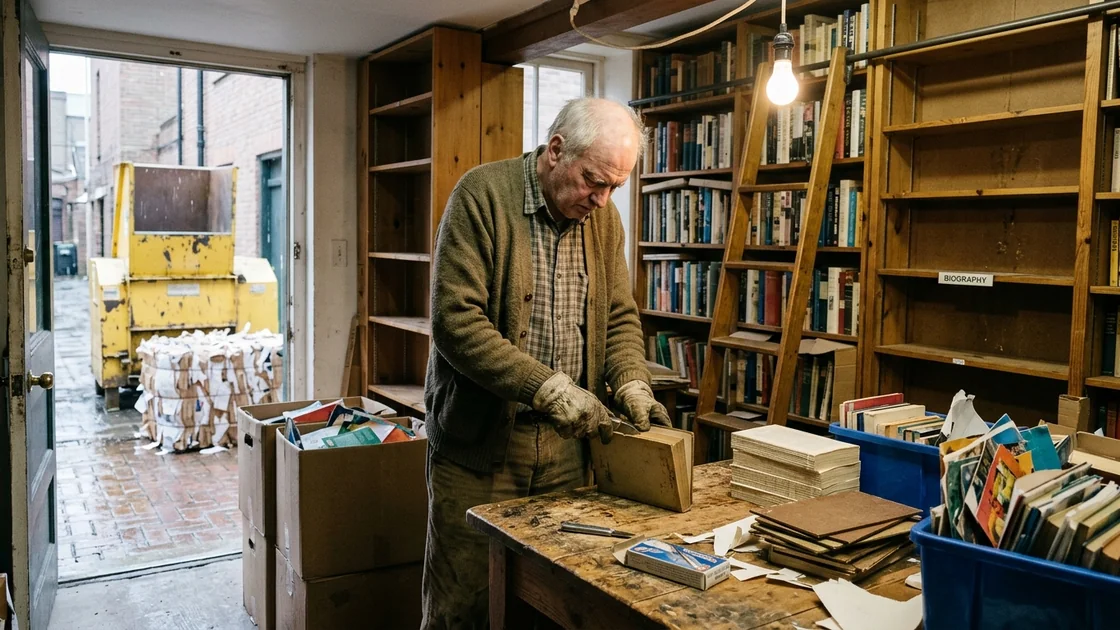
Arthur Pendelton spends the final forty-eight hours of his life’s work dismantling The Gilded Spine, an independent bookshop he built from dust and devotion over forty-two years. Facing insurmountable debts, rising commercial rents, and a world that has traded paper for glowing glass, Arthur is forced to do the unthinkable: strip the covers off thousands of unsold books and feed their hearts into a rented industrial pulper to recover pennies on the dollar. As the machines roar in the back alley and the shelves grow barren, Arthur journeys through the memories housed within the shop's walls—his late wife’s laughter among the poetry sections, the generations of eccentric regulars, and the quiet sanctuary he fought to preserve. By the time the final crate is emptied and the keys are surrendered, Arthur experiences the profound, quiet death of his lifelong dream, discovering in the silence that while paper can be reduced to grey slurry, the ghost of a sanctuary lingers forever in the man who tended it.
I. The Geometry of Grief
The machine arrived on a Tuesday, carried on the flatbed of a rusted municipal truck that smelled of fried brakes and wet iron.
Arthur Pendelton stood behind the warped Victorian glass of his front door, watching two men in grease-stained coveralls lever the beast down a hydraulic ramp. It was an industrial shredder-baler, painted a chipped, municipal yellow that offended the muted, autumnal palette of Mercer Street. To Arthur, it looked less like a piece of recycling equipment and more like an iron lung inverted—designed not to breathe life into a failing body, but to crush the breath out of ten thousand small, rectangular souls.
"Sign here, chief," the younger of the two men said, pushing open the shop door. The brass bell above the lintel—a heavy, nautical thing Arthur had found in a Portsmouth salvage yard in 1983—let out its clear, Dorian-mode chime. It was a sound designed to announce possibility: a browser escaping the rain, a scholar hunting a footnote, a child with a warm silver coin in their mitten. Today, it sounded like a gavel.
Arthur took the clipboard. His fingers, permanently stained a faint sepia around the cuticles from four decades of newsprint, leather dressing, and cheap wood-pulp paper, trembled slightly as he pressed the ballpoint pen to the carbon sheet.
"You got the three-phase hookup in the alley?" the driver asked, chewing on the plastic cap of a toothpick.
"Yes," Arthur said. His voice was like dry parchment rubbing together. "The electrician put the box in yesterday. Behind the damp-course, next to the coal chute."
"Right. We pick it up Friday morning. Eight sharp. Make sure the hopper's clear, or they charge you a cleaning fee. And no hardboards in the main sluice unless you want to snap the teeth. Text blocks only. Covers go in the blue bins."
"Text blocks only," Arthur repeated. "I understand the geometry of it."
The man gave him a brief, pitying look—the look contractors reserve for homeowners watching a century-old oak get taken down because the roots have cracked the sewer line—and went back out into the gray November drizzle.
Arthur turned back to his shop. The Gilded Spine.
It was not a grand establishment in the style of the London antiquarians, with their rolling library ladders and busts of Homer. It was a labyrinth of crooked pine shelving that Arthur had planed and stained himself in the spring of 1982, when his back was strong and Clara was still alive to hold the spirit level. The shop occupied the ground floor and basement of a narrow, three-story brick townhouse that leaned slightly to the north, as if listening to the river three blocks away. Because the floors sloped, every bookcase had been shimmed with folded scraps of cardboard—mostly old Penguin paperbacks whose spines had finally given up the ghost. The shop was literally held upright by literature.
For forty-two years, the air inside had maintained a specific microclimate. It was a dense, layered atmosphere composed of vanillin breaking down in decomposing lignin, the sharp tang of lemon oil used on the oak counter, the lavender sachets Clara used to tuck behind the Brontë sisters to ward off silverfish, and the faint, toasted aroma of Arthur’s small electric kettle in the back cubby.
Now, a new smell was creeping in from the alley: ozone and hydraulic fluid.
Arthur walked down the central aisle, his corduroy trousers whispering against the overflow stacks that had, over the last five years, colonized the floorboards. There were fourteen thousand, six hundred and twelve volumes in the shop. He knew the number because the receiver at the bank had demanded an itemized inventory before declaring the stock "illiquid collateral of negligible auction value."
Negligible.
The word had sat in Arthur’s stomach like a lead type-slug for three weeks. When the landlord—a consortium in Zurich that communicated exclusively through a local law firm whose partners looked twelve years old—had tripled the lease upon its forty-year renewal, Arthur had gone to the bank expecting a bridge loan. Instead, he had received a spreadsheet. The spreadsheet explained, in neat Helvetica font, that the square footage of The Gilded Spine was worth forty-eight dollars a foot as a boutique selling artisanal dog biscuits or cold-pressed kale, and approximately negative twelve dollars a foot as a repository for mid-century histories of the Peloponnesian War and remaindered literary fiction.
He had tried to sell the stock in bulk. The other independent booksellers in the city—all three of the survivors—had come by after hours, hats in their hands, like mourners viewing a body. They had bought what they could. Miller from The Owl and Pussycat had taken the first editions and the folio art books, paying Arthur in crisp fifties that felt like Judas silver, though Arthur knew Miller was dipping into his own mortgage money just to help. Sarah from the university quarter had taken four hundred volumes of philosophy and critical theory.
They had even held a "Everything Must Go" sale for two weeks. The neighborhood had turned out, full of performative sorrow. People who hadn't bought a hardcover since the turn of the millennium came in, took selfies in the narrow, photogenic aisles for their social feeds, murmured about what a tragedy it was that "places like this" were disappearing, and left with a single two-dollar paperback—or nothing at all, having discreetly photographed a book cover to order it for sixty cents less from a warehouse the size of Rhode Island.
When the dust settled on Sunday night, eleven thousand books remained.
The charities didn't want them; their basements were already choked with donated encyclopedias and outdated thrillers. The auction houses wouldn't touch mixed trade stock. Storage units cost four hundred dollars a month—money Arthur would need for his own tiny studio apartment out by the ring road.
Which left two options: pay three thousand dollars for a waste management company to haul the lot to the municipal landfill, or rent the yellow machine for four hundred, strip the books to their raw paper cores, and sell the resulting bales to the mill in Mercer Valley for forty dollars a ton. The publisher credit for stripped mass-market paperbacks was long gone—most of these houses had folded or been swallowed by conglomerates decades ago—so it was pure salvage weight now. White grade-two paper pulp.
He was going to have to murder his shop to pay for its funeral.
Arthur stopped in front of Section C: Biography & Memoirs. His hand drifted out, touching the faded red buckram of a two-volume life of Charles Lamb. He had bought it in an estate sale in 1994. For thirty years, he had dusted its top edge every Monday morning with a feather duster made of real ostrich plumes. He had moved it during the great roof leak of '03. He had recommended it to at least a dozen graduate students who had nodded politely and bought a slim volume of Roland Barthes instead.
"I'm sorry," Arthur whispered to the red buckram.
The shop did not answer. It only settled, a timber creaking somewhere above the biography section, like an old dog shifting its weight by a dying fire.
II. The Anatomy of a Book
To destroy a book properly, one must first understand how it was born.
Arthur sat on a low wooden stool in the back room—the "sorting room," though for thirty years it had mostly been the place where he drank Darjeeling tea and repaired torn dust jackets with archival Mylar and bone folders. On the workbench before him lay a fresh box of heavy-duty Stanley utility blades, a pair of thick leather gardening gloves he hadn't used since he and Clara gave up the allotment in 2011, and the first crate of books from the basement storage: General Fiction, M–P.
He picked up the top volume. It was a hardcover novel from 1998, written by a young man who had been hailed by the Observer as the voice of his generation, and who had subsequently vanished into the scriptwriting rooms of daytime television. Arthur remembered ordering six copies. He had sold two. Four had lived in the dark beneath the stairs for twenty-six years, waiting for a reader who never walked through the door.
Arthur slipped on the gloves. The leather made his hands feel clumsy, divorced from the tactile sensitivity that was the hallmark of his trade. A bookseller’s fingertips are his eyes; he can tell acid-free paper from cheap groundwood in the dark; he can feel the slight ridge of a facsimile title page; he can detect the subtle clamminess of foxing before the brown spots even bloom. Wearing leather to handle books felt obscene, like a surgeon operating in oven mitts.
He laid the novel flat on the scarred pine table.
"First, the jacket," he murmured, instructing himself as if training a phantom apprentice.
He slipped the glossy dust wrapper off the boards. The author’s young, hopeful face stared up at him from the back flap, leaning against a brick wall in nineties monochrome, a cigarette dangling from his fingers. Arthur tossed the jacket into the blue bin for mixed glossy recycling. Without its skin, the book looked naked, vulnerable in its cheap, quarter-bound cardboard and textured paper siding.
Next, he opened the front board. The endpapers were a pale, Robin’s-egg blue. With his thumb, he pressed the joint down flat, exposing the mull—the stiff, cheesecloth-like mesh that bound the sewn signatures of the text block to the heavy outer boards.
He picked up the Stanley knife, thumbed the brass slider, and clicked the blade out three notches.
When he drew the steel down the inner hinge, the sound it made was not the clean zip of cutting wrapping paper. It was a wet, fibrous tearing—a crunchy, agonizing scritch as the linen threads and dried PVA glue resisted the blade. It sounded remarkably like gristle giving way under a butcher’s knife.
The front board came free. He flipped the book over, pressed his palm into the exposed paper spine, and sliced the back hinge. Then, with a twist of his wrists that he knew would cripple his arthritic thumbs by midnight, he wrenched the spine strip away from the text block.
The hard shell clattered into the trash bin. What remained in his left hand was the heart of the book: three hundred and twenty pages of cream-colored wove paper, naked, cold, and shivering at the edges.
Arthur walked to the back door, which stood propped open with a brick of unread poetry, and stepped out into the alley. The drizzle had stopped, leaving the cobblestones slick and black, reflecting the bruised purple of the four-o'clock sky. He flipped the heavy plastic switch on the wall.
The yellow machine coughed, shuddered, and then settled into a low, guttural roar that vibrated through the soles of Arthur’s shoes. Inside the steel throat, two counter-rotating shafts studded with hexagonal tool-steel hooks began to turn, slick with grease, moving at a slow, inexorable thirty revolutions per minute. It didn't use speed; it used torque.
Arthur held the naked text block over the hopper. For a second, the breeze riffled the pages, flashing words at him—she walked toward the harbor, knowing that the boats...—and then he let go.
The hooks caught the corner of the first signature. There was a dry thwack, a brief, violent flutter of white wings as the pages fanned out in panic, and then the machine bit down. The book folded in on itself, groaning as the glue spine buckled, and was drawn down into the iron teeth. Three seconds later, a snowdrift of confetti—fragments of dialogue, severed adjectives, half-punctuation marks—spilled into the wire-mesh baling cage at the rear.
Arthur stood looking into the empty hopper for a long time.
One down. Ten thousand, nine hundred and ninety-nine to go.
III. The Ghosts of the Stacks
By nine o'clock that evening, Arthur had developed a rhythm, though it was the rhythm of a galley slave.
Slice. Wrench. Toss. Scritch. Crack.
He had moved the workbench closer to the back door to save steps, rigging a bare sixty-watt bulb on an extension cord so he could see the hinges clearly. The sorting room was filling up with the detritus of dismemberment. Blue bins overflowed with vibrant, laminated covers—a surreal collage of severed titles, disembodied accolades ("A Triumph!", "Mesmerizing!"), and barcode stickers bearing Arthur’s own handwriting in pencil: 7.95, 12.00, Reduced 4.50.
His lower back was a solid bar of hot iron. To distract himself from the pain, and from the steady, masticating growl of the machine outside, he allowed his mind to drift back through the strata of the shop, reading the geology of his own life in the crates he was emptying.
He was currently working through the remaindered history section—books he had bought heavily in the late nineties when a local distributor went bust. As he sliced the olive-green boards off a history of the Austro-Hungarian Navy, the smell of the glue released a sudden, sharp memory of Mr. Halloway.
Mr. Halloway had come into The Gilded Spine every Thursday afternoon from 1986 until the winter of 2008. He was a retired customs clerk who wore a tweed overcoat in all seasons, the pockets weighed down with boiled sweets and magnifying glasses of varying focal lengths. Halloway didn't read fiction; he considered it "organized lying." Instead, he was constructing a massive, unified timeline of nineteenth-century European railway timetables, convinced that the outbreak of the First World War could be blamed entirely on a scheduling discrepancy between the Prussian State Railways and the Paris-Lyon-Méditerranée line in July of 1894.
"Look here, Pendelton," Halloway would wheeze, slamming a dusty quarto volume onto the oak counter, sending up a mushroom cloud of nineteenth-century soot. "The 4:15 from Cologne! Three minutes late at the Belgian border for eleven years running! Do you think the General Staff didn't notice? Do you think Moltke didn't lose sleep over those three minutes?"
Arthur had never checked if Halloway’s theory held water. That wasn't the point of a bookshop. The point was that for two hours every Thursday, Mr. Halloway was not a lonely widower living in a damp basement flat off Mercer Street, eating tinned sardines over the sink. In The Gilded Spine, he was a scholar. He was a historian on the verge of a breakthrough, consulting with his colleague, Mr. Pendelton, among the towering walls of human knowledge.
When Halloway died, his niece had brought a cardboard box of his notebooks to the shop, asking if Arthur wanted them before she threw them in the skip. Arthur had kept them under the counter for ten years, tucked behind the till rolls.
Wait. Behind the till rolls.
Arthur stopped, the Stanley knife poised mid-air over a biography of Disraeli. He laid the knife down, walked stiffly out of the sorting room, and went to the front counter.
He knelt on the worn linoleum, his knees popping like pistol shots, and reached into the dark cubby beneath the antique brass cash register—a National model he had stopped using for actual accounting in the nineties, keeping it only because customers liked the heavy ka-ching of the drawer.
His fingers brushed past petrified rubber bands, a bottle of dried-up India ink, and a mouse trap that hadn't been baited since the Blair administration. And then, cardboard.
He pulled the box out. Inside were six black-and-red marbled composition notebooks, filled from margin to margin with Halloway’s spidery, fountain-pen copperplate. Diagrams of locomotives. Columns of figures. Newspaper clippings pasted in with flour-and-water glue.
Arthur sat on the floor, his back against the counter, and leafed through the third volume. Not a single person on earth cared about these notebooks. They had no ISBN. They had no barcode. To the men from Zurich, they were less than worthless; they were fire hazards.
Yet, as Arthur traced the ink with his gloved thumb, he felt a sudden, fierce protective surge. This was twenty years of a human mind trying to make sense of the chaos of the world. If he put these into the yellow machine, Halloway wouldn't just be dead; he would be erased.
Arthur stood up, carried the box of notebooks to the front door, and placed it carefully inside his own canvas rucksack, right next to his thermos and his spare cardigan.
"You're coming with," he told the empty aisle.
IV. The Ledger of Clara
At midnight, he turned off the machine out of respect for the neighbors—though the neighbors nowadays were mostly short-term corporate rentals and a pilates studio on the second floor next door—and spent the next four hours solely on the stripping.
Without the roar of the motor, the shop was terrifyingly quiet. Only the scritch-tear of the blade and the heavy thud of text blocks dropping into the staging crates broke the silence.
He moved up from the basement stock to the main floor, starting at the back wall: Poetry, Drama, and Essays.
This was Clara’s territory.
Arthur hadn't changed the layout of the poetry section since October 14, 2014, the day she came home from the oncology ward at St. Jude’s and said she didn't think she’d be able to manage the stairs to the shop anymore.
Clara had been a primary school teacher before they married, and she had brought a teacher’s fierce, unsentimental order to the chaos of Arthur’s buying habits. Left to himself, Arthur would have filled the entire shop with three-volume Victorian travelogues about the source of the Nile and obscure treatises on fly-fishing. Clara was the one who insisted on stocking contemporary poetry, feminist presses, and a small, sun-drenched corner by the radiator for children’s picture books.
"A bookshop isn't a museum, Artie," she used to say, perched on the top rung of the library ladder, her dark hair pinned up with a pair of bone knitting needles while she alphabetized the Seamus Heaney titles. "If you only stock dead men, you'll only get customers who are halfway there themselves. We need things with sap still in them."
Arthur stood before the eight-foot bay of pine shelves that held the poets. Because most poetry volumes were slim paperbacks—chapbooks from tiny presses in Hull or Vermont, held together with two staples or a whisper of glue—they looked pathetic when stacked together, like a flock of sparrows waiting for a hawk.
He pulled down a handful of the F–K shelf.
As he tipped them into his arm, a small green slip of paper fluttered out from between the pages of a collection by Mary Oliver and landed on the toe of his boot.
Arthur bent down and picked it up. He had to take off his leather glove to hold it.
It was an old stock-control card. Before they had bought the clunky beige computer that currently sat gathering dust by the window, Clara had maintained an index-card system for every book in the shop. Each card lived inside the front cover until the book was sold, at which point it went into a wooden drawer to be tallied at the end of the week.
This card was written in Clara’s distinctive, slanted green ink:
Oliver, Mary. New and Selected Poems (Vol. 1). Beacon Press. $14.00. Rec'd: 12/04/06. Loc: P-3. Note: Keep at least two in stock for spring. Good for grief.
Good for grief.
Arthur stared at the three words. His vision blurred, the green ink swimming into a watery smudge.
She had written that note eighteen years ago, long before the shadow appeared on her lung X-ray, long before the hospital beds and the liquid morphine and the terrible, hollow mornings when Arthur woke up reaching for the warm hollow of her shoulder and found only cold linen. She had left a diagnostic note for a customer she hadn't met yet, never knowing that the customer who would finally find it would be her own husband, standing in the ruins of their life’s work with a box cutter in his pocket.
He couldn't strip the poetry. He tried. He laid a volume of Philip Larkin on the bench, clicked the blade out, and found that his hand simply would not descend. To cut these spines felt like cutting the tendons of Clara’s wrists.
Instead, he did something entirely irrational. He pulled two empty banana boxes from the corner, lined them with brown kraft paper, and began packing the poetry section intact. Covers on. Spines unbroken. He didn't know where he would put them. His new flat was three hundred and fifty square feet—a bedroom/living room hybrid with a kitchenette that smelled of the previous tenant’s cabbage. If he brought the poetry home, he wouldn't have room for a kitchen table.
"I don't need a table," he said aloud to the dark shop. "I can eat off Yeats. He's sturdy enough."
By three in the morning, four boxes of intact poetry sat beside Mr. Halloway’s railway notebooks by the front door. It was a tiny lifeboat launched from the deck of a sinking liner, carrying fewer than three hundred survivors out of eleven thousand.
He went back to the bench, picked up the knife, and started in on the Sociology section with a vengeance that bordered on rage.
V. The Last Browser
At 8:00 AM on Wednesday, the yellow machine began to roar again.
Arthur hadn't slept. He had washed his face in the tiny cloakroom sink, brewed a pot of tea so strong it could have tanned leather, and gone back to the trough. The alley was now piled high with seven massive, wire-tied bales of shredded paper, each the size of a butcher’s block and weighing nearly four hundred pounds. The hydraulic ram at the back of the machine compressed the confetti with a rhythmic, wheezing hiss-clunk before spitting it out onto wooden pallets.
In the grey morning light, the bales looked strangely geological, like blocks of quarried marble streaked with black veins of Times New Roman, Garamond, and Baskerville. If you looked closely at the compressed sides of a bale, you could read vertical slices of a thousand different minds crushed together:
—the Duke’s forces retreated across— —two tablespoons of unsalted butter— —never loved you, she said, looking at the— —Fig. 4.2: The carburetor assembly—
It was Babel, flattened into bricks.
Around ten o'clock, while Arthur was in the middle of the shop wrestling a four-shelf bookcase of Travel & Topography into the wheelbarrows he was using to shuttle stock to the back, someone rattled the front door handle.
Arthur froze. He had taped a piece of brown parcel paper over the glass yesterday, scrawling CLOSED PERMANENTLY in thick black marker.
The handle rattled again, followed by a sharp, imperious tap of a brass-headed cane against the glass.
Arthur sighed, wiped the sweat and paper dust from his forehead with the back of his sleeve, and shuffled to the front. Peering around the edge of the brown paper was Mrs. Gable. She was eighty-eight years old, wore a coat made of some indeterminate dead rodent from the Eisenhower era, and had been coming into the shop every Wednesday since 1991 to buy murder mysteries involving vicarages.
Arthur turned the deadbolt and pulled the door open three inches.
"We're closed, Mrs. Gable," he said gently. "The sale ended Sunday. I'm stripping the stock now."
Mrs. Gable didn't look at the sign. She pushed the door with the tip of her cane—surprisingly strong for a woman who weighed ninety pounds—and squeezed past him into the vestibule.
"Don't be ridiculous, Arthur," she snapped, her watery blue eyes darting around the devastated room. "It's Wednesday. And I've finished the Marsh. The inspector was dull, and the poison was entirely implausible. Arsenic doesn't act that fast in tea unless you boil it down to a syrup. My late husband was a pharmacist; I know these things."
She stopped in the center of the main aisle. For the first time, the reality of the room seemed to penetrate her cataract-hazed vision.
The front tables, where Arthur usually arranged thematic displays—Autumn Reads, Banned Books, Staff Favorites—were gone, sold to a man who restored mid-century furniture. The shelves along the east wall were completely bare, showing ghosts of lighter pine where books had shielded the wood from forty years of sunlight. The floor was ankle-deep in curling shavings of glue, torn endpapers, and stray bookmarks that had fallen out of forgotten volumes: train tickets from 1997, dried four-leaf clovers, grocery lists written on the backs of envelopes, a child's school photo from the eighties.
And from the back of the shop came the steady, mechanical thrum-crunch of the shredder idling in the alley.
Mrs. Gable’s hand went to the collar of her fur coat. "What is that noise?"
"It's a pulper, Mrs. Gable," Arthur said, leaning heavily against the bare oak counter. "The shop is gone. The lease is up on Friday."
"Gone?" She looked at him as if he had told her the Thames had decided to flow uphill. "Where is it going?"
"Nowhere. It's just... stopping."
"Well, where am I supposed to go on Wednesdays?" she demanded, though the sharp edge had gone out of her voice, replaced by the thin, reedy quaver of the very old when the landmarks of their world are moved in the night. "The library closed the branch on High Street three years ago. They told me to use an iPad. Do I look like a woman who wants to read off a television screen in bed? It hurts the eyes. And you can't smell it."
"I know," Arthur said softly.
He looked toward the back room. The Crime & Mystery section had been scheduled for the afternoon shift. Its five bays were still standing near the basement stairs, waiting their turn at the bench.
"Stay there," Arthur said. "Don't walk around; you'll trip on the crates."
He walked back to the mystery section. With practiced eyes, he scanned the A–Z shelves, pulling down twelve paperbacks: three Dorothy L. Sayers, four Margery Allinghams, two Josephine Teys, and three obscure Golden Age reprints from the British Library collection that he had been saving for her Christmas stack. He put them in one of the few remaining brown paper bags with The Gilded Spine printed on the front in faded gold ink.
He brought the bag back to the front and pressed it into her gnarled, spotted hands.
"That should see you through till Spring," Arthur said.
Mrs. Gable peered into the bag, then fumbled with the clasp of her leather handbag. "How much?"
"Nothing. The register is empty, Mrs. Gable. The taxman has already closed my books."
"I don't take charity, Arthur Pendelton." She pulled a crumpled ten-pound note from her purse and slapped it onto the bare oak counter. "You keep the change for the next time."
She turned, navigated the doorway with her cane, and stepped out into the damp street without looking back, her small, stooped figure quickly swallowed by the commuters rushing toward the underground station, every one of them staring down into the blue glow of their palms.
Arthur looked down at the ten-pound note on the counter. It was the last transaction in the forty-two-year history of The Gilded Spine.
He didn't put it in his pocket. He took a piece of Scotch tape, stuck the note to the inside of the brass cash register drawer, and slammed it shut. Ka-ching.
Let the scrap metal dealers find it when they broke the machine down.
VI. The Deep Strata
Wednesday afternoon bled into Wednesday night. The physical toll on Arthur’s sixty-eight-year-old body was moving past pain into a strange, floating numbness. His hands were blistered inside the leather gloves; twice he had nicked his left thumb with the Stanley knife when a stubborn cloth binding slipped, leaving dark, rust-colored smears of his own blood on the white text blocks before he fed them to the hopper.
He was now in the basement, working by the light of a single halogen work-lamp that cast long, theatrical shadows against the whitewashed brick walls.
The basement was where the heavy books lived: Art, Architecture, Illustrated Folios, and Reference.
These were the hardest to kill. They weren't glued together with cheap cold-set adhesive; they were Smythe-sewn in heavy linen signatures, backed with headband ribbons, and cased in three-millimeter Dutch greyboard covered in buckram. They were built to survive centuries, fires, and revolutions. They were not built to survive a four-hundred-dollar municipal shredder.
Arthur had to change his technique. A single pass of the knife wouldn't free these text blocks; the bindings were too thick to go into the hopper whole without jamming the teeth. He had to split the spines down the middle with a wood chisel and a rubber mallet, breaking the backs of great quartos on Renaissance frescoes, Gothic cathedrals, and the flora of the Amazon basin, tearing them into halves and quarters before carrying them up the narrow wooden stairs.
Thud. Rip.
There went the Uffizi Gallery.
Thud. Rip.
There went a four-volume dictionary of nineteen-century musicology that he had bought from a retiring choirmaster in 1989.
As he split a massive, slipcased edition of Audubon’s Birds of America—a 1966 reprint he had priced at eighty pounds and refused to discount for twenty years—the chisel slipped and gouged the Passenger Pigeon right through the breast.
Arthur dropped the mallet. It rolled across the uneven stone floor and came to rest against the base of the cast-iron pillar that supported the shop floor above.
He sat down on a crate of Encyclopedia Britannica (1974 edition, useless since the day Wikipedia went live, yet too handsome in its faux-morocco leather to throw out) and buried his face in his filthy hands.
The grief that hit him then was not the sharp, cinematic grief he had felt at Clara’s graveside. It was a vast, grey, suffocating weight, like being buried alive under wet sand.
It wasn't just the books. He knew, intellectually, that a book was only a vessel—a dead tree flattened and tattooed with soy ink. The words of Shakespeare or Jane Austen did not die because Arthur Pendelton shredded a Penguin Classics edition in a back alley in Mercer Street. The texts lived on in university servers, in the cloud, in a billion binary ones and zeros floating through the ether.
What was dying here, under the halogen lamp, was the curation.
A search algorithm could give you what you knew you wanted. If you typed history of Venice, the glowing screen would hand you ten thousand titles ranked by sales velocity and paid sponsorship.
It could never do what The Gilded Spine did. It could never allow a nineteen-year-old boy—as Arthur had been in 1975—to walk into a dusty room looking for a cheap copy of The Lord of the Rings, trip over a footstool, catch himself against a shelf of French translation, knock down a tattered paperback of Albert Camus’s The Myth of Sisyphus, read the first page on the floor while apologizing to the proprietor, and walk out two hours later with his entire internal architecture rearranged.
A bookshop was an engine of serendipity. It was a physical manifestation of the idea that you do not know who you are until you bump into something you weren't looking for. Every shelf Arthur had arranged over forty-two years had been a quiet conversation. He had placed a history of the Spanish Civil War slightly encroaching on the biography of George Orwell, hoping a browser’s eye would drift three inches to the left. He had tucked a volume of Rilke’s letters next to the books on Rodin’s sculptures.
He had spent half a century building a mind out of wood and paper, a giant, walk-in brain where the synapses were the aisles and the memories were the books. And now, piece by piece, he was giving himself a lobotomy with a Stanley knife.
From above, through the floorboards, he heard the wind rising in the alley, rattling the corrugated tin roof over the shredder. It was starting to rain again. If the bales got too wet, the mill would dock him ten percent for water weight.
Arthur took a deep breath that smelled of damp brick and old paper. He picked up the rubber mallet. He picked up the chisel. He set the steel edge against the spine of the Britannica, right between Aardvark and Abyssinia, and brought the hammer down.
VII. The Archeology of the Forgotten
Thursday morning arrived without a dawn, just a gradual lightening of the soot-colored sky above the chimney pots.
Arthur was operating on pure muscle memory now. He had lost track of the bales; the alley was so choked with them that the deliverymen from the bakery four doors down had to turn their handcarts sideways to squeeze past. He had gone through forty-six utility blades, their tips snapped or dulled to butter-knives by forty years of hardened animal glue and linen thread.
The basement was empty. The back room was empty. He was down to the final circle: the front room’s main walls, Sections A through G—General Fiction.
As he pulled the books from the shelves, throwing them into the wheelbarrow in armfuls, a secondary storm occurred: the rain of forgotten things.
For forty-two years,Arthur had bought roughly half his stock second-hand from estate clearances, house moves, and people walking in off the street with plastic carrier bags. Though he usually fanned a book before pricing it, thousands of thin, flat artifacts had remained pressed between the pages like botanical specimens, waiting for this final earthquake to shake them loose.
As he stripped the A–C fiction on the workbench, which he had now dragged right into the middle of the shop floor to save his legs, he began making a neat pile of these ghosts on the corner of the table.
From a 1954 copy of Lucky Jim: a BOAC boarding pass from London to Cairo, dated November 1956, the week of the Suez Crisis. Did the reader finish the novel before the bombs fell?
From a water-stained paperback of The Great Gatsby: a Polaroid photograph, faded to a dreamy magenta and cyan, showing a young woman in bell-bottom jeans laughing on the hood of a Morris Minor, her hand raised to block a sun that had set in 1977.
From a hardcover of Middlemarch (unread past page 112, judging by the unbroken spine): a folded sheet of lined notebook paper containing an unsent letter in blue ballpoint.
"Dearest Thomas," Arthur read, holding the paper under the bare bulb. "If you are reading this, then you finally took my advice and tried George Eliot, which means you are either very bored in Devon or you are thinking of me. I want to tell you that what I said at the station wasn't true. I wasn't angry about the money. I was just afraid that if we moved to Bristol..."
The letter ended mid-sentence. And because the spine of Middlemarch had never cracked past chapter twelve, and the letter had been tucked into page three hundred, Thomas had never read it. He had brought the book into The Gilded Spine—or someone had after he died—and sold it to Arthur for fifty pence, trading his own unwritten future for the price of a newspaper.
There were dozens of them. Prayer cards for dead grandmothers (Pray for the soul of Patrick O'Malley, 1912–1988). Dried rose petals that turned to brown dust the moment Arthur’s leather glove brushed them. A child's drawing of a house with a yellow sun and a dog as big as a car. A bet slip from Kempton Park racecourse for a horse named Tinker’s Dam that had run in 1984. A pressed maple leaf from a New England autumn thirty years dead.
Every book was a reliquary. People didn't just read them; they lived alongside them. They used them as safes for their secrets, as flower presses for their afternoons, as anchors to hold down the fluttering scraps of their days.
When a man reads an e-book, Arthur thought, what falls out of it when he dies? Nothing. A password that his children don't know, and a license agreement that says he never owned the words in the first place.
He swept the pile of photographs, letters, and dried leaves into an empty cigar box he had kept pencils in, and put the cigar box into his rucksack on top of the poetry and Mr. Halloway’s railway timetables. He was becoming the curator of a museum with a floor space of two square feet.
VIII. The First Book
By nine o'clock on Thursday night, the walls of The Gilded Spine were bare.
The shop looked enormous, and terribly ugly. Without the multi-colored tapestry of spines to absorb the sound and soften the lines, the room was just a narrow, damp Victorian corridor with stained plaster showing through the gaps in the cheap pine shelving. Every cough Arthur gave echoed back at him with a hollow, metallic ring.
The floor was buried under six inches of paper scraps, torn boards, and dust balls the size of kittens that had been disturbed from their thirty-year slumber behind the bottom shelves.
Only one book remained on the shelves.
It sat alone in the exact center of the shop, on eye-level shelf three of Section D, resting on its side because there were no neighbors left to hold it upright.
Arthur walked over to it. He took off his leather gloves and dropped them onto the pile of discarded book covers at his feet. He didn't need them anymore.
He reached out with his raw, blistered fingers and picked up the volume.
It was a battered, cloth-bound 1932 Chatto & Windus edition of Aldous Huxley’s Brave New World, missing its dust jacket, with a coffee ring stained into the front board.
Inside the front cover, written in purple indelible pencil that had faded to a ghostly violet, was a price: 50p. And beneath that, in Arthur’s own thirty-six-year-old hand, written on the morning of May 12, 1982, five minutes before he turned the front door sign from CLOSED to OPEN for the very first time: Stock #00001.
He had never intended to sell it. Every time a customer had brought it to the counter over the years, Arthur had apologized, claimed it was already reserved for a mail-order client, and directed them to a newer paperback copy in the back. It was his lucky penny, the cornerstone of the cathedral. Clara had laughed at his superstition, calling it his "load-bearing Huxley."
He carried Stock #00001 to the workbench.
The yellow machine outside was still running, its steel teeth turning endlessly in the rain, waiting for the last mouthful. The hopper was nearly full to the brim of the last bale; it needed maybe a pound more of paper to trip the automatic wire-tier and finish the load.
Arthur laid the Huxley on the scarred wood. He picked up the Stanley knife.
He looked at the coffee ring on the cover. He had made that ring himself, in a cold bedsit in Camden in 1976, the night he first met Clara at a lecture on William Morris where the heater had broken and they had shared a thermos of Nescafé laced with cheap brandy. She had borrowed the book that night, kept it for three months as an excuse to see him again, and returned it with a corner of page forty-two turned down to mark a passage she thought was pompous.
He opened the book to page forty-two. The dog-ear was still there, the crease set permanently into the fibers of the eighty-year-old paper.
Arthur looked out the back door at the yellow machine. Then he looked at the knife in his hand.
With a sudden, violent motion, he drove the tip of the Stanley knife straight down into the pine workbench, burying the steel half an inch into the wood, where it stood vibrating like a tuning fork.
He closed the Huxley, slipped it into the deep pocket of his corduroy jacket—where it fit with the familiar, comforting weight of a pistol—and walked out into the alley to hit the big red kill switch on the side of the shredder.
IX. The Silence After the Roar
When the machine died, the silence that rushed in to fill the vacuum was so profound that Arthur actually staggered, putting a hand out against the wet brick wall to steady himself.
For forty-eight hours, the growl of the motor and the crunch of tearing bindings had been his heartbeat. Now, there was only the drip-drip-drip of rainwater falling from the overflowing gutter onto the top of the twelfth bale of pulp, and the distant, muffled hum of traffic over on the Embankment.
He stood in the alley for ten minutes, letting the cold November rain wash the paper dust from his hair and face. Steam rose slightly from his shoulders.
Then, slowly, he went back inside to clean up.
He couldn't leave a mess. Even if the men from Zurich were going to gut the building with sledgehammers on Monday morning to put in recessed halogen lighting and polished concrete floors for the kale-juice people, Arthur Pendelton was a bookseller, and a bookseller kept a tidy shop.
He spent the hours between ten and midnight shoveling the thousands of severed book covers, broken spines, and curls of dried glue into heavy black contractor bags, dragging them out to the curb for the commercial waste collection. Without their text blocks, the covers were strangely light, yet bulky and sharp-edged, poking through the black plastic like the bones of starved birds.
When the floor was clear, he took the wide push-broom from the cloakroom and swept the shop from the back door to the front vestibule.
He swept forty-two years of dust down the sloping pine floorboards. It was grey, velvety stuff, composed almost entirely of cellulose fibers worn off ten thousand bindings by the friction of human hands, mixed with the dead skin cells of every dreamer, student, insomniac, and lonely pensioner who had ever wandered these aisles, and a fair portion of Arthur and Clara themselves.
He swept it into a dustpan, walked to the back door, and scattered it over the wet cobblestones of the alley, where the rain immediately turned it into a dark, rich mud that washed down the cast-iron drain toward the river.
At 1:00 AM on Friday, there was nothing left to do.
The workbench stood bare, save for the Stanley knife still sticking out of its center. The brass cash register sat silent on the counter. The shelves stood empty, their cardboard shims still wedged beneath their feet—little folded squares of Agatha Christie and Thomas Hardy holding up nothing at all.
Arthur didn't go home to his studio flat. He couldn't bear the thought of unlocking that strange, paint-smelling door in the dark while The Gilded Spine still had seven hours of legal life left in its lease.
Instead, he took his old tweed overcoat from the peg behind the door, rolled it into a pillow, and lay down on the bare pine floorboards right in the center of the main aisle, between Biography and History.
He pulled his cardigan tight around his ribs, rested his cheek on the rough wool of his coat, and closed his eyes.
The floor was hard and cold, and a draft blew steadily under the front door, smelling of wet asphalt and dead leaves. Every muscle in his body screamed; his thumbs throbbed in time with his pulse; his lungs felt coated in white flour.
Yet, as he lay there in the dark, looking up at the dim orange rectangle thrown onto the ceiling by the streetlamp outside, the shop began to populate itself around him.
In the half-sleep of total exhaustion, the empty pine shelves filled up again, not with the books as they were, but with the books as he had imagined them when he was twenty-eight years old and painting the sign out front. He heard the whisper-thump of Clara dropping an armful of Penguin Poets onto the sorting table. He heard Mr. Halloway clearing his throat by the counter, preparing to launch into a lecture on the 1894 Cologne express. He heard the nautical bell above the door chime, again and again, letting in a long procession of wet umbrellas, stamping boots, and quiet, expectant faces looking for a place to hide from the century.
"Can I help you find something?" Arthur murmured into his coat sleeve.
"Just looking," the darkness whispered back. "Just browsing."
X. The Weight of the Keys
The nautical bell woke him at 7:45 AM.
Arthur sat up, wincing as his stiff neck protested. The shop was flooded with the pale, merciless light of a clear Friday morning. Without the books in the front window to filter the sun, the glare off the wet street was blinding.
A young man in a tailored navy overcoat stood in the doorway, holding a leather briefcase in one hand and a takeaway cup of coffee in the other. He had the smooth, unlined face of someone who had never lifted anything heavier than a laptop, and he was looking around the gutted shop with an expression of mild professional approval.
"Mr. Pendelton?" the young man asked, checking his watch—a stainless steel thing the size of a saucer.
Arthur used the edge of the oak counter to haul himself to his feet. He brushed the sawdust from his corduroy knees and ran a hand through his wild white hair. "Yes. You're from Vane, Mercer & Associates."
"Toby Vane, Junior Partner," the young man said, though he didn't offer to shake Arthur’s blistered, ink-stained hand. "And right on time, I hear."
From the back alley came the rumble of a heavy diesel engine, followed by the warning beep-beep-beep of the municipal flatbed reversing over the cobblestones. Through the open back door, Arthur saw the two men in coveralls hop down from the cab and begin hitching chains to the yellow shredder. Outside on the street, a second truck—a massive flatbed with a hydraulic crane—was pulling up to load the twelve bales of white grade-two pulp.
"The premises are broom-clean, as stipulated in the surrender clause," Arthur said. His voice sounded strange to his own ears, as if he were speaking from the bottom of a deep well. "Wait—let me get the fixtures."
"Don't worry about the shelving," Toby Vane said, waving his coffee cup dismissively. "The incoming tenants are ripping it all out anyway. Going back to the bare brick. Very industrial chic. The wood’s probably full of woodworm anyway."
It’s Swedish pine, Arthur wanted to say. I rubbed three coats of Danish oil into every board with my own hands while my wife read me the Sunday papers.
He said nothing. You do not explain the anatomy of a swan to a man who only eats chicken nuggets.
"Just the keys then, Mr. Pendelton," Vane said, pulling a single sheet of paper from his briefcase and laying it on the oak counter. "And a signature here confirming vacant possession."
Arthur reached into his pocket, past the heavy block of Brave New World, and pulled out his brass keyring.
There were four keys on it: the heavy iron Chubb key for the front mortise lock; the smaller Yale key for the upper latch; the rusted skeleton key for the back alley door; and a tiny silver key that unlocked the glass case where he used to keep the signed first editions and the sixteenth-century Bibles.
Over forty-two years, the brass of the keys had been worn completely smooth by his thumb, the sharp teeth rounded into soft, golden waves that knew the tumblers of the locks the way an old husband knows the clasp of his wife’s necklace in the dark.
Arthur slipped his own flat key off the ring. Then he laid the shop keys on the counter beside the paper.
They made a small, dull clink against the wood.
He took the young man’s heavy Montblanc pen, signed A. Pendelton on the dotted line, and handed the pen back.
"Splendid," Vane said, scooping up the keys and dropping them into his coat pocket without looking at them. "The deposit return will be processed within thirty business days, less the legal fees for the lease termination, which I believe brings the balance to... well, the accounting department will send you a statement. Have a good retirement, Mr. Pendelton."
Arthur picked up his canvas rucksack. He hoisted the two banana boxes of poetry that he had tied together with baling twine to form a makeshift suitcase with handles, and tucked the box of Mr. Halloway’s notebooks under his left arm.
It was a heavy load—perhaps fifty pounds of dead weight—and his knees trembled as he took the first step toward the door.
"Do you need a hand to your car?" Vane asked, a flicker of genuine human awkwardness crossing his smooth face as he watched the old man struggle.
"I don't have a car," Arthur said. "And I can carry it. I'm used to the weight."
He walked down the central aisle for the last time. His boots didn't whisper against overflow stacks anymore; they echoed sharply against the naked boards: clack, clack, clack.
At the threshold, he paused. He looked up at the brass nautical bell mounted above the lintel. He had forgotten to unscrew it.
He considered setting his boxes down and going back for a screwdriver, or pulling the Stanley knife out of the workbench to pry it off the wood.
Then he looked at the bell’s bright, polished lip, and decided against it. A ship’s bell belonged with the wreck, at the bottom of the sea. To hang it in his tiny plasterboard flat by the ring road would only be an insult to the voyages it had rung in.
Arthur stepped out onto the pavement of Mercer Street. Behind him, the bell gave one final, clear Dorian chime as the door swung shut, followed immediately by the sharp snick of the Yale lock as Toby Vane secured the property from the inside.
On the curb, the crane operator was lifting the last of the twelve bales of shredded paper off the alley cart and swinging it high into the November air over the roof of the flatbed truck.
Arthur stood on the pavement, boxes in his arms, and watched it rise.
In the morning sunlight, the four-hundred-pound block of compressed confetti glowed a brilliant, blinding white against the grey brick of the townhouses. A gust of wind came off the river, catching the loose edges of the bale, and a sudden flurry of tiny paper squares broke free from the wire ties, swirling upward like a flock of white sparrows or a sudden, localized snowstorm over Mercer Street.
A single scrap landed on the wet sleeve of Arthur’s tweed coat.
He looked down at it. It was a triangular fragment of cream-colored paper, torn through the middle of a line of twelve-point Baskerville type. Only three words were legible:
—and yet the—
Arthur looked at the fragment for a long moment. His mind, trained over forty-two years of cataloging the human condition, tried automatically to place the book, the author, the edition, the shelf. He couldn't. All ten thousand volumes had become one volume now, a single, vast, unreadable text that was being hauled away to Mercer Valley to be boiled in caustic soda, bleached with chlorine, pressed between heated rollers, and reborn as cereal boxes, parking tickets, and coffee cup sleeves.
The dream was dead. It had not died in a fire, like Alexandria, or under the boots of censors, like Berlin. It had died quietly, politely, in a flurry of spreadsheets and municipal recycling receipts, while the city walked past with headphones on.
And yet.
Arthur shifted the weight of the poetry boxes in his bleeding hands. Inside his coat pocket, the cloth board of the 1932 Huxley pressed warmly against his ribs. In his rucksack, Thomas’s unsent love letter and Mr. Halloway’s impossible trains rested safe against his spine. And inside his own skull, behind his tired, watering eyes, the entire floor plan of The Gilded Spine stood intact—every crooked shelf, every lavender sachet, every footnote, every ghost.
The wind blew harder, lifting the tiny scrap of paper off his sleeve and carrying it away down the street, over the heads of the commuters, toward the river.
Arthur Pendelton turned his back on the shop window, adjusted his grip on the twine handles, and began the long walk toward the bus stop, carrying what was left of the library into the morning.