The Weight of the Oarlock
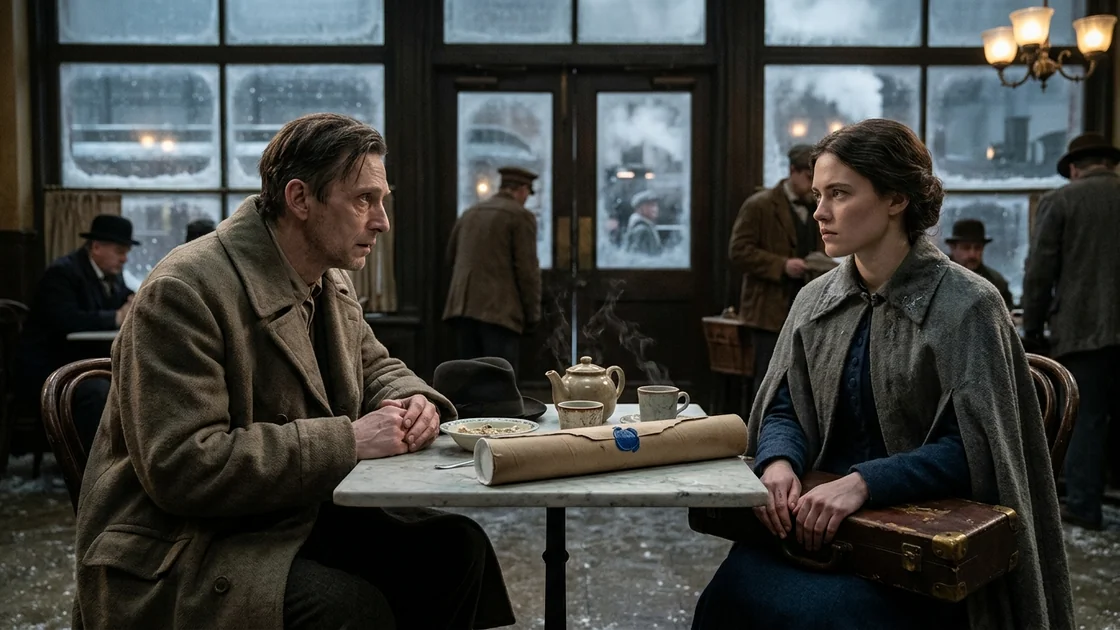
Arthur Pendelton survived the catastrophic sinking of the ocean liner Aethelgard by claiming the final seat on Lifeboat Four, a split-second decision that left a younger man named Julian Vance in the freezing Atlantic waters. Upon returning to his mundane life as an actuary in the damp, bustling streets of Boston, Arthur finds himself completely estranged from his wife, Clara, and unable to reintegrate into polite society. Consumed by crippling survivor's guilt and haunted by auditory hallucinations of groaning steel and salt water, he embarks on a quiet, obsessive quest to track down Julian's surviving sister, hoping that confessing his cowardice will either destroy him or finally set him free.
I. The Geometry of Salt
The porcelain edge of the bathtub was cold against Arthur’s shoulder blades, a stark, rigid boundary that reminded him of fiberglass and frozen pine. He stared at the brass faucet. A single drop of water swelled at its lip, trembling with surface tension before detaching and striking the dry basin below. Clink.
In the North Atlantic, water did not drip; it arrived in mountains. It arrived with the weight of cathedrals, black and veined with silver foam, smelling not of the pleasant, briny beaches of Cape Cod, but of deep, ancient mud and cold iron.
"Arthur?"
Clara’s voice came through the heavy oak door of the bathroom, muffled and tentative, the way one speaks in a sickroom or a chapel. She had been using that voice for four months—ever since the coast guard cutter had deposited him, wrapped in a stiff gray wool blanket that smelled of diesel fuel, onto the pier in Halifax.
"I’m awake," Arthur said. His voice sounded like dry leaves scraping across slate. He cleared his throat, trying to summon the resonance he used to possess, the baritone that had once delivered quarterly risk assessments to the board at Mutual of New England. "I’ll be down in a moment, Clara."
"The Hendersons are coming at seven," she reminded him, her footsteps already retreating down the runner of the upstairs hallway. "Just for tea and cold cuts. Nothing elaborate. Doctor Croft said routine is the best tonic."
Routine. Arthur stood up, his knees popping in the quiet room. He was thirty-eight years old, though the man in the bevel-edged mirror above the sink looked sixty. The skin beneath his eyes had the bruised, papery quality of overripe plums. He had lost twenty-two pounds in the five days Lifeboat Four had drifted before the flares were spotted, and despite Clara’s relentless regime of roast beef, buttered parsnips, and heavy cream, his body refused to reclaim the mass. It was as if his flesh knew it had no right to occupy the space.
He dressed in the uniform of his former life: a starched white shirt that gaped around his collarbones, a charcoal worsted suit that hung from his shoulders like drapery on a coat rack, and sensible wingtip shoes. He tied his necktie with fingers that still bore the faint, crescent-shaped scars of salt sores around the knuckles.
When he descended the stairs, the house smelled of beeswax and lemon oil. Clara had been cleaning furiously since his return, as though she could scrub the maritime trauma out of the floorboards. She stood in the parlor, adjusting a vase of white chrysanthemums on the mantelpiece. She was a small, neat woman with hair the color of tarnished copper, and when she turned to look at him, her smile arrived a fraction of a second too late to be genuine.
"You look very handsome," she said, smoothing her skirt. "Very much yourself."
"The trousers need taking in," Arthur replied, looking at the rug. It was a Persian pattern, deep reds and blues swirling together in tidy, symmetrical eddies. Nothing like the real thing. Nothing at all.
"Mr. Miller can do that on Tuesday when you go into the city," Clara said brightly. She crossed the room and adjusted his lapel, her fingers brushing his chest. He tried not to flinch, though her touch felt scorching, an unbearable intimacy he no longer deserved. "You’re still planning on going into the office Tuesday?"
"Yes. Half-days to start, as Mr. sterling suggested."
"Good. That’s very good, Arthur. Numbers don't change, do they? A table of mortality is the same in October as it was in May."
She froze the moment the words left her mouth, the color draining from her cheeks. Mortality. The word hung between them, heavy and dripping with sea-wrack.
"I meant—" she began, her eyes widening with a familiar, exhausted panic.
"I know what you meant, my dear," Arthur said softly, sparing her. He walked to the window and pulled back the lace curtain. Outside, the gaslights along Commonwealth Avenue were being lit, casting warm yellow pools onto the damp cobblestones. A carriage rattled past, the horse’s hooves clicking a steady, predictable rhythm. "And you are quite right. The tables do not change. The probabilities remain absolute."
That was the horror of it, of course. As an actuary, Arthur lived his life inside the bell curve. He understood that out of twelve hundred passengers and crew aboard the SS Aethelgard, given a hull breach across four watertight compartments in forty-two-degree water at two o'clock in the morning, a specific, calculable percentage would perish. When he had boarded the vessel in Liverpool, he had been a data point. When he had stepped into Lifeboat Four, he had become an anomaly.
More accurately, he had become a thief.
The doorbell rang, its brass chime cutting through the quiet house. Clara inhaled sharply, putting on her hostess face like a porcelain mask, and went to welcome the Hendersons.
II. The Parlor Sea
Robert Henderson was a man who believed that all human misery could be cured by a firm handshake and a glass of port. He was a senior partner at a maritime law firm—an irony that had evidently escaped Clara when she issued the invitation, or perhaps it was simply that everyone in Boston was connected to the sea in one way or another.
"Pendelton, my boy!" Robert boomed, clamping a meaty hand onto Arthur’s shoulder while his wife, Evelyn, kissed the air beside Clara’s cheek. "Looking stout. Looking remarkably stout, all things considered. The sea air didn't quite pickle you, eh?"
"Robert," Evelyn hissed under her breath, shooting him a look that could have sheared iron rivets.
"What? No sense tiptoeing around the elephant in the parlor, Evie. Arthur’s a man of the world. Faced the abyss and stared it down. There's grit in these actuaries, I always say. People think it's all ink-stains and spectacles, but when the moment comes—iron!"
Arthur accepted a glass of sherry from the tray Clara held. The amber liquid sloshed against the cut crystal. He watched the miniature tide rise and fall. "It wasn't iron, Robert. It was mostly confusion."
"Modesty," Robert declared, settling his bulk into the wingback chair by the unlit fireplace. The room was warm, almost stiflingly so, yet Arthur could feel a draft around his ankles, a phantom current that smelled of bilge water and wet wool. "The papers said the discipline on the boat deck was exemplary. Anglo-Saxon pluck at its finest. Women and children first, the band playing until the boilers went—or was that the other steamer back in '88? No matter. The point is, order was maintained."
"Order is a very localized phenomenon," Arthur said. He sat on the edge of the settee, his posture rigid. Clara was watching him from the tea service, her knuckles white around the silver handle of the teapot. "On the port side, perhaps. I was on the starboard boat deck, aft."
"Ah," Robert leaned forward, his legal mind scenting a deposition. Despite his wife’s frantic throat-clearing, he pressed on. "The inquiry in London made much of the starboard davits. Something about the list of the ship fouling the blocks?"
"She was listing twelve degrees to port within twenty minutes of the collision," Arthur said. The words came out mechanically, as if he were reading from a ledger. He had recited the metrics to the Board of Trade investigators in Halifax until his throat bled. "That meant the starboard boats swung out too far from the rail. There was a gap of nearly six feet between the promenade deck and the gunwales of the lifeboats. Down below, you could see the green water churning around the bilge keel."
"Good God," Evelyn whispered, her hand fluttering to her throat. "Six feet? In the dark?"
"The emergency dynamos were still running," Arthur continued, his gaze fixed on the sherry glass. "The deck was lit by a very pale, very yellow electric light. It made everyone’s faces look like tallow. Like candles that had been left in the rain. And the noise... the newspapers never mention the noise. They write as if a ship sinks in a great, solemn hush, like a cathedral submerging."
"Arthur," Clara said, her voice tight. "Perhaps Mrs. Henderson would prefer to hear about the renovations to the library."
"No, no, let him speak," Robert said, though his ruddy complexion had paled slightly. "It’s history, Clara. The man lived through the greatest maritime disaster of the decade."
"It wasn't solemn," Arthur said, not looking at any of them. He was looking at the gap between the settee and the coffee table. Six feet. "The steam was venting from the funnels. A roar like a thousand locomotives trapped in a tunnel. You couldn't hear orders. You couldn't hear prayers. You could only see mouths opening and closing. And when the deck began to cant toward the bow, the pianos in the grand salon broke their moorings. We could hear them through the skylights, crashing through the partitions, striking the bulkheads with this terrible, discordant twang as the frames snapped."
In the quiet parlor, the grandfather clock ticked. Clack. Clack. Clack.
"Boat Four was the last on the starboard quarter," Arthur said. His thumb traced the cut-glass pattern of his tumbler. "The Second Officer—his name was Miller, a boy from Southampton with a mustache he was far too young for—was trying to load the women. Two women missed the jump. They didn't scream; the wind took their breath away before they hit the water. They just vanished into the gap between the hull and the boat."
"Arthur, please," Clara stood up, setting the teapot down with a sharp clatter that made Evelyn jump. "The tea is getting cold."
Arthur blinked. The yellow electric light of the Aethelgard faded, replaced by the rose-tinted glow of Clara’s parlor lamps. He looked at the three faces staring at him—Evelyn’s horrified, Robert’s suddenly sober and uncomfortable, Clara’s shimmering with unshed tears of humiliation and grief. They didn't want the truth. They wanted the engraving from Harper’s Weekly: brave men tipping their hats at the rail while the lifeboats pulled away in neat, geometric rows.
"Forgive me," Arthur said, setting his untouched sherry on the table. "The doctor says my mind still catches on the details. Like a coat on a nail. Robert, how is the real estate market in Back Bay? I understand the new landfill projects are progressing."
The conversation limped forward for another hour, wounded and bleeding on the Persian rug, before the Hendersons made their excuses and fled into the Boston night.
When the front door clicked shut, Clara didn't turn around. She stood in the vestibule, her forehead pressed against the wood of the door.
"You promised," she whispered.
"He asked, Clara."
"Everyone asks! They ask because they want to hear that you’re fine! They want to hear that God was merciful and plucked you from the waves because you are a good, Christian man who pays his tithes and loves his wife!" She spun around, her eyes wild. "They don't want to hear about women falling into the dark, Arthur! I don't want to hear about it!"
"Then what should I tell them?" Arthur asked, his voice terrifyingly calm. "Should I tell them how I got into the boat?"
Clara flinched as if he had struck her. He had never told her the end of the story. He had stopped at the six-foot gap during the inquiry, and he had stopped there with her. The official report stated that Mr. Arthur Pendelton had been ordered into Boat Four by Second Officer Miller to assist with the oars, as there were not enough seamen available. Miller had gone down with the ship; dead men do not contradict sworn affidavits.
"I don't want to know," she said, her voice breaking. She walked past him, giving him a wide berth as if he were still dripping with the freezing brine of the Grand Banks. "I just want my husband back. The one who cared about the rhododendrons and complained about the price of coal. Please, Arthur. Let the dead bury the dead."
She went upstairs. A moment later, the bedroom door closed, followed by the soft, metallic click of the lock. She had been sleeping in the guest room for six weeks,ever since the night he had woken up screaming, his hands locked around her throat because, in the dark, the silk of her nightgown had felt like the slick, wet oilskin of a man trying to drag him down into the dark.
III. The Ledger of the Drowned
On Tuesday, Arthur took the streetcar into the financial district. The morning was gray and smelled of horse manure, coal smoke, and the Charles River. Inside the crowded car, pressed between a clerk reading the Globe and a stout woman carrying a basket of laundry, Arthur began to sweat.
The proximity of bodies was unbearable. Every jostle of the car on its iron tracks felt like the sickening lurch of a deck losing its buoyancy. When the woman’s elbow brushed his ribs, his heart hammered against his sternum like a trapped bird.
Thirty-two, his mind whispered. The capacity of a standard thirty-foot clinker-built lifeboat is sixty-five souls. Boat Four left the davits with thirty-two.
He got off three stops early and walked the rest of the way, his breath pluming in the crisp October air.
The offices of Mutual of New England occupied the third and fourth floors of a granite building on State Street. It was a temple of quiet certainty. When Arthur pushed through the heavy mahogany doors, the sound of forty steel nibs scratching across forty linen-paper ledgers greeted him like the rustle of dry grass.
For a moment, the silence fell absolute. Men looked up from their high desks. These were men he had worked beside for fifteen years—men whose children’s names he knew, men with whom he had debated the merits of the gold standard over mutton chops at Locke-Ober. They stared at him as if Lazarus had walked in, still trailing the linen strips of the tomb.
Mr. Sterling, the chief actuary, emerged from his glass-walled office, wiping his spectacles with a handkerchief. "Pendelton! By Jove, it’s good to see you vertical. Come in, come in. Don't stand there in the draft."
Arthur’s desk had been kept exactly as he had left it in April, before his trip to London to audit the firm’s reinsurers. The blotter was clean. The brass inkwell was polished. Even his spare pair of sleeve garters lay coiled in the top drawer like sleeping adders.
"We’ve kept your caseload light," Sterling said, perching on the corner of Arthur’s desk, a violation of office protocol that underscored just how broken they all assumed he was. "Mostly railroad annuities. Dry stuff. No... well, no marine underwriting, obviously. We shifted the Cunard and White Star accounts over to Higgins."
"Thank you, sir," Arthur said, sitting down. The leather chair conformed to his body, though it felt too large now.
"Take your time. If the head starts swimming, just step out for some air. Nobody expects miracles." Sterling hesitated, lowering his voice. "The company handled the... the claims from the Aethelgard back in July. We had twelve policyholders aboard, besides yourself. Paid out in full, of course. Cut the red tape to ribbons. Good for the firm's reputation in a time of crisis."
Arthur’s fingers stilled on the edge of the blotter. "Twelve?"
"Thirteen, counting you, though happily your policy remains an asset rather than a liability," Sterling chuckled, then immediately looked regretful. "Well. I'll leave you to it."
Arthur waited until Sterling was back behind his glass partition before he stood up and walked to the central filing room. The clerk on duty, a pimply youth named Thomas who had been hired while Arthur was in England, looked at him with wide, terrified eyes.
"The disaster files from July," Arthur said. "Specifically the Aethelgard claims."
"Mr. Sterling said—"
"I am the Senior Reviewer for the casualty division, boy. Give me the box."
Thomas scrambled up a rolling ladder and retrieved a black cardboard transfer case from the top shelf. Arthur carried it back to his desk, ignoring the sidelong glances of his colleagues. He opened the brass clasps.
Inside were twelve manila folders, each tied with red cotton tape—the color of a settled death claim.
He went through them slowly, methodically. He knew these names; he had read the passenger lists in the newspapers a hundred times, searching for a ghost. Most of the firm's policyholders had been First Class passengers—textile merchants from Lowell, a judge from Beacon Hill, a railway magnate and his wife. People who had died in their staterooms or gone down with the promenade deck because they couldn't comprehend that their wealth wouldn't keep the water out.
At the bottom of the box, beneath the thick dossiers of the wealthy, was a thin folder marked: Industrial / Third Class. Policy #449-02-B.
Arthur untied the red tape. His hands were shaking so violently the paper rattled.
Insured: Julian Vance. Age at Death: 24. Occupation: Draughtsman. Face Value of Policy: $500.00. Cause of Death: Drowning / Exposure. Loss of SS Aethelgard, April 14.
Attached to the claim form was a copy of the death certificate issued in absentia by the British Board of Trade—Body Not Recovered—and a short correspondence regarding the beneficiary. The five hundred dollars had been paid out on August 3rd to one Miss Eleanor Vance, sister of the deceased, residing at 142 Margin Street, Marblehead, Massachusetts.
Arthur stared at the name. Julian Vance.
In the darkness of the starboard boat deck, the man had not had a name. He had been a shape in a heavy tweed overcoat that was missing two buttons. He had been a pair of spectacles with one cracked lens, reflecting the yellow glare of the emergency dynamos. He had been a voice with a slight coastal New England flatten to the vowels, saying, “Wait—the falls are jammed on the forward block! Let me clear the rope!”
Arthur remembered the rope. It had been thick Manila hemp, stiff with frost and grease, fouled in the pulley above their heads while the boat hung forty feet above the churning black water. While the young man in the tweed coat—Julian, his name was Julian—had leaned out over the abyss, bracing his boots against the ship's rail to hack at the tangled line with a clasp knife, Second Officer Miller had screamed into the din of the venting steam: “One more! We need one more weight on the aft thwart to balance the drop! Jump, damn you!”
There had been two of them left at the rail. Arthur, frozen in his expensive ulster, and Julian, who had just sliced through the fouled line, freeing the boat to drop.
Julian had turned, his chest heaving, his cracked spectacles slipping down his nose. He had looked at the six-foot gap, then at Arthur. Julian was twenty-four. His muscles were warm from exertion; his balance was sure. He had stepped back one pace to take the running leap.
And Arthur had moved.
It had not been a conscious thought. It had been the reptile at the base of his skull, the ancient, terror-stricken thing that existed before actuaries, before gentlemen, before God. As Julian lunged forward, Arthur had thrown out his left arm—not to push, he told himself in the dark of his bathroom every night, not to push, just to steady himself—and his heavy leather valise, which he had idiotically clutched to his chest the entire time, had struck Julian squarely in the knees.
The younger man’s boots had slipped on the ice-sheathed teak of the deck. He had gone down hard on his hip, his cracked spectacles flying off into the scuppers.
Arthur hadn't looked back. He had dropped the valise—right onto Julian’s outstretched hand—and he had jumped.
He had landed in the bottom of Boat Four in a tangle of oars and screaming women, bruising his ribs against a water keg. As the blocks screeched and the lifeboat plunged down the side of the Aethelgard’s black hull like a falling elevator, Arthur had looked up.
High above, framed against the yellow light and the pouring white steam, Julian Vance had pulled himself up to the rail. He wasn't screaming. He wasn't cursing. He was just squinting blindly without his glasses into the dark, one hand held to his bleeding temple, watching the boat fall away into the sea.
"Pendelton?"
Arthur slammed the folder shut. Higgins, from the desk across the aisle, was standing over him, holding a stack of railroad schedules.
"You alright, old man? You look like you've got a touch of the ague."
"Just a chill," Arthur said. While speaking, he slipped the piece of scrap paper on which he had written the Marblehead address into his waistcoat pocket. "The heating in this building has never been adequate. Tell Sterling I’m going home for the afternoon."
IV. The Fog on Margin Street
Marblehead in late October was a town retreating into itself. The summer yachts of the Boston Brahmins had been hauled out and shrouded in canvas, leaving the harbor to the lobster dories and the cold, pewter-colored chop of Massachusetts Bay.
Arthur took the afternoon train from North Station, telling Clara via a telegraph messenger that he was auditing a client's estate in Salem and might be detained until the late train. The lie had come with terrifying ease. Once a man has stolen a life, he realized, the smaller commandments offer very little resistance.
He stepped off the train into a thick sea fog that smelled of rotting kelp and woodsmoke. The town was a labyrinth of crooked, narrow streets lined with timber-framed houses built before the Revolution, their clapboards painted the colors of dried blood, mustard, and slate. They leaned toward the street at precarious angles, like old sailors nursing bad knees.
Margin Street was near the harbor, a damp thoroughfare where the fog condensed on the iron fences and dripped onto the cobbles. Number 142 was not a house, but the upper half of a gambrel-roofed cottage whose ground floor was occupied by a ship chandler’s shop. A faded sign creaked in the salt wind: H. Wetherby — Cordage, Sailcloth, & Tar.
Arthur stood across the street for twenty minutes, the collar of his coat turned up against the drizzle, watching the upstairs windows. A yellow light burned behind a simple muslin curtain.
What was he doing here? If he had been asked to calculate the utility of this visit, he would have marked it at zero. He could not resurrect Julian Vance. He could not return the five hundred dollars—a sum so pitifully small it made his stomach turn; he had spent nearly that much on the first-class cabin that had failed to save his soul.
He crossed the street and mounted the exterior wooden stairs that led to the second-floor door. The wood was slick with green algae from the perpetual damp. He knocked.
The woman who opened the door was tall—taller than Clara—and wore a dark blue wool dress with the sleeves rolled up past her elbows. Her hands were stained with Prussian blue ink and smudge-marks of charcoal. She had Julian’s jaw, slightly too square for conventional beauty, and the same wide-set gray eyes, though hers needed no spectacles.
"Yes?" she asked. Her voice had that same flat, coastal cadence. A voice shaped by speaking over the wind.
"Miss Eleanor Vance?"
"I am." She looked at his fine wool coat, his silk hat, his spotless gloves. Her posture stiffened slightly, the pride of a New England woman who knew the exact monetary value of the clothes standing on her threshold and resented the charity they usually implied. "If you’re from the parish relief committee, Mr. Vicar told you last month I don't require the coal vouchers."
"I am not from the parish," Arthur said. The fog seemed to have gotten into his lungs; he could barely push the words past his teeth. "My name is Arthur Pendelton. I am with the Mutual of New England Life Insurance Company."
The change in her face was instantaneous. The pride vanished, replaced by a hollow, guarded wariness. "The claim was settled in August. Everything was signed. Is there a discrepancy?"
"A minor one," Arthur lied. His heart was thudding a slow, heavy rhythm against his ribs. Clack. Clack. "A matter of... a supplementary dividend that was overlooked during the rush of the July processing. When a policy is terminated due to an act of God on the high seas, there is occasionally an adjustment for unearned premiums. May I come in?"
She hesitated, looking down the dark stairs into the fog, then stepped back. "The stove is low, Mr. Pendelton. You’ll want to keep your coat on."
The apartment consisted of two small rooms tucked beneath the sloping eaves of the roof. It was spare, almost monastic, but fiercely clean. Instead of parlor furniture, the main room was dominated by a massive tilted drafting table positioned beneath the dormer window to catch the northern light.Pinned to the pine board was a large sheet of vellum covered in the intricate, precise lines of a marine steam engine’s boiler assembly.
"You are a draughtsman," Arthur said, looking at the brass T-square and the row of callipers laid out on a clean rag.
"My brother was," Eleanor said, closing the door. She picked up a shawl from a wooden chair and wrapped it around her shoulders. "He worked for the Fore River Shipyard down in Quincy before he went to Liverpool to study the new turbine designs at Harland and Wolff. When he didn't come back, Mr. Cramp at the local boatworks had some piecework copying hull blueprints. Julian taught me lettering and scale drawing when we were children. It pays the rent."
Arthur looked at the drawing. The lines were extraordinary—clean, unwavering, absolute. "He was very talented."
"He was going to design hulls that didn't break when they hit ice," she said flatly, without a trace of melodrama. It was simply a statement of fact, a mechanical problem that had been left unsolved. She gestured to the only other chair in the room, a cane-bottomed rocker. "Sit down, Mr. Pendelton. What is this paper I need to sign?"
Arthur didn't sit. He stood near the small iron parlor stove, which radiated a faint, dying heat. On the wall above a low bookshelf hung a framed photograph. It was Julian, standing on the deck of a small catboat, squinting into the sun, his hair blown sideways by a summer gale. Beside the photograph hung a pair of wire-rimmed spectacles, one lens intact, the other an empty brass hoop.
Arthur’s breath caught in his throat.
Eleanor followed his gaze. "They aren't the ones he was wearing," she said quietly. "Those were his spares. I found them in the trunk the shipping company sent back from his lodgings in Liverpool. Everything in that trunk smelled of coal smoke and lavender soap. It was strange, having his shirts come back on a steamer three weeks after the Aethelgard went down. As if his clothes knew the way home, even if he didn't."
"Miss Vance," Arthur said. The room was tilting. A twelve-degree list to port. He gripped the back of the cane chair until the wood creaked. "I didn't come about a dividend."
Eleanor didn't look surprised. She just looked tired, her gray eyes narrowing slightly as she studied his face—really studied it—for the first time. She looked at the gaunt hollows beneath his cheekbones, the way his suit hung off him, the crescent scars on his knuckles where he had gripped the gunwale of Boat Four for a hundred and twenty hours.
"You were on the ship," she whispered.
"Yes."
"I read the lists of the survivors," she said, her voice dropping an octave. "Every day for a month, I went down to the telegraph office and read the bulletins from Halifax. Pendelton, A., First Class. I didn't connect the name. Why would I? Julian was down on E-Deck, near the steering gear."
"He came up," Arthur said. "When the stewards unlocked the gates between the classes, he came up to the boat deck. Starboard side, aft."
Eleanor took a single step toward him. Her hands, stained with blue ink, clenched into the wool of her shawl. "You saw him?"
Here was the precipice. A six-foot gap between the rail and the boat, with the green water churning in the dark below. All he had to do was step off. All he had to do was say: I knocked him down. I took his place. I am the reason his shirts came home in a trunk without him.
"I saw him," Arthur said. His tongue felt thick, coated in salt. "At Boat Four. The forward block was fouled with frost. The seamen couldn't clear it—they were down on the lower deck trying to swing out the davits. Your brother climbed up onto the rail."
Eleanor’s lips parted. She wasn't breathing. In the silence of the attic room, they could hear the surf breaking against the rocks at the mouth of Marblehead Harbor, a dull, rhythmic thudding like a giant’s heart.
"He had a clasp knife," Arthur continued, the memory washing over him with such clarity he could smell the hot tallow of the grease on the Manila ropes. "A stag-horn handle. He leaned out over the water—it was forty feet down to the sea, Miss Vance, and the ship was rolling heavily—and he cut the fouled lanyard. If he hadn't done that, the boat would have hung vertically from the aft falls when they let go the brakes. Everyone in it—thirty women and children—would have been tipped into the sea."
"A stag-horn knife," she whispered, a tear finally breaking over her lower lash, cutting a clean track through a smudge of charcoal on her cheek. "I gave it to him for his twenty-first birthday. He always carried it."
"He saved the boat," Arthur said. His voice was rising, a desperate, pleading note creeping into the dry actuary’s tone. "Do you understand? Without him, thirty-two people would have died in three minutes."
"Then why wasn't he in it?" she asked.
The question wasn't an accusation; it was the simple, terrible logic of a draughtsman looking at a flawed blueprint. If the man was at the rail, and the boat had room for sixty-five, why was the man not in the boat?
Arthur looked at her eyes—Julian’s eyes. He saw the grief there, raw and jagged, held together only by the thin wire of her pride and the memory of a boy squinting into the sun on a catboat. If he told her the truth, he wouldn't be unburdening himself; he would be handing the weight to her. He would be telling her that her brother didn't die a hero in a grand tragedy, sacrificing himself for women and children, but died like a dog in the scuppers because a panicked clerk from Boston hit him in the knees with a leather valise full of dirty laundry and actuarial tables.
He realized then, with a cold, crushing finality, that confession was just another lifeboat. And he was trying to push her out of it so he could sit down.
"The officer ordered the boat lowered the second the rope parted," Arthur lied. Every word tasted like bilge water and copper. "The drop was sudden. Your brother was still braced against the davit iron. He... he waved us off. He shouted that he was going to help with the collapsible boats on the roof of the officers' quarters."
Eleanor closed her eyes. She swayed slightly, and Arthur reached out a hand to steady her, stopping himself an inch from her sleeve. He did not have the right to touch her.
"The collapsibles," she murmured, nodding slowly as she matched his lie to the official testimony she had memorized from the newspapers. "Yes. The papers said the water reached the bridge before they could cut the lashings on the last collapsible. That's where they found the Second Officer's body, tangled in the canvas."
"Yes," Arthur said.
She opened her eyes and looked at him with something that made Arthur want to throw himself through the dormer window and onto the cobblestones below. It was gratitude. Pure, shining, unbearable gratitude.
"Thank you," she whispered, reaching out and taking his gloved hand in both of hers. Her fingers were rough from the pumice stones used to prepare vellum, and very warm. "For four months, I’ve thought of him trapped down in those white-painted corridors in the dark, with the doors locked. Knowing he was up in the air... knowing he had his knife, and that he was working... Julian couldn't stand to be idle when something was broken. He always had to fix the mechanism."
"He fixed it," Arthur said, his vision blurring until the room became a wash of gray and yellow. "He fixed it, Miss Vance."
V. The Weight of Five Hundred Dollars
Arthur missed the five o'clock train back to Boston. He walked out to the end of Marblehead Neck, where the granite cliffs dropped straight into the Atlantic. The fog had lifted slightly as twilight fell, revealing a vast, heaving expanse of dark slate water that stretched unbroken all the way to Ireland.
He sat on a wet boulder, took off his silk hat, and placed it beside him. The wind tore at his thinning hair.
He pulled his checkbook from his breast pocket. He had a personal account at the Merchants Bank in Boston—the modest savings of fifteen years of prudence, totaling some four thousand dollars. Clara and he had been saving it to buy a small summer house in Duxbury.
He uncapped his fountain pen, balanced the checkbook on his knee, and wrote a draft to H. Wetherby, Ship Chandler, for three hundred dollars, with a note instructing the man to apply it anonymously to the rent of the upstairs tenant for the next five years. He would mail it from Salem. He would find other ways—fake drafting commissions funneled through Higgins’s cousin at the shipyard, bogus insurance adjustments—to bleed himself dry until every penny he possessed had flowed into that attic room on Margin Street.
It wouldn't change the ledger. An actuary knew better than anyone that you cannot buy back a life once the risk has matured into a loss. The column was closed; the ink was dry.
He stood up and walked to the very edge of the cliff. Down below, thirty feet down, the surf boiled white and furious in a cleft of the black rock, sucking back the pebbles with a sound like a thousand rattling teeth.
It would be very easy. One step across a six-foot gap. The water was cold now, nearly as cold as it had been in April, though there was no ice. He would be dead in twenty minutes, his heart stopping long before he drowned. Clara would collect his policy from Mutual of New England—Sterling would cut the red tape to ribbons—and she would be free to marry someone who didn't scream in the dark and didn't smell of old salt.
He leaned forward, letting the wind take his weight.
“Wait—the falls are jammed on the forward block! Let me clear the rope!”
Julian’s voice rang in his ears, clearer than the surf.
If Arthur jumped into the sea, Boat Four would only have carried thirty-one souls to safety. If Arthur died on the rocks of Marblehead, then the last thing Julian Vance had ever done—cutting that frozen Manila hemp with a stag-horn knife—would be diminished by one thirty-second of its value.
Arthur looked down at his hands. He took off his leather gloves and let the wind snatch them away into the foam. He looked at the small, white crescent scars on his knuckles.
He was not allowed to die. Dying was a luxury for men who had stayed on the deck. His sentence was to remain in the boat. His sentence was to row, and to keep rowing, through the parlor teas with the Hendersons, through the silent breakfasts with Clara, through the scratching of forty steel nibs on State Street, carrying the weight of a twenty-four-year-old draughtsman on his back until his own heart finally, naturally, gave out.
Arthur stepped back from the edge of the cliff. He picked up his hat, brushed the salt spray from the brim, and began the long walk back through the fog toward the train station.
VI. The Winter Tides
November arrived in Boston with a hard, metallic frost that killed the last of Clara’s chrysanthemums and turned the mud of the Back Bay fens into iron ruts.
In the house on Commonwealth Avenue, a strange, fragile truce had settled over the rooms, like dust sheets laid over furniture in an unused wing. Arthur no longer spoke of the Aethelgard. When acquaintances on the streetcar or at church inquired after his health with that hushed, morbid curiosity he had come to recognize, he smiled a small, tight smile, said that the salt air had actually done wonders for his rheumatism, and asked after their terriers or their municipal bonds.
He became an exemplary ghost.
"You're eating better," Clara remarked one morning in middle November. The dining room was bright with the thin, lemony sunlight of a frosty morning. She was pouring coffee from the silver pot, her copper hair pinned up with its usual mathematical neatness.
"The oatmeal is very good," Arthur said, lifting his spoon. It no longer shook. He had trained the tremor out of his fingers by spending an hour every evening in his study, holding a heavy brass paperweight at arm's length until the muscles in his forearm burned like fire and went numb. "And Mr. Miller took the trousers in an inch. They sit much better now."
Clara set the coffee pot down. Her hand lingered on the linen tablecloth, halfway across the expanse of mahogany that separated them. "Doctor Croft saw Evelyn Henderson at the symphony Friday night. Evelyn told him you seemed much improved when we dined with them last week. She said you spoke quite knowledgeably about the new waterworks bond issue."
"It is a sound municipal investment," Arthur said, chewing methodically. "The city is growing westward. The pipes must follow the population."
Clara looked at him for a long moment. The fear that had lived in her eyes during the summer—the terror that he was going to shatter like a dropped teacup right on the parlor rug—had receded, replaced by a quiet, baffled loneliness. He had given her what she asked for. He had given her back the husband who talked about municipal bonds and the price of anthracite coal. Yet she looked at him as if he were a waxwork delivered from a museum, an uncanny replica that moved its limbs by clockwork.
"Arthur," she said softly, "we don't have to go to my sister's for Thanksgiving if you feel it will be too crowded. There will be fourteen at the table, and the children are very noisy."
Fourteen. Less than half the capacity of Boat Four.
"We should go," Arthur said, dabbing his mouth with his napkin. "It would disappoint Margaret if we stayed away. And I haven't seen young Thomas since he started at Latin School. I promised him my old set of Euclid."
"Yes," Clara said, withdrawing her hand from the table and folding it into her lap. "You did. Last Christmas."
He rose, kissed her forehead—her skin smelled of lavender water, the same scent that had come back in Julian Vance’s trunk from Liverpool—and went to the vestibule to put on his ulster. It was a new coat. He had given the one he wore on the Aethelgard to a rag-and-bone man in South Boston, along with the suit he had worn that night, though he knew perfectly well that the smell of the North Atlantic was not in the wool, but in his own nostrils.
At the office, the rhythm of the ledgers had reclaimed him. Mr. Sterling had gradually returned the marine underwriting accounts to Arthur’s desk, emboldened by his subordinate's stoic recovery.
Arthur welcomed them. There was a grim, monastic penance in calculating the insurance rates for tramp steamers carrying grain from Odessa or passenger liners plowing the winter tracks between Southampton and New York. He studied the hull specifications with a new, ferocious intensity. He sent queries to the shipbuilders in Glasgow and Belfast that baffled the firm’s clerks—demanding to know the tensile strength of the iron in the boat davits, the gauge of the Manila hemp used in the falls, the exact height of the watertight bulkheads relative to the load waterline.
"Pendelton," Sterling said one afternoon in December, leaning over Arthur’s partition with a sheet of foolscap in his hand. "You’ve rejected the underwriting proposal for the Star of Antwerp. We’ve insured the Red Star Line for twenty years."
"Their lifeboat capacity is calculated by gross tonnage based on the 1854 Act, Mr. Sterling," Arthur said without looking up from his columns. His steel nib scratched steadily. Clack. Clack. "The vessel carries eleven hundred passengers and has boatage for four hundred and twenty. Furthermore, their davits are the old gooseneck pattern, not the quadrant type. In a fifteen-degree list, half those boats will be pinned against the superstructure."
Sterling blinked behind his spectacles. "Well, yes, man, that’s standard across the Atlantic trade. The watertight subdivision makes the ship her own lifeboat. That’s what the builders say."
"The builders do not sail on them in April," Arthur said, dipping his pen in the black ink. "If Red Star wants our capital at four percent, they can fit quadrant davits and double their lifeboat cradles. Otherwise, let Lloyd’s take the risk. The probability of a total loss over a ten-year depreciation cycle is zero point zero four, which exceeds our threshold for unsecured marine casualty."
Sterling stared at him, opened his mouth to argue the politics of corporate relations, and then closed it. Nobody at Mutual of New England argued with Arthur Pendelton about maritime mortality anymore. He was the oracle who had been inside the whale’s belly; if he said the davits were wrong, the davits were wrong.
"Very well," Sterling muttered, retreating. "I’ll cable Antwerp."
When Sterling was gone, Arthur opened his bottom desk drawer. Beneath a stack of railroad annuity tables lay a small, leather-bound notebook he kept for his private accounts.
November 12: $50.00 — Fore River Shipyard (Drafting fee for E. Vance, via Higgins). December 1: $40.00 — Boston Steam Engine Works (Tracing fee for E. Vance, via Miller).
He had constructed an entire phantom economy around the attic room at 142 Margin Street. Through a network of bewildered but compliant acquaintances in the marine engineering trades, Arthur was paying for technical drawings he didn't need, having the work commissioned from Eleanor Vance in Marblehead, and then burning the exquisite vellum blueprints in his study fireplace once they were delivered to him, because looking at the clean, steady lines of her penmanship made his eyes ache as if he were staring into the sun.
It was costing him nearly eighty dollars a month—almost half his salary. To cover the shortfall in the household accounts without alerting Clara, he had stopped taking the streetcar, walking the four miles to and from State Street in the freezing slush, and had foregone lunch entirely, spending the noon hour sitting in the pews of King’s Chapel, staring at the white painted columns and listening to the traffic rumble past on Tremont Street like distant thunder.
VII. The Blueprint of the Boiler
Two days before Christmas, the snow came—a wet, heavy noreaster that blew in off the bay, plastering the brick facades of Boston with white mortar and muffling the bells of the sleighs.
Higgins came by Arthur’s desk at four o’clock, stamping the snow from his galoshes and carrying a cardboard tube sealed with wax.
"My cousin at the Atlantic Works says this is the last set of tracings he can run through his books before the end-of-year audit, Pendelton," Higgins said in a low voice, laying the tube on the blotter. He looked at Arthur with a mixture of pity and deep confusion; he assumed the Vance girl was either a blackmailer or a dishonored niece, though Arthur Pendelton was the last man in Christendom anyone would suspect of an indiscretion. "The girl came into Boston on the train this morning to deliver them in person to the yard. Said she wanted to make sure the ink didn't run in the damp."
Arthur’s hand froze over his ledger. "She’s in Boston?"
"Was at noon. Cousin said she looked half-starved, despite the fees you’ve been funneling her. Wore a coat no thicker than a blanket. Anyway, that’s my part done. Merry Christmas, Arthur."
When the office cleared at five, Arthur did not walk home toward Back Bay. Instead, he turned north, walking through the swirling, grease-stained snow toward North Station, the cardboard tube tucked beneath his arm.
The great vaulted waiting room of the station was a cavern of wet wool, coal smoke, and the echoing cries of porters. Trains were delayed all up and down the Eastern Route; the switches at Lynn were frozen solid. Hundreds of commuters sat on the long oak benches, huddled over parcels tied with string.
He found her near the far end of the concourse, sitting beneath a gasolier that hissed and flickered in the draft from the tracks.
She was wearing the same dark blue wool dress he had seen in October, covered by a threadbare gray cloak that was dark with melted snow around the shoulders. On her lap rested a wooden box—a mahogany instrument case with brass corners, the kind draughtsmen used to carry their compasses and ruling pens.
She wasn't reading a paper. She was just sitting with her spine straight, her chapped hands folded over the brass clasp of the box, staring at the chalkboard where the delayed departures were listed.
Arthur stood behind a cast-iron pillar thirty feet away. He should leave. Every rule of the penance he had constructed demanded that he remain invisible, a faceless providence operating through bank drafts and third-party shipyards.
A man on the bench beside her—a laborer in a sheepskin vest who smelled of cheap rye whiskey even from ten paces away—shifted his weight, his heavy boot striking Eleanor’s ankle. He didn't apologize; he simply slumped further down the bench, his shoulder pressing against hers, crowding her against the iron armrest.
Eleanor didn't complain. She simply pulled her thin cloak tighter around her ribs, making herself smaller to yield the space.
The reptile at the base of Arthur’s skull stirred, followed instantly by a wave of nausea so violent he had to brace his hand against the cold iron of the pillar. Crowding her out. Taking the space.
Before he knew what he was doing, his feet were carrying him across the sawdust-strewn tile floor.
"Miss Vance," he said.
She looked up. For a second, in the yellow gaslight, her face was so terribly like Julian’s as he had turned from the davit rail that Arthur’s knees went weak. Then the recognition cleared her gray eyes.
"Mr. Pendelton," she said, half-rising from the bench.
"Please, don't get up." Arthur turned and looked down at the laborer in the sheepskin vest. Arthur was not a large man, and he was thinner now than he had ever been, but there was something in his eyes—the flat, dead gaze of a man who had watched thirty people freeze to death in an open boat and had done the math on their survival—that made the laborer sober up in a hurry. "I believe there is room on the bench across the aisle, sir."
The man muttered an oath, gathered his bundle, and shambled away.
Arthur did not sit in the vacated spot. He remained standing, holding his hat and the cardboard tube in front of him like a butler awaiting instructions. "The trains to Marblehead are held at the drawbridge. They say it will be another hour."
"Yes," she said. Her lips were slightly blue from the cold of the concourse. "I came in to deliver some drawings to East Boston. The ferry was slow in the snow."
She glanced at the cardboard tube under his arm. It bore the blue wax seal of the Atlantic Works—the very seal she had watched the clerk affix three hours ago.
The silence between them stretched, pulling taut like a line under a heavy strain. She was not a stupid woman; she was a woman who understood geometry, who spent her days tracing how one gear meshed with another to transfer force across an engine room.
Her eyes traveled from the blue wax seal on the tube up to Arthur’s face.
"The Atlantic Works doesn't build marine boilers with triple-expansion valves anymore," she said very quietly. "They switched to water-tube designs two years ago. Julian told me that before he left."
Arthur said nothing. Behind them, a locomotive vented steam onto the platform with a long, shrieking roar that made the glass in the station roof rattle.
"And Mr. Wetherby downstairs told me last month that my rent was paid through the year," she continued, her voice steady, though her fingers tightened on the mahogany box in her lap. "He said it was a dividend from a seamen’s trust my father belonged to. My father was a shoemaker in Lynn, Mr. Pendelton. He never set foot on a deck in his life."
"The accounting in these charitable trusts is often muddled," Arthur said, his voice barely audible over the hissing steam. "Clerical errors are common."
"You aren't a man who makes clerical errors." She stood up. She was nearly his height, and she looked straight into his eyes, refusing to let him look away at the departure board or his own boots. "Why are you paying me to draw engines that nobody is going to build?"
"You do good work, Miss Vance. The lines are very clean."
"Is it charity?" The New England steel came into her spine, sharp and cold. "Because if it is charity from your insurance company to keep a survivor’s conscience quiet—"
"My conscience is not quiet," Arthur said.
The raw, jagged violence in his quiet voice stopped her cold. People on the neighboring benches glanced over at the well-dressed gentleman and the shabby woman standing beneath the gasolier.
"Come," Arthur said, gesturing toward the station restaurant, a brightly lit room smelling of boiled beef and chicory coffee. "You are freezing, and I cannot shout over the locomotives."
He bought her a bowl of oyster stew and a pot of tea. He ordered nothing for himself, sitting across from her at the small marble-topped table with his hands folded over the cardboard tube. At first, she refused to touch the spoon, her pride warring with the obvious hollowness in her stomach, until he looked out the frosted window toward the tracks and said, "If you do not eat it, the waiter will throw it into the pig-bucket in the alley. That seems a poor way to honor a shoemaker's upbringing."
She ate, slowly at first, and then with a desperate, quiet precision, finishing every drop of the broth while he watched the snow pile up against the glass.
When she was done, she set the spoon down neatly on the saucer. The color had returned to her cheeks, though her eyes remained fixed on him like callipers measuring a flaw in a casting.
"Tell me," she said.
"I told you in October," Arthur replied, still looking at the snow. "Your brother saved Boat Four. Every person in that boat owes him their life. I am simply the only one among those thirty-two who happens to know your address. Thirty-two lives, Miss Vance. In my profession, we calculate the economic value of a productive citizen based on their future earnings multiplied by their life expectancy. By my calculation, the passengers of Boat Four owe your brother’s estate approximately one hundred and forty thousand dollars. I am paying my one-thirty-second share on the installment plan, as my liquid capital is limited."
It was a brilliant speech. It was logical, actuarial, and completely insane.
Eleanor stared at him across the marble table. She looked at his frayed cuffs—he had stopped buying new shirts in November—and the hollow, grey skin around his mouth.
"You haven't eaten today," she said.
"I had a large breakfast."
"You’re lying," she said simply. "You lied to me in October, too, didn't you?"
Arthur’s heart stopped. The warmth of the restaurant vanished, replaced by the forty-two-degree chill of the Labrador Current. He turned his head slowly and looked at her.
"He didn't stay behind to work on the collapsible boats," she said. Her voice didn't tremble. It had the terrible, flat calm of the sea on the third morning after the sinking, when the wind had died and left the lifeboat sitting on a mirror of grey glass, surrounded by floating deck chairs and cork lifebelts that had nobody inside them. "When you left my rooms in Marblehead, I got out the transcript of the British inquiry. My brother’s friend at the shipyard lent it to me. I read Second Officer Miller’s testimony—Wait, no, Miller died. It was the Quartermaster, a man named Wynn, who was at the tiller of Boat Four."
Wynn. Arthur remembered him. A thick-necked Welshman who had spent the five days in the boat singing hymns in a language nobody understood and weeping over his frostbitten toes.
"Wynn testified that the collapsible on the officers' quarters was washed overboard twenty minutes before Boat Four was lowered," Eleanor said, leaning forward slightly. "There was nothing left on the starboard aft deck when your boat went down. Nothing at all. Just the rail, and the water coming up over the promenade."
Arthur’s hands gripped the cardboard tube so hard the heavy pasteboard buckled with a dry crunch.
"Why did you tell me he went to the collapsibles?" she whispered. "Did he... did he panic? Did he try to jump and miss, like those women? Tell me the truth, Mr. Pendelton. I can bear it if he was afraid. He was only twenty-four, and he couldn't see three feet in front of his face without his glasses."
She thought she was asking about Julian’s cowardice. The sheer, blinding grace of her misunderstanding nearly brought Arthur to his knees right there in the sawdust and spilled salt of the station buffet.
He looked at her hands, stained with the Prussian blue ink he had bought for her. He thought of his own house on Commonwealth Avenue, where Clara was currently wrapping a silver-backed hairbrush for him to open on Christmas morning so they could pretend the year 1912 had been just like the year 1911. He was a dead man between two worlds, belonging to neither the living in Boston nor the drowned on the Grand Banks.
"He wasn't afraid," Arthur said, and for the first time since April, the words didn't feel like ash in his mouth, because that part, at least, was the gospel truth. "The Quartermaster was at the stern. He couldn't see the forward block because of the steam."
He reached into his pocket, pulled out his handkerchief, and wiped a bead of sweat from his upper lip.
"There was only room for one more to jump before the boat swung too far out from the hull," Arthur said, his gaze locked onto the empty brass hoop of the spectacles he could still see hanging on her wall in Marblehead. "Your brother had just cut the rope. He was first in line at the rail. I was behind him."
Eleanor didn't breathe. The waiter rattled a tray of dirty crockery behind them, the sound like breaking ice.
"He lost his glasses," Arthur said. His voice dropped until it was just a vibration in the marble table between them. "My valise struck him. He fell on the ice on the deck, and his glasses went into the scuppers. And instead of helping him up... instead of giving him my hand... I stepped over him, Miss Vance. I stepped over him and I jumped into the boat. Because I wanted to live."
There it was. The six-foot gap. He had finally stepped off into the dark.
He waited for her to scream. He waited for her to strike him across the face with the heavy mahogany instrument case, to call the station police, to curse his name until every commuter in North Station knew what a First Class gentleman from State Street was made of when the electric lights began to turn red and die.
Eleanor sat perfectly still. Her gray eyes searched his face—not with hatred, not even with surprise, as if some deep, quiet part of her had known the mechanics of the thing the moment he had walked into her attic in October smelling of fear and expensive wool.
She looked at the crushed cardboard tube in his white-knuckled hands. She looked at his thin wrists sticking out of his frayed cuffs, and the terrible, hollowed-out cavern of his eyes.
"And when the boat went down," she asked, her voice barely a thread of sound, "what did he do?"
"He stood up," Arthur whispered, a single, scalding tear finally cutting down his gaunt cheek, the first he had shed since they pulled him onto the cutter in Halifax. "He stood at the rail. He was bleeding from his forehead where he hit the iron. He didn't curse me. He just stood there in the steam, squinting into the dark, watching us go down."
Eleanor closed her eyes. Two tears slipped from beneath her lashes, dropping onto the collar of her threadbare gray cloak. She reached up with one ink-stained thumb and wiped them away with a sharp, angry gesture.
"That damned fool," she said, her voice breaking on a half-sob, half-laugh that was the most terrible sound Arthur had ever heard. "He never could keep his glasses on his nose when he was in a hurry. I told him to tie a string to the bows before he got on that ship."
She opened her eyes. They were red-rimmed and fierce, burning with a grief that had finally found its true shape—not the soft, romantic grief of a newspaper engraving, nor the agonizing mystery of a locked corridor, but the hard, cold, ugly reality of iron, ice, and human frailty.
She looked at Arthur.
"You're starving yourself," she said coldly.
"Yes," Arthur whispered.
"And you're burning those drawings I send to your friend Higgins, aren't you? Nobody needs tracings of an 1898 Scotch boiler."
"Yes."
"Stop it," she said. She stood up, picking up her brother’s mahogany instrument case and tucking it firmly beneath her arm. "Julian hated waste. It made him furious when the apprentices at the yard ruined a sheet of good linen paper with sloppy ink-work. If you’re going to pay for my drawings with his blood money, Mr. Pendelton, you’re going to take them to someone who builds ships and make them use them."
She reached across the table and pulled the crushed cardboard tube from his frozen fingers, laying it flat beside the empty soup bowl.
"The train to Marblehead is boarding on Track Four," she said, looking toward the iron gates where the conductor was finally waving a green lantern through the snow. "My rent is paid until next November, thanks to your imaginary shoemaker's trust. Don't send me any more money through Mr. Higgins. I have enough work from the boatyard in Beverly to see me through the spring."
Arthur looked up at her, desperate, drowning in the shallow air of the restaurant. "Miss Vance... Eleanor. What am I supposed to do?"
She paused, her hand on the back of the chair. She looked down at him, and while there was no forgiveness in her face—she was a New England woman, and some debts were simply too large for the ledger—there was a grim, hard-won pity. The pity one survivor of a wreck feels for another who has washed up on a colder beach.
"You're in the boat, Mr. Pendelton," she said quietly. "I suggest you pull your oar."
She turned and walked out of the restaurant, her tall, straight figure disappearing into the crowd of commuters surging toward the iron gates of Track Four, leaving behind the smell of wet wool, coal smoke, and oyster broth.
VIII. The Spring Thaw
In April, on the anniversary of the sinking, it rained in Boston—a warm, steady spring rain that washed the last of the gray winter soot from the magnolias on Commonwealth Avenue and swelled the gutters with brown water.
St. Trinity’s held a memorial service at noon for the twelve Bostonians who had gone down with the Aethelgard. Clara did not attend; she had developed a migraine after breakfast, a real one that left her lying in the darkened guest room with a vinegar cloth over her eyes, unable to face the black crepe and the brass plaques.
Arthur went alone. He sat in the very last pew, near the heavy oak doors, his wet umbrella resting between his knees.
Robert Henderson was near the front, along with Mr. Sterling and the governor of the Commonwealth. The rector spoke at length about the inscrutable will of the Almighty, the heroism of the Anglo-Saxon race, and the certainty that the sea would one day give up its dead. The choir sang Eternal Father, Strong to Save, and when the organ hit the low, rumbling pedals of the bass line, the floorboards vibrated beneath Arthur’s boots with the exact frequency of a reciprocating steam engine running at full astern.
Arthur did not bow his head during the prayers. He kept his eyes open, looking past the marble pulpit, past the stained-glass windows depicting fishermen on the Sea of Galilee, watching the rain beat against the lancet glass.
When the service ended, he slipped out before the recessional reached the nave, avoiding the handshakes and the murmured condolences on the church steps.
He walked back to State Street in the rain. At his desk, he took off his wet coat, hung it on the brass hook, and pulled a thick leather folder from his briefcase.
Inside were six large sheets of vellum, drawn in Prussian blue and black India ink by a steady, precise hand in Marblehead. They were not tracings of obsolete boilers. In January, Arthur had gone to the marine library at the Institute of Technology and borrowed the transactions of the Institution of Naval Architects. He had sent the volumes to Margin Street with a single note: Draw a davit system that can lower a sixty-five-man boat against a twenty-degree list using only one seaman at the brake.
Eleanor Vance was not her brother, who had studied turbines in Liverpool, but she had his notebooks from the Harland and Wolff yards, and she had the cold, relentless patience of a woman spending a winter alone above a ship chandler’s shop.
The design she had sent back in March used a counterweight gear and a double-threaded worm screw that any landsman could crank with one hand, swinging the boat eight feet clear of the hull’s bilge keel even if the ship were lying nearly on her beam ends.
Arthur had taken the drawings to a patent attorney on Washington Street—not Robert Henderson’s firm—and filed the application under the name Julian Vance & Sister, Marine Draughtsmen.
Now, he laid the patent certificate and the vellum blueprints on Mr. Sterling’s desk.
The chief actuary looked up from his noon sandwich, his spectacles sliding down his nose. "What’s this, Pendelton? You weren't at the church? I looked for you in the front pews."
"I was in the back," Arthur said. He tapped the blueprint with a scarred knuckle. "This is the new standard for the Mutual of New England marine casualty discount. Any coastal or transatlantic vessel wishing to qualify for our preferred three-percent hull rate must retrofit their boat decks with this worm-screw davit gear before the winter season of 1914. The royalty to the patent holder is twelve dollars per set of davits."
Sterling stared at the intricate blue lines, then up at Arthur. "My dear fellow, we are an insurance company, not the Board of Trade. We cannot dictate naval architecture to the shipping lines."
"We hold four million dollars in mortgages on the White Star and Leyland fleets," Arthur said, his voice level, dry, and entirely immovable. "If they do not fit the gear, we call the notes on their Boston pier facilities when the leases renew in September. I have already run the tables, Mr. Sterling. The retrofit will cost the lines four thousand dollars per vessel. Losing one ship costs us half a million. The math is entirely on our side."
Sterling looked at the blueprint again, his finger tracing the neat, block-lettered signature in the bottom right corner: J. & E. Vance, Inv.
"A relative of that boy in the third-class claims?" Sterling asked quietly.
"The beneficiary," Arthur said.
Sterling sighed, took off his spectacles, and rubbed the bridge of his nose. He looked out his glass partition at the forty clerks scratching away at their desks, then back at the gaunt, quiet man standing before him—a man who had become, over the past six months, the most terrifyingly efficient actuary in the city of Boston.
"Leave the drawings, Arthur," Sterling said softly. "I’ll present it to the underwriting committee on Thursday. They won't like the strong-arm tactics with the shipping lines, but... well, after today's sermon, nobody on the board has much stomach for arguing about lifeboats."
"Thank you, sir," Arthur said.
He went back to his desk, sat down in his leather chair, and opened the afternoon ledger.
That evening, when he let himself into the house on Commonwealth Avenue, the parlor was dark, the rain still drumming steadily against the bay windows. Clara was sitting in the wingback chair by the unlit fireplace, a shawl wrapped around her shoulders. The vinegar cloth was gone, lying folded on the side table beside an untouched cup of tea.
"Did you go?" she asked into the dimness.
"Yes," Arthur said, setting his wet umbrella in the porcelain stand by the door. He didn't turn on the gasolier. He walked into the parlor and sat down on the settee, six feet away from her across the Persian rug.
"Was it... did the rector speak well?"
"He spoke for forty minutes," Arthur said. "He doesn't know anything about the sea, Clara."
In the shadows, he saw her nod slowly. "No. I suppose he doesn't."
They sat in silence for a long time. The grandfather clock in the hall ticked its steady, metallic rhythm, measuring out the seconds of the extra life he had stolen, one by one. Clack. Clack. Clack.
"I can't pretend anymore, Arthur," Clara said, her voice small and clear in the dark room. "I tried all winter. When you talk about the waterworks bonds, and when you eat your oatmeal without spilling a drop... it’s worse than when you were screaming in July. Because I know you aren't here. You're still out there in that boat."
Arthur looked at his hands resting on his knees. The scars on his knuckles were fading now, turning the same pale color as the rest of his skin, though they still ached when the barometer dropped.
"Yes," he said honestly. "I am."
"Why?" she asked, and for the first time, she didn't cover her ears or walk upstairs to lock the guest room door. "Tell me why you can't get out of it, Arthur. Please. Even if it's terrible. I would rather live in a house with a terrible truth than live in a museum with a stranger."
Arthur looked across the six-foot gap of the parlor rug. In the faint yellow light filtering through the wet lace curtains from the streetlamps outside, his wife’s face looked pale, almost like tallow, waiting for the blow.
He took a deep breath—a breath that smelled of beeswax, lemon oil, and the cold, deep mud of the North Atlantic—and he told her about a twenty-four-year-old draughtsman with cracked spectacles and a stag-horn knife. He didn't spare himself the valise, and he didn't spare himself the ice on the deck, or the sight of the boy standing at the rail as the blocks screeched and the boat fell away into the dark.
When he finished, the house was completely quiet save for the rain in the gutters.
Clara hadn't moved. Her hands were clasped tightly in her lap, her knuckles white against the dark wool of her skirt. He could see the horror in her eyes—the death of the last illusion she had held about the good, Christian gentleman she had married fifteen years ago—and he braced himself for the sound of her footsteps retreating up the stairs forever.
Instead, after a long, shivering minute, Clara stood up.
She didn't come to embrace him; they were past the easy comfort of embraces, and they both knew it. Instead, she walked to the mantelpiece, struck a match, and lit the small oil lamp that sat beside the empty chrysanthemum vase. The warm, familiar light pushed back the shadows of the parlor, turning the dark eddies of the Persian rug back into red and blue wool.
"What was his sister's name again?" Clara asked, her back to him as she adjusted the glass chimney of the lamp with a hand that trembled only slightly.
"Eleanor," Arthur said, his throat tight. "Eleanor Vance."
"We have that spare bedroom on the third floor," Clara said, looking into the mirror above the mantel, meeting his eyes in the reflection. "The one with the northern skylight that gets too much glare in the summer. If she has business with the shipyards in Boston, she shouldn't be taking the late train back to Marblehead in the winter. You should write to her and tell her the room is hers whenever she needs to come into the city."
Arthur stared at his wife’s reflection in the bevel-edged glass. "Clara... she knows what I did."
"Then we won't have to lie at the dinner table when she visits, will we?" Clara said quietly. She turned around and looked at him—really looked at him, the thief, the survivor, the man in the boat—and for the first time since April, neither of them looked away. "I'm going to go down to the kitchen and make some toast, Arthur. You look like you haven't eaten since breakfast."
She walked out of the parlor, her footsteps steady on the oak floorboards, leaving the door open behind her so the light from the hallway fell across the threshold.
Arthur sat alone on the settee for a moment longer. In the back of his mind, the high, white mountain of water was still there, and the young man in the tweed coat was still standing at the rail in the pouring steam. He would always be standing there. No patent, no bank draft, and no confession would ever bring Julian Vance down from that deck.
Available space in the boat: zero. Souls saved: thirty-two.
Arthur Pendelton stood up, smoothed the lapels of his coat, and walked out of the dark parlor toward the light in the kitchen, bending his back to the oar.