The Weight of the Headlights
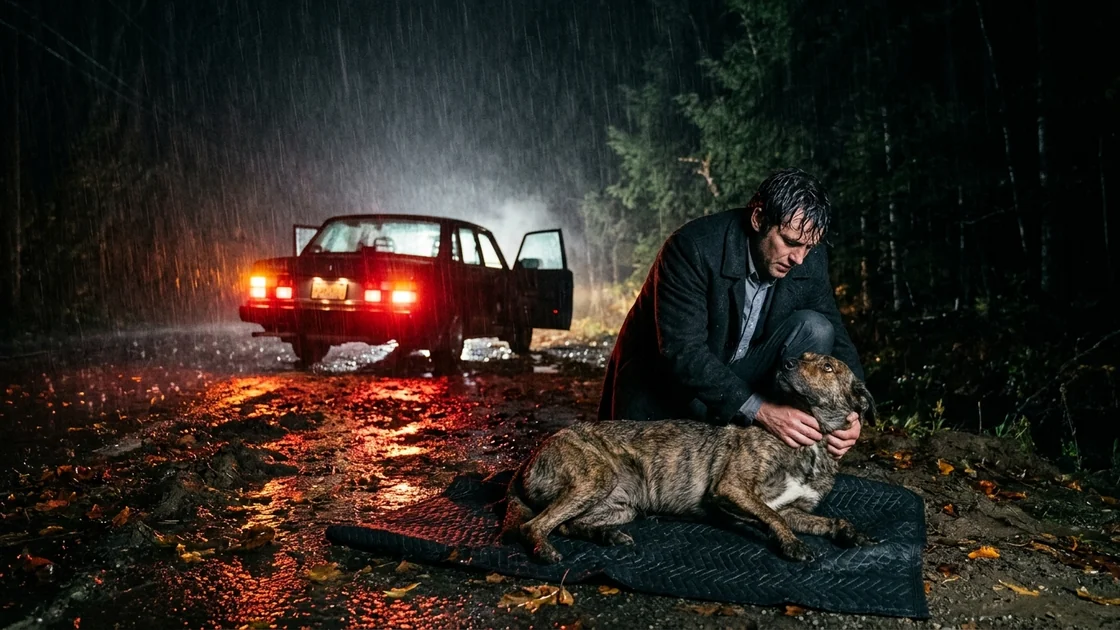
This is the story of Arthur Pendelton, a forty-two-year-old structural engineer whose meticulously ordered life unravels after he accidentally strikes a stray dog on a desolate country road during a torrential autumn rainstorm. While attempting to save the critically injured animal by rushing it to a rural veterinary clinic, the sensory details of the crisis—the smell of wet fur, the frantic rhythm of the windshield wipers, and the desperate battle against mortality—shatter the psychological dam he constructed thirty-four years ago. Through the agonizing hours spent in the sterile waiting room and the subsequent recovery of the dog, Arthur is forced to confront the repressed memories of a fatal childhood tragedy involving his younger brother, Leo, and the cruel, suffocating silence enforced by his abusive father, ultimately leading him toward a fragile, hard-won redemption.
The rain on Route 9 did not merely fall; it assaulted the windshield in thick, diagonal sheets that the aging rubber blades of Arthur’s Volvo could scarcely clear. Each pass of the wipers left a smeared, oil-slick crescent across the glass, catching the glare of his high beams and refracting it into a dizzying web of yellow light. Arthur kept his hands at ten and two, his knuckles pale against the dark leather of the steering wheel. He liked driving at night, usually. He liked the containment of the cabin, the predictable hum of the six-cylinder engine, the way the world outside was reduced to simple geometry: the white line on the right, the double yellow on the left, the measurable distance of the asphalt ahead.
Arthur was a man who lived by measurements. As a senior structural engineer for a firm in Albany, his days were consumed by load-bearing calculations, shear stress, and the precise tolerances of steel and concrete. He knew how much weight a bridge could take before its trusses buckled. He knew the exact point at which tension became fracture. His life was built along similar principles. He lived alone in a house with minimal furniture, ate the same three meals on rotation during the workweek, and avoided emotional deadloads that might compromise his internal equilibrium. He believed, with a quiet, unexamined certainty, that what was not remembered did not have the mass to crush you.
The dashboard clock read 11:42 PM. He was twenty miles south of the county line, returning from a site inspection in the Adirondacks that had run late due to a contractor’s incompetence. The heater was blowing dry, dusty air against his shins, smelling faintly of toasted wiring. Outside, the hemlock and pine forests pressed close to the narrow shoulders of the highway, their dark boughs thrashing in the October gale.
He was rounding a long, banked curve near an abandoned quarry when the geometry of the road failed him.
It happened in the half-second between the sweep of the wipers. One moment the asphalt was an empty ribbon of black mirror; the next, something low, gaunt, and mud-colored lunged from the flooded ditch on the right.
Arthur didn’t have time to calculate stopping distance. Instinct, raw and unmeasured, slammed his right foot onto the brake pedal. The anti-lock system engaged with a violent, mechanical shudder that rattled his teeth. The tires screamed against the wet tarmac, a high, thin sound lost immediately under the roar of the deluge. The Volvo slewed slightly to the left, the headlights sweeping across the wet trunks of the pines, and then came the sound.
It was not a loud sound. It was a dull, heavy thud, like a sack of wet cement dropping from the back of a truck, followed by a brief, metallic scrape against the lower valence of the bumper.
The car slid another thirty feet before coming to a dead stop, straddling the center line. Inside the cabin, the silence was absolute, broken only by the frantic thwack-thwack-thwack of the wipers and the drumming of the rain on the roof. Arthur’s chest was heaving, the seatbelt locked tight against his sternum. His breath came in shallow, ragged gasps that fogged the side window.
For ten seconds, he did not move. A voice in the back of his mind—a cold, pragmatic voice that sounded remarkably like his father’s—told him to put the car in drive. It’s a deer, the voice reasoned. Or a coyote. It’s dead, or it’s in the woods. Stopping on a blind curve in the rain is a hazard. Keep moving. Don't look back.
His hand actually reached for the gearshift. His fingers closed around the cool plastic knob. Looking back was dangerous. Looking back was how things got in.
Then, in the red glow of his taillights reflected in the rear-view mirror, he saw movement. A dark shape was thrashing in the center of the northbound lane, trying to rise on front legs that kept splaying outward on the slick pavement.
A hot, nauseating wave of adrenaline washed through Arthur’s stomach, carrying with it a sudden, phantom smell—not the smell of his car, or the autumn rain, but the sharp, coppery tang of old blood and the suffocating odor of damp earth. His vision blurred for a fraction of a second, the red taillights bleeding into the blackness until they looked like two glowing coals in a dark basement.
"No," Arthur whispered aloud, though he didn't know what he was denying.
He hit the hazard lights. The rhythmic clicking of the turn signal relay—tick-tock, tick-tock—filled the cabin like a countdown. He pushed open the heavy door and stepped out into the storm.
The wind tore at his wool coat immediately, driving needles of icy rain into his face. Within three steps, his dress shoes were soaked through, the frigid water seeping into his socks. He walked toward the back of the car, shielding his eyes against the glare of his own red lights.
It was a dog. A large, mixed-breed creature, perhaps part shepherd, part hound, with a coat of matted wire-haired brindle that was currently plastered to its protruding ribs. It was lying on its side in a shallow puddle that was rapidly turning pink in the intermittent flash of the hazards.
As Arthur approached, the dog lifted its head. Its ears were pinned flat against its skull, and its eyes—wide, amber, and terrifyingly lucid—locked onto him. It didn't growl. It didn't bark. It let out a low, trembling whine, a high-pitched vibration of pure agony and terror, and tried once more to scramble away. Its hindquarters didn't respond. The back legs lay twisted at an unnatural, sickening angle, the left femur clearly shattered beneath the skin.
Arthur froze four feet away. The sound the dog was making—that thin, whistling whimper from the back of the throat—struck a chord deep behind his breastbone. It was a sound that didn't belong to this century. It belonged to a humid August afternoon in 1988. It was the sound of someone trying not to cry because crying brought the belt.
Don't make a sound, Leo. Please. If he hears you, he'll come down.
Arthur pressed the heels of his hands against his temples, his eyes squeezing shut against the rain. The memory had flashed with the violent intensity of a magnesium flare—not a thought, but a physical sensation. He could feel the rough burlap of an old potato sack under his bare knees. He could taste dust.
He opened his eyes. The dog had stopped struggling. Its head had dropped back onto the asphalt, its jaw slightly open, tongue lolling into the gritty water running off the crown of the road. Its sides were heaving like bellows. It was going into shock.
"Okay," Arthur said, his voice cracking over the wind. "Okay, hold on. Just hold on."
He ran back to the trunk of the Volvo, popped the latch, and threw aside his neatly organized canvas tool bag and his hard hat. Underneath was a heavy, quilted moving blanket he used to protect the upholstery when hauling samples. He ripped it out, slammed the trunk, and ran back to the dog.
Kneeling in the freezing water, Arthur spread the blanket beside the animal. His hands were shaking so badly he could barely coordinate his fingers. "I'm sorry," he muttered, the words tumbling out in a frantic, repetitive stream that felt entirely foreign to his mouth. "I'm sorry, I didn't see you. It was dark. You came out of nowhere. I'm so sorry. Don't die. Please don't die."
He expected the dog to snap at him when he slid his hands under its chest and pelvis to roll it onto the blanket. He braced himself for the tear of teeth against his skin, almost welcoming the prospect of physical pain to anchor him to the present. Instead, as his hands made contact with the sodden, mud-caked fur, the dog simply shuddered and pressed its wet muzzle weakly against Arthur’s forearm. The heat radiating from the animal’s body was shocking against the freezing rain.
Arthur gathered the corners of the blanket and lifted. The dog weighed at least sixty pounds, a dead, shifting weight that strained the muscles in Arthur’s lower back. As he hoisted the animal against his chest, a fresh wave of warm, wet heat soaked through his wool coat and dress shirt. Blood. The smell of it—iron and wet dog and swamp mud—filled his nostrils.
He staggered back to the car, wrenched the rear passenger door open, and laid the bundle as gently as he could across the immaculate beige leather of the backseat. The dog let out another sharp, wheezing cry as its broken hip settled, then went terrifyingly still, only the rapid flutter of its ribcage proving it was still alive.
Arthur threw himself back into the driver’s seat, slamming the door shut. He was drenched, shivering violently, his hands smeared with mud and dark crimson. He fumbled in his pocket for his phone, his wet fingers sliding uselessly across the capacitive glass three times before he managed to wipe them on his trousers and unlock the screen.
Veterinary emergency, he typed into the map application.
The blue dot spun. Signal was weak in the valley. For ten agonizing seconds, the screen remained blank, and in the silence of the car, the dog’s ragged breathing sounded like tearing paper.
Come on, come on, come on, Arthur pleaded.
Finally, a pin dropped. Adirondack Valley Animal Hospital – 24 Hour Emergency. Eighteen miles ahead, just outside the town of Glens Falls.
Arthur threw the car into drive and floored the accelerator. The tires spun briefly on the wet pavement before biting in. He drove like a man possessed, taking the curves at sixty miles an hour, the Volvo’s chassis groaning under the lateral G-forces. He didn't look at the speedometer. He kept one hand on the wheel and reached his right arm back between the bucket seats, resting his fingertips lightly on the top of the dog’s wet skull, just between the ears.
"Stay here," Arthur commanded the dark car. "Stay right here. Don't go to sleep. We're almost there. I've got you. I won't let him get you."
He didn't realize what he had said until the words were already hanging in the damp air of the cabin. I won't let him get you.
Who was him? There was no one out there on the road.
Yet, as the headlights bored into the tunnel of falling rain, the darkness beyond the trees seemed to thicken, taking on the shape of a tall, broad-shouldered man standing at the top of a flight of wooden stairs, backlit by the yellow glow of a kitchen doorway, holding a heavy leather strap in his hand.
Who broke the frame? the shadow asked. The voice wasn't in Arthur’s ears; it was vibrating in the bones of his jaw. Arthur? Leo? One of you is going to tell me, or both of you are going to pay for it.
"Shut up," Arthur gasped, his foot pressing harder on the gas. "Just shut up."
Beneath his fingers, the dog whimpered softly, its skull warm and solid, a fragile anchor in a sea of rising black water.
The fluorescent lights of the Adirondack Valley Animal Hospital were blinding after the darkness of Route 9.
Arthur didn't park; he pulled the Volvo directly under the aluminum awning of the entrance, leaving the engine running and the driver’s door wide open. He gathered the dog in the blood-soaked blanket and kicked the glass double doors until a buzzer sounded and a young woman in blue scrubs came running from the back.
"I hit him," Arthur said. His voice sounded hollow, echoing strangely in his own ears, as if he were speaking from the bottom of a well. "On Route 9. About twenty minutes ago. His back legs—I think his pelvis is broken. He’s losing blood."
The technician didn't waste time asking questions. She took one look at the pale, trembling man covered in mud and blood, and then at the gray gums of the dog in his arms. She turned and shouted toward the rear corridor. "Dr. Mercer! Trauma coming in! Large canine, HBC, pale mucous membranes!"
Within thirty seconds, a rolling stainless-steel gurney was pushed into the lobby. A tall man with graying hair and a stethoscope around his neck helped Arthur lay the dog onto the cold metal surface.
As Arthur’s arms were relieved of the weight, he felt a sudden, terrifying lightness, as though without the burden of the dying animal, he might simply float up through the acoustic tiles of the ceiling and disappear. He tried to hold onto the corner of the blanket, his fingers stiff and cramped.
"Sir, you need to let go so we can get a line in him," Dr. Mercer said gently, prying Arthur’s blood-caked fingers away from the quilted fabric. "Is this your dog?"
"No," Arthur said, staring at his hands. The blood was drying in the creases of his palms, turning a rusty brown. "No, he was in the road. He didn't have a collar. Save him. Please. I'll pay for it. Whatever it costs, I have money. Just don't let him die."
"We're going to stabilize him first and see what we're dealing with," the vet said, already moving the gurney toward the double doors marked SURGERY / ICU. "Clara, get his information once we have a catheter placed."
The doors swung shut with a pneumatic hiss, cutting off the view of the dog’s amber eyes, which had remained fixed on Arthur until the very last second.
Arthur stood alone in the middle of the linoleum floor. Puddles of dirty water were forming around his shoes, mixed with pinkish runoff from his coat. The lobby smelled fiercely of chlorhexidine, bleach, and old dog—a sharp, clinical odor that burned the back of his nose.
In the corner, a small television mounted near the ceiling was playing a muted late-night talk show. A display rack held bags of prescription kibble. On the wall hung a corkboard covered in photographs of smiling people with their pets, alongside a smaller section bordered in black ribbon titled The Rainbow Bridge.
Arthur’s knees buckled. It wasn't a faint; it was a structural failure. The columns of his legs simply lost their capacity to bear the load of his torso. He sank down dynamically, his back hitting the base of a row of plastic waiting room chairs, sliding until he was sitting directly on the cold vinyl floor, his knees drawn up toward his chest.
The shivering started in his jaw and quickly spread to his shoulders, his ribs, his thighs. He wasn't just cold; he was freezing from the inside out, as if someone had replaced his marrow with crushed ice.
Why was he reacting like this? He was forty-two years old. He had seen dead animals on the highway hundreds of times. Six years ago, he had hit a deer in Pennsylvania; it had totaled his sedan, and he had waited calmly for the state troopers, filled out the insurance forms with a steady hand, and rented a car to finish his trip. He hadn't cried. He hadn't collapsed on a floor.
It was the sound, his mind whispered. And the eyes.
When the dog had looked at him on the road, terrified of being struck again yet pressing its face into his arm because there was nowhere else to go—that had been Leo.
Arthur buried his face in his wet, dirty knees. He hadn't thought the name Leo in decades. Not truly. Whenever the syllables began to form in the deep recesses of his consciousness, Arthur had a ritual: he would immediately begin calculating the prime factors of whatever four-digit number was nearest to him—a license plate, a digital clock, a street address. He had built a fortress of mathematics around that name, brick by brick, equation by equation, until he had convinced himself the room inside the fortress was empty.
Now, the walls were rubble.
1988. New Hampshire.
They lived in an old farmhouse three miles outside of town, at the end of a dirt road that turned to axle-deep mud every spring and froze into iron ruts every winter. Their mother had left when Arthur was six and Leo was four. She hadn't taken them with her, a fact their father, Thomas Pendelton, reminded them of every time they spilled milk or left a door unlatched. She couldn't stand the sight of you two, he would say, his voice never rising above a flat, gravelly baritone as he methodically cleaned his fingernails with a pocketknife. And I'm the fool she stuck with the bill.
Thomas Pendelton was a carpenter by trade, a man who believed in plumb lines, square corners, and absolute obedience. If a board was warped, you didn't try to bend it into place; you threw it on the burn pile. He viewed his sons through the same lens.
Arthur, being the elder, had learned early how to be straight-grained. He learned how to walk across the pine floorboards of the upstairs hallway without making a single nail squeak. He learned how to read the tension in his father’s shoulders the moment the pickup truck pulled into the gravel driveway at five-thirty. He learned to be invisible, to be useful, to hold the flashlight steady for three hours in the freezing garage without his arm trembling a fraction of an inch.
Leo couldn't learn.
Leo was seven in the summer of 1988. He was small for his age, with a mop of sandy hair that refused to lie flat and a gap between his front teeth through which he whistled when he was happy. Leo was soft. He cried when he scraped his knee; he cried when their father shot the woodchucks that got into the cabbage patch; he forgot to put the cap back on the wood glue; he hummed at the dinner table. Every week, it seemed, Leo did something that required "straightening out."
"Sir? Mr. ...?"
Arthur jerked his head up, gasping as if he had been held underwater. The young technician, Clara, was kneeling a few feet away, holding a thick blue bath towel and a paper cup of water. Her face was etched with concern.
"I turned your car off and brought your keys in," she said softly, setting the keys on the plastic chair beside him. She held out the towel. "You're soaked through. Come sit in the exam room where it's warmer. The heaters in the lobby aren't great."
Arthur stared at her outstretched hand. He wanted to tell her he was fine, to stand up, smooth his coat, and offer her a polite, professional nod. That was what Arthur Pendelton did. Instead, he took the towel with trembling hands and wiped his face, leaving smears of mud on the blue terrycloth.
"The dog," he croaked. "Is he—"
"Dr. Mercer has him on IV fluids and pain medication," Clara said. "His vitals are stabilizing, which is a good sign. He’s a tough old guy. They’re getting ready to take some X-rays now to see the extent of the damage to his pelvis and check for internal bleeding. Dr. Mercer will come talk to you as soon as he has the films."
"Pain medication," Arthur repeated numbly. "He's not hurting right now?"
"No, sir. He's got a heavy dose of fentanyl onboard. He's resting comfortably."
Something in Arthur’s chest loosened by a fraction of an inch, allowing him to draw his first full breath since the curve on Route 9. He allowed the girl to help him up. His joints popped, aching from the cold and the violent tension of the drive. He followed her into Exam Room 2, a small, windowless cubicle with a stainless-steel table in the center and a single vinyl bench against the wall.
Clara brought him a scrub top to replace his wet shirt and a cup of black coffee in a Styrofoam cup, then left him alone, closing the door quietly behind her.
Arthur didn't put on the scrub top. He sat on the bench, wrapped the blue towel around his shoulders over his damp undershirt, and held the hot coffee cup between his palms without drinking it.
In the quiet of the small room, with only the hum of the ventilation system overhead, the fortress didn't just crumble; the ground beneath it gave way entirely.
It had begun with a stray dog. That was why the lock had broken tonight. The symmetry was too violent for his mind to ignore.
In late July of 1988, a dog had wandered onto the Pendelton property. It was a small, yellow mongrel, probably dumped by summer tourists heading back to Boston. It had a crooked tail that looked like it had been caught in a door once, and one ear that flopped over the center of its forehead.
Leo had found it hiding under the old floorboards of the collapsed barn at the edge of the pasture.
When Leo showed Arthur, Arthur’s immediate reaction had been terror. "You have to chase it off," nine-year-old Arthur had said, looking nervously back toward the house, even though their father was at a job site twenty miles away. "Throw rocks at it, Leo. If Dad comes home and sees it here, he'll shoot it. You know he will. He said no animals that don't earn their keep."
"He won't see him," Leo had pleaded, his dirty hands buried in the yellow dog's scruff. The dog was licking Leo’s chin frantically, its whole skinny body wagging along with its crooked tail. "He stays under the barn, Artie. He doesn't bark or nothing. Look, he knows how to be quiet. I gave him my crusts from breakfast. Please, Artie. He's my friend. I don't got any friends out here."
It was true. Because they lived so far out, and because Thomas Pendelton didn't allow other children on his property ("liability and noise," he called them), the boys spent the entire summer vacation in total isolation. While their father worked, they were given a list of chores—stacking two cords of firewood, weeding the half-acre vegetable garden, scraping peeling paint off the shed—and heaven help them if the list wasn't finished by five-thirty.
Looking at his brother’s face, radiant with a joy Arthur hadn't seen since before their mother packed her blue suitcase, Arthur had relented. He had made a miscalculation. He had allowed an unaccounted-for variable into the structure of their survival.
"Okay," Arthur had said. "Okay, you can feed him your scraps. But he stays at the barn. If he comes near the porch, I'll chase him into the woods myself. Understand? And you don't name him. If you name him, you'll get stupid about him."
Leo had nodded solemnly, crossing his heart. Of course, he had named the dog within ten minutes. He called him Barnaby.
For two weeks, those were the happiest days of Leo’s short life. The boys would finish their chores with frantic speed, working until their hands were blistered and their backs ached under the July sun, just to buy two hours of afternoon freedom down by the ruined barn.
Even Arthur had softened. The yellow dog was remarkably gentle. While Leo chattered endlessly to him, building little forts out of rotten cedar shingles and telling Barnaby elaborate stories about astronauts and knights, the dog would often come over and rest its chin on Arthur’s knee, looking up at the older boy with dark, liquid eyes that seemed to understand the crushing weight of responsibility nine-year-old Arthur carried. For a few hours a day, Arthur stopped calculating. He stopped listening for the crunch of gravel on the road. He laughed when Barnaby chased grasshoppers through the tall timothy grass, snapping his jaws at the empty air.
Then came the second Tuesday in August.
The rain had started in the afternoon—a heavy, unseasonable cold front pushing down from Canada, much like the storm tonight. Because of the rain, their father’s crew had been rained out of a framing job in Conway.
The pickup truck pulled into the driveway at three-fifteen.
Arthur and Leo weren't at the barn; they were in the cellar of the main house. It had been raining so hard that the crawlspace under the barn had flooded, and Leo, terrified that Barnaby would drown or freeze, had committed the ultimate sin: he had snuck the wet, muddy dog into the house through the bulkhead doors of the basement while Arthur was upstairs using the bathroom.
When Arthur came down the cellar stairs and saw the yellow dog sitting on a pile of old burlap potato sacks behind the oil furnace, he had gone pale with fury and fear. He was in the middle of dragging the dog back toward the bulkhead doors when they heard the low, unmistakable rumble of the Ford F-150’s muffler outside, followed by the slam of the cab door.
"He's home," Leo whispered, all the color draining from his freckled face. "Artie, he's home early."
"Get him out!" Arthur hissed, shoving the dog toward the sloped wooden doors that led up to the yard. "Push him out into the woods!"
They were too late. The bulkhead doors were on the driveway side of the house. Through the high, grime-crusted casement window of the cellar, Arthur saw his father’s heavy work boots walk right past the bulkhead, heading toward the back porch steps. If they opened those wooden doors now, the rusted hinges would screech, and he would see them immediately.
Above them, the heavy back door slammed shut. Footsteps—slow, deliberate, heavy—crossed the kitchen linoleum directly over their heads.
Thomas Pendelton had been drinking. Arthur knew it instantly from the cadence of the steps. When their father was sober, his stride was brisk, clipped, efficient. When he had stopped at the tavern on Route 16 because a job got rained out, his steps dragged slightly at the heel, heavier, like a pile driver settling into mud.
In the cellar, the three of them froze behind the massive, rusted hulk of the furnace. The basement was dark, lit only by a single bare forty-watt bulb hanging from a frayed wire near the stairs, and smelled permanently of damp earth, fuel oil, and rotting turnips from the root bin.
Leo was on his knees on the dirt floor, his arms wrapped tightly around Barnaby’s neck, his face buried in the dog’s wet fur. "Be quiet, Barnaby," Leo breathed, so softly it was barely air moving over his lips. "Please be a good boy."
Above them, the refrigerator door opened and closed. The pop of a beer can tab echoed faintly through the floorboards. Then, silence.
For five minutes, nothing happened. Arthur began to hope that his father would go into the living room, turn on the television, and fall asleep in his recliner, as he sometimes did on rainy afternoons. Once he was snoring, they could grease the bulkhead hinges with lard from the pantry and slip the dog out.
Then, footsteps crossed the kitchen again. The door at the top of the cellar stairs clicked open.
Yellow light from the kitchen spilled down the steep, open-backed wooden steps, cutting a sharp diagonal across the dirt floor.
"Arthur?" Thomas’s voice boomed down into the gloom. "Leo? Why aren't the weeds pulled in the squash patch? I just walked past it. Half a row left."
Arthur stepped out from behind the furnace, careful to position his body so that he blocked the line of sight to the dark corner where Leo was crouched. His heart was hammering so hard against his ribs he was sure his father could see his T-shirt moving.
"It started raining real hard, Dad," Arthur called up, keeping his voice steady, respectful, pitched to the exact frequency his father required. "The dirt turned to mud. When we pulled the weeds, it was pulling the squash roots right up with 'em. I figured you wouldn't want the vines ruined, so we came down here to sharpen the hoes and clean the workbench."
It was a good lie. It was a structural lie—logical, practical, appealing to his father’s sense of thrift and maintenance.
At the top of the stairs, Thomas stood in silhouette. He was a big man, six-foot-two, with forearms like cured hams under his flannel sleeves. He took a slow sip from his can. "You sharpening 'em in the dark?"
"Light's right here, Dad," Arthur said, gesturing to the forty-watt bulb. "Plenty to see the file by."
Thomas grunted. He seemed satisfied. He turned half away from the doorway, about to pull the door shut.
Down in the dark behind the furnace, a drop of cold condensation fell from an overhead copper pipe and landed squarely inside the ear of the yellow dog.
Barnaby shook his head violently. The wet leather of his ears slapped together with a loud, rapid flap-flap-flap-flap, and he let out a low, half-strangled sneeze, followed by a joyful little yip as he saw another person at the top of the stairs.
In Exam Room 2, forty-two-year-old Arthur Pendelton dropped the Styrofoam cup. Dark coffee splashed across the sterile linoleum, soaking into the cuffs of his trousers. He didn't notice. He had both hands clamped over his ears, his eyes wide and blind, staring at the stainless-steel examination table as the sound of his father’s boots coming down the wooden stairs echoed through thirty-four years of silence.
Thud. Thud. Thud. Thud.
Thomas didn't run down the stairs. He never ran. He descended with the inexorable gravity of a rockslide.
"What have you got behind that furnace?" Thomas asked. He reached the bottom step and walked past Arthur as if the boy were made of smoke.
Arthur tried to grab his father’s flannel shirt, a suicidal impulse born of sheer panic. "Dad, it's just—it came in out of the rain, we were just gonna—"
The back of Thomas’s left hand caught Arthur across the cheekbone without the man even looking at him. It wasn't a punch; it was a brush-off, like swatting a horsefly, but the sheer mass of the carpenter’s arm sent nine-year-old Arthur flying sideways into the wooden support post of the stairs. His head struck the six-by-six beam with a crack that filled his vision with white stars. He collapsed onto the dirt floor, half-stunned, his mouth filling with the salty taste of blood from a cut on the inside of his cheek.
Through the ringing in his ears and the swimming blur of his vision, Arthur watched his father step behind the furnace.
"No! Daddy, no, he's good! He doesn't eat anything!" Leo’s voice was a high, shrill shriek of pure terror. "He's mine! He doesn't cost any money! Please!"
"A dog," Thomas said. His voice was terrifyingly calm, almost conversational. "You brought a filthy, flea-bitten stray into my house. And you lied to my face about it, Arthur."
"Arthur didn't do it!" Leo screamed, trying to shield the yellow dog with his small body. "I brought him in! Hit me! Don't hurt him, hit me instead!"
Thomas reached down. With one massive hand, he grabbed Leo by the collar of his T-shirt and yanked him backward, throwing the seven-year-old across the cellar floor where he landed in a heap near the root bin, scraping his elbows raw on the gravel-packed dirt.
With his other hand, Thomas grabbed Barnaby by the loose skin at the back of his neck and lifted him off the ground. The dog yelped, its hind legs pedaling frantically in the air, its crooked tail tucked tightly against its belly, urine spraying across the dirt floor in its terror.
"No! Barnaby! Put him down!" Leo was scrambling back on his hands and knees, sobbing so hard he was choking. He lunged for his father’s legs, wrapping his arms around Thomas’s mud-caked work boots. "Please, Daddy, I'll do all the chores! I won't eat supper for a week to pay for him! Please!"
Thomas kicked his leg free, sending Leo sprawling onto his stomach. He didn't reach for his belt. He didn't yell. He carried the dangling, yelping dog over to the wooden bulkhead doors. With his free hand, he threw the iron slide-bolt back and shoved the heavy wooden doors open with his shoulder.
Rain poured down the stone steps into the cellar, grey and torrential.
"Lock the cellar door when I go out, Arthur," Thomas said over his shoulder as he climbed the stone steps into the yard, holding the thrashing dog at arm's length. "Neither of you comes up until I say so."
"Where is he taking him?!" Leo screamed, scrambling toward the open bulkhead.
Arthur, his head throbbing viciously, found his legs. He knew where their father was taking the dog. Behind the woodshed was the chopping block and the heavy iron maul used for splitting oak logs, or perhaps the old steel water trough that stayed full of green rainwater all summer. Thomas wouldn't waste a twenty-two cartridge on a stray if he didn't have to.
Arthur tackled his brother at the bottom of the wet stone steps just as Thomas let the heavy wooden bulkhead doors slam down from the outside. A second later, they heard the heavy iron hasp drop over the staple on the outside of the doors, followed by the click of a padlock.
They were locked in from both sides—or would be, as soon as Thomas walked back into the kitchen and threw the bolt on the top of the stairs.
"Let me go! Artie, let me go!" Leo was fighting like a wild animal, scratching at Arthur’s face, kicking at his shins, his small fists pummeling Arthur’s chest. "He's gonna kill him! He's gonna hurt Barnaby! We have to help him!"
"We can't!" Arthur sobbed, pinning his brother to the muddy floor at the base of the stone steps, using all his nine-year-old weight to hold Leo down. Outside, muffled by the rain and the thick wood of the bulkhead, they heard a single, sharp yelp from the direction of the woodshed, and then nothing at all. Only the roar of the rain.
Arthur felt the moment the sound reached Leo. The younger boy went rigid beneath him, his back arching, before all the fight drained out of his small muscles at once, leaving him limp and shuddering in the mud.
"He killed him," Leo whispered, his eyes wide and staring at the dark joists of the cellar ceiling. "Artie, he killed him."
Above them, the back door opened and slammed shut again. Boots crossed the kitchen floor. They went to the cellar door at the top of the wooden stairs. The brass bolt slid home with a heavy, final clack.
Arthur rolled off his brother and sat up against the cold stone foundation wall, holding his bruised jaw. "Don't make a sound, Leo," Arthur whispered, terrified that if Leo kept screaming, their father would come back down with the length of rubber heater hose he kept hung on a nail in the mudroom. "Please. If he hears you, he'll come down. We just have to wait till tomorrow."
Leo didn't scream. He curled into a ball on the damp dirt floor, his face pressed against the burlap sacks that still smelled of the yellow dog, and he cried silently, his small shoulders jerking in the dim yellow light of the forty-watt bulb.
That was the memory Arthur had thought he was running from. If the story had ended there—a cruel man, a dead dog, two terrified boys in a basement—Arthur might have survived it intact. People survived cruelty.
Wait.
In the veterinary exam room, Arthur frowned through his tears. His chest was still tight; the air was still refusing to go all the way down into his lungs. The pressure behind his eyes hadn't abated; it was building, pushing against the back of his skull with a force that made him want to vomit.
Why did I say "I won't let him get you" to the dog in the car? Arthur thought franticly. Why did I remember the red taillights looking like coals?
There weren't any coals in the furnace in August. The furnace wasn't running.
The red lights... the red lights were the indicator lamps on the old chest freezer in the back corner of the basement. And the small, red nightlight plugged into the socket by the fuse box.
Why had the forty-watt bulb gone out?
"Oh, God," Arthur gasped, his hands dropping from his ears to clutch at the front of his damp undershirt, tearing at the cotton as if it were strangling him. "No. No, that's all there was. He locked us in, and in the morning he let us out. That's what happened. That's what I told the trooper."
The trooper?
Why had there been a state trooper at the house if it was just a stray dog?
The exam room door clicked open.
Dr. Mercer walked in, carrying a tablet computer in one hand. He stopped short when he saw Arthur sitting on the floor in a puddle of cold coffee, his face grey, sweat pouring down his temples despite the chill in the room, hyperventilating.
"Mr. Pendelton?" Dr. Mercer knelt quickly beside him, his medical training taking over even if his usual patients had four legs. He placed a warm, steady hand on Arthur’s shoulder. "Hey. Breathe with me. In through the nose, out through the mouth. You're having a panic attack. You're in shock from the accident."
Arthur grabbed the veterinarian’s wrist. His grip was vise-like. "Did he die?" Arthur whispered, his eyes wild, unfocused, looking through Dr. Mercer’s grizzled face at the dark joists of a New Hampshire cellar. "Did I let him die in the dark?"
"No," Dr. Mercer said firmly, meeting Arthur’s eyes and holding them. "No, he's alive. Listen to me. The dog is alive. He's awake in his cage right now, looking around."
Arthur blinked. The fluorescent lights of Exam Room 2 slowly reasserted themselves over the forty-watt bulb. The smell of turnips and fuel oil receded slightly, replaced by the sharp sting of antiseptic and spilled coffee.
"He's... he's awake?" Arthur’s voice was a pathetic whisper.
"Yes. Let's get you up onto the bench. Come on." Dr. Mercer hoisted Arthur up by the arm and got him seated on the vinyl bench, then grabbed a roll of paper towels from the dispenser by the sink and tossed them onto the spilled coffee on the floor. He didn't call for help or make a fuss; he had seen plenty of big, stoic rural men fall completely apart in this room over the years.
Once Arthur’s breathing had slowed from a ragged pant to a shaky, uneven draw, Dr. Mercer pulled over a rolling stool and sat down opposite him, holding up the tablet.
"Okay," the vet said calmly. "Here is the situation with your stray. First of all, you getting him here as fast as you did saved his life. He was in hypovolemic shock from blood loss and pain, and the hypothermia from lying in that freezing rain was accelerating it. Another twenty minutes on that road, and we wouldn't be having this conversation."
Arthur swallowed hard, nodding once. He looked at the X-ray glowing on the tablet screen. Even to a structural engineer, the geometry was clear—and catastrophic. The white bones of the pelvis and the left femur looked like a bridge truss that had suffered a direct hit from a demolition ball.
"The good news," Dr. Mercer continued, pointing with a pen to the upper cavity on the image, "is that his lungs are clear, his diaphragm is intact, and the ultrasound showed no free fluid in his abdomen. His spleen and liver were spared. The bleeding was all from a deep laceration on his inner thigh where the bumper caught him, which we've already sutured and packed."
"And his legs?" Arthur asked.
"His right hind leg is bruised and sprained, but intact. The left femur has a comminuted fracture, and the pelvis is fractured on the left ilium." Dr. Mercer lowered the tablet. "It's repairable, Mr. Pendelton. It requires orthopedic surgery—plates and screws to rebuild the femur and stabilize the pelvis—followed by at least eight weeks of strict crate rest and physical therapy. Because he's a stray, normally in a case like this, if nobody steps forward to claim responsibility, the town animal control officer authorizes humane euthanasia. The county doesn't have five thousand dollars in the budget for orthopedic reconstruction on an unowned dog."
"No," Arthur said instantly. The word came out like a gunshot. "No euthanasia. You don't put him down. I told you out there—I'll pay for it. Give me the forms right now. I have a credit card in my wallet with a thirty-thousand-dollar limit. Do the surgery."
Dr. Mercer studied Arthur for a long moment. "Alright. I can perform the surgery tomorrow morning once he's completely stable for general anesthesia. Tonight, we keep him warm, keep his pain managed, and let his blood pressure normalize. After the surgery, though, he's going to need somewhere to go. A shelter kennel isn't a great place for an eight-week orthopedic recovery."
"I'll take him," Arthur said. He didn't think about his immaculate, minimalist house. He didn't think about his twelve-hour workdays or the beige carpets. "He comes home with me. He's mine now."
A small, genuine smile touched the corners of the vet's mouth. "Okay then. He's a lucky dog, considering he just got hit by a Volvo. Do you want to come back to the ICU and see him for a few minutes before you head home to get some dry clothes? He's pretty groggy, but it might do you both some good."
Arthur hesitated. Every instinct of self-preservation he had honed over thirty-four years screamed at him to pay the bill at the front desk, get in his car, drive home, take two sleeping pills, and rebuild the wall in his mind before the rest of that night in 1988 forced its way into the light.
If he went back there and looked at that dog—bandaged, broken, lying in a cage—he knew the wall wouldn't hold.
"Yes," Arthur said, standing up on shaky legs. "I want to see him."
The ICU was a large, rectangular room lined with stainless-steel cages of varying sizes. The lights were dimmed here to allow the animals to rest, leaving the room bathed in the soft, rhythmic glow of digital infusion pumps and vital-sign monitors.
Beep... beep... beep...
And the red digital numbers on the fluid pumps. Red lights in the dark.
Dr. Mercer led Arthur to a large, floor-level run at the back of the room. Inside, lying on a thick orthopedic pad covered in fleece blankets, was the brindle dog.
They had cleaned the mud and blood from his coat, revealing a handsome, graying muzzle that suggested he was at least six or seven years old. A plastic Elizabethan collar was fitted around his neck, and his left hindquarter was shaved bare, painted bright orange with surgical scrub, and wrapped in a bulky Robert Jones bandage. An IV line ran from a shaved patch on his right foreleg up to a bag of lactated Ringer's solution hanging outside the bars. A heating pad was tucked beneath the fleece, and a heavy towel was draped over his shoulders.
Dr. Mercer unlatched the gate and swung it open. "Go ahead. Just don't let him try to stand up."
Arthur lowered himself slowly onto the floor outside the open cage door, sitting cross-legged on the cold concrete so he was at eye level with the dog.
At the sound of his movement, the dog’s ears twitched. Slowly, fighting the heavy fog of the narcotics, the animal lifted its head an inch off the pad. Its amber eyes focused on Arthur.
There was no fear in them now. The frantic, drowning terror from the center line of Route 9 was gone. In its place was a deep, exhausted recognition. The dog looked at the man who had broken him, and the man who had carried him out of the rain, and let out a long, shuddering sigh through his nose. The tip of his tail gave a single, weak thump against the fleece pad before his head sank back down, his muzzle resting near Arthur’s knee.
Arthur reached out a hand that had finally stopped shaking. He laid his palm gently against the warm, rough fur of the dog’s neck, feeling the steady, strong pulse of the carotid artery beneath the skin.
He’s warm, Arthur thought. He’s warm, and he’s breathing.
Leo hadn't been warm.
The thought didn't come like an explosion this time. It came quietly, inevitably, like water rising through floorboards until there was nowhere left to stand. Sitting there on the concrete floor in the dim, red-lit quiet of the ICU, with his hand on the living dog, Arthur finally stopped doing the math. He stopped factoring the primes. He let the forty-watt bulb in the basement go out.
August 1988. Night.
They had been in the cellar for four hours when the thunderstorm knocked out the power lines on the ridge.
The forty-watt bulb above the stairs flickered twice, turned a dull orange, and died. Simultaneously, the low hum of the chest freezer in the corner stopped, its little red power light vanishing, and the red nightlight by the fuse box went black.
The darkness in the cellar was absolute. It was a physical substance, thick and suffocating, smelling of wet stone and earth.
Upstairs, they hadn't heard their father move for hours. After locking the cellar door, Thomas had gotten back into his truck—Arthur had heard the engine start through the casement window—and driven back toward town, back to the tavern on Route 16, leaving them locked in the pit below the empty house.
At first, when the lights went out, Leo hadn't reacted. He had been lying on the burlap sacks behind the dead furnace in a state of catatonic grief since the sound behind the woodshed.
Then, about twenty minutes after the power failed, the cellar began to flood.
The old farmhouse was built in a hollow at the base of a granite ridge. Normally, when it rained hard, an electric sump pump set into a pit in the corner of the cellar floor kicked on every ten minutes to pump the groundwater out through a PVC pipe into the pasture. Without electricity, the sump pump was dead iron.
Arthur felt it before he saw it: the icy creep of water soaking through the knees of his jeans. Within half an hour, there were three inches of freezing, muddy runoff covering the cellar floor, washing over the burlap sacks, carrying floating bits of sawdust and dead beetles.
"Artie?" Leo’s voice came out of the pitch blackness, small and trembling. He was shivering violently; his T-shirt had been soaked earlier when he tried to reach the bulkhead doors, and the basement air was fifty degrees. "Artie, there's water. I can't see."
"I'm here," Arthur said, splashing through the rising water to find his brother by touch. He grabbed Leo’s icy hands and pulled him up toward the wooden stairs. "Come sit on the steps. The water won't get up the steps."
They climbed halfway up the steep staircase and sat together on the narrow pine treads, huddled side by side in the dark, listening to the water gurgle as it poured in through the cracks in the fieldstone foundation and cascaded down the stone steps behind the locked wooden bulkhead doors.
An hour passed. Then two. Outside, the storm raged on, lightning occasionally flashing through the tiny, mud-splattered casement window near the ceiling, illuminating the black, rising mirror of water below them for a fraction of a second before plunging them back into blindness.
Leo wouldn't stop shaking. His teeth were chattering so hard Arthur could hear them clicking in the dark between claps of thunder.
"Artie, we have to get out," Leo whispered. His voice sounded strange—thin and breathless. "I have to go find Barnaby. Maybe Dad just tied him up in the woodshed. Maybe he's out there in the rain waiting for me."
"Leo, don't be stupid," Arthur said, his own fear making him harsh, making him sound like the man who owned the house. "You heard him. You know what Dad did. And the doors are locked. Just sit still and be quiet."
"No," Leo whimpered. "Maybe Dad just hit him once to scare him and chased him into the woods. If he's hurt in the woods, he'll die in the cold. I promised him I'd take care of him, Artie. I crossed my heart."
"Leo, sit down!"
In the dark, Leo stood up on the narrow step. "The window," Leo said, his voice suddenly frantic with a desperate, seven-year-old plan. "The little window over the workbench. The latch is broken on it, remember? You're too big to fit through it, Artie, your shoulders are too wide, but I can squeeze through! I can climb onto the workbench, push the window open, and crawl out into the yard! Then I can take the padlock off the bulkhead—Dad always leaves the key on the nail under the eaves—and I can find Barnaby!"
"No!" Arthur reached out in the blind dark to grab his brother’s belt, to pull him back down onto the steps. "Leo, the workbench is covered in Dad's tools, and the floor is under water! You can't see anything! Sit down!"
Leo pulled away. His wet T-shirt tore slightly in Arthur’s grasp, and then he was gone, splashing down the steps into the calf-deep, freezing water.
Wait. No.
In the ICU of the animal hospital, Arthur’s breath hitched. His fingernails dug into the palm of his free hand until they drew blood.
Did Leo pull away?
Look at the truth, Arthur. Calculate the load. Don't lie about the numbers.
Why hadn't Arthur gone down the steps after him to drag him back? Arthur was nine; he was a head taller and twenty pounds heavier than Leo. He had pinned Leo to the floor earlier that afternoon without any trouble. Why had he stayed sitting on the dry fourth step in the dark while his seven-year-old brother splashed across the flooded cellar toward the workbench?
Because Arthur was freezing, too. Because Arthur was terrified of the dark cellar. And because a small, cold voice in nine-year-old Arthur’s head—the survival calculator—had whispered: If Leo crawls out that window and unlocks the kitchen door from the inside before Dad gets home, we can get dry clothes and say the latch on the cellar door didn't catch right. And if Dad comes home while Leo is doing it, it'll be Leo who broke the window. Not me.
Arthur hadn't pulled him back. Arthur had let go of the shirt.
"Be careful of the saws on the wall," nine-year-old Arthur had whispered into the dark from the safety of the stairs. "Hurry up."
In the pitch black, Arthur listened to the splashes as Leo waded across the basement. He heard the scrape of an overturned five-gallon paint bucket as Leo used it as a stepping stool to climb onto the high wooden workbench beneath the casement window.
A flash of lightning briefly lit the cellar. In that strobe-light instant, Arthur saw Leo standing on his tiptoes on the cluttered, greasy surface of the workbench, his small hands pushing upward against the stuck wooden frame of the narrow casement window.
Below the workbench, resting on two iron brackets just above the waterline, was a pile of leftover materials from a job Thomas had finished the week before: three-foot lengths of concrete reinforcing bar—half-inch steel rebar, jagged where they had been sheared with a bolt cutter—and an open toolbox full of chisels and auger bits.
Thunder shook the foundation. The cellar went black again.
"It's stuck, Artie," Leo grunted in the dark, straining against the swollen wood of the window frame. "Hold on, I got it moving—"
There was a loud crack as the painted seal of the window finally gave way, flying outward quicker than Leo expected. At the same moment, the wet sole of Leo’s sneaker slipped on a patch of spilled motor oil on the workbench.
There was a sharp, terrified gasp in the dark. The clatter of an aluminum level knocking against the stone wall. The sound of a small body falling backward from a height of four feet.
And then a dull, heavy thud.
It wasn't a splash. He hit the rack beneath the workbench before he hit the water.
In the silence that followed, broken only by the steady drip-drip-drip of rainwater coming through the now-open casement window above, Arthur heard a sound he would spend the next thirty-four years building bridges to drown out.
A low, trembling whine. A high-pitched, bubbling vibration from the back of a throat that couldn't draw air because a rusted piece of half-inch rebar had gone three inches into the base of a seven-year-old skull and through the side of his neck.
"Leo?" Arthur called from the stairs.
Only the bubbling whimper answered him, followed by the weak thrashing of small sneakers kicking against the side of the submerged metal toolbox, trying to rise, splaying outward in the dark water.
Arthur scrambled down the stairs then. He plunged into the freezing water, screaming his brother’s name, wading blindly to the workbench. When his hands found Leo in the dark, pulling him off the iron rack and into his lap in the six inches of icy floodwater, the heat pouring out of Leo’s neck was shocking against the cold water. It soaked Arthur’s chest, his arms, his hands.
When the lightning flashed again through the open window above them, the water around Arthur’s knees was pink, and Leo’s eyes were wide, amber-brown in the brief light, looking right at his big brother in total, helpless confusion before they went completely still.
Arthur sat in the freezing water in the pitch dark, holding his dead brother’s head above the floodline on his knees, for six hours.
"Stay here," nine-year-old Arthur had whispered to the dark basement over and over until his voice was gone, his hand resting between his brother’s cold ears. "Stay right here, Leo. Don't go to sleep. I've got you. I won't let him get you."
In the back of the veterinary clinic, Arthur Pendelton wept.
He didn't cry like a movie character, with neat tears running down a stoic face. He wept like the nine-year-old boy who had never been allowed to make a sound. He doubled over on the concrete floor beside the dog's cage, his forehead pressed against the cold steel bars, and he wailed—a raw, tearing, primal agony that wrenched itself up from the bottom of his lungs, thirty-four years of concrete and steel fracturing all at once.
The stray dog didn't flinch at the noise. Drugged and broken as he was, he shifted his front paws an inch closer to the open gate of the cage and pressed his dry nose against the top of Arthur’s bowed head, breathing warm, steady puffs of air into the man’s graying hair.
When Thomas Pendelton had finally come home at dawn, reeking of whiskey and stale cigarette smoke, and unlocked the cellar door to find the basement flooded and his younger son dead in his older son’s arms, the carpenter hadn't cried either.
He had stood on the third step for five minutes in silence, looking down at the body and the open window.
Before he walked back upstairs to call the state police on the rotary phone in the kitchen, he had looked at Arthur—whose hair was matted with his brother’s blood and whose skin was blue with hypothermia—and spoken the sentence that had sealed the tomb for over three decades:
You tell that trooper you were both asleep on the stairs and you didn't hear him get up. If you tell them I locked that door, or about that goddamn dog, they'll put me in the state prison in Concord and you'll go to an orphanage where they beat you twice as hard. You keep your mouth shut, Arthur. What’s done is done. Looking back won't fix the frame.
And Arthur had kept his mouth shut. He had nodded at the trooper. He had gone to the funeral in a borrowed suit that was too big for him. He had grown up, gone to college on scholarships, watched his father die of cirrhosis in a VA hospital in 2004 without saying ten words to the old man at his bedside, and become an engineer who never looked back.
Because if he looked back, he didn't just see his father locking the door. He saw himself letting go of Leo’s shirt on the stairs.
Dr. Mercer appeared quietly at the entrance to the ICU. He saw Arthur collapsed against the cage, sobbing into the dog’s fur, and wisely stepped back into the corridor, pulling the door mostly shut to give the man his privacy.
Arthur stayed on that floor for forty minutes until there was nothing left inside him to tear loose.
Slowly, the convulsions in his chest subsided. He sat up, wiping his swollen, wet face on the sleeve of the borrowed scrub top he had finally pulled over his head. He felt hollowed out, exhausted to the point of nausea, as if he had survived a structural collapse and had just crawled out from beneath three tons of masonry.
Yet, for the first time since August of 1988, the air went all the way to the bottom of his lungs. The phantom smell of basement dirt and rotting turnips was gone. He smelled only dog, and fleece, and antiseptic.
He looked down at the brindle hound. The dog’s eyes were half-closed now, drifting back into a narcotic sleep, though its muzzle still rested against Arthur’s knee.
"I let go of his shirt," Arthur whispered to the dog. There was no one else in the world he could ever say it to, and somehow, the dog was the only one who had the authority to hear it. "I was scared, and I was nine years old, and I let him climb up there in the dark."
The dog inhaled deeply and let out a low, rumbling sigh, his eyebrow twitching slightly as he dreamed.
You were nine, the silence of the room seemed to answer. Not in Thomas Pendelton’s voice, and not in the cold voice of the engineer’s calculator, but with the simple, undeniable reality of physics. A nine-year-old child is not designed to bear the load of a drunken father and a flooded basement. The truss hadn't failed because it was flawed; it had failed because the weight placed upon it was monstrous.
Arthur reached out and gently stroked the rough fur between the dog’s ears.
"I'm going to call you Barnaby," Arthur said, his voice hoarse and raw, but steady. "Even if it makes me stupid about you."
The next three days were a strange, suspended reality for Arthur.
For the first time in fifteen years at his firm, he called in sick for the remainder of the week, offering no elaborate explanation to his stunned managing partner beyond, "I had an accident on Route 9. I'm dealing with the aftermath."
On Thursday morning, while Dr. Mercer spent three hours in the operating room fitting a stainless-steel dynamic compression plate and seven cortical screws to Barnaby’s shattered femur, Arthur drove home in the daylight.
Passing the curve near the abandoned quarry on Route 9, he slowed the Volvo and pulled onto the wide gravel shoulder. The storm had passed, leaving behind a crisp, brilliant October morning. The sky was a sharp, cloudless cerulean, and the wet needles of the pines glistened in the sun. The rain had washed the asphalt completely clean; there was no blood left in the center lane, only a faint black skid mark where his tires had locked.
Arthur sat on the shoulder for five minutes, looking at the ditch where the dog had emerged, and then put the car in gear and drove home.
His house—a renovated 1920s craftsman bungalow in a quiet neighborhood that he had previously kept looking like an uninhabited architectural museum—required immediate retrofitting. The engineer in him woke up, not to build walls this time, but to solve a problem of care.
He spent Friday afternoon at a home improvement store and a pet supply warehouse. He bought six rolls of rubber-backed runner rugs and laid them over every square inch of his polished hardwood floors so that a three-legged dog wouldn't slip when learning to walk again. He disassembled the minimalist glass coffee table in his living room—a hazard of sharp corners—and stored it in the basement. In its place, right in front of the large picture window that looked out onto the backyard maples, he set up an extra-large wire recovery crate, lining the bottom with four inches of memory foam and two washed cotton blankets.
He built a ramp out of pressure-treated two-by-fours and plywood over the three concrete steps leading from his back deck into the fenced yard, calculating the incline to a gentle twelve-degree slope and covering the surface with outdoor carpet for traction.
As he knelt on the damp grass in the late afternoon sun, driving the final deck screws into the ramp with his cordless drill, Arthur paused. He looked at his hands holding the carpenter’s square and the level.
He had always hated tools with wooden handles or steel blades because they were his father’s instruments. That was why he had gone into structural engineering—designing on computers and paper, staying high above the sawdust and the nails.
Now, running his thumb over the smooth, chamfered edge of the pine handrail he had just planed so it wouldn't splinter, he realized that wood and nails weren't evil. A ramp was just a structure. You could use the exact same knowledge to build a cage in a cellar, or to build a bridge so a broken creature could reach the grass in the sun. The material didn't care; the builder decided.
On Saturday afternoon, he brought Barnaby home.
It took both Arthur and Clara to lift the sixty-pound dog into the back of the Volvo using a heavy nylon sling positioned under the animal’s belly to support his hindquarters. Barnaby was wearing his plastic cone, and his left leg was bare and Frankensteinian, a twelve-inch line of black nylon sutures running down the shaved gray skin from hip to knee, swollen and bruised purple around the incision.
He came home with a plastic bag containing four different pill bottles: tramadol for pain, cephalexin to prevent bone infection, carprofen for inflammation, and trazodone to keep him sedated if he became too restless in the crate.
Dr. Mercer had handed Arthur a printed discharge packet and a resources sheet that included a link to veterinary orthopedic recovery protocols from the American College of Veterinary Surgeons, warning him that the first seventy-two hours at home would be the hardest.
"He's going to be confused when the hospital fentanyl patch wears off completely tonight," the vet warned as they stood by the car. "He might vocalize. You have to keep him confined, Mr. Pendelton. If he jumps on a couch or tries to run and pulls those screws out of the soft bone before the callus forms, we won't have enough healthy bone left to plate it a second time."
"I understand," Arthur said. "I won't leave him."
That first night in the bungalow was long.
Arthur didn't sleep in his bedroom upstairs. He dragged his own mattress down the staircase and laid it directly on the living room floor next to the wire crate, leaving the latch door of the crate open so he could reach his arm inside.
Around two in the morning, as the residual hospital narcotics faded from Barnaby’s bloodstream and the deep, throbbing ache of drilled bone set in, the dog began to cry. He couldn't get comfortable with the plastic cone knocking against the wire sides of the crate, and the strange house smelled of cedar and new carpet instead of the woods and ditches he had known his whole life.
Arthur woke instantly. He didn't turn on the overhead lights; he turned on a warm, yellow table lamp in the corner, banishing the shadows without blinding them.
He checked his notebook where he had logged the medication schedule. It was still an hour too early for the next dose of tramadol, so he couldn't give a pill yet.
Instead, Arthur took off the dog’s plastic cone—since he was right there to watch him and ensure he didn't lick the stitches—and crawled partway into the oversized crate himself, lying with his upper body on the memory foam pad beside the dog.
He wrapped a warm towel from the dryer around Barnaby’s shivering shoulders and began to talk.
In the quiet living room, at three in the morning, Arthur told Barnaby about Leo.
He didn't tell the story of the basement again; that part was over. Instead, he pulled up the things that had been buried underneath the basement—the treasures that had been locked in the vault along with the horror.
"He had this gap between his front teeth," Arthur whispered, his fingers gently massaging the tense muscles at the base of the dog’s ears until Barnaby’s panting slowed. "When he drank milk through a straw, if you made him laugh, he could shoot a stream of it right through the gap without opening his teeth. Used to drive our father crazy, so we only did it when he was out in the barn."
Barnaby blinked his amber eyes in the yellow lamplight, listening to the low rumble of the man’s voice.
"And he used to collect rocks that looked like states," Arthur continued, a strange, bittersweet warmth spreading through his chest as the memories surfaced—clean, bright, unstained by blood. "He had a piece of white quartz that looked just like New Hampshire, and a flat piece of slate from the creek that was shaped like Texas. He kept them in an old cigar box under his bed. He wanted to drive a big rig when he grew up so he could see the real Texas. He thought cowboys still rode horses down the highway."
Arthur smiled in the dark, a tear slipping down the bridge of his nose and dropping onto the dog’s muzzle. It wasn't a tear of terror; it was just grief. Clean, ordinary, human grief for a little boy who had loved dogs and shaped rocks.
"He would have liked you, Barnaby," Arthur murmured, resting his forehead against the dog’s warm neck as the animal finally closed its eyes and drifted back to sleep. "He would have told you stories about astronauts all afternoon."
Winter came early to upstate New York that year, bringing three feet of snow by Thanksgiving and locking the rivers in white ice by mid-December.
Inside the craftsman bungalow, time was measured not by structural engineering deadlines—Arthur had negotiated a permanent shift to a four-day workweek, working remotely from his dining room table two of those days—but by the healing of bone.
Week two: the sutures came out. The bruising on Barnaby’s thigh faded from angry purple to greenish-yellow, then disappeared beneath a fuzzy regrowth of brindle stubble.
Week four: passive range-of-motion exercises. Twice a day, sitting on the rubber runner rugs, Arthur would gently hold Barnaby’s left paw and slowly flex and extend the knee and hip joints twenty times to prevent scar tissue from freezing the limb, following the physical therapy charts with the precision he usually reserved for highway overpasses. Barnaby tolerated the manipulation with saintly patience, largely because Arthur kept a jar of unsalted peanut butter open beside him, offering a spoonful after every fifth repetition.
Week six: the sling came off for bathroom trips in the yard. Using the carpeted ramp Arthur had built, Barnaby began touching the toes of his left hind foot to the snow, bearing twenty percent of his weight, then forty, then sixty.
As the dog healed, he revealed his personality. He was not a barker; like Arthur, he preferred a quiet house. He had a deep, abiding suspicion of brooms and loud trucks passing on the street—ghosts of whatever hard life he had lived before Route 9—but with Arthur, his devotion was absolute. Wherever Arthur went in the house, the rhythmic tap-tap-thump of Barnaby’s nails on the rubber runners followed three feet behind. When Arthur worked at his computer, the dog lay directly across his dress shoes under the desk, a sixty-pound living anchor keeping the engineer tethered to the earth.
And as the dog’s bones knitted together around the steel plate, something similar happened inside Arthur.
In late November, Arthur had looked up a therapist in Albany—a woman who specialized in childhood trauma and grief—and walked into her office without a calculator in his head. The first three sessions had been grueling, leaving him exhausted and raw as he laid out the architecture of his childhood in words spoken aloud to another human being.
"Guilt is a clever defense mechanism for a child," Dr. Vance had told him during their fourth meeting, as snow swirled outside her fifth-floor window. "If a nine-year-old believes that he caused the tragedy by letting go of a shirt, it means he had power in that room. To admit you were completely powerless to save your brother from that environment is terrifying for a child's brain. So you chose guilt over helplessness. You carried the blame for thirty-four years because it was the only way you could still hold onto your brother."
Arthur had sat with that thought for a long time. It was the only way you could still hold onto him.
He didn't need the guilt to hold onto Leo anymore. He had the cigar box of state-shaped rocks in his mind now. He had the gap-toothed whistle.
On the Saturday before Christmas, eight weeks to the day after the surgery, Dr. Mercer took the final set of follow-up X-rays at the clinic in Glens Falls.
Arthur stood beside the illuminated viewing screen in Exam Room 2—the same room where he had collapsed in a puddle of coffee in October.
"Look at that," Dr. Mercer said, tapping the glowing image with his pen. Where there had once been a jagged, shattered gap in the white column of the femur, a thick, smooth cloud of new bone had bridged the fracture completely, encasing the steel plate in living calcium. The pelvis had fused cleanly, the alignment perfect. "That's a textbook union, Arthur. The bone where it healed is actually thicker and stronger than it was before the break. You can put the crate in the basement and take the sling off. Start with fifteen-minute leash walks on flat ground, and by spring, he’ll be able to run."
Arthur stared at the X-ray—at the bright white steel screws buried deep inside the living bone, holding the structure together until the body could rebuild itself around the metal.
"Stronger than before the break," Arthur repeated softly.
"Happens all the time," the vet smiled, patting Arthur on the shoulder. "Take him out and enjoy the snow."
Instead of driving straight south toward Albany, Arthur turned the Volvo north onto Route 9, heading up into the mountains toward the New Hampshire border.
In the passenger seat—he had graduated from the backseat weeks ago—Barnaby sat upright, wearing a red plaid wool dog coat Arthur had bought him against the December cold, his nose pressed against the glass as he watched the snow-laden pines rush past.
It was a three-hour drive across the state line and up through the valleys toward Conway. As they got closer to the old town, Arthur checked in with his chest, waiting for the familiar tightness, the cold sweat, the roaring in his ears.
His heart beat a little faster, naturally, as he turned off the paved highway onto the secondary county road, and then onto the plowed dirt lane that led into the hollow at the base of the granite ridge. His hands tightened slightly on the steering wheel, so he reached over with his right hand and rested it on Barnaby’s warm skull between his ears. The dog leaned into his palm, and Arthur’s breathing stayed deep and even.
The old farmhouse wasn't there anymore.
Arthur pulled the Volvo over to the side of the dirt road where the gravel driveway used to be. After their father had died in 2004, the bank had foreclosed on the reverse mortgage Thomas had drank away, and a developer had bought the forty acres. They had bulldozed the rotting farmhouse and the collapsed barn, filling in the fieldstone cellar hole with gravel and topsoil.
Where the house and the woodshed had stood was now an open, snow-covered meadow bordered by young white birches and second-growth pines, sloping gently up toward the granite ridge. A quarter-mile away, on the higher, drier ground near the pasture, stood a neat, modern log cabin with smoke curling peacefully from a stone chimney and a yellow plastic sled leaning against the porch.
There was no basement left in the hollow. There was no dark water. There was only three feet of clean, untouched December snow sparkling violently under the afternoon sun.
Ten miles back, in the small municipal cemetery outside of town, Arthur had stopped for twenty minutes. He had walked through the iron gates with Barnaby on his leash, brushed the snow off a small, flat granite marker that read LEO PENDELTON – 1981-1988, and placed a flat piece of grey river slate shaped remarkably like the state of Texas on top of the stone.
Now, looking at the filled-in hollow where the cellar had been, Arthur realized he had come here to see if the ghost was still waiting for him in the dirt.
It wasn't. The ground was level and quiet.
Arthur opened the car door, clipped the nylon leash to Barnaby’s collar, and helped the dog step down onto the snowpack at the edge of the road.
Together, the man and the dog walked twenty yards into the open meadow where the old barn had stood. The snow was crusted enough on top to support Barnaby’s weight, and the dog hopped through the drifts with a clumsy, joyful gait—barely favoring his left hind leg at all—snorting loud puffs of white steam into the freezing air as he investigated the tracks of a snowshoe hare beneath a low hemlock bough.
His crooked, graying tail was wagging furiously, his left ear flopping slightly over his forehead as he looked back at Arthur, waiting to see if his friend was coming.
Arthur stood in the center of the white field, the cold wind stinging his cheeks, the sun warm on his face. He didn't calculate the distance to the road. He didn't factor any numbers. He just watched the dog play in the snow where a yellow stray had once chased grasshoppers in the July grass, and for the first time in his life, he let the silence be just silence.
"Come on, Barnaby," Arthur called out, his voice carrying clear and strong across the quiet valley. "Let's go home."