The Weight of the Gavel
Retired Superior Court Judge Arthur Pendelton spends his final years in the quiet solitude of his coastal Maine estate, until a breaking news report shatters his peace by revealing that novel DNA evidence has exonerated Marcus Vance, a man Arthur sentenced to life without parole thirty years ago. Instantly, Arthur is besieged by relentless, hyper-vivid nightmares that force him to experience the suffocating terror of Blackwood State Penitentiary through the eyes of the innocent man he condemned. As the psychological torment bleeds into his waking hours and erodes his proud faith in the infallibility of the legal system, the eighty-two-year-old jurist embarks on a grueling journey into his own past, dissecting the flawed 1994 trial and confronting the retired prosecutor who helped him seal Vance's fate. His investigation reveals that his own rigid arrogance and obsession with judicial efficiency blinded him to suppressed evidence and coerced testimony, driving him to seek out the newly freed, broken man in a desperate bid for a redemption that neither the law nor his own shattered conscience can ever truly grant.
The rain in Camden, Maine, did not fall so much as it hung in the air, a perpetual, salt-bitten mist that clung to the slate roof of Highcliffe Manor and seeped into the marrow of old bones. Inside the sprawling, cedar-shingled house, the silence was absolute, broken only by the rhythmic, solemn ticking of an eighteenth-century grandfather clock in the foyer and the occasional crackle of birch logs dying in the study’s hearth.
Arthur Pendelton sat in his oxblood leather wingback chair, a heavy wool tartan blanket draped over knees that had long since surrendered to arthritis. At eighty-two, he remained a man of imposing, if withered, architecture. Even in solitude, he wore a crisp white Oxford shirt and a dark silk tie beneath his cardigan, as though he might be called upon at any moment to sustain an objection or deliver a bench ruling. For forty-one years, he had been "His Honor," a title he wore not like a garment, but like skin. He had retired seven years ago, retreating from the grit and clamor of the Boston Superior Court to this windswept promontory overlooking Penobscot Bay, bringing with him three thousand leather-bound volumes of jurisprudence, a silver-inlaid rosewood gavel, and an unblemished conviction that he had spent his life as an instrument of immaculate order.
On the low mahogany table before him sat a crystal tumbler containing two fingers of single-malt Scotch, untouched, and a brass lamp casting a warm amber pool over the latest issue of the Harvard Law Review. Across the room, a sleek television screen flickered with the muted images of the evening news. Arthur rarely listened to the broadcasts; he found modern journalism hysterical and imprecise, lacking the evidentiary rigor he demanded of the world. He preferred to read the chyrons, absorbing the day’s catastrophes as clean, unemotional text.
Until he saw the face.
Arthur’s hand, spotted with age and blue-veined like Roquefort cheese, froze halfway to his glass. The man on the screen was stepping out through a heavy, razor-wire-topped gate into the blinding glare of a dozen camera flashes. He was stooped, his shoulders curled inward as if perpetually bracing for a blow. His hair was a wild halo of brittle white wool, and his skin had the gray, subterranean pallor of a root cellar. Yet, beneath the deep trenches carved by decades of misery, the bone structure remained unmistakable. The high, wide cheekbones; the slight asymmetry of the jaw; the deep-set, haunted eyes that looked out at the crowd with the terrified confusion of an animal pulled from a trap.
Arthur reached for the remote control, his fingers trembling so violently that he dropped the plastic device onto the Persian rug. He leaned forward, grunting as a sharp pain lanced through his lower back, scooped it up, and pressed the unmute button.
"—walked out of Blackwood State Penitentiary at four o'clock this afternoon a free man," the young correspondent was saying, shouting slightly over the wind and the clamor of the gathered press. "Now fifty-two years old, Marcus Vance spent the last thirty years, four months, and twelve days in a maximum-security cell for the 1994 robbery and brutal murder of convenience store clerk Emily Chen. Today’s historic vacating of his sentence comes after the New England Innocence Project successfully petitioned for Touch DNA and M-Vac testing on the murder weapon and the victim’s clothing—technology that did not exist when Judge Arthur Pendelton handed down a sentence of life without the possibility of parole."
The camera cut to archival footage. A grainy, four-by-three video clip from October 1994 filled the screen. There was Marcus Vance at twenty-two, wearing an ill-fitting, borrowed gray suit, his wrists shackled, his face contorted in raw, weeping agony as two court officers dragged him backward out of the frame. And then, the camera panned up to the elevated mahogany bench.
Arthur stared at his younger self. At fifty-two, he had been a titan—thick silver hair swept back from a high forehead, black robes cascading over broad shoulders, his face a mask of patrician granite. The archival audio crackled through the speakers of the television, his own voice echoing across three decades to strike him in the quiet of his study.
"The sheer depravity of this crime," the younger Arthur said, his baritone resonant, measured, and utterly devoid of doubt, "coupled with the defendant’s refusal to express a shred of remorse before this court, leaves me with only one avenue to protect the Commonwealth. Mr. Vance, you have forfeited your right to walk among civilized men. It is the judgment of this court that you be remanded to the custody of the Department of Correction for the remainder of your natural life."
The broadcast cut back to the present. A woman in a sharp navy coat—Vance’s attorney—was speaking into a cluster of microphones. "The DNA recovered from the interior lining of the turned-out pockets of the victim, as well as the haft of the knife, matched a single male profile in CODIS," she said, her voice tight with righteous fury. "That profile belongs to Richard Miller, a transient serial offender who died in an Ohio prison in 2011. Marcus Vance was never at that store. He was nineteen blocks away, asleep in his grandmother's apartment, just as he told the police, the prosecutor, and Judge Pendelton for nine hundred hours of interrogation and fourteen days of trial."
The camera zoomed in on Marcus Vance again. Someone had draped a winter coat over his thin shoulders. A reporter thrust a microphone toward his face, shouting, "Marcus! What do you say to the people who put you away? What do you say to the judge?"
Vance stopped. He looked directly into the lens. For three seconds, he didn't blink. He didn't speak. A tear, thick and slow, tracked through the creases of his gray cheek, and then his mouth opened in a silent, trembling inhalation before his lawyers ushered him into the back of a waiting black SUV.
Arthur’s thumb found the power button. The screen went black, leaving only his own ghostly reflection staring back at him from the dark glass.
"Impossible," Arthur whispered to the empty room. His voice sounded like dry leaves scraping across pavement. "The eyewitness... the jacket... the jury deliberated for less than four hours."
He stood up, using the arm of the chair for leverage. His heart was hammering against his ribs with a frantic, arrhythmic thud that made him dizzy. He walked—shuffled, really, his slippers dragging across the hardwood—toward the back of the study, where a concealed door led to his private archive. Unlike his colleagues, who had gladly surrendered their papers to university libraries or the shredder upon retirement, Arthur had kept everything. Every trial notebook, every sentencing memorandum, every bound transcript of every major felony he had presided over sat in acid-free boxes on steel shelving, organized chronologically. They were the monuments of his life's work.
He flicked on the harsh fluorescent light of the archive room and squinted along the rows of boxes until he found 1994: Vol. III (Sept–Dec). The box was heavy. He dragged it off the shelf, nearly losing his balance as it thudded onto the small reading table in the corner. With shaking hands, he lifted the cardboard lid.
There it was, bound in stiff blue cardstock: Commonwealth v. Marcus Vance, Docket No. 94-10884-CR.
He did not carry it back to the warmth of the fire. He sat right there on a hard wooden stool beneath the buzzing fluorescent tube, the cold draft from the floorboards wrapping around his ankles, and opened the cover. The smell of old paper and fading toner rose up like dust from a crypt.
He went to bed at midnight, though he had absorbed very little of the transcript. His eyes had kept skittering off the page, his mind constructing frantic fortifications of legal doctrine. I was the arbiter of law, not the trier of fact, he told himself as he brushed his teeth, staring at his gaunt face in the vanity mirror. Twelve citizens heard the evidence. Twelve citizens found him guilty beyond a reasonable doubt. The mandatory minimum under the statute was clear. My hands were tied by the legislature and the jury.
It was a familiar liturgy, the great absolution of the bench: the system was a machine, and he was merely the engineer ensuring the gears meshed according to the manual. If the raw material fed into the machine was flawed, that was the fault of the police, the district attorney, or the defense counsel. Not the judge. Never the judge.
He climbed into the vast four-poster bed he had shared with his late wife, Eleanor, for forty years before ovarian cancer had taken her five winters ago. Since her death, the bed had felt like a raft adrift on a dark ocean. Tonight, the linen sheets felt colder than usual, almost damp, as though the Maine fog had penetrated the brick and plaster of the house.
He switched off the bedside lamp. Darkness rushed in, heavy and immediate.
For a long time, he lay listening to the surf pounding against the granite cliffs three hundred feet below the lawn. Boom. Hiss. Boom. Hiss. Gradually, the rhythm of the waves began to change. The sound grew metallic, hollow, and sharp. It was no longer water striking rock. It was steel striking steel.
Clang.
Arthur opened his eyes, or thought he did.
The mahogany posts of his bed were gone. The bay windows overlooking the Atlantic had vanished. The air did not smell of salt and pine and Eleanor’s lingering lavender sachet; it smelled of floor wax, boiled cabbage, unwashed bodies, and the sharp, throat-burning tang of industrial bleach.
He tried to sit up, and his forehead struck something hard and cold. He gasped, reaching up, and his palms flattened against riveted gray steel. He was lying on a thin, plastic-covered mattress stuffed with lumpy batting, less than two feet below an upper bunk.
Panic, hot and blinding, surged through his chest. He scrambled off the bunk, expecting the stiff, aching resistance of his eighty-two-year-old joints, but his body moved with a terrifying, alien fluidity. His legs were strong, taut with the coiled tension of youth, yet his skin felt raw, as if scrubbed with wire brushes. He looked down at his hands. In the dim amber security light filtering into the space, he saw dark brown skin, long fingers, and knuckles scraped raw and crusted with dried blood.
He was in a box. Six feet wide. Nine feet long.
At the back, a stainless-steel toilet and sink combination jutted from the concrete wall like a tumor. At the front, heavy vertical bars of painted iron separated him from a narrow tier walkway. Beyond the walkway was a sheer drop into a cavernous hall lined with four tiers of identical cages, humming with a low, monstrous symphony of coughs, muttered curses, weeping, and the distant blare of a television.
"No," Arthur tried to say, his mind clawing for purchase. "No, this is a dream. This is an episode. I am at Highcliffe."
Wait—the voice that came out of his mouth was not his own. It was higher, cracked with dehydration and terror, thick with the cadence of Roxbury. "Please," the voice whimpered. "Somebody tell 'em. My grandma was right there. I was asleep on the couch. Please!"
His hands—Marcus’s hands—grasped the cold iron bars. The metal was greasy with decades of human sweat and paint. He pressed his face between them, the cold steel biting into his cheekbones. Down the tier, heavy boots clomped against the metal grating. A corrections officer in a dark blue uniform walked past, swinging a heavy polycarbonate baton against his thigh, not even glancing inward.
"CO! Yo, CO, please!" Arthur felt his vocal cords tearing as he screamed through Marcus’s throat. He didn't want to scream; his judicial mind was horrified by the lack of decorum, the sheer futility of the outburst, yet he was a passenger in a vessel of pure, undiluted agony. He felt Marcus’s heart—a twenty-two-year-old heart—slamming against his ribs like a trapped bird. He felt the suffocating weight of the concrete above him, the terrible, crushing mathematical certainty of the sentence: Forever. Until you die. You will never see a tree again. You will never touch a woman again. You will die in this box.
From the bunk above, or perhaps from the shadows in the corner of the cell, a figure detached itself.
It was tall, draped in flowing black silk robes that seemed to absorb the dim orange light of the tier. The figure stood between the steel toilet and the bunk, impossible in the cramped geometry of the cell, towering and immovable. Its face was shadowed, carved from pale granite, topped with a crown of thick silver hair.
Arthur looked at himself. The Judge.
The figure raised a hand, holding a rosewood gavel. It didn't strike a block; it struck the concrete wall of the cell. The sound was deafening, like a cannon shot in a submarine, vibrating through Arthur’s teeth and skull.
"You have forfeited your right," the apparition boomed, its voice the cold, indifferent roar of the ocean, "to walk among civilized men."
With that, the concrete walls began to move inward. The six-foot gap narrowed to four, then to two. The cold, sweating cinderblocks pressed against his shoulders, pinning his arms to his sides, crushing his ribcage so he could draw no breath. The smell of bleach turned to the smell of damp earth, of a grave being filled in while the occupant still clawed at the lid.
Arthur woke with a strangled shriek, pitching himself sideways out of the four-poster bed.
He hit the hardwood floor hard, his left shoulder taking the brunt of the fall, the bedside lamp toppling with him as his flailing arm caught the cord. The ceramic base shattered against the floorboards.
For several minutes, he lay tangled in the down comforter on the freezing floor, gasping for air, his hands frantically patting his own chest, his face, his legs. The loose, papery skin of an old man. The knobby, arthritic knees. The flannel pajamas soaked through with ice-cold sweat.
He was in Maine. The ocean was booming outside. The smell of bleach was gone, replaced by the metallic scent of blood where he had bitten the inside of his own cheek.
"Just a dream," he wheezed into the dark, curling into a fetal position on the rug, his shoulder throbbing with a deep, sickening ache. "A psychosomatic reaction. Induced by the broadcast. Nothing more."
Yet, he did not climb back into the bed. He couldn't bear the thought of the sheets wrapping around him. Instead, when the shaking finally subsided enough for him to stand, he dragged himself down the stairs to the study, turned on every light in the room, and sat upright in his leather chair with his eyes wide open until the gray dawn broke over the Atlantic.
By nine o'clock the next morning, after three cups of black coffee and two aspirin for his bruised shoulder, Arthur had reconstructed his armor.
In the clear, pale light of day, the nightmare seemed absurd—a gothic melodrama concocted by an aging brain startled by an unexpected piece of news. He was a man of science and logic, trained at Harvard, honed on the bench. If there had been an error in Commonwealth v. Vance, the only way to excise this ridiculous phantom of guilt was to conduct a post-mortem on the trial record. He would read the transcript from gavel to gavel. He would prove to himself that, given the evidence presented in October of 1994, no reasonable jurist could have acted differently.
He carried the blue-bound transcript from the archive to his big partner’s desk by the window, set a legal pad and a Montblanc fountain pen beside it, and began to read.
Day One: Jury Empanelment and Opening Statements.
Representing the Commonwealth was Assistant District Attorney Thomas Paulson. Arthur remembered Paulson well—ambitious, slick, a man with a booming voice and a penchant for double-breasted suits who now sat as a senior partner at one of Boston’s most lucrative white-collar defense firms. Representing the defendant was a court-appointed attorney named Gerald Hollis. Arthur had to squint his memory to recall Hollis: a harried, disorganized solo practitioner who worked out of a Buick LeSabre and took murder appointments from the Superior Court list because the flat fee kept his malpractice insurance paid.
Arthur flipped through the pages of testimony from Day Three. The prosecution’s star witness was a man named Leonard Gable, a local resident who claimed he had been walking his dog across the street from the Pay-N-Pak convenience store at 11:40 PM when he heard a scream and saw a young Black man in a red and black flannel jacket sprinting out the door, stuffing something into his waistband.
Arthur read the direct examination, nodding slightly. Gable had picked Marcus Vance out of a photo array two days later, and again in a live lineup. He pointed at him in the courtroom. "That's him. I'll never forget the eyes."
Solid, Arthur thought. Eyewitness identification was the bedrock of criminal trials in 1994. The judicial skepticism regarding cross-racial identification and memory contamination was still years away from becoming mainstream doctrine.
Then he turned to the cross-examination by Gerald Hollis.
Arthur’s brow furrowed as he read. Hollis had uncovered that Gable was legally blind in his left eye due to cataracts and had not been wearing his prescription glasses that night. Furthermore, the streetlamp directly outside the Pay-N-Pak had been broken for three weeks, according to city maintenance records Hollis tried to introduce.
Tried to introduce.
Arthur’s finger stopped on Page 412 of the transcript.
MR. HOLLIS: Your Honor, at this time the defense moves to enter Defense Exhibit D for identification, the certified work order from the Boston Public Works Department showing luminaire #4402 on Blue Hill Avenue was non-functional from September 14th through October 3rd.
MR. PAULSON: Objection, Your Honor. Late disclosure. And the keeper of the records isn't here to authenticate. It’s hearsay.
MR. HOLLIS: Judge, it’s a self-authenticating public record under the statute! And I only got it from the city clerk this morning because the Commonwealth didn't disclose that Gable changed his story about which side of the street he was standing on until yesterday!
THE COURT: Mr. Hollis, lower your voice. You know the discovery cutoff order I issued at the pretrial conference. I do not run a trial by ambush in this courtroom.
MR. HOLLIS: Judge, please, it goes directly to the witness’s ability to perceive—
THE COURT: The objection is sustained. The exhibit is excluded. Move on, Mr. Hollis. I have another trial starting Monday and we are already half a day behind schedule.
Arthur stared at the page. The black ink seemed to lift off the paper, swimming slightly before his eyes.
He remembered that afternoon now. Not the specifics of the light pole, no—that had been trivia to him at the time. What he remembered was that the Judicial Conduct Committee had just published its annual metrics on docket clearance rates, and Arthur Pendelton prided himself on having the fastest, most efficient trial calendar in Suffolk County. And he remembered that Eleanor had bought tickets to the Boston Symphony Orchestra for Friday night, and if Commonwealth v. Vance spilled over into the next week, they would miss their weekend drive to the Berkshires.
He had excluded a certified public record proving the crime scene was pitch dark because Gerald Hollis had been twenty-four hours late filing a piece of paper.
"It was within my discretion," Arthur said aloud, his voice echoing hollowly in the study. He uncapped his fountain pen and wrote Rule 14 Sanctions - Discretionary on the legal pad. His handwriting, usually a neat, copperplate scrawl, looked jagged and defensive. "Rules exist for a reason. Without procedural order, there is chaos."
He turned the page, his mouth dry.
Day Five. The defense case.
Marcus Vance’s grandmother, Evelyn Vance, sixty-eight years old, a retired hospital orderly with no criminal record, took the stand. She testified that Marcus had come home from his shift washing dishes at a diner at 10:30 PM, eaten a plate of pork chops, watched Arsenio Hall with her on the sofa, and fallen asleep there. She knew he hadn't left because the front door of her first-floor apartment had a heavy brass chain that screeched like a banshee when slid, and she had insomnia; she had been sitting in her armchair knitting three feet from him until 1:00 AM.
During cross-examination, ADA Paulson had savaged the old woman, implying she would lie to save her grandson. Then, Hollis had attempted to call a second alibi witness: Mrs. Clara Higgins, the upstairs neighbor.
Arthur read the sidebar conference on Page 688.
MR. HOLLIS: Your Honor, Mrs. Higgins is seventy-four, she’s in the hallway right now. She’ll testify she came downstairs at 11:30 PM—ten minutes before the murder, nineteen blocks away—to borrow pepto-bismol from Mrs. Vance, and she saw Marcus dead asleep on the couch in his socks.
MR. PAULSON: Objection! She’s not on the reciprocal alibi notice, Judge.
MR. HOLLIS: Because she was in the hospital with pneumonia until Tuesday! I didn't even know she existed until Mrs. Vance mentioned her during lunch! Judge, this is an independent, non-family alibi witness placing my client miles away from the scene ten minutes before the shooting! You can't exclude her!
THE COURT: Mr. Hollis, don't tell me what I can and cannot do in my courtroom. Did you file a motion to amend your witness list prior to the close of the Commonwealth’s case?
MR. HOLLIS: How could I? I just found out—
THE COURT: The rule is explicit. Notice of alibi must be provided twenty-one days prior to trial. If I allow every defense attorney to pull surprise neighbors out of the corridor on the last day of trial, the rules of criminal procedure are worthless. The witness is excluded. Call your next witness, Mr. Hollis.
MR. HOLLIS: I don't have another witness, Judge! You’re gutting my defense over a technicality! This boy is innocent!
THE COURT: Step back from the bench, Mr. Hollis, or I will hold you in contempt and you can spend the weekend in the Nashua Street Jail thinking about trial preparation.
Arthur slowly lowered his head into his hands.
He didn't write anything on the legal pad this time. He couldn't. The memory was returning now with the sickening clarity of a developing photograph. He remembered Gerald Hollis standing at the defense table, his cheap suit jacket stained with sweat under the arms, his face gray with despair as he looked back at the twenty-two-year-old kid sitting beside him. And Arthur remembered his own feeling at that moment: not a search for truth, not a solemn weighing of liberty against security, but a petty, self-satisfied irritation with an inferior lawyer who didn't respect the clock.
He had assumed Marcus Vance was guilty from the moment he read the indictment sheet. Everyone in the building had. A dead girl in a convenience store, a kid from the projects with a juvenile arrest for shoplifting, a red flannel jacket found in his closet—never mind that half the teenagers in Boston wore red flannel jackets in the autumn of 1994, and the one in Vance’s closet had tested completely negative for blood.
Arthur had used the Rules of Criminal Procedure not as a shield to ensure a fair fight, but as a guillotine to hurry a predetermined execution along before Friday afternoon traffic hit the Mass Pike.
Outside the window, the afternoon light was already fading into the early dusk of a Maine November. The shadows in the corners of the study seemed to lengthen, stretching across the Persian rug toward his desk, thick and rectilinear, like the bars of a cage.
That night, Arthur tried not to sleep.
He brewed a pot of espresso at ten o'clock. He paced the length of the first floor, turning on every chandelier, every sconce, every reading lamp, until Highcliffe Manor blazed on the dark headland like a lighthouse. He played Bach cello suites on the stereo at a volume that rattled the windowpanes, trying to drown out the rhythmic boom-hiss of the surf below, which sounded increasingly like the hydraulic doors of Cellblock C.
At 2:14 AM, sitting upright on the stiff horsehair sofa in the formal parlor, his head nodded forward onto his chest.
Instantly, the music vanished.
It was hot. A suffocating, wet, ungodly heat that smelled of human feces, baking concrete, and rust.
Arthur gasped, his lungs drawing in air that felt like warm soup. He was not in the six-by-nine cell anymore. He was in a windowless concrete box completely stripped of furniture, save for a hole in the floor in the corner and a molded concrete slab jutting from the wall. There was no light fixture—only a thick, wire-mesh-reinforced glass slit in the solid steel door, through which a sliver of fluorescent hallway light cut across the darkness.
Solitary confinement. The Departmental Disciplinary Unit at Blackwood.
He looked down at himself. He was wearing only a pair of ragged white boxers. The body he inhabited was older now—maybe thirty, thirty-five. The skin on his forearms was crosshatched with pale, raised keloid scars, and his ribs showed sharp beneath his chest.
His throat was on fire. He hadn't had water since the morning tray.
"Mama," Marcus’s voice croaked from Arthur’s lips. He was lying curled on the unpainted concrete floor, pressing his cheek against the tiny gap at the bottom of the steel door where a faint draft of cooler air from the corridor seeped in. "Grandma? Did they tell you? I didn't do it."
Suddenly, the heavy steel slot at waist-height on the door banged open. The sound was like a pistol shot in the acoustic chamber of the box. Arthur flinched so violently his spine scraped against the wall.
A pair of eyes peered through the slot—not a guard’s eyes, but Arthur’s own cold, blue eyes, framed by the black silk of his judicial robes.
"Mr. Vance," the voice through the slot said, conversational and dry, "your grandmother died four hours ago at Boston Medical Center. Congestive heart failure. Your request for an escorted furlough to attend the funeral has been denied due to your classification status."
A sound tore out of Arthur’s chest—a primal, animal howl of bereavement that he had never imagined a human body could produce. It was the grief of a man whose single tether to the living world, the only person on earth who knew for a fact where he had been on that Tuesday night in 1994, had just been lowered into the dirt while he rotted in a concrete tomb.
He threw himself at the steel door, slamming his bare palms, his bleeding knuckles, his forehead against the unyielding iron. Every impact exploded with white-hot pain through Arthur’s nervous system. He felt the cartilage in his nose crunch; he tasted warm, coppery blood flooding his mouth and dripping onto his chin.
"Let me out! You killed her! You killed her, you old bastard!" Marcus screamed, his fists drumming a frantic, useless tattoo against the three-inch steel. "I was on the couch! I was watching TV with her! Why didn't you let Mrs. Higgins talk?! Why didn't you let her talk?!"
The slot banged shut. Darkness swallowed the cell.
In the pitch black, something wet and cold dripped onto Arthur’s bare shoulder. Then another drop. Within seconds, black, freezing water was pouring from the ceiling vents, rising rapidly over his ankles, his shins, his knees—the dark, churning water of Penobscot Bay filling the concrete box, smelling of dead kelp and salt, rising toward his nostrils while the steel door held fast.
Arthur woke choking, vomiting bile onto the Aubusson carpet of the formal parlor.
He was on his hands and knees, shivering so violently his teeth clicked together like castanets. His forehead was pressed against the mahogany leg of the coffee table; he had evidently struck it when he fell from the sofa, and a warm trickle of blood was leaking from a gash above his right eyebrow, mirroring the phantom wound from the cell door.
He didn't get up for an hour. He lay on the floor in the blazing light of the parlor while Bach’s cello mocked him from the speakers, weeping with the dry, rasping sobs of an old man who had forgotten how to cry half a century ago.
When morning came, Arthur did not bother with his tie. He pressed a butterfly bandage over the cut on his brow, pulled a heavy overcoat over his rumpled shirt, and walked out to the garage.
His 2016 Mercedes sedan sat under a canvas dust cover. He hadn't driven further than the Camden village market in three years; his night vision was poor, and his reflexes were slow. Today, he didn't care. He ripped the cover off, backed out of the gravel drive, and pointed the car south toward Route 1 and Interstate 95.
He drove with both hands death-gripped to the steering wheel, his eyes bloodshot and fixed on the asphalt. Every time he blinked for more than a second, he saw the gray steel door and the feeding slot. He turned the radio on to NPR to keep himself anchored to reality, only to snap it off in a panic when an interview with a legal scholar discussing the Vance exoneration came over the speakers.
By one o'clock in the afternoon, the pine forests of Maine had given way to the sprawling concrete arteries of Greater Boston. The city looked alien to him—taller, shinier, crowded with glass towers that hadn't existed when he stepped down from the bench. He navigated by muscle memory into the Financial District, pulling the Mercedes into the underground garage of One International Place.
He took the elevator to the forty-second floor. The reception area of Bingham, Paulson, & Cross LLP was a cathedral of marble, glass, and quiet, terrifying wealth, overlooking Boston Harbor.
The young receptionist looked up with a practiced smile that faltered slightly when she took in Arthur’s appearance: the unshaven jaw, the blood-spotted bandage on his forehead, the mud on the hem of his overcoat, the wild, hollow desperation in his eyes.
"May I help you, sir?"
"Judge Arthur Pendelton to see Thomas Paulson," Arthur said. Even frayed and trembling, the forty-year habit of command in his voice made the young woman straighten in her chair.
"Do you have an appointment, Judge?"
"Tell him it’s regarding Commonwealth v. Vance," Arthur said, leaning his palms against the marble desk to keep his knees from buckling. "Tell him if he doesn't see me in this office in three minutes, I will walk down to the lobby and hold a press conference with the reporters currently camped outside the Suffolk County Courthouse."
Two minutes later, Arthur was ushered into a corner office the size of a tennis court.
Thomas Paulson stood behind a glass desk, looking out at the harbor. At sixty-four, he was a specimen of preserved vitality—tanned from golf courses in Naples, his hair artfully dyed apeppery brown with distinguished silver at the temples, wearing a bespoke charcoal suit that cost more than Gerald Hollis had been paid for the entire Vance trial.
When the door clicked shut, Paulson turned around. He didn't offer his hand.
"Arthur," Paulson said, his voice dropping the courtroom boom for a low, cautious register. "Jesus Christ. What happened to your head? I thought you were up in Maine."
"I read the transcript, Tom," Arthur said, ignoring the question. He didn't sit down. He stood in the center of the plush carpet like a ghost at a banquet. "I read every word of it."
Paulson exhaled slowly, walking over to a credenza to pour himself a glass of sparkling water. He didn't offer any to Arthur. "Why would you do that to yourself? It was thirty years ago. Look, my phone has been ringing off the hook since yesterday morning—the Globe, the Herald, CNN. My PR people put out a two-sentence statement expressing respect for the scientific process and sympathy for Mr. Vance. That’s the play, Arthur. We don't engage. Judicial immunity, prosecutorial immunity—the statute of limitations on any civil tort hasn't even begun to run, of course, because he just got out, so he’ll sue the state under the erroneous convictions statute, collect his million-dollar cap, and go away. It doesn't touch us."
Arthur stared at him. "Doesn't touch us?"
"Legally? No. Reputationally, it’s a bump in the road, sure, especially with the Innocence Project crowing on every channel, but people have short memories." Paulson took a sip of water, eyeing Arthur over the rim. "You shouldn't be in Boston, Judge. You look unwell."
"How did Leonard Gable pick him out of the photo array, Tom?" Arthur asked quietly.
Paulson stopped. The glass paused halfway to the desk.
"I read Gable’s testimony," Arthur continued, taking a step closer. "On Day Three, when Hollis asked him about the initial photo array at the Area B-2 detective bureau, Gable slipped up. He said, 'After the detective showed me the pictures the second time.' You jumped up and objected to the form of the question before Hollis could follow up, and I sustained it because I thought Hollis was badgering an elderly man. Why was there a second time, Tom?"
Paulson set the glass down. The genial, clubby veneer vanished, replaced by the hard, shark-like eyes of the young ADA from 1994.
"Are you wearing a wire, Arthur? Have you lost your mind?"
"I am eighty-two years old and I haven't slept in forty-eight hours because every time I close my eyes, I am locked in a six-by-nine cage at Blackwood!" Arthur roared, the sudden violence of his voice making Paulson step back against his glass desk. "Answer the question! What happened at Area B-2?!"
Paulson glanced at the closed mahogany door, then back at the trembling old man. A look of contemptuous pity crossed the lawyer's face. He walked past Arthur, checked the corridor through the frosted glass sidelight, and turned back, speaking in a hiss.
"The Chen girl’s murder was on the front page of the Herald for five days straight," Paulson said. "The Mayor was screaming at the Commissioner, the Commissioner was screaming at the District Attorney. We needed a clearance. Detective Riordan—who has been dead for ten years, by the way, so don't get any bright ideas—canvassed the neighborhood. Somebody mentioned Vance had a red flannel shirt and walked home down Blue Hill Ave from the diner."
"He was nineteen blocks away at 11:40," Arthur whispered. "Mrs. Higgins saw him."
"Yeah, well, we didn't know about Mrs. Higgins then, and thanks to you, the jury never knew about her either," Paulson shot back cruelly.
Arthur flinched as if struck across the face.
Paulson saw the blow land and pressed his advantage, his voice turning cold and clinical. "Gable looked at the six-pack array. He pointed to filler number three first—a guy who was in lockup at Deer Island that night. Then he said he wasn't sure between number two and number five—Vance. Riordan tapped his finger on Vance’s photo and told Gable, 'Take your time, Leo, we already found the jacket in number five’s closet.' So Gable picked number five. Two hours later, they did the formal recorded array, and Gable nailed it."
Arthur felt the room tilting. He reached out and gripped the back of a leather visitor’s chair. "You knew that? You knew the identification was tainted and you didn't turn it over to Hollis under Brady?"
"Riordan didn't put it in the report, Arthur! He told me in the elevator on the way to the grand jury," Paulson snapped. "What was I supposed to do? Blow up my own murder case over how a cop cleared his throat during a photo array? We thought he did it! Everybody thought he did it!"
"And the jacket had no blood on it," Arthur breathed, the pieces falling together into a monstrous mosaic. "Because it wasn't at the scene. And Richard Miller—the man whose DNA was in the dead girl's pockets—"
"Was picked up two weeks later in Worcester for stabbing a gas station attendant," Paulson said, looking away toward the harbor window, his jaw tight.
The silence in the office became absolute. The distant hum of the HVAC system sounded like the roar of a furnace.
"What did you just say?" Arthur asked, his voice barely audible.
Paulson didn't turn around. He stared out at the gray water of the bay. "Three days before the Vance trial started, State Police sent a teletype to all metro DAs about a guy named Richard Miller they’d collared in Worcester. M.O. was identical—late-night convenience store, clerk stabbed in the neck with a hunting knife, pockets turned inside out. Miller had a red and black flannel jacket in the trunk of his stolen car."
Arthur’s knees gave out. He didn't fall to the floor, only because he collapsed heavily into the leather visitor's chair, staring at the back of Paulson's expensive suit.
"You had that teletype," Arthur whispered. "Before opening statements."
"It went into the general homicide file at the office," Paulson said defensively, whirling around, his face flushed crimson. "I saw it on the second day of testimony. And I looked at it, Arthur, and I looked at you on that bench. You were already grinding Hollis into dust. We had a kid from Roxbury with a prior record, an eyewitness on the stand pointing his finger at him, and a jury that wanted to go home by Friday. If I had turned that teletype over to Hollis on Day Two, you would have had to declare a mistrial. The Herald would have crucified the office. My career would have been over before I made First Assistant."
Paulson leaned over the desk, pointing a manicured finger at Arthur.
"And don't you sit there and play Saint Thomas More with me, Judge! Why didn't I turn it over? Because I knew you wouldn't ask any hard questions! Everyone in the defense bar called you 'The Express Train.' Once the Commonwealth put a body in the chair, Arthur Pendelton made sure the train reached the station on time! You excluded the light pole record. You excluded the neighbor. And when it came time for sentencing, when Hollis begged you to delay sentencing for thirty days so he could investigate a rumor about a similar stabbing in Worcester—do you remember what you said?"
Arthur’s mouth opened, but no sound came out. He didn't need to remember. He had read Page 810 of the transcript in the cold dawn before he left Maine.
"I see no reason to delay the inevitable conclusion of this matter based on defense counsel’s fishing expeditions," Arthur had said from the bench. "We will proceed to sentencing immediately."
"We were a team, Arthur," Paulson said softly, straightening his cuffs. "The whole courthouse was a machine designed to process meat, and you and I were the best butchers in the building. Marcus Vance lost thirty years of his life because I wanted to be District Attorney, and you wanted to be on the Supreme Judicial Court. Neither of us got what we wanted, and he got Blackwood. Now go back to Maine, take a sleeping pill, and let the lawyers handle the cleanup. If you ever come near my office again, I’ll have building security call the paramedics and put you on a seventy-two-hour psychiatric hold."
Arthur did not remember taking the elevator down, or paying the parking attendant, or driving out of the garage.
He came back to himself sitting in the idling Mercedes at a curb in Roxbury, three miles south of the Financial District. The afternoon sky had bruised into a dark, sleeting twilight. Freezing rain ticked against the windshield, blurring the neon signs of bodegas and check-cashing storefronts along Blue Hill Avenue.
Across the street stood a squat, flat-roofed brick building with barred windows. In 1994, it had been the Pay-N-Pak. Today, the faded plastic sign above the door read J&L Beauty Supply.
Directly in front of the door stood a municipal streetlamp—luminaire #4402, though the old cobra-head fixture had long since been replaced by a modern, harsh white LED.
Arthur turned off the ignition. The car grew cold quickly.
He sat there as darkness fell over the city, watching people hurry past in the sleet with their collars turned up—mothers with plastic grocery bags, teenagers in hoodies laughing at a phone screen, an old man shuffling along with a cane. Thirty years of ordinary, mundane Tuesdays had passed on this sidewalk while Marcus Vance stared at the rivets on the underside of an iron bunk. Eleven thousand days.
Paulson was right. That was the horror that sat in Arthur’s belly like swallowed glass, cutting him from the inside out. Paulson was a monster—a corrupt, cowardly sociopath who had buried exculpatory evidence to protect his conviction rate—but Paulson could never have done it without Arthur Pendelton.
In his hubris, Arthur had believed that dignity was the same thing as justice. He had believed that because he wore a clean robe, spoke in complete sentences, cited precedent accurately, and kept his courtroom silent and orderly, he was a righteous man. He had been so enamored with the aesthetics of the law—the majesty of the bench, the deference of the bailiffs, the crisp finality of the gavel—that he had become completely blind to the human beings being crushed beneath the wheels.
Gerald Hollis, with his stained suit and his messy briefcase, shouting at the bench in desperate, unpolished anger, had been the only man in that courtroom who actually cared about the truth. And Arthur had threatened to put him in jail for disrupting the schedule.
Arthur’s head dropped against the leather steering wheel.
He didn't fall asleep, not truly, yet the boundary between his waking mind and the nightmare dissolved right there on Blue Hill Avenue.
He heard the scraping of metal chairs on linoleum. He smelled the stale coffee and wet wool of Superior Courtroom 906.
When he lifted his head from the steering wheel, the windshield of the Mercedes was gone. He was sitting at the defense table. His wrists were cold and heavy, bound together by steel handcuffs chained to a leather belly-belt around his waist.
Beside him stood Gerald Hollis, weeping quietly into his hands. Behind him, past the mahogany bar of the courtroom, an old Black woman in a worn Sunday coat—Evelyn Vance—was being held up by her sister as she wailed, her church hat slipping off her gray hair, her hands reaching out across the barrier toward him, never to touch him again on this side of the grave.
And up on the high bench, beneath the gilded seal of the Commonwealth of Massachusetts, sat the Judge.
Arthur looked up into his own face. The Judge was not looking at Marcus. The Judge was already gathering his papers into a neat stack, tapping their edges against the mahogany blotter to align them, checking his gold Patek Philippe wristwatch to see if he could beat the 4:30 traffic out of the Sumner Tunnel.
"Court Officer," the Judge said without looking up, "remove the prisoner."
Heavy hands gripped Arthur’s biceps, yanking him out of the chair, dragging him backward toward the heavy oak door with the small wire-glass window—the door that led to the lockup chute, the prisoner transport van, and thirty years of living death.
"Look at me!" Arthur screamed through Marcus’s throat, his heels dragging across the waxed parquet floor as the bailiffs hauled him into the dark stairwell. "Look at me, you coward! Just look at my face!"
The Judge on the bench never looked up.
Arthur jerked upright in the driver's seat of the Mercedes, his heart misfiring with a sharp, Vice-like pain that radiated down his left arm and into his jaw. He gasped, clutching at his coat over his breastbone, his breath fogging the inside of the cold windshield.
For a long, agonizing minute, the pain squeezed his chest like a giant fist. He looked at the glove compartment, where a small bottle of nitroglycerin tablets sat behind his registration papers.
His hand hovered over the latch. Then, slowly, he pulled his hand back.
No, he thought, as the spasm gradually subsided into a dull, heavy throb. Not yet. Not here in a warm leather seat.
He pulled his smartphone from his pocket. With fingers stiff from the cold and arthritis, he opened the browser and searched the recent news articles about Marcus Vance. Most of them respected his privacy, noting only that he was staying with a distant cousin while the Innocence Project arranged transitional housing. However, a local neighborhood blog from Dorchester had posted a video clip of a small welcome-home vigil held the night before outside a triple-decker on Nightingale Street, complete with the house number visible on the porch column.
Arthur started the engine.
Nightingale Street was a narrow, one-way canyon of three-story wooden houses packed bumper-to-bumper, their porches sagging slightly under the weight of a century of New England winters. The sleet had turned to a cold, steady rain that drummed on the roofs of the parked cars and ran in dirty rivulets down the gutters.
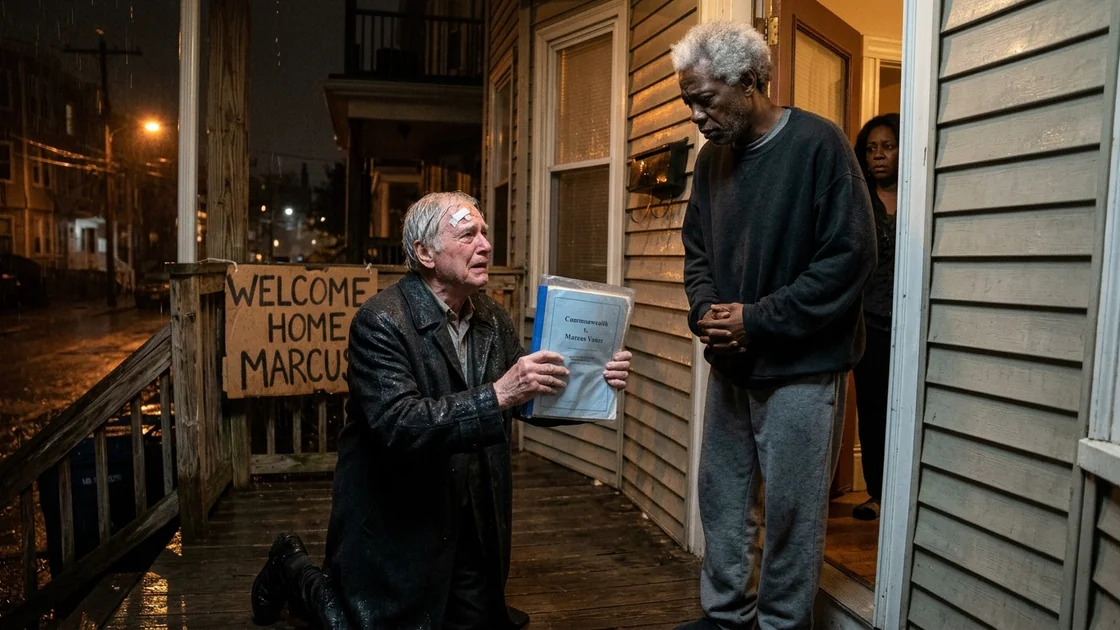
Arthur parked half a block down from number 44. He sat in the dark car for twenty minutes, watching the first-floor windows of the triple-decker. Warm yellow light glowed behind thin lace curtains. A handmade cardboard banner taped to the porch railing, now sagging and bleeding ink in the rain, read: WELCOME HOME MARCUS.
What was he doing here?
As a judge, he had listened to hundreds of allocutions—convicted felons standing before him at sentencing, offering halting, self-serving apologies to the families of their victims in the hope of shaving five years off their time. Arthur had always despised those moments. He knew that most apologies were not offered for the benefit of the victim; they were offered to relieve the intolerable pressure of the perpetrator’s own guilt. They were an act of selfishness disguised as contrition.
And now here he was, wanting to beg his victim for a crumb of absolution so the nightmares would stop.
I won't ask for forgiveness, Arthur vowed silently, gripping the door handle. I have no right to it. I will give him what he needs to destroy Thomas Paulson and the Commonwealth in federal court, and I will look him in the eye the way I refused to do thirty years ago.
He reached into the backseat, retrieved the blue-bound transcript of Commonwealth v. Vance, and tucked a folded sheet of hotel stationery—on which he had written a sworn, signed affidavit detailing his conversation with Thomas Paulson—inside the front cover.
He stepped out into the rain.
The walk from the car to the porch of number 44 was less than two hundred feet, yet it felt like miles. His knees buckled twice on the uneven wet slate of the sidewalk. The freezing rain soaked through his silver hair immediately, plastering it to his skull and trickling down the back of his neck beneath his coat collar. By the time he climbed the four wooden steps to the front porch, he was shivering uncontrollably and gasping for breath, the dull ache in his chest tightening once more.
He pressed the buzzer for the first-floor apartment.
Through the frosted glass of the front door, he saw a shadow move down the narrow hallway. The deadbolt clicked back, and the door opened the width of its brass security chain—the exact same type of chain Evelyn Vance had testified about in 1994.
A woman in her forties with tired eyes looked out through the gap. Her gaze dropped from Arthur’s bruised, rain-streaked face to the expensive wool of his coat, then back up. "Can I help you?"
"My name is Arthur Pendelton," he said. His voice had lost its courtroom resonance; it was thin, reedy, and broken by the rattling in his lungs. "I was the judge at Marcus’s trial. Please... I don't want to intrude for more than two minutes. I brought him something."
The woman’s eyes widened in shock, then narrowed into a look of pure, visceral revulsion. "You got some nerve coming to this house," she whispered fiercely. "Get off my porch before I call the police."
"Who is it, Denise?" a voice called from inside the apartment.
It was a quiet voice, raspy and hesitant, as if the speaker were still unused to speaking above a whisper without asking permission from a man with a baton.
"Nobody, Marcus, go sit back down in the kitchen," Denise said, moving to slam the door.
"Wait," Marcus said.
Footsteps shuffled down the hallway. A moment later, Denise was gently moved aside, and the brass chain rattled as someone slid it free from the track. The heavy wooden door swung open.
Marcus Vance stood on the threshold.
Up close, without the mediation of a television screen, the ruin that thirty years had wrought upon him was staggering. He was wearing gray sweatpants and a faded oversized sweater, looking like a child swimming in a grown man’s clothes. He was fifty-two, thirty years younger than Arthur, yet they looked like contemporaries. One of his front teeth was missing, the casualty of some long-forgotten yard assault, and his left eyelid drooped slightly from poorly healed scar tissue. His shoulders were permanently rounded forward, his hands instinctivelyclasped together at his waist in the posture of a man waiting for handcuffs to be applied.
When Marcus looked at Arthur, he froze.
The color drained from his already ashen face. He took a half-step backward into the hallway, his chest rising and falling in shallow, rapid pants. His eyes didn't look at Arthur’s frail, rain-soaked body; they looked up slightly, as if Arthur were still elevated four feet above him on a mahogany dais.
For a terrible ten seconds, neither man spoke. Only the rain drumming on the porch roof and the distant wail of a siren over on Blue Hill Avenue filled the space between them. In that silence, Arthur felt the full, crushing weight of his own nightmare—because he realized that for thirty years, he had been the monster in Marcus Vance’s dreams.
"Mr. Vance," Arthur whispered.
Slowly, painfully, ignoring the screaming protest of his arthritic joints and the wet grit on the painted wood, Arthur Pendelton lowered himself onto his knees on the porch.
Denise gasped in the doorway, stepping back. Marcus stared down at the old man kneeling at his feet in the rain puddle blowing across the floorboards, his hands trembling at his sides.
Arthur held up the plastic-wrapped blue transcript with both hands, like a supplicant offering a tribute at an altar.
"Inside this cover is a sworn statement," Arthur said, looking up into Marcus’s terrified, haunted eyes. "Today, Thomas Paulson confessed to me that Detective Riordan rigged the photo array with Leonard Gable. More importantly, he confessed that before your trial began, the District Attorney’s office was in possession of a State Police teletype implicating Richard Miller in an identical stabbing in Worcester—and that Paulson intentionally suppressed it."
Marcus didn't reach for the book. He just stared at Arthur, his lower lip trembling.
"Your lawyers at the Innocence Project can use that statement to pierce the city’s and the Commonwealth’s immunity," Arthur continued, his voice cracking as tears finally mixed with the rain on his cheeks. "They can depose Paulson. They can disbar him. They can take everything he has."
Arthur’s arms were shaking so badly he had to set the wrapped transcript down on the dry threshold between Marcus’s sneakers.
"And in that statement," Arthur said, his chin dropping toward his chest as a wave of nausea and chest pain rolled through him, "I have sworn under penalty of perjury that I denied you a fair trial. That I excluded the evidence of the broken streetlight and the testimony of Mrs. Clara Higgins not out of a good-faith application of the law, but out of malice, bias, and a corrupt desire to clear my docket before the weekend. I have waived any claim to judicial immunity in any civil action you bring against my estate. My house in Maine, my accounts, my pension trust—I called my personal attorney from the car an hour ago to begin drafting an irrevocable transfer of my assets into a restitution trust in your name."
Denise looked from the blue book on the floor to Marcus, her hand covering her mouth.
Marcus hadn't moved an inch. His eyes were fixed on the top of Arthur’s bowed, wet silver head. When he finally spoke, his voice was a hollow rattle.
"You wouldn't let me go to my grandma's funeral," Marcus said.
Arthur squeezed his eyes shut. He felt the cold concrete of the DDU floor against his cheek again; he tasted the copper blood from the steel door.
"I know," Arthur sobbed. "God help me, I know."
"She died thinking the world thought her boy was a killer," Marcus said, a single tear spilling over the scarred ridge of his cheekbone. "She took the bus up to Norfolk every Sunday for eight years until her legs gave out, and then they moved me to Blackwood and she couldn't afford the cab from the train station. She died alone in a ward at City Hospital while I was in the hole because a guy tried to take my sneakers and I fought back."
"I am so sorry, Marcus," Arthur wept, his hands gripping the wet wool over his knees. "I am so sorry."
Marcus looked down at the man who had been God in October of 1994—now just a shrunken, weeping octogenarian with a bandaged forehead, kneeling in the dirt of a Dorchester porch.
"You want me to say I forgive you?" Marcus asked softly. There was no rage in his voice; he didn't have the strength left for rage. There was only an infinite, bottomless exhaustion. "My lawyer told me on the ride home yesterday that I gotta let go of the bitterness or I’ll still be in prison out here. Maybe she’s right. Maybe one day I will."
Marcus took a slow step backward into the warmth of the hallway.
"But not tonight, Judge," Marcus said. "I got thirty years of nightmares in my head. Every time a door shuts too loud in this house, I think it’s count time and I stand by the wall. You don't get to drop a book on my porch and go home to sleep in a soft bed while I’m still standing by the wall."
Arthur looked up at him through blurred eyes. For the first time since he had turned on the television in his study two nights ago, he felt a strange, terrible clarity.
"No," Arthur whispered, nodding slowly. "No, I don't. You owe me nothing, Mr. Vance. Nothing at all."
Marcus looked at him for one last moment. He didn't kick the book away, nor did he pick it up yet. He simply reached out with a scarred, trembling hand, gripped the edge of the front door, and pushed it shut.
The heavy deadbolt slid home with a sharp, metallic clang.
Arthur remained on his knees on the dark porch for a long time after the lace curtains fell back into place.
He used the porch railing to haul himself back to his feet. The pain in his chest was no longer a dull ache; it was a steady, crushing weight, as if the granite blocks of the Suffolk County Courthouse had been stacked upon his sternum. His left arm hung virtually useless at his side, numb from the shoulder to the fingertips.
He walked slowly back down the wet steps and along the sidewalk toward his car. He did not get in immediately. Instead, he leaned against the cold wet metal of the rear fender, looking up at the dark, rain-swept sky over Boston.
He knew what was happening inside his chest, and he knew that his phone was in his right pocket, and that Boston Medical Center was less than ten minutes away by ambulance. He also knew that even if doctors restarted his heart or cleared his arteries, when he closed his eyes in the hospital bed tonight, or tomorrow night, or for however many nights remained to him on this earth, the six-by-nine cage at Blackwood would be waiting for him.
The law had no remedy for what he had done. There was no appellate court to vacate thirty stolen years, no restitution fund that could resurrect Evelyn Vance or put the light back into her grandson’s eyes. The only verdict left that carried any truth was the one his own mind had handed down.
Arthur Pendelton opened the door of the Mercedes, sat down in the cold dark without touching the glove compartment, closed his eyes, and waited for the cell door to lock.