The Weight of Salt
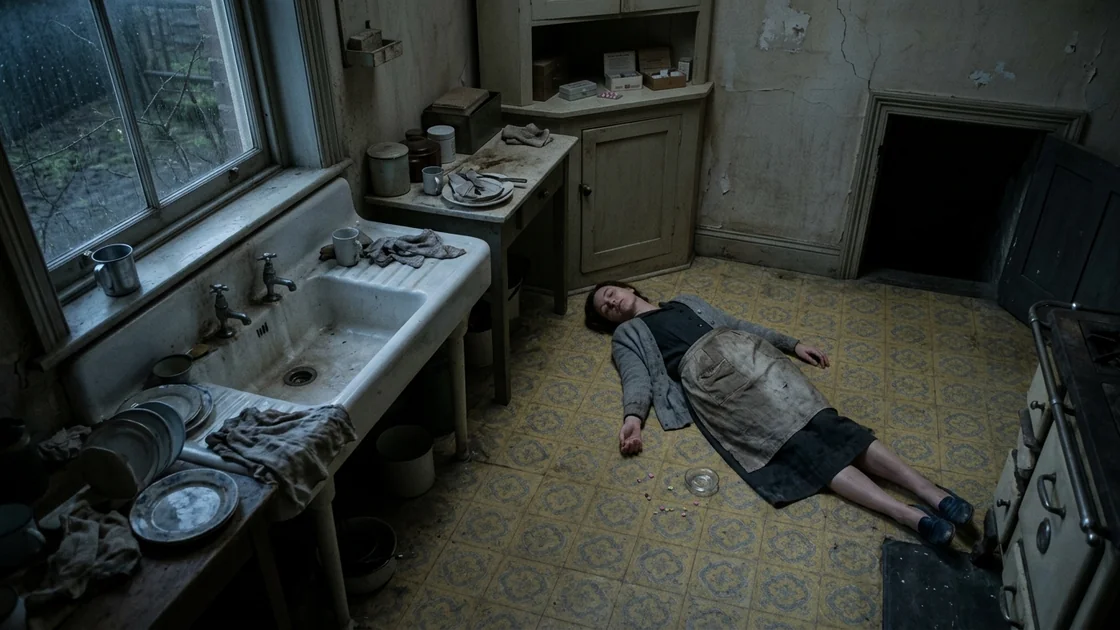
Clara spent four relentless years tending to her bitter, bedridden Aunt Judith in a decaying Victorian house on the edge of Oakhaven, sacrificing her youth, her health, and her sanity for a woman who met every act of mercy with venom. This is the chronicle of Clara’s slow erosion under the grinding weight of thankless servitude, tracing the suffocating routines of her daily existence, the systematic destruction of her spirit, and the inevitable autumn afternoon when her body finally gave out on the cold kitchen linoleum, forcing a quiet reckoning within the silent walls of the house.
The brass bell did not ring; it rattled. Inside its tarnished dome, the clapper was tied with a frayed piece of butcher’s twine to an iron nut—a modification Judith had demanded three years ago because the original tone was, in her words, too cheerful. It made a dry, clacking sound, like teeth chattering in an empty room.
In the narrow hallway two floors below, Clara froze with her hand on the doorknob of the linen closet. She had been counting washcloths, her forehead pressed against the cool, painted wood of the doorframe, trying to steal thirty seconds of darkness. Her eyelids felt as though they had been rubbed with fine grit. Her lower back throbbed with a dull, persistent rhythm that matched the ticking of the grandfather clock in the foyer.
Clack-clack-clack.
The sound traveled down the stairwell, sharp and imperative.
Clara let out a breath she didn’t realize she had been holding. It smelled of peppermint tea and stomach acid. She pulled three threadbare cotton cloths from the shelf, closed the door without letting the latch click—Judith hated the sound of latching doors when she was trying to digest—and began the climb.
There were nineteen steps to the first landing, and twelve more to the second floor. Four years ago, when Clara first arrived with two suitcases and a naïve belief that family obligation was a finite currency, she had taken these stairs two at a time. Now, at thirty-four, she ascended like an octogenarian. She placed her right foot on the riser, leaned her weight onto the mahogany banister, and dragged her left foot up to meet it. The wood beneath the worn runner protested with a familiar chorus of groans: the third step creaked on the left side; the seventh gave a high-pitched squeak right in the center; the fourteenth sagged by a fraction of an inch. Clara knew the geography of this house better than she knew the lines on her own face, primarily because she had stopped looking in mirrors two winters ago.
Clack-clack.
"I’m coming, Aunt Judith," Clara called out. Her voice was a dry rasp, stripped of resonance. She had learned not to project too loudly; volume was interpreted as aggression, while speaking too softly was seen as a malicious attempt to convince the old woman she was going deaf.
When Clara pushed open the heavy oak door at the end of the hall, the smell hit her first. It was a dense, layered miasma that no amount of open windows or lavender spray could ever fully banish: mentholated rub, stale urine, boiled cabbage, and the sour, papery scent of old skin that hadn't felt the sun in half a decade.
The room was kept in permanent twilight. Heavy velvet drapes, the color of dried blood, were drawn tight across the bay windows, sealing out the crisp October afternoon. In the center of this gloom sat the massive four-poster bed, and propped against a mountain of yellowing pillows was Judith.
She was a small woman, shrunk by arthritis and renal failure into something resembling a gnarled root pulled from dry earth, yet she possessed a terrifying density. Her white hair was sparse, revealing the pink, freckled dome of her scalp, and her mouth was permanently puckered as if she had just swallowed vinegar. Her eyes, however, were remarkably clear—pale blue, sharp, and relentlessly watchful.
"You were on the stairs for two minutes," Judith said. Her voice was thin, wheezing slightly at the end of the sentence, yet every consonant was clipped with precision. "I counted. Sixty-two seconds to reach the landing. Another fifty-eight to the door. Were you sleeping on the steps?"
"I was getting clean cloths from the downstairs closet, Judith. The ones up here were still damp from the line."
"They wouldn't be damp if you’d hung them before ten o'clock, like I told you. The dew comes back down after three. My mother knew that. A girl of twelve knows that. Put them on the radiator."
Clara walked to the cast-iron radiator beneath the window and laid the cloths across the warm metal ridges. Her fingers trembled slightly as she smoothed the edges. She tucked her hands into the pockets of her gray cardigan so Judith wouldn't see the shake. If Judith saw weakness, she burrowed into it like a tick.
"What did you need?" Clara asked, turning back toward the bed.
Judith didn't answer immediately. She stared at Clara’s shoes—a pair of scuffed navy loafers with worn-down heels. "You’re dragging your feet again. It ruins the runner. That runner came from Boston before you were even a thought in your father’s irresponsible head. Pick your feet up when you walk."
"I'll try. Did you want your water refreshed?"
"The tea you brought at two was cold," Judith said, gesturing with a crooked, swollen finger toward the porcelain teacup on her nightstand. It was three-quarters full, a pale skin formed over the amber liquid. "And you used the cheap leaves. I can taste the dust in the bottom. Where is the tin from Fortnum’s?"
"That tin finished three months ago, Judith. We talked about this. The grocer in town only carries the Twinings or the store brand."
"You’re lying," the old woman said flatly. She adjusted the quilted bed jacket around her bony shoulders, her movements slow and deliberate. "You’re saving the good tin for yourself. I hear you down in that kitchen at night. Clinking spoons. Drinking the good tea while I lie up here in the dark with my kidneys rotting."
Clara looked at the teacup. She had brewed it at precisely one-fifty-five, scalding the pot first, just as Judith demanded. She had carried it up the thirty-one stairs while it was still steaming, and Judith had ignored it for forty minutes while listening to a radio play with the volume turned up to a roar.
In the first year, Clara would have argued. She would have brought the empty Fortnum’s tin upstairs to show the bare, scratched metal inside. In the second year, she would have cried in the hallway afterward, biting her knuckles to keep the sobs silent. Now, in the fourth year, the accusation simply passed through her like wind through a ruined barn. There was nothing left inside her for the words to catch on.
"I’ll make a fresh cup," Clara said, reaching for the saucer.
"Leave it," Judith snapped, slapping her hand down on the bedspread. The brass bell jumped an inch off the mattress. "My stomach is turned now. Look at you, hovering like a vulture. Waiting for me to die so you can sell the silver."
"There isn't any silver left, Aunt Judith. We sold the tea service last April to pay the heating oil bill."
Judith’s eyes narrowed to slits. "Because you keep the furnace running like we’re living in the tropics. Sixty-two degrees is plenty for a working body. If you’re cold, it’s because you’re lazy. Blood doesn't move if you just sit in that kitchen staring at the wall."
"Ineed to turn you," Clara said, stepping closer to the bed. It was four o'clock. At four o'clock, the ulcer on Judith’s left hip needed to be dressed, the sheepskin pad needed to be smoothed, and the pillows needed to be rotated.
"Don't touch me with cold hands," Judith hissed, though she made no move to assist as Clara lowered the side rail—an ugly steel attachment they had rented from the medical supply store, which looked grotesque bolted to the nineteenth-century mahogany frame.
Clara rubbed her palms together furiously, trying to generate friction from skin that felt permanently clammy. Her own temperature regulation had gone haywire months ago; she was either shivering in a sweater while sweat pooled between her shoulder blades, or flushed with a sudden, dizzying heat that made the edges of her vision turn gray.
"Roll toward the window, please," Clara said, leaning over the mattress.
Judith went deliberately limp. It was her favorite game. Though she had enough strength in her arms to grip the bedrail when she wanted to shift herself during the night, the moment Clara’s hands touched her, she became dead weight—one hundred and ten pounds of unyielding bone and spite.
Clara braced her knees against the side of the mattress, slid her hands under Judith’s right shoulder and hip, and pulled.
A white-hot wire seemed to snap behind Clara’s eyes. Her lower back gave a sickening, liquid pop, and for three seconds, the room vanished into a wash of static. She gasped, her forehead dropping forward until it nearly touched Judith’s sour-smelling hair. Her heart hammered against her ribs—thud-thud-pause-thud—an erratic, fluttering bird trapped in a cage too small for its wings.
"You're breathing in my ear," Judith barked, shoving backward with a sharp elbow that caught Clara right in the sternum. "Get off me! You smell like onions. Why do you always smell like the scullery?"
Clara stumbled back half a step, gripping the iron rail with both hands until the gray static receded from the edges of the room. Her chest ached where the elbow had landed. She swallowed hard, tasting copper at the back of her throat.
"Hold the rail," Clara whispered.
She didn't wait for Judith to comply. Working on pure mechanical memory, she wedged a pillow behind the old woman’s back, lifted the flannel nightgown, and began to peel away the surgical tape holding the gauze over the hip ulcer.
The wound wasn't large—about the size of a silver dollar—because Clara was obsessive about turning her every two hours from six in the morning until midnight, and once more at three in the morning. The visiting nurse, a harried woman named Brenda who came once a month for fifteen minutes, had remarked in September that it was a miracle the sore hadn't tunneled to the bone given Judith’s poor circulation. You’re doing the work of three orderlies, Clara, Brenda had said, while scribbling on her clipboard and already looking toward the front door. Make sure you’re getting respite.
Respite. The word had sounded foreign, like a term from a dead language. Who provided respite when there was no money in the bank account, when the house was mortgaged twice over to pay for the specialty medications Medicare wouldn't cover, and when the only other living relative—Clara’s brother, Julian—lived in Seattle and had changed his phone number two years ago?
Clara cleaned the shallow crater of red tissue with saline solution. Her movements were gentle, precise, and entirely divorced from affection. She was a mechanic servicing an engine that hated her.
"Ouch! You’re gouging me!" Judith shrieked, though Clara was only dabbing the unbroken skin around the perimeter with a sterile swab. "You do that on purpose! You have your mother’s heavy hands. Clumsy. Margaret was always breaking things. Broke my mother’s gravy boat in nineteen-seventy-two and didn't even have the decency to replace it."
"My mother was nine years old in nineteen-seventy-two, Judith," Clara murmured, tearing a strip of paper tape with her teeth.
"Old enough to hold a saucer with two hands," Judith retorted. She grunted as Clara eased her back onto the sheepskin pad. "And fix the blanket. It’s bunched by my ankles. You know the weight hurts my toes."
Clara moved to the foot of the bed, lifted the heavy wool blanket, and tucked it over the footboard to create a tent over Judith’s feet. As she bent down, the blood rushed to her head with such violence that she had to grab the mahogany post to keep from pitching forward onto the floor. The wood was slick with lemon oil she had applied the previous Tuesday.
She stayed bent over for a long moment, staring at the faded floral pattern of the carpet. The flowers looked like bruised mouths.
"What are you doing down there?" Judith demanded, craning her neck to see over the mound of blankets. "Are you going through the cedar chest?"
"Just tucking the corner," Clara said, hauling herself upright. The room tilted ten degrees to the left, then slowly leveled out. "Dinner will be at six. Poached cod and mashed turnips."
"Turnips give me wind. I told you I wanted the squash."
"The squash had mold on the stem. It wasn't good."
"Because you let it rot in the pantry!" Judith’s hand found the brass bell again, her knotted fingers curling around the wooden handle like talons. "Bring me my pills at five. Not five-ten. And bring water from the tap, after you let it run for a minute. Not from the pitcher. The pitcher tastes like plastic."
"Yes, Aunt Judith."
Clara picked up the cold teacup and the soiled dressings, backed out of the room, and pulled the heavy oak door shut until it met the frame with a soft, muted thud.
Alone in the dim hallway, she leaned her back against the wallpaper—a faded pattern of vertical stripes that always made her feel as if she were standing inside a birdcage—and slid down until her heels hit the floorboards. She sat there on the top step, holding the saucer with the scummy tea balanced on her knees, and closed her eyes.
Her body didn't just hurt; it hummed with a strange, hollow vibration, like a telephone wire in a high wind. She hadn't slept more than ninety consecutive minutes in fourteen months. Even when Judith didn't ring the bell at night, Clara’s brain had been rewired to snap awake at every shift in the house’s acoustics. A settling joist, the click of the furnace thermostat, a branch scraping the gutter—each sound launched an immediate spike of adrenaline straight into her bloodstream, jerking her upright in her narrow cot in the sewing room, her feet hitting the cold floor before she was even conscious.
She looked down at her left hand resting on the rim of the saucer. There was a dark bruise on the back of her wrist from where she had banged it against the washing machine wringer two days ago, and her fingernails were bitten down to the quick, the skin around the cuticles ragged and red. She couldn't remember the last time she had eaten a meal sitting down. She grazed on scraps over the sink—the crusts cut off Judith’s toast, the cold spoonfuls of turnip left in the pot, crackers eaten in the dark while waiting for the kettle to boil at three in the morning.
From behind the oak door came the muffled sound of Judith clearing her throat, followed by the sudden, blaring static of the AM radio being tuned to a talk show.
Clara stood up. Her knees popped twice. She had fifty-two minutes before the five o'clock pills, and the cod was still frozen in the icebox.
The kitchen was the coldest room in the house, built as an addition in the 1920s over an uninsulated crawlspace. Even with the oven running, a perpetual draft seeped up through the seams of the yellowed linoleum, wrapping around Clara’s ankles like cold wet rags.
She stood at the deep porcelain sink, running lukewarm water over a block of frozen whitefish wrapped in butcher paper. Out the window above the taps, the backyard was disappearing into the gray wash of early evening. The grass was knee-high, choked with dead goldenrod and burdock. The neighbor, Mr. Henderson, used to mow it for ten dollars every other week, until Judith had screamed at him from the upstairs window two summers ago, accusing him of stealing her prize peonies—peonies that had died of blight during the Bush administration. Nobody came into the yard now, except the oil delivery man and the meter reader, both of whom moved at a jog.
Clara watched a crow land on the rusted clothesline pole. It ruffled its feathers against the wind, looked toward the house with a bright, black eye, and then launched itself into the gray sky, disappearing over the treeline toward the highway.
Clara felt a sudden, sharp stab of envy so profound it made her throat constrict. The bird had simply decided to leave, and then it wasn't there anymore.
How had she gotten here? She tried to trace the breadcrumbs backward through the fog in her brain, but her memories of her life before Oakhaven felt like a movie she had watched on a small television in another room.
She had lived in Chicago. She had worked as a junior archivist at a small maritime museum, spending her days in a quiet basement cataloging shipping manifests from the nineteenth century. She had owned a green wool coat with horn buttons. She had dated a man named David who played the cello in a community orchestra and smelled like cedarwood and coffee.
Then her mother had died—a sudden aneurysm in a supermarket parking lot—and three months later, Aunt Judith had suffered the first stroke.
It’s just for six weeks, Clara, Julian had said over the phone after the hospital discharge planner called them both. Just until the rehab facility on Elm Street has an open bed. I can’t leave right now, we’re in the middle of a merger, and you have those four weeks of accrued leave. Just go down there, get the house sorted out, and get her on the waitlist.
Clara had packed two bags. She had told the museum director she’d be back by Thanksgiving. She had kissed David at the train station.
When she arrived, she found that Judith had canceled her supplemental insurance four years prior because she believed the agent was a communist, that the Elm Street facility cost six thousand dollars a month out of pocket, and that to qualify for state Medicaid placement, they would have to liquidate the house and trace five years of chaotic, paranoid financial transactions Judith had hidden in coffee cans and hollowed-out books. Worse, when the social worker came to do the intake assessment for the state ward, Judith had suddenly become lucid, charming, and fiercely articulate, declaring that she was entirely capable of managing her affairs with her "devoted niece’s" help, and threatening to sue the county for elder kidnapping if they touched her property.
As soon as the social worker’s car pulled out of the driveway, Judith had urinated on the parlor sofa and told Clara to clean it up before it stained the chintz.
Six weeks became six months. The museum held Clara’s job until February, then sent a polite, regretful letter with her final paycheck. David visited once in March, stayed at a motel near the interstate because Judith refused to allow a "strange man" to use her bathroom, and spent forty-eight hours watching Clara run up and down the stairs while an invisible tyrant banged a cane against the ceiling. He had tried to convince Clara to just pack her bags and walk out the front door with him.
She’ll die, David, Clara had said, standing on the freezing front porch while the upstairs bell rattled through the floorboards. She can't get to the toilet by herself. She can't reach the stove. If I leave, she’ll lie in her own filth until she dehydrates.
Then call the police from the train station and tell them there’s an abandoned adult in the house, David had pleaded, gripping her shoulders. Let the state take her, Clara. She’s not your mother. She wasn't even nice to your mother.
I can’t do that, Clara had said. The programming went too deep—generations of midwestern Protestant guilt, of quiet women who swallowed their own teeth rather than make a scene, of her mother’s dying whisper in Clara’s childhood memory: Be good to Judith, she’s got nobody else.
David had stopped calling by June. Julian had stopped answering her emails by October, sending one final check for five hundred dollars with a note on the memo line that read: Final contribution. Put her in a home, Clara. Stop playing the martyr.
The word martyr still burned when she thought of it. A martyr died for a cause they believed in. A martyr got a stained-glass window and the satisfaction of moral superiority. Clara didn't feel superior. She felt like a piece of soap left in the bottom of a dish, dissolving into gray slime a little more every time the water ran.
The kitchen timer gave a single, sharp ping. It was four-fifty.
Clara dried her hands on her apron and walked to the corner cabinet where the medications were kept in two plastic fishing tackle boxes. Her fingers moved over the compartments without her needing to read the labels: the tiny yellow tablet for blood pressure, the large chalky white oval for potassium, the pink capsule for nerve pain, the diuretic that would ensure Judith rang the bell at least four times between nine and midnight, and the blue stool softener.
She placed them in a small glass dish—Judith refused to take pills from paper cups—and ran the cold tap for sixty seconds, watching the water swirl down the rusted drain.
As she turned off the faucet, her left leg suddenly went numb from the hip to the ankle, as if someone had severed a cord in her spine. She pitched sideways, her hip slamming against the edge of the Formica counter. The glass dish slid from her fingers, hit the linoleum, and didn't break, instead spinning in a wide, noisy arc across the floor, scattering the five pills into the shadows beneath the refrigerator and the stove.
Clara didn't curse. She didn't make a sound. She just stood leaning against the counter, waiting for the feeling to return to her foot. Pins and needles prickled through her calf, sharp and cold.
Above her head, right on cue, the bedroom floorboards creaked, followed by three heavy thuds of the rubber-tipped cane kept beside the bed.
Five o'clock, the ceiling said. You dropped something. What did you break?
Clara got down on her hands and knees. The linoleum was freezing against her palms, sticky with decades of old wax and grease that no amount of mopping could lift. She pressed her cheek against the floor and squinted into the dark gap beneath the refrigerator.
The pink capsule was wedged against a dust bunny the size of a mouse. The white potassium pill had rolled near the kickplate of the stove. She reached in, her fingers scraping against the sharp metal underside of the appliance, and retrieved them. She blew the gray lint off the potassium tablet, wiped the pink capsule on her sleeve, and crawled over to the base of the cellar door to find the tiny yellow blood pressure pill.
While she was down there, her forehead resting against the baseboards, a strange thought occurred to her: I don't have to get up.
The floor was dirty, and the draft from the cellar door smelled of wet earth and rotting potatoes, yet the horizontal position felt indescribably luxurious. Gravity was no longer pulling her spine into her pelvis. Her heart didn't have to pump blood quite so high to reach her brain. If she just stayed here, curled against the cellar door like an old dog, what would happen?
Judith would bang the cane. Then she would rattle the bell. She would rattle it until her arthritic fingers cramped. Then she would scream—a thin, reedy sound that wouldn't even carry to the street through the closed storm windows. Eventually, silence would fall.
Clack-clack-clack-clack.
The bell started. Fast and furious.
Clara’s body moved before her mind could finish the rebellion. The Pavlovian conditioning was absolute. Her knees straightened; her hand found the edge of the sink; she hauled her weight upright, dropped a fresh yellow pill from the tackle box into the dish alongside the dusty ones retrieved from under the stove, grabbed the glass of water, and walked out of the kitchen.
"What did you break?" Judith asked the instant the door opened. She wasn't looking at Clara; she was staring at the water glass, checking the level to make sure it was filled to within half an inch of the rim, as required.
"Nothing. The lid fell off the flour canister."
"You’re clumsy because you don't pay attention. Your mind is always woolgathering. Give me those."
Judith took the glass dish, dumped the pills into her gnarled palm, and poked at them with a yellowed fingernail. She paused, squinting in the dim light of the bedside lamp. She picked up the large white potassium tablet and held it close to her nose.
"There’s a hair on this," she said. Her voice dropped an octave, vibrating with triumph. "A gray fuzz. Did you drop my medicine on the floor?"
"It’s just lint from my sweater, Judith," Clara said, taking the pill between her thumb and forefinger and rubbing the invisible speck away. "Here."
"I’m not taking floor dirt! Are you trying to give me lockjaw? Go get a clean one. And bring the bottle up here so I can see you take it out. That bottle costs forty dollars. You probably throw them in the trash just to spite me."
"If I go back downstairs for the bottle, your dinner will be late," Clara said. Her voice was completely flat, a dead monotone. "The fish is on the counter. If I don't put it in the pan now, it won't be ready at six."
Judith stared at her. It was a calculated stare, weighing the pleasure of forcing Clara down the thirty-one stairs against the pleasure of eating at precisely six o'clock. The stomach won.
Without another word, Judith tossed the pills into her mouth, took a sip of water, and swallowed them with a loud, theatrical grimace, as if she were swallowing crushed glass. She thrust the empty dish and the half-full glass back toward Clara, not waiting to see if Clara had a grip on them before letting go.
Clara caught the glass with her fingertips, cold water sloshing over her knuckles and onto the bodice of her dress.
"Wipe that up," Judith snapped, pointing at two drops that had hit the mahogany surface of the nightstand. "You’re ruining the finish. My father bought that table in Providence."
Clara used the dry corner of her apron to wipe the wood. As she straightened up, she caught sight of Judith’s face in the dim amber glow of the forty-watt bulb.
The old woman wasn't angry. That was the terrible revelation that had slowly dawned on Clara over the past year. Judith wasn't miserable, or frightened of dying, or lashed out because she was in pain—all the soothing platitudes the hospice pamphlets and caregiver support articles used to excuse abuse. No, there was a faint, glistening light in Judith’s pale eyes, a tiny curl at the corner of her vinegar mouth.
She was feeding.
For seventy-eight years, Judith had been an insignificant woman—an unmarried clerk in a county tax office, ignored by her brothers, condescended to by her sisters-in-law, living a small, grey life in a small, grey town. Now, in her decay, she had become an empress. Her world had shrunk to the dimensions of a twelve-by-fourteen bedroom, yet within those walls, she held absolute, totalitarian power over another human being. Every time Clara climbed the stairs, every time Clara apologized for the temperature of the tea, every time Clara wiped a drop of water off the nightstand with trembling hands, Judith grew stronger. She was a parasite that had grown larger than its host.
"Six o'clock," Judith said, settling back into her pillows and reaching for the radio dial. "And don't put butter on the fish. It repeats on me."
Between six-thirty and ten o'clock that evening, Clara climbed the stairs seven times.
At six-thirty, she retrieved the dinner tray. Judith had eaten all the fish and half the turnips, though she had mashed the remaining turnips into a smear across the plate with her fork and declared them "woody and unfit for a pig."
At seven-fifteen, the bell rattled because the room was "stifling" and the window needed to be cracked half an inch.
At seven-forty, the bell rattled because a draft from the half-inch crack was giving Judith neuralgia in her neck, and the window needed to be closed and locked.
At eight-ten, it was time for the bedpan. This was a twenty-minute ordeal involving warm washcloths, talcum powder, and a steady stream of commentary regarding Clara’s lack of grace compared to a Catholic sister who had once nursed Judith’s grandmother in 1954.
At nine o'clock, the evening medications were delivered, along with a small bowl of stewed prunes—four prunes, precisely two tablespoons of juice, warmed to blood heat. Judith counted the prunes, complained that one of them was smaller than the others, and demanded a fifth from the jar downstairs.
At nine-twenty, Clara brought the fifth prune.
At ten o'clock, Clara performed the night turn, positioning the foam wedges behind Judith’s back and between her knees, dimming the lamp to its lowest setting, and placing the brass bell within three inches of Judith’s right hand.
When Clara finally descended into the kitchen at ten-thirty, the house was quiet except for the wind rattling the loose putty in the pantry windowpanes.
She didn't turn on the overhead light; the sixty-watt bulb was too harsh for her eyes, which were now pulsing with a migraine that started behind her left ear and wrapped over her scalp like a tight iron band. Instead, she lit the small candle stub she kept by the breadbox and sat down on the wooden stool by the sink.
On the counter lay the afternoon mail, which she had pulled from the box at one o'clock and hadn't had thirty seconds to open. There were three envelopes: the electric bill, a circular for a hardware store in the next county, and a thick cream-colored envelope addressed to Miss Clara Vance in neat, slanted calligraphy.
Clara stared at the cream envelope for a long time. Nobody wrote to her. Her friends from Chicago had sent birthday cards the first two years, then Christmas cards the third year, and now nothing at all. You couldn't maintain a friendship via correspondence when you had nothing to report except the consistency of an old woman’s bowel movements and the price of adult diapers.
She slid her thumb under the flap and pulled out a heavy card printed on linen paper.
Mr. and Mrs. Arthur Pendelton request the honor of your presence at the marriage of their daughter, Sarah Elizabeth, to Mr. David Ross...
Clara’s breath didn't catch. Her heart didn't break. A heart required blood and muscle to break, and hers felt as though it had calcified into pumice stone months ago.
Instead, she held the card close to the candle flame and studied the typography. It was very nice—engraved charcoal ink, a small embossed botanical motif at the top. David was marrying a woman named Sarah. The ceremony was in Evanston, at a chapel near the lake that Clara remembered walking past with him one Sunday when the magnolias were in bloom.
At the bottom of the card, someone—probably Sarah, judging by the looping, feminine handwriting that matched the envelope—had written a short note in blue fountain pen: David spoke so warmly of you when we were making our list, and wanted you to know. We hope you are well and happy back East!
Well and happy.
Clara looked down at her apron. There was a yellowish stain of turnip puree near the pocket, and a dark wet spot from the bedpan rinse water near the hem. She smelled of Vicks VapoRub and bleach. A lock of her hair fell forward over her cheek; in the candlelight, she could see it was nearly half gray, dry and brittle as dead grass. She was thirty-four years old, and she had the posture, the wardrobe, and the future of a woman twice her age.
She didn't cry. Tears required surplus water in the body, and Clara was chronically dehydrated because if she drank too much, she had to take time to use the bathroom herself, and Judith always seemed to know the exact moment the bathroom door locked, rattling the bell with frantic malice until Clara hurried out.
Clara folded the wedding invitation neatly in half, then in quarters, tearing the heavy linen cardstock along the creases until she had a small pile of cream-colored squares. She dropped them into the kitchen trash can on top of the coffee grounds and the skin from the poached cod.
She blew out the candle and walked through the dark dining room toward the back stairs that led to the sewing room.
Halfway through the dining room, the darkness seemed to thicken, pressing against her eardrums with a low, rushing roar, like the sound of the ocean trapped inside a shell. Her knees buckled. She didn't hit the floor hard; she simply folded down against the side of the mahogany sideboard, her cheek scraping against the brass keyhole of the bottom drawer.
For several minutes, she lay curled on the cold hardwood floor in the pitch black. Her limbs were jerking with tiny, involuntary spasms—the muscles misfiring from potassium depletion and sheer, bone-deep exhaustion. Her chest felt tight, as if an iron band were being winched tighter and tighter around her lower ribs.
I need to go to a doctor, a distant, rational voice whispered in the back of her mind. Something is wrong with my heart.
You can't go to the doctor, the house answered. The doctor’s office is twelve miles away. You don't have a car because you sold the Civic to pay the property taxes in nineteen. Even if you took the bus, you’d be gone for four hours. Who would give her the twelve o'clock pills? Who would turn her at two?
Clara crawled the rest of the way to the sewing room on her hands and knees, pulled the thin wool blanket off the cot, and wrapped it around herself on the floor because she didn't have the strength in her arms to hoist her torso sixteen inches onto the mattress.
She closed her eyes at eleven-ten.
At one-fifteen, the bell rattled.
November arrived not with snow, but with five days of freezing, horizontal rain that turned the unkempt yard into a bog and found every missing shingle on the Victorian’s steep roof.
Clara now had three buckets placed in the attic, which meant an additional flight of narrow, unpainted pine stairs twice a day to empty the brown rainwater before it soaked through the plaster ceiling of the upstairs hallway.
Her physical deterioration was no longer a slow erosion; it was a landslide.
She had stopped sleeping entirely, entering instead into a permanent twilight state where she dreamed while walking. She would be standing at the ironing board pressing Judith’s pillowcases—Judith insisted on ironed percale; wrinkled linen bruised her ears—and suddenly a man in a yellow raincoat would be standing by the cellar door, speaking to her in a language made of numbers, only to vanish when she blinked and burned her knuckles on the side of the hot iron.
She was losing words, too. When the grocery delivery boy—a sullen teenager who charged five dollars extra to bring the boxes up the porch steps—asked her to sign the receipt on Thursday, Clara had stared at the blank line for thirty seconds, unable to remember the first letter of her own name. She had finally drawn a wavering horizontal line across the paper and shut the door in his face before he could look at her.
And Judith was getting louder.
The rain trapped the dampness in the old woman’s joints, making her meaner, more restless, and infinitely more inventive in her torments. Because she couldn't hear the street noise over the drumming of the rain on the roof, she demanded that Clara sit in the bedroom with her for two hours every afternoon and read aloud from old issues of Reader’s Digest from the 1980s, which were stacked in the closet.
"You’re mumbling," Judith said on Friday afternoon, interrupting a story about a dog that had walked four hundred miles across Montana. "Open your mouth when you speak. And sit up straight in that chair. You’re slouching like a sack of meal."
Clara was sitting on a hard-backed Windsor chair near the radiator. The words on the page were swimming in and out of focus, little black ants marching across a yellow field. Every time she inhaled, a sharp stitch caught under her left collarbone, radiating down into her elbow.
"I’m sorry," Clara said. She licked her dry, cracked lips and tried to find her place on the page. "'When Bobbie reached the outskirts of Boise, his paws were worn to the quick, yet a kindly widow...'"
"Stop," Judith commanded.
Clara lowered the magazine to her lap.
Judith was staring at her with those clear, pale blue eyes. In the gray light filtering through the gap in the velvet curtains, the old woman looked almost vampiric—her cheeks flushed a faint, healthy pink from the warm soup Clara had spoon-fed her an hour earlier, while Clara sat beside her looking like a corpse dug up from the yard.
"You look terrible," Judith said, and there was no concern in her voice, only disgust, as if Clara had worn a dirty dress to church. "Your skin is yellow. Are you sick?"
"No, Aunt Judith. Just tired."
"Tired from what? You sit in that chair half the day. If you’re getting a cold, don't you dare breathe it on me. Pneumonia would kill me in a week, and you know it. Wear a scarf over your face when you bring my tray tonight."
"I don't have a cold."
"My mother took care of her father for nine years after he lost his legs at the sawmill," Judith said, leaning back against the freshly ironed pillowcases and folding her twisted hands over her stomach. "Nine years, while raising four children and keeping six acres of orchard. She didn't have washing machines or gas stoves. She hauled water from a pump in January. And I never once heard her complain that she was tired. Your generation is made of wet paper. No stamina. No gratitude for a roof over your head."
Clara looked at the wallpaper behind the bed. A thin brown stain had appeared near the ceiling molding since morning—another leak in the roof, bypassing her attic buckets.
Gratitude.
The word echoed in the hollow cave of Clara’s skull. She was supposed to be grateful for the privilege of living in a tomb, eating cod scraps, and wiping the backside of a woman who hated the sound of her breathing.
For the first time in four years, Clara didn't say Yes, Aunt Judith. She didn't say anything at all. She just stared at the brown water stain as it slowly crept down the faded stripe of the wallpaper, shaped like a long, thin finger pointing toward the floor.
"Are you listening to me?" Judith snapped, reaching for the bell on the mattress even though Clara was sitting four feet away. She gave it a violent shake. Clack-clack-clack. "I said, are you listening?"
The dry, chattering rattle of the iron nut against the brass dome hit Clara’s eardrums like a hammer striking an anvil.
Something inside her head shifted—not a metaphorical shift, not an emotional epiphany, just a physical sensation of a heavy load sliding off a shelf in a dark warehouse.
"I need to check the buckets in the attic," Clara said.
She stood up, dropping the Reader’s Digest onto the seat of the chair.
"I didn't say you could leave! Finish the story about the dog! Clara! Come back here!"
Clack-clack-clack-clack-clack.
Clara walked out of the room and left the door open. She didn't care about the draft anymore.
She didn't go up to the attic. She walked down the thirty-one stairs to the ground floor, her hand sliding down the mahogany banister. She walked through the dark hallway and into the freezing kitchen.
The rain was lashing against the glass above the sink. The clock on the stove said three-forty. In twenty minutes, Judith would need to be turned. At five, the pills. At six, the tray. At eight, the pan. At ten, the wedges. At three, the turn. Forever and ever, world without end, amen.
Clara walked to the sink to get a drink of water. Her mouth was so dry her tongue was sticking to the roof of her palate. She reached for the tin cup she kept on the windowsill, her fingers brushing the handle.
She never closed her hand around it.
The stitch under her left collarbone suddenly exploded into a blinding, crushing vise that seized her entire chest, squeezing the air from her lungs in a single, silent wheeze. Her vision didn't go gray this time; it went instantly, utterly black, as if someone had thrown a heavy velvet curtain over her face.
Clara didn't feel her knees hit the linoleum. She didn't feel the back of her head strike the iron leg of the radiator beneath the window, though the impact made a dull, heavy thwack that vibrated through the floorboards.
When consciousness flickered back a few minutes later, she wasn't in pain. That was the strangest part. The crushing weight in her chest had subsided into a vast, numb coldness that spread from her sternum outward to her fingertips and toes.
She was lying flat on her back between the sink and the stove. She tried to lift her right hand to touch the warm liquid trickling from the back of her scalp onto the linoleum, but her arm didn't belong to her anymore. It lay three inches from her hip, palm up, fingers slightly curled, completely unresponsive to the frantic commands of her brain.
She tried to roll onto her side. Nothing happened. Her legs were lead pipes bolted to the floor. Her heart was beating very slowly—a heavy, sluggish thump... pause... pause... thump that sounded like footsteps in snow.
Directly above her head, through the ceiling joists, came the furious thumping of Judith’s cane.
Thump-thump-thump.
Then the voice, muffled by plaster and oak, yet unmistakable in its shrill fury: "Clara! The door is open! The hall draft is coming in! Clara!"
Clara stared straight up at the kitchen ceiling. From this angle, she could see things she had never noticed while standing up: a cobweb hanging from the brass chain of the light fixture, swaying gently in the draft from the cellar door; a grease spot above the stove shaped like the map of Italy; the tiny cracks in the plaster where the house had settled over a century of winters.
Clack-clack-clack-clack-clack.
The bell started. It sounded very far away, like a tin can being kicked down an alley in another town.
Four o'clock came and went. The kitchen grew darker as the November twilight bled the gray light from the window above the sink. The rain stopped, replaced by the rhythmic, hollow drip-drip-drip of water falling from the broken gutter onto the back porch steps.
At four-thirty, the banging upstairs reached a crescendo. Judith was hitting the side rail of the bed with the brass bell itself, a metallic clang-clang-clang that echoed through the empty house.
"Clara! Where are you? It’s past four! My hip is burning! If you’re down there sleeping, I’ll have the lawyer put you on the street tomorrow! Do you hear me? You ungrateful little wretch!"
Clara blinked slowly. A single tear, warm and salty, finally squeezed out from the corner of her right eye, rolling down across her temple and disappearing into her hair where it mingled with the drying blood from her scalp.
She wasn't crying because Judith was screaming at her. She was crying because, for the first time in one thousand, four hundred and sixty days, the bell was ringing and she didn't have to get up.
The realization washed over her with a warmth that pushed back the freezing draft coming from under the cellar door. Her body had done what her mind, bound by guilt and duty and cowardice, had refused to do. Her body had gone on strike. It had thrown itself onto the gears of the machine and jammed them shut.
By five-thirty, the kitchen was completely dark.
Upstairs, the tone of the shouting had changed. The imperial rage had frayed at the edges, replaced by a thin, breathless shrillness that carried a new note Clara had never heard in Judith’s voice before.
"Clara? It’s five-thirty! I need my potassium! Why aren't the lights on in the hall? Clara, answer me!"
Pause.
Clack-clack.
"Clara? Did you go to the store? You know you’re not allowed to leave the house without telling me! Come up here right now! I won't be mad about the door, just bring the water!"
Clara listened to the bargain being offered through the ceiling. I won't be mad about the door. In four years, Judith had never yielded an inch of territory, had never softened a demand, had never admitted that she needed the creature who climbed the stairs.
Now, in the dark, with her bladder full and her hip aching and the house growing cold because nobody had turned up the thermostat for the evening, the empress was discovering that an empire of one is just a locked room.
The silence stretched for twenty minutes.
Clara’s breathing was shallow now, barely lifting the front of her gray cardigan. The cold had reached her knees and elbows; she felt as though she were floating on a raft of ice in a dark, quiet lake. It wasn't unpleasant. The migraine behind her left ear was completely gone. The ache in her lower back had vanished.
Then, from the floor above, came a sound that made Clara’s sluggish eyes widen slightly in the dark.
A heavy, muffled thud, followed by a sharp cry of pain and the clatter of the steel bedrail shaking in its brackets.
Judith had tried to get out of bed by herself.
A moment later, a scraping sound began—slow, agonizingly labored, moving across the bedroom floorboards toward the open door. Judith was dragging herself on her elbows.
"Help," a small, cracked voice whimpered from the top of the stairs. There was no venom in it now, only the raw, naked terror of an animal caught in a trap of its own making. "Clara, please. I fell. I’m on the floor. It’s cold out here."
The brass bell wasn't ringing anymore; she had left it behind in the bed.
Clara stared up at the cobweb on the light fixture, invisible now in the pitch black of the November night. She heard the wind pick up outside, shaking the dead goldenrod in the yard and rattling the loose glass in the pantry window.
Down on the linoleum, in the quiet dark where no one could reach her, Clara closed her eyes and finally went to sleep.