The Weight of Salt and Bread
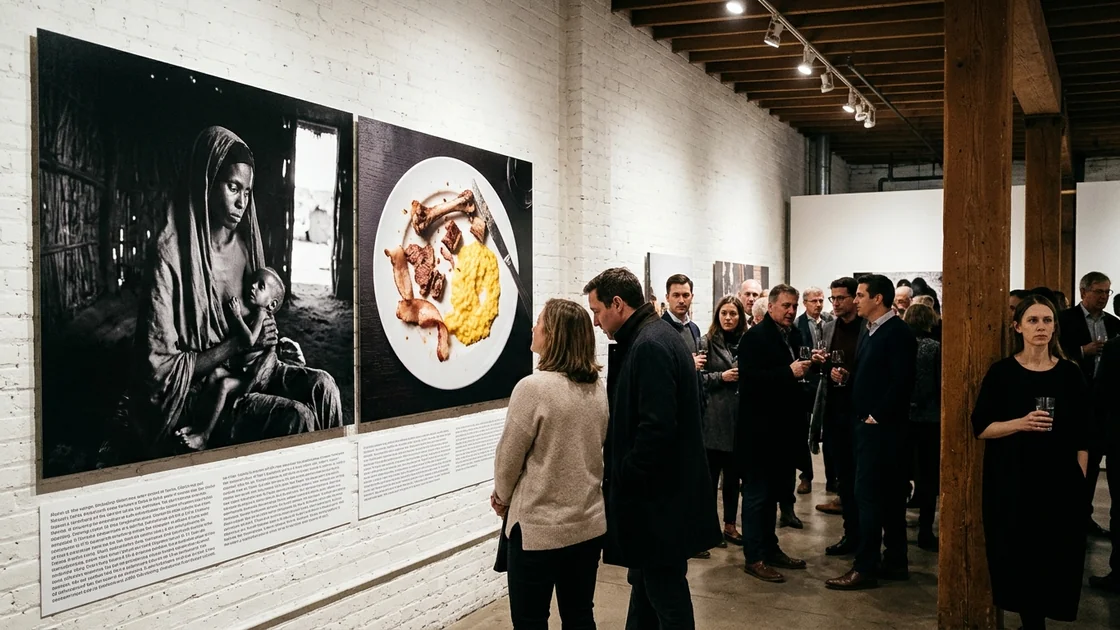
After six months documenting a severe famine in the arid highlands of Oromia, photojournalist Clara Vance returns to her comfortable life in Seattle, only to find herself completely alienated by the city's overwhelming abundance and the triviality of everyday conversations. As she struggles to edit her harrowing photographs for an upcoming exhibition, the stark contrast between the starving children she left behind and the wasteful luxury of her friends and fiancé drives her into a silent, obsessive isolation. This psychological rift culminates at a lavish dinner party and her subsequent gallery opening, where Clara realizes she can no longer inhabit a world that treats survival as a given and tragedy as mere aesthetic entertainment.
The automatic doors of the Whole Foods on Westlake slid open with a soft, pneumatic sigh, releasing a draft of air conditioned to a precise sixty-eight degrees and scented with the sweet, waxy perfume of bruised organic apples and misted cilantro. Clara stood on the rubber welcome mat for five seconds, her canvas tote bag slung over a shoulder that still bore the faint, sun-baked crease of a camera strap. Five seconds was the exact duration of the artificial thunderstorm that rolled over the leafy greens aisle every quarter-hour—a recorded rumble of thunder followed by a fine, pressurized hiss of municipal water spraying over pyramids of lacquered red bell peppers, glossy purple eggplants, and bundles of curly kale bound with blue rubber bands.
Her fingers, tucked into the pockets of her linen jacket, found the dry, cracked skin around her thumbnails and began to pick. It was a habit she had brought back from the dry riverbeds of the eastern rift, where the dust wasn't dirt so much as pulverized basalt and dried dung that worked its way into the whorls of her fingerprints and stayed there, impervious to the rationed baby wipes she had used for eighty-two days.
She stepped off the mat. The cart she pulled from the interlocking steel row made a bright, metallic clatter that made her flinch. Two weeks home, and sharp noises still registered in her spine as the snapping of dry acacia branches or the sharp, dry cough of a goat dying in the shade of a thorn bush.
"Sorry," murmured a man in slate-gray running tights, maneuvering around her with a small plastic basket containing two yellow mangoes and a bottle of fermented tea. He didn't look at her. He was looking at his watch, tapping its glass face.
Clara pushed the cart toward the bakery section. Her fiancé, Julian, had texted her at three o’clock: Pick up a boule of the rosemary sourdough for tonight? And maybe some of that triple-cream brie Sarah likes. Don't stress if they're out of the rosemary, olive is fine.
The word fine had sat on the glass screen of her phone like a drop of oil.
The bakery smelled of yeast and scorched sugar. Behind the curved glass cases, tiers of pastries sat on sheets of brown parchment—croissants laminated into dozens of butter-soaked layers, scones studded with plump, bursting blueberries, tarts glazed with apricot jelly until they shone like wet river stones. Beside the cases, stacked in rustic wooden crates, were the loaves. Hundreds of them. Crusts blistered and dusted with white flour, sesame seeds, rolled oats, and coarse sea salt.
A woman in a camel-hair coat stood before the crates, using a pair of silver tongs to prod a round loaf of country white. She squeezed it, frowned slightly at the give of the crust, and set it back down, reaching for the one behind it. Her silver bracelet slid down her wrist, clicking against the tongs.
Clara watched the woman’s knuckles. They were smooth, the skin taut and hydrated, padded with a layer of subcutaneous fat that made the tendons invisible. In the makeshift clinic at Kora, forty miles south of the paved road where the relief trucks had stalled due to a blown culvert and local militia disputes, Clara had spent four hours photographing the hands of mothers waiting for the Plumpy’Nut distribution. When the body consumes itself, it begins with the soft announcements of the face and the belly, then moves to the thighs, and finally strips the hands, leaving them looking like bundles of dry twigs tied together with blue twine. The skin over the knuckles of the women in Kora had been gray, translucent, and scaly with pellagra.
"Excuse me, miss? Are you in line for the slicer?"
The baker behind the counter was looking at her, holding a long serrated knife. He had a smear of flour across his black apron and a small silver ring in his septum.
"No," Clara said. Her voice sounded thin to her own ears, raspy, as though she hadn't drunk enough water, though she had been drinking tap water directly from the bathroom faucet in five-minute intervals since landing at Sea-Tac. "Just looking for the rosemary sourdough."
"Ah, we tossed the last two about twenty minutes ago," the baker said cheerfully. "The morning batch got a little too much steam in the proofer, went kind of gummy by two o'clock. I've got roasted garlic, or the kalamata olive just came out."
"You tossed them," Clara repeated.
"Yeah, corporate policy on texture. Can't sell a gummy crumb for nine bucks, right?" He laughed, a short, polite puff of air, and held up a paper bag. "Olive?"
Clara looked past his shoulder. In the back of the bakery, behind the stainless-steel racks of cooling baguettes, stood a gray sixty-gallon Brutes trash bin. Rising over its rim were the jagged, golden-brown crowns of half a dozen loaves, mingled with discarded parchment paper and the crushed shells of eggs.
"The olive," Clara said. "Yes. Thank you."
She took the warm paper bag. Through the thin kraft paper, the heat of the bread bled into her palms. It weighed perhaps two pounds. Nine hundred grams. In the feeding center run by the French doctors, a child under five with a mid-upper arm circumference of less than eleven point five centimeters was allocated two hundred grams of fortified peanut paste a day, assuming the convoy hadn't been looted at the dry crossing at Dawa. Nine hundred grams of dense carbohydrate was four days of survival for a child whose hair had already turned the brittle, rusty orange of kwashiorkor.
She set the bread in the child seat of the cart, where it wouldn't be bruised, and walked toward the cheese counter.
The apartment she shared with Julian was on the fourth floor of a converted timber warehouse in Belltown. It had fourteen-foot ceilings, exposed Douglas fir beams that had been sandblasted to a warm honey tone, and tall industrial windows that looked out over the gray, choppy expanse of Elliott Bay. When they had signed the lease three years ago, right after Clara won the Overseas Press Club award for her series on the migration routes through the Darién Gap, she had loved the light. It was northern light—cool, diffused by clouds, honest.
Now, as she unlocked the heavy steel door and stepped inside, the space felt monstrously large, an echo chamber of polished concrete and empty cubic footage that served no purpose other than to display their ability to pay for air.
Julian was in the kitchen, standing at the walnut butcher-block island. He had his sleeves rolled up to his elbows, revealing forearms lightly dusted with blond hair, and he was using a small paring knife to core a tray of jalapeños. The radio on the shelf was tuned to NPR; a woman with a calm, modulated voice was interviewing a behavioral economist about the psychological impact of four-day workweeks on middle-management retention.
"Hey," Julian said, looking up and smiling. He came around the island, wiping his hands on a linen dish towel, and kissed her on the temple. He smelled of cedarwood soap and the sharp, green scent of the peppers. "You found it. Great. How was it out there? The traffic on Mercer looked brutal from the office."
"It was fine," Clara said, setting the tote bag on the counter. "They didn't have the rosemary. They threw it out because the crumb was gummy."
Julian chuckled, already turning back to his cutting board. "God, only at Whole Foods. Did you get the brie?"
"Yes." She pulled the white wax-paper parcel from the bag and placed it beside the sink. Then she stood at the sink, turned the brushed-nickel lever, and watched the water gush from the aerated spout. Clear, cold, pressurized, infinite. It came down from the Cedar River watershed in the Cascades, filtered through gravel beds, treated with ozone and chlorine, and traveled through miles of iron pipe just to swirl down their stainless-steel drain because she wanted to rinse the invisible dust of the supermarket off her fingers.
She turned it off faster than she meant to, making the pipes in the wall give a dull thunk.
Julian glanced over at her. His smile faded into the careful, diagnostic expression he had been wearing for fourteen days—the look of a man handling an antique vase he suspected had a hairline fracture somewhere beneath the glaze. Julian was an urban planner for a mid-sized architectural firm that specialized in "sustainable transit-oriented developments." He was a good man. He donated to Doctors Without Borders every December, composted religiously, and had spent the months she was away sending her long, newsy emails about the neighborhood council's fight over a bike lane and the antics of his sister’s new golden retriever.
"How did the editing go today?" he asked softly, returning to his peppers. He scraped the white ribs and seeds into a small ceramic bowl destined for the green compost bin under the sink. "Did you send the finals to Marcus?"
Marcus was her editor at the agency in New York, and the curator of the upcoming retrospective at the Pioneer Square gallery.
"I sent him forty," Clara said, leaning her hip against the cold granite of the counter. "He wants twenty-five by Monday so the lab can start printing the large-format baryta sheets. I’m still cutting."
"Have you decided on the anchor piece?"
"No."
She looked across the living room toward the second bedroom—her studio. The door was shut. Behind that door, pinned to two eight-foot sheets of white foam core leaned against the wall, were eighty-four five-by-seven work prints. And on the glowing twenty-seven-inch calibrated monitor on her desk was the folder labeled KORA_RAW_SELECTS.
"You shouldn't push yourself too hard on the turnaround, Clara," Julian said, lining up the hollowed pepper halves on a baking sheet with geometric precision. "Marcus knows what that assignment was like. If the show needs to be pushed to November, the gallery will understand."
"The famine isn't going to be pushed to November, Julian," she said. She didn't mean for her voice to have an edge, and the moment the words left her mouth, she saw the slight tightening of his shoulders.
He paused, the knife resting against the wood. "I know that, sweetheart. I'm just talking about your health. You've lost twelve pounds. You haven't slept past four in the morning since you got back. Last night you were sitting on the bathroom floor with the shower running."
"I was cold," she lied. She hadn't been cold; she had been listening to the water hit the porcelain tiles, trying to calculate how many liters per minute the rain-shower head delivered, and multiplying that by the number of apartments in the building, and trying to figure out how many boreholes that volume of water represented in the Somali Region, until the numbers had blurred into a roaring white noise behind her eyes.
"Okay," Julian said quietly. He reached into a bowl of cream cheese, scooped a dollop with a spoon, and pressed it into a pepper half. "Look, if tonight is too much, I can call David and Sarah and tell them you came down with a bug. We can just eat this ourselves and watch a movie."
"No," Clara said, forcing herself to stand up straight and walk over to him. She put her hand between his shoulder blades. His linen shirt was warm and smooth. "No, I want to see them. I haven't seen Sarah since March. It's good for me. Normal is good."
He turned and wrapped his arms around her waist, resting his chin on the top of her head. "I missed you," he whispered into her hair. "It was really quiet here without you."
She closed her eyes and pressed her face into the hollow of his collarbone, inhaling the clean, soapy smell of him. Behind her closed eyelids, etched into the rhodopsin of her retinas like a ghost image from a flashbulb, was the shape of a boy named Tesfaye. He had been nine years old, though he was the size of a Seattle four-year-old, sitting in the red dust outside a collapsed mud-walled granary, holding an empty blue plastic jerrycan between his knees and staring into the lens of her Leica with eyes so dry they no longer reflected the sky.
David and Sarah arrived at seven-thirty, bringing with them a gust of cool hallway air and the rustle of tissue paper around two bottles of Pinot Noir from the Willamette Valley.
"Clara!" Sarah cried, dropping her leather handbag onto the entryway bench and enveloping Clara in a hug that smelled of Santal 33 and rain. "God, look at you. You're so tan, it's unfair, though you're practically a twig. Let me look at you."
Sarah held her at arm's length. Sarah was a senior brand strategist at a tech company in South Lake Union. Her hair was cut in a sharp, glossy bob that swung back into place with mathematical perfection whenever she moved her head, and she wore an oversized cashmere sweater the color of oatmeal that probably cost more than the monthly operating budget of the Kora maternal ward.
"You look fierce," Sarah declared, squeezing Clara’s hands. "Exhausted, obviously, I can't even imagine, what you do is just so important, honestly I told David on the way over in the Uber that I felt guilty even complaining about my Q3 deliverables when we were coming to see you."
"Don't feel guilty," Clara said, smiling with the muscles around her mouth. "How are you, David?"
David, who worked in venture capital focusing on green-tech startups, kissed her cheek and handed Julian the wine. "Surviving, Clara, surviving. Actually, we just got back from ten days in Oaxaca, so I have zero right to complain about anything. The mole alone was a religious experience."
They moved into the living room. Julian had lit four unscented beeswax candles on the coffee table and put a Miles Davis record on the turntable. On the slate cheeseboard lay the triple-cream brie, already softening at the edges, alongside a mound of Marcona almonds gleaming with oil, a honeycomb still dripping golden wax, thin slices of prosciutto folded like silk ribbons, and the olive sourdough, which Julian had sliced and brushed with olive oil before grilling.
Clara sat on the leather sofa, holding a glass of sparkling water with a wedge of lime. She watched the food.
She couldn't stop watching the food.
David picked up a slice of the grilled bread, laid a ribbon of prosciutto over it, topped it with a wedge of brie, and took a bite. A few crumbs of the crisp crust fell onto his navy-blue trousers; he brushed them casually onto the Persian rug without breaking the rhythm of his sentence.
"—and the guy who runs the mezcaleria is actually a former agronomist from Mexico City," David was saying, gesturing with the half-eaten crostini. "So he's doing all this wild heritage agave restoration in the hills outside Matatlán. We spent a whole afternoon up there in the dust. Honestly, Clara, I thought of you—it was so desolate, just miles of cactus and dirt roads, really humbling to see how people live out in the sticks, though obviously they have this incredible culinary tradition that sustains them."
"And the textiles," Sarah chimed in, reaching for a handful of Marcona almonds. She popped one into her mouth and left the other three resting on her cocktail napkin. "We bought this incredible rug in Teotitlán—all natural dyes, cochineal from the beetles on the cactus, indigo. The woman who wove it said it took her four months. I felt terrible bargaining, so I just paid what she asked. What was it, Dave, like four hundred dollars? Which is nothing here, right, for four months of labor, so you feel like you're doing micro-philanthropy just by redecorating the guest room."
Julian laughed, pouring the Pinot Noir into large, thin-lipped crystal bowls. "Careful, Sarah, you're sounding like a colonialist."
"I am not!" Sarah protested, laughing and throwing one of the remaining almonds at him. It bounced off his forearm and rolled under the credenza. Neither of them looked for it. "I'm serious! Direct-to-maker commerce is the only ethical way to travel now. Speaking of ethical nightmares, though, Julian, tell me you guys aren't using that contractor from Ballard for the bathroom remodel. Chloe used him for their ADU in Fremont and he literally ghosted them for three weeks after ripping out the subfloor."
"We haven't pulled the permits yet," Julian said, sitting on the arm of the sofa beside Clara and resting his hand on her shoulder. "We're waiting until after Clara's show opens at the gallery. One major stressor at a time."
"Right, the show!" Sarah turned her bright, dark eyes toward Clara, leaning forward over the coffee table, her expression shifting instantly from cocktail banter to solemn reverence. "Julian told us it’s at the Foster/White space? Or no, the new one on Occidental. Clara, how was it over there? We saw the coverage on the BBC a few weeks ago, just... horrific. It must be so hard to witness that and just... take pictures."
The room grew quiet, save for the soft trumpet of Miles Davis and the faint hum of the Sub-Zero refrigerator in the kitchen. Julian’s thumb rubbed a slow circle on Clara’s collarbone. He was telegraphing support, offering her an exit ramp if she wanted to change the subject.
Clara looked at the three almonds on Sarah’s paper napkin. Then she looked at the smear of brie left on the slate board where David had dragged his knife.
"It's very quiet," Clara said.
"Quiet?" Sarah tilted her head, her brow furrowing with practiced empathy. "I would think with the refugee camps it would be chaotic."
"Crying takes calories," Clara said. Her voice was flat, conversational. "When children reach the third stage of severe acute malnutrition, they stop crying. They don't move much. Their bodies shut down non-essential systems to preserve glucose for the brain and heart. So you can walk through a tent with two hundred mothers and children, and the only sound is the flies and the rustling of the plastic tarps in the wind. And the breathing. Their lungs lose elasticity, so the breathing sounds like dry leaves being dragged across concrete."
David stopped chewing his prosciutto. He swallowed, took a slow sip of his wine, and nodded gravely. "God. It’s all climate change, isn't it? Five failed rainy seasons in a row. That’s what we’re trying to tackle with the portfolio at the firm—if we don't get carbon capture scaled in the next decade, the whole equatorial belt is going to look like that."
"There is grain in the capital," Clara said, looking at David’s wineglass. A drop of red wine had run down the outside of the crystal bowl and was pooling at the base of the stem. "The warehouses in Addis and Djibouti have wheat. And the regional markets eighty miles away have sorghum and teff. It isn't just the rain. The local militias tax the relief trucks forty percent at the checkpoints, so the NGOs halted the convoys in May. And the price of diesel tripled because of the shipping blockades in the Red Sea, so the farmers who did have groundwater couldn't run their diesel pumps, and the traders couldn't afford to truck the grain into the valleys where the pastoralists lost their cattle."
She picked up her lime wedge from the rim of her glass and squeezed it into the water. A tiny spray of citric oil misted her knuckles.
"The pastoralists stayed in the valley because three years ago, an international development fund built three solar-powered deep-water boreholes there and told them it was a permanent climate-resilient hub," she continued, unable to stop the cadence of the words, which sounded like the captions she had been typing into the metadata fields of her RAW files all afternoon. "Then the solar inverters broke in January. The German company that made the inverters went bankrupt during the European energy crisis, so there were no replacement circuit boards. A circuit board the size of a coaster. Because that piece of plastic and silicon wasn't there, four thousand head of cattle died in twelve days around a dry concrete trough. And when the cattle died, the people started eating the boiled hides. And when the hides were gone, they started boiling the leaves of the dobera glabra tree, which has to be boiled for twelve hours to leach out the toxins, except they didn't have enough water to change the pot, so the children got acute liver failure on top of the marasmus."
The trumpet on the record player finished a long, melancholic solo, followed by the soft brush of a snare drum.
Sarah was staring at her, her hand frozen halfway to her wineglass. David was looking down at his knees, nodding slowly with a tight, grim mouth. Julian’s hand on her shoulder had stopped moving; his fingers were rigid.
"It's just..." Sarah breathed out a long sigh, shaking her head so the glossy bob swung and settled. "It's so broken. The whole system is just so broken. You feel so helpless hearing about it. Like, what can an ordinary person even do against geopolitics like that?"
"Dinner is probably ready," Julian said, his voice slightly too loud as he stood up from the arm of the sofa. "I made the braised short ribs from the Times recipe—the one with the pomegranate molasses and anchovies. Dave, grab your glass, let's move to the table."
At the dining table, Clara sat with her back to the tall windows. Across from her, hanging on the exposed brick wall, was a framed print of one of Julian’s favorite architectural drawings—a cross-section of the Pantheon in Rome, all clean geometry and harmonious proportions.
Julian served the short ribs over a bed of saffron risotto. The meat had been braising for four hours; it fell off the bone at the touch of a fork, dark and glossy with reduced beef stock, red wine, and rendered fat. The smell of it was so rich, so heavy with iron and caramelized protein, that Clara felt a sudden, violent contraction in the back of her throat, the unmistakable prelude to nausea.
She picked up her fork and pushed a grain of yellow rice across the white porcelain plate.
"Julian, this is unreal," David said around a mouthful of meat. "Seriously. Did you get the ribs at Beast and Cleaver?"
"Yeah, drove up to Ballard yesterday," Julian said, pouring more wine. He didn't look at Clara’s plate. "They grass-feed them in the Methow Valley and finish them on spent brewery grain."
"You can taste it," Sarah said. She had recovered her equilibrium; the wine had brought a warm flush to her cheekbones. She cut a piece of meat, trimmed away a ribbon of glistening white fat, and pushed the fat to the rim of her plate. "We're actually trying to cut back on red meat—David's trainer has him on this anti-inflammatory protocol for his marathon prep, and I've been doing intermittent fasting since we got back from Mexico. Sixteen-eight. Honestly, Clara, the mental clarity you get around hour fourteen when your body switches into ketosis is incredible. You realize how much of our eating is just boredom."
Clara’s fork made a sharp clink against her plate.
Julian looked up instantly. "Sarah, how’s the rebrand going for the logistics client? Did they go for the new typography?"
"Oh, god, don't even start," Sarah groaned, rolling her eyes as she stabbed another forkful of risotto. "Their VP of Marketing is thirty-two and thinks he's Steve Jobs because he wears black turtlenecks and went to Stanford. We spent six weeks developing a whole visual identity around 'kinetic empathy'—warm earth tones, humanist sans-serifs—and in the final pitch on Thursday he literally said, 'It doesn't feel disruptive enough.' For a freight-forwarding software company! What are you disrupting, pal, pallets?"
David laughed. Julian laughed too, a little too hard, reaching for the salt cellar.
Clara looked down at her lap. Under the mahogany table, her hands were clenched into fists in the folds of her linen napkin. Intermittent fasting. Kinetic empathy. Spent brewery grain.
In the third week of July, in a village called Godey that wasn't on the government maps because it had only existed since the drought of 2017, Clara had photographed a woman named Halima. Halima was twenty-four—eight years younger than Clara, ten years younger than Sarah. She had given birth to twins four days before Clara arrived with the local fixer, a taciturn former schoolteacher named Dawit. Because Halima had eaten nothing but boiled acacia seeds and dirty water for the last trimester of her pregnancy, she had no breast milk.
One of the twins had died on the second day and was buried under a cairn of thorny branches fifty yards from the hut to keep the hyenas from digging it up. The second twin, a girl weighing less than three pounds, was still alive when Clara ducked through the low doorway of woven mats. Halima was sitting on the dirt floor in the dark, dipping the corner of a dirty cotton rag into a tin cup of sugarless black tea and pushing it into the infant’s mouth. The baby was too weak to suck; the brown liquid just trickled down its wrinkled cheek and soaked into the dust.
Clara had knelt in the dirt five feet away. Through the viewfinder of her 35mm lens, the light coming through the doorway had caught the side of Halima’s face—a high, sharp cheekbone, an eye glittering with fever, and the tiny, skeletal hand of the infant resting against the hollow of its mother’s dry breast. It was a classical composition. A Pieta in silver halides. She had shot twelve frames. The shutter of the Leica M10-P was almost silent, a discreet snick like two fingernails clicking together.
Then she had backed out of the hut into the blinding, hundred-and-eight-degree glare, walked to Dawit’s Hilux, pulled two boxes of high-energy biscuits and a five-liter bottle of Highland spring water from her own pack, and handed them to Dawit to take inside.
"It won't help the baby," Dawit had said in English, not unkindly, taking the water. "The baby needs a nasogastric tube and F-75 therapeutic milk. The clinic is sixty kilometers."
"Take her in the truck," Clara had said, reaching for the door handle.
"If we take the truck off the route to the clinic, we miss the militia commander at the riverbed before dark," Dawit had replied, looking at her over his scratched sunglasses. "If we miss him, we don't get the permit for the camp at Kora tomorrow, and the fuel we have in the spare drums won't get us back to the main road. There are three thousand people at Kora, Clara. And if I put one woman in the Hilux, forty men will pull her out and take the truck."
They had left. Clara had sat in the passenger seat, watching the thorn cairn shrink in the side mirror through a cloud of white alkali dust, her camera heavy and hot in her lap.
"Clara?"
She blinked. The dining room came back into focus—the warm amber glow of the pendant light over the table, the half-empty wine bottles, the dark red smears of pomegranate reduction on four white plates.
"Sorry," Clara said. "What?"
"Sarah asked when the opening reception is," Julian said. His voice was tight with a mixture of concern and embarrassment.
"Next Friday," Clara said. "Seven to ten."
"We'll be there with bells on," Sarah said warmly, though her eyes darted briefly to Julian’s before returning to Clara. "And I'm bringing two of the art directors from my team. They collect photography, and I told them your work is just... essential viewing."
When they stood up to clear the table for dessert—a lemon tart Julian had bought from a French bakery in Pike Place Market—Clara picked up Sarah’s plate and David’s plate. On Sarah’s plate sat the ribbon of white beef fat, a spoonful of saffron risotto, and a piece of short rib the size of a walnut that had been pushed aside next to a bone. On David’s plate were two crusts of the olive sourdough, soaked in the meat jus.
In the kitchen, Julian was already at the sink, scraping his own leftovers into the stainless-steel mouth of the InSinkErator. He flipped the wall switch. The disposal roared to life with a wet, grinding snarl, chewing up saffron rice from Spain, grass-fed beef from the Methow Valley, and olive bread, flushing the slurry down into the municipal sewer toward Puget Sound.
Clara stood behind him holding the two plates. Her hands were shaking so violently that the forks rattled against the porcelain like castanets.
"Give me those, I'll get them," Julian said over the noise of the grinder, reaching back.
"Don't," Clara said.
He turned off the disposal. In the sudden silence, he looked at her face, then down at the plates in her hands. "Clara, it's just scraps. People touched them with their forks."
"It's meat," she whispered. Her throat felt as if it were lined with broken glass. "It's fat. She cut the fat off and left it."
"Keep your voice down, they're twenty feet away," Julian hissed, stepping closer to shield her from the open archway to the dining room. He tried to take the plates from her hands, his fingers closing around her wrists. "Let go, Clara. Please. You're scaring me."
She looked down at the walnut-sized piece of beef on Sarah’s plate. Before Julian could stop her, she picked it up with her bare fingers—it was lukewarm, slick with congealed tallow—and shoved it into her mouth, followed by the ribbon of white fat. She didn't chew; she swallowed it whole, feeling it scrape down her esophagus like a stone, a grotesque, private penance that accomplished nothing at all.
Julian stared at her, his face draining of color. For a long moment neither of them moved. From the living room came the sound of David laughing at something on his phone.
Julian took the plates from her limp hands, set them quietly in the sink without turning on the water, took a clean paper towel from the holder, and wiped a smear of grease from the corner of her mouth.
"Go upstairs," he said softly, his eyes bright with a helpless, exhausted grief. "Go tell them you have a migraine. I'll serve the tart and get them out of here in twenty minutes."
She didn't go to bed. After the heavy front door clicked shut behind David and Sarah, and after Julian came into the bedroom, stood at the foot of the bed in the dark for two minutes watching her pretend to sleep, and then retreated to the guest room at the end of the hall, Clara got up.
She walked barefoot across the cold concrete floor to her studio, locked the door behind her, and turned on the single architectural lamp clamped to her drafting table.
The eighty-four work prints stared back at her from the foam core boards.
She had arranged them chronologically, from the edges of the drought zone in the foothills—where the earth still held the memory of grass in dry, yellow stubble, and the ribs of the zebu cattle were merely prominent—down into the furnace of the rift floor at Kora and Godey.
For fifteen years, Clara had believed in the secular religion of photojournalism. She had believed the old mid-century catechism of Cornell Capa and W. Eugene Smith: that if you went to the dark places of the earth with a quiet camera and a clean heart, if you framed the suffering of strangers with enough formal rigor and moral clarity, and brought those rectangles of silver and shadow back to the capitals of the wealthy world, the world would be shamed into action. The veil of ignorance would be torn. The checkbooks would open; the senators would call hearings; the grain ships would sail.
She walked up to the second board and looked at Print #62.
It was the photograph of Halima and her dying infant in the dark hut.
It was, technically and artistically, the best photograph she had ever taken. The tonal range was extraordinary. Because she had exposed for the band of harsh desert sunlight slicing through the reed doorway, the shadows of the hut had fallen into a deep, velvety Caravaggio black, out of which Halima’s cheekbone and the infant’s skeletal fingers emerged like carved ivory. The composition followed the golden ratio with uncanny precision; the viewer’s eye was drawn from the bright geometry of the doorway down the curve of the mother’s bare shoulder to the tiny, dark hollow of the baby’s open mouth, where a single drop of tea hung suspended on the lower lip.
Marcus, her editor in New York, had called her five minutes after opening the encrypted drive on Tuesday.
"Clara, sixty-two is the World Press Photo of the Year," he had said, his voice hushed with professional awe. "I'm not exaggerating. It’s Eugene Smith’s 'Tomoko in Her Bath.' It’s Salgado in the Sahel. We print that forty by sixty inches on museum baryta, put it on the north wall of the gallery by itself with a single spot, and the Times* will run it across two pages in the Sunday Review."*
Forty by sixty inches. Five feet wide.
If you printed the infant’s hand five feet wide, the fingers would be the size of banquet tapers. People like Sarah and David and the thirty-two-year-old art directors from the brand consultancy would stand six feet back on the polished concrete floor of the gallery on Occidental Avenue, holding plastic cups of complimentary Washington Sauvignon Blanc. They would tilt their heads. They would admire the grain structure of the monochrome sensor, the restraint of the framing, the terrible, sublime dignity of the mother’s gaze. They would feel a sharp, exquisite pang of kinetic empathy in their chests—a catharsis that assured them they were good, sensitive, globally aware human beings—and then they would walk three blocks to Il Terrazzo Carmine and order the osso buco.
And the baby in Print #62 was already in the ground under a pile of thorn branches, her three pounds of bone and dry skin long since digested by the beetles and the heat.
Clara reached out and pulled the stainless-steel T-pin out of the top of Print #62. The five-by-seven glossy rectangle fluttered into her palm.
She sat down at her desk, woke her computer, and opened a browser. In the search bar, she typed the name of the NGO that operated the feeding center at Kora. She navigated past the splash page—which featured a stock photo of a smiling girl holding a tin cup of porridge—to their technical reports archive. In the dry, bureaucratic vocabulary of international aid, she found the latest bulletin from the FEWS NET famine early warning system, dated three days ago.
Area Phase Classification: Phase 5 (Catastrophe/Famine). Access to the Kora corridor remains suspended following the ambush of a commercial contractor convoy near the Dawa crossing on August 14. Acute malnutrition rates among children under five are estimated to exceed 38 percent, with crude mortality rates surpassing 4 deaths per 10,000 per day.
Four per ten thousand per day. In a camp of three thousand people, that was one or two every morning wrapped in a white cotton shroud and carried out past the perimeter ditch before the sun got too high to dig.
She minimized the browser. Behind it sat Lightroom, open to the grid view of her selects.
She clicked on File _L104892.DNG—Print #62. She zoomed
in to four hundred percent on the corner of the frame, away from
Halima’s face, down in the deep shadow near the dirt floor where the
gallery viewers wouldn't look. By dragging the exposure slider up three
stops, she brought the shadow detail out into grainy gray noise.
There, half-buried in the dirt beside Halima’s bare heel, was the corner of a yellow plastic wrapper from an expired packet of Chinese batteries, and next to it, the desiccated carapace of a dung beetle. And in the upper right corner, caught in the shaft of sunlight, were the faint, blurred streaks of three houseflies mid-flight, headed for the moisture on the baby’s lip.
In her gallery edit, she had burned those shadows down to pure black to eliminate the distractions, purifying the tragedy into art.
She reset the sliders, returning the image to its raw, flat, ugly state—gray dirt, blown-out doorway, garbage in the corner.
She didn't sleep at all that night. When the gray light of a Seattle dawn began to seep through the blinds at five-thirty, turning the waters of Elliott Bay the color of wet slate, she was still sitting in her ergonomic mesh chair, her knees pulled up to her chest, her chin resting on the bone of her kneecaps.
At eight o'clock, she heard Julian moving around in the kitchen. The familiar domestic liturgy: the burr grinder chewing through nineteen grams of Ethiopian Yirgacheffe beans—grown four hundred miles west of where Halima’s baby had died, in the green, watered highlands around Jimma, and air-freighted to a roastery on Capitol Hill—followed by the whistle of the gooseneck kettle and the clink of ceramic mugs.
Clara unlocked the studio door and walked out. She was still wearing the black trousers and wrinkled linen blouse from the night before.
Julian stood by the window with his mug, dressed in a pressed Oxford shirt and dark chinos, his leather messenger bag resting against the leg of a dining chair. When he heard her bare feet on the floor, he turned. The dark circles under his eyes nearly matched hers.
"There's coffee in the Chemex," he said quietly.
"Thank you." She didn't move toward the counter. She stopped by the edge of the dining table, where the beeswax candles from the night before sat surrounded by hardened pools of yellow drips. "I'm sorry about last night. In the kitchen."
Julian looked down into his mug, swirling the dark liquid. "You don't need to apologize to me, Clara. You're sick. It's PTSD, or secondary trauma, or whatever the term is. When you got back from the Darién Gap, you didn't talk for a week, and then you cried for three days, and then you came back to me. To us. This is different."
"In the Darién Gap, they were walking toward something," she said. "Even when they drowned in the river, they were moving. And there were trees. There were bananas and rainwater. In Kora, nobody was walking anywhere. You can't walk when your potassium drops below two. Your heart just stops if you stand up too fast."
Julian set his mug down on the windowsill with a sharp click. He crossed his arms over his chest, looking out at a white ferry pushing its way across the bay toward Bainbridge Island.
"What do you want me to do, Clara?" he asked, and for the first time, there was a tremor of raw anger beneath his practiced patience. "Do you want me to stop eating? Do you want me to go down to the street and dump the contents of our refrigerator onto the sidewalk? Tell me what the correct moral posture is here, because I'm failing the test every time I butter a piece of toast in my own house."
"I'm not testing you, Julian."
"You are!" He turned to face her, his face flushed. "You look at me, you look at our friends, you look at the kid bagging groceries at the market, and there’s this... this cold, measuring disgust in your eyes. Like we’re all grotesque,bloated pigs rolling around in a trough while the world burns. Do you think I don't know we're lucky? I know it's an accident of birth that I live in Seattle and design bike lanes instead of starving in the Horn of Africa! David knows it! Even Sarah, with her stupid corporate jargon and her diets, knows it! We’re just trying to live the lives we actually have, in the place we actually are, because the alternative is going insane!"
His voice echoed off the high timber ceiling and died away. Outside on Western Avenue, a garbage truck beeped steadily as it backed into an alley.
Clara looked at him. She loved him. Or rather, she remembered with total, photographic clarity the woman who had loved him seven months ago—the woman who had argued passionately with him about whether to paint the bedroom walls Farrow & Ball’s 'Pigeon' or 'Mizzle,' who had laughed when he burned the sourdough starter, who had curled against his warm back under the down duvet on rainy Sunday mornings and felt safe. That woman was like a person she had met once on a train and exchanged polite conversation with before getting off at a terminal station.
"I don't think you're pigs," she said softly. "I don't think anything about you at all. That's the problem. I look at this room, and it doesn't look real to me. It looks like a stage set made of cardboard. When Sarah was talking about her contractor, I wasn't judging her. I literally couldn't understand the grammar of what she was saying. I knew the English words, and I couldn't assemble them into a meaning that mattered."
Julian rubbed his face with both hands, dragging his palms down over his jaw. When he dropped his hands, the anger was gone, replaced by a deep, defeated weariness.
"Dr. Miller at the UW clinic specializes in returning aid workers and journalists," he said, reaching down to pick up his messenger bag. "Marcus gave me his number last week when I called him to ask how you were doing with the edits. I wrote it on the notepad by the phone."
"You called Marcus?"
"I was worried about you, Clara! You're my fiancée. We’re supposed to get married in June. My mother is calling me every three days asking if we’ve finalized the guest list for the vineyard in Walla Walla so she can book the block of hotel rooms, and I can't even ask you whether you want salmon or halibut for the reception because I'm terrified you'll have a nervous breakdown at the word catering."
He walked to the front door and put his hand on the heavy steel handle. He paused, looking back at her across the expanse of the living room.
"Call Dr. Miller today," he said. "Please. I'm going to stay at David's place in Queen Anne tonight so we can both get eight hours of sleep without watching each other breathe. I'll come back tomorrow after work."
The door opened, closed, and the deadbolt turned from the outside.
Clara stood by the dining table for a long time. On the counter beside the landline phone sat the small yellow Post-it note in Julian’s neat, draftsman’s block letters: DR. ALAN MILLER - UW PSYCHIATRY.
She walked into the kitchen, picked up the glass carafe of the Chemex, and poured the coffee down the sink. She didn't want the caffeine; her heart was already beating at ninety beats a minute, a light, dry flutter against her ribs like a bird trapped in a chimney.
Instead, she opened the pantry.
It was a walk-in pantry with wire shelving, organized by Julian during the first month of her absence. There were glass Mason jars with bamboo lids containing arborio rice, basmati rice, black forbidden rice, red quinoa, French green lentils, dried chickpeas, and steel-cut oats. Below them were three rows of canned San Marzano tomatoes, coconut milk, artichoke hearts, and wild-caught albacore tuna. On the bottom shelf sat a twenty-pound burlap sack of King Arthur bread flour, a gallon tin of Spanish olive oil, and four boxes of sea salt flakes.
She pulled a kitchen scale from the drawer, set a large mixing bowl on it, and zeroed the tare.
She opened the jar of red lentils and poured until the digital display read 400 grams. According to the World Food Programme manual she had read in the back of Dawit’s truck, a standard general food distribution ration for an adult in a crisis zone was four hundred grams of cereal or pulses per day, plus twenty-five grams of vegetable oil and five grams of iodized salt, yielding roughly 2,100 kilocalories. In Kora, before the convoys stopped entirely, they had cut the ration to fifty percent—two hundred grams—to stretch the warehouse stocks.
She poured half the lentils back into the jar until the scale read 200.
It was a pathetic little mound at the bottom of the stainless-steel bowl. Two cupped handfuls of dry orange discs.
She carried the bowl to the stove, dumped the lentils into a saucepan, added tap water, and turned on the gas burner. No salt. No oil. No onion or garlic. She stood over the stove for twenty-two minutes as the water came to a boil and simmered, reducing the hard orange discs into a gray-pink, starch-scented mash.
When the water was absorbed, she turned off the flame and ate a spoonful directly from the pot with a wooden spoon. It was scalding hot and tasted of wet dust and iron.
She put the lid on the pot, left it on the burner to cool, and went back into her studio to call New York.
"You want to pull sixty-two?" Marcus’s voice crackled through the speakerphone, competing with the distant siren wail of Sixth Avenue traffic. "Clara, are you out of your mind? The press release went out to Aperture and Artforum yesterday with a watermarked low-res of that exact frame. The gallery director already had the wall vinyl cut with the quote from the UN rapporteur."
"I don't want it on the wall, Marcus," Clara said. She was sitting on the floor with her back against the studio radiator, pulling threads from the hem of her trousers. "It's a lie."
There was a long pause on the line. She heard the click of Marcus’s lighter—he still smoked Parliaments by the open window of his office when the interns weren't looking—and a slow exhale.
"Okay," Marcus said, shifting into his crisis-management voice, the one he had used over satellite phones in Donetsk and Port-au-Prince. "Talk to me, kid. How is it a lie? Did you stage it? Did the fixer move the baby?"
"No. I didn't touch anything."
"Did you use generative fill or clone out something in post?"
"No. Just burned the shadows."
"Which is standard darkroom practice since Matthew Brady at Antietam," Marcus said briskly. "So it's not a journalistic lie. What you're telling me is that you have the post-assignment bends, and you're looking at a gorgeous, devastating picture and feeling dirty because you're sitting in a nice apartment in Seattle and the kid in the picture is dead."
Clara closed her eyes. "The baby died the next day, Marcus. Dawit texted me on WhatsApp when I was at the airport in Addis."
"I figured," Marcus said softly. "They usually do at that stage. Clara, listen to me. I’ve been editing your film since you were twenty-four years old and shooting riot police in Athens with a beat-up Nikon. Every time you come back from the edge, you go through this Puritanical self-flagellation where you decide photography is vampirism. Remember Susan Sontag? Remember Kevin Carter and the vulture? We’ve had this conversation in four different bars on three continents."
"It is vampirism," she said. "I walked into that woman's house while her child was dying of thirst. I didn't ask her permission, because she was too delirious with fever to speak. I took twelve pictures of her breast and her dying baby, I left her a box of biscuits she couldn't chew, and now we're selling five limited-edition prints of her agony at four thousand dollars a piece, sixty-forty split with the gallery, so somebody in Bellevue can hang it in their foyer to show their dinner guests they care about the Global South."
"We are donating your forty percent of the print sales to the International Rescue Committee," Marcus countered sharply. "Just like we put in the contract. If we sell out the edition of sixty-two, that’s twelve thousand dollars directly to the Horn of Africa appeal. Do you know how many sachets of Plumpy’Nut twelve thousand dollars buys, Clara? Around thirty thousand. That’s five hundred kids kept alive for two months because some tech millionaire in Bellevue wanted to feel deep in his foyer. You want to be pure, or you want to buy the peanut paste?"
The logic was airtight. It was the same calculus that had kept her getting on airplanes for fifteen years. You traded the dignity of the dying for the currency of the comfortable, and you skimmed a brokerage fee of survival off the top.
"Keep sixty-two in the show," Clara said, her voice dropping to a whisper. "Print it without the shadow burn. Leave the garbage in the corner. And I'm changing the other twenty-four."
"Changing them to what? The lab in SoDo starts printing at nine tomorrow morning."
"I'm sending a new folder in an hour. You don't have to touch them. Just tell the lab to print them straight from the TIFFs."
"Clara, what is in the new folder?"
"The cause," she said, and hung up the phone.
For the next six days, Clara rarely left the apartment, and when she did, it was only after midnight.
Julian came home on Tuesday evening as promised, saw the pot of cold, gray lentils sitting on the stove with three spoonfuls missing, and didn't say a word about it. He moved his pillow and his laptop charger into the guest room with a quiet, formal politeness that was worse than screaming. They passed each other in the hallway like polite roommates in a boarding house. He left for the office at seven-thirty; he came home at eight, having eaten dinner out with colleagues or at his sister’s house in Wallingford.
On Wednesday night at two in the morning, Clara put on her heavy rain shell and walked six blocks through the mist to the loading dock behind a high-end grocery store near Pike Place.
The city was damp and slick under the sodium streetlights. A few blocks away on Third Avenue, the silhouettes of unhoused men and women huddled in the recessed doorways of closed bank branches, wrapped in gray wool blankets and blue tarps—another species of hunger, invisible in a different way, swimming in a sea of cheap fentanyl and discarded fast-food wrappers.
Behind the grocery store, two green locking dumpsters sat next to a row of blue recycling bins. The night manager had forgotten to snap the padlock through the iron hasp on the second dumpster.
Clara looked up and down the wet alley, then heaved the heavy black plastic lid open.
The smell wasn't rotten; it was cold and sweet, like a walk-in refrigerator. She turned on the small flashlight she used for loading film in the dark and shone the beam inside.
It was a cross-section of a feast. There were four plastic clamshells of organic strawberries, discarded because a single berry at the bottom of each container had grown a white tuft of mold. There were six rotisserie chickens in domed plastic trays with orange "TIME EXPIRED - DO NOT SELL" stickers across the barcodes, their skin still golden and glistening with rosemary fat. There was a cardboard flat containing two dozen Hass avocados, slightly too soft to the touch, and beneath them, a split black contractor bag spilling out dozens of beige bagels, artisanal brioche buns, and vacuum-sealed packages of smoked wild salmon that had reached their "sell-by" date at midnight.
Clara didn't touch anything. She pulled her Leica from under her rain shell, set the ISO to 6400, opened the Summilux lens to f/1.4, and photographed the interior of the dumpster from directly above, framing the golden rotisserie chickens and the bruised avocados with the exact same flat, forensic geometry she had used to photograph the dead zebu cattle around the broken solar borehole in Kora.
On Thursday afternoon, she walked to the gallery on Occidental Avenue while the preparators were hanging the show.
The gallery was a cavernous room with whitewashed brick walls, twenty-foot ceilings, and a floor of gray epoxy resin that shone like still water. The director, a tall woman in her fifties named Evelyn who wore round tortoiseshell glasses and architectural black linen, was standing in the center of the room with a laser level and a clipboard, directing two young men in white cotton gloves.
When Clara walked in out of the gray drizzle, Evelyn lowered her clipboard and walked over quickly, lowering her voice so the preparators wouldn't hear.
"Clara," she said, taking Clara’s cold hand between both of hers. "Marcus called me on Monday afternoon to warn me you were re-sequencing the wall layout, and the lab delivered the final mounted prints an hour ago. We need to talk about the pairing panels."
Clara looked past her toward the north wall.
There, hanging beneath a dedicated halogen track light, was Print #62—Halima and her baby, sixty inches wide, printed without the shadow dodging. At that scale, the three houseflies near the infant’s mouth were the size of thumbtacks, dark and unmistakable against the gray skin, and the yellow battery wrapper in the dirt corner caught the eye like a slap.
And mounted two inches to the right of it, at the exact same sixty-inch scale, was a high-resolution color photograph Clara had taken in her own kitchen on Monday afternoon: Sarah’s white porcelain dinner plate, showing the walnut-sized piece of braised beef short rib, the ribbon of trimmed white fat, and the smear of saffron risotto, lit by the soft northern light of Elliott Bay.
Along the east and west walls, the rest of the twenty-four famine portraits—the boy Tesfaye with his empty blue jerrycan; the old men digging in the dry riverbed; the row of tiny white shrouds outside the Kora clinic tent—were each paired, diptych-style, with the photographs Clara had shot over the last week in Seattle. Tesfaye’s skeletal ribcage hung beside the sixty-gallon Whole Foods trash bin overflowing with gummy rosemary sourdough boules. The dead cattle around the broken borehole hung beside the dumpster of rotisserie chickens and smoked salmon.
"It's..." Evelyn adjusted her glasses, looking back at the walls with a mixture of professional discomfort and defensive curatorial pride. "Marcus wanted me to veto the Seattle prints. He said it turns a transcendent documentary exhibition into an angry undergraduate agitprop installation. He thinks the Times critic will pan the juxtaposition as heavy-handed."
"Are you going to take them down?" Clara asked. She felt entirely calm. If Evelyn took them down, Clara would simply take a utility knife from the preparator’s toolbox and slash the famine prints across the middle before walking out the door.
Evelyn studied Clara’s face for a long moment—the hollow cheeks, the chapped lips, the flat, dead calm in her eyes.
"It's your show, Clara," Evelyn said quietly. "And frankly, after looking at the diptychs for an hour while the boys unpacked the crates, they made me physically ill, which I suppose is your point. The wall texts you sent over, though—the captions. Usually we just put location and date. Kora, Somali Region, July 2024. You have three-hundred-word paragraphs under every frame."
"If you don't put the paragraphs," Clara said, "people think hunger is the weather. They think it just falls out of the sky onto dark-skinned people because the dirt is dry. I want the names of the shipping companies, the price of a liter of diesel in Djibouti, the name of the German inverter manufacturer, and the weight in grams of the beef fat on that plate."
Evelyn sighed, looking down at her clipboard. "The vinyl lettering company charged us twelve hundred dollars for rush turnaround on that much text, and it looks like a museum of natural history wall, not a fine art gallery. Wait until the collectors see it tomorrow night. Nobody is going to buy the color prints of garbage, Clara."
"They're not sold separately," Clara said. "If someone wants to buy the dead baby for their living room, they have to hang the half-eaten short rib next to it. It's a single editioned work."
By seven-forty-five on Friday night, the gallery on Occidental was packed with nearly two hundred people, and the noise level had risen to that bright, reverberating cocktail roar that is identical in art spaces from Seattle to Berlin.
Waiters in black shirts and black aprons threaded through the crowd carrying silver trays of sparkling water, Pinot Gris, and small square napkins upon which rested a single, artful canapé: a toasted brioche round topped with whipped goat cheese and a sliver of pickled fig.
Clara stood near the back pillar by the administrative office door, wearing a plain black wool dress that hung loosely from her collarbones. She held a glass of tap water.
Julian stood beside her. He looked handsome in a dark charcoal suit and a white shirt open at the collar, though his jaw was set in a hard, defensive line. He hadn't seen the final edit of the show until they walked through the front doors at six-thirty.
When he had seen the sixty-inch color photograph of his own wedding-registry porcelain plate—with the remnant of the meal he had cooked for their best friends—hanging beside the dying infant on the north wall, he had stopped dead in the middle of the epoxy floor. He hadn't yelled. He had simply turned his head slowly to look at Clara, his eyes wide with a mixture of betrayal and comprehension, and then he had walked over to the bar and drunk two glasses of white wine in five minutes before coming to stand beside her like a soldier serving out the last hours of a doomed enlistment.
"Sarah and David just walked in," Julian said quietly, not looking at her. He nodded toward the glass front doors, where people were shaking out black umbrellas against the October rain. "You didn't tell me you put the plate up there, Clara."
"You wouldn't have come if I told you," she said.
"She's going to recognize it. She was sitting across from that plate six days ago, and you wrote the exact menu and the date in two-inch vinyl Helvetica on the wall next to it."
"It doesn't have her name on it," Clara said. "It just says Belltown, Seattle. 180 grams of discarded grass-fed beef and saffron rice, 620 kilocalories."
"Jesus Christ, Clara," Julian muttered, rubbing the bridge of his nose. "Why do you hate us so much?"
Before she could answer, Marcus materialized out of the crowd, wearing a crumpled navy blazer over a black T-shirt, his gray hair damp from the rain. He kissed Clara roughly on both cheeks, smelled strongly of peppermint and cigarette smoke, and glared at the east wall.
"Well, you were right about one thing," Marcus growled, gesturing with his wineglass toward a knot of people gathered in front of the dumpster diptych. "Nobody is drinking the wine on that side of the room. Look at them. Two guys just put their canapés back on a waiter’s tray like they were holding radioactive waste. Evelyn says we haven't had a single red dot inquiry at the desk, and the collector from Microsoft who usually buys two pieces before the doors open walked out after ten minutes."
"Good," Clara said.
"No, not good!" Marcus hissed, leaning in close so only she and Julian could hear. "I flew three thousand miles in coach to watch you set fire to your own career! You think this is radical? In forty-eight hours, everyone in this room is going to forget they felt bad about their groceries, and the only thing that will have changed is that the IRC doesn't get twelve grand for the feeding centers, and National Geographic won't assign you the Sudan story in the spring because word is out that Clara Vance has gone off the deep end and ambushes her own patrons!"
Clara looked past Marcus’s shoulder.
Across the room, under the bright halogen spot on the north wall, stood Sarah and David. With them were two young men in thick-framed glasses and expensive Japanese denim—the art directors from Sarah’s firm.
Clara watched them with a detached, clinical fascination, as if she were looking through a 50mm lens from across a dry riverbed.
At first, they looked at Halima and the baby. Sarah put her hand over her mouth, her shoulders dropping in that familiar choreography of solemn, performative empathy. She leaned toward the younger of the two art directors, pointing at the shadow detail of the hut, probably murmuring something about the lighting or the composition.
Then David stepped two paces to the right to look at the companion piece, and leaned in to read the vinyl text on the white brick wall.
Clara saw the exact second the words registered. David’s back stiffened. He looked from the wall text to the giant photograph of the white porcelain plate with the smear of yellow saffron and the ribbon of white beef fat, and then he tapped Sarah on the elbow.
Sarah turned, read the text, and looked up at the sixty-inch photograph of the fat she had trimmed from her short rib on Saturday night.
Even from forty feet away, through the gaps in the shifting black-clad crowd, Clara could see the deep, blotchy crimson flush that rose from Sarah’s oatmeal cashmere collar all the way to the roots of her glossy bob. Sarah spun around, scanning the room until her eyes locked onto Clara and Julian standing by the back pillar.
For three seconds, Sarah stared at her across the gallery. There was no empathy in her face now; there was only the raw, naked humiliation of a person who had been secretly photographed on the toilet and pasted onto a billboard. Without saying a word to Julian or waving goodbye, Sarah grabbed David by the sleeve of his tweed coat, turned on her heel, and marched out through the glass doors into the rain, leaving the two art directors blinking in confusion in front of the dying baby.
Beside Clara, Julian let out a long, shuddering breath. He set his empty wineglass down on a radiator cover.
"I'm going home, Clara," Julian said. His voice wasn't angry anymore; it was completely hollow, the voice of a man reading a legal notice. "When you come back to the apartment, we need to talk about how we’re splitting the lease, because I can't live inside one of your exhibits."
He didn't kiss her cheek. He didn't touch her arm. He turned, walked past Marcus without a nod, and pushed his way through the crowd toward the street.
Marcus watched him go, wincing slightly, then turned back to Clara. "Well. That was brutal. Come on, kid, let’s go into Evelyn’s office and get a drink of real scotch before the Seattle Times girl comes over with her tape recorder."
"In a minute," Clara said.
Marcus patted her thin shoulder with a heavy, rough hand and retreated into the back office.
Clara stayed by the pillar for another twenty minutes.
As the first shock of the diptychs wore off, a strange, predictable alchemy began to occur in the room. Human beings, she had learned in a dozen war zones, cannot sustain acute horror or acute shame for more than fifteen minutes at a time; the nervous system simply blows a fuse and reroutes the current back into the familiar grooves of social survival.
By eight-thirty, the crowd had adapted. They stopped standing directly in front of the wall texts. They turned their backs slightly to the sixty-inch prints of the starving children and the rotting supermarket chickens, forming small, inward-facing circles of three and four people in the center of the floor. The volume of conversation rose again. Someone laughed near the front desk. A man in a gray turtleneck gestured animatedly with a glass of Pinot Gris, talking about interest rates and the commercial real estate market in Bellevue. A woman in a green silk blouse took a toasted brioche round off a passing tray, popped it into her mouth while standing three feet from the photograph of Tesfaye’s ribs, and wiped the crumbs of goat cheese from her fingertips with a cocktail napkin.
The photographs were already becoming wallpaper. By Tuesday, they would just be rectangles on bricks in an empty room while Evelyn answered emails at the front desk, and in four weeks, the preparators would take them down with white cotton gloves, slide them into acid-free archival boxes, and paint the walls white again for a sculptor from Portland who worked in reclaimed driftwood.
Clara set her glass of water down next to Julian’s wineglass on the radiator.
She didn't go into the office to get her coat; she didn't want to talk to Marcus or Evelyn. She walked quietly around the perimeter of the crowd, passing beneath the giant, unblinking eyes of Halima and the three black houseflies suspended forever an inch from her dead daughter’s mouth, and pushed open the heavy glass door onto Occidental Avenue.
The rain had stopped, leaving the brick cobblestones of the pedestrian mall dark and gleaming under the string lights hung between the London plane trees. The air smelled of salt water from the Elliott Bay tide flats, wet wool, and the rich, buttery exhaust of the kitchen vents from the oyster bar on the corner.
Through the tall, steam-fogged windows of the oyster bar, Clara could see the diners sitting at marble-topped tables under warm brass lamps. A waiter was setting down a three-tiered aluminum platter heaped with crushed ice, glistening grey Willapa Bay oysters, pink Dungeness crab legs, and lemon wedges. Across the table, a woman in a red dress was laughing, throwing her head back, her throat pale and full in the amber light.
Clara stood in the middle of the wet brick street in her thin black dress, her arms wrapped around her ribs against the forty-five-degree chill coming off the water.
In her pocket, her phone vibrated once—probably Julian, or Marcus wondering where she had gone. She didn't take it out.
She knew that if she walked back to the apartment in Belltown, the pot of cold gray lentils would still be sitting on the back burner of the six-burner Wolf range, and the twenty-pound sack of flour would still be sitting in the pantry, and tomorrow morning the automated misters at Whole Foods would still roll their recorded thunder over the pyramids of bell peppers every fifteen minutes. And seven thousand miles away, the sun would come up at six o'clock over the dry riverbed at Kora, where the dust was already blowing over the thorn cairns, and nobody was crying because crying took too much energy.
She turned her back on the glowing windows of the oyster bar and began to walk west toward the dark, cold edge of the piers, where there were no restaurants and no galleries, only the black water of the Sound slapping endlessly against the creosote pilings in the dark.