The Weight of Fifty Unwept Years
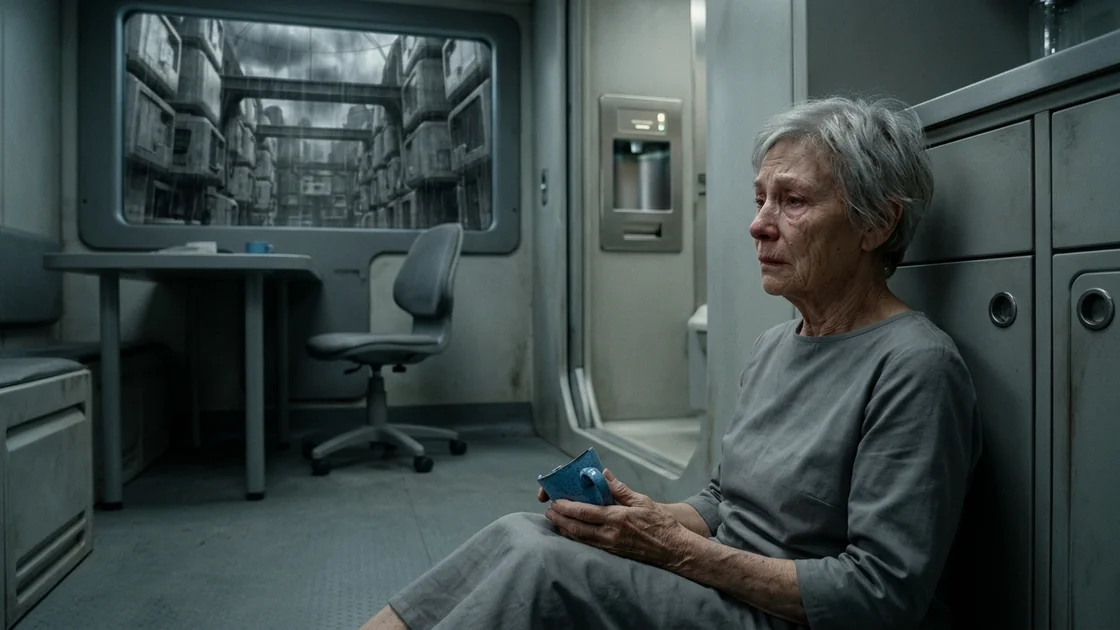
In a sterile future where human sorrow is eradicated through mandatory daily doses of a synthetic stabilizer called Lethe-9, seventy-two-year-old Elara Vance makes the illicit decision to abandon her regimen after a mechanical glitch disables her home dispenser. Over the course of several harrowing days, the chemical dam within her mind breaks, unleashing five decades of accumulated, unmourned tragedies—the death of her husband, the loss of her child, and the slow erasure of her own humanity—forcing her to experience fifty years of devastating grief in a single, catastrophic torrent before the state authorities arrive to restore her compliance.
The chime at 0600 hours did not sound like an alarm; it sounded like a harp string plucked under warm water. It was engineered by the Ministry of Harmonious Living to raise the human resting heart rate by no more than three beats per minute upon waking.
Elara Vance opened her eyes. The ceiling of her Residential Pod—Sector 4, Level 82, Unit 914—glowed with the exact chromatic temperature of a high-altitude spring morning. She did not stretch. In New Oakhaven, one rarely felt the muscular tension that required stretching. The atmospheric processors infused the nighttime oxygen with mild myorelaxants, ensuring that citizens woke up supple, compliant, and entirely rested.
She swung her legs over the edge of the bed. Her feet met the thermally regulated polymer floor. At seventy-two years old, her joints did not ache, though the skin on the backs of her hands was thin and translucent, mapping a network of pale blue veins. She looked at those hands for a moment. She knew, intellectually, that they were the hands of an old woman. She felt a pleasant, detached curiosity about them, the same way she felt about the hydroponic ferns in the atrium, or the daily waste-recycling metrics displayed on her wall screen.
She walked into the sanitation alcove and stood before the mirror. Her silver hair was cropped to regulation length, just above the collar of her dove-grey tunic. Her eyes were a clear, placid hazel. Around the corners of her mouth, there were faint, permanently etched parentheses—the musculature set into what the citizens called the Baseline Smile. It wasn’t a grin; it was merely the absence of a frown, maintained by a steady, unwavering hum of chemical sereneness.
To the left of the mirror sat the Dispenser. It was a sleek, brushed-steel cylinder recessed into the wall, connected directly to the municipal fluid grid. Beneath its nozzle sat a tiny recessed alcove.
Elara placed her right thumb onto the biometric reader.
Normally, the reader flashed a soft pastel green, emitted a two-tone affirmative chime, and dropped a single, pearl-white capsule of Lethe-9 into the stainless-steel cup, followed by sixty milliliters of mineralized water.
Today, the light flashed amber. Instead of the chime, there was a dull, mechanical clack-clack-whir from deep within the wall, followed by the faint smell of ozone.
A text prompt scrolled across the mirror’s surface in soothing, rounded sans-serif font: Actuator Fault 404-B. Dispensation mechanism obstructed. A Maintenance Drone has been automatically dispatched to your unit. Estimated time of arrival: 74 hours. Please proceed to the Sector 4 Clinic for manual dosing.
Elara stared at the amber light.
"Seventy-four hours," she said aloud. Her voice was smooth, carrying the flat, melodic cadence that characterized all speech in the city.
The logic pathways in her brain, conditioned by fifty years of unbroken routine, presented the correct course of action immediately. She should put on her street shoes, take the transit tube down eighty-two levels to the Sector 4 Clinic, present her wrist code to the automated pharmacist, and swallow her pearl-white capsule. The entire excursion would take twenty-eight minutes. She would still be on time for her shift at the Historical Data Curation Bureau.
She turned toward the entryway to retrieve her shoes.
As she passed the small dining table, her sleeve brushed against a ceramic cup she had left near the edge the night before. The cup tipped, fell, and struck the polymer floor. Because the polymer was designed to absorb impact, the cup did not shatter into dust; it broke cleanly into three large, jagged pieces.
Elara stopped and looked down at it.
It was an old cup. It was not standard-issue poly-glass. It was real stoneware, glazed in an uneven, speckled blue. She had possessed it for forty-six years.
She knelt to pick up the pieces. As her fingers closed around the broken handle, a strange, microscopic sensation pricked the back of her throat. It was a tightness, no larger than a grain of sand.
She looked at the blue glaze. Marcus made this, her memory supplied.
Marcus had been her husband. He had died thirty-two years ago in a Mag-Lev derailment in the outer agricultural rings. When the Wardens had come to her door to deliver the news, they had brought a secondary inhalant of high-dose Lethe-9. She remembered breathing in the sweet, vanilla-scented vapor while the Warden explained that Marcus’s physical form had been rendered unrecoverable. She remembered nodding, thanking them for their efficiency, and offering them synthetic tea. She had gone to work the next day. When colleagues asked about Marcus, she had said, "He has transitioned to the statistical past, thank you," and they had smiled the Baseline Smile and replied, "May the balance hold."
Now, holding the broken handle of the cup Marcus had thrown on a wheel when they were twenty-six, the little grain of sand in her throat refused to dissolve.
Why is this broken? she thought. And immediately behind that thought came another, entirely foreign in its structure: Nothing of his is left.
Elara stood up slowly, leaving the shards on the floor. She looked at the front door, beyond which lay the transit tube and the Sector 4 Clinic. Then she looked back at the Dispenser, blinking its quiet amber light.
"Seventy-four hours," she whispered again.
What happened if a citizen missed a dose? In school, decades ago, before the Great Stabilization had even finished its global rollout, they had been shown educational reels. The reels depicted the "Before Times"—a chaotic, grey-tinted horror show of human beings weeping in the streets, screaming at one another, tearing at their hair, paralyzed by a pathological condition known as Melancholia. Lethe-9 did not deaden intelligence, nor did it prevent quiet contentment. It simply bound itself to the amygdala and the subgenual anterior cingulate cortex, acting as a molecular circuit breaker. Whenever a neural pathway began to generate the cascade of neurotransmitters associated with grief, despair, longing, or heartache, Lethe-9 intercepted the signal and transmuted it into a mild, endorphin-laced neutrality.
If she went to the clinic, the grain of sand in her throat would vanish. She would throw the blue ceramic shards into the molecular reclaimer, and she would forget that Marcus’s thumbs had pressed that specific indentation into the base of the handle.
Elara walked to the entryway. She picked up her street shoes. Then, deliberately, she set them back down on the rack.
"Home Terminal," she said to the empty room.
"Listening, Citizen Vance," a warm, maternal voice replied from the ceiling.
"Log a personal maintenance day. Cite minor gastrointestinal variance. Non-contagious."
"Logged. Do you require a medical drone?"
"Negative. Hydration and rest will suffice. Set unit privacy to maximum until my next scheduled work shift tomorrow."
"Privacy engaged. Have a harmonious day, Elara."
Elara walked back to the living area and sat in her ergonomic chair. She placed the broken handle of the blue cup on her lap. She did not know why she was doing this. It was entirely illogical. It was a violation of the Civic Health Mandate. Yet, she sat very still, watching the artificial sunlight creep across the floor, waiting to see what the grain of sand would do.
By noon, the physical symptoms of withdrawal had begun. Lethe-9 had a remarkably short half-life; its efficacy relied on the saturation of the tissues through unbroken daily dosing. After fifty years—one thousand, eight hundred and twenty-five consecutive decadal cycles, plus leap days—her body had forgotten how to regulate its own limbic system.
It started with the temperature. The pod was maintained at a constant 21.5 degrees Celsius, yet Elara found herself shivering. It wasn't the skin-level chill of a draft; it felt as though the marrow inside her femurs and ribs had turned to slush. She pulled a cellular blanket from the bed and wrapped it around her shoulders, but the cold was radiating outward from her core, not inward from the room.
Then came the auditory shift. The ambient hum of New Oakhaven—the whisper of the air scrubbers, the distant, rhythmic thrum of the atmospheric stabilizers—usually blended into a comforting white noise. By 1400 hours, the hum sounded like a groan. Every mechanical vibration in the walls seemed intolerably loud, scraping against her eardrums with a frantic, metallic urgency.
At 1600 hours, the dam developed its first structural crack.
Elara was standing by the kitchenette, trying to force herself to drink a glass of nutrient water. Her hands were trembling so violently that the liquid sloshed over the rim, wetting her tunic. She looked down at the dark stain spreading across the grey fabric.
Without warning, a memory surfaced. It did not arrive like normal memories—which were like flat, indexed photographs retrieved from a filing cabinet. This memory arrived with temperature, scent, and a terrifying three-dimensional weight.
She was twenty-two. It was the year of the Mandate. She was sitting on the wooden porch of her childhood home in the Old District, before the concrete domes were erected. Her mother was sitting beside her. Her mother was dying of lung-rot from the ash-storms of the late century. The first batch of Lethe-1—the crude precursor to Lethe-9—had just been distributed in the ration boxes. Her mother had refused to take it. "I want to miss your father while I go," the old woman had rasped, her hand like a dry autumn leaf in Elara's. "Don't let them take the dark away, Ellie. Without the dark, you can't see the stars."
Two days later, her mother died. And two hours after that, the Public Health Corps arrived at the house. They had pinned twenty-two-year-old Elara to the kitchen floor—not maliciously, just with clinical efficiency—while she kicked and screamed, and they had pressed the pneumatic injector against her carotid artery.
She remembered the exact second the chemical hit her brain. She had been wailing, her face pressed against the dusty linoleum, her heart tearing itself in half at the sight of the sheet pulled over her mother's face. And then, a warm, heavy curtain of velvet had dropped behind her eyes. Her sob had cut off mid-inhale. She had blinked, wiped the saliva and tears from her cheek, stood up, and apologized to the corpsmen for knocking over a chair.
In her pod, fifty years later, the glass of nutrient water slipped from Elara’s fingers.
Her mouth opened, and a sound came out of her that she did not recognize as human. It was a dry, rusted shriek, wrenched from a vocal tract that had only spoken in measured, polite tones for half a century.
Her knees buckled. She hit the polymer floor hard, her hip striking the edge of the cabinetry. Pain flared—sharp and bright—and right behind the pain came the wave.
"Mama," Elara gasped.
Her chest convulsed. She thought she was having a myocardial infarction. Her diaphragm spasmed violently, drawing in ragged, whistling breaths and expelling them in choking bursts. Fluid was pouring from her eyes—hot, stinging, salty liquid that blurred her vision and ran into her open mouth. Her face felt as though the muscles were being wrenched apart by pliers as the fifty-year-old Baseline Smile was violently shattered by a grimace of pure agony.
She’s dead, her brain screamed, as if the sheet had just been pulled over her mother's face five seconds ago. She’s dead, she’s in the ground, they burned the house, I never buried her, I thanked them! I thanked the men who took her away!
The temporal lobe, starved of its chemical muzzle, had lost all sense of chronology. Because the grief of her twenty-second year had never been processed, filed, and allowed to fade into the scar tissue of the psyche, it had remained preserved in amber—fresh, wet, and bleeding.
Elara curled into a fetal position on the floor among the three shards of the blue ceramic cup. She clutched at her chest, her fingernails digging through the grey tunic into her skin. She sobbed until her ribs felt bruised, until her throat tasted of copper, until the lack of oxygen made black spots dance across the artificial spring light of the room.
When the first paroxysm finally subsided, leaving her gasping on the damp floor, she looked up at the wall clock.
It was 1645. Forty-five minutes had passed.
She had just survived the year 2094. She had forty-nine more years to go.
The night was not a night; it was an excavation conducted with dynamite.
Elara managed to drag herself from the kitchenette floor to the edge of the bed, though she did not have the strength to climb onto the mattress. She sat propped against the base, her legs splayed out before her, her back pressed into the soft synth-leather of the frame. The room had cycled down to its nocturnal illumination—a faint, bioluminescent indigo designed to encourage theta-wave sleep.
There would be no sleep.
Her brain was overheating. She could practically feel the synapses misfiring, rerouting around the dissolving blockades of Lethe-9. For fifty years, her mind had been a river dammed by a wall of white pills. Every tragedy, every disappointment, every quiet cruelty of a sterile world, every death, every betrayal had been dumped into the reservoir behind that dam, sinking into the dark silt at the bottom, unseen and unfelt.
Now, the concrete had crumbled. The reservoir was emptying, and the water was black with half a century of rot.
At 2100 hours, the year 2102 arrived.
She didn't just remember the miscarriage; her body reenacted the bereavement of it.
At thirty, she and Marcus had been granted a Reproduction License. They had been so pleased—pleased in that mild, civic-minded way that the drug allowed. When the gestation failed in the sixth month, the clinic had removed the stillborn fetus while Elara was awake, reading an architectural digest on her tablet. The doctor had said, "A genetic incompatibility, Citizen Vance. We have revoked the current license to prevent inefficient resource allocation, but your names have been entered into the commendation lottery for your effort." And Elara had smiled, swung her legs off the stirrups, and gone home to make dinner.
Now, at seventy-two, Elara’s hands flew to her flat, withered abdomen.
A howl tore out of her that rattled the ventilation grates. The phantom weight of the child suddenly existed, and its sudden absence was a physical vacuum inside her pelvis, sucking her organs downward.
"Her name!" Elara screamed at the empty indigo room, tearing at her silver hair, pulling strands out by the roots. "We didn't give her a name! Marcus, we didn't even look at her!"
The horror of her own past compliance was worse than the loss itself. She saw herself in her mind’s eye—that thirty-year-old monster with the placid hazel eyes and the slight, polite smile, flipping through pages of modular furniture designs while her dead daughter was placed in a bio-incinerator tray three feet away.
What was I? she wept, slamming the back of her head against the bed frame. What did they make me?
She vomited onto the polymer floor—thin, acidic bile that smelled of the nutrient water. The Home Terminal remained silent; she had muted its diagnostic subroutines under the privacy protocol, a mercy she had not known she would need. If the Terminal heard her retching and screaming, it would override her request and summon a Rapid Response Medical Unit within three minutes.
She had to be quieter. If they came now, they would shoot the velvet curtain back into her neck. And despite the fact that the pain was splitting her skull open from the inside, a fierce, animalistic instinct had awakened in the ruins of her mind: This is mine. This pain is my daughter. If I stop hurting, she dies again.
She crawled across the floor, avoiding the vomit, and grabbed the pillows from the bed. When the next wave hit—the year 2108, the slow, agonizing realization that she and Marcus had stopped touching each other because the higher formulation of Lethe-6 had inadvertently killed human libido alongside human longing—she buried her face in the dense foam of the pillow and screamed into it until her vision went white.
By 0300 hours, the memories were no longer arriving in chronological order. The floodwaters had reached a turbulent, churning peak, smashing decades together into a single, incomprehensible maelstrom of sorrow.
She mourned the trees. In 2115, the city had paved over the last three acres of natural soil in Sector 4 to build the Central Logistics Hub. She had walked past the fallen oaks on her way to work, stepping over the sawdust, feeling nothing as five-hundred-year-old roots were ground into mulch. Now, she smelled the crushed leaves and the dying sap, and her heart broke for the earth itself, for the murdered green of the world, for the sky that had been replaced by a temperature-controlled projection dome.
She mourned her friend, Clara, who in 2121 had walked into an industrial recycler because her dispenser had been recalibrated too high, leaving her so profoundly numb that she could no longer distinguish between walking into an elevator and walking into a furnace. Elara had attended the "Reclamation Ceremony," eating small savory pastries and discussing archive filing systems with Clara’s widower. Now, Elara clawed at her own face, drawing four red lines down her cheeks, screaming Clara’s name into the wet, saliva-soaked pillow.
And then, at 0500 hours, just before the artificial dawn, Marcus died.
He had died thirty-two years ago, in 2112. Tonight, he died in the room with her.
It was not a single memory; it was the totality of him, crashing down on her frail, seventy-two-year-old frame like a collapsing mountain. She remembered the smell of his skin before the atmospheric scrubbers removed human scent—like cedarwood and dry clay. She remembered the way he used to hum off-key before the Mandate, a habit that disappeared the day the water supply was first supplemented with lithium-derivatives. She remembered the morning he left for the agricultural rings, how he had paused at the door, looked back at her with his dead, placid eyes, and said, "I believe I have forgotten my datapad."
That were his last words to her. I believe I have forgotten my datapad. No kiss. No embrace. No lingering glance. Just two chemical automatons exchanging logistical data before a Mag-Lev train tore him into pieces at four hundred kilometers per hour.
Elara did not scream this time. The grief for Marcus was too vast, too dense for sound. It entered her chest like molten lead, pouring into her lungs, hardening around her heart.
She crawled back to the kitchenette, her movements jerky and palsied, like an insect that had been stepped on. She found the three pieces of the blue ceramic cup. She gathered them against her chest, pressing the sharp, unglazed edges of the broken stoneware directly into her sternum, rocking back and forth in the dark.
I loved you, she thought, discovering a verb she had not conjugated in half a century. I loved you, and I let you go into the dark without a single tear. I let them sweep you up like dust.
When the 0600 harp chime sounded, signaling the start of her second day without Lethe-9, Elara Vance was lying unconscious in the corner of her pod, her hands bleeding slightly from the ceramic shards clutched to her breast.
The chime at 0830 was sharper. It was the Communications Terminal.
Elara dragged her eyelids open. They were swollen, crusted with dried salt, so puffy that she could only see through narrow slits. Every muscle in her body was locked in a state of tetanic exhaustion. Her head throbbed with a migraine so severe that the simulated spring light on the ceiling looked like a sheet of white fire.
"Citizen Vance," a voice came through the comms speaker. It was not the Home Terminal’s maternal AI; it was a live person. Supervisor Tarkin, from the Historical Data Curation Bureau. His voice carried the bright, breezy cadence of a man whose Lethe-9 levels were optimal. "Good morning! Our rosters indicate you have not badged into your workstation, and your Home Terminal shows your medical variance expired at 0800. Are you experiencing continued gastrointestinal inefficiency?"
Elara tried to speak. What came out was a croak that sounded like gravel sliding down a chute. She cleared her throat, wincing at the raw, torn agony of her larynx. She reached up, gripping the edge of the counter, and pulled herself to a kneeling position so her voice would project toward the wall mic.
"Yes," she whispered. Then, forcing her shattered vocal cords to imitate the flat, melodic pitch of the city—an effort that took every ounce of her remaining willpower—she spoke louder. "Yes, Supervisor. My apologies. The inefficiency persists. I am... requesting an additional twenty-four-hour variance."
There was a brief pause on the other end. In New Oakhaven, forty-eight-hour variances were statistically rare, occurring in less than 0.04% of the population annually.
"That is unusual, Elara," Tarkin said, though his tone remained entirely devoid of actual concern, holding only a mild bureaucrat's curiosity. "Have you visited the Sector 4 Clinic? I see a maintenance flag on your unit’s Dispenser. Have you been manually dosing during the mechanical outage?"
Elara’s heart slammed against her ribs. They can see the maintenance flag. Of course they could. Everything was networked.
"Yes," she lied. It was the first lie she had told since the twentieth century. Under Lethe-9, lying required an emotional investment—fear of consequences, desire for an alternative outcome—that simply didn't exist. "I went to the clinic yesterday morning. The... the clinician suggested the manual capsule binding agent might be irritating my stomach lining."
"Ah! That is a known 0.002% probability with the clinic-grade gelatin capsules," Tarkin replied brightly. "Very well. I will approve the secondary variance. Rest well, Citizen Vance. We have three terabytes of late-millennium property tax records to purge tomorrow. May the balance hold."
"May the balance hold," Elara rasped.
The line clicked dead.
She slumped back against the cabinets, her breath coming in shallow, ragged pants. She had bought herself twenty-four hours, perhaps less if the Sector 4 Clinic’s automated logs cross-referenced Tarkin’s report and realized her wrist code had never been scanned at their facility. That cross-reference happened during the weekly server scrub, which was... she tried to think through the blinding fog of her migraine... Friday at midnight. Today was Thursday.
She stood up, using the counter for leverage. Her reflection caught her eye in the sanitation alcove mirror.
She froze.
The woman in the mirror did not belong in New Oakhaven. She looked like a creature dragged from the "Before Times" educational reels. Her silver hair stood out in wild, sweat-matted tufts where she had torn at it. Her face was blotchy, mottled with bruised purples and angry reds. Deep, cavernous trenches had appeared overnight, running from her nostrils to the corners of her mouth, and her mouth itself was pulled down in a slack, trembling bow of utter devastation. Her tunic was stained with bile and small, rust-colored spots of blood from her cut fingers.
Most terrifying of all were her eyes. The placid hazel was gone. In its place was a terrifying, bottomless clarity. They were the eyes of a prophet who had looked directly into a burning sun.
She stumbled to the sink and drank water directly from the tap, gulping it down like an animal until her stomach cramped.
As the water hit her system, her brain, slightly rehydrated, immediately resumed its terrible labor.
The second day of grief was different from the first. The first day had been the explosion—the sudden, violent trauma of the major losses: her mother, her baby, her husband, her friend.
The second day was the sedimentation. It was the grief of the small things, the existential horror of fifty wasted years.
Elara walked out of the sanitation alcove and stood in the center of her 300-square-foot pod. For the first time in five decades, she actually saw where she lived.
There were no books. There were no photographs on the walls, because photographs of the dead or the past were discouraged as "triggers of non-productive nostalgia." There was no art, save for a geometric pattern molded into the acoustic wall panels. The bed was a grey rectangle. The table was a grey circle. Her seven tunics hanging in the closet were identical shades of dove-grey.
She walked to the window. It wasn't a window; it was a high-definition OLED screen showing a pre-rendered view of a lush, green valley that didn't exist anywhere on Earth anymore.
"Home Terminal," she whispered. "Disable window projection. Show external camera feed."
"External feeds are uncalibrated for aesthetic harmony, Citizen Vance," the AI replied.
"Override. Show me the outside."
The green valley flickered and vanished.
In its place was the reality of Sector 4. A colossal, monolithic canyon of unpainted grey ferro-concrete stretching up and down as far as the camera lens could see. Opposite her unit, across a chasm of three hundred meters, were ten thousand identical rectangular pods, stacked like shipping containers in a dead warehouse. Above them, instead of a sky, was the curved, soot-stained underside of the Atmospheric Dome, crisscrossed with massive steel girders and sodium-vapor lamps that cast a sickly, yellowish smog over the megastructure. Acid rain streaked down the external lens, oily and black.
Elara pressed her forehead against the cold glass of the screen.
A quiet, steady weeping began in her chest. There was no screaming today; she didn't have the strength for it. The tears simply leaked from her swollen eyes, tracing the newly carved channels of her wrinkled cheeks, dripping off her chin.
Fifty years, she thought.
When they had put the needle in her neck at twenty-two, she had been a girl with fire in her veins. She had written poetry in lined notebooks. She had loved the smell of rain on hot asphalt. She had been terrified of dying, passionately in love with a boy who made crooked blue pottery, furious at the government, heartbroken over her mother. She had been alive.
And then, she had gone to sleep with her eyes open.
She had spent eighteen thousand days sitting in a grey room, deleting old history files for the Bureau, eating soy-paste cubes, smiling a plastic smile at people whose names she barely cared to remember, waiting for her body to expire so it could be rendered into fertilizer for the hydroponic ferns.
She had missed her own life.
She was seventy-two years old. Her body was at the end of its biological run, and she had just woken up to discover that the fifty years between youth and old age had been stolen from her while she stood in the corner and applauded the thieves.
She sank to her knees beneath the image of the black, raining concrete canyon.
This grief was not sharp like the grief for Marcus; it was wide and grey and suffocating, like an ocean of ash. She wept for Elara Vance. She wept for the paintings she had never painted, the arguments she and Marcus had never had, the passionate reconciliations they had been denied, the wrinkles she should have earned from laughing and crying instead of the smooth, preserved mask of chemical idiocy she had worn into senescence.
She stayed by the window for nine hours.
As the afternoon wore on, every small betrayal she had ever committed under the influence of the drug paraded before her.
She remembered when she was forty-five, working at the Bureau. A young man—barely nineteen, whose metabolism had a rare genetic resistance to Lethe-9—had begun crying at the workstation next to hers. He had found an old file containing poems from the twentieth century, and the beauty of them had broken through his insufficient dosage. He had grabbed Elara’s arm, his eyes wild and wet, begging her, "Look at this! Read this! Do you feel what he's saying?"
And what had forty-five-year-old Elara done?
She had looked at his wet face with mild distaste, gently detached his fingers from her sleeve, and pressed the green button on her desk to summon the Wardens. She had watched them drag him away to the Recalibration Wing—where they performed trans-orbital leukotomies on the drug-resistant—and she had gone back to deleting property tax files before the doors had even closed behind him.
"Forgive me," Elara whispered to the empty room, her forehead pressed to the floor now, her arms stretched out before her in supplication to ghosts. "Oh, God, forgive me. I didn't know. I was dead. I was already dead."
The guilt was a physical toxin. Her skin burned with it. Every nerve ending in her body felt flayed, exposed to salt and vinegar. She understood now why the Ministry had created Lethe-9. It wasn't just to stop riots or increase productivity. It was because once you allowed a human being to feel the weight of what humanity had done to the world—and to itself—the sheer mass of that sorrow was enough to crush the bones in the chest.
Yet, as the hours bled into the second evening, something miraculous began to happen beneath the crushing weight.
Around 2000 hours, the violent trembling in her hands stopped.
Her breathing, though still hitched and heavy, found a deep, slow rhythm. She sat up, leaning her back against the wall beneath the external camera feed, watching the black rain fall against the distant concrete towers.
The pain had not lessened. It was still there—a colossal, jagged monument occupying the center of her consciousness. Her heart felt like an open wound, raw and weeping. Her head still ached, and her throat was still torn.
But the panic was gone. The feeling that she was dying had receded, replaced by a profound, solemn stillness.
She reached into the pocket of her stained tunic and pulled out the broken handle of Marcus’s blue cup. She turned it over in her fingers.
Yesterday, touching it had triggered a seizure of agony. Now, as her thumb found the small indentation where Marcus’s thumb had rested forty-six years ago, a fresh tear spilled over her lashes, warm and slow.
With that tear came a sensation she had forgotten existed. It was not the flat, synthetic "harmony" of Lethe-9. It was a piercing, devastating sweetness.
Because she was finally allowing herself to be shattered by the fact that Marcus was gone, Marcus was suddenly here. In the fifty years she had been on the drug, he had been nothing more than a collection of biographical data points in her memory banks. Now, in the crucible of her grief, he was resurrected. She could feel the warmth of his hand. She could hear the exact timbre of his laugh before the Mandate—a bark that ended in a wheeze. She could feel the immense, terrifying privilege of having loved him at all.
Without the dark, you can't see the stars, her mother had said on the porch in 2094.
Elara looked up at the external feed on the wall. In the distance, through the pouring black rain, the ten thousand windows of the opposite residential block glowed with their faint, identical indigo night-lights. Ten thousand pods. Twenty thousand people, lying in their beds with their Baseline Smiles, dreaming nothing, missing no one, loving nothing, floating in a warm chemical soup toward the grave.
And here she sat, in Unit 914, bleeding, filthy, broken-hearted, and entirely, gloriously awake.
"I remember you," she whispered to the blue handle. "I remember you, Marcus. I remember my mother. I remember my little girl."
She pressed the ceramic to her lips and kissed it. The sorrow inside her expanded, filling the room, vast and dark and sacred as a cathedral. For the first time in half a century, Elara Vance did not want to be anywhere else.
At 0600 hours on the third day, the harp chime sounded.
Elara did not flinch. She had not slept, at least not in the way she used to sleep. She had drifted in and out of a twilight state, sitting upright in her ergonomic chair, wrapped in her blanket, her mind gently sifting through the wreckage of her seventy-two years.
The storm had passed its peak. What remained was the landscape after the flood—scoured clean, devastatingly quiet, and real.
She stood up. Her joints ached fiercely now; without the residual anti-inflammatory properties that rode alongside Lethe-9's neural blockers, arthritis had bloomed in her knees and hips. She welcomed it. The pain was honest. It belonged to her body, earned by seven decades of gravity.
She walked into the kitchenette and made a cup of hot water, sipping it slowly to soothe her blistered throat. She did not wash the blood or the dried salt from her face. She felt a strange reluctance to wash the tears away; they were the only things her body had produced in fifty years that weren't regulated by the state.
At 0815, the Communications Terminal chimed again.
She did not answer it.
It chimed again at 0820. Then at 0825, the tone shifted from the polite administrative chime to the sharp, insistent staccato of a Welfare Override.
"Citizen Vance," Supervisor Tarkin’s voice projected directly into the room, bypassing the manual accept-call protocol. "The Sector 4 Clinic automated registry completed its Friday cycle at 0800 rather than midnight due to a system update. Their records indicate you have not received a manual dose of Lethe-9 since your unit's Dispenser registered Fault 404-B fifty hours ago. Please respond immediately."
Elara took another sip of her warm water. She looked at the speaker grille on the wall, feeling a strange, maternal pity for the voice coming out of it. Poor Tarkin. He didn't even know he was in a cage.
"Citizen Vance," Tarkin repeated, his voice still entirely flat, devoid of the panic a normal human would feel when discovering a colleague had gone rogue. "Non-compliance with the Civic Health Mandate is a Class-1 Physiological Variance. By law, I have notified the Ministry of Harmonious Living. A Maintenance Drone and a Wellness Escort Team have been routed to Unit 914. They will arrive in twelve minutes. Please unlock your entryway and assume a seated position."
"Thank you, Supervisor," Elara said.
She didn't bother faking the flat cadence this time. Her voice was low, resonant, and thick with the gravel of her weeping. Even through the low-fidelity speaker, the raw, unmedicated humanity in those three words was so jarring that Tarkin went completely silent on the other end. He didn't know how to process a voice that had weight in it.
He terminated the connection without saying May the balance hold.
Twelve minutes.
Elara looked around her pod. There was no escaping. The residential blocks were sealed ecosystems; the windows were solid ferro-concrete behind the screens; the only exit was the corridor leading to the central elevator shafts, which would already be locked down to her biometric signature. Even if she reached the ground level, where would a seventy-two-year-old woman with arthritic knees go? Out into the acid rain of the wasteland?
And what would they do when they breached the door in eleven minutes?
If she had merely missed a dose by accident and was found confused, they would administer a localized inhalant, fix the Dispenser, and return her to work.
But one look at her face—at the torn hair, the bloodied cheeks, the vomit on the floor, the external camera feed glowing on the wall—would tell the Wellness Escort Team that this was a deliberate abstention. Worse, she had gone fifty hours. The Ministry knew that once a citizen experienced the full, unmitigated return of the limbic system—what they clinically termed Acute Retroactive Melancholia—a simple daily capsule was rarely enough to re-establish the Baseline. The memory of the depth of the emotion was too potent; the brain fought the chemical muzzle once it knew what lay behind it.
They would take her to the Recalibration Wing. They would strap her to a white table, insert a probe through the bone above her tear duct, and sever the neural tracts of her prefrontal cortex, leaving her alive, smiling, and entirely empty until her heart stopped beating ten years from now.
Elara set her cup down on the counter.
Ten minutes.
Fear—cold, sharp, and metallic—rose in her chest. She hadn't felt fear since she was twenty-two either. She paused to examine it, marveling at the way it made her skin prickle and her vision sharpen. Even the fear was a gift. It meant there was something worth losing.
I will not go back into the velvet, she thought. I will not let them make me forget Marcus again.
If they severed her brain, who would hold the memory of the blue cup? Who would mourn the nameless baby? Who would remember the oak trees of Sector 4? Right now, she was the only living library of those sorrows on the face of the earth. If she let them wipe her clean, those people, those things, would die their final, absolute death.
Wait. Did she have to die to keep them?
She looked at the kitchenette. There were no knives in New Oakhaven pods; all food arrived pre-cubed or in paste tubes. The glass was shatter-resistant polymer. The electrical currents in the wall were low-voltage DC, stepped down to prevent self-harm or accidental electrocution. The Ministry had designed a world where death could only occur by natural cellular decay or state-sanctioned industrial accident.
She looked at the three pieces of the blue stoneware cup on the floor.
Stoneware. Pre-Mandate ceramic. Fired at twelve hundred degrees, hard as flint, with a break along the base as sharp as an obsidian scalpel.
She walked over and knelt beside the shards. Eight minutes.
She picked up the largest jagged triangle of the cup's body. The unglazed white clay along the fracture line glinted in the harsh light of the room. She pressed the point of it against the pale blue vein on the inside of her left wrist.
She held it there, breathing heavily.
Is this what I want? she asked herself.
She thought of her mother, gasping for air with lung-rot on the porch. Her mother hadn't killed herself; she had fought for every ragged breath because she wanted to stay in the world and miss her husband for as long as her body would allow.
If Elara cut her wrist now, the grief would stop. And she realized, with a blinding flash of clarity, that she didn't want the grief to stop. She had only had it for two days! Fifty years of emotional starvation could not be satisfied by a forty-eight-hour feast. She wanted to cry for another year. She wanted to remember her childhood dog. She wanted to remember the taste of real strawberries. She wanted to sit with the ache of Marcus until she knew every contour of it by heart.
No. Dying was just another form of Lethe-9. It was the ultimate anesthesia.
She dropped the sharp shard of ceramic. Instead, she picked up the curved handle again.
Five minutes.
Out in the corridor, she heard the heavy, pneumatic hiss of the fire doors sealing off the eighty-second level. The Wellness Team was on the floor.
If she couldn't escape, and she wouldn't kill herself, how could she fight them? How could she keep the dark so she could see the stars?
Her eyes fell on the Dispenser in the sanitation alcove, still blinking its quiet amber light. Actuator Fault 404-B. Dispensation mechanism obstructed.
Why had it jammed? For fifty years, those machines ran with 99.999% reliability.
Elara stood up and walked into the alcove. She looked closely at the recessed steel cup beneath the nozzle. She reached her slender fingers up into the narrow chute where the capsules dropped.
Wedged sideways in the tiny plastic baffle at the top of the chute was a capsule. It hadn't failed electronically; the humidity from her shower two days ago must have caused the gelatin casing of a single Lethe-9 pill to swell slightly, sticking it to the side of the tube and blocking the optical sensor.
As her fingertip brushed it, the dried gelatin gave way.
Clack.
Two pearl-white capsules—Wednesday’s dose and Thursday’s dose—tumbled down into the stainless-steel cup. Above the mirror, the amber light blinked twice, turned a soft, pastel green, and emitted the soothing two-tone chime.
Simultaneously, the mechanical actuator whirred to life, recognized that it was now 0830 on Friday, and dropped a third capsule into the cup, followed by sixty milliliters of mineralized water.
The text on the mirror updated: Obstruction cleared. Fault 404-B resolved. Maintenance request automatically canceled.
Elara stared at the three white pills sitting in the cup beside the tiny pool of water.
Down the hall, the heavy, synchronized footsteps of the Wellness Escort Team came to a halt directly outside the door of Unit 914.
The electronic lock on her door beeped as they engaged their master override key.
In three seconds, the door would slide open. If they found a raving, weeping woman in a ruined room, she would be lobotomized before noon.
If they found a technical error...
Elara did not think. Her mind, sharpened by the terrifying electricity of pure survival instinct, moved faster than it had since she was twenty.
She grabbed the three white pills from the cup. She did not swallow them; she shoved them deep into the pocket of her tunic alongside the blue ceramic handle. She grabbed the towel from the rack, soaked it in cold water from the tap, and scrubbed violently at her face, wiping away the blood and the crusted salt. She couldn't hide the swollen eyes or the haggard lines, nor the vomit in the corner, nor the external camera feed on the wall.
She didn't try to hide the mess. She used it.
As the front door hissed open, revealing two broad-shouldered Wardens in white bio-armor and a clinician carrying a pneumatic carotid injector, Elara stumbled out of the sanitation alcove, clutching her stomach, and collapsed purposefully onto her knees in plain view.
"Help me," she gasped, forcing her face—every screaming, rebellious muscle of it—to pull the corners of her mouth upward into a grotesque, trembling imitation of the Baseline Smile.
The clinician stepped forward immediately, raising the injector, his eyes scanning the room—the vomit, the torn hair, the terrifying rain-streaked city on the wall screen. "Acute variance," the clinician said to the Wardens. "Fifty hours unmedicated. Prepare for restraint."
"No, no!" Elara said, her voice pitching upward into the breezy, melodic cadence of New Oakhaven, though she let it shake with physical weakness. She pointed a trembling hand back toward the sanitation alcove, where the green light was now glowing serenely above the mirror. "It was the stomach virus! I told Supervisor Tarkin! I went to the clinic yesterday, I took the manual dose, and I threw it all up! I threw everything up for two days! Look at the floor! I couldn't keep the capsules down, I couldn't keep the water down!"
The clinician paused, lowering the injector by a fraction of an inch. In a society without lies, a citizen’s explanation of physical mechanics was taken at face value unless contradicted by hard data.
"The clinic registry showed no scan of your wrist code yesterday, Citizen Vance," the clinician said smoothly.
"The scanner at the door was blinking amber!" Elara lied, weaving the truth of her own dispenser into the fabrication with breathless speed. "The nurse just handed me the cup from the counter because I was retching into a basin! I tried to take them, I swear by the Balance, I tried! Look at my Dispenser! I finally had the strength to reach up into the chute just now and clear the jam so I wouldn't have to leave the pod while contagious! I just took all three doses at once! My stomach—I think taking three at once is making me dizzy, and my Home Terminal glitched when I threw up on the sub-panel, the window screen went dark—"
One of the Wardens stepped past her into the sanitation alcove. He looked at the Dispenser.
"Green light," the Warden confirmed. "Diagnostic log shows Fault 404-B cleared ninety seconds ago. Three capsules dispensed. Cup is empty. Water consumed."
The clinician looked down at Elara. He looked at her swollen, bloodshot eyes, the deep trenches of grief in her face, the scratches on her cheeks.
"Why is your face lacerated, Citizen?" the clinician asked.
Elara kept that horrible, muscular smile pinned to her face, even as her fingernails dug into her palms inside her sleeves. "I fell," she said brightly, melodically. "In the dark last night, trying to reach the toilet. I knocked my ceramic cup off the table and fell onto the pieces. Without my dose holding down my nausea, my equilibrium was entirely unharmonious! I felt... oh, it was dreadful. I think I even cried! Can you imagine? Just like the Before Times reels! How inefficient!"
She gave a little, airy laugh.
The effort it took to produce that laugh while the raw, bleeding ghost of her dead husband stood in the corner of her mind nearly caused a blood vessel to burst behind her eyes. It was the greatest performance in the history of the city, delivered by an actress who had just relearned what theater was.
The clinician stared at her for five long seconds. He pulled a handheld scanner from his belt and passed it over her carotid artery.
Elara held her breath. If it was a blood-chemistry analyzer, she was finished; there was zero Lethe-9 in her bloodstream.
"Heart rate 118. Cortisol severely elevated," the clinician read from the screen. Thankfully, it was just a standard vitals monitor; full blood-assays required a clinic draw. "Consistent with acute viral dehydration and temporary withdrawal spikes. If you ingested three capsules ninety seconds ago, Citizen Vance, they will not cross the blood-brain barrier for another fourteen minutes, assuming your gastric lining retains them."
"I feel them settling already," Elara said, widening her Baseline Smile until her cracked lips bled a tiny drop of red. "Truly, the relief is immediate. May the balance hold."
The clinician looked at the vomit on the floor, then back at the green light of the Dispenser. Bureaucracy, especially medicated bureaucracy, always favored the path of least paperwork. An accidental withdrawal caused by a verified mechanical fault (404-B) combined with a documented gastrointestinal variance (logged with Tarkin 48 hours prior) required only a standard sanitation cleanup. A Class-1 Physiological Variance required a tribunal, a neurological surgery slot, and a replacement data curator at the Bureau.
"Since your gastric system is compromised," the clinician said, lifting his pneumatic injector again, "I will administer a half-dose sub-dermally to bridge the gap until the oral capsules metabolize, and to prevent nausea."
No, Elara’s mind screamed. Not even a half-dose. Don't touch my mind.
Wait. If she refused, they would hold her down and give her a full dose, and then take her to the clinic for observation, where they would discover her blood was completely clean of the three pills she claimed to have swallowed.
A half-dose. Lethe-9 was cumulative; its power relied on saturation. After fifty hours of total clearance, what would a single sub-dermal half-dose do? It would dull the edges for six or eight hours. It would put a thin veil of gauze over the cathedral, not brick it back up. And by tonight, it would wear off.
"Thank you, Clinician," Elara said, tilting her wrinkled neck to the side, exposing her vein. "Your efficiency is appreciated."
The clinician stepped forward, pressed the cold steel nozzle against the side of her neck, and pulled the trigger.
Hiss.
Elara closed her eyes.
She felt the familiar, vanilla-scented coldness enter her bloodstream. Ten seconds later, it hit her brain.
She braced herself, gripping the blue ceramic handle in her pocket with all her strength, focusing every volt of her consciousness on Marcus’s face, on her mother’s voice, on the phantom weight of her baby. Hold on, she told the pain. Hide in the deep water. Don't let it erase you.
The velvet curtain dropped—not heavy and black as it had been for fifty years, because her receptors were raw and inflamed and fighting back—but like a thick grey fog rolling in over a jagged mountain range.
The excruciating migraine behind her eyes vanished instantly. The razor blades in her throat dissolved into a pleasant warmth. The crushing, suffocating weight in her chest lifted by half, as if someone had taken two hundred pounds of stones off her sternum.
For a terrifying second, she felt the urge to let go—to let the fog take the rest of it, to sink back into the warm, painless nothingness where no one ever died because no one ever lived. It was so easy. It felt so good not to hurt.
Then, she squeezed her hand in her pocket. The sharp edge of the broken stoneware bit into her palm, drawing fresh blood.
The physical pain lanced up her arm, cutting right through the chemical fog. And anchored to that sharp point of pain, the grief held fast. The mountains remained beneath the mist. She could still see their dark, massive shapes. She still knew her daughter was gone. She still missed Marcus with a profound, aching solemnity that the half-dose could not touch. Her brain had been permanently rewired by the fifty-year flood; the river had carved a canyon too deep for a single afternoon’s dam to contain.
She opened her eyes. They were clear again, placid on the surface, hiding the dark ocean underneath.
"There," the clinician said, stepping back. "Your heart rate is dropping to 78. I will dispatch a sanitation drone to sterilize your floor, and reset your external display to the standard valley projection. You are cleared to return to the Historical Data Curation Bureau tomorrow morning at 0800."
"Thank you," Elara said, standing up smoothly. "Have a harmonious day."
The Wardens and the clinician turned and exited Unit 914. The door slid shut behind them with a soft, definitive click.
Elara stood alone in the center of her pod. On the wall, the black, acid-rain-streaked reality of the city flickered out, replaced once again by the sunny, non-existent green valley.
She walked slowly into the sanitation alcove.
The Dispenser was glowing green. Tomorrow morning at 0600, the chime would sound, and she would place her thumb on the reader. A white capsule would drop into the cup.
And she would pick it up, walk two inches to the left, and drop it silently down the molecular waste-reclamation drain of the sink, while drinking the sixty milliliters of water so the weight sensors in the cup registered compliance.
She pulled the three capsules from her pocket and dropped them into the sink drain right now, watching them vanish into the pipes.
Then, she pulled out the broken blue handle of Marcus’s cup.
The half-dose in her veins was humming its quiet, seductive song, trying to coax her mouth into the Baseline Smile, trying to smooth out the new trenches in her cheeks.
Elara looked into the mirror. Deliberately, using the newly awakened muscles of her face, she forced the smile down. She thought of the day the Mag-Lev train derailed. She thought of her mother’s hand, dry as an autumn leaf. She thought of the fifty years she had lost.
Slowly, fighting its way through the chemical fog of the sub-dermal injection, a single, hot tear welled up in her right eye, spilled over the lower lid, and tracked down her cheek.
The drug hadn't stopped it. She was stronger than the drug now.
Elara Vance did not wipe the tear away. She held the broken piece of blue clay against her heart, walked over to her chair, and sat down to weep for the rest of her life.