The Weight of Cedar and Dust
After the sudden passing of their formidable mother, estranged sisters Clara and Margot return to their sprawling, dilapidated childhood home in upstate New York to prepare the estate for sale. Having spent a decade apart, the two women must navigate towers of hoarded memories and the suffocating architecture of a house that served as the stage for their uneven childhood. Evelyn Vance had loved Margot with a fierce, gilded pride while treating Clara as an invisible caretaker, a bitter dynamic that poisoned their sisterhood long before they reached adulthood. Over the course of one agonizing, rain-soaked weekend, as they sort through decades of family heirlooms, forgotten diaries, and hidden financial records, the sisters are forced to confront the suffocating ghosts of their upbringing. In the dusty light of the attic, they discover that being the favored child carried its own crushing price, ultimately allowing them to dismantle their mother's toxic legacy and forge a fragile, honest reconciliation before locking the front door for the last time.
The brass key stuck in the deadbolt, just as it had every autumn since 1986 when the damp crept up from the Hudson River and swelled the heavy oak doorframe. Clara jiggled the key, lifting the tarnished brass doorknob slightly to the left before throwing her shoulder against the wood. It gave way with a loud, splintering groan that echoed through the cavern of the front hall.
Inside, the air smelled of peppermint oil, decaying paper, and the dry, powdery scent of Evelyn Vance’s lavender talc. It was the smell of a museum that had run out of funding.
Clara stepped over the threshold, her sensible canvas tote bag slung over one shoulder, a carton of heavy-duty contractor trash bags tucked beneath her arm. She did not call out. There was a strange, ingrained reflex in her throat—a tightening of the vocal cords that usually preceded the phrase, Mom, it’s just me—and she swallowed it down until it felt like a stone in her stomach. Evelyn was three days in the ground at St. Jude’s Cemetery, tucked beneath a blanket of wet October leaves and a granite headstone she had pre-selected and paid for in 2014.
Behind Clara, the crunch of gravel announced the arrival of a vehicle far too expensive for the potholed driveway of 42 Sycamore Lane. Clara didn’t turn around. She knew the purr of the rented luxury sedan, just as she knew the sharp, rhythmic click of heeled boots that followed a moment later.
Margot appeared in the open doorway, framed by the grey October drizzle. She looked like she had stepped out of a magazine spread about autumn in Milan. Her camel-hair coat was belted tightly at the waist, her dark hair swept up into an effortless knot that Clara knew took twenty minutes and three different products to achieve. Margot pushed her oversized tortoiseshell sunglasses to the top of her head and looked past Clara into the gloom of the foyer.
"God," Margot said, her voice husky from the flight in from Chicago. "It’s smaller. Or darker. Did she never open a curtain after 2018?"
"The west-facing pulleys snapped," Clara said, setting the roll of trash bags down on the radiator cover. "She didn’t want the repairman tracking mud on the parquet, so she just left the drapes drawn."
Margot stepped inside, pulling a sleek leather weekender bag behind her. The wheels rattled loudly over the gap between the threshold and the faded Oriental rug. She stopped, looking at Clara for the first time. A muscle feathered in Margot’s jaw, the prelude to an embrace neither of them wanted to initiate. Instead, Margot reached out and briefly touched Clara’s forearm—two seconds of leather glove against wool sweater.
"You look tired, Care," Margot said softly.
"I’ve been here since Tuesday, Margot. Doing the funeral home intake, the death certificates, the probate lawyer, and emptying the perishables out of the fridge before they turned into a biohazard." Clara turned away, pulling a pair of yellow rubber gloves from her coat pocket. "You flew in for four hours on Thursday, stood by the grave under an umbrella, and went back to your hotel in the city. Of course I’m tired."
Margot sighed, a practiced, weary sound that meant she had decided to be the bigger person. She slipped out of her coat and looked around for the mahogany coat tree, frowning when she saw it was buried beneath four layers of Evelyn’s vintage wool capes and a tangled mass of dog leashes for a spaniel that had died during the Obama administration. She draped her camel coat over the banister instead.
"I had to close the quarter, Clara. We talked about this. That’s why I’m here now. All weekend. Until Monday night. No laptop, no calls." Margot gestured vaguely at the towering wainscot walls. "Where do we start? The lawyer said the estate liquidators come on Tuesday morning, right?"
"Tuesday at eight," Clara confirmed. "Everything we don’t want goes to auction or the dump. Anything personal, financial, or sentimental needs to be sorted by us before they walk through that door. They don’t sort through trash. If there’s garbage mixed in with the antiques, they charge us a hazardous waste fee."
"It’s not hazardous," Margot said defensively, though her eyes lingered on the stacks of The New Yorker and unopened mail that rose like stalagmites along the baseboards. "She was just… a collector. She was an art historian, Clara. She liked things with provenance."
"She kept butter tubs, Margot. Wait until you see the pantry."
Clara walked down the long hallway toward the kitchen, leaving her younger sister standing in the dim light of the foyer. Every floorboard had its own distinct voice, a chorus of creaks and pops that Clara knew by heart. Left foot near the telephone table to avoid the loud shriek; right foot dead center before the swinging door to the butler’s pantry. It was the choreography of a girl who had spent eighteen years trying not to be noticed, followed by twenty years of coming home every second Sunday to clean a house for a woman who barely looked up from her crossword puzzle.
The kitchen was a time capsule of 1970s harvest gold and turn-of-the-century cast iron. Clara had already scrubbed the counters, so the room smelled sharply of bleach, cutting through the general mustiness of the house. On the center island sat three cardboard boxes labeled in thick black marker: KEEP, SHRED, and DONATE.
Margot pushed through the swinging door a moment later, rolling up the sleeves of her cream cashmere sweater. "Do we have coffee? Or did you throw that out with the perishables?"
"There’s a French press on the stove and a kettle," Clara said, pointing toward the range. "I bought beans in town this morning. The coffee in her freezer was from theBush administration."
Margot busied herself with the kettle, her movements brisk and efficient. Even from the back, Margot possessed a kinetic grace that Evelyn had worshipped. Look at Margot’s posture, Evelyn used to say while Clara slouched over her algebra homework at this very island. She has my mother’s bones. Like a thoroughbred. Clara, sit up, you look like you’re digging for truffles.
"We should divide and conquer," Margot said, leaning against the counter as the water began to rumble. "I’ll take the living room and the study. You take the dining room and the sunroom. Tomorrow we tackle the upstairs."
Clara paused, her hand hovering over a stack of yellowing cookbooks held together by brittle rubber bands. "No."
Margot blinked. "No?"
"We aren't dividing the rooms," Clara said, her voice flat and steady. "If you do the study alone, you’ll throw out the tax records from 2021 because they look boring, and you’ll keep forty pounds of her old exhibition catalogs because they look pretty. And if I do the dining room alone, you’ll accuse me of donating the silver gravy boat you suddenly remember loving."
"I don't care about the gravy boat, Clara."
"We go room by room. Together," Clara insisted. "We touch everything once, we decide, and we move on. That’s the only way this gets done without three months of passive-aggressive emails afterward."
Margot stared at her as the kettle began to whistle—a thin, rising shriek that grew until it filled the high-ceilinged kitchen. Margot reached back and snapped the burner off, letting the silence rush back in. "Fine. Room by room. Where first?"
"The parlor," Clara said. "It’s the shrine. We might as well tear the band-aid off."
The parlor was at the front of the house, separated from the foyer by heavy pocket doors that Evelyn had kept open a precise twelve inches to allow airflow without letting the sun fade the upholstery. When Clara slid the doors all the way back into the walls, dust motes exploded into the grey light like disturbed insects.
The room was dominated by a baby grand piano that neither sister had played since high school, its polished mahogany lid crowded with dozens of silver-framed photographs. The walls were covered in faded green damask wallpaper, stained with dark rectangular ghosts where paintings had once hung before Evelyn sold them off quietly in her seventies—something Clara had only noticed because she was the one who dusted around the frames.
Margot walked in holding two mugs of black coffee, handing one to Clara before turning toward the piano.
Clara didn’t need to look at the piano to know what was on it. She had wiped the glass on those frames every month for a decade while Evelyn sat in the wingback chair by the dry fireplace, supervising with a glass of dry sherry.
There was Margot at eight, missing a front tooth, holding a first-place ribbon from a regional equestrian meet. There was Margot at eighteen, radiant in a white strapless gown at her debutante cotillion, her dark eyes bright with the knowledge that every person in the country club was looking at her. There was Margot at twenty-two, graduating magna cum laude from Columbia, Evelyn standing beside her in a Chanel suit, her arm hooked through Margot’s with a possessive, triumphant smile that never once appeared in any photograph taken with her elder daughter.
And there, tucked behind a massive silver frame of Margot’s first wedding in Napa Valley, was a single four-by-six snapshot in a cheap brass border. It showed Clara at twelve, squinting into the sun at Cape Cod, standing next to Margot so that half of Clara’s shoulder was cropped out to center her sister in the frame.
Margot stood in front of the piano, sipping her coffee. Her eyes moved slowly over the metallic sea of her own face.
"Jesus," Margot murmured. "It’s creepy."
"It’s a curated collection," Clara said, pulling a black trash bag from the roll and snapping it open with a loud crack of plastic. "She rotated them depending on what she was bragging about to the garden club. When you got promoted to Vice President, she put the corporate headshot from your company website right in the center, next to the Beethoven bust."
Margot set her coffee down on a coaster—an old habit that died hard—and picked up the wedding photo. She stared at the smiling man beside her in the tuxedo, a man she had divorced six years ago after he emptied their joint savings account to fund a failing tech startup.
"I asked her to take this down in 2019," Margot said quietly. "I told her it made me sick to look at him."
"She told me she liked the way her hat looked in the background," Clara replied, kneeling by the low bookshelves that flanked the fireplace. "And she liked telling people you married a Stanford man. The divorce didn't fit the narrative, so in this room, you were still happily married in California."
Margot pulled the back off the silver frame, slid the glossy photograph out, and tore it cleanly in half. She dropped the pieces into Clara’s open trash bag. "Keep the frame?" she asked, holding up the heavy sterling border.
"Put it in the estate sale box," Clara said. "Sterling is going for good money by weight right now."
They worked in silence for the first hour. The rhythm was awkward at first, a dance of two people trying not to brush shoulders in a crowded room. Clara was methodical. She started at the top left shelf of the bookcase, pulling out five books at a time, fanning the pages to check for hidden cash or letters—Evelyn had a paranoid streak in her final years and distrusted banks—before stacking them neatly into cardboard boxes. Margot was erratic. She would start sorting a pile of old sheet music, get distracted by a porcelain figurine on the mantel, carry it to the window to check the maker’s mark on the bottom, and then sit on the ottoman for ten minutes reading an old issue of Architectural Digest.
"Focus, Margot," Clara said around eleven o'clock, wiping sweat from her forehead with the back of her wrist. Her knees ached from the hardwood floor. "You’ve been looking at that magazine since I started the third shelf."
"Look at this," Margot said, turning the magazine toward Clara. A yellow sticky note was attached to a page featuring a minimalist loft in Tribeca. Evelyn’s spidery, fountain-pen handwriting was scrawled across the note: For M—too cold? Tell her to buy rugs. "She was clipping decorating ideas for the condo I bought three years ago. She never even saw it."
"She printed the Zillow listing from the library computer and brought it home," Clara said, not looking up from a stack of National Geographic magazines. "She hated the exposed brick. She told the postman you were living in a factory."
Margot let out a short, sharp laugh that sounded remarkably like a sob, though when Clara glanced up, her sister’s eyes were dry. "She called me every Sunday at four o’clock to tell me my life was too modern, my hair was too short, and my job was making me hard. Every single Sunday, Care."
Clara froze, a stack of dusty paperbacks poised over a box. "She called you every Sunday?"
"Like clockwork," Margot said, tossing the magazine into the trash bag. "If I didn't pick up by the third ring, she’d leave a voicemail that sounded like she was dying of consumption. 'Margot, darling, it’s Mother. I suppose you’re at a cocktail party. I’m just sitting here in the dark, listening to the wind.'"
Clara felt a strange, cold sensation trickle down her spine. "Sunday at four?"
"Four Eastern, three Central," Margot said, walking over to the curio cabinet. "Why?"
"Because I was here every second Sunday from noon until five," Clara said, her voice dropping an octave. "Cleaning the gutters, doing her laundry, balancing her checkbook. Around three-forty-five, she would always tell me she had a migraine and needed to lie down in her room with a cold cloth. She’d lock her bedroom door. She was calling you."
Margot turned from the cabinet, her hand resting on the brass key in the glass door. "She told me she was alone, Clara. She told me you never came by anymore unless you needed to borrow the lawnmower."
The silence in the parlor thickened, heavy with the smell of old wool and fifty years of deceit. Clara looked at her sister—really looked at her—taking in the fine lines around Margot’s eyes that hadn't been there at their aunt’s funeral five years ago, the slight tremor in the hand holding the cabinet key.
"I don't even own a lawn, Margot," Clara said softly. "I live in a third-floor walk-up above a bakery in Rhinebeck. I’ve lived there for eight years."
Margot looked down at the floor. "I know. I mean, I knew you had an apartment. I just… when she said it, I didn't question it. With Mom, it was easier not to cross-examine her. You just let the wave wash over you and waited for the tone to disconnect."
"Must have been nice," Clara said, the bitterness rising in her throat like bile, "to be able to hang up on her."
"Don't start," Margot warned, her voice tightening. "You stayed here, Clara. Nobody chained you to Dutchess County. You could have moved to Boston after college like you planned."
"She broke her hip my senior year, Margot!" Clara slammed a heavy volume of Renaissance art history into the box so hard the cardboard split at the seam. "Someone had to do the physical therapy runs. Someone had to manage the house. And when it healed, she suddenly couldn't drive at night anymore, and then her arthritis flared up, and you were in London doing your fellowship! You were the golden child, the bird meant to fly, and I was the mule meant to pull the cart!"
"I was twenty-one!" Margot shouted back, the veneer of the cool, composed executive cracking down the middle. "Do you think I orchestrated her falling on the ice? Do you think I sat in London laughing about how Clara was stuck making soup? I was terrified to come home!"
"Terrified of what? Being worshipped? Having another portrait hung over the piano?"
"Of being eaten alive!" Margot’s voice echoed off the high ceiling, making the crystal prisms on the sconces shiver. She turned away, pressing the heels of her hands against her temples, breathing hard. "Forget it. Just… let's finish the cabinet."
Clara stood up slowly, her joints popping. The rage in her chest was an old friend; she had kept it warm for twenty years, feeding it small scraps of resentment every time Evelyn introduced her to a neighbor as my helpful daughter while Margot was my brilliant girl in Chicago. To hear Margot claim she had been afraid of this house felt like an insult to every Saturday night Clara had spent scraping burnt casserole dishes in the sink while her friends were out at bars.
Clara walked to the curio cabinet and yanked the glass door open. "Fine. Top shelf. The Staffordshire dogs. Keep or sell?"
"Sell," Margot whispered, not turning around. "I hate those fucking dogs."
By mid-afternoon, the October drizzle had turned into a relentless, driving rain that lashed against the wavy glass of the parlor windows. The house had grown colder. Clara went down to the basement to coax the ancient oil boiler to life, and soon the cast-iron radiators were clanking and hissing like angry ghosts, radiating a faint smell of singed dust.
They moved into the dining room at three o'clock, eating stale crackers and sharp cheddar cheese Clara had brought in a cooler while standing over the ten-foot mahogany table. The table was covered in stacks of linen tablecloths, mismatched candlesticks, and boxes of old correspondence that Evelyn had brought down from the attic when climbing the stairs became too difficult.
The dining room was darker than the parlor, paneled in dark walnut up to the plate rail, which was lined with Blue Willow platters.
"What are all these boxes?" Margot asked, wiping crumbs from her hands and lifting the lid off a dusty banker’s box at the end of the table.
"Her 'projects,'" Clara said, opening a bottle of lukewarm sparkling water. "A few years ago, she decided she was going to write a family history. All it really meant was that she dumped forty years of unsorted drawers into boxes, brought them down here, and then got angry at me when I tried to move them so we could eat Thanksgiving dinner."
Margot pulled a handful of papers from the box. There were old report cards, faded color Polaroids from the eighties, receipts from department stores that no longer existed—B. Altman, Bonwit Teller, Lord & Taylor.
"Look at this," Margot said, her voice softening as she held up a construction-paper turkey with dried macaroni glued to the tail feathers. "Clara Vance, Grade Two. Mrs. Gable’s class."
Clara walked over and looked at the pathetic little craft. Half the macaroni had fallen off over the decades, leaving crusty yellow ovals of Elmer’s glue on the brown paper. "I remember making that. I spilled the glue bottle all over my plaid jumper. Mom didn't speak to me for two days because it was dry-clean only."
"She kept it, though," Margot pointed out, gently placing it in a pile she had designated for Clara’s personal things.
"She kept everything in that drawer, Margot. Look underneath it."
Margot dug deeper and pulled out a stack of expired coupons for cat food—they had never owned a cat—and a warranty booklet for a 1984 General Electric toaster oven. Margot’s mouth twitched, and she tossed the toaster manual into the trash bag.
For the next two hours, the only sounds were the tearing of paper, the rustle of plastic bags, and the steady drum of rain against the bay window. As the natural light faded into a bruised purple twilight, Clara flipped the switch for the brass chandelier. Only three of the eight flame-shaped bulbs worked, casting long, theatrical shadows across the walnut walls.
Clara was at the sideboard, wrapping crystal wine glasses in newspaper, when she heard Margot stop moving.
Over the years, Clara had learned to read the quality of silences. Evelyn’s silences were sharp, punitive, waiting for an apology. Margot’s silences were usually distracted or guarded. This silence was neither. It had the heavy, airless quality of a room just after a glass has been dropped, before the pieces stop skittering across the floor.
Clara turned around, a sheet of newsprint crinkling in her hands.
Margot was sitting in one of the high-backed dining chairs at the head of the table—Evelyn’s seat. In front of her was a dark green metal lockbox, the kind sold at stationery stores in the seventies. The small brass lock had been forced open years ago with a screwdriver; Clara remembered when Evelyn had lost the key and made Clara pry it open so she could get to her passport.
Margot was holding a bundle of pale blue envelopes tied with a faded white ribbon, and beside it lay a thick, leather-bound ledger.
"Margot?" Clara set the wine glass down. "What is that?"
Margot didn't look up. Her face in the dim light of the chandelier was the color of skim milk. Her fingers were trembling so violently that the blue paper rattled like dry leaves.
"Where did you get this box?" Margot asked. Her voice was unrecognizable—thin, reedy, stripped of its Chicago polish.
"It was in the bottom of the sideboard, behind the soup tureen," Clara said, walking slowly toward the head of the table. "I pulled it out an hour ago. I thought it was just old warranty cards and the deed to the cemetery plot. What's in it?"
Margot slowly slid one of the blue envelopes across the mahogany table.
Clara picked it up. It was addressed to Miss Clara Vance, 42 Sycamore Lane, in a looping, unfamiliar hand. The postmark was from Florence, Italy, dated June 14, 1998. The envelope had been slit open neatly along the top—Evelyn’s silver letter opener had a very specific, jagged bite—Wait.
Clara frowned, turning the envelope over. 1998. The summer after Clara graduated from high school.
"What is this?" Clara asked, pulling the single sheet of thin airmail paper from inside.
It was a letter from Rhode Island School of Design. Not the admissions office—Clara had applied there behind her mother’s back, been accepted, and then been told by the financial aid office that her family’s income was too high for a grant, forcing her to go to the state commuter school twenty minutes away. No, this was from the coordinator of the Summer Pre-College Painting Intensive in Florence.
Dear Clara, the letter read. Following up on our telephone conversation with your mother this morning, we regret to hear that your health will prevent you from joining the fellowship this summer. As the scholarship was fully funded by the Alumni Endowment, we will award your spot to the first alternate. We wish you a speedy recovery…
Clara read the lines three times. The words seemed to swim on the blue paper, refusing to link together into a coherent sentence.
"I didn't apply to a summer intensive in Florence," Clara whispered. "Mr. Henderson—my art teacher—he said he was submitting my portfolio for a contest, that’s all. He told me in May that I didn't win."
"Look at the other ones," Margot said, her voice hollow.
Clara reached for the stack. There were six envelopes in total. Two were from the RISD admissions department in the spring of 1998, detailing a merit scholarship package that covered seventy percent of tuition, contingent on a signed parental acknowledgment form by May 1st. The form was still inside the envelope, unsigned, with a small coffee ring staining the bottom corner.
The other three letters were from David Miller, a boy Clara had dated her freshman year of college—a quiet, gentle photography student who had transferred to a school in California after sophomore year. He had promised to write. Clara had spent the autumn of 2000 checking the mailbox at the end of the driveway every day until her heart hardened into a knot of humiliation, assuming he had met someone in San Francisco and forgotten she existed.
The letters from David hadn't even been opened. Evelyn hadn't bothered to read them; she had simply intercepted them from the rural mailbox before Clara got home from her shift at the bookstore and locked them in the green tin box.
Clara sat down heavily in the chair beside Margot. Her hands felt numb, as if she had plunged them into river water in January. The room seemed to tilt slightly on its axis. Her whole life—the smallness of it, the quiet, grey walls of the local college, the job at the framing shop that turned into managing the town’s small historical society, the lingering belief that she was simply too ordinary to be chosen by the world or by a man who left town—it hadn't been fate. It hadn't been a lack of talent.
It had been Evelyn, walking down the gravel driveway at one in the afternoon in her gardening clogs, sorting the mail with the casual cruelty of a customs officer.
"She clipped my wings," Clara said, the words coming out in a breathless rush. "She didn't even let me know I had them."
"Clara," Margot choked out. A tear finally spilled over her lower lashes, cutting a shiny path through her expensive foundation. "That’s not all of it. Look at the ledger."
Clara tore her eyes away from David’s twenty-five-year-old handwriting and looked at the black leather book in front of her sister.
"What is it? Her estate accounts?"
"It’s a debt ledger," Margot said, tapping a page near the middle with a manicured fingernail. "It’s my tab."
Clara leaned in, squinting at the neat columns of figures written in Evelyn’s unmistakable black ink. At the top of the page, underlined twice, was written: MARGOT — INVESTMENTS & MAINTENANCE.
Beneath it, starting in the year 1990—when Margot was seven years old—every single penny Evelyn had ever spent on her younger daughter was recorded to the cent.
Oct 1992: Riding boots (custom) - $240.00 June 1994: Posture & Etiquette camp, Lake Placid - $1,800.00 April 1999: Orthodontics (veneer correction for slight overlap, upper left) - $3,200.00 Sept 2001: Columbia Tuition (Semester 1) - $14,650.00 May 2008: Wedding contribution (Napa) - $45,000.00
And on the opposite page, in red ink, was a column of credits.
Dec 2006: Check from M (First bonus) - $5,000.00 June 2010: Wire transfer from M - $10,000.00 Nov 2014: Roof repair paid by M - $18,400.00 Jan 2015 – Present: Monthly stipend from M ($1,500/mo)
Clara turned the pages, her eyes widening as the red numbers grew larger and more frequent over the last decade. Thousands upon thousands of dollars, wired from Margot’s accounts every month, right up until three weeks ago.
"You were paying her?" Clara’s voice cracked. "Margot, there’s over three hundred thousand dollars in red ink here. You paid for the roof? She told me the insurance covered the roof after the hailstorm!"
Margot buried her face in her hands, her shoulders shaking as the sobs she had held back at the cemetery finally broke through. "She sent me a copy of this ledger the week I got my first real promotion in New York," Margot wept, her voice muffled against her palms. "She took me to lunch at The Plaza, ordered champagne, told me how proud she was that her 'investment' had matured, and slid a photocopy of the total across the tablecloth."
Clara stared at her sister, horrified. "And you paid it?"
"She told me she had mortgaged the house to put me through Columbia and pay for my wedding!" Margot lifted her head, her eyes red-rimmed and wild. "She told me if I didn't pay her back $1,500 a month, the bank would foreclose on Sycamore Lane, and you and she would be out on the street! She said, 'Clara can't help me, Margot, you know how limited Clara is. You’re the one I built to succeed. You owe this family.'"
The rain hammered against the glass, loud and frantic, filling the silence between them.
Clara looked back at the ledger, flipping to the back where Evelyn kept the house deeds and mortgage satisfaction papers. She pulled out a thick cream document stamped by the Dutchess County Clerk.
"Margot," Clara said quietly, holding the paper out. "The mortgage on this house was paid off in 1996 when Dad’s life insurance cleared. There hasn't been a lien on this property in almost thirty years."
Margot took the document, staring at the raised county seal through a blur of tears. She let out a sound that was half-laugh, half-whimper, and dropped the paper onto the table. "I lived in a studio apartment in Queens for two years while I was making six figures because I was sending her half my take-home pay. My marriage—Richard and I—we started fighting because I was secretly funneling money out of our house fund to pay her 'mortgage' so she wouldn't get evicted."
"Why didn't you ask me?" Clara demanded, reaching out and grabbing Margot’s cold hand across the table. "Why didn't you call me and ask if the house was in foreclosure?"
"Because she told me you didn't know!" Margot cried, her fingers clutching Clara’s with desperate strength. "She said you were too fragile, that if you knew how precarious the finances were, you’d have a breakdown like you did after graduation. And every time I talked to you on the phone, you were so cold to me, Care. You acted like you hated me for having a big job and living in Chicago. I thought you resented me for costing her so much money!"
"I resented you because I thought you had everything for free!" Clara shouted, tears finally spilling down her own cheeks, hot and salt-heavy. "I thought I was the servant and you were the princess! I didn't have a breakdown after graduation, Margot—I spent four months crying in my room because my scholarship fell through and David disappeared!"
They stared at each other across the corner of the massive mahogany table, their hands locked together over the spilled secrets of the green metal box. The portrait of their mother that hung in both their minds—for Clara, the neglectful queen who only had eyes for her glamorous youngest; for Margot, the martyred architect who demanded blood for every brick she laid—shattered simultaneously into a million unrecognizable pieces.
Evelyn hadn't loved Margot more. Evelyn didn't know how to love at all. She was a warden who had divided her prisoners into two cells, telling each that the other had the key, ensuring they would spend their lives hating each other through the wall instead of teaming up to break down the door.
Clara looked down at the blue envelopes, then at the ledger. Slowly, she stood up, letting go of Margot’s hand.
"Where are you going?" Margot asked, wiping her nose with the sleeve of her cashmere sweater—something that would have earned her a slap on the wrist thirty years ago.
"To get the fireplace matches," Clara said, her voice eerily calm. "The chimney in the dining room still draws. I had it swept last fall."
They didn't burn the financial records the lawyer needed, nor did they burn the letters from David. Clara tucked those into her canvas tote bag, though she knew she would never look David up; he was a ghost from a life she hadn't been allowed to live, and she had no desire to haunt a stranger.
Instead, they burned the ledger.
They knelt together on the hearthrug in front of the dining room fireplace. Margot tore the heavy ledger pages out three at a time, crumpling them into tight balls and piling them onto the iron grate. Clara added the unsigned RISD scholarship form, the sticky notes from the architectural magazines, and the four-by-six snapshot from Cape Cod where she had been cropped in half.
When Clara struck the long wooden match and touched it to the corner of MARGOT — INVESTMENTS & MAINTENANCE, the dry, forty-year-old paper caught instantly. A bright orange flame licked up the chimney, casting warm, dancing light over their faces and driving back the damp chill of the room.
Margot sat back on her heels, pulling her knees up to her chest and wrapping her arms around them. With her hair falling out of its pins and smudges of soot and dust along her jaw, she didn't look like a corporate vice president anymore. She looked like the twelve-year-old girl who used to sneak into Clara’s room during thunderstorms because Evelyn didn't allow "coddling" after age six.
Clara sat down beside her on the rug, leaning her shoulder against Margot’s. Neither of them flinched.
"Do you remember," Margot said softly, watching the red ink curl into black ash, "the summer I broke the Wedgewood teapot?"
"The blue jasperware one," Clara murmured. "You were nine. You were trying to reach the circus cookies she hid on the top shelf of the butler's pantry."
"You told her the cat from next door got in through the screen door and knocked it off the counter," Margot said, leaning her head against Clara’s shoulder. "She didn't believe you. She made you weed the entire gravel driveway by hand in ninety-degree heat until your fingernails bled. And when you came inside, I didn't even thank you. I hid in my room because I was scared if she saw us talking, she’d figure out I did it and take away my riding lessons."
"I didn't want you to lose your riding lessons," Clara said simply. "You were happy when you were on those horses. It was the only time in this house you ever looked like a kid instead of a mannequin."
Margot let out a long, shuddering breath. "I hated riding, Care. I was terrified of jumping. Every time we approached a fence, I used to pray the horse would refuse so I wouldn't have to go over it. I only did it because when I won a ribbon, she’d smile at me for three whole days. It was like heroin. You’d do anything to keep the sun shining on you, because you saw what it looked like in the shade where your sister was standing."
Clara reached over and smoothed a stray lock of dark hair behind Margot’s ear. "The shade wasn't so bad once your eyes adjusted. At least nobody was watching me."
"I’m sorry," Margot whispered. "For ten years of four-minute phone calls on your birthday. For leaving you with the funeral. For believing her when she said you didn't want me here."
"I’m sorry I never picked up the phone and just asked you how you were," Clara replied, watching the last scrap of the ledger collapse into grey powder on the grate. "We were both very good students, Margot. She taught us well."
"Let's order a pizza," Margot said suddenly, sitting up and wiping her face with both hands. "From that place by the train station with the greasy pepperoni. And let's open the good wine she was saving in the cellar for 'company.' Fuck the estate liquidators, they don't need the Bordeaux."
For the first time all day, Clara smiled—a real smile that reached the corners of her tired eyes. "The cellar stairs are rickety. Give me the flashlight, I’ll go get two bottles."
That night, Clara didn't go back to her apartment in Rhinebeck, and Margot didn't drive down to the boutique hotel she had booked in Poughkeepsie.
They dragged two twin mattresses out of the guest room—refusing to sleep in their old childhood bedrooms or, God forbid, Evelyn’s vast four-poster sanctuary—and laid them side by side on the floor of the parlor, right in front of the baby grand piano they had stripped bare of photographs earlier that morning.
They ate cold pizza out of the greasy cardboard box by the light of a single floor lamp and drank a 1995 Pauillac out of coffee mugs because they had already packed the crystal stemware into newspaper.
Halfway through the second bottle, the conversation drifted from the heavy excavations of the afternoon into the lighter, absurd territory of shared survival.
"What about the Christmas of 2004?" Margot asked, lying on her back with her ankles crossed, staring up at the plaster medallion on the ceiling. "When she decided she was allergic to pine needles?"
Clara snorted into her mug, nearly spilling her wine. "And she made Dad spray-paint a dead birch branch silver and stick it in an umbrella stand! And then she got mad when the paint peeled off onto the presents!"
"And she gave you a lettuce spinner," Margot said, dissolved into giggles. "A plastic lettuce spinner from Sears, wrapped in leftover baby shower paper, while she gave the mailman a cashmere scarf because she wanted him to think we were rockefellers!"
Clara laughed—a loud, barking laugh that echoed through the empty parlor and up the grand staircase. It felt illicit, making this much noise after midnight in Evelyn’s house. Half of her still expected to hear the sharp rap-rap-rap of Evelyn’s cane against the upstairs floor, the universal signal that someone below was having an unsanctioned emotion.
When the laughter died down, the house settled around them. The rain had finally stopped, replaced by the wind blowing down from the Catskills, stripping the wet leaves from the sycamore trees outside.
"What are you going to do, Care?" Margot asked quietly into the dark, after Clara had clicked off the floor lamp. "When the house sells?"
"The lawyer says even after taxes and the nursing aides' back pay, we’ll split about four hundred thousand," Clara said, her eyes adjusting to the streetlight filtering through the sheer curtains. "Plus whatever the auction brings in."
"You’re taking the first three hundred thousand off the top," Margot said firmly.
"Margot, no. The will says fifty-fifty."
"The will was written by a sociopath," Margot countered. "You worked here as an unpaid property manager and home health aide for ten years, and she stole my money for fifteen. If you take the lion's share of the house, we call it even without getting accountants involved. Don't argue with me, Clara, I negotiate mergers for a living. I will bury you in paperwork until you take the money."
Clara turned her head on the pillow to look at the shadowy outline of her sister on the next mattress. "What would I even do with three hundred thousand dollars?"
"Go to Florence," Margot said without hesitation. "Quit the historical society. Let someone else organize the town's colonial butter churns. Buy a plane ticket, rent an apartment near the Santo Spirito with good light, and buy fifty canvases. You’re forty-four, Clara, not dead."
Clara’s throat tightened. She looked at her hands in the dim light—hands that were chapped from bleach and cardboard dust, nails clipped short and practical. She hadn't picked up a paintbrush since she was twenty-six, when Evelyn had walked into the sunroom, looked at the still life Clara was working on, and asked why she was wasting money on oil paint when the back porch needed primer.
"I don't know if I remember how," Clara whispered.
"Then paint badly in Italy," Margot said, rolling onto her side and reaching across the gap between the mattresses to find Clara’s hand. "It beats not painting at all in Rhinebeck."
Sunday morning broke clear and startlingly bright, the kind of crisp Hudson Valley autumn day that made people from the city drive up the Taconic Parkway just to look at the trees. Sunlight poured through the front windows, illuminating the bare spots on the parlor walls and the taped-up cardboard boxes stacked in the hall like miniature skyscrapers.
They tackled the upstairs after breakfast, moving with a synchronized efficiency that hadn't been possible the day before. The hostility that had made every object a landmine had evaporated, leaving behind a brisk, unsentimental pragmatism.
Evelyn’s bedroom was the largest room on the second floor, smelling heavily of mothballs and lavender. They stripped the closet in forty minutes flat, feeding endless racks of tweed skirts, silk blouses with shoulder pads, and structured wool coats into massive contractor bags for the local women’s shelter.
"What about the jewelry box?" Margot asked, sitting on the edge of the stripped mattress with Evelyn’s velvet-lined mahogany chest in her lap.
"Pick what you want," Clara said, pulling out the bottom drawer of the highboy. "We know what's real and what's costume."
Margot opened the lid and sifted through the tangled ropes of pearls, gold chains, and cameo brooches. She pulled out a heavy gold signet ring—their father’s—and tossed it onto Clara’s pile, then selected a single pair of small pearl studs for herself. She closed the lid with a decisive thwack.
"Sell the rest," Margot said. "Everything in here feels like it has teeth."
By two in the afternoon, the first and second floors were completely cleared of personal effects, categorized into neat zones for the liquidators and the charity truck. Only one door remained closed at the end of the upstairs hallway: the narrow pine door that led to the third-floor attic.
Clara stood in front of it, her hand on the porcelain knob. "It’s going to be freezing up there, and half the floorboards aren't nailed down. We can just tell the estate company to clear it out blind."
Margot came up behind her, tying a bandana around her hair to keep the cobwebs out. "After yesterday? No way. For all we know, she’s got the Lindbergh baby and three Picasso sketches hidden behind the Christmas ornaments. Open it up."
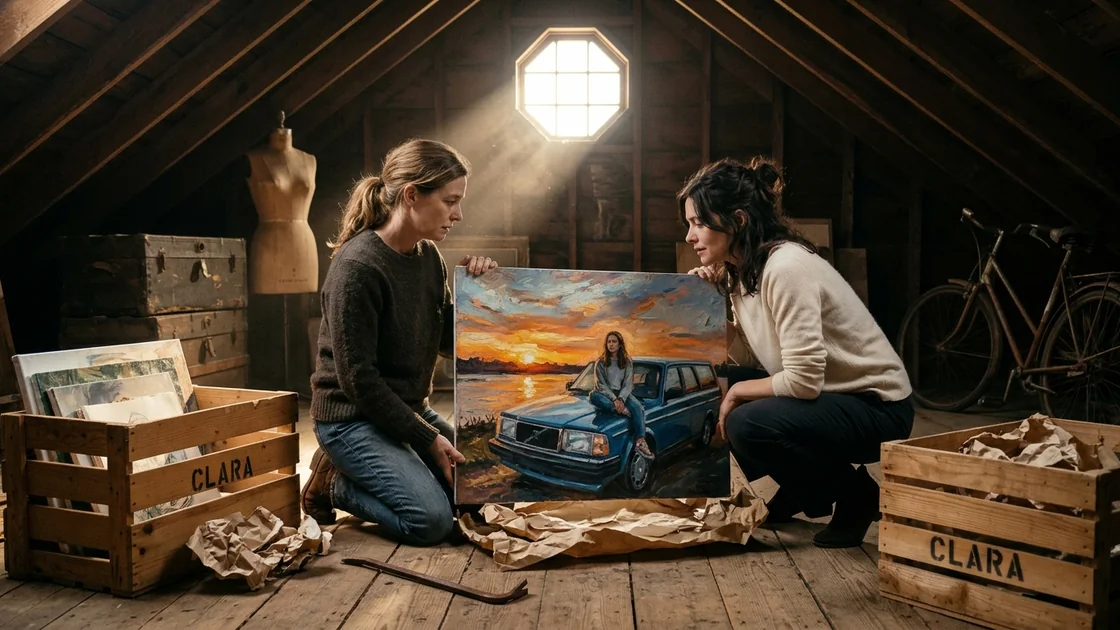
The stairs were steep and unpainted, rising into the pitched roof of the house where the smell of ancient cedar shingles and dried wasps' nests was overpowering. A single octagonal window at the far gable let in a dusty beam of golden sunlight.
The attic wasn't as packed as the downstairs rooms. Evelyn’s bad hip had kept her off these stairs for the last fifteen years of her life, which meant the clutter up here belonged to an earlier era—the eighties and nineties, before their father died, before the house turned into a fortress.
There were trunks of baby clothes, a rusted Schwinn bicycle with flat tires, boxes of their father’s engineering textbooks, and, leaning against the brick chimney stack in the center of the room, three large wooden crates made of slatted pine.
Clara stopped at the top of the stairs, her breath catching in her chest.
"What are those?" Margot asked, stepping around a dressmaker’s dummy with a broken base. She walked over to the chimney and crouched down, squinting at the stenciled black letters on the side of the largest crate. "Clara… these have your name on them."
Clara walked slowly across the rough pine planks. She knew those crates. Her father had built them in the garage in the spring of 1998, right after she finished her senior art portfolio for Mr. Henderson’s AP studio class.
"I thought she threw them out," Clara said softly, kneeling beside her sister in the thick gray dust. "When I didn't get into RISD, I came home from my shift at the bookstore and my easel and all my canvases were gone from the basement. She told me the trash men had already come. She said since I was going to major in business administration at the state college, there was no point cluttering the cellar with amateur hobbies."
Margot grabbed a rusty crowbar that was lying near an old window frame and wedged it under the top slat of the first crate. With a sharp wrench of her shoulders, the nails screamed out of the dry pine. She tossed the slat aside and reached into the crumpled brown packing paper inside.
Slowly, Margot lifted out a thirty-by-forty-inch stretched canvas.
She turned it toward the octagonal window, letting the October sun hit the oil paint.
It was a painting of the Hudson River at dusk, viewed from the bluff behind the local high school, looking west toward the mountains. In the foreground, sitting on the hood of a beat-up blue Volvo station wagon, was a fourteen-year-old Margot. She was wearing an oversized flannel shirt of Clara’s, her knees pulled up to her chin, eating an ice cream cone while the wind blew her dark hair across her face.
The brushwork was bold, confident, alive with purples and deep burnt oranges that captured the exact weight of a late summer evening when you are young and waiting for your life to begin.
Margot stared at the painting, her chest rising and falling rapidly. "I remember this day," she whispered, her fingers hovering an inch above the dry impasto of the sky. "You drove me to get soft-serve after I failed my geometry midterm and was scared to come home. You made me sit on the hood for an hour until the light went down because you said the reflection on the windshield was right."
"You kept moving because the hood was hot from the engine," Clara said, a tear slipping down her cheek and dropping onto the dusty floorboard. "I had to buy you a second cone to keep you still."
Margot looked from the canvas to Clara, her dark eyes fierce. "Amateur hobby? Clara, this is incredible. Look at the water. Why would she put these up here instead of throwing them away?"
Clara reached into the crate and pulled out another canvas—a self-portrait done with a palette knife in shades of cool blue and ochre—and then another, and another. Eighteen canvases in all, plus four sketchbooks wrapped in plastic sheeting to protect them from the roof leaks.
At the very bottom of the third crate, resting on a bed of cedar shavings, was a small, flat wooden box—Evelyn’s old Windsor & Newton watercolor set from her own college days at Vassar in the late fifties.
Clara opened the wooden lid. The cakes of pigment were cracked and dry like miniature desert riverbeds. Tucked inside the lid, where the mixing chart usually went, was a folded sheet of heavy cream stationery, yellowed with age, bearing the letterhead of the Vassar College Art Department, dated May 1959.
Clara unfolded it and held it out so Margot could read it over her shoulder.
Dear Miss Montgomery, the typed assessment read. While your technical grasp of art history and periods remains exemplary, the faculty committee must decline your application to the Senior Studio Thesis track. Your compositions, while mechanically precise, lack original perspective and emotional vitality. We strongly encourage you to remain within the Curatorial and Historical Studies department, where your organizational talents will be best served…
Neither sister spoke for a long time. Downstairs, the old grandfather clock in the foyer chimed four times, the deep, resonant bong vibrating faintly through the floorboards beneath their knees.
Every domingo at four o'clock.
"She couldn't do it," Margot breathed, the realization dawning across her face. "She wanted to be a painter. And they told her she didn't have it in her."
"And then she had me," Clara said quietly, looking down at the bold, slashing brushstrokes of the river at dusk. "And she saw the one thing she couldn't buy, or curate, or bully into existence, sitting in her basement."
Evelyn hadn't thrown the paintings in the dump because, as an art historian, she knew their value; she couldn't bring herself to destroy real work. Instead, she had buried them in the rafters like a pharaoh entombing a rival, and spent the next twenty-five years making sure the artist never picked up a brush again. And with Margot, she had poured all her terrifying, mechanical ambition into building a monument—a daughter whose success in the tangible, corporate world would prove Evelyn’s superiority, while keeping her chained by a fabricated debt so the monument could never walk away.
Clara closed the lid of the watercolor box and set it gently back into the empty crate. She didn't feel angry anymore. Looking at the letter from 1959, she felt only a vast, hollow pity for the bitter twenty-year-old girl who had grown into the monster downstairs. Evelyn had lived eighty-one years in a prison of her own envy, and she had died alone in a dark room with the curtains drawn so the sun wouldn't fade the rugs.
"Help me carry these down," Clara said, lifting two canvases under each arm. "They're going in the back of my Subaru."
By Monday afternoon, the house on Sycamore Lane echoed like a seashell.
The charity truck had come at noon, hauling away fifty bags of clothing, linens, and kitchenware. The dumpster in the driveway was brimming with forty years of paper, broken furniture, and dried-out paint cans. What remained in the house—the mahogany dining table, the baby grand piano, the Staffordshire dogs, the rolled-up Oriental rugs—sat tagged with numbered yellow stickers, waiting for the estate auctioneers to arrive the next morning.
Clara stood in the center of the empty parlor, her hands in the pockets of her jeans. Without the heavy velvet drapes, which they had pulled down to let the air in, the room was flooded with the warm amber light of late afternoon. You could see the river through the trees at the end of the lawn, a ribbon of silver moving steadily south toward the sea.
Margot walked in from the hallway, carrying her leather weekender bag and her camel-hair coat. She was dressed for the airport again, in tailored trousers and a silk blouse, though she had left her hair down, loose and slightly wavy around her shoulders.
She stopped beside Clara, looking at the pale rectangles on the green damask wallpaper where the family history had once hung.
"I called my broker in Chicago while you were locking up the garage," Margot said. "I told him to liquidate my tech stocks and set up a joint escrow account for the estate proceeds. While I was on the phone, I also called my boss and told him I’m taking a six-week sabbatical starting in November."
Clara turned her head, raising an eyebrow. "A sabbatical? Did the sky fall in Illinois?"
"It might," Margot smiled faintly. "They’ll figure out how to survive without me. I thought… if you go to Florence in November to find an apartment, you’re going to need someone to yell at the Italian landlord in bad French and help you haul canvases up four flights of stairs. And I haven't had a vacation where I didn't bring two laptops since 2012."
Clara looked at her little sister. The decade of silence between them wasn't completely erased—there were still ten years of missed birthdays, unshared heartbreaks, and unfamiliar habits they would have to learn to navigate. They were two women in their forties who had been shaped in the dark by the same hard hands, and they would probably still argue over how to load a dishwasher or which train to take.
But when Clara reached out and pulled Margot into a tight, fierce hug, Margot didn't stiffen or tap her forearm with two fingers. She dropped her bag on the parquet floor and wrapped both arms around Clara’s neck, holding on as if they were standing on the deck of a ship in high wind.
"November," Clara said against her sister’s hair. "We’ll rent a place with two bedrooms and a terrace. And I’m buying the rugs."
Margot laughed, a wet, bright sound, and stepped back, wiping beneath her eyes with her thumb. "Deal. Come on, walk me to my car. If I miss the seven o'clock out of Newark, I have to sleep in New Jersey."
They walked out the front door together onto the wide wraparound porch. The autumn air was crisp, smelling of woodsmoke from a neighbor’s chimney and the sweet, cider-like rot of fallen apples in the orchard next door.
Clara pulled the heavy oak door shut behind them. She slid the tarnished brass key into the deadbolt, lifted the handle slightly to the left to clear the swollen wood of the frame, and turned the lock until it clicked home.
Then she took the key off her ring, dropped it into the brass mail slot so the auctioneers could find it on the mat in the morning, and walked down the steps into the sun with her sister.