The Weight of a Broken Spring
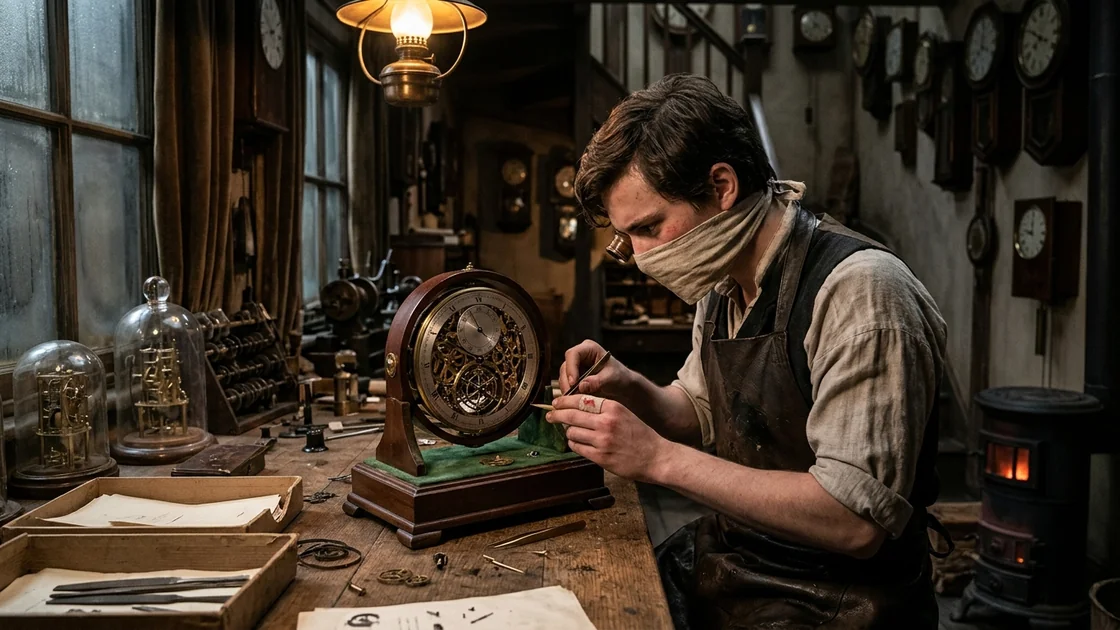
This is the story of Julian Vance, a devoted horology apprentice in the fog-shrouded town of Oakhaven, who serves the legendary and dying master clockmaker, Henrik Vos. In the final days of Vos's life, Julian accidentally destroys the core mechanism of the Astral Chronometer, a commissioned masterpiece meant to secure the old man's legacy and settle his massive debts. Terrified that the truth will kill his bedridden mentor before his time, Julian conceals the disaster and embarks on a grueling, secret crusade to rebuild the impossible parts from scratch while feeding his master comforting lies about the clock's progress. Through sleepless nights of physical exhaustion, psychological torment, and desperate improvisation, Julian eventually constructs a slightly flawed, ticking illusion just in time to bring peace to Vos in his final moments, leaving the apprentice to inherit a legacy built on equal parts devotion and deceit.
The workshop of Henrik Vos smelled perpetually of whale oil, shaved brass, and the dry, metallic tang of passing time. It was a narrow, three-story timber building wedged between an apothecary and a tallow chandler on Spindle Lane, where the cobblestones were forever slick with the gray drizzle rolling in from the northern sea. Inside, however, the dampness was kept at bay by seven coal stoves that Julian had to stoke every four hours, maintaining an exact, unwavering temperature so the metals wouldn't expand or contract by so much as a thousandth of an inch.
Every surface in the main room was crowded with the anatomy of measurement. There were glass bell jars protecting delicate balance wheels, racks of steel pinions arranged by tooth count, trays of synthetic rubies that caught the amber light of the gas lamps like drops of stagnant blood, and dozens of completed clocks ticking in a chaotic, unsynchronized chorus. To an outsider, the sound was maddening—a relentless chatter of insects chewing through the seconds of a man’s life. To Julian, who had lived within these walls since his fourteenth autumn, it was simply the sound of breathing.
Now, at nineteen, Julian knew that the heart of the house was failing, and it had nothing to do with brass or steel. Upstairs, in the small bedroom tucked beneath the eaves, Master Henrik Vos was dying.
It had begun in the late autumn with a dry, rattling cough that sounded terribly like a slipped gear catching on a worn mainspring barrel. By midwinter, the old man’s hands—once steady enough to file a lever fork no larger than an eyelash without the aid of a loupe—had developed a violent, palsied tremor. By February, the gray congestion in his lungs had pinned him to his feather mattress, leaving him propped up on a mountain of yellowing pillows, gasping for air that seemed too thick for his throat.
And down on the center workbench, resting upon a cradle of green baize velvet, sat the Astral Chronometer.
It was a commission from the Earl of Ravenscroft, a man whose obsession with celestial navigation bordered on mania, and whose purse was the only thing keeping the bailiffs from seizing Spindle Lane for the debts Henrik had accrued buying rare tools from Geneva. The chronometer was not merely a clock; it was a small, self-contained universe of brass, invar, and platinum. Standing fourteen inches high within a gimbaled mahogany casing, it was designed to track mean solar time, sidereal time, the equation of time, the phases of the moon, and the shifting positions of the five visible planets from the pitching deck of a frigate in a hurricane. Henrik had spent four years designing its escapement—a tourbillon of such terrifying complexity that its cage rotated on three separate axes simultaneously, negating the pull of gravity from any angle.
On a freezing Tuesday night in March, only three days before the Earl’s steward was scheduled to arrive with the final payment and a padded carriage, the chronometer was ninety-nine percent complete. Only the integration of the primary fusee chain and the final regulation of the triple-axis cage remained.
"You must feel the tension through the horn of your thumb, Julian," Henrik had whispered earlier that evening, his voice like dry leaves scraping across a gravestone. His sunken eyes, milked over at the edges with cataracts, had fixed on Julian with an intensity that made the boy’s stomach knot. "Do not trust the gauge. The gauge is blind. When you hook the fusee chain to the barrel, the steel must sing at C-sharp when plucked with a quill. No higher, or the mainspring will shear the arbor teeth. No lower, or the balance will lose amplitude by the sixth day. Swear to me you understand."
"I understand, Master," Julian had said, wiping the cold sweat from his palms onto his leather apron. "I have watched you wind the test models a hundred times."
"Watching is the luxury of the ignorant," the old man had wheezed, his fingers clawing weakly at the wool blanket. "Doing is the burden of the maker. Go. The oil on the third-axis pivots will begin to thicken if you leave it unworked before the third watch. Bring it up to me when it beats. I want to hear it before I sleep."
Julian had descended the narrow corkscrew stairs to the workshop, his boots heavy on the worn pine treads. The shop was silent save for the ticking of the lesser clocks and the hiss of the coal stoves. He had locked the street door, drawn the heavy velvet curtains to keep out the draft from the glass storefront, and sat down at the master’s bench.
For four hours, Julian worked in a state of suspended terror that gradually melted into the hypnotic trance of his craft. With his left eye screwed shut to hold the walnut-shell loupe in his right socket, he became a creature of pure miniature motion. His world shrank to a diameter of two inches. Using brass-tipped tweezers, he guided the fusee chain—a marvel forged in Sheffield, consisting of six hundred individual steel links, each thinner than a horsehair—around the spiral grooves of the brass cone.
His breathing was shallow, directed away from the work through a linen mask tied over his nose and mouth so the moisture of his exhale wouldn't rust the bare steel.
At two in the morning, the chain was seated. The triple-axis tourbillon cage hung suspended in the center of the upper plate like a golden spiderweb waiting for the wind. All that remained was to apply the initial tension to the mainspring ratchet, release the locking lever, and let the escapement take its first breath.
Julian reached for the winding key. His shoulders ached with a fierce, burning tightness that radiated from the base of his skull down to his elbows. He hadn't slept more than two hours at a stretch since Sunday, splitting his time between emptying Henrik’s basin of dark phlegm, boiling mutton broth the old man couldn't swallow, and finishing the polishing of the chronometer's dial plates.
As his fingers closed around the ebony handle of the key, a sudden, violent sound tore through the ceiling above him.
Thump.
It was followed immediately by the shattering of porcelain and a choked, gurgling cry.
Henrik had fallen out of bed.
Julian’s body reacted before his mind could sever the connection between his hands and the work. He gasped, jerking upright in his tall stool. As his knee slammed into the underside of the heavy oak bench, his right elbow swung outward, knocking a heavy cast-iron leveling block off the secondary shelf.
Time didn't slow down; it fractured into hideous, razor-sharp intervals.
Julian saw the three-pound iron block tip over the lip of the shelf. He saw his own left hand shoot out in a blind, clumsy attempt to catch it. His knuckles deflected the iron just enough to save the glass dome resting to the left, redirecting the block’s trajectory straight into the heart of the gimbaled cradle.
There was no grand crash. The sound was sickeningly small, like someone stepping on the dried shell of a beetle.
Crunch. Zing.
A tiny golden spark of tempered blued steel—a piece of the escape wheel—shot past Julian’s cheek and vanished into the floorboards. The fusee chain whipped backward like a decapitated viper, lashing through the delicate brass pillars of the triple-axis cage, tearing the hairspring from its collet, and tangling itself around the central arbor in a knotted, jagged snarl of ruined geometry. The diamond endstone at the apex of the bridge cracked cleanly in two.
Julian froze, his hand still hovering in the air above the bench. The silence in the workshop seemed to rush in and crush his eardrums, despite the fifty other clocks still ticking on the walls.
Above him, a weak, muffled groan filtered through the floorboards. "Julian?" Henrik’s voice was barely audible, thin and terrified. "Julian, the lamp... the lamp went out..."
Julian looked down at the green baize cloth. The Astral Chronometer, the culmination of Henrik Vos’s forty-year career, the machine that was supposed to prove to the Royal Society that a provincial clockmaker on the northern coast had surpassed Harrison and Breguet, was dead. The tourbillon cage was bent at a forty-degree angle. The main arbor was sheared. The hairspring—which Henrik had spent three months drawing, coiling, and blueing over a spirit lamp until its temper was divine—looked like a clump of hair pulled from a drain.
"Julian!" the voice above cracked into a wet, suffocating cough.
"Coming, Master!" Julian shouted, though his voice came out as a strangled squeak.
With trembling hands, he grabbed a piece of black chamois leather and threw it over the ruined movement, as if hiding a corpse from the eyes of God. Then he bolted up the stairs, taking them three at a time.
The bedroom was freezing. Henrik had reached for his water pitcher in the dark, missed the table, and tumbled from the mattress, dragging the heavy quilt and the bedside oil lamp with him. Fortunately, the lamp was of the safety variety and had extinguished itself when the chimney shattered, though the smell of spilled paraffin was overpowering.
Julian dropped to his knees among the shards of glass and porcelain, sliding his arms under the old man’s frail, skeletal shoulders. Henrik weighed nothing; he was like a bundle of dried birch twigs wrapped in a sweat-soaked nightshirt.
"I have you, Master. I have you. Do not struggle," Julian murmured, lifting him back onto the bed. He worked quickly in the dark, pulling the wet linen away, wrapping the old man in two spare wool blankets from the chest at the foot of the bed, and lighting a single tallow candle on the high mantelpiece.
In the flickering yellow light, Henrik’s face was the color of tallow itself, save for two feverish, purple spots high on his cheekbones. His breathing was a shallow, rapid whistle. Yet, the moment his head touched the bolster, his bony hand shot out and clamped onto Julian’s wrist with a strength born of pure panic.
"The noise," Henrik gasped, his eyes wide and rolling. "I heard... I heard iron fall. Downstairs. When I fell. Did I startle you? The chronometer—"
Julian looked into those clouded, desperate eyes. He saw the purple tint around Henrik’s lips—the sign the apothecary, Master Garrow, had warned him about two days prior. “His heart is like a paper bag full of water, boy,” Garrow had said on the porch, tapping his own chest. “One hard shock, one fit of rage or grief, and the wall gives way. He’s staying alive on stubbornness alone to see that Ravenscroft clock out the door. Keep him calm, or you’ll be measuring him for pine before Friday.”
If Julian told him the truth right now, Henrik Vos would die before the candle burned down an inch. He would die knowing his life’s work was scrap metal, knowing the bailiffs would throw his tools into the street, knowing his name would be forgotten.
"The iron block," Julian said. His voice was terrifyingly steady, belonging to someone else entirely. "It fell from the shelf, Master. Yes. You startled me."
Henrik’s grip tightened until his uncut fingernails dug crescents into Julian’s skin. "The movement...?"
"Untouched," Julian lied. The word tasted like copper and ash. "It fell onto the floorboards beside my stool. Missed the bench by a foot. I had just locked the fusee chain into the barrel hook when I heard you fall."
For three agonizing seconds, Henrik stared at him, searching the boy’s face in the dim light. Then, slowly, the rigid tension in the old man’s spine dissolved. His head sank back into the pillows, and a single, milky tear leaked from the corner of his eye, losing itself in the deep wrinkles of his temple.
"Thank the Maker," Henrik whispered, his chest heaving. "Thank the Maker. My hands... I couldn't have helped you fix it, Julian. If a pivot had snapped... if the cage had warped... there is no time left. And I have nothing left in me."
"It is safe, Master," Julian said, kneeling beside the bed and tucking the blanket around the old man’s chin. His own heart was hammering so violently against his ribs he was afraid Henrik could hear it across the gap between them. "The chain sang at C-sharp. Just as you said."
A ghost of a smile touched Henrik’s gray lips. "Good boy. You have my ears, Julian. You always did. Bring it up... bring it up to me in the morning. Let me hear the beat."
"Wait until tomorrow night," Julian said quickly, his mind racing at a frantic, dizzying speed. "The oil... when the block hit the floor, it kicked up dust from between the planks. I covered the bell jar immediately, of course, no dust got in, I swear it—but I want to let the air settle and check the third-axis endshake one more time in the daylight before I release the escapement. If I move it up the stairs tonight while the drafts are cold, the brass might contract against the new chain."
It was a plausible lie, woven from the very paranoia Henrik had drilled into him for five years.
Henrik nodded slowly, his eyelids already drooping from the exhaustion of his fall. "Wise. Yes. Never rush the release. Caution is the mark of a master. Tomorrow night, then. Give me the laudanum, Julian. My ribs ache where I struck the floor."
Julian measured out twenty drops of the dark, bitter tincture into a spoon of water and held it to his master’s lips. He sat in the cold bedroom for twenty minutes, listening to the ragged whistle of Henrik’s breathing slow into the deep, drugged stupor of opium sleep.
Only when Henrik’s hand slipped lifelessly from the edge of the mattress did Julian stand up. He did not take the candle. He walked down the corkscrew stairs in pitch darkness, his hand trailing along the rough plaster wall to keep his legs from buckling beneath him.
Back in the workshop, Julian pulled the chamois cloth off the Astral Chronometer.
He did not cry. Tears were salt water, and salt water rusted steel; Henrik had beaten that reflex out of him during his first month as an apprentice when he had wept over a ruined verge escapement. Instead, Julian sat on the tall stool, placed his elbows on the green baize, and cataloged the devastation with the cold, clinical detachment of a surgeon examining a battlefield casualty.
Using a pair of brass forceps and a tray lined with white paper, he began to disassemble the wreckage.
It took him until dawn just to clear the debris without causing further damage to the mainplates. When the gray, watery light of Wednesday morning began to press against the cracks in the velvet curtains, the tally of destruction lay spread across the white paper like the bones of a tiny bird:
One: The upper bridge of the tourbillon cage was bent beyond straightening. If he tried to hammer it flat, the brass would work-harden and develop microscopic fractures, throwing off the poise of the entire assembly. It had to be remade from raw sheet brass.
Two: The primary escape wheel had lost four of its fifteen club-shaped teeth.
Three: The balance staff—a spindle of hardened steel no thicker than a sewing needle, with pivots turned down to the width of a human hair—was snapped cleanly in two.
Four: The palladium hairspring was destroyed.
Five: Eighteen links of the Sheffield fusee chain were twisted or sheared.
Six: The diamond cap jewel on the upper plate was split.
Julian stared at the white paper. To fabricate these parts originally had taken Henrik Vos—a man with forty years of experience and the finest hands in the northern provinces—nearly seven months of painstaking labor.
Julian had fifty-six hours before the Earl’s steward knocked on the door. He had perhaps fourteen hours before Henrik woke up from the laudanum and demanded to hear the clock tick.
His eyes drifted toward the back door of the shop, which led out into the alley behind Spindle Lane. He had four silver crowns hidden in the toe of his Sunday boots. He could pack his small leather satchel, take his own set of files and tweezers, and walk out into the fog. By noon, he could be on a coal barge heading downriver toward the coast. By tomorrow, he could be on a packet steamer to Rotterdam or London, lost in the anonymity of the great factories where a boy who knew how to turn a pivot could always find bread. Henrik would die, the Earl would seize the house, and Julian would never have to see the look on his master’s face when the betrayal was revealed.
Julian stood up. He walked to the back door and rested his forehead against the cold, damp wood.
He thought of the winter of his fifteenth year, when the scarlet fever had swept through Oakhaven. Julian had burned for nine days in the attic room. Henrik, a notoriously miserly and irritable hermit who despised interruption, had locked the shop door, hung a black crepe ribbon on the handle to ward off customers, and sat beside Julian’s cot for a week, sponging his chest with vinegar and cold water, reading aloud from Treatise on the Horizontal Escapement in a gruff, monotonous voice just to keep the boy tethered to the world of the living. When Julian’s fever finally broke, he had woken to find Henrik asleep in the chair, his prized Boley lathe covered in a week’s worth of neglectful dust.
Julian took his forehead off the door. He walked back to the stoves, shoveled three scoops of coal into each, and opened the dampers until the iron bellies began to glow a dull, angry red.
He could not leave. And he could not tell the truth. Therefore, he had to do the impossible.
The first problem was the evening deadline: Henrik needed to hear the chronometer beat by nightfall.
A tourbillon does not sound like an ordinary clock. Because the entire escapement rotates within its cage, the acoustic signature of the tick changes subtly as the cage turns toward and away from the listener—a gentle, rhythmic swelling and fading of sound, beating at eighteen thousand vibrations per hour, five ticks every second, with the crisp, crystalline ring of a diamond palette striking hardened steel.
Julian could not rebuild the chronometer by tonight. It was physically impossible.
His eyes scanned the shelves along the eastern wall, where Henrik kept the "graveyard"—dozens of experimental movements, failed prototypes, and unfinished commissions from decades past, all resting under glass domes.
Julian walked over and lifted the bell jar off Model Number Four. It was Henrik’s first attempt at a marine chronometer for the Admiralty ten years ago. It didn't have the triple-axis tourbillon; it was a standard spring-detent escapement. It beat at four ticks per second, not five, and its tone was heavier, duller—brass against ruby rather than steel against diamond. A deaf man might be fooled, but Henrik Vos, even dying and drugged on opium, knew the voice of every escapement he had ever birthed. If Julian brought Model Four upstairs, Henrik would know within three seconds that it was a fraud.
Wait. Next to Model Four sat a small, square brass box containing the first prototype of the Ravenscroft tourbillon cage—a single-axis version Henrik had abandoned two years ago because it couldn't compensate for vertical pitching on a ship.
Julian snatched the box and brought it to the bench. The prototype had a working balance wheel, a hairspring, and a single-axis cage. It lacked a mainspring barrel and a gear train; Henrik had only built the upper platform to test the weight of the cage.
If I can’t make the real clock run by tonight, Julian thought, his mind sharp and feverish, I only need to make the sound.
He didn't need the whole chronometer to work for Henrik tonight. Henrik was nearly blind from cataracts and confined to a dark room lit by a single candle. He couldn't see through the glass dome into the depths of the movement. He only wanted to hear it and feel the vibration through the mahogany box.
Working with frantic speed, Julian took the gutted mahogany casing of the real Astral Chronometer. He removed the ruined movement entirely and set it aside. Then, he took the heavy brass dial plate—engraved with its silvered astronomical rings and gold hands—and mounted the abandoned single-axis prototype directly underneath the dial, using blobs of sealing wax and spare brass pillars to jury-rig it to the mainplate of a common carriage clock drive-train he pulled from the repair bin.
The carriage clock train was too fast, and its spring was too strong for the delicate prototype cage. If he let it run freely, it would tear itself apart in ten minutes.
Julian grabbed a strip of thin pigskin leather and wedged it against the third wheel of the carriage clock train to act as a friction brake, soaking the leather in heavy clock oil so it wouldn't squeak. He wound the makeshift monstrosity three turns.
Tick-tick-tick-tick-tick.
Five beats a second. Because it was using the actual prototype tourbillon cage Henrik had built for the Ravenscroft project, the acoustic pitch was identical. As the single-axis cage rotated once per minute, the sound swelled and faded against the mahogany walls of the box just as the triple-axis would have done.
Julian held his breath and listened. It was a phantom—a hideous, wax-and-leather Frankenstein’s monster hiding behind the beautiful silver face of the Astral Chronometer. The hands on the dial didn't even move, as they weren't connected to any motion works. It couldn't keep time for five minutes without losing thirty seconds.
But in the dark, for the three minutes Henrik would be awake enough to listen to it, it sounded like a miracle.
It was ten o'clock in the morning. The deception for the night was ready. Now, Julian had forty-four hours to actually rebuild the real movement before the Earl’s steward arrived on Friday morning to inspect the clock in broad daylight with a magnifying glass.
He began with the balance staff.
Turning a balance staff on a hand-bowed lathe is the supreme test of a clockmaker’s nerve. The piece of steel begins as a blue tempered rod an eighth of an inch thick. It must be whittled down using hand-held gravers—tiny chisels of harder steel—while spinning the lathe backward and forward with a horsehair bow held in the left hand.
Julian clamped a fresh blank of Huntsman’s crucible steel into the collet of the lathe. He adjusted his walnut loupe, leaned his chest against the curved cutout of the bench to steady his breathing, and drew the bow.
Whir-whir-whir-whir.
The tip of the sapphire-hard graver touched the spinning steel. A microscopic curl of metal, finer than spider silk, peeled away.
The measurements were recorded in Henrik’s leather-bound ledger, written in the old man’s cramped, precise script: Total length: 4.12 millimeters. Hub diameter: 1.05 millimeters. Upper and lower pivots: 0.08 millimeters.
Zero point zero eight millimeters. The thickness of a single strand of a young girl’s hair. If Julian pressed the graver a fraction of an ounce too hard, the steel would snap. If he generated too much friction, the temper would draw out of the metal, turning it soft and useless.
By noon, he had shaped the body of the staff and the collet seat. He began tapering the upper pivot.
Whir-whir-whir—tink.
The tip of the pivot vanished. He had breathed in slightly through his nose while drawing the bow, and his right thumb had twitched. Four hours of work was ruined in a heartbeat.
Julian didn't curse. He didn't throw the graver across the room. He simply unclamped the ruined blank, dropped it into the scrap bucket, took a sip of cold tea, and clamped a fresh piece of steel into the jaws.
Down on Spindle Lane, the town was waking up. The iron-shod wheels of a brewer’s dray rumbled over the cobblestones, making the floor of the workshop vibrate. Julian had to stop drawing the bow every time a cart passed, waiting with his hands poised in mid-air until the tremor in the oak legs of his bench subsided, lest the vibration shatter the second staff.
At four in the afternoon, the second staff was complete. He polished the tiny pivots using a slip of bell-metal charged with diamantine powder mixed with olive oil, working until the steel under his high-powered lens looked like black glass, entirely free of microscopic scratches that could chew into the jewel holes.
One part down. Five to go.
A banging on the ceiling interrupted him—the rhythmic tap of Henrik’s ash walking stick against the floorboards.
Julian’s stomach dropped. He wiped the black oil and steel dust from his hands, splashed cold water on his face from the basin in the corner, and grabbed a bowl of warmed barley broth from the stove.
When he entered the bedroom, Henrik was sitting up higher than he had been the night before, though the effort clearly cost him dearly. The skin around his nostrils was white and pinched, and every breath sounded like someone tearing wet canvas.
"What hour is it?" Henrik rasped, ignoring the broth Julian set on the repaired bedside table.
"Four past the meridian, Master. The sun is already behind the roofs."
"You have been down there all day. I haven't heard you eat. I haven't heard you sweep the shop." Henrik’s eyes narrowed as he peered through the gloom at his apprentice. "Why didn't you open the shutters to the street? Master Garrow told me through the window when he passed that the shop was dark as a tomb."
"I kept the curtains drawn to keep the sun off the mahogany case while I did the final timing adjustments," Julian lied smoothly, holding a spoon of broth to the old man’s mouth. "And I didn't want any town folk coming in with their turnip watches and cuckoo clocks to distract me. Not with Ravenscroft’s man coming on Friday."
Henrik swallowed the broth reluctantly, his Adam’s apple bobbing like a cork in his scrawny neck. "And? Where is it? Why are your hands empty?"
"I am bringing it up now," Julian said. "I wanted to make sure you were awake and comfortable first."
"Go," Henrik commanded, waving a trembling, translucent hand toward the stairs. "Do not make me wait, boy. My chest feels as though the devil himself is sitting on my sternum. Let me see my child."
Julian walked back down the stairs. His knees felt as though they had been replaced with tallow. He picked up the mahogany box containing the false movement, wound the carriage-clock spring three turns, checked that the pigskin brake was holding the five-beat rhythm, and closed the glass lid of the gimbaled case, locking it with the small brass key and slipping the key into his pocket. Whatever happens, he told himself, he cannot open the glass.
He carried the chronometer upstairs as if it were the host at high Mass.
Setting the mahogany box on the quilt between Henrik’s knees, Julian stepped back toward the foot of the bed, deliberately placing his body between the candle on the mantel and the bed, casting a deep shadow directly over the glass dial of the clock.
Henrik leaned forward. He placed both of his gnarled, trembling hands flat against the polished mahogany sides of the box. He closed his eyes and lowered his ear until his wispy white hair brushed the beveled glass lid.
In the quiet of the attic bedroom, the sound rose clearly:
Tick-tick-tick-tick-tick. Tick-tick-tick-tick-tick.
Faint, metallic, and impossibly rapid, swelling slightly as the single-axis prototype cage swung toward the top of the box, then receding like a tiny wave pulling back from a shingle beach.
Julian watched his master’s face, holding his breath until black spots danced at the edges of his vision. If the pigskin brake slipped, the clock would race like a madman’s heart. If the sealing wax holding the pillar gave way from the warmth of the bedroom, the whole contraption would collapse inside the case with a dull thud.
Ten seconds passed. Twenty. Thirty.
A long, shuddering sigh escaped Henrik’s lips. The deep furrows of pain between his eyebrows smoothed out, replaced by a look of such profound, childlike rapture that Julian felt a physical lance of shame pierce his own chest.
"Listen to her," Henrik whispered to the empty room. "Not a drop-error in the beat. No banking. The diamond palettes are singing, Julian. Do you hear how the third axis smooths out the transition at the thirty-second mark?"
There was no third axis in the box. What Henrik was hearing was merely the slight eccentricity of an unbalanced carriage-clock wheel rubbing against a piece of greasy pigskin. The old man was hearing what his soul desperately needed to hear.
"I hear it, Master," Julian whispered, his throat constricting so tightly it hurt to speak.
Henrik opened his milky eyes and tried to peer down through the glass. "Bring the candle closer. The room is so dark... my eyes are worse today. I want to see the cage turn."
Panic surged like ice water through Julian’s veins. If the candle came within two feet of the dial, even Henrik’s ruined eyes would see that the hands were motionless and that the great cut-out window at the six-o'clock position revealed only the crudely filed brass of the abandoned prototype and a smear of red sealing wax.
"Master, no," Julian said, stepping forward and gently placing his hands over Henrik’s cold fingers on the box. "The tallow candle is sputtering badly—the chandler used wet fat in the dip. If a spark of hot grease pops onto the glass dome, it could crack the crystal, or the smoke will smudge the lacquer on the gimbal rings. And the draft near your window is ten degrees colder than the workshop. Look—the brass case is already sweating."
It wasn't sweating, of course, though Julian’s own palms were damp enough to leave moisture on the wood where he touched it.
Henrik hesitated, his fingers twitching against the mahogany. The habits of a lifetime of obsessive care warred with his desire to look. Finally, the clockmaker defeated the dying man.
"Take it down, then," Henrik murmured, pulling his hands back beneath the blankets. "You are right. Stupid of me. No smoke near the gimbals. Take it back to the warm room, Julian. Keep it running on the bench so the oils settle into the jewel pores. On Friday morning, when Lord Ravenscroft’s steward comes, bring him up here with the bank draft so I may see it signed."
"I will, Master."
Julian lifted the box and backed out of the room before the carriage clock’s three turns of winding could run down. He made it halfway down the corkscrew stairs before the ticking inside the box suddenly stuttered—tick-tick-clack—and stopped dead as the makeshift brake jammed the third wheel.
Julian leaned against the curved plaster wall in the dark stairwell, clutching the silent box to his chest, and dry-heaved until his stomach cramped.
Wednesday night bled into Thursday morning in a blur of heat, sulfur, and flying brass filings.
Julian did not sleep. To keep himself awake, he chewed on dried gentian root from the apothecary’s jar and kept a bucket of freezing well water beside his stool; whenever his head began to nod toward the lathe, he plunged his entire face into the icy water until his skull ached with a sharp, blinding pain.
He disassembled the phantom clock, restored the silvered dial to the real workbench, and threw himself at the remaining five impossibilities.
The eighteen broken links of the fusee chain were repaired by midnight. He did not have time to forge new links; instead, he shortened the chain by removing the damaged section entirely and riveting the remaining five hundred and eighty-two links back together using a punch no thicker than a bristle from a hog’s back. It meant the chronometer would only run for seven days instead of eight on a full wind, a discrepancy he prayed the Earl’s steward wouldn't notice until the clock was fifty miles away at Ravenscroft Manor.
Next came the escape wheel.
Cutting a fifteen-tooth club-foot escape wheel from solid brass required the dividing engine—a massive cast-iron wheel beneath a microscope, etched with thousands of microscopic degree-markings around its perimeter. Julian mounted a blank disk of hammered brass onto the spindle, set the indexing arm to twenty-four degrees per tooth, and began cranking the rotary cutter by hand.
His fingers were raw and blistered now. A splinter of brass had driven itself deep under the nail of his right index finger, throbbing in time with his pulse, a tiny red hammer beating inside his flesh. He ignored it, letting a drop of dark blood smear across the wooden handle of the crank with every rotation.
By three in the morning on Thursday, the new escape wheel was cut, beveled, and polished with rottenstone.
By seven in the morning, he had cut and filed the new upper bridge for the triple-axis tourbillon cage from a sheet of Dutch brass, using the bent original as a template, drilling the pivot holes and friction-fitting the synthetic ruby jewels into the settings.
Two problems remained. And they were the two that could not be solved by mere brute endurance.
First: the cracked diamond cap jewel at the top of the cage. A diamond can only be cut or polished with diamond dust, and Henrik kept no spare cut diamonds in the shop; the stone in the chronometer had been supplied directly by the Earl from an old family ring. Without that endstone, the upper pivot of the tourbillon would have nothing to ride upon; it would drop through the setting and jam the gears.
Second: the palladium hairspring.
Julian stared at the ruined hairspring on the white paper. Forming a spherical helical hairspring with Phillips terminal curves at both ends was considered high art—a secret guarded by a handful of spring-makers in Clerkenwell and Neuchâtel. It required winding the wire around a grooved brass cylinder, packing it in powdered charcoal inside an airtight iron box, baking it in the coal stove at an exact cherry-red heat for forty minutes to set the memory of the metal, quenching it in oil, and then spending days bending the end curves with tweezers while testing the rate against a pendulum regulator.
Julian had twenty-two hours left. Even if he got the curve right on the first try—which no apprentice in history had ever done—he didn't have the forty-eight hours required to test the isochronism of the spring across different temperatures.
He slumped forward onto the bench, his forehead resting on the cold iron bed of the dividing engine. His body was shaking uncontrollably now, a deep, rhythmic tremor caused by exhaustion, gentian root, and starvation. His vision was swimming with yellow halos around the gas lamps.
I can’t do it, a small, quiet voice whispered inside his skull. You fixed the staff. You fixed the wheel. You fixed the bridge. You did four days of master-work in one night. No one can blame you for failing the spring and the diamond.
From upstairs came the sound of Henrik coughing—a long, dreadful, tearing spasm that went on for nearly two minutes, followed by a dead, heavy silence.
Julian raised his head. He looked at the small mahogany case waiting at the edge of the bench.
If he failed now, everything he had endured over the last thirty-six hours—the lies, the blood under his nail, the agony in his back—was for nothing. If the clock didn't run on Friday morning, the steward would refuse payment, the truth would come out in the bedroom, and Henrik would die in despair.
I don't need the clock to win the Admiralty prize in Greenwich, Julian realized suddenly, a cold, ruthless clarity cutting through the fog of his exhaustion. I only need it to pass the steward’s inspection on Friday morning.
Lord Ravenscroft’s steward, a pompous former barrister named Mr. Finch who had visited the shop twice before, knew nothing of horology. He would bring a pocket chronometer set to Greenwich time, compare the Astral Chronometer against it for one hour while drinking sherry in the parlor, inspect the finish of the movement with a glass to ensure all the jewels and engravings were in place as contracted, hand over the bank draft for four hundred guineas, and get back in his carriage.
Once the bank draft was signed and the carriage cleared the gates of Oakhaven, Henrik Vos would die in peace. What happened a week later when the Earl realized the chronometer lost four minutes a day in cold weather didn't matter. By then, Henrik would be beyond the reach of earls and bailiffs alike.
Julian didn't need a palladium helical hairspring. And he didn't need a real diamond.
He scrambled over to the graveyard shelves again, his eyes darting across the rows of old watches. In the back corner sat a French pocket watch with a silver case—a Breguet-style souscription piece Henrik had bought at an estate sale twenty years ago for its unusual ruby cylinder escapement.
Julian pried open the back of the French watch. Inside was a flat, blued-steel hairspring—not a spherical helix like the chronometer required, and made of carbon steel rather than non-magnetic palladium, which meant it would rust at sea. Furthermore, its natural vibration rate was slightly too slow for the chronometer’s gear train.
"I can pin it short," Julian muttered aloud to the empty room, his voice cracked and raspy. "If I cut the outer two coils off the Breguet spring and pin it closer to the stud, it will beat at eighteen thousand. And if I bend the outer coil upward on a vertical dog-leg, it will fit into the stud of the triple-axis cage."
Anyone who looked closely inside the spinning cage would see a flat blue spring where a spherical silver-gray palladium spring ought to be.
How could he make blued steel look like silver palladium?
"Acid," Julian whispered.
He grabbed a small glass vial of muriatic acid from the gilding shelf. Dipping a camel-hair brush into the acid, he painted the delicate blue coils of the French hairspring. Within seconds, the acid stripped the blue oxide layer right off the steel, leaving it bright, raw, silvery-gray—identical in color to palladium unless tested with a magnet. He rinsed the spring in spirits of wine, dried it in boxwood sawdust, and held it up to the lamp.
From three inches away, through a thick crystal dome while spinning on three axes, no human eye could tell it wasn't a helical spring unless the cage was stopped.
Now, the split diamond cap jewel.
The two halves of the real diamond sat on the white paper. It was a rose-cut stone, flat on the bottom where the pivot rested, and faceted into a dome on top where it sat visible in the center of the golden tourbillon bridge—the crowning ornament of the clock.
If he glued the diamond back together, the seam in the center of the flat bottom would act like a miniature saw blade against the spinning 0.08-millimeter steel pivot he had spent all yesterday turning. It would shred the pivot into iron filings within twenty minutes, stopping the clock right in front of Mr. Finch.
Unless the pivot doesn't touch the diamond.
Julian’s hands flew to the drawer of standard repair jewels. He pulled out a paper packet labeled Garnet Endstones – Thin. He selected a tiny, flat disk of polished red garnet, barely a millimeter wide, and used a brass scraper to widen the bottom of the gold jewel-setting from the underside, deepening the recess.
Then, using a pinpoint of shellac warmed over the spirit lamp, he cemented the two broken halves of the real diamond together at the top of the gold setting so that, from above, the stone looked whole—the single hairline fracture disguised as one of the natural facets of the rose cut. Directly underneath the broken diamond, completely hidden from view inside the collar of the gold bezel, he seated the thin disc of red garnet, using a piece of tin foil behind it to block the red color from showing through the clear diamond above.
When the balance staff was installed, the steel pivot would ride safely on the smooth, unbroken surface of the hidden garnet, while the observer looking down through the glass would see only the Earl’s heirloom diamond glittering at the apex of the cage.
It was a masterwork of pure charlatanry. Every instinct Henrik had trained into Julian screamed that it was sacrilege—a sin against the pure mathematics of horology. If Henrik ever looked at this clock under a loupe, he would cast Julian into the street and curse the day he took him in.
"He will never look at it under a loupe," Julian told the ticking walls. "He will never see it at all."
Thursday evening was the hardest part of the ordeal.
Having reassembled the first and second axes of the tourbillon cage, Julian had to stop at six o'clock to deal with the world outside the workshop. Master Garrow, the apothecary, knocked on the alley door to check on his patient.
Julian let the old medical man in through the back, keeping the door to the main workshop firmly shut and bolted from the inside so Garrow wouldn't see the chaos of tools, acid vials, and cannibalized watches strewn across the room.
Garrow paused in the dark kitchen passage, peering at Julian over his wire-rimmed spectacles. "Good God, boy. You look worse than the man upstairs. Your eyes are like two burnt holes in a blanket, and you’re shaking like a wet dog."
"I’ve just finished the Ravenscroft piece, sir," Julian said, leaning against the stair post to keep his legs from trembling. "Four days at the bench without coming up for air. Master Vos wanted it regulated before the steward arrives at nine tomorrow."
Garrow grunted, shifting his leather bag. "Well, it’s a miracle you finished it in time. Let us go up."
Julian followed the apothecary up the narrow stairs. The smell in the bedroom had changed since the morning. Beneath the sharp odors of paraffin, camphor, and stale sweat, there was a faint, sweetish, cold smell that Julian didn't recognize, though he noticed Master Garrow’s nostrils flare slightly the moment he crossed the threshold.
Henrik was awake, staring straight up at the water-stained plaster of the ceiling. His breathing was no longer a loud, rattling whistle; it had become shallow, irregular, and disturbingly quiet, with long, terrifying pauses of five or six seconds between each inhale where his chest didn't move at all.
Garrow sat on the edge of the mattress, took Henrik’s limp wrist to feel for a pulse, and then placed his ear directly against the old man’s linen-clad chest for a full minute.
When the apothecary straightened up, he didn't reach into his bag for the laudanum or the blistering plasters. He simply folded Henrik’s hands neatly over his stomach and pulled the wool blanket up to his shoulders.
"Henrik?" Garrow said gently, raising his voice slightly. "Henrik, can you hear me?"
The old clockmaker’s eyelids fluttered. His head turned a fraction of an inch toward the sound. "Garrow...?" The voice was no louder than the rustle of silk. "Is it... Friday?"
"Not yet, my old friend. Tomorrow morning. Julian tells me the great clock is finished and regulated."
A faint spasm of life seemed to flicker behind the milky cataracts. Henrik’s fingers twitched on the blanket. "Yes... I heard it... yesterday. Five beats... clear as winter water. Julian... Julian did the final adjustment on the cage. The boy... has the touch, Garrow. He didn't drop the chain."
Standing in the shadows by the doorway, Julian felt his fingernails bite into the palms of his hands, reopening the wound under his index nail. Warm blood trickled down his wrist into his sleeve.
"You should be very proud of him," Garrow said softly, patting Henrik’s bony shoulder. "Rest now. Save your strength for the Earl’s man in the morning."
Garrow stood up and motioned for Julian to follow him down the stairs. In the kitchen passage, the apothecary stopped and looked at the apprentice with grave pity.
"He has fluid around the heart, and the kidneys have ceased their work," Garrow said in a low voice, not bothering with medical euphemisms. "Do you hear that pause in his breathing? We call it the tide going out. Each time it goes out a little further, and soon it simply won't come back in. Honestly, Julian, I am astonished he is still drawing breath now. He won't see Sunday. I doubt he’ll see tomorrow night."
Julian swallowed hard, his mouth completely dry. "Will he... will he last until nine tomorrow morning? When Mr. Finch comes?"
"If he does, it will only be because his mind is refusing to let the body cool until that business is done," Garrow said, opening the back door into the rainy alley. "Keep the room warm. Don't try to force broth down him anymore, or you'll choke him; just wet his lips with a rag dipped in wine and water. If he passes in the night, ring the bell at my gate."
The door clicked shut. Julian was alone with the ticking house and the dying man.
He had fourteen hours left. And the real Astral Chronometer still wasn't assembled.
The final hours of Thursday night were a descent into a mechanical purgatory.
Julian locked himself in the workshop, turned every gas lamp up to its brightest, whistling flame, and began the final integration of the triple-axis tourbillon.
To assemble a three-axis cage is like building a ship inside a bottle while the bottle sits inside two other bottles, using tools passed through the neck of a needle.
The innermost cage—weighing less than a dried pea, holding the balance wheel with its acid-stripped French hairspring, the repaired balance staff, and the newly cut escape wheel—had to be poised first. Julian placed the cage on the ruby knife-edges of the poising tool. Because the new upper bridge he had filed by hand was a fraction of a grain heavier on the left side than Henrik’s original, the cage tipped downward.
Using a triangular scraper, Julian shaved microscopic curls of brass from the underside of the bridge arm—places where no eye could see—checking the balance on the ruby edges forty times until the cage sat completely stationary in any position, utterly indifferent to gravity.
At midnight, he mounted the inner cage into the second-axis ring.
At two in the morning, his hands shaking so badly he had to bind his wrists tightly with strips of linen rag to restrict the movement of his tendons, he mounted the second-axis ring into the outer planetary carriage.
At half-past three, he hooked the shortened Sheffield fusee chain onto the mainspring barrel, wound the spring slowly around the spiral cone, and listened with a goose-quill pressed between his teeth and the brass plate.
Twang.
C-sharp. A fraction flat, perhaps, because the chain was eighteen links shorter and sat one groove higher on the cone than intended, but the steel held. The arbor didn't shear.
Now came the moment of truth.
Julian picked up the assembled triple-axis tourbillon carriage with his brass tweezers. His breathing was stopped behind his linen mask. Sweat ran down his temples, stinging his eyes, threatening to dislodge the walnut loupe from his socket. He lowered the golden spiderweb into the circular cutout of the mainplate, aligning the fourth-wheel pinion with the fixed steel crown wheel.
He lowered the upper bridge—the one bearing the cracked, shellacked diamond and its secret garnet lining—over the top pivot. He drove home the three blued-steel screws that locked the bridge to the pillars.
For ten seconds, nothing happened. The balance wheel sat motionless.
Julian’s heart stopped. Had he made the new balance staff a hundredth of a millimeter too long? Was it binding against the hidden garnet stone? If it was too tight, he would have to strip the entire three-axis cage down to the bare plate to shorten the pivot—four hours of work that he didn't have, and which his raw, bleeding hands could no longer perform.
With the tip of a pegwood stick sharpened to a point, Julian reached through the bars of the outer cage and gave the rim of the balance wheel a tiny nudge.
Tick.
The escape wheel jumped forward one tooth. The diamond palette kicked the impulse roller. The French hairspring coiled and uncoiled like a tiny silver lung.
Tick-tick-tick-tick-tick.
The inner cage began to turn, completing one rotation every ten seconds. Around it, driven by the intermediate bevel gears, the second ring began to tilt slowly upward at ninety degrees, completing its roll once every thirty seconds. And carrying them both, the outer brass platform began its stately, one-minute march around the dial.
It was alive.
Julian dropped the pegwood stick. He didn't dare touch the bench. He simply leaned back on his stool and watched the golden sphere spin within itself, catching the yellow light of the gas lamps on a hundred beveled steel edges and ruby settings.
From a foot away, it was the most breathtaking machine Julian had ever seen. It looked exactly as Henrik Vos had dreamed it in his feverish sketches four years ago.
And only Julian knew what it really was: a hollow lie.
Inside that gleaming dance of brass and steel hid a shortened chain that would stop a day early, a carbon-steel pocket watch spring stripped with acid that would rust the first time it smelled salt air and lose ten minutes in a storm, and a shattered diamond held together with bug-resin over a two-penny piece of red garnet.
He watched it against the master pendulum regulator on the wall for two hours as the black sky outside the curtains turned to the bruised purple of Friday dawn.
By six o'clock, the chronometer had gained twelve seconds—a catastrophic error for a marine navigation instrument meant to stay within half a second a day.
Julian didn't care. He used his screwdriver to turn the timing weights on the balance wheel outward by two turns, slowing the rate down brutally until, between six and seven o'clock, it tracked within one second of the wall regulator. As long as the temperature in the parlor didn't change by more than five degrees before ten o'clock, the clock would keep perfect time while Mr. Finch was in the house.
At seven-thirty, Julian mounted the movement into its gimbaled mahogany case, polished the brass fittings with rouge cloth until his reflection stared back at him—hollow-eyed, pale as a corpse, with dark purple rings under his eyes—and set the gold hands to Greenwich Mean Time, the planetary dials to the seventh day of March, and the moon-phase disk to the waning gibbous.
Then he cleaned the workshop. He swept every brass filing into the stove. He threw the ruined original parts—the bent bridge, the snapped staff, the tangled palladium spring, the broken escape wheel—deep into the white-hot coals of the central furnace, watching until the steel melted into slag and the brass flared with a bright, poisonous green flame before vanishing into the ash pit.
There was no evidence left on earth.
At ten minutes to nine, Julian stood at the storefront window, having drawn back the heavy velvet curtains for the first time in three days. He wore his clean Sunday shirt, with a clean linen bandage wrapped neatly around his throbbing right index finger, tucked out of sight whenever possible.
The rain had stopped, leaving Spindle Lane buried in a thick, wool-white sea fog that muffled the hooves of the horses.
At nine o'clock on the stroke of the church bell, a black lacquered brougham with the Ravenscroft crest painted on the door pulled up to the curb. A footman jumped down to lower the iron step, and Mr. Finch emerged, clutching a silver-headed cane in one hand and a leather dispatch box in the other.
Julian unlocked the shop door and bowed low.
"Good morning, Mr. Finch."
The steward stepped inside, wrinkling his long, aristocratic nose at the warm, oily air of the workshop. He took off his beaver hat, shook the fog-damp from its brim, and looked around the empty room.
"Where is Vos?" Finch asked briskly, unbuttoning his heavy wool greatcoat. "Still abed with the winter grippe, I hear? The Earl has been most impatient, boy. The Vanguard sails from Portsmouth on Tuesday, and His Lordship intends to have this instrument bolted to the chart-room table before they weigh anchor."
"Master Vos is very near his end, sir," Julian said quietly. "The apothecary says he may not last the day. That is why I worked through the nights this week under his direction to ensure the chronometer was cased and regulated for your arrival."
Finch paused, a flicker of genuine discomfort crossing his sharp features. Like most men of business, he found death an inconvenient breach of etiquette when introduced into a commercial transaction. "Ah. Unfortunate. Truly. A difficult man, Vos, and ruinously expensive, but His Lordship swears there isn't another pair of hands like his in the kingdom." He walked over to the center workbench where the mahogany box sat under its glass dome. "Well. Let us see what four years and eight hundred guineas have bought us."
Julian stepped aside and lifted the outer wooden lid.
Even the jaded steward gasped softly.
In the gray morning light filtering through the shop window, the Astral Chronometer looked like a captured star. The silvered dial with its blued-steel planetary hands gleamed with frost-like perfection, and in the deep theater of the six-o'clock window, the triple-axis tourbillon performed its hypnotic, gravity-defying ballet, the rose-cut diamond flashing at the center of the golden bridge every thirty seconds as the second axis rolled toward the glass.
Tick-tick-tick-tick-tick.
Finch pulled a folding magnifying glass from his waistcoat pocket and leaned over the glass dome. Julian stood two paces behind him, his hands clasped behind his back, his fingernails digging into his palms.
Finch examined the dial. He leaned closer to examine the spinning tourbillon.
Don't look at the flat coils of the spring, Julian prayed silently. Look at the diamond. Look at the gold.
"Remarkable," Finch murmured, straightening up and snapping his glass shut. "The Earl showed me the drawings from London, of course, but to see the cage revolve in three planes... it is quite uncanny. And the diamond from Lady Ravenscroft’s ring—set cleanly at the upper pivot, just as stipulated."
"Master Vos set the stone himself before he took to his bed," Julian lied without blinking.
Finch pulled a heavy gold pocket chronometer from his fob and compared the second hands. "Fifty-eight... fifty-nine... mark. Dead on the second with Greenwich, allowing for the longitude of Oakhaven. Has it been tested in the gimbals?"
"For forty-eight hours, sir. Not a half-second’s variation."
Finch nodded, visibly relieved that he wouldn't have to linger in a house with a dying man on the upper floor. He opened his leather dispatch box, drew out a heavy parchment bank draft drawn on Coutts & Co. of London for four hundred guineas—the final half of the commission—and a printed receipt of delivery.
"Can Vos hold a pen to sign the receipt and endorse the warrant?" Finch asked, tapping the papers on the bench.
"If you will come upstairs with me for two minutes, sir, I can guide his hand," Julian said. "He made me promise he would see the draft before the clock left the house. I fear if I don't let him see you, the agitation will finish him on the spot."
Finch grimaced slightly, glancing toward the narrow corkscrew stairs, then sighed and picked up his dispatch box. "Very well. Bring the clock with us, boy, so the footman can take it straight to the carriage when we come down. I don't wish to leave eight hundred guineas of brass sitting unattended near the street door."
Julian lifted the heavy mahogany box by its brass drop-handles and led the steward up the creaking stairs.
The bedroom was freezing; the small coal grate had died down to gray ash in the early morning hours, and Julian hadn't dared leave the workbench to tend it.
Henrik lay exactly as he had the night before, propped against the pillows, his eyes half-open and fixed on the foot of the bed. His skin had turned the dull, waxen gray of old pewter, and his nose looked terrifyingly sharp, as though the flesh had melted away from the cartilage overnight.
When Julian and Mr. Finch entered, the long pause in Henrik’s breathing stretched out—four seconds, five, six, seven—before a tiny, shallow gasp rattled in his throat.
"Master?" Julian whispered, setting the mahogany box on the small table beside the bed and kneeling on the floorboards next to the mattress. "Master Vos, can you hear me? It is nine o'clock. It is Friday. Mr. Finch is here from Lord Ravenscroft."
Slowly, with an effort that seemed to consume the very last drop of oil in his lamp, Henrik’s eyes rolled downward until they found the black silhouette of the steward standing at the foot of the bed.
"Mr. Vos," Finch said, clearing his throat and holding up the parchment with a stiff bow. "His Lordship sends his compliments upon the completion of the Astral Chronometer. I have inspected the piece below. The workmanship is beyond reproach, the diamond is seated to specification, and the rate is exact. I have placed the final bank draft for four hundred guineas upon your table."
Henrik didn't look at the bank draft. His milky, half-blind eyes drifted sideways toward Julian, and then toward the mahogany box resting a foot from his face.
"Open... the glass," Henrik breathed. The words were barely more than the shaping of his dry lips. "Let me... touch the case."
Julian glanced nervously at Finch, then unlocked the outer mahogany lid and lifted it back, keeping the inner crystal dome over the dial tightly shut. He guided Henrik’s icy, skeletal right hand across the quilt until the old man’s stiff fingertips rested against the warm brass rim of the inner bezel.
Through the thin brass and glass, the rapid, five-beat pulse of the spinning tourbillon vibrated faintly against the dying man’s skin.
Tick-tick-tick-tick-tick.
"Do you hear it, Finch?" Henrik whispered, a sudden, fierce pride flashing through the ruin of his voice. "Three axes... no friction in the pivots... it will run for a hundred years... when I am dust."
"I have never seen its equal, Master Vos," Finch said honestly, moved despite himself by the sight of the old craftsman’s skeleton clinging to the gleaming brass box. "If your apprentice here will witness your mark upon the receipt, I shall leave you to your rest."
Julian dipped a quill into the portable inkhorn Finch held out, placed the feather between Henrik’s rigid fingers, and guided his master’s hand to make a shaky, sprawling H.V. at the bottom of the parchment. Then Julian signed his own name beneath it as witness: Julian Vance, Apprentice.
Finch blotted the ink with sand, bowed once more, and gestured toward the box. "Boy, bring the instrument down to the carriage, if you please. The horses are standing in the damp."
Julian gently lifted Henrik’s fingers off the brass bezel and laid the old man’s hand back on the wool blanket.
Before Julian could lift the box, Henrik’s cold fingers hooked weakly into the linen cuff of Julian’s shirt, pulling him down until Julian’s ear was an inch from his master’s bluish lips.
"The shop... and the tools... are yours in the will, Julian," Henrik breathed, each word separated by a shallow, clicking gasp. "Keep the stoves... warm. Never... never compromise... the work. Truth... is in the steel. A clock... cannot lie."
Julian closed his eyes. A single, burning tear finally broke free from his lashes, falling straight down onto the back of Henrik’s gnarled hand—salt water at last, where there was no longer any steel left to rust.
"I know, Master," Julian whispered into the cold air between them. "I will keep the stoves warm."
Henrik’s fingers relaxed, slipping from Julian’s cuff. His eyes drifted back up to the ceiling plaster, and a look of profound, untouchable stillness settled over his sharpened features. He took one small breath.
Then the tide went out.
Julian counted the seconds in his head, measuring them with the steady, five-beat rhythm that had been burned into his brain over five years of servitude.
One. Two. Three. Ten. Twenty. Thirty.
The chest beneath the wool blanket did not rise again. In the quiet room, the only sound left was the frantic, glittering lie ticking inside the mahogany box on the table: tick-tick-tick-tick-tick.
"Is he...?" Mr. Finch asked softly from the doorway, his hat clutched against his stomach.
Julian stood up slowly. He reached over and pulled the wool blanket up over Henrik Vos’s face, covering the milky eyes that would never see the flaw in his masterpiece.
"He is gone, sir," Julian said. His voice was hollow, stripped of youth, sounding remarkably like the old man who had just left the room.
He picked up the Astral Chronometer in both arms, feeling its weight pull against the torn muscles of his shoulders and the throbbing splinter beneath his fingernail. He carried it down the corkscrew stairs, past the fifty ticking clocks on the workshop walls, out through the front door into the white sea fog of Spindle Lane, and placed it carefully upon the velvet cushions of the Earl’s carriage without ever looking back inside the glass.