The Wailing at Oakhaven Reef
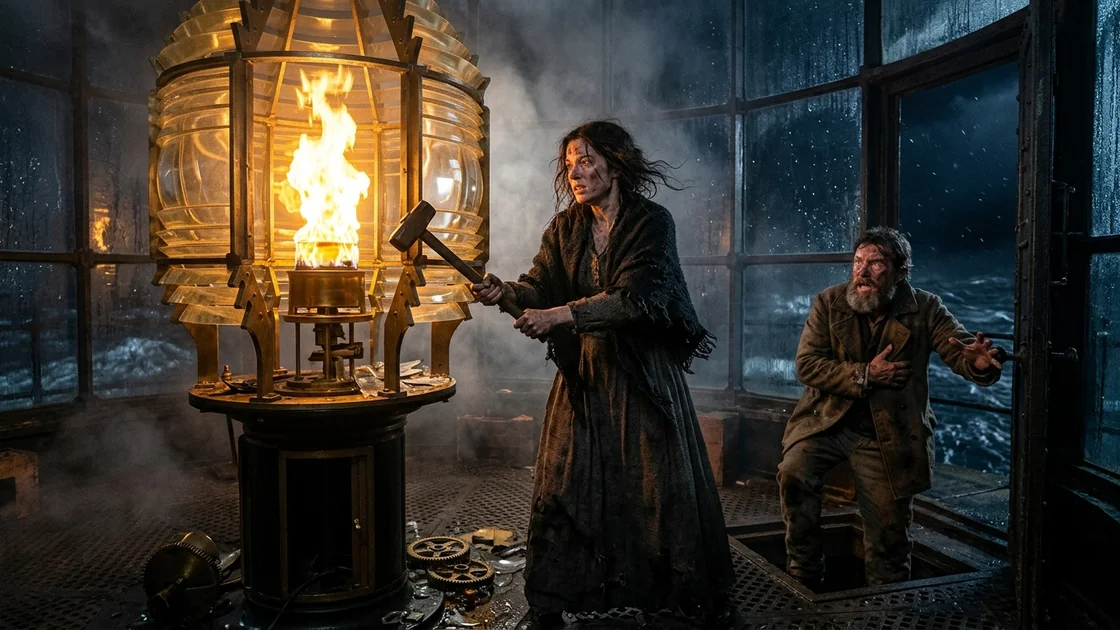
In the late nineteenth century, on the jagged and unforgiving rock of Oakhaven Reef, Clara Vance endures a solitary existence alongside her husband, Thomas, the island's dutiful lighthouse keeper. Following the devastating loss of three stillborn infants, Clara's profound grief collides with the unceasing, deafening roar of the Atlantic wind that batters the stone tower day and night. Over the course of one brutal winter, the isolation and the acoustic torture of the gale erode her sanity, leading her to believe that the voices of her lost children are crying out from within the tempest, demanding that she extinguish the great lantern and surrender herself to the freezing depths of the sea.
The boat from the mainland came only once every three months, and when it left in the gray dawn of October, it took the last of the autumn mildness with it. Clara stood at the base of the granite steps, her coarse wool shawl pulled tight around her shoulders, watching the supply sloop pitch and roll until its patched canvas sail became indistinguishable from the whitecaps of the North Atlantic. Beside her, Thomas wiped his oil-stained hands on a rag, his eyes already turning back toward the whitewashed tower that rose eighty feet above the black basalt of Oakhaven Reef.
"Get inside, Clara," Thomas said, raising his voice above the rising swell. "The glass is dropping. We'll have a gale before nightfall."
He did not touch her as he passed. In the four years since they had taken the post at Oakhaven, the space between them had widened from the natural quiet of a working marriage into an unbridgeable gulf of unspoken mourning. Thomas retreated into his brass work, his logbooks, and the meticulous trimming of the four concentric wicks of the great Fresnel lens. Clara retreated into the three-room cottage attached to the base of the tower, where the walls were three feet thick and yet still trembled when the sea was angry.
Inside the kitchen, the peat fire smoked, driven backward down the chimney by a sudden downdraft. Clara knelt on the flagstones with the iron poker, coaxing the dull red embers to life. Above the mantelpiece hung a framed needlepoint sampler she had made during their first winter on the rock, before the first child had come and gone without taking a breath. God Is Our Refuge and Strength, the faded blue thread read. Looking at it now, the letters seemed to squirm in the dim light.
She walked to the deep-set window facing the leeward side of the island. In a cleft between two massive boulders, where the salt spray only reached during the fiercest equinox storms, lay a patch of coarse earth no larger than a dining table. Three small cairns of white quartz pebbles marked the ground. There were no headstones; the mainland mason had wanted four shillings a letter, and Thomas’s wages from the Lighthouse Board barely covered their salt beef, flour, and coal. They had no names on the parish register, either, because the parson at Port Merrick would not row seven miles through the shoals to baptize dead flesh.
In her own mind, Clara had named them anyway. Samuel, who had arrived in the dead of a January blizzard three years ago, as blue and cold as an icicle. Alice, who had come six weeks too early the following autumn, the cord wrapped thrice around her bird-like throat. And little Arthur, delivered just four months past in the stifling heat of June, perfectly formed, with Thomas’s broad forehead and her own dark eyelashes, yet utterly, terribly still.
As Clara watched the cairns, the wind shifted four points to the northeast and found its voice.
It began, as it always did on Oakhaven, with a low, resonant hum that vibrated through the soles of her leather boots. Then, as the air pressed against the curve of the lighthouse tower and squeezed through the narrow gap between the cottage roof and the cliff face, it rose in pitch. It was not the rustling wind of the inland valleys where Clara had grown up among elm trees and barley fields. Here, there was nothing soft to break the air’s passage. There was only iron, glass, granite, and water. The wind struck the iron gallery railings high above and shrieked like a saw blade binding in green oak.
Clara pressed her palms flat against her ears. The gesture was useless; the sound did not merely enter the ears—it lived inside the stonework, vibrating in her teeth and behind her breastbone.
"Not tonight," she whispered to the empty room. "Please, not tonight."
By six o'clock, the darkness was absolute save for the rhythmic, sweeping wheel of light high overhead. Thomas had gone up at four to light the lamps, and he would remain in the watch room until midnight, tending the clockwork mechanism that rotated the lens and logging the weather every hour. Clara sat at the scrubbed pine table, a bowl of mutton broth cooling before her.
Wha-a-a-a-oo-oo-oo, went the chimney flue.
She picked up her wooden spoon, her hand trembling so violently that it clattered against the earthenware rim. Beneath the bass roar of the breakers smashing against the western shelf—a sound like cannon fire that shook the dishes in the dresser—there was a higher, thinner sound. It was coming from the ventilator shaft in the pantry wall.
It sounded like a throat clearing. A tiny, wet gasp for air.
Clara stood up so quickly her chair tipped backward and struck the flagstones. She stood frozen, her heart hammering against her ribs like a trapped gull. The wind dropped for a fraction of a second—that strange, vacuum-like lull that precedes a heavier squall—and in that pocket of silence, she heard it distinctly.
A thin, reedy mewling, just like the sound her sister’s baby had made when it was hungry.
She walked to the pantry door and lifted the iron latch. The narrow room smelled of tallow, salted cod, and damp lime. In the upper corner, a cast-iron grate covered the air vent that led to the exterior wall. The wind was whistling through the iron scrollwork, cold and sharp and smelling of kelp.
"Samuel?" Clara breathed.
The gale slammed back against the house with the force of a battering ram. The oil lamp on the kitchen table flickered wildly, throwing her shadow huge and hunchbacked against the whitewashed wall. Through the grate came a frantic shrieking, a chorus of high, desperate wails that overlapped one another.
"I'm here," she said, reaching up to touch the freezing iron of the grate. Her fingertips came away wet with salt condensation. "Hush now. Mother is here."
November arrived wrapped in sleet that froze upon the lantern panes, forcing Thomas to spend hours lashed to the outside gallery with a safety rope, chipping away the crust with a brass scraper and washing the glass with spirits of wine. When he came down for his meals, his beard was stiff with rime and his skin had the gray, tallow-like look of a corpse.
He noticed little at first. A lighthouse keeper on a rock station learns to narrow his world to the horizon, the barometer, and the flame. If the woman who ladled his soup stared past his left shoulder with wide, glassy eyes, or if her lips moved in silent conversation while she kneaded the soda bread, he attributed it to the solitary nature of their lot. Women, the Board’s inspector had once told him over a pipe, did not have the constitution for the outer rocks; they lacked the mechanical duties that kept a man’s mind anchored to the clock.
"You've left the pantry vent open again, Clara," Thomas said one morning, sitting by the stove to grease his sea boots. "The draft is freezing the potatoes, and the noise of it is enough to wake the dead."
Clara, who was sitting in her rocking chair with a bundle of gray wool in her lap, stopped rocking. Her knuckles turned white around her knitting needles.
"Wake the dead?" she repeated, her voice flat and tight.
Thomas didn't look up from his boot. "Just a manner of speaking. I wedged a bit of old sacking into the grate from the outside before I came in. That should stop the howling."
Clara rose slowly. The wool fell from her lap, unraveling across the floor. "You stuffed rags in their mouths?"
Thomas finally raised his head, frowning beneath his heavy brows. "What are you talking about, woman? I plugged the iron vent. The wind was whistling through it like a boatswain's pipe."
"They can't breathe, Thomas!" she screamed, flying at him with her hands crooked into claws. "You've smothered them! Just like the cord smothered her! Let them breathe!"
He caught her by the wrists as she struck at his face. He was a powerful man, accustomed to hauling hundredweight casks of colza oil up the cliff crane, yet it took all his strength to hold her back. Her slight frame possessed a sudden, terrifying wire-drawn tension. Her dark hair had come unpinned and hung in greasy rats' tails around a face she hadn't washed in days.
"Clara! Come to your senses!" He shook her once, hard, until her teeth clicked together. "It's an iron hole in a stone wall! There is nothing out there but the sea!"
She went limp in his grasp, sinking to her knees on the hearthrug, weeping with a dry, racking sound that held no tears. "You don't hear them because you're always up by the light," she sobbed against the coarse wool of his trousers. "The machinery drowns them out up there. Down here, they come to the windows. They scratch at the glass with their little nails, Thomas. Arthur has no blanket. We buried him in an old flour sack, and the frost is in the ground."
Thomas stared down at the crown of her head, a cold dread—far colder than the Atlantic spray—seeping into his chest. They were ten weeks from the next relief boat. The nearest land was seven miles of jagged reefs and crosscurrents that no rowboat could survive in winter, and their only way of summoning help was to hoist a black ball to the yardarm on the gallery and pray a passing collier saw it through the fog.
He lifted her gently and carried her into the bedroom, laying her down upon the quilt. He drew the heavy serge curtains across the window so she could not see the little patch of earth between the boulders.
"You must sleep, Clara," he said softly, awkwardly patting her cold hand. "It's the wind playing tricks on your ears. Every keeper hears things in the gale when he’s new to the rock. You hear church bells, and horses' hooves, and voices calling your name. It’s only the air among the crags. Nothing more."
She looked up at him, her pupils dilated until her eyes looked entirely black. A sly, secretive expression crossed her features—the look of someone who realizes she is speaking to a blind man about the color of the sky.
"Yes, Thomas," she whispered, smoothing her apron. "Only the air. I'll rest now. Go back to your lamps."
As soon as his heavy footsteps had ascended the spiraling iron stairs of the tower—clang, clang, clang, fading into the upper masonry—Clara got out of bed.
She knew now that Thomas could not be trusted. In fact, as she stood in the center of the kitchen listening to the house groan, a dreadful suspicion began to crystallize in her mind. Why had Thomas brought her to Oakhaven in the first place? Why had he insisted they stay after Samuel died? After Alice? After Arthur?
It was the Light.
She walked to the narrow doorway that connected the cottage to the base of the tower. Looking up the central well, she could see the underside of the spiral staircase twisting upward like the inside of a whelk shell. At the very top, through the iron grating of the service floor, shone a faint, yellow glow.
The great lamp burned three gallons of oil a night. It was a greedy, devouring thing. Thomas worshiped it, polished its brass reservoirs, trimmed its wicks with special curved scissors, and fed it endlessly. And every time the light burned bright and clear across the waters, another child inside her womb had withered and died. The light was drawing the life out of the island to feed its own glare, leaving her babies cold and dark in the ground. And worse: its blinding beam scared them away. They were out there in the surf, carried on the backs of the screaming squalls, trying to find their way back into the warm kitchen, back to her breast, and the terrible revolving eye at the top of the tower kept sweeping over them, driving them back into the freezing black water.
Mama-a-a-a, shrieked a gust as it tore around the curving granite of the tower base. Let us i-i-in.
"I will," Clara promised the stone wall. "I know how to mend it. Wait for the dark."
For the next three weeks, Clara played the part of the dutiful, recovering wife. She washed her face in cold rainwater. She braided her hair and pinned it into a neat coronet. She boiled the salt beef with dried peas and carried hot mugs of sweetened tea up the eighty-seven steps to the watch room at midnight.
Thomas watched her with wary relief. The gale had blown itself out into a sullen, rolling swell, though the sky remained the color of wet slate and the wind never dropped below a stiff breeze that kept the chimney moaning.
"You're looking more yourself, lass," Thomas said one evening in early December, taking the tin mug from her hands. He was sitting at the curved watch desk, the leather-bound logbook open before him. Above their heads, the giant brass chariot carrying the Fresnel lens rolled slowly on its iron wheels, clicking with a steady, rhythmic clack-clack-clack as the clockwork weights descended through the center column of the tower.
"My head is much clearer," Clara said, smiling pleasantly. She looked up into the lantern room above them. The heat from the four concentric wicks was intense, smelling strongly of roasted oil and hot metal. Around them, the curved panes of storm glass were black as pitch, save where the great beams of light struck out into the mist like solid white spokes. Occasionally, a sea bird, blinded and confused by the glare, would hurl itself against the half-inch glass with a dull thud and drop dead onto the gallery outside, or down into the sea.
"Another gull?" Thomas murmured as a sharp tap sounded against the leeward pane.
"No," Clara thought, though she kept her smile fixed. That was Alice's little hand. She's trying to reach me, and your devil's fire is burning her fingers.
Aloud, she said, "How long do the weights run before you must wind them again, Thomas?"
"Four hours in calm weather," he said, pleased by her interest. "Three when the wind is high, for the draft creates a drag on the cowl vent at the top and slows the governor."
"And if the weights aren't wound?"
"Then the lens stops turning," Thomas said, his voice dropping into the solemn register he used when speaking of the Board's regulations. "A revolving light that stops becomes a fixed light. A master on a brig out there in the dark sees a fixed white light instead of a flash every thirty seconds, he takes this rock for the harbor light at Port Merrick twelve miles south. He turns his helm to run in for shelter, and ten minutes later his keel is ripped out on the North Fang. Two hundred souls went down on the Caledonia before this tower was built. That’s why a solo keeper can never sleep more than two hours at a stretch."
"Two hundred souls," Clara repeated softly. "And three more."
"What's that?"
"Nothing, husband. Drink your tea while it's hot."
She had begun to spend her afternoons down on the rocks when Thomas was taking his daytime sleep between eight in the morning and noon. She would wrap herself in an old oilskin coat and creep out the heavy oak door of the cottage, sliding the iron bolt back with greased fingers so it made no sound.
Oakhaven Reef at low tide was less an island than the spine of a drowned monster. Long, slick ribs of black basalt ran out into the churning foam, covered in bladderwrack that popped underfoot and barnacles that cut through leather soles. In the deep gullies between the rocks, the water never went quiet; it surged in and sucked back with a hollow, throat-clearing roar, rolling boulders the size of hogsheads back and forth on the sea floor with a sound like distant thunder.
Clara did not go to the cairns anymore. She had dug into the middle one—Alice’s—with an iron coal shovel two days after Thomas had plugged the pantry vent. Her fingernails had split and bled as she clawed through the frozen dirt and quartz pebbles at two feet depth, only to find that the salt water had seeped up through the fissures in the rock. The little pine box Thomas had knocked together from a tea chest was rotted through and empty. The sea had come up through the stone and taken the bones back to itself.
That had been a great comfort to her. It meant they were not trapped in the dirt. They were in the water, swimming around the rock like little white seals, waiting for the wind to lift them up to the cottage door.
She would sit on the wet weeds at the very edge of the southern shelf, her skirts soaked to the knees with freezing spray, and sing lullabies into the teeth of the gale. The wind here was magnificent. It took her breath and shoved it back down her throat; it whipped her hair until the strands lashed her cheeks like whipcord; it filled her head with such a stupendous, cathedral roar that she didn't have to think at all. Thinking was where the pain lived. In the roar, there was only sound.
And out of the roar, they answered her.
She saw them clearly in the spume that blew off the tops of the breakers. When a thirty-foot wave struck the outer reef, exploding into a tower of white foam that hung in the air for three seconds before falling, she could see their faces molded in the lace of the water. Samuel’s round cheeks. Arthur’s little fists waving.
The light, the surf hissed as it dragged the shingle backward down the shelf. S-s-smother the light, Mama. It burns our eyes.
"Soon," she called back, holding her arms out to the gray wall of water. "Wait for the big wind! Come up when the big wind blows!"
Around her ankles, the freezing foam swirled like white lace, warm as bathwater to her ruined nerves. She had stopped feeling the cold in November.
The big wind came on the twentieth of December.
Thomas knew it was coming twenty-four hours before it struck. The mercury in the tube on the watch-room wall fell lower than he had ever seen it in nineteen years with the service. The sea turned an oily, leaden green, rolling in long, greasy swells that broke against the rock with a sickening thud, even though there was scarcely a breath of air stirring. The gulls and cormorants that usually roosted on the eastern ledges vanished entirely, flying inland toward the moors.
"We're in for the worst of the winter," Thomas said at midday dinner. He was bolting the two-inch oak storm shutters over the cottage windows from the inside, plunging the kitchen into a permanent twilight lit only by the peat fire and a single tallow dip. "I want you to stay in the cottage, Clara. Do not unbar the main door for any reason. If the seas come over the western ridge, they'll sweep the courtyard clean. Two years before we came, a wave took the pigsty and the coal shed right off the rock."
Clara sat by the hearth, sewing a tiny flannel shirt from an old petticoat. She didn't try to hide it anymore. Thomas looked at the miniature garment in her lap, his jaw tightening until a muscle jumped in his cheek, but he said nothing. The storm was upon them; there was no time for madness now.
"I'll take a loaf of bread and the cold bacon up to the watch room with me," he said, slinging a canvas haversack over his shoulder. "If the water breaches the lower passage, I'll have to stay aloft until the tide turns. Keep the fire banked."
He paused at the foot of the tower stairs, looking back at her in the dim red glow of the peat. For a moment, the gruff, weathered mask of the keeper slipped, and he was just a tired, frightened man of fifty locked in a stone tube at the end of the world.
"Pray for the ships tonight, Clara," he said quietly.
She looked up from her stitching and gave him a luminous, terrifying smile. "Oh, I will, Thomas. I’ll pray for everything in the water."
The storm hit at three in the afternoon, bringing night with it an hour early.
It did not rise gradually; it arrived like an express train hitting a wall. A horizontal sheet of hail and green sea water struck the tower with a noise that made Clara drop her sewing scissors. The stone beneath her feet gave a distinct, sickening shudder, like a ship striking a shoal.
Then the howling began.
Every crevice, joint, lintel, and iron bar on Oakhaven Reef became an instrument in a demonic orchestra. The wind was blowing at ninety miles an hour from the west-northwest. It struck the thirty-foot cliffs of the western face and was deflected straight upward, tearing pebbles and fish out of the sea and hurling them against the lantern glass eighty feet above. In the kitchen, the air pressure dropped so violently when the gusts passed over the chimney pot that the smoke and red ashes were sucked out of the grate into the room, filling the air with the smell of burning turf and sulfur.
Clara stood up in the swirling smoke and laughed.
The cottage wasn't a house anymore; it was the inside of a drum being beaten by giants. BOOM. A solid wall of black water crossed the western ridge and slammed against the three-foot granite of the kitchen wall. Through the mortar around the bolted window shutters, thin jets of salt water squirted five feet into the room, hissing as they hit the stove.
And the voices—the voices were no longer whispering through the pantry grate. They were everywhere. The whole sky was full of children screaming.
Mama! Mama! Mama!
"I hear you!" Clara shouted at the ceiling, spinning around in the dark, smoky kitchen with her skirts flying. "I'm coming!Wait for me!"
The light! The light is blinding us! Put out the eye, Mama!
The heavy oak door leading to the outside courtyard groaned against its iron drop-bar as five tons of foaming green water surged against it, leaking a frothy tide underneath that soaked Clara’s slippers. As the wave receded, sucking at the door, it sounded like a hundred tiny fists beating on the oak panels.
"He locked you out," Clara wept, tearing at her cheeks with her nails. "He barred the door and he lit the fire to burn you! Wait! Mother will make it dark!"
She turned toward the narrow archway that led into the base of the tower.
As she reached the bottom of the iron spiral stairs, she looked up. High above, the tower was swaying. It was built to sway—an inch or two of give in the mortised blocks of granite to keep the wind from snapping it off at the root—but to Clara, the whole structure felt alive, a monstrous white throat roaring into the tempest. The draft roaring up the stairwell was so fierce it lifted her hair straight up from her head and pulled at her skirts like unseen hands helping her climb.
She went to the woodbin under the bottom stair and picked up the heavy iron coal hammer Thomas used for breaking up the big black slabs from Cardiff. Its hickory handle was smooth and greasy in her palm.
Step by step, she began to climb.
On the first landing—the oil room, where the great tin cisterns sat in a row like fat gray soldiers—the sound of the sea was muffled by the six-foot thickness of the solid masonry base. Here, there was only the deep, visceral thrum of the rock itself vibrating as millions of tons of water hammered its foundations.
On the second landing—the provision room—the walls thinned to four feet. The wind outside was a continuous, high-pitched scream that never paused for breath.
On the third landing—the bedroom they used in summer when the cottage was damp—water was running down the curved inner wall, forced right through the lime mortar by the hurricane pressure outside.
Above her was the watch room floor.
Clara slowed her pace, pressing her back against the curving cold stone, hiding the coal hammer in the folds of her skirt. Through the open trapdoor at the top of the steep iron ladder, she could see the yellow warmth of the room and hear the steady clack-clack-clack of the clockwork mechanism.
Thomas was standing with his back to the ladder, braced wide-legged against the tremor of the tower, peering out through a clear spot he had rubbed in the condensation on the small watch-room window. The noise up here was indescribable. The copper dome of the lantern room above them was booming like a cathedral bell being struck with sledges, and every few seconds, the crest of a wave—sheer solid spray torn from the rollers fifty feet below—would lash across the thick storm panes with a sound like a musket volley.
"God Almighty," Thomas was muttering to himself, his hands white on the brass handrail. "God help anyone in the channel tonight. The sea is coming clean over the North Fang."
Clara stepped lightly off the top rung of the ladder onto the linoleum floor. The roar of the wind and the clatter of the revolving chariot above drowned out the soft scuff of her wet slippers.
"They aren't on ships, Thomas," she said right behind his ear.
He spun around, his eyes wide with shock at seeing her there. "Clara! I told you to stay below! The draft in the stairwell—Wait. What have you got in your hand?"
She raised the coal hammer.
"You plugged the vent," she said conversationally, though she had to scream to be heard above the gale. "And you nailed them up in tea chests. And every night you light that wicked thing up there so they can't find the rocks. My little Arthur is out there in the cold, Thomas. He’s only four months old, and he hasn't got his flannel shirt."
"Clara, put the hammer down," Thomas said, holding one large, oil-stained hand out in front of him like a man trying to calm a bolted horse. He took a half-step sideways, trying to put himself between her and the narrow brass ladder that led up into the lantern room itself. "You're sick, lass. You've got the rock fever. When the weather breaks, I'll hoist the black ball. We'll get the district boat out from Port Merrick and take you ashore to your sister's. I swear it on the Book. Just give me the hammer."
"Ashore?" She laughed, a shrill, broken sound that harmonized horribly with the whistling ventilator cowl overhead. "And leave them here with you? So you can burn their eyes out with your brass lamps?"
A monstrous wave—a seventy-foot wall of black water driven by five hundred miles of open ocean fetch—struck the tower dead on.
For three terrifying seconds, the entire lighthouse was submerged in green foam. The light in the watch room went dim as the water covered the lantern panes above them, turning the world outside into the belly of a whale. The tower lurched so violently that the mercury leaped out of the barometer trough, and Thomas was thrown off balance against the chart table.
Clara didn't fall. She seemed to move with the motion of the storm, part of its geometry. As Thomas grabbed at the edge of the desk to right himself, she lunged forward and swung the iron hammer with both hands.
It did not hit his skull—he threw his left arm up at the last instant, and the three-pound iron head struck him squarely on the forearm with the dry crack of a breaking branch. Thomas bellowed in agony, tumbling backward into the curved wooden chair. Before he could rise, gripping his shattered arm to his chest, Clara wasn't looking at him anymore.
She was already scrambling up the six brass steps into the lantern room.
"Clara, no!" Thomas roared, struggling to his feet as the tower shuddered out of the wave's grip. "The ships, Clara! For the love of Christ, the ships!"
She pulled the heavy brass trapdoor shut behind her and slid the steel locking bolt home just as Thomas’s good hand slammed against the underside of the metal plate.
She stood up inside the crystal cage of the light.
It was a world of blinding fire and deafening thunder. Around her, the eight-foot beehive of crystal prisms—the First Order Fresnel lens—turned slowly on its iron rollers, throwing four massive beams of white light out into the howling chaos of the night. Inside the lens, the four concentric wicks burned with a roaring white flame a foot high, fed by brass pipes from the pressure reservoir below.
Outside the curved panes of glass, the storm was an apocalypse. The wind was shrieking at a pitch that made her ears bleed—or perhaps it was the glass vibrating so hard the putty was flaking out of the bronze frames. And pressed against the outside of the glass, illuminated by the blinding glare of the burner, she saw them.
Not sea spray. Not driving hail.
Faces. Three little white faces with dark, hollow eyes and blue lips, flattening their tiny hands against the streaming glass, their mouths open in silent screams as the white-hot light of the lens swept past them and drove them backward into the dark.
Mama! It burns!
"I'm here!" Clara sobbed, tears finally bursting from her eyes, scalding her sunken cheeks. "Close your eyes, my darlings! Mother is putting out the candle!"
Beneath the brass floor plates, Thomas was hammering with a heavy wrench, trying to shear the bolt of the trapdoor. CLANG! CLANG! CLANG!
Clara raised the coal hammer and swung it into the revolving clockwork governor at the base of the lens pedestal.
Brass gear-teeth sheared off like yellow corn kernels. A steel regulating rod snapped with a sound like a pistol shot. Freed from the governor's restraint, the hundredweight iron drive-weights inside the tower's central column plunged downward. The giant glass beehive spun wildly for three seconds, faster and faster, until the iron rollers jumped their circular track with a screech of tearing metal and jammed solid against the service gallery rail.
The lens stopped turning. Dozens of triangular glass prisms, worth a king's ransom, cracked under the sudden torque and rained down onto the iron floor like diamonds.
Now, only the roaring flame in the center remained.
Clara reached through the open service gap in the brass framework of the lens. The heat inside the crystal cage was blisteringly intense, singeing the eyebrows from her face and blistering the skin on her forearms, but she felt nothing. She grabbed the red-hot brass lever of the oil pump valve and wrenched it shut. Then, because the oil remaining in the burner cup would still burn for ten minutes, she swung the coal hammer directly into the four concentric brass rings of the burner.
Boiling colza oil and flaming wicks splashed across the iron floor plates. Clara took off her wet wool shawl and beat at the burning puddles with maniacal strength, stamping on the sputtering red wicks with her bare, bleeding feet, choking on the thick, black, greasy smoke that instantly filled the glass dome.
One by one, the flames died.
The last yellow tongue of fire licked at the soot-blackened glass of a broken prism, flickered twice, and went out.
Instantly, the darkness rushed in from the Atlantic and swallowed the tower whole.
It was a blackness so total, so primordial, that it felt solid. For the first time in forty years, the rock of Oakhaven was dark. There were no stars, no moon, no horizon—only the triumphant, ear-splitting roar of the hurricane and the white ghostly glow of the thirty-foot breakers piling up on the reefs below.
Below her feet, the hammering stopped. Thomas knew what the sudden dark meant. He would be going for the heavy iron crowbar in the oil room down below to pry the hatch hinges off, or perhaps he was going down to the gallery staging with a flare—it didn't matter. He was too late.
Clara pressed her burned, soot-streaked face against the ice-cold storm glass.
Now that the blinding glare was gone, the children weren't shrinking back anymore. They were right there on the narrow iron walkway outside the glass—the outside gallery that ran around the lantern room eighty feet above the boiling surf. She could hear their bare feet pattering on the wet iron grating. She could hear them giggling in the shriek of the gale.
Come out, Mama, the wind sang through the broken ventilator pane. Come and hold us. We're so cold.
"Wait for me, Samuel!" she cried joyfully, fumbling in the pitch black for the heavy brass wheel-dog that sealed the narrow iron storm door leading out onto the exterior gallery. "Alice! Hold your brother's hand so the wind doesn't take him!"
The wheel was stiff with salt, and the wind was pressing against the door from the outside, trying to keep it shut—no, that was just the children pushing against it, eager to see her. She braced her foot against the frame and pulled with all the demonic strength left in her wasted body.
The brass latch cleared the catch.
The wind caught the edge of the heavy iron door and tore it out of her hands, slamming it back against the outside railing with a boom that cracked the hinges. A solid hurricane of freezing salt spray, hail, and screaming black air blasted into the lantern room, sweeping the broken glass across the floor.
Just as the trapdoor behind her burst upward with a shriek of bent iron—and Thomas’s voice, hoarse and terrified, screamed her name through the gale—Clara stepped out onto the iron grating of the high gallery.
The wind took her instantly, lifting her skirts like the feathers of a gull.
She didn't feel the iron railing hit her hips, nor did she feel the terrible, empty drop through eighty feet of howling black air. In her ears, the shrieking of the gale had finally resolved itself into the sweetest sound on earth: the warm, sleepy sigh of three babies settling down into their cradles for the night. She opened her scorched arms wide to gather them in, and the white water at the foot of the rock rose up to meet her.