The View From the Third Floor
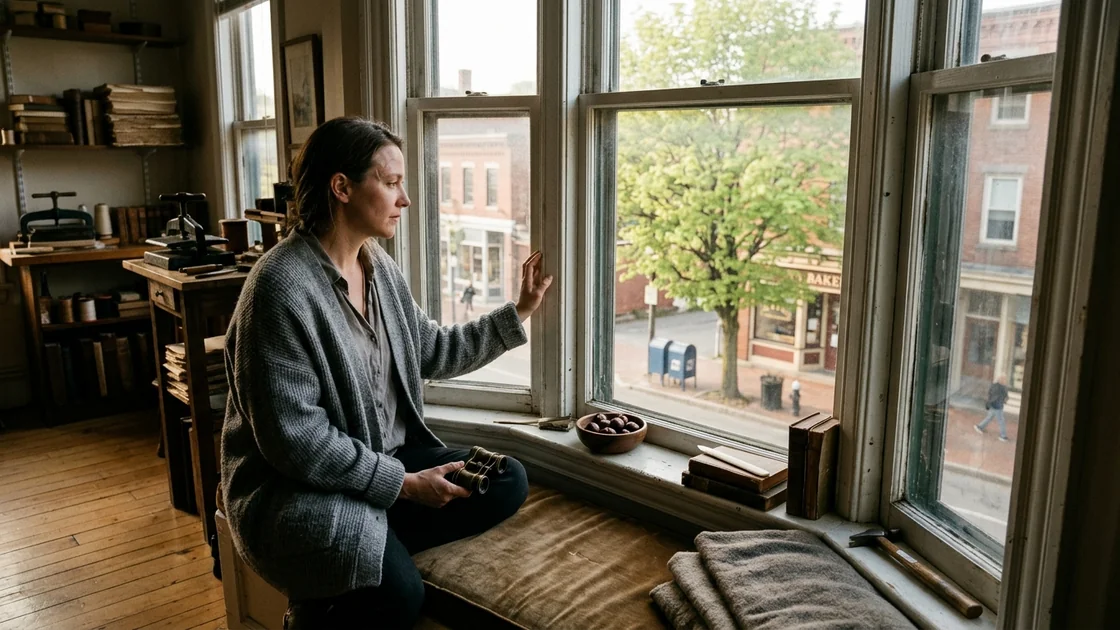
Clara Vance lives her entire life within the confines of a third-floor apartment in a quiet New England town, trapped by a debilitating agoraphobia that took root after a sudden tragedy five years ago. Through a wide, three-paneled bay window facing Elm Street, she observes the relentless march of the four seasons and the shifting lives of her two closest friends, Maya and Arthur, who continue to navigate the vibrant, unpredictable world outside while faithfully tethering her to reality through their weekly visits and the ever-changing glass pane between them.
I. The Amber Light
The glass of the center pane was always the coldest. Even in late September, when the afternoon sun slanted low and rich across the brick facades of Elm Street, the glass retained a sharp, mineral chill that pressed against Clara’s forehead like a coin. She knew the quirks of all three panels. The left one, angled toward the old Congregational church and the town green, had a slight bubble in the lower corner that warped the heads of passersby into elongated teardrops if she knelt on the window seat. The right panel, facing the corner bakery and the iron mailbox, rattled in its sash whenever the delivery trucks rumbled past at five in the morning. The center panel was wide and clear, an unobstructed frame measuring forty-two inches across and sixty inches high. It was the screen upon which the world was projected.
Inside, the apartment smelled of cedarwood, dried lavender, and the faint, metallic tang of the radiators waking up from their summer dormancy. Clara’s universe was fifty-four feet long and twenty-two feet wide. It had hardwood floors worn pale along the exact vectors of her daily pacing: from the bed to the bathroom, from the bathroom to the galley kitchen, and from the kitchen to the velvet-cushioned bay window. Near the front door—a heavy oak slab fitted with two brass deadbolts and a chain that had not been unhooked from the inside by her own hand in fifty-eight months—the floorboards were dark and pristine, untouched by the friction of her wool socks.
Down on the street, the sugar maples were beginning to turn. It started every year at the very top of the tree directly opposite her building, a single branch catching fire in brilliant orange while the rest of the canopy remained a dusty, exhausted August green.
Clara picked up her brass opera glasses from the sill. They were an antique pair Arthur had found at an estate sale three years ago, heavy and cold, wrapped in worn black leather. She didn’t need them to see the street, which was only thirty feet below, but she needed them to see the details that made the street real. Through the lenses, she could see the mortar crumbling between the bricks of the bakery across the way; she could see the gray hairs multiplying on the muzzle of Mr. Henderson’s golden retriever; she could see the exact expression on Maya’s face before Maya knew she was being watched.
At four-fifteen, Maya rounded the corner by the bakery. She was wearing a camel-colored trench coat she hadn't owned the previous autumn, and she was walking fast, her boots clicking a sharp staccato that Clara couldn't hear through the double-paned storm glass, though her mind supplied the rhythm automatically. Maya wasn't alone. Walking beside her was a tall man in a navy corduroy jacket, his hands buried deep in his pockets, his shoulders slightly hunched against the crisp wind.
Clara adjusted the small brass wheel between the lenses. The man had dark, unruly curls and wore spectacles with thick tortoiseshell frames. When Maya said something, gesturing wildly with a baguette she was carrying in a paper sleeve, the man threw his head back and laughed.
Clara lowered the glasses. Her heart gave a small, tight flutter—not quite panic, just the echo of the larger terror that lived permanently behind her sternum. A new person. The street was full of strangers, of course, hundreds of them passing through her forty-two-inch frame every day, but when a stranger entered the orbit of Maya or Arthur, the geometry of Clara’s world shifted.
She walked to the kitchen and filled the kettle. The routine was a bulwark against the vertigo that always threatened when she thought too long about the space beyond the oak door. When she tried to picture the street not as a flat image framed by white-painted wood, but as a three-dimensional expanse with no ceiling—a place where the sky went up forever into freezing, airless blue, and the pavement stretched continuously all the way to the ocean—her knees would turn to water. The walls of the apartment were not a prison; they were an exoskeleton. Without them, she was soft, boneless, exposed to a crushing atmospheric pressure that no one else seemed to feel.
Ten minutes later, there was a rhythmic knock at the door: two shorts, a pause, and two longs. Maya’s knock. Then the rattle of a key in the lock. Only Maya, Arthur, and the building superintendent had keys.
The heavy door swung open, letting in a brief, terrifying draft of hallway air—smelling of floor wax and Mrs. Gable’s cabbage soup from 2B—before Maya kicked it shut and threw the deadbolt with practiced efficiency.
"It’s crisp out there," Maya announced, unwinding a burgundy scarf from her neck and tossing it onto the coat rack by the door. Her cheeks were flushed pink, her dark eyes bright with the kinetic energy of the outside. She always brought the weather in with her on her clothes; if Clara stood close enough, she could smell the ozone and dead leaves on the wool of Maya’s coat. "The kind of air that makes you want to buy apples and twelve-dollar notebooks you’ll never write in."
"You got the sourdough," Clara said, offering a small smile from the edge of the kitchen counter.
"And the salted butter from the farm stand up by the highway," Maya said, setting the paper bag on the small round dining table. She paused, looking at Clara, and then glanced toward the bay window, where the brass opera glasses sat gleaming on the sill. A slightly sheepish smile touched her lips. "You saw him."
"Navy corduroy," Clara said, pouring boiling water over two chamomile tea bags. "Good hair. He laughs with his whole upper body."
Maya groaned, flopping into one of the Windsor chairs and stretching her legs out. "His name is Julian. He teaches restoration ecology at the community college. We met at the nursery on Saturday—we reached for the same pot of winter heather, which is so aggressively cliché I almost put the plant back and walked into traffic."
"Did he carry the heather to your car?"
"He did. And then we got coffee, and today he walked me from the bus stop." Maya took the mug Clara handed her, wrapping her cold fingers around the porcelain. "He knows about you. Well, he knows I have a best friend who lives up here and doesn't come down. He didn't ask any annoying questions about it."
"They always ask eventually," Clara murmured, moving back toward the window seat. She tucked her legs beneath her long gray cardigan, leaning her shoulder against the woodwork. "They ask why I don't just try standing on the porch for five minutes a day. Or they suggest a service dog."
"If he suggests a service dog, I'll push him into the duck pond," Maya said fiercely. She got up and joined Clara at the window, sitting on the opposite end of the cushioned bench. Down below, the streetlamps were just flickering on, their sodium-vapor bulbs warming from a dull violet to a rich, buttery amber. The light caught the turning leaves of the sugar maple, making them glow against the gathering dusk.
"He looked nice, Maya," Clara said softly. "You haven't brought anyone down Elm Street since David moved to Seattle."
"David was a coward who couldn't handle a New England winter," Maya said, though there was no real heat in her voice anymore. Two years ago, Clara had watched David’s yellow hatchback pull away from the curb below, packed to the roof with boxes, while Maya stood on the sidewalk under a gray November drizzle, her hands shoved into her pockets, refusing to look up at the third-floor window even though she knew Clara was watching over her.
They sat in companionable silence for a long time, eating thick slices of sourdough smeared with yellow butter, watching the commuter traffic thin out. At six o'clock, the lights in the bakery went off, and Mr. Rossi came out to flip the sign on the door and lock the grate. He looked up, as he did every evening, toward the third-floor window. From the street, with the apartment lights dimmed, Clara was just a pale silhouette behind the glass, a fixture as permanent as the stone gargoyles on the church roof. Mr. Rossi tipped his flour-dusted cap. Clara raised her teacup in return.
"Arthur is coming by tomorrow with your groceries," Maya said, brushing crumbs from her lap. "And he found those heavy ledger books you wanted for your binding."
Clara made her living—a modest one, supplemented by the life insurance policy her brother Leo had left behind—by repairing and rebinding old books for the town library and a few private collectors Arthur tracked down through his work at the historical society. It was tactile, quiet work that required immense patience and a steady hand. She had a workbench set up in the small second bedroom, crowded with bone folders, jars of wheat paste, spools of linen thread, and sheets of marbled endpaper. Books were safe. They had beginnings and ends, and their spines held them together firmly, no matter what storms raged inside their pages.
"Tell him to get the Honeycrisp apples," Clara said, her eyes tracking a solitary bicyclist coasting down the hill, a red taillight blinking into the twilight. "If they're in season yet."
"They're in season," Maya said, standing up and kissing the top of Clara's head. She smelled of chamomile and the cold evening air. "Everything's turning, Clary. It's going to be a loud autumn."
II. The Anatomy of the Threshold
The panic did not live in the apartment, unless Clara invited it in by approaching the door.
On Thursday mornings, Mrs. Gable’s cleaning lady vacuumed the third-floor hallway, and the machine always bumped against the base of Clara’s front door. Every week, at nine-fifteen, that dull wooden thud sent a jolt of pure, unrefined adrenaline through Clara’s bloodstream.
It was not a rational fear of people, nor was it a fear of germs or violence. Before the bridge collapsed five years ago—taking her brother Leo’s sedan into the freezing black current of the Kennebec River while Clara sat in the passenger seat, her seatbelt jamming for forty-five endless seconds under twenty feet of water before a diver cut her free—she had been a surveyor for the county. She had spent her twenties walking through unmarked timberland, wading through vernal pools in rubber hip-boots, standing on the edges of granite quarries with the wind whipping her hair. She had loved big spaces.
Now, big spaces felt like deep water. When she looked at the front door, her mind did not register a hallway, a staircase, and a street. It registered a sudden, catastrophic loss of containment. Beyond that two-inch slab of oak, there was nothing to hold the air down. If she stepped onto the sidewalk, what was to stop gravity from reversing? What was to stop the sky from swallowing her whole, just as the dark river had swallowed the beams of the car's headlights?
On Friday afternoon, Arthur arrived.
Arthur did not knock like Maya; he tapped a soft, hesitant rhythm with a single knuckle before using his key, as if apologizing to the door for disturbing its peace. He was thirty-eight, four years older than Clara and Maya, with the stooped, gentle posture of a man who spent ten hours a day reading eighteenth-century parish registries in a basement archive. He wore tweed jackets with leather elbow patches without a trace of irony, and his hair was the color of wet sand, perpetually falling over his forehead.
"Heavy load today," Arthur said, setting two canvas tote bags on the kitchen floor and puffing out his cheeks. His glasses were fogged from the transition between the brisk October air and the warm apartment. He took them off and polished them with the tail of his flannel shirt. "The library sent over six volumes of the Township Gazette from the 1890s. The spines are completely perished, Clara. Red rot everywhere. I told Marjorie you might not want the mess, considering the dust, but she insisted nobody else in the county can do a sewn-on-tapes binding that actually lays flat."
"I don't mind red rot," Clara said, kneeling by the bags to unpack the apples, the carton of eggs, the blocks of sharp cheddar, and a brown paper package tied with butcher's twine. She paused, holding the package. "What's this?"
Arthur’s ears turned faintly pink beneath his sandy hair. "Chestnuts. From the big tree behind the historical society. Well, horse chestnuts, mostly, so don't roast them or you'll poison yourself, though I think there are a few sweet ones mixed in. You mentioned last week you missed the feel of them."
Clara untied the string. Inside were two dozen glossy, mahogany-brown nuts, their surfaces impossibly smooth and cool, each bearing the pale, rough scar of its attachment to the spiky burr. She rolled two of them between her palms. The tactile sensation was immediate and grounding—a piece of the October afternoon brought safely through the airlock.
"Thank you, Artie," she said, looking up at him from the floor. "How is the street today?"
"Windy," Arthur said, leaning against the kitchen doorframe and folding his arms. "A front is coming down from Canada. The leaves are coming off the oaks in sheets. I saw Maya’s new fellow down by the pharmacy."
"Julian," Clara supplied, rising to put the eggs in the refrigerator.
"Julian," Arthur repeated, testing the syllables as if they were a dubious Latin translation. "He was wearing a scarf tied in that complicated loop that only men with humanities degrees know how to execute. He seemed very enthusiastic about a display of artisanal gourds outside the grocer's."
Clara laughed, a genuine, bright sound that made Arthur’s shoulders relax. For the last five years, Arthur had been the barometer of her days. While Maya brought the drama, the velocity, and the news of the world, Arthur brought the stillness. He often came over on Sunday afternoons with a stack of his own work, sitting in the wingback chair near the radiator while Clara worked at her bookbinding press or sat in the window seat. They would go two hours without speaking a word, the only sounds the ticking of the mantle clock, the scratch of Arthur’s fountain pen, and the muffled rumble of Elm Street below.
They moved to the living room. Arthur settled into his chair, accepting a mug of cider Clara heated on the stove, while Clara took her post on the window cushions.
Outside, the autumn was reaching its crescendo. The sugar maple across the street was now a towering torch of crimson and gold. Every time a gust of wind swept down the canyon of the street, hundreds of leaves detached at once, swirling in a chaotic vortex that rose as high as Clara’s third-floor pane before settling into the gutters.
Down on the sidewalk, a group of high school students walked past in their varsity jackets, laughing and shoving each other into the drifts of dry leaves. Behind them, a woman pushed a stroller with a plastic rain shield over it to block the wind.
"Mr. Henderson hasn't walked Barnaby since Tuesday," Clara noted, her forehead resting against the cool glass of the center panel. "His daughter came by yesterday in the blue Subaru and stayed for three hours. She carried out two bags of laundry."
Arthur looked up from the nineteenth-century ledger he was transcribing. "His sciatica acts up when the barometer drops. I ran into his daughter at the post office on Wednesday. She said he’s fine, just stubborn about using the walker indoors. She’s hired a college kid to walk Barnaby in the mornings before seven—that’s why you’ve missed them. You’re still asleep."
Clara nodded slowly, her tension easing. In the micro-economy of her street, an unexplained absence was a minor crisis. Because she could not cross the street to knock on a door, the people below existed in a state of quantum uncertainty the moment they stepped outside the frame of her bay window. If Mr. Henderson didn't walk his retriever at four o'clock, he could be sick, he could be dead, or he could simply have changed his schedule. She relied on Arthur and Maya to fill in the off-screen narrative.
"And the bakery?" Arthur asked softly, knowing the routine of her anxieties. "How is the new girl doing?"
"She drops the tongs a lot," Clara said, a small smile tugging at the corner of her mouth. "Through the window, I can see her ducking behind the pastry case every ten minutes to check her phone. Mr. Rossi stands by the espresso machine with his arms crossed, looking at the ceiling. Give it another week, and he’ll have his nephew back in there on the weekends."
Arthur smiled, his eyes warm behind his lenses. He wasn't looking at the street; he was looking at the way the orange light reflected off the side of Clara’s face, illuminating the fine, pale scar near her left temple where the broken glass of Leo’s car window had grazed her.
"My sister wants me to come to Boston for Thanksgiving," Arthur said after a moment, his voice dropping slightly.
Clara turned her head from the glass. Over the past five years, Arthur had spent every Thanksgiving and Christmas in this apartment, roasting a small Cornish hen in her miniature oven because a full turkey wouldn't fit, while Maya bounced between her parents' house in Vermont and whatever boyfriend she had at the time, always stopping by for pie in the evening.
"You should go, Artie," Clara said immediately, keeping her voice steady and light. "You haven't seen your nephews since last summer. They must be huge."
"Thomas is nearly five feet tall," Arthur admitted, looking down at his ledger. "He plays the trombone now. Poorly, by all accounts. Still... I don't like the idea of you being here alone on the Thursday. Maya said she’s taking Julian up to Burlington to meet her mother."
"It's just a Thursday," Clara said. She picked up one of the horse chestnuts from the sill and rolled it under her thumb. "From up here, Thursdays look remarkably like Tuesdays, just with fewer delivery trucks and more people carrying casserole dishes in foil. I have the entire 1894 volume of the Gazette to resew. I’ll be fine."
Arthur looked at her for a long moment, his expression unreadable in the fading amber light. There was an unspoken agreement between them, forged in the dark, terrible first year after the bridge collapse when Clara couldn't even leave her bedroom without vomiting from vertigo. The agreement was that Arthur would never ask her to be better than she was, and Clara would never ask him to stop living in the world on her account. Yet, for five years, Arthur’s world had shrunk to match the dimensions of her apartment more than he cared to admit.
"I'll come back on the Friday morning train," Arthur said finally, returning his gaze to his papers. "I'll bring you a leftover turkey sandwich with the cranberry sauce you like. The canned kind with the ridges still on it."
"The only kind worth eating," Clara agreed, turning back to the glass.
Down below, a municipal truck with a spinning yellow light on its cab was moving slowly along the curb, a giant vacuum hose sucking up the piles of maple leaves. Two men in reflective vests guided the nozzle with long metal handles. In minutes, the brilliant gold drifts were gone, leaving wet, black asphalt and bare gray concrete. The street looked wider without the leaves, colder and more starkly defined.
III. The Frost Line
By late November, the sugar maple was an intricate skeleton of black iron against a sky the color of unwashed wool. Without the leaves to screen the view, Clara’s field of vision expanded. She could now see the upper stories of the brick townhouses on the next block over, and the distant, slate-gray spire of the town hall clock tower three streets away.
Winter was always the hardest season, yet also the most clarifying. In the summer, the foliage of the street trees created a green wall that made the bay window feel like a treehouse, cozy and enclosed. In the winter, the world was stripped down to its geometry. Lines were hard. Shadows were long and blue. And the cold pressed through the old wooden sashes of the window so fiercely that Clara had to keep a rolled-up woolen blanket wedged against the bottom sill to stop the draft.
Thanksgiving Day arrived with a dry, spitting snow that didn't stick to the pavement but gathered in white crescents along the windward edges of the brick window ledges across the street.
The apartment was profoundly quiet. Without the normal Thursday rumble of the bakery delivery vans or the chatter of children walking to the bus stop, the silence had a physical weight. Clara spent the morning in her workroom, scraping old hide glue from the spine of the 1894 Township Gazette with a bone folder. The old paper smelled of vanilla and decay. She read snippets of the news as she worked: a barn fire in West Parrish; a social supper at the Grange Hall; the birth of a two-headed calf at the Miller farm. All those people, she thought, who had walked down Elm Street a hundred and thirty years ago, worried about the price of coal and the croup, now reduced to brittle, yellowing rag paper under her fingers.
At two o'clock, she made herself a plate of scrambled eggs and toast and carried it to the bay window.
Elm Street was deserted. The bakery was dark, a hand-lettered sign taped to the inside of the glass wishing customers a Happy Thanksgiving. Across the way, in the second-floor apartment above the dry cleaner's, she could see a television flickering blue against the ceiling, and occasionally a man in an undershirt walked past the window carrying a can of beer.
At three-fifteen, a dark green sedan pulled up to the curb directly beneath her window. It wasn't a car she recognized from the street's regular rotation. The engine idled, sending a plume of white exhaust swirling up into the cold air.
After a moment, the passenger door opened, and Maya stepped out. She was wearing a green velvet dress under her trench coat, and her hair was pinned up in a loose twist that was already coming undone in the wind. She leaned back into the car, said something that looked sharp and clipped, and slammed the door harder than necessary.
Clara set her plate down on the floor and reached for the opera glasses.
Inside the car, Julian was visible through the windshield, his hands gripping the top of the steering wheel. He wasn't wearing his glasses, and he was staring straight ahead down the empty street. Maya didn't walk toward the apartment building's entrance; instead, she stood on the curb, her arms wrapped tightly around her ribs, staring up at the bare branches of the sugar maple.
After two minutes, the driver's side door opened. Julian got out, leaving the car running. He walked around the hood and stood behind Maya, not touching her, his breath making rapid white clouds in the frigid air. He spoke. Maya shook her head, looking down at her boots. He reached out, placing a hand on the shoulder of her coat. For a second, Maya stayed rigid, and then her shoulders slumped. She turned and buried her face against the front of his navy coat.
They stood like that in the spitting snow for a long time, an island of warmth and complication in the middle of the deserted street. Then Julian reached into the back seat of the car, pulled out a white bakery box tied with string, and handed it to her. He kissed her forehead, got back into the car, and drove away toward the highway.
Five minutes later, Maya’s key turned in the lock.
When she came in, she didn't say anything about the weather. She kicked off her heeled boots by the door, dropped the bakery box on the kitchen counter, and walked straight to the bay window, collapsing onto the cushions beside Clara and resting her head on Clara’s shoulder. Her hair was cold and smelled of car heater and expensive perfume.
"I thought you were in Burlington," Clara said softly, resting her cheek against Maya’s cold hair.
"We got as far as Concord," Maya said, her voice muffled against Clara's cardigan. "And then my mother called to ask if Julian was 'permanent enough' to be in the family photo, or if he should stand on the end so he could be cropped out later like David."
Clara let out a small breath. "Oh, Marjorie."
"Right? And I laughed—you know, that brittle, horrible laugh I do when my mother says something sociopathic—and Julian asked what was wrong. So I told him. And then we got into this massive, sprawling conversation on Interstate 89 about whether I actually let people in, or if I just keep everyone at arm's length so I always have a clean exit strategy."
Maya sat up, wiping a smudge of mascara from beneath her left eye with the back of her thumb. She looked out the window at the empty curb where the green sedan had been.
"Do I?" Maya asked, turning her dark eyes on Clara. "Keep an exit strategy?"
Clara looked at her oldest friend. She had known Maya since they were nine years old, trading stickers on the school bus. She had watched Maya burn through jobs, apartments, and men with the restless energy of someone who believed that staying still was a form of dying. Only one thing in Maya’s life had remained entirely fixed for the last five years, and it was sitting right beside her in a gray cardigan.
"You're brave out there, Maya," Clara said carefully. "You go fast. Sometimes when you go fast, it's hard for other people to match your speed without feeling like they're going to get left behind at a rest stop."
Maya gave a watery laugh. "He turned the car around at the White River Junction exit. He said we didn't have to go to Vermont if it made me miserable, and he knew I'd rather bring pie to you anyway. And then I got mad at him on the drive back for being so reasonable, because who gets to be that reasonable when I'm trying to pick a fight?"
"A man who teaches restoration ecology," Clara said. "They're trained to deal with invasive species and eroded riverbanks. A little road trip angst is nothing."
Maya nudged Clara’s knee with her own. "Come eat pecan pie with me. I told him I’d take the seven o'clock bus out to his place in Pelham tonight. His roommates are all gone for the weekend."
They ate the pie straight from the white cardboard box with two forks, sitting on the living room rug with the radiator clanking softly behind them. As the early winter twilight descended at four-thirty, turning the snow flurries outside into tiny grey moths against the glass, Maya talked about Julian’s apartment—how he had seventeen houseplants with human names, how his kitchen floor tilted toward the pantry, how he made coffee in a glass chemist’s flask that looked like a bomb.
Clara listened, absorbing every detail like a sponge. She built Julian’s apartment in her mind, placing the seventeen plants on windowsills she would never see, tilting a floor she would never walk across. This was how she traveled. Through Maya’s impulsive tours and Arthur’s meticulous descriptions, Clara possessed an entire phantom geography of the county, mapped out in second-hand stories.
IV. Whiteout
In January, the world disappeared for three days.
It began on a Tuesday afternoon with a low, bruised sky that pressed down just above the church steeple. By four o'clock, the first flakes were falling—not the dry, powdery snow of November, but fat, wet, relentless curtains of white driven horizontally by a gale off the Atlantic.
Arthur had come by at noon with two bags of groceries, three gallon-jugs of spring water, and a bundle of beeswax candles in case the ice took down the power lines on Elm Street. He had wanted to stay—he had stood by the door in his heavy woolen overcoat, his hand on the brass deadbolt, looking back at Clara with a deep crease between his eyebrows—but the historical society had a leaky roof over the map room, and if the snow load got too heavy without someone running the sump pump and checking the tarps in the attic, three hundred years of county surveys would be ruined.
"Call me every three hours," Arthur had instructed, his voice unusually stern. "If the landlines go down, keep your cell phone charged off the laptop battery."
"I'm indoors, Artie," Clara had reminded him gently. "I'm the only person in town who doesn't have to worry about the roads."
Now, at eight o'clock on Wednesday night, the blizzard was at its peak.
Clara sat in the bay window with a woolen blanket wrapped around her shoulders. Usually, the window was a portal to a recognizable world, even at night; the amber pools of the streetlamps, the neon sign of the dry cleaner's, the lighted windows of the apartments opposite all formed a familiar constellation.
Tonight, the glass was plastered with a two-inch crust of frozen slush on the outside. Between the bursts of snow, the streetlamps were barely visible as diffuse, sickly orange halos suspended in a churning void. There were no cars. Even the snowplows had given up around six o'clock, leaving Elm Street buried under three feet of drifted white that erased the curbs, the fire hydrants, and the steps of the bakery.
The wind hit the three panels of the bay window like a physical fist. Whump. Whump. The old glass bowed inward by a fraction of a millimeter, groaning in its putty bed.
For the first time in years, the window did not make Clara feel connected; it made her feel as though she were in a diving bell at the bottom of a freezing, turbulent sea.
Around nine o'clock, the lights in the apartment flickered twice, dimmed to a dull brown glow, and went out. Simultaneously, the constant, low hum of the refrigerator died, and the radiator gave a final, metallic clink as the basement boiler shut down.
The silence that followed the loss of power was absolute, broken only by the shriek of the wind tearing around the brick corners of the building.
Clara sat completely still in the dark. Her breath came shallow and fast. In the pitch black, the boundaries of the fifty-four-foot apartment dissolved. Without the visual anchors of her furniture, her bookshelves, and the kitchen counter, the room felt cavernous, infinite, and unmoored. She was back in the passenger seat of Leo’s car. The brown river water was rising over the dashboard. The headlights were dying in the silt. Her fingers were tearing at the plastic release button of the seatbelt, which wouldn't give, wouldn't give, wouldn't give—
"Forty-two inches across," Clara whispered aloud into the dark. Her voice sounded tiny, swallowed by the roar of the storm outside. "Sixty inches high. Left panel, church. Right panel, bakery. Center panel, maple tree."
She forced her hand to reach out along the cold wooden sill until her fingers brushed the brass box of matches Arthur had left beside a heavy ceramic candlestick. Her hands were shaking so violently that she snapped the first two matches against the striker strip without lighting them. On the third try, the sulfur flared with a sharp, chemical hiss, and she touched it to the wick of the beeswax candle.
The golden flame steadied, casting a small, warm sphere of light over the window seat. The walls of the apartment snapped back into existence, solid and reassuring.
Clara let out a long, ragged shuddering breath and pulled the blanket tighter around her chest. Her phone rang on the small table beside her, the screen lighting up with Arthur’s name.
"I'm here," she said, picking it up on the first ring. "I have the candle lit."
"The whole grid between Main and High Street just blew a transformer," Arthur’s voice came through the speaker, slightly static-ridden. Beneath his voice, she could hear the rhythmic thump-whoosh of the sump pump in the historical society basement. "I saw the green flash through the cellar bulkhead. Are you alright? How is the breathing?"
"It caught me for a minute when the fridge stopped," she admitted, watching her own reflection in the black glass of the center pane. Because the outside was obscured by snow and darkness, the window had become a mirror. She saw a pale woman with dark circles under her eyes, her brown hair braided loosely over one shoulder, holding a candle in a room that looked like a nineteenth-century daguerreotype. "I'm okay now. How are the maps?"
"Dry, mostly," Arthur sighed. "I have six buckets under the north eaves in the attic, and I'm emptying them every forty minutes. It’s thirty-eight degrees in the reading room. I’ve wrapped myself in an 1840s horse blanket from the textile collection. If the board of trustees finds out, they’ll have me shot, but it smells of mothballs and sheep grease, and it’s remarkably effective."
"Stay on the line with me for a little while?" Clara asked. She rarely asked for things directly; she hated the weight her needs placed on the two people she loved.
"I don't have anywhere else to be, Clara," Arthur said softly. "And the battery on my landline base is dead anyway, so I’m on the cell. Let me tell you about the absolute scandal I uncovered in the 1872 selectmen's minutes while I was waiting for the buckets to fill."
For two hours, as the temperature inside the apartment slowly dropped from sixty-eight degrees to fifty-five, Arthur talked. He told her about a nineteenth-century feud between two blacksmiths over the rights to shoe the town's fire horses; he described the exact pattern of frost forming on the inside of the archive's leaded windows; he read her recipes from a ladies' auxiliary cookbook from 1912 that called for "butter the size of a walnut" and boiled calf's head.
Clara lay curled on the window seat, her head propped on a throw pillow, the phone pressed to her ear, watching the candle flame dance in the draft coming through the sash. Eventually, her eyes grew heavy. The storm still raged against the glass, inches from her face, a howling white emptiness that wanted to tear the roofs off the town. But inside the small circle of beeswax light, tethered by the thin copper wire of Arthur’s voice, the walls held.
V. The Thaw and the Fissure
On Thursday morning, the world returned, blinding and strange.
Clara woke under three quilts on the window seat to a light so intense it burned through her closed eyelids. The crust of slush on the outside of the bay window had melted away under a brilliant, cloudless cobalt sky, revealing an Elm Street transformed into an arctic canyon.
The snowdrifts were sculpted into smooth, sweeping dunes five feet high against the front of the bakery. Icicles the thickness of fence posts hung from the eaves of the buildings opposite, dripping in the bright morning sun. The power had come back on around dawn, and the radiator was hissing frantically, filling the apartment with heat and the smell of toasted dust.
Below, the neighborhood was emerging like ants after a flood. Because the street was still impassable to cars, people were walking down the center of the road in snowshoes and cross-country skis. Mr. Rossi was out with a grain shovel, carving a narrow trench from his front door to the middle of the street, his breath puffing like a steam engine. A dozen kids from the block over were climbing the massive mountain of snow the town plows had pushed against the base of the church wall, sliding down on plastic laundry baskets.
It was a carnival of the outside, loud and bright and communal. People who normally walked past each other with their eyes fixed on their phones were stopping in the middle of the buried asphalt to lean on their shovels and talk, pointing at downed tree limbs and comparing how cold their bedrooms had gotten during the blackout.
Clara watched them with her hands wrapped around a mug of hot coffee. She felt a strange, hollow ache in the center of her chest. Usually, she had no desire to be on the street; the street was a threat. Today, watching a teenage boy help Mr. Henderson’s daughter dig out the blue Subaru while Mr. Rossi handed them hot paper cups of espresso through the trench in the snowbank, Clara felt the thickness of the glass between them. She was a ghost haunting her own neighborhood, watching the living from behind a two-way mirror.
The phone didn't ring until noon, and when it did, it was Maya.
"Tell me you didn't freeze into an ice sculpture," Maya said, though her voice lacked its usual post-storm exuberance. She sounded tired, and there was a faint echo in the room she was calling from.
"Arthur talked me through the blackout," Clara said. "Where are you? Did you get snowed in at Julian's?"
There was a long pause on the other end of the line. Clara heard the click of a lighter—strange, because Maya had quit smoking three years ago when she started running half-marathons.
"Yeah," Maya said finally, exhaling smoke away from the receiver. "Yeah, we've been locked in here since Tuesday afternoon. Just me, Julian, his two grad-student roommates, and seventeen ferns."
"Are you sick of board games yet?"
"We weren't playing board games, Clary," Maya said. Her voice was flat, stripped of its performative warmth. "He got an offer on Tuesday morning. Right before the storm hit. A two-year fellowship with the Forest Service. In Oregon. Starting in May."
Clara’s grip tightened on her coffee mug. Down on the street, the kids on the snow pile shrieked with laughter as a laundry basket flipped over in a drift. "Oregon," Clara repeated. The word felt impossibly distant, like the name of a crater on the moon.
"Outside of Eugene," Maya said. "Old-growth timber management. It's his dream job. He applied for it eight months ago, before we met at the nursery."
"And what did he say?" Clara asked, though she already knew, with a sudden, cold certainty that had nothing to do with the draft from the window, what the real problem was.
"He asked me to go with him," Maya whispered. "We spent forty-eight hours in a freezing bedroom while the wind tried to rip the siding off the house, and he asked me to pack up my life and drive across the country in a Honda Civic in twelve weeks."
Clara closed her eyes. For five years, her world had been built on a tripod: the apartment, Arthur, and Maya. Maya had stayed in this small, quiet town after college—working a graphic design job she could do remotely for a firm in Hartford, living in a studio apartment four blocks away—long after her ambition and her restlessness would have naturally carried her to New York or Boston or Seattle. Neither of them had ever said out loud why Maya stayed. To say it out loud would have made Clara a burden rather than a friend.
"Maya," Clara said, her throat tight. "What did you tell him?"
"I told him I couldn't," Maya said, and now her voice cracked, sharp and jagged. "I told him my life was here. My work, my history... you. And he looked at me—God, Clary, he didn't even get angry, which made it ten times worse—and he said, 'Maya, you're using her as a shield because you're terrified of what happens if you actually commit to a future that isn't stuck in amber.'"
The silence between them stretched, heavy and suffocating.
"Is he right?" Clara asked, barely above a whisper.
"I don't know!" Maya’s voice rose, raw with tears and exhaustion. "I don't know anymore! For five years, every time something gets too big or too scary out here, I come up your stairs, and we drink chamomile tea, and we look out the window, and the world stays on the other side of the glass where it can't hurt us! I love you, Clary, you're my sister, you're my whole heart, but sometimes I feel like I'm sitting in that window seat too, just taking notes for you while my thirties disappear!"
Maya gasped, sucking in a sharp breath, as if horrified by the words that had just left her mouth. "Clary—God, Clara, I'm sorry. I haven't slept since Tuesday, and I'm smoking Julian's roommate's stale American Spirits, and I didn't mean—"
"It's okay," Clara said. Her voice was remarkably steady, though she felt as if someone had opened all three panels of the bay window and let the arctic air flood straight into her lungs. "Maya, it's okay. Really. Don't apologize for telling the truth."
"I'm coming over as soon as the plows clear Pelham Road," Maya said, panicking now. "I'll bring soup from the Thai place if they're open. We'll talk."
"Not today," Clara said gently. "Stay with Julian today. The roads are still bad, and you two need to finish talking without the storm in the way. Come by on the weekend."
"Clary—"
"Go talk to him, Maya. I'm fine. The sun is out, and the heat is back on."
Clara hung up before Maya could argue. She set the phone down beside the cold beeswax candle.
She looked out the center pane. The snow plow had finally arrived on Elm Street, a massive yellow truck with a wing blade that threw a twenty-foot rooster tail of white powder onto the sidewalks, undoing half an hour of Mr. Rossi’s shoveling in three seconds. Mr. Rossi stood on the top step of the bakery, shaking his snow shovel at the back of the truck, his face red, his mouth open in a silent curse that made the teenagers across the street double over with laughter.
Life was loud, messy, infuriating, and constantly moving toward Oregon or Boston or the grave. Only Clara was still. She was the hub of a wheel, demanding without words that the spokes remain attached to her, even when the rim was trying to roll forward.
VI. The Green Fuse
By late April, the mountains of dirty gray ice in the corners of the parking lots had finally vanished, leaving behind heaps of winter sand and lost mittens. The sugar maple across the street was covered in tiny, sticky red buds that made the crown of the tree look as if it were veiled in a faint crimson mist.
In the three months since the blizzard, a subtle, polite distance had entered the apartment whenever Maya visited. They didn't fight; they had never fought. Instead, they were careful with each other, which was infinitely worse.
Maya still came by on Tuesdays and Thursdays after work. She still brought sourdough from the bakery and gossip about the town council. She rarely mentioned Julian, except to confirm, when Clara asked directly, that they were still seeing each other. May was approaching like an express train, its arrival marked by the lengthening of the daylight on the brick wall opposite Clara’s window. In January, the sun had vanished from the bricks by three-thirty; now, a band of pale yellow light lingered near the roof gutters until nearly seven.
Clara spent those spring weeks working furiously in her bindery. She took on every project Arthur brought her, plus three private commissions she found through an online guild of book conservators—a resource she had previously avoided because it required shipping boxes out via the courier service, which meant leaving taped packages in the hallway outside her door while no one was looking and waiting for the driver to take them away.
She was trying, in her own silent way, to become self-sufficient. She set up a grocery delivery account with the big supermarket out by the highway, instructing the teenaged drivers to leave the plastic crates against the hallway wall.
When Arthur came over on the third Sunday in April and found her unpacking her own milk and oranges from a green plastic crate she had dragged across the threshold with a fireplace poker after the delivery boy’s footsteps had faded down the stairs, he stopped dead in the entryway.
"What is this?" Arthur asked, gesturing to the crate with the rolled-up copy of the Sunday Globe he always brought for them to read together.
"The market started doing doorstep drop-offs for five dollars," Clara said brightly, not meeting his eyes as she put a carton of orange juice into the fridge. "I figured it didn't make sense for you to haul heavy bags up three flights of stairs every Friday when you have that bad knee from the archive ladder."
Arthur didn't move. He stood by the coat rack, still wearing his light canvas raincoat, smelling of April mud and wet pavement. "My knee hasn't bothered me since November, Clara. And I like picking out your apples. The kids at the supermarket don't check for bruises on the bottom of the bag."
"Still," Clara said, wiping her hands on a dish towel. "It saves you an hour."
"And what am I supposed to do with the hour?" Arthur asked. His voice wasn't angry, just strangely hollow.
Clara looked up at him then. Arthur looked older this spring. The winter in the damp basement of the historical society had left him pale, and the sandy hair at his temples had gone decidedly silver over the last few months.
"Whatever people do on Friday afternoons, Artie," she said softly. "Go to the pub with the other archivists. Drive out to the reservoir and look at the migrating ducks. You don't have to be my courier forever."
Arthur walked slowly into the kitchen and set the newspaper down on the small round table. He looked at the green plastic crate by the door, then at Clara’s workbench through the open doorway of the spare bedroom, where three shipping boxes sat taped and labeled for the UPS pickup on Monday.
"Maya told me," Arthur said quietly. "About the conversation you two had during the blizzard. And about Oregon."
Clara’s gaze dropped to the floorboards. "She’s going to let him go, Artie. Because of me. He leaves in three weeks, and she hasn't packed a single box, and she hasn't given notice to her landlord. She’s going to stand on the sidewalk and watch another car drive away to the West Coast, and this time she’s going to hate me for it, even if she never says a word."
"Maya is thirty-four years old," Arthur said, stepping closer to the counter. "She makes her own choices, Clara."
"No, she doesn't," Clara said, her voice rising with a sudden, sharp desperation. "Neither of you do! You didn't take the fellowship at the Massachusetts Historical Society in Boston two years ago—don't look at me like that, Marjorie at the library told me on the phone when she was checking on the Gazette volumes! She said they offered you the head archivist position for the colonial manuscripts collection, and you turned it down because you didn't want to leave the valley!"
Arthur froze. The color drained from his face, followed by a dull, patchy flush that crept up his neck. For a man who lived in a world of quiet footnotes and dusty marginalia, having his private sacrifices dragged into the harsh April light of the kitchen was clearly agonizing.
"Boston is loud," Arthur muttered, looking away toward the bay window. "And the rent in Back Bay is absurd."
"You love Boston," Clara said, tears finally pricking the corners of her eyes. "You did your master's there. You used to talk about the Athenaeum like it was the Garden of Eden. You stayed here in a damp cellar with a broken sump pump because if you left, nobody would bring me horse chestnuts in October or talk to me on the phone when the power goes out!"
"And what if I wanted to bring you horse chestnuts?" Arthur snapped. It was the first time in fifteen years of friendship that Clara had ever heard him raise his voice. The sound of it—rich, resonant, and trembling with five years of suppressed grief—shocked them both into silence.
Arthur took off his glasses with a shaking hand and pinched the bridge of his nose. When he spoke again, his voice was rough and low.
"Do you think I come up those stairs out of pity, Clara? Do you think I sit in that chair for four hours every Sunday reading parish death records because you're a charity case on my calendar?" He opened his eyes, looking straight at her without his glasses, his gaze startlingly direct and vulnerable. "When that bridge went down, I thought you were dead for three hours until your mother called from the hospital in Portland. For three hours, the entire world was just... empty space. Cold, useless geography. I don't care if you never step across that threshold again for the rest of our lives. The only room in New England I actually want to be in is this one."
Clara stood paralyzed against the kitchen counter, her heart hammering against her ribs with the same wild, terrifying force she felt when she looked at the front door.
For five years, she had kept her world small to keep it safe. She had cast Arthur in the role of the sexless, saintly brother—the quiet substitute for Leo who would never leave, never demand anything, never disrupt the fragile equilibrium of the apartment. She had watched Maya’s romantic dramas unfold down on Elm Street through her brass opera glasses, treating love and desire as things that belonged strictly to the outdoors, like thunderstorms and traffic jams.
Now, the outdoors was inside the kitchen.
"Artie," she breathed, her hands gripping the edge of the laminate counter behind her.
Arthur looked at her white knuckles, at the way she was pressing herself back against the cabinetry as if trying to merge with the wall. The flash of anger vanished from his face, replaced by a deep, weary sadness. He put his glasses back on, restoring the polite glass barrier between them.
"I'm sorry," Arthur said quietly, stepping back toward the coat rack. "I shouldn't have put that on you. It violates the terms of the lease, doesn't it? No sudden movements inside the perimeter."
"Artie, don't leave," Clara said, taking a single step forward, her wool socks sliding on the worn floorboards.
"I have to go check on my mother's garden," Arthur lied gently, his hand already on the brass deadbolt. "I left the Globe on the table. The crossword looks easy this week. I'll... I'll call you on Wednesday."
He opened the heavy oak door, stepped out into the dim third-floor hallway, and pulled it shut behind him. Clara didn't hear the deadbolt click because he couldn't lock it from the outside without using his key, and for the first time in five years, he didn't pause to lock her in. He just walked down the stairs, his footsteps fading rapidly into the silence of the building.
Clara stood in the center of the living room for a long time. Then she walked to the bay window.
Ninety seconds later, the front door of the building below opened, and Arthur stepped out onto the sidewalk. He didn't look up at the third-floor window. He turned left, walking past the church with his hands shoved deep into the pockets of his canvas raincoat, his head bowed against the bright April sun, until the warped bubble of glass in the lower corner of the left pane stretched him into a blurred shadow and he vanished around the corner.
VII. The Vertigo of May
The next ten days were the longest of Clara’s thirty-four years.
The sugar maple burst into leaf during the first week of May—a sudden, chartreuse explosion that obscured the brick townhouses on the next block and turned the light inside the apartment a cool, underwater green.
Arthur called on Wednesday, just as he had promised, and again on Sunday, claiming he had caught a spring cold and didn't want to bring germs into the apartment. They talked for fifteen minutes about the library's summer restoration budget and the town's plan to repave Main Street. His voice was kind, steady, and separated from her by an invisible sheet of plate glass thicker than the bay window.
Maya didn't come by on Tuesday or Thursday. She sent text messages instead—brief, cheerful notes with photos of her lunch or a weird dog she saw by the post office—claiming she was swamped with a website redesign for a client in New Haven.
Clara was getting what she had engineered: her independence. The supermarket delivery boy left the green crates in the hallway; Clara dragged them in with the fireplace poker when the coast was clear. The UPS driver took her finished books from the hall table and left new boxes from private collectors in Connecticut and New York. Technically, the system worked flawlessly. She didn't need anyone to survive within her fifty-four-foot sanctuary.
She had never been more miserable in her life.
Without Maya lounging on the window seat eating buttered bread, and without Arthur reading in the wingback chair while the mantle clock ticked, the apartment was no longer a fortress; it was a tomb. The books in her bindery smelled only of dead glue and rotting leather. The view through the forty-two-inch center pane was flat and meaningless, like a television left playing in an empty motel room.
On the second Saturday in May, the weather turned unseasonably warm. Down on Elm Street, people were wearing short sleeves. Mr. Rossi had brought out two small wrought-iron tables and set them on the wide sidewalk in front of the bakery, opening a striped canvas umbrella over each one.
At two o'clock in the afternoon, Clara was sitting in the window seat, her forehead pressed against the glass, which was no longer cold. The sun warmed the pane until it felt like living skin against her brow.
Down at the corner by the mailbox, Maya appeared.
She was wearing a yellow sundress and white sneakers, and she was walking with Julian. They stopped beside one of Mr. Rossi’s iron tables. Julian went inside to get coffee while Maya sat down in the wrought-iron chair, tipping her face up toward the sun with her eyes closed.
When Julian came back out carrying two iced coffees and a pastry on a paper plate, he sat across from her. From her perch thirty feet above, Clara picked up the brass opera glasses and focused on their table.
Through the magnified lenses, she saw Julian reach into the pocket of his linen shirt and pull out a set of keys on a bright green plastic tag—the kind rental companies used for moving vans. He placed them on the iron table between their coffee cups.
Maya opened her eyes and looked at the keys. She didn't reach for them, and she didn't push them away. Instead, she looked up—straight past the striped umbrella, past the new green leaves of the sugar maple, directly at the center pane of the third-floor window.
Through the opera glasses, it felt as though Maya were looking straight into Clara’s pupils from two inches away. Maya’s face was pale, her jaw set in that stubborn, heart-breaking line Clara remembered from when they were twelve years old and Maya had broken her collarbone falling out of an apple tree, refusing to cry until her father got the car started.
Maya wasn't going to take the keys. She was going to sit at that iron table and drink her iced coffee and say goodbye to Julian on Monday morning, and then she was going to walk up three flights of stairs on Tuesday afternoon with a loaf of sourdough and pretend her heart wasn't broken in half.
Clara lowered the opera glasses. Her hands were entirely steady.
She looked away from the window and across the length of the apartment, down the pale, worn path in the hardwood floors, toward the heavy oak door at the end of the room.
For fifty-eight months, that door had been the edge of the world. Beyond it lay the black water of the Kennebec River, the crushing weight of the open sky, the terrifying, chaotic machinery of a universe where bridges fell down without warning and brothers died in the dark while you sat twenty inches away unable to save them.
If I don't open that door, Clara thought, I am going to drown both of them in here with me.
She stood up from the window seat. She didn't put on shoes—she hadn't owned a pair of outdoor shoes since her mother threw away her mud-stained river boots five years ago, only a pair of soft leather moccasin slippers she used when the kitchen floor was cold in January. She stepped into the slippers. She picked up the brass apartment key from the little ceramic bowl on the kitchen counter—a key she had never once used—and dropped it into the pocket of her gray cardigan.
She walked down the fifty-four feet of hardwood floor until her toes touched the dark, pristine boards in front of the entrance.
Her heart was no longer beating in a normal rhythm; it was a trapped bird throwing itself violently against the cage of her ribs. A high, thin ringing started in her ears, the familiar herald of a full-blown panic attack. Her vision narrowed into a dark tunnel, the edges of the room dissolving into gray static.
It's just wood, she told herself, placing her palm flat against the oak panel. It's just a hallway that smells of cabbage and floor wax. There is a ceiling in the hallway. The sky isn't in the hallway.
With fingers that felt numb and wooden, as if they belonged to someone else, she turned the top brass deadbolt. Because Arthur hadn't locked the bottom one ten days ago, the latch gave way with a single, loud clack.
She gripped the brass doorknob, turned it, and pulled the door open six inches.
The draft from the stairwell hit her face instantly—cooler than her apartment, smelling of dust, old carpet, and the faint, damp mineral scent of the brick foundation three stories below.
Clara’s knees buckled. She caught herself on the doorframe, her fingernails digging into the white painted trim so hard a splinter drove beneath her index fingernail. The pain was sharp and bright, cutting through the gray static in her eyes.
She looked out at the third-floor landing. The carpet was a faded red floral pattern she hadn't seen since the day Maya and Arthur brought her home from the psychiatric ward in Portland, walking on either side of her with their arms locked around her waist while she kept her eyes squeezed shut. Across the landing was the door to 3B, which had been empty since Mr. Miller moved to Florida two years ago. To her left was the banister of the staircase, polished dark mahogany, spiraling down toward the second floor.
"One foot," Clara whispered into the empty hall.
She pushed her right foot across the brass threshold strip. Nothing happened. Gravity did not reverse. The ceiling did not peel back to reveal the vacuum of space.
She pulled her left foot after it, letting the heavy oak door swing shut behind her until the latch clicked.
The sound of that click behind her back nearly made her vomit. She was on the wrong side of the wall. She gripped the mahogany banister with both hands, her knuckles white, and began to walk down the stairs like an eighty-year-old woman with vertigo, bringing both feet together on each carpeted tread before attempting the next one.
Thirty-six steps, she counted in her head, remembering the architecture of the building from her life before the river. Twelve to a flight. Three landings.
On the second-floor landing, Mrs. Gable’s door was closed, a small brass wreath hanging on the knocker. Through the wood, Clara could hear the faint murmur of a afternoon talk show on television. She kept going, sliding her hands down the smooth wood of the rail, her chest heaving as if she were climbing Everest rather than descending twenty-five feet.
When she reached the ground-floor vestibule, she stopped.
Ahead of her was the building’s front door. Unlike her solid oak apartment door, this one had a large oval pane of beveled glass set into the upper half. Through the glass, at eye level for the first time in five years, she saw Elm Street.
The perspective was terrifyingly wrong. For nearly two thousand days, she had looked down at the world from a thirty-foot elevation, where cars were the size of loaves of bread and people were foreshortened figures of tops of heads and shoulders. Now, looking through the beveled glass, the parked cars at the curb looked like monstrous walls of painted steel. A teenager walked past on the sidewalk six feet away, and he looked ten feet tall, his movement violent and dizzyingly fast.
And beyond the roof of the bakery across the street—there it was. The sky. Vast, unbroken, blindingly blue, stretching up for miles without a ceiling, without a frame, without forty-two inches of white woodwork to contain it.
Clara pressed her back against the row of brass mailboxes in the vestibule, gasping for air, her vision swimming with black spots. She couldn't go out there. If she pushed that front door open, the sheer volume of the air outside would crush her lungs. She would fall down on the concrete and never get up.
She closed her eyes, pressing the back of her head against the cold brass door of mailbox 1A.
Why are you here? she asked the dark behind her eyelids. Because Maya is sitting at that table. Because Artie is sitting in his house pretending he has a cold.
She opened her eyes, refusing to look up at the sky above the bakery roof. Instead, she fixed her gaze entirely on the pavement directly outside the vestibule steps, and on the iron legs of the table thirty yards away across the asphalt.
She pushed the heavy brass crash-bar of the front door and stumbled out onto the granite stoop.
The sound hit her first. Behind her double-paned storm windows on the third floor, the world was a silent movie with a muffled bass track. Out here, the sound was deafening, three-dimensional, and inescapable. The hiss of tires on warm asphalt; the roar of the bakery’s exhaust fan across the street; the chatter of sparrows in the sugar maple; the clink of a metal spoon against a glass at the sidewalk table; the distant wail of a siren two miles away near the highway. And the wind—live, moving air brushing against her bare neck and lifting the hem of her cardigan, smelling of car exhaust, lilac bushes, and yeast.
She didn't try to walk down the four granite steps to the sidewalk; she sat down hard on the top step, wrapping both arms around the cold black iron railing at the side of the stoop, anchoring herself to the metal as if she were on the deck of a ship in a hurricane.
Across the street, Julian was saying something, his hands resting flat on the iron table. Maya was looking down at her lap.
"Maya!" Clara called out.
Or she tried to call out. After five years of speaking only in small rooms, her voice came out as a dry, rasping croak that didn't even carry past the hood of the parked Subaru at the curb.
She took a deep, terrifying lungful of the huge outdoor air—air that tasted of sunshine and street dust—and tried again, pitching her voice the way she used to when calling measurements across a wide river valley to her surveying partner.
"Maya!"
Across the street, Mr. Rossi, who had just stepped out of the bakery with a tray of biscotti, froze. The tray tilted in his hands, three almond biscuits sliding off onto the concrete, completely ignored. He stared at the granite stoop of the apartment building opposite as if the stone gargoyle from the Congregational church had just climbed down and ordered a latte.
At the sidewalk table, Maya’s head snapped around.
For three full seconds, Maya didn't move. She stared across the two lanes of Elm Street at the pale woman in the gray cardigan and leather house slippers sitting on the top granite step, clutching the iron handrail with both hands like a shipwreck survivor clinging to a spar.
Then Maya stood up so violently that her wrought-iron chair tipped backward and crashed onto the sidewalk with a loud metallic clang. She didn't look for traffic; she sprinted straight across the warm asphalt, her yellow sundress billowing behind her, and vaulted up the three granite steps, dropping to her knees on the stone beside Clara.
"Clary?" Maya breathed, her hands hovering an inch from Clara’s shoulders, as if afraid that touching her outside the apartment might cause her to evaporate in the sunlight. "Clary, what—is the building on fire? Are you hurt?"
"Take the keys," Clara gasped. Her eyes were fixed rigidly on the yellow cotton of Maya’s dress; she couldn't look any wider without the horizon tilting sideways. Her whole body was trembling with a fine, violent muscular tremor, sweat cold on her forehead despite the seventy-degree sun. "The green tag on the table. Take the keys, Maya. Go to Oregon."
Maya’s hands finally landed on Clara’s arms, warm and solid. "Clara, you're on the porch. You're outside."
"I saw them through the glasses," Clara said, her teeth chattering slightly as the adrenaline surged through her veins. "You were going to give them back. Don't you dare stay here because of me, Maya Lin. I have the grocery boy now, and I have UPS, and if you stay in this town one more winter, I'll... I'll brick up the window so you can't wave at me."
Maya stared at her. Tears spilled over her lower lashes, tracking down her flushed cheeks. She looked back across the street, where Julian had stood up beside the table, watching them with a bewildered, reverent expression, having finally pieced together who the woman on the steps must be. Then Maya looked back at Clara’s white knuckles on the iron rail.
"Do you know how big the sky is out here?" Clara whispered, a manic, terrified half-laugh escaping her throat as she leaned her forehead against Maya’s collarbone, shutting out the blinding light of Elm Street. "It's ridiculous. I don't know how you people walk around under it without falling up."
Maya wrapped both arms around Clara, pulling her tight against her chest, rocking her slightly on the warm granite step while the Saturday afternoon traffic rumbled past six feet away.
"I got you," Maya whispered fiercely into Clara’s hair. "I'm holding onto you. You're not falling anywhere."
"Promise me you'll go," Clara murmured into the yellow cotton.
Maya closed her eyes, her chin resting on Clara’s shoulder, looking across the street at Julian, who had quietly righted her fallen chair and was waiting patiently beside the striped umbrella.
"Only if you let me set up a webcam in the Oregon apartment," Maya said, her voice thick with tears. "And only if I can come back at Christmas and sleep on your sofa."
"Deal," Clara breathed. "Now please help me stand up before Mr. Rossi calls an ambulance. He’s staring at me like I’m Lazarus."
VIII. The Open Sash
It took Clara twenty minutes to recover enough on the hallway stairs to make the climb back to the third floor, with Maya walking one step below her as a spotter. When the heavy oak door finally closed behind them and Clara collapsed onto the familiar velvet cushions of the bay window seat, she slept for fourteen hours straight, exhausted to the marrow of her bones by fifteen minutes of fresh air.
She did not magically recover the next day. Agoraphobia was not a spell that broke with a single dramatic gesture; it was a deep geological fault line in her nervous system. On Sunday morning, when she looked at the front door, her palms still sweated and her heart still gave a sharp, warning kick.
But the door was no longer an absolute wall between life and death. She had crossed it, and the sky had not eaten her alive. There were four granite steps outside the building, and she knew how warm they felt under her wool socks in the May sun.
At four o'clock on Sunday afternoon, she called Arthur.
"How is your cold?" she asked when he picked up on the fourth ring.
There was a brief hesitation on the line. "Lingering," Arthur said carefully. "A bit of a cough. I thought it best to stay home again today. I left the Sunday Globe and three volumes of probate records with Mrs. Gable on the second floor, though; she said she'd leave them outside your door before dinner."
"You didn't have a cold on Friday when I saw you walking past the church without a scarf," Clara said, looking out the left panel of the window.
Silence hummed over the wire.
"And I went outside yesterday," Clara added quietly. "Just to the top step of the stoop. I sat on the granite for ten minutes and told Maya to go to Oregon."
She heard a sharp intake of breath on the other end, followed by the scrape of a wooden chair against a floor as Arthur stood up in his kitchen six blocks away. "You went down the stairs? By yourself?"
"By myself," Clara said. "It was horrible, Artie. It was loud, and the cars looked like tanks, and I nearly threw up on the mailboxes. I don't think I'm ready to walk to the bakery yet. Or Boston."
"Clara..." Arthur’s voice was trembling.
"But I've been thinking about the window," she continued, looking at the wooden catches on the sides of the center sash. For five years, the window had remained painted shut, sealed against the noise and the dust and the pollen of Elm Street. Earlier that afternoon, while waiting for four o'clock to arrive, she had taken a putty knife and a small brass hammer from her bookbinding kit and carefully scored the layers of white latex paint along the tracks of the two narrow side panels. "I broke the paint seal on the left and right sashes this afternoon. They're stuck pretty hard in the tracks, though. My wrists aren't strong enough to lift them."
"You want to open the window," Arthur said softly.
"It's May," Clara said. "And the lilacs behind the church are blooming. I could smell them from the stoop yesterday. If you aren't actually contagious, Artie... do you think you could come over and help me get the sashes up? I have a fresh loaf of sourdough, and the crossword in the Globe is too hard for me today."
"Give me twelve minutes," Arthur said, and the line went dead before she could say goodbye.
Clara set the phone down on the sill. She picked up the brass opera glasses and looked down toward the corner by the mailbox, waiting.
Actually, she realized after a moment, she didn't need the glasses. She set them back down beside the horse chestnuts she still kept in a small wooden bowl on the ledge, and simply looked through the clear, forty-two-inch glass with her own eyes.
Nine minutes later, Arthur rounded the corner by the bakery. He wasn't walking with his usual stooped, archival shuffle; he was moving at a brisk, long-legged clip that nearly broke into a jog when he saw the traffic light at Main Street turn yellow. He wasn't wearing his tweed jacket or his canvas raincoat—just a blue Oxford shirt with the sleeves rolled up to his elbows, carrying a brown paper bag from the farm stand in one hand.
When he reached the base of the sugar maple directly opposite her building, he stopped for a fraction of a second and looked up.
Through the new, bright green canopy of the leaves, dappled with late afternoon sunlight, Clara looked down at him. She didn't raise a teacup or give a polite, distant wave from the shadows of the room. She pressed both palms flat against the warm glass of the center pane, leaning forward into the light so he could see her clearly from the street.
Arthur smiled—a wide, unguarded, boyish smile that took ten years off his face—and disappeared beneath the overhang of the building's entrance below.
Clara turned away from the window and walked down the worn path of the hardwood floorboards toward the heavy oak door. When she reached the dark, unblemished wood near the threshold, she didn't stop or retreat to the kitchen counter. She stood right beside the brass deadbolt, listening to the rapid, familiar thud of his boots climbing the three flights of stairs, and reached out to turn the lock before he even had to knock.