The Unstrung Bow
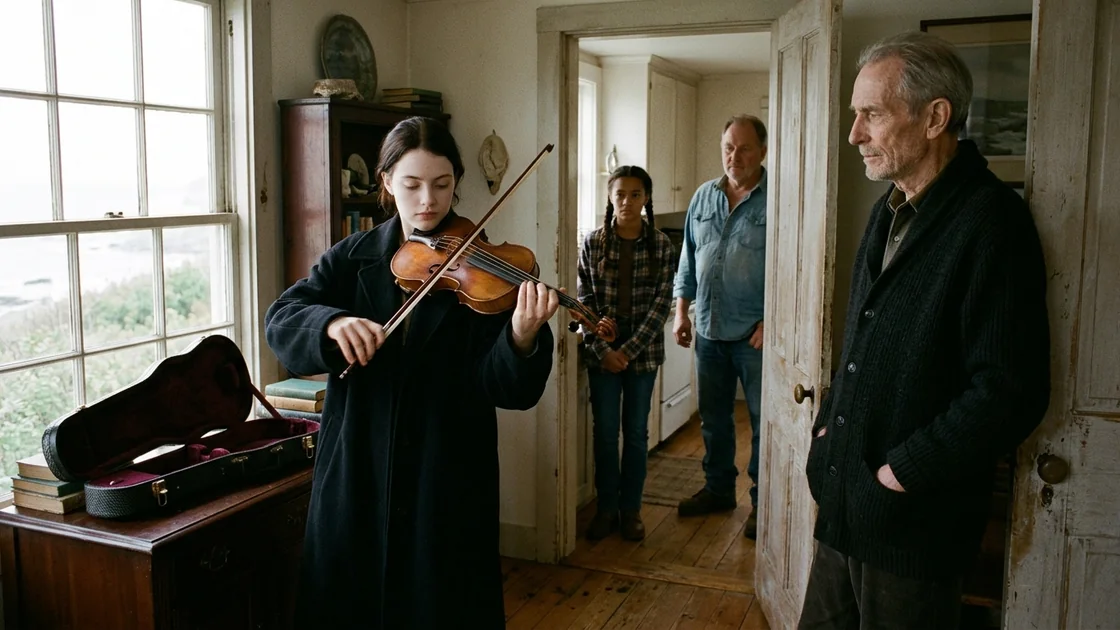
Arthur Pendelton, a celebrated former concertmaster, faces the ultimate betrayal of his own body when severe peripheral neuropathy ruins the dexterity of his hands. Forced into an early retirement in a quiet coastal cottage, he spends his days haunted by the silence that has replaced a lifetime of symphony halls and relentless practice. As the physical pain in his fingers mirrors the emotional ache of his lost identity, Arthur resists all attempts at connection, wallowing in bitterness and locking away his prized seventeenth-century Guarneri violin. However, through an unexpected friendship with a local piano tuner who is losing his hearing and a persistent young neighbor eager to understand the architecture of sound, Arthur slowly learns that music is not merely an act of physical execution, but a way of listening to the world, ultimately allowing him to find peace in the quiet chapters of his life.
The morning light in Oakhaven did not arrive with the dramatic flair of stage illumination. It crept in through the salt-crusted panes of the cottage windows, gray and diffuse, settling over the floorboards like a fine layer of dust. Arthur Pendelton sat at the oak table in his kitchen, staring at the porcelain mug situated three inches from his right hand.
Outside, the Atlantic threw itself against the shale cliffs with a rhythmic, shushing monotony that Arthur found infuriatingly imprecise. The ocean had no conductor. It dragged its tempos; it rushed its crescendos. It was an amateur percussionist playing an endless, unedited score.
Arthur looked down at his fingers. To the untrained eye, they were still the hands of a master. The fingers were long, tapering toward square, well-maintained nails. The left hand bore the faint, permanent architecture of his trade: a slight widening of the pads at the tips, the ghost of calluses that had once been hard enough to deflect a needle, and a web of tendons across the back that had navigated the treacherous leaps of Paganini and the weeping portamentos of Mahler for over five decades.
To Arthur, however, his hands were no longer instruments. They were cages filled with crushed glass and live copper wire.
Complex Regional Neuropathy, the specialist in Boston had called it eighteen months ago, tapping a silver pen against a clipboard while Arthur stared at a framed print of water lilies on the clinic wall. Idiopathic, mostly, though exacerbated by sixty years of repetitive micro-trauma. The myelin sheaths are degrading, Mr. Pendelton. The signals are scrambling. Your brain is interpreting standard tactile feedback as thermal or mechanical damage.
"They burn," Arthur had said then, his voice flat.
"Yes," the doctor had replied, with the practiced, hollow sympathy of a man who delivered death sentences to careers before lunch. "And I am afraid the fine motor control will continue to degrade as the nerve conduction slows."
Now, in the gray light of the coastal morning, the burning was at a moderate mezzo-forte. It started at the base of the carpals, a dull, throbbing ache that radiated outward, transforming into a sharp, prickling static by the time it reached the fingertips. It felt as though he had plunged his hands into a bucket of snow and held them there until frostbite set in, only to pull them out and hold them directly over an open flame.
He needed to pick up the mug. The tea inside—chamomile, because caffeine made the nerve tremors worse—was cooling.
Arthur inhaled through his nose, a four-count breath he had once used to steady himself in the wings of the Musikverein before stepping out to greet two thousand expectant faces. He extended his right index finger and thumb. The movement was hitching, mechanical, like a marionette controlled by a puppeteer with palsied hands. When his skin made contact with the warm ceramic, a jolt of phantom electricity shot up his radial nerve, making his eyelid twitch.
He curled his fingers through the handle. His grip was weak; the intrinsic muscles of the hand were beginning to atrophy from disuse and faulty innervation. Using his left hand as a brace—careful only to use the heel of his palm, where the nerve endings were less hysterical—he lifted the mug to his lips and drank.
It was lukewarm. It tasted of wet hay.
He set the mug down with a ceramic clink that sounded too loud in the empty house. That was the other thing about Oakhaven: the silence.
For sixty-four of his seventy-two years, Arthur had lived inside a fortress of sound. Even when he was not holding his violin, his mind was an active conservatory. He had walked down city streets translating the wail of sirens into minor thirds, the clatter of subway cars into Stravinskian polyrhythms. In his apartment in Symphony Hall’s shadow, there had always been a score open on the stand, a recording spinning on the turntable, or the muffled sound of a student practicing scales in the studio down the hall. His internal monologue had been written on five-line staves.
When the diagnosis became undeniable—after the night in Chicago where his bow had slipped during the slow movement of the Brahms Concerto, skittering across the strings with a sound like a dying cat while the guest conductor stared at him in horrified disbelief—Arthur had severed the cord entirely. If he could not be inside the music, he would not stand outside the window looking in.
He had sold the Boston brownstone. He had donated his collection of three thousand vinyl records and four hundred annotated scores to the conservatory library. He had unplugged his stereo. He had moved to this sparse, wind-battered promontory in Maine where nobody knew the difference between a spiccato and a spinet, and he had brought only one thing with him from his former life.
It sat in the parlor, resting horizontally on a velvet-lined mahogany credenza, inside a carbon-fiber case that remained locked. A 1741 Guarneri del Gesù. The Baron, it was called in the registries. He had not opened the latches in four hundred and twelve days.
Arthur stood up from the table, his knees popping in the damp air. He walked into the parlor, his slippers shuffling against the pine floorboards. He stood three feet from the black case.
In his mind, he knew the exact smell that lived inside that box: aged spruce, oxidation, hide glue, and the sweet, piney dust of Pirastro rosin. It was a scent more intimate to him than the perfume of his late wife, Clara, who had died ten years prior, leaving him with nothing but his wooden mistress to absorb his grief.
His left hand twitched at his side. The index finger curled slightly, seeking the E-string in third position. A phantom note rang in his auditory cortex—a high, pure C-sharp—followed immediately by a spike of burning pain across his knuckles, as if his nervous system were punishing him for the audacity of the memory.
"Enough," Arthur muttered aloud. His voice was rusty from lack of use.
He turned away from the credenza and walked to the front window. Outside, the fog was lifting slightly, revealing the jagged coastline and the narrow dirt road that connected his cottage to the village two miles south. Coming up that road, bobbing rhythmically through the knee-high sea grass, was a bright yellow knit cap.
Arthur’s jaw tightened. He checked the grandfather clock in the corner—the only ticking thing he allowed in the house, and only because he had removed the chimes. It was nine-thirty. Tuesday.
He had forgotten it was Tuesday.
Five minutes later, a brisk, uneven knocking rattled the front door. Arthur took his time answering it, though he knew delay was futile. When he pulled the heavy door open, letting in a blast of briny, forty-degree air, the girl was already wiping her muddy boots on his coir mat.
"Morning, Mr. Pendelton," Maya said, not looking up until her soles were clean. She was fourteen, all sharp elbows and oversized flannel, with dark hair braided so tightly it pulled at the corners of her eyes. In her arms, she carried a brown paper grocery bag from the village market.
"You're early," Arthur said, stepping back to let her in because the cold air was making his wrists ache.
"I'm not early, you're just slow getting to the door," she replied cheerfully, breezing past him into the kitchen. "And Mrs. Gable wanted me to get the deliveries done before the rain starts. She says there's a squall coming in off the bank by noon."
Arthur closed the door with his elbow and followed her. Maya was already unpacking the bag with a rapid, careless dexterity that made him wince. Milk, eggs, a loaf of sourdough, a tin of soup, and a brown plastic prescription bottle from the pharmacy in Machias.
She set the pill bottle on the counter next to his lukewarm tea. Gabapentin, the label read. Arthur hated the stuff. It dulled the burning in his hands by turning his brain into a swamp of gray wool.
"Did you eat breakfast?" Maya asked, folding the paper bag with crisp, loud creases that set Arthur’s teeth on edge.
"I am not an invalid, Maya. You are paid to bring the groceries down the hill, not to play nursemaid."
Maya didn't flinch. She had been making this Tuesday run for six months, ever since Arthur had realized that driving his manual-transmission Volvo required a grip strength he no longer possessed, and she had quickly developed an immunity to his barbed wire.
She lingered by the doorway between the kitchen and the parlor, her eyes drifting, as they always did, toward the sleek black case on the credenza.
"Mr. Miller at the hardware store said you used to be famous," she said, leaning a shoulder against the doorframe.
Arthur stiffened. He picked up the loaf of bread, cradling it against his forearm rather than gripping it with his fingers, and moved toward the pantry. "Mr. Miller should concern himself with the price of copper piping and leave my biography alone."
"He looked you up on the computer at the library," she continued, entirely undeterred. "Said you played in London and Tokyo. Said there are videos of you wearing a tuxedo with tails, playing with eighty other people behind you."
"Ninety-two, usually," Arthur corrected automatically, then bit the inside of his cheek for rising to the bait. "Is there a receipt for the groceries?"
"In the bag." Maya took a single step into the parlor. "Is that it? In the box?"
"Don't go in there, please."
She stopped, respecting the boundary, though her dark eyes remained fixed on the carbon-fiber shell. "Why don't you play it for yourself? Nobody’s around to hear you out here except the gulls."
Arthur stood in the shadow of the pantry. The burning in his left thumb suddenly flared, a white-hot needle driving under the nail bed. He pressed his hand flat against his thigh, trying to smother the misfiring nerves through sheer pressure.
"Because," Arthur said, each word clipped like a staccato eighth note, "when a thing cannot be done properly, it is an insult to do it at all. Your money is on the hall table. Thank you for the delivery."
Maya looked back at him. For a second, the adolescent brashness dropped away, and she looked at the way he was holding his left hand pinned against his trouser leg. She didn't offer pity—she was a Maine fisherman’s daughter, raised in a culture where lost fingers and ruined backs were simply the tax paid for living—but her gaze softened by a fraction of a degree.
"Alright," she said quietly. "See you next Tuesday, Mr. Pendelton. Make sure you latch the storm shutters. That wind's gonna have teeth."
The front door clicked shut behind her. Arthur stood in the kitchen for a long time, listening to the crunch of her boots fading down the gravel path until there was nothing left under the sky but the ragged, unmeasured breathing of the sea.
The squall arrived at one o'clock, just as Mrs. Gable had predicted.
Rain lashed horizontally against the eastern windows of the cottage, driven by a gale that howled down the chimney flue in an erratic, whistling glissando—hovering somewhere between a flat F and a sharp G. It was the wind that drove Arthur out of the house the following morning.
The storm had passed during the night, leaving the world washed in a blinding, cold clarity, and it had knocked a heavy cedar limb onto the roof of Arthur’s woodshed. He couldn't clear it himself—the thought of gripping a saw handle was laughable—which meant he had to walk into Oakhaven to hire one of the local boys to haul it away before the weight cracked the rafters.
He dressed with the slow, methodical choreography he had developed over the past year. Everything he owned now had been modified or replaced for utility. No dress shirts with tiny pearl buttons; only heavy wool pullovers and jackets with large brass zippers fitted with leather loops he could hook a thumb through. His boots had Velcro straps instead of laces—a concession that still filled him with a quiet, humiliating rage every time he looked down at his feet.
The two-mile walk into the village took him fifty minutes. He walked with his hands jammed deep into the fleece-lined pockets of his coat, not just for warmth, but to protect them from the wind. Even a sudden draft of cold air across his bare skin could trigger an episode of allodynia, making the breeze feel like sandpaper.
Oakhaven was a village built in a cleft of granite, consisting of a lobster co-op, a general store, a white-steepled church, a hardware store, and three dozen clapboard houses painted in faded maritime pastels. As Arthur descended the hill onto Main Street, the sonic landscape shifted.
Here, the ocean was muffled by the harbor breakwater, replaced by the low, diesel thrum of lobster boats idling at the pier, the clang of metal rigging against aluminum masts, and the sharp, gossiping cries of herring gulls fighting over bait scraps.
Arthur kept his eyes on the frost-heaved pavement. He did not want to make eye contact with Mr. Miller or Mrs. Gable. He did not want to be the gentleman from Boston who used to wear tails in Tokyo.
He had just arranged for the cedar limb to be cleared by the harbor master's nephew and was turning back toward the hill when a sound stopped him dead in the middle of the crosswalk outside the First Congregational Church.
It was a B-flat.
Then another. Then the A below it, struck hard, held until the decay died away into the wooden ribs of the church, and struck again.
Clang. Clang. Clang.
Someone was tuning the church piano. And they were doing it badly.
Arthur stood frozen on the asphalt, a pickup truck rattling past behind him. The tuner inside the church was working on the midrange Temperament octave, trying to set the intervals, and the fourths were wide—grotesquely wide. The third harmonic was beating like a frantic heart.
Arthur’s right hand twitched in his pocket. For a man with absolute pitch, a badly tuned interval wasn't merely an aesthetic annoyance; it was a physical itch in the inner ear, a geometric wrongness in the universe that demanded correction.
The B-flat sounded again, followed by an F. The fifth was flat. Not tuned carefully slightly flat, as equal temperament required, but flat by nearly fifteen cents. It was sour. It was stagnant water.
Before his rational mind could remind him of his vow of silence, Arthur’s Velcro-strapped boots had carried him up the granite steps of the church. He pushed open the heavy red double doors with his shoulder and stepped into the narthex.
The sanctuary smelled of floor wax, damp hymnals, and old wool. Down near the altar, beneath the shadow of a tall brass cross, sat an upright Baldwin piano, its front panels removed and leaning against the first pew, exposing its harp and the uniform rows of felt hammers.
Sitting on the bench was a man who looked to be about Arthur’s age, though built on an entirely different chassis. Where Arthur was tall, lean, and bird-boned, this man was barrel-chested and thick-necked, wearing a faded denim work shirt with the sleeves rolled up over forearms that looked like cured hams. A leather tool roll lay open on the communion rail beside him.
The man had his left hand resting on the keys and his right hand gripping a long, wooden-handled tuning lever fitted over a steel pin. Notably, he had his left ear pressed directly against the wooden cheek of the piano case, his eyes squeezed shut.
He struck the F again, gave the lever a minute tug, and nodded to himself in satisfaction.
"It's still flat," Arthur said.
His voice carried down the center aisle, bouncing off the plaster walls with surprising resonance.
The man at the piano didn't jump. He slowly opened his eyes, removed the tuning lever from the pin, and turned around on the bench. Up close, Arthur could see the pale beige crescent of a heavy-duty hearing aid hooked behind the man's right ear, a thick clear tube running into the canal.
"Beg pardon?" the man said. His voice had the flat, nasal vowels of Down East Maine, pitched slightly too loud, the way people speak when they can no longer accurately gauge the volume of their own vocal cords.
Arthur walked down the aisle, stopping at the wooden rail that separated the pews from the chancel. "The F above middle C. You're tuning the fifth from B-flat. It's flat by at least ten cents. The beat rate is entirely wrong."
The man looked at Arthur, taking in the expensive wool coat, the rigid posture, and the thin, aristocratic face pinched with chronic pain. Then he looked back at the exposed guts of the Baldwin.
"You the new deacon?" the man asked.
"Hardly."
"Then you must be the fellow up on Breakers Point. The violinist." The man offered a wry, lopsided smile that crinkled the weathered skin around his eyes. "Maya told me about you. She takes lessons from my sister over in Machias. Flute. Though she blows it like she's trying to call hogs." He stood up, wiping his massive hands on a rag, and extended the right one across the rail. "I'm Martin Cole."
Arthur looked at the outstretched hand. The social reflex of seventy years warred with the terrifying calculus of pain. If a man with forearms like that squeezed Arthur’s right hand, Arthur would likely drop to his knees on the sanctuary carpet.
"Arthur Pendelton," Arthur said, keeping his hands firmly buried in his pockets. "Forgive me. Arthritis. I don't shake."
It was a lie—arthritis was mechanical, something people understood without asking follow-up questions—and Martin accepted it without a blink, dropping his hand back to his side.
"Well, Mr. Pendelton," Martin said, turning back to the piano and tapping the F key again. Clang. "Sounds square to me. Though, to be fair, most things above two thousand hertz sound like a wet blanket these days." He tapped the beige plastic behind his ear. "Forty years in the machine shop at the paper mill in Bucksport before I took up my father's trade full-time. The boilers took the high end. Age is taking the middle."
Arthur stared at him, genuinely appalled. "You are a deaf piano tuner."
Martin chuckled, a rich, rumbling bass note. "Hard of hearing, let's say. And I am the only piano tuner between Ellsworth and the Canadian border. The Widow Gable wants her hymns on Sunday, and the school needs the upright in the gym fixed after the basketball team knocked it over. They get what I've got left."
"Why don't you use an electronic strobe tuner?" Arthur asked, stepping closer despite himself, drawn by the scent of lubricating oil and aged felt. "A visual meter. Any amateur can tune a piano with a machine now."
Martin’s smile faded slightly. He picked up the tuning lever, hefting it in his palm. "Tried one. Hated it. Looking at a spinning green light doesn't tell you how the wood in the soundboard is settling. Every old box like this has its own stretch. If you tune it strictly to the math on a screen, it sounds dead. Sterile. You know that, don't you?"
Arthur said nothing. He did know. Inharmocity—the natural stiffness of strings that required octaves to be tuned slightly wider at the extremes of the keyboard so they sounded resonant to the human ear. No computer truly understood the architecture of the room the instrument sat in.
Martin sat back down on the bench. He fitted the star-head of the lever onto the F pin. He looked up at Arthur.
"My bone conduction is still decent," Martin said, tapping his cheekbone. "That's why I press my skull against the case. I feel the beats where the sound waves collide. Two waves out of phase, pushing against each other. Wah-wah-wah. When the waving stops, or slows down to the right pulse, you're home. Must have missed the pulse on this one. The pinblock on this old Baldwin is dry as toast; the pins jump instead of turning smooth."
He looked at Arthur evenly. "Tell me when I hit it."
Arthur took a half-step back. "I didn't come in here to work."
"You came in here because a bad fifth offended your sensibilities from across the street," Martin countered mildly, resting his left finger on the B-flat and the F, and his right hand on the lever. "Help an old man out, Mr. Pendelton. Save the congregation from my bad ears."
Arthur looked toward the exit. He should leave. Engaging with this—making a decision about pitch, about the physical manipulation of tension and wire—was opening a door he had nailed shut.
Martin struck the dyad. Clang. The sour, wide wobble filled the nave, making the small muscles around Arthur’s eyes contract in distaste.
"Strike it again," Arthur said, his voice dropping into the quiet, authoritative register he had used for thirty years when addressing the string section of the Boston Symphony. "Mezzo-piano. Don't bang it; you're driving the pitch sharp on the attack and masking the overtone."
Martin’s eyebrows went up, a flicker of amusement crossing his face, but he obeyed. He depressed the keys with a gentler weight. The two notes sang out, clearer now, the discord between their third andsecond harmonics pulsing in the cold air of the church.
"Go up," Arthur said, closing his eyes. Without his sight, the dark theater behind his eyelids immediately lit up with the geometry of sound. He saw the two frequencies as silver lines that refused to run parallel. "Slowly. Feel the pin flex before it turns in the wood."
Martin leaned his weight into the handle. The steel string groaned microscopically against the bridge pin. The pitch crept upward. The rapid wah-wah-wah of the colliding sound waves began to decelerate, stretching out into long, undulating swells.
"Hold," Arthur whispered. "Strike again."
Martin played the fifth. The swells were almost gone, reduced to a slow, breathing pulse—just under one beat per second. The exact mathematical compromise required for equal temperament. The two notes locked together, creating the acoustic illusion of a third, deeper note humming beneath them in the floorboards.
"There," Arthur said, opening his eyes. "Set the pin."
Martin gave the lever a tiny, practiced downward dip to relieve the torsion on the steel wire so it wouldn't slip back later. He played the chord again. Even to Martin’s damaged ears, the change in resonance seemed obvious; the wooden belly of the piano vibrated differently against his knee.
"Well I'll be damned," Martin murmured, looking at the keys. "That's clean." He looked up at Arthur, gesturing to the empty space on the long bench beside him. "I've got forty-six more notes to go in the treble, and that's where my ears really fall off the cliff. You got somewhere urgent to be?"
Arthur looked down at his Velcro boots. His hands were still in his pockets, throbbing with their steady, low-voltage fire. He had nothing waiting for him on Breakers Point except a fallen tree branch and the unmeasured roar of the tide.
"Your temperament strip needs to be moved up an octave," Arthur said stiffly, walking around the communion rail and sitting on the far end of the pew nearest the piano, refusing the bench. "And stop hitting the keys like you're driving railroad spikes. Let the hammer rebound."
Martin grinned, pulling the strip of red felt from between the middle strings. "Yes, Maestro."
They spent two hours in the church.
Arthur never touched the piano. He sat on the hard oak pew, his posture ramrod straight, his hands tucked beneath his armpits inside his coat, acting as a human oscilloscope. Martin provided the muscle—the delicate, high-torque leverage required to turn steel pins set in rock maple—and Arthur provided the ears.
As they moved into the high treble, where the strings were short, under immense tension, and grouped in threes per note, the work became painstaking. Up there, Martin admitted he heard almost nothing but the percussive thwack of the wooden mechanism. He had to rely entirely on the tactile vibration through the tuning lever and Arthur’s clipped, precise commands.
Up. Too far, ease the torsion. Strike the unison. The left string is weeping. Bring it up a hair. Stop.
When the final C at the top of the keyboard was set, Martin leaned back, rolling his massive shoulders until his spine popped. He ran a thick, calloused thumb down the length of the keyboard in a rough glissando, then played a simple C-major triad in the middle register, stepping on the sustain pedal.
The chord bloomed in the empty church. It wasn't a Steinway in Carnegie Hall—the hammers were grooved and hard, the bass strings were slightly tubby with thirty years of coastal corrosion—but it was in tune with itself. It had integrity.
Arthur felt a strange, hollow sensation beneath his ribs as the chord decayed into silence. For one hundred and twenty minutes, he had forgotten his hands were burning. The pain had been there, roaring away in the background like a furnace, but his mind had been entirely occupied in the upper rooms of the house, listening to the architecture of the harmonics.
Now, in the silence that followed the chord, the furnace door swung open again. His left pinky finger gave a violent, involuntary spasm in his pocket.
Arthur stood up abruptly. "That will hold until the humidity changes in the spring. Tell them to put a damp-chaser rod inside the lower cabinet, or the soundboard will crack by February."
Martin was already packing his felt wedges and mutes into the leather roll. "I've told the deacons three times. Yankees don't spend money on preventing a disaster, Mr. Pendelton; they wait for it to break and then complain about the cost of glue."
He tied the leather thong around his tool roll and stood up, looking at Arthur with shrewd, clear eyes. "There's a pot of chowder on the stove at my place down by the boatyard. Haddock. Made it this morning."
"I don't eat lunch," Arthur lied.
"Suit yourself," Martin said easily, slinging his canvas bag over his shoulder. He didn't press, which Arthur found slightly disorienting. In Boston, people had always pressed—colleagues offering unwanted medical advice, patrons trying to coax him to attend galas as a tragic ornament, students begging to just sit and talk about phrasing. Martin simply accepted the boundary as if it were a stone wall between pastures.
They walked out of the church together into the blinding noon sunlight. As they stood on the granite steps, Martin paused, adjusting the dial on his hearing aid as a gull shrieked overhead.
"It's a funny thing," Martin said, looking out toward the harbor where the water was chopped into whitecaps. "Losing the tools of your trade while you're still breathing."
Arthur’s jaw tightened. "I don't know what you mean."
"Sure you do," Martin said mildly. "My ears are turning to tin. Your hands are shot. Don't look at me like that—a blind man could see the way you guard your wrists when you walk, and a man doesn't wear Velcro boots unless laces are a bastard to pull."
Arthur felt a hot flush of anger rise up his neck, competing with the cold wind. "My medical history is not a matter for village speculation."
"Nobody's speculating, Arthur. Nobody cares that much," Martin said, and there was no cruelty in his voice, only the vast, indifferent pragmatism of the coast. "Half the lobstermen in this harbor have ruined rotator cuffs and fingers missing from getting caught in the pot-hauler. We all wear out. The trick is figuring out what to do with the leftover parts."
He tapped two thick fingers against the brim of his cap. "Thanks for the ears. If you're walking by the Methodist chapel next Thursday, they've got a Kimball console that sounds like a barrel of cats falling down the stairs."
Martin turned and lumbered down the street toward the boatyard, leaving Arthur standing alone on the church steps, his heart hammering a frantic, uneven accelerando against his ribs.
That night, the pain was worse.
Arthur didn't know if it was the cold walk back up to Breakers Point, or the psychological fallout of spending two hours listening to pitched wire, but by nine o'clock, his hands were incandescent.
He sat on the edge of his bed in the dark, unable to bear the weight of a blanket over his wrists. He had taken two of the gabapentin capsules at seven, washing them down with tap water, and now his head felt detached from his neck, floating three inches above his collarbones like a tethered balloon, while his hands remained stubbornly, agonizingly anchored to the earth.
It was a specific torture, this neuropathy. It wasn't the honest, structural pain of a broken bone or a torn ligament. It was a phantom. It was a lie told by dying nerves.
In the darkness, with the gabapentin blurring the edges of his discipline, he began to play the Chaconne.
The Bach Partita No. 2 in D minor. The Everest of solo violin literature. Fourteen minutes of polyphonic architecture pulled from four strings and a horsehair bow. He had played it at his debut in London at twenty-two; he had played it at Clara’s memorial service when he was sixty-two, standing alone in a cavernous cathedral because words were too small for what he had lost.
His mind cued the opening chord: the heavy, tragic D-minor sarabande rhythm. Dah, dah-dah, dah...
Instantly, his fingers began to twitch on his knees.
This was the curse of the muscle memory he had spent sixty years carving into his basal ganglia. He could not hear a piece of music—even in his own imagination—without his motor cortex automatically firing the commands to execute it.
Second finger on the F. First finger on the D. Open G. Bariolage across the strings.
As his brain sent the signals down the spinal cord, through the brachial plexus, and into the ruined wiring of his median and ulnar nerves, the signals crashed into the damaged myelin. The music translated directly into agony. The arpeggios of the middle section became a series of white-hot razor slashes across his knuckles. The shift into D major—the moment in the piece where the clouds break and the light pours through—felt like someone was driving heated upholstery tacks beneath his fingernails.
"Stop," Arthur gasped into the dark room, curling forward until his forehead rested on his knees. "Stop playing. Stop."
But the mind of a master musician does not have a brake once the tempo is set. The Bach rolled on, relentless, mathematical, and sublime, grinding his nervous system beneath its wheels until Arthur was weeping silently into the wool of his trousers, trapped between the beauty in his skull and the fire in his flesh.
He didn't know how long he sat there before he stood up, stumbled down the narrow stairs in his stocking feet, and walked into the parlor.
He didn't turn on the lamp. The moon was up, three-quarters full, throwing hard, silver rectangles across the pine floor and illuminating the credenza.
Arthur stood before the carbon-fiber case.
For over a year, he had told himself he kept The Baron out of stewardship. One didn't simply sell a 1741 Guarneri at a local auction; it required brokers in London or New York, climate-controlled transport, endless paperwork he didn't have the heart to organize.
Now, in the moonlight, with the gabapentin stripping away his pretenses, he knew the truth. He had kept it because he was a coward. As long as the violin was in the house, he could pretend he was merely taking a sabbatical. He was still Arthur Pendelton, the man who owned the Guarneri. If the case was empty, he was just an old man in Velcro shoes waiting to die by the sea.
Moving with clumsy, frantic jerks, he hooked his thumbs under the brushed-steel latches of the case. The metal was cold, sending a fresh volley of sparks up his forearms, and he bit down on his lower lip until he tasted salt, forcing his thumbs upward.
Click. Click.
He lifted the lid with the back of his wrist.
The smell hit him first, rising up like a ghost from a tomb. Pine resin. Old varnish. The faint, metallic tang of silver-wound gut strings. And beneath it all, the scent of his own sweat, absorbed into the bare maple of the neck over forty years of performances.
The violin lay nestled in crushed burgundy velvet. In the moonlight, the varnish on the two-piece spruce top glowed like dark, antique amber. The f-holes were carved with the wild, asymmetrical genius of Giuseppe Guarneri’s late period—less refined than a Stradivari, wider in the waist, built not for drawing rooms, but to project a dark, volcanic contralto to the very back row of the largest halls in Europe.
Clipped into the lid above it were two bows—a Tourte and a Sartory, their Pernambuco wood shafts gleaming, their horsehair slackened so the camber wouldn't warp.
Arthur stared at it. His breathing was ragged, shallow.
Just hold it, a voice whispered in the drugged fog of his brain. You don't have to draw the bow. Just put it under your chin. Feel the weight.
He slid his left hand—palm up, sliding like a spatula to avoid using his fingers—under the neck of the instrument. He lifted it from the velvet bed.
It weighed less than a pound. Fourteen ounces of dried wood and air. Yet as it cleared the case, the muscles in his forearm trembled under the load.
He brought it up toward his left collarbone, tilting his head down to catch the ebony chinrest with his jaw—the posture that had tilted his cervical spine slightly to the left over half a century.
Before the wood could touch his neck, his left thumb brushed against the G-string peg, and a sudden, violent fasciculation seized his hand. The nerve misfired completely. His fingers snapped open like a sprung trap.
Arthur cried out as the violin slipped from his flat palm.
In the fraction of a second that it fell, sixty years of instinct overrode every pain receptor in his body. He lunged downward, snatching at the falling instrument with both hands, catching it awkwardly by the upper bout and the bridge just inches above the hard pine floorboards.
The impact of the catch drove the sharp maple edge of the violin's ribs directly into the hypersensitive palm of his right hand, while his left fingers crushed down across the strings, the thin steel E-string biting deep into the pad of his index finger.
The violin let out a hollow, discordant thrum as the strings vibrated against his skin, and the pain that detonated in Arthur’s hands was so absolute, so blindingly white, that his vision tunnelled into darkness.
He dropped to his knees on the floor, cradling the violin against his chest with his forearms like a wounded animal, gasping for air as cold sweat broke out across his forehead.
The violin was unharmed. He had saved it.
Slowly, moving on his knees like a penitent, Arthur lifted his arms and laid the Guarneri back into its velvet cradle. He didn't bother trying to latch the lid; he simply pushed it closed with his forehead, resting his brow against the cold carbon fiber as the tremors wracked his shoulders.
He stayed on the floor until the gray dawn began to dilute the moonlight, listening to the ocean beat against the rocks, entirely out of time.
He did not leave the cottage for six days.
When Tuesday came around, he left the grocery money clipped to the outside of the storm door with a wooden clothespin and locked the inner deadbolt. He watched from the upstairs bedroom window as Maya walked up the path, her breath pluming in the frosty air.
She stopped at the door, looked at the money, and then stepped back into the yard, craning her neck to look up at the house. She couldn't see him behind the lace curtains, he knew, yet her dark eyes seemed to bore directly through the glass. She set the brown paper bag carefully between the storm door and the inner door, took the money, and walked away, looking back over her shoulder twice.
By Wednesday afternoon, the cottage felt less like a refuge and more like a submarine that had lost its engines and settled into the silt at the bottom of a trench.
Arthur sat in his armchair, wrapped in a wool blanket, staring at the closed violin case. He hadn't eaten since Tuesday morning. The gabapentin bottle sat untouched on the kitchen counter; after the hallucination of the Bach and the near-disaster with the Guarneri, he was terrified of the drug’s ability to erode his self-control. Consequently, the pain in his hands was completely unmedicated, a raw, shrieking fortissimo that left him exhausted and nauseated.
At three o'clock on Thursday, someone hammered on the front door.
It wasn't Maya's brisk, two-beat tap. It was the heavy, slow thud of a fist that belonged to a man who used hammers for a living.
Arthur didn't move. Go away, he thought.
The knocking came again, louder, rattling the loose putty in the window frames. Then a voice boomed through the keyhole, pitched at the unnatural volume of the half-deaf.
"Pendelton! I know you're in there! The chimney's smoking, which means you're either burning furniture or you haven't died yet! Open the damn door before my toes freeze off!"
Arthur closed his eyes. The sheer acoustic assault of Martin Cole’s voice in his quiet sanctuary was unbearable. If he didn't open the door, the man would likely kick it off its hinges out of sheer neighborly concern.
Arthur dragged himself out of the chair, shuffled to the hall, and threw the deadbolt back with his wrist. He pulled the door open three inches.
Martin stood on the stoop, wearing a grease-stained Carhartt jacket and a wool cap pulled down to his eyebrows. His breath smelled of peppermint and cold air. In one hand he held his leather tuning roll; in the other, a thermos.
"You missed the Methodist Kimball," Martin said, pushing the door the rest of the way open with his boot and stepping inside without waiting for an invitation. "Had to do the whole thing myself. Probably sounds like a honky-tonk in a logging camp now."
He stopped in the narrow hallway, taking one look at Arthur—the unshaven gray stubble, the sunken eyes ringed with purple bruises of insomnia, the way Arthur was holding both arms crossed over his chest like a medieval effigy on a tomb.
Martin’s loud voice dropped an octave, losing its bluster. "Jesus, Arthur."
"I was resting," Arthur said, his voice a dry croak. "I did not invite you here, Mr. Cole."
Martin ignored him. He walked past Arthur into the kitchen. He saw the brown grocery bag from Tuesday still sitting unpacked on the floor where Arthur had kicked it inside, the milk carton warm and bulging slightly.
Without a word, Martin set his thermos and tool roll on the table. He picked up the spoiled milk and poured it down the sink, running the cold tap to wash it away. He put the eggs and bread away, then took two mugs from the drying rack, unscrewed his thermos, and poured dark, steaming coffee into both.
"Sit down," Martin said, pointing at the kitchen table.
"Get out of my house," Arthur said, leaning against the doorframe because his knees were shaking.
"I'll get out when you drink this and eat a piece of toast," Martin replied calmly, dropping two slices of sourdough into the toaster and pushing the lever down. "Maya told my sister you left the money on the porch like a hermit with the plague. Said the curtains hadn't moved in three days."
"My life is my own affair!" Arthur’s voice cracked, rising into a thin, reedy tenor. "Do you people have so little to occupy your minds in this wretched village that you must police the habits of a stranger?"
Martin turned around, leaning his thick hips against the edge of the sink. The toaster ticked quietly behind him.
"Look," Martin said. "Up here, in the winter, if a man stops opening his door, one of two things happens. Either the pipes freeze and burst, or we find him in the spring when the thaw comes, and the town has to pay to bury him. It isn't nosiness, Arthur. It's just keeping the ledger straight."
His eyes dropped to Arthur’s hands, which were trembling violently against his ribs, the skin pale and shiny—a classic trophic change of severe nerve damage.
"How bad is it today?" Martin asked softly.
Arthur looked away, staring at the yellowed linoleum floor. The shame of being seen like this—unwashed, weak, stripped of the austere dignity that had been his armor on every stage in the world—was worse than the burning in his palms.
"It is... loud," Arthur whispered.
Martin nodded once, as if that made complete sense. The toast popped up. Martin buttered it generously—not bothering to ask if Arthur wanted butter—set the plate on the table alongside the coffee, and then did something Arthur didn't expect.
He took a wide plastic drinking straw from his coat pocket—the kind they gave out at the gas station down the road for large sodas—and dropped it into Arthur’s mug.
Arthur looked at the straw.
"My mother had the shaking palsy at the end," Martin said, sitting down across the table and picking up his own mug. "Hated people holding cups to her mouth. Figured you'd rather bite my fingers off than let me help you lift a mug."
Arthur slowly walked to the table and sat down. He didn't touch the toast yet, but he leaned forward, kept his hands safely in his lap, and drank the hot, heavily sweetened coffee through the plastic straw.
The sugar and caffeine hit his empty stomach like a warm flare. He closed his eyes, letting the heat travel down his esophagus.
"What did the doctors give you for it?" Martin asked after a minute, looking toward the prescription bottle on the counter. "The nerve pills?"
"Gabapentin," Arthur said, sitting back. "It makes me... imprecise. It clouds the mind. And when the mind is clouded, I cannot stop myself from thinking of the music. And when I think of the music, the hands try to play." He looked down at his lap. "It is a closed loop."
Martin chewed on that for a while, drinking his coffee. While he sat there, his gaze wandered through the open doorway into the parlor, resting on the credenza. The lid of the Guarneri case was still slightly ajar from six nights ago, a sliver of burgundy velvet visible like a wound.
"Is that a real one?" Martin asked.
Arthur followed his gaze. "A Guarneri del Gesù. 1741. Cremona."
"Worth as much as this house?"
"Worth as much as every house on this street combined, including the church," Arthur said flatly.
Martin whistled—a low, breathy sound without much pitch. "And it's just sitting there drying out in the Maine winter?"
Arthur flinched. He hadn't checked the hygrometer inside the case in over a year. The damp tubes were certainly bone-dry. The thought of a winter crack opening up along the bass bar of The Baron made his stomach lurch, a sacrilege against three centuries of caretakers who had kept that wood alive through revolutions and world wars before passing it to him.
"I tried to lift it," Arthur confessed, the words coming out in a sudden, quiet rush. "Last week. I almost dropped it on the floor."
Martin didn't gasp or lecture him about the value of the instrument. He finished his coffee, set the mug down, and stood up. He walked to the sink and washed his hands thoroughly with dish soap, drying them for a full minute on a clean towel until not a trace of moisture or machine oil remained.
Then he walked into the parlor.
"Mr. Cole—" Arthur started, half-rising from his chair.
"Stay there and eat your toast," Martin said over his shoulder. "I've handled two-hundred-year-old broadwood pianos with soundboards thinner than a potato chip. I know how to touch old wood."
Arthur sank back into his chair, watching through the doorway.
Martin approached the credenza with a quiet, workmanlike reverence. He lifted the carbon-fiber lid all the way open. Even from the kitchen, Arthur saw the older man pause, his broad shoulders dropping an inch as he looked down at the amber belly of the Guarneri.
"Lord above," Martin murmured. "Look at the flame on that maple."
He didn't pick the violin up. Instead, he unscrewed the long plastic humidifier tube clipped to the inside of the case wall. He brought it into the kitchen, soaked the internal sponge under the tap, wiped the outside bone-dry with a paper towel so it wouldn't drip onto the varnish, and carried it back into the parlor, clipping it back into place.
Then he gently lowered the lid and snapped the two steel latches shut. Click. Click.
He came back into the kitchen and picked up his thermos and leather roll.
"Eat the bread, Arthur," Martin said, pausing by the front door. "And take half of one of those pills tonight so you can sleep. You don't need to be precise in your dreams."
"Why are you doing this?" Arthur asked, staring at the half-eaten piece of toast on his plate.
Martin adjusted his cap. "Because you're the only man in Washington County who hears the third harmonic on an F-sharp, and I've got a baby grand over in Cutler next month that belongs to a retired judge who thinks he knows Mozart. Don't go dying on me before then."
The door closed behind him. Arthur looked down at the buttered sourdough. For the first time in a week, using the flat of his palms to trap the crust between his wrists like a pair of tongs, he lifted the food to his mouth and ate.
February arrived, locking Oakhaven in a vise of blue ice and salt rime.
And with February came a routine that Arthur neither agreed to nor actively prevented.
On Tuesdays, Maya brought the groceries. She no longer left them at the door. Under instructions from Martin—or perhaps just emboldened by her own stubborn nature—she came inside, unpacked the bags, washed whatever dishes had accumulated in the sink, and spent twenty minutes drinking hot cocoa at Arthur’s table while complaining about her flute teacher in Machias.
"Miss Evelyn says I have no support," Maya grumbled on the second Tuesday of the month, kicking her mud-caked boots against the rung of the kitchen chair. "She keeps poking me in the ribs with a pencil and telling me to breathe from my boots. How do you breathe from your boots? Lungs are in your chest."
Arthur sat on the opposite side of the table, his hands resting on a warm gel pack he now microwaved every morning—another of Martin’s practical suggestions that actually calmed the peripheral static slightly.
"Your lungs are in your chest," Arthur said, staring out the window at the icicles hanging from the eaves, "but your diaphragm is a piston. If you raise your shoulders when you inhale, you are only filling the top third of the bellows. The air has no weight behind it. When the air has no weight, the pitch goes sharp when you play loud and flat when you play soft."
Maya stopped kicking the chair. She stared at him over the rim of her mug. "How do you know that? You played a string thing."
"A bow is just lungs made of wood and hair, Maya," Arthur said distantly. "The mechanics of tension and release are identical. If you choke the instrument with tension in your throat or your shoulders, the tone dies before it leaves the tube."
Maya thought about this for a moment.The next Tuesday, when she arrived with the groceries, she had a black plastic case tucked under her arm alongside the brown paper bag.
Arthur looked at the narrow rectangular case sitting on his kitchen counter next to the cabbage and the eggs. He felt a familiar tightening in his chest. "What is that doing here?"
"Miss Evelyn wants me to play the Handel sonata for the spring recital at the grange," Maya said, stripping off her mittens with her teeth. "The one in F major. And the fast part sounds like I'm falling down the stairs."
"I am not a flute teacher."
"You know about breathing from the boots," she countered, already snapping open the little chrome latches of her student-model Yamaha. She assembled the nickel-plated tubes with a rapid, twisting motion that made Arthur wince—she was gripping the rod mechanism directly, which would eventually bend the keys out of alignment.
"Stop," Arthur said sharply. "Never twist the foot-joint while holding the key-work. Hold it by the bare metal at the collar, or you will spring the pads and the low C will never speak."
Maya froze, then moved her hand to the collar. "Like that?"
"Yes."
She raised the flute to her lips, took a huge, gasping breath that lifted her shoulders nearly to her earlobes, and launched into the Allegro of the Handel F-major Sonata.
It was dreadful.
Martin had been right; she blew the flute as if she were trying to signal a ship through the fog. Every note began with a violent, percussive spit of air, the tempo rushed frantically during the sixteenth-note runs as her fingers panicked, and the F-naturals were so sharp they set the nerves in Arthur’s wrist twitching in sympathetic protest.
Yet, standing there in his cramped kitchen, watching her reflection in the dark windowpane, Arthur saw something else. Beneath the clumsy execution, her posture was fierce. She wasn't playing it like a chore assigned by her mother; she was attacking the Handel as if it were a personal enemy she was determined to wrestle to the floor.
She ran out of air four bars before the cadence, dropping the flute and gasping like a landed trout. "See? I run out of wind right before the high note, and then it squeaks."
Arthur looked at his hands resting on the blue gel pack. For thirty years, young prodigies from Juilliard and Curtis had flown to Boston to play for him, trembling in their polished shoes, offering him near-perfect technical execution and begging for the secret of his phrasing.
Here was a girl in a flannel shirt who didn't even know where to take a catch-breath in a binary baroque movement.
It didn't hurt to listen to her. That was the shock that settled over Arthur as the silence returned to the kitchen. Because it wasn't violin music—because his own basal ganglia didn't know how to finger a Boehm-system flute—his motor cortex remained quiet. He could hear the Handel purely as architecture, divorced from his own ruined flesh.
"You are running out of air," Arthur said slowly, "because you are trying to play four measures on one breath without letting the phrase breathe. Handel was writing for the human voice, Maya, even when he wrote for instruments. Where is the comma in the sentence?"
Maya blinked at him, holding the flute like a baseball bat. "There aren't commas in music."
"There is nothing but punctuation in music," Arthur said, a spark of his old, acerbic classroom authority flaring in his eyes. "Play the first four bars again. Half tempo. And if I see your collarbones move when you inhale, I will throw that nickel pipe into the ocean."
Maya grinned, a flash of crooked white teeth, and raised the flute.
They didn't call them lessons. Arthur refused to accept the ten-dollar bills Maya’s father tried to send up the hill in an envelope, sending them back inside the empty egg cartons.
Instead, it became a transaction of labor. Maya would arrive on Tuesday and Friday afternoons after school. For thirty minutes, she would do the things round the cottage that required fine pinch-strength: changing lightbulbs in the fixtures, winding the grandfather clock with the heavy brass key, opening cans of soup and transferring them into Tupperware containers with wide tabs Arthur could pry open with his wrists, and refilling the damp-tube in the Guarneri case while Arthur watched like a hawk from the doorway.
In exchange, for forty-five minutes, Arthur made her play scales until she was blue in the face.
He sat in his armchair in the parlor, a heavy wool throw over his knees, conducting exclusively with his chin and his eyes. He had no sheet music, of course, which initially baffled Maya.
"How do you know there's a B-natural in bar twenty-two?" she demanded one snowbound Friday in late February, lowering her music stand to glare at him. "You don't even have the paper!"
"Because Handel was not an idiot, Maya," Arthur replied dryly. "He is modulating to the dominant key of C major. You cannot modulate to C major from F without raising the fourth scale degree to create a leading tone. If you play a B-flat there, you are driving the car into a ditch. Play it again from bar sixteen, and lean on the B-natural so the listener knows we are going somewhere new."
He found himself talking to her about things he hadn't articulated in years. Not the mechanics of fingerings, which he didn't know on the flute anyway, but the physics of sound and the psychology of time.
He taught her about agogic accents—how holding a note for a fraction of a millisecond longer than its mathematical value gave it more emotional weight than simply blowing it louder. He taught her that a rest on the page was not an absence of music, not a dead hole where the player could stop paying attention, but a silent beat pulsing with tension, the intake of breath before a diver leaves the board.
"Music is not the notes, Maya," he told her one afternoon as the March wind rattled the storm shutters. "Any mechanical monkey can press the keys down in the right order. Music is the space between the notes. It is how you get from one sound to the next without breaking the line."
Maya lowered her flute, wiping her chin with the back of her sleeve. Her dark eyes shifted, as they always did at least once a visit, to the black carbon-fiber case on the credenza behind his chair.
"Did you play like that?" she asked quietly. "In the spaces?"
The question hung in the parlor. A month ago, Arthur would have terminated the afternoon immediately. Now, he simply looked down at his hands, which were resting palm-up on his knees. The burning today was a low, steady hum—an A-flat drone in the cellos.
"I tried to," Arthur said.
"Will you ever open the box and let me see it?" she asked. "You don't have to touch it. I just never saw something that old that still works."
Arthur was silent for a long moment. Outside, the snow on the roof was beginning to melt, dripping past the window in a steady, irregular plink-plpl-plink into the rain barrel below.
"Open the latches, Maya," he said softly. "Do not touch the wood."
Maya set her flute carefully on the sofa. She approached the credenza on tiptoe, as if the violin were a sleeping infant. With her nimble, painless fingers, she flipped the latches and raised the lid.
The afternoon sun, low and golden over the water, slanted through the parlor window and struck the belly of The Baron. The three-hundred-year-old varnish seemed to catch fire, glowing with deep reds and honey-browns that looked wet, as if Giuseppe Guarneri had just hung it up to dry in his workshop in Cremona that morning.
Maya didn't say cool or wow. She just stood there, her hands clasped securely behind her back to keep from touching, her breath fogging slightly in the cool room.
"It looks like it's breathing," she whispered.
"It is," Arthur said from his chair, not looking around because he didn't need to. He knew every grain line in the spruce, the tiny, repaired wing-crack near the bass f-hole from 1840, the dark patch under the bridge where generations of rosin had cooked into the wood. "Wood never really dies, Maya. It swells in the summer and shrinks in the winter. It remembers every vibration that has ever passed through its ribs."
And as he said the words, something shifted inside Arthur’s chest—a tight, frozen tuning peg finally giving way in the block.
In April, the mud season came, turning the road down from Breakers Point into a ribbon of brown grease, and Martin Cole came up the hill in his rusted four-wheel-drive pickup to collect his debt.
"Get your coat," Martin barked from the porch, not even bothering to come inside. "The ice is out of the reach, and Judge Mercer in Cutler finally stopped being a miser and called me about his Steinway. We've got a forty-minute drive."
Arthur went.
It was the first time he had been in a moving vehicle in nearly a year. The cab of Martin’s truck smelled of dog hair, WD-40, and wintergreen tobacco, and the suspension was so stiff that every frost heave in Route 1 sent a jarring vibration through the seat that made Arthur cradle his hands in his lap like eggs.
Yet, looking out the passenger window at the gray-green blur of the spruce forests and the sudden, breathtaking vistas of rocky coves opening onto the Atlantic, Arthur felt a strange, dizzying expansion of his world. For eighteen months, his universe had been reduced to the twenty-foot radius of his cottage and the six inches of agonizing flesh at the ends of his arms.
Judge Mercer’s house was a sprawling Victorian shingled cottage overlooking Cutler Harbor, filled with oriental rugs and oil paintings of clipper ships. The judge himself was eighty, deaf in a different way than Martin—he heard fine, he just didn't listen to anyone—and he hovered over them in the sunroom for the first ten minutes, lecturing Martin on how the damp sea air had ruined the action of his 1928 Steinway Model M.
"I played the Chopin Nocturne in E-flat this morning," the judge announced, adjusting his ascot, "and the G-sharp in the upper register sticks like molasses, Martin. And the bass has no ring!"
"The bass has no ring because you've got three wet retriever dogs sleeping under the soundboard every afternoon, Judge," Martin said cheerfully, unrolling his leather kit on the bench. "And my associate here doesn't work with an audience. Go have your sherry."
The judge bristled, looking at Arthur, who was sitting quietly in a wicker armchair by the bay window, wearing his wool pullover and his Velcro boots. "Your associate?"
"Arthur Pendelton," Martin said, fitting a rubber mute between the strings with a practiced flick. "Used to work in Boston. Knows a thing or two about strings. Now shoo, Judge. You're burning my daylight."
Once the judge had retreated, grumbling, to his study, the sunroom fell quiet save for the ticking of a mantelpiece clock and the cries of the kittiwakes down by the lobster pound.
It was a three-hour job. The Steinway was a magnificent beast that had been criminally neglected. Before they could even touch the tuning pins, Martin had to remove the entire keyboard action frame, setting the complex mechanical assembly of eighty-eight hammers, levers, and dampers across his knees like a wooden centipede.
"There's your sticky G-sharp," Martin grunted, holding a tiny brass center-pin with needle-nose pliers and applying a single drop of solvent. "The felt bushing is swollen with salt damp. Look at the hammers, Arthur. Grooved deeper than the ruts in your driveway."
"File them," Arthur said from his chair, watching the sunlight glint off the brass harp of the piano. "Take a millimeter of felt off the shoulders with the sandpaper paddle, or the overtones will be too bright for this room. With all this glass on the bay window, the highs will bounce around like ping-pong balls."
Martin looked over his reading glasses at Arthur, a slow grin spreading across his weathered face. "Voicing the hammers now, are we? That'll cost the old skinflint an extra fifty bucks."
"He can afford it," Arthur said.
While Martin filed the felt hammers in a fine white snow of wool dust, sending up a smell that reminded Arthur intensely of the luthier shops on Newbury Street, they talked. Or rather, Martin talked at his booming, machine-shop volume, and Arthur offered quiet, economical replies that Martin read half by sound and half by watching Arthur’s lips.
"You ever going to open that box in your parlor?" Martin asked, blowing felt dust off the D-hammer.
"Maya opened it," Arthur said.
Martin paused with the sanding paddle. "Yeah? She didn't drop it?"
"She didn't touch it. She just looked." Arthur looked out the bay window at a lobster boat cutting a white V through the dark blue water of the harbor. "It shouldn't stay here, Martin. In Maine."
Martin went back to his sanding, his strokes smooth and rhythmic. Shhh-shhh-shhh. "Why not? You gave it a drink of water, didn't you? Wood's fine."
"A violin is not a painting," Arthur said, and for the first time, speaking about the Guarneri didn't make the nerves in his palms flare with defensive fire. "A painting does its job simply by hanging on the wall and being looked at. If you don't play a violin—if you don't drive sound waves through the spruce top every day—the wood goes to sleep. The resin inside the cellular structure crystallizes differently. It loses its voice. It takes months of hard playing to wake a sleeping Guarneri up again."
Martin inspected the rounded crown of the hammer with his thumb. "So who's going to wake it up?"
"There is a girl in Berlin," Arthur said, the thought arriving fully formed, though he realized it had been germinating in the dark soil of his mind for weeks. "Elena Rostova. She won the Queen Elisabeth Competition three years ago. She is twenty-four. She plays on a modern copy right now because she comes from nothing and cannot afford an Italian master."
"She play in the spaces?" Martin asked, proving that Maya had been reporting back to her flute teacher’s brother with verbatim accuracy.
A faint, genuine smile touched the corners of Arthur’s mouth. "She plays in the spaces. She has a left hand like Heifetz, and she doesn't rush the Brahms."
"So give her a call," Martin said, lifting the heavy action frame and sliding it back into the belly of the Steinway with a solid wooden thunk. "Now close your eyes, Maestro. Let's see if we can make this old box sing before my back gives out."
May came in green and wet, the lilac bushes around the cottage exploding into heavy, purple blooms that smelled so sweet when the rain stopped that it was almost dizzying.
The spring recital for the Machias Valley Music Teachers Association was held on the third Saturday of the month in the basement fellowship hall of the First Congregational Church—downstairs from the sanctuary where Arthur had first heard Martin butchering the B-flat fifth in January.
Arthur did not attend concerts. That had been the prime directive of his exile.
Even at the height of his career, sitting in the audience rather than on the stage had made him restless and critical; after his hands failed, the thought of sitting in a velvet seat while someone else stood in the light was a masochism he refused to indulge.
Yet at two o'clock on that Saturday afternoon, Arthur stood in front of his bathroom mirror, struggling to get a dark navy blazer over his shoulders.
He hadn't worn a jacket without a zipper in two years. His left arm got caught in the lining of the sleeve, twisting his wrist at an awkward angle that sent a jagged lightning bolt of neuropathy from his thumb to his elbow. He leaned against the sink, breathing through his nose on a four-count—one, two, three, four—waiting for the red mist behind his eyes to clear.
When it subsided to its standard, sizzling baseline, he didn't take the jacket off. He used his teeth to grip the cuff of his sweater, pulled his arm through the blazer sleeve, and smoothed the lapels down with his forearms.
He walked the two miles into town. The afternoon was mild, fifty-five degrees, with a light fog rolling in off the bay, softening the edges of the clapboard houses. For the first time since moving to Maine, he didn't keep his hands buried in his pockets the entire way. He let his arms swing naturally at his sides. The damp air pricked at his skin like tiny needles, an erratic pizzicato across his knuckles, and he simply let it happen, acknowledging the sensation without fighting it, treating the pain like an unwanted percussion section playing in another room.
The church basement was crowded and smelled strongly of damp wool coats, folding metal chairs, and the Maxwell House coffee brewing in a giant aluminum urn in the corner.
Forty people—parents in clean flannel and Sunday dresses, restless younger siblings, and fishermen with scrubbed, windburned faces—sat in four crooked rows facing a small raised platform at the front of the room. On the platform sat a smaller upright piano (tuned by Martin three days prior; Arthur had stood in the kitchen upstairs and approved it through the floor vents).
Arthur slipped in through the back door near the boiler room and remained standing against the cinderblock wall in the shadows.
A few people glanced back at him. Mr. Miller from the hardware store gave a quiet nod; Mrs. Gable offered a brief, tight smile before turning back to watch her grandson torture a cello through "Twinkle, Twinkle, Little Star." Nobody stared. Nobody whispered about Tokyo or London. In the basement of the Oakhaven church, he was simply an old neighbor who had walked down the hill to hear the kids play.
Martin was sitting in the back row on the aisle, his massive frame overflowing the metal folding chair. He spotted Arthur, reached over, and silently pulled another folding chair ten feet back into the shadow by the boiler room door so Arthur wouldn't have to stand or sit near the crowd.
Arthur sat down. He rested his hands palms-down on his thighs.
The recital was an endurance test for a man with absolute pitch. There were eight-year-old pianists who hit the wrong bass notes with heroic confidence and kept going; there was a boy with a trumpet whose embouchure was so tight he sounded like a goose caught in a fence; there was a duet of clarinets that drifted a quarter-tone apart by the fourth measure, creating acoustic interference beats so strong they nearly rattled the fluorescent light fixtures.
And Arthur sat through it all without wincing once.
He realized, watching a terrified ten-year-old girl lose her place in Bach’s Minuet in G, start over, and finally stumble across the finish line to thunderous applause from her father, that he had forgotten where music actually lived.
For fifty years, he had lived at the peak of Olympus, where music was a blood sport of perfection. A single slipped shift in a recording session meant three hours of re-takes; a slightly flat oboe in the symphony meant a union grievance hearing. He had come to believe that music was the rarefied air produced only when a hundred world-class athletes operated at ninety-nine percent efficiency on instruments worth millions of dollars.
Sitting by the boiler room, watching a lobsterman with a missing index finger beam with pride because his daughter had managed to play seven consecutive measures of a C-major scale without stopping, Arthur saw the truth.
Perfection was merely the polish on the cabinet. The music itself was the human impulse to organize time against the chaos of the world—to strike a piece of wire or blow through a metal tube and say, I am here, and this is how it feels to be alive.
"Next," said Miss Evelyn, a bird-like woman in a floral cardigan standing by the piano, "we have Maya Linwood, playing the first and second movements of the Sonata in F Major by George Frideric Handel."
Maya walked up the three wooden steps to the platform.
Someone had forced her into a dark green skirt and black flats, which she wore with the awkward hostility of a wild pony in a harness, though her hair was braided with its usual fierce tightness. She carried her nickel-plated Yamaha.
As she stood in the crook of the upright piano while Miss Evelyn arranged the accompaniment score, Maya scanned the four rows of chairs. She looked past her parents in the second row, past Martin on the aisle, searching the back wall until her dark eyes locked onto the shadow by the boiler room door.
Arthur didn't smile—he wasn't sure the muscles in his face remembered how—but he lifted his chin an inch and dropped his shoulders, giving her the cue he had given her fifty times in his parlor.
Breathe from the boots.
Maya turned slightly toward the audience, raised the flute, and inhaled. Her shoulders didn't move a millimeter. Her ribcage expanded against the green wool of her sweater like a bellows.
Miss Evelyn played the opening F-major chord of the Larghetto—which rolled out of the upright piano with a clear, warm resonance that made Martin, sitting in the back row, nod in quiet professional satisfaction—and Maya began to play.
Her first note—the sustained C—didn't start with a percussive spit. It emerged out of the piano chord as if it had already been vibrating in the room and she had merely uncovered it.
She wasn't a prodigy. Her tone was still a little breathy in the lower register, and her vibrato was uneven, oscillating between too fast and non-existent. If she had auditioned for the conservatory in Boston, she wouldn't have made it past the preliminary screen.
But as she moved through the slow, stately lines of the Larghetto, she played the punctuation. When she came to the deceptive cadence in the middle of the movement, she didn't rush through the rest to get to the next phrase; she held the silence for a heartbeat longer than the math required, letting the unresolved chord hang over the folding chairs until a genuine hush fell over the church basement—even the toddlers in the front row stopping their fidgeting to look up at her.
Then she leaned into the Allegro.
Arthur closed his eyes.
For the first time since the night in Chicago when his bow had skittered across the strings of the Brahms, he listened to a piece of live music from beginning to end without a single spike of phantom pain in his hands.
His fingers remained completely still on his trousers. They didn't try to finger the Handel. They didn't burn any hotter than they had when he woke up that morning. Because he wasn't wishing he was on the stage in her place. He was entirely content to be in the dark by the boiler room, receiving the sound she was sending out into the hall.
In bar twenty-two, she hit the B-natural. She leaned on it, just a fraction of a second—an agogic accent that tilted the entire room toward C major—before tumbling down the sixteenth-note run to the cadence, her fingers clicking cleanly against the keys, her breath holding strong right through the final, ringing high F.
The basement erupted into applause, loud and boxy against the low ceiling. Maya lowered her flute, bowed stiffly from the waist as if someone had hinged her with a ruler, and then looked straight back at the boiler room door, a huge, crooked grin splitting her face.
Arthur didn't clap—striking his palms together was out of the question—so he stood up in the shadows and inclined his head in a formal concertmaster's bow, the exact acknowledgement he had once given to Martha Argerich and Yo-Yo Ma from the first stand of the Boston Symphony.
Three weeks later, on a Tuesday morning in June when the lupines were turning the ditches along the coast into rivers of violet and blue, a sleek black Mercedes sprinter van with New York plates pulled into the gravel turnaround outside Arthur’s cottage.
Two men in dark suits stepped out, accompanied by a young woman wearing an oversized trench coat and carrying nothing at all, her hands tucked carefully into her pockets even though the morning was warm.
Arthur watched them from the porch, where he was sitting in a cedar Adirondack chair Martin had brought up the hill in the back of his truck the week before.
The two men in suits were from Tarisio—the fine instrument brokers in Manhattan with whom Arthur had spent three grueling afternoons on the speakerphone over the past month, dictating the terms of the permanent loan trust while Maya sat at the kitchen table signing the notary papers as a witness when his own signature proved too illegible.
The young woman was Elena Rostova. She had flown into Logan from Berlin the night before and driven up the coast at dawn.
She climbed the three steps of the porch, stopping in front of Arthur’s chair. She was small, pale, with dark circles under her eyes from jet lag, and she looked at Arthur with the terrifying, awe-struck intensity of a pilgrim arriving at a shrine.
"Maestro Pendelton," she said, her English heavily accented with the dark vowels of St. Petersburg.
"Please don't call me that, Miss Rostova," Arthur said mildly, gesturing with his elbow toward the open front door. "I am retired. And the tea is getting cold, though my neighbor Maya tells me I make it far too weak."
They went inside. The two brokers remained in the kitchen with Maya and Martin—whom Arthur had asked to be present simply because the man took up enough physical space to intimidate New York lawyers—while Arthur led Elena into the parlor.
The carbon-fiber case sat on the credenza. The latches were already open.
Elena walked to the table and lifted the lid. She didn't breathe for ten seconds. When she finally reached in and lifted The Baron from the velvet, her hands moved with that liquid, effortless certainty that Arthur remembered from another lifetime—a lifetime that no longer felt like a ghost haunting him, but simply like a book he had finished reading and placed back on the shelf.
She tucked the Guarneri under her chin. She didn't even take the bow out of the lid at first; she simply plucked the four strings with her right thumb.
G - D - A - E.
Even pizzicato, and slightly flat from its long sleep, the voice of the violin filled the small coastal cottage with a dark, woody richness that made the windowpanes hum in their frames.
Elena took the Sartory bow from the clips, tightened the horsehair with four quick turns of the ebony screw, and looked at Arthur, who was standing by the doorway, his hands resting comfortably in the pockets of his cardigan.
"May I?" she whispered.
"Wake it up, Miss Rostova," Arthur said. "It has been sleeping too long."
She set the bow to the G-string and drew it down.
She didn't play the Bach Chaconne. Whether by instinct or grace, she chose something simpler: the opening Adagio of the Bach Sonata in G minor. A long, weeping, unaccompanied line that began on a single low G and climbed upward like smoke in a still room.
As the first note bloomed—a sound so vast, dark, and devastatingly human that it seemed impossible it was coming from fourteen ounces of spruce and maple—Arthur felt his left index finger twitch in his pocket.
The nerve flared. A spark of the old, white-hot static ran up his wrist as his brain recognized the G-minor chord.
Arthur didn't flinch. He didn't curl his shoulders. He breathed in from his boots, letting the air fill the bottom of his lungs, and listened past the pain in his hand, focusing entirely on the way the third harmonic of the Guarneri’s D-string was vibrating against the pine floorboards beneath his feet.
In the kitchen behind him, the low murmur of Martin and the brokers stopped completely. Outside the window, the gulls wheeled silently over the whitecaps of the bay.
Elena played on, her eyes closed, waking the three-hundred-year-old wood note by note, and Arthur stood in the doorway between the rooms, his hands quiet at last in the middle of the sound.
When the black van finally pulled out of the gravel drive at noon, carrying The Baron south toward Boston, and from there to a stage in Berlin where two thousand people were waiting to hear the Brahms Concerto next month, the parlor looked remarkably unchanged.
There was only a slight rectangular indentation in the dust on the mahogany credenza where the case had rested for a year and a half.
Maya came out onto the porch first, wiping her eyes furiously with the sleeve of her flannel shirt, though she would have died rather than admit she had been crying during the Bach.
"She plays pretty loud for somebody so skinny," Maya muttered, picking up her bicycle from the grass by the steps. "Are you still going to yell at me about my scales on Friday, or are you done with music now that the box is gone?"
"You haven't played a clean E-flat major scale since January, Maya," Arthur said from his cedar chair. "And Miss Evelyn tells me you are attempting Mozart for the fall festival. God help us all if I leave you to your own devices with Mozart. Bring a can of peaches when you come; I'm out."
Maya gave him a quick, fierce nod, hopped onto her pedals, and rattled down the dirt road toward the village, disappearing into the coastal fog that was beginning to creep back over the bluff.
Martin came out of the house a moment later, carrying two mugs of coffee—one with a wide plastic straw sticking out of it—and set them on the wide wooden arm of Arthur’s chair. He lowered himself onto the top step of the porch, leaning back against the post and letting out a long, whistling sigh.
"Well," Martin said, adjusting his hearing aid against the wind. "That girl's got some torque in her elbow. I actually heard the high notes on that one. Or felt 'em in my teeth, anyway."
"She has a good bow arm," Arthur agreed, leaning forward to take a sip through the straw. The coffee was hot and bitter, just the way he had finally taught Martin to make it.
They sat in silence for twenty minutes.
Down below the cliff, the tide was coming in, pushing long swells of dark green water into the shale caves along Breakers Point.
Shhhhh-boom. Shhhhh-boom.
Arthur leaned his head back against the cedar slats of the chair and closed his eyes. His hands rested open on his lap, palms turned upward toward the gray sky. The cool June air moved across his scarred nerve endings—a faint, prickling static that felt like warm rain, or perhaps like the very softest spiccato of a string section warming up before the curtain rises.
Beneath that static, he listened to the ocean.
He realized he had been wrong about it in the winter. The sea wasn't an amateur percussionist playing without a conductor. It was playing in a meter so vast, with a tempo rubato stretched across so many thousands of years, that a man who only knew how to count four beats to a measure couldn't hear the cadence until he stopped trying to conduct it himself.
A gull cried out overhead—a high, sliding glissando from C-sharp down to A.
Down on the rocks, a wave broke in a long, foaming diminuendo, pulling the pebbles back into the deep in a rattling, polyrhythmic sigh, leaving a full measure of absolute, resonant silence before the next swell gathered itself to begin again.
Arthur sat on the porch in the quiet, and he listened.