The Silent Archive of Clara Vance
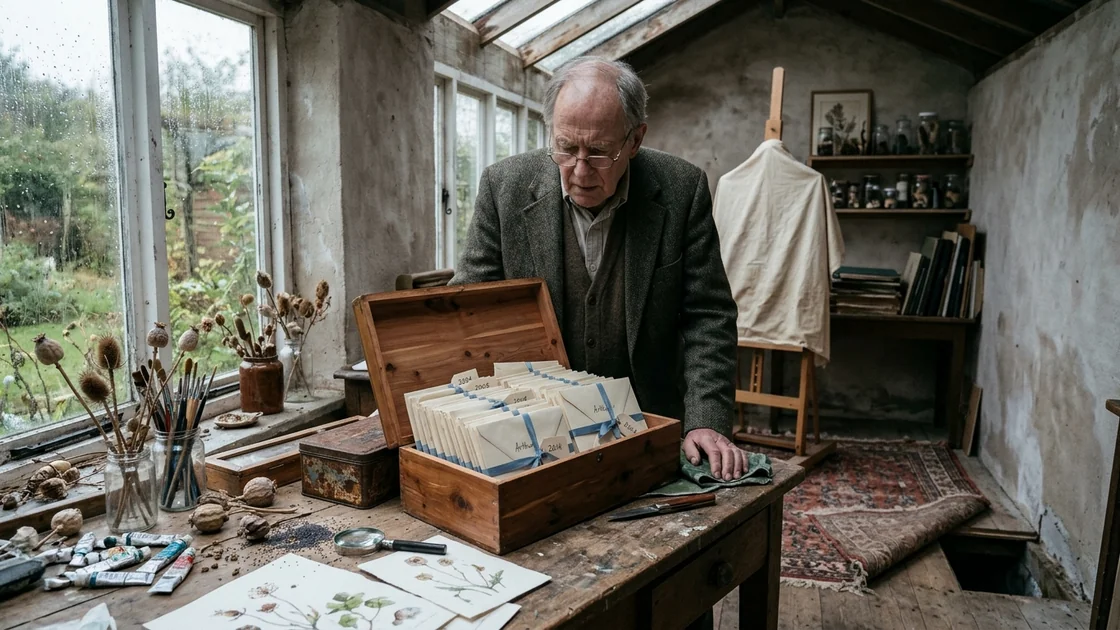
Arthur Pendelton spent forty-two years believing his marriage to his late wife, Clara, was a monument of quiet contentment, only to have that illusion shattered six months after her funeral when he discovered a cedar box hidden beneath the floorboards of her garden studio. Inside were dozens of unsent letters addressed to him, spanning the last two decades of their life together, which chronicled a profound, suffocating loneliness and a desperate unhappiness he had been entirely too self-absorbed to notice. Forced to confront the ghost of a woman he never truly knew, Arthur embarks on a harrowing journey through her written words and his own fractured memories, dismantling the myth of his domestic perfection piece by piece until he is left with the devastating truth of the love he slowly starved to death.
The rain had been falling on the slate roof of the conservatory for three days, a steady, rhythmic tapping that sounded to Arthur like impatient fingers on a desk. It was October, the month Clara had always claimed smelled of rust and woodsmoke, though to Arthur it simply smelled of damp earth and the impending annoyance of clogged gutters.
Six months had passed since the wet April morning they lowered her into the clay at St. Jude’s. For one hundred and eighty days, Arthur had moved through the rooms of their Victorian house in Hampshire like a curator in a museum after hours. Everything was kept precisely as she had left it. Her silver-backed hairbrush still sat on the mahogany vanity, a few strands of fine, white-gold hair caught in the bristles. Her blue cardigan hung on the peg by the scullery door, retaining the faint, powdery scent of the lavender sachets she tucked into her drawers.
People at the village post office told him he was bearing up remarkably well. "A man of fortitude," the vicar had called him during a brief, awkward visit over dry Madeira cake. Arthur had nodded, accepting the compliment as his due. They had had a good innings, he told everyone. Forty-two years without a raised voice. No plates thrown, no doors slammed, no bitter separations. It had been a model marriage, built on routine, mutual respect, and a sensible division of labor. He had provided the stability—thirty-five years as a senior partner at a chartered accountancy firm in Winchester—and she had provided the grace.
It was the damp that finally forced him into the garden studio.
The studio was a converted stable at the bottom of the orchard, separated from the main house by fifty yards of overgrown boxwood and moss-slicked flagstones. Clara had used it for her botanical illustrations, a hobby that had consumed her afternoons for as long as Arthur could remember. He had rarely gone down there while she was alive; the space smelled too strongly of turpentine and linseed oil, and the light was too bright, pouring through the north-facing skylights she had paid for out of her small inheritance in ninety-eight.
Now, a dark stain was spreading across the plaster of the studio’s western wall. The guttering had given way behind the ivy. If he didn't clear the interior wall so the mason could get to the damp course, the floorboards would rot.
Arthur unlocked the heavy oak door with the brass key that had hung unused on the kitchen rack since March. The air inside was stagnant and cold. Her easel stood in the center of the room, draped in a unbleached calico sheet like a shrouded body. Along the shelves, dozens of glass jars held dried seed heads, teasels, honesty pods, and bleached twigs, all meticulously labeled in her slanted, copperplate hand.
He worked methodically, as he did everything. He moved the chest of flat drawers containing her Whatman paper. He stacked the frames. When he reached the corner beneath the window where the damp was worst, he knelt to pull back the frayed Persian runner she had rescued from the drawing room twenty years ago.
Beneath the rug, the pine floorboards were swollen with moisture. One of the short planks near the skirting board didn't sit flush with the others. When Arthur pressed his thumb against the edge, it tipped downward Like a seesaw.
Curious, and slightly irritated by the shoddy carpentry he had never noticed before, he wedged his pocketknife into the gap and pried the board up. There were no nails holding it. The wood had been beveled at the edges to allow for easy removal, and the underside was lined with green baize to keep it from squeaking against the joists.
In the cavity between the brick foundation and the subfloor sat a tin biscuit box, wrapped in oilcloth and tied with garden twine. Inside the tin, when he pried off the rusted lid, was a smaller box of polished cedarwood.
Arthur sat back on his heels, his knees popping in the silence. His first thought was of money—some secret hoard of housekeeping cash she had squirreled away, the way his grandmother used to do during the war. Or perhaps jewelry she had forgotten she owned. Clara had grown slightly vague in the months before the stroke, sometimes standing at the window for an hour with a teacup gone stone-cold in her hands.
He carried the cedar box over to her workbench, brushing away a scattering of dried poppy seeds to make room. The brass latch was unlocked. He lifted the lid.
The box was filled to the brim with envelopes. They were made of heavy, cream-colored rag paper—the expensive kind from Smythson that she used only for formal condolences or thank-you notes. There were dozens of them, bundled together by year with narrow strips of blue grosgrain ribbon. The earliest bundle was marked 2004. The final one, containing only three envelopes, was marked 2023.
Every single envelope bore the same inscription in black fountain-pen ink:
Arthur.
No address. No stamp. Just his name, written with a strange, rigid precision that lacked the flowing loops of her usual calligraphy.
Arthur frowned, pulling his reading glasses from his breast pocket. He untied the ribbon on the top bundle—2004—and slid the first envelope from the stack. It wasn't sealed; the flap was merely tucked inside. He drew out two sheets of folded paper. The date at the top right corner read November 14th, 2004.
He remembered 2004 well. It was the year he had been made senior partner. They had gone to Tuscany in the spring to celebrate; he had bought the Rover 75 in the autumn. It had been a banner year, a golden plateau in their middle age.
He began to read.
Dear Arthur,
You are downstairs in the study, listening to the shipping forecast. I can hear the murmur of the radio through the floorboards, just as I have heard it every night at this hour for thirty years. Earlier tonight, at dinner, I tried to tell you about the woman I met on the train back from Salisbury. The one who had just lost her son in that awful business in Iraq. Do you remember what you did? You looked at your watch, Arthur. While I was speaking about a mother's grief, you checked the time against the grandfather clock in the hall, and then you asked me if the butcher had remembered to include the kidneys with the steak.
I didn't say anything. I rose and cleared the plates, and while I was standing at the sink with my hands in the hot water, I realized that if I were to walk out the back door into the orchard and lie down in the long grass until the frost took me, you wouldn't notice until the morning, when your tea didn't arrive at seven.
I am fifty-two years old today. You gave me a barometer in a mahogany case. A very fine instrument, you said. Something we could both enjoy. I looked at it on the breakfast table and thought: he is measuring the pressure of the air in this house because he cannot feel that I am suffocating.
I will not give you this letter. If I gave it to you, you would put on that pained, patient face—the one you use with junior clerks who have miscalculated a column of figures—and you would ask me if I was coming down with one of my 'turns.' You would offer me an aspirin and tell me to lie down. You would erase my anger by treating it as an illness. So I am putting it here, in the dark, where the rest of me lives.
Clara.
Arthur’s hand did not tremble. He was not a man given to melodramatic physical reactions. Instead, a cold, heavy stillness settled into his chest, as though someone had poured wet cement down his throat. He read the letter a second time, his eyes scanning the lines for a clue—some indication that this was an exercise from a creative writing class she had never mentioned, or the copied transcript of a novel.
I am fifty-two years old today. You gave me a barometer.
His eyes drifted toward the door of the studio, looking up the slope of the orchard toward the house. In the front hall, hanging just to the left of the umbrella stand, was the mahogany barometer. He had tapped it that very morning before coming out. Change, the needle had said.
He looked back down at the cedar box. There were twenty bundles of ribbon. Twenty years.
He did not bring the box into the house immediately. A strange, superstitious dread kept him at the workbench in the cold studio until the light failed completely. His joints stiffened with the damp, his fingers turning white around the edges of the heavy cream paper, yet he could not stop untying the blue ribbons.
He read them out of order at first, snatching at years like a drowning man grabbing at driftwood, hoping to find a period where the tone changed—where she wrote to say she had been mistaken, that the darkness had lifted, that she remembered how much she loved him.
He pulled a letter from 2008.
July 19th, 2008.
Arthur,
Margaret came for tea today while you were at the club. She talked for two hours about her divorce. She is terrified of being alone in that big house in Petersfield, terrified of the silence. She looked across the table at me, her eyes red from weeping, and said, 'You don't know how lucky you are, Clara. Arthur is a rock. You never have to wonder where you stand with him.'
I smiled and poured her another cup of Darjeeling. How could I tell her that standing on a rock for thirty years only leaves your feet bruised and your spirit parched? Nothing grows on a rock, Arthur. I wanted to scream at her that I would trade ten years of your 'stability' for ten minutes of a man who looked at me as if I were a person rather than an essential piece of household furniture. You are not cruel to me. I almost wish you were. Cruelty requires passion; it requires that you see the person you are striking. Your kindness is entirely impersonal. It is the maintenance of an asset.
He dropped the page as if it had scorched him. 2008. That was the summer he had won the Club Captain’s prize at golf. He had a framed photograph in his study from that very month: the two of them standing on the terrace of the clubhouse, Clara in a pale yellow linen dress, her hand resting lightly on his sleeve, smiling into the camera.
He got up from the stool so fast it toppled backward onto the floorboards with a sharp crack. Leaving the box open on the workbench, he practically ran up the garden path, his breath coming in ragged, shallow gasps that tore at his throat. The rain plastered his thinning gray hair to his skull.
Bursting through the back door, he didn't stop to take off his muddy boots—an infraction that, six months ago, would have earned him a gentle, wordless look from Clara as she fetched the dustpan. He tracked brown clods of earth across the cream hallway runner and went straight into his study.
He switched on the green banker’s lamp on his desk and seized the silver-framed photograph from the bookshelf.
He held it inches from his face under the glare of the bulb. There he was, tanned, slightly portly in his navy blazer with the gold crest, grinning with the self-satisfied assurance of a man whose accounts were balanced and whose handicap was down to twelve. And there was Clara.
For sixteen years, that photograph had sat on his shelf. He had looked at it thousands of times. Whenever someone asked about his wife, he had gestured vaguely toward it. That’s Clara. Wonderful woman. Never complains.
Now, with the words of July 19th ringing in his ears, he looked at her face. Really looked at it.
The smile didn't reach her eyes. It wasn't even a smile; it was a muscular contraction of the lower face, practiced and brittle. Her eyes, shaded slightly by the brim of her straw hat, were fixed on the camera lens with an expression of such hollowed-out exhaustion that Arthur felt his stomach drop. And her hand on his sleeve—the gesture he had always interpreted as affectionate pride—was barely touching the wool of his jacket. Her fingers were curled inward, tense, as if she were forcing herself to maintain contact with a hot stove.
"No," Arthur whispered to the empty room. "No, that's not fair. You didn't say. You never said a word."
He was an accountant. He understood ledgers. He understood that for every debit there must be a corresponding credit, that imbalances did not simply appear out of the ether without a trail of receipts, invoices, and red ink. You could not declare bankruptcy after twenty years of showing a profit in the annual report. It was fraudulent. It was a breach of contract.
He marched back out into the rain, retrieved the cedar box, and brought it into the study. He locked the study door—why, he didn't know, for there was no one in the house to interrupt him—and poured himself a large measure of Glenfiddich. He rarely drank before six, and never more than a single finger, but his hands were shaking now. The delayed shock had arrived, vibrating through his bones like a low-voltage current.
He sat at his leather-topped desk, pushed his tax returns and estate management folders to the floor with a sweep of his arm, and arranged the twenty bundles in chronological order.
If there was an audit to be done on his life, he would do it properly. From the beginning.
The year 2004 had not started with the barometer.
As Arthur read through the first bundle, he realized the barometer in November was merely the culmination of something that had broken in the spring. The very first letter was dated April 3rd, 2004.
Arthur,
We are back from Siena. You are already in your study, going through the post that accumulated while we were away. You haven't even unpacked your suitcase; it is sitting in the hall like a monument to your eagerness to return to your real life.
Do you remember the afternoon in the Piazza del Campo? No, why would you? You spent it reading a two-day-old copy of the Financial Times at the café table while the sun went down over the Palazzo Pubblico. I walked across the bricks alone. I went into the Duomo. I stood before the Piccolomini Library, looking at the frescoes—the colors so bright, so alive after five hundred years—and I began to weep. An Italian woman in a black coat asked me if I was ill. 'Signora, sta bene?'
I told her I had a headache from the light. How could I tell a stranger in a church that I was crying because I realized my life was over? Not my physical life—my mother lived to eighty-eight, and I have her strong heart, God help me. I meant the part of life where anything might happen. The part where one is seen.
When I came back to the café, my eyes were still red. I sat down opposite you. I took off my sunglasses so you would have to look at my face. I wanted you to ask. I prayed to God: if he looks up from that pink newspaper and asks me why I have been crying, I will tell him everything. I will tell him how lonely I am since Sarah went to Australia. I will tell him that I feel like a ghost rattling around in those eight bedrooms. I will ask him to hold my hand.
You folded the paper, looked directly at my wet face, and said, 'The euro is strengthening against the pound, Clara. We’d better settle the hotel bill tonight before the rate slips further.'
That was the moment I died, Arthur. Right there, between the espresso cups and the ashtray. Everything since then has just been posthumous housekeeping.
Arthur took off his glasses and rubbed the bridge of his nose. His eyes burned.
Siena. He remembered Siena as a triumph. He had booked a four-star hotel near the gates; he had insisted they take a private taxi from Florence rather than the bus because Clara sometimes got travel sick. He had paid forty euros for a bottle of Brunello di Montalcino on their last night because he wanted everything to be first-rate.
And she had been crying in the cathedral.
He tried to reconstruct the café scene in his mind. The rusted iron tables, the noise of the pigeons, the crisp pink pages of the FT. Had he looked at her face? He must have. He wasn't blind. Perhaps he had assumed the wind had caught her eyes, or her allergies were playing up from the cypress pollen. Why had she expected him to read her mind? Why this theatrical test—if he asks me, I will tell him?
"Why didn't you just speak?" he said aloud, his voice cracking in the quiet study. "I'm a plain man, Clara! If you wanted to talk, why didn't you take the paper out of my hands?"
The answer was waiting for him three letters later, dated August 12th, 2004.
You asked me tonight why I was so quiet at the Hendersons' dinner party. You said it didn't look well for the new senior partner's wife to sit at the end of the table like a church mouse while Richard Henderson was holding forth on the new bypass.
Have you forgotten what happens when I speak, Arthur? Have you truly forgotten, or did you never notice? Three weeks ago, when the vicar came to tea, I began to tell him about the history of the parish almshouses—something I spent six months researching at the county archives for my illustrations. Five sentences in, you interrupted me to correct the date of the original endowment. You were wrong—it was 1642, not 1648—and when I gently said so, you laughed that booming, indulgent laugh of yours and told the vicar, 'Clara has a wonderful eye for a petal, Vicar, but she never did have a head for figures.'
You do it every time I step outside the little fenced paddock you have built for me. The paddock of flowers, and jam-making, and remembering your sister's birthday. Whenever I try to speak of books, or politics, or history, you tap your spoon against your teacup, or you sigh, or you correct a trivial detail until the life drains out of the story and I am left holding the carcass of my own thought. Over forty years, Arthur, you have trained me like a spaniel not to bark inside the house. And now you complain to me in the car on the way home that the dog is too quiet.
Arthur stared at the ink. A flush of heat crept up his neck, prickling beneath his collar.
1642, not 1648.
He didn't remember the conversation with the vicar—it had been twenty years ago, and there had been three vicars since then—but he recognized his own voice in her transcription. Clara never did have a head for figures.
It was a joke! A harmless, affectionate bit of banter between husband and wife. Everyone knew he was the numbers man and she was the artist. It was their dynamic, their little comedy routine for guests. He had said it a hundred times over the decades: at cocktail parties, at their daughter Sarah’s wedding, at his retirement dinner. I look after the pence, and Clara looks after the peonies. People always chuckled. It was charming.
To read it back in her cold, precise script made him feel as though he had been caught on a hidden camera committing a petty, disgusting crime.
He reached for the bottle of Scotch and poured another two inches into the tumbler. The clock in the hall struck midnight—twelve slow, resonant booms that vibrated through the floorboards. The same clock he had checked while she was talking about the dead soldier in Iraq.
He did not sleep that night. By four in the morning, the fire in the grate had died to gray ash, and Arthur was wrapped in an old plaid travelling rug, his eyes bloodshot, working his way through 2007 to 2011.
A terrible pattern was emerging from the letters. It was not a story of dramatic betrayals; there were no other men, though in one searing letter from 2009 she confessed to having fallen half in love with the young tree surgeon who came to take down the diseased beech at the bottom of the lawn, simply because the man had asked her what she thought of the light through the remaining canopy and had listened for four minutes without looking away.
No, the horror of the archive lay in its microscopic accumulation of nothingness. It was the geological record of a glacier grinding a mountain down to dust, millimeter by millimeter, day by day.
She wrote about his habits with the clinical detachment of an entomologist studying a beetle. The way he cleared his throat at the foot of the stairs every morning at seven-fifteen to signal that he was ready for his poached egg. The way he turned the pages of his book in bed—licking his forefinger with a sharp wet sound, then snapping the paper over—every ninety seconds while she lay beside him in the dark, staring at the molding on the ceiling, her body aching with an untouched, unacknowledged hunger that had eventually curdled into repulsion.
May 4th, 2010.
You reached for me tonight. The first time since Christmas. I know your schedule better than you do, Arthur. Once at Christmas, after the firm's dinner when you've had two glasses of port; once on our anniversary in June; once on the third night of our summer holiday, provided the hotel bed is firm enough for your back.
You didn't say my name. You never say my name in the dark. You simply rolled over, placed your heavy hand on my hip, and waited for me to turn. And I did, because if I don't, we have the Silence for three days—that heavy, wounded silence where you walk around the house with your shoulders slightly hunched, making your own toast very loudly so I will hear how neglected you are.
While you were above me, breathing through your nose in that rhythmic, industrious way—like a man sawing through a particularly stubborn log—I kept my eyes open and looked over your shoulder at the window. The moon was caught in the branches of the pear tree. I thought about the girl I was when I was twenty, when I was at the Slade School of Art before I met you at my cousin's wedding. I had a blue velvet coat from Biba and I used to walk along the Embankment in the rain just to watch the lights on the water. I wondered what happened to her. I wondered how she ended up pinned beneath a chartered accountant in Hampshire, counting the cracks in the ceiling plaster while he wiped himself with a handkerchief and rolled over to go to sleep without a single word.
Afterward, when you were snoring, I went into the bathroom and sat on the edge of the tub for an hour. I scrubbed my skin with a nailbrush until it bled, just to feel something that belonged to me.
Arthur let the paper slip from his fingers. It fluttered to the carpet, landing among the scattered folders of his pension statements.
He pressed the heels of his hands into his eye sockets until purple geometric shapes flared in the darkness behind his lids. A sound escaped him—a dry, strangulated wheeze that he didn't recognize as weeping until a hot tear leaked between his knuckles and ran down the deep crease beside his mouth.
The Slade.
He hadn't thought about the Slade in forty years. When they met in 1981, she had completed one year of her fine art degree in London. He had been twenty-eight, already qualified, looking for a house in the country and a wife to put in it. He remembered her in that blue coat—yes, God help him, he remembered the coat, though he had thought it looked slightly bohemian and frayed at the cuffs.
They had been engaged within six months. It had seemed completely natural that she wouldn't go back to London for her second year. How could she commute from Winchester? And besides, what did she need a degree for? He was making a very good living; she could paint all she liked in the mornings after the housework was done, without the sordid pressure of trying to sell her work in smoky Soho galleries full of posture and degenerates. He remembered telling her father that very thing over brandy before the wedding: "She’ll have her own little room with a view of the garden, George. No need for her to rub shoulders with that crowd anymore."
And her father had clapped him on the shoulder and said he was a sound fellow.
He had thought he was rescuing her from precarity. He had never once considered that he was abducting her.
When dawn broke—a smeared, gray smudge above the dripping yew hedges—Arthur rose from his chair. His body felt ancient, hollowed out, the bones brittle as dried twigs. He walked up the stairs, pulling himself up by the banister.
Instead of going to his own bedroom—their bedroom, with the twin mahogany beds they had moved into in 2012 because of his "restless legs"—he stopped outside the small guest room at the end of the corridor. This was where Clara had kept her clothes and her personal things during the last five years, ostensibly so she wouldn't disturb him when she got up early to paint.
He opened the door. The room was cold; he had turned the radiator valve off after the funeral to save on heating oil.
He walked over to the tall oak wardrobe and pulled the doors wide. Her dresses hung in neat, muted rows—greys, sage greens, soft blues. The uniform of a respectable country wife. He pushed them aside, reaching into the very back corner where the dry-cleaning bags were bunched together.
His fingers brushed against velvet.
He pulled it out. The plastic shroud was yellowed and brittle with age, tearing as he stripped it away. Underneath was a double-breasted coat of midnight-blue crushed velvet, cut narrow at the waist and flared at the hem, with tarnished brass buttons. The lining was tattered emerald silk.
Arthur buried his face in the velvet. It didn't smell of lavender. It smelled faintly of patchouli, cheap turpentine, and forty-year-old London coal smoke. She had kept it. Through three house moves, through forty-two years of tweed skirts and Barbour jackets he had bought her for Christmas, she had kept the skin of the girl she was before he put her in a cage.
For the next three days, Arthur did not leave the house. He didn't answer the telephone when his solicitor called about the probate on Clara’s small savings account, nor did he answer the door when Mrs. Gable from next door came round with a casserole dish wrapped in a tea towel. He watched her from the upstairs landing through the narrow sidelight of the front door until she gave up and walked back down the drive, looking worriedly back at the dark windows.
He ate cold heel of bread with cheese standing at the kitchen counter, carrying his plate back into the study like a beast retreating to its lair. The cedar box was his entire world now. The letters were spread across the desk, the sofa, and the floor, weighted down with river stones and brass paperweights.
He was in the 2014 bundle now. This was the year their daughter, Sarah, had had her second child in Melbourne.
October 28th, 2014.
Sarah called this morning via the computer. You came in from the garden for five minutes, leaned over my shoulder, waved at the little screen, asked Mark about the Australian interest rates, and then went back out to prune the espaliers because the connection was 'a bit crackly.'
After you left, Sarah looked at me—really looked at me through all those thousands of miles of wire—and said, 'Mum, why don't you come out for three months after Christmas? Just you. Dad hates the heat anyway, and he’s got his golf tournament in February. Come and stay with us. You look so tired, Mum.'
My heart leaped into my throat, Arthur. Three months in the sun. Three months of holding my granddaughter, of hearing people laugh at the breakfast table, of sleeping in a house where the silence isn't a judgment. I told her I would talk to you at dinner.
Do you know what you said tonight when I brought it up over the lamb? You didn't forbid me. You are far too modern and reasonable a husband to forbid your wife to see her daughter. Instead, you laid your knife and fork down side by side on the rim of your plate. You looked down at the tablecloth and you sighed. And then you said, 'Well, Clara, if you think you can manage the twenty-four-hour flight with your varicose veins, of course you must go. I daresay I can get Mrs. Higgins to come in twice a week to do the shirts, though she always burns the collars. And I'll just have to cancel the rotary dinner in March, as I can hardly go without a hostess. Still, you must do as you wish.'
Look at the masterwork of it, Arthur. In four sentences, you made me feel old, infirm, selfish, and negligent. You piled three months of your helplessness onto my shoulders before I had even bought a ticket. By the time the pudding arrived, the joy had been so thoroughly poisoned that the thought of getting on that plane felt like climbing a scaffold. I told you ten minutes ago that I had decided against going—that the flight was really too much at my age. You smiled, patted my hand, and said, 'Sensible girl. We'll go down to Bournemouth for a long weekend in April instead.'
I hate you tonight, Arthur. God forgive me, I looked at the back of your neck while you were locking the conservatory door and I wished you were dead.
Arthur sat back in his chair, the sheet of paper trembling in his lap.
Bournemouth.
They had gone to the Royal Bath Hotel in April of 2015. It had rained the entire four days. They had sat in the palm court drinking coffee while a string trio played selections from Gilbert and Sullivan. He remembered thinking how peaceful it was, how lucky they were to have reached an age where they didn't need to fill the silence with constant chatter.
And all that time, sitting across from him in her beige twinset, she had been thinking about Melbourne. She had been looking at the back of his neck and wishing him dead.
A sudden, desperate urge to defend himself seized him. He snatched the telephone receiver from the cradle on his desk and dialed a long string of numbers he knew by heart. He didn't calculate the time difference; he didn't care.
The line clicked and hummed across the ocean. On the fourth ring, a groggy, startled voice answered.
"Dad? Is that you? Do you know what time it is here?"
"Sarah," Arthur said. His voice sounded like gravel being turned with a spade. "Sarah, in 2014. When little Toby was born. You asked your mother to come out on her own."
There was a long pause on the line. He could hear the rustle of bedsheets in Melbourne, the faint murmur of her husband, Mark, asking who it was. "Hold on, Dad, let me go into the kitchen." Footsteps on tile. The click of a door. "Dad, are you alright? Have you had a fall? It’s three in the morning."
"Answer the question, Sarah. Why didn't she come? What did she tell you?"
Another silence, heavier this time. When his daughter spoke again, the sleepiness had vanished from her voice, replaced by a cool, guarded caution that Arthur had heard increasingly since the funeral.
"She said her veins were playing up, Dad. And she said she couldn't leave you alone for the winter because you’d never manage the Aga and you’d just live on tinned soup."
"Did you believe her?"
"What is this about, Dad?"
"Did you believe her!" Arthur shouted. He had never shouted at his daughter in his life. The sound of it echoed off the bookcases.
Across ten thousand miles, he heard Sarah take a sharp breath. "No," she said quietly. "Of course I didn't believe her."
"Then why didn't you say something to me?"
"Say something to you?" Sarah gave a short, bitter laugh that sounded terrifyingly like the prose in the cedar box. "Dad, nobody says anything to you. How could anyone tell you anything? Whenever I tried to suggest you were leaning on her too hard—even last year, after she had that first mini-stroke in the garden and you were still expecting a cooked lunch at one o'clock every day—you just lectured me on how 'routine is the best medicine for your mother.' You had it all worked out, Dad. You always had it all worked out."
"She didn't tell me about a mini-stroke in the garden," Arthur whispered. The strength went out of his legs, and he sank onto the edge of the desk. "The stroke in March was the first one. The doctor said—"
"No, Dad. She fainted in the raspberries the August before. Mrs. Gable found her and helped her inside. Mum made her swear not to tell you because you were in the middle of organizing the parish council audit and she didn't want you 'fussing'—which was her polite word for you getting angry at her for being inconvenient."
Arthur looked down at the bundle marked 2022. He hadn't opened it yet.
"Why did I stay with you, you ask?" Sarah’s voice was trembling now, forty years of witnessed silence breaking through the receiver. "Why do you think I moved to the other side of the planet when I was twenty-four, Dad? I couldn't bear to watch it anymore. I couldn't bear to watch my mother fold herself into smaller and smaller pieces just so you could take up the whole room. I begged her to leave you in 2006. When I was home for Christmas. I found her crying in the pantry over a burnt bread sauce because she was so exhausted. I told her to pack a bag and come back to Melbourne with me."
Arthur’s mouth was dry as plaster. "What did she say?"
"She looked at you through the kitchen door—you were sitting by the fire doing the Times crossword—and she said, 'If I left him, Sarah, he wouldn't even know why. It would be like kicking a blind dog. He thinks he’s a good husband. I can't take that away from him; it's the only thing he has.'"
The receiver slipped from Arthur’s ear. He heard Sarah calling his name—"Dad? Dad, are you there?"—a tiny, tinny voice coming from the black Bakelite handset lying on the blotter. He reached out with a leaden finger and pressed the cradle down, cutting her off.
It would be like kicking a blind dog.
Pity. She hadn't stayed for love. She hadn't stayed for duty, or for the house, or for the money. She had stayed out of a devastating, maternal pity for his moral stupidity. She had protected his delusion the way one protects a simple-minded child from learning that his drawings are ugly.
The rain stopped on the fifth day, replaced by a hard, brilliant frost that turned the orchard grass to silver wire.
Arthur finally opened the 2018 bundle. There was a reference in it that made him stop and go back to his own files—the meticulous green box-files he kept in the bottom cupboard of the bookcase, labeled Household & Medical.
The letter was dated February 11th, 2018.
Arthur,
My hands are getting worse. Dr. Miller says it is osteoarthritis in the basal joints of both thumbs. Today in the studio, I tried to paint the winter aconites I dug up from beneath the hazel hedge. You know the fine sable brush—the Triple Zero I use for the stamen veining? I dropped it three times. My thumb simply gave way, as if the bone had turned to water. When I finally managed to hold it, the line was thick and clumsy. Like a child's work.
I sat at my bench and looked at my hands. If I cannot paint, Arthur, there is nothing left. The studio is the only place where I exist. In the house, I am Mrs. Pendelton. Down here, with a piece of vellum and a magnifying glass, I am still Clara Vance.
Dr. Miller says there is a specialist in London—a Mr. Chowdhury at the Wellington Hospital—who performs a new kind of joint reconstruction using a synthetic ligament. It isn't available on the NHS in our trust yet, not for patients over sixty-five who aren't 'economically active.' Isn't that a marvelous phrase? Economically active. Because I don't sell my botanical studies, my hands are officially worthless to the state.
The operation costs four thousand pounds per hand. I came into the house at four o'clock to ask you for the money. We have over two hundred thousand pounds in the high-interest bond alone; I saw the statement on your desk last week.
I found you in the morning room. You had all the brochures spread out on the table for the new conservatory roof. You were so excited about the self-cleaning argon-filled glass. Seventeen thousand pounds, you said, but it would add value to the property and keep the draughts out of the dining room.
I held my swollen hands behind my back, Arthur. I listened to you talk about thermal efficiency for twenty minutes, and I knew that if I asked you for eight thousand pounds so that I could continue to paint weeds in a shed at the bottom of the garden, you wouldn't say no immediately. You would ask me if it was really necessary. You would ask if a splint from the chemist wouldn't do just as well at our time of life. You would weigh my soul against double-glazing, and the double-glazing would win because it stays with the house.
So I didn't ask. I went into the kitchen and put the kettle on. My thumbs are throbbing so badly tonight I can barely hold this pen. Soon the handwriting will go, too, and then I won't even have you to talk to in this box.
Arthur didn't weep this time. He had gone beyond tears into a region of arid, freezing horror.
He looked at the handwriting on the page. It was true: compared to the crisp, flowing script of 2004, the letters of 2018 were larger, more jagged, the loops flattened into painful angles where her thumb had refused to bend. He had noticed her handwriting getting untidy on the Christmas cards that year. What had he said? He remembered it with sickening clarity. He had picked up the stack of envelopes for his former partners and said, "Good heavens, Clara, you’re scribbling like a doctor. Better let me address the ones to the Lord Lieutenant’s office."
And the conservatory roof. He walked out of the study, through the dining room, and stood beneath it.
There it was. Sixteen panes of argon-filled, blue-tinted Pilkington glass, supported by powder-coated aluminum rafters. Spotless. Completely draught-free.
He looked at his own hands. Broad, pink, liver-spotted, the nails neatly clipped. Hands that had never done anything more delicate than press the keys of a calculator or grip a nine-iron. His thumbs moved smoothly, effortlessly, without a twinge of pain.
He turned and walked back down the garden path to the studio.
The frost crunched beneath his soles, loud as breaking glass. Inside the studio, the morning sun was pouring through the skylights, illuminating every mote of dust.
Arthur walked over to the easel in the center of the room and pulled away the calico sheet.
Pinned to the drawing board was a piece of heavy watercolor paper. On it was the unfinished study of a common dandelion—Taraxacum officinale—in the stage where the yellow petals had just given way to the white clock of seeds.
Half of the seed-head was rendered with astonishing, microscopic fidelity. Every tiny silk parachute was distinct, catching a phantom breeze on the page, the brown achene at the base painted with such precision it looked as though you could blow it off the paper. It was the work of a master.
The other half of the flower was a ruin.
A smudge of dirty gray wash had bled across the paper where the brush had been dropped. Beside it, three or four thick, trembling brown lines jabbed at the stalk, ugly and hesitant, before trailing off into blank paper. In the bottom right corner, instead of her usual neat monogram—C.V.—there was a slash of black graphite, where she had driven the pencil down so hard the lead had snapped, tearing a jagged hole right through the expensive Whatman paper.
Arthur looked at the shelves of portfolios leaning against the damp wall.
He spent the next two hours carrying them up to the house, two at a time, until every rug and chair in the drawing room was covered in open folders. Hundreds of paintings. From the 1980s through to 2019, when the folders abruptly stopped.
Orchids, fritillaries, dead-nettles, hornbeam catkins, field mice nests woven into corn stalks, the rotting underside of a fly agaric mushroom. It wasn't a hobby. It was a monumental, forty-year survey of the ten acres surrounding their house, executed with a scientific rigor and an emotional intensity that took his breath away. Each plant was painted not as a pretty specimen, but as a living thing struggling against the season—battered by wind, eaten by caterpillars, glorious in its brief flowering and tragic in its decay.
It was her autobiography, written in sap green and burnt umber.
And he had called it her little flower pictures. When guests had admired the two framed ones he allowed in the downstairs cloakroom, he had smiled and said it kept her out of mischief while he was on the golf course.
In the corner of the studio, when he went down for the last portfolio, he found a small wicker wastepaper basket beneath her stool. At the bottom, under a layer of dried hydrangea heads, were three tubes of Voltaren gel, squeezed completely flat and rolled up from the bottom to get the last drop out, and two clumsy homemade splints fashioned from wooden lolly sticks and surgical tape.
He reached the final bundle—2023—as the light began to fade on the sixth day.
There were only three envelopes. The handwriting was barely legible now, scrawled with a thick-nibbed felt pen because she could no longer control the pressure of a fountain nib.
The first was from January, written after they had spent New Year's Eve alone watching Jools Holland on television while Arthur dozed in his armchair.
January 4th, 2023.
I am tired, Arthur. The anger has gone out of me at last, which I suppose is a mercy. For fifteen years I burned with it, like coal in a sealed seam underground. Now there is only ash. I look at you across the breakfast table—your little pill organizer beside the marmalade, the way you fold the Telegraph into quarters so it doesn't touch the butter dish—and I don't hate you anymore. You are just a man who built a very small box and called it the world. It isn't entirely your fault that you dragged me inside it and nailed the lid shut; I didn't fight hard enough when I still had my teeth.
The second letter was dated August 19th, 2023. The day after she had collapsed in the raspberry canes.
August 19th, 2023.
The left side of my mouth felt numb for twenty minutes yesterday while I was picking the autumn bliss for your pudding. The punnet went all over the dirt. The sky turned white, like overexposed film, and then I was looking up at the nettles with my cheek in the mud.
Jane Gable helped me into the scullery. She wanted to call an ambulance. I gripped her wrist with my bad hand—God, how it hurt—and told her that if she brought paramedics into this house while you were having the parish finance committee in the dining room, I would never speak to her again.
Do you want to know why I didn't go to the hospital, Arthur? It wasn't to spare your meeting. That was the excuse I gave Jane because she understands wives who coddle tyrannical husbands. The truth is that while I was lying in the nettles, looking up through the canes at the clouds, I thought: this is the door.
For twenty years I have been looking for a way out of this marriage that wouldn't break Sarah's heart or leave me penniless in a bedsit in Basingstoke. And suddenly, there it was. A little clot of blood, no bigger than a pinhead, travelling toward my brain like a key turning in a lock. If I went to the doctor, they would give me blood thinners. They would give me another ten years of poaching your eggs and listening to the shipping forecast through the floorboards.
So I washed my face, changed my blouse, and brought the sherry decanter in to Mr. Henderson at twelve-thirty. None of you noticed that my left eyelid was drooping.
Arthur stopped breathing.
He read the paragraph again. And a third time.
If I went to the doctor, they would give me blood thinners.
When the massive stroke had hit her seven months later, on a Tuesday morning in March while she was making the bed, the consultant at Winchester Royal County Hospital had stood at the foot of the ICU bed, looking at the brain scan on his tablet.
Arthur remembered the doctor’s exact words. "There’s evidence of a previous ischemic event, Mr. Pendelton. Probably six to nine months ago. A TIA—a transient ischemic attack. It’s a terrible pity it wasn't picked up at the time. A simple daily aspirin or clopidogrel regimen would almost certainly have prevented this catastrophic hemorrhage."
And Arthur, standing there in his sensible tweed overcoat, had shaken his head gravely and said, "She was terribly stoic, Doctor. Never liked to make a fuss about her health. That generation, you know."
Stoic.
She hadn't been stoic. She had committed suicide by omission. She had felt death tap her on the shoulder in the raspberry canes, and rather than spend another decade as his wife, she had turned around and held the door open for it.
A roaring sound filled Arthur’s ears, louder than the wind in the orchard, louder than the sea. He stood up, knocking his chair backward, and staggered to the window, tearing at the collar of his shirt. The room was too small. The air was thick with forty years of his own voice—correcting, explaining, managing, suffocating.
He looked back at the desk. There was one envelope left.
It was dated March 10th, 2024. Four days before she died.
His legs would not carry him back to the chair; he dropped to his knees beside the desk, his chest heaving against the mahogany drawer pulls, and pulled the single sheet of paper from the final envelope.
March 10th, 2024.
I have been having the headaches again—the bright, flickering ribbons at the edge of my vision, like light on water. Like the Thames along the Embankment when I was twenty.
I don't think I will be coming down to the studio much longer, so I am going to put the box back under the boards today while you are at the rotary lunch. I thought about burning these letters in the incinerator behind the compost heaps. It would be the neat thing to do, and you know how much you value neatness.
Why am I leaving them? Am I hoping you will find them and suffer? Six years ago, when my hands went, the answer would have been yes. I wanted these pages to be a bomb under your comfortable old age.
Today, I don't think I care if you ever find them. Perhaps the woodlice will eat them, or some stranger who buys the house after we are both dead will pull up the floorboards to put in underfloor heating and wonder who the miserable woman was.
I am leaving them simply because they are the only proof that I was here. In the house, there is only your wife—the woman who liked lavender and didn't have a head for figures and made a very good marmalade. She is a fiction you wrote, Arthur, and you will doubtless put her name on a very tasteful piece of grey granite in St. Jude's churchyard.
But I was here, too. I loved the smell of turpentine and the way the light hit the underside of the fern fronds in May. I had a sharp tongue that I bit until it bled, and a mind that wanted to know everything, and a body that wanted to be held in the dark by someone who knew my name. I existed. Even if nobody saw me.
Clara Vance.
Not Pendelton. Vance.
Arthur remained on his knees until the room was completely dark. He didn't turn on the lamp. For the first time in his life, he did not check the clock in the hall when it struck seven, then eight, then nine.
The village mason, a man named Miller whose father had laid the patio for Arthur in ninety-two, arrived at eight o'clock the next morning in his flatbed truck. He walked around the side of the house toward the orchard, carrying his spirit level and a bucket of mortar, expecting to find Mr. Pendelton waiting by the studio door with a clipboard, as usual.
Instead, he found the studio door standing wide open to the frost.
The floorboards inside had not been cleared for the damp course; in fact, one of them had been pried up and tossed into the bushes. The easel, the flat-file drawers, the jars of dried seed-heads—all of them were gone. The room was completely empty save for a small cedar box lying broken on the workbench, its lid snapped off at the brass hinges.
When Miller walked back up to the house and knocked on the kitchen door, there was no answer, though he could see through the window that the kitchen table was piled high with what looked like hundreds of sheets of heavy cream paper.
"Mr. Pendelton?" Miller called out, rapping his knuckles against the glass.
No one came.
At ten o'clock, Arthur walked into the offices of Hampshire & Sons, Monumental Masons, on the high street in Winchester.
The young woman behind the desk looked up with a professional, sympathetic smile, which faltered slightly when she saw his appearance. Arthur Pendelton, who had never been seen in town without a pressed shirt and a silk tie, was wearing a mud-stained tweed jacket over a collarless pajama top. He hadn't shaved in nearly a week; his gray stubble was patchy and wild, and his eyes were sunken into dark, bruised-looking hollows.
"Mr. Pendelton," she said, rising warily. "We weren't expecting you until Friday to sign off on the final rubbing. The headstone is nearly finished—the inscription was completed yesterday afternoon. Just the final polishing left before we set it in the ground on Monday."
"I want to see it," Arthur said.
"Of course. It's in the yard at the back. If you'll just follow me."
She led him through the showroom, past the blank slabs of polished black granite and white Carrara marble, out into the covered mason’s yard where the air was thick with stone dust and the high-pitched whine of a pneumatic chisel.
Resting on two wooden trestles in the center of the yard was a headstone of dark grey Welsh slate, shaped with a traditional cambered top. Arthur had chosen it himself in May. He had spent three hours over the font book, eventually selecting Times New Roman because it was dignified and legible from the footpath.
He walked over to the trestles and looked down at the freshly cut letters, gilded with gold leaf that gleamed brightly in the grey light:
IN LOVING MEMORY OF CLARA PENDELTON 1952 – 2024 A DEVOTED WIFE AND MOTHER "PEACE, PERFECT PEACE"
Arthur stared at the stone.
A devoted wife. Peace, perfect peace.
It was the final entry in his ledger. The last lie, carved an inch deep into Welsh slate so that for the next two hundred years, anyone walking through St. Jude’s churchyard would know that Arthur Pendelton had been a good man who was loved by a quiet woman. Even in death, he had bricked her up inside his own respectability.
"The gilding turned out very well, didn't it?" the young woman said softly beside him. "Very traditional. And when the time comes, Mr. Pendelton, there is ample room beneath for your own inscription, just as we discussed."
Beneath me, Arthur thought. Even in the dirt, she'll be pinned beneath me, looking over my shoulder at the pear tree.
"Destroy it," Arthur said.
The woman blinked. "I'm sorry?"
"Take a hammer to it. Grind it down for gravel. I don't care what you do with it, as long as it isn't put over her grave."
"Mr. Pendelton, it's already paid for—the stone is cut—"
"I'll pay for another one," Arthur said. He reached into his coat pocket and pulled out his checkbook—the familiar leather cover that had been his weapon and his shield for half a century. His hand was shaking so badly he could barely tear the blank check from the stub. He threw it onto the dusty slate, right over the words DEVOTED WIFE. "Fill in whatever it costs. Double it for the rush."
"Sir, I think perhaps you aren't feeling well. Shall I call your daughter?"
"Look at me," Arthur said.
The woman looked into his face and took a half-step backward. There was no madness in his eyes, only a terrifying, bottomless clarity.
"I want a plain piece of Portland stone," Arthur said, his voice dropping to a whisper. "No gold leaf. No Bible verses. And no room at the bottom for me. I have purchased a plot on the other side of the yew hedge, by the north wall. I am not going in with her."
"And... and the inscription, Mr. Pendelton? If we are to recut a new stone?"
Arthur reached into his other pocket and drew out a piece of torn watercolor paper. It was the corner he had cut from the unfinished painting of the dandelion—the corner before the brush had slipped, where she had signed a preliminary sketch in the margin five years ago, before her thumbs had turned to water.
He laid the scrap of paper on the slate.
"Only this," Arthur said. "Have your man copy her hand directly onto the stone. Nothing else. Just the dates, and her name."
The young woman leaned over the trestle and looked at the two words written in faded sepia ink:
Clara Vance.
Two weeks later, the house in Hampshire was put on the market.
Arthur did not oversee the sale; he handed the keys to the estate agent with instructions to accept the first offer and to send the contents of the house—the mahogany barometer, the leather-topped desk, the silver golf trophies, the dining table where the lamb had gone cold—to a house-clearance auction in Basingstoke.
The only things he took with him when he moved into the two-room service flat above the chemist’s shop in Petersfield were a blue velvet coat from Biba, which hung alone in his narrow wardrobe, and the twenty bundles of letters.
Before he left the village for the last time, he made two stops. The first was at the offices of the Royal Horticultural Society in London, where he delivered eighteen portfolios of botanical illustrations, along with a certified check for one hundred and fifty thousand pounds—the entirety of the high-interest bond—to endow a permanent exhibition space and an annual grant for women painters over the age of fifty, under the name The Clara Vance Trust.
The second stop was St. Jude’s churchyard.
It was late November, and the rain had returned, blowing sideways across the downs and soaking through the knees of his trousers as he stood before the new white stone. It looked starkly different from the grey Victorian monuments around it—clean, unadorned, bearing only her maiden name in a slanted, flowing script that seemed almost to move in the wet light.
Arthur stood there for an hour with his hands hanging empty at his sides. He didn't pray, and he didn't speak to her. He knew now that he had forfeited the right to address her, and that the greatest kindness he could offer the woman beneath the grass was the one thing he had denied her for forty-two years: his silence.
When the church clock struck four, he didn't look at his watch. He turned and walked back through the lychgate toward the bus stop, going home to his two small rooms to read her letters from the beginning, so that at least one person in the world would know she had been there.