The Silence of the Frost
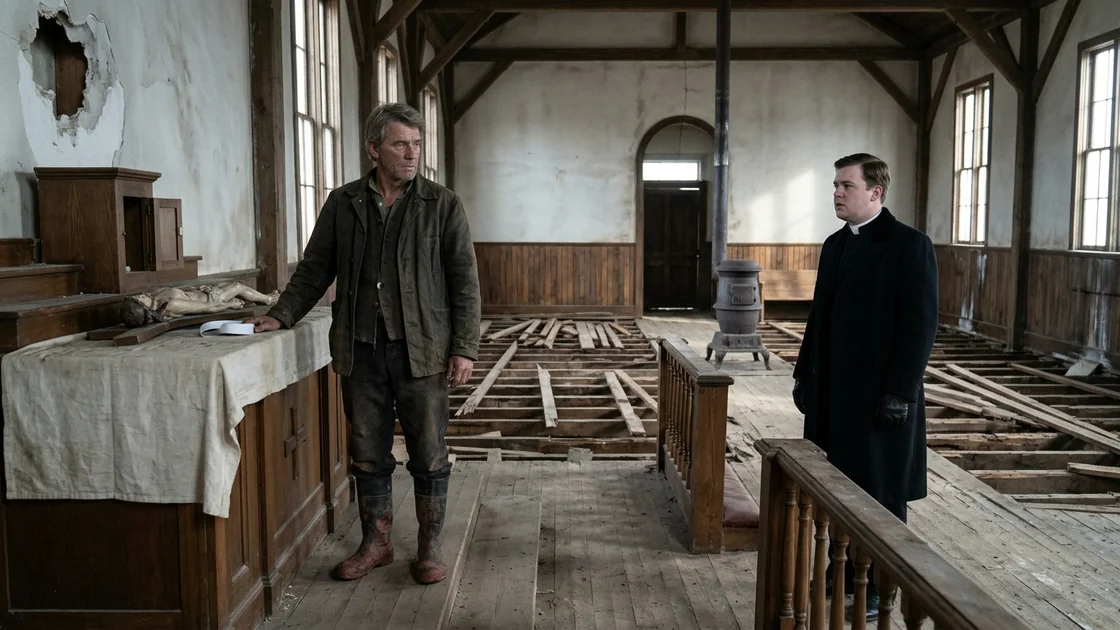
In the isolated northern settlement of Oakhaven, Father Thomas Ward shepherds a dwindling congregation through the brutal winter of 1924. What begins as a season of standard hardships quickly descends into a relentless sequence of tragedies, starting with a devastating mine collapse, followed by an outbreak of scarlet fever, and culminating in a starvation frost that cuts the town off from the outside world. As the bodies pile up in the frozen earth behind St. Jude’s Church, Thomas finds his prayers turning to ash in his mouth. With each funeral he conducts and each dying confession he hears, the theological certainties that sustained him for thirty years erode, leaving him to confront the terrifying possibility that the heavens are entirely empty, and that his flock is suffering beneath an indifferent sky.
The stove in the sacristy had a crack in its cast-iron belly, a jagged fissure that looked like a bolt of black lightning when the coals burned hot. Father Thomas Ward stood before it, holding his purple stolon close to the heat, trying to bake the dampness out of the wool before the seven o'clock Mass. Outside, the November wind came down off the Iron Range, carrying the metallic scent of early snow and the sour smoke of the Oakhaven smelter.
Thomas was fifty-four years old, a man whose joints had begun to predict the weather with more accuracy than the farmer’s almanac. His hair, once the color of dark oak, had gone the grey of wood ash, and his hands were thick-knuckled and scarred from thirty years of chopping his own cordwood and repairing the rotting cedar shakes of St. Jude’s. He was not a scholar; the bishop had not sent scholars to the north woods. The bishop sent men with broad shoulders and lungs that could handle the damp, men who knew how to deliver a breach calf as well as they knew the Latin liturgy.
"Father?"
The voice belonged to young Matthew Lindqvist, the altar boy, whose boots were two sizes too large, stuffed with newspaper to keep his toes from freezing on the two-mile walk from his father’s homestead. The boy’s nose was raw and red, dripping constantly.
"Come in by the fire, Matthew," Thomas said, his voice a low rumble that seemed to vibrate in the small, timber-framed room. "Leave the door unlatched for a moment to clear the smoke, then bar it against the draft."
"My ma says to tell you the baker’s wife is down with the pleurisy again," Matthew said, holding his chapped hands out to the glowing iron. "And Mr. Curran broke his axle hauling timber down the ridge. He won't be at Mass."
"We will remember them in the intentions," Thomas said, draping the heavy chasuble over his shoulders. The fabric smelled of beeswax, old incense, and the inescapable mildew of the northern forest.
There were twelve people in the pews that morning. The church had been built forty years prior during the first copper boom, designed to hold three hundred miners and their families. Now, the boom was a memory, the primary vein was nearly tapped out, and the remaining men worked the secondary shafts—dangerous, wet holes in the earth that yielded just enough low-grade ore to keep the company store open. In the cavernous nave, the twelve parishioners looked like driftwood scattered on a vast, grey beach.
Thomas went through the motions of the Mass with the quiet, rhythmic certainty that had defined his life. Introibo ad altare Dei. I will go in unto the altar of God.
Ad Deum qui laetificat juventutem meam, Matthew mumbled back, mangling the Latin as he always did. To God, who gives joy to my youth.
Thomas believed it then. On that grey November Tuesday, looking out at the bowed heads of the widows in their black wool shawls and the few old men too crippled for the morning shift at the mine, he believed that the words he spoke were tethered to an ultimate, benevolent reality. He believed that the thin wafer he elevated in his calloused fingers was the precise intersection of eternity and time, a small, white anchor holding Oakhaven fast against the encroaching wilderness.
When the service ended, he stood at the heavy double doors to greet them. He pressed the arthritic hands of Mrs. Gable, promised to bring some elderberry syrup to the baker’s wife, and listened to old man Henderson complain about the price of kerosene. It was a small life, constricted by the pines and the frost, but as Thomas walked back up the aisle to snuff the altar candles, he felt a familiar, warm satisfaction. God was in the tabernacle; the woodpile behind the rectory was stacked high; winter would be hard, as it always was, but the spring would follow.
He had just touched the brass snuffer to the second candle when the floor beneath his boots shuddered.
It was not a loud sound at first. It was a visceral sensation, a deep, subterranean groan that traveled up through the bedrock of the ridge, vibrating through the stone foundation of the church and into the bones of his shins. The heavy brass Sanctuary lamp, suspended from the ceiling by a twenty-foot chain, began to swing in a slow, widening arc, casting a restless red shadow across the plaster statues of the Virgin and St. Joseph.
Then came the sound—a muffled, flat thud from three miles away, up at the headwaters of the Black Creek where the Number Four shaft went down into the mountain.
A silence followed that was heavier than the iron in the hills. Even the wind seemed to pause in the needles of the hemlocks outside.
In the sacristy, the tin cup on the washstand rattled against the pitcher, then settled.
Matthew appeared in the doorway, his white surplice half-pulled over his head, his eyes wide and dark in his pale face. "Father," the boy whispered. "My brother is on the morning shift."
The road to the Number Four shaft was a ribbon of frozen mud, rutted deep by the ore wagons. By the time Thomas reached the clearing, hitching his skirts up around his knees so he could run in his heavy cassock, the whole town was already there.
The air was thick with brown rock dust that refused to settle in the cold, hanging over the pithead like a dirty fog. The timber frame of the hoist house was skewed at a drunken angle, one of its massive pine supports snapped like a dry twig. The great iron wheel at the top, which usually spun with a greasy, rhythmic squeak, was still.
Fifty women and children, along with the men from the night shift who had been woken from their beds, stood in a ragged semi-circle around the mouth of the shaft. Nobody was screaming. The people of the Iron Range did not scream; they had been bred out of it by generations of hard rock and cold water. Instead, there was a low, continuous keening from the younger wives, and the grim, tight-lipped silence of the older ones who had stood in this exact circle ten or twenty years before.
"Father Ward."
Jim MacAllister, the shift boss, stepped out of the crowd. His face was smeared with grease and the grey dust of the collapse. He wasn't wearing a coat, despite the biting wind, and his flannel shirt was torn at the shoulder.
"How bad, Jim?" Thomas asked, his breath pluming white between them.
"The main stope at the four-hundred-foot level gave way," MacAllister said, his voice flat and mechanical, the voice of a man reciting numbers to keep from breaking. "The whole ceiling came down. Rotten shale. We told the company superintendent last month the timbering wasn't holding the weight with the frost working down through the fissures."
"How many?"
"Nineteen below the break. Four men were near the cage at the two-hundred level; we got them up. One’s got a crushed pelvis. The rest..." MacAllister looked back at the twisted hoist frame. "The shaft is plugged solid from three hundred feet down. Tens of tons of rock, Father. And the water main broke. The pump's dead."
Thomas closed his eyes. In the darkness behind his lids, he saw the map of the mine he had looked at a dozen times in the superintendent’s office. He knew the four-hundred-foot level. It was a low, wet belly of rock where the men worked on their knees in three inches of freezing water. If the pump was dead, the Black Creek seepage would fill that belly in twelve hours.
"Can we dig?" Thomas asked.
"We're starting a bypass bucket brigade through the old ventilation shaft," MacAllister said, spitting brown dust onto the frozen ground. "Every man who can hold a shovel is going down. It'll take three days to clear the plug, if the air holds and the water doesn't rise too fast." He looked at Thomas with eyes that were suddenly red-rimmed and desperate. "They’re in the dark down there, Father. Pray for the rock to hold while we dig."
For the next seventy-two hours, Thomas did not sleep.
He set up a station in the carpenter’s shed near the pithead, where the injured man, a twenty-year-old Pole named Lukas with his lower body ruined, lay on a door balanced on two sawhorses. Thomas gave him the last of the laudanum from the rectory cabinet and heard his confession while the boy wept and bit through his own lip. Lukas died at midnight on the first day, his cold hand gripping Thomas’s wrist with terrifying strength until the very end, when the fingers suddenly went slack like wet rope.
Between tending to the boy, Thomas walked the line of women by the bonfires they had built at the edge of the clearing. He prayed the Rosary with them until his knees were bruised from the frozen dirt and his voice was reduced to a dry rasp. Hail Mary, full of grace, the Lord is with thee...
He meant every word. He threw his soul against the vault of heaven like a bird throwing itself against a windowpane, demanding that God look down through the grey clouds and see Oakhaven. He bargained. He offered his own remaining years; he offered to take the rheumatism ten times worse; he offered to fast on bread and bitter water until Easter if only the air would hold in the four-hundred-foot level, if only the water would stay back.
On the second day, the wind shifted to the north, bringing a dry, powder snow that hissed into the bonfires and coated the shoulders of the waiting women until they looked like statues carved from salt. Thomas went down the ventilation shaft himself for a four-hour shift, stripping off his cassock to work in his woolen trousers and undershirt alongside the men. The space was four feet wide, pitched at a forty-five-degree angle, and slick with black slime. He passed leather buckets of shattered shale hand-over-hand in the choking dark, the whale-oil lamps casting monstrous shadows against the wet rock.
Below them, through thirty feet of collapsed stone, they could hear tapping.
It was faint—tink, tink, tink—the sound of a steel drill bit hitting a vein of quartz.
"They're alive!" Danny Lindqvist, Matthew’s older brother, was down there. His father, Erik, was three men ahead of Thomas in the line, his face contorted into a mask of maniacal exertion, tearing at the rubble with his bare hands when the shovel caught, his fingernails splitting and bleeding into the mud. "Hang on, Danny!" Erik roared at the rock. "We're coming, boy!"
"See, Father?" the man behind Thomas gasped as he passed a bucket up. "The Lord heard you. They're alive."
A fierce, intoxicating rush of faith surged through Thomas’s exhausted body. The pain in his back vanished. His hands bled, and he did not care. God was in the rock. God was holding back the Black Creek. This would be the miracle that would bring the town back to the church, the undeniable proof of grace in a hard world.
On the morning of the third day, at four o'clock, the tapping stopped.
An hour later, the men at the bottom of the ventilation shaft broke through the final shelf of shale. Thomas was near the top of the chute when he heard the sound that came up from the depths. It was not a cheer. It was a long, hollow wail that echoed off the wet stone walls, a sound that did not belong to a human throat.
The water had not come from the creek above; they had struck an underground pocket when the ceiling collapsed. The four-hundred-foot level had flooded from the bottom up. The men had climbed into a high chimney in the rock, an air pocket no bigger than a root cellar, where they had tapped on the stone as the freezing water rose inch by inch over two days, until the air went bad from their own breath, and then the water took the rest.
They brought them up one by one on the cargo sled, winched through the narrow hole. Nineteen of them. They were already stiff, not from rigor mortis, but from the freezing water, their bodies contorted into the shapes of the rock crevice they had died in, their faces blue-grey in the dawn light, their eyes open and filmed with silt.
Danny Lindqvist was the seventh one up. He was seventeen. His fingers were worn down to the white bone of the first knuckle from scratching at the solid granite ceiling above his head.
Thomas stood over the row of bodies laid out on the snow-covered planks by the sawmill. The women were no longer quiet. The sound in the clearing was a jagged, tearing noise of pure agony. Martha Lindqvist had thrown herself across her son’s frozen chest, her cheek pressed against his wet, gravelly hair, while her husband Erik stood ten feet away, staring at his own bloody, ruined hands with a look of utter, vacant incomprehension.
Thomas reached into his pocket for the vial of holy oil to anoint the foreheads of the dead, though he knew the sacrament was only for the living; it was a gesture for the mothers, a final touch of the Church. The brass vial was so cold it stuck to the skin of his thumb.
He looked at Danny’s ruined fingers. The boy had not been holding a rosary. He had been clawing at the mountain in the pitch dark, choking on bad air, freezing to death by inches while thirty feet away, Thomas had been chanting Latin by a warm fire.
The Lord heard you, the miner had said in the shaft.
Thomas unscrewed the cap of the oilstock. The olive oil inside was congealed into a yellow lard by the frost. He had to dig a flake of it out with his fingernail and smear it onto Danny’s icy forehead. It wouldn't melt. It sat there on the blue skin like a crumb of tallow.
Ego te absolvo, Thomas whispered, though his throat felt as if he had swallowed ground glass.
He looked up at the sky. The snow had stopped, leaving a high, seamless ceiling of pewter cloud. Nothing moved up there. No light broke through. There was only the smell of wet wool, coal smoke, and the iron stench of the deep earth. For the first time in thirty years, as he formed the words of the prayer in his mind, he felt them go no higher than the tops of the pine trees before falling back down into the snow, dead and heavy as the shale.
They could not dig nineteen graves in the churchyard. The November frost had already gone down two feet, turning the red clay of Oakhaven into red iron.
Instead, six of the surviving miners brought two sticks of dynamite down from the company magazine. Thomas stood on the back porch of the rectory, his hands tucked into his sleeves, and watched them drill holes into the consecrated ground behind the apse. They blew a single long trench, forty feet long and six feet wide. The blast rattled the stained-glass windows of St. Jude’s, cracking the yellow pane that formed the halo around the head of St. Peter.
The funeral took place on Saturday. There were not enough pine boards in the sawmill to make nineteen proper coffins, so the carpenter nailed together simple three-sided troughs for the unmarried men, wrapping their remainder in canvas tarpaulins from the ore wagons. Only the married men and young Danny Lindqvist got full boxes.
The church was full now. Every soul in the settlement—two hundred and twelve of them, by Thomas’s last parish census—was packed into the pews, standing along the walls, crowding the vestibule. The air inside was suffocating, thick with the smell of damp wool, unwashed bodies, and the sharp, piney tang of the raw lumber boxes lined up in the center aisle and across the front of the sanctuary rail.
Thomas stood in the pulpit to deliver the homily.
He looked down at the nineteen boxes. Behind them sat nineteen widows, or mothers, or sisters. In the front row, Erik Lindqvist sat with his hands wrapped in dirty linen rags, staring straight ahead at the altar, not blinking. Little Matthew was not at the altar today; he sat squeezed between his parents, looking terribly small, his eyes fixed on the raw pine lid that covered his brother.
Thomas had prepared notes. He had stayed up until three in the morning by the cracked stove, his Bible open to the Book of Job and the Gospel of John. I am the resurrection and the life. The Lord gave, and the Lord hath taken away; blessed be the name of the Lord. The standard architecture of consolation. The words that had been worn smooth by two thousand years of priests standing in pulpits looking down at boxes of dead men.
He opened his mouth to speak them.
"My brethren," he began. His voice echoed hollowly off the timbered ceiling.
He looked down at his notes. The ink looked very black and very small on the page. He thought of Danny’s fingers, the nails torn off, the bone showing white against the grey stone. He thought of the forty-eight hours it had taken the water to rise to the boy's chin. Forty-eight hours is two thousand, eight hundred and eighty minutes. In every one of those minutes, the boy had been praying, or screaming, or shivering in the absolute dark, waiting for a God who had created the mountain, and the water, and the shale, and had chosen not to hold any of them back.
Blessed be the name of the Lord.
If he said those words to Erik Lindqvist right now, Thomas realized with a sudden, cold clarity, it would be an obscenity. It would be a lie told to protect the reputation of an absentee landlord whose house had just collapsed on his tenants.
"We are told," Thomas said slowly, his hands gripping the edges of the walnut pulpit until his knuckles turned white, "that God’s ways are not our ways. That as the heavens are higher than the earth, so are His ways higher than our ways, and His thoughts than our thoughts."
He paused. In the silence of the church, someone coughed—a wet, rattling sound from the back pews. A baby whimpered and was quickly hushed.
"We are told," Thomas continued, looking not at his notes, but at the cracked yellow glass in St. Peter’s halo, "that not a sparrow falls to the ground without the Father knowing it. That the very hairs of your head are all numbered."
He stopped again. The congregation waited. They were used to Father Ward’s slow, deliberate cadence. They were waiting for the turn—the moment where he would explain how the falling of the sparrow was part of a grand, merciful tapestry they were simply too blind to see from the underside.
Thomas looked at the nineteen pine boxes. He looked at the dirt under his own fingernails, which he hadn't been able to scrub out since Wednesday.
"I do not know what to tell you," he said.
A slight rustle went through the pews. Mrs. Gable looked up from her beads, her brow furrowed.
"I was in the shaft," Thomas said, his voice dropping lower, losing its priestly resonance, becoming just the voice of a tired old man in a cold room. "I heard them tapping on the rock. We prayed for three days. You women knelt in the snow until your skirts froze to the ground. There was faith enough in that clearing to move that mountain into the lake, if the promise of the Scripture were kept as we understand it."
He saw Erik Lindqvist’s head turn slightly. The man’s hollow eyes fixed on the pulpit.
"The mountain did not move," Thomas said. "The water rose. I cannot stand six feet above your heads today and tell you that I see the mercy in it. I cannot tell you why a boy of seventeen must tear his fingers to the bone in the dark while we sit above him with our lamps lit. If God’s thoughts are higher than our thoughts, then they are so high that the cold up there would kill a man. All we have down here is the dirt, and the shovels, and each other. Keep each other warm. The winter is only beginning. In the name of the Father, and of the Son, and of the Holy Ghost. Amen."
He turned and walked down the three steps of the pulpit before anyone could move. His heart was hammering against his ribs like a trapped bird. He had just committed a grave failure of his office; he knew it. A priest was a cistern meant to hold living water for when the well of the world went dry. He had just stood up and shown them the cistern was empty, cracked down the middle like the sacristy stove.
Yet, when they stood by the blasted trench in the churchyard twenty minutes later, with the wind whipping snow horizontally across the raw red clay, it was Erik Lindqvist who stepped out of the crowd after the coffins were lowered. The big Swede walked over to Thomas, who was standing alone with the brass sprinkler in his hand, his cassock snapping around his legs like a black flag.
Erik didn't say anything about God. He just reached out with one of his bandaged, club-like hands and laid it briefly on Thomas’s shoulder. The grip was heavy and solid.
"Thank you for not lying to us, Father," Erik said quietly, and then walked back to his wife.
That night, Thomas sat in the rectory kitchen without lighting the kerosene lamp. The only light came from the grate of the range, casting long, trembling bars of orange across the scrubbed pine floorboards.
On the table before him sat a bottle of whiskey—not the sweet altar wine, which was locked in the sacristy cupboard, but real rye whiskey that old man Henderson had left on the porch steps two weeks ago to pay for a wedding Mass he’d never paid for in 1898. Beside the bottle was his breviary, the thick, leather-bound book of the Divine Office that he had read from four times a day since the morning of his ordination in St. Paul thirty-one years ago.
The book was closed. A brass key lay on top of it—the key to the tabernacle.
Thomas poured two fingers of rye into a tin cup and drank it down. It burned his raw throat, a clean, honest fire that had nothing to do with grace.
He had not said Vespers. He had not said Compline. It was eleven o'clock, and if he did not read the offices before midnight, he would be in a state of mortal sin, bound by canon law to confess before he could touch the Eucharist again—and the nearest priest was Father Gagnon in Two Harbors, forty miles south through the timber on a trail that was already drifting shut.
He looked at the breviary. The leather was worn smooth and dark where his thumbs had held it for three decades. The gold leaf on the page edges was mostly gone, rubbed away by ten thousand turnings of the leaves.
He reached out and touched the cover. Open it, a voice in his mind said—the voice of his old seminary rector, Monsignor Vance, a man who had never seen a mine shaft or a frozen corpse in his life, a man who smelled of lavender water and snuff. Dryness of spirit is a common trial, Thomas. The dark night of the soul. St. John of the Cross wrote of it. When you feel nothing, that is when your prayer is most pleasing to God, for it is an act of pure will, stripped of sensible consolation.
"Sensible consolation," Thomas said aloud to the empty kitchen.
He thought of the yellow fat of the frozen oil sitting on Danny Lindqvist’s blue forehead. He thought of the way the nineteen corpses had rattled in their pine troughs when the men lowered them with ropes into the dynamited ditch, because their limbs were bent at angles that didn't fit flat against the boards.
Was that a test of his spiritual dryness? Had nineteen men drowned in freezing mud so that Father Thomas Ward could practice an act of pure will by reading Latin psalms at eleven o'clock at night? The sheer, grotesque arrogance of the theology made his stomach turn. Either God had wanted those men to die like rats in a flooded cellar, in which case God was a monster no decent man should worship; or God had wanted to save them and could not, in which case He was no God at all, just another helpless spectator watching the rock fall; or—and this was the thought that made the kitchen suddenly feel much larger and much colder than it was—there was nothing there at all.
Just rock, and water, and gravity. Just the law of the shale, which falls when the frost splits it, regardless of how many old women are on their knees in the mud above it.
Thomas poured another two fingers of whiskey. He did not open the book. He sat in the dark until the coals in the range turned from orange to grey, and the frost crept up the inside of the kitchen windowpanes, drawing blind, white ferns across the glass.
The company closed the Number Four shaft permanently the following week. The superintendent took the train south on the last run before the heavy snows buried the spur line, leaving a notice nailed to the door of the company store: credit was suspended until the spring thaw, when the engineers from Duluth would come up to assess whether the Number Two shaft was worth reopening.
Oakhaven was effectively marooned. There were forty tons of flour, salt pork, and dried beans in the storehouse, guarded by the clerk, a nervous young man from Chicago named Miller who slept with a shotgun behind the counter. The families had what they had put up in their root cellars—potatoes, rutabagas, pickled fish, and whatever venison the men could shoot before the deer yarded up too deep in the cedar swamps to reach.
Then, in the second week of December, the sky cleared, and the real cold came down from Hudson Bay.
The thermometer outside the rectory door dropped to twenty below zero, then thirty. At forty below, the mercury drew itself down into the bulb and froze solid. The spruce trees in the forest around the town began to explode as the sap froze and expanded inside their trunks, sounding like rifle shots in the dead of night.
With the cold came the scarlet fever.
It started in the boarding house down by the frozen creek, where three of the widow women had moved in together to save on firewood. Thomas was called there on a Tuesday evening. When he stepped inside the low-ceilinged room, the heat and the stench hit him like a physical blow. All the windows were nailed shut and stuffed with rags to keep the forty-below air out, and four children were lying on straw pallets near the stove.
Their skin was the color of boiled lobster, rough as sandpaper to the touch. Their tongues were swollen, bright red with white spots like unripe strawberries, and the air was filled with the wet, whistling sound of their breathing.
"It's the red fever, Father," Mary McGuire said, wringing out a grey rag in a basin of melted snow. Her husband had been one of the nineteen in the trench. Her face looked as though it had been carved out of driftwood, all planes and hollows. "Little Sarah started with the sore throat on Sunday. Now they all got it."
"Where is Doc Miller?" Thomas asked, kneeling beside the smallest pallet. The girl, Sarah, was six. Her eyes were glassy and rolling back in her head, the fever cooking her brain.
"Drunk in his shack," Mary said without malice, just stating a fact of the weather, like the depth of the snow. "Says he's out of quinine anyway, and quinine don't touch the scarlet fever. Says all we can do is grease 'em with lard when the skin starts peeling and keep 'em warm."
"Open the window an inch, Mary," Thomas said, stripping off his heavy sheepskin coat. "The air in here is poison. I'll split more wood from your pile to keep the stove roaring, so the chill doesn't reach them, but they need clean air."
"You shouldn't stay, Father," one of the other widows, Anna Novak, said from the corner where she was holding a two-year-old boy who was convulsing slightly in her arms. "You'll carry it to the rest of the town."
"Half the town was in church on Sunday coughing," Thomas said grimly. "It's already out. Where's your axe?"
For the next three weeks, the church bell did not ring for Mass. Thomas stopped saying the morning liturgy altogether after the third day of the outbreak, when nobody came except old Mrs. Gable, who collapsed in the vestibule with a fever of a hundred and four before she could dip her fingers in the holy water stoup—which was frozen into a block of grey ice anyway.
Instead, Thomas became the town’s nurse, woodcutter, and gravedigger.
He moved from cabin to cabin through a landscape that looked like the surface of the moon. The snow was four feet deep on the level, crusted hard enough by the wind to walk on with snowshoes. The sun rose at nine in the morning, hung low and pale in the southern sky like a grease spot on brown paper for six hours, generating no warmth at all, and then dropped back behind the black ridge at three in the afternoon.
Inside the cabins, it was a dim, stifling purgatory of tallow candle smoke, turpentine, and the sour smell of sickness. The fever showed no preference, though it seemed to have a particular appetite for the children of the men who had died in the mine.
Little Sarah McGuire died on December eighteenth. Thomas held her down while the convulsions took her, so she wouldn't break her own arms against the iron legs of the stove. When the shaking stopped, her skin was already beginning to slough off her hands in great, papery sheets, like gloves being pulled inside out.
Mary McGuire didn't cry. She just sat on a stool, staring at the wall, while Thomas washed the tiny body with snow-water, wrapped her in a clean flour sack, and carried her out to the woodshed. They couldn't use dynamite on the churchyard anymore; the remaining sticks had frozen solid, and thawing nitroglycerine by a stove was a good way to blow the whole rectory to splinters. So the dead had to wait in the woodsheds, stacked like cordwood alongside the frozen quarters of venison, until April.
As he laid the little bundle on top of the split birch logs in the dark shed, Thomas realized he had forgotten to baptize the Novak baby before it died the night before, and he had not said the prayers for the commendation of a departing soul over Sarah.
He stood in the freezing dark of the shed, his breath frosting his beard, looking down at the white flour sack.
Go forth, Christian soul, out of this world, in the name of God the Father Almighty, who created thee...
He didn't say it. He couldn't. The words felt like lead coins from a bankrupt empire. If there was a God the Father Almighty who had created Sarah McGuire, He had created her to have her father crushed by shale in November and her own throat closed up by scarlet slime in December, while her mother watched both happen in the space of thirty days. If that God was waiting on the other side of the dark to judge whether asix-year-old girl had had Latin muttered over her by an old man in a black dress before her heart stopped, then Thomas had nothing to say to Him.
He closed the woodshed door, dropped the wooden bar into its iron bracket to keep the wolves and the pine martens out, and walked back into the house to split more wood.
By Christmas Eve, twenty-two people were stacked in the sheds behind St. Jude’s and the various cabins. Fourteen of them were children under the age of twelve.
The fever had finally begun to burn itself out, simply because there was nobody left in Oakhaven who hadn't either had it, died of it, or proven immune. Those who survived were left broken by it—children who were now stone deaf from the ear infections that followed the rash, men whose kidneys were failing, their faces puffy and yellow as wax, women whose hair had fallen out in handfuls.
On the afternoon of December twenty-fourth, a knock came at the rectory door.
Thomas opened it to find Erik Lindqvist standing on the porch. The big Swede had lost thirty pounds since the mine collapse. His heavy wool coat hung off his frame like a tent on a ridgepole, and his beard was matted with ice. Behind him stood his horse, hitched to a flat timber-sled. On the sled was a small shape wrapped in a grey army blanket, tied down with hemp rope.
Thomas didn't have to ask. He just looked at the sled, and something inside his chest, some final timber that had been holding up the roof of his mind, gave a quiet, splintering crack.
"Matthew?" Thomas whispered.
Erik nodded once. His eyes were sunk so deep into his skull they looked like two bullet holes in a snowbank. "This morning," he said. "His heart gave out after the fever broke. Doc said it happens sometimes with the scarlet. The poison goes to the valves."
Thomas stepped out onto the porch without his coat. The forty-below air bit through his worn cassock instantly, stinging his ribs like nettles. He walked down the steps to the sled and untied the corner of the grey blanket.
Matthew’s face was peaceful, at least. The red rash had faded, leaving his skin the color of skim milk. His hair was combed neatly—his mother had done that before they wrapped him—and in his stiff, bluish fingers, someone had laced his small wooden rosary, the cheap one with the black painted beads that Thomas had given him when he first learned to serve Mass at age eight.
Ad Deum qui laetificat juventutem meam, Thomas heard in his head. To God, who gives joy to my youth.
The boy was ten years old. His youth had consisted of walking two miles in boots stuffed with newspaper, eating lard sandwiches, watching his seventeen-year-old brother brought up out of a hole like a frozen dog, and then drowning in his own blood as his heart failed in a dark cabin.
"Martha wanted him in the church shed," Erik said, his voice scraping like a shovel on gravel. "Not in ours. She can't stand to go out for wood and see him laying there till spring. And Danny’s right out back in the trench. She figures they'll be close."
"Of course, Erik," Thomas said. He didn't feel the cold anymore. He felt entirely hollow, as if the wind were blowing straight through his ribs without touching anything solid. "Bring him around to the back. I'll get the key to the coal shed. It's tighter against the rats than the woodhouse."
Together, the two men lifted the light, stiff bundle off the sled. Matthew didn't weigh fifty pounds. He felt like a bundle of dry pine branches wrapped in wool. They carried him around the corner of the church, wading through the drifts that had piled up against the clapboards, and laid him on a clean plank on top of the coal bin, beside the seven other bundles already waiting there in the freezing dark.
When they stepped back out into the gray twilight, Erik didn't leave right away. He stood by the corner of the church, looking up at the bell tower.
"Are you having the Midnight Mass, Father?" he asked.
Thomas looked at him in surprise. "Erik, you haven't been inside the church since we buried Danny."
"I know," the Swede said, looking down at his mittens. "It's for Martha. Since the little one went this morning, she hasn't said a word. She hasn't cried. She just sits by the window looking at the snow. I'm afraid for her mind, Father. Two boys in five weeks. That's all we had. I thought... if the candles were lit tonight, and the music... maybe it would break the ice in her head. Make her cry, at least."
Thomas looked at the church. The building looked dead. The snow was drifted halfway up the tall, narrow windows, and icicles as thick as a man's thigh hung from the eaves like the bars of a cage. Inside, it was forty degrees below zero. The altar bread in the sacristy drawer was stale, and the wine in the cruets had frozen and cracked the glass weeks ago.
More than that, Thomas knew that if he went up those altar steps tonight and opened the missal, he would be an impostor. He had not opened his breviary since the night of the miners' funeral. He had not prayed in a month. When he looked at the tabernacle now, he did not see the Real Presence of Christ; he saw a brass box bolted to a wooden table in an empty room, containing a few pieces of unleavened flour that the church mice would have eaten if they hadn't frozen to death in November.
"I will light the candles, Erik," Thomas said slowly. "And I will say the Mass at midnight. Bring Martha."
At ten o'clock that night, Thomas went into the church with an armful of split birch and a bucket of glowing coals from the rectory stove.
The cold inside the nave was monumental. It had a smell of its own—the smell of old stone, frozen dust, and dead cedar. His boots rang loudly on the floorboards as he walked down the center aisle toward the two pot-bellied stoves that stood at the front and back of the church. Every breath he took made his nostrils stick together.
He built the fires carefully, feeding them kindling and birch bark until the stovepipes began to tick and snap with the sudden heat. It would take hours just to raise the temperature in the vast room above zero, let alone make it comfortable, so he piled the coal in on top of the wood until the iron bellies of the stoves began to glow a dull, angry cherry red in the gloom.
Then he went into the sanctuary to light the candles.
There were thirty-six of them on the high altar for Christmas—tall beeswax tapers set into the six-tiered brass candlesticks flanking the tabernacle. His hands were shaking so badly from the cold and from a deep, nauseating dread that he dropped the wax taper twice before he got them all lit.
As the flames caught and steadied, the gold leaf on the reredos behind the altar began to gleam softly. Out of the corner of his eye, to his left, stood the Christmas crib. He had not set it up this year, of course, so the space by the St. Joseph altar was bare, save for the permanent plaster statues that stood in their niches year-round.
Thomas stood at the foot of the altar and looked up at the crucifix that hung above the tabernacle.
It was a life-sized corpus, carved by some forgotten Bavarian immigrant fifty years ago out of basswood and painted with startling, peasant realism. The blood from the crown of thorns and the side wound was painted the bright, glossy red of wild cranberries. The knees were skinned and bruised blue. The wooden face was twisted in the final spasm of asphyxiation, looking up toward the rafters.
For thirty years, that figure had been Thomas’s compass. Whenever the winter was too long, whenever his own loneliness in the celibate silence of the rectory became too heavy to bear, whenever he had to watch a man die of gangrene after a logging accident, he had looked at that piece of painted basswood and thought: He knows. God Himself came down into the meat and the bone, into the cold and the dark, and let the world break Him on two pieces of rough timber so that we would never be alone in the breaking.
It was a magnificent story. Standing there in the flickering candlelight, with the stoves ticking behind him, Thomas realized for the first time how truly magnificent an invention it was.
Men could not bear the world as it actually was. They could not bear the fact that the shale falls because of gravity, that the bacteria multiply in the throat of a six-year-old girl because her blood is warm and sweet, that the frost kills the potatoes in the ground because the earth tilts away from the sun on its blind, mechanical orbit. To look at that naked machinery for too long was to go mad, like Martha Lindqvist sitting by her window looking at the snow.
And so, out of their terror and their unbearable grief, men had carved a God out of basswood and painted Him with their own blood. They had nailed Him to a cross so that their own crosses would mean something. They had invented a Father in the sky because they were orphans in the forest.
"You aren't there," Thomas said aloud.
His voice was quiet, barely louder than the roaring of the draft in the stove chimneys, yet in the empty church it sounded like a gunshot.
He walked up the three carpeted steps to the predella, standing right before the altar table. He did not genuflect. For the first time in his adult life, he stood upright before the tabernacle without bending his knee.
He reached into his pocket, took out the brass key, and fitted it into the small, ornate door of the golden safe. The lock turned with a sharp click. He swung the little door open and pulled aside the white silk veil inside.
The ciborium sat there, a golden cup with a domed lid, draped in its own miniature cloth of white and gold. Thomas took it out, set it on the corporal—the square of white linen spread on the altar—and took off the lid.
Inside were six round hosts, consecrated at the last Sunday Mass he had said in early December, before the fever shut the doors. According to everything he had ever been taught, everything he had staked his life, his youth, his manhood, and his sanity upon, he was looking at the literal body, blood, soul, and divinity of the Creator of the Universe, hiding under the appearance of bread.
Thomas looked down into the gold cup.
He reached in with his cold, scarred thumb and forefinger and picked up one of the wafers. He held it up to the candlelight. It was stamped with a cross and a lamb. The edge was slightly chipped where it had rattled against the side of the cup.
"If You are here," Thomas whispered, his eyes fixed on the little circle of white flour, "if there is a breath of life in this, or in the sky above this roof... strike me down right now. Stop my heart on these steps, the way Matthew’s heart stopped this morning. Do not let a blasphemer hold You in his hands."
He waited.
The tallow in one of the candles popped with a tiny hiss. The stove at the back of the church gave a metallic clang as the iron expanded. Outside, the wind pushed against the cedar shakes of the roof with a long, low sigh.
His heart beat on—steady, heavy, tired. One beat. Two. Ten.
He looked at the wafer. It was bread. It was flour and water, baked between two hot irons by the sisters at the convent in Duluth, packed in a tin box, and shipped north on the train with the kegs of nails and the sacks of beans. Nothing more.
A strange, terrible relief washed over him, cold and clean as snow-water. The war was over. He didn't have to defend the absentee landlord anymore. He didn't have to twist his mind into knots trying to figure out how drowning nineteen men in freezing mud and choking fourteen children to death on their own phlegm was an expression of infinite love. There was no love in the sky, and there was no malice either. There was only the weather, and the rock, and the brief, flickering warmth that human beings could make for each other before the cold got in.
He put the wafer back into the cup, put the lid on, and shoved the ciborium back into the brass box, locking the door.
Behind him, the heavy outer doors of the church creaked open, letting in a blast of forty-below air that made all thirty-six candles bow toward the sanctuary wall at once.
Thirty people came to the Midnight Mass.
They came wrapped in buffalo robes, horse blankets, and patchworked quilts over their coats, shuffling down the aisle like a procession of ghosts. They didn't scatter throughout the pews as they usually did; they huddled together in the four rows closest to the front stove, seeking the heat of the iron and the heat of each other’s bodies.
Erik and Martha Lindqvist sat in the second row. Martha looked like a woman who had already died and was merely waiting for the ground to thaw so she could lie down. Her eyes were wide, dry, and completely empty, fixed on the bright bank of candles on the altar.
Thomas came out of the sacristy at midnight. He was alone; there was no altar boy left in Oakhaven who was well enough to walk, and the one who had stood beside him for two years was lying on a plank in the coal shed twenty feet behind the wall he was facing.
He wore the white and gold vestments of the Nativity. They were the finest garments the poor parish possessed, donated by a wealthy lumber baron’s wife in 1905, though the gold thread was tarnished green in places from the damp.
He walked to the foot of the altar, bowed his head, and began.
Introibo ad altare Dei.
Nobody answered him. The congregation didn't know the Latin responses; that was the boy's job. So Thomas answered himself, his voice echoing back to him from the dark rafters of the empty choir loft.
Ad Deum qui laetificat juventutem meam.
He said the words clearly, loudly, with a resonance he had not possessed in months. Now that he knew it was a play, he found he could act the part with extraordinary precision. It was no longer a matter of his own soul, or of appeasing a jealous Deity in the clouds; it was a performance given for the thirty shivering, broken animals huddled around the stove behind him. They had come out into the killing frost at midnight because they needed the gold, and the light, and the ancient, rhythmic words that told them they were more than meat that freezes in the dark.
If the sky wouldn't give them mercy, Thomas would give them the theater of it.
He ascended the steps, kissed the altar stone containing the bone fragment of some obscure Roman martyr, and read the Introit for Christmas Midnight. Dominus dixit ad me: Filius meus es tu, ego hodie genui te. The Lord hath said to me: Thou art my Son, this day have I begotten Thee.
He read the Epistle. He read the Gospel of Luke—the decree from Caesar Augustus, the journey to Bethlehem, the child wrapped in swaddling clothes and laid in a manger because there was no room for them in the inn, the shepherds keeping watch over their flock by night.
When he turned around to face them after the Gospel, he did not climb into the high pulpit. He stood right at the break in the altar rail, five feet away from the front row, where the heat from the stove reached his face and smelled of hot iron and scorching dust.
He looked at Martha Lindqvist. She was still staring past him, her eyes reflecting the thirty-six tiny flames of the altar candles.
"Two thousand years ago," Thomas said softly, without any of the booming cadence of the preacher, "a woman had a child in a stable in the middle of the winter, in a town where nobody knew her name, while the men who owned the world sat in warm palaces five hundred miles away counting their money."
In the front row, Mary McGuire, who had buried her husband in November and put her six-year-old girl in the woodshed a week ago, looked up from her lap.
"It is a story about being cold," Thomas said. "And being poor. And being forgotten by the people who run the world. The shepherds who came in from the hills didn't bring gold; that was another story told later. They brought sheepskins, and their own breath to warm the stall, and maybe a skin of milk. They came because it was dark out on the hills, and there was a light in the stable."
He stepped down from the sanctuary floor so that he was standing on the same level as the pews, his tarnished gold chasuble brushing against the coal scuttle by the stove.
"We have lost almost everything this winter," he said, looking from face to face—from the yellow, swollen face of Tom Novak, whose kidneys were failing, to the scarred, empty hands of Erik Lindqvist, to the blank eyes of Martha. "Our men are under the rock, or under the clay. Our children are in the sheds waiting for the sun to come back so we can give them to the earth properly. If you look up at the sky tonight, you will see stars that look like chips of ice, and you will feel a wind that would kill you in an hour if your fire went out."
He paused, letting the silence of the church settle around them.
"Do not look at the sky," Thomas said. "There is nothing up there for us tonight. Look at the person sitting beside you on the bench. That is all the grace there is in Oakhaven. The wood Erik splits for Mary’s stove. The broth Anna brings over when her own legs can barely carry her through the drift. The light we make in this room so we don't have to sit in the dark alone."
He looked directly into Martha Lindqvist’s wide, dry eyes.
"Danny was a good boy, Martha," Thomas said, his voice breaking for the first time, not with the theatrical emotion of a sermon, but with the raw, human grief of an old man who had loved the child. "He worked like a man to help his father, and he never spoke a cruel word in my hearing. And little Matthew... he came through the snow every morning in boots stuffed with paper to help an old man light his candles, with his nose running and his hands chapped raw, and he never complained once. They are gone, and nothing I say at this altar will bring them back through that door. It is a cruel, bitter thing, and you have a right to curse the winter that took them. We all do. Let us weep for them together, because they were ours, and nobody else in the world knew how good they were."
For ten seconds, nothing happened. The stove ticked. A log shifted in the grate.
Then Martha Lindqvist blinked. Her mouth, which had been set in a thin, grey line since morning, trembled violently, and she let out a sound—a low, ragged sob that seemed to tear its way up from the very bottom of her lungs. She doubled over in the pew, burying her face in Erik’s heavy wool coat, her shoulders shaking convulsively.
Beside her, Erik put his bandaged arms around her and pulled her tight against his chest, his own face twisting as the tears finally ran down into his matted beard. Across the aisle, Mary McGuire reached over and took the hand of old Mrs. Gable, and within a minute, the whole huddle of thirty people around the stove was weeping—not the wild, terrified screaming of the mine pithead, but the deep, exhausting weeping of people who had finally been given permission to stop pretending that their pain was a blessing in disguise.
Thomas turned back to the altar so they wouldn't see his own face. He walked back up the steps, wiped his eyes on the sleeve of his alb, and continued the Mass.
When he came to the Consecration, he took the large white host in his hands, bent low over the altar table, and whispered the words of institution: Hoc est enim Corpus meum. For this is My Body.
He knew nothing happened to the bread. The molecules of wheat starch did not rearrange themselves into the flesh of a first-century Galilean carpenter. The sky did not open; no angels descended through the cedar roof to adore the Victim on the paten.
Yet as he knelt and elevated the white circle above his head in the candlelight, holding it high so the weeping people behind him could see it glowing against the dark wood of the reredos, he felt a strange, quiet solemnity that was entirely different from the faith he had lost. It was just bread. Bread was what kept men alive when the frost was forty below. To share bread in the dark was the oldest, truest sacrament the human race had ever known.
When he distributed Communion at the rail, he placed the cold wafers on their tongues with gentle, deliberate care. Corpus Domini nostri Jesu Christi custodiat animam tuam in vitam aeternam. May the Body of our Lord Jesus Christ keep thy soul unto life everlasting.
They believed it. He could see it in the way Mary McGuire closed her eyes as she swallowed, a brief, fragile peace smoothing out the deep lines around her mouth. He did not begrudge them the illusion; he was glad he could still provide the vessel for it, even if he himself was standing outside in the cold, looking in through the window.
January and February were not months; they were a single, endless night divided into grey slices of afternoon.
The fever was gone, replaced by the slower, quieter Arithmetic of starvation.
By the middle of January, the forty tons of supplies in the company store were half gone, and Miller, the clerk from Chicago, was rationing them out strictly to the families whose men still had credit on the books from the autumn ore tally—which meant the families of the nineteen dead men, whose accounts had been closed the day the shaft collapsed, got nothing unless someone else bought it for them.
Thomas went down to the store on the twentieth of January. The wind was blowing thirty miles an hour off the ridge, driving ground-blizzards across the clearing between the cabins. He had to follow the rope lines the men had strung between the buildings so he wouldn't lose his bearings in the whiteout and walk straight into the forest.
Inside the store, it was dimly lit by a single coal-oil lamp. Three of the surviving miners were standing by the counter, their faces dark and ugly under their fur caps, while Miller stood behind the scale with his shotgun leaning against the salt-pork barrel within easy reach of his right hand.
"I told you, Novak," Miller was saying, his voice high and tight with fear. "The company telegram before the wire went down in December was clear. No advances against spring labor. Cash or existing credit on the ledger. If I give away the company's flour, they take it out of my bond in Duluth, and they throw me in the penitentiary for embezzlement."
"My kids are eating boiled potato peelings and birch bark tea, Miller," Tom Novak said. He was leaning heavily on the counter; the scarlet fever had left his heart weak and his legs swollen with dropsy inside his wool trousers. "I worked the Number Two shaft for twelve years. You got forty sacks of Gold Medal in the back room with weevils getting into 'em while we starve."
"That's the company's weevils, not mine," Miller snapped, his hand moving an inch closer to the stock of the twelve-gauge.
"Mr. Miller," Thomas said, stepping forward and shaking the snow off his sheepskin collar.
The clerk jumped slightly, looking at the priest with nervous, darting eyes. "Father Ward. Your account is good, Father. The diocese sent a draft in October. What do you need? Lard? Beans?"
"I need ten sacks of flour, two barrels of salt pork, and four hundred pounds of dried peas," Thomas said calmly.
Miller stared at him. "Father, you got twelve dollars left on the parish ledger. That wouldn't buy two sacks at winter prices."
Thomas reached inside his coat and pulled out a heavy velvet bag that clinked softly as he laid it on the scarred pine counter between Novak and the clerk.
He untied the drawstring and dumped the contents out onto the wood.
Out rolled the golden ciborium—after he had emptied the remaining six wafers into the stove fire that morning—along with the silver chalice with the amethyst stones set into the base that his own mother had bought for his ordination with her life savings, the heavy brass monstrance plated with twenty-four-karat leaf, and the two silver cruet trays.
Novak gasped, crossing himself automatically and stepping back from the counter as if the metal were red-hot. "Father! That's the church plate! That's the blessed vessels!"
"It's eight pounds of sterling silver and twelve ounces of gold, Tom," Thomas said, not taking his eyes off Miller. "St. Ambrose melted down the vessels of the cathedral in Milan to ransom captives from the Goths. I think the Bishop of Duluth will forgive me if we melt down St. Jude’s to keep his flock from dying of scurvy before Easter. And if he doesn't, he can come up here on snowshoes and tell me himself."
Miller looked down at the gleaming heap of metal, then up at Thomas’s hard, grey face. The clerk swallowed hard. He wasn't a bad man, just a small one trapped in a place that was too big and too fierce for him.
"I can't put chalices in the company cash box, Father," Miller whispered. "The auditors..."
"You will hold them as collateral in the safe until the train runs in May," Thomas said, his voice dropping an octave, taking on the old, iron authority of the pulpit. "When the train runs, I will wire the chancery, or I will sell them to a jeweler in Two Harbors myself and pay the company store every cent on the ledger. Or, you can refuse, and I will walk back out that door and tell the thirty men left in this town that I have no moral objection to them taking that shotgun away from you and dividing the storehouse by hand. Which would you prefer to explain to the auditors in May, Mr. Miller?"
Miller looked at the silver cup, then at the three gaunt miners standing behind the priest, their eyes fixed on the shotgun.
The clerk reached under the counter, pulled out the big iron key to the back storeroom, and laid it beside the chalice. "Take the hand-sleds out back, Father," he said quietly. "Leave the silver. You can keep it in the church till spring. Just sign a paper saying you requisitioned the goods for famine relief so they don't put me in jail."
"Thank you, my son," Thomas said, using the priestly phrase without thinking, though he saw the relief in the young man's eyes and knew it had done its work.
By late February, the woodpiles in the town were gone.
Nobody had anticipated forty days of temperatures that never rose above twenty below zero. The men who were healthy enough went out with crosscut saws to cut green birch and maple on the ridge, hauling it back through waist-deep drifts, but green wood burned poorly, hissing and steaming in the stoves, coating the chimneys with thick creosote that caught fire twice a week and threatened to burn the cabins down in the wind.
At St. Jude’s, Thomas had long since stopped trying to heat the church. They held Sunday services in the rectory kitchen now, twenty people crammed into a twelve-by-twelve room around the cracked range, while Thomas read the Gospel from a chair by the flour barrel.
When his own woodpile ran out on the twenty-eighth of February, he didn't ask the men to cut green timber for him; they were barely keeping their own widows warm.
Instead, Thomas went into the dark, freezing nave of the church with a crowbar and a splitting maul.
He started with the back pews. The seasoned oak fought him at first, the iron nails screaming as he wrenched the planks loose from the floor, the sound echoing wildly through the empty building. Once he got the rhythm of it, the work warmed him. He smashed the curved backs and the kneeling benches with the maul, splitting the two-inch oak boards into stove-length billets.
It burned magnificently. Hundred-year-old white oak, dried for forty years inside the church, caught with a clear, hot, smokeless flame that turned the cracked belly of the rectory stove bright yellow.
When the back six rows of pews were gone, he burned the confessional box.
He took a strange, grim satisfaction in taking the crowbar to the dark little booth where he had sat for three decades in the smell of cheap hair oil and peppermint, listening to the pathetic, harmless sins of poor people—a man who had cursed his mule, a woman who had missed Mass because her boots were leaking, a boy who had stolen three apples from the company store—and doling out penances as if the Ruler of the Cosmos kept a ledger of stolen apples while ignoring the shale at the four-hundred-foot level.
The lattice grille through which they had whispered Bless me, Father, for I have sinned made excellent kindling.
In the second week of March, a blizzard came down that lasted four days without a break, burying the windows of the rectory completely so that Thomas lived in a cave of lantern-light. The oak pews were hard to split in the dark church, and his arthritis had flared up in his left shoulder until he could barely lift the maul.
On the third night of the storm, the kitchen stove went down to the last shovelful of coals, and the frost began to creep across the floorboards toward his boots.
Thomas took the lantern, wrapped his blanket around his shoulders, and pushed through the snow tunnel between the rectory and the sacristy door.
He walked out into the sanctuary, holding the lantern high.
The church looked like a sacked cathedral after a war. Half the floor was bare joists where the pews had been torn up. Snow had blown in through the cracked yellow glass in St. Peter’s halo, forming a long, neat drift across the altar rail.
Above the high altar, the basswood corpus of Christ hung on its cross, coated in a fine rime of white frost that made the painted red blood look dull and brown.
Thomas set the lantern down on the altar steps. He didn't have the strength in his left arm to swing the maul against the two-inch oak of the remaining pews tonight. He needed dry, soft wood that would split easily with the small hatchet.
Basswood was very soft, very dry, and light to carry.
He climbed up onto the altar table itself, his snow-crusted boots stepping right on the linen corporal, and reached up to the massive iron spike that held the top of the cross to the reredos wall. He wedged the claw of the crowbar behind the wood and pulled with all his remaining weight.
The dry timber groaned, the rusty spike shrieked in the plaster, and the cross came loose, tilting forward into his arms.
It was lighter than he expected. He lowered it down the steps to the sanctuary floor, the wooden arms scraping across the carpet. In the yellow light of the kerosene lantern, the carved face of the Christ looked directly up at him from the floor, its glass eyes glinting under the frost, the mouth frozen in its fifty-year-old cry of Eli, Eli, lamma sabachthani—My God, my God, why hast Thou forsaken me?
"You know how it is, then," Thomas muttered to the wood, his breath clouding the painted face.
He did not take the hatchet to it inside the church; if someone came by in the morning and saw the head of the Savior lying in the woodbox by the kitchen stove, it would break whatever fragile thread was still holding the town together. Instead, he pried the corpus off the cross-beams in one piece, wrapped the wooden figure in an old purple Lenten altar cloth, and shoved it deep under the altar table, behind the frontal where nobody ever looked.
Then he split the two eight-foot beams of the cross itself right there on the sanctuary steps. The dry basswood parted cleanly with every stroke of the hatchet, smelling faintly of old varnish and fifty years of frankincense.
He carried the pieces of the cross back into the kitchen in his arms, fed them into the stove, and sat with his feet on the open oven door while the wood of the gibbet kept him from freezing to death.
The thaw came on the seventh of April.
It did not come with sun and birdsong; it came with a warm, grey rain from the south that turned the four-foot drifts into a knee-deep sea of grey slush, exposing all the filth of the winter that the snow had mercifully covered—the piles of coal ash, the frozen dog droppings, the scattered wood chips, and the gaunt, blackened skeletons of deer at the edge of the timber that had starved to death within sight of the cabins.
Water dripped constantly from every eave, a million tiny hammers beating on the tin roofs and the rotten cedar shakes.
For four days, the men of Oakhaven did nothing but dig graves.
The frost went out of the red clay slowly, turning the churchyard behind St. Jude’s into a red quagmire that sucked the boots off a man's feet. There were twenty-six bodies in the sheds now; four old people, including Mrs. Gable, had slipped away quietly in March from the slow starvation and the cold.
Thomas worked alongside Erik Lindqvist, Tom Novak, and Jim MacAllister in the mud, his black trousers tucked into rubber mining boots, his cassock discarded altogether in favor of an old canvas jacket of MacAllister’s. His shoulder was permanently stiff now from the winter, so he couldn't throw the heavy clay over the lip of the five-foot holes, but he could work the pickaxe at the bottom to break up the remaining shelves of frost.
On the eleventh of April, they buried them all in a single morning.
There was no service inside the church; the building smelled of wet plaster and rot, and half the pews were gone anyway. When the women saw the empty space at the back of the nave through the open doors, Thomas simply told them the wood had been needed for the widows' stoves, and nobody asked a second question. When they looked at the bare spot above the tabernacle where the great crucifix had hung, he told them the damp had rotted the iron bracket and it had fallen and broken in the March storm, and he had put it away until a carpenter could mend it. They accepted that too. People who had spent four months watching their children's skin peel off did not have much curiosity left for church furniture.
They stood in the rain around the twenty-six raw holes in the mud. The pine boxes—and the flour sacks for the smallest ones, because the lumber had run out completely by the tenth coffin—were lowered down with mud-slicked ropes into the three inches of red water that had already seeped into the bottom of each grave.
Thomas walked down the line of graves with his ritual book open in the rain, the drops blurring the purple ink on the pages.
He read the prayers. He sprinkled each hole with water from the Black Creek that he had blessed—or gone through the motions of blessing—that morning in a tin bucket.
When he came to the two small holes side by side near the head of the miners' trench, where Matthew Lindqvist and Mary McGuire’s little Sarah lay in their small pine boxes, he stopped.
Erik and Martha stood at the foot of Matthew’s grave. Martha was thin as a lath, her shawl soaked through by the warm rain, but her eyes were no longer blank. She was holding Mary McGuire’s hand. The two women had moved into the Lindqvist cabin in February after Thomas had burned the back pews for them; they shared the same pot of pea soup and the same fire now.
Thomas looked down into the hole. The red water was already rising halfway up the sides of the little box, staining the raw pine.
Requiem aeternam dona eis, Domine, the book in his hand said. Eternal rest grant unto them, O Lord. Et lux perpetua luceat eis. And let perpetual light shine upon them.
He closed the book, letting the wet leather covers slap shut.
He picked up a handful of the heavy, red mud from the pile beside his boots. He didn't say the Latin.
"Rest easy, Matthew," Thomas said quietly into the rain. "The work is done, boy. You don't have to walk in the cold anymore."
He dropped the mud onto the lid. It hit with a heavy, dull thud.
Erik Lindqvist didn't wait for the sexton. He picked up one of the long-handled shovels himself, spat on his scarred palms, and began to pull the red clay back into the hole, covering his son. Novak took the other shovel and began on little Sarah’s grave. None of the women left until the mounds were heaped high and patted flat with the backs of the spades, keeping the rain out as best they could.
On the twentieth of April, the spur line was cleared of the winter deadfalls, and the first train from Two Harbors came wheezing and clanking up the grade, its whistle blowing a long, mournful blast that echoed off the wet iron ridges.
It brought flour, salt, kerosene, three company engineers to look at the Number Two shaft, and a tall, stout priest in a pristine black overcoat with a velvet collar: Monsignor Vance’s nephew, Father Lawrence, the assistant chancellor of the Diocese of Duluth.
Thomas met him on the station platform. Thomas was still wearing MacAllister’s canvas jacket over his frayed Roman collar, and his boots were caked with dried red clay from the churchyard, where he had spent the morning planting grass seed over the mounds so the spring rains wouldn't wash them flat.
Father Lawrence looked at Thomas with a mixture of shock and fastidious distaste, as if he had been sent to inspect a civilized parish and had found a missionary who had gone native in the Congo.
"Father Ward," the young priest said, shaking Thomas’s calloused hand briefly with soft, kid-gloved fingers. "The Bishop was deeply alarmed when we received the telegram from the company clerk yesterday. A requisition of four hundred dollars against the sacred vessels of the altar? And forty-five deaths on the parish register since November?"
"Forty-five," Thomas said, picking up the young man’s heavy leather valise with his good right arm. "Nineteen in the shaft, twenty-two of the scarlet fever, four of the winter. The vessels are in the safe at the company store, Father. Unharmed. Once the Bishop pays the clerk's draft, Mr. Miller will hand them over to you."
"To me?" Lawrence asked, walking beside Thomas up the muddy rutted road toward the church. "The Bishop hasn't sent a replacement, Father Ward, though looking at you, perhaps a month at the sanitarium in St. Cloud is in order. You look ten years older than you did at the synod last autumn."
"I am not going to St. Cloud, Father," Thomas said, looking ahead at the grey timber spire of St. Jude’s rising above the wet hemlocks. "And you will need to send a replacement on the next train."
They reached the church. Thomas pushed open the heavy double doors and stepped aside to let the chancellor enter.
Father Lawrence walked ten feet into the nave and stopped dead in his tracks.
The afternoon sun, breaking through the clouds for the first time in a week, slanted through the tall western windows, illuminating a scene of utter desolation. Half the floor was bare, splintered joists. The confessional was a dark stain on the wall where the varnish hadn't faded. The sanctuary rail was watermarked from the snowdrifts, and above the high altar, the plaster wall was torn where the great spike had been ripped out, leaving a raw white hole where the Crucified had hung.
"Good God in heaven," Lawrence whispered, crossing himself rapidly. "What happened here? Was there a riot? Did the Protestant miners sack the church?"
"We got cold, Father," Thomas said from the doorway.
Lawrence spun around, his plump face flushing crimson above his crisp white collar. "You burned the pews? You burned the tribunal of penance?"
"Oak burns slower than pine," Thomas said evenly. "And the confessional was dry cedar. It made good kindling when my shoulder got too stiff to split the heavy logs."
"Have you lost your mind?" Lawrence’s voice rose to a near-shriek in the hollow room. "Where is the altar cross? Where is the Blessed Sacrament?"
"The tabernacle is empty," Thomas said. "I consumed the hosts in January before I pawned the ciborium for the dried peas. As for the cross..."
Thomas walked slowly down the center aisle, his muddy boots thudding on the remaining floorboards, and climbed the three steps to the altar. He reached under the dusty purple frontal cloth and pulled out the five-foot basswood figure of the Christ, laying it gently across the altar table where the sun fell on its chipped, frost-dulled paint.
"I burned the cross in March," Thomas said, looking down at the carved wooden face. "I couldn't bring myself to burn Him, though. He looked too much like Danny Lindqvist when they brought him up out of the four-hundred-foot level."
Father Lawrence stood at the foot of the steps, trembling with genuine horror. To the young man from the chancery, who lived in a brick house with steam radiators and ate beefsteak on Wednesdays, he was looking at a madman, an apostate who had desecrated a consecrated temple in the wilderness.
"You are suspended a divinis as of this moment, Father Ward," Lawrence said, his voice shaking as he backed away from the altar rail as if the older man were contagious with something worse than scarlet fever. "You will not touch a chalice, you will not hear a confession, you will not wear the collar. You will pack your personal effects and come back with me on the five o'clock train to answer to the Bishop’s tribunal."
Thomas reached up to his throat. With his thick, scarred fingers, he unfastened the small brass stud at the back of his neck and pulled the strip of stiff white celluloid out of his neckband.
He laid the Roman collar down on the altar cloth beside the wounded wooden feet of the statue.
"I won't be on the five o'clock train, Father," Thomas said, and for the first time since November, he felt a strange lightness in his chest, as if a heavy iron band that had been tightening around his ribs for thirty years had finally snapped. "The Number Two shaft is opening next week. They're short nineteen men on the timbering crew, and my right arm is still good enough to swing an adze. And Erik Lindqvist needs help clearing the stumps on his lower forty before the potato planting, now that his boys are gone."
"You would stay here as a common laborer?" Lawrence stared at him in disbelief. "Outside the Church? Without the sacraments? Thomas, think of your immortal soul! After thirty years in the vineyard, to throw away your salvation because of a hard winter?"
Thomas looked past the young priest, out through the open double doors of the church.
Down on the muddy road, Mary McGuire and Martha Lindqvist were walking back from the train depot, carrying a fresh fifty-pound sack of flour between them, each woman holding one corner of the burlap to share the weight. Behind them, two of the Novak children—the ones who had survived the fever, though the little boy was deaf now—were splashing barefoot in a puddle of snow-melt, laughing at a robin that was hopping through the mud looking for worms.
Above them, the April sky was vast, pale blue, and completely empty. No face looked down from behind the clouds; no hand held the sun in its place. There was nobody up there watching them, nobody keeping score, nobody coming to save them when the next winter rolled down off the Bay.
They had only each other, walking through the mud between one frost and the next, carrying the flour between them so neither woman's back would break.
"My soul has been in the ground behind this building since November, Father," Thomas said quietly, stepping down from the sanctuary and walking past the chancellor toward the open door and the smell of wet earth. "I'm staying where my people are. Don't forget to lock the tabernacle when you leave."