The Silence of Ostrov
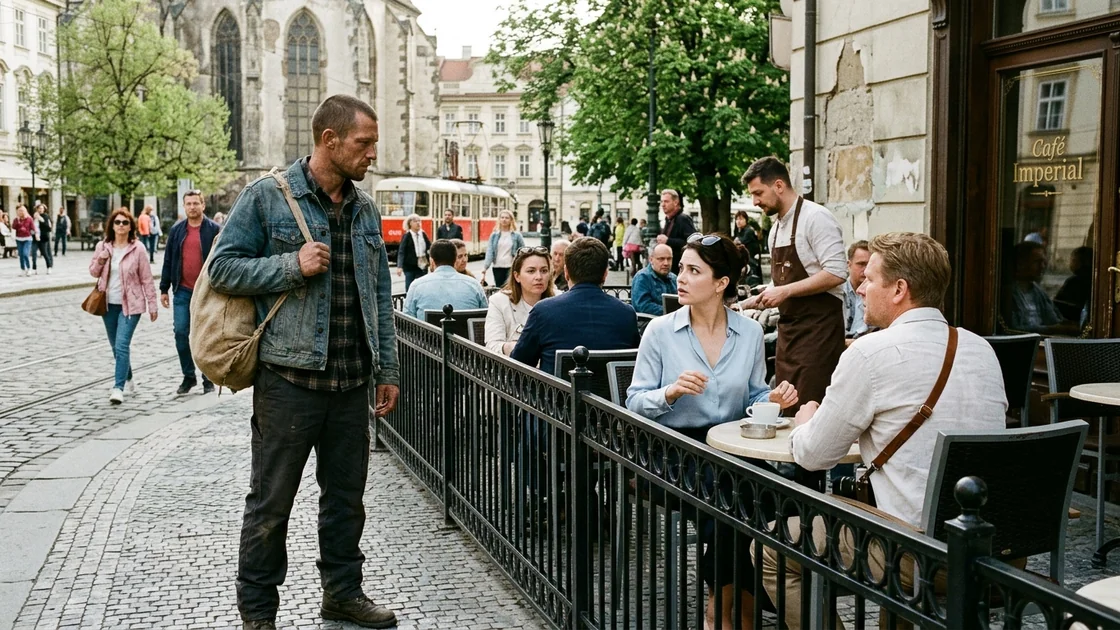
Arthur Pendelton gave up his entire life in Chicago to follow Katarina to the bleak, rain-slicked port city of Ostrov, believing their whirlwind romance was enough to sustain him in a strange land. Six months after arriving, he wakes up to an empty apartment and a cold note he cannot read, stripped of his life savings and utterly abandoned in a country where he does not speak the language or know a single soul. Left with a rapidly expiring visa and winter closing in, Arthur must navigate the hostile bureaucracy, profound isolation, and incomprehensible streets of a foreign metropolis. Through a grueling descent into poverty and silence, he eventually finds an unlikely lifeline in a deaf baker and a grumpy night-shift janitor, discovering how to rebuild an identity from the ashes of his gullibility without needing to say a word.
The radiator in the corner of the bedroom did not hiss; it clanged, a rhythmic, metallic striking that sounded like a dull iron pipe hitting an anvil. Arthur woke to that sound every morning, and every morning for one hundred and eighty-two days, he had reached across the dip in the mattress to find the warm, curving slope of Katarina’s shoulder.
On the one hundred and eighty-third day, his hand met only the rough, unbleached linen of the bottom sheet.
The sheet was cold. Not the cool of a bed recently vacated for a trip to the bathroom, but the tight, ambient chill of a room where the window didn't quite seal against the Baltic wind.
Arthur sat up, the thin wool blanket pooling around his waist. The gray light of an Ostrov November filtered through the grime on the glass, casting the plaster walls in the color of wet slate. "Kat?" he called out. His voice was thick with sleep, sounding oddly loud in the small room.
No answer came from the galley kitchen. There was no smell of strong, boiled coffee, no sound of the little radio she liked to play in the mornings—the one where rapid-fire consonants and guttural vowels spilled out in news broadcasts he had given up trying to decipher three months ago.
He swung his legs out of bed, his bare feet recoiling from the icy parquet floor. He pulled on the heavy wool sweater he had brought from Illinois, the one that still smelled faintly of cedar closets and a life that made sense, and walked out into the narrow hallway.
The coat hooks by the front door were empty. Her heavy shearling coat—the one he had bought her in October when the first frost hit—was gone. Beneath the hooks, the scuffed wooden rack where she kept her three pairs of winter boots was bare.
Arthur’s heart gave a slow, heavy thud against his ribs. He walked into the living room. The little porcelain icons that usually sat on the mantelpiece above the dead fireplace were missing. He turned and went back to the bedroom, pulling open the double doors of the heavy oak wardrobe.
His clothes hung on the left side: two suits, four flannel shirts, three pairs of jeans, and a heavy parka. They looked pathetic, huddled together like refugees. The right side of the wardrobe was a cavernous wooden void. Half a dozen wire hangers swung gently on the brass rod, chiming softly against one another in the draft.
On the small wooden table in the kitchen, weighted down by a solitary brass key, was a piece of folded lined paper.
Arthur picked it up. His hands were trembling slightly, a minor tremor in his thumbs that he tried to still by pressing them hard against the paper's edge. He unfolded it.
The handwriting was Katarina’s—sharp, slanted, and uncompromising. He had seen her write grocery lists in this script. In Chicago, when she was working on a tourist visa at the boutique hotel near the river, she used to leave him little notes in English. Buy milk, my love. Wait for me at eight. Her English had been charmingly broken then, a melodic puzzle he loved to solve.
This note was not in English.
It was three lines of dense, jagged script, peppered with diacritical marks—little hooks and slashes above the c’s and s’s and z’s that changed the sounds in ways his American tongue could never quite master. He stared at the ink. The only part he recognized was his own name at the top—Artur, spelled their way, without the 'h'—and her initial at the bottom. K.
He didn't need a dictionary to read the silence of the apartment. The silence was fluent in every language.
He pulled his phone from the pocket of his sweatpants. He tapped her contact icon. The phone didn't even ring; it went straight to a recorded voice—a woman speaking rapidly in the local tongue, followed by a sharp, finality-laden beep. The number had been disconnected. He opened his messaging app. Her profile picture was gone, replaced by a gray silhouette.
Panic, cold and greasy, began to rise in his throat. He opened his banking app, logging into the joint account they had set up at the Národní Banka two months ago. They had needed a local account to sign the lease on this apartment, and because Arthur was here on a six-month tourist entry while they supposedly prepared the paperwork for their civil union, the account had been opened primarily in her name, with him as a secondary signatory. He had wired forty-two thousand dollars—the entirety of his savings after selling his Honda, his furniture, and cashing out his modest 401(k)—into that account to prove to the immigration ministry that they were self-sufficient.
The app loaded. The interface was in the local language, which he navigated by memory, clicking the blue button on the left.
The balance read: 412,50 K.
In American money, it was roughly seventeen dollars.
Arthur sat down on the edge of the wooden kitchen chair. The wood bit into the backs of his thighs. He stared at the screen until the display dimmed and went black, reflecting his own pale, unshaven face back at him.
He was thirty-four years old. He was four thousand miles from Chicago. He did not know the word for "police," "help," or "thief." He did not have a single friend in the northern hemisphere west of the Atlantic. And in eleven days, the purple stamp in his passport would expire.
The first forty-eight hours were spent in a state of suspended disbelief, a pathetic vigil kept in an apartment that was rapidly losing its heat. Arthur convinced himself that it was a misunderstanding. Perhaps her mother in the south had fallen ill, and she had taken the money for an emergency surgery, unable to explain it to him in English in her haste.
It was a lie so transparent that he felt ashamed even formulating it in the privacy of his own skull.
He remembered the last two months with a sudden, terrifying clarity. When they had first arrived in May, Ostrov had been bathed in a pale, deceptive golden light. They had walked along the stone embankments of the Vltavka river, drinking cheap, bitter beer at wooden tables, laughing when Arthur accidentally ordered pickled herring instead of roast pork. She had been his translator, his tether, his lens. The city was a romantic, crumbling backdrop to their great leap of faith.
Then the autumn rains began. Katarina started going out alone in the evenings, claiming she was meeting an old school friend who worked at the ministry to "grease the wheels" for his residency permit. She stopped speaking English in the apartment, growing irritated when he didn't understand her rapid requests to take out the trash or buy bread. "You live here now, Artur," she had snapped three weeks ago, her eyes hard and dark like wet coal. "You are like a baby. A big, deaf baby."
He had tried to learn. He bought a thick grammar book with a yellow cover from an international bookstore near the central station. He spent hours at the kitchen table, trying to memorize the seven grammatical cases, how every noun changed its ending depending on whether you were looking at it, giving something to it, or standing next to it. He would practice a phrase for an hour—Prosím, jeden chléb (Please, one bread)—only to go to the corner shop and have the cashier bark a rapid follow-up question at him that wasn't in the book. When he froze, stammering, the people in line behind him would sigh, a collective, heavy exhalation of Slavic impatience that made him shrink into his collar. Eventually, he stopped speaking altogether, pointing at things and holding out large bills, letting them take whatever coins they wanted.
By the third day after her disappearance, the hunger drove him out of the apartment.
He had eaten the last of the stale rye bread and a tin of sardines he found at the back of the cupboard. He took the brass key off the table, put on his parka, and stepped out into the stairwell. The building smelled of boiled cabbage, damp wool, and decades of cheap tobacco.
As he reached the ground floor, the door to the tiny ground-floor flat swung open. Paní Nováková, the landlady, stood in the threshold. She was a squat woman of seventy with hair dyed the color of an eggplant and eyes that missed nothing behind thick, square spectacles.
She blocked his path to the heavy street door, folding her arms over her floral housecoat, and unleashed a torrent of words.
"Dobrý den," Arthur said weakly, using one of the five phrases he knew. Good day.
She didn't care what kind of day it was. She tapped her wrist, then pointed up at the ceiling, then rubbed her thumb and index finger together—the universal, unmistakable gesture for money.
"Katarina," Arthur said, pointing toward the street. "Katarina... gone. She had the money."
Paní Nováková’s face hardened. She didn't know the English words, but she knew the tone of a man who couldn't pay. She stepped closer, jabbing a thick, arthritic finger toward the calendar hanging inside her hallway. It was the first of the month.
"Katarina," she spat the name out like a piece of gristle, followed by a string of harsh, sibilant words. She mimed carrying heavy suitcases, holding her hands out at her sides, and then pointed toward the street, making a sound like an engine revving. Vroom. Then she held up two fingers.
Arthur stared at her. "Two? Two people?"
The old woman nodded grimly, her eggplant curls bobbing. She held up her right index finger: "Katarina." She held up her left index finger, tapping it against the first, and lowered her voice to a gruff baritone: "Muž."
Muž. Man. That word was in Chapter One of the yellow book.
Katarina hadn't left alone. A man had helped her carry her bags down the stairs while Arthur was asleep, or perhaps the day before when he had taken his long, aimless walk through the park to give her "space."
Paní Nováková held out her palm, flat and demanding. "Nájem," she said. Rent. "Dnes." Today.
Arthur reached into his pockets. He pulled out his wallet, opening it to show her the empty leather folds. He pulled out a handful of small, brass-colored coins—maybe four dollars' worth—and held them out. "I don't have it," he whispered, his throat constricting. "She took everything."
The landlady looked at the coins, then up at his face. For a fraction of a second, something like pity flickered behind her thick lenses, recognizing the absolute ruin of the foreigner standing before her. Then, the pragmatic survival instinct of a woman who had lived through two regime changes and a collapsed economy took over. Pity didn't pay for the coal delivery.
She held up three fingers. "Tři dny," she said, her voice dropping to an iron register. She pointed at him, then at the street, and made a sweeping motion with her arm. Three days. Out.
He went to the police station first. It was a brutalist concrete block three streets over, smelling of wet dog and floor wax. He waited on a plastic bench for two hours before a young officer with a buzzcut and a bored expression called him to a glass partition.
"Do you speak English?" Arthur asked, leaning close to the circular metal grate in the glass.
The officer frowned, shaking his head slightly. "Malinko," he said, pinching his thumb and forefinger together. A little.
"My girlfriend," Arthur said, speaking slowly, trying to keep the hysteria out of his voice. "We had a bank account. She took forty thousand dollars. She left me."
The officer stared at him, translating the words in his head. "Girlfriend? Wife?"
"Girlfriend. Fiancée."
"Bank account... her name?"
"Both our names. Joint. Společný," Arthur said, pulling a word from the memory of the day they signed the papers.
The officer shrugged, his heavy shoulders rising and falling beneath his dark blue uniform shirt. "If her name on bank... it is her money. Not police problem. Civil problem. You get lawyer."
"I don't have money for a lawyer! She took it all!" Arthur’s voice cracked, echoing off the tiled walls of the lobby. An old man waiting by the door looked up at him with cold curiosity.
The officer’s eyes narrowed at the raised voice. He tapped the counter. "Passport."
Arthur hesitated, then slid his blue U.S. passport under the glass slot. The officer flipped through it, finding the entry stamp. He looked at the date, then up at the clock on the wall.
"You tourist," the officer said, his English suddenly sufficient for the task of dismissal. "Ten days, you go home. No money, you go to embassy. Next."
The embassy was in the capital, two hundred miles away. A train ticket cost three hundred crowns. Arthur had eighty-six crowns in his pocket and four hundred in the bank. Even if he got there, what would the embassy do? Give him a loan he had to pay back, put him on a plane back to Chicago where he had no apartment, no car, no job, and a family he had alienated when he told them he was leaving everything for a woman he’d known for four months? His brother had called him an idiot at O'Hare. The thought of calling Mark now, begging for wire transfers, felt worse than freezing to death in the Vltavka.
He walked back out into the gray drizzle. The city seemed to press in on him, its Gothic spires and crumbling Baroque facades leering down like gargoyles. The street signs were an aggressive jumble of consonants: Hviezdoslavova, Křížkovského, Náměstí Republiky. They looked like words designed to keep outsiders from ever finding their way home.
He spent the next two days trying to sell his possessions. He took his laptop—a three-year-old MacBook—to a pawnshop near the tram depot with a neon sign that read ZASTAVÁRNA.
The man behind the wire mesh took one look at the American keyboard layout, saw the desperation in Arthur’s hollow eyes and unwashed hair, and wrote a number on a scrap of paper. It was a fifth of what the machine was worth.
Arthur tried to argue, holding up ten fingers and pointing at the screen, saying "More, please, více." The man simply pushed the laptop back across the counter and turned back to his television. Arthur took the money.
He sold his watch—a gift from his father when he graduated college—for enough to buy two weeks in a hostel. He packed his two suits, his flannels, and the yellow grammar book into his single large suitcase, left the brass key on the kitchen table on top of Katarina's note, and slipped out of the apartment building before the sun came up on the third day, terrified of facing Paní Nováková again.
The hostel was called U Nádraží—By the Station—though Arthur only knew it by the faded blue sign showing a pictograph of a bed. It was located in a district of Ostrov where the tourists never went, a neighborhood of soot-blackened tenement blocks and abandoned textile factories near the rail yards.
It wasn't a backpacker hostel with guitars and pub crawls. It was a dormitory for transient laborers—men from Ukraine, Romania, and the poorer eastern provinces who came to Ostrov to lay bricks and haul scrap metal.
Arthur was given a top bunk in a room with seven other men. The air inside was a thick soup of unwashed bodies, wet work boots, garlic, and cheap vodka. Nobody spoke English. In fact, the men barely spoke to each other. They came in at dark, their hands cracked and bleeding from the cold mortar, ate bread and lard from plastic bags, stared at their phones, and slept like the dead.
Arthur became a ghost among them. He learned to make himself small. He kept his suitcase chained to the iron frame of the bunk bed and slept with his passport and the remaining pawnshop cash taped to his chest inside a plastic bag.
When the ten days were up, the purple stamp in his passport quietly expired. There were no sirens. The sky didn't fall. He simply crossed an invisible line from being a tourist to being a shadow. He was now undocumented, an illegal alien in a post-Soviet industrial port.
The money from the laptop and the watch lasted until the first week of December. By then, the rain had turned to snow—not a clean, powdery snow, but a gray, industrial slush that soaked through the soles of his American boots.
He needed work. Without a work permit or the language, the formal economy was a fortress with fifty-foot walls. He walked the streets from dawn until dusk, looking into the windows of restaurants and warehouses, miming the act of washing dishes or lifting boxes to stone-faced managers who waved him away like a stray dog.
He was down to his last thirty crowns—about a dollar and twenty cents—when he found the bakery.
It was four in the morning. He hadn't slept well; a Romanian mason in the bunk below had been coughing up his lungs all night, and the hostel's radiator had broken. Arthur was walking through the narrow, cobbled alleys of the Old Quarter, trying to keep his blood moving, when a wave of warm, yeasty air hit him in the face from a basement grate.
He stopped and stood on the grate, letting the heat rise up through his wet trousers. It smelled like heaven—like caraway seeds, scorched flour, and woodsmoke.
A heavy wooden door set into the stone wall beside the grate banged open. A man stepped out into the alley, struggling to drag a hundred-pound sack of flour off a wooden pallet that had been left by an early delivery truck.
The man was old, at least sixty-five, with a barrel chest, forearms like knotted oak branches, and a white apron smeared with gray ash. As he heaved the third sack, his boot slipped on a patch of black ice. He went down hard on one knee with a grunt, the sack tumbling off the pallet and threatening to split open against the cobblestones.
Arthur didn't think. He stepped off the grate, grabbed the top ears of the burlap sack, and hoisted it up, taking the weight into his own back before the stitched seam could burst.
The old man looked up, rubbing his bruised knee. He barked something harsh and guttural at Arthur.
Arthur didn't say a word. He had learned that speaking English only confused or angered people here; it marked him as a complication, an anomaly they didn't have the energy to process at four in the morning. Instead, he simply nodded toward the open basement door, hoisted the sack onto his shoulder, and carried it down the steep stone steps.
The basement was dominated by a massive brick oven that radiated a fierce, dry heat. Long wooden tables dusted with flour stretched across the low-vaulted room. Arthur set the sack down next to a row of others against the far wall, turned around, and went back up the stairs.
There were twelve more sacks on the pallet. The old man stood by the door, watching him with narrowed, suspicious eyes beneath bushy white eyebrows. Arthur didn't look at him. He just grabbed the next sack, threw it over his shoulder, and carried it down. By the sixth sack, his back was screaming and sweat was cutting tracks through the grime on his neck. By the twelfth, his knees were shaking from lack of food.
When the pallet was empty, Arthur lifted the wooden frame itself, leaned it neatly against the alley wall, and brushed the white dust from his parka. He nodded once at the old man and turned to walk away.
A heavy hand clamped onto his shoulder. The grip was like a bench vise.
Arthur froze, turning slowly. The old man was staring closely at his face, taking in the sunken cheeks, the dark hollows under his eyes, and the desperate, hunted look that Arthur hadn't seen in a mirror for two weeks.
The baker pointed down the stairs. Then he pointed at a pile of black iron baking sheets crusted with burnt sugar and grease sitting in a massive concrete sink. He held up a heavy wire brush. Then, he picked up a round, dark loaf of rye bread from the cooling rack and held it in his other hand.
Brush. Bread.
It was the first sentence anyone had spoken to him in a month that he understood completely.
Arthur walked down the stairs, took off his parka, and picked up the wire brush.
The baker’s name was Milan, though Arthur didn't learn that for three weeks. What he learned on the third day was why Milan hadn't been bothered by Arthur’s silence.
At six in the morning, a young woman arrived to open the storefront above the basement. When she came down to collect the first trays of rohlíky—the crescent-shaped white rolls the locals ate by the millions—she didn't speak to the old man. Instead, she tapped the wooden table twice so he would feel the vibration, waited for him to look up, and moved her hands in rapid, fluid shapes.
Milan was deaf. The guttural sound he had made in the alley hadn't been a word; it had just been the grunt of a man who lived in a world without noise.
For Arthur, this revelation felt like a reprieve from God. In that hot, flour-choked basement, the crushing weight of the Czech-Slavic grammar simply ceased to exist. There were no seven cases here. There were no masculine animate plurals or palatalized consonants to trip his tongue and expose him as a fool. There was only weight, heat, dirt, and motion.
Milan communicated through taps, points, and demonstrations. If Arthur scrubbed a pan too slowly, Milan would thump the side of the concrete sink with a wooden peel, take the brush, and scrub with ferocious, circular violence for five seconds before shoving it back into Arthur’s raw, blistered hands. If Arthur stacked the firewood too close to the oven door, Milan would yank him back by the collar and point to the scorch marks on the ceiling.
He worked from four in the morning until ten. At ten, Milan would hand him two hundred crowns—about eight dollars—a loaf of yesterday’s bread, and sometimes three or four bruised apples that weren't good enough for the strudel.
Two hundred crowns was enough for the hostel bunk (which cost one hundred and fifty a night) and a packet of cheap pork sausages or a block of hard cheese from the discount market.
In the afternoons, to stay warm without burning calories walking the streets, Arthur went to the municipal library. It was a grand, nineteenth-century building with high ceilings and brass reading lamps. Nobody asked for an ID card just to sit at the long oak tables.
He would sit in the back corner, smelling faintly of yeast and woodsmoke, and open the yellow grammar book.
Before, when he lived with Katarina, he had studied the language like a student cramming for an elective he didn't care about—lazily, resenting its difficulty, waiting for his teacher to give him the answers. Now, he studied it like a prisoner studying the blueprints of his jail.
Every word was a tool he needed to survive. He stopped trying to learn polite conversational phrases like Where is the museum of modern art? Instead, he used the library’s battered English-local dictionary to look up the words of his new reality.
Mouka (Flour). Voda (Water). Oheň (Fire). Bolest (Pain). Kolik? (How much?).
He wrote them on scraps of flour-sack paper with a stubby pencil, memorizing them until his eyes watered. He began listening to the librarians when they spoke to patrons, picking out the rhythm of the sentences, noticing how the stress always fell on the very first syllable of every word, like a hammer striking a nail.
One afternoon in late December, just before Christmas, he returned to the hostel to find his suitcase sitting in the snow outside the front door.
Arthur ran up the concrete steps and tried the handle. The door was locked from the inside. Through the frosted glass, he saw the hostel manager—a thick-necked man with a shaved head named Pavel—standing behind the reception desk.
Arthur banged on the glass. Pavel walked over and opened the small sliding window set into the door, letting out a blast of warm, cabbage-scented air.
"Policie," Pavel said curtly, tapping the side of his nose. He held up a piece of paper—a standard municipal registration form. Every hostel had to report the passport numbers of its guests to the foreign police once a month. Pavel had clearly been pocketing Arthur's cash off the books for weeks, but a routine inspection was coming. He pointed at Arthur, then drew his finger across his own throat. "Problém. Ty jít." Problem. You go.
"Prosím," Arthur said, his breath pluming white in the freezing air. "Jeden noc. One night."
Pavel slammed the little window shut and drew the curtain.
Arthur stood on the steps as the early winter dusk settled over the rail yards. The temperature was ten degrees below freezing. If he slept outside tonight, he wouldn't wake up tomorrow.
He picked up his suitcase—it was lighter now, as he had sold his two suits the week before for boot repairs—and began to walk back toward the Old Quarter.
He arrived at the alley behind the bakery at seven in the evening. The shop upstairs was dark and shuttered. The iron grate over the basement window was cold; the big brick oven was banked for the night, holding just enough heat deep in its masonry for the four a.m. firing.
Arthur sat down in the recessed stone doorway of the basement, pulling his knees up to his chest and using the suitcase as a windbreak. By ten o'clock, he couldn't feel his toes. By midnight, he was shivering so violently that his teeth clicked together like castanets. He was slipping into that dangerous, warm drowsiness that precedes hypothermia when the heavy wooden door suddenly swung inward.
Arthur tumbled backward down the top two stone steps, his stiff limbs refusing to catch him.
Milan stood over him, holding a heavy iron poker in one hand and a flashlight in the other. The old man wore a thick flannel nightshirt under an overcoat; he lived in a tiny room behind the coal cellar and had evidently felt the thud of Arthur's body or smelled the cold air seeping under the door.
The beam of the flashlight hit Arthur's blue lips, then dropped to the suitcase at the top of the stairs.
Milan didn't need anyone to sign the story for him. A man with a suitcase at midnight in December only had one story.
The old baker reached down with his free hand, grabbed the front of Arthur’s parka, and hauled him down the rest of the stairs, kicking the suitcase down behind him before slamming and bolting the heavy oak door.
He dragged Arthur over to the brick oven. Even banked, the bricks were warm to the touch. Milan opened a small iron door on the side of the masonry—the proofing cupboard, where dough was put to rise in the residual heat—letting a wave of ninety-degree air spill out into the room. He shoved Arthur onto a stack of empty burlap flour sacks right next to the warm bricks, threw an old horsehair blanket over him, and turned off the light.
Arthur lay on the rough burlap, pressing his frozen hands directly against the warm mortar of the oven. For the first time since he had woken up in the empty apartment, he cried—silent, wracking sobs that didn't make a sound in the dark, deaf basement.
The next morning, Arthur didn't leave at ten. When the morning bake was finished, Milan pointed to the narrow space behind the brick chimney where the firewood was stacked. There was a gap about six feet long and four feet wide between the warm back of the oven and the stone foundation wall.
Milan threw an old foam mattress into the gap. Then he held up two fingers, pointed to the clock on the wall, and made a sweeping motion across the floor of the upstairs shop.
Arthur understood. Instead of two hundred crowns, he would get one hundred, the mattress behind the chimney, and he had to clean the upstairs shop in the evening after the girl went home.
He had a home. It was four feet wide, smelled permanently of wood ash and yeast, and had no running water other than the cold tap over the concrete sink, but it was fifty degrees warmer than the street.
As January bled into February, Arthur’s hands changed. The soft palms of an American office worker—he had been a logistics coordinator for a mid-sized paper company in Chicago, a job spent entirely on keyboards and headsets—split, bled, calloused, and hardened into thick leather pads. His shoulders broadened from hauling the fifty-kilo sacks of rye meal; his waist shrank until he had to punch two new holes in his belt with an ice pick.
He learned to read the dough. Milan taught him without words, taking Arthur’s hands and plunging them into the massive wooden troughs of fermenting starter. He made Arthur feel the difference between dough that was slack and lifeless and dough that was tight, elastic, and ready for the peel. He showed him how to slash the tops of the loaves with a razor blade just before they went onto the hot hearth stones, and how to throw a cup of water into the roaring firebox to create the burst of steam that gave the bread its blistered, mahogany crust.
Yet, despite the sanctuary of the basement, the isolation of his mind was a slow poison. He hadn't had a conversation with another human being in three months. Sometimes, late at night behind the chimney, he would whisper English words to himself just to make sure his vocal cords still worked. Chicago. Lake Michigan. Coffee with cream. My name is Arthur Pendelton. The words sounded alien, thin, and meaningless, like incantations from a dead religion.
He needed more money if he was ever going to get out of this basement, pay the inevitable fine for overstaying his visa, and buy a plane ticket—or figure out a way to exist legally. One hundred crowns a day barely bought enough calories to fuel the labor Milan demanded.
In February, the girl who worked the upstairs counter—her name was Tereza, and she treated Arthur with a cool, nervous politeness, clearly aware that he was an illegal living behind the oven—left an advertisement from a local free paper on the worktable. She tapped it and looked at Arthur before going home.
Arthur took the paper to his corner and pulled out his pocket dictionary.
ÚKLIDOVÁ FIRMA HLEDÁ PRACOVNÍKY. NOČNÍ SMĚNA. PLATBA V HOTOVOSTI.
Cleaning company looking for workers. Night shift. Payment in cash.
At the bottom was an address in the industrial zone near the river port and a time: 20:00.
That evening, after scrubbing the bakery tiles, Arthur walked the three miles to the port through a biting wind. The address was a vast, communist-era municipal slaughterhouse and meatpacking plant that was currently being converted into a commercial cold-storage facility.
A dozen men were gathered outside a rusted metal door—mostly older men with the red, broken-veined noses of chronic alcoholics, and a few young guys with central Asian features. A foreman with a clipboard came out, counted heads without asking for a single name or document, and led them inside.
The job was simple and brutal: scraping decades of congealed tallow, rust, and grime off the tiled walls of the old meat lockers using long-handled steel scrapers and industrial acid wash, from nine at night until three in the morning.
It was during his second week at the meat plant that Arthur met Jozef.
They were working in Locker Four, a cavern of cracked white tile that smelled of bleach and ancient blood. Arthur was on a ladder, his goggles fogged, chipping away at a thick crust of grease near a ceiling vent, when the bottom rung of the rusted aluminum ladder suddenly sheared off.
The ladder kicked out sideways. Arthur dropped ten feet, landing hard on his hip on the slick tiles, the heavy steel scraper flying out of his hand and slicing across the back of his left forearm as it clattered to the floor.
He lay there, the wind knocked out of him, watching a dark ribbon of blood well up through the tear in his flannel shirt and mix with the grey acid water on the floor.
A pair of heavy rubber boots splashed into his field of vision. An older man with a thick gray mustache, wearing a faded blue railway worker’s cap, looked down at him.
"Kurva," the man muttered. It was the universal curse word of Eastern Europe, the one word Arthur had heard a thousand times in the hostel and the streets.
The man reached down, grabbed Arthur’s good arm, and helped him sit up against the wall. He looked at the cut on Arthur’s forearm. It was about three inches long, gaping slightly, though it hadn't hit an artery.
"Mluvíš česky?" the man asked, pulling a surprisingly clean cotton handkerchief from his coveralls. Do you speak the language?
Arthur shook his head, clenching his jaw against the sting of the acid mist hitting the open wound. "Trochu," he gasped out. A little. "Jsem Američan." I am American.
The old man stopped tying the handkerchief around Arthur's arm and stared at him. He looked at Arthur’s filthy parka, his flour-stained jeans, his raw, baker's hands, and the bleeding gash on his arm. Then, he let out a short, barking laugh that turned into a smoker’s cough.
"Američan," the man repeated, shaking his head in sheer, cynical wonder. "Co dělá Američan v tomto pekle?" What is an American doing in this hell?
Arthur knew enough words now to piece the question together. Co (what), dělá (makes/does), peklo (hell—a word he had looked up in the library one bleak Sunday).
Arthur looked down at the bloody rag on his arm. He thought about how to explain the whole stupid, pathetic tragedy in the fifty words he possessed.
"Žena," Arthur said quietly. Woman.
He pointed to his heart. "Láska." Love.
Then he made the gesture Paní Nováková had made months ago—sweeping his hands apart into nothingness—and turned his empty pockets inside out. "Konec." The end.
The old man stared at him for a long time. The cynicism faded from his watery blue eyes, replaced by a deep, fraternal recognition. He finished tying the knot on the handkerchief with a firm tug, patted Arthur’s shoulder, and sat down next to him on an overturned plastic bucket, pulling a crushed pack of Petra cigarettes from his pocket.
He offered one to Arthur. Arthur didn't smoke, but he took it anyway. The man lit both with a brass lighter.
"Já jsem Jozef," the man said, tapping his chest. He pointed toward the door, out toward the city. "Moje žena... před deseti lety." My wife... ten years ago. He mimed someone drinking from a bottle, then pointed to the ground, making the sign of a cross. Drank herself into the grave. Then he tapped his own chest again and pointed around the filthy meat locker. "Teď jsem tady." Now I am here.
They sat together in the stinking, bleach-fumed cold for ten minutes, smoking the harsh tobacco, two men at the bottom of the world who had arrived there by different roads.
When the foreman’s heavy footsteps echoed in the corridor, Jozef stood up, helped Arthur to his feet, and picked up the broken ladder, hiding the snapped rung against the wall so the foreman wouldn't dock Arthur's pay for damaging equipment.
"Drž se, Američan," Jozef muttered, picking up his scraper. Hold on, American.
Having a name—even if it was just "Američan"—and a voice to hear it every night changed the chemistry of Arthur’s brain. The gray fog of isolation began to lift.
Every night at midnight, during the twenty-minute break at the meat plant, Jozef would sit with Arthur on the loading dock. Jozef became Arthur’s teacher. He wasn't a gentle teacher; he was a former machinist from the shipyards who spoke a rough, working-class dialect, and he found Arthur’s pronunciation hilarious.
Jozef would point to things on the loading dock and force Arthur to name them, correcting his grammar with a flick to the ear if he got the endings wrong.
"To je železo," Jozef would say, kicking a steel girder. That is iron. "S železem." With iron. "Bez železa." Without iron.
"Bez železa," Arthur would repeat, his breath steaming in the freezing air.
"Dobře. Nejsi úplně blbý." Good. You aren't completely stupid.
By March, Arthur was sleeping only three hours a day—from ten in the morning until one in the afternoon behind the bakery oven, and another hour on the floor of the meat plant locker room before the shift started—but he was saving three hundred crowns a day. He kept the cash rolled tightly inside an empty metal yeast tin buried under the coal pile in Milan’s cellar.
More importantly, he was no longer invisible. When he went to the discount grocery store now, and the cashier barked, "Tašku chcete?" (Do you want a bag?), he didn't freeze while the line sighed behind him. He looked her in the eye and said, "Ne, děkuji, mám vlastní," (No, thank you, I have my own), in a voice roughened by coal smoke and bleach. The cashiers didn't smile—nobody smiled at the discount market—but they nodded, treating him like any other tired working man in Ostrov.
He was becoming part of the masonry of the city.
In early April, the ice on the Vltavka river broke with shots like cannon fire, and the gray slush finally washed down into the storm drains.
On a Tuesday morning, Milan suffered a minor stroke.
It happened at five in the morning while they were pulling the first batch of thirty-pound sourdough loaves from the hearth. Milan was wielding the twelve-foot wooden peel when his right side suddenly went slack. The heavy wooden paddle clattered to the stone floor, and the old man slumped against the flour table, his right hand clawing uselessly at his apron, his mouth pulled down at one corner.
Arthur caught him before his head hit the flagstones.
Six months ago, Arthur would have panicked, running into the street screaming in English for an ambulance while the old man died. Now, he gently lowered Milan onto the pile of flour sacks, ran up the stairs to the shop phone behind the counter, and dialed 155.
When the dispatcher answered, Arthur spoke clearly, using the words he had forced himself to memorize from a poster at the library two months ago.
"Dobrý den. Pekařství v Dlouhé ulici číslo osm. Starý muž, asi sedmdesát let. Nemůže hýbat pravou rukou. Nemůže mluvit. Je hluchý. Pospěšte si, prosím."
Good day. The bakery on Long Street, number eight. An old man, about seventy years old. He cannot move his right arm. He cannot speak. He is deaf. Hurry, please.
"Rozumím, sanitka je na cestě," the woman said without hesitation. I understand, the ambulance is on the way.
Arthur unlocked the street door for the paramedics, then ran back down to the basement. The bread was still in the oven. Within three minutes, forty loaves—the entire morning's revenue—would turn to charcoal.
Milan was watching him from the floor, his left eye wide and terrified, tapping his good left hand frantically against his chest and pointing at the oven. For a man like Milan, losing a day's bake was worse than dying.
Arthur looked at theold man, tapped his own chest twice—the sign Milan used for I have it—and picked up the twelve-foot wooden peel.
One by one, he slid the blade under the scorching loaves, balanced the weight on the fulcrum of his calloused palm, and swung them out onto the wooden racks. When the paramedics clattered down the stairs ten minutes later, the oven was empty, the next batch of rolls was proofing in the cupboard, and Arthur was kneeling beside Milan, holding the old man’s good hand.
Milan was in the hospital for ten days. It was a mild ischemia; he would recover most of the use of his arm, the doctors told Tereza, his niece, who worked the counter.
During those ten days, the bakery should have closed. Tereza didn't know how to fire the brick oven or mix the three-stage rye sour.
On the night of the stroke, when Tereza came down to the basement in tears after visiting the hospital, preparing to put a ZAVŘENO (Closed) sign on the door, she found Arthur already mixing the starter for Wednesday morning.
"Ty to umíš?" she asked, wiping her nose with a tissue, staring at the massive trough of dough. You know how to do it?
Arthur scraped the wet dough from his knuckles against the rim of the trough. "Milan mě učil," he said simply. Milan taught me. "Ráno bude chleba." In the morning, there will be bread.
He quit the night shift at the meat plant—telling Jozef to meet him at the bakery back door at six every morning for a hot loaf instead—and did the work of two men for ten days. He mixed five hundred pounds of dough every night, chopped the birch logs for the firebox, swept the hearth with a wet burlap rag attached to a chain, baked four hundred loaves and a thousand rolls, scrubbed the pans, and slept four hours in the afternoon.
Not a single customer in the Old Quarter knew that the old deaf baker wasn't in the basement. The crust was just as dark; the crumb was just as sour and dense.
When Milan returned on the eleventh day, walking slowly down the stone steps with a cane in his right hand and Tereza supporting his left elbow, he stopped at the bottom and looked around.
The brass fittings on the oven doors were polished. The flour sacks were stacked in neat rows by date. On the cooling racks sat eighty round loaves, ticking softly as their crusts cooled in the draft, smelling of caraway and birch smoke.
Milan let go of his niece’s arm, walked over to the racks, and picked up a loaf with his good left hand. He turned it over, tapping the bottom with his knuckles. It gave a hollow, drum-like thump—the mark of a perfectly baked loaf.
The old man turned to Arthur, who stood by the sink with a wet rag in his hands. Milan set the bread down, walked over, and placed his heavy left hand on the side of Arthur’s neck, squeezing once, hard, the way a father grips a son who has come back from a war.
Then Milan turned to Tereza and began signing rapidly with his left hand, his face stern and commanding.
Tereza watched her uncle’s hand, her eyes widening slightly. She nodded, signed something back, and looked at Arthur.
"Můj strýc říká," Tereza said slowly, making sure Arthur understood, "že už nemůže dělat těžkou práci sám. Ptá se, jestli máš papíry."
My uncle says that he cannot do the heavy work alone anymore. He asks if you have papers.
Arthur’s stomach dropped. Here it was. The end of the road. He looked at the floor, then raised his head and met Tereza’s eyes, refusing to lie to the people who had kept him from freezing to death.
"Nemám," Arthur said. "Moje vízum skončilo v listopadu." I don't have them. My visa ended in November.
Tereza translated this to Milan with three quick movements of her hand. The old man didn't even blink. He just grunted, waved his hand dismissively, and signed another rapid sequence to his niece.
"Strýc říká, že to nevadí," Tereza translated, a small, dry smile touching the corners of her mouth. "Manžel mojí sestry pracuje na cizinecké policii. Uděláme ti pracovní smlouvu jako pekař. Budeš muset zaplatit pokutu, ale dostaneš vízum. A v patře nad obchodem je malý pokoj, kde nikdo nebydlí."
My uncle says it doesn't matter. My sister's husband works at the foreign police. We will make you a work contract as a baker. You will have to pay a fine, but you will get a visa. And on the floor above the shop, there is a small room where nobody lives.
Arthur stood by the concrete sink, the flour dust settling on his eyelashes. He had enough money in the yeast tin under the coal pile to pay the overstay fine.
"Děkuji," Arthur said. His voice didn't crack. He looked at Milan and tapped his own chest twice.
By May, the linden trees along the Vltavka embankments were in bloom, filling the city with a sweet, honeyed scent that drifted even into the narrow stone alleys of the Old Quarter.
Arthur now lived in the attic room above the bakery. It had a slanted ceiling, a real iron bedstead, a small sink with running cold water, and a window that looked out over the red clay tiles of the city's roofs toward the river. He had a laminated residency card in his wallet that identified him as a skilled artisanal baker—a trade that happened to be on the municipal shortage list, which, combined with three bottles of plum brandy delivered by Milan to Tereza’s brother-in-law at the ministry, had erased the five months of illegal overstay with a rubber stamp and a five-thousand-crown fine.
On Sundays, the bakery was closed.
Every Sunday afternoon, Arthur would put on a clean flannel shirt, take two fresh loaves of braided poppy-seed bread, and walk down to the small beer garden by the river docks to meet Jozef.
They would sit at a scarred wooden table under the chestnut trees, drinking ten-degree draft beer from heavy glass mugs. They talked about the price of coal, the incompetence of the city council, the football results, and the weather. Arthur still made mistakes with his verb aspects—confusing when an action was completed with when it was ongoing—and his accent would always mark him as an outsider from across the ocean, a curiosity that made the waitresses look twice when he ordered.
It was on the third Sunday in May, while he was walking back from the river alone, that he saw her.
He was crossing Náměstí Republiky—Republic Square, a name that no longer looked like a jumble of hostile letters to him, just a place where the #4 tram turned toward the station. The afternoon sun was warm and bright. People were sitting outside at the expensive cafés that lined the square, drinking tiny cups of espresso and eating cream cakes.
Arthur was walking past the wrought-iron railing of the Café Imperial, carrying his empty bread sack over his shoulder, when a laugh caught his ear.
It was a high, melodic laugh, followed by a voice speaking English with a heavy, charmingly broken cadence.
"No, darling, you must try the plum cake, it is traditional here..."
Arthur stopped on the cobblestones.
Ten feet away, sitting at a small round table just inside the railing, was Katarina.
She was wearing a pale blue silk blouse he had never seen before, her dark hair pinned up beneath a stylish sunglasses band. Sitting across from her was a man in hisearly forties with sandy hair, wearing a crisp linen shirt, a brand-new leather camera strap around his neck, and the unmistakable, eager, slightly bewildered expression of a Western tourist who had just fallen madly in love. By the sound of his accent when he replied to her, he was British, maybe from London.
Arthur stood completely still as the foot traffic of the square flowed around him.
For six months, in the freezing dark behind the chimney and in the bleach-fumed misery of the meat lockers, he had fantasized about this exact moment. He had imagined grabbing her by the shoulders, screaming at her in the street, dragging her to the police station, demanding his forty thousand dollars back, asking her why she had left him to die in a country where he couldn't even ask for a glass of water.
He looked at her now. He saw the way she leaned across the table, touching the British man's wrist with her manicured fingers, tilting her head with that exact same mix of vulnerability and mystery she had used on a rainy Tuesday in Chicago a year ago.
It wasn't personal. It had never been personal. She was a predator, and this city was simply her hunting ground. The money was long gone, spent on silk blouses and trips to Vienna or Berlin to find the next mark.
As Arthur watched, Katarina turned her head slightly to signal the waiter, and her eyes swept across the sidewalk.
She looked directly at him.
At first, her gaze slid right past him—registering only a tall, lean man in a faded denim jacket and heavy work boots, with close-cropped hair, a face weathered by wind and oven heat, and hands that looked like they could bend iron bars. He looked nothing like the soft, slightly pudgy, anxious American office worker she had left asleep in November.
Then, six inches past his face, her eyes snapped back.
The color drained from her cheeks so fast it looked like someone had pulled a plug. Her mouth fell slightly open. Her hand froze mid-air, the silver bracelet on her wrist glinting in the sun. For a second, she looked terrified, glancing wildly toward the café door as if calculating how fast she could run before he vaulted the iron railing and strangled her.
The British man noticed her sudden stillness and turned in his chair, following her gaze to the man standing on the sidewalk. "Kat? Everything alright?" the man asked, frowning slightly at Arthur.
A waiter walked up to their table just then, holding a notepad. "Prosím, máte vybráno?" the waiter asked. Have you chosen?
Katarina was staring at Arthur, paralyzed, unable to answer the waiter, waiting for the explosion of American rage that would ruin her new game right in front of her new prize.
Arthur looked at her pale, terrified face. He looked at the soft, clean, clueless man sitting across from her. He thought about the forty-two thousand dollars. With that money, he had bought a dead-end life with a liar who called him a deaf baby. Without it, he had bought his own spine, a trade in his hands, a room above the roofs, an old deaf man who needed him at four in the morning, and a grumpy machinist who saved him the corner seat at the river pub.
It had been an expensive tuition, he realized, but he had graduated.
Arthur didn't vault the railing. He didn't shout in English.
Instead, he looked past her, directly at the waiter, and nodded toward Katarina’s table.
"Ta dáma už zaplatila," Arthur said in calm, gravelly, unmistakable local slang. The lady has already paid. "Ale ten pán by si měl dát pozor na peněženku." But the gentleman should watch his wallet.
The waiter blinked in surprise, looking from the rough-looking baker on the pavement down to the pale woman in the silk blouse, a flicker of local understanding crossing his face.
Katarina flinched as if Arthur had slapped her. Hearing him speak her language—hearing the flat, hard cadence of an Ostrov working man coming out of the mouth of the victim she had left voiceless—broke something behind her eyes. She looked smaller suddenly, cheap and transparent in the bright May sunlight.
"What did he say?" the British man asked, looking nervously at Katarina. "Do you know him?"
Arthur didn't wait to hear what lie she would invent. He adjusted the empty bread sack on his shoulder, turned his back on the café, and walked down the cobbled street toward Long Alley. It was four o'clock in the afternoon. In two hours, he had to go down to the cellar and feed the starter for tomorrow’s bake.