The Second Setting at the Table
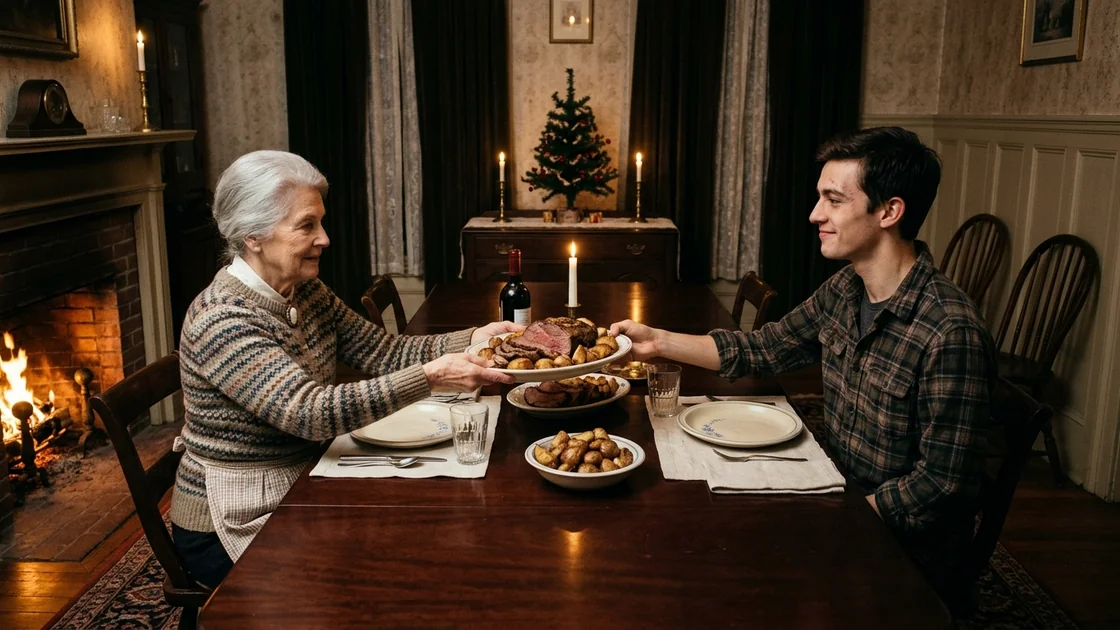
Eleanor Vance, a seventy-eight-year-old widow living in the quiet coastal town of Oakhaven, spends every evening preparing an elaborate meal for two to ward off the suffocating silence that settled into her Victorian home after the death of her husband, Arthur, three years ago. Each night she sets out his bone-china plate, pours his favorite dry red wine, and speaks to the empty chair across from her as though he has merely stepped out of the room for a moment, a fragile domestic ritual that keeps her grief from consuming her entirely. This solitary existence is gradually disrupted when a bruised, fiercely guarded nineteen-year-old runaway named Julian seeks shelter in her dilapidated garden shed during a violent autumn storm, setting in motion a hesitant, transformative companionship between an old woman trapped in the past and a young man terrified of the future. Over the course of a long, bleak winter, as Julian earns his keep by repairing the decaying house and slowly joins her at the dining table, both must confront the painful ghosts they are hiding from before Eleanor can finally clear the extra plate and allow the house to hold the living once more.
The hallway clock always struck five with a sound like a clearing throat, a raspy mechanical rattle before the five heavy chimes dropped through the quiet rooms of the house on Elm Street. For fifty-two years, that sound had been a signal. It meant the kettle needed filling, the radiators needed bleeding if the frost was creeping up the windowpanes, and Arthur would be turning the corner by the pharmacy, his briefcase knocking slightly against his right knee the way it always did when he was tired.
Eleanor stood at the kitchen counter, the heavy steel paring knife resting against her knuckles. Outside the bay window, the October light was thinning into the bruised purple of an early coastal dusk. She looked down at the cutting board. Four small red potatoes, halved. Two sprigs of rosemary from the wooden box on the sill. Two thick cod fillets, patted dry with paper towels and seasoned with coarse sea salt.
Always two.
The first week after the funeral, once the nieces from Chicago had packed up their rental car and the casserole dishes from the neighbors had been washed and returned, Eleanor had tried to cook for one. She had boiled a single egg and toasted a single slice of bread. She had carried the small saucer to the dining table, sat down in her accustomed chair facing the china cabinet, and looked across the expanse of polished mahogany. The empty space where Arthur’s placemat belonged had seemed to widen before her eyes, stretching out like an ice floe until the opposite wall looked miles away. The silence in the room was not the peaceful quiet of an empty house; it had weight and temperature. It pressed against her eardrums with a low, ringing hum. She had sat there for forty minutes without touching the toast, watching the butter congeal into a pale yellow smear, her throat so constricted she couldn't have swallowed water.
The next night, she had taken down two plates.
Now, three years later, her hands moved through the choreography of the evening without requiring her mind to direct them. She opened the tall cupboard with the glass panes—the one where the latch stuck if the humidity was high—and reached for the everyday porcelain. It wasn't the wedding china, which had gold rims that couldn't go in the dishwasher, though Eleanor hadn't used the dishwasher since eighty-nine anyway. It was the cream-colored stoneware with the faint blue cornflowers around the border. One had a tiny, crescent-shaped chip on the underside from the time Arthur had dropped it into the cast-iron sink while trying to swat a wasp in the summer of 1998. That was his plate. Her fingers found the rough unglazed edge of the chip before she even looked at it.
She carried the plates into the dining room. The house was too large for her—four bedrooms upstairs, a parlor nobody had sat in since the seventies, and this dining room with its heavy velvet curtains that held the ghost of Arthur’s pipe tobacco even after three professional cleanings. She placed her plate at the south end of the table. She walked around the perimeter, her slippers whispering against the worn Oriental rug, and placed the chipped plate at the north end.
Fork on the left. Knife on the right, blade turned inward. Water glass above the knife. Wine glass slightly to the right of that.
"The butcher didn't have the lamb chops today, Arthur," she said aloud. Her voice was dry, a little reedy from lack of use during the day, like an instrument that had sat in its case all afternoon. "Mr. Henderson’s boy—well, he’s fifty now, I suppose, isn't he?—he said the truck from the valley got held up on the pass. So it’s cod. You never minded cod on a Tuesday, so long as I didn't skimp on the capers."
The empty Windsor chair across the table offered no objection. Its spindles gleamed dully in the light of the brass chandelier, which she kept dimmed to save on the electric bill, though they weren't hurting for money. Arthur had been an actuary before he retired; he had calculated his own mortality with such quiet precision that Eleanor had enough set aside to live to be a hundred and ten without ever touching the principal.
She went back to the kitchen. The butter was foaming in the cast-iron skillet. When she laid the fish in the pan, the sudden, aggressive sizzle was a relief. It filled the kitchen, bouncing off the subway tiles and the pressed-tin ceiling, drowning out the ticking of the grandfather clock in the hall and the wind beginning to scrape the dead branches of the hydrangea bushes against the clapboards outside.
Cooking took forty-five minutes if she was deliberate about it. She never hurried. She peeled the garlic cloves with the flat of her knife, taking care to remove every paper-thin shred of skin. She warmed the serving platter in the low oven. She uncorked a bottle of Pinot Noir that she had bought four days ago, pouring two modest glasses—three ounces for herself, four for the north end of the table.
At precisely six-fifteen, she brought the platter in, set it on the silver trivet between them, and sat down. She unfolded her linen napkin and laid it across her lap. Across the table, Arthur’s napkin remained in its silver ring, a neat cylinder beside his fork.
She served him first. A smaller piece of fish—not to be wasteful, though she never thought of it in those terms—a spoonful of the roasted potatoes, a scattering of lemon-buttered green beans. Then she served herself.
"The postman was late again," she began, picking up her fork. "The new girl. She doesn't wear a coat even when the wind is coming straight off the sound. Just a fleece vest. It makes my shoulders ache just to look at her from the parlor window. I had a postcard from Clara. They’re in Scottsdale until November. She says Richard’s knee is acting up again, though if you ask me, if the man would stop trying to play eighteen holes in the desert heat, he wouldn't need the cortisone shots."
She took a bite of the fish. It was good—flaky, salt-crusted, bright with lemon. She chewed slowly, looking at the wall just above the empty chair, where a framed watercolor of the Oakhaven lighthouse hung slightly crooked. She never looked directly at the plate across from her while she was chewing. If she looked at the food sitting there, the steam gradually dying away until the butter turned opaque and white on the porcelain, the illusion thinned. The trick was to keep her eyes moving—to the chandelier, to her own glass, to the dark window where her reflection sat framed against the yellow wallpaper—and to keep talking.
The human voice, she had discovered during that first terrible winter, was the only thing that could push back the walls when they started to lean in. The radio didn't work; the voices of the BBC announcers or the local weather men were too slick, too detached, reminding her that the world was going on at a furious pace somewhere outside her hedges while she was stuck in amber. The television was worse, all bright blue light and canned laughter that made the dark corners of the parlor look deeper than they were. Only her own voice, speaking to the man who knew the shorthand of her fifty years of memories, kept the room at a survivable temperature.
"The gutter over the sunporch is loose," she continued, taking a sip of her wine. "I heard it rattling during that squall on Sunday. I know what you’re going to say. Do not get the aluminum ladder out of the shed, Eleanor. And I won't. I’ll call the Miller boy on Friday if the rain holds off. Though the last time he came to do the storm windows, he left mud all over the back mudroom and charged me eighty dollars for forty minutes of work."
She ate until her plate was clean, then sat for another twenty minutes while the tallow candles in the brass holders burned down half an inch. Outside, the wind had risen from a low mutter to a sustained, whistling press against the glass. The first drops of rain hit the windowpane like thrown gravel.
At seven, the hardest part of the evening arrived.
Eleanor stood up, her knees giving their twin, dry clicks, and picked up her empty plate. Then she walked around the table and picked up the chipped plate. The cod was cold now, the skin shriveled, the potatoes hard at the edges. She carried both plates into the kitchen. She didn't scrape his food into the Tupperware containers she kept under the sink. Eating Arthur’s dinner for lunch the next day felt ghoulish, a violation of the unwritten rules that kept this whole fragile enterprise from collapsing into madness. Instead, she scraped the cold fish and potatoes directly into the pedal bin, let the lid drop with a soft hiss, and poured the four ounces of Pinot Noir down the drain. The red wine swirled against the white porcelain of the sink like a tiny, sudden injury before the tap water washed it away.
She washed both plates, two forks, two knives, and four glasses in hot, lemon-scented suds, dried them with a linen towel, and put them back in the cupboard so they would be ready to do it all over again tomorrow.
That night, the storm came in off the Atlantic with the belligerence of an early nor'easter. By ten o'clock, the rain was coming down sideways, drumming against the cedar shingles of the roof until the whole house seemed to vibrate like the hull of an old wooden ship. Eleanor lay in the big four-poster bed upstairs— strictly on the left side, the mattress on the right still firm and unindented under the quilt—listening to the oak tree by the carriage house thrash its limbs against the telephone wires.
Around two in the morning, a sound cut through the steady roar of the rain. It wasn't the rhythmic banging of the loose gutter over the sunporch. It was a sharp, metallic crack from the bottom of the garden, followed by the heavy thud of wood hitting wood.
Eleanor sat up, pulling her wool cardigan over her flannel nightgown. Her first thought, born of decades of homeownership, was the potting shed. It was an old structure at the back of the property, built at the same time as the house in 1904, with wavy glass windows and a roof that Arthur had patched with tar paper the summer before he got sick. If the wind had taken the door off its hinges, the rain would ruin the lawnmower and the boxes of terracotta pots she still pretended she was going to use come spring.
She didn't go out—she wasn't foolish enough to navigate wet flagstones in the dark at seventy-eight—but she went to the spare bedroom window at the back of the house and peered down through the streaming glass.
The garden was a tossing sea of black shadow and wet leaves under the distant orange glow of the streetlamp on the lane. The shed door was shut. In fact, as a jagged fork of lightning briefly bleached the backyard white, she saw that the heavy iron hasp that usually hung loose because the padlock was rusted had been pulled tight from the inside, held closed by a piece of garden twine pulled through the gap in the jamb.
Eleanor stood at the window for a long time after the thunder rolled away over the water, her hand resting on the cold sill. Twine didn't tie itself in the wind.
The morning broke clear and sharp, the sky scrubbed to a pale, wintery blue, though the air smelled strongly of rotting kelp and wet pine needles knocked down by the gale.
Eleanor dressed with her usual care—gray wool trousers, a high-necked blouse fastened with her mother’s cameo brooch, and a thick Shetland sweater. She made a pot of Darjeeling tea, ate a small bowl of oatmeal at the kitchen counter—breakfast had never been a shared meal since Arthur’s retirement, as he liked to sleep until nine while she rose at six, so the morning didn't require the theater of the dining room—and then she took Arthur’s heavy ash walking stick from the umbrella stand by the back door.
She didn't call the police. Oakhaven had four officers, two of whom were under twenty-five and looked to Eleanor like children playing dress-up in tactical vests. Besides, if it was one of the local teenagers looking for a dry place to smoke cigarettes out of the rain, calling Chief Miller would only result in a great deal of paperwork and flashing lights in her driveway for the neighbors to gossip about over their hedges.
She walked down the brick path, stepping carefully around the puddles and the downed twigs. The garden was a mess. The heads of the late chrysanthemums were beaten flat into the mud, and the birdbath had tipped over into the hostas.
When she reached the shed, she saw what had made the noise in the night. The rusted iron hasp had been yanked right out of the rotting doorframe when someone had pulled the door open against the swollen wood. A length of green gardening twine—hers, from the spool on the workbench inside—was tied around the interior handle and wedged around a nail on the inner stud.
Eleanor raised the ash stick and rapped sharply on the warped cedar planks. Three times, hard enough to rattle the wavy glass in the small side window.
"I have the kettle on," she said, her voice carrying clearly in the crisp morning air. "And I have a telephone in the hallway. You have until I count to ten to untie that string, or I shall go back inside and use the latter rather than the former."
Silence from inside the shed. Not even the rustle of dry leaves on the floor.
"One," Eleanor said. "Two. Three."
At six, there was a scrape of a boot heel against the floorboards, followed by the dull clatter of a rake handle falling against a metal watering can. The twine went slack. The door didn't open all the way; it creaked outward three inches and stopped, blocked by the warped threshold.
Eleanor stepped back two paces, keeping both hands on the head of the walking stick planted firmly in the gravel in front of her. "All the way out, if you please. It is far too damp for me to stand in the wet grass waiting on your manners."
The door was shoved hard from the inside, scraping over the threshold with a shriek, and a boy stepped out into the blinding morning sun.
He wasn't one of the local high schoolers. Eleanor knew the Oakhaven faces—the broad, ruddy cheeks of the fishermen’s families or the sleek, well-fed look of the summer people’s grandchildren. This boy was thin in a way that looked structural, as if his bones had grown too fast on too little fuel. He was perhaps eighteen or nineteen, wearing an oversized canvas work jacket stained with motor oil and dark with damp at the shoulders. His hair was dark, matted on one side where he had been sleeping against a sack of peat moss, and there was a four-day-old bruise, yellow at the edges and plum-colored in the center, blooming across his left cheekbone just below an eye the color of dirty pond water.
He squinted against the light, one hand still gripping the edge of the shed door, a battered canvas rucksack slung over one shoulder by a single frayed strap. He looked at the walking stick first, then at her face, his jaw set with a hard, braced expression she recognized from stray dogs that expected the boot rather than the scrap.
"I didn't take anything," he said. His voice was rough, cracked at the bottom from cold. "Just the string. I was gonna leave before it got light, but I fell asleep after the rain stopped."
"You broke the latch," Eleanor said, looking past him into the gloom of the shed. He had made a bed out of three burlap sacks and an old horse blanket Arthur used to use to cover the radiator of the Buick in the seventies. Nothing on the workbench had been disturbed; the chisels and hammers hung on their nails in a neat row.
"It was rusted through," the boy said defensively, taking a half-step toward the hedge that separated her property from the lane. "The wind caught it when I tried to shut it. The screws just pulled right out of the soft wood."
"The wood has dry rot," she agreed calmly. "My husband meant to replace the jamb in twenty-nineteen, and he died in twenty-twenty, so the wood has had five years to get softer. Are you planning to go over the hedge like a fox, or do you know how to use a gate?"
He froze, one foot already lifted toward the gap in the privet. He looked at her sideways, suspicious, trying to find the trap in the question. "You're not calling the cops?"
"Not unless you intend to steal my lawnmower on your way out, and it hasn't run since the carburetor flooded two summers ago, so it would be a poor prize for the effort of pushing it up the hill." She looked at his hands. His knuckles were raw and red from the night's drop in temperature, and he was shivering—not a theatrical shiver, but a deep, rhythmic tremor in his shoulders that he was trying to lock his spine to stop. "What is your name?"
He hesitated, his eyes darting toward the lane. "Julian."
"Well, Julian. You have peat moss in your hair and you look as though you haven't seen a hot meal since Tuesday. Come into the kitchen. You can wash your hands at the utility sink, and I will fry you two eggs. After that, if you have any knowledge of how a screwdriver works, you can put longer screws into that doorframe so the raccoons don't get into my bone meal."
"I don't want your charity, lady," he said, though his eyes dropped involuntarily toward the back door of the house, where the warm smell of woodsmoke and toasted bread was drifting out through the screen.
"It isn't charity if you fix the door," Eleanor said, turning her back on him with a deliberate display of lack of concern. "It is a transaction. The Miller boy charges me eighty dollars to look at a hinge and tell me he needs to order a part from Portland. Two eggs and half a loaf of soda bread is a bargain for me. Wipe your boots on the bristle mat before you cross the threshold, please. I washed the mudroom floor on Thursday."
She didn't look back to see if he followed. She walked up the brick path, the ash stick clicking rhythmically against the stones, opened the back door, and went into the kitchen. She stood by the stove for ten seconds, her heart beating a little faster than usual against her ribs—she wasn't entirely immune to the knowledge that she was an old woman alone in a house with a stranger—before she heard the heavy, hesitant scrape of rubber soles against the bristle mat in the mudroom.
He didn't come all the way into the kitchen. He stopped in the doorway between the mudroom and the pantry, his rucksack still clutched against his chest like a shield, looking around the warm, yellow-painted room with wide, wary eyes.
"The sink is right there behind you," Eleanor said, taking the cast-iron skillet off the back burner where it had sat since last night's cod. "There is a bar of Pears soap in the dish and a clean towel on the peg. Put your bag down on the bench; nobody here wants what’s in it."
She heard the groan of the old pipes as he turned the brass tap, then the splash of water. While he washed, she didn't just fry two eggs. She took out four rashers of thick-cut bacon, four eggs, and cut three thick slabs of the soda bread she had baked on Monday. The sizzle of the bacon fat filled the room instantly—that glorious, domestic roar that pushed the silence back into the hallway.
"Sit at the counter," she said over her shoulder.
Julian came out of the mudroom drying his hands on the hem of his canvas jacket rather than her clean linen towel, as if afraid to dirty it. He sat on one of the two wooden stools at the butcher-block island, perching on the very edge with one foot hooked around the rung, ready to bolt if he heard a siren in the distance.
Up close, in the bright morning light pouring through the bay window, he looked even younger than he had in the garden. The bruise on his cheek was ugly, the skin split slightly at the apex of the bone, and the collar of the T-shirt under his jacket was stretched out and gray with sweat.
Eleanor didn't ask him who had hit him, or where he had walked from in the storm, or why he wasn't in school or at a job. Arthur had been a quiet man who hated being pried at when he was working through a problem, and fifty years with him had taught her that people were like bread dough: if you poked at them too much before they were ready, they went flat.
She slid a blue cornflower plate in front of him—her plate, not the chipped one—heaped with bacon, four eggs with the yolks still soft, and the buttered bread. She set a mug of black coffee with two spoons of sugar beside it.
He looked at the food for two seconds, his throat bobbing as he swallowed, and then the guarded posture dissolved. He ate with his head bowed low over the counter, using the bread to mop the yolk before it could cool, his left hand resting around the edge of the plate as if he were eating in a crowded room where someone might reach over and take a piece. He finished the four eggs in less than three minutes.
Eleanor stood by the sink, sipping her tea and looking out at the wrecked garden. "There is a jar of marmalade in the icebox if you want another slice of bread," she said when she heard his fork scrape clean porcelain.
"I'm good," he muttered, wiping his mouth with the back of his wrist. He looked down at the empty plate, a faint flush of embarrassment creeping up his neck now that the immediate animal hunger was dulled. "Thanks."
"The screws are in the coffee tins on the third shelf in the shed," she said, setting her teacup in the sink. "And there is a piece of scrap pine behind the lawnmower you can use to Dutchman the rotted part of the frame if you know how to use a chisel."
Julian blinked, looking up at her. "You know what a Dutchman is?"
"My father was a boatbuilder in Bath, and my husband spent forty years reading Fine Homebuilding in bed instead of mystery novels," Eleanor said dryly. "I know the theory of everything in this house, Julian. It is only my knees and my wrists that prevent the execution. Take your coffee with you if you like. Leave the mug on the porch rail when you’re done."
She expected him to walk out the back door, walk down the path, and disappear through the privet hedge without ever touching the shed door. She had already written off the four eggs as the price of a morning's company.
Instead, twenty minutes later, as she was dusting the bookshelves in the parlor, she heard the distinct, rhythmic tap-tap-tap of a mallet hitting the wooden handle of a chisel.
She went to the back window on the stairs and looked down. He had taken off his oil-stained jacket despite the chill in the air, revealing forearms that were corded and surprisingly capable despite his thinness. He hadn't just jammed longer screws into the rotten wood; he had chiseled out a neat, six-inch rectangular recess in the doorframe where the iron hasp had torn away, cut a matching block of sound pine from the scrap pile with her hand saw, and was currently planing it flush with the frame using Arthur’s old Stanley block plane.
He worked with his tongue caught slightly between his teeth, his dark eyebrows drawn together in total concentration. For the first time since she had seen him, the hunted, twitchy look had left his shoulders.
He finished the door by eleven. Then, without coming to the house to announce it, he picked up the fallen branch of the oak tree that had crushed the lattice by the compost heap, dragged it to the chopping block behind the shed, and began breaking it down into kindling with the small hatchet.
At noon, Eleanor went out onto the back porch. The shed door was shut tight, the iron hasp screwed into the fresh, pale pine patch so squarely that it didn't sag a fraction of an inch. Julian was kneeling by the brick path, setting the heavy stone basin of the birdbath back onto its pedestal, packing flat stones under the base to level it in the mud.
"The gutter over the sunporch," Eleanor called out from the top step.
Julian stood up, wiping his muddy palms on his jeans. "What about it?"
"The bracket on the east corner pulled out during the storm on Sunday. And the kitchen faucet has had a slow drip since August because I don't have the leverage in my thumbs to turn the shut-off valve under the sink to change the washer." She looked down at him from the porch. "I have a pot of split-pea soup from Sunday that needs eating before it turns, and the couch in the sunporch has a radiator under the window that actually works."
Julian looked from her face to the sunporch—a glassed-in room off the side of the kitchen that had a separate entrance onto the driveway and a small half-bath off the mudroom—and then back toward the lane. The wind was picking up again from the northwest, carrying the hard, metallic smell of an early frost tonight. His canvas rucksack was leaning against the shed wall. It looked very flat, containing perhaps one extra shirt and nothing that would keep a person alive when the temperature dropped to twenty-eight degrees at three in the morning.
"I don't have any money to pay rent," he said, his voice flat and guarded again. "And I don't have an ID on me if you're thinking of making me fill out some tax thing."
"Do I look like the Internal Revenue Service?" Eleanor asked. "I have a four-bedroom house built in 1904 that is slowly returning to the soil because I cannot climb a ladder, and you have two hands and no roof. You may sleep on the sunporch until the frost gets into the glass, or until you decide to walk down the lane again. I don't care which. The only rule is that you do not smoke inside, you take your boots off on the mat, and you do not go into the front parlor or upstairs without being asked. The soup will be hot in ten minutes."
She went back inside and left the door unlatched.
For the first two weeks, they lived like two cats occupying different territories of the same barn, crossing paths in the kitchen only at predictable intervals and otherwise leaving each other to their respective silences.
Julian was a ghost of a tenant. He woke before she did—she would come down at six to find the porch empty, the old green Hudson's Bay blanket folded into a military-neat square at the foot of the daybed, and the kettle already filled with cold water on the stove, waiting for her to turn the burner on. During the day, he worked outside with a grim, silent ferocity that bordered on exhaustion. He didn't ask for a list of chores; he simply looked at the house with the eyes of someone who knew how buildings failed and went to work arresting the decay.
He cleared ten years of wet black oak leaves from the gutters. He re-puttied six panes of rattling glass in the carriage house windows using a tin of linseed putty he warmed in his hands until it was pliable. He dug up the overgrown vegetable patch behind the hydrangeas, turning the heavy, winter-wet clay with a garden fork until his shirt was dark between his shoulder blades despite the November wind.
At noon, Eleanor would leave a plate of sandwiches or a bowl of stew on the kitchen island and go into the parlor to read until one. When she came back out, the plate would be washed, dried, and sitting on the wooden draining board, and Julian would be back outside, scraping peeling paint off the porch railings.
He didn't ask questions about the house, and she didn't ask why he flinched every time a white delivery van or a municipal truck slowed down on Elm Street to turn around in the cul-de-sac. Once, when Chief Miller’s cruiser rolled past at twenty miles an hour on its afternoon patrol, Eleanor happened to be looking out the kitchen window and saw Julian drop cleanly into the trench behind the raspberry canes, staying flat on his stomach in the icy mud for five full minutes after the cruiser’s taillights had vanished around the bend.
She didn't mention it when he came in later with mud soaked through the knees of his jeans. She merely left a pair of Arthur’s old flannel-lined work trousers—from his thinner days in the eighties—on the washing machine in the mudroom with a pair of wool socks on top. The next morning, the trousers were gone, the cuffs rolled up twice to fit Julian’s slightly shorter frame.
The only time the arrangement strained was at five o'clock.
Every afternoon, when the grandfather clock in the hall cleared its throat and struck five, Eleanor’s anxiety would begin to rise. The secret of the dining room felt different when there was another breathing creature on the other side of the kitchen wall. It was one thing to talk to an empty chair when the house was a sealed tomb; it was another to do it when a nineteen-year-old boy with sharp, cynical eyes was sitting twenty feet away on the sunporch reading tattered paperback Westerns he’d found in the carriage house.
So at four-forty-five each day, Eleanor would put a heavy plate of whatever she was making—roast chicken, beef bourguignon, baked haddock—onto a tray with a glass of milk and two pieces of fruit, and carry it to the sunporch door.
"Your dinner, Julian," she would say, knocking once before setting the tray on the small wicker table inside the door. "I am going to have mine in the dining room now. If you need anything from the kitchen, please get it before six, as I prefer not to be disturbed in the evenings."
"Yeah. Thanks, Mrs. Vance," he would say from the daybed, barely looking up from his book, his bruised cheek—now faded to a dull greenish smudge—turned away from the light.
Then she would shut the heavy oak door between the kitchen and the mudroom, and the inner door between the kitchen and the dining room, and set the two plates.
With the doors shut, she kept her voice lower than she used to. Instead of speaking across the mahogany table in a normal conversational tone, she leaned forward over her cod or her pork chop and spoke in a hushed, urgent murmur toward the chipped plate at the north end.
"He fixed the cellar bulkhead today, Arthur," she whispered on the eighteenth of November, the candle flames wavering between them in the draft from the chimney. "planed the warped board right down and put two coats of grey porch enamel on it so the snow won't rot it through come January. He doesn't talk. Not ten words since Tuesday. He reminds me a little of your brother Thomas after he came back from Korea—all corners and looking at the doors whenever a car goes by."
She took a sip of the Pinot Noir, her eyes fixed on the silver napkin ring across the table. Because she was whispering, the silence in the room felt bolder than usual. It crept out from behind the velvet curtains and settled around her ankles like cold water. Whispering felt like hiding, and hiding made her realize, with a sharp, unpleasant pang behind her breastbone, how very strange she would look if anyone were to peer through the keyhole. An old woman in a cameo brooch, murmuring about porch enamel to a cold pork chop and four ounces of wine she was going to pour down the sink in twenty minutes.
On the twenty-fourth of November, the first real snow came down, and the furnace died at four in the afternoon.
It didn't go quietly; the old cast-iron boiler in the basement gave a great, shuddering clank that rattled the cast-iron radiators in every room, followed by the acrid smell of an overheated fan belt drifting up through the floor grates.
Within an hour, the temperature in the house began to drop. Old houses didn't hold heat; it leaked out through the sash cord slots and up the unlined chimneys. By five o'clock, when the hallway clock chimed, Eleanor could see the faint ghost of her breath in the pantry.
She was standing at the stove, stirring a pot of beef stew with her wool shawl wrapped twice around her shoulders, when a knock sounded on the inner mudroom door.
Julian stood there holding a flashlight and a crescent wrench, a streak of black grease across his forehead from the basement.
"The blower motor seized up," he said, blowing on his blackened fingers. "The bearings are shot. It's an old Sears unit from the seventies—nobody’s gonna have that motor in stock on a Friday night before a holiday weekend, even if you called someone."
Eleanor looked at the pot of stew, then at the clock. Five-ten. "We will have to wait until Monday, then. There are extra quilts in the cedar chest at the top of the stairs."
"It's gonna hit ten degrees tonight, Mrs. Vance," Julian said, stepping into the kitchen and looking at the ceiling vents. "The pipes in the north wall will freeze by three in the morning if there's no heat in the main rooms, and your sunporch is already forty degrees. Do you have flue dampers in the fireplaces?"
"In the parlor and the dining room, yes," she said, her hand tightening on the wooden spoon. "The dining room chimney was swept two years ago."
"I'll bring in a half-cord of the oak from the shed and get a fire going in the dining room," he said simply, already turning back toward the mudroom. "If we shut the sliding doors to the hall and the parlor, that chimney is right in the center of the house. It'll keep the kitchen pipes warm on the other side of the wall, too."
"No, the parlor will do," Eleanor said quickly—too quickly. Her voice came out sharp, almost panicked. "Light the fire in the parlor, Julian."
He stopped with his hand on the brass doorknob and looked back at her. His pond-water eyes narrowed slightly in curiosity. "The parlor chimney is on the outside wall, Mrs. Vance. Half the heat goes straight into the driveway bricks, and I saw a squirrel nest sticking out of the cap when I was doing the gutters on Wednesday. If I light a fire in there, we'll smoke the whole house out. The dining room stack is clean. I checked it from the roof."
He didn't wait for her to argue. He went out into the snow, and five minutes later he came back through the kitchen, his arms stacked to his chin with split oak logs dusted with white powder. He pushed open the swinging door to the dining room with his hip.
Eleanor followed him, her heart hammering against her ribs, her hands wiping nervously at her apron.
She had already set the table at four-thirty, before the furnace broke.
Julian knelt on the slate hearth in front of the dining room fireplace, dumping the logs into the brass basket with a loud clatter. He crumpled up three pages of last week’s Oakhaven Gazette, laid the cedar kindling he had split the first week in a neat crisscross over the paper, and struck a wooden match against the brick inside the firebox.
Only when the kindling caught, throwing a bright, dancing orange light across the dark room, did he stand up, brushing the bark dust from his knees, and turn around.
He looked at the table.
In the firelight, the two settings were unmistakable. The two cream-colored plates with the blue cornflowers. The two linen napkins. The two water glasses. The bottle of Pinot Noir standing open beside two stemmed goblets.
Julian looked at the south end of the table, then at the north end. Then he looked around the empty room—at the closed velvet curtains, at the sideboard, at Eleanor standing rigidly in the doorway with her hands twisted in her apron strings.
A flush, hot and painful, rose from Eleanor’s collarbones all the way to the roots of her silver hair. For three years, she had existed inside a private logic where this table made complete sense. Seen through the eyes of a nineteen-year-old stranger standing on her hearth rug, she saw it for what the world would call it: an old woman losing her grip on her mind in a cold house.
She waited for the smirk, or the awkward, pitying look she sometimes got from the women at the library when she accidentally used the present tense to speak of Arthur.
Julian didn't smirk. He looked at the chair at the north end of the table for a long moment, his face entirely unreadable in the flickering orange glow of the oak logs. Then he looked down at his grease-stained hands.
"I didn't know you had company coming in this weather," he said quietly, his voice neutral, giving her the easiest lie in the world to take if she wanted it. "I'll take my tray in the kitchen once you're done in here. It's still warm enough by the stove."
Eleanor looked at him. He was standing slightly hunched, trying to take up as little space in the room as possible, the way he always did when he thought he had overstepped one of her boundaries. Outside, the snow was ticking against the glass like dry salt. On the sunporch, the water in the kettle she kept on the trivet for his tea was probably already filming over with ice at the edges.
She looked at the chipped plate at the north end of the table. Then she looked at the six extra oak chairs lined up against the wainscot under the window.
If she let him take the lie, she would spend the next hour sitting here in the firelight, afraid to speak above a whisper because he was on the other side of the swinging door, eating cold stew over the sink like a stray dog while she poured good beef and red wine into the garbage bin.
Her spine straightened. She let go of her apron strings.
"I do not have company coming, Julian," she said. Her voice trembled once on his name, and then steadied into the clear, clipped cadence of a retired schoolteacher. "That is my husband's place. He died three years ago in October, and I set his plate every evening because if I sit at this table alone, the silence in this room is so loud I cannot swallow my food."
The fire popped, throwing a tiny spark against the brass mesh screen.
Julian didn't look away, and he didn't look at her as if she were mad. In fact, something in his tight, guarded shoulders loosened slightly, as if an equation he had been trying to work out in his head for three weeks had finally balanced.
"My mom kept my brother’s boots by the radiator for two years," he said softly, looking at the silver napkin ring at the north end of the table. "Size eleven Timberlands with the left lace knotted where it snapped. Nobody was allowed to move 'em when they swept the kitchen, until her new boyfriend threw 'em in the dumpster one night when he was drunk." He paused, rubbing the back of his neck with a soot-smudged thumb. "People do what they gotta do to get through the night, Mrs. Vance. Doesn't make you crazy."
Eleanor stared at him. In the three years since Arthur had died, the pastor had told her to pray, her niece Clara had told her to join a bridge club or get a rescue cat, and Dr. Miller had offered her a prescription for small peach-colored pills to help her sleep. Nobody had ever simply looked at the hole in her house and said it made sense.
She walked over to the wainscot, took hold of the back of one of the heavy oak side chairs, and pulled it across the rug to the long west side of the table—halfway between her chair at the south end and Arthur’s empty chair at the north.
"Go and wash the grease off your hands in the pantry sink," she said, her voice thick. "And bring another plate from the cupboard. Not the ones on the bottom shelf. The ones on the second shelf with the blue flowers."
"I don't want to mess up your—"
"The sunporch is forty degrees and the stew is getting a skin on it in the pot," Eleanor said firmly, turning toward the kitchen door. "And if we are going to keep the sliding doors closed to save the pipes, you will have to sleep on the sofa in here tonight anyway, so you may as well sit down and eat like a Christian."
That first night at the table was awkward, stiff with the rust of two people who had forgotten the mechanics of eating in company.
Eleanor still set down the chipped plate at the north end—she couldn't bring herself to put it back in the cupboard once it was already on the linen cloth—and out of long habit, when she brought the tureen of beef stew in from the kitchen, she put a small ladleful onto Arthur’s plate before filling Julian’s bowl to the brim.
She half-expected the boy to stare at the food steaming in front of the empty chair. Instead, Julian kept his eyes politely on his own bowl, tore his bread in half with his hands before remembering to put his napkin on his lap the way she did, and waited until she picked up her spoon before he began to eat.
She couldn't talk to Arthur with Julian sitting two feet to her left. The monologue about the postman and Clara’s postcard died in her throat. For the first five minutes, the only sounds in the room were the crackle of the oak logs in the grate and the quiet clink of their spoons against the stoneware.
Yet, to Eleanor’s astonishment, the silence didn't press against her ears.
The room didn't stretch out into an ice floe. When she looked up from her bowl, instead of seeing the dark window reflecting her own solitary silhouette, she saw the top of Julian’s dark head bowed over his stew, the firelight catching the stubborn curve of his jaw and the faded scar through his left eyebrow. The simple fact of another set of lungs drawing air across the mahogany table changed the physics of the room.
"How did the blower motor fail?" she asked finally, just to test the sound of her voice in the new arrangement.
Julian swallowed a mouthful of potato and set his spoon on the edge of his plate. "Nobody oiled the sleeve bearings," he said, looking toward the hallway as if he could see through the floorboards into the cellar. "There are two little red flip-caps on either end of the shaft. You're supposed to put three drops of 20-weight oil in 'em every autumn before you kick the furnace on for the winter. Looking at the dust caked on those caps, nobody’s touched 'em in ten years. The shaft just wore the brass sleeve into an oval until the rotor locked up against the magnets."
Eleanor looked across the table at the empty Windsor chair, then back at Julian. "Arthur hated the basement," she said, a small, dry smile tugging at the corner of her mouth. "He was a brilliant man with numbers—he could calculate the probability of a hurricane hitting Charleston in thirty years down to the decimal point in his head—but if anything made a noise in the cellar, his method of repair was to turn up the classical station on the radio until he couldn't hear it anymore."
Julian gave a short, quiet huff of breath through his nose that was almost a laugh. "My grandfather was a mechanic down in New Bedford. He used to say people treat machines like magic boxes until the smoke comes out, and then they get mad at the box." He picked up his bread and sopped the gravy from the bottom of his bowl. "If you give me thirty bucks tomorrow, I can walk down to that salvage yard behind the marina. Old man Peters has three rusted-out Sears furnaces sitting under a tarp by the fence. A quarter-horse motor is a quarter-horse motor. As long as the frame mount matches, I can swap the pulley over and have your heat back on before noon."
"You know Mr. Peters?" Eleanor asked, surprised. "He hasn't let anyone into that yard since the town tried to fine him for zoning violations in twenty-twelve. He keeps a very unpleasant German Shepherd."
"The dog's fourteen and has hip dysplasia," Julian said, reaching for the butter dish when she nudged it toward him. "I threw him the fat off my ham sandwich on Tuesday when I went down to the hardware store for the stove bolts. He's fine once he knows you aren't from the town hall."
At seven o'clock, when they finished the stew and a dish of canned peaches, Eleanor stood up to clear the table. She picked up her bowl and Julian’s bowl. Then she reached for the chipped plate at the north end, where the single ladleful of stew sat cold and congealed.
As she lifted it, her eyes met Julian’s. She braced herself for the embarrassment of the kitchen pedal bin.
"I can put that in a container if you want," Julian said quietly, standing up and picking up the empty bread plate and the butter dish. "If you mix it with an egg and some flour in the morning, it makes a pretty good hash in the skillet."
Eleanor stopped with the chipped plate in her hands. For three years, she had thrown the north end’s food into the trash in the dark like a shameful secret.
"Yes," she said after a beat, handing him the plate. "The plastic containers with the blue lids are in the bottom drawer to the left of the stove."
By the middle of December, the furnace was humming down in the cellar with a smoothness it hadn't possessed since the Carter administration, its newly salvaged motor oiled and its fan belt replaced, yet Julian hadn't moved back out to the sunporch.
The winter had settled in hard. The salt marshes behind the lane froze into gray, brittle plains of dead cordgrass, and the wind off the sound carried a constant, damp tooth that made the uninsulated glass porch uninhabitable until April. Without a great deal of discussion, Eleanor had cleared Arthur’s stack of National Geographics out of the small sewing room off the back of the kitchen—a narrow room with its own radiator and a window overlooking the birdbath—and they had carried the daybed in from the porch between them.
And at six-fifteen every evening, Julian washed his hands in the pantry, combed his damp hair flat with his fingers, and sat down on the west side of the dining room table.
The chipped plate still sat at the north end. Eleanor couldn't quite bear to leave the head of the table bare wood—fifty-two years was a heavy anchor to drag up all at once—so she still laid the placemat, the plate, the fork, and the knife. She still poured the four ounces of Pinot Noir on Fridays when she bought a bottle.
But she no longer served the empty chair.
Instead, the platter of roast pork or shepherd’s pie sat in the middle of the table, and Julian ate what used to go into the pedal bin. In fact, he ate enough for three men. Now that the constant, low-grade adrenaline of sleeping in sheds had faded from his bloodstream, his nineteen-year-old body seemed to remember it wasn't finished growing. Within a month, the hollow beneath his cheekbones had filled out, his skin lost its gray, tallowy cast, and he had to let the waist tab out on Arthur’s flannel trousers.
More than that, the dinners were no longer silent, nor were they Eleanor’s one-sided performances for the chandelier.
They talked about the house at first—the dry, practical language of mortar joints, flashing, and copper pipes. Julian had found Arthur’s workshop in the back of the carriage house, and after finishing the outdoor repairs before the snow got too deep, he had taken to spending his afternoons stripping seven layers of cracked white paint off the interior shutters from the front parlor using a heat gun and a brass wire brush, bringing the hundred-year-old heart pine back to the color of dark honey.
Gradually, as the nights grew longer and the dining room fire became their regular evening anchor, the talk drifted past the baseboards.
"You didn't learn to miter corners like that in high school shop class," Eleanor observed one Tuesday in mid-December. They were eating macaroni and cheese baked with breadcrumbs and stewed tomatoes, and Julian had spent the afternoon building a new set of oak cellar stairs to replace the ones that creaked so badly she was afraid of falling through them with the laundry basket.
Julian looked down at his fork, pushing a piece of tomato around the blue cornflower border of his plate. Whenever the conversation touched on the time before he had stepped out of her garden shed, a shutter usually came down behind his eyes. Tonight, perhaps because the snow was banking up against the windows and the room was warm with the smell of cheddar and oak smoke, the shutter only came down halfway.
"My brother Danny was a finish carpenter," Julian said after a long pause. "Did custom cabinets and yacht interiors down in Bristol. He started taking me on jobs during the summers when I was thirteen so I wouldn't stay in the apartment while my mom’s boyfriend was off shift."
Eleanor kept her eyes on her own plate, chewing slowly, giving him the room Arthur had always needed. "He taught you well. The joints on the bottom riser are tighter than the ones the builder put in when the house was new."
"He was a pain in the ass about it," Julian said, and for a second, a genuine, fond smile broke through the guarded lines around his mouth, making him look heartbreakingly young. "If a seam was off by a sixteenth of an inch, you could hide it with wood filler and paint and the rich guy buying the boat would never know the difference in a million years. Not Danny. He’d take a crowbar, rip the whole trim piece off the bulkhead, and make me recut it on my own dime. Said even if the customer couldn't see it, we’d know it was garbage every time we drove past the marina."
The smile faded as quickly as it had come. He picked up his water glass and took a long drink.
"He got hurt on a commercial job site three years ago," Julian continued, his voice dropping into the flat, toneless register he had used on the first morning by the shed. "Scaffolding collapsed. Crushed two discs in his back. The doctor put him on OxyContin for six months so he could sleep, and then one Tuesday the insurance company decided he was healed enough and cut the prescription off cold." He stared at the candle flame reflecting in the polished mahogany between them. "He lasted four months buying pills off guys at the docks before somebody sold him something pressed with fentanyl in a Burger King parking lot."
Eleanor set her fork down quietly on the edge of her plate. Across the table, the empty Windsor chair at the north end seemed very still. "I am so sorry, Julian. That was the brother with the boots by the radiator."
"Yeah." Julian’s left hand—the one with the small white scar across the knuckle—closed into a fist on the tablecloth. "After Danny died, my mom kind of checked out. Moved this guy Gary in permanently. Gary figured since I knew how to use Danny’s tools, and since Danny had left his truck and about eight grand worth of DeWalt saws and routers in the garage, that meant Gary owned a contracting business. Only Gary didn't like working. He liked taking deposits from old ladies for kitchen remodels, spending the cash at the dog track in Raynham, and then sending me over with three sheets of cheap plywood to stall 'em while he changed his phone number."
Eleanor looked at the faint, lingering shadow on his left cheekbone where the purple bruise had been in October. "And you refused to go."
"I didn't just refuse," Julian said, a hard, bitter edge creeping into his voice. "In October, he took five thousand bucks cash from a lady named Mrs. Gable down the street from us—seventy-five years old, lived on her husband’s Navy pension—to fix her back porch before the winter. Then he went into the garage to load Danny’s table saw into the back of his buddy’s pickup to pawn it for rent money. I told him those were Danny’s tools. He hit me in the face with a framing hammer."
Eleanor drew in a sharp breath, her hand rising involuntarily to her throat.
"Caught me glancing with the flat of the claw because I ducked," Julian said, touching the bone under his left eye without looking at her. "So I picked up a length of three-quarter-inch iron pipe off the workbench and broke his collarbone and his right wrist. Then I took the envelope with Mrs. Gable’s five grand out of his jacket pocket on the kitchen floor, left it in her mailbox on my way out of town, and got on a freight bus heading north until my money ran out."
The dining room was utterly silent except for the soft hiss of sap boiling out of the end of an oak log in the grate.
"That is why you dive into the raspberry canes when Chief Miller drives by," Eleanor said softly.
Julian nodded once, his jaw set hard, waiting for the verdict. "Gary’s cousins are cops in Bristol. He told my mom he was gonna press charges for felony assault and grand theft for the five grand, because there’s no way he’s admitting to the cops that it was Mrs. Gable’s deposit money. I’m nineteen, Mrs. Vance. With no lawyer, it’s his word against mine, and I left him on the linoleum with two broken bones. If a patrol car runs my name, I’m going to state prison for three to five years."
He pushed his chair back six inches from the table, his hands flat on his knees, the old stray-dog posture back in full force. "I should've told you that the first week. If you want me out of the house before morning, I get it. I fixed the cellar stairs and split enough wood in the carriage house to get you through February, so we’re square."
Eleanor looked at him. She thought of her fifty-two years with Arthur—a man who had never raised his voice above a polite baritone, who had paid his taxes six weeks early every March, and whose greatest brush with the law had been a parking ticket in Portland in 1984 that he had contested by mail with a hand-drawn diagram of the curb. Before October, if she had read about a nineteen-year-old boy breaking a man’s collarbone with an iron pipe in the Gazette, she would have clicked her tongue, locked the back screen door, and remarked to the empty chair that the world was becoming a terrible, violent place.
Now she looked at the boy sitting across from her in Arthur’s rolled-up flannel trousers, who had spent three hours on his knees in the freezing cellar on Thanksgiving Eve oiling a forty-year-old furnace motor so her pipes wouldn't burst, and who had put a piece of scrap wood under the birdbath so the sparrows could drink out of the mud.
"Did Mrs. Gable get her envelope?" Eleanor asked.
Julian blinked, thrown off balance by the question. "Yeah. I watched from behind the laurel bush across the street until she came out in her bathrobe to get the morning paper and took it inside."
"Then it wasn't theft, it was bookkeeping," Eleanor said briskly, picking up her fork again. "And if a grown man attacks a boy with a framing hammer while attempting to steal a dead man’s tools, he is fortunate you only broke his wrist. Eat your macaroni, Julian. It is getting cold, and I made an apple brown betty for pudding."
Julian stared at her for five seconds, his mouth slightly open, before the rigid tension went out of his shoulders all at once. He pulled his chair back up to the table and picked up his fork, though he kept his head ducked low for the next two minutes so she wouldn't see his eyes.
Two days before Christmas, a thaw came briefly to the coast, bringing a dense, dripping sea fog that ate the snowbanks down to dirty gray crusts and made the oak trees along Elm Street weep cold water onto the pavement.
Eleanor hadn't put up a tree since Arthur died. The boxes of glass ornaments in the attic—some of them fragile German blown glass from her grandmother’s childhood in the eighteen-nineties—were too heavy for her to carry down the steep attic stairs, and besides, a Christmas tree in an empty house was worse than an empty chair at the table. It simply stood in the corner blinking its lights at nobody.
On the afternoon of the twenty-third, however, she came back from the village market with a twine bag of groceries to find the sharp, resinous scent of balsam fir filling the front hallway.
In the dining room, sitting in the middle of the sideboard between the brass candlesticks, was a two-foot-tall tabletop tree that Julian had fashioned by drilling holes at an upward angle into a length of birch branch he’d pruned from the lane and fitting fresh balsam boughs into the slots until it looked like a miniature, slightly lopsided pine. He hadn't gone into the attic for the ornaments—he still observed her rule about the upstairs with scrupulous care—so he had hung six curls of clean cedar shavings from his hand plane and a handful of red winterberries from the bushes by the shed along the green needles.
He wasn't in the kitchen when she set her groceries down. From the parlor at the front of the house, she heard voices.
Eleanor stood very still by the butcher-block island, her hand on a bag of flour. Nobody came to the front door anymore except the girl with the parcels, and she just dropped the boxes on the porch steps and ran back to her van.
She walked quietly down the front hall toward the parlor. Through the half-open pocket doors, she saw Chief Miller standing on the faded floral carpet, his wet yellow slicker dripping slightly onto the floorboards beside his boots, his campaign hat held in both hands in front of his belt.
Eleanor’s heart gave a violent, sickening lurch. Her fingers gripped the edge of the mahogany pocket door so hard her knuckles turned white.
Then she saw Julian. He hadn't run out the back door, though he must have seen the cruiser pull into the driveway while he was working on the porch shutters. He was standing by the fireplace mantel with a brass screwdriver in his hand, his back straight, his face pale but steady as he looked at the chief.
"—just wanted to check on the place before the freeze comes back tomorrow night," Chief Miller was saying in his slow, gravelly Maine drawl. "My deputy said he saw smoke coming out of the center chimney last week and a boy walking down the driveway with a sack of road salt. We know Mrs. Vance has been on her own since Arthur passed, and there’s been a couple of kids from over by the highway breaking into the summer cottages on the point to strip the copper pipe."
"The pipes here are fine, sir," Julian said evenly. "I'm just fixing the shutters and keeping the walk shoveled for Mrs. Vance."
"You local?" Miller asked, his eyes—not unkind, just forty-years-on-the-job observant—traveling from Julian’s work boots up to the faint, healed scar on his cheekbone. "Don't recognize you from the high school."
"No, sir. From down south."
"Got a last name, son?"
Julian’s thumb rubbed once against the fluted handle of the screwdriver. He knew what happened if he gave his real name, and he knew that if he gave a fake one and Miller asked to see a driver's license, he’d be in the back of the cruiser in three minutes flat.
"His name is Julian Vance, Robert," Eleanor said clearly, stepping through the pocket doors into the parlor.
Both men turned. Eleanor didn't look at Julian; she walked straight to Chief Miller, her chin up, the cameo brooch at her throat catching the gray afternoon light from the bay window, looking every inch the woman who had served on the Oakhaven Library Board for thirty-two years and whose late husband had audited the town’s pension fund for free every spring.
"He is Arthur’s sister’s grandson from Providence," Eleanor lied without a single tremor in her voice. "Thomas’s boy. He is taking a semester off before starting at the trade school in the spring to help me get this house in order so the roof doesn't fall in on my head while your department is busy writing tickets to the tourists on Route One. And you are dripping water on my Wilton rug, Robert."
Chief Miller blinked, looking down at his boots and immediately taking a step backward onto the bare oak border by the door. A sheepish look crossed his weathered face; Eleanor had known his mother in the Garden Club, and in small coastal towns, an old woman’s authority over the sons of her dead friends was absolute.
"Sorry about that, Mrs. Vance," Miller said, touching the brim of his hat in his hand. "Didn't know Thomas’s family was still down in Rhode Island. Thought they all moved out to Ohio."
"Clara is in Ohio. Julian’s mother stayed in the East," Eleanor said smoothly. "Would you like a cup of tea before you go back out in the fog? I have some shortbread in the tin."
"No, ma'am, I gotta get over to the harbor before high tide to check the seawall." He nodded to Julian, the professional suspicion entirely vanished from his face now that the boy had a lineage attached to a house on Elm Street. "Good to see somebody keeping the place up, son. Arthur was a good man, even if he couldn't drive a nail without bending it. Merry Christmas to you both."
"And to you and Martha, Robert," Eleanor said.
She walked the chief to the front door, watched him climb into the cruiser and back down the driveway, and waited until the red taillights disappeared into the gray wall of fog on the lane before she shut the heavy oak door and turned the brass deadbolt.
She leaned her forehead against the cold glass of the sidelight for a moment, letting her knees shake now that there was nobody in the hall to see it. Fifty-two years of telling the truth, and she had just lied to a police officer on her own front rug without blinking.
When she walked back into the parlor, Julian was sitting on the edge of the horsehair sofa—the first time he had ever sat down in that room—with his elbows on his knees and his face buried in his hands.
"You shouldn't have done that," he said into his palms, his voice muffled and shaking slightly. "If he checks up on that—that’s obstructing an officer, Mrs. Vance."
"Robert Miller hasn't checked a piece of paperwork that wasn't handed to him on a clipboard since nineteen-ninety-six," Eleanor said, walking over and sitting down on the wingback chair across from him, folding her hands in her lap to stop their trembling. "He only came to the door because Mrs. Garside across the street saw you on the ladder on Tuesday and called the station to be nosy."
Julian dropped his hands and looked at her. His eyes were bright, almost fierce with a mixture of relief and bewilderment. "Why did you tell him I was your nephew?"
"Great-nephew," she corrected mildly. "I am seventy-eight, Julian, not forty. And I told him that because the parlor shutters are only half stripped, and if Robert took you down to the station, I would have to look at mismatched paint until the spring."
He didn't smile at the deflection. He looked around the parlor—at the framed photographs of Arthur on the mantelpiece, at the silver tea service on the low table, at her sitting in her high-necked blouse—and then down at his own scarred knuckles.
"I can't stay here forever hiding behind an old lady’s skirt," he said quietly, the truth of it sitting heavy between them in the quiet room. "It's not right to you, and it's not a life. Gary’s a loudmouth drunk, Mrs. Vance. Sooner or later, either the warrant goes into the system or it doesn't, and I can't spend the next ten years diving into bushes every time a white car drives down the street."
Eleanor looked at him for a long time. A cold, familiar tightness crept around her ribs—the anticipation of the hallway clock striking five in an empty house again. Yet she knew, with the unsentimental clarity that had kept her alive this long, that he was right. You couldn't keep a nineteen-year-old boy in a sewing room like a pressed leaf in a book just to keep the silence away.
"Do you know for a fact that he filed a police report?" she asked.
"My mom called my cell phone three times the night I left before I ditched the SIM card at the bus station," Julian said, staring at the pattern in the rug. "Left a voicemail screaming that the cops were in the driveway and Gary was going to the hospital in an ambulance and I was dead to her. I haven't called her since."
"Have you called Mrs. Gable?"
Julian looked up, frowning. "The lady with the porch? No. Why would I call her?"
"Because she lives across the street from your mother, she is seventy-five years old, and she has two eyes and a bedroom window," Eleanor said, standing up and smoothing her wool trousers. "If there is one thing I know about seventy-five-year-old widows, Julian, it is that we know everything that happens on our street after dark, and we do not care for men who steal five thousand dollars from our pensions. Do you remember her telephone number?"
"It was written on the work order Gary left on the kitchen table," Julian said slowly. "Yeah. I remember it. I stared at the envelope all the way to the bus station."
"The telephone is on the table in the hallway," Eleanor said, nodding toward the pocket doors. "And it is a landline, so nobody in Rhode Island is going to trace a satellite to my hydrangea bushes. Go and call her before I put the haddock in the oven."
Julian stayed in the hallway with the pocket doors pulled shut for twenty-five minutes.
Eleanor stayed in the kitchen, peeling potatoes at the sink with slow, methodical strokes of the steel knife. Outside, the fog had thickened until the garden shed at the bottom of the yard was completely invisible, swallowed in a white, soundless cloud. She could hear the low rumble of Julian’s voice through the wall, followed by long stretches of silence while the person on the other end of the line spoke.
When the kitchen door finally pushed open, Julian walked in and stopped by the corner of the butcher-block island. He looked as though someone had just cut the ropes holding a hundred-pound sack of concrete to his shoulders; he seemed two inches taller, though his face was pale and his eyes were suspiciously bright at the rims.
"Well?" Eleanor asked, not putting down her knife.
"She was happy to hear from me," Julian said, his voice cracking slightly in the middle before he cleared his throat. "Said she took thefive grand to her nephew who works at the bank and had him put it back in her savings account the next morning."
"And the police?"
Julian let out a long, shaky breath, resting both hands on the edge of the counter. "They came that night because the neighbors heard my mom screaming in the driveway. Mrs. Gable walked right across the street in her housecoat and told the sergeant on the lawn that Gary had extorted five thousand dollars from her for unperformed work, that she had a carbon copy of the receipt with his signature on it, and that he had gone into the garage with a hammer to rob Danny’s estate when I stopped him."
A fierce, quiet satisfaction warmed Eleanor’s chest. "Good for Mrs. Gable."
"That's not all of it," Julian said, shaking his head in disbelief. "When the cops ran Gary’s name at the scene while the paramedics were strapping his arm up, it turned out he had an open bench warrant out of Massachusetts for skipping bail on an insurance fraud charge in twenty-twenty-one. He didn't press charges against me because the cops arrested him right out of the emergency room. He’s in the county jail waiting for extradition to Fall River, and my mom moved down to Florida with her sister in November."
He looked up at Eleanor, his pond-water eyes wide and completely unguarded for the first time since the morning after the October gale. "There’s no warrant, Mrs. Vance. Nobody’s looking for me."
"Then you won't have to ruin another pair of Arthur’s trousers kneeling in the raspberry mud," Eleanor said briskly, turning back to the sink so he wouldn't see her blink back the sudden sting in her own eyes. "Take the compost bucket out to the heap before it gets completely dark, please. Dinner will be ready in twenty minutes."
That night, as they ate the baked haddock by the light of the fire and the little birch-branch Christmas tree on the sideboard, Eleanor watched him across the corner of the table.
The boy who had eaten four eggs with his arm curved around the plate was gone. As Julian talked—telling her about Mrs. Gable’s dog, and how Danny’s old boss at the boatyard in Bristol had actually stopped by Mrs. Gable’s house in November asking if anyone knew where Julian had gone because he needed a shop apprentice for the spring refit season—Eleanor felt a strange, quiet shifting in the foundations of the house.
For three years, she had kept time stopped in this room. Every evening at five, the grandfather clock had struck, and she had wound the house backward to 2019, setting out the chipped plate and keeping the air still so nothing else could be taken from her.
Now, looking at the balsam needles drying in the heat of the fireplace and listening to a nineteen-year-old boy talk about wooden boats he wanted to build in April, she realized that the silence she had been so terrified of wasn't Arthur’s absence. It was the absence of tomorrow. When you lived entirely with the dead, there was nothing left to wait for except the pedal bin at seven o'clock.
"Bristol is a four-hour drive south," she said calmly when he paused to take a drink of water. "When does the boatyard start their spring work?"
Julian set his glass down immediately, the enthusiasm fading from his face as he looked at her. "March, usually. When they start pulling the shrink-wrap off the hulls." He hesitated, looking toward the kitchen door. "I don't have to go in March, Mrs. Vance. The carriage house roof still needs reshingling on the north slope once the snow melts, and the front porch steps need new stringers."
"You are a finish carpenter, Julian, not a caretaker for a museum," Eleanor said gently. "If Danny’s boss is holding a bench for you at a boatyard in Bristol, you would be a fool not to be standing at the door on the first of March."
"What about the house?" he asked, his voice dropping low. "And—you know. Dinner."
He glanced, just for a fraction of a second, toward the north end of the table, where the chipped cornflower plate sat gleaming in the candlelight.
Eleanor looked at the plate, too. For the first time in three years, looking at the empty Windsor chair didn't make the opposite wall seem miles away. Arthur wasn't in the chair. He had never been in the chair. He was in the way she knew what a Dutchman patch was, and in the pension that paid for the coal and the cod, and in the fifty-two years that had made her strong enough to stand in the front parlor and lie to Chief Miller to protect a boy with a bruised face. He didn't need four ounces of Pinot Noir poured down the sink to prove he had lived here.
"March is two months away," Eleanor said. "And Bristol is four hours on the bus, not on the moon. I imagine they give apprentices three days off at Thanksgiving and Christmas, and the sewing room bed will still fit you when you come up in the summer to fix my porch stringers."
On Christmas Eve, the cold returned, clear and diamond-hard, freezing the fog on the branches of the oak trees until the whole garden glittered like blown glass under the streetlamp.
At five o'clock, the hallway clock cleared its throat and struck five times.
Eleanor stood in the kitchen. A small standing rib roast was ticking in the oven, surrounded by browned potatoes and shallots, filling the back of the house with a rich, savory warmth that reached all the way up the stairs. From the parlor, she could hear the soft shhh-shhh of Julian’s sandpaper smoothing the last of the pine shutters on a drop cloth by the radiator.
She walked to the tall cupboard with the glass panes and opened the sticky latch.
She reached up to the second shelf and took down two of the cream-colored stoneware plates with the blue cornflowers around the border. Her thumb brushed the underside of the top one, feeling the familiar, crescent-shaped chip in the unglazed porcelain from the summer of 1998.
For a long moment, she stood in the quiet kitchen, holding the chipped plate in both hands, looking out the bay window at the ice-coated hydrangeas and the repaired door of the garden shed at the bottom of the yard.
"The boy fixed the shutters, Arthur," she murmured softly to the windowpane, her reflection looking back at her from the dark glass—an old woman in a clean apron, her silver hair pinned up neatly, the kitchen warm and bright behind her. "Heart pine under seven coats of paint. You always said it was poplar, and I told you my father said nobody built with poplar on the coast in 1904."
She didn't wait for the window to answer, and her throat didn't ache when the only sound in the kitchen was the low, steady hum of the basement furnace coming up through the floor grate.
Carefully, she lifted the chipped plate back up into the cupboard, setting it on the top shelf behind the gravy boat where the wedding china lived—safe, out of the way, where it wouldn't get broken in the daily wash. Then she took down a second intact plate from the stack.
She carried the two plates, two forks, two knives, and two glasses into the dining room.
She didn't set the north end of the table. She left the polished mahogany at the head and foot bare, letting the brass candlesticks and the little balsam tree with its red winterberries occupy the center of the wood. Instead, she laid her own place on the long east side facing the fireplace, and she laid the second plate directly across from it on the west side.
When Julian came in through the swinging door at six-fifteen, his hands scrubbed pink from the turpentine and a clean flannel shirt buttoned to his collar, he stopped just inside the room.
He looked at the north end of the table—at the bare wood where the chipped plate had sat every night since October, and the Windsor chair pushed back neatly against the wainscot beside its twins. Then he looked at the two plates set directly across from each other in the warm orange glow of the hearth.
He didn't say anything about it—he had learned her ways too well to poke at the dough—but when he pulled out his chair and sat down across from her, unfolding his linen napkin onto his lap, he looked straight across the narrow width of the table into her eyes and smiled.
"The roast smells great, Eleanor," he said, using her name for the first time.
"Mr. Henderson’s boy saved me the end cut," Eleanor said, picking up the carving fork and passing him the warmed platter across the table. "Take two pieces of the Yorkshire pudding while they're hot, Julian, and tell me what that man in Bristol said about the schooner they’re planking in the spring."