The Rust That Settles on the Desk
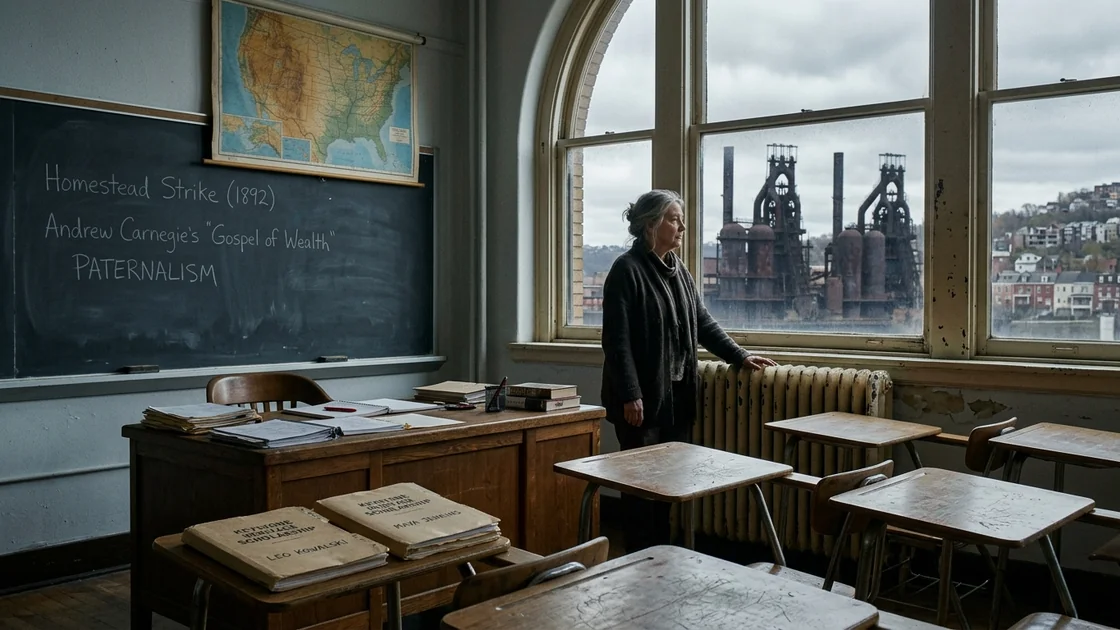
Clara Vance has spent three decades teaching history at Oakhaven High School, situated in the shadow of the defunct Vulcan Steelworks that once sustained the entire valley. Every autumn, she identifies the brilliant minds sitting behind the scarred wooden desks, and every spring, she watches the crushing weight of economic reality extinguish their ambitions before they can cross the graduation stage. This particular year, her hopes rest on two remarkably talented seniors, Leo Kowalski and Maya Jenkins, whose sharp intellects and fierce dedication offer a fleeting promise of escape from the town's entrenched cycle of poverty. Through the long, gray winter of the Rust Belt, Clara fights a losing battle against failing furnaces, domestic crises, and the invisible gravity of generational despair that pulls the children of Oakhaven back down into the soot. By the time the graduation banners are hung in the humid gymnasium, Clara is forced to confront the agonizing truth that education alone cannot dismantle the borders of a dying town, as she watches her brightest students trade their futures for the immediate necessity of survival.
The bell at Oakhaven High School did not ring so much as it rattled, a harsh, metallic vibration that seemed to shake the fine layer of brown dust loose from the ceiling tiles in Room 204. Clara Vance stood by the radiator, her fingers resting lightly on the chipped cream paint of the cast iron. It was late September, and though the furnace in the basement was not yet lit for the season, the metal beneath her hand felt perpetually cold, as if it held the memory of thirty previous winters in its core. Outside the tall, arched windows, the sky over the Monongahela valley was the color of a tarnished nickel. Dominance over the horizon belonged, as it always had, to the four blast furnaces of the Vulcan Steelworks—The Four Sisters, the old-timers called them—which stood three miles downriver like rusted cathedral spires, silent since the spring of nineteen eighty-eight.
Clara turned back to the classroom as the door swung inward on its complaining hinges. Her third-period Advanced Placement United States History class filed in. There were fourteen of them this year. Ten years ago, there had been twenty-eight; twenty years ago, there had been two full sections. The attrition was not merely a matter of declining birth rates, though the town of Oakhaven had shrunk from twenty-two thousand souls to fewer than seven thousand in Clara’s lifetime. It was an attrition of expectation. To sign up for an Advanced Placement course in Oakhaven was to make a quiet, dangerous statement: that you intended to go somewhere where college credits mattered.
She watched them take their seats. They wore the uniform of the valley—faded denim, oversized grey hoodies bearing the logos of regional sports teams or long-defunct union locals, and sneakers with soles held together by stubbornness and salt stains. Their posture was almost universally defensive, shoulders curved inward as if bracing against a wind that blew even inside the brick walls of the school.
"Take out your primary source packets from yesterday," Clara said, her voice pitched to carry over the shuffling of boots and the zipping of nylon backpacks without sounding sharp. She had learned decades ago that sharpness made these kids shut down. Their lives were full of sharp voices—foremen at the distribution warehouse, stressed parents staring at utility bills, landlords on the first of the month. "We were looking at the Homestead Strike of 1892. Specifically, Andrew Carnegie’s essay, The Gospel of Wealth, contrasted with the testimony of the amalgamated workers."
In the second row, by the window, Leo Kowalski was already flipping through his dog-eared staple-bound packet. Leo had the broad, flat cheekbones of his Polish grandfather, who had poured pig iron at Vulcan for forty-two years, and the dark, restless eyes of someone who read too late by the light of a cracked smartphone screen. His fingernails were rimmed with crescent moons of black grease that no amount of Lava soap could entirely banish; he worked four hours every evening after school at his uncle’s salvage yard off Route 51, stripping copper wire from gutted appliances and sorting catalytic converters.
Two rows over sat Maya Jenkins. Her desk was immaculate—a sharpened pencil placed parallel to the edge of her spiral notebook, her textbook covered in a brown paper grocery bag from the Shop ’n Save down in the flats. Where Leo’s brilliance was jagged and combative, Maya’s was architectural. She built arguments in her essays with the clean, load-bearing precision of an engineer. She was the eldest of four children; her mother worked the overnight shift at the county nursing home out by the interstate, which meant Maya had already been awake since five-thirty that morning, pouring store-brand oat circles into plastic bowls and braiding her seven-year-old sister’s hair before catching the first yellow bus at the bottom of Furnace Hill.
"Leo," Clara said, leaning back against the edge of her oak desk—a massive, scarred piece of furniture that had been in the room when she started teaching during the second Reagan administration. "Yesterday, just before the bell, you said Carnegie’s philanthropy was a form of violence. That’s a strong word for building public libraries. Defend the thesis."
A few students slumped lower in their seats, grateful the spotlight had landed elsewhere. Leo didn’t look up from his paper immediately. He traced a sentence with the tip of a chewed bic pen.
"He cut wages at Homestead by twenty-two percent because the price of steel billets dropped," Leo said, his voice a low baritone that still occasionally cracked when he got angry. "Then he locked the union out, hired three hundred Pinkertons with Winchester rifles, and broke the town. Ten years later, he gives them a building full of books they’re too tired to read because he’s got them working twelve-hour shifts six days a week. That’s not charity, Mrs. Vance. That’s laundering. He took the money out of their pay envelopes to buy his own reputation. If I steal your car, sell it for scrap, and buy you a bus pass with the leftover change, I’m not a philanthropist."
Clara felt that familiar, dangerous tightening in her chest—the sharp intake of breath that came whenever she encountered a mind that had no business being trapped in Oakhaven. Leo hadn't just read the text; he had recognized the mechanics of it because he lived inside the corpse of the machine Carnegie and men like him had built.
"A compelling metaphor," Clara said, stepping toward the chalkboard and picking up a piece of dustless chalk that was neither dustless nor whole. She wrote Paternalism in her neat, slanted cursive. "Maya, if you’re sitting on the board of Carnegie Steel in 1892, how do you counter Leo’s indictment? Use the text."
Maya didn't hesitate. She had dark circles under her eyes that looked like thumbprints of violet ink, a permanent feature of her face since sophomore year. "Carnegie argues from a Social Darwinist perspective," she said, her voice clear and measured, devoid of the personal rancor that colored Leo’s analysis. "In the second paragraph on page four, he states that if you redistribute that capital in small amounts through higher wages, it gets consumed in small, non-permanent ways—better food, maybe slightly better rent, or what he considered vices. By concentrating the surplus capital in the hands of the administrator, he argues the community gets institutions—libraries, music halls, universities—that elevate the whole species over generations. He’s not arguing about fairness to the individual worker in 1892. He’s arguing about the efficiency of historical progress."
"And do you buy it?" Leo asked, twisting in his seat to look at her. "Do you think the guy who got bayoneted by the state militia on the riverfront felt elevated?"
"I didn't say I agreed with it, Leo," Maya replied evenly, her pencil tapping once against her notebook. "Mrs. Vance asked for the counter-argument from the text. On the AP exam in May, the graders don't care if we’re mad at dead millionaires. They care if we can contextualize the document."
"And both of you have just demonstrated the exact tension at the heart of the Gilded Age," Clara intervened smoothly, though her eyes lingered on Maya. Maya was always thinking about the rubric, the exam, the score that would translate into credits at the state university in Pittsburgh, sixty miles away and a world apart. For Maya, history wasn't a grievance; it was a ladder, and she was counting every rung.
For the next forty minutes, Clara orchestrated the room. She pulled in the quieter students—Tyler, whose father had lost three fingers at the stamping plant in eighty-nine and now sold scrap metal out of the bed of a rusted Ford Ranger; Sarah, who worked twenty-five hours a week at the Dollar General on the highway that bypassed the town’s boarded-up Main Street. In Room 204, for fifty minutes a day, Clara maintained a quarantine against the outside world. Here, ideas had currency. Here, cause and effect were things to be analyzed on paper, not forces that shut off your gas in January or put a foreclosure notice on your front door.
When the bell rattled again at ten-fifteen, the quarantine broke.
"Read up to page two-forty for tomorrow," Clara called out over the scrape of chairs. "We’re moving into the Pullman Strike and the rise of Eugene Debs. Leo, Maya—a word, please."
The rest of the class trickled out into the hallway, which smelled perpetually of boiled cabbage from the cafeteria downstairs and the damp wool of wet jackets. Leo slung his faded canvas bag over one shoulder, lingering by Clara’s desk with the wary posture of a stray dog expecting either a crust of bread or a kick. Maya stood beside him, hugging her binder to her chest like a shield.
Clara opened her top desk drawer and pulled out two thick, glossy manila folders she had assembled over the weekend at her kitchen table.
"The deadline for the Keystone Heritage Scholarship is November fifteenth," Clara said, placing one folder in front of each of them. "It’s funded by the old steel trusts in Pittsburgh. Specifically for students from the Mon Valley whose families were formerly employed in heavy industry. It’s not a thousand-dollar book stipend, guys. It’s full tuition, room, and board at any school in the state system for four years."
Maya’s hand went out immediately, her slender fingers closing over the edge of the folder. A flicker of something fierce and bright lit behind her tired eyes. "Room and board, too?" she whispered. That was the killer for kids like Maya. Tuition could sometimes be cobbled together with Pell Grants and federal loans, a mountain of debt to be worried about later, at twenty-two. But the twelve thousand dollars a year just to sleep in a dorm room and eat in a dining hall—that was an insurmountable wall when your family’s entire household income was twenty-four thousand dollars before taxes.
"Everything," Clara said softly. "They award four of them across the three counties. You need two letters of recommendation—I’ve already drafted mine for both of you—your transcripts, and a five-thousand-word historical research paper connecting a local industrial artifact or site to broader national economic trends."
Leo hadn't touched his folder. He was looking down at the manila cardstock as if it were a summons from the magistrate’s office.
"Five thousand words?" he muttered. "Mrs. Vance, that’s twenty pages. Between the yard and helping my old man with the roof before the snow hits, I barely got time to do the regular reading."
"You have six weeks, Leo," Clara said, leaning forward, resting her knuckles on the desk so she was at eye level with him. "And you already have your topic. Three weeks ago, you spent twenty minutes after class telling me about those nineteenth-century Bessemer converter blueprints your uncle found in the safe of the old company store when they tore it down. Nobody else applying for this is going to have primary documents that haven't been seen by historians since 1910. You could write this in your sleep."
"I don't sleep much as it is," Leo said, a corner of his mouth twitching upward in a humorless grin. Still, he reached out with his grease-stained fingers and picked up the folder. He weighed it in his hand. "State system. So, Indiana University of Pennsylvania? Slippery Rock?"
"Or Pitt branch campuses, or Penn State," Maya said, her mind already racing through the logistics. "Mrs. Vance, can I use the library computers during seventh period study hall? Our internet at the house got shut off on Tuesday. Mom says she’s switching providers, but I know she’s waiting on her check from the county."
"Forget the library computers, their keyboards are missing half their vowels," Clara said, reaching into her sweater pocket and pulling out a brass key on a worn leather fob. "Here’s the key to my storage annex in the back of the room. The desktop in there is slow, and the printer makes a terrible grinding noise, but there’s a full ream of paper in the tray and it’s connected to the district T1 line. You can both use it during study hall, lunch, or after school until five."
Maya took the key as if it were a sacrament. "Thank you, Mrs. Vance. I’ll have an outline on your desk by Friday."
She hurried out to make her fourth-period calculus class—a class of six students taught remotely via a flickering television screen from a better-funded high school twenty miles away.
Leo remained for a second longer. He tapped the manila folder against his thigh.
"My dad thinks college is for people who don't know how to fix their own brakes," he said quietly, looking out the window toward the river. From here, you couldn't see the water, only the steep, wooded bluff on the opposite bank where the trees were just beginning to turn the color of dried blood.
"Your father grew up in a town where a high school diploma got you nineteen dollars an hour plus benefits at the gate of Gate Three," Clara said, her voice dropping its teacherly cadence, becoming simply the voice of a woman who had lived on the same street as the Kowalskis for forty years. "That world is gone, Leo. It’s not coming back. You know how to fix brakes, and you also know what laissez-faire capitalism did to the labor movement in the 1890s. Don't let him convince you that using your brain is a betrayal of your hands."
Leo looked at her, his dark eyes unreadable for a long moment. Then he nodded once, shoved the folder into his canvas bag—bending the corners in a way that made Clara wince internally—and walked out of the room.
Clara stood alone in the silence of her planning period. She walked over to the window and looked down into the faculty parking lot. Her own car, a ten-year-old Honda Civic with rust bubbling around the rear wheel wells, sat near the dumpster. Beyond the chain-link fence of the school property, row houses climbed the steep incline of Bunker Hill in staggered, crooked tiers, like bad teeth. Most of them were covered in Insulbrick—that grey, asphalt-soaked siding designed in the forties to look like masonry—now peeling away in dark, curling strips to reveal the rotting pine sheathing underneath. Every third house had plywood over the windows, painted with the bright orange X of the borough’s condemnation authority.
Clara had grown up on the third street up that hill. Her father had been a rigger in the open-hearth department at Vulcan. He had died at fifty-eight with lungs so scarred by silica and graphite dust that his last six months were spent tethered to a green oxygen tank in the living room, its rhythmic hiss-click providing the soundtrack to Clara’s senior year at Pitt. She had gotten out—barely, by commuting on two transfer buses every day for four years—and then she had done the one thing her father had begged her between wheezing breaths not to do: she had come back.
Somebody has to teach the kids Who stayed, Dad, she had told him in the spring of eighty-five, holding her fresh teaching certificate. If everyone who gets a degree leaves the valley, what happens to the ones who are five years old right now?
He had looked at her from his recliner, the plastic cannula digging into his grey cheeks, and said, The river don't flow backward, Clara. You can't bail out a valley with a teaspoon.
For twenty-nine years, she had wielded her teaspoon. In her first decade, she had sent dozens of kids out into the world—engineers, nurses, accountants, a boy who now practiced corporate law in Chicago and sent her a Christmas card every year from an address on Lake Shore Drive. Back then, the memory of prosperity was still fresh; families still had small savings bonds tucked into dresser drawers, houses that could be remortgaged for a few thousand dollars to cover freshman tuition, union pensions that kept grandmothers afloat so they could watch the younger kids while mothers worked.
Now, the savings bonds were long cashed. The houses were worth twelve thousand dollars on the county tax rolls and couldn't be mortgaged for the price of a used transmission. The grandmothers were fifty-two years old and working double shifts at the convenience store themselves, or they were gone, lost to the wave of little blue pills and white powder that had swept through the valley in the late two-thousands like a second, quieter flood. The poverty had calcified. It was no longer an event—the mill closed—it was the weather. It was the air the teenagers breathed. And Clara was sixty-one years old, her knees aching when the barometer dropped, watching the circle of light she could cast grow smaller with every passing semester.
October arrived with three weeks of cold, sideways rain that stripped the remaining leaves from the sycamores along the river and turned the unpaved alleys of Oakhaven into troughs of black mud.
Inside the storage annex at the back of Room 204, however, a fragile ecosystem was thriving. The annex was a narrow room, eight feet wide by twelve feet long, lined with steel shelving units packed with thirty years of obsolete textbooks—editions that ended with the Nixon administration, maps of the Soviet Union rolled around wooden dowels, yellowing mimeographs from the seventies that still smelled faintly of purple ditto fluid. At the far end, beneath a single high transom window, sat the old Dell desktop Clara had salvaged from the main office when the administrators upgraded their machines.
Every day at two-forty-five, after the final bell, Maya and Leo squeezed into the space with two mismatched plastic chairs.
Clara would sit at her desk in the main room, grading essays on the Constitutional Convention with a red pen, listening to the low murmur of their voices through the half-open door, accompanied by the rhythmic clatter of the sticky keyboard and the occasional groan of the floor joists.
"Look at this ledger entry from October 1907," Leo said one Tuesday afternoon, his voice carrying through the doorway. Clara paused her pen over a sophomore's mangled paragraph about the Federalist Papers and listened. "My uncle let me bring the whole book in, wrapped in a garbage bag so it wouldn't get wet. See the column marked Deductions - Hospital & Doctor? Every man in the blooming mill had seventy-five cents docked from his pay every two weeks for the company doctor."
"That was standard practice in company towns," Maya’s voice replied, followed by the scratch of a pencil. "I read about it in the Brody book Mrs. Vance gave me. They called it 'check-off' medicine."
"Yeah, well, look at the next page," Leo said, the heavy parchment of the hundred-year-old ledger rustling. "It’s the coroner’s receipts from the explosion at Furnace Number Two that same month. Fourteen guys dead, mostly Slovaks and Ruthenians who had been in the country less than a year. Every single one of them has a release form stapled to the back of his pay stub, signed with an X by the widow, waiving all liability against Vulcan Iron and Steel in exchange for thirty-five dollars for a pine box and a plot up on St. Casimir’s hill. Thirty-five dollars, Maya. And the company doctor—the one the guys were paying for out of their own pockets—was the expert witness who testified to the county coroner that the explosion was caused by 'worker negligence' so the company wouldn't have to pay out on the state insurance fund."
There was a long silence in the annex, broken only by the hum of the computer's cooling fan.
"You have to put the scans of those release forms in your appendix," Maya said softly. "That’s your whole thesis right there, Leo. The closed loop of capital. Even their deaths were subsidized by their own wages."
"It makes me sick to look at it," Leo said, his voice dropping. "My great-granduncle’s name is three lines above the guys who got blown up. Jan Kowalski. Cinder-snapper. Fourteen cents an hour. If he hadn't traded shifts that Tuesday because he had a boil on his neck, I wouldn't be sitting here."
"Then don't waste the shift trade," Maya said practically. "Give me the keyboard, you've had it for forty minutes and my fingers are freezing. I need to type up my section on the 1959 strike before I have to go get Marcus and Tasha from the after-school program at the church."
Clara smiled down at her grade book, a fragile warmth blooming behind her ribs. They were doing it. Leo’s rough, intuitive grasp of power dynamics was sharpening Maya’s clinical detachment, and Maya’s relentless discipline was keeping Leo anchored to the page when his anger threatened to make him throw the books across the room. By late October, Maya had three thousand words drafted—a brilliant, devastating analysis of how the Federal Housing Administration’s redlining maps from 1938 had segregated the steelworkers of Oakhaven by race, pushing Black families like her own down into the flood-prone "Bottoms" near the coke ovens, where the property values never recovered even during the post-war boom.
Leo was slower on the keyboard, hunting and pecking with two grease-stained forefingers, but his outline was a masterpiece of original archival research. Clara had called an old acquaintance of hers—a professor in the history department at Pitt whom she had gone to graduate school with thirty years ago—and described what Leo was working with.
If the kid has legitimate, uncatalogued company ledgers from the Panic of 1907 and he can write a coherent sentence, Clara, Dr. Halpern had told her over the phone, he won't just win the Keystone scholarship. We’ll want him in our undergraduate research fellow program as a freshman. Have him send me a draft by Thanksgiving.
For a few weeks, walking home up the steep sidewalk of Mulberry Street in the gathering four-thirty dusk, Clara allowed herself to imagine May. She saw Leo in a clean button-down shirt—she would buy him one herself from Kohl’s if she had to, and a tie—walking across the auditorium stage. She saw Maya giving the valedictory address, not with the hollow platitudes about "chasing your dreams" that the guidance counselor usually cribbed from the internet for the seniors, but with something real in her pocket: an acceptance letter with a zero balance at the bottom.
Then November hit, and the valley reminded Clara who owned the lease on their lives.
It started on the first Monday of the month, a morning when the first hard frost turned the weeds growing through the cracks in the school sidewalks into brittle grey glass.
Maya wasn't in homeroom. She wasn't in third-period AP History, either.
Maya had missed exactly two days of school since ninth grade, both when she had strep throat so bad she couldn't swallow water. All through the lesson on the Spanish-American War, Clara’s eyes kept drifting to the empty desk in the fourth row. Leo noticed it too; he kept looking back over his shoulder toward the hallway whenever footsteps passed the frosted glass of the classroom door.
When the bell rang for lunch at eleven-thirty, Clara didn't go to the faculty lounge. She walked down to the main office, where Darlene, the school secretary whose husband had worked with Clara’s brother on the river barges before the coal traffic dried up, was sorting attendance slips.
"Darlene, did Maya Jenkins’s mother call her in today?" Clara asked, leaning over the high laminate counter.
Darlene looked up over her half-moon reading glasses and sighed, setting down her stack of pink slips. In a town the size of Oakhaven, the school secretary knew the domestic weather of every household before the people living in it did.
"Her mama didn't call, Clara. Her grandma did, about eight-fifteen," Darlene said, lowering her voice so the sophomore sitting on the bench with a bloody nose wouldn't hear. "Lorraine Jenkins had a stroke at the nursing home around four this morning. Right in the middle of her shift. Found her on the floor in the laundry room."
Clara gripped the edge of the counter. "God in heaven. How bad?"
"Bad enough they didn't keep her at Monongahela General. Life-flighted her into Presbyterian in the city," Darlene said, shaking her head. "Lorraine’s only forty-three, Clara. Same age as my oldest girl. Blood pressure was probably through the roof for years, working those doubles without insurance since the county outsourced the aides to that private contractor out of Ohio."
Clara felt a cold stone drop into her stomach. She knew about the outsourcing. Three years ago, the county commissioners had privatized the staffing at the geriatric center to balance the municipal budget. Lorraine Jenkins had kept her job, wearing the same scrubs, washing the same sheets, lifting the same bedridden pensioners, except her hourly wage had dropped from fourteen-fifty to ten-twenty, and her health benefits had been replaced by a high-deductible catastrophic plan that didn't cover routine prescriptions unless you paid the first four thousand dollars out of pocket. Lorraine had stopped taking her lisinopril six months ago; Maya had mentioned it offhandedly in September when they were discussing the healthcare debates of the Truman administration.
"Who’s with the little ones?" Clara asked, though she already knew the answer.
"Grandma took the bus into the city to be at the hospital," Darlene said, picking up her slips again. "So that leaves Maya."
Maya didn't come back on Tuesday. Or Wednesday.
On Thursday afternoon, after the last bell, Clara packed a Tupperware container of beef stew she had made the night before, put Maya’s history textbook and a fresh printout of her scholarship essay draft into a canvas tote bag, and drove her Civic down the hill toward the Bottoms.
To get to the Bottoms, you had to drive under the rusted iron viaduct of the Pennsylvania Railroad and past the mile-long chain-link fence of the Vulcan site. The mill wasn't entirely there anymore; in the nineties, a salvage company from New Jersey had bought the salvage rights and knocked down the rolling mills and the open-hearth sheds, leaving behind seventy acres of slag heaps, broken concrete foundations sprouting sumac trees, and the four massive blast furnaces, which were too expensive to demolish because they were lined with asbestos and toxic firebrick. The ground there was so poisoned with heavy metals and benzene that even after thirty years, nothing grew on the flats except knotweed and tough, wiry goldenrod.
Behind the floodwall, where the river made a sharp, muddy bend, sat four streets of frame houses built by the company in nineteen twelve to house the unskilled laborers brought up from Alabama and Georgia as strikebreakers—men who had discovered only after stepping off the locked boxcars that they had been hired into a war zone, and who had subsequently been penned into the lowest, wettest corner of the borough by redlines and custom.
Clara parked in front of 114 Cinder Way. It was a narrow, two-story house that leaned slightly to the left, its porch roof held up by two replacement four-by-fours that had never been painted. A plastic tricycle with a sun-bleached red wheel sat in the patch of mud that served as a front yard.
She climbed the three wooden steps, which sagged under her sensible shoes, and knocked on the aluminum storm door.
Inside, she heard the high, shrill sound of a television cartoon and the thudding of small feet. A moment later, the inner door opened six inches, stopped by a brass security chain.
Maya looked out through the gap. She was wearing an oversized Steelers sweatshirt with a pale stain on the shoulder, her hair pulled back into a messy bun that was coming undone at the nape of her neck. When she saw it was Clara, her face didn't brighten with relief; instead, a look of intense, defensive mortification flashed across her features. No teenager in Oakhaven wanted a teacher—someone with a steady paycheck and a pension—looking inside their front door.
"Mrs. Vance," Maya said, her voice tight. "I’m sorry I haven't emailed. The internet—"
"I know about your mother, Maya," Clara said gently, holding up the Tupperware container and the canvas bag. "You don't need to apologize to me for anything. Take the chain off for a second so I can hand you this stew. It’s just beef and potatoes, nothing fancy, you can heat it up in a pot for the kids."
Maya hesitated, looking back over her shoulder into the dim hallway, before sliding the chain out of its track and opening the door just wide enough to step out onto the porch, pulling the heavy wooden door shut behind her to block Clara’s view of the interior. Even in the brief second it was open, Clara caught the smell of the house: kerosene from a space heater, damp plaster, and the sweet, sour scent of unwashed laundry.
The November wind off the river whipped Maya’s bare ankles above her worn house slippers. She crossed her arms over the Tupperware container after taking it from Clara’s hands.
"How is she?" Clara asked.
Maya looked past Clara’s shoulder at the massive, rusted silhouette of Furnace Number One rising above the roofline across the street. "The bleeding in her brain stopped yesterday," she said, using that same flat, clinical tone she used in class when discussing casualties at Antietam. "She can wake up, and she knows who we are, mostly. Watch your step on that middle board, Mrs. Vance, it’s rotten. Her left side isn't working right. The doctor told my grandma she’s going to need inpatient rehab for at least a month, maybe two, and even then..." Maya swallowed, her throat clicking audibly. "Even then, she’s not going to be lifting two-hundred-pound patients out of beds anymore."
"I’m so sorry, Maya," Clara said. She wanted to reach out and touch the girl’s shoulder, to pull her into an embrace the way she might have done when Maya was a freshman, but Maya was eighteen now, and she was holding herself together like a piece of over-tightened wire; Clara was afraid a gentle touch might make her snap. "What is your grandmother saying about the next few weeks?"
"Grandma’s got arthritis in both knees so bad she can barely get up the stairs to the bathroom," Maya said, looking down at the grey floorboards of the porch. "She can watch the kids during the day while they’re at the elementary school—well, Marcus and Tasha are in school, Baby Jaxon is three, so he’s here—if she sits on the couch. So I can come back to school on Monday."
Clara let out a breath she didn't realize she had been holding. "Good. That’s good, Maya. I talked to Mr. Henderson in the principal’s office and the other teachers. Nobody is going to penalize you for the missed days. We can push your internal deadlines back. And the Keystone deadline is still ten days away. You only have about twelve hundred words left on your paper. You’ve already done all the research."
Maya didn't look up. She shifted the cold plastic container of stew against her chest.
"I can come back to school during the day, Mrs. Vance," Maya said quietly. "Because if I drop out before I’m eighteen and graduated, the state cuts the survivor benefits we get from Tasha and Jaxon’s dad. That’s four hundred and ten dollars a month. We can't lose that."
"Of course you can't drop out," Clara said, a spike of alarm piercing through her relief. "Maya, you’re number one in your class."
"My mom’s paycheck was nine hundred dollars every two weeks," Maya continued, as if Clara hadn't spoken. She was doing the math out loud—the brutal, unforgiving arithmetic of the working poor, where every variable is a catastrophe. "Disability takes at least five months to get approved, and the social worker at the hospital told my grandma that because Mom was classified as a part-time seasonal contractor by the staffing agency—even though she worked forty-eight hours a week—she doesn't qualify for short-term company disability. The rent on this house is five-fifty. The electric company already sent a ten-day shut-off notice for November twentieth because we’re on the budget plan from last winter and if you miss one payment by twenty-four hours, the whole back balance of eight hundred dollars comes due at once."
"There’s LIHEAP," Clara said quickly, her mind scrambling for the acronyms she had learned over thirty years of watching families go under. "The Low-Income Home Energy Assistance Program. And the food bank at St. Jude’s—"
"LIHEAP takes six weeks to process an application, Mrs. Vance, and you can't pay the landlord with canned corn from St. Jude’s," Maya said. Her voice wasn't disrespectful, just terribly, devastatingly old. She looked up at Clara then, her dark eyes steady and dry. "I went up to the Fulfill-Mart distribution center out by the turnpike this morning while Grandma was here. Because I turned eighteen in October, I can work the twilight sort shift. Four-thirty in the afternoon to eleven-thirty at night, Monday through Friday, plus a twelve-hour shift on Saturday. Thirteen-fifty an hour."
Clara felt the cold wind off the Monongahela cut right through her wool coat. "Maya. If you work until eleven-thirty at night in a warehouse thirty minutes away, and get up at five-thirty to get your brothers and sister ready for school... when are you going to sleep? When are you going to do your coursework?"
"I’ll sleep from midnight to five-thirty," Maya said. "People do it. My mom did it for ten years."
"And what about next fall?" Clara’s voice rose slightly before she caught herself. A toddler’s face had appeared in the narrow, grime-streaked window beside the front door, pressing a small, flat nose against the glass. Clara lowered her voice to a fierce whisper. "What about the Keystone scholarship? What about Pitt? Maya, if you get that scholarship, you get a living stipend. You could send a few hundred dollars home every month—"
"A few hundred dollars next September doesn't keep the sheriff from putting our couches on the curb in December, Mrs. Vance!"
The sharpness in Maya’s voice made the little boy in the window pull back. Maya closed her eyes for a second, her shoulders slumping as the brief flash of anger drained out of her, leaving only exhaustion. When she opened them, she looked at the canvas bag in Clara’s left hand.
"And who puts Marcus and Tasha on the bus next September if I’m living in a dorm room in Oakland?" Maya asked softly. "Who changes my mom’s adult diapers if she’s sitting in a wheelchair in the dining room while Grandma’s knees are locked up? You think I don't know the math, Mrs. Vance? I’ve been doing the math in my head in the waiting room at Presby for three days."
She reached out and took the canvas tote bag from Clara’s numb fingers.
"I’ll finish the paper for class credit so I pass AP," Maya said, turning back toward the door. "And thank you for the stew. Really. The kids will eat it tonight. I start my training shift at the warehouse at four, so I have to go iron a pair of black pants."
The wooden door clicked shut. The brass chain rattled back into its slot.
Clara stood on the sagging porch of 114 Cinder Way for a full minute, listening to the distant, hollow boom of empty coal barges colliding at the lock and dam a mile upriver. Her hands were empty. She looked down at the peeling gray paint of the porch railing, then walked slowly back down the rotten steps to her car.
With Maya gone from the storage annex after school, the little room at the back of 204 felt like a tomb.
Maya came back to school the following Monday, just as she had said she would. She sat in her desk in the fourth row, her textbook still covered in its neat brown grocery bag, her pencil still aligned with the edge of her spiral notebook. But the girl sitting in the chair was a ghost of the one who had been there in October.
Within two weeks of starting the twilight shift at the Fulfill-Mart warehouse—where she spent seven hours a night walking twelve miles on concrete floors, scanning barcodes on cardboard boxes and loading them onto conveyor belts—Maya had lost ten pounds she couldn't afford to lose. Her wrists looked like twigs sticking out of the cuffs of her hoodie. She began falling asleep in third period.
It wasn't the ostentatious, head-on-the-desk sleeping of the boys in the back row who stayed up until three in the morning playing video games. Maya would fall asleep sitting bolt upright, her pencil still poised over her paper, her eyelids fluttering shut for ten, twenty, thirty seconds at a time while Clara lectured on the Progressive Era, until her chin would drop an inch and she would jerk awake with a look of sheer terror, her eyes darting to the clock above the chalkboard.
Clara stopped calling on her in class. It broke her heart to do it, to participate in the erasure of her best student, but she couldn't bear the sight of Maya struggling to focus her bloodshot eyes on a paragraph by Woodrow Wilson while her body was screaming for rest.
Leo noticed. Of course he noticed.
On the afternoon of November fourteenth—the day before the Keystone Heritage Scholarship applications had to be postmarked—Leo was in the annex alone. The printer was screaming its rhythmic, mechanical screech as it spat out the twenty-two pages of his completed research paper: Blood on the Ledger: Company Paternalism and the Privatization of Risk at the Vulcan Steelworks, 1900–1910.
Clara stood in the doorway of the annex, watching the pages stack up in the plastic tray. She had read his final draft the night before. It was extraordinary. It was angry, yes, with an undercurrent of working-class fury that no suburban kid from Mount Lebanon could ever replicate, but he had disciplined that fury with footnotes, wage tables, and photographic plates of the 1907 coroner’s releases.
"Maya didn't print hers," Leo said without looking up from the printer. He was wearing a flannel shirt with a torn elbow over a thermal undershirt; the temperature had dropped into the twenties that week, and the school board was keeping the building thermostats set at sixty-two degrees to save on heating oil.
"Maya has a lot on her plate right now with her mother’s illness," Clara said carefully. "She decided to focus on her regular coursework for the semester."
Leo turned around, leaning his hip against the steel shelving unit. He crossed his arms. He looked older, too, the teenage softness around his jaw sharpening into the hard, angular lines of the men in this valley who spent their lives squinting into welding arcs or diesel exhaust.
"She’s working the docks at the box factory out on Seventy, Mrs. Vance," Leo said flatly. "My cousin drives a forklift out there on the night shift. He sees her in the breakroom at nine o'clock eating crackers out of the vending machine and sleeping on two plastic chairs pushed together. She didn't 'decide' to focus on her coursework. She got drafted."
Clara looked away from his dark, accusing eyes, down at the floor where a curl of dust sat against the baseboard. "Life isn't fair, Leo. You don't need me to teach you that; it’s not on the syllabus because you already know it. Which is why you cannot afford to waste the opportunity sitting in that printer tray right now."
Leo pulled the warm stack of paper from the printer and tapped the edges against the desk to align them, though he did it without any visible satisfaction.
"She’s smarter than me," he said to the papers. "She actually believes in the rules. She thought if she got a 4.0 and didn't get pregnant and didn't do dope like half our class, the door would open. I always knew the door was painted on the wall."
"The door is not painted on the wall," Clara said, her voice rising with a sudden, desperate heat that surprised even her. She stepped into the cramped annex, taking the stack of papers from his hands and sliding them into a large brown clasp envelope she had already addressed to the foundation in Pittsburgh. "Look at this, Leo. Dr. Halpern at Pitt emailed me this morning after reading your draft. He wants to meet with you after Thanksgiving. He says if the Keystone committee has half a brain, you’re a lock for one of the four spots, and even if they don't give it to you, the History department has discretionary endowment money they can combine with your Pell Grant to get you through the door."
She held the envelope out to him like a weapon. "Take it across the street to the post office before four-thirty so it gets the postmark. I already put the stamps on it."
Leo looked at the brown envelope, then up at Clara’s face—at the deep lines etched around her mouth, the grey hair pulling loose from her clips, the fierce, pleading intensity in her eyes.
"Okay, Mrs. Vance," he said quietly, taking the envelope. "I’ll walk it over now."
Clara watched him from the window of Room 204 five minutes later. She stood with her forehead pressed against the cold glass, watching his tall, slightly hunched figure in the thin flannel shirt cross the cracked asphalt of the street, push open the glass door of the tiny Oakhaven post office, and come back out two minutes later with his hands empty, shoved deep into the pockets of his jeans against the wind.
She let out a long breath that fogged the glass. One, she told the ghost of her father, who always seemed to stand just behind her shoulder on dark November afternoons. If I can't have two, I’ll take one. One is not nothing.
December came down on the valley like an iron lid.
The snow that fell in Oakhaven did not stay white for long; even without the mills running, the combination of woodsmoke from people burning scrap lumber in old fireplaces, coal dust blowing off the train cars that still rumbled through on their way to the power plant downriver, and the black slush kicked up by salt trucks turned the snowbanks along Main Street into crusty grey heaps that looked like frozen lard.
Three days before Christmas break, the boiler at Oakhaven High School cracked its main heat exchanger.
For two days, they tried to hold classes anyway, with students wearing their winter coats and gloves in the rooms while their breath plumed white in the air, until the pipes in the girls’ bathroom on the second floor froze and burst, sending a cascade of rusty brown water through the ceiling of the cafeteria. The superintendent called an early dismissal for the holiday break on Wednesday morning. There was no money in the capital reserve fund for a new boiler; they would have to wait for an emergency grant from the state Department of Education in Harrisburg to weld the old one back together.
Leo wasn't there to see the ceiling collapse.
He had been absent on Tuesday, and he wasn't in homeroom on Wednesday when the pipes let go. Unlike Maya’s disappearance in November, Leo’s absence didn't trigger an immediate rumor in the main office. Leo’s family lived two miles outside the borough limits, up a narrow, wooded hollow called Pucketa Creek where five or six Kowalski relatives lived in a cluster of mobile homes and cinderblock houses scattered around the ten acres of his Uncle Stan’s auto salvage yard. People up in Pucketa didn't call the school secretary when something went wrong; they handled their business behind closed doors and rusted chain-link fences.
During the chaotic early dismissal at ten o'clock, as students streamed out toward the idling buses with their hoods pulled tight against the sleet, Clara caught sight of Tyler—the boy from third period whose father sold scrap metal—shoving books into his locker outside her room.
"Tyler," Clara called out, stepping into the freezing hallway. "Have you talked to Leo this week? He missed the unit test yesterday, and I need him to make it up before grades close for the quarter."
Tyler stopped, his hand on his locker door. He looked down the hallway toward the exit doors, then back at Clara, shifting his weight from one heavy work boot to the other. There was an unwritten code among the boys in the valley: you didn't talk to authority figures—teachers, cops, truancy officers, social workers—about another family’s trouble.
"Tyler, it’s me," Clara said softly, stepping closer so the other kids rushing past wouldn't hear. "I’m not looking to get him in trouble with Mr. Henderson. You know I’m helping him with that Pittsburgh scholarship. If he gets an Incomplete for the second nine weeks, it messes up his transcript right when the committee is reviewing it."
Tyler chewed on the inside of his lip, then looked down at the scuffed linoleum. "His old man fell off a roof over in Charleroi on Monday morning, Mrs. Vance."
Clara closed her eyes. "How high?"
"Two stories. Putting tarps on that old furniture store that burned last month, doing under-the-table demolition work," Tyler muttered. "Hit the alley pavement on his hip. Broke his pelvis in three places and shattered his right wrist. He’s down at Mon General. They had to put pins in him."
"Did he have insurance through the contractor?" Clara asked, though the words under-the-table had already answered her question.
Tyler gave her a look of profound, weary pity—the look a seventeen-year-old who knows how the world works gives a sixty-one-year-old who asks stupid questions. "It was cash work for Tony Varga, Mrs. Vance. Varga told the hospital he didn't even know who Mr. Kowalski was, said he must have been trespassing to steal copper flashing. So there ain't no workers' comp."
Tyler slammed his locker shut and spun the combination dial. "Leo’s up at his uncle’s yard. Stan gave him full-time hours on the dismantling bay so they can pay the mortgage on his dad’s trailer. You didn't hear it from me."
He turned and disappeared into the crowd of winter coats heading for the buses.
Clara didn't go home when the building was cleared at noon. She sat in her cold classroom until one o'clock, wearing her wool coat and scarf at her desk, staring at the manila folder in her bottom drawer labeled KOWALSKI, LEO - AP/COLLEGE. Inside was a printout of an email she had received just that morning from the Keystone Heritage Foundation: Dear Mrs. Vance, We are pleased to inform you that your student, Leo Kowalski, has been selected as one of eight finalists for the 2024 Keystone Heritage Scholarship. In-person interviews with the selection committee will be held at the Duquesne Club in downtown Pittsburgh on Saturday, January 13th...
At one-fifteen, Clara picked up her purse, locked the door of Room 204, and walked out to her Honda.
The drive up Pucketa Creek Road was treacherous. The borough plow stopped at the town line, and beyond that, the narrow two-lane blacktop wound between steep shale embankments where water seeped out of abandoned coal seams and froze into thick, yellow-brown sheets of ice that hung like stalactites over the ditch.
Two miles up, the trees fell back to reveal a wide, flat clearing along the creek bed that looked as though a bomb had gone off in a parking lot. Thousands of cars—sedans from the eighties, rolled-over pickups, rusted minivans—were stacked three high in long, canyon-like rows, their windshields smashed, their hoods gaping open like the mouths of dead fish. Near the road sat a long, low building made of corrugated green fiberglass and unpainted concrete block, with a hand-painted sign nailed to a telephone pole: KOWALSKI AUTO WRECKING & METAL RECYCLING - WE BUY JUNK CARS.
Black, oily smoke was chugging out of a stovepipe sticking through the roof of the block building—they were burning waste oil from drained crankcases to heat the garage.
Clara pulled her Civic into the rutted gravel lot beside a flatbed tow truck with chains draped over its headache rack. She got out, stepping carefully over a frozen puddle rainbowed with transmission fluid, and walked toward the open bay door of the garage.
The noise inside was deafening. The high-pitched, metallic shriek of an air chisel echoed off the concrete walls, punctuated by the heavy clang of steel dropping onto concrete and the guttural roar of a kerosene torpedo heater glowing cherry-red in the corner.
Inside the dim, cavernous bay, a stripped Dodge Ram pickup sat up on four massive iron jack stands, its wheels gone, its front clip removed to expose the greasy iron block of its engine. Standing beneath the raised chassis, showered in a cascade of orange sparks from an angle grinder, was a figure in a heavy canvas Carhartt coverall stiff with years of black axle grease.
Clara stopped just inside the bay door, the acrid smell of burning steel and old gear oil stinging her throat.
An older man with a thick grey mustache and a wool cap pulled down to his eyebrows stepped out of a small plywood office in the corner, wiping his hands on a red shop rag. That was Stan Kowalski; Clara had taught his daughter back in ninety-six.
"Can I help you, ma'am?" Stan shouted over the scream of the grinder, squinting through the blue haze of exhaust. Then he recognized her and stopped. His face hardened slightly—not with hostility, exactly, but with the defensive pride of a man on his own dirt. "Mrs. Vance. You need a part for that little foreign car? I don't keep much Honda stuff."
"I’m here to see Leo, Stan," Clara said, keeping her voice steady and respectful.
Stan looked over at the boy under the truck, then spat a thin stream of tobacco juice onto the oil-stained concrete floor. He walked over to the wall and threw a heavy iron breaker switch. The air compressor in the back corner died with a long, wheezing hiss, and a moment later, Leo lowered the angle grinder from the truck’s exhaust manifold.
In the sudden, ringing silence, Leo pushed his scratched plastic face shield up onto his forehead. His face was smeared with soot from the cut exhaust pipe, a black line running across the bridge of his nose like war paint. When he saw Clara standing by the torpedo heater in her good navy wool coat, holding her leather purse with both hands, he froze.
For five seconds, nobody moved. Stan looked between his nephew and the schoolteacher, then muttered, "Five minutes, Leo. That radiator needs pulled before the guy from Greensburg gets here at two," and walked back into his plywood office, pulling the door shut behind him.
Leo set the heavy grinder down on a workbench cluttered with bent wrenches and rusted bolts. He pulled off his split-leather welding gloves, slapped them down beside the tool, and walked slowly over to where Clara stood. He smelled of sweat, cold iron, and burned kerosene.
"You shouldn't be up here, Mrs. Vance," he said, his voice hoarse from breathing shop dust. "You’re gonna get grease on your coat."
"I don't care about my coat, Leo," Clara said. She reached into her purse and pulled out the folded sheet of paper she had printed from her email that morning. "I heard about your dad. I’m terribly sorry. How is he doing?"
Leo wiped the back of his wrist across his forehead, smearing the soot further across his skin. "He’s alive. He’s pissed off. The doctor says he won't be able to put weight on his left leg for three months, minimum, and his right wrist is all pins and plates now. Even when it heals, he’s not gonna be swinging a framing hammer anymore."
It was an echo so exact, so cruel in its symmetry to what Maya had told her on the porch on Cinder Way a month earlier, that Clara felt a wave of nausea pass through her. A stroke in a laundry room; a slip on an icy roof. In Oakhaven, the margin between getting by and ruin was the thickness of a patch of black ice or the wall of a tired artery.
"Look at this," Clara said, unfolding the paper and holding it out to him so he wouldn't have to touch it with his black hands. "It came at nine o'clock this morning. You made the final eight for the Keystone, Leo. Out of four hundred applicants across Allegheny, Washington, and Westmoreland counties. All you have to do is go down to Pittsburgh on January thirteenth and talk about your paper for thirty minutes in front of the committee. Four of the eight get the full ride."
Leo looked at the paper. His eyes moved back and forth across the lines of crisp laser-printed text. For a brief, agonizing second, Clara saw the seventeen-year-old boy underneath the Carhartt coveralls—the boy who had gotten excited about a hundred-year-old ledger, the boy who wanted to know why history worked the way it did.
Then the mask came down. It was the same mask his uncle wore, the same mask his father wore when Clara saw him at the hardware store: flat, stoic, impenetrable.
"January thirteenth is a Saturday," Leo said.
"I’ll drive you in my car," Clara said immediately, stepping closer to the roar of the kerosene heater. "You don't have to worry about bus fare or parking or anything. We’ll leave at eight in the morning, and I’ll have you back here by one in the afternoon."
"Mrs. Vance, look around," Leo said, gesturing with one bare, grease-stained hand toward the cavernous garage, the yard full of dead cars beyond the door, the mud road leading up the hollow toward his father’s trailer. "Who’s gonna pay the lot rent on my dad’s trailer in February? Who’s gonna buy the heating oil? My mom left when I was nine, you know that. It’s just me and him. And now he’s lying in a hospital bed we can't pay for, in a cast from his ribs to his knee."
"You can take out an emergency student loan once you enroll in August—"
"It’s December!" Leo’s voice cracked, echoing off the tin roof of the bay. In the little plywood office, Stan’s shadow shifted behind the frosted glass window, though the older man didn't come out. Leo lowered his voice, stepping closer to Clara, his dark eyes bright with a furious, trapped misery. "It’s December, Mrs. Vance! What am I supposed to tell the guy who delivers the fuel oil next week? Hey, don't let my crippled dad freeze to death in his living room, I might get a scholarship to go read books in Oakland nine months from now? My uncle Stan is giving me fifteen bucks an hour under the table to pull transmissions and strip catalytic converters, six days a week, fifty hours. If I drop to part-time so I can sit in high school all day, Stan has to hire somebody else, because he’s got contracts with the smelter in Ohio to fill."
"You cannot drop out of high school in December of your senior year, Leo!" Clara grabbed his forearm through the stiff, greasy canvas of his sleeve, her fingers digging in. She didn't care about the black stains transferring to her gloves. "You are five months away from a diploma! You have an A in Advanced Placement History! You wrote a college-level thesis on the exploitation of working men in this valley, and now you’re going to let the exact same trap snap shut on your own leg?"
Leo looked down at her small, gloved hand on his arm, then up into her face. A bitter, terrible smile twisted his mouth.
"Why do you think I understood that ledger so good, Mrs. Vance?" he asked softly. "You thought I was writing history. I was writing the orientation manual."
He pulled his arm gently out of her grip and stepped back toward the raised Dodge pickup.
"I told Mr. Henderson’s secretary this morning I’m transferring into the Vo-Tech co-op track for the second semester," Leo said, picking up his heavy leather gloves from the workbench. "Since I already got all my math and English credits done, I only gotta go in to the building from eight to ten-thirty in the morning for basic civics and gym, and I get work-study credits for working here from eleven to six. It’s legal. I still get the diploma in May."
"If you drop AP History and go into the Vo-Tech co-op track, the Keystone Foundation will disqualify your application," Clara said, her voice trembling so badly she could barely get the words out. "And Pitt will pull your conditional admission. You need four years of academic social studies on your final transcript."
"Yeah," Leo said, pulling the scratched plastic shield back down over his soot-streaked face. "I figured they would. Tell that professor guy in the city thanks for reading my paper."
He reached over, threw the iron breaker switch on the wall, and the air compressor roared back to life, drowning out anything else Clara might have said. He stepped back under the belly of the truck, raised the angle grinder, and a shower of brilliant, dying orange sparks rained down onto the concrete floor between them.
The winter did not break until late March, and even then, it didn't give way to spring so much as it dissolved into a grey, oozing thaw that smelled of wet coal ash and rotting leaves.
In Room 204, the third-period AP History class was down to twelve students.
Leo’s desk by the window was empty. Clara saw him occasionally at ten-thirty in the morning when she had hall duty by the side doors; he would be walking out toward the student parking lot to get into a beat-up primer-grey Chevrolet pickup his uncle had let him piece together from two wrecks in the yard. He always nodded to her—"Morning, Mrs. Vance"—polite, distant, already carrying himself like one of the thirty-year-old men who drank coffee at the Sheetz gas station at five-thirty in the morning before heading to a job site. He never stopped to talk, and Clara, after one agonizing attempt in January when she had tried to tell him that the scholarship deadline had been extended by a week due to weather, stopped trying to catch his eye. There was a cruelty in waving a ticket to a train that had already left the station.
Maya was still in the fourth row.
She had kept her promise to finish her research paper for class credit; she had handed it in on the day before Christmas break—eighteen pages, typed during twenty-minute breaks in the Fulfill-Mart warehouse cafeteria on an old iPad with a cracked screen, printed out in the school library because she was too ashamed to go back into Clara’s storage annex.
Clara had graded it over the holidays at her dining room table, with a glass of dry sherry sitting untouched beside her elbow. It was a brilliant piece of work, though the last four pages were noticeably thinner in their citations, the sentences shorter, the desperate economy of a girl typing at midnight when her eyes were closing against her will. Clara had written A+ (98%) at the top in red ink, without her usual two paragraphs of encouraging marginalia. What was there to encourage? Excellent synthesis of post-war municipal bond structures, Maya; it will serve you well while you’re taping up cardboard boxes on Line Four.
In February, the state system universities sent out their financial aid packages. Maya got into the University of Pittsburgh’s main campus—a triumph that, five years ago, would have resulted in her name being read over the morning announcements by Mr. Henderson, followed by a round of applause in homeroom.
Instead, Maya showed Clara the letter quietly after class one rainy Tuesday in early March.
With her Pell Grant, a maximum federal Stafford loan, and a small merit grant from the university, she was still fourteen thousand dollars short per year for room, board, and fees. Fourteen thousand dollars might as well have been fourteen million on Cinder Way. To cover the gap, the university suggested a Parent PLUS loan, which required a credit check on Lorraine Jenkins—who was currently sitting in a rented hospital bed in the living room of the house in the Bottoms, fighting with the Medicaid office over the cost of physical therapy while her electric bill was three months in arrears.
"They shifted me to full-time at the warehouse last week," Maya told Clara, folding the Pitt letter neatly along its original creases and slipping it back into her brown-bagged textbook. "Since I’m eighteen and my grades are high enough that I only need two credits to graduate, Mr. Henderson signed the work-release waiver so I can leave after fourth period. If you stay full-time at Fulfill-Mart for a year without more than three attendance points, they have a tuition reimbursement program. Up to twenty-five hundred dollars a year for community college."
Clara looked at the violet shadows beneath Maya’s eyes, at the slight tremor in her thin hands caused by the monster energy drinks she drank during second period to stay awake through calculus. Everyone in the valley knew about the Fulfill-Mart tuition program. It was a carrot dangled by human resources to keep nineteen-year-olds from quitting during the brutal Christmas rush. To keep it, you had to maintain forty hours a week on the concrete floor while taking night classes at the community college thirty miles away in Youngwood—a schedule designed by an actuary to ensure that fewer than four percent of employees ever claimed a dime of the money before their bodies gave out or they missed a shift because a child got an ear infection and got fired for "attendance points."
"That’s a plan, Maya," Clara lied, her voice sounding hollow in her own ears. "You’re resilient. You’ll find a way through."
Maya looked at her teacher for a long moment. In that look, Clara saw the final, quiet snapping of the thread that had bound them together in September. Maya knew Clara was lying. Worse, Maya knew that Clara knew it was a lie. Everything Clara taught in Room 204—the idea that knowledge was power, that understanding the systems that oppressed you was the first step toward transcending them—was exposed in that silence as a polite fiction maintained by the state to keep teenagers in chairs until they were old enough to clock in.
"Yes, ma'am," Maya said softly. "Have a good afternoon, Mrs. Vance."
She walked out of the room at eleven-fifteen to catch the public transit bus out to the turnpike interchange.
In May, they took the Advanced Placement exam in the basement of the Methodist church down the street because the high school auditorium was being used for state remedial math testing.
Eight of Clara’s original fourteen students showed up. Maya wasn't there; the ninety-eight-dollar exam fee had come due in March, and though the district had a waiver program reduce it to fifteen dollars for low-income students, Maya had told Clara she couldn't afford to take a Friday morning off from the warehouse during their spring inventory push, and besides, community college took regular high school credits anyway.
In July, the scores would come back in the mail to Clara’s house: two 3s, four 2s, and two 1s. None of them would go to four-year universities outside the valley.
Graduation for the Class of 2024 was held on the first Friday in June in the high school gymnasium, because the bleachers on the football field by the river had been condemned by the borough building inspector in April after the wooden footboards rotted through.
It was eighty-eight degrees outside, a thick, muggy heat that rolled up off the stagnant water of the Monongahela and settled into the brick bowl of the valley. Inside the gym, with no air conditioning and four hundred parents, grandparents, and crying toddlers packed onto the pull-out wooden bleachers, the temperature easily topped ninety-five. The air smelled of cheap drugstore perfume, damp polyester graduation gowns, and the old floor wax baked by body heat.
Clara sat in the second row of folding chairs reserved for the faculty, wearing her own black master’s gown from Pitt—the velvet chevrons on the sleeves faded to a rusty brown after thirty-five commencements. Beside her sat Bill Miller, the shop teacher, who was retiring that afternoon after thirty-eight years and had already mentally checked out to his fishing camp up in Tionesta.
Up on the temporary plywood stage erected under the basketball hoop, the sixty-two graduating seniors of Oakhaven High School sat in four rows of metal chairs, fanning themselves with their folded paper programs.
Because she was still technically number one in her class by grade-point average—her straight A’s from freshman through junior year having provided enough mathematical cushion to absorb the B’s and C’s she had scraped together while working forty hours a week since Thanksgiving—Maya Jenkins gave the valedictory address.
Clara watched her walk up to the podium in her shiny blue polyester gown. Underneath the hem of the robe, Clara could see that Maya wasn't wearing dress shoes; she was wearing her black orthopedic warehouse sneakers, the only footwear her swollen feet could tolerate after standing on concrete for six months.
Maya didn't give the speech she and Clara had talked about back in October, when the leaves were turning and they had joked in the storage annex about quoting Frederick Douglass or Eugene Debs to wake up the school board. Instead, she read a three-minute speech written on two index cards—brief, polite, thanking the teachers and families, wishing her classmates luck in the "next chapter of our journey." Her voice over the malfunctioning PA system was flat, crackling slightly through the blown speaker above the scoreboard. She looked out over the crowd toward the top row of the handicap-accessible bleachers by the door, where her mother sat in a wide wheelchair, her left arm strapped to a foam trough across her lap, while Maya’s seven-year-old sister leaned against the wheel, asleep in the heat.
When Maya finished, there was a polite, sweaty scatter of applause, and she walked back to her seat without looking toward the faculty chairs.
Then Mr. Henderson stepped to the microphone and began reading the names.
Adams, Brittany Marie.
Barker, Cody James.
One by one, they crossed the plywood stage. Clara knew the biographies behind almost every name. Cody Barker was going into the Marines on Monday morning—the one reliable exit ramp left in the valley, though he would likely come back in four years with bad knees and a Dodge Charger financed at twenty-four percent interest, looking for a security guard job at the hospital. Brittany Adams was already five months pregnant under her blue robe; she and her boyfriend were moving into the basement of his grandmother’s house on Fourth Street.
Jenkins, Maya Lorraine.
A loud cheer went up from her brothers in the bleachers. Maya crossed the stage, shook Mr. Henderson’s hand, took the imitation-leather folder containing her diploma, and walked down the steps.
Kowalski, Leo Stanislaus.
Clara sat up straighter in her metal chair, her hands tightening on her knees.
Leo stood up from the third row. His blue gown was four inches too short for his long frame, revealing the cuffs of a pair of stiff, brand-new blue jeans and heavy brown steel-toed Timberland boots that already had a gray scuff across the left toe. His hair was cut short on the sides, his neck burned red from working out in the open yard at the salvage lot all May as the weather warmed.
From the back of the gym, standing by the double doors with a pair of aluminum forearm crutches propped under his arms, Leo’s father let out a sharp, two-finger whistle that echoed off the rafters. Beside him stood Uncle Stan in a clean flannel shirt with the sleeves rolled up.
Leo walked across the stage with a slight, rolling hitch in his shoulders—the walk of a man who spent his days lifting cylinder heads and dragging rear axles through gravel. He took the folder from Mr. Henderson, gave a brief, tight nod to the superintendent, and started down the wooden stairs on the side of the stage that passed directly in front of the faculty section.
For one second, as he reached the bottom step on the gym floor, he was four feet away from Clara.
He looked directly at her. There was no resentment in his dark eyes, and no blame. That was the hardest part for Clara to bear—that he didn't even hate her for making him believe, for six weeks in the autumn, that he was going somewhere else. He looked at her with the mild, distant fondness one might feel for a elementary school teacher who had once read you a nice story about dragons before you grew up and learned the world was made of cinderblock and iron.
He gave her a tiny, almost imperceptible nod, his rough thumb rubbing the corner of the imitation-leather folder, and then he walked back to his row and sat down.
Thirty minutes later, they threw their cheap cardboard mortarboards into the humid air, and the crowd spilled out of the stifling gymnasium into the bright, hazy glare of the six o'clock sun.
Clara didn't linger on the sidewalk outside the school where families were taking pictures with smartphones against the rusted chain-link fence. She walked briskly back into the emptying building, up the wide, hollow-sounding concrete stairs to the second floor, and unlocked Room 204.
She stripped off her heavy black master’s gown, hung it on the wooden coat tree in the corner, and stood for a moment in her damp blouse, listening to the sounds from the street below—car doors slamming, the loud rumble of a pickup truck with a rusted-out muffler roaring up Bunker Hill, laughter that sounded too loud and slightly frantic.
By six-thirty, the street outside had gone quiet. Everyone had gone down to the fire hall for cold cut trays and sheet cake, or back to their porches with cases of Iron City beer, or—in Maya’s case—home to change out of her gown so she could make the seven-thirty night shift differential at the warehouse.
Clara walked to the back of her classroom and pushed open the door to the storage annex.
It was stifling inside the narrow room, the air thick with the smell of old paper and warm dust. She walked to the back desk where the old Dell computer sat dark and silent. On the shelf beside the monitor sat the two glossy manila folders she had handed out in September, along with the thick photocopy of the 1907 Vulcan Steelworks ledger Leo had left behind when he transferred out of her class before Christmas.
She picked up the photocopied ledger. On the top page, in the margin beside the list of fourteen dead immigrant laborers and the seventy-five-cent hospital deductions, was a note written in Leo’s cramped, heavy-handed scrawl from October: Ask Mrs. V if the state archives in Harrisburg have the 1908 tax assessments for the company houses.
next to it, in Maya’s neat, architectural script, was a tiny check mark and the words: Checked online catalog—Record Group 17, Box 42. We can look when we go to state finals.
Clara stood there in the dim light coming through the dirty transom window above her head. For twenty-nine years, she had kept a box in the bottom of the steel cabinet where she saved the best papers from every graduating class—a personal archive of what the children of Oakhaven were capable of before the valley took them.
She looked down at Leo’s notes and Maya’s handwriting. Suddenly, the thought of putting those pages into the steel cabinet felt obscene, like pinning the wings of dead butterflies to a piece of velvet and calling it natural history.
She carried the stacks of paper out into the main classroom, walked over to the tall grey metal trash can beside the door—already emptied by the janitor for the summer and lined with a fresh black plastic bag—and dropped them in. They landed at the bottom with a heavy, flat thud.
Then she walked over to her desk, sat down in her wooden swivel chair, and pulled her lesson planner for the upcoming 2024–2025 school year across the blotter. The guidance office had put the preliminary rosters for next fall in her mailbox that morning.
She opened the folder and ran her finger down the list of rising juniors who had signed up for third-period Advanced Placement United States History. There were eleven names on the page.
Halfway down the list, her finger stopped on Jenkins, Marcus. Maya’s fifteen-year-old brother. Clara had seen him in the hallway; he had his sister’s quiet, watchful eyes and a habit of carrying a paperback science fiction novel in the back pocket of his jeans.
Clara picked up her pen, uncapped it, and stared at the name for a long time while the shadows of the four cold blast furnaces down by the river stretched slowly across the valley floor, climbing the hill toward the school window as the sun went down behind the ridge. Finally, with a hand that only shook a little, she wrote the boy’s name onto the first line of her fall seating chart.