The Ring Inside His Head
Marcus Vance spent fifteen years taking punches for a living, trading his future for a string of middleweight titles and the roar of strangers in smoky arenas. Now forty-two and retired to a quiet suburb, the bill for his career has arrived in the form of debilitating, relentless headaches that turn the world into a jagged blur of light and agony. Worse than the physical pain is the creeping erosion of his mind; a hair-trigger rage has begun to hijack his nervous system, turning minor domestic frustrations into terrifying blackouts of fury. As he watches the fear grow in the eyes of his loyal wife, Elena, and his twelve-year-old son, Toby, Marcus must confront the horrifying truth that the monster he spent his life fighting in the ring now lives inside his own decaying skull, leading him toward a heartbreaking decision to protect the people he loves from the man he is becoming.
The morning started with the hum of the refrigerator. It wasn't a new sound—the appliance was ten years old, a brushed-steel monolith they had bought when Toby was still in diapers—but today, the low, sixty-hertz vibration felt like a masonry drill pressing directly into Marcus’s left temple.
He sat at the kitchen island, his thick, scarred hands wrapped around a mug of lukewarm chamomile tea. The doctor had told him to cut out caffeine. No coffee, no dark sodas, no chocolate. As if a cup of dark roast was the thing tearing his brain apart, rather than the four hundred and twelve rounds of professional boxing he had logged between the ages of nineteen and thirty-four.
Marcus closed his eyes, trying to breathe through his nose, the way old Mickey used to tell him to do in the corner between the ninth and tenth rounds. In through the nose, kid. Let the shoulders drop. Don't fight the air.
"Dad?"
The voice was soft, tentative, yet it struck Marcus’s eardrums with the force of a brass cymbal. A flash of white light burst behind his closed eyelids. His jaw clenched so hard his molars groaned.
He opened his eyes slowly. Toby was standing by the pantry, holding an empty cereal box. The boy was twelve, all long limbs and nervous energy, with Elena’s dark, expressive eyes and Marcus’s square chin. Right now, Toby was standing with his weight on his back foot. Ready to pivot. Ready to retreat.
Seeing that stance in his own son made Marcus’s stomach turn cold.
"Yeah, buddy?" Marcus kept his voice low, forcing the gravel out of it. It took immense concentration just to modulate his volume. Every word felt like he was pushing boulders uphill.
"We're out of the oat Os. Mom said I should ask you if you could drive me to school today, and maybe we could stop at the bodega for a bagel?"
A simple request. A normal Tuesday morning father-son routine.
Behind Marcus’s eyes, the masonry drill shifted gears, grinding deeper into the soft tissue of his frontal lobe. The kitchen lights—even with the dimmer switch pulled all the way down—seemed to buzz in harmony with the fridge. Bzzzzzt. Thump. Bzzzzzt. Thump.
"I don't know where my keys are," Marcus said. He looked down at the granite countertop. The black swirls in the stone seemed to be moving, swimming like oil on water. "Did you see them?"
"I think they're on the hook by the garage door," Toby said, taking a half-step toward the mudroom. "I'll get them."
"No, I put them on the dish," Marcus muttered, pressing the heel of his palm against his left eyebrow. The bone there was thick, built up by years of calcified scar tissue from headbutts and right crosses. "I always put them in the ceramic dish."
"Mom moved the dish yesterday because she was cleaning the—"
"Why does everyone move my things?"
The words didn't come from his mouth; they erupted from his chest, loud and ragged, tearing through the quiet kitchen.
Toby froze. The empty cereal box slipped from his fingers and hit the linoleum with a hollow thwack.
That tiny sound—cardboard on plastic—was the spark in a room full of gas. A sudden, blinding heat surged up the back of Marcus’s neck. It wasn't anger about the keys. It wasn't even about the dish. It was a chemical flood, a violent misfiring of synapses that told his body he was trapped against the ropes, bleeding, with an opponent trying to take his head off. Fight or die. Swing or go down.
Marcus stood up so fast the heavy wooden barstool tipped backward and crashed to the floor.
"I can't find one goddamn thing in my own house!" Marcus roared. His hands balled into fists—heavy, misshapen hammers that had broken ribs and shattered orbital bones. He brought his right fist down onto the granite island.
CRACK.
The ceramic mug of chamomile tea jumped three inches into the air, overturned, and shattered, sending pale yellow liquid and porcelain shards skittering across the counter.
Toby didn't make a sound. He had pressed his back flat against the pantry door, his hands raised slightly near his chest in a pathetic, instinctive guard. His eyes were wide, wet, and fixed entirely on Marcus’s hands.
For three seconds, Marcus wasn't in the kitchen. He was in Atlantic City, 2011. The eleventh round against Hector Morales. The lights were blinding, his left eye was swollen shut, and the referee was yelling something he couldn't hear over the ocean of noise inside his skull. He needed to throw the left hook. He needed to hurt whatever was in front of him so the noise would stop.
"Marc!"
Elena’s voice cut through the red haze. She came running down the hallway, still in her bathrobe, her hair damp from the shower. She didn't look at Marcus first; she moved immediately between him and Toby, her back to the boy, her hands held out just like a referee stepping in to stop a fight.
"Marc, stop. Look at me. Look at the floor."
Marcus blinked. The Atlantic City arena dissolved. There were no ropes. There was no Hector Morales. There was only his wife, trembling in a terrycloth robe, a puddle of tea dripping onto his bare feet, and his twelve-year-old son shaking behind her.
The rage vanished as instantaneously as it had arrived, leaving behind a hollow, nauseating vacuum. The pain in his head spiked violently, a punishment for the surge in blood pressure. Marcus’s knees buckled. He caught himself on the edge of the island, right in the middle of the broken porcelain. A sharp shard bit into his palm, drawing a thick bead of dark blood, though he barely felt it over the screaming agony in his temples.
"Go to the car, Toby," Elena said, her voice terrifyingly calm. It was a practiced calm. The voice of a woman who had been reading clinical pamphlets in the bathroom at two in the morning. "The keys are on the hook. Go wait in the passenger seat. I'll be out in two minutes."
Toby slipped past her, moving like a ghost, not looking back as the mudroom door clicked shut.
Silence descended on the kitchen, save for the steady drip, drip, drip of tea and blood hitting the linoleum, and the relentless hum of the refrigerator.
Marcus stared at his bleeding hand. "El," he whispered. His voice was a broken thing, the voice of a little boy lost in the dark. "El, I didn't... the keys..."
Elena didn't scream at him. He almost wished she would. If she screamed, if she threw a plate at him, it would feel like a normal marriage having a terrible fight. Instead, she walked slowly to the sink, pulled a wad of paper towels from the holder, and wet them under the tap. She approached him cautiously—the way one approaches a dog that has been hit by a car—and gently took his massive, scarred right hand in her small ones.
"Sit down, Marcus," she said softly, dabbing at the cut on his palm.
He couldn't sit on the stool; he had knocked it over. He slid down the face of the wooden cabinets until his backside hit the floor, pulling his knees up to his chest. He buried his face in his good hand and began to weep.
They weren't quiet tears. They were ragged, choking sobs that racked his broad shoulders, making the pain in his head flare like a supernova with every gasp for air.
"I don't know why I did that," he sobbed into his palm. "I wasn't even mad, El. I swear to God, I wasn't mad at him. It just... it went white. Everything went white and loud."
Elena knelt beside him on the floor, wrapping the wet paper towel around his bleeding hand and holding it tight. When he risked a glance at her face, he saw that she wasn't crying. Her eyes were dry, rimmed with dark circles of exhaustion, and filled with a profound, bottomless grief that terrified him more than any opponent he had ever faced.
She was mourning him. And he was still alive.
By noon, the house was empty. Elena had taken Toby to school and then gone in to her shift at the dental clinic, though not before calling Marcus’s younger brother, Benny, to come sit with him.
Marcus hated being babysat, a fact that usually sparked another argument, which in turn sparked another headache. Today, however, he didn't have the strength to fight it. He lay on the leather sofa in the den with a heavy blackout curtain pinned over the window and a cold gel pack strapped around his skull.
Benny sat in the armchair across the room, scrolling through his phone with the brightness turned all the way down. Benny was thirty-eight, softer around the middle than Marcus, having given up the amateurs at twenty to go into HVAC repair. He had all his teeth, a straight nose, and a mind that worked like a Swiss watch.
"You want some water, Marc?" Benny asked quietly.
"No."
"Did you take the triptans?"
"Took 'em at nine," Marcus mumbled from beneath the gel pack. His tongue felt thick and dry, a side effect of the medication. "Might as well be eating Tic Tacs. They don't touch this kind of pain, Ben. The neurologist said they probably wouldn't."
Benny sighed, the leather of the chair creaking as he leaned forward, resting his elbows on his knees. "Dr. Aris called Elena back while you were sleeping. She gave me the rundown before she went to work."
Marcus didn't move, though his heart gave a dull, heavy thud against his ribs. "And?"
"They want to adjust the mood stabilizers. Up the dosage on the divalproex. And Aris wants you to come in next week for another functional MRI and a neuro-psych eval."
Marcus let out a bitter, humorless laugh that made the base of his skull throb. "Another eval. What's the point, Benny? So that college kid with the clipboard can ask me to remember five words and draw a clock again? Last month I couldn't remember the third word after two minutes. 'Velvet, church, daisy...' I don't know the rest. I know what I got. You know what I got. Aris knows what I got, even if he says they can't prove it until they slice my brain open after I'm dead."
"Don't talk like that," Benny said, an edge of desperation creeping into his voice.
"Why not? It's the truth." Marcus pulled the gel pack off his eyes and looked at his brother in the dim, cavernous gloom of the den. "Three letters, Ben. C-T-E. Everybody tip-toes around it like if we don't say the name, it won't happen. Like I'm just having 'post-career migraines' and 'adjustment depression.' Bullshit. My brain is rotting. It's full of brown gunk from taking left hooks from guys like Tommy Hearns' sparring partners when I was twenty-one."
Benny looked away, staring at the darkened television screen. On the mantle above the fireplace sat Marcus’s old IBF belt, the gold plating slightly tarnished now, the red leather cracked in places. Next to it was a framed photo of Marcus and Benny from 2008, the night Marcus won the title. Marcus was grinning through a red mouthpiece, his eyebrows stitched up with black thread, while Benny was lifting him into the air, screaming with joy.
Back then, the pain had meant something. It had bought this house. It had paid off their mother's mortgage before she died. It had put thirty grand into a college fund for Toby. Every punch Marcus absorbed had been a transaction: Take a shot to the head, put a brick in the wall around your family.
Now, the wall was falling down on top of them.
"Toby was scared of me today, Ben," Marcus said, his voice dropping to a whisper. "He put his hands up. Like I was gonna hit him."
Benny rubbed the back of his neck. "Elena told me what happened. You broke a cup, Marc. You yelled. Lots of dads yell."
"Not like that," Marcus said, shaking his head slowly. "You weren't here. You didn't feel what was inside me when that stool went over. If Elena hadn't walked in... I don't know what was happening in my head, Benny. For a second, I didn't even see Toby. I just saw a target. Something making noise that I had to shut up."
"You wouldn't have touched him," Benny said fiercely. "You're Marcus Vance. You're the cleanest fighter who ever stepped in the ring. Never fouled, never hit on the break, never lost your cool even when Morales was thumbing your eye for twelve rounds. That's who you are."
"That guy is gone!" Marcus snapped, sitting up halfway before clutching his head with a groan as the room spun. He panted through his teeth, waiting for the nausea to subside. "That guy is gone, Benny. Whatever part of my brain used to hold the brakes... it's worn out. The pads are gone. It's just metal grinding on metal."
He slumped back against the cushions, staring at the ceiling. The popcorn texture up there looked like a swarm of gray insects crawling over each other.
"Remember Gary 'The Kid' Miller?" Marcus asked quietly.
Benny stiffened. "Marc, don't."
"Remember him?" Marcus insisted. Gary had been a welterweight out of Philadelphia who trained at the same gym as Marcus in the early two-thousands. Fast hands, granite chin. Took way too much punishment at the end of his career as a stepping-stone for younger prospects. "Remember what he did three years ago? Drove his truck into the Delaware River with his dog in the front seat. Left a note saying his head wouldn't stop screaming."
"You aren't Gary," Benny said, standing up and walking over to the couch. He sat on the coffee table, right in front of Marcus, forcing him to look at him. "Gary was alone. Gary was drinking a fifth of scotch a day to kill the pain and living in a trailer. You got Elena. You got Toby. You got me. We're gonna figure out the meds, Marc. We'll try the hyperbaric chamber thing that football player talked about. We'll go to that clinic in Boston."
Marcus looked at his brother's earnest, terrified face. Benny had always looked up to him. Marcus was the big brother, the protector, the guy who cleared the bullies out of the neighborhood park in South Philly with two punches. Benny needed to believe there was a twelve-round decision to be won here.
So Marcus lied, the way he used to lie to the ringside physician when they held up two fingers and he saw four.
"Yeah," Marcus breathed, closing his eyes and pulling the gel pack back down. "Okay, Ben. We'll look into Boston."
The headache didn't break until Thursday afternoon.
When a cluster cycle finally receded, it left Marcus feeling like a house after a hurricane—structurally compromised, waterlogged, and eerily quiet. The sharp, stabbing pain behind his left eye dulled into what he called "the wool"—a heavy, muffled sensation where his thoughts moved at half-speed and his limbs felt as though they were encased in wet sand.
He spent Thursday afternoon trying to do penance.
With a bottle of wood glue and two C-clamps from the garage, he repaired the rung on the kitchen barstool he had broken during his outburst. His hands, once capable of hitting a moving speed bag three hundred times a minute without missing a beat, now had a permanent, fine tremor. He dropped the glue cap twice. Each time it clattered on the concrete floor of the garage, he stopped, closed his eyes, and counted backward from ten, monitoring his heart rate, waiting for the white heat to rise.
It didn't come today. The wool was too thick.
After fixing the stool, he vacuumed the living room, folded two baskets of laundry—taking twenty minutes just to match the socks because the patterns kept confusing his eyes—and started making dinner. He was making chicken parmesan, Toby’s favorite. It was a bribery meal, and he knew it, and he hated himself for how cheap it felt, as if melted mozzarella and marinara sauce could erase the memory of a two-hundred-pound former prizefighter smashing a ceramic mug inches from his son's face.
At 4:15, the front door opened.
Marcus was standing at the stove, turning cutlets in a pan of hot oil. He turned down the burner immediately and wiped his hands on a dish towel, stepping out of the kitchen so Toby wouldn't feel cornered if he wanted to walk through to his bedroom.
Toby walked into the foyer, his backpack slung over one shoulder. When he smelled the garlic and frying bread crumbs, he paused. He looked into the kitchen, saw Marcus standing by the back door with his hands clasped loosely in front of his apron, and looked down at his sneakers.
"Hey, champ," Marcus said softly.
"Hey, Dad."
"How was school? You had that history quiz today, right? On the Civil War?"
Toby nodded, his fingers fidgeting with the strap of his backpack. "I think I got an A. Or a high B. I mixed up the dates for Antietam and Gettysburg."
"Ah, that's easy to do," Marcus said, trying a small smile. "Lots of numbers. Hey, I'm making chicken parm. Got the good garlic bread from the Italian bakery down on Fourth, too. Walked down there this afternoon."
"Cool. Thanks." Toby shifted his weight. The silence stretched between them, thin and fragile as blown glass.
Marcus took a slow breath. "Toby... come here for a second? Not all the way in. Just by the counter."
Toby hesitated for a fraction of a second—a tiny flinch that broke Marcus's heart all over again—before walking over and resting his hands on the back of the repaired barstool.
Marcus stayed where he was, ten feet away, keeping the island between them so the boy would feel safe. "I fixed the stool," Marcus said, nodding toward it.
Toby looked down at the freshly glued rung. "Looks good."
"Listen to me, bud." Marcus’s throat tightened. He had given interviews to HBO in front of twenty thousand people without his voice shaking, and now he could barely string three words together in his own kitchen. "What happened on Tuesday... that wasn't on you. You didn't do a single thing wrong. You know that, right?"
"Yeah, Dad. Mom explained it."
"I got... my head's got some bad wiring in it now, Toby. From the boxing. Sometimes the wires cross and it sets off an alarm in my brain when there's no fire. It hurts real bad, and it makes me act crazy. Like an animal." Marcus swallowed hard, blinking back the sudden sting in his eyes. "Wait, no—that sounds like an excuse. It's not an excuse. I don't care how bad my head hurts, I don't ever have the right to scare you like that. Ever. I'm your dad. I'm supposed to be the guy who keeps the scary stuff outside the house."
Toby looked up then. His dark eyes were serious, way too old for a kid who still had a Lego Death Star on his dresser.
"Are you gonna get better, Dad?"
The question hung in the smell of frying chicken and oregano. Marcus thought of Dr. Aris’s solemn face. He thought of the pamphlet he had found in Elena’s nightstand drawer: Stages of Chronic Traumatic Encephalopathy: A Guide for Caregivers.
Stage I: Headaches, loss of attention and concentration. Stage II: Depression, explosivity, short-term memory loss. Stage III: Executive dysfunction, cognitive impairment. Stage IV: Dementia, word-finding difficulty, aggression.
He was on the border of Two and Three. There was no Stage Zero at the end of the book. You didn't walk backward up those stairs.
"I'm working on it, buddy," Marcus said, the second lie of the week tasting like ash in his mouth. "Me and Mom and the doctors, we're working on it real hard. I got new pills I'm starting tomorrow. Okay?"
Toby nodded slowly. He didn't look entirely convinced, not anymore, not after the last six months of broken plates, punched holes in the drywall of the basement, and days where Marcus couldn't remember how to work the lawnmower. Still, the boy wanted to believe it just as badly as Benny did.
"Okay," Toby said. "Can I help with the salad?"
A wave of gratitude so intense it nearly brought Marcus to his knees washed over him. "Yeah. Yeah, wash your hands. Grab the cucumbers out of the crisper."
When Elena came home an hour later, she paused in the doorway of the dining room. The table was set. The lights were dimmed to a comfortable amber glow. Marcus and Toby were sitting across from each other, arguing amiably about whether the Phillies had any shot at the wild card this year.
Marcus looked up and caught Elena’s eye. For a moment, the terrible grief in her face receded, replaced by a fragile, desperate hope. When he stood up to kiss her cheek, she held onto his biceps for a long second, leaning her forehead against his chest, breathing in the smell of him—garlic, soap, and the faint, permanent scent of wintergreen liniment that seemed baked into his pores.
"Good day?" she whispered against his shirt.
"Good day," he whispered back. Please, God, he prayed to a ceiling he no longer trusted. Just let me stay right here. I can live with the wool. I can live with forgetting words. Just don't let the red come back.
He got eleven days.
Eleven days of relative peace. He started the increased dose of the mood stabilizer, which made him sleep ten hours a night and wake up with a mouth like sandpaper, his thoughts moving even slower than before. He forgot a dentist appointment. He left the water running in the backyard for four hours until the lawn turned into a swamp. He called Elena "Sarah"—the name of a girl he had dated in eleventh grade—twice in one afternoon.
Elena took it all in stride. She bought a massive whiteboard for the kitchen wall and color-coded their schedule. She put sticky notes on the dashboard of his truck, on the bathroom mirror, on the coffee maker. Check stove. Check back faucet. Keys go in the blue bowl.
It was humiliating, being managed like a toddler with a driver's license, and there were moments when Marcus would stare at a yellow Post-it note that said TURN OFF IRON and feel a cold prickle of resentment at the base of his skull. His pride, the stubborn warrior's ego that had kept him on his feet when his ribs were cracked, would whisper: She thinks you're an idiot. You're a champion, and she's treating you like a punch-drunk bum.
When those whispers started, Marcus would immediately walk out to the backyard, sit on the grass, and stare at the clouds until the prickle went away.
Then came the Saturday of Toby’s travel baseball tournament.
It was mid-May, and the sun came out with a vengeance, turning the municipal park into a glaring bowl of dust and heat. Marcus knew by ten in the morning that he was in trouble. He had forgotten his polarized sunglasses on the kitchen counter—right next to the sticky note reminding him to bring them—and the sunlight reflecting off the aluminum bleachers and the chrome bumpers in the parking lot was like shards of glass being driven into his retinas.
By the third inning, the familiar aura had begun. The outer edges of his vision were shimmering with jagged, zigzagging lines of neon prism light, like heat mirages on asphalt. The masonry drill was back, starting up with a low whine behind his left ear.
"Marc, you're squinting," Elena said, sitting beside him on the bottom row of the bleachers. She reached into her purse. "Did you bring your Imitrex?"
"Left 'em," he grunted. The crack of an aluminum bat hitting a baseball sounded like a rifle shot. PING! Marcus winced, his shoulders hunching up around his ears. "I'm fine. Toby's up next inning. I'll go sit in the truck with the AC on after he bats."
"Go now," she urged, touching his forearm. His skin was clammy and hot. "He knows you came. I'll take a video of his at-bat."
"I said I'm fine, Elena," he said, a little too sharply. He pulled his arm away. A couple of other parents sitting a few feet up the bleachers glanced down at them, then quickly looked back at the field. Marcus knew they talked. Everyone in town knew who he was—the ex-boxer who lived on Maple Street—and everyone knew what happened to old fighters. He hated the idea of these soft suburban dads in their golf shirts whispering about him while he hid in his truck.
He forced himself to stay.
The fourth inning dragged on forever. The heat seemed to amplify every sound: a toddler crying near the concession stand, the tinny country music playing from someone's portable speaker, the incessant chatter of the kids in the dugout. Hey batter batter batter, swing batter!
Shut up, Marcus thought, pressing his thumb and forefinger into the bridge of his nose. Just shut up for five seconds.
Finally, Toby walked up to the plate, tapping his cleats with his bat. Marcus tried to focus through the shimmering neon zigzags in his vision. Toby looked good in his uniform, #14, the same date in October Marcus had won the title.
The pitcher on the other team was a big kid, tall for twelve, throwing hard but wild. The first pitch went way inside, nearly clipping Toby’s elbow. Toby bailed out, falling into the dirt.
Marcus stood up automatically, his heart kicking into a fast, jagged rhythm. "Watch the kid!" he barked toward the mound.
"Marc, sit down, he's twelve," Elena hissed, tugging on his belt loop.
Marcus sat, though his legs were vibrating like plucked guitar strings. The drill behind his ear was screaming now. The sun was too bright. Everything was too bright.
Toby brushed himself off and stepped back into the box. The next pitch was a fastball, clearly six inches outside the chalk line. Toby held up.
"Stee-rike!" the umpire yelled, throwing his right arm out.
The umpire was a guy in his fifties, overweight, wearing a chest protector over his polo shirt. It was a volunteer gig, or maybe paid thirty bucks a game. It didn't matter. To Marcus’s misfiring brain, bathed in adrenaline and agonizing pain, an injustice had just been committed against his blood.
"That was outside by a foot!" a dad near the fence yelled.
Marcus stood up again. The zigzag lights in his eyes were turning red at the edges. "Open your eyes, blue! He almost hit him the pitch before, now you're giving him the river?!"
Elena grabbed his hand with both of hers. "Marcus, please. Stop. Look at Toby."
Out at home plate, Toby wasn't looking at the pitcher anymore. He was looking through the chain-link backstop right at Marcus, his face flushed crimson beneath his batting helmet.
The third pitch came in. Toby, distracted and desperate just to get the at-bat over with, swung wildly at a ball in the dirt.
"Strike two!"
"Come on, Toby, protect the plate!" the coach called out.
The fourth pitch was high, right at Toby’s letters, maybe a little above. Toby froze.
"Strike three! Batter's out!"
Toby dropped his head and started walking back toward the dugout. As he passed the umpire, the older man said something to him—probably just "Gotta swing at the close ones, son"—and tapped Toby lightly on the top of his batting helmet with his indicator.
In the normal world, it was a harmless, grandfatherly gesture on a Little League field.
In Marcus’s head, the fuse burned all the way down to the powder keg.
He touched my kid. The man in front of me just hit my kid in the head.
"Marc, NO!"
Elena’s scream didn't even register. Marcus didn't walk around the bleachers; he vaulted the four-foot chain-link fence bordering the spectator area with the terrifying, explosive athleticism that still lived in his muscle memory. He hit the dirt running, his vision narrowed down to a tiny tunnel the size of a quarter, centered directly on the umpire’s chest protector.
The noise of the park vanished. There was only the roar of blood in his ears—WHOOSH, WHOOSH, WHOOSH—and the blinding white agony slicing his skull in two.
Toby’s coach, a guy named Dave who sold insurance and weighed maybe a hundred and seventy pounds soaking wet, saw Marcus coming and stepped out of the dugout, hands raised. "Whoa, Marcus! Easy, man, it's just a game—!"
Marcus didn't throw a punch at Dave, because some tiny, buried fragment of his boxing training still recognized that civilians weren't allowed to be hit with closed fists. Instead, he shoved Dave in the center of the chest with both palms.
The force of a career middleweight driving off his back foot lifted the insurance salesman completely off his cleats and sent him sprawling backward into the chain-link door of the dugout with a horrific metallic crash.
Women screamed in the stands. Kids in the dugout scrambled backward onto the benches.
The umpire turned around just as Marcus reached home plate, tearing off his wire mask, his face going pale as a sheet. "Hey! Stay back! I'm calling the—"
Marcus grabbed the thick foam edges of the umpire’s chest protector and lifted the two-hundred-and-twenty-pound man up onto his tiptoes, slamming him backward against the backstop fence. The entire steel structure groaned and rattled, sending a shower of dust down from the top pipes.
"You don't touch his head!" Marcus screamed into the man's face. Spit flew from his lips. His eyes were bulging, bloodshot, completely devoid of recognition. "You don't ever hit him in the head! Do you know what it does?! Do you know what happens?!"
He cocked his right fist back. The big hammer. The punch that had knocked out sixteen men under the bright lights. If he threw it at an unconditioned fifty-year-old man's jaw with his back against a steel pipe, he would kill him.
"DAD! STOP! PLEASE STOP!"
Toby had thrown himself onto Marcus’s right arm, hanging off his bicep with his entire eighty-pound body, sobbing hysterically. At the same time, two other fathers from the stands tackled Marcus around the waist, while Elena was suddenly right in front of his face, wedging herself between Marcus’s chest and the terrified umpire.
"It's me! Marc, it's Elena! Look at me! Look at Toby!" she shrieked, grabbing his cheeks with her hands, forcing his head down.
Marcus looked down. He saw his son hanging off his cocked arm, crying so hard he was gagging, his little fingers digging frantically into Marcus’s forearm in front of forty horrified neighbors. He saw Dave the coach groaning on the ground by the dugout, holding his collarbone. He saw the umpire trembling against the fence, tears of sheer terror leaking out of the corners of his eyes.
The tunnel vision shattered. The white noise came rushing back in—sirens in the distance, mothers herding their children toward the parking lot, someone yelling into a cell phone for the police.
Marcus let go of the chest protector. His hands dropped to his sides like lead weights.
Then, right there on home plate, the pain in his brain reached a crescendo so violent that his body simply shut down to escape it. He turned sideways, dropped to his hands and knees in the batter's box, and vomited onto the white chalk line before collapsing face-first into the dirt.
He didn't go to jail, mostly because of who he used to be.
One of the responding officers was a sergeant named Miller who had driven down to Atlantic City in 2008 to watch Marcus win the belt. Between Miller talking to the umpire, Dave refusing to press charges once the paramedics confirmed his collarbone was only bruised, and Elena showing the cops the discharge papers from the neurology clinic in her glove compartment, they agreed to take Marcus to the psychiatric evaluation unit at St. Jude’s instead of the county lockup.
They kept him for seventy-two hours.
It was a quiet place, painted in muted greens and soft blues, with heavy doors that didn't have handles on the inside and windows made of polycarbonate that wouldn't break if you threw a chair at them. They gave him an IV cocktail of heavy sedatives, anti-inflammatories, and anti-emetics in the ER, which knocked out the migraine and left him floating in a gray, featureless ocean for the first two days.
On the third day, Tuesday, his head was clear enough for visitors.
Elena came alone. She sat across from him at a bolted-down laminate table in the common room. She looked smaller than she had on Saturday, as if she had lost ten pounds over the weekend simply through the act of crying until there was nothing left inside her.
Marcus sat in his paper slippers and hospital-issued drawstring pants, staring at his bruised knuckles. They weren't bruised from the park; they were just permanently scarred, dark and knobby at the joints. A carpenter's tools. A wrecker's tools.
"How's Toby?" Marcus asked. His voice was hoarse.
"He's staying at Benny's for a few days," Elena said quietly. She was twisting her wedding band around and around her finger—a nervous habit she'd had since they were teenagers in South Philly. "He didn't want to go to school yesterday or today. Everyone was talking about it. Someone's mom put a video on Facebook before they took it down."
Marcus closed his eyes. The shame was a physical weight, heavier than the headaches, pressing down on his sternum until he could barely draw breath. "And Dave?"
"His shoulder is sprained. I went over to their house yesterday with a casserole and apologized. He was very nice about it, Marc. He said he understands you're sick. He said Toby is still welcome on the team, though... I don't think Toby wants to play anymore this season."
A tear leaked out from beneath Marcus’s closed eyelids, tracking down the deep crease beside his nose. "He loved baseball. He was having such a good season."
Elena didn't say anything. The quiet between them was different from the quiet in the kitchen the week before. The fragile hope was dead. It had been beaten to death against the backstop on Field Three.
Marcus opened his eyes and looked at his wife. He had loved Elena since he was seventeen years old and she was the girl working the counter at the Italian ice stand on Snyder Avenue. Everything he had ever done—every roadwork mile at five in the morning in the freezing rain, every starved week making weight in a rubber suit, every brutal war in the ring—had been so he could take her out of that neighborhood and give her a life where she never had to worry about anything ever again.
"Dr. Aris came to see me this morning," Marcus said. "With the psychiatrist here. Dr. Patel."
"I talked to them on the phone an hour ago," Elena said, her eyes dropping to the laminate tabletop.
"They called it 'intermittent explosive disorder secondary to suspected neurodegenerative trauma,'" Marcus recited slowly, proud that he had managed to repeat the phrase ten times in his head over the last hour so he wouldn't forget it before she arrived. "Patel said they can put me on antipsychotics. Risperdal, or something like it. Basically chemical straightjackets to slow my brain down so fast that the rage can't catch up."
"They told me," Elena whispered. "They said it could help manage the episodes."
"Manage," Marcus repeated. He leaned forward slightly, resting his forearms on the table, though he was careful to keep his hands flat, palms down, non-threatening. "El, look at me. Please."
She raised her eyes. They were red-rimmed and terrified.
"Did Patel tell you the rest of what he told me?" Marcus asked softly. "When I asked him for the truth, man to man, no sugarcoating?"
Elena’s lower lip trembled. She gave a tiny, almost imperceptible nod.
"He said the antipsychotics might buy us a year, maybe two, where I'm basically a zombie on the couch," Marcus said, his voice remarkably steady now that the bottom had finally dropped out of their world. "And he said that as the tau proteins keep spreading into my frontal lobe and my amygdala, eventually the drugs won't work cleanly anymore. Because the part of the brain the drugs are supposed to talk to won't be there. And I'll still be six-foot-one and two hundred and five pounds. And I'll still know how to throw a left hook."
"Marc, stop," Elena choked out, covering her mouth with her hand as her shoulders began to shake. "We don't know how fast it will progress. Some people plateau for years—"
"I almost killed a fifty-year-old man over a bad strike call, Elena!" Marcus whispered fiercely, leaning across the table. "I pushed Toby's coach into a fence! And when Toby grabbed my arm... El, for half a second, before I heard his voice, my body started to turn on him. My shoulder dropped to throw a short right hand to get whoever was holding my arm off me. My own son."
Elena let out a broken sob, bowing her head until her forehead touched the table.
Marcus reached out, his hand hovering an inch above her dark hair. He wanted to touch her more than he wanted his next breath, yet he pulled his hand back and tucked it safely beneath the table. He didn't trust his own fingers anymore.
"I can't come home, El," he said.
She jerked her head up, tears streaming down her face. "What are you talking about? Of course you're coming home! We'll get a home health aide. Benny said he can move into the guest room for a few months while you adjust to the Risperdal—"
"No."
It was the quietest, firmest word Marcus had spoken in years. For the first time in months, there was no wool in his head, and no red heat either. The sedatives had knocked the pain back to a dull throb, leaving him with a rare, crystal-clear window of the man he used to be. The strategist. The guy who knew how to read a fight in the eleventh round and see that he was behind on the scorecards.
"If I come home, one of two things happens," Marcus said, looking right into her eyes. "Either I turn into a drooling vegetable in the den and Toby spends his teenage years watching his father rot away in front of him, terrified to bring friends over... or the meds slip on a bad day when Benny's at work, and you drop a glass in the kitchen, and I hurt you. Or I hurt Toby."
"You would never hurt me," she wept, reaching across the table to grab his wrists. "Marcus, we took vows. In sickness and in health. This is sickness! You didn't ask for this! You did this for us!"
"And I'm not letting it take you down with me," he said, his voice cracking as he turned his hands over to hold hers one last time. Her skin was so soft, so warm. "Do you think I could live with myself—even with whatever's left of my mind—if I woke up out of a blackout and saw blood on your face? Look at what I already did to Toby. The kid flinches when I walk into a room, Elena. Twelve years old, and he's walking on eggshells in his own house."
"Where would you go?" she asked, desperate now, gripping his hands so tightly her nails dug into his scarred skin. "Those memory care facilities cost eight thousand dollars a month, Marc! Insurance won't cover residential care until you're Stage Four! We'd lose the house in two years!"
"I've been thinking about that since yesterday," Marcus said. Even with the wool, when a fighter had nothing else to do in a white room for forty-eight hours, he could work out a game plan. If you want to learn more about how families navigate the financial and emotional toll of neurodegenerative diseases, the realities are often brutal and unforgiving. "I talked to Benny on the phone last night before lights-out."
Elena froze. "You talked to Benny? He didn't tell me."
"Because I made him swear on Mom's grave he wouldn't until I talked to you first." Marcus took a deep breath. "Remember Mickey's old place up in the Poconos? The cabin out by Lake Harmony where I used to do training camp before the title fights?"
"Mickey died four years ago, Marc."
"His nephew, Sal, owns it now. Uses it for hunting two weeks in November, and the rest of the year it just sits there. It's two miles down a dirt road from the nearest neighbor, and twenty minutes from Benny's HVAC shop since he moved out toward Allentown."
Elena stared at him as the shape of his plan began to form in the space between them. She shook her head slowly, horror dawning in her eyes. "No. Marcus, you can't live alone in the woods! You left the stove on twice last month!"
"Sal's gonna disconnect the gas stove," Marcus said calmly. "Just a microwave and a toaster oven with an automatic shut-off timer. Benny's gonna come up every Tuesday, Thursday, and Sunday with groceries and my pill organizer. And there's a retired nurse from the VA who lives three miles down the mountain—friend of Sal's—who agreed to stop in every morning for fifty bucks a day just to check my vitals and make sure I didn't burn the place down."
"You arranged all this from a psych ward?" she whispered, stunned.
"I didn't arrange it yesterday, El," Marcus confessed, looking down at their joined hands. "I called Sal a month ago. Right after the day I punched a hole in the laundry room wall because I couldn't figure out why the washing machine was beeping. I knew then where this was going. Saturday just... Saturday told me the bell rang."
"I'm your wife!" Elena cried, her voice rising enough that the orderly stationed by the door glanced over at them. She lowered her voice, leaning in until their foreheads were nearly touching. "Let me take care of you! Please, Marc, don't shut me out! We can move! We'll sell the house, buy a smaller place with a guest house in the back—"
"So Toby can look out his bedroom window and see his crazy father pacing around in a cage in the backyard?" Marcus shook his head, tears finally spilling over his cheeks. "No, baby. No. That house is yours and Toby's. I paid for that house with my head. If we sell it to pay for nurses, or if I stay there and ruin his childhood, then every punch I ever took was for nothing. Do you understand me? For nothing. The only way I win this fight, El, is if you and Toby stay in that house, safe and happy, and he goes to college with the money in that account."
"I won't be happy without you!" she sobbed.
"You won't be safe with me," he answered.
They sat like that for forty minutes, until the orderly gently tapped on the table to say visiting hours were over. By the end, Elena hadn't agreed—he knew she would never truly agree to abandon him—yet the fight had gone out of her arguments. Deep down, beneath the thirty years of love and loyalty, the mother in her knew he was right. She had seen Marcus’s fist cocked back at the baseball field. She had seen what happened when the man disappeared and only the damaged brain remained.
They discharged him on Wednesday morning into Benny’s custody.
Marcus refused to stop by the house on Maple Street to pack his clothes. He didn't trust himself to walk through that front door and ever have the strength to walk back out again. Instead, Benny brought three duffel bags of Marcus’s sweatpants, hoodies, and old gym t-shirts in the back of his work van, along with a box of canned food and the new prescriptions from the hospital pharmacy.
Wait—there was one stop Marcus asked to make before they got on the turnpike heading north.
Toby’s middle school got out at 2:45. At 2:30, Benny pulled his white HVAC van into the gravel lot of the convenience store across the street from the school's bus loop.
Marcus sat in the passenger seat, wearing a dark pair of wrap-around sunglasses the hospital had given him and a baseball cap pulled low. The Risperdal was already in his bloodstream. It felt like someone had poured wet concrete into his skull, filling up all the spaces between his thoughts. The headache was there—a dull, persistent pressure behind his left eye—yet it felt distant, like a storm happening in the next county.
"You want me to text Elena and tell her to bring him over to the van when she picks him up?" Benny asked quietly, his hands resting on the steering wheel.
Marcus looked across the street at the red-brick school building. "No. Last time he saw me, I was throwing up in the dirt with three cops standing over me. And right now I look like a ghost, Ben. My tongue's so thick I can barely talk right. I don't want him remembering me sounding like this right now. Let him get a few weeks of normal first. Then maybe... maybe in June, on a good day, he can come up to the lake and we can fish off the dock for an hour."
Benny wiped his eyes roughly with the sleeve of his work shirt and nodded. "Okay, Marc. Whatever you want."
At 2:45, the bell rang—even muffled by the van's closed windows and the traffic on the road, Marcus flinched slightly at the high-pitched ring. A moment later, the heavy double doors of the school burst open, and a flood of kids poured out into the May sunshine.
Marcus leaned forward slightly, his hand braced against the dashboard, scanning the crowd through his dark glasses.
It took him a minute—his eyes didn't track fast-moving things well anymore—before he spotted him. Toby was walking down the concrete steps near the side of the building. He had his hood pulled up over his head despite the warm weather, his head down, walking fast toward the parent pick-up line where Elena’s blue sedan was idling at the curb.
Two other boys walked past him, laughing and shoving each other playfully. Neither of them said anything to Toby, and Toby didn't look up at them. He looked lonely, carrying the invisible, crushing weight of having the weird, scary dad in town.
When Toby reached the blue sedan, Elena got out of the driver's side instead of just waiting for him to open the door. She wrapped her arms around him right there on the sidewalk, kissing the top of his hooded head. Before getting into the passenger seat, Toby paused and looked around the street—not scared, just searching, the way a kid looks for a dog that ran away.
His eyes passed right over the white HVAC van across the street, not recognizing it, before he ducked into the car and pulled the door shut.
In the passenger seat of the van, Marcus pressed his fist against his mouth to keep the sound inside his chest. His body shook silently against the seatbelt as the blue sedan pulled away from the curb and disappeared around the corner toward Maple Street.
"Okay, Ben," Marcus choked out when the street was empty. "Let's go."
The cabin at Lake Harmony wasn't on the water; it was set back in a thick stand of pine and hemlock trees on the side of a ridge, built out of dark cedar logs in the nineteen-seventies. Mickey had bought it back when he was managing a string of Golden Gloves kids out of Philly, believing the mountain air and chop-wood routines built better lungs than city gyms.
In the old days, the place had been full of noise: the rhythmic thump-thump-thump of the heavy bag hanging from the rafters of the screened-in porch, the sizzle of steaks on the grill, the laughter of sparring partners playing cards at the pine table.
Now, as Benny carried the duffel bags inside, the silence of the woods was absolute. Dust motes danced in the shafts of late-afternoon light filtering through the high canopy of pines outside.
Benny spent three hours setting the place up. Just as promised, the propane tank for the stove had been unhooked and hauled away. On the counter sat a new microwave and a small toaster oven. Benny taped a series of large, laminated cards to the walls, written in thick black Sharpie.
Above the kitchen sink: MORNING PILLS: 8:00 AM (BLUE BOX). NIGHT PILLS: 8:00 PM (RED BOX). By the front door: DO NOT WALK IN THE WOODS ALONE. STAY ON THE GRAVEL DRIVEWAY. Next to the landline telephone on the wall: 1. ELENA. 2. BENNY. 3. NURSE JACKIE. 4. 911.
Marcus sat in the old plaid armchair in the living room while his brother worked, feeling the heavy, chemical blanket of the medication pressing him deeper into the cushions. The pine walls of the cabin were dark, which was a blessing. There was no white glare here. No humming stainless-steel refrigerator—just a small dorm fridge under the counter that clicked on softly every twenty minutes.
When Benny was finished, he stood in the center of the braided rug, looking around the small, dim room with an expression of utter helplessness.
"I got the Wi-Fi hooked up so we can FaceTime you every night," Benny said, pointing to an iPad plugged in on the end table next to Marcus’s chair. "I already set it up so all you gotta do is touch the green button when it rings. You don't even have to type a password."
"Thanks, Ben," Marcus said. His tongue felt heavy, slurring the 's' slightly.
"Nurse Jackie is coming at nine tomorrow morning. And I'll be back up Thursday right after I finish the job in Bethlehem. Around four." Benny walked over and stood in front of Marcus’s chair. Suddenly, the thirty-eight-year-old man dropped to his knees on the rug and buried his face in Marcus’s lap, wrapping his arms around his big brother's waist and crying the way he had when he was seven years old and broke his collarbone falling out of a tree.
"I'm sorry, Marc," Benny sobbed into his sweatpants. "I'm so sorry I couldn't fix it."
Marcus rested his heavy, trembling right hand on the back of Benny’s head, stroking his short hair slowly. "Nothing to be sorry for, little brother. You're taking care of my family. You're my cornerman. Always were."
When Benny finally drove away down the long gravel lane at dusk, the isolation settled over the cabin like snow.
The first week was a strange, timeless purgatory.
Without the constant sensory bombardment of a busy household—without television shows playing in the next room, doors slamming, homework questions, traffic outside, and the agonizing pressure of trying to act normal in front of the people he loved—Marcus’s nervous system began to power down.
He still had the headaches. On Friday of that first week, a bad one rolled in with a thunderstorm that swept across the Poconos. For six hours, Marcus lay on the cabin floor in the dark, groaning as the barometric pressure drop squeezed his skull in a vise. Halfway through the storm, a clap of thunder shook the cedar logs so violently that the irrational, chemical rage flared up in his chest.
He jumped to his feet in the pitch black, screaming wordlessly at the ceiling, and swung a savage left hook into the pine logs next to the fireplace.
THUD.
He split the skin over two of his knuckles and sprained his wrist. When the red haze cleared ten minutes later, he was sitting on the braided rug in the dark, holding his throbbing hand against his chest, listening to the rain drum on the tin roof.
He waited for the crushing shame to follow, the way it always did at home.
Instead, as he looked around the empty, shadowed room, he felt a profound, soaring wave of relief.
There was no broken mug near Toby’s bare feet. There was no terrified wife standing between him and the door. Nobody had to hide in the car. Nobody had to call the police. He was just a sick old fighter in a box in the woods, shadowboxing with the ghosts in his head, and the only person bleeding was him.
I did it, he thought in the dark, leaning his wet face back against the rough cedar wall and smiling through the agony in his temple. They're safe. Tonight, they're eating dinner in the kitchen, and nobody is scared.
Summer arrived in the mountains slowly, turning the ferns around the cabin a deep, lush emerald.
Marcus settled into a small, narrow life measured out in pill boxes and laminated cards. His mind continued its slow, erratic retreat, like a tide going out and leaving strange things stranded on the beach.
Some days were remarkably clear. On those days, when Nurse Jackie—a tough, sixty-five-year-old former Army medic with a voice like gravel—came at nine, they would sit on the screened-in porch where the heavy bag still hung, and Marcus would tell her stories about fighting in London in 2006, or about how Elena used to sneak him lemon water ice through the back fence of the shop when he was cutting weight.
Other days were "fog days." On fog days, Jackie would find him sitting at the pine table in his underwear with one shoe on, staring at a can of soup because he couldn't remember how the pull-tab worked, or asking her when Mickey was coming back from the hardware store so they could wrap his hands.
He started keeping a notebook on the table, tied to the leg with a piece of string so he wouldn't lose it. Whenever his head was clear, he wrote in it with a thick black marker, because a regular ballpoint pen was too skinny for his stiff, trembling fingers to grip properly.
He didn't write for himself; he wrote for Toby. He knew that in a year, or three years, or five, the man who loved Toby wouldn't be able to speak through the static anymore. So while he still had words, he put them down on paper.
June 14. Toby. Remember when you were six and you were scared of the dark in the hallway? I told you monsters don't come in houses where a middleweight champ lives. I wasn't lying. I'm outside now so the monster stays out here with me. Be good to your mother. Check the oil in her car every 3,000 miles. Uncle Benny will show you how.
June 22. Bad head today. Forgot your birthday was in August for a minute, thought it was winter. Sorry I missed the rest of baseball. Don't quit playing just because of me. Keep your back elbow up when you're in the box. Don't drop your hands.
July 3. I love Elena. I love Toby. I am Marcus Vance. We live on Maple Street.
He called home on the iPad every Wednesday and Sunday evening at seven, when the Risperdal had settled his temper and before the nighttime confusion—what Jackie called "sundowning"—set in.
At first, the calls were agonizing. Elena would cry the entire time, begging him to let her come up for the weekend, and Toby would sit stiffly beside her on the couch in the den, looking at the screen as if he expected Marcus to reach through the glass.
By July, however, a new rhythm had emerged. Marcus could see it in the background of the video calls, even through the pixelated screen and his own dimming eyesight. The house on Maple Street looked lighter. The blackout curtains in the den had been taken down; afternoon sunlight streamed through the windows behind Elena’s head. Toby had gained a little weight, his face losing that pinched, haunted look he'd worn all spring.
On the second Sunday in July, Toby came onto the screen holding a trophy.
"Dad, look!" Toby held it right up to the camera lens. "We played the make-up tournament down in Cherry Hill. I went two-for-three in the semi-final! Coach Dave let me bat cleanup!"
Marcus sat in his plaid chair in the dim cabin, grinning so wide his scarred cheeks ached. "Cleanup! Look at you, champ! Did you keep your back elbow up?"
"Yeah! Hit a double off the fence in left-center!" Toby beamed, the gap between his front teeth completely gone now, his shoulders broader than they had been in May. Then the boy paused, lowering the trophy slightly, his dark eyes softening as he looked at his father's graying beard and the dark glasses Marcus wore even inside the cabin. "I wish you were there, Dad. I kept looking at the bleachers by third base."
A sharp pain lanced behind Marcus’s left eye—not the migraine, just the ordinary, terrible ache of a father missing his son's life.
"I saw it, buddy," Marcus said, his voice slow and thick from the afternoon pills, yet warm and steady. "Mom sent me the video on the tablet. Watched it ten times this morning with Nurse Jackie. Best swing on the team."
Later that week, on a warm, clear Saturday morning when the humidity broke and a cool breeze came off the lake through the pines, Elena drove up with Toby.
Nurse Jackie had given Marcus a haircut the day before and helped him shave so he wouldn't nick himself with the tremor. He wore his cleanest polo shirt and sat on the wooden steps of the cabin's porch, his hands clasped firmly between his knees, waiting for the crunch of tires on the gravel lane.
When the blue sedan pulled into the clearing, Marcus felt the familiar flutter of panic in his chest. What if the pain starts? What if the sun off the hood triggers an aura? What if I yell?
He looked down at the laminated card he had taped to the porch railing right beside his knee: BREATHE IN. BREATHE OUT. HANDS STAY OPEN. IF IT GETS LOUD, GO INSIDE AND SHUT THE DOOR.
Elena got out first, carrying a picnic basket. When she saw him sitting on the steps, looking cleaner and calmer than he had since the winter, she stopped by the front bumper with her hand over her heart.
Marcus didn't stand up—he wanted to stay lower than them, smaller, safe. He just opened his arms wide.
Elena dropped the basket in the grass and ran up the steps, throwing her arms around his neck and burying her face in his shoulder. Marcus held her gently, keeping his hands open and flat against her back, breathing in the smell of her shampoo and the summer air from home.
"Hey, El," he whispered into her hair. "You look pretty."
"You look good, Marc," she whispered back, kissing his scarred cheek, her fingers tracing the line of his jaw. "You feel quiet."
"Yeah," he said softly. "It's quiet up here."
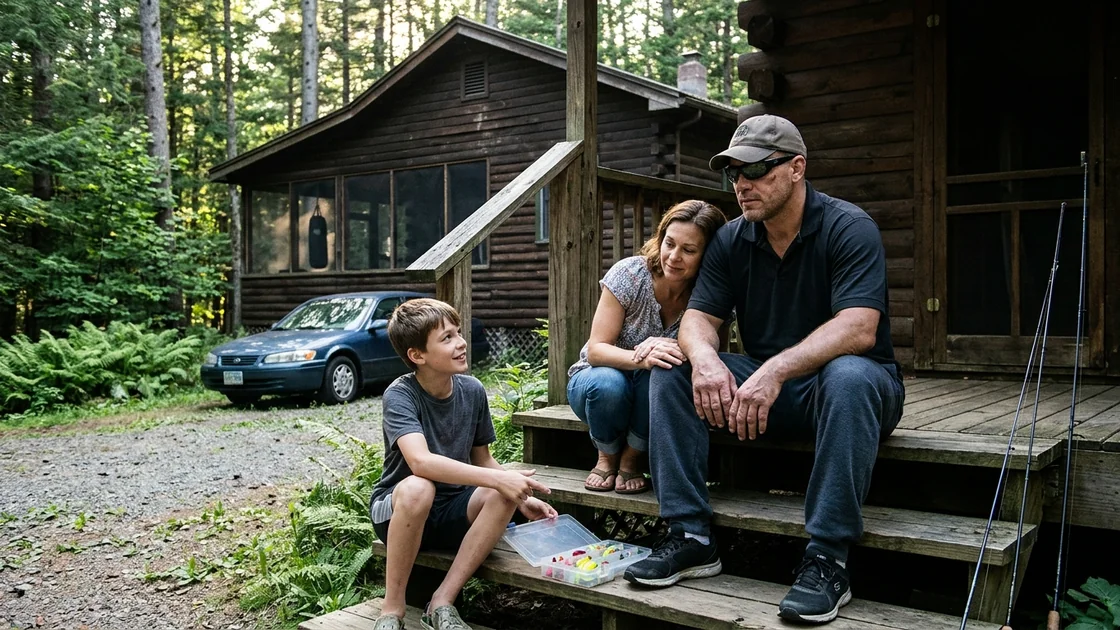
Then he looked over her shoulder down at the car. Toby was standing by the passenger door, holding two fishing rods and a plastic tackle box. He wasn't standing on his back foot anymore. He was just twelve, a little awkward, waiting his turn.
"Hey, cleanup hitter," Marcus called out softly. "You gonna stand there all day, or are you gonna show me what you got in that box?"
Toby smiled—a real, unguarded smile that reached all the way to his eyes—and walked up the porch steps. He didn't flinch when Marcus reached out slowly and ruffled his hair. Instead, Toby leaned into the touch for a second before sitting down on the step right next to his dad, popping open the plastic latch of the tackle box to show him the new green rubber worms Benny had bought him.
For three hours, they didn't go down to the lake; they just stayed right there in the shade of the big pines in front of the cabin. They ate turkey sandwiches out of the basket, and Toby threw a baseball back and forth to himself in the clearing while Elena sat on the step between Marcus’s knees, leaning her back against his chest while he rested his chin on top of her head.
Around two o'clock, the sun shifted through a gap in the hemlock trees, throwing a bright, blinding spear of light across the porch steps.
Almost immediately, the masonry drill behind Marcus’s left temple gave a warning rev. Whirrrrrr. A tiny, jagged crescent of neon light flickered at the very edge of his left eye. His jaw tightened automatically. The sound of Toby’s baseball slapping into his leather glove out in the yard—POP! POP!—suddenly sounded twice as loud as it had a minute ago.
Marcus felt the chemical heat begin to pool at the base of his skull, rising like dark water toward the broken dam of his frontal lobe.
Before the water could spill over, Marcus looked down at the laminated card on the railing.
He gently tapped Elena’s shoulder twice—the signal a boxer gives in sparring when he needs to take a knee.
"El," Marcus said, his voice tight and clipped as he forced every ounce of remaining willpower into keeping his hands open on his knees. "Sun's getting bright. My head's starting to ring. You guys gotta go now."
Elena turned around immediately. One look at the taut muscles in his jaw and the slight dilation of his pupils behind the dark glasses told her everything she needed to know. There was no argument this time. No denial. Just the practiced teamwork of two people who had loved each other for twenty-five years and finally knew the rules of the ring they were in.
"Okay," she said softly, standing up and kissing the top of his head quickly. "Toby! Pack up your glove, honey, we need to beat the traffic on the turnpike!"
"Aw, already?" Toby called out, walking toward the porch. "I wanted to show Dad my change-up grip."
"Next time, champ," Marcus said, standing up slowly and backing up toward the screened door of the porch, putting distance between himself and the boy as the roar in his ears grew louder and the pine trees began to swim with red and white light. "Show me on the iPad tomorrow night. Keep that elbow up, okay? Love you, bud."
"Love you too, Dad!" Toby waved from the car door, completely unaware of the monster currently clawing at the inside of his father's skull, seeing only his dad waving goodbye from the porch of a cool mountain cabin.
Marcus stepped inside the cabin, pushed the heavy wooden front door shut, and threw the deadbolt just as the car engine started outside.
He didn't make it to the armchair. As the sound of the blue sedan's tires crunching down the gravel lane faded into the whisper of the pines, the pain detonated behind his eyes in a blinding, white-hot flash.
Marcus dropped to his knees on the braided rug, clutching his head in his scarred hands as the rage and agony tore through the empty room. He roared into the dark cedar logs, pounding his fist against the floorboards once, twice, three times until the storm finally broke into ragged, solitary sobs.
When it was over, he lay on his side on the rug in the cool, quiet gloom of the cabin, watching the dust motes drift peacefully through a narrow beam of mountain light. His head throbbed, and for a long moment he couldn't remember what month it was, or what the name of the nurse was who came in the mornings.
He pulled himself over to the pine table, reached up with a shaking hand, and pulled down the notebook tied to the table leg. Flipping to the last page, he squinted through his blurred vision at the thick black letters he had written there the week before.
I love Elena. I love Toby. I am Marcus Vance. They are safe.
Marcus let the notebook rest against his chest, closed his eyes in the quiet dark, and waited for the bell.