The Quiet Space Between Breaths
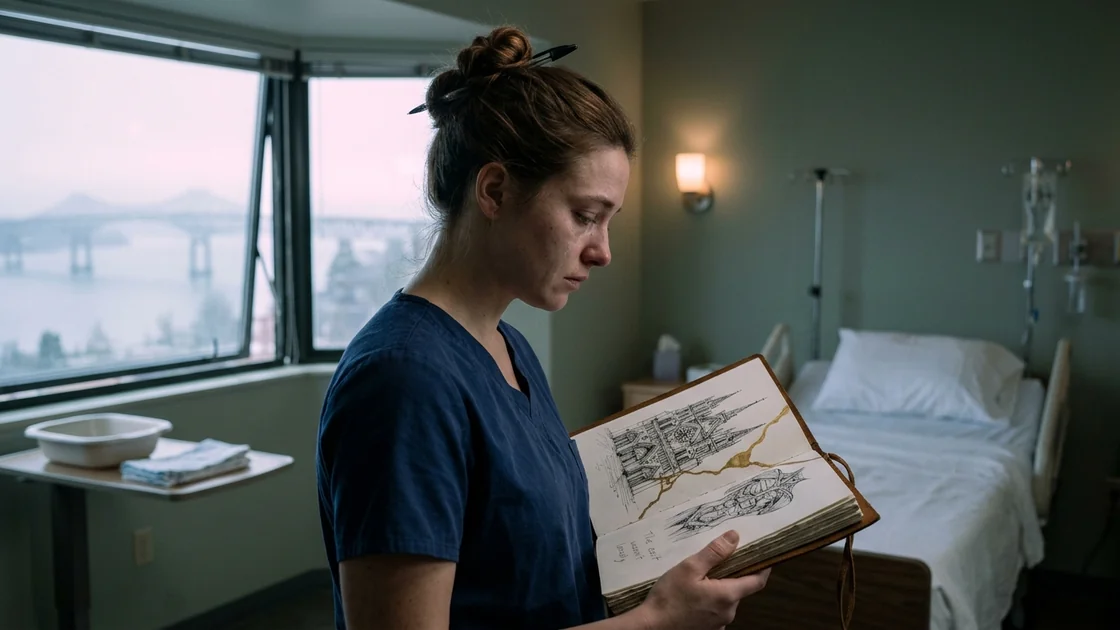
Clara Vance, a dedicated twenty-eight-year-old palliative care nurse at St. Jude’s Hospice, prides herself on maintaining a compassionate yet fortified boundary between her professional duties and her personal heart. That carefully constructed emotional wall begins to crumble when Maya Lin, an architectural illustrator of the exact same age, is admitted to the ward with terminal stage-four cholangiocarcinoma. Over the span of a fragile autumn and a biting winter, the two women forge a profound, unspoken sisterhood built on late-night conversations, shared artistic sensibilities, and the haunting realization that their lives are mirror images separated only by a cruel twist of cellular fate. As Maya’s physical condition inevitably deteriorates from vibrant defiance to the quiet, shadowy threshold of organ failure, Clara is forced to confront a paralyzing grief that threatens to shatter her professional composure, ultimately teaching her the agonizing difference between curing a body and holding a soul as it leaves.
The autumn rain in Seattle did not fall so much as it hung in the air, a perpetual silver mist that clung to the brick facade of St. Jude’s Hospice and blurred the neon lights of the city below. Inside the fourth-floor nurses’ station, the world smelled of industrial lemon disinfectant, stale dark-roast coffee, and the faint, metallic tang of central heating kicking on for the first time since spring.
Clara Vance stood by the narcotic lockbox, counting blister packs of liquid morphine and oxycodone with the practiced, rhythmic flick of her thumb. She was twenty-eight years old, though the pale fluorescent lighting of the night shift often made the hollows beneath her grey eyes look a decade older. She wore navy blue scrubs that had been washed so many times they felt like brushed silk, and her chestnut hair was twisted into a knot secured by a black ballpoint pen.
For five years, Clara had walked these linoleum corridors. In the beginning, freshly graduated and terrifyingly earnest, she had cried in the linen closet after every death. She had carried the weight of every rattling breath home with her on the dawn bus, watching commuters read their newspapers and wondering how the world could keep spinning when Mr. Henderson in Room 404 had just stopped existing.
But survival in palliative care required calcification—not of the heart entirely, for a hard heart made a cruel nurse, but of the perimeter. Clara had learned to build a sea wall. She gave her patients warmth, dignity, gentle hands, and unhurried presence, yet she kept her deepest self safely behind the concrete. When the flatline came, or more accurately, when the slow, spaced-out Cheyne-Stokes breathing simply ceased to rise again, she could wash the body, comfort the weeping family, sign the paperwork, and go home to sleep without drowning.
"New admission in 412," said Marcus, the charge nurse, sliding a thick manila chart across the laminated counter. He was a broad-shouldered man in his fifties with a voice like gravel and eyes that missed nothing. "Transferred from the oncology floor at University Hospital. Dr. Aris just signed off on the transition to comfort care."
Clara secured the lockbox, clicked it shut, and picked up the chart. "What are we looking at?"
"Cholangiocarcinoma. Bile duct cancer," Marcus said softly, his tone shifting slightly—a subtle tell that Clara recognized immediately. Usually, Marcus delivered handoffs with brisk efficiency. A drop in register meant the chart held something heavy. "Metastatic to the liver, lungs, and peritoneum. Failed two lines of chemo and an immunotherapy trial. Stent failed yesterday. She declined further invasive biliary drainage. Came here for pain and symptom management."
Clara flipped open the cover. Her eyes went automatically to the top right corner: Name, DOB, Age.
Lin, Maya. DOB: October 14, 1995. Age: 28.
Clara’s thumb froze on the edge of the paper. October 14. Clara’s own birthday was October 22. Eight days apart. They had been born under the same autumn sky, had likely watched the same cartoons on Saturday mornings, had graduated high school the same spring, had navigated their early twenties in the same bewildering decade.
"She's a kid," Clara whispered, though twenty-eight wasn't a kid. It just felt like one in a ward where the average birth year started with a nineteen-forty or fifty.
"She's your age," Marcus said, reading her face. "If you want me to swap you with Sarah—put you on 408 instead—"
"No," Clara said quickly, straightening her spine. The sea wall went up, automatic and cool. "No, I'm fine. Has she been settled?"
"Transport brought her up twenty minutes ago. No family with her tonight. Parents are flying in from Chicago tomorrow afternoon. She’s awake, alert, pain is currently a seven out of ten, mostly right upper quadrant and radiating to her back. Aris ordered a PCA pump—hydromorphone. It needs to be set up."
"I'll get the pump calibrated," Clara said.
Fifteen minutes later, carrying the infusion pump and a tray of supplies, Clara knocked softly on the heavy wooden door of Room 412.
"Come in," a voice called out. It wasn't the weak, papery rasp Clara was accustomed to hearing from terminal liver patients. It was clear, slightly husky, and carried an edge of dry exhaustion.
Clara pushed the door open. The rooms at St. Jude’s were designed to look as little like a hospital as possible. The walls were painted a muted sage green, the lighting came from warm sconces rather than overhead tubes, and a large bay window looked out toward the misty lights of the Puget Sound.
Sitting propped up against a mountain of white pillows was Maya Lin.
Even with the unmistakable stigmata of end-stage biliary disease—the deep, saffron-yellow tint of jaundice in her skin and the sclera of her dark eyes, the hollowed collarbones protruding above a faded oversized sweatshirt, the slight distension of ascites beneath the blanket—Maya was striking. Her black hair was cut in a sharp, chin-length bob that framed high cheekbones. Around her on the bed were not tissues and plastic emesis basins, but a heavy leather-bound sketchbook, a tin of archival ink pens, and a small travel set of watercolors.
"Hi," Clara said, offering a warm, unhurried smile as she stepped into the room. "I'm Clara. I'm going to be your night nurse."
Maya looked up from her sketchbook. Her amber-tinted eyes swept over Clara’s face, lingering for a fraction of a second on the lack of lines around Clara’s mouth, the youth in her posture. A flicker of something—recognition, perhaps, or a flash of bitter irony—crossed Maya’s features before smoothing out into polite composure.
"Hi, Clara," Maya said. "Looks like you brought the good stuff." She nodded toward the PCA pump.
"I did," Clara said, setting her tray down on the bedside table and beginning the routine of hanging the medication bag on the IV pole. "Dr. Aris ordered hydromorphone. With this pump, you’ll have a button you can press whenever you feel the pain creeping up. It delivers a small, measured dose right into your PICC line, so you don't have to wait for me to answer a call light."
"Self-service," Maya remarked, shifting slightly and wincing. Her right hand went instinctively to her lower ribs, her fingers pressing against the fabric of her sweatshirt. A tiny bead of sweat glistened near her temple. "I like the autonomy. Downstairs on the oncology ward, I felt like I had to file a formal petition with the state senate just to get five milligrams of oxycodone."
Clara let out a small, genuine laugh as she swabbed the port of the dual-lumen PICC line protruding from Maya’s upper left arm. Maya’s skin was hot and dry to the touch, thin as parchment over the blue tracing of her veins. "That's the difference between acute care and palliative care. Downstairs, they're fighting a war, and sometimes the patient gets caught in the crossfire of protocols. Up here, you're the general. If you hurt, we treat it. No senate approval required."
She attached the tubing, keyed in the basal rate and the bolus parameters, and handed the gray plastic cord with its green button to Maya. "Go ahead and press it now. Let’s get ahead of this seven out of ten."
Maya pressed the button. The machine gave a soft, reassuring beep. She leaned her head back against the pillows and closed her eyes, letting out a long, shuddering exhale through her nose.
While they waited for the medication to hit her bloodstream, Clara did her baseline assessment. She listened to Maya’s lungs—clear in the upper lobes, slightly diminished at the bases where fluid was beginning to crowd the pleural space. She checked her pulse, strong and slightly tachycardic at ninety-eight beats per minute. She noted the mild edema in Maya’s ankles.
"What are you drawing?" Clara asked softly, pulling the blanket back up over Maya’s feet. It was a standard rapport-building question, one she had used ahundred times, yet as she looked at the open sketchbook, her breath caught slightly.
It wasn't a casual doodle. Rendered in excruciatingly fine black ink was a cross-section of a gothic cathedral, except the flying buttresses and vaulted ceilings were seamlessly morphing into human ribcages and branching bronchial trees. The shading was done in tiny, obsessive stippling—thousands of microscopic dots forming shadows of breathtaking depth.
Maya opened her eyes, already looking marginally softer as the hydromorphone began to unspool the tight coil of pain in her abdomen. "I'm an architectural illustrator," she said, looking down at the page. "Or, I was. Before my biliary tree decided to stage a coup. I used to draw renderings for firms pitching big civic projects—libraries, museums, bridges. Lately, my subject matter has gotten a little more... anatomical."
"It's incredible," Clara said, and she meant it. She stepped closer, marveling at the precision of the lines. There was no tremor in the inkwork. "How long does a piece like this take?"
"Thirty, forty hours," Maya said, her fingers brushing the rough cotton paper. "Stippling is great for insomnia. You just make one dot, and then another dot, and before you know it, it’s four in the morning and you haven't thought about your mortality for three whole hours." She looked up at Clara, her dark eyes sharp despite the opiates. "How old are you, Clara? You don't have to answer if that violates nurse-patient Geneva conventions."
Clara hesitated for a beat. The textbook answer was a deflection: Old enough to know what I'm doing, young enough to handle the night shift. Keep the focus on the patient. Keep the sea wall intact.
Instead, looking into eyes that had seen the exact same slice of history she had, Clara heard herself say, "Twenty-eight. I’ll be twenty-nine on the twenty-second."
Maya’s eyebrows shot up. A slow, wry smile spread across her yellowed face. "October четырнадцать," she said, using a mangled, high-school-level Russian word before correcting herself with a laugh. "Sorry, hydromorphone brain. October fourteenth. I beat you by eight days. Which means, technically, I am your elder, and you have to respect my wisdom."
"Noted," Clara smiled, feeling a strange, warm tug in the center of her chest. "I'll make sure to address you as 'ma'am' during the 4:00 AM vitals check."
"Do that and I'll haunt this station," Maya replied lightly. The joke hung in the air for a second—the casual mention of haunting in a hospice room. On the oncology floor, nurses usually flinched when patients made death jokes, rushing in with toxic positivity: Don't talk like that, you've got to stay positive!
Clara didn't flinch. She simply leaned a hip against the edge of the radiator, crossing her arms loosely. "If you haunt the fourth floor, do me a favor and rattle the ice machine whenever Marcus is trying to nap on his break. It makes this awful clunking noise anyway, he’ll never know it’s ectoplasm."
Maya stared at her for a moment, and then she laughed—a real, bright sound that ended in a shallow cough. She pressed a hand to her ribs again, her smile fading into something quieter, more grateful. "Thank you," she whispered.
"For what?"
"For not telling me I'm going to get better," Maya said, looking out the black glass of the bay window where the city lights bled into the mist. "Everyone downstairs... my friends, my mom, even some of the residents... they look at me like if they just wish hard enough, my liver will magically regenerate. It’s exhausting pretending for them. I came up here because I'm too tired to pretend anymore."
"You don't have to pretend here, Maya," Clara said softly. "You can be whatever you are tonight. Angry, tired, funny, scared. It all fits in this room."
Maya nodded slowly, her eyelids growing heavy as the analgesic wave finally crested. "I think right now... I'm just sleepy."
"Then sleep," Clara said, dimming the wall sconces until only a faint amber glow remained near the bathroom door. "I'll be right outside."
Over the next three weeks, Room 412 became the gravitational center of Clara’s shifts.
Palliative care at St. Jude’s was not always a rapid descent. When patients stopped receiving aggressive, toxic chemotherapy and had their pain and nausea properly managed for the first time in months, they often experienced what the staff called the "hospice bounce"—a brief, golden plateau where their energy returned just enough for them to feel human again.
Maya had a bounce.
Her parents, Arthur and Helen Lin, arrived from Chicago the second day. They were quiet, retired academics who wore their grief like heavy, wet overcoats they couldn't take off. During the day, they sat by Maya’s bed, reading to her, bringing her clear ginger broth from Chinatown that she could barely sip, and talking in hushed, terrified tones with the social workers in the hallway.
By 8:00 PM, exhausted and overwhelmed by the sterile finality of the building, her parents went back to their hotel a few blocks away. And at 7:00 PM, Clara’s shift began.
Because the nights were quieter—most of the older patients slept heavily from sundown to sunrise, aided by haloperidol and lorazepam—Clara found herself spending her charting breaks in 412. She would bring her rolling computer cart just inside the doorway, typing up assessments while Maya worked on her stippling under the focused beam of a clip-on reading light.
They talked about everything that didn't matter, which, in the shadow of a terminal diagnosis, suddenly mattered more than anything else.
They discovered they had both gone to the same torrential outdoor music festival at the Gorge in 2016; they did the math and realized they had probably stood within fifty yards of each other in the mud while listening to an indie band neither of them still liked. They debated the architectural merits of the Seattle Central Library—Maya loved the audacious steel-and-glass geometry; Clara thought the neon-yellow escalators gave her vertigo. They talked about bad mid-twenties boyfriends: Clara’s ex, a software engineer who had broken up with her because her shift work interfered with his weekend rock-climbing schedule, and Maya’s ex, a fellow architect who had slowly, cowardly ghosted her six months into her diagnosis when the surgical scars and chemo ports became too real for his curated life.
"To be fair," Maya said one rainy Tuesday night in early November, her pen tapping rhythmically against the paper—tock, tock, tock, tock—"he was a minimalist. And metastatic cancer is decidedly maximalist. Tubes, bags, jaundice, existential dread. Very cluttered aesthetic. Ruined his vibe."
Clara, who was flushing Maya’s PICC line with saline, snorted so hard she nearly dropped the syringe. "That is the darkest excuse for a terrible man I have ever heard."
"It’s true!" Maya insisted, grinning. The jaundice had deepened over the weeks, turning her skin from saffron to a dark, bruised bronze, and she had lost another six pounds, her wrists looking like bird bones beneath the cuffs of her cardigan. Yet her eyes were still fiercely bright. "What about you? Anyone waiting for you at home when you clock out of the house of spirits?"
Clara capped the line and secured the dressing. "Just a very judgmental calico cat named Soup and a sink full of dishes."
"Why Soup?"
"Because when I found her behind the dumpster at the hospital three years ago, she was the size of a soup can and making a noise like boiling water." Clara pulled up the wooden visitor chair and sat down, tucking her legs underneath her. She knew she shouldn't sit like this—curled up as if she were in a dorm room rather than a clinical setting—but her feet ached, and the ward was silent. "Honestly, it’s hard to date when your answer to 'How was your day?' is usually 'Well, I helped a family wash their father’s body and then I ate a cold burrito in three minutes.'"
Maya stopped stippling. She set her Micron pen down on the blanket and looked at Clara for a long moment. The rain beat against the bay window, a steady, rhythmic drumming.
"Why do you do it, Clara?" Maya asked quietly. "You're twenty-nine now. You're smart, you have steady hands. You could be in the ER doing adrenaline stuff, saving gunshot victims. You could be in labor and delivery, handing pink babies to crying moms. Why sit in the dark with people who are leaving?"
Clara looked down at her own hands—pale, short-nailed, chapped at the knuckles from washing them forty times a shift. No patient had ever asked her that directly. Usually, family members just called her an "angel," a word Clara despised because it stripped away the grueling, deliberate human labor of the job and turned it into some effortless divine calling.
"My older brother died when I was nineteen," Clara said.
She froze internally the second the words left her mouth. Rule number one, her nursing school instructors had drilled into them. Self-disclosure must only ever serve the therapeutic needs of the patient. Never make your trauma their burden. She hadn't told a patient about Julian in five years. The sea wall had a crack in it, and the cold tide was seeping through.
Maya didn't gasp or offer platitudes. She just tilted her head, waiting.
"Car accident on I-5," Clara continued, her voice dropping to match the hush of the rain. "He didn't die right away. He was in the ICU for nine days with a traumatic brain injury. It was... loud. Everything in the ICU was loud. Alarms screaming, doctors arguing about surgical interventions that wouldn't work, machines breathing for him when he was already gone. Nobody talked to us about him. They just talked about his numbers—intracranial pressure, blood gas levels, urine output. When they finally withdrew care, the nurse who was on shift that night—her name was Elena—she turned off all the monitors. She brought in warm blankets. She washed the dried blood out of his hair that had been there for a week because everyone was too busy trying to save his organs to notice he was dirty. She made the room quiet so we could actually say goodbye to my brother, instead of saying goodbye to a science experiment."
Clara swallowed against the familiar, dry ache in her throat and looked up at Maya. "I think I realized then that how you leave matters just as much as how you arrive. Labor and delivery nurses make sure the entrance is safe. Somebody has to make sure the exit isn't lonely."
Maya was completely still. A single tear leaked from the corner of her amber-stained eye, cutting a clean track down her cheek before soaking into the white pillowcase. She reached out her right hand—the one not tethered to the IV pole—and laid it palm-up on the blanket between them.
Clara didn't hesitate. She took Maya’s hand. It was hot, dry, and shockingly light, like holding a bundle of dried autumn leaves.
"I'm really glad you're at my exit, Clara," Maya whispered.
Clara squeezed her fingers gently, her own chest tightening with a fierce, protective ache that terrified her. "We're not at the door yet, Maya. You still have a lot of dots left to put on that page."
On the morning after Maya’s twenty-ninth birthday—for which Clara had smuggled in a tiny, illegal beeswax candle stuck into a cup of lemon Italian ice, the only thing Maya’s stomach could tolerate—Marcus called Clara into the breakroom before she clocked out.
He poured himself a mug of black coffee, leaned against the scratched laminate counter, and looked at her over the rim of his glasses.
"You been in 412 a lot this past month," Marcus said. It wasn't an accusation; it was an observation delivered with the weary tenderness of a veteran who had seen a hundred young nurses burn out.
"She has complex pain management needs," Clara said automatically, reaching for her coat in her locker. "The biliary colic flares up around two in the morning. And she has severe insomnia."
"Clara," Marcus said softly.
She stopped, her hand on her coat sleeve.
"I’ve been doing this twenty-two years," he said. "I know what complex pain management looks like, and I know what transference looks like. You're looking at that girl and seeing yourself in that bed. Or your sister. Or your best friend."
"My care is completely objective," Clara said, a defensive heat rising in her cheeks. "Have I missed a med pass on my other rooms? Have my charts been late?"
"Your charts are immaculate, and Mr. Henderson’s family sang your praises yesterday," Marcus replied calmly. "I’m not talking about your nursing, Clara. I’m talking about your head. Her labs came back from yesterday’s draw—the last one Aris is going to order, since she’s declining further bloodwork. Her bilirubin is nineteen. Her albumin is tanking. Her liver is shutting down. The bounce is over."
Clara felt a cold stone drop into her stomach. She had known it, clinically. She had seen the increasing ascites making it harder for Maya to take a deep breath; she had smelled the faint, sweetish odor of fetor hepaticus on Maya’s breath over the last two nights—the unmistakable scent of a liver no longer filtering toxins from the blood. She had seen it, charted it, and somehow refused to know it.
"When hepatic encephalopathy hits," Marcus continued gently, "when the ammonia builds up in her brain, it’s not going to be pretty. She’s going to get confused. She might get agitated, delirious. The girl you've been laughing with at three in the morning is going to slip away before her body does. If you don't step back a little now, it’s going to tear you in half. Let me rotate your assignment for the next rotation. Take the west wing."
"No," Clara said. Her voice was sharper than she intended. She took a breath, forcing her shoulders down. "Marcus, please. She trusts me. She hates it when new nurses come in and fuss over her or talk to her like she’s a child. If she’s going to get confused, having a familiar face in the room helps ground the patient. That’s standard delirium protocol."
She was using textbook jargon to defend a breaking heart, and they both knew it.
Marcus sighed, rubbing the bridge of his nose. "Standard protocol," he echoed dryly. "Alright, Vance. Keep the assignment. But the second I see you losing your footing, I’m pulling you off. Go home. Get some sleep."
Clara didn't sleep well that day. She lay in her sun-dappled apartment, listening to the daytime traffic of Seattle—delivery trucks, sirens, kids walking to school—while Soup the cat purred like a chainsaw on her chest. She stared at her ceiling and thought about the sketchbook in Room 412. She thought about how unfair it was that her own liver was quietly, effortlessly filtering her blood right now, that her lungs were expanding without fluid crushing them, that she had decades of mundane Tuesdays ahead of her while Maya’s entire universe was shrinking down to the dimensions of a twin-sized hospital bed.
The decline did not happen like a cliff; it happened like an eroding shoreline, chunks of Maya’s vitality washing out to sea with every twelve-hour shift.
By late November, the winter storms had rolled in off the Pacific, battering the fourth-floor windows with freezing rain. Inside Room 412, the landscape had changed.
The leather sketchbook sat closed on the windowsill. Maya no longer had the strength or the neurological coordination to hold the Micron pens. When she tried, her hands exhibited asterixis—the classic "liver flap," a coarse, involuntary jerking of the wrists caused by metabolic toxins affecting the motor centers of her brain. The first night the tremor ruined a line on her cathedral drawing, throwing a jagged black slash across the delicate stippling of a vaulted arch, Maya had stared at it in silence for ten seconds before shoving the book off the bed.
When Clara came in to answer the call light, she found Maya sitting on the edge of the mattress, her thin shoulders heaving with dry, silent sobs, her feet dangling an inch above the linoleum because she was too weak to stand and kick the book away.
"Hey, hey, I've got you," Clara murmured, dropping to her knees on the floor in front of her, ignoring the hard chill of the tiles. She wrapped her arms around Maya’s waist, feeling the frightening prominence of her spine and ribs through the cotton hospital gown—Maya had finally given up wearing her own clothes three days prior because pulling sweatshirts over her head exhausted her oxygen reserves.
"It's ruined," Maya gasped against Clara’s shoulder, her breath hot and sweet with ammonia. "I ruined it. My hands won't work. Clara, my hands won't work."
"It's not ruined," Clara whispered, rocking her slightly, one hand smoothing the damp black hair at the back of Maya’s neck. "It's just finished. You've done enough work, Maya. You don't have to draw anymore."
"If I can't draw, what am I doing here?" Maya wept, her fingers clutching weakly at the back of Clara’s navy scrubs. For the first time, the dry wit, the brave architectural armor, was completely gone. She sounded twenty-nine and terrified of the dark. "I'm so scared, Clara. I don't want to disappear. Everyone is going to keep going. My friends are getting married in June. There’s a new bridge going up over the ship canal and I won't ever see it finished. Where do I go when my brain stops?"
Clara’s eyes burned so fiercely that the sage-green walls of the room blurred into watery smears. The sea wall inside her didn't just crack; it collapsed entirely under the weight of the question. She had no clinical answer. She had no religious certainty to offer. She only had the crushing weight of her own presence.
"I don't know where we go," Clara said, her voice trembling so hard she barely recognized it. She pulled back just enough to frame Maya’s gaunt, bronze-tinted face in her hands, forcing Maya to look at her. "Listen to me. You are not disappearing. I am right here. Your mom and dad are right here. And I am going to look at that bridge over the ship canal every single time I cross it, and I am going to remember how you told me the suspension cables were mathematically derivative."
A tiny, wet hitch of a laugh escaped Maya’s throat.
"I won't let you go into the dark alone," Clara promised, a vow that violated every rule of professional detachment she had ever been taught. "I'm staying right with you."
She helped Maya back under the covers, elevated the head of the bed to forty-five degrees to ease the pressure of the abdominal fluid on her diaphragm, and administered a bolus of hydromorphone and two milligrams of intravenous lorazepam. She sat on the edge of the mattress, holding Maya’s twitching hand until the medication smoothed out the tremors and pulled her down into a heavy, drug-induced sleep.
Only then did Clara pick up the sketchbook from the floor, place it gently on the table, and walk out of the room. She bypassed the nurses' station, walked straight into the clean utility room, locked the door behind her, and sank down against the shelves of sterile gauze and saline bags. She buried her face in her knees and cried until her ribs ached—silent, violent sobs that she muffled into the fabric of her scrubs so Marcus wouldn't hear.
By the second week of December, the encephalopathy had claimed the surface of Maya’s mind.
She slept twenty hours a day now. Her parents no longer went back to the hotel at night; St. Jude’s had rolled two convertible sleeper chairs into the corners of Room 412. Arthur and Helen Lin looked like ghosts themselves, hollow-eyed and grey, moving in slow motion around their daughter’s bed.
Clara became their anchor, translating the terrifying physical mechanics of dying into a language they could survive.
When Maya stopped being able to swallow even ice chips, Helen panicked, begging Clara to hang a bag of IV fluids so Maya wouldn't "starve or dry up." Clara took the older woman’s trembling hands and explained, with infinite gentleness, why artificial hydration at the very end was a cruelty rather than a kindness—how a failing liver and kidneys couldn't process the extra water, how it would only pool in Maya’s lungs and belly, making her drown from the inside out.
"Her body knows how to shut down," Clara told them softly as she swabbed Maya’s parched lips with a damp Toothette dipped in cool water and applied a thin layer of peppermint lip balm. "Dehydration right now actually triggers the brain to release natural endorphins. It’s nature’s anesthesia. She isn't thirsty, Mrs. Lin. The dry mouth is just from breathing through her mouth. Keep swabbing her lips like this—that’s how you love her today."
Yet while Clara could guide the parents with the steady, practiced grace of an experienced nurse, the nights when the parents finally collapsed into exhausted sleep were an endurance test of pure agony for Clara.
Because in the dead of night, Maya would wake up in the grip of terminal delirium.
Her eyes would open, wide and unfocused, staring at the ceiling sconces. She didn't know she was in St. Jude’s anymore. Sometimes she thought she was in her university studio during finals week, muttering feverishly about missing deadlines and spilled ink. Sometimes she reached upward with frail, picking fingers—carphologia, the nurses called it, plucking at invisible threads in the air—trying to catch things only she could see.
One freezing Thursday night at 3:00 AM, while her parents snored softly under their blankets in the corner, Maya began to thrash weakly against the sheets, her heart rate spiking to one hundred and thirty on the portable oximeter Clara was using. A low, distressed moan came from the back of her throat, her eyebrows drawn together in agony and confusion.
"Maya," Clara whispered, rushing to the bedside. Before reaching for the haloperidol syringe, she leaned down, putting her face directly in Maya’s line of sight, and took both of Maya’s hot, fluttering hands in hers. "Maya, look at me. It's Clara."
Maya’s cloudy, amber eyes rolled toward the sound. For ten long seconds, there was nothing there—just the terrifying, vacant stare of a brain swimming in toxins.
Then, like a swimmer breaking through dark water for one last gasp of air, Maya’s pupils contracted slightly. Her gaze locked onto Clara’s face. The frantic picking of her fingers stopped.
"Clara?" Maya rasped. The word was barely audible, a dry rustle of leaves.
"I'm here," Clara breathed, her heart hammering against her ribs. "You're safe. You're at St. Jude’s. Your mom and dad are sleeping right next to you. You don't have to finish the drawing. The deadline was extended."
Maya’s cracked lips twitched—the ghost of the wry smile from six weeks ago. Her fingers curled with surprising, sudden strength around Clara’s thumb.
"Cold," Maya whispered. "Water's cold."
"I'll get you a warm blanket," Clara said, her throat closing up. "And I'm going to give you something so you can rest, okay?"
"Stay," Maya breathed, her eyes already losing focus again, drifting back down into the dark current. "Soup..."
Clara let out a choked sound—half sob, half laugh. Even in the fragments of her dying mind, Maya remembered the name of Clara’s cat.
"I'll stay," Clara whispered against Maya’s knuckles. "I'm not going anywhere."
Those were the last words Maya Lin ever spoke.
By Saturday night, Maya was actively dying.
Anyone who had worked in hospice for more than a month could tell the moment they stepped across the threshold of Room 412. The air in the room had changed weight; it felt thick, sacred, and suspended outside of normal time.
Maya lay flat on her back now, supported by pillows arranged to keep her airway completely open. Her skin had shifted from the dark bronze of jaundice to a waxy, translucent grey at her extremities. When Clara gently lifted the sheet to check her legs during the 8:00 PM assessment, she saw the unmistakable lacy, purplish-blue web of mottling creeping up from Maya’s soles to her knees. The peripheral circulation was shutting down, pulling the last reserves of blood toward the heart and brain.
Her breathing had transitioned into the classic Cheyne-Stokes pattern: several rapid, shallow breaths accompanied by a soft, wet rattling in the back of her throat—terminal secretions that Maya was too deep in coma to cough up—followed by a terrifyingly long pause of apnea where her chest did not move at all for fifteen, twenty, thirty seconds, before a sudden, shuddering gasp started the cycle over again.
Arthur Lin sat on the left side of the bed, holding his daughter’s left hand, his forehead resting against the mattress rail. Helen sat on the right, stroking Maya’s forehead over and over in a hypnotic rhythm.
Clara moved around them like a shadow. She administered glycopyrrolate through the PICC line to dry up the secretions so the rattling wouldn't distress her parents—the "death rattle" didn't hurt the patient, who was as deeply unconscious as someone under general anesthesia, but the sound haunted families forever. She increased the basal rate of the hydromorphone slightly whenever she saw the slightest furrow appear between Maya’s brows. She turned Maya gently every two hours with Marcus’s help, using slide sheets so they barely disturbed her body, tucking fresh, warm linen pillows behind her back.
At 2:00 AM, Clara was sitting at the nurses' station, staring blankly at a computer screen she wasn't reading. Her hands were shaking so badly she couldn't type. She felt hollow, as if someone had taken a scoop to the inside of her ribcage and scraped everything out. Every time she closed her eyes, she saw Maya on that first night—propped up against the pillows, dark hair sharp against her cheekbones, holding the green button like a TV remote and joking about haunting the ice machine.
Twenty-nine, Clara’s mind kept repeating on a loop. She only got twenty-nine years. It’s not enough. It’s not fair. Why am I sitting in this chair breathing when she’s in there suffocating on her own blood?
A heavy hand came down on her shoulder. Clara flinched violently, looking up to see Marcus standing over her. He didn't say a word. He just looked at her trembling hands on the keyboard, then nodded toward the breakroom.
Clara stood up on wooden legs and followed him inside.
"Drink," Marcus said, handing her a paper cup of cold water.
Clara took it, her teeth chattering against the rim as she tried to take a sip. Half of it spilled down the front of her scrub top. She looked down at the dark wet stain on the navy fabric, and something inside her snapped. She crushed the paper cup in her fist and threw it into the trash can.
"I can't do this anymore, Marcus," she gasped, leaning both hands against the breakroom table, her head hanging between her shoulders. "I can't. Five years of this. Watching people rot. Putting morphine into a girl who should be out at a bar in Capitol Hill tonight complaining about her rent! Why doesn't anything we do actually save anyone? We just make them comfortable while cancer eats them alive!"
Marcus closed the breakroom door quietly and leaned against it, folding his arms. He let the silence stretch until Clara’s ragged breathing slowed down.
"You think we didn't save her?" Marcus asked softly.
Clara laughed, a bitter, broken sound, wiping her nose with the back of her wrist. "Have you looked in 412 lately? Her knees are purple, Marcus. She’s going to be dead before the sun comes up."
"Yeah, she is," Marcus said unflinchingly. "Cancer killed her body six months ago when that stent failed. Nothing on God's green earth was going to change that. Not Dr. Aris, not the oncologists downstairs, not you. You want to know what she would have had without you this last month, Clara?"
Clara didn't answer, staring at the wood grain of the table.
"She would have died on the eighth floor at University Hospital," Marcus said, his voice dropping into a low, steady cadence. "She would have died under bright fluorescent lights with a resident cracking her ribs doing pointless CPR while her mother screamed in the hallway. Or she would have spent her last six weeks vomiting in terror at three in the morning with a nurse who didn't have time to hold her hand because they were hanging chemo in four other rooms. Instead, she finished a drawing. She laughed. She ate lemon ice on her birthday. And when her brain broke and she was terrified, she heard a voice she loved telling her she was safe."
Marcus stepped forward and put a hand on the back of Clara’s neck, his grip warm and grounding. "You didn't save her life, Clara. You saved her death. Don't you dare stand in my breakroom and tell me that doesn't matter, when you're the one who taught half the younger nurses on this floor how much it does."
Clara stood frozen, the words sinking through the frantic static of her grief and hitting something solid at the bottom of her soul. You saved her death. She thought of Elena, the ICU nurse who had washed her brother Julian’s hair ten years ago. Elena hadn't saved Julian’s life either. Yet Elena was the only reason Clara’s family hadn't been destroyed by the memory of that room.
Clara let out a long, shaky breath. She stood up straight, pulled three rough brown paper towels from the dispenser, and pressed them hard against her eyes. She washed her face with cold water at the sink, dried her hands, and looked at Marcus.
"I need to go back in there," she said. "Her pauses are up to forty seconds. It’s going to be soon."
Marcus nodded once and stepped aside from the door. "Go bring her home, Vance."
When Clara re-entered Room 412 at 3:45 AM, the rain outside had finally stopped. Through the bay window, the clouds were parting just enough to reveal the ink-black water of the Sound and the distant, quiet lights of Bainbridge Island.
In the bed, Maya was completely still. The Cheyne-Stokes rattling had ceased; the glycopyrrolate had done its job. Now, there were only tiny, whisper-quiet puffs of air moving past her lips—one breath, then forty-five seconds of absolute silence, then another tiny breath, like a pebble dropping into a still pond.
Arthur and Helen were both awake now, standing close together on the left side of the bed, holding each other and Maya’s left hand. When Clara walked in, Helen looked up at her with wide, pleading eyes.
"Is it..." Helen couldn't finish the sentence.
Clara walked silently to the right side of the bed. She didn't reach for her stethoscope or the pulse oximeter; she wouldn't put cold metal or plastic on Maya now. Instead, she laid two warm fingers lightly against the side of Maya’s neck, finding the carotid pulse—faint, fluttering like a trapped moth’s wing—and with her other hand, she picked up Maya’s right hand from the blanket.
It was cool now, the heat of the fever finally gone.
"Just a little longer," Clara whispered to her parents. "Keep talking to her. Hearing is the very last sense to go. Tell her she can let go whenever she's ready."
Arthur Lin bowed his head over his daughter’s arm, tears dropping silently onto the white sheet. "You were a good girl, Maya," he whispered in Mandarin, and then in English, his voice breaking. "We're okay, sweetheart. Mom and I will take care of each other. You don't have to fight anymore. Go rest."
Clara stood on the opposite side of the bed, holding Maya’s cooling fingers between both of her own hands. She looked at Maya’s face. All the tension—the months of nausea, the agony of the failing liver, the terror of the delirium—had been completely erased from her features. Her brow was smooth. Her sharp cheekbones caught the warm, dim light of the wall sconce. She looked twenty-nine again. She looked like an artist sleeping late on a Sunday morning.
Thank you for being my friend, Clara thought, projecting the words with everything she had into the quiet space of the room, hoping that wherever Maya’s consciousness was drifting, she could feel the warmth of Clara’s hands. I'll see you at the bridge.
Maya’s chest rose slightly—a soft, effortless sigh that barely lifted the collar of her gown.
And then the room went still.
Ten seconds passed. Thirty. A minute.
Beneath Clara’s fingertips on Maya’s neck, the faint, fluttering moth beat once, twice, and then stilled into absolute quiet.
Clara waited another full minute, listening to the profound, ringing silence that always followed the last breath—a silence that didn't feel empty, but rather like a room after a long, difficult symphony has finally resolved into its final chord. Only then did she take her stethoscope from around her neck, warm the diaphragm against her scrub top for a second out of sheer habit, and place it gently over Maya’s heart.
She listened for sixty seconds to the quiet chest. There was no sound.
Clara slowly removed the earpieces, bowed her head slightly, and looked up at Arthur and Helen Lin. Tears were running freely down Clara’s own cheeks now, and for once, she didn't try to wipe them away or hide them behind a clinical mask.
"She's gone," Clara said softly. "Time of death, 4:02 AM."
Helen let out a low, keening cry and collapsed against her husband’s chest, both of them sinking down onto the edge of the mattress to hold their daughter. Clara gently laid Maya’s right hand across her abdomen, stepped back silently, and slipped out of the room, pulling the heavy wooden door shut to give them the sacred privacy of the first hour.
At 5:30 AM, after Arthur and Helen had finally kissed their daughter’s forehead one last time and been escorted gently down to the lobby by the night social worker, Clara returned to Room 412 alone to perform the post-mortem care.
Marcus had offered to help, or to have the nursing assistant do it, knowing how close Clara had been to her. Clara had refused. This was the last nursing act she would ever perform for Maya, and she wasn't going to hand it off to anyone else.
She brought in a basin of steaming warm water scented with lavender soap, a stack of soft white washcloths, and a clean, pale-blue gown from the linen warmer.
Working in the quiet pre-dawn light, Clara moved with a slow, reverent tenderness. She turned off the PCA pump—the machine that had hummed steadily in the corner for six weeks—and the sudden cessation of its mechanical whir made the room feel even more peaceful. She carefully removed the transparent dressing on Maya’s left arm and slid the long, thin catheter of the PICC line out of the vein, pressing a small square of gauze over the site. No more tubes, she thought. Back to minimalism, Maya.
She washed Maya’s face, gently cleaning away the traces of peppermint balm and dried tears. She washed her thin arms, her hands—the hands that had drawn a million tiny black dots to keep the dark at bay—cleaning a tiny smudge of old archival ink that still clung stubbornly to the callous of Maya’s right middle finger. With a wide-toothed comb, she smoothed Maya’s dark bob until it framed her face just the way Maya had liked it when she was first admitted.
When Maya was dressed in the clean gown, the sheets pulled up neatly to her elbows and her hands folded peacefully over her waist, Clara walked over to the bay window and pushed it open two inches, just as she had been taught to do by an old Irish nurse during her first week at St. Jude’s—to let the soul out into the morning air.
Cold, salt-tinged wind from the Puget Sound drifted into the room, ruffling the edge of the blanket.
As Clara turned to pick up the basin of water, her eyes fell on the bedside table where Maya’s parents had left a small stack of items for Clara after they packed up Maya’s belongings. Sitting right on top of the laminated hospital bereavement folder was the heavy, leather-bound sketchbook, with a yellow Post-it note stuck to the cover in Helen Lin’s neat handwriting:
Clara—Maya told me two weeks ago that when she was done, this book belonged to you. Thank you for loving our girl through the night. —Helen & Arthur.
Clara set the basin down. With trembling hands, she picked up the sketchbook and opened it to the page Maya had been working on before the tremors took her coordination.
There was the gothic cathedral morphing into a human ribcage—breathtaking, intricate, unfinished. And there, across the upper right arch, was the jagged black slash Maya had made when her wrist jerked that night in November, the night she had sobbed on the floor that the drawing was ruined.
Only it wasn't a slash anymore.
Clara stared at the page, her breath catching in her throat.
Sometime during the day shift that week, before the delirium had taken over completely—perhaps with her mother holding her wrist steady, or perhaps in one last, stubborn burst of sheer architectural willpower—Maya had gone back into that jagged, ruined line with a watercolor brush dipped in pale gold paint. She had traced over the erratic black slash and branched it outward into delicate, glowing veins of gold leaf, exactly like kintsugi, the Japanese art of repairing broken pottery with lacquer and gold so that the fracture becomes the most beautiful part of the vessel.
Beneath the golden fracture, in tiny, shaky pencil handwriting that looked like it had taken everything she had left to write, were four words:
The exit wasn't lonely.
Clara pressed the open sketchbook against her chest, her forehead resting against the cool glass of the bay window as the first pale, pink light of a December dawn broke over the Seattle skyline. She cried then—not the violent, suffocating sobs of the utility room, where she had fought against the helplessness of her job, but a long, quiet rain of grief and gratitude that washed the hollow ache out of her ribs.
She knew that when she came back to work on Tuesday night, Room 412 would be scrubbed clean, the sage-green walls smelling of lemon disinfectant, the mattress remade with crisp white hospital corners waiting for someone else’s mother, or brother, or friend. She knew that her sea wall was gone, and that she would probably never be able to rebuild it the way it was before Maya Lin walked onto the fourth floor.
And as she looked out at the new steel bridge rising over the ship canal in the morning mist, its suspension cables catching the first gold of the sun, Clara realized she didn't want the wall back. The pain of loving them was the price of keeping the dark away—and she would pay it again tomorrow night.