The Quiet Side of the Curtain
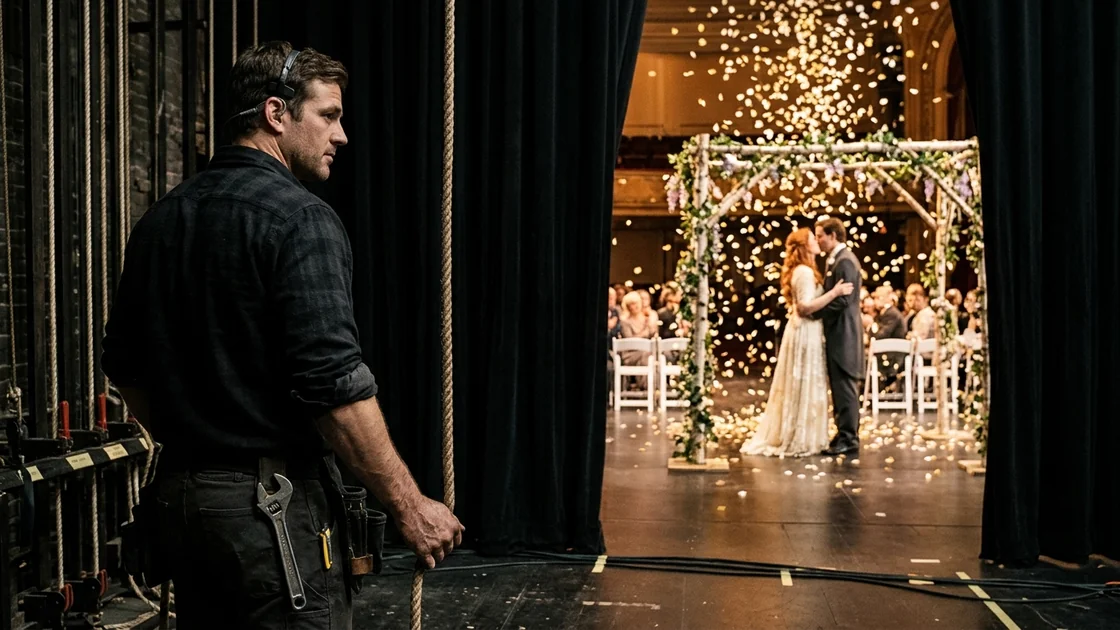
Arthur Pendelton spent seven years working as the head carpenter and stagehand at the Grand Orpheum Theater, harboring a silent, all-consuming love for Clara Vance, the theater’s brilliant and kind-hearted costume designer. Throughout countless productions, late-night repairs, and shared moments in the dusty quiet of the backstage world, Arthur built a life around her happiness, never quite finding the courage to confess his feelings over the roar of his own insecurities. When the charming, golden-voiced leading actor Julian Sterling joined the company for a six-month run of a classic romance, Arthur watched from the dim rigging of the wings as Julian effortlessly swept Clara off her feet. Ultimately, Arthur’s devotion was put to the final test when Julian and Clara decided to hold their actual wedding ceremony on the main stage of the Orpheum, leaving Arthur to operate the fly rail and lighting cues for the marriage of the woman he loved to another man.
Part I: The Sawdust and the Silk
The Grand Orpheum smelled of things that had lived a thousand lives and died a thousand deaths, only to be resurrected by three-inch drywall screws and fresh coats of flat black paint. To the people who bought tickets at the mahogany box office out front, the theater was a palace of crimson velvet, gilded plaster cherubs, and crystal chandeliers that hummed like giant beehives when the bass notes hit the auditorium floor. To Arthur Pendelton, the Orpheum was an anatomy of pine framing, rusted counterweights, hemp ropes that bit into the palms, and eighty-foot drops from the gridiron that could kill a man if he forgot to clip his harness.
Arthur lived in the anatomy. He was thirty-two years old, with shoulders broadened by hauling four-by-eight sheets of three-quarter-inch plywood and hands that were permanently stained a faint walnut brown from wood glue and dark oak stain. He was a quiet man, the sort of man whose boots didn't squeak on the masonite deck because he knew where every joist lay underneath. He wore flannel shirts with the sleeves rolled up twice, revealing forearms mapped with small, pale scars from stray staples and hot lighting instruments. In his belt, he carried a crescent wrench on a lanyard, a utility knife, a roll of white spike tape, and a small pencil tucked behind his left ear.
He was the ghost who made the magic stand up straight. When a prince scaled a castle wall on stage, it was Arthur who had reinforced the hidden treads on the back of the flat so the wood wouldn't groan under the actor's boots. When the moon rose over an enchanted Venice, it was Arthur pulling the purchase line on Rail Fourteen with such a steady, practiced hand that the painted canvas orb seemed to float on an invisible tide.
He loved the theater, not for the applause—which sounded like heavy rain hitting a tin roof from where he stood in the wings—but for the logic of it. A toggle clamp held or it didn't. A Dutchman covered the seam between two flats, or the light bled through. Everything backstage was honest because its only job was to create a lie for the people sitting in the dark.
And then there was Clara.
Clara Vance had arrived at the Orpheum five years ago, hauling three vintage Singer sewing machines in the back of a dented hatchback and wearing a pincushion strapped to her wrist like a watch. She had hair the color of dark copper that she usually twisted up and skewered with whatever was handy—a bone crochet hook, an unsharpened Number Two pencil, or once, memorably, a six-inch carriage bolt she had borrowed from Arthur’s shop table.
The costume shop was in the basement, right next to the scene shop, separated only by a heavy fire door that they both propped open with a painted brick during the muggy summer months. For the first year, their relationship was built entirely on small, transactional rescues.
"Arthur," she would say, appearing in the doorway through a haze of birch sawdust, holding up a fractured wooden hoop from an eighteenth-century pannier skirt. Her brown eyes would be wide, smudged underneath with the violet shadows of a woman who had been hemming velvet until three in the morning. "Tell me you have some magic that can fix this before dress rehearsal at seven. The lead soprano sits like she’s felling timber."
Arthur wouldn't say much. He would wipe his hands on his jeans, take the fragile cedar hoop from her fingers—careful not to brush her skin, though he always noticed the faint smell of lavender starch and iron steam that clung to her—and carry it over to his workbench. He would sister the break with a thin strip of aircraft plywood, bind it with sinew and hide glue, and clamp it while she sat on an overturned five-gallon joint-compound bucket, drinking bad coffee from his thermos and talking about fabric weights.
She talked to him the way people talk to the ocean, or to an old dog, or to a journal. Because Arthur didn't interrupt, and because he watched her with a steady, grey-eyed attention that never demanded anything in return, Clara gave him the whole history of her heart. He knew about her father, a high school history teacher in Ohio who had taught her to love old periods; he knew about her older sister who thought working in regional theater was a form of prolonged adolescence; he knew that she hated the texture of cheap polyester organza because it felt like "angry spiderwebs," and that she always cried during the third act of Our Town, no matter how bad the actors were.
By the end of the second year, Arthur was in love with her in the way he built scenery: permanently, with heavy timber and reinforced corners, designed to hold weight for a century.
He never told her. It wasn't out of cowardice, exactly, though fear was a large part of it. It was a sense of proportion. Clara was an artist. Her sketches were pinned all over the walls of her shop—watercolors of dashing cavaliers and tragic queens that ended up framed in the lobby after the shows closed. She went to opening night parties in vintage silk dresses she had altered herself, laughing with the directors and the board members, her copper hair falling down around her shoulders, catching the light of those beehive chandeliers.
Arthur was the guy who swept up the broken glass after the party was over. He was the guy who smelled of turpentine and pine resin. He didn't have the vocabulary for the things she loved; when she talked about the "emotional architecture of a silhouette," he just nodded and wondered if he needed to widen the upstage left doorway by two inches so her new crinolines wouldn't snag on the trim.
Instead of speaking, he built things for her.
When he noticed her back was hurting from hunching over the cutting table, he spent three nights after the crew went home milling a set of oak risers with routed grooves that lifted the six-foot table precisely four inches—the exact height for her elbows. When her spools of silk thread kept rolling off her shelves whenever the subway rumbled beneath the theater, he built a wall-mounted rack with three hundred hand-turned birch dowels, each angled slightly upward at ten degrees.
"Arthur!" she had gasped when she came in that Tuesday morning, running her small, needle-pricked fingers over the sanded birch. He had finished it with beeswax so it wouldn't snag the delicate threads. "When did you do this? It’s... it’s like a piece of furniture from a monastery."
"Scrap wood," he had mumbled, looking down at the toe of his boot, his ears burning a fierce, traitorous red. "From the Crucible set. Had it lying around. Didn't want to throw it in the dumpster."
She had stood on her tiptoes then and kissed his cheek. It lasted less than a second. Her lips were warm and slightly chapped, and the copper curls tickled his temple. Arthur had stood frozen by the band saw for ten minutes after she went back into her shop, his thumb pressed against his cheekbone as if he were trying to hold a glue joint together until it set.
For five years, that was enough. They had their rituals. Between the matinee and the evening show on Saturdays, when the actors stayed in their dressing rooms ordering Thai food and the rest of the crew went down the street to McSorley’s for tall beers, Arthur and Clara would take two folding chairs up to the roof via the iron ladder in the carpenter’s loft. They would sit behind the giant neon ORPHEUM sign, which hummed and buzzed with twenty thousand volts of red electricity, eating sandwiches from the bodega on the corner and watching the pigeons wheel over the water towers of the city.
Up there, with the tar paper warm under their feet and the sky turning the color of a bruised plum, Arthur almost felt like he belonged in the same play she did.
"I don't think I ever want to leave here, Artie," she said one evening in late September. She was pulling the crusts off her rye bread to throw to a particularly fat pigeon with one club foot. "People keep telling me I should take my portfolio to television, or try for a big Broadway assistantship where you just buy socks for the chorus all day. Doesn't that sound miserable? I like the dust here. I like that I know what sound the boiler makes before it kicks on."
"It’s a good boiler," Arthur said, leaning back against the brick parapet. He had a pocketknife out, whittling a scrap of white pine into a tiny dress form. He had twenty of them in a cigar box at home. "Cast iron. 1948. If you treat the gaskets right, it'll outlive us all."
She looked at him, her chin resting on her drawn-up knees, her eyes reflecting the red pulse of the neon sign behind them. "You're like the boiler, Arthur. If you ever left, the whole building would just get cold and fall down."
"I'm not going anywhere," he said. And he meant it. He was bolted to the floor.
He thought they had forever. In the theater, time doesn't move in a straight line; it moves in seasons. Fall tragedy, winter musical, spring farce, summer Shakespeare. A man could live inside that loop for forty years and never notice his hair turning grey until he caught his reflection in a dressing room mirror while replacing a burnt-out globe. Arthur figured that maybe, in another season or two—maybe during the spring farce, when everyone was in a good mood—he would ask her if she wanted to go somewhere that wasn't the roof. Somewhere with tablecloths.
Then came the winter revival of Cyrano de Bergerac. And with it came Julian Sterling.
Part II: The Golden Voice
Usually, the Orpheum cast its leads from the pool of seasoned city actors—men and women who rode the subway with their scripts in canvas tote bags, who knew the stagehands’ names and brought boxes of Entenmann’s donuts to the first tech rehearsal.
Julian Sterling did not ride the subway, and he did not eat Entenmann’s.
He was thirty, fresh off a three-year stint in London where he had played all the young kings at the National, and his agent had booked him into the Orpheum’s Cyrano as a "pre-Broadway prestige vehicle." The theater’s artistic director, a nervous man named Finch who wore bowties and smelled of peppermint, treated Julian as if he were made of blown glass and box-office gold.
Arthur first saw Julian on the first day of rehearsals, down in the basement hallway outside the costume shop. Arthur was hauling a twelve-foot length of two-inch schedule-40 steel pipe on his shoulder, heading toward the trap room.
Julian was leaning against the cinderblock wall, waiting for his initial measurements. Even in a damp basement lit by flickering fluorescent tubes that made everyone else look like they had liver failure, Julian looked like he was standing in a bastidor of warm amber light. He was tall—six-two, the same height as Arthur, though where Arthur was thick and rectangular like an oak timber, Julian was all long, tapering lines, like a rapier. He had thick, wavy hair the color of dark honey that fell across his forehead in a way that looked accidental but probably took twenty minutes with a round brush, and a jaw that could have been used to square timber.
When he spoke, his voice didn't just travel through the air; it seemed to vibrate in the floorboards. It was a rich, cello-like baritone, trained in the best schools in England to reach the back row of the third balcony without a microphone.
"My dear girl," Julian was saying as Clara came to the door with her yellow measuring tape draped around her neck. He didn't look at his phone; he looked at Clara as if she were the only person who had walked through a door in the last hundred years. "They told me the Orpheum had a costume shop, not a sanctuary. Have you been hiding down here keeping all the beauty out of the auditorium?"
Arthur stopped ten feet away, the steel pipe biting into his trapezius muscle. He expected Clara to roll her eyes. Clara hated actors who laid it on thick. Last season, a tenor had tried to call her "darling" while asking for tighter breeches, and she had accidentally-on-purpose stuck him in the thigh with a basting pin.
Instead, Clara’s hand went up to her copper hair, her fingers nervously pulling out the yellow pencil that was holding her bun together. The curls tumbled down over her shoulders. A flush crept up from the collar of her denim work shirt, pinking her throat and her cheeks.
"It’s mostly just lint and damp wool, Mr. Sterling," she said, and her voice sounded strange to Arthur—smaller, softer, pitched slightly higher than usual.
"Julian, please. If you call me Mr. Sterling, I shall look around for my father, and he’s a terribly dull barrister in Surrey." He stepped into the shop, bowing his head slightly as he passed under the doorframe, though he had six inches of clearance. It was a gesture of grace, a tall man making himself gentle for a small room. "Now, tell me how we are going to make a man with a nose like a peninsula look like someone Roxane could actually mourn."
Arthur stood in the hallway for a long moment. Through the open fire door, he saw Julian step up onto the little wooden fitting box—the box Arthur had built out of cabinet-grade birch three winters ago, with the edges carefully rounded by hand so Clara wouldn't bruise her shins on it. He saw Clara reach up with her tape measure to span Julian’s shoulders. When her hands brushed the wool of his cashmere sweater, Julian didn't look at the three-way mirror the way actors always did. Every actor Arthur had ever known spent their fittings staring deeply into their own eyes in the glass, checking their angles, sucking in their stomachs.
Julian looked down at the top of Clara’s head.
Arthur shifted the steel pipe on his shoulder. It clanged against a low-hanging steam pipe with a loud, hollow ring that echoed down the corridor.
Clara jumped, looking toward the door. "Oh! Artie." She smiled, that familiar, easy smile, though the pink was still high on her cheeks. "Come meet Julian. Julian, this is Arthur, our master carpenter. He’s the one who’s going to build the balcony you'll be climbing in Act Three."
Julian turned on the birch box. His eyes were a startling, clear blue-green, like sea glass. When they landed on Arthur, there was no arrogance in them, which somehow made it worse. If Julian had been a snob, Arthur could have hated him with a clean, righteous workman’s hatred. He could have left a slightly loose tread on the balcony stairs, or made sure the raked stage had a squeak right where Julian had his big monologue.
Instead, Julian hopped off the box and walked over, extending a hand that was long-fingered, smooth, and warm.
"Arthur," Julian said, his grip firm and genuine. "Thank God. A man who actually knows how things work. In London, the balcony collapsed during preview week because someone used drywall screws on a load-bearing brace. I broke my collarbone and had to play the rest of the run with my arm in a velvet sling. I am entirely in your hands, my friend."
"Three-inch carriage bolts," Arthur said. His voice sounded like gravel being turned over with a shovel compared to Julian’s music. "Grade five steel. Through-bolted into four-by-four hemlock posts. You could park a Buick on that balcony, Mr. Sterling."
"Brilliant," Julian beamed, clapping Arthur on the clean shoulder—the one without the grease from the steel pipe. "I shall leap upon it with complete abandon."
Arthur nodded once, looked at Clara—who was already pinning a swatch of burgundy velvet against a charcoal sketch on her wall, a tiny, unconscious smile playing at the corners of her mouth—and walked away down the dark hallway toward the trap room.
Part III: The Irony of the Prompt Book
Cyrano de Bergerac is a cruel play to watch from the wings if you are in love with someone who doesn't know you exist.
During the four weeks of rehearsals in the big room upstairs, Arthur was busy in the shop, building the siege of Arras and the convent garden with its falling autumn leaves. He didn't have to hear the words then. He just heard the rhythm of the saws, the hiss of the pneumatic staplers, and the radio playing classic rock covered in a quarter-inch of grey dust.
Wait—he noticed the absences first.
The fire door between the scene shop and the costume shop started staying closed. Not because Clara was shutting him out, he told himself, but because Julian was down there almost every day. A production like Cyrano required six costume changes for the lead—capes, leather jerkins, plumed hats, sword belts, high boots—and Julian was what the director called a "collaborative artist."
He didn't just stand on the box while Clara pinned hems. He brought her books of seventeenth-century French paintings from the Strand bookstore. He brought a small espresso machine from his sublet in Greenwich Village and set it up next to her serger so she wouldn't have to drink the sludge from Arthur’s thermos anymore. Through the heavy metal door, muffled by the hum of the ventilation system, Arthur would hear the low, resonant rumble of Julian’s voice—reading poetry, telling stories about catastrophe on the West End, doing impressions of famous knights of the British theater—followed by the bright, silver cascade of Clara’s laughter.
It was a different laugh than the one she used on the roof behind the neon sign. Up on the roof, her laugh was a dry, companionable chuckle, often followed by a snort she tried to hide behind her sleeve. Down in the shop with Julian, she sounded like a girl in an orchard.
On the third Saturday of rehearsals, Arthur packed two roast beef sandwiches with extra horseradish from the bodega, put two bottles of root beer in the deep pockets of his barn coat, and knocked on the costume shop door at one o'clock.
"Come in!" Clara called.
Arthur pushed the door open. The shop was warm, smelling of espresso and the beeswax Clara used on her heavy linen threads. Clara was sitting on the floor in a sea of cream-colored lace, hand-stitching the cuffs of Roxane’s second-act gown. Julian was sitting on the overturned five-gallon joint-compound bucket—Arthur’s bucket—with a script in his lap and a silk doublet half-buttoned over his white linen shirt.
"Hey," Arthur said, his hand staying on the brass doorknob. "The rain stopped. Sun’s out, mostly. Thought maybe... roof?"
Clara looked up, blinking as if she were surfacing from deep water. A lock of copper hair fell across her eyes, and she blew it away. "Oh! Artie, what time is it?" She looked at the clock above the dyeing vats. "One-fifteen? God, the morning just vanished. We’re trying to figure out the quick-change between the pastry shop scene and the balcony. If Julian can't get out of the baldric in twelve seconds, he misses the entrance cue."
"And I am all thumbs when I'm rushed," Julian said cheerfully, holding up his hands. "Clara is currently inventing a system of hidden magnets that she claims will save my dignity, though I suspect I'll end up stuck to a steel support column in the wings."
"It’s rare-earth neodymium, it’s not going to stick you to a column unless you hug it," Clara laughed, looking at Julian with a bright, fierce pride that made Arthur’s chest feel as though someone had tightened a ratchet strap around his ribs. Then she looked back at Arthur, and her face softened with genuine apology. "I'm so sorry, Artie. We ordered focaccia from that place on Bleecker an hour ago, and I really have to get these cuffs basted before the run-through at two. Rain check? Next Saturday?"
"Sure," Arthur said. His voice was entirely level. He had spent seven years learning how to keep his voice level when a four-hundred-pound batten slipped its brake; he could keep it level now. "No problem. Magnets are a good idea. Just keep 'em away from the sound board's tape decks."
"You're the best, Artie," she said, already turning back to the lace in her lap.
Arthur went up to the roof alone. The club-footed pigeon came over, cocking its iridescent head, waiting for rye crusts. Arthur ate one sandwich, which tasted like dry sawdust, and fed the entire second sandwich to the bird, piece by piece, while the giant transformer on the back of the ORPHEUM sign buzzed in his teeth.
A week later, the show moved out of the rehearsal room and onto the main stage for technical rehearsals.
This was Arthur’s kingdom. During tech, the stagehands ruled the earth. For fourteen hours a day, the actors stood around in the dark under the harsh glare of the work lights while Arthur and his crew of six carpenters and four riggers shifted towers, spiked the floor with glow-in-the-dark tape, and balanced the sixty-line counterweight system on the stage right wall.
Arthur’s station during the show was the pin rail and the stage-left wing—the primary entrance side, right behind the proscenium arch, five feet from the stage manager’s desk. From there, standing in the narrow canyon formed by the black velour legs and the brick wall of the building, he oversaw the big scene shifts and personally operated the "specials"—the hand-winched moon, the falling leaves cradle, and the heavy oak lock on the two-story balcony unit for Act Three.
Because it was Cyrano, Arthur had to watch the third act six times a day during tech week.
If you didn't know the play, it was simple enough: Cyrano, a brilliant swordsman and poet with a hideous giant nose, is secretly in love with his cousin Roxane. Roxane, however, is in love with Christian, a handsome young cadet who has the face of a Greek god and the brain of a turnip. When Christian tries to woo Roxane under her balcony and fails miserably because he can only say "I love you" like a parrot, Cyrano hides in the shadows beneath the ivy, whispering the glorious, heart-shattering words up to Christian—and eventually taking over altogether, speaking to Roxane in the dark with his own voice while pretending to be the handsome boy.
Christian gets the kiss, Arthur thought on the fourth night of tech, standing in the darkness of the stage-left wing with his hand resting on the cold iron brake of the balcony wagon. And the guy in the shadows just holds the ladder.
Except in this production, Julian wasn't playing Christian. Julian was playing Cyrano.
With three ounces of mortician’s wax and latex sculpted onto the bridge of his nose, Julian somehow didn't look hideous; he looked tragic, noble, like a hawk in an old tapestry. And when he stood beneath the hemlock balcony Arthur had built, tilting his head back into the blue moonlight that fell from the first electric pipe, his voice didn't belong to a man pretending to be someone else.
Clara didn't need to be in the wings for the balcony scene. There were no costume changes during the middle of Act Three. Her job during tech was to sit out in the tenth row of the orchestra with a legal pad, taking notes on how the velvet caught the stage lights or whether a hem was dragging on the raked masonite floor.
Instead, every single night, five minutes before the balcony scene began, Arthur would hear the soft shush-shush of her rubber-soled boots coming up the spiral iron stairs from the basement. She would slip into the stage-left wing, standing just three feet in front of Arthur, her hands clasped tight against the bib of her apron, her chin tilted up as she watched Julian through the gap in the black velour curtains.
She wasn't looking at the hems.
From where Arthur stood, the blue sidelight from the dance booms caught the profile of her face. He could see the way her lips parted slightly, moving silently along with the lines she already knew by heart.
"Love, I hate trembling," Julian’s voice rolled across the stage, soft as brushed velvet, yet filling every cubic inch of the sixty-foot ceiling. "Yet I tremble now... Look! I have dared to climb up by the boughs of this sweet lilac that obscures the sight—"
And on the night of the final dress rehearsal, Julian did something that wasn't in the blocking.
At the end of the long monologue—the one where Cyrano talks about a kiss being "a rosy dot placed on the 'i' in loving"—Roxane was supposed to lean over the balcony rail, and Christian was supposed to climb up to claim the prize while Cyrano stepped back into the stage-right bushes.
Julian stepped back into the stage-left shadows instead. He backed right into the wings, still in the blue spill of the moon-box, until he was standing ten inches from Clara. While the young actor playing Christian climbed Arthur’s reinforced hidden treads up the front of the balcony, Julian turned his head in the dark. He took off his plumed hat, holding it against his chest, and looked straight into Clara’s eyes as he spoke the final, lingering lines of the scene, so softly that only she—and Arthur, three feet behind her—could hear them over the swell of the incidental cello music.
"Look up, my heart... she has heard you at last."
Clara didn't breathe. She reached out, her small, pale hand hovering for a fraction of a second before resting on the dark burgundy sleeve of the doublet she had sewn for him.
Behind them, in the deeper blackness by the brick wall, Arthur slowly pulled the iron lever on the floor lock, releasing the brake on the garden bench wagon for the next shift. The greased casters didn't make a sound.
Part IV: The Winter Run
The show was a triumph. The Times called Julian’s performance "a lightning strike of romantic bravura in a cynical age," and specifically praised the "sumptuous, lived-in poetry of Clara Vance’s period silhouettes."
The six-month run settled into the bones of the Orpheum as November turned into a grey, slushy December, and December froze into the hard, glassy iron of January. Every night at eight, and twice on Saturdays and Sundays, the house was packed to the rafters. Standing room tickets were sold at the back of the orchestra rail.
Backstage, the world had reorganized itself around the golden couple.
They didn't hide it, though they were never obnoxious about it. That was the hardest part for Arthur: Julian was genuinely wonderful to her. If Julian had been a bastard—if he had flirted with the young actress playing Roxane, or snapped at the dressers when he was tired, or treated Clara like a convenient backstage romance to pass the winter—Arthur would have had a job to do. He would have been there with the broom and the glue pot when it fell apart.
Instead, Julian treated Clara as if she were the leading lady and he were merely her supporting player.
When the theater’s ancient 1948 boiler finally threw a gasket during a brutal cold snap in mid-January, and the temperature in the basement shops dropped to forty-two degrees, Julian didn't stay up in his carpeted star dressing room with his electric space heater. He came down to the scene shop in his shirtsleeves, found Arthur kneeling inside the soot-blackened belly of the furnace room with a pipe wrench and a blowtorch, and asked what he could do to help.
"Nothing, Mr. Sterling," Arthur said, sweat and coal dust streaking his forehead as he tried to free a rusted union bolt that hadn't been turned since the Truman administration. "You'll ruin your manicure. And Mr. Finch will have a stroke if you breathe this soot before an eight o'clock curtain."
"Finch can go jump in the Hudson," Julian said mildly. He took off his cufflinks, dropped them in his pocket, rolled up his Egyptian cotton sleeves, and knelt on the dirty concrete beside Arthur. "Clara’s fingers are turning blue down there while she’s trying to re-bead Roxane’s bodice. Tell me where to pull, Arthur. I have a reasonably strong back, even if I am an actor."
For forty minutes, the two of them worked in the cramped, stifling heat of the boiler’s firebox. Julian held the four-foot cheater bar on the back-up wrench without a word of complaint when the sharp steel edge bit into his palms, bracing his expensive leather boots against the brick ash-pit while Arthur threw his whole two hundred pounds against the main wrench until the rusted iron shrieked and gave way.
When the steam finally began to hiss and clank back up through the risers, Julian sat back on his heels, wiped his brow with the back of his forearm—leaving a long black smudge of grease across his famous forehead—and grinned at Arthur.
"There," Julian said, breathing hard. "That’s better than the third act sword fight any day. You do this all the time?"
"Whenever it breaks," Arthur said, handing him a clean rag soaked in Gojo hand cleaner.
Julian scrubbed his hands, looking at Arthur thoughtfully through the dim yellow glow of the single trouble-light hanging from the pipes. "She talks about you all the time, you know."
Arthur’s hands stilled on his wrench roll. He kept his eyes on the brass slots of the canvas pouch, sliding the half-inch box wrench into its pocket. "We've worked together a long time."
"No, it’s more than that," Julian said softly. The theater voice was gone; he sounded like a regular man in a quiet room. "When the agents from Los Angeles came by last week to talk to her about that HBO miniseries, the first thing she said wasn't about the money or the scripts. She said, 'Who would build my cutting tables if I didn't have Artie?' She thinks you're the north star of this place, Arthur. I just wanted you to know... I know how much she values you. And I intend to take very good care of her."
Arthur looked up then. He looked right into those sea-glass eyes, searching for a flicker of triumph, a hint of a territorial warning from one man to another—some acknowledgement that Julian knew how Arthur looked at her when the lights were blue in the wings.
There wasn't a trace of it. Julian didn't see Arthur as a rival because it had simply never occurred to Julian that a man like Arthur could be in the same race. To Julian, Arthur was like an older brother, or a beloved uncle, or the grandfather clock in the hall—a noble, permanent fixture of Clara’s past and present that deserved respect.
"You'd better," Arthur said quietly. He stood up, hoisting his heavy steel toolbox by the handle. "The gasket will hold till spring. Tell the wardrobe crew they can take their coats off in twenty minutes."
That night, Arthur didn't stay in the wings during Act Three. He handed the cue sheet for the floor locks to his assistant, a twenty-year-old kid named Toby who chewed gum like a cow and wanted to be a lighting designer, and walked up the sixty iron steps to the fly gallery forty feet above the stage.
From up there, walking along the narrow wooden catwalk beside the endless row of hemp ropes and steel pins, the people on stage looked like wooden dolls in a shoebox. You couldn't see their eyes. You could only see the tops of their heads—Julian’s honey-gold hair, Clara’s dark copper curls tucked into the darkness of the stage-left portal below—and the vast, dusty geometry of the canvas drops hanging in the blackness between them.
Arthur leaned his forearms on the heavy oak pin rail, resting his chin on his calloused knuckles, and watched the leaves fall when Toby pulled the cradle line on cue.
Part V: The Ghost Light
The news came in April, two weeks before the show was scheduled to close and transfer to the West End in London for a summer engagement.
It was a Tuesday—dark night at the theater. Normally, on Tuesdays, the building was completely empty except for the night watchman, an eighty-year-old former vaudeville tap dancer named Mac who slept in a recliner by the stage door with a transistor radio playing the Mets game.
Arthur was in the theater because the transfer to London meant the set had to be modified to fit a slightly narrower proscenium at the Haymarket. He was alone on the main stage at ten o'clock at night, working by the light of the ghost light—the single, bare hundred-watt bulb mounted on a rolling upright iron pipe set dead-center on the stage so nobody would walk off into the orchestra pit in the dark.
The auditorium out beyond the footlights was a vast cavern of shadows, the thousand empty red velvet seats looking like rows of silent witnesses.
Arthur was on his knees STAGE RIGHT, using a Japanese pull-saw to trim three inches off the base molding of the Roxane balcony unit, when he heard the heavy iron door at the back of the orchestra click open.
Laughter echoed under the balcony overhang—soft, hushed, conspiratorial laughter, the kind people make when they break into a church at midnight.
Arthur stopped sawing. In the shadow of the eight-foot plywood wall of the balcony unit, wearing a charcoal flannel shirt and black Carhartt pants, he was entirely invisible.
Footsteps came down the center aisle carpet. Two shadows grew long against the gold fringe of the front curtain as they climbed the small set of wooden rehearsal stairs that bridged the orchestra pit.
It was Julian and Clara.
Clara was wearing a cream-colored trench coat over an emerald green silk dress—they had clearly just come from dinner somewhere uptown—and her hair was down, curling slightly from the April rain outside. Julian was in a dark suit with no tie, carrying a bottle of champagne by the neck in one hand and two paper coffee cups from an all-night diner in the other.
"Are we trespassing?" Clara whispered, though in the acoustics of the Orpheum, her whisper carried straight to Arthur’s ears as clearly as if she had spoken into a tin can tied to a string. "If Mac catches us, he'll make us listen to that story about opening for Milton Berle in Scranton."
"Mac is fast asleep; I left a twenty-dollar bill and a pastrami sandwich on his desk," Julian said. He led her to the center of the stage, right up to the iron pole of the ghost light. The bare bulb threw sharp, dramatic shadows across their faces, turning them into an etching in black and white, while illuminating the millions of tiny dust motes that danced perpetually in the air of the stage house.
Arthur started to stand up. He meant to clear his throat, to scrape his boot on the masonite so they would know he was there and he wouldn't be eavesdropping. He had his hand on the top of the balcony railing to push himself up.
Then Julian set the champagne and the paper cups down on the floor beside the ghost light’s cast-iron base, and dropped to one knee on the black-painted wood.
Arthur’s hand froze on the oak rail. His knees remained on the floor.
"Julian," Clara breathed. Both of her hands flew to her mouth.
"Don't look so terrified, my darling, it’s not a trap door," Julian said, and for the first time since Arthur had met him, the great actor’s voice had a slight tremor in it. It wasn't the polished vibrato of the Royal Academy; it was the raw, reedy shake of a man who was genuinely afraid of the answer.
"I thought about doing this in Paris next month," Julian said, reaching into the breast pocket of his dark jacket. "Or on that ridiculous boat in Central Park, or at Lutèce over dessert. Somewhere with violins and white linen. Somewhere worthy of the things you make."
He opened a small box covered in worn blue velvet. Even from twenty feet away, in the naked tungsten glare of the ghost light, the diamond caught a spark and threw a tiny white prism against the back of Clara’s coat.
"Wait—no," Julian continued, looking up at her. "I realized that all those places are just sets someone else built for strangers. This is where I walked through a door in a basement and saw a girl with a six-inch bolt in her hair and realized I had been sleepwalking through my entire life until that second. You are the architecture of everything I want to be, Clara. Come to London with me. Come everywhere with me. Marry me."
Clara was crying. She didn't cry like actresses cried on stage, with their chins up so the light caught the single tear on their cheek. She cried the way she had cried when her father had his mild heart attack two years ago—her shoulders shaking, a small, hiccupping sound coming from behind her fingers before she dropped to her knees right there on the dusty masonite beside him, throwing her arms around his neck so hard she nearly knocked him backward into the ghost light.
"Yes," she sobbed against his collar. "Yes, you idiot, of course yes."
Behind the plywood wall of the balcony, Arthur sat very still on his heels. In his right hand, he was still holding the wooden handle of the Japanese pull-saw. The thin, flexible steel blade was resting in the kerf of the pine molding.
He looked down at his own hands in the dark. He saw the half-moon scar on his left knuckle where a chisel had slipped during The Tempest. He saw the grey dust of the Orpheum’s floor ground into the creases of his palms.
Out at center stage, Julian was popping the cork on the champagne. It made a loud thwack that echoed up into the eighty-foot gridiron, followed by a brief hiss of foam spilling onto the stage floor—a mess Arthur would have to mop up in the morning so the dancers wouldn't slip on the sugar—and they were drinking it out of the paper diner cups, laughing and kissing in the circle of the single bulb.
"Wait," Clara said suddenly, pulling back, her eyes shining wetly in the light. She looked around at the towering black curtains, the rows of lights hanging overhead like sleeping bats, the empty red seats out in the dark, and the balcony unit standing silently to their left. "Julian... when?"
"Whenever you want. Tomorrow at City Hall? Or in June, in Surrey, before rehearsals start at the Haymarket?"
"No," she said, her voice rising with a sudden, bright inspiration that made Arthur’s blood turn to ice water in his veins. "Not City Hall. And not England—nobody I love here could afford to fly to England in June. Let’s do it here."
Julian blinked, holding his paper cup. "In New York?"
"Right here," Clara said, tapping the heel of her shoe against the masonite floor. "On this stage. Two Sundays from now—the day after closing night, before they strike the set and pack it into the shipping containers for London. The garden set is already up! The lilac trees, the balcony, the autumn leaves... Finch would let us, you know he would! And the whole company is already here—the actors, the wardrobe girls, the crew..." She paused, her face glowing as the picture completed itself in her mind. "And Artie! Artie can run the board and the fly rail so the leaves fall when we walk back up the aisle. He wouldn't even have to wear a suit—you know how much he hates suits!"
Julian stared at her for a second, and then threw his head back and laughed—that great, golden bell of a laugh that filled the whole theater.
"Married on the stage of the Orpheum," Julian said, pulling her against his chest and kissing the top of her copper head. "God, the press agent will think he died and went to heaven. And Arthur shall be our master of revels."
Arthur waited forty-five minutes behind the balcony wall until they finished their champagne, walked back up the center aisle hand in hand, and let the heavy iron doors click shut behind them.
When the theater was silent again, except for the sixty-cycle hum of the ghost light filament, Arthur stood up. His legs were cramped and numb, pins and needles shooting through his calves like hot wire. He walked over to the center of the stage, picked up a damp paper towel from the stage manager’s table, and knelt down to wipe up the sticky ring of spilled champagne by the base of the iron pole so it wouldn't ruin the paint job.
Then he walked back over to the balcony unit, picked up his pull-saw, and finished cutting the molding down to size.
Part VI: The Master of Revels
A stagehand’s job is to say yes to the script. If the script says a ship sinks in Act Two, you don't argue with the playwright that the ship was well-built and deserves to reach port; you figure out how to hinge the deck so it tilts at forty-five degrees without crushing the violins in the pit.
When Clara came into the scene shop the next morning, her left hand held slightly out in front of her like she was carrying a lit candle through a drafty hallway, Arthur was ready.
He had gone home at two in the morning, showered until the hot water ran out, and then sat at his kitchen table until dawn with a piece of green felt, a jar of jeweler’s rouge, and the cigar box of twenty tiny pine dress forms he had whittled over the last five years. One by one, he had dropped the little wooden figures into a canvas hardware bag, walked down to the East River pier at five-thirty, and dropped the bag into the grey, choppy water beside a tugboat mooring.
Instead, on his workbench that morning, sat a small ring box he had made between six and eight A.M. out of a scrap of bird’s-eye maple, lined with a remnant of crimson velvet from the Orpheum’s old grand drape.
"Artie!" she cried, bursting through the fire door before he even had the band saw turned on. She didn't say anything else; she just held out her hand, her fingers trembling slightly, her face so radiant it actually hurt his eyes to look at her directly, like staring at an ungelled two-kilowatt Fresnel lens from three feet away.
"Well," Arthur said. He wiped his hands carefully on a clean shop towel—he had kept a brand-new one in his pocket just for this—and took her small left hand in his large, scarred palm. The diamond was an old-European cut, set in platinum filigree. It looked like her. Julian had paid attention. "Look at that. Guess I don't need to ask if the show’s extending."
"He asked me last night! Right out there by the ghost light!" She was bouncing on the balls of her feet, laughing and wiping at a tear with her free hand. "And Artie—we’re going to do it here. On the Sunday after closing. Before you guys load the trucks for the port. Mr. Finch already said yes, he’s paying for the caterers in the lobby himself! And... and I was hoping..."
She stopped, suddenly looking shy, her fingers curling slightly inside his hand.
"You want the leaves," Arthur said, a small, crooked smile touching the corner of his mouth. "Line-set twenty-two. And the warm amber wash from the balcony rail, not the blue moonlight. Blue makes wedding dresses look like skim milk."
Her breath caught. "How do you always know?"
"It’s my house, Clara," he said gently, letting go of her hand and reaching behind him to pick up the little maple box from the workbench. "I know what looks good in it. Here. You'll need somewhere to put that when you're in the dye vats. Potassium permanganate will eat right through platinum solder if you aren't careful."
She took the maple box. She opened the tiny brass hinge he had recessed with a sixteenth-inch chisel at seven o'clock that morning, touched the crimson velvet inside, and looked up at him. For a long, terrible second, her brown eyes searched his face. The smile faded from her lips, replaced by a sudden, quiet confusion—as if she had heard a strange noise in the walls of a house she had lived in for five years and was suddenly wondering if there was a room she had never opened.
"Artie..." she whispered, her fingers tightening on the smooth maple wood. "When we go to London... Julian’s contract at the Haymarket is for six months, and then there’s talk of a film in Prague in the fall. I... I resigned this morning. After this run closes, I'm not coming back for the autumn season."
"I figured," Arthur said. He turned slightly away, picking up his framing square and checking the ninety-degree angle against the edge of the table saw, as if steel could warp overnight. "Can't commute from Prague on the F train. They'd kill you on the transfers."
"What will you do?" she asked, and her voice sounded small again, like the girl on the roof feeding the club-footed pigeon.
"Fall show is Death of a Salesman," Arthur said, squinting at the ruler markings on the steel square. "Loman house has a lot of skeletal framing. Two-story platform, scrim walls so you can see the apartment buildings behind 'em. Going to take a lot of quarter-inch steel rod welding. Keeps a guy busy."
She stepped forward and wrapped her arms around his waist, pressing her cheek against the breast pocket of his flannel shirt, right over his pencil and his notebook. She held on tight—tighter than she had ever hugged him before, so tight he could feel the rapid, bird-like flutter of her heart against his ribs.
"You'll come visit us," she said fiercely into the wool of his shirt. "Julian already said so. We’re going to have a flat in Bloomsbury with a guest room, and you're going to take a vacation for the first time in seven years and come drink warm beer with us."
Arthur raised his right hand. He held it two inches above the copper curls at the back of her head for three seconds before letting it settle, very lightly, between her shoulder blades.
"Sure, Clara," he said. "Now go on. You've got a matinee to prep, and now you've got a white dress to build in thirteen days. Hope you have enough bobbins wound."
Part VII: Thirteen Days of Carpenter's Work
A wedding on a theater stage is just another production, except there is no rehearsal and the run is only one performance long.
For the next two weeks, while Cyrano played out its final, sold-out performances to standing ovations every night, Arthur worked double shifts. He refused to let anyone else touch the wedding prep. When Toby or the other carpenters offered to stay late to help re-rig the Act Three garden set so it could accommodate a hundred folding chairs on the stage apron and an altar under the balcony arch, Arthur waved them off and told them to go home to their wives and girlfriends.
He wanted the work. If his hands were moving, his head was quiet.
Every night after the eleven-thirty curtain fell and the actors left through the stage door into the warm April night—usually heading to Sardi’s or some downtown lounge to celebrate the impending nuptials—Arthur stayed behind in the empty auditorium.
He knew the Act Three set better than he knew his own apartment in Astoria, because he had built every square inch of it, and now he was rebuilding it into a cathedral for Julian Sterling.
First, he crawled under the stage trap room with a screw-jack and twelve lengths of four-by-four fir. The spot under the balcony arch where Clara and Julian would stand to take their vows had a slight bounce to it—just a sixteenth of an inch deflection where two four-by-eight deck panels met over a long span. Nobody in the audience would ever see it, and an actor in boots wouldn't notice it, but a woman in white satin heels whose knees might already be shaking would feel the floor give under her feet. Arthur spent three hours in the dark, dusty spiderwebs beneath the deck, jacking the joists up until they were dead level and lagging three-inch oak sister-beams onto the framing until the floor above was as solid as bedrock.
Next, he looked at the lilac trees. For the play, scenic artists had wired five hundred silk lilac blossoms onto real dried birch branches that flanked the balcony. After six months of eight shows a week, hot stage lights, and being bashed around during forty-second scene shifts, the silk flowers were grey with theater dust and frayed at the edges. From thirty feet away in the orchestra seats, they still looked fine. From five feet away, where Clara’s mother and father from Ohio would be sitting in the front row of the on-stage chairs, they looked like dead rags.
Arthur didn't tell Clara. Clara was down in the basement until two every morning, working with her three assistants on a gown made of antique Brussels lace she had found in a trunk in the theater’s attic—lace from a 1924 production of Romeo and Juliet that she was painstakingly restoring by hand.
Instead, Arthur took the subway down to the flower district on 28th Street at six in the morning on Thursday, bought thirty bolts of high-grade French silk ribbon in three shades of pale violet and ivory, and spent four nights sitting on a wooden crate in the carpenter’s loft with a hot glue gun and a pair of wire cutters, making two thousand new blossoms by hand. His thick, calloused fingers were clumsy with the tiny petals at first; he burned his thumb and forefinger a dozen times with the hot glue until the skin blistered and hardened into a protective crust. By Saturday night, he had climbed the sixteen-foot A-frame ladder and replaced every single dusty flower on the birch trees, spacing them so that when the top-light hit them, they glowed like real spring morning.
Then there were the leaves.
In Cyrano, the falling leaves in the fifth act were brown and withered—cut from flame-retardant butcher paper and painted with burnt umber to signify death and the passing of years. Clara wanted the leaf-cradle—a forty-foot canvas trough suspended between two battens seventy feet up in the grid that dropped leaves when you pulled a trip-line—to run at the end of the ceremony.
You couldn't drop dead brown butcher paper on Clara Vance on her wedding day.
On the Friday before the final weekend, Arthur bought forty yards of white China silk and pale gold organza—the real silk kind, not the cheap polyester that felt like angry spiderwebs—and brought it up to the paint bridge. Using a steel die-punch shaped like a silver birch leaf and a heavy rawhide mallet, he punched out ten thousand silk leaves. It took six thousand blows of the mallet. The rhythmic thud-thud-thud echoed through the upper rafters of the theater all night long, like a slow, steady heart beating in the dark above the stage.
When he was done, he mixed a tiny amount of iridescent pearl mica powder into a spray bottle of flame-retardant solution and misted the ten thousand silk leaves so that as they fluttered down through the amber cross-lights, each one would catch a tiny spark, like snow in the sun.
On Saturday night—closing night of Cyrano de Bergerac—the atmosphere backstage was delirious.
Champagne corks were popping in the dressing room hallways before the third act was even over. Finch had tears in his eyes behind his spectacles; the London producers were standing in the back of the house in bespoke tuxedos, nodding at the thunderous applause.
When the final curtain came down at eleven-fifteen, after seven curtain calls and a shower of red roses thrown from the boxes for Julian, the company didn't scatter. The closing night party was right there on the stage, until one in the morning, when the actors were finally shooed out so Arthur’s crew could convert the theater from a seventeenth-century battlefield into a wedding chapel by noon the next day.
As the crowd was drifting toward the stage door at one A.M., laughing and carrying half-empty wine glasses and bouquets of roses, Clara broke away from Julian and the London producers and walked over to the stage-left wing.
Arthur was already in his work vest, coiling a hundred-foot length of heavy black feeder cable over his arm, his back to the stage.
"You aren't going home to sleep at all, are you?" she asked softly behind him.
Arthur finished the final loop of the figure-eight coil, tied it off with a piece of tie-line, and turned around.
Clara was wearing a simple black sweater and jeans, her copper hair messy, her face pale with exhaustion and excitement. In her arms, hung inside a breathable white muslin garment bag that was six feet long, was her wedding dress. She was taking it up to the star dressing room on the first floor so it would be steamed and waiting for her in the morning.
"Sleep on Monday," Arthur said, kicking the coil of cable neatly against the baseboard. "Once the sea-containers are locked on the flatbed trucks for the port, I got four days with nothing to do but stare at the ceiling. Don't worry about the deck. We'll have the chairs out and the floor swept and mopped with oil-soap by ten."
She looked past him, up at the towering hemp ropes of the pin rail, and then out at the garden set. Her eyes caught the birch trees framing the balcony. Even in the flat white glare of the overhead work lights, she noticed immediately. She was a designer; she saw everything except the one thing standing right in front of her.
"The lilacs," she whispered, taking a half-step toward the stage. "Artie... they're all new. They're silk ribbon."
"Old ones were fire hazards," Arthur lied smoothly, pulling his crescent wrench out of his loop to check the tension on a turnbuckle that didn't need checking. "Dry rot in the cloth. Fire marshal was coming by on Thursday, didn't want him writing us a ticket before the load-out."
Clara looked back at him. She didn't believe him about the fire marshal—she knew the fire marshal was Mac’s cousin from Queens who hadn't inspected anything above eye level since 1982—and her lower lip trembled slightly.
"I don't know how to thank you for the last five years, Artie," she said, her voice thick, hugging the white muslin bag against her chest like a shield. "I feel like... I feel like I'm leaving part of my own bones behind in this building."
"Bones go with you," Arthur said, looking down at the turnbuckle. "That’s how they work. Go on up to the hotel and get some rest, Clara. Nobody wants a bride who looks like she’s been doing tech week."
"Clara, darling!" Julian’s voice rang out from the stage door hallway, warm and golden even at one-fifteen in the morning. "The car is here! If I don't get you into a cab now, you'll start re-hemming the curtains!"
"Coming!" she called back, never taking her eyes off Arthur. She reached out with one hand from behind the white muslin bag and touched the rough flannel of Arthur’s elbow. "See you tomorrow, Artie. In the wings."
"In the wings," Arthur said.
Part VIII: The Cue Sheet
Sunday morning broke clear and bright over the city, the kind of late April morning where the air smells briefly of wet pavement and the flowering pear trees on the side streets before the exhaust of the crosstown buses takes over.
By eleven o'clock, the Grand Orpheum didn't look like a place of plywood and drywall screws.
Arthur had sent his crew home at nine-thirty so he could do the final prep himself. He had mopped the black masonite floor twice with warm water and a capful of lemon oil until it shone like dark glass, reflecting the warm amber glow of the forty lighting instruments he had climbed the ladders to re-focus and re-gel at four A.M. He had set up one hundred white wooden chairs in a wide semicircle on the stage apron and in the first four rows of the orchestra, facing upstage toward the garden balcony.
In the center of the balcony arch, where Christian had climbed to steal another man’s kiss a hundred and eighty times over the winter, Arthur had built a simple trellis out of white birch saplings, interwoven with the remaining silk lilacs and forty yards of real English ivy he had bought from the florist on 6th Avenue.
At eleven-thirty, the guests began to arrive through the front lobby.
It was a strange, wonderful crowd—the kind you only get in the theater. Clara’s parents from Ohio sat in the front row, her father in a slightly shiny navy blue suit, looking up in awe at the eighty-foot ceiling of the stage house where the unused canvas drops from Cyrano hung like giant tapestries in the dark above their heads. Beside them sat the wardrobe women in their Sunday hats, the box office staff, the London producers, Finch in a white silk bowtie, and the entire cast of the play.
At eleven-forty-five, Arthur took his place in the stage-left wing.
He had gone down to the basement locker room at eleven, washed his face and hands with pumice soap until his skin was raw, and put on a brand-new black flannel shirt—still stiff from the package—and a pair of clean black denim jeans with no paint stains on the knees. He had even combed his dark hair with water, though a stubborn cowlick at the crown stood up the moment it dried.
He didn't take off his tool belt. He needed his knife in case a trip-line fouled, and he felt naked on the deck without the weight of the crescent wrench against his right hip.
Toby was up at the lighting console in the back of the auditorium, wearing a headset connected by a thin black cable to the single ear-cup headset Arthur wore pushed half-back behind his left ear.
"Five minutes to places, Artie," Toby’s voice crackled softly in his ear over the hum of the dimmers. "The string quartet in the pit is tuning up. Man, the stage looks incredible from out here. Like a painting."
Arthur pressed the talk-button on his belt pack once—a single click of static that meant copy that—so he wouldn't have to speak out loud.
He was standing in his usual spot, five feet behind the proscenium wall, between the lighting tree and the pin rail. Ten feet away, waiting near the iron stairs that led up to the dressing rooms, stood Julian and his best man—the young actor who had played Christian.
Julian looked magnificent. There was no mortician’s wax on his nose today. He wore a bespoke morning suit of charcoal grey wool with a pale silver waistcoat and a white rose in his lapel. He was pacing slightly, running a hand through his honey-colored hair, doing silent lip-trills to keep his jaw loose the way actors did before an opening night entrance.
When he caught sight of Arthur standing by the pin rail in his clean black shirt, Julian stopped pacing and walked over into the shadow of the wing.
"Arthur," Julian whispered, his eyes wide with a boyish nervousness that made him look twenty-two. He held out his hands; they were actually shaking slightly. "Look at this. I played Hamlet at the Old Vic in front of the Prince of Wales and my pulse didn't go over seventy. Today I feel like I'm going to forget my own middle name."
"It’s a short script, Mr. Sterling," Arthur said quietly, keeping his voice down so it wouldn't carry past the black velour legs to the guests sitting twenty feet away on the stage. "Only two words that matter. If you drop a line, just look at her. She knows the whole show backward and forward; she'll prompt you."
Julian let out a long breath, a real smile breaking across his handsome face. He reached out and gripped Arthur’s shoulder. "Thank you, my friend. For everything. The floor, the flowers... Clara told me this morning that if you weren't standing on this rail today, she wouldn't have walked out on the deck."
The quartet in the orchestra pit struck a chord—Bach’s Cello Suite in G Major, arranged for four strings.
"That’s your entrance cue," Arthur said, nodding toward the amber light spilling across the masonite floor. "Break a leg."
Julian straightened his silver waistcoat, squared his shoulders, and walked out onto the stage. As he emerged from the shadows of the wings into the warm golden wash, a soft murmur of admiration rose from the hundred people seated on the deck. He took his place beneath the birch trellis, turning to face the stage-left portal.
Arthur stood alone in the wing.
And then he heard her coming down the iron stairs from the first floor.
It wasn't the quick shush-shush of her rubber-soled work boots today. It was the slow, careful click of satin heels on the metal treads, accompanied by the rich, whispering rustle of yards and yards of hundred-year-old Brussels lace.
Arthur turned toward the stairwell door.
Clara stepped into the dim backstage hallway with her father beside her. Her father looked proud and slightly terrified by all the cables taped to the floor, his arm held out stiffly like a bracket for her hand.
Arthur had seen a hundred actresses in wedding dresses over seven years—from the frothy tulle confections of musical comedies to the blood-stained white shifts of Jacobean tragedies. He thought he knew what a costume looked like when it came out of the shop.
He didn't know anything.
The 1924 lace was the color of warm cream and old ivory, fitting close to her narrow shoulders and flaring out like morning mist around her ankles. She hadn't pinned her copper hair up with a pencil or a bolt today; it was braided loosely down her back, woven through with tiny sprigs of real white heather and baby’s breath. She wasn't wearing stage makeup—none of the heavy pancake foundation or false eyelashes required for the third balcony—just her own skin, flushed pink at the cheekbones, and her brown eyes wide and luminous in the blue work-light of the backstage crossover.
Her father walked on ahead three paces to check his footing by the curtain line.
Clara stopped right beside Arthur at the pin rail.
For five seconds, before the string quartet transitioned from Bach into Pachelbel, there was nobody else in the world. Beyond the black velour curtain, a hundred people and Julian Sterling were waiting in the amber light, and sixty feet above them, ten thousand silk leaves were balanced in a canvas cradle waiting for Arthur’s hand.
Here in the shadows, it was just the two of them, smelling of sawdust and lavender starch.
Clara looked up at him. She saw the brand-new black flannel shirt with the square fold-creases still visible across his broad chest. She saw the angry red burn blisters on his right thumb and forefinger from four nights with the hot glue gun making two thousand lilac blossoms.
Her eyes filled instantly. Not with the happy, overwhelmed tears of the night by the ghost light, but with something sudden, vast, and terribly clear. Her lips parted, and her hand—the one holding the bouquet of white roses and heather—dropped an inch against her lace skirt.
Wait—in that single, suspended beat between the cello’s final note and the first pluck of the violin, Arthur saw the door in the wall finally swing open in her mind. He saw her look at the blisters on his thumb, and then up into his steady, grey eyes, and suddenly the five years of oak risers, and birch spool-racks, and sandwiches behind the neon sign, and the quiet man who never left the building came crashing together into a single, devastating focus.
"Artie..." she breathed, and it wasn't a nickname anymore; it was a question that broke in the middle.
If he said a word—if he took one step forward, if he let his face crack by a fraction of an inch—the whole building would come down. He knew it as surely as he knew the breaking strain of three-quarter-inch Manila hemp rope. She was looking at him the way an actor looks at the stage manager when the set is on fire and they need to know whether to evacuate the house.
Arthur didn't let his face crack. He had spent seven years holding the weight so she could make the magic; he wasn't going to drop the batten on her now.
He smiled at her—a slow, warm, steady carpenter’s smile, the exact same smile he gave her when he handed back a mended hoop-skirt or a sharpened pair of fabric shears. He reached out with his left hand—the one without the glue burns—and very carefully adjusted a tiny sprig of white heather that had come loose near her temple, tucking it behind her ear where he kept his pencil.
"Your hem’s hanging dead level, Clara," Arthur whispered over the swell of the violin. "Best piece of work that ever came out of the basement. Go on. Your cue’s up."
A single tear spilled over her lower lashes. She didn't wipe it away, because she couldn't take her eyes off his face, even as her father reached back and gently tugged her elbow toward the gap in the curtains.
"Thank you, Arthur," she whispered.
Then she turned, lifted her chin the way she had watched a hundred leading ladies do from this exact spot in the dark, and stepped out of the shadows into the golden light.
Arthur stayed in the wing.
He watched from behind the black velour leg as she walked across the reinforced masonite floor—which didn't bounce by a hair’s breadth under her satin shoes—toward the man waiting for her beneath the birch arch. He watched Julian step forward, his sea-glass eyes shining with an honest, consuming adoration as he took her hand.
Arthur didn't watch the whole ceremony. A stagehand doesn't stare at the actors like a tourist; a stagehand watches his lines.
While Julian’s resonant, cello-like baritone filled the theater with his vows—promising her London, and Prague, and a hundred seasons of light—Arthur turned his face toward the brick wall of the stage-left wing. He rested his forehead briefly against the cool, painted iron of the counterweight arbor for Line-Set Twenty-Two. The metal smelled of machine oil and dust. It was cold against his skin.
"Stand by on Lights Twelve and the leaf cradle," Toby’s voice whispered in his headset, subdued and respectful, as the minister on stage asked for the rings. "Going on the kiss, Artie."
Arthur straightened up. He didn't click his belt pack; Toby knew he was there.
He reached up with both hands and took hold of the three-quarter-inch hemp purchase line for the leaf cradle. He wrapped the rough Manila fibers once around his right forearm to take the shock of the release, his blistered thumb locking over the weave.
Out on the stage, Clara’s voice rose—clear, steady, and bright as silver—speaking her vows into the vast cavern of the auditorium.
"I do."
"By the power vested in me..."
Arthur looked through the six-inch gap between the black curtain and the proscenium arch. He saw Julian cup Clara’s face in his smooth, long-fingered hands and lean down to kiss her beneath the silk lilacs.
The string quartet surged into Mendelssohn. The hundred people on the stage rose to their feet, applauding and cheering, the sound echoing off the gilded plaster cherubs in the ceiling like a summer storm.
"Lights Twelve... GO," Toby whispered. "Leaves... GO."
Arthur pulled the hemp rope down three feet, smooth and steady, and gave the trip-line two rhythmic, practiced shakes before locking it off on the oak pin.
Seventy feet overhead, in the dark gridiron where nobody ever looks, the canvas cradle opened.
Ten thousand white and gold silk leaves spilled out into the warm amber beams of the stage lights. They didn't fall all at once; because Arthur had spent four hours the night before layering them by weight between tissue-paper baffles, they drifted down in a slow, shimmering, endless curtain of gold and ivory pearl. They caught the light like falling stars, settling in Clara’s copper braids, dusting Julian’s charcoal shoulders, and carpeting the dark, level floor as the bride and groom turned hand-in-hand to walk down the center steps toward the lobby doors.
As she passed the stage-left wing, twenty feet away through a blizzard of drifting silk, Clara didn't look toward the shadows. She was laughing up at her husband, shielding her eyes with her bouquet against the golden snow falling from the sky.
Arthur stood behind the black curtain with his hand on the rope, watching the line-tension until the last silk leaf hit the floor, and then he secured the hitch on the oak pin so it wouldn't slip in the dark.