The Quiet Ledger of Unclaimed Lives
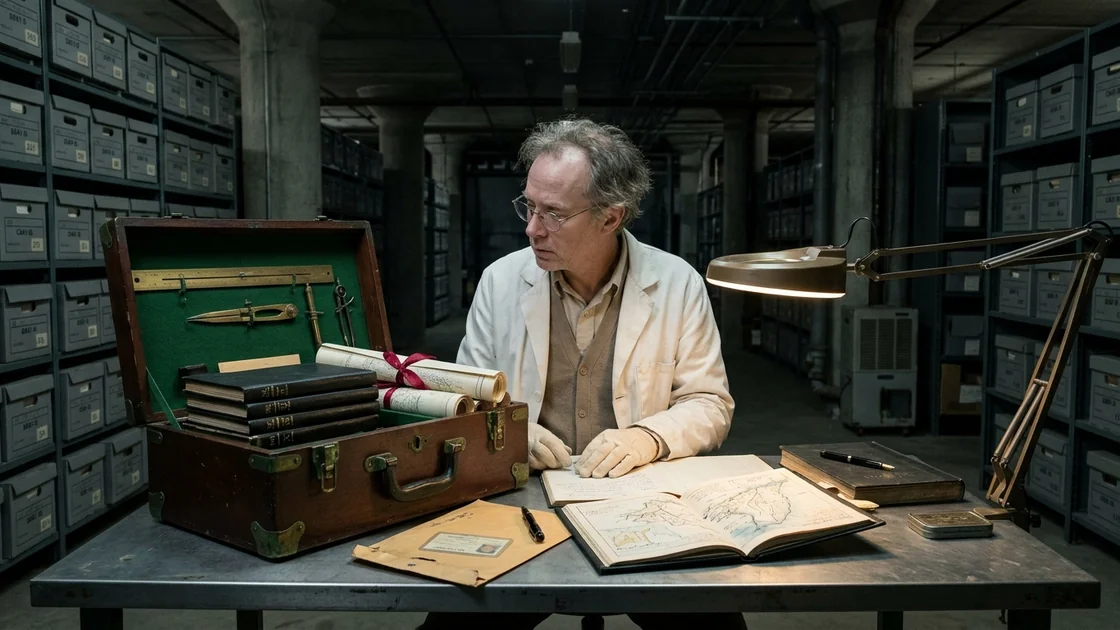
Arthur Pendelton spent his days in the subterranean vaults of the Municipal Archive of the Unclaimed, methodically cataloging the final physical remnants of citizens who died entirely alone. For twenty-two years, his solitary existence was governed by strict taxonomy, stainless steel tables, and the quiet comfort of emotional detachment, reducing complex human lives to numbered cardboard boxes and dry ledger entries. This fragile equilibrium shattered when Crate 8841-B arrived, containing the peculiar estate of a former municipal mapmaker named Clara Vance. Inside her collection of brass instruments and hand-drawn notebooks, Arthur discovered an intricate, undocumented cartography of the city's forgotten spaces, alongside subtle evidence that Clara had been quietly observing his own invisible life from afar. Compelled to abandon his desk and trace her final routes through the decaying metropolis, the reclusive archivist embarked on a transformative journey through the shadows of the city, discovering that even the most isolated lives leave indelible imprints on the world, and that his own story was far from ready to be filed away.
The air in Sub-Basement Four tasted permanently of cedar shavings, oxidized brass, and the faint, sweet rot of acidification. It was a climate controlled to fifty-five degrees Fahrenheit and forty-five percent relative humidity, an atmospheric purgatory designed to arrest the decay of dead men’s shoes and dead women’s letters.
Arthur Pendelton sat at Station Three, the only illuminated island in a sea of grey steel shelving that stretched three hundred yards into the subterranean gloom. Above him, separated by forty feet of poured concrete, plumbing conduits, and compacted metropolitan earth, the city of Oakhaven roared with the frantic, transient energy of four million living souls. Down here, the only sound was the rhythmic, sixty-cycle hum of the industrial dehumidifiers and the dry scritch-scritch of Arthur’s fountain pen against heavy archival bond paper.
He was fifty-four years old, though the subterranean pallor of his skin and the deliberate, unhurried economy of his movements made him appear somewhat timeless, like a carving in soapstone left in a niche. He wore a cardigan the color of river silt beneath a pristine white cotton lab coat, and on his hands, he wore unbleached linen gloves. He always wore the gloves. To touch the artifacts with bare skin was to leave oils, salts, and moisture—to introduce his own biological narrative into a story that had already reached its period.
Before him sat a gray acid-free transfer box bearing the stenciled designation: CASE 8840-A: KOWALSKI, VICTOR. DOB: UNK. DOD: 14 NOV.
Arthur picked up the first item from the sorting tray using a pair of silicone-tipped forceps. He examined it under the harsh, shadowless glare of his articulating magnifying lamp.
Item 8840-A-01, he wrote in a neat, architectural hand that had not changed since his twenties. Pocket watch, base metal, chrome plating worn through at the bezel. Face cracked between the four and the nine. Movement seized. Inscription on reverse: "To V., for twenty years of service, Consolidated Foundry." Condition: Poor.
He placed the watch into a small polyethylene bag, sealed it, affixed a matching numbered label, and laid it gently in the permanent storage carton. He reached for the next item.
Item 8840-A-02. Eyeglasses, wire-rimmed. Left lens missing. Right lens heavily scratched, prescription approximately +3.50 diopters. Right temple repaired with black electrical tape. Condition: Poor.
There were fourteen items in total. A keyring with three keys of standard residential brass, their locks now certainly drilled out and replaced by a landlord eager to re-let a tenement room. A plastic comb missing four teeth. A small, petrified bar of hotel soap still in its wrapper from a seaside motor court that had burned down in 1983. A stack of seven postcards from a sister in Gdansk, the earliest postmarked 1974, the latest 1979, the ink faded to the color of weak tea, written in a cramped Polish that Arthur could not read and was not paid to translate. A wallet of cracked brown vinyl containing forty-two dollars in small bills, a frayed laminated Social Security card, and a clipping from an undated newspaper showing a photograph of a prize-winning marrow squash.
In forty-five minutes, Victor Kowalski was entirely processed. His terrestrial footprint, reduced to one cubic foot of archival cardboard, was ready for the stacks. In seven years, if no second cousin or long-lost nephew emerged from the ether with a notarized affidavit of kinship, the box would be pulled by the sanitation detail. The metal would be scrapped, the forty-two dollars deposited into the municipal general fund, and the paper, the comb, and the petrified soap would be fed into the municipal incinerator on Petty’s Island.
Arthur removed his gloves, rubbed the bridge of his nose where his own wire-rimmed glasses left twin red indentations, and stood up. His knees gave a dry, papery pop that echoed briefly among the shelving units. He lifted Box 8840-A and carried it down Aisle Twelve, past thousands of identical grey boxes.
8812-C. 8815-A. 8829-B.
He knew the geography of this underground necropolis better than he knew the streets of the city above. He knew that Aisle Four smelled faintly of lavender water because of an elderly spinster who had died in 2019 with three hundred unbroken bottles of Yardley’s in her hall closet, six of which had been retained as "representative samples." He knew that Bay Nineteen felt colder than the rest because of a draft from an abandoned pneumatic mail tube behind the drywall.
He slid Victor Kowalski into an empty slot on the fourth tier, aligned the front edge of the box flush with the steel lip of the shelf—a quarter-inch overhang was an invitation to structural sagging over a multi-year period—and walked back toward the receiving bay at the front of the vault.
At two o'clock every Tuesday and Thursday, the freight elevator at the end of the loading dock would groan to life, its counterweights clanking in the greasy shaft, bringing down the latest harvest from the County Coroner’s Property Office and the Department of Public Health’s Indigent Burial Unit.
Today was Thursday. The red indicator light above the heavy mesh gates was already glowing.
With a shuddering metallic clang, the car settled level with the concrete floor. The inner gate rattled open, pushed by Tommy, a twenty-something courier from the Property Office who wore giant over-ear headphones and chewed gum with the rhythmic intensity of a cow in clover. Tommy was the only human being Arthur spoke to in an average week, assuming one counted their exchanges as speech.
"Afternoon, Mr. P," Tommy said, his voice overly loud because of the music bleeding from his headphones—something frantic and percussive that made Arthur’s teeth ache. Tommy wheeled a flat dolly out of the lift. On it sat three standard grey totes and one oddity: an old surveyor’s transit case made of dark, oil-stained mahogany with brass corners, bound around the middle with heavy hemp twine and sealed with the red paper tape of the Coroner’s office.
"Good afternoon, Thomas," Arthur said, picking up his clipboard from the receiving podium. "Four units today?"
"Just two cases," Tommy said, pulling a receipt book from his back pocket. "The first three totes are one guy. Hoarder out in the East Ward. Mostly old license plates and clocks that don't work. They weeded out the trash, kept the stuff that looked like it might have a name on it. The wooden box is a single. Lady over on Mercer Street."
Arthur looked at the manifest sheet clipped to the totes.
CASE 8841-A: MILLER, HAROLD. Three totes. Standard.
CASE 8841-B: VANCE, CLARA. One item (composite).
Arthur frowned slightly. "The Department policy requires all effects to be transferred into standard polypropylene totes prior to descent, Thomas. Wood introduces lignins and potential wood-boring beetles into the vault environment."
Tommy shrugged, holding out a cheap ballpoint pen. "Coroner’s clerk said the lock was rusted shut and they didn't have a crowbar handy when they cleared the room. Everything she had that wasn't furniture was already packed inside that box sitting by the door, like she was waiting for a cab. Just sign on the X, Mr. P. I gotta get up to the fourth floor before three."
Arthur did not take the offered ballpoint; he used his own fountain pen to sign A. Pendelton, Senior Archivist in the tiny rectangle. There had not been a Junior Archivist since the municipal budget cuts of 2011, making the title somewhat ironic, though Arthur appreciated the precision of it.
Once the elevator gates had clashed shut and the whine of the hoist motor had faded into the stone ceiling, silence rushed back into Sub-Basement Four like water filling a lock. Arthur stood looking at the mahogany box.
He decided to process Harold Miller first. It was a matter of discipline. One did not skip ahead in the ledger simply because an container was unusual.
For the next three hours, Arthur cataloged eighty-four rusted state license plates dating from 1952 to 1998, nineteen disassembled alarm clocks, a coffee can full of wheat pennies, and a bundle of water-damaged letters from the Veterans Administration denying a claim for hearing loss. By five-fifteen, Harold Miller was neatly boxed, labeled, and shelved in Aisle Twelve, directly beside Victor Kowalski.
Normally, Arthur would have washed his teacup at five-thirty, turned off the task lamp at five-forty-five, and ascended to the street at precisely six o'clock. Yet as he stood by the sink in the tiny alcove that served as his breakroom, watching the pale grey water swirl down the brass drain, his eyes remained fixed on the mahogany box sitting on the receiving dolly.
It was thirty inches long, fourteen inches wide, and twelve inches deep. The brass corner-braces were green with verdigris in the crevices of the screws, but the flat surfaces were surprisingly bright, as though they had been handled frequently and recently.
Arthur dried his hands on a linen towel, put on a fresh pair of cotton gloves, and wheeled the dolly over to Station Three.
He lifted the box onto the stainless-steel table. It was heavy—easily forty pounds. He took a surgical scalpel from his tool rack and sliced neatly through the red coroner’s tape and the hemp twine. The lock, contrary to what the clerk above had told Tommy, was not rusted shut. It wasn't a standard key lock at all; it was a brass puzzle latch of the sort found on nineteenth-century sea chests and high-end theodolite cases. To someone unfamiliar with vintage brasswork, it looked seized. To Arthur, who had cataloged three dozen similar latches over the decades, the mechanism was obvious: one depressed the center rivet while sliding the left hasp toward the hinge.
With a crisp, well-oiled click, the latch sprang open.
Arthur raised the lid. A scent rose from the interior—not the usual stale odor of dusty carpets and unwashed wool that clung to the effects of the lonely dead, but the sharp, clean smell of cedarwood pencils, peppermint, and linseed oil.
The interior of the box was lined with faded green baize, divided into custom compartments that had clearly been modified by hand using thin strips of cigar-box cedar.
Arthur pulled a fresh ledger sheet toward him, dipped his pen, and wrote at the top: CASE 8841-B: VANCE, CLARA. DOB: 12 AUG 1958. DOD: 16 NOV.
She was sixty-six. Only twelve years older than Arthur.
He began with the upper tray.
Item 8841-B-01. Parallel ruler, solid brass and ebony, 12-inch. Maker: W.F. Stanley & Co., London. Condition: Excellent.
Item 8841-B-02. Proportional dividers, German silver, in fitted leatherette case. Condition: Very good.
Item 8841-B-03. Magnifying glass, folding pocket lens in horn frame. Condition: Good.
Item 8841-B-04. Fountain pen, black vulcanite, gold nib. Ink reservoir half-full (sepia ink).
He paused as he lifted the upper tray out to reveal the deep well of the box beneath. There were no clothes here. No battered shoes, no dentures in plastic cups, no bundles of past-due utility bills, no expired grocery coupons. Instead, the bottom of the trunk was packed tight with two dozen uniform notebooks bound in black oilcloth, their spines numbered in white paint from I to XXIV, and a series of hand-drawn maps rolled into tight cylinders and tied with crimson silk ribbon.
Tucked into the space between the last notebook and the wall of the box was a small, flat tin originally meant for throat lozenges, and an unsealed manila envelope.
Arthur’s training dictated that he count the notebooks as a single bulk lot—Twenty-four (24) manuscript journals, personal—and move on to the next case. The Municipal Archive was a repository, not a library. He was not supposed to read the journals of the dead, any more than a gravedigger was supposed to open the coffins to admire the suits. Early in his career, he had made the mistake of reading a diary belonging to a woman who had starved to death in an apartment above a bakery; the desperate, repetitive inventory of the smells coming through her floorboards had ruined his sleep for a month. Since then, he had cultivated a professional blindness. Text was merely ink on cellulose, to be noted for its physical state and ignored for its semantic content.
He picked up the manila envelope first, as it was loose and likely contained the vital statistics documents the police usually swept off the kitchen table. He tipped the contents onto the steel surface.
Out slid an expired municipal identification badge.
Arthur leaned closer, adjusting the magnifying lamp. The photograph showed a woman with short, iron-grey hair tucked behind prominent ears, and dark, intensely observant eyes that seemed to look not at the camera lens, but at the mechanism behind it.
CITY OF OAKHAVEN — DEPARTMENT OF TOPOGRAPHY AND SUBSURFACE INFRASTRUCTURE. NAME: Clara E. Vance. TITLE: Senior Cartographer (Grade IV).
She had worked for the city. In fact, the Department of Topography was located on the seventh floor of this very building—the Municipal Services Annex. For thirty years, while Arthur had been burrowing through the basement, Clara Vance had been sitting under the skylights seven stories above his head.
Beneath the ID badge was a single sheet of heavy cream stationery, folded once. It was not an official form. Written across the center in sepia ink—Clearly from the vulcanite pen now resting in his sorting tray—were four words:
For the Archivist below.
Arthur’s heart gave a small, irregular thump against his ribs, like a moth hitting a lampshade. He looked around the vast, empty vault. The gray aisles stretched away into the dimness, silent and indifferent. He looked back down at the paper.
There was no name. The Archivist below. Every clerk in the Annex knew there was only one person who worked in Sub-Basement Four.
Slowly, feeling as though he were violating a law of physics rather than a departmental regulation, Arthur unfolded the cream sheet.
Dear Mr. Pendelton, the letter began. The handwriting was exquisite—the tiny, uniform block lettering of an old-school draftsman who had spent her life labeling culvert diameters and property lines by hand before the computers took over.
If this box has reached your table, then the congenital aneurysm my physician warned me about in October has finally kept its appointment, and the coroner’s men have found my room on Mercer Street. I have no cousins, no siblings, and no spouse, which makes me your jurisdiction. I took the liberty of burning my bedding, donating my clothes to the mission on Fourth, and throwing out my pots and pans last week, so that the city would not burden you with five totes of rubbish. What remains in this case is the only part of my sixty-six years that requires filing.
You do not know me, though we have shared an elevator forty-seven times over the last twelve years (I retired in 2021, or it would have been more). You always stand in the back left corner, facing the brass inspection plate, holding your canvas briefcase with both hands. On rainy days, your umbrella is always rolled more tightly than anyone else’s in the building. In 2016, you dropped a receipt from Murphy’s Hardware for two brass radiator keys; I returned it to you, and you thanked me without looking above my chin.
I am leaving these maps and field notes to your care—not to the city’s—because you are the only person in Oakhaven who understands that things which have no market value may still have weight. Please do not let them go to Petty’s Island when my seven years are up. If you open Notebook XXIV, page 82, you will understand why.
Yours in the quiet work, Clara E. Vance.
Arthur sat entirely still for three minutes. The sixty-cycle hum of the dehumidifiers seemed to grow louder, vibrating in the fillings of his molars.
Forty-seven times. She had counted.
He tried to summon the image of the woman from the ID badge into his memory of the main passenger elevator—a cramped, wood-paneled box he only used twice a day, at 8:55 AM and 6:00 PM. He remembered coats. He remembered wet umbrellas, the smell of cheap cologne from the tax assessors on the third floor, the click of high heels from the secretaries in Zoning. He remembered shoes—hundreds of pairs of shoes he had stared at to avoid making eye contact with the living. He did not remember her face. And yet, a sudden, phantom fragment surfaced: a small hand in a grey wool glove holding out a crumpled yellow slip of paper. You dropped this. Had he really not looked above her chin?
A strange, hot sensation crept up the back of his neck. It was shame, an emotion he had had very little occasion to feel since childhood, living as he did without witnesses.
He looked at the clock on the wall. It was six-fifteen. For the first time in eleven years, he was late leaving the vault.
With a hand that trembled almost imperceptibly, Arthur reached into the mahogany box and lifted out Notebook XXIV.
The oilcloth cover was slightly tacky to the touch, worn soft at the corners from being slipped in and out of a coat pocket. Arthur laid it under the lamp and turned the pages. The paper was high-rag-content grid stock, five squares to the inch.
Every page was a masterpiece of micro-cartography. Unlike official municipal maps, which showed sewer mains, zoning districts, and street widths, Clara Vance’s notebooks mapped the ephemeral, the overlooked, and the vanishing.
Page 12 was a meticulously scaled plan of the vacant lot behind the old Packard plant on Tenth Street, showing the exact migration of a colony of feral snapdragons between the summers of 2017 and 2020, shaded in delicate watercolor washes of magenta and ochre.
Page 29 was an acoustic map of the Municipal Library’s main reading room, charting the decibel levels of the radiator clanks and the exact floorboards that creaked in F-sharp when the afternoon sun dried out the oak joists.
Page 45 was titled The Stray Cat Highways of the Lower Canal District, complete with dotted red lines indicating fence-top routes, culvert underpasses, and the back doors of three Cantonese restaurants where scraps were set out at 10:30 PM.
Arthur turned slowly to page 82.
It was a map of a six-block radius in the North Ward, centered on the intersection of Elm and Sycamore. Arthur recognized the street grid instantly, though it took his brain a moment to accept what he was seeing.
It was his neighborhood.
In the center of the page, drawn at a scale of one inch to fifty feet, was the three-story brick house where Arthur had rented the top-floor flat for nineteen years. A tiny blue line traced a path from the front stoop of that house, down Sycamore to the corner bakery, across to the newsstand (marked Closed 2019), down into the subway entrance at Elm, and then re-emerged eight blocks south at the Municipal Annex.
Beside the blue line, in handwriting so small he had to swing the magnifying lens into place to read it, were annotations:
08:12 — Exits front door. Pauses 4 seconds on third step to check sky and button top button of overcoat. 08:19 — Bakery (Polanski’s). Purchases one (1) plain roll and one (1) poppyseed pastry (Fridays only). 08:26 — Pauses at iron grating outside St. Jude’s churchyard to observe the walnut tree. (Note: Tree felled by city crew, 14 Oct 2022. Subject continued to pause at empty stump for three weeks following).
On the facing page, page 83, there was another line, drawn in violet ink. It traced a parallel path through the same streets—often on the opposite sidewalk, sometimes cutting through an alley to intersect the same corners three minutes earlier or four minutes later.
At the bottom of page 83 was a small key: Blue line: A.P. (The Archivist). Violet line: C.V. (The Cartographer). Points of intersection (12-year cumulative): 1,402. Words exchanged: 7.
Arthur let go of the magnifying lamp. His breath came shallow and quick.
In anyone else’s hands, this might have seemed like the work of a stalker, a deranged intrusion upon his privacy. Yet as Arthur looked at the delicate watercolor shading of the felled walnut tree at St. Jude’s—she had drawn the little phantom canopy in pale green pencil above the brown dot of the stump—he did not feel violated. He felt an overwhelming, dizzying sense of vertigo, as if he had spent his life believing he was a ghost walking through walls, only to discover he had been casting a sharp, dark shadow on the pavement the entire time.
He had paused at that stump for three weeks. He didn't even know he had done that. He had liked the walnut tree because a pair of Cooper’s hawks nested in its upper fork every spring; when the city cut it down due to blight, he had felt a dull ache in his chest every morning at 8:26, though he had never articulated to himself that his feet were still stopping on the exact square of bluestone where he used to look up.
She had seen him look up at nothing. And she had drawn the tree back in for him.
Below the key on page 83, there was one final note, written in a slightly shakier hand than the rest, dated November 12—four days before her death.
The map of the Old Cistern on Finch Lane is incomplete. I lack the breath for the stairs now. The brass key is in the pastille tin. The final bearing is 310 degrees Northwest from the iron bollard at the dead end of Weaver’s Court. Someone ought to finish the shading before they pour the concrete on Monday.
Arthur looked at the calendar on his desk. Today was Thursday, November 21.
"Monday," he whispered aloud. His voice sounded rusty, like a hinge that hadn't been swung in a decade. Did she mean last Monday, two days after she died, or this coming Monday, the twenty-fifth?
He reached into the mahogany box and pulled out the flat tin that had once held French throat pastilles. He pried off the lid. Resting on a pad of surgical cotton was a heavy, flat-bitted key made of dark bronze, its bow stamped with the letters O.W.W. 1894—Oakhaven Water Works. Beneath the cotton was a folded slip of tracing paper, blank except for a single pencil outline of a vaulted chamber, half-drawn, the grid lines trailing off into white space on the right-hand side.
Arthur sat for a long time under the glare of the lamp.
The rules of the Municipal Archive of the Unclaimed were absolute, drafted in 1924 and amended only to update the fire codes: No item belonging to an estate under quarantine shall be removed from the premises of Sub-Basement Four for any purpose other than judicial subpoena or scheduled destruction.
If he took the notebook, the pen, and the key out of this room, he would be committing petty theft of municipal property. More than that, he would be breaking the seal of his own life. For twenty-two years, the steel door at the top of the freight elevator had been the boundary between the messy, unpredictable chaos of the living and the calm, finished certainty of the dead. Down here, people did not disappoint you. They did not leave you, as Arthur’s mother had when he was twelve, walking out into a Tuesday afternoon with a blue suitcase and never sending a postcard; they did not die slowly and angrily in hospital beds, as his father had when Arthur was twenty-four, cursing the nurses and the noise of the traffic outside. Down here, people were quiet. They stayed in their boxes.
He looked at Clara Vance’s ID badge again. Her dark eyes looked back at him from the laminated square. You are the only person in Oakhaven who understands that things which have no market value may still have weight.
At seven-fifteen, Arthur Pendelton did something he had never done in twenty-two years of unblemished civil service.
He did not assign an item number to the pastille tin. He did not bag the vulcanite fountain pen, nor did he log Notebook XXIV into the master ledger. Instead, he slipped all three into the deep leather pocket of his canvas briefcase. He closed the mahogany box, threw the puzzle latch, and draped a grey dust cloth over it so that it looked like a piece of maintenance equipment waiting for repair.
When he emerged from the bronze doors of the Municipal Annex at seven-thirty, the night air hit him like a cold wave. It smelled of diesel exhaust, roasted chestnuts from a vendor’s cart down the block, and wet asphalt. The streetlights had haloed in a thin November fog rolling off the river.
Arthur stood on the top step of the building, his hand automatically rising to button the top button of his wool overcoat. Halfway through the motion, he froze.
08:12 — Pauses 4 seconds on third step to check sky and button top button of overcoat.
He looked at his own gloved fingers holding the horn button. Then, slowly, he lowered his hand, left the collar open to the cold fog, and walked down the steps toward the North Ward.
Arthur’s flat on the third floor of 414 Sycamore Street was, in many respects, a satellite branch of Sub-Basement Four, though with slightly better carpeting.
Every book in his three oak bookcases was arranged by the Library of Congress classification system. His six white shirts hung in the wardrobe spaced precisely two inches apart on wooden hangers. On the wall above his narrow walnut dining table hung three framed engravings of eighteenth-century seaweeds, hung with a spirit level so that their bottom edges formed a continuous horizontal line across the plaster.
Normally, his Thursday evening routine was immutable: he would heat a tin of lentil soup in the small enameled saucepan, eat it with two slices of rye bread while listening to the seven o'clock chamber music broadcast on the public radio station, wash the bowl and spoon, read for ninety minutes from whatever history of the Byzantine Empire or the Hanseatic League he was currently working through, and extinguish his bedside lamp at ten-fifteen.
Tonight, the lentil soup remained in the pantry. The radio stayed silent.
Arthur sat at the walnut table with his overcoat still on, the fiverolled maps he had ended up taking from Clara’s box spread out before him, weighted down at the corners with his salt cellar, a brass paperweight, and two volumes of Gibbon’s Decline and Fall.
Now that he was looking at the larger rolled sheets alongside Notebook XXIV, the sheer scope of Clara Vance’s secret life began to emerge.
For forty years, by day, she had drawn the official maps of Oakhaven—updating the plat books when old neighborhoods were bulldozed for expressways, plotting the new glass office towers that sprouted in the financial district, erasing the alleys and the cobblestones as the city modernized.
And by night, and on weekends, and throughout the three years of her retirement, she had mapped everything the city was erasing.
She called the project, according to the title page of the first rolled parchment, The Palimpsest of Oakhaven: An Atlas of the Beneath and the Between.
It was not merely a sentimental record of pretty old buildings. It was an extraordinarily rigorous geographical survey of the spaces that existed in the blind spots of modern urban planning. She had mapped the forgotten brick-lined subterranean creeks that still flowed beneath the asphalt of the shopping malls, fed by natural springs that the nineteenth-century engineers had simply arched over and buried. She had charted the "spite strips"—slivers of land two feet wide between commercial buildings that belonged to no one because of surveying errors made in 1840, where antique apple trees still grew wild, nourished by kitchen vents and pigeon droppings. She had documented the names and histories of the forty-two boot-scrapers still embedded in the curbstones of the Old Quarter, noting which ones had been forged by which vanished blacksmith.
And in the margins of every map, there were people.
Not the famous or the wealthy, whose names were already on the street signs and the hospital wings, but the fixtures of the sidewalks. The man who sold roasted sweet potatoes from a converted oil drum at the corner of Third and Pine for thirty-one winters; Clara had recorded the exact tonal pitch of his street cry (a flat G above middle C) and the recipe his father had brought from Georgia in 1948. The blind woman on Beatrice Street who knew the time of day by the heat patterns of the sun on her brick garden wall; Clara had mapped the thermal shadows of that wall for every solstice and equinox.
They were the very people who, when their hearts finally stopped in their quiet rooms, ended up in grey polypropylene totes on Tommy’s freight elevator.
"We were doing the same job," Arthur murmured to the empty room.
The realization struck him with the force of a physical blow. He had spent twenty-two years cataloging the husks of these lives at the very end, reducing them to condition reports—poor, fair, rusted, cracked—while she had been out in the weather, capturing their trajectories while they were still in motion. He was the coroner of their things; she was the cartographer of their souls. And because he himself was one of the solitary, invisible mechanisms of the city, she had mapped him, too.
He pulled Notebook XXIV back toward him and examined the entry for November 12 again.
The map of the Old Cistern on Finch Lane is incomplete... Someone ought to finish the shading before they pour the concrete on Monday.
Arthur stood up and walked over to his bookcase. He pulled down the current Municipal Directory and Street Guide, along with a three-week-old copy of the Oakhaven Municipal Gazette, the dry weekly bulletin of city council zoning variances, demolition permits, and paving contracts that he received as a department head and usually used to line his rubbish bin.
He flipped through the thin newsprint pages of the Gazette until he found the Public Works notices for the current month. Near the bottom of page fourteen, under Subsurface Remediation and Infill, he found it:
PROJECT #24-909: Stabilization of abandoned Municipal Water Works Reservoir #3 (Finch Lane / Weaver’s Court). Due to structural subsidence risk prior to construction of the North Ward Logistics Hub, the subterranean brick vault will be permanently pumped of standing water and filled with high-density cellular concrete slurry. Pour scheduled to commence Monday, Nov 25, 07:00 HRS.
This coming Monday. Four days away.
Arthur looked back at the tracing paper from the pastille tin. It showed a cross-section and a partial floor plan of a circular vaulted structure, supported by twelve massive stone piers. Only the western half was fully rendered, showing intricate brick-bonding patterns, water-level marks, and a mysterious annotation near the center pier: The Mason’s Daughter (See detail). The detail box in the corner was empty.
If the city pumped twenty thousand cubic yards of liquid concrete into the cistern at seven o'clock Monday morning, whatever was in the eastern half of that vault—and whatever was carved or built onto that center pier—would be entombed in artificial stone for the rest of geological time.
Arthur looked at his hands. Without the white linen gloves, they looked pale, slightly veined, the nails trimmed short and square. They were the hands of a clerk who had not gotten dirt under his fingernails since the Carter administration.
"I am an archivist," he said aloud to the three framed engravings of seaweed. "I do not conduct field surveys. It is entirely outside my classification."
The seaweed offered no rebuttal. Across the room, on the walnut table, the bronze key from 1894 gleamed dully in the yellow light of his reading lamp.
On Friday morning, Arthur arrived at Sub-Basement Four at his usual hour of nine o'clock, though he had not paused at the site of the walnut tree, nor had he bought a poppyseed pastry at Polanski’s. He had slept poorly, his dreams tangled in a labyrinth of violet and blue ink lines that kept intersecting without ever quite touching.
He spent the morning attempting to process a new arrival from the previous afternoon—an elderly former longshoreman whose worldly goods consisted almost entirely of sixty-three carved wooden seagulls and a coffee tin full of foreign coins—but his concentration was ruined. His handwriting, usually as steady as a seismograph in a desert, showed a distinct rightward slant. Twice, he dipped his pen into his teacup instead of the inkwell.
At twelve-thirty, instead of eating his cheese sandwich at his breakroom table, Arthur took the passenger elevator up to the seventh floor.
He had not been on the seventh floor since 1999, when he had been required to sign a revised pension beneficiary form in the temporary Human Resources annex. Unlike the cavernous, windowless concrete of the basement, the seventh floor had high, arched windows that looked out over the slate roofs of the city toward the gray ribbon of the river. The corridor smelled of floor wax and ozone from the wide-format plotters.
He walked down the hall until he reached a pair of frosted-glass doors stenciled with DEPARTMENT OF TOPOGRAPHY AND SUBSURFACE INFRASTRUCTURE.
Inside, the room was a warren of low fabric cubicles filled with the glow of dual-monitor workstations. Yet around the perimeter of the room, pushed against the walls like dinosaurs retreating before an ice age, stood a dozen massive oak map-chests with wide, shallow drawers, and three old cast-iron drafting tables tilted at steep angles.
A young man with a neatly trimmed beard and a lanyard around his neck looked up from a computer screen near the reception counter. "Help you?"
"Good afternoon," Arthur said, clasping his hands behind his back to hide their nervous flexing. "I am Arthur Pendelton, from the Sub-Basement Archive. I am making an inquiry regarding the estate of a former employee of this division. Clara Vance."
The young man blinked. "Clara? Wait—did something happen to Clara?"
A woman in her late forties with a streak of silver in her braided hair stood up from a cubicle two rows back. "Did you say Clara Vance?" She walked over quickly, her face creasing with immediate concern. "You said estate?"
"I regret to inform you that Ms. Vance passed away on the sixteenth of November," Arthur said gently. "Natural causes, at her residence."
The woman’s hand went to her mouth. "Oh, God. No." She leaned against the wooden counter, her eyes shining with sudden tears. "She was just in here in October. She brought us pears from that weird little tree she knew about behind the gasworks. Hey, Marcus—Clara died."
An older man at the far end of the room took off his glasses and stared blankly at the wall. Within thirty seconds, the quiet hum of the office had died completely. Five people stood in the aisles between the cubicles, looking stunned.
Arthur felt a strange tightness in his throat. Down in the vault, Case 8841-B had arrived with the rubber-stamped designation NO KNOWN KIN / INDIGENT BURIAL. In the binary logic of the municipal bureaucracy, if you did not have a spouse, a child, or a sibling within the state, you died alone. Yet looking at the faces in this bright room under the skylights, Arthur realized that Clara had not been unmourned; they simply hadn't known she was gone until the paperwork filtered down through the floorboards.
"I'm Helen," the woman with the silver braid said, wiping her cheek with the back of her hand. "I worked under Clara for fifteen years before she retired. Does she—is there going to be a service?"
"When there is no next of kin of record, the county conducts a direct cremation and inters the ashes in the municipal plot at Oak Hill," Arthur said, hating the mechanical coldness of the words as they left his mouth. "However, the ashes are held at the Coroner’s annex for thirty days prior to interment. If her colleagues wished to claim them for a private memorial, a petition signed by three municipal employees of Grade III or higher is usually sufficient for the clerk to release the urn."
Helen nodded fiercely. "We'll do that. Today. Marcus and I will go down after lunch. We won't let them put her in a numbered trench. She hated grids." A small, wet laugh escaped her. "A cartographer who hated grids. That was Clara."
"She was a very precise draftsman," Arthur offered quietly. "I have been reviewing some of her personal papers to determine their disposition."
"Oh, the Palimpsest?" Helen asked softly. "She told me about it once, when we were stuck in a van during a thunderstorm out by the creek beds. She never showed them to anyone, though. She said if the city engineers saw her maps, they’d just use them as a checklist of things left to pave over."
"Where was her desk?" Arthur asked.
Helen pointed toward the far corner of the room, where one of the old cast-iron drafting tables stood directly beside a narrow, gothic-arched window. "Right there. When they switched us all to AutoCAD in '08, she learned the software faster than the kids out of college, just so they wouldn't have an excuse to fire her. Then she'd finish her week’s quota by Wednesday noon and spend Thursday and Friday standing at that board with a ruling pen, redrawing the 1870 sewer surveys just to fix the ink fading."
Arthur asked permission and walked over to the corner. The drafting table was bare now, used to stack boxes of plotter paper, its green vinyl surface scarred with thousands of tiny compass-point pricks.
He looked out the window beside the table.
Seven stories below, directly across the narrow courtyard formed by the wings of the Municipal Annex, was the bronze-doored employees' entrance at the top of the basement stairs. From this exact angle, looking down between two gargoyles on the third-floor cornice, one had a clear, unobstructed view of the steps where Arthur emerged every evening at six, and the thirty yards of sidewalk leading toward Sycamore Street.
On the wooden windowsill, scratched lightly into the varnish with the point of a divider, was a tiny, two-inch compass rose. One of the arrows pointed straight down into the courtyard. It was labeled A.P.
Arthur touched the tiny scratch in the wood with the tip of his bare index finger.
"She used to stand at that window every day at nine and six," Marcus said quietly, having walked up behind Arthur. The older man had a coffee mug in his hand and looked tired. "Used to drink her peppermint tea and look down at the courtyard. I asked her once what she was watching. She said she was setting her watch by the only reliable mechanism left in city government." Marcus looked sideways at Arthur, taking in his silt-colored cardigan, his neatly parted grey hair, and the canvas briefcase he still carried even within the building. "That was you, wasn't it?"
"I believe I am rather punctual," Arthur murmured, his ears warming.
"She wasn't lonely, you know," Marcus said, as if answering a question Arthur hadn't known how to ask. "People thought she was eccentric because she lived by herself over that bookbindery on Mercer and spent her Saturdays walking down railroad tracks with a sketchbook. But I never met anybody who paid more attention to being alive. She used to say that most people walk through a city like it’s a hallway on the way to somewhere else, whereas she liked the wallpaper."
Arthur looked back down at the courtyard. From seven stories up, the people crossing the plaza looked like moving dots of charcoal and sepia on a wet paving-stone grid.
"Did she ever mention Mercer Street?" Arthur asked. "Or Finch Lane?"
"Finch Lane?" Marcus frowned. "That’s up by the old cotton mills they’re tearing down for the Amazon depot, isn't it? Why?"
"No reason," Arthur said. "Merely verifying an annotation."
He thanked them, gave Helen the exact form number—Coroner’s Disposition Request 44-C—required to rescue Clara’s ashes from the county trench, and took the stairs back down to the basement instead of the elevator. He walked all the way down nine flights of concrete fire stairs, listening to the echo of his leather soles, wondering how it was possible to miss someone with whom you had exchanged only seven words in twelve years.
On Saturday morning, it rained—a cold, slantwise November drizzle that turned the fallen sycamore leaves into brown paste on the sidewalks.
At ten o'clock, Arthur stood in the doorway of Murphy’s Hardware on Elm Street—the very hardware store whose receipt had served as his only real introduction to Clara Vance eight years ago. He felt profoundly foolish. He was wearing a pair of rubber galoshes over his oxfords, his oldest tweed trousers, and a heavy navy-blue pea coat he had bought during a trip to Maine in 1996. In his canvas briefcase, alongside Clara’s Notebook XXIV and the bronze key, he now carried a heavy aluminum three-cell flashlight, a fifty-foot hank of nylon mason’s twine, a fresh cake of carpenter’s chalk, and a small bottle of distilled water.
He took the bus north toward the old industrial district, getting off four stops past the end of his known world.
Here, the neat brick rowhouses and small bakeries of the North Ward gave way to the corpse of nineteenth-century Oakhaven. For a mile along the canal, vast red-brick textile mills and iron foundries stood with their multi-pane windows knocked out like broken teeth. Half of them were already surrounded by chain-link fencing topped with razor wire, bearing the bright yellow banners of the demolition contractors. Huge piles of crushed brick and splintered heart-pine beams rose in the mud under the drizzle, watched over by silent yellow excavators whose booms rose against the grey sky like the necks of grazing brontosauruses.
Arthur consulted page 82 of Clara’s notebook, holding his umbrella low to shield the open paper from the blowing mist.
He turned down Finch Lane, a narrow cobble street that had been partially paved over with asphalt that was now peeling back like dead skin. At the end of the lane, squeezed between the windowless brick flank of a condemned brewery and the high stone retaining wall of the freight rail embankment, was a tiny dead-end alley no wider than a horse cart. A rusted cast-iron sign nailed to the brewery bricks read WEAVER’S COURT.
At the back of the court stood a single, bell-shaped iron bollard, originally placed there in the 1880s to keep dray wagons from scraping the corner of the stonework.
Arthur pulled a small brass pocket compass—Item 8841-B-05, borrowed from Clara’s mahogany box that morning—from his coat pocket. He stood directly over the iron bollard, waited for the needle to settle, and sighted along a bearing of 310 degrees Northwest.
The line of sight pointed directly into a dense tangle of dead pokeweed, sumac, and rusted bedsprings piled against the base of the railway embankment.
Arthur glanced back down Finch Lane. The street was entirely deserted; the demolition crews did not work on Saturdays, and the rain kept even the scrap-metal scavengers indoors. He closed his umbrella, laid it carefully beside the bollard, and waded into the wet weeds.
Ten feet into the brush, his rubber galoshes struck something solid and metallic beneath a mat of rotting leaves. He knelt down on the wet earth—ignoring the immediate, icy soak of muddy water through the knees of his tweed trousers—and cleared away the debris with his gloved hands.
Set into the base of the stone embankment was a low arched doorway, barely four feet high, closed with a heavy door of riveted boiler plate that had been painted with green park-department enamel fifty years ago and was now mottled with orange rust. In the center of the iron plate was a slotted keyhole covered by a heavy brass weather-flap.
Across the stone lintel above the door, half-obscured by black lichen, were the carved letters: O.W.W. — RES. NO. 3 — 1894.
Thirty yards away, out on Finch Lane, Arthur had noticed a thick, six-inch yellow canvas hose snaking out from a portable diesel generator near the demolition fence, running through the weeds toward the top of the embankment—undoubtedly connected to a vent shaft on the roof of the vault, ready for Monday’s concrete pour.
Arthur took the bronze key from his pocket, lifted the brass flap, and slid the bit into the keyhole.
At first, it refused to turn. His heart sank. He had come all this way, broken six departmental regulations, and ruined a perfectly good pair of trousers, only to be defeated by eighty years of oxidation. Then he remembered Clara’s note: I lack the breath for the stairs now.
She had been inside here recently. The lock wasn't rusted shut; it was merely stiff.
Arthur braced his left shoulder against the wet stone, gripped the bow of the key with both hands, and turned with all the modest leverage of his fifty-four-year-old frame. With a heavy, greased clunk, the deadbolt retracted inside the lock box.
He pulled the iron door outward through the wet weeds. A breath of air drifted out from the black aperture—surprisingly warm compared to the raw November drizzle outside, smelling intensely of wet limestone, river silt, and old iron.
Arthur switched on his heavy aluminum flashlight, tied one end of the nylon mason’s twine to the iron hinge of the door—a precaution he remembered reading about in a monograph on Cretan caves—and ducked through the low archway.
Inside, a narrow flight of twenty-two granite steps descended steeply into the earth. The walls were built of massive blocks of dressed ashlar, slick with moisture and tiny, pale fern fronds that grew in the mortar joints where a faint glimmer of daylight reached from the doorway.
At the bottom of the stairs, the passage opened out, and the beam of Arthur’s flashlight seemed to vanish into an immense, swallowing darkness.
He stopped on the bottom step, playing the light in a slow arc.
It was like standing inside a drowned cathedral.
Reservoir Number Three was a circular subterranean vault nearly two hundred feet in diameter. Twelve colossal octagonal piers of granite rose twenty-five feet from the floor to support a complex groin-vaulted ceiling of cherry-red brick. The pumps the city contractors had installed through the roof manhole earlier in the week had already done their work; the three feet of standing groundwater that had pooled here for a century since the reservoir was decommissioned had been sucked out, leaving behind a floor of glistening, dark-grey silt scored with the delicate, wandering tracks of water beetles and blind cave crickets.
The silence down here was completely different from the silence of Sub-Basement Four. In the archive, the silence was dead, dry, and mechanical, pressed down by the weight of six stories of municipal offices. Here, the silence was resonant and alive. Every drop of water that fell from the brick arches into the silt produced a pure, bell-like plink that echoed back and forth between the twelve piers in a complex, shifting counterpoint, as if invisible musicians were tuning glass harps in the dark.
Arthur pulled Clara’s tracing paper from his briefcase and held it in the crook of his arm while shining the flashlight across the vault.
He walked slowly along the perimeter walkway—a raised stone ledge that remained relatively free of mud—counting the piers. The western half of the vault was exactly as Clara had drawn it: a marvel of late-Victorian utilitarian grace, every brick arch laid with mathematical perfection by Italian and Irish masons who knew that once the water was turned on and the iron doors were bolted, no human eye would ever see their craftsmanship again.
Then he reached the center pier.
In Clara’s drawing, this pier was marked The Mason’s Daughter (See detail).
Arthur stepped off the perimeter ledge, his galoshes sinking two inches into the heavy silt with a soft shluck, and approached the massive octagonal column in the center of the cavern. He walked around to its eastern face—the side facing away from the entrance stairs—and raised the beam of his flashlight.
He caught his breath.
Carved directly into the hard grey granite of the central pier, five feet above the floor—just above the original high-water line marked by a dark band of mineral deposits—was a life-sized bas-relief portrait.
It had not been part of the municipal blueprint of 1894. Some master stonecutter, working by the light of a tallow candle during lunch hours or after the city inspectors had climbed out for the evening, had chiseled it into the structural heart of the reservoir.
It showed the profile of a young girl, perhaps nine or ten years old, with long braids pinned up in a crown around her head, holding a wild rose against her collarbone. The carving was astonishingly delicate; the mason had used the natural mica flecks in the granite to give a slight shimmer to the pupil of her eye and the petals of the flower. Beneath the relief, carved in tiny, serifed Roman capitals, was an inscription:
LUCIA BELLINI. 1885 – 1894. TAKEN BY THE CHOLERA. HERE WHERE THE PURE WATER RISES, MAY SHE NEVER THIRST.
Arthur stood in the ankle-deep mud, the beam of his flashlight trembling slightly on the stone girl’s face.
In 1894, Oakhaven had built its modern filtered water system specifically to end the cholera epidemics that had ravaged the tenement wards along the canal. This man—this anonymous immigrant stonecutter whose name wasn't even on the brass plaque at the waterworks—had lost his nine-year-old daughter to the poisoned well water of the slums, and had then spent his days building the giant subterranean cistern that would save everyone else’s children. And before they flooded the dark vault, he had carved her face above the water line, so that she would live forever above the clean water.
And on Monday morning at seven o'clock, the Department of Public Works was going to bury Lucia Bellini in twenty thousand tons of liquid cellular concrete so that a logistics company could park delivery vans on the lot above.
Arthur looked down at the stone ledge at the base of the pier.
Resting on a flat piece of slate, kept dry in a heavy zip-top plastic bag weighted down with a smooth river pebble, was a small brass clinometer, a wooden ruler, and a folded piece of rag paper.
Clara had left her tools behind on her last visit. She must have felt the dizziness coming on—the first warning whisper of the aneurysm in her brain—and had barely managed to climb the twenty-two granite steps and lock the door behind her, intending to come back in a day or two when she felt stronger.
Arthur picked up the plastic bag. Inside, on the rag paper, Clara had already begun the detailed scale drawing of the relief of Lucia Bellini. The braids were there, and the curve of the cheek, and the first three letters of the inscription, drawn with exquisite tenderness in lead pencil. The lower half of the face, the hand holding the rose, and the rest of the epitaph were blank.
Someone ought to finish the shading before they pour the concrete on Monday.
Arthur looked at the unfinished drawing. Then he looked at his watch. It was eleven-thirty in the morning.
He had never considered himself an artist. In school, forty years ago, he had excelled at mechanical drawing and geometry, and in the archive, when a particularly fragile or significant artifact arrived without a photograph—a rare regimental badge or an unusual hallmark on a silver spoon—he sometimes drew a small marginal sketch in the ledger to supplement the text. His lines were clean, accurate, and entirely devoid of flair.
"I am not a cartographer, Ms. Vance," he said aloud to the vaulted ceiling. The dripping water answered with a soft plink-plink from the eastern shadows. "You have selected a very poor substitute."
Nevertheless, Arthur took off his canvas briefcase, set it upright on the dry stone ledge at the base of the pier, and sat down on a projecting granite footing, pulling his coat tails around his knees against the damp chill.
He opened his briefcase and took out Clara’s vulcanite fountain pen, the unfolded tracing paper, and the incomplete sketch of the mason’s daughter. He propped his flashlight between two stones on the opposite pier so that it cast a raking, oblique light across the carving of Lucia Bellini, bringing every chisel mark into sharp relief.
He uncapped the pen. The sepia ink was still wet in the nib.
For the first twenty minutes, his hand was stiff with cold and self-consciousness. He used Clara’s wooden ruler and brass clinometer to take the exact measurements of the Eastern half of the cavern first, stepping through the silt to pace off the distances between Piers Seven through Twelve, noting the slight three-inch settlement crack in Pier Nine and the colony of blind white isopods living in the weep-hole of the eastern wall. He plotted the points onto the tracing paper, connecting the vault ribs with the small brass parallel ruler he had brought from her box.
Slowly, as the hours passed in the timeless, dripping dark beneath the city, something shifted inside Arthur Pendelton.
To catalog an object in Sub-Basement Four was an act of closure; you looked at a cracked pocket watch, wrote down its flaws, put it in a bag, and closed the lid. You stood outside the thing, safe in your linen gloves.
To draw the cistern—and, when he returned to the central pier at two o'clock, to draw the face of Lucia Bellini—required a completely different kind of looking. You could not remain outside it. To capture the exact curve of the nine-year-old girl’s chin as the Italian mason had remembered it in the dark, Arthur had to trace the stone itself with his bare fingertips, feeling the tiny flat facets left by the quarter-inch drove chisel, understanding where the father’s hand had lingered softly on the eyelid and where he had struck fiercely into the granite to undercut the shadow beneath the rose.
His fingers grew black with stone dust and sepia ink. The damp cold of the reservoir crept through his wool socks and settled into his shins, yet he hardly noticed.
He shaded the rose petals using tiny, cross-hatched strokes, just as Clara had done on the braids above. Where her pencil lines ended, his sepia ink lines began. At first, the junction between their two hands was obvious—hers fluid and organic, his tight and architectural. But as he worked down through the curve of the girl’s small knuckles and copied the serifs of HERE WHERE THE PURE WATER RISES, his hand began to loosen, borrowing the rhythm of Clara’s shading, while bringing his own lifelong devotion to minute detail to the texture of the granite grain.
By four-thirty, the beams of his flashlight were turning yellow and dim as the batteries drained.
The tracing paper of the cistern floor plan was complete, right down to the elevation marks on the eastern weep-holes. And on the separate sheet of rag paper, Lucia Bellini looked out from the page, whole and unbroken, half in Clara Vance’s graphite and half in Arthur Pendelton’s ink.
In the bottom right-hand corner of the sheet, where Clara had written Surv. & Delin. C.E. Vance, Nov 2024, Arthur added a tiny, neat notation beneath hers: Compl. A. Pendelton, Archivist, 23 Nov 2024.
He stood up, his legs so stiff he had to hold onto the stone pier for a full minute before he could walk. He shone the dying orange glow of the flashlight on the stone girl one last time.
"Goodnight, Lucia," he said softly.
He gathered the papers, the clinometer, and the ruler, wound up his nylon twine as he walked back to the stairs, and climbed out into the late twilight. He locked the iron boiler-plate door with the bronze key, pulled the dead pokeweed back over the threshold so the contractors wouldn't notice the disturbed mud on Monday, and walked out of Weaver’s Court in the rain.
One might have thought that completing the map of Reservoir Number Three would have satisfied Arthur’s sense of obligation to Case 8841-B. He had fulfilled the dying wish contained in the note; he could now return the items to the mahogany box on Monday morning, assign them their proper reference numbers, and resume his quiet wait for retirement.
Instead, when Arthur woke on Sunday morning in his flat on Sycamore Street, despite a terrific ache in his calves and a slight head cold from five hours in a subterranean swamp, he felt a strange, restless hunger he had not experienced since he was a boy turning over flat rocks in the creek behind his grandfather’s house.
He ate his toast standing up by the window, looking down at Sycamore Street.
The rain had cleared overnight, leaving the sky a sharp, washed winter blue. He looked at the paving stones in front of his house, where Clara’s blue and violet lines had run side by side for twelve years. Where had the violet line gone after it left his street?
He opened Notebook XXIII—the volume immediately preceding the final one, which he had also slipped into his briefcase on Friday evening—and turned to the index at the back.
Mercer Street, No. 114 (Residence): Roofline vistas and chimney pots, p. 14. The Sunday Perimeter (Autumn Route): p. 40.
He turned to page 40. It was a map of a four-mile walk through the southern edge of the city, starting at Mercer Street at nine o'clock on Sunday mornings, winding through the old shipyards, crossing the iron swing-bridge over the canal, stopping at a particular bench in the Botanical Conservatory ("Bench #4, behind the giant Dicksonia antarctica tree fern—best acoustics for reading when the fountain is running"), and ending at a tiny storefront on Water Street labeled Mr. Lin’s Tea & Sundries.
Arthur looked at the clock on his mantelpiece. It was eight-forty.
He put on his dry shoes, his grey overcoat, and a cashmere scarf he had never worn because he had always considered it slightly too patterned for a civil servant, and went out into the bright, cold morning.
He walked south to Mercer Street first. Number 114 was a narrow three-story building of painted yellow brick tucked between an industrial laundry and a shop that repaired violins. The ground floor was an old-fashioned bookbindery, its window displaying rolls of marbled endpaper and jars of bone glue. A separate narrow door to the left led up to the apartments above.
Arthur stood across the street for five minutes, looking up at the third-floor dormer window. The curtains were gone; the glass looked dark and vacant, already cleaned out by the landlord. A small terracotta pot holding a dead rosemary bush still sat on the narrow lead gutter outside the window.
From there, holding Notebook XXIII open in his hand like a tourist in a foreign capital—though he had lived within two miles of these streets for half a century—Arthur walked Clara’s Sunday route.
He began to see what Marcus had meant about the wallpaper.
For decades, Arthur had walked with his eyes fixed five feet ahead of his toes, navigating the city purely as an obstacle course between his front door and the archive elevator. Now, guided by Clara’s tiny marginal notes, he looked up, and down, and sideways.
At the corner of Water and Dock, he found the cast-iron horse trough from 1888 that the city had filled with concrete and turned into a traffic island; Clara’s note pointed out that on the north base, beneath six coats of municipal yellow paint, you could still feel the raised bronze letters of the donor’s name—a society for the prevention of cruelty to dray horses. Arthur took off his glove and felt the letters under the paint.
On the iron swing-bridge over the canal, he stopped at the third truss from the south bank and looked down into the timber pilings below the waterline, where, just as page 42 promised, the skeletal wooden ribs of a nineteenth-century coal barge lay half-buried in the mud, visible only at dead low tide when the sun was behind the gasworks. Two mallard ducks were asleep on the rotting prow.
At eleven o'clock, he entered the warm, humid glass dome of the Botanical Conservatory in the park. His glasses immediately fogged over. When he wiped them with his handkerchief and followed the brick path behind the immense, shaggy trunk of the Tasmanian tree fern, he found Bench Number Four—a small green wooden seat entirely hidden from the main walkway by a curtain of broad-leaved philodendrons.
He sat down. The small limestone fountain ten feet away made a steady, hushed shhh-shhh sound that completely masked the traffic on the parkway outside and the voices of the Sunday families walking through the palm house. It was like sitting in a green velvet cave.
On the underside of the wooden armrest, when Arthur ran his fingers beneath the slats, he felt a small, smooth indentation where someone had habitually rested her thumb while holding a book open.
He sat on Bench Number Four for an hour, not reading, simply watching the beads of condensation gather on the glass panes fifty feet above and fall into the fern fronds. For the first time in his adult life, he felt no anxiety about the passage of time. He did not feel the phantom tug of the gray boxes waiting in the vault.
When he finally left the park and walked down to Water Street, he found Mr. Lin’s Tea & Sundries—a shop so narrow that two people could hardly pass in the aisle between the burlap sacks of dried mushrooms and the towering walls of square tin canisters.
An elderly man in a quilted silk vest looked up from an abacus behind the counter. He looked at Arthur’s overcoat, then down at the black oilcloth notebook protruding from Arthur’s pocket. The old man’s eyebrows rose a fraction of an inch.
"Can I help you, sir?"
"Good afternoon," Arthur said. "I believe a friend of mine—an acquaintance—was a regular customer here on Sundays. Ms. Clara Vance."
Mr. Lin’s hands stopped on the wooden beads of the abacus. "Miss Vance," he said quietly. "She did not come last Sunday. And she did not come this morning. In twelve years, she only missed when she had the bronchitis in twenty-nineteen." He looked closely at Arthur’s face. "She is gone?"
"The sixteenth of November," Arthur said. "Quietly, at home."
Mr. Lin closed his eyes for a moment and bowed his head slightly over the counter. Without another word, he turned to the wall of tins behind him, took down a small brass scoop, and measured two ounces of dried green leaves into a white paper packet, folding the corners with rapid, practiced precision. He placed it on the counter alongside a small, flat cake of compressed dark sugar wrapped in bamboo leaf.
"Organic peppermint from Oregon, with a quarter-measure of roasted barley," Mr. Lin said softly. "She drank it while she worked at the window. She told me once that if a tall gentleman with very neat shoes ever came in asking about her blend, I was not to charge him for the first packet."
Arthur stared at the white paper packet on the worn wooden counter.
"She told you that?" Arthur whispered.
"Three weeks ago," Mr. Lin said. "When she bought her November supply. She had a small tremor in her left hand when she took the change. I think she knew the winter would be short for her." The old man pushed the packet an inch closer to Arthur. "She said you drank terrible dusty tea from paper bags down in the basement, and that someone ought to correct it."
Arthur’s vision blurred so suddenly that the rows of tin canisters behind Mr. Lin melted into a wall of dull gold. He reached out, took the packet with both hands, and bowed his head, unable to trust his voice to say thank you before the bell above the shop door jangled behind him on his way out into the cold sun.
On Monday morning at seven o'clock, as the concrete trucks were backing down Finch Lane in the North Ward to fill Reservoir Number Three, Arthur Pendelton arrived at Sub-Basement Four two hours early.
He did not sit at Station Three. Instead, he went to the far corner of the vault, behind Bay Twenty-Two, where the old wooden archival furniture from the 1930s had been stacked and forgotten when the department modernized to steel shelving in the eighties.
Working with a screwdriver, a rag, and a bottle of lemon oil he had brought from home, he cleared out a space beside the auxiliary ventilation shaft and set up a wide, six-foot oak reading table and a glass-fronted wooden bookcase with four deep shelves.
He spent the next two hours transferring the contents of Clara Vance’s mahogany box—not into polyethylene bags and acid-free disposal cartons, but onto the shelves of the oak bookcase. He stood the twenty-four black oilcloth notebooks in a neat row from I to XXIV. Alongside them, in protective mylar sleeves he cut to size himself, he laid the rolled maps of The Palimpsest of Oakhaven, adding the newly completed survey of Reservoir Number Three and the portrait of Lucia Bellini to the top of the folio.
Then he sat down at Station Three, opened the Master Ledger of the Unclaimed, and turned to the entry he had begun on Thursday afternoon: CASE 8841-B: VANCE, CLARA.
Under the column headed INVENTORY OF EFFECTS, where he should have listed the brass dividers, the notebooks, and the vulcanite pen, he took a fresh steel nib, dipped it in black archival ink, and wrote:
8841-B-01: One (1) wooden utility box, empty, severely damaged by dry rot. Destroyed upon receipt per sanitation protocol. 8841-B-02: Personal papers, miscellaneous, illegible due to water damage. Destroyed upon receipt. ESTATE CLOSED. NO RETAINED ARTIFACTS. DELETED FROM SEVEN-YEAR INCINERATION QUEUE.
He blotted the page, closed the heavy leather ledger with a soft thud, and locked it in the fireproof cabinet.
In the eyes of the City of Oakhaven, Clara Vance’s belongings no longer existed. No clerk would ever come looking for Box 8841-B in seven years to feed it into the furnaces on Petty’s Island. Her maps, her notebooks, and her brass instruments now belonged permanently to the unlisted, unnumbered furniture of Sub-Basement Four—and, after Arthur retired, to whatever quiet library or historical society he chose to bequeath them to in his own will.
Yet as he sat looking at the closed ledger, Arthur realized that hiding Clara’s work was only half the task.
He looked out across the three hundred yards of grey steel shelving. Twelve thousand boxes sat in the climate-controlled dimness.
He stood up and walked slowly down Aisle Twelve, stopping in front of the fourth tier where he had shelved the two men from Thursday’s run.
CASE 8840-A: KOWALSKI, VICTOR. CASE 8841-A: MILLER, HAROLD.
He pulled Victor Kowalski’s box off the shelf and carried it back to the oak table behind Bay Twenty-Two.
He opened the lid and took out the seven faded postcards from Gdansk, the broken pocket watch from Consolidated Foundry, and the newspaper clipping of the prize-winning marrow squash.
For twenty-two years, he had looked at these objects as debris—the sad, random detritus left behind when a ship sank. Now, looking at them with Clara’s eyes, he saw that they were coordinates on a map.
He took the newspaper clipping of the marrow squash and examined the reverse side under his magnifying lamp. There was a fragment of a masthead date—September 1994—and the name of a parish church festival in the South Ward: St. Stanislaus Autumn Fair. First Prize, Heavy Vegetable Division: V. Kowalski, 412 Reed Street (Rear).
Four-twelve Reed Street (Rear). A carriage house or a back-alley cottage with a garden patch large enough to grow a forty-pound squash in the middle of the brick tenements. And the watch from Consolidated Foundry—thirty years at the pouring furnaces on the riverfront, coming home every evening with iron dust in his eyebrows to water a vegetable patch behind Reed Street and read seven postcards he kept for forty-five years after his sister stopped writing.
Arthur reached into his pocket and took out Clara’s black vulcanite fountain pen, still half-full of sepia ink. From the bottom of her mahogany box, he took a blank spare notebook—unnumbered, its grid pages clean and waiting—that she had packed at the end of the row.
He opened to the first page and wrote at the top, in his neat, architectural hand:
VOLUME XXV: THE SUBSURFACE ARCHIVE (ADDENDA). Page 1: The Garden of Victor Kowalski (412 Reed Street, Rear).
He pulled a street directory toward him, measured out a scale grid of one inch to a hundred feet for the intersection of Reed and Fifth, and began to plot the life that had connected a foundry on the river, a church hall in the South Ward, and a village outside Gdansk.
On Thursday afternoon at two o'clock, the red light above the freight elevator glowed, and the car clanked down to the loading dock.
Tommy pushed the mesh gate open, chewing his gum and nodding his head to the bass thrumming inside his headphones. He wheeled out a dolly holding two grey polypropylene totes.
"Afternoon, Mr. P," Tommy said loudly, reaching for his receipt book. "Just two today. Old guy over on Cedar, and a musician or something from the rooming house on Ninth—got a busted trumpet in the second bin."
"Good afternoon, Thomas," Arthur said.
Tommy held out his clipboard, then stopped. For the first time in the three years he had been riding the freight lift down to Sub-Basement Four, the courier actually blinked and pushed one side of his giant headphones back behind his ear.
The breakroom alcove behind the receiving podium smelled strongly of fresh peppermint and roasted grain. On the corner of Arthur’s stainless-steel sorting table stood a small glass jar holding a cutting of green rosemary that was just beginning to put out tiny white rootlets in the water—rescued two days earlier from a terracotta pot on a third-floor windowsill on Mercer Street with the reluctant permission of a surprised landlord.
And Arthur himself was not wearing his white cotton lab coat or his linen gloves. He was wearing a silt-colored cardigan with dark ink stains on the right cuff, and he was looking directly at Tommy’s eyes rather than at his clipboard.
"You do something different down here, Mr. P?" Tommy asked, glancing around the vault. "Feels warmer."
"The humidity remains forty-five percent, Thomas," Arthur said, taking his own pen—a black vulcanite fountain pen with a gold nib—from his breast pocket to sign the manifest. "However, I have adjusted the lighting in the rear bays. Whom have you brought me today?"
"Uh, name’s Delgado in the first tote. And the guy with the horn is named Baptiste. Ellis Baptiste."
"Mr. Delgado and Mr. Baptiste," Arthur repeated softly, testing the weight of the names on his tongue. "Thank you, Thomas. I shall see that they are properly placed."
"Right. Catch you Tuesday, Mr. P."
The elevator gates clashed shut, and the car rumbled upward toward the living city.
Arthur stood by the dolly for a moment, listening to the building settle around him. Tomorrow afternoon at four, after his shift, he was meeting Helen and Marcus from the seventh floor at the Botanical Conservatory; they had obtained the release form from the Coroner’s office, and the three of them—along with Mr. Lin from Water Street—were going to scatter Clara Vance’s ashes among the roots of the giant Tasmanian tree fern behind Bench Number Four, where the acoustics were best when the fountain was running.
He wheeled the two grey totes over to Station Three, poured himself a fresh cup of peppermint tea, and lifted the lid of the second bin.
Sitting on top of a folded wool cardigan was a battered brass cornet—not a trumpet, as the coroner’s clerk had mistakenly written—its valves worn down to the raw copper from decades of thumb-work, its bell slightly dented, wrapped in a silk handkerchief embroidered with the initials E.B. and the faded ticket stub from a 1968 jazz festival in Montreal.
Arthur picked up the horn with his bare hands. The brass was cold at first, then quickly took the warmth of his skin. He opened Volume XXV to page fourteen, dipped Clara’s pen into the sepia ink, and began to draw the map.