The Quiet Erosion of Clara Thorne
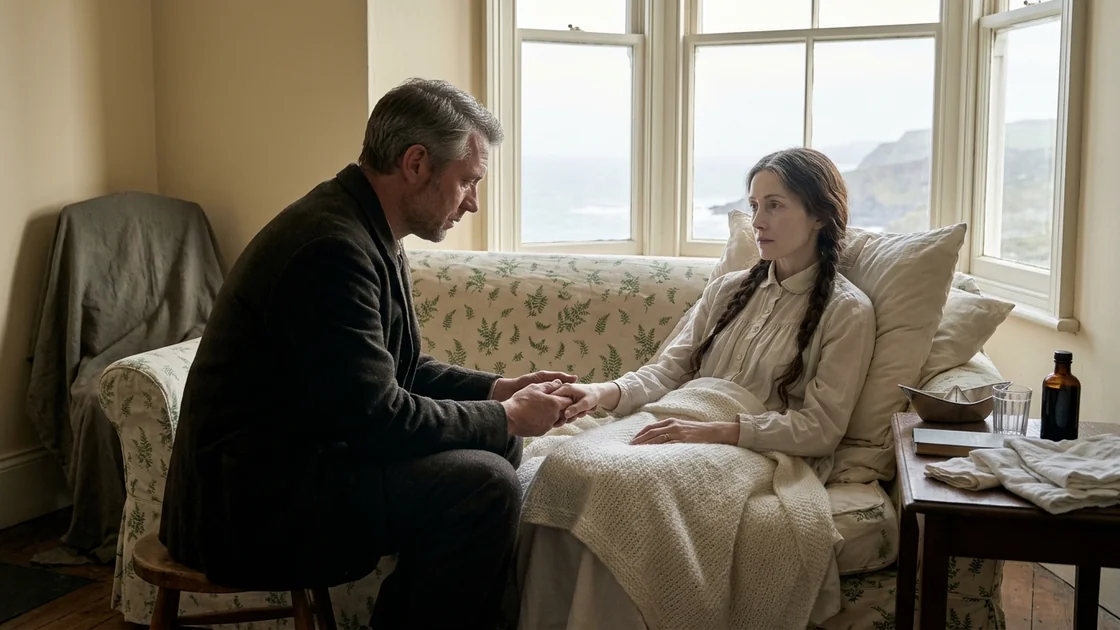
Arthur Thorne watches over the course of a single year as his vibrant wife, Clara, slowly surrenders to an inexplicable and profound melancholia that transforms their bustling Victorian coastal home into a house of quiet ghosts. Beginning with a sudden hesitation in her autumn garden and progressing through the bleak winter until she speaks no more by the following autumn, Clara slips past the reach of medical specialists, sunlit sea air, and Arthur’s tireless devotion, leaving him to learn the agonizing art of loving a woman who has vanished while remaining entirely within his sight.
The first sign was not a tear, nor was it a sigh, though Arthur would spend the rest of his life searching his memory for both. It was simply a trowel left in the damp dark earth of the south border, its wooden handle slick with the mist that rolled in from the North Sea every October afternoon.
Clara was standing three paces away from it, her heavy wool shawl pulled tight around her shoulders, though her hands remained bare and mud-streaked at her sides. She was looking at the rosemary bushes—great, sprawling things that smelled of salt and pine—as if she had never seen them before, or as if they had spoken to her in a language she could almost, quite nearly, understand, provided she stood still enough to catch the cadence.
"The wind is turning, Clara," Arthur had called out from the gravel path, his boots crunching loudly to announce his approach. At forty-two, Arthur was a man who believed in the solidity of things: the weight of ledgers at his shipping office in the harbor below, the dependability of a well-built sea wall, the warm, predictable geometry of his marriage. "Dr. Hendrick says a northerly gale will bring frost before Tuesday. Shall I help you bring the pots into the glasshouse?"
Clara did not turn her head at once. When she did, the movement was peculiarly mechanical, as though her neck were stiff from a draft. Her gray eyes, usually as quick and changeable as the water beyond the cliffs, seemed flat, reflecting the overcast sky without taking any of the light inward.
"The frost," she repeated. Her voice was light, almost conversational, yet it lacked the small rise at the end that turned a phrase into an invitation. "Yes. I suppose it will."
She walked past him toward the house without picking up the trowel. Arthur waited until the scullery door clicked shut behind her before he knelt on the cold turf, pulled the iron blade from the soil, and wiped it clean with a handful of dead grass. He thought nothing more of it than that she had caught a slight chill, or perhaps that the long summer of hosting his nieces from London had tired her more than she had cared to admit. He was a man who looked for causes in the immediate calendar, believing that every shadow had an object of equal size standing just between it and the sun.
That evening, the dining room was warm with the glow of two oil lamps and a coal fire that popped and shifted in the grate. Mrs. Galt, who had cooked for them since the year of their marriage twelve years prior, sent up a roast mutton with caper sauce and a dish of buttered parsnips—things Clara favored when the weather turned raw.
"The Margaret Rose made port three hours ahead of the tide," Arthur said, carving the meat with steady, practiced strokes. "Old Miller swears the hull needs coppering before we send her down to Lisbon, though I told him the timber is sound enough for one more winter passage. What do you think, my dear? You always had a softer spot for Miller’s grumbling than I."
Clara was looking at her fork. She had the tines pressed lightly against the white damask tablecloth, making four tiny indentations in the linen, then lifting the silver to watch the fabric slowly rise back to flatness, only to press it down again.
"Clara?"
She looked up, startled, though her face remained smooth. "I beg your pardon, Arthur. My mind was elsewhere."
"With the Margaret Rose, I hope, or at least with your dinner," he said, smiling as he set a plate before her. "You haven’t eaten a mouthful."
"The sea was very loud this afternoon," she said, picking up her knife with an obedient small sigh. "Did you hear it from the harbor? Not the waves breaking, I mean, but the dragging sound. When the water pulls back through the shingle. Like it’s trying to take the stones with it, and it never quite manages, so it has to come back and try again."
Arthur chuckled, pouring himself a half-glass of claret. "It has been doing that for ten thousand years, love. If it hasn't managed the trick by now, I think our cliffs are safe until morning."
She smiled then—a brief, thin curving of her lips that didn't reach the corners of her eyes—and cut a very small piece of mutton. She chewed it for a long time, her gaze drifting back toward the heavy velvet curtains that shut out the night. Outside, the wind was indeed rising, rattling the sash of the bay window with the dry, impatient tap of an old man’s knuckles.
By November, the garden was entirely abandoned to Thomas, the boy who came three days a week to haul coal and sweep the stable yard. Clara no longer went out after breakfast with her basket and shears. Instead, she took to sitting in the morning room, which faced west toward the moor rather than east toward the sea. It was the smallest room in the house, papered in a faded willow pattern that Arthur had promised for three years to have stripped and replaced with something brighter from Morris & Co.
When Arthur returned from the counting-house at four o'clock, the dusk already settling thick and greasy over the cobblestones of the high street, he would find her there without a lamp lit. She would have a piece of needlework in her lap—a linen altar cloth she had been embroidering for St. Jude’s since August—but the needle would be stuck fast in the canvas, the silk thread trailing across her dark skirt like a bright vein that had ceased to pulse.
"Sitting in the dark, Clara?" he would ask, striking a match and touching it to the wick of the table lamp until the yellow flame bloomed inside the frosted glass globe. "You’ll ruin your eyes."
"The light comes down from the sky so quickly now," she would answer, her hands folding over the embroidery hoop as if to hide it from the sudden glare. "It seems a waste to burn oil when one isn't really doing anything that requires seeing."
"Not doing anything? Why, the vicar expects those lilies on the altar by Advent, doesn't he?"
She looked down at the half-finished petals—stiff, gold-threaded things that looked nothing like the wild lilies of the valley she used to gather in the woods behind her father’s rectory. "They are very ugly, Arthur. Don't you think? So terribly yellow. Nothing in nature is that color unless it is dying."
"Nonsense," he said, bending to kiss her forehead. Her skin was cool, dry as paper, and smelled faintly of the lavender water she kept on her dressing table, though she had stopped pinning her hair with her usual neatness; a loose strand of chestnut, threaded with the first silver of her thirty-eighth year, hung beside her ear. "Your work is always the pride of the parish. Come, let us have tea in the parlor. I’ve brought the Illustrated London News, and there is a long piece on the new suspension bridge at Clifton."
She rose when he took her elbow, yielding to the pressure of his hand with a compliance that troubled him more than resistance would have done. In the early years of their marriage, Clara had been a woman of brisk, cheerful opinions. She had argued with him over the placement of the pear trees, over the politics of Mr. Gladstone, over whether a terrier was a suitable dog for a house with Turkish carpets. She had laughed with her head thrown back, showing the small gap between her lower teeth, and when their only child—a boy who had lived for four hours in the bitter February of their third year together—had been laid in the churchyard on the hill, she had wept with a fierce, tearing grief that had shaken Arthur to his foundations, yet from which she had eventually risen, paler and quieter, to take up the reins of her household and her life again.
This was not like that grief. There was no weeping in the morning room. There was no anger at God, no clinging to Arthur’s coat lapels in the dark hours before dawn. There was only a slow, steady receding, like the tide going out over a flat mudbank where the slope is so gradual you cannot see the water moving, only that where there was silver a moment ago, there is now only gray silt.
In the first week of December, Dr. Hendrick came to dine. He was a man of sixty, with mutton-chop whiskers as white as salt and a booming voice developed through forty years of shouting over the sea wind into the ears of deaf fishermen. Arthur had asked him to drop by on the pretext of a game of whist, though they played only two rubbers before Clara excused herself, pleading a headache.
When the door had closed behind her slow, measured step, Arthur laid his cards face down on the green baize and looked across at his friend.
"Well, Robert?" Arthur said quietly. "You watched her all evening. What is it?"
Dr. Hendrick took a long pinch of snuff from a silver box, tapped his wrist, and inhaled with a wheezing sigh. "She has lost weight, Arthur. Her wrists are like bird bones inside those cuffs."
"Mrs. Galt makes beef tea every noon. She takes three spoonfuls and leaves the rest to skin over in the bowl. If I press her, she drinks it to please me, and then she sits so still for two hours afterward that I am half afraid she will bring it up again." Arthur leaned forward, his hands clasped tightly between his knees. "Is it the lungs? Her mother died of a decline, you know, though she was scarce twenty-five when it took her."
"Did she cough on the stairs just now?"
"No. She never coughs."
"No fever in the evenings? No bright spot on the cheek?"
"Look at her, Robert. She hasn’t had color in her face since Michaelmas."
The doctor nodded slowly, gazing into the fire. "It is not the lungs, my boy. At least, I hear nothing in her breathing, though I’ll come round tomorrow with my horn and tap her chest to be certain. It is the nerves. Women of Clara’s temperament—fine-strung, imaginative women who have no children to occupy their hands—are prone to a thinning of the blood when the dark weather sets in. The humors grow sluggish. What we used to call the spleen, though the young men in Edinburgh have three-syllable Greek names for it now that don't cure it a whit faster."
"What will cure it, then?" Arthur asked, a sharp edge of impatience cutting through his voice. "Give me a prescription. Iron? Quinine? We have money, Robert. If she needs port wine six times a day, or a crate of oranges from Seville, you have only to write it down."
"Iron, certainly. I’ll send round a bottle of Easton’s Syrup in the morning—strychnine, iron, and quinine. Bitter as gall, so it wakes the stomach into wanting food. And you must get her out of that west parlor. There is no sun there until afternoon, and by then the fog is up from the marsh. Make her walk on the cliff path every day at noon, rain or shine. And bring people into the house, Arthur. You two live like monks here since your sister went back to Surrey. A woman needs chatter. She needs to care what ribbon she puts on her cap."
Arthur felt a great, warm rush of relief, the kind that comes to a man who has been given a hammer and told which nail is loose. "Of course," he said, reaching for the decanter to refill the doctor’s glass. "We have been too quiet. I have been buried in the Baltic timber accounts, and I’ve let her mope. We shall have the Vicarage girls over for charades at Christmas, and I’ll buy her a phaeton to drive herself into town when the roads are dry."
The Easton’s Syrup arrived at nine the next morning in a square blue bottle with a ribbed side. Arthur himself poured the first dose into a medicinal glass at eleven, diluting it with water as instructed.
Clara was sitting by the bedroom window, fully dressed in her gray merino gown, though she had not come down for breakfast. Her hands were folded in her lap. She was looking at the stable roof, where three jackdaws were huddled against the brick chimney for warmth.
"Here we are, my darling," Arthur said, using the brisk, cheerful tone he had practiced on the stairs. "Dr. Hendrick’s magic elixir. It tastes abominable, I am told, so I have brought a piece of candied ginger from the pantry to take the edge off afterward."
Clara looked from the jackdaws to the glass in his hand. Her eyes were very large in her thin face, the circles beneath them the color of a bruised plum.
"Must I, Arthur?"
"Only a tablespoonful. It is to bring your appetite back, so you will be strong enough for our walk at noon. The sun is actually trying to break through over the headland."
She took the glass. Her fingers touched his, and he was shocked by how cold they were, though a great fire was roaring in the bedroom hearth three feet from her skirt. She drank the draught without a grimace, as if her tongue had lost the faculty of distinguishing bitter from sweet, and handed the empty glass back to him, declining the ginger with a slight shake of her head.
"You are very good to me, Arthur," she said softly.
"Good to you? Why, I am your husband," he laughed, sitting on the edge of the padded footstool at her feet and taking both her chill hands between his broad, warm palms. He rubbed them gently, trying to chafe some heat into the blue-veined skin. "Who else should I be good to? Now, tell me—would you like to invite Lucy and Harriet over on Friday? They have a new portfolio of watercolors from their cousin in Rome. We could have Mrs. Galt make those almond cakes you like."
Clara’s gaze slipped past his shoulder, back toward the window and the gray slant of slate where the black birds sat. For a long moment she said nothing, and the only sound in the room was the ticking of the small French clock on the mantelpiece—a rapid, metallic tink-tink-tink that seemed suddenly far too fast for the room.
"If you wish it, Arthur," she whispered. "Only... it is such a very great deal of noise, isn't it? When people talk. One has to think of what to say back to them, and the words seem so far away lately. Like trying to fetch water from the bottom of a well with a sieve. By the time I bring them up to my mouth, there is nothing left in them."
Arthur stopped rubbing her hands. A cold finger seemed to touch the base of his own spine, though he shook his shoulders to cast the feeling off. "Then you shan't say a word," he declared stoutly. "Lucy talks enough for four parishes, as we both know. You shall only sit and look at the pictures of the Colosseum and let them do the work."
They took the walk at noon. It was an ordeal that Arthur did not care to repeat, though he forced himself to repeat it every day for three weeks. Clara walked beside him with her hand tucked into the crook of his arm, her boots moving with a slow, dragging heaviness through the salt-bitten grass of the cliff top. The wind whipped her veil across her face, and she did not lift a hand to brush it back; Arthur had to stop every hundred yards to untangle the black gauze from her bonnet pins.
When they met neighbors—Mr. Phipps the solicitor, or old Lady Greaves in her bath chair—Clara would drop a slight curtsy and look at the ground between their feet while Arthur made hearty, loud conversation to cover her silence. He found himself talking incessantly, filling the air with observations about the weather, the price of coal, the repairs to the harbor jetty, anything to prevent the gap of silence from widening between his wife and the world. He felt like a man rowing a leaking boat across a wide estuary: if he stopped pulling at the oars for a single second, or stopped bailing with his free hand, the water would come over the gunwales and take them both down into the dark.
By Christmas, the pretense of the walks had to be abandoned. A great snow came down from the Cheviots, burying the coast road in drifts six feet deep and turning the sea the color of old pewter against the blinding white of the cliffs.
On Christmas Eve, Arthur came home early with a parcel of hothouse violets he had ordered by train from Newcastle, wrapped in three layers of flannel to keep them from freezing on the platform. He went straight up to their bedroom, his boots still dusted with snow, his face glowing from the wind.
The room was dim, as she always kept it now. The curtains were drawn three-quarters of the way across the sash. Clara was not in her chair by the fire. She was lying on the outside of the counterpane, still in her morning dress, her face turned toward the wall where the shadow of the wardrobe fell heaviest.
"Clara?" He set the parcel on the dressing table and came to the bedside. "My darling, are you sleeping?"
"No," she said into the wallpaper. Her voice was a dry rustle, like dead leaves blown across a stone floor.
"Look what I have brought you. All the way from the south—or nearly so. Smell them." He unwrapped the flannel and held the small bunch of purple blossoms near her cheek. The scent was small and sweet, a fragile memory of April in the dead heart of winter.
Clara did not turn her head. A single tear—the first he had seen in three months—slipped from the bridge of her nose and soaked into the white Marseilles quilt.
"Take them away, Arthur," she said.
He stood frozen, the flowers in his hand. "Clara? What is it? Does the scent make your head ache?"
"They are alive," she said, and her voice trembled with a strange, quiet horror. "They have to be put in water, and then they will droop, and the petals will fall on the mahogany, and someone will have to sweep them up. Everything takes so much doing. Why must things keep beginning when they only have to end?"
Arthur sat down on the edge of the mattress. The springs gave a small, familiar groan. He laid the violets on the bedside table and placed his hand on her shoulder. Beneath the wool of her dress, the bone of her scapula felt sharp enough to cut the cloth.
"Clara," he said, all the briskness gone out of him now, leaving only a naked, begging bewilderment. "Look at me. Please. Tell me where the pain is. Is it something I have done? Have you been unhappy in this house all these years and hidden it from me?"
Slowly, with immense effort, she rolled onto her back. Her eyes looked up at the canopy of the bed, not at his face.
"You are the best man in the world, Arthur," she said, and the absolute flatness of her tone made the praise sound like an epitaph read over a stranger's grave. "There is no pain. I wish there were a pain. A pain has a shape, doesn't it? You can put your hand over it and say, Here it is, under my ribs. There is nothing under my ribs. I think I died in the autumn, Arthur, when the rosemary stopped blooming, and nobody noticed, so they haven't come to bury me yet. And it is so tiring, having to walk about and hold a teacup when one is already dead."
"Don't say such things!" Arthur cried, his voice cracking in the quiet room. He seized her shoulders, almost shaking her in his terror. "It is wicked to speak so, Clara! You are my wife—you are thirty-eight years old—you are in your own bed with a good fire and a husband who worships the ground your shoe touches! You must fight this! You must pray, or—or get angry with me, or break the china, anything, only do not lie there and talk of being dead!"
She looked at him then. Her gray eyes met his, and for one terrible second Arthur saw down into them, as a man looking over the side of a ship sees down through forty fathoms of clear green water to the hull of a wreck lying on the sand below. She was down there, very small and very far away, watching him shout from the surface, and she could neither swim up to him nor could he dive deep enough to reach her before his lungs burst.
"I am sorry, Arthur," she whispered, closing her eyes to shut him out. "I know it makes you cross. I will try to come down for dinner."
She did not come down for dinner that night, nor on Christmas Day, nor in the bleak, howling weeks of January that followed.
In February, Arthur wrote to London. Dr. Hendrick had confessed himself beaten, though he continued to call twice a week to take her pulse and shake his head over the untouched bottles of tonic that lined the washstand. At Hendrick’s suggestion, Arthur engaged the services of Dr. Septimus Vance, a physician from Harley Street who had written a treatise on The Moral and Physical Derangements of the Nervous System in Females and who charged thirty guineas plus first-class railway fare from King’s Cross to visit the provinces.
Dr. Vance arrived on a Tuesday afternoon when the thaw was turning the road into yellow soup. He was a tall, narrow man in a frock coat of impeccable broadcloth, with steel-rimmed spectacles and fingernails pared so short they looked raw. He smelled of carbolic soap and peppermint.
He spent forty minutes alone with Clara in the bedroom while Arthur paced the hall carpet downstairs, his hands behind his back, counting the diamonds in the runner from the front door to the foot of the stairs—forty-two, turn, forty-two, turn—while Mrs. Galt watched him from the kitchen doorway with her apron pressed to her mouth.
When Dr. Vance descended, he did not go into the parlor, where a cold collation had been laid out for him, but drew Arthur into the study and shut the door.
"A classic presentation, Mr. Thorne," Dr. Vance said, warming his coat-tails before the study fire while Arthur stood by the desk like a schoolboy awaiting a birching. "Simple melancholia without delusion—or rather, with only the depressive delusion of negation. Cotard in Paris has written of similar cases, where the patient believes the internal organs have ceased to function or that the spirit has already departed."
"I do not care what a Frenchman calls it," Arthur said, his knuckles white against the leather top of his desk. "How do we bring her back?"
"The brain, Mr. Thorne, is an organ like the liver or the kidneys," Vance said, placing the tips of his pared fingers together. "When it is congested with dark, poorly oxygenated blood, or when the nervous fluid is depleted by some unseen constitutional shock, the mind reflects that stagnation as sorrow. Your wife is not sad about anything. If you gave her a diamond necklace the size of a horse collar, she would feel no pleasure; if you told her your ships had all gone to the bottom of the Bay of Biscay, she would feel no additional grief. The instrument itself is unstrung."
"Then string it," Arthur said harshly.
"Here," Dr. Vance said, looking around the shadowed room with a slight curl of his lip, "everything reinforces the habit of the disease. The solitude. The sound of that abominable ocean—a most depressing influence on the lymphatic temperament. Above all, Mr. Thorne, your own indulgence."
Arthur stiffened. "My indulgence?"
"A loving husband is frequently the worst nurse for a nervous wife," Vance said smoothly. "You hang upon her looks. You ask her ten times an hour how she feels. You allow her to lie in a darkened room with the curtains drawn because the light distresses her. In short, you permit her to retreat into the fortress of her malady. At my establishment in Twickenham, we pursue the opposite course. Cold shower-baths at six in the morning to shock the capillary circulation into action. Forced feeding with a stomach tube if the patient refuses mutton chops. Galvanic batteries applied to the spine three times weekly, and strict removal from all familiar faces until the will is broken of its morbid habit and re-established on a healthy footing."
Arthur stared at him. In his mind’s eye, he saw Clara—Clara, who started if a coal fell from the grate, who had wept over the violets because they had to die—standing naked under an icy torrent of water in a strange house among hired warders, a rubber tube forced between her small teeth.
"Get out," Arthur said.
Dr. Vance blinked behind his spectacles. "I beg your pardon?"
"Your train leaves at six-fifteen," Arthur said, walking to the desk, taking out his checkbook, and writing out the draft for thirty-five guineas with a hand that tore the nib through the paper. He blotted it, tore it out, and held it toward the specialist. "My groom will have the trap at the door in five minutes. If you are still in this house in six, I will throw you down the steps into the mud myself."
"My dear sir," Vance said, taking the check hastily and stepping back toward the door, "if you prefer to watch your wife waste into complete dementia or suicide in her own bed, that is entirely your prerogative as a householder. Good day to you."
When the wheels of the trap had rattled away down the drive, Arthur went upstairs. He did not knock, as he had taken to doing lately out of a strange, tiptoeing deference to her silence; he opened the door and walked straight in.
Clara was sitting on the edge of the bed where the London doctor had left her. Her nightdress was unbuttoned at the throat where Vance had listened to her heart, and she had not bothered to fasten the little mother-of-pearl buttons again. She looked very small against the high mahogany headboard, like a child left behind in a railway waiting room.
Arthur crossed the room, knelt on the floor in front of her, and buried his face in her lap, his arms wrapping around her waist. His shoulders heaved with dry, tearing sobs that he had held back since November. He smelled the stale lavender in the folds of her skirt, the faint sourness of a sickroom that hasn't had the windows opened since the frost began.
"I won't let them take you," he choked into the wool of her dress. "I swear to God, Clara, nobody shall touch you. You don't have to walk, you don't have to talk to Lucy, you don't have to take the bitter stuff anymore. Only stay here with me. Don't leave me alone in this house."
For a long time, there was nothing. Then, with a slowness that broke his heart more completely than her stillness had done, he felt the negligible weight of her hand come to rest on the crown of his head. Her fingers did not stroke his hair; they simply lay there, light and cool as five fallen leaves, until he had finished crying and lifted his head to button her collar for her.
Spring came to the coast late and grudgingly, as it always did, arriving first as a change in the smell of the wind—less iron, more wet kelp and turned earth—and then as a pale yellow wash of celandines along the ditches of the high road.
Arthur reorganized his life with the methodical precision he had once applied to his shipping schedules. He sold his share in the Baltic timber trade to his junior partner, young Garroway, retaining only the coastal colliers that required scarce two hours of his morning at the quay. By eleven o'clock every day, he was back at Cliff House.
He had moved her from the bedroom into the large room on the south side of the first floor, which had been intended for a nursery twelve years ago and had stood locked ever since, filled with holland-covered chairs and a rocking horse that had never been unpacked from its straw. Before bringing her in, Arthur had spent three nights there himself with the gardener’s boy, hauling the shrouded furniture up to the attic, stripping the faded paper from the walls, and painting the plaster a soft, warm cream that caught the morning sun off the water without dazzling the eye. He had a wide low couch placed before the bay window, piled with downs and covered in soft chintz patterned with small green ferns.
Here Clara spent her days. A girl from the village, Annie—a quiet, heavy-footed creature whose own sister had been born simple and who therefore felt none of the superstitious dread that the older servants felt around a mistress who never spoke—was hired to help dress and wash her in the mornings.
For Clara hardly spoke at all now. The sieve had come up from the well entirely empty at last.
In April, she still answered yes or no if Arthur asked her directly whether she was cold, or whether the sun was in her eyes, though there was always a pause of ten or fifteen seconds between the question and the reply, as if the sound had to travel across an immense plain of snow to reach her ears, and her voice had to travel all the way back against the wind. By May, when the hawthorn hedges along the lane were white with blossom that smelled of bitter almonds, the pause grew so long that she would forget the question before the word reached her lips, and she would only look at him with a mild, puzzled apology in her gray eyes before turning her face back toward the sea.
Arthur learned to read the minute weather of her body instead.
He learned that when the muscles at the corner of her jaw tightened ever so slightly, the noise of the gulls fighting over the herring boats below the cliff was hurting her head, and he would go quietly to close the sash. He learned that she would not swallow solid meat anymore—not from stubbornness, as Dr. Vance had thought, but because the effort of chewing seemed to exhaust her before the morsel was ready for the throat—and he spent hours in the kitchen with Mrs. Galt, straining mutton broth through triple muslin and beating the yolks of new-laid eggs with warm milk and a drop of brandy until they were as light as foam.
He fed her himself at noon and at six. He would sit on a low wooden stool beside the chintz couch, a napkin tucked carefully under her chin, holding the silver pap-boat they had bought twelve years ago for the baby who had never needed it.
"Just a little more, my darling," he would murmur, touching the lip of the silver vessel to her pale mouth. "Mrs. Galt took this from the speckled hen this morning. Still warm from the straw. There, that’s my good girl."
Sometimes she would open her lips slightly and let the warm liquid trickle in, swallowing with a small, visible effort of her thin throat. Sometimes the milk would simply run down her chin onto the napkin, and she would not seem to know it was there until Arthur wiped it away with a damp corner of linen.
His friends fell away one by one, not from malice, but from the awkwardness that chronic misfortune breeds in healthy men. At first, the Vicar called every Tuesday, sitting by her couch with his thick red hands on his knees and reading the Psalms in a resonant baritone while Clara stared at the brass buckle on his gaiter. Once, the Vicar tried to question her about the state of her soul, asking whether she despaired of God’s mercy, for the churchmen had their own names for her silence, older than Dr. Vance’s Greek ones.
"Do you feel yourself cast out from grace, Mrs. Thorne?" the old man had asked, leaning close to her face. "Is it the Enemy who stops your tongue from praising your Maker?"
Clara had not moved a muscle, not even her eyelids, though Arthur, standing by the mantelpiece, saw her small thumb rub once, very slowly, against the seam of her skirt.
Afterward, downstairs in the hall, Arthur had asked the Vicar not to bring his Bible again. "If God is in that room, Mr. Mowbray," Arthur said, holding the front door open into the bright May sunshine, "He knows why she is quiet without your shouting at her. And if He is not, then the shouting only tires her."
People in the town began to speak of poor Arthur Thorne in the tone usually reserved for the dead or the bankrupt. When he walked down the high street to the harbor at nine in the morning, shopkeepers would come to their doors and nod to him with solemn, lowered faces, no longer shouting across the cobbles about the mackerel catch or the Town Council elections. Garroway, his partner, took to bringing the weekly accounts up to the house on Saturday evenings so Arthur would not have to leave her alone at dusk, sitting nervously in the parlor for half an hour with his hat between his feet, speaking in a hushed whisper as though there were a coffin on the trestles upstairs.
"How is Mrs. Thorne this week, sir?" the young man would ask without fail as he buckled his leather portfolio.
And Arthur, whose hair had gone entirely silver at the temples between Christmas and Whitsuntide, would answer in a steady, even voice: "Much the same, thank you, Edward. She took a little arrowroot at four, and we had the window open for an hour while the tide was high."
He did not tell Garroway, or Hendrick, or anyone on earth, that he was no longer entirely unhappy.
That was the strange, secret transformation that had occurred in Arthur as the summer deepened and the days grew long and golden along the coast. In the winter, he had fought her silence like a madman fighting a house fire; he had bruised his own soul against the locked door of her mind, demanding that she come out, demanding that yesterday be restored to him. He had measured every day against theClara who had laughed in the garden with the mud on her hands, and every day had been an unbearable defeat.
Now, he had stopped remembering October. He had shortened his horizon until it was no wider than the south room between sunrise and the lighting of the night-lamp.
When he came up the stairs at eleven in the morning, took off his heavy boots outside her door so as not to jar the floorboards, and slipped into his carpet slippers, he felt a curious, hushed peace descend upon him. The world downstairs—with its bills of lading, its noisy carts rattling over the granite setts, its men shouting about politics and percentages—seemed coarse and frantic, a play acted by people who did not know how thin the floorboards were beneath their feet.
In the south room, time did not move by the clock; Arthur had stopped the pendulum of the little French timepiece in March because its brisk tink-tink had seemed an impertinence. Time moved by the square of sunlight that fell through the bay window: at eleven it lay on the floorboards by the washstand; by two it had climbed the green ferns of her couch, warming the white wool shawl across her knees; by five it was a long, honey-colored bar on the cream wall behind her head, turning slowly to rose and then to violet as the sun dropped behind the high moorland to the west.
He would sit beside her for hours with a book open on his knee—sometimes The Pickwick Papers, which they had read aloud together when they were courting, sometimes an old volume of George Herbert’s poems that had belonged to her father—and he would read a paragraph or a stanza aloud every now and then, not expecting her to follow the sense, only offering the sound of his voice as a kind of shelter, like an umbrella held over her head in a light rain.
Mostly, he didn't read at all. He simply watched her face, or held her left hand in his right. Her wedding ring had grown so loose on her wasted finger that it had slipped off in the bedsheets in April; Arthur had bought a narrow guard-ring of twisted gold wire from the jeweler in the high street to keep it in place, and his thumb would turn the two rings slowly round her knuckle for an hour at a time.
She was forty now—her birthday had passed in June—and in her utter stillness she had acquired a strange, porcelain beauty that she had never possessed when she was well. Every line of care, every small crease of effort or irritation had been smoothed out of her brow, as water smooths a pebble in a cave where no wind ever blows. Her skin was translucent, showing the faint blue tracery of veins at the temples, and her hair, which Annie brushed out every morning and left loose in two long braids over her shoulders so the pins would not press into her scalp against the pillows, looked like dark silk against the white linen.
Once, in July, during a week of breathless heat when the sea lay like a sheet of hammered tin below the cliffs and the smell of the hayfields drifted even into the town, Arthur brought a basin of cool water from the deep well in the yard, scented with a few drops of her old lavender water, and bathed her face and wrists himself while Annie was downstairs at her dinner.
As he passed the damp sponge across her forehead, brushing back a damp tendril of hair, her eyelids fluttered and opened. Instead of looking past his ear at the wall, as she had done for ten weeks, her gray eyes focused directly on his face.
Arthur held his breath. The sponge dripped once, twice, into the china basin on the floor.
Her lips parted. They were dry, despite the glycerin and rosewater he touched to them every morning. He leaned down until his ear was two inches from her mouth, his heart hammering against his ribs like a bird caught in a chimney.
"Arthur," she breathed. It was scarcely a voice at all—only a shaping of the breath as it left her lungs.
"I am here, my darling," he whispered, not daring to move his head lest he break the thread. "Right here."
"You have... gray," she whispered, her eyes fixed on his temple where the sunlight struck the hair above his ear. "So much gray."
"It is nothing," he said, a hot tear splashing down from his cheek onto her neck. "Only the fashion, Clara. All the fellows at the Exchange are wearing it so this summer."
The ghost of that old, small curve touched the corner of her mouth—not a smile, scarce the shadow of one, like the ripple made by a leaf falling on deep water—and then her eyelids dropped again, and her head turned half an inch back toward the window.
She did not speak again that summer, nor ever after. Yet Arthur lived on those six words through the whole of August and into the shortening days of September, turning them over in his mind at night as he lay on the narrow truckle bed he had had set up at the foot of her couch so he could hear if her breathing changed in the dark. She had seen him. Down at the bottom of the forty fathoms of green water, through the dim light and the drifting silt, she had looked up and noticed the color of his hair.
When October came round again, completing the circle of the year since the trowel had been left in the south border, the decline of her physical body, which had remained strangely arrested during the warm months, resumed with a quiet, sudden swiftness.
It was not a disease that Dr. Hendrick could name on a certificate with any confidence, though he came every morning now, climbing the stairs with a heavy, creaking tread and standing by the foot of the couch with his gold watch in his palm.
"The pulse is scarce forty to the minute, Arthur," the old doctor said on an afternoon when the first autumn gale was hurling handfuls of rain like gravel against the south panes. "And thin as a spider’s thread. She is not taking enough nourishment to keep a sparrow warm."
"She swallowed half a wineglass of beef jelly at noon," Arthur said from his stool. He had not shaved that morning, and his coat was wrinkled from sleeping in it; he had not left the room since Tuesday, when she had begun to choke slightly on the milk and he had had to moisten her mouth with a camel-hair brush dipped in water and brandy instead. "When the wind drops, she will take a little more. The noise of the gale always tires her."
Dr. Hendrick looked down at his friend—at the bowed shoulders, the grey stubble, the eyes that were bright and sunken with months of broken sleep—and laid a heavy, gentle hand on Arthur’s shoulder.
"My dear boy," Hendrick said softly. "A lamp goes out when there is no oil left in the bowl, yes. But sometimes it goes out simply because the wick has burned down below the brass, and you may pour all the oil in creation over it and never get a spark again. She has been trying to go for a year, Arthur. Do not trouble her with the spoon anymore."
Arthur did not answer. He waited until the doctor’s boots had creaked down the stairs and the front door had closed with its heavy, muffled thud against the storm. Then he dipped the little camel-hair brush into the glass of brandy-and-water and touched it gently to the corner of Clara’s lips.
The rain stopped toward midnight, and the wind fell away into that immense, hollow silence that follows an autumn squall on the coast, when only the long swell is left, booming at regular intervals into the sea-caves half a mile below the garden.
Arthur lit no lamp, for the moon was near the full, and as the clouds tore apart and drifted out toward the Dogger Bank, a white, cold light flooded through the bay window, laying the pattern of the glazing bars across the chintz couch and the floor.
He sat on his low stool, his head resting on the edge of the mattress beside her pillow, her left hand enclosed in both of his. Her skin was no longer merely cool; it had the chill of marble that has stood all night in an unheated church, a cold that seemed to pass through his own palms and up into his wrists, slowing his own blood to match the long, shallow intervals of her chest.
Drag... and pause. Like the water pulling back through the shingle on the beach, as she had said at the dinner table a hundred years ago. Trying to take the stones with it, and never quite managing, so it had to come back and try again.
Toward three in the morning, when the moonlight had slid off the couch and lay only on the threshold of the door, the sound of her breathing grew so faint that he had to lift his head from the bolster and lean over her face to hear it at all.
Her eyes were open in the dimness. They were not looking at the ceiling, nor at the wall, nor at him. They were wide and entirely dark, the pupils dilated until the gray iris was gone, drinking in the dark of the room without reflection.
"Go on, then, my love," Arthur whispered into the quiet space between his mouth and her cheek. His voice did not shake; it was as soft and grey as the light on the floorboards. "You don't have to lift the teacup anymore. I have everything looked after here."
There was one more breath—smaller than a sigh, no more than the settling of dust on a shelf when a door is closed in another part of the house—and then the long pause began, and the water did not come back up the shingle again.
Arthur did not call Annie, who was sleeping in the dressing room across the landing, nor did he go down to wake Thomas to fetch Dr. Hendrick. He remained on the low wooden stool until the sky over the North Sea turned from black to the color of a wet slate, and then to a pale, washed-out lemon that crept across the sea and touched the rosemary bushes in the south border, where the woody stems were thick with the first rime of frost, holding onto her cold hand until it had grown quite stiff within the shape of his own.