The Quiet Between the Stars
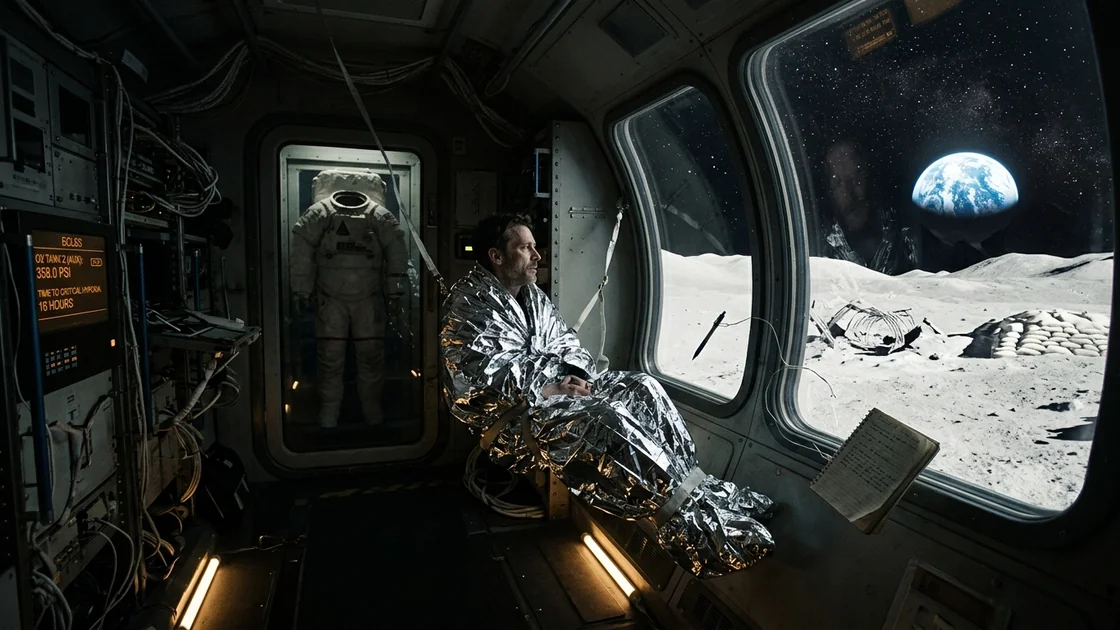
Astronaut Elias Vance finds himself entirely alone on Research Outpost Artemis-IV after a sudden coronal mass ejection forces a chaotic evacuation that leaves his escape pod crippled on the launchpad. As he works desperately to repair the habitat's failing life support systems, he watches the high-gain communication relays with Earth degrade into incomprehensible static due to solar interference and hardware decay. With his oxygen reserves steadily ticking down to zero and no possibility of a rescue mission arriving in time, Elias must confront the crushing silence of the lunar surface, the ghosts of his past, and the quiet acceptance of his final hours staring back at a blue marble that can no longer hear him.
The dust on the Mare Crisium did not blow away. When the evacuation lander Hermes-2 fired its ascent stage engines six hours ago, the plume of hypergolic propellant had blasted a fresh radial scar into the ancient regolith, throwing gray powder against the triple-paned alumino-silicate viewports of Sector C. It hung there for a fraction of a second in the one-sixth gravity before dropping like lead back to the surface, leaving the horizon as sharp and dead as a knife’s edge.
Elias Vance stood by the viewport, his boots Velcroed to the composite deck plates to keep from drifting in the sluggish lunar pull. His left shoulder still throbbed where the airlock hatch had clipped him during the blowout in the connecting tunnel between Hab-1 and the launch gantry. That blowout had been the deciding factor. Five seconds of venting atmosphere, an automatic bulkhead slamming shut with ten tons of hydraulic force, and a green indicator light turning stubbornly, irrevocably red. Commander Sarah Chen had been on the other side of the bulkhead. Through the four-inch polycarbonate porthole in the hatch, Elias had seen the terror in her eyes, wide behind the polycarbonate visor of her helmet, before the emergency launch sequencer took over and dragged her crew toward the ascent module.
They hadn't wanted to leave him. He knew that. In the frantic seconds before the umbilical severed, Chen’s voice had been tearing through the local UHF channel, overriding the automated flight director warnings. “Vance! Override the manual lock! Cycle the external—” And then the CME hit the upper magnetosphere of the Earth-Moon system, a wall of charged plasma hurled from the sun at two thousand kilometers per second, turning every unshielded radio frequency into a howling blizzard of white noise.
Now, the outpost was quiet, save for the rhythmic, metallic clicking of the secondary carbon dioxide scrubbers in the floor beneath his feet. Click-whir. Click-whir. It sounded like an old mechanical grandfather clock, the kind his grandfather had kept in the hallway of the house in Ohio, measuring out time in rigid, unforgiving increments.
Elias turned away from the viewport and pushed off gently, gliding across the central command module toward the environmental control and life support system—the ECLSS console. The screens were flickering, suffering from brownouts caused by the solar storm’s inductive currents surging through the station’s external power grid. The primary solar arrays on the crater rim had automatically feathered themselves to prevent total photovoltaic degradation, leaving Artemis-IV running on its reserve hydrogen-oxygen fuel cells.
He tapped the capacitive glass of the primary life support display. The numbers were rendered in a sterile, amber typeface that NASA engineers had decided fifty years ago was the most soothing color for high-stress scenarios. Elias didn't find it particularly soothing right now.
O2 TANK 1 (MAIN): 0.00 PSI [VENTED] O2 TANK 2 (AUX): 412.8 PSI CABIN PRESSURE: 8.4 PSI PARTIAL PRESSURE O2: 2.9 PSI ESTIMATED CONSUMPTION RATE: 0.84 KG/SOLAR DAY TIME TO CRITICAL HYPOXIA: 46 HOURS, 12 MINUTES
Forty-six hours. Two days, give or take a few ragged breaths at the end.
The blowout in the transfer tunnel had ruptured the main cryogenic oxygen manifold before the isolation valves could seal it off. What he had left was the localized emergency reserve built into the hull of the Command and Communications Module, plus whatever sat inside the two Portable Life Support System packs hanging in the suitlock.
"Okay," Elias said aloud. His voice sounded thin in the low-pressure air. Running the cabin at 8.4 PSI with a higher oxygen concentration was standard procedure to reduce structural stress on the habitat seals, aesthetic consequences becoated: it stripped the bass right out of a man's vocal cords, making everyone sound slightly reedy, slightly smaller than they were on Earth. "Okay. Let's work the problem."
It was the mantra drilled into every candidate from the first week at Johnson Space Center. You don't panic. Panic increases heart rate; increased heart rate spikes metabolic oxygen consumption from 0.84 kilograms a day to upwards of 1.5. Panic literally suffocates you faster. You work the problem until there are no variables left to manipulate.
The first variable was communications.
Elias drifted over to the comms bay, a curved rack of black anodized aluminum panels studded with BNC connectors, status LEDs, and three high-definition monitors. One of the monitors was dedicated to the Deep Space Network link via the S-band and Ka-band phased-array antennas mounted on the roof of the habitat. Currently, the telemetry waterfall display was a solid block of crimson and jagged yellow spikes. The signal-to-noise ratio was negative twelve decibels. The sun was still screaming across the electromagnetic spectrum, blinding the dishes at Madrid, Goldstone, and Canberra.
Even so, the automated handshaking protocol was trying. Every thirty seconds, the transceiver emitted a high-frequency burst toward Earth, waiting the 1.28 seconds for the light-speed pulse to reach the ground stations, and another 1.28 seconds for a reply acknowledgment packet to bounce back.
Ping. Two and a half seconds of silence. Packet loss: 100%.
Elias strapped himself into the operator’s chair, the nylon webbing biting into his bruised shoulder, and pulled the gooseneck microphone toward his lips. He flipped the physical toggle switch for the S-band omni-directional antenna. The high-gain Ka-band dish was useless if its tracking motors had been fried by the geomagnetic surge, as the diagnostic panel suggested, leaving the low-gain omni as his only real shot. It broadcast a wide, weak cone of radio energy toward the general vicinity of the Earth.
"Houston, this is Artemis-IV Actual," Elias said, keeping his cadence slow and measured. "Transmitting in the blind on S-band primary, two-two-eight-seven पॉइंट five megahertz. If you read, be advised I am secure in Sector C. Tunnel B bulkhead is holding at eight point four PSI. Primary cryo O2 was lost during the event. I am showing approximately forty-six hours of breathable air on the localized reserves. Requesting telemetry verification and status of Hermes-2. Over."
He released the push-to-talk button. The cabin speakers hissed at him. It wasn't the clean, flat hiss of an empty frequency; it was a rhythmic, surging roar, like surf breaking on a gravel beach, punctuated by high-pitched whistles as pockets of solar plasma interacted with the lunar exosphere and the station’s own magnetic shielding.
Two seconds. Five seconds. Ten.
Nothing.
He looked up through the overhead observation dome. Because Artemis-IV was situated near the eastern limb of the lunar near side, the Earth did not hang directly overhead; it sat low on the western horizon, tilted at an awkward angle above the jagged, sunlit peaks of the Promontorium Agarum. Right now, it was a waxing gibbous disk, blindingly bright against the absolute pitch black of the vacuum. The Pacific Ocean was rotating into view, a vast expanse of deep sapphire smudged with the white whorls of typhoons and frontal systems. Looking at it, it seemed impossible that seven billion people were down there, going about their Tuesday mornings, drinking coffee, sitting in traffic, while he sat in an aluminum can two hundred and forty thousand miles away, completely invisible to them.
somewhere between that blue marble and the gray dust outside his window, Hermes-2 was coasting along its trans-Earth injection trajectory. Sarah Chen, Marcus Vance—no relation, though they joked about it—and Elena Rostova. They would be cramped into the tiny gumdrop capsule of the Orion-class return vehicle, their own comms likely degraded, wondering if the man they had left behind was already dead from explosive decompression.
They know I’m alive, Elias thought, tapping a gloved finger against the console edge. The bulkhead sealed before the tunnel blew completely. Sarah saw me through the glass. As soon as they clear the van Allen belts or get a clean line-of-sight to a TDRS satellite, they’ll tell Houston.
And what would Houston do?
Elias was an aerospace engineer before he was a mission specialist. He knew the orbital mechanics better than almost anyone at the agency. There was no second lander at the Gateway space station; it was down for scheduled thruster maintenance at the Lockheed facility in Denver, waiting on a Heavy lift launch next quarter. Even if NASA commandeered a commercial cargo lander on the pad at Cape Canaveral right this second, stripped its payload, jury-rigged a life support capsule into the fairing, and launched on an high-energy fast-transfer profile without a single safety check, the transit time from launch to lunar orbit insertion was seventy-two hours. Add four hours for descent phasing and landing.
Seventy-six hours minimum. Assuming a rocket was sitting fueled on the pad at Kennedy right now, which it wasn't.
He had forty-six hours of air.
The math was as cold and vacuum-hard as the basalt outside.
Elias leaned back in the chair and closed his eyes. Behind his eyelids, the afterimage of the amber ECLSS display floated in green and violet blobs. He felt his heart rate climbing—ninety, ninety-five, one hundred beats per minute—and forced himself to inhale slowly through his nose for four counts, hold for four, and exhale for four.
Work the problem. If the rescue time was fixed, or nonexistent, then the only variable he could control was the denominator: his consumption rate, and the total volume of oxygen available on the base.
He unbuckled the harness and drifted toward the workstation where the station’s technical schematics were stored on local solid-state drives. The network server in Hab-1 was severed—the fiber-optic bundles running through the transfer tunnel had been sheared when the explosive bolts blew the docking collar—so he had to rely on the cached backups on his local terminal.
He pulled up the architectural layout of Artemis-IV.
The base was constructed in three distinct phases. Hab-1 was the original inflatable module, a multi-layered Kevlar and Vectran bladder covered in three meters of sintered regolith bags for radiation protection. That was where the sleeping quarters, the galley, the main exercise equipment, and the primary life support racks were located. Between Hab-1 and Sector C was Tunnel B, a rigid aluminum-lithium corridor that had a T-junction leading out to the launch pad gantry. When the micro-meteoroid—or whatever piece of orbital debris had been knocked loose during the solar storm chaos—punctured the gantry bellows, the pressure wave had ripped backward into Tunnel B, tearing the structural seam right at the Hab-1 hatch.
Wait.
Elias zoomed in on the structural telemetry log from the last five minutes before the comms cutoff. The sensors in Tunnel B were dead, reading zero across the board, which was expected since they were exposed to hard vacuum. What about Hab-1?
The fiber-optic data line was cut, so the terminal showed Hab-1 as grayed out—NO TELEMETRY. He didn't know if the hatch between Tunnel B and Hab-1 had sealed before the tunnel ruptured.
If it had sealed, Hab-1 was still pressurized. And attached to the exterior bulkhead of Hab-1 was the secondary cryogenic farm: four spherical titanium tanks containing three hundred kilograms of liquid oxygen and two hundred kilograms of liquid nitrogen, along with twenty crates of lithium hydroxide canisters and the closed-loop Sabatier reactor. Enough air to keep one man alive for two years.
If it hadn't sealed, Hab-1 was a tomb of frozen packets of tortilla soup and burst water pipes.
To find out, he would have to go outside.
Elias turned his head toward the suitlock at the rear of Sector C. Through the small rectangular window in the inner door, he could see two xEMU lunar surface suits hanging on their recharging frames like headless white beetles. One was his; the red Velcro stripes on the legs denoted the EV-1 commander position he’d shared with Chen. The other was Rostova’s spare suit.
Going EVA during a Class X coronal mass ejection was a violation of every flight rule in the book. Without a magnetic field or an atmosphere, the lunar surface was currently being bombarded by high-energy protons. The aluminum hull of Sector C, lined with polyethylene water bladders, blocked about eighty percent of the secondary radiation. An EVA suit blocked maybe twenty percent. Two hours outside in this storm would give him a dose of roughly one point five Sieverts—enough to induce acute radiation sickness: nausea, vomiting, crashing white blood cell counts, and a markedly increased risk of fatal cancer ten years down the line.
Elias let out a dry, humorless laugh that rattled in his throat. Cancer in ten years. Sign me up.
Before he could prep the suit, the comms console behind him chirped.
It wasn't the harsh buzz of a failed handshake packet. It was a dual-tone chime—the signal for a locked carrier wave.
Elias spun around, grabbing the handrail above the ECLSS rack and hauling himself back to the comms chair so hard the metal frame groaned under the impact. On the waterfall display, a razor-thin blue line had cut straight through the red hash of solar interference. It was wavering, drifting across the kilohertz markers as the Doppler shift and atmospheric ionization played havoc with the phase lock, but the automated tuner was holding onto it like a terrier.
LINK ESTABLISHED: DSN GOLDSTONE (DSS-14) BITRATE: 1.2 KBPS [DEGRADED] VOICE CHANNEL: ACTIVE (LOW FIDELITY)
"Houston!" Elias barked, slamming his palm onto the transmit key. "Houston, Artemis-IV, I read your carrier! Say again, I have a lock on DSS-14!"
He let go of the key. One. Two.
The speaker erupted in a gargantuan crackle of static, like tearing sheets of tin foil, and underneath it, buried deep in the troughs of the wave, was a voice. It was heavily compressed, digitized into robotic syllables by the low-bandwidth vocoder, and pieces of words were missing entirely as data packets dropped into the void, but Elias recognized the flat, West Texas drawl immediately. It was Gene Kranz’s spiritual successor on the CAPCOM loop: Mark "Sully" Sullivan.
"—emis-Four, Houston—read you three-by—massive ionospheric—telemetry is—say again your O2 status, Elias, over."
A hot, sharp lump rose in Elias’s throat, so sudden and fierce it made his eyes water. After six hours of absolute isolation, hearing another human voice felt like a physical hand reaching down through the roof to pull him out of freezing water.
"Houston, copy!" Elias said, his fingers trembling slightly as he adjusted the band-pass filter, trying to notch out a persistent sixty-hertz hum that was bleeding into the audio. "I am in Sector C. Cabin pressure eight point four. I have one auxiliary O2 tank online reading four-one-two PSI. That gives me roughly forty-five hours at nominal metabolic rates. Primary cryo farm is severed on the other side of Tunnel B. How copy? Over."
One. Two.
The blue line on the waterfall display juked violently to the left. The signal-to-noise ratio dropped from positive four decibels to zero, then bounced back to two.
"—copy forty-five hours—Hermes-2* is on trajectory, crew is safe, repeat, Chen, Vance, and Rostova are safe—they confirmed you made the airlock—Elias, our engineering teams are looking at the—"*
A wall of white noise slammed down over Sullivan’s voice, lasting for six agonizing seconds. Elias leaned his ear right against the perforated metal grille of the speaker, holding his breath.
"—proton flux is peaking right now—dish at Goldstone is rotating out of view in twelve minutes, Madrid is experiencing heavy geomagnetic ground-induced currents—we might lose you for a while—listen carefully—"
"I'm listening, Sully, go ahead!" Elias shouted, forgetting protocol, before snapping his finger off the trigger.
One. Two.
"—Sabatier unit in Sector C—can you bypass the—" KRRRRSHH * "—regulator valve—li-oh canisters in the sub-floor—we are calculating—no assets available in cis-lunar space, Elias, I'm going to be straight with you—"*
The vocoder artifacts made Sullivan’s voice sound oddly devoid of emotion, like an automated telephone menu, which somehow made the words hit harder. No assets available in cis-lunar space.
Elias closed his eyes. He had known it. He had done the math ten minutes ago. Yet hearing Houston confirm it aloud felt like the final bolt being turned on a coffin lid. There was no cavalry coming over the hill. There was no secret military spaceplane waiting at Vandenberg, no miracle burn from the Gateway station. He was two hundred and forty thousand miles out on the end of a broken branch.
"—not giving up on you—" Sullivan’s voice broke through the static again, fainter now as the Earth rotated and Goldstone’s seventy-meter dish dipped toward the California horizon, forcing the radio beam to travel through a thicker slice of the Earth’s turbulent, storm-charged atmosphere. "—looking at Hab-1 integrity—if the alpha bulkhead held—you need to—"
The blue line on the monitor dissolved into a splatter of yellow pixels.
CARRIER LOST SEARCHING... PACKET LOSS: 100%
"Houston?" Elias keyed the mic twice. "Sully, say again after 'alpha bulkhead'? Houston, Artemis-IV, do you read?"
The surf-roar of the sun returned, vast and indifferent.
Elias sat still for a long time, his hand resting on the cool plastic of the transmit switch. The confirmative relief of hearing a voice was already evaporating, replaced by a hollow, metallic taste at the back of his mouth. The crew was safe. That was good. Marcus had two kids in elementary school in Clear Lake; Elena had just been accepted as lead investigator for the Europa Clipper follow-on. And Sarah—Sarah had fought until the very last millisecond to get him through that hatch. If she had waited another ten seconds, the debris strike that took out the gantry would have severed the main fuel lines on Hermes-2, and all four of them would be sitting here watching the amber numbers tick down to eleven hours instead of forty-five.
He looked back at the ECLSS panel.
O2 TANK 2 (AUX): 409.1 PSI
Wait.
Elias frowned and pulled himself closer to the screen. Five minutes ago, when he first checked the panel, the tank pressure had been 412.8 PSI.
He tapped the screen to bring up the pressure trend graph over the past six hours.
Instead of a shallow, linear slope reflecting the steady consumption of a single human lung capacity, the green line was curving downward in a steep, parabolic arc. He hit the diagnostic key, calling up the flow-rate sensors on the high-pressure feed lines outside the hull.
LINE A-1 (CABIN FEED): 0.035 KG/HR [NOMINAL] LINE A-2 (SUITLOCK RECHARGE): 0.000 KG/HR [CLOSED] TANK 2 MANIFOLD PRESSURE DROP: 0.420 KG/HR [ANOMALY DETECTED]
The computer hadn't updated the "Time to Critical Hypoxia" readout because the algorithm calculated remaining time based on the internal cabin flow sensor (Line A-1), not the raw tank pressure transducer. The tank itself—or the manifold between the tank and the hull entry port—was leaking directly into space.
Elias grabbed a stylus and scribbled a quick calculation on the scratchpad strapped to his thigh. Four hundred and nine PSI in a standard forty-liter composite overwrapped pressure vessel, losing point-four-two kilograms per hour plus his own metabolic draw...
He didn't have forty-five hours.
He had nine hours and twenty minutes.
"Son of a bitch," Elias whispered.
The shockwave from the tunnel blowout, or a secondary impact from the micro-meteoroid debris field, must have cracked a weld on the external tank cradle. The cold of the lunar dusk—or rather, the weird thermal gradient between the sunlit side of the module and the deep shadow of the radiator fins—was probably causing the hairline fracture to expand as the metal contracted.
Nine hours. That changed the calculus entirely. Even if Madrid came online and pierced the solar storm in the next hour, nine hours wasn't enough time for the engineering teams in the back room at Houston to simulate a fix, test it in the neutral buoyancy lab or the systems integration facility, and uplink a procedure. He was on his own, operating in real-time, with a nine-hour clock.
He looked back at the suitlock.
There were two problems now, and both of them had solutions located on the outside of the tin can. First, he had to inspect the Tank 2 manifold and see if he could isolate the leak or cross-feed the remaining gas into the internal portable tanks before it all boiled off into the vacuum. Second, he had to reach the exterior of Hab-1 and see if the primary cryo farm was intact and accessible.
Elias propelled himself into the suitlock, grabbing the handholds and swinging his legs down into the lower torso assembly of his xEMU suit. Normally, donning a lunar suit was a two-person job that took forty-five minutes of careful checklist verification, seal lubrication, and communications testing. Doing it solo with a wrenched shoulder was an exercise in claustrophobic contortionism.
He greased the rear entry hatch seal on the suit’s hard upper torso, ducked beneath the overhanging life support backpack, and shoved his arms up into the sleeves, grunting in pain as his left rotator cuff caught on the rigid scye bearing. For a terrifying three seconds, he was wedged halfway inside the fiberglass shell, his face pressed against the dark, Kevlar-lined interior of the chest plate, smelling stale sweat and the plasticky tang of the liquid cooling garment, unable to reach the release latch behind his back.
Don't panic. Breathe out. Make your chest smaller.
He exhaled completely, went limp in the weak gravity, and twisted his hips ten degrees to the right. His shoulder popped past the metal ring with a dull stab of agony, and his head emerged through the neck ring like a diver breaking the surface of a pond.
Panting, sweat beading on his forehead—which would be annoying in twenty minutes when he couldn't scratch his nose—he reached back and pulled the rear hatch lanyard. The heavy door swung shut against his spine. He worked theratcheting lock mechanism with his right hand until it clicked home into the green safety detent.
He grabbed the hemispherical bubble helmet from its cradle, clicked it onto the neck ring, and engaged the dual locking latches. Immediately, the sound of the cabin vanished, replaced by the close, claustrophobic rush of air from the suit’s internal ventilation fan blowing across his forehead.
He checked the wrist display on his left arm.
PLSS BATTERY: 98% PRIMARY O2: 100% (6.5 HOURS) SECONDARY O2: 100% (1.0 HOURS) RADIATION DOSIMETER: 0.12 mSv/HR [INTERNAL]
He reached over to the wall panel, initiated the suitlock depressurization sequence, and watched the digital barometer count down from 8.4 to 0.0. As the air was pumped back into the Sector C cabin—at least the scavenger pump was working—his suit inflated like a balloon, the joints stiffening into rigid, high-torque hinges that fought every movement of his fingers and knees.
When the green light came on above the outer hatch, Elias turned the manual D-ring handle and pushed the door open.
The lunar landscape hit him with the force of a physical blow.
No camera, no matter how high its dynamic range, ever truly captured what the Moon looked like to the naked human eye. There was no atmospheric scattering, no blue sky to soften the edges, no haze to indicate distance. A boulder ten meters away looked just as crisp and immediate as a mountain range forty kilometers on the horizon. Everything was rendered in blinding, violent chalk-white where the sun hit it, and absolute, bottomless abyssal black in the shadows.
Elias stepped out onto the metal grating of the porch, clipping his safety tether to the braided steel jackstay line that ran along the exterior of Sector C. Immediately, the small piezoelectric speaker inside his helmet began to click.
Tick... tick-tick... tick...
The internal radiation dosimeter was registering the solar proton event. On the wrist display, the dose rate jumped from 0.12 millisieverts per hour to 48.5 millisieverts per hour. The warning icon flashed amber on the edge of his Heads-Up Display.
"Yeah, I see it," Elias muttered. "Shut up and let me work."
He moved with the strange, loping, two-footed hop that every moonwalker since Armstrong had discovered was the only efficient way to cover ground, though here on the grated aluminum catwalk, he mostly pulled himself along by his hands. He rounded the curved cylinder of Sector C, heading toward the shadow side where the ECLSS service bay was mounted.
As soon as he crossed the terminator line from sunlight into the shadow of the habitat, the world vanished. He flipped on his helmet lamps, two high-intensity LED beams that cut across the gold-anodized Kapton foil and white beta-cloth blankets covering the module's skin.
There it was. About two meters up the curve of the hull, a protective micrometeoroid shield panel had been peeled back like the lid of a sardine can. A jagged shard of blackened carbon-fiber composite—a piece of the launch gantry fairing that had shattered during Hermes-2's emergency liftoff—was wedged deep into the plumbing tree beneath the shield.
Around the puncture site, a faint, shimmering cone of ice crystals was spraying silently into the vacuum, catching the light of his helmet lamps like diamond dust. Every second that sparkly plume existed, another five minutes of his life was blowing away into the dark.
Elias unclipped his utility tether and anchored himself directly to the structural truss next to the service bay. He pulled the inspection camera from his chest mount and pointed it at the manifold, zooming in on the wrist screen so he didn't have to put his polycarbonate visor close to the jagged carbon-fiber shrapnel. One tear in his suit glove or a deep scratch on the faceplate, and the forty-six-hour problem would become a twelve-second problem.
The debris had sheared the bleed valve on the Tank 2 primary regulator. The tank itself—a spherical Kevlar-wrapped bottle the size of a beach ball—appeared untouched, its outer thermal blanket intact. The leak was entirely downstream of the manual service cutoff valve, which was only used by ground crews at Kennedy during pre-launch fueling.
"Okay," Elias breathed. "Okay, I can shut the manual stem valve. If I shut the stem valve, I stop the leak. Wait—if I shut the stem valve, I also cut off the oxygen feed to Sector C."
He stared at the frost-covered brass fitting. It was a classic catch-22. The regulator had two output ports: one went through the hull to the cabin air mixer; the other went to the external suitlock recharge manifold. The crack was right in the T-junction casting between them. There was no way to isolate the crack without turning off the entire tank.
Unless he bypassed the regulator entirely.
Sullivan’s fragmented voice echoed in his memory: “—Sabatier unit in Sector C—can you bypass the—regulator valve—”
Houston had seen the pressure drop on the telemetry burst before he had! When he had keyed the mic to respond to Sully, the automated S-band transceiver had dumped a cached packet of station health data along with his voice transmission. The flight controllers in the trench had spotted the manifold leak immediately and were already trying to tell him how to route around it when Goldstone set below the horizon.
How do you bypass an external high-pressure regulator with no spare parts?
Elias looked down at his own chest. The Primary Life Support System on his suit had an umbilical port designed to hook into the lunar rover or the suitlock recharge station. In the tool locker on the porch, there was a three-meter flexible stainless-steel braided whip hose used for transferring gas between the rover’s tanks and the portable field bottles.
If he closed the main stem valve on Tank 2, unscrewed the shattered regulator assembly with a wrench, and threaded the high-pressure rover whip hose directly onto the tank’s CGA-540 outlet fitting, where could he plug the other end?
He couldn't plug it into the hull feed line; that used a proprietary orbital orbital-weld fitting that required a brazing torch.
He could plug it into the external suitlock depressurization vent. No, that was a low-pressure line; four hundred PSI would blow the check valves right through the interior wall of the airlock like shrapnel.
Wait. The umbilical panel on the outside of the airlock had a high-pressure input port meant to allow an external rescue crew to pump oxygen into a disabled habitat from a mobile cart.
Elias’s heart leaped. He twisted around on his tether and shone his lights back toward the airlock porch, four meters away. Right next to the hatch, beneath a flip-up white protective cover marked EMERGENCY O2 INJECT - 3000 PSI MAX, was a standard quick-disconnect nipple. Compatibility across systems was one of the few things the international space agencies had actually agreed upon when designing the Artemis architecture; the rover transfer hose used the exact same quick-disconnect fitting.
He checked his wrist display.
TANK 2 PRESSURE (REMOTE TELEMETRY): 388.4 PSI
It was dropping faster now. The thermal stress from his helmet lights hitting the cold metal, or just the mechanical fatigue of the cracked brass, was widening the fissure. The plume of ice crystals looked thicker, pulsing slightly like an arterial bleed.
Elias unclipped from the truss, bounded back to the porch in two clumsy leaps, and tore open the aluminum latch on the exterior tool locker. Inside, racked in grey foam cutouts, were the high-torque pistol-grip power tool, a set of beryllium-copper wrenches, and, coiled neatly at the bottom, the silver braided transfer whip.
He grabbed the hose and a manual crescent wrench, then hauled himself back along the jackstay to the service bay. The radiation counter in his ear was clicking faster now—tick-tick-tick-tick-tick—like dry leaves rattling in a gale. The solar flare was entering its secondary peak. On the edge of his vision, even inside the shadow of the habitat, he saw a brief, ghostly white streak flash across his retina. A cosmic ray or a high-energy solar proton had just passed straight through his helmet, through his skull, and through the optic nerve of his left eye, exciting the rods and cones by sheer kinetic ionization.
Ignore it. Work the valve.
He braced his boots against the structural ring of the module and reached into the torn opening of the micrometeoroid shield. First, he had to clear the shard of carbon-fiber fairing. He gripped the jagged black composite with his gloved left hand and pulled. It was frozen in place by the expanding ice of the oxygen leak. He hit it twice with the heavy butt of the beryllium wrench. The ice shattered into a cloud of glittering motes that drifted lazily downward toward the lunar dust, and the carbon shard came free. He tossed it over his shoulder; it sailed silently in a high, slow arc and vanished into the black crater shadow thirty meters away.
Now, the stem valve. It was a knurled brass wheel at the top of the tank neck, coated in a rime of white frost—condensed moisture from the initial blowout that had frozen solid in the minus-one-hundred-and-fifty-degree shadow.
He gripped the wheel and turned clockwise.
The suit gloves were pressurized to 4.3 PSI, making every flex of the fingers feel like squeezing a stiff tennis ball. After five minutes of wrestling with the suit’s own entry hatch and hauling himself along the cables, his forearms were already burning with lactic acid buildup. The valve didn't budge. The extreme cold had shrunk the brass packing nut onto the stainless-steel stem, cold-welding the threads together.
"Come on," Elias grunted, teeth clenched. "Come on, you piece of—"
He wedged the jaws of the crescent wrench over the spokes of the brass wheel to give himself twelve inches of leverage. He braced his knee against the titanium tank cradle, took a deep breath, and threw his entire weight against the wrench handle.
For a terrifying moment, nothing happened except his boots slipping off the rounded hull, sending his lower body swinging out into the void while he hung by one arm from the wrench. If the valve stem sheared off, four hundred PSI of pure oxygen would turn the forty-liter tank into an unguided rocket, smashing through the thin aluminum skin of Sector C right in front of his chest.
Then, with a sharp, metallic tink that he felt through the bones of his wrist rather than heard, the frost seal broke. The wheel rotated a quarter-turn. Then a half-turn. He spun it down five full rotations until it seated hard against the stop.
Instantly, the shimmering plume of diamond dust vanished. The bleeding had stopped.
Elias hung there on his tether, chest heaving inside the rigid torso shell, watching the condensation from his breath fog the lower half of his visor before the anti-fog coating and the air duct cleared it away. He looked at his wrist screen.
TANK 2 PRESSURE: 374.0 PSI [STABLE] CABIN PRESSURE: 8.3 PSI [DROPPING SLOWLY]
Because he had closed the tank, Sector C was now receiving zero replenishment oxygen, though since nobody was inside breathing it, the cabin pressure would hold steady for hours unless there was another leak.
Now for the surgery.
Using the wrench, he backed off the large hex nut that joined the cracked regulator body to the tank’s outlet port. Without pressure behind it, the residual gas in the line puffed out in a harmless little white cloud as the threads cleared. He pulled the ruined regulator free of the hull connection—breaking the small copper capillary tube that went into the cabin—and let it drop to the catwalk grating.
He took the braided steel whip hose, carefully aligned the brass male threads with the tank outlet, and turned the collar by hand. Cross-threading this fitting in bulky pressurized gloves was his biggest danger; if he stripped the soft brass threads, he would never get a gas-tight seal. He went backwards half a turn until he felt the distinct click of the lead threads dropping into the groove, then turned it clockwise—one, two, three turns—before cinching it down tightly with the wrench.
He uncoiled the rest of the three-meter hose, stretching it back along the hull toward the airlock porch.
It was thirty centimeters too short.
Elias froze, holding the end of the steel hose in his hand, staring at the EMERGENCY O2 INJECT port thirty centimeters away across the gap of the hull plates.
The hose had been designed to reach from the rover parked at the bottom of the porch steps to the rack on the side of the porch. Routing it from the ECLSS service bay around the structural flange of the airlock took up just enough slack that the quick-disconnect collar ended right over a blank sheet of white beta-cloth.
"No," Elias said. His voice cracked. "No, no, no, don't do this to me."
He pulled on the hose with everything he had, trying to straighten out the gentle curve where it exited the tank valve, but braided stainless steel had zero elasticity. Twenty centimeters. Still a hand's breadth away from the nipple.
He looked back at the tank. Could he unbolt the tank from its titanium cradle and slide the whole sphere thirty centimeters closer to the airlock?
He shone his light into the service bay. The tank was held in place by two massive Inconel straps tensioned with explosive separation bolts—designed so a ground crew could jettison a faulty tank in an emergency, not so an astronaut could slide it around with a hand wrench. Even if he had the socket size for the mounting bolts, they were torqued to four hundred foot-pounds at the factory.
Wait. What was inside the tool locker?
He dropped the end of the hose, lunged back to the open locker on the porch, and dug through the foam trays with frantic, clumsy hands, tossing tethered tethers, sample bags, and geologic hammers out into the dust. At the very bottom, beneath the spare rover battery interconnect cables, was a small plastic pelican case labeled FLUID/GAS EVA CONTINGENCY KIT.
He popped the latches. Inside was an assortment of anodised blue and red aluminum adapters—and a forty-centimeter flexible pigtails extension used for purging the water cooling loops on the suits!
Wait. Water loop. Water loops used a different keying on the quick-disconnect sleeve to prevent an astronaut from accidentally pumping high-pressure oxygen into his underwear cooling tubes.
Elias pulled the forty-centimeter pigtail out of the foam and held it up to his visor, six inches from his eyes. Around the collar of the fitting, three small stainless-steel pins protruded at hundred-and-twenty-degree intervals—the mechanical lockout keys that prevented it from mating with an oxygen port.
He looked at the geologic rock hammer drifting on its tether by his knee. The hammer had a hardened steel chisel point on one end and a flat striking face on the other.
Elias locked his boots into the porch foot restraints, wedged the aluminum connector of the water pigtail into the vice-like gap between two steel rungs of the ladder, and raised the geologic hammer.
Clang.
In the vacuum, there was no sound, only a dull shockwave that traveled up the handle of the hammer into his wrist. One of the lockout pins bent sideways. He hit it again. The pin sheared off flush with the collar.
He rotated the fitting in the ladder rung. Clang. Clang. The second pin snapped off.
His left shoulder was screaming now, a hot, radiating fire that made his vision swim with dark spots that had nothing to do with solar protons. His heart rate on the HUD was flashing red: 158 BPM. The suit’s CO2 sensor was ticking upward as the lithium hydroxide cartridge struggled to keep up with his heavy, ragged panting.
Clang. The third pin broke away.
He snatched the modified pigtail out of the ladder rung, pushed the female end onto the EMERGENCY O2 INJECT nipple on the hull—it slid over the scarred metal with a gritty scrape and locked into place with a solid mechanical snap—and then grabbed the dangling end of the three-meter tank hose.
He brought the two ends together. They met with five centimeters of slack to spare. He shoved the quick-disconnects together until the locking sleeve clicked home.
Slowly, moving like an old man underwater, Elias pulled himself back to the Tank 2 service bay, gripped the wrench still hanging on the brass stem valve, and opened it a quarter turn.
Through his glove, he felt the braided steel hose instantly go rigid as three hundred and seventy PSI of cold oxygen slammed into the line, snaking around the hull and straight into the Sector C plumbing manifold. He checked the joints for the telltale sparkle of escaping ice crystals. Nothing. The modified water pigtail was holding the pressure.
He checked his wrist display.
CABIN PRESSURE: 8.4 PSI [RECOVERING] TANK 2 PRESSURE: 371.2 PSI [NOMINAL DRAW] ESTIMATED O2 REMAINING: 41 HOURS, 05 MINUTES
He had bought his two days back.
Elias sagged against the hull, letting the rigid frame of the suit support his weight while he tried to bring his breathing back under control. In for four. Hold for four. Out for four.
As his heart rate dropped back below one-twenty, he looked at the cumulative radiation badge readout in the corner of his HUD.
TOTAL DOSE: 62.4 mSv
He had been outside for forty minutes. That wasn't a lethal dose yet—nowhere near the thousand millisieverts that caused acute radiation sickness—because he had spent the entire time working in the deep shadow of Sector C, using the bulk of the habitat and the lunar horizon itself to block the direct line-of-sight to the sun.
To get to Hab-1, however, he would have to leave the shadow.
Elias turned his head and looked out past the edge of the catwalk.
The collapsed skeleton of Tunnel B stretched across fifty meters of open, sunlit regolith like the spine of a dead whale. Where the explosive bolts had severed the gantry connection, the aluminum-lithium ring frames were twisted and blackened by the hypergolic blast of Hermes-2. Beyond the wreckage sat Hab-1, a great, low mound of gray sandbags that looked like an ancient prehistoric barrow, with the white spheres of the main cryogenic farm gleaming brightly in the raw sunlight on its western flank.
Fifty meters out, thirty minutes to inspect the hatches and hook up a portable bottle or reset the cross-feed breakers, and fifty meters back. All of it in direct, unshielded solar glare while a historic coronal mass ejection was turning the lunar surface into a particle accelerator beamline.
If he went out there right now, his dose rate would jump by a factor of ten once he cleared the shadow of Sector C and took the full brunt of the solar wind and the secondary neutron scatter kicking up from the regolith.
"No point waiting inside," Elias muttered to the empty helmet. "Storm could last three days. And right now I'm already suited up. Every time I cycle the airlock, I lose ten percent of the cabin volume that the scavenger pump can't grab."
He unclipped his tether from the Sector C jackstay. There was no safety line running across the open dirt to Hab-1; nobody had ever planned for an astronaut to walk along the outside of the pressurized tunnel when you could just walk inside it in your socks and a t-shirt.
He climbed down the five rungs of the porch ladder and stepped onto the lunar surface.
His boot sank an inch into the fine, powdery regolith, leaving a sharp, waffle-patterned rectangular imprint that would remain there for a million years if nobody came back to step on it. As soon as he hopped three meters away from the porch and stepped across the razor-sharp line of shadow into the sunlight, the Geiger counter in his earpiece stopped clicking and turned into a continuous, angry buzz, like an agitated hornet trapped inside his helmet.
WARNING: HIGH RADIATION FLUX DOSE RATE: 410.0 mSv/HR SEEK SHELTER IMMEDIATELY
The thermal load changed instantly, too. Inside the suit, the sublimator on his backpack kicked into high gear, boiling small amounts of feedwater into space to chill the glycol running through the tubes woven against his skin. Even through the gold-plated visor that reflected ninety percent of the infrared and ultraviolet light, the glare off the gray dust was blinding.
Elias began the long, loping traverse alongside the ruined tunnel. Left boot, glide, right boot, glide. In one-sixth gravity, he weighed less than thirty-five kilograms including the massive suit, yet he still had two hundred kilograms of mass and inertia. Stopping or changing direction too quickly was a guaranteed way to tumble face-first into a jagged piece of torn hull plating.
Halfway across the flat, he reached the breach point.
It was worse than he had imagined from inside. It hadn't been a micrometeoroid at all. Looking at the pattern of the metal fatigue and the sheared bolts on the gantry coupling, Elias saw the truth immediately. When the solar storm induced a massive geomagnetically induced current in the long umbilical cables running from the nuclear kilopower reactor three hundred meters away, the voltage spike had prematurely detonated two of the pyrotechnic separation bolts on the Hermes-2 docking adapter while the crew was still boarding. The asymmetric explosion had whipped the heavy steel collar sideways like a wrecking ball, smashing straight through the side of Tunnel B.
Sarah Chen hadn't just launched early because of the storm. The ship had literally started blowing itself off the pad around them. If she hadn't hit the main ignition sequence within ten seconds of that collar shearing, the lander would have tipped over onto its side in the one-sixth G, rupturing the NTO and Aerozine-50 tanks and killing all four of them in a silent, orange fireball.
"Good call, Commander," Elias whispered. Any lingering, dark whisper of resentment that had been hiding in the back of his lizard brain since watching that hatch close vanished completely into the vacuum. She had saved three lives—the maximum possible number of lives the physics allowed.
He kept moving, hopping past the splayed, gleaming aluminum ribs of the tunnel until he reached the base of the regolith mound covering Hab-1.
The outer structural ring of the Hab-1 airlock protruded from the sandbag wall like the entrance to a bunker. This was where the other end of Tunnel B had been bolted.
Elias slowed to a halt, kicking up a small spray of gray dust that fell in perfect, airless parabolas around his boots, and shone his chest light into the dark cavity of the torn collar.
The Alpha Bulkhead—the heavy titanium pressure door that sealed Hab-1 from the tunnel—was half-closed.
Wedged squarely in the bottom track of the sliding door was a three-inch thick bundle of braided copper power cables and the blue-insulated main water line from the fuel cells. When the tunnel decompressed, the hurricane-force wind of escaping air from Hab-1 had sucked the severed utility lines out of the floor trench and jammed them right into the hydraulic seal before the door could latch.
Hab-1 was completely depressurized.
Elias stood there in the roaring silence of the radiation storm, staring at the three-inch gap in the titanium door. Beyond that gap, inside the dark belly of the inflatable module, every drop of water had boiled into vapor and then frozen into snow; the hydroponic lettuce trays were freeze-dried black husks; the computers were cold-soaked down to minus a hundred degrees; and the main ECLSS distribution manifold—which required internal cabin power and thermal regulation to heat the cryogenic liquid oxygen into breathable gas—was dead iron.
He walked around the side of the sandbag mound to the cryogenic farm on the western flank, just to be thorough. Work the problem until there are no variables left.
The four white titanium spheres were sitting peacefully on their truss frames. He stepped up to the local mechanical gauge panel. The needles for LOX Tank 1 and LOX Tank 2 were pinned hard against the zero pegs.
When the main water line had ruptured in the tunnel hatch, the sudden loss of pressure in the thermal heat-exchanger loop had triggered an automatic safety blowdown on the cryo tanks to prevent them from over-pressurizing and exploding as their cooling loops failed. Three hundred kilograms of liquid oxygen had been vented cleanly through the mast at the top of the ridge five hours ago.
There was no air in Hab-1. There was no air in the cryo farm.
Everything that existed to keep Elias Vance alive was inside that single beach-ball-sized composite tank bolted to the side of Sector C, and the two small bottles strapped to the back of the suit he was standing in.
CUMULATIVE DOSE: 284.0 mSv
The HUD flashed red. A sudden wave of profound, hollow nausea rolled through Elias’s stomach, though whether it was the early prodromal stage of radiation sickness or simply the psychological weight of those zeroed-out gauges, he couldn't tell.
He turned around and looked back toward Sector C. From here, fifty meters away, the command module looked shockingly small and fragile—a white metal cylinder no bigger than a city bus, sitting alone on an endless ocean of gray slag under a black sky. Behind it, hanging low over the jagged white teeth of the crater wall, the Earth gleamed like a blue jewel.
Slowly, methodically, Elias began the loping walk back to his shelter.
By the time he cycled through the airlock, crawled out of the rear hatch of the xEMU suit, and pulled the sweaty liquid cooling garment over his head, his hands were shaking uncontrollably. He barely made it to the waste management compartment before throwing up—a miserable, wrenching spasm in low gravity that required holding a plastic seal-bag tight against his mouth so droplets of bile wouldn't float out into the cabin air.
Three hundred millisieverts was right on the threshold of mild acute radiation syndrome. He wasn't going to die from it—his bone marrow would survive, his gastrointestinal tract wouldn't slough off—but for the next twelve hours, he was going to feel like he had the worst hangover of his life combined with a case of influenza.
He wiped his mouth with a wet disinfectant towel, sealed the bag into the bio-hazard receptacle, and drank a few milliliters of warm water with electrolyte powder from a foil pouch through a straw. His left shoulder had stiffened into a solid block of pulsing agony; he fished two ibuprofen tablets and an anti-emetic out of the medical kit strapped to the wall and dry-swallowed them.
Then he floated back to the ECLSS console.
CABIN PRESSURE: 8.4 PSI O2 TANK 2 (AUX): 358.0 PSI TIME TO CRITICAL HYPOXIA: 39 HOURS, 40 MINUTES
Since the main computer was now reading the pressure directly through the emergency injection port sensor, the time estimate was finally accurate. Thirty-nine hours and forty minutes on the tank, plus maybe five hours left in the two EVA suits if he climbed back into them at the very end and breathed them down to the vacuum stops. Call it forty-four hours total.
He drifted over to the comms rack.
The waterfall display was still a chaotic mess of yellow and red streaks, though the violent crimson spikes of the proton peak were beginning to subside into a dull orange rumble. Goldstone had set below the western horizon of the Earth hours ago. Right now, the seventy-meter dish at Robledo de Chavela outside Madrid should be looking straight at the Moon, with Canberra coming up behind it in a few hours.
Wait. On the secondary text-buffer screen—the low-baud-rate telemetry channel that used heavy Reed-Solomon error correction to punch text messages through high noise environments—the green cursor was blinking.
Three lines of text had crawled across the black screen while he was outside.
MSG 0419Z FROM MCC-H TO ARTEMIS-4
ELIAS WE SAW CABIN PRESSURE STABILIZE AT 0358Z. UNBELIEVABLE WORK ON THE MANIFOLD BYPASS.
MADRID DSS-63 HAVING PHASE LOCK ISSUES DUE TO IONOSPHERIC SCINTILLATION. VOICE UNLIKELY FOR NEXT 4 HOURS. SEND TEXT IF ABLE.
Elias strapped himself into the chair and pulled the keyboard onto his lap. Typing gave him a strange sense of normalcy, as if he were just filing his evening status report before heading into Hab-1 to argue with Marcus over who got the last packet of irradiated beef brisket.
MCC-H FROM ARTEMIS-4. EVA COMPLETE. USED MODIFIED WATER PIGTAIL AND ROVER WHIP TO BYPASS REGULATOR INTO EMERG INJECT PORT. HOLDING STEADY AT 358 PSI.
He paused, his fingers hovering over the mechanical keys. He didn't want to type the next sentence. As long as he didn't type it, some part of the people down in Houston might still believe he had a way out. They might still be cheering in the viewing gallery, the way they cheered during Apollo 13 when the crew jury-rigged the square lithium hydroxide canisters into the round holes with duct tape and a sock.
He typed it anyway.
INSPECTED HAB-1 AND CRYO FARM. ALPHA BULKHEAD FOULED BY DEBRIS. HAB-1 AT VACUUM. CRYO TANKS AUTO-VENTED TO ZERO. ALL REMAINING O2 IS IN SECTOR C AUX TANK 2. EST 40 HRS REMAINING. TOOK ~300 MSV ON EVA. FEELING ROUGH BUT STABLE. OVER.
He hit the TRANSMIT PACKET key. The progress bar at the bottom of the screen crept across in tiny increments as the transceiver broke the ASCII characters down into heavily redundant binary blocks and hammered them out through the S-band omni antenna at twenty bits per second.
Packet Sent.
He leaned his head back against the padded headrest and watched the Earth through the overhead viewport.
Spain was right on the terminator line of the Earth's disk now, slipping into dusk. He imagined the giant white dish in the valley outside Madrid, its massive hydraulic gears whining as it tracked the Moon across the darkening Iberian sky, pumping kilowatts of radio energy up into a bruised, crackling ionosphere.
Two minutes later, the text buffer began to populate, letter by agonizing letter, as the error-correction algorithm pieced together the reply from the scattered fragments of radio waves that managed to survive the journey.
MSG 0426Z FROM MCC-H TO ARTEMIS-4
COPY ALL ELIAS. STAND BY.
That was it. For twenty minutes, nothing else came through.
Elias knew what was happening in Mission Control right now. Flight Director Evelyn Vance—no relation either, there were too many Vances in the space program—would have just polled the room. She would have gone around the loop: Trench, Guidance, Propulsion, FIDO, Surgeon, CAPCOM. She would have asked if there was any conceivable combination of hardware in the solar system—an uncrewed Russian Luna probe, a Chinese Chang'e lander sitting at the south pole, an experimental SpaceX propellant depot in high Earth orbit—that could reach Mare Crisium in forty hours with ten kilograms of gaseous oxygen.
And one by one, the best engineers on the planet would have looked at their screens, run the delta-V budgets, and given her a negative. Even the Chinese lander at Shackleton Crater was two thousand kilometers away with only three hundred meters per second of hop-capability left in its descent tanks. It might as well have been on Mars.
The cursor blinked. New characters began to appear, slow and halting, some of them replaced by asterisks where the Reed-Solomon code couldn't reconstruct a corrupted byte.
MSG 0448Z FROM MCC-H
ELIAS THIS IS SULLY. EVELYN HAS CLEARED THE LOOP. WE HAVE RUN EVERY SIM FROM HERE TO THE CAPE AND BACK.
WE DONT HAVE A RIDE FOR YOU PAL. IM SO SORRY.
SARAH AND THE CREW ARE ON THE LOOP FROM HERMES-2 RELAY. THEY WANT TO TALK TO YOU WHEN VOICE COMMS RESTORE.
IS THERE ANYWAY TO DROP METABOLIC RATE FURTHER? SURGEON SAYS SEDATIVES IN MEDKIT CAN LOWER O2 DRAW BY 20 PCT.
WE ARE HERE FOR THE DURATION ELIAS. NOBODY IS LEAVING THIS CONSOLE. YOU TELL US WHAT YOU NEED.
Elias read the lines three times.
WE DONT HAVE A RIDE FOR YOU PAL. IM SO SORRY.
Oddly, the wave of terror he had been bracing for since the tunnel blew didn't come. Now that the problem was officially unworkable—now that the variables had all been reduced to constants—a strange, heavy calm settled over the cabin. The frantic energy that had driven him outside into a radiation storm with a wrench and a hammer simply drained out of his muscles, leaving him feeling profoundly tired and strangely light.
He typed back:
COPY SULLY. TELL THE TRENCH NOT TO BEAT THEMSELVES UP. THE MATH IS THE MATH. TELL SARAH SHE MADE THE RIGHT CALL ON THE LAUNCH. IF SHE WAITED 5 SECONDS WE WOULD ALL BE DEAD.
NO ON THE SEDATIVES FOR NOW. DIDNT COME ALL THIS WAY TO SLEEP THROUGH THE VIEW.
CAN YOU PATCH A MESSAGE TO CLAIRE IF I TYPE IT OUT?
Claire. They had been divorced for four years—another casualty of the eighty-hour weeks in the simulator, the six-month rotations on the ISS, the relentless, grinding obsession required to get a seat on a lunar lander. When the selection list for Artemis-IV had been announced, she had sent him a bottle of twenty-year-old Scotch with a note that read: I'm glad you finally got her, since I always knew she was the other woman. They still talked once a month, mostly about their golden retriever, Barnaby, who was twelve now and had hip dysplasia.
The reply came back four minutes later.
CLAIRE IS ON A FLIGHT TO HOUSTON NOW. AGENCY SENT A T-38 TO SEATTLE TO PICK HER UP TWO HOURS AGO. SHE WILL BE IN THE VIEWING ROOM BY 0700Z. SEND WHATEVER YOU WANT ELIAS.
Elias smiled slightly, his dry lips cracking. Good old NASA. They couldn't get a rocket to the Moon in forty hours, but they would scramble a supersonic jet across the continent to make sure an ex-wife could sit in a soundproof room and listen to a man run out of breath.
For the next twelve hours, time lost its sharp edges, blurring into a quiet routine measured only by the clicking of the CO2 scrubbers and the slow, inexorable crawl of the amber numbers on the ECLSS display.
TIME TO CRITICAL HYPOXIA: 27 HOURS, 15 MINUTES
Around hour fourteen, the solar storm took a strange turn. Instead of subsiding completely as the coronal mass ejection passed the Earth-Moon system, a secondary magnetic reconnection event occurred in the Earth's magnetotail, sending a massive feedback loop of charged particles whipping back across the lunar orbit, while simultaneously cooking the low-noise amplifier on Sector C’s S-band transponder.
Elias smelled it before he saw it on the board—that distinct, acrid tang of ozone and burning phenolic resin that every electrical engineer knows by heart. A tiny wisp of gray smoke curled out from behind the comms rack Panel 3.
He killed the circuit breaker immediately, pulled the panel off with a manual screwdriver, and looked inside. One of the tantalum capacitors on the main frequency synthesizer board had blown its top, spraying black electrolyte across the adjacent microprocessor pins. Radiation single-event upset—a stray heavy ion had punched through the hull, hit the semiconductor junction while it was under high voltage load, and created a dead short.
He didn't have a spare synthesizer board; the spares locker was in Hab-1.
When he flipped the breaker back on in bypass mode, the transceiver still powered up, and the receiver could still pick up the faint carrier wave from Canberra, which had taken over from Madrid. However, without the phase-locked loop on the synthesizer board, his transmitter frequency was drifting wildly across a fifty-megahertz band, and the text encoder was completely dead.
He could hear them—faintly, buried under the static—but he could no longer send text packets, and his voice transmissions were smeared across so much bandwidth that the Deep Space Network receivers couldn't pull his voice out of the thermal noise floor.
"—lias, Canberra copies carrier drift—we see your transponder dropping out of lock—if you read, toggle your S-band power switch twice for affirmative—"
Elias reached out and flipped the power toggle off, waited five seconds, flipped it on, waited five seconds, and did it again.
Two and a half seconds later:
"—copy two toggles! Okay, we know you lost your modulator or your exciter board. Stay with us, Elias, we're reconfiguring the seventy-meter array at Tidbinbilla to wide-band capture, see if we can't pull some audio off your sidebands, stand by—"
It didn't work. Even with the biggest radio telescopes on Earth staring directly at Mare Crisium, a five-watt omni-directional signal smeared over fifty megahertz at a distance of four hundred thousand kilometers was fainter than the cosmic microwave background radiation left over from the Big Bang.
By hour twenty-two, the receiver stage began to fail too, starved of voltage regulation from the damaged board.
Before it died completely, Sully put Claire on the uplink.
Her voice was so heavily distorted by the failing analog demodulator and the lingering ionospheric hiss that if Elias hadn't spent ten years listening to the specific rhythm and cadence of her speech, he would never have known it was her. It sounded like a ghost speaking from the bottom of a deep, windy well.
"—lias? Can you—me? They told me to just talk, that you can't—back."
Elias unstrapped himself from the chair and floated right up against the rack, pressing his forehead against the cool black aluminum of Panel 2, his hand resting over the speaker grille so he could feel the tiny vibrations of her voice against his palm.
"I hear you, Claire," he whispered into the empty cabin. "I got you five-by-five."
"—brought Barnaby on the plane. Can you believe it? They let a ninety-pound dog into the back of a NASA jet—he threw up on the flight surgeon’s boots over Utah—you would have laughed so hard—"
A crackle of static ate the next ten seconds. The amber LED on the receiver front-end was flickering now, dimming as the voltage regulator overheated and went into thermal shutdown.
"—mad at you for so long for always looking up at the sky when we were—in the backyard—" KRRRRSHH "—get it now, Eli. I looked at the Moon out the cockpit window on the way down here and—it’s so bright. I’m not mad anymore. You’re right where you always—"
The amber LED blinked once, twice, and went dark.
The hiss from the speaker cut off with a tiny, soft pop.
In the sudden, absolute silence that followed, the only sound left in the universe was the click-whir, click-whir of the carbon dioxide scrubber beneath the floor, and the soft, rhythmic rustle of Elias’s own lungs drawing in air and pushing it back out.
He stayed there with his forehead against the cold metal for a long time. He didn't try to open the panel again or jumper the voltage regulator with a paperclip. He knew when a circuit was dead, and frankly, there was nothing left to say that hadn't just been said. It was better to end the call on Barnaby throwing up on a flight surgeon than to spend his last ten hours listening to engineers cry over a degraded telemetry link.
TIME TO CRITICAL HYPOXIA: 16 HOURS, 00 MINUTES
With the comms rack powered down, the electrical load on the fuel cells dropped by forty percent. Elias methodically went around Sector C and turned off everything else he didn't need. He shut down the scientific payload racks, the thermal conditioning loops for the external cameras, the guidance navigation computer, and two of the three banks of internal LED overhead lights, leaving only a dim, warm strip of illumination along the floorboards.
He found an MP3 player—an old, radiation-hardened solid-state unit they used during exercise sessions on the resistance machine—tucked into the mesh pocket by the workstation. It belonged to Elena Rostova; it was loaded entirely with Russian post-punk from the nineteen-eighties and Glenn Gould playing Bach’s Goldberg Variations.
He plugged it into the local intercom jack, set the volume very low, and let the clean, mathematical precision of Gould’s piano trickle through the quiet module, weaving around the rhythmic click-whir of the scrubbers.
At hour thirty, Elias decided to run an experiment on the human mind.
In training, every astronaut went through the hypobaric chamber at Brooks City-Base or Johnson Space Center to learn their personal hypoxia symptoms. They would take your mask off at an equivalent altitude of twenty-five thousand feet and have you play patty-cake or fill out a multiplication worksheet until you turned blue and the instructor slapped the mask back on your face. When they later showed you the video, you were always horrified to see yourself grinning like an idiot, insisting that four times seven was purple while you were thirty seconds away from brain death.
That was acute hypoxia—a sudden drop in partial pressure.
Gradual hypoxia, where the carbon dioxide was still being completely scrubbed out of the air by the lithium hydroxide canisters while the oxygen percentage slowly ticked down from twenty-one percent to fifteen, to twelve, to eight, was entirely different. Because the human body’s urge to breathe is triggered by a buildup of carbon dioxide in the blood, not a lack of oxygen, as long as the scrubbers kept working, he would never feel like he was suffocating. There would be no gasping for air, no clawing at his throat, no chest-crushing panic.
Instead, the world would simply get smaller, warmer, and further away.
To reduce his metabolic draw as much as possible, he turned the cabin thermostat down to ten degrees Celsius, pulled two silver Mylar thermal blankets out of the survival locker, wrapped himself inside them like a cocoon, and tethered himself right beneath the zenith observation dome so he could look straight out at the Earth and the stars without moving his bruised neck.
He kept a mission logbook and a pressurized Fisher Space Pen in his hand, intending to record his cognitive decline for whoever eventually landed at Mare Crisium—maybe in three years, maybe in ten—to recover the station’s data drives and put him in a body bag.
Hour 32. Partial Pressure O2: 2.1 PSI. Equivalent altitude roughly 10,000 feet. Headache behind the eyes, hard to tell if it's the hypoxia starting or the 300 mSv of protons I ate yesterday. Probably both. Shoulder stopped hurting an hour ago, which is nice. Gould is on his second playthrough of the Aria. You can hear him humming in the background of the recording. I never noticed that before.
He slept for four hours—not a deep sleep, but a strange, floating twilight state where dreams blended seamlessly with the view outside the glass. He dreamed he was sixteen again, lying on the hood of his dad’s rusted Ford F-150 in the middle of a harvested cornfield outside Chillicothe, watching the Perseid meteor shower while the engine block ticked as it cooled down beneath his spine. Tick-whir. Tick-whir.
When he opened his eyes, the amber light from the ECLSS console across the dim room was reflecting faintly off the inside of the glass dome. He didn't untether himself to go look at the exact psi reading; he could tell by the way his fingers felt like they belonged to someone else across the room that the tank was empty. He was breathing the residual volume of the cabin itself now, slowly turning the remaining oxygen molecules inside the thirty-cubic-meter cylinder into carbon dioxide, which the chemical beds under the floor were faithfully absorbing and locking away into solid lithium carbonate.
He raised the notebook. His handwriting had grown large, looping, and erratic, drifting off the printed lines of the grid paper.
Hour 39 (maybe 40). Vision is getting dark around the edges. Tunnel vision. Classic textbook stuff. Funny thing is the color perception goes first. The blue of the Pacific looks sort of slate gray now, like Lake Erie in November. Can't feel my toes at all. Cold doesn't bother me anymore.
He dropped his arm, letting the notebook and the tethered pen float at the end of their string next to his cheek.
Looking out the dome, he realized something remarkable. Because his retinal rods and cones were starving for oxygen, the glare of the sunlit lunar landscape below the window rim was no longer blinding them. His eyes were adapting to the dark in a way they hadn't been able to do since he landed on the Moon.
For the first time since stepping off Hermes-2 three weeks ago, he could see the stars in the daytime.
They didn't twinkle. Without an atmosphere to refract their light, they were needle-sharp points of diamond, sapphire, and ruby, packed so densely across the velvet black sky that there seemed to be no empty space between them at all. The Milky Way arched directly over the crater wall of Mare Crisium like a bridge of powdered bone and silver frost.
And low in the west, hanging above the gray dust that held his last footprints, was the Earth.
The sun was shifting slowly behind it from his perspective, turning the waxing gibbous disk toward a crescent, lighting up the thin, fragile blue line of the stratosphere like a neon halo around the dark curve of the night side. Down there in the dark patch of North America, the cities were glowing in tiny, golden webs—Chicago, New York, Houston.
Somewhere in that golden cluster along the Gulf Coast, Claire was probably sitting on a hotel bed, stroking Barnaby’s old gray ears, looking out the window at the exact same Moon he was lying on. And halfway between them, coasting silently through the dark, Sarah, Marcus, and Elena were sleeping in their harnesses, carrying the rock samples he had chipped out of the basalt ridge four days ago back to the laboratories on Earth.
He had done his job. The rocks were going home. The crew was going home.
Elias tried to lift the pen to write one last line in the book, just to note the exact time the peripheral vision closed down to a pinhole, because the flight surgeons in Houston always appreciated complete data sets, even if they had to wait five years to read them. His fingers twitched against the silver Mylar blanket, three inches away from the floating pen, and then simply stayed where they were. Moving them seemed like an enormous amount of unnecessary engineering for a problem that had already been solved.
In his ears, Glenn Gould finished the final chord of the Aria da Capo, the last piano note hanging in the thin, cold air of the cabin for a second before fading away.
Beneath the floorboards, the scrubber clicked once more—click-whir—and then seemed to recede into a great, warm distance, until there was only the quiet between the stars, and the blue light of home shining through the glass.