The Quiet Below the Sirens
Arthur Pendelton is a veteran paramedic working the grueling night shift in a decaying industrial city, where fifteen years of relentless trauma have eroded his capacity for empathy. This story chronicles his descent into severe burnout and compassion fatigue, a psychological state where the catastrophic injuries and profound grief of his patients register as nothing more than mechanical puzzles to be solved. Alongside his idealistic new partner, Maya Lin, Arthur navigates a brutal seventy-two-hour stretch of shifts that forces him to confront the terrifying void where his humanity used to be, culminating in a high-stakes multi-vehicle pileup and a quiet domestic tragedy that test whether a deadened heart can ever truly beat again.
The tea at Station 4 always tasted faintly of copper and scorched plastic. Arthur Pendelton sat at the laminate table in the crew quarters, staring into the dark liquid of his mug without drinking it. Above him, the fluorescent tube flickered with a sixty-cycle hum that matched the vibration behind his eyes. He had been awake for twenty-two hours, or perhaps he had never truly woken up from the shift three days ago. Time in the ambulance service did not move in a straight line; it coiled around itself like used surgical tubing, knotted and stained and smelling of antiseptic.
Across the room, Maya Lin was checking the expiration dates on the epinephrine ampoules in the spare jump bag. She was twenty-four, three months out of her field internship, and she still moved with the crisp, rhythmic efficiency of someone who believed the protocols were a ward against death. Her uniform navy trousers still held a factory crease. Her boots were polished to a dull, regulation sheen at the toes, not yet scuffed down to the grey composite beneath by a thousand curb-stones and gravel driveways.
"You're out of 18-gauge angiocaths in the primary," Maya said, not looking up. Her voice had that bright, metallic ring that new medics carried until their first winter of pediatric codes broke it out of them. "I pulled six from the locker. And the seal on the pediatric airway kit was snipped, so I inventoried it and put a green tag on."
"Good," Arthur said. His voice sounded to his own ears like gravel being turned over with a flat shovel.
"Did the day crew run a pedi call?"
"Don't know," Arthur said. "Didn't ask."
Maya paused, a handful of plastic-wrapped catheters held between her slender fingers. She looked at him with an expression he had seen on a dozen partners over the last five years—a mixture of clinical curiosity and polite disappointment. To the rookies, Arthur was a monument, a fifteen-year relic who could drop an endotracheal tube into an edematous airway while the rig was hitting potholes at fifty miles an hour, a man whose hands never shook. They wanted war stories from him. They wanted the dark, gallows brotherhood they had seen on television. Instead, he gave them silence and a driving style that prioritized the preservation of the suspension over the urgency of the dispatch tones.
The klaxon above the door didn't ring; it dropped a heavy, two-tone weight into the room, followed by the wash of red ceiling lights that turned the pale green walls the color of bruised meat.
“Medic Four, Engine Four. Priority One. 1422 Mercer Street, Apartment 3B. Twenty-eight-year-old male, unresponsive, possible overdose. Time out: 02:14.”
Arthur stood up. His knees made a dry, snapping sound. He didn't feel the spike of cortisol that used to hit his stomach like a shot of cheap gin whenever the red lights dropped. His heart rate, he knew from the cheap fitness watch his ex-wife had bought him two Christmases ago, was fifty-eight beats per minute. While walking out to the bay, it would rise to sixty-four. It wouldn't go higher than seventy unless he had to carry someone over two hundred pounds down a flight of stairs without a stair-chair.
The night air in the bay smelled of diesel exhaust and wet concrete. It had been raining in Oakhaven since Tuesday, a thin, greasy drizzle that washed the soot off the old brick foundries and carried it down into the storm drains. Arthur climbed into the driver’s side of the Type III Ford, his body fitting into the hollowed-out foam of the seat that ten thousand shifts of other men’s misery had shaped.
He flipped the master switch, waited two seconds for the glow plugs, and fired the engine. Maya was already in the passenger seat, buckling her harness, her thumb scrolling rapidly through the notes on the Mobile Data Terminal.
"PD is on scene," she said, hitting the siren switch as the bay door rattled upward. "Caller is the girlfriend. Says she found him in the bathroom forty minutes ago. Doesn't know what he took, says he's been clean for six months."
"They're always clean for six months," Arthur said, easing the rig out onto the slick asphalt of Fourth Avenue.
He didn't use the wail; he used the yelp only at the blind intersections, tapping the air horn twice before clearing the red lights against the empty midnight lanes. The city slid past the wet glass in streaks of sodium orange and neon blue. Bail bondsmen, twenty-four-hour check cashing, a boarded-up Methodist church with a rusted chain-link fence around the yard, the endless rows of three-story timber-frame tenements that had been built for steelworkers in 1920 and now housed their unemployed great-grandchildren.
Mercer Street was a narrow canyon of parked cars with mismatched fenders. Engine Four was already there, its massive bulk blocking the lane, its white scene lights bleaching the peeling porch of 1422. Two patrol cars sat crookedly against the curb, their blue strobes washing rhythmically across the wet vinyl siding.
Arthur set the parking brake, flipped the high-idle switch so the batteries wouldn't drain, and stepped out into the drizzle. He grabbed the monitor and the airway bag; Maya took the primary trauma bag and the oxygen cylinder.
Inside the building, the air was ten degrees warmer and smelled of boiled cabbage, damp drywall, and cat urine. The stairs were narrow, carpeted in a threadbare floral pattern that had gone black down the center from decades of wet boots. On the third-floor landing, a young police officer with a shaved head and a vest that looked too big for his chest stood holding the apartment door open.
"In the back," the cop said, nodding toward a narrow hallway. "Fire's already got him on the floor."
A woman was sitting on a swaybacked corduroy sofa in the living room. She was wearing oversized pink pajama pants and a faded band t-shirt. Her knees were pulled up to her chin, and she was tearing a paper napkin into tiny, uniform strips, dropping them like snow between her bare feet. She was crying, a high, thin, rhythmic sound that didn't have enough air behind it.
"He was doing good," she said to the wall as Arthur walked past her. "He had his chip. He showed his mom his chip on Sunday."
Arthur didn't look at her. He looked at the floor to make sure there were no needles lying in the shag carpet, then turned into the tiny hallway outside the bathroom.
Three firefighters from Engine Four were crowded around a pair of pale, hairless legs that stuck out of the bathroom doorway. The patient had been dragged clear of the porcelain so they had room to work. He was a thin man with a patchy beard and a sunken chest covered in faded jailhouse ink—a blurring spiderweb on the left shoulder, a name in Gothic script across the collarbones that had been crossed out with a thick black bar. His skin was the color of skim milk with a drop of blue ink stirred into it, the cyanosis deepest around his lips and the beds of his fingernails.
"What do we got, Miller?" Arthur asked the engine lieutenant, setting the LifePak down with a dull thud.
"Apneic, pulseless when we walked in," Lieutenant Miller said. He was fifty, gray-mustached, and breathed loudly through his nose as he rotated off the chest. A younger firefighter dropped to his knees and took over compressions immediately, his locked elbows driving the heels of his hands into the man's sternum with a wet, hollow thump-thump-thump. "Girlfriend says forty minutes, looks more like an hour. Jaw's starting to get a little tight, Artie, and he's cool to the touch, but no lividity yet. We pushed four of intranasal Narcan before we checked the carotid. Nothing."
"Pads on?" Arthur asked.
"Just got 'em on."
Arthur knelt beside the man's head. His knees sank into a damp bathmat. He didn't feel the wetness soaking through the Cordura of his trousers; he simply registered that his skin was now cold from the patella down to the shin. He connected the therapy cable from the firefighter's pads to his monitor and hit the power button.
The screen booted up, chimed once, and drew a flat, slightly trembling green line across the black grid. Asystole.
"Hold compressions," Arthur said.
The firefighter stopped, hovering his hands an inch above the pale chest. The green line settled into a dead, horizontal rule.
"Still flat," Arthur said. "Resume."
Maya was already on the patient's left side, tearing open a tourniquet with her teeth. She had the bright, focused eyes of a bird dog. "I see a decent vein in the external jugular, Arthur. Arms are totally scarred over."
"Don't bother with the EJ," Arthur said, pulling the yellow plastic drill out of the side pouch of his bag. "Just go IO. It's faster."
He didn't wait for her to agree. He exposed the patient's right leg, wiped the flat bone just below the kneecap with an alcohol prep pad that smelled sharply of wintergreen and ethanol, and pressed the needle of the EZ-IO against the skin. He pulled the trigger. The high-pitched whine of the drill lasted less than two seconds before the pitch dropped as the needle seated in the marrow cavity of the tibia.
If the man had a shred of consciousness left, the pressure of the flush that followed would have made him scream. He didn't twitch. His head merely rocked back and forth on the linoleum in time with the firefighter's chest compressions, his lifeless eyes half-open, staring at the water-stained ceiling tiles.
"Line's in and flushed," Arthur said, tossing the sharps into the red shuttle. "Push a milligram of epi."
He reached into the airway bag, pulled out a number four i-gel supraglottic airway, lubricated the back of it with a squirt of water-soluble jelly, and slid it into the man's mouth until it seated against the larynx. It took him four seconds. There was no art to it anymore. Five years ago, he would have intubated with a laryngoscope, taking pride in visualizing the vocal cords through the vomit and secretions. Now, he used the blind insertion device because it required less movement of his wrists.
From the living room, the girlfriend's voice rose an octave. "Is he breathing? Why aren't you bringing him out? You have to take him to the hospital! St. Jude's is right down the street!"
Maya looked toward the hallway, her brow furrowing as she twisted the pre-filled syringe of epinephrine onto the needleless hub. "Should I go talk to her?" she whispered to Arthur. "Let her know we're doing everything we can?"
Arthur looked at Maya. Beneath the harsh glare of the bathroom vanity light, he could see a tiny smudge of mascara under her left eye and a single bead of sweat at her temple. She was feeling the room—the cramped heat, the smell of old death, the girl's terror on the couch. It was all pouring into her through her skin, filling her up like water in a sponge.
"No," Arthur said. "Stay on the drugs. Watch the clock for your three-minute intervals."
They ran the code for twenty minutes, as the county medical director's protocol demanded for witnessed or semi-witnessed arrests without obvious signs of rigor. Every three minutes, Maya pushed another milligram of epinephrine into the man's shinbone. The firefighter swapped out with the driver from the engine. The sweat from the second firefighter's forehead dripped onto the dead man's stomach, beading up on the pale, waxy skin like rain on a freshly waxed hood.
Arthur squeezed the green rubber bag once every six seconds. Squeeze, release, two, three, four, five, squeeze. While he did it, he looked at the baseboard behind the toilet. Someone had tried to caulk the gap between the vinyl tile and the wood with white silicone, but they hadn't cleaned the dust out first, so the caulk was peeling away in a long, grey ribbon. Behind it, the wood was black with rot. He wondered what his own bathroom looked like behind the vanity. He hadn't replaced the wax ring on his toilet since Sarah moved out, and there was a faint, soft spot in the subfloor near the tub.
"Twenty minutes, Arthur," Maya said softly. "End-tidal CO2 is nine. Rhythm is still asystole."
"Hold compressions," Arthur said.
The firefighter sat back on his heels, blowing out a long breath and wiping his forearm across his brow. The room went quiet except for the hiss of the oxygen tank and the rhythmic, mechanical weeping from the living room.
Arthur picked up his radio handset and called Medical Control at St. Jude's. He recited the patient's age, the downtime, the total dosage of epinephrine, the persistent asystole, and the capnography reading in a flat, cadence-free monotone that sounded like an automated weather broadcast. The resident on the other end of the line gave him a time of death: 02:41.
"Clear," Arthur said, clicking the monitor off.
He stood up, peeling his purple nitrile gloves off inside-out so theyballed up into a neat little package, which he dropped into the biohazard bag. He walked out into the living room.
The girl on the couch stopped tearing the napkin. When she looked up at him, her eyes were huge, wet, and entirely focused on his mouth, waiting for the words that would either let her stay in the world she knew or drop her through the floor into a different one.
Arthur stood three feet from the sofa. He knew the posture he was supposed to take—kneel down to get on their eye level, use a soft, slow cadence, avoid euphemisms like "passed away" or "gone," use the hard, clear word "dead" so the brain couldn't bargain with it. He had taught that module in the rookie academy three years ago.
He didn't kneel. His knees hurt.
"Ma'am," Arthur said, looking at the bridge of her nose. "We worked on your boyfriend for twenty minutes with everything they have in the emergency room. His heart didn't respond to the medications. I'm very sorry, but he's dead."
The girl didn't scream immediately. Her mouth opened, forming a silent, round 'O', and her chest hitched twice as if she had been punched in the solar plexus. Then the sound came—not a cry, but a low, animal rattle that started in her belly and scraped its way up her throat, ending in a shriek that made the young police officer on the landing flinch and look away. She threw herself sideways onto the cushions, clawing at the cheap fabric.
Arthur stood there for five seconds, waiting to see if she would hyperventilate to the point of syncope and become a second patient. Her respiratory rate was high, maybe forty, with good tidal volume. Her color was pink. She wasn't going to pass out.
He turned to the cop. "Coroner's case. We left the IO in the right tibia and the tube in the throat per protocol. My partner will give you the strip and the run number."
He walked past Maya, who was standing in the hallway doorway with the monitor strap slung over her shoulder, her face pale and pinched. She was looking at the girl on the sofa, her hand half-raised as if she wanted to walk over and touch the woman's shaking shoulder, then dropping it back to her side.
"Come on, Lin," Arthur said over his shoulder as he started down the floral-carpeted stairs. "We have to decon and restock before the bars let out."
In the ambulance, with the heater blowing lukewarm air that smelled of dusty vents across their shins, Maya didn't speak until they were parked outside the ambulance bay at St. Jude's, drawing new drugs from the Pyxis machine.
Arthur was sitting on the squad bench in the back, wiping down the monitor cables with purple top sani-wipes. Those wipes were supposed to kill tuberculosis and HIV in two minutes; the label warned against touching them with bare skin because they caused cancer in laboratory rats. Arthur never wore gloves when he used them. His fingers were dry and cracked around the cuticles, smelling permanently of quaternary ammonium.
Maya climbed into the back, holding the small plastic box of narcotics and epinephrine they had signed out from the charge nurse. She stood in the narrow aisle between the bench and the stretcher, bracing her hip against the action wall.
"You didn't even kneel down," she said.
Arthur didn't stop wiping the twelve-lead trunk cable. "The floor was wet."
"She was twenty-two, Arthur. The cop said her name was Chloe. She was sitting right there for twenty minutes listening to that machine beep, and you walked out and told her he was dead like you were telling her her card got declined at the grocery store."
Arthur tossed the gray, twisted rag of the wipe into the trash hole in the counter and pulled a fresh one from the canister. "Did she misunderstand me?"
"What?"
"Did she think he was still alive when I was done talking?"
"No, obviously not, it's just—" Maya gestured vaguely toward her own chest, her fingers splaying out against the dark blue wool of her job shirt. "It was cold, Arthur. Even the cop looked like he wanted to crawl out of his skin."
"The cop has six months on the street," Arthur said, starting on the blood pressure cuff. "In two years, he'll be eating a ham sandwich on the porch while we're still pumping the chest. Put the epi in the box and lock the cabinet, Maya. We're still showing delayed availability on the board."
"Is that what happens?" she asked. The anger in her voice had thinned out, replaced by something quieter and more fragile. "In two years, I just stop giving a shit?"
Arthur stopped wiping. He looked up at her. She was so young it almost hurt to look at her directly, like staring into an unshaded sixty-watt bulb. She had a bachelor's degree in biology and had decided to go to paramedic school before applying to PA programs because she wanted "real clinical contact." She had a boyfriend who worked in commercial real estate and a golden retriever whose picture was taped to the inside of her locker door at the station.
"If you're lucky," Arthur said mildly.
"I don't think that's lucky. I think that's broken."
"If you feel every one of those," Arthur said, nodding back toward the closed rear doors of the rig, toward Mercer Street and the girl in the pink pajamas, "you have about a thousand calls in you before you start drinking a fifth of vodka every morning at seven-thirty so you can sleep. There are twelve thousand calls a year in this district. Do the math."
He stood up, his head brushing the vinyl grab-rail on the ceiling, and squeezed past her to drop out the side door.
The truth—the part he didn't tell her because there was no point in frightening the horses—was that it hadn't happened all at once. There hadn't been a single catastrophic call that blew the fuses in his head, the way it happened in the movies. No burning school bus, no partner shot in the chest.
Instead, it had been like soil erosion on a river bank. A grain of sand washed away by an eighty-year-old woman dying alone in a house filled with three feet of old newspapers. A pebble dislodged by a four-year-old with scalded legs whose mother kept changing the story about how the bathwater got so hot. A clump of grass undermined by the fifth suicide of a rainy November five years ago, a kid who had used an extension cord over a basement rafter and left a note apologizing for not mowing the lawn.
For the first ten years, Arthur had felt it all. He had cried in the shower with the water turned up as hot as he could stand it so Sarah wouldn't hear him through the bathroom door. He had gone to the Critical Incident Stress Debriefings, sitting in a circle of folding chairs in the basement of headquarters, eating stale donuts and talking about his feelings with a chaplain who smelled of Old Spice.
Then, about two years before Sarah packed her suitcases and moved to her sister's house in Columbus, the volume knob had simply begun to turn itself down.
At first, it felt like competence. He stopped getting the shakes after the bad calls. He stopped seeing the grey faces of the dead in the dark space behind his eyelids when he tried to sleep. He became the medic everyone wanted on their scene when things went sideways, because Arthur Pendelton didn't panic when an arterial bleed hit the ceiling of the rig or when a mother tried to climb into the back with a lifeless infant in her arms.
It wasn't until Sarah left that he realized the volume knob didn't have separate channels for work and home. When you turned down the horror, you turned down everything else along with it.
He remembered the afternoon she told him she was leaving. It was an October Saturday, and the maples in their front yard were dropping huge, yellow leaves onto the hood of his truck. She had sat across from him at the kitchen island, her face blotchy and swollen from crying for three hours while he had been out cleaning the gutters.
"Say something, Artie," she had begged him, her hands flat on the granite between them. "Yell at me. Throw a plate. Tell me I'm a bitch for giving up on you. Just show me there's somebody inside that shirt."
He had looked at her—this woman he had known since he was nineteen, whose smell of vanilla and dryer sheets had been the only thing that kept him tethered to the world for a decade—and he had tried to find the grief. He knew it was supposed to be there, somewhere beneath his breastbone, a heavy, sharp thing that needed to come out. He had reached down into his chest with his mind, groping in the dark for the anger or the heartbreak.
His fingers had come back empty. There was nothing down there at all. Just a cool, dry cellar with swept concrete floors.
"Do you need help getting the boxes down from the attic?" he had asked her.
She had looked at him then with the exact same expression Maya had just worn in the back of the rig—not anger, just a sudden, chilling terror, as if she had realized she was sharing a house with a mannequin that had learned how to walk and talk.
They ran four more calls before the sky began to turn the color of an old pewter mug over the river.
At three-thirty, an eighty-four-year-old man at the Shady Pines Convalescent Home had pulled his Foley catheter out with the balloon still inflated. The LPN on the night shift met them at the door with a stack of photocopied transfer paperwork an inch thick, chewing gum and complaining that she had thirty-nine other residents to pass morning meds to. The old man lay in a pool of pinkish urine, staring at the ceiling and whispering the name "Martha" over and over again as Arthur wrapped him in a draw sheet and lifted his ninety-pound frame onto the cot. He felt like a bundle of dry sticks wrapped in wet parchment.
At four-fifteen, a man with no shoes and three coats on was found sleeping on a heating grate outside the bus terminal. When Arthur shook his shoulder, the man swung a quart bottle of malt liquor inside a brown paper bag at Arthur's head, missing by six inches and smashing it against the brick wall of the station.
"My chest hurts!" the man bellowed, grinning through a beard matted with dried soup to reveal three yellow teeth. "I got the radiated pain down my left arm, boss! Ten out of ten! You gotta take me to General, they got the turkey sandwiches!"
Arthur didn't argue with him. He didn't lecture him about using an emergency ambulance as a taxi while people were having real heart attacks across town, the way the five-year medics did when the righteous anger was still hot in their veins. He simply stepped aside so the man could climb up the back step, hooked him up to the four-lead monitor while the rig was rolling, and stared out the back window at the streetlamps while the man snored, smelling of wet wool and rotting feet.
At five-ten, a nineteen-year-old college student on the east side called because she had smoked too much high-potency cannabis from a vape pen and was convinced her heart had stopped beating entirely. Her heart rate was one hundred and forty. Maya sat with her on the edge of her dorm bed for twenty minutes, coaching her through box breathing until the girl's pulse dropped below a hundred and she signed a refusal form. Arthur stood in the hallway outside the room, reading a flyer pinned to a corkboard about an upcoming intramural ultimate frisbee tournament. He read it four times from top to bottom without retaining a single word.
At six-fifteen, forty-five minutes before their shift was supposed to end, they caught a pedestrian struck on the industrial bypass.
A sixty-year-old woman in a reflective vest over a hairnet and a cafeteria smock had been crossing the four-lane road to catch the early bus after finishing her shift at a commercial bakery. A kid in a rusted-out Honda Civic with a frosted windshield had hit her at forty-five miles an hour.
When Medic Four arrived, the kid was sitting on the curb ten feet from his car, vomiting into the weeds while a state trooper stood over him with a flashlight. The woman was lying thirty yards down the road in the center turn lane. One of her white orthopedic shoes was still in the crosswalk, sitting upright as if someone had carefully placed it there.
Her right femur was broken, the thigh swollen to the size of a watermelon and angled inward across her left knee. She had a six-inch scalp laceration that had peeled the skin back from her hairline to expose the white, glistening periosteum of her frontal bone, and she was breathing with the wet, snoring rattle of a basilar skull fracture.
Arthur and Maya worked in the rain without speaking much. Their movements were choreographed by the checklist: C-spine immobilization, jaw-thrust, oral airway, traction splint on the femur, two large-bore IVs in the antecubital veins while rolling code-three to the Level One trauma center at University Hospital.
In the back of the rig, the red and white ceiling dome lights were turned up to high. Arthur stood straddling the woman's head, holding the bag-valve-mask seal with a practiced claw-grip of his left hand while his right hand squeezed the bag. Every time he ventilated her, a tiny bubble of bright red blood formed and popped at the corner of her left nostril.
Maya was cutting away the bakery smock with her trauma shears. As the cheap polyester parted, a small laminated photo ID badge clipped to the collar fell onto the rubber floor of the rig, landing face-up in a smear of rainwater and blood.
Dolores Ramirez. Lead Decorator.
In the photo, she was smiling broadly, her dark hair pulled back under a white net, her cheeks round and flushed. On the stretcher between Arthur's boots, her face was slack and asymmetrical, the left eye already swelling shut with the dark purple bruising of raccoon eyes.
"Her pressure's dropping," Maya said, her voice tight as the automatic cuff finished its cycle and beeped a warning. "Eighty-two over forty-eight. Heart rate's down to fifty-two. She's Cushing's, Arthur. She's herniating."
"Bagging a little faster," Arthur said. He increased his rate slightly to blow off carbon dioxide and constrict the blood vessels in her brain, buying the neurosurgeons at University ten minutes they probably wouldn't be able to use.
"Come on, Dolores," Maya whispered, opening the roller clamp on the normal saline bag wide open and squeezing the plastic chamber with both hands. "Stay with us, okay? We're three minutes out from University. Just stay right here."
Arthur looked down at the white bone of the woman's skull showing through the parted flesh of her forehead. A single crumb of yellow cake was stuck to the grey hair just above her right ear. He looked at the crumb and thought that he needed to stop at the store on the way home to buy bread, or he wouldn't have anything to take with him for lunch when they came back at seven tonight for the second half of their forty-eight. Then he remembered he still had half a jar of peanut butter in the pantry that he could eat with a spoon if he didn't feel like stopping. He decided he wouldn't stop.
Arthur lived in a two-bedroom bungalow near the old railroad yards on the south side of town. He had bought it twelve years ago when the neighborhood was supposedly "transitioning," before the city closed the elementary school at the end of the block and half the houses on the street were bought up by an out-of-state LLC that rented them out by the month without fixing the roofs.
He pulled his ten-year-old Tacoma into the gravel driveway at seven-forty-five. The rain had stopped, leaving the sky a flat, blinding white that hurt his eyes even through his polarized sunglasses.
Inside, the house was cold and smelled of old carpet and nothing else. When Sarah had lived here, there had always been a smell—cinnamon candles in the autumn, lemon oil on the furniture, garlic and onions sizzling in a pan when he walked in off a day shift. Now the air was static, like the air inside an empty mayonnaise jar.
The kitchen table was buried under three months of unopened mail, mostly credit card offers and notices from the county water department printed on pink paper. Arthur walked past it without looking, unbuckled his duty belt, and let it drop onto the arm of the sofa, where the heavy brass buckle had worn a hole through the beige microfiber over the years. He kicked off his boots in the hallway, stripped his uniform shirt and trousers off in the bathroom, and stepped into the shower.
He stood under the spray for fifteen minutes without moving. He didn't wash his hair at first; he just stood with his forehead pressed against the cool white tiles beneath the showerhead, letting the hot water hit the back of his neck at the C7 vertebra and run down his spine.
When he closed his eyes, he didn't see the boy with the spiderweb tattoo on Mercer Street, and he didn't see Dolores Ramirez's white bone gleaming under the dome lights. He saw nothing at all—just the reddish-black blankness of his own eyelids.
After he dried off, he walked into the bedroom in his boxers and sat on the edge of the mattress. On the nightstand sat a small, black-framed photograph from five years ago—him and Sarah on a dock in Michigan, squinting into the sun. In the photo, Arthur had his arm around her waist, and his mouth was open in a laugh. He looked at the man in the picture every morning before he pulled the blackout curtains shut, trying to remember what the joke had been, or what it had felt like in his stomach when he made that face. The man in the photo looked like someone he had gone to high school with and lost touch with twenty years ago.
Next to the photograph was a folded tri-fold pamphlet that Captain Henderson had slid across the desk to him during his annual evaluation last month. It was printed on glossy blue paper with a stock photo of a sad-looking firefighter staring at a helmet.
"You're my cleanest medic on paper, Artie," Henderson had said, leaning back in his swivel chair until the springs groaned. "Zero medication errors in four years. Fastest scene times in the battalion. Nobody complains about your driving."
"Thank you, Captain," Arthur had said.
"I'm not complimenting you," Henderson had replied, tapping the blue pamphlet with a thick, scarred index finger. "Three different rookies have asked to transfer off your truck since January. They say you don't talk to them. They say you don't talk to the patients. Miller on Engine Four told me you worked that double shooting on Ninth last month and didn't blink when the kid bled out in your lap, then walked across the street and bought a lottery ticket while they were hosing out the back of the rig."
"We were out of service for biohazard decon," Arthur had explained reasonably. "The bodega was right there."
Henderson had stared at him for a long time. "Read the brochure, Artie. Call the number on the back. Or take some of that six hundred hours of vacation time you've got sitting on the books before you turn into a ghost in my station."
Arthur picked up the pamphlet now, unfolded it once, and looked at the bulleted list on the inside flap.
- Emotional exhaustion and detachment.
- Cynicism or depersonalization of patients.
- Reduced sense of personal accomplishment.
- Inability to connect with loved ones outside of shift work.
At the bottom of the page, there was a link printed in bold white letters for the state’s First Responder Burnout and Compassion Fatigue Resource Center alongside a twenty-four-hour confidential peer-support hotline.
Arthur folded the pamphlet back along its creases, set it down precisely parallel to the edge of the nightstand, and pulled the blanket up over his shoulders. Within ninety seconds, his breathing slowed to twelve times a minute, and he dropped into a dreamless, gray sleep that lasted until his phone alarm buzzed at 17:30.
The second night of the forty-eight-hour rotation was colder. A front had pushed down from Canada around noon, clearing the rain out of the valley and dropping the temperature into the low twenties. All the standing water on the broken asphalt of Oakhaven froze into black glass.
When Arthur walked into the station at 18:45 with a thermos of black coffee he had brewed at home, Maya was sitting at the kitchen table with a textbook open in front of her, highlighting passages on pediatric cardiology with a yellow marker. She looked up when the door hissed shut behind him, gave him a small, tight nod, and looked back down at her book.
The silence between them during the rig check was different from the night before. On the first night, Maya's silence had been respectful, the deference of a rookie waiting for the senior man to set the tone. Tonight, her silence was defensive, like a raincoat buttoned up to the chin. She checked the airway cabinet while he checked the fluids under the hood; they didn't brush against each other once in the narrow space of the bay.
The cold brought out the breathers and the chest pains.
Between seven and midnight, they ran six calls in a row without returning to quarters. A seventy-year-old woman with end-stage COPD who lived in a trailer heated by three kerosene space heaters and still smoked Menthol 100s with her nasal cannula looped over her ears; a forty-five-year-old man who had shoveled slush off his front walk and given himself an inferior wall STEMI; two drunk college kids who had slipped on the ice outside a frat house and split their chins open on the brick steps; a baby with croup whose barking cough cleared up the moment Maya carried him out of his overheated apartment into the freezing night air.
Arthur drove, lifted, started IVs, and read twelve-lead strips with the steady, frictionless efficiency of a lathe turning metal in an automated factory. On the STEMI call, the patient—a heavy-set plumber named Frank who was sweating through his flannel shirt and clutching a Saint Christopher medal to his chest—grabbed Arthur's wrist as Arthur was shaving his chest for the defibrillator pads.
"Am I gonna die in this truck, pal?" Frank wheezed, his eyes wide and yellowing with panic. "My kid's got a basketball game tomorrow night. Regional semi-finals. I can't miss it."
Arthur looked down at the man's thick, grease-stained fingers digging into the sleeve of his jacket.
"Your right coronary artery is occluded," Arthur said, pulling the backing off the razor-prepped pad and slapping it beneath Frank's right collarbone. "We're giving you aspirin, nitroglycerin, and fentanyl for the pain, and I've already transmitted your EKG to the cath lab at St. Jude's. They're scrubbing in right now. Keep your arms down by your sides so the tracing stays clean."
Frank's grip loosened, his hand falling back onto the blanket. He looked over at Maya, who was drawing up the fentanyl in the captain's chair behind his head.
"You're going to be at that game, Frank," Maya said immediately, leaning forward to rest her free hand on his damp shoulder. "St. Jude's has the best interventional team in the state. You're in the right place right now, I promise."
Frank kept his eyes on Maya for the rest of the twelve-minute ride, holding onto her wrist whenever the nitroglycerin made his head throb. Arthur sat on the squad bench, entering the vital signs into the tablet with his stylus, tap, tap, tap, his face illuminated by the pale blue glow of the screen.
At 01:40, while they were clearing University Hospital after dropping off an elderly man with a GI bleed, the radio cracked open with an all-call tone that made the speakers in the dashboard buzz.
“All units on Channel One. Battalion One, Engine Four, Engine Seven, Truck Two, Heavy Rescue One, Medic Four, Medic Six, Medic Nine. Respond to Interstate 80 Westbound at the Mile 14 river bridge. Multi-vehicle accident with entrapment, reported semi-tractor-trailer jackknifed across all lanes. Multiple injuries. Weather conditions hazardous.”
Maya sat up straight in the passenger seat, her hands going automatically to the MDT keyboard. "That's the high bridge over the foundry flats," she said. "If the deck froze over before the salt trucks got to it—"
"Medic Four responding from University," Arthur said into the handset, already swinging the heavy Ford around the concrete islands of the ambulance bay. "Four minutes out."
They were the closest unit by two miles. When Arthur hit the on-ramp to I-80, the tires spun once on the black ice before the dual rear wheels caught the dry salt in the center ruts. Above them, the sky was crystal clear, dusted with hard, tiny stars that looked like steel filings, and the wind coming off the river hit the flat side of the ambulance box with enough force to make the steering wheel tug in Arthur's hands.
They saw the smoke before they cleared the rise of the bridge approach—not black tire smoke, but a huge, ghostly cloud of white steam mixed with diesel exhaust and pulverized safety glass, glowing pink and orange under the highway sodium lamps.
A fifty-three-foot refrigerated trailer hauling dressed hogs had lost its rear axle traction on the bridge expansion joint, swung ninety degrees across all three westbound lanes, and slammed its cab through the concrete jersey barrier on the left shoulder. Behind it, coming over the blind crest at seventy miles an hour on a sheet of black ice, eight cars had piled into the side and underside of the trailer in a tangled, smoking reef of crumpled sheet metal.
Arthur stopped the rig two hundred yards back on the high side of the bridge, angling it across two lanes with every strobe and scene light blazing to act as a blocker in case another car came over the hill too fast.
"Grab the triage tags," Arthur said, reaching into the back for his heavy yellow turnout coat and helmet. "No treatment until we count heads. Black, red, yellow, green. Thirty seconds per car, Maya. Don't get sucked into the first person screaming."
"Got it," she said. She was breathing fast, little white plumes rising from her lips inside the cab before she even opened the door.
Stepping out onto the bridge deck was like stepping onto a hockey rink in leather-soled shoes. The wind was thirty miles an hour off the black water two hundred feet below, carrying the smell of spilled diesel fuel, hot radiator glycol, and raw pork from the ruptured belly of the trailer. Somewhere in the tangle of metal, a car horn was stuck on, blowing a continuous, flat B-flat into the freezing dark.
A woman with blood running down her chin from a split lip was wandering between a crushed Toyota Camry and the guardrail, carrying a small dog wrapped in a cardigan sweater and asking no one in particular where her purse was.
"Green," Arthur said, pointing her toward the ambulance. "Walk back to the flashing lights and sit in the front seat of the truck, ma'am. Stay inside the guardrail."
They moved into the wreckage together, sliding their boots along the ice.
In the first car, a silver sedan wedged sideways against the semi's rear tandems, a man in a suit was slumped over his steering wheel, his airbag hanging limp and dusted with white talc around his knees. Maya wrenched the buckled driver's door open with a halligan bar while Arthur reached in and felt for a carotid pulse. The man groaned, swatting lazily at Arthur's gloved hand. His breath smelled of peppermint and scotch, and his left wrist was bent like a dinner fork.
"Yellow," Arthur said, snapping a yellow ribbon onto the man's lapel. "Stay in the car, sir. Turn the ignition off."
The center of the pileup was worse. A dark blue minivan had gone nose-first under the center of the refrigerated trailer, shearing the roof pillar back to the second row of seats. The top of the trailer was resting directly on the headrests of the front seats.
Arthur shone his flashlight through the shattered rear hatch of the van.
In the front passenger seat, a woman's hand hung down between the bucket seats, pale and still, a gold wedding band glinting in the beam. Above the neckline of her quilted winter coat, there was nothing recognizable because the steel rub-rail of the trailer had come through the windshield at eye level. Behind the wheel, a man in a plaid flannel jacket was pinned by the steering column, his chest crushed flat against the seatback, his open eyes glazed with a thin film of frost in the sub-zero wind.
"Two black in the front," Arthur said calmly, pulling two black-striped tags from his belt pouch.
Then a sound came from the floorboard behind the front seats—a small, wet cough, followed by the metallic clink of a seatbelt buckle.
Maya scrambled up onto the crumpled rear bumper of the van, shining her light down over the back of the middle bench seat.
"Arthur!" Her voice cracked across the roar of the wind and the blaring horn. "There's a kid in the back! He's in a booster seat!"
Arthur came around the side of the van where the sliding door had been popped off its track by the impact. The metal frame was jagged, twisted inward like the lid of an opened sardine can.
A boy, maybe七 or eight years old, was strapped into a high-backed booster seat on the driver's side of the middle row. He was wearing a bright blue puffer jacket covered in glittering cubes of tempered glass and dark, congealing splatters of his parents' blood from the front seat. The back of the driver's seat had been driven rearward by the trailer's frame, pinning both of the boy's shins against the base of his bench seat, and a jagged strip of aluminum window trim had sliced deep into his right shoulder, soaking his sleeve dark red.
He was awake. His face was dead white in the flashlight beam, his lips trembling violently, whether from shock or the ten-degree wind blowing through the missing windshield Arthur couldn't tell.
"Mommy?" the boy whispered, looking past Arthur's helmet toward the crushed front cabin. "My legs hurt, Mommy."
Maya was already squeezing her thin shoulders through the gap in the sliding door, ignoring the torn sheet metal that snagged and ripped the sleeve of her turnout coat. "Hey, buddy! Hey, look at me, don't look up front, okay? Look at my light! What's your name?"
"Leo," the boy said, his teeth chattering so hard he bit his tongue, a tiny bead of fresh red appearing on his lower lip.
"Hi, Leo! My name is Maya! Can you hold onto my hand? We're going to get you out of here real fast."
In the distance, the heavy, guttural air horns of Engine Four and Heavy Rescue One were echoing off the river bluffs as they fought their way up the icy on-ramp.
Arthur reached through the broken side window behind Maya, his gloved hands moving with clinical speed over the boy's body. He didn't look at Leo's face; he looked at the boy's neck veins, the rise and fall of the blue puffer jacket, the rate of the blood welling from the tear in the nylon at the right deltoid.
It was dark blood, venous or small-arterial, not squirting, just a steady, thick ooze that was already stiffening into red jelly where it hit the freezing upholstery. Radial pulse at the left wrist was present, rapid, thready—maybe one-thirty. Airway clear.
"Red tag," Arthur said, pulling a bundle of four-by-four gauze pads and an elastic trauma bandage from his coat pocket and shoving them into Maya's free hand. "Pack that shoulder and wrap it tight. Don't try to pull his legs out; the seat frame has his tib-fibs pinned and it's probably tamponading the vessels. Wait for Rescue to spread the seat."
"Arthur, stay here and hold C-spine!" Maya pleaded, her voice raw and high as she pressed the gauze into the boy's shoulder, making him whimper and arch his back. "He keeps trying to turn around to look at his mom! Just block his view with your coat!"
"We still have five cars we haven't looked into, Maya," Arthur said, stepping back down onto the ice of the bridge deck. "Hold his head with one hand and the dressing with the other. Engine Four is coming up the ramp right now."
"He's seven years old, Arthur! His parents are dead two feet in front of him!"
"And there might be somebody with an obstructed airway in the pickup behind the truck," Arthur said, turning his back on the minivan and walking toward the next twisted shape in the steam.
He checked the remaining five vehicles in four minutes. Two more yellows—a trucker with a dislocated hip and a college girl with a probable concussion and a broken nose—and three greens who were huddled together in the cab of a dually pickup whose heater was still running.
By the time he walked back to the blue minivan, Heavy Rescue One was on scene, its hydraulic generator roaring like a jet engine as two firefighters in full bunker gear carried the fifty-pound Hurst spreader across the ice.
Arthur stood six feet back from the van, holding the spine board and the pediatric cervical collar, watching the rescue crew work. Maya was still inside the van, kneeling in the broken glass between the seats. She had taken off her helmet and draped her own yellow turnout coat over the boy's head and shoulders like a tent to keep the hydraulic fluid and flying glass off him—and to keep him from seeing the horror in the front seat as the firefighters cut the roof posts away.
From under the yellow canvas of the coat, Arthur could hear Maya's voice, continuous and singsong, talking about her golden retriever, telling the boy how the dog liked to steal socks out of the laundry basket and bury them in the backyard snow.
When the hydraulic rams groaned and pushed the crushed driver's seat forward three inches, the boy screamed—a thin, piercing sound that cut clean through the roar of the diesel engines and made the veteran rescue lieutenant working the valve control grimace and curse under his breath.
Arthur stepped forward, slid the pediatric collar under the coat, and helped Maya slide the boy onto the board.
In the back of Medic Four, with the diesel heater cranked to eighty degrees, they cut the blue puffer jacket and the boy's Spider-Man pajama shirt away. The shoulder wound was deep, four inches long, showing the pale fascia over the muscle, and both of his lower legs had the sickening, bruised curve of closed greenstick fractures.
While Maya comforted the boy, holding his left hand against her cheek as she taped down the hub of the 22-gauge IV she had slipped into the back of his hand, Arthur drew up forty micrograms of fentanyl into a tuberculin syringe with an atomizer tip.
He leaned over the stretcher. The boy—Leo—looked up at him with huge, dark brown eyes that were swimming in tears. His face was smeared with soot and blood that wasn't his.
"Are my mom and dad coming in the other ambulance?" Leo askedArthur. His voice was very small, polite in the strange, heartbreaking way that badly injured children sometimes are when they think being good will make the pain stop.
Maya froze, her hand hovering over the boy's forehead, her eyes darting up to Arthur's face in silent, desperate warning. Don't, her eyes said. Please don't be what you are right now.
Arthur looked down into the boy's dark eyes. He knew the protocol for pediatric patients when parents were deceased on scene: defer notification until the hospital where social work and family support were present; use redirection to prevent acute agitation that could worsen shock or intracranial pressure.
"They have a lot of people helping them right now, Leo," Arthur said. He adjusted his voice by half an octave, softening the gravel at the edges—a technical adjustment, like feathering the clutch on an old truck. "Right now, my job is to make your legs stop hurting. This is going to tickle your nose like soda pop, okay?"
He placed the white cone of the atomizer into the boy's right nostril, gave half the dose, switched to the left nostril, and gave the rest.
Within two minutes, as Arthur pulled the ambulance onto the salted concrete of the interstate and headed back toward University Children's Hospital, the boy's eyelids grew heavy and drooped, the fentanyl wrapping him in a warm, cottony blanket that kept the bridge and the dark minivan a million miles away.
They didn't get back to Station 4 until five-thirty in the morning. They had spent two hours at the hospital waiting for the county coroner and the state police reconstruction team to take statements, and another hour hosing the blood, road salt, and shattered tempered glass out of the back of the rig with the hot-water line in the bay.
Arthur sat at the laminate table in the crew quarters again. The fluorescent tube overhead was still flickering. In his hand was another mug of tea that he wasn't drinking.
Maya walked out of the women's locker room wearing her grey station sweatpants and a navy hoodie. Her hair was wet from the shower, combed straight back behind her ears, and her eyes were red-rimmed and puffy. She had been crying in the shower; Arthur had heard the muffled hitching sound through the cinderblock wall while he was filling out the electronic patient care report at the watch desk.
She walked into the kitchenette, opened the refrigerator, stared into the empty white light for ten seconds, and closed it again without taking anything out. Then she turned around and leaned back against the edge of the stainless-steel sink, crossing her arms tightly over her chest.
"I called the pediatric ICU while you were backing the rig in," she said. Her voice was flat, stripped of its usual bell-like clarity. "My roommate from college is a night-shift nurse on the fourth floor."
Arthur looked at his mug. "Yeah?"
"He's out of surgery. They put two pins in his right tibia and closed the shoulder. His aunt is on her way down from Cleveland to tell him about his parents when he wakes up."
"Good," Arthur said. "Kids bounce back fast from long-bone fractures."
Maya let out a short, bitter sound that might have been a laugh. "You didn't even ask if he lived, Arthur. You sat at that desk for forty-five minutes typing in insurance codes and billing mileage, and you didn't even wonder if he made it off the table."
"His vitals were stable when we transferred care," Arthur said, looking up at her. "Systolic was one-oh-four, heart rate down to a hundred after the second dose of fentanyl. There was no clinical reason for him to arrest in the OR."
"That's not what I'm talking about and you know it!" Maya took two steps toward the table, her hands balling into fists inside the sleeves of her oversized hoodie. "Did you see his shoes, Arthur? When we took his boots off in the trauma bay, he had little dinosaurs on his socks! His mother put those socks on him four hours ago before they got in the car to go wherever they were going, and now her head is in three pieces on the back of a flatbed tow truck!"
A tear spilled over her lower lashes and tracked fast down her pale cheek. She didn't wipe it away.
"I'm sitting in there in the shower," she whispered, her voice shaking now, "and I'm washing his mother's blood out of my hair because it dripped through the roof of the van while we were pulling him out, and I'm losing my mind, Arthur! I'm thinking about that little boy waking up in a room full of strangers and asking for his mom and learning he's an orphan, and it feels like somebody is taking a blowtorch to the inside of my chest! And I come out here, and your pulse is sixty, and you're drinking fucking tea!"
Arthur looked at her. He looked at the tear hanging on the curve of her jaw, at the way her shoulders were hunched up toward her ears as if she were still standing out on the freezing bridge deck in the wind.
He remembered feeling like that. He remembered a call in his third year—a little girl who had fallen into an unmaintained backyard swimming pool in April through the rotting winter cover. He had done mouth-to-mouth on her in the back of the rig before they carried pediatric bag-masks on the engine, tasting the stagnant leaf-water and chlorine on her cold lips, and afterwards he had sat behind the dumpster at the old Station 2 for an hour, vomiting until nothing came up but yellow bile and wishing he were dead too.
He looked inside his chest now, down into that swept concrete cellar under his ribs, to see if Maya's pain—or the boy's dinosaur socks, or the woman's gold wedding ring hanging between the bucket seats—had left even a scratch on the floor.
Nothing. Just the sixty-cycle hum of the light bulb above his head and a dull ache in his lower back where his lumbar disc had bulged back in 2019.
"What do you want me to do, Maya?" Arthur asked quietly. There was no malice in his voice, no sarcasm. It was a genuine question. "If I sit here and cry with you, does his mother come back together?"
"No," she choked out. "It just means we're still human beings."
"Being a human being doesn't get the tube in the trachea," Arthur said. "Being a human being makes your hands shake when you're trying to find a vein on a seven-year-old in the dark. You want to feel it? Go ahead and feel it. Cry until your eyes swell shut. Just make sure you're done by the time the tones drop again."
Maya stared at him for a long time. Slowly, she wiped the back of her sleeve across her cheek. When she spoke again, the heat was gone from her voice, replaced by a quiet, weary disgust.
"I'm putting in a paper with Captain Henderson at seven o'clock," she said. "I want off this truck, Arthur. I'll go to the float pool, I'll work the downtown drunk bus on Friday nights, I don't care. Because I'm looking at you right now, and I'd rather quit EMS tomorrow and go sell shoes at the mall than wake up in ten years and be whatever you are."
She turned and walked into the dark bunk room, pulling the heavy wooden door shut behind her with a soft click.
Arthur sat alone under the flickering light. He picked up his mug, walked over to the sink where Maya had been standing, and poured the cold tea down the drain.
At 06:42, eighteen minutes before the oncoming day crew was scheduled to walk through the front door with boxes of fresh donuts and the morning sports section, the tones dropped one last time.
“Medic Four. Priority Three. 812 Sycamore Lane. Assist an invalid, no injuries reported. Caller states her husband passed away in his sleep, hospice has been notified, requesting EMS for pronouncement per county protocol. Time out: 06:42.”
Arthur walked to the bunk room door and knocked once with his knuckle. "Lin. One more. Pronouncement on Sycamore."
She came out ten seconds later, slipping her arms into her uniform jacket, her boots unlaced at the top eyelets. She didn't look at him as she walked past him into the bay.
Sycamore Lane was in an older neighborhood on the north edge of the district, a street of modest, tidy brick ranches built after the Korean War for machinists and postal workers who had stayed in the same houses for sixty years. The trees lining the curb were huge, bare oaks whose roots had heaved the sidewalk squares up like tilted dominoes.
At 812, a porch light was burning yellow against the grey morning twilight. The driveway had already been shoveled and salted in a neat path precisely the width of a snow shovel.
They didn't bring the stretcher or the jump bags—just the monitor for the three-lead strip and the clipboard with the coroner's release forms.
Before Arthur could reach for the brass doorbell, the front door opened.
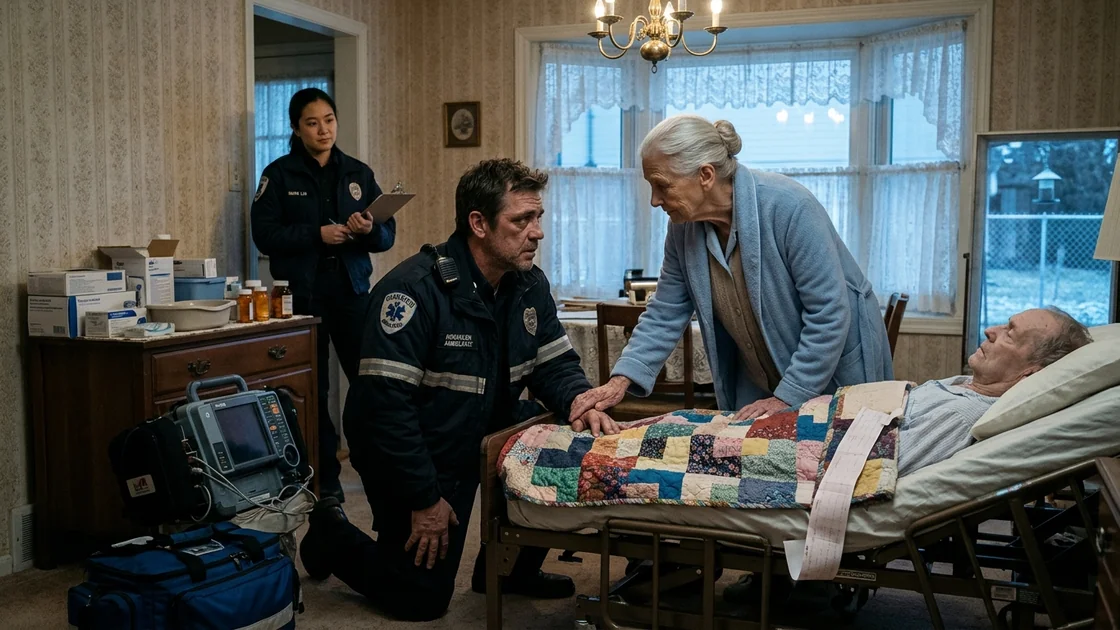
A woman who looked to be eighty years old stood in the threshold. She was tiny, barely five feet tall, wearing a clean blue housecoat buttoned up to her chin over wool slippers, her silver hair pinned into a neat bun at the nape of her neck. The house behind her was warm and smelled of lemon polish, toasted bread, and the faint, sweetish-medicinal odor of liquid morphine and old age.
"Come in, boys—and young lady," the old woman said softly, stepping back on the plastic runner that protected the beige hallway carpet. "Watch your step on the threshold, the weather-stripping is a little loose. My name is Evelyn."
"Good morning, ma'am," Maya said gently. "I'm Maya, and this is Arthur. We're very sorry for your loss."
"Oh, thank you, dear," Evelyn said. She didn't look hysterical; her face had the calm, hollowed-out exhaustion of someone who had been saying goodbye for two years an inch at a time. "The hospice nurse, Cheryl, she's on her way from across town, but the sheriff's office said you folks had to come out first with the machine because she got stuck behind that big wreck on the highway."
"Yes, ma'am," Arthur said. "Where is he?"
"In the dining room," Evelyn said, leading them down the short hall. "We moved his bed down here in November so he could look out the bay window at the bird feeder. He loved the cardinals when it snowed."
The dining room table had been pushed against the wall and covered with folded sheets, boxes of adult briefs, plastic basins, and amber medication bottles arranged by height. In the center of the room under the brass chandelier sat a motorized hospital bed, cranked slightly up at the head.
An old man lay on his back beneath a handmade patchwork quilt pulled neatly up to his armpits. He was paper-thin, his cheekbones standing out like polished ivory beneath translucent skin spotted with liver marks, his white hair brushed carefully across his scalp. His hands were folded over the quilt on his stomach, the fingers long and knotted with arthritis.
He was unmistakably dead. His mouth was slightly open, the jaw already set in early rigor, and the pale skin of his earlobes had the waxy, yellowish stillness of tallow.
"When did you notice he had stopped breathing, Mrs. Vance?" Arthur asked, setting the LifePak down on the edge of the dining room carpet.
"About five-thirty," Evelyn said, standing at the foot of the bed with her hands clasped over the rail. "His breathing changed around three—got real loud and slow, with long spaces in between, just like Cheryl told me it would. I sat here and held his hand until he just let out a little sigh and didn't take another one. Then I washed his face and put his clean pajamas on him before I called."
She looked at her husband's face with a quiet, fierce pride. "Sixty-one years in June. Never went to sleep angry once, even when he bought that terrible Studebaker in 1964 without asking me."
Arthur knelt beside the bed, unbuttoned the top two buttons of the fresh blue flannel pajamas Evelyn had struggled to put on her husband's stiffening arms, and placed three electrodes on the old man's cool, hollow chest. He turned the monitor on, waited for the flat green line to march across the screen for six seconds, and hit the print button.
The thermal printer whirred, spitting out a six-inch curling ribbon of pink grid paper with a black line down the center. Arthur tore it off against the serrated plastic edge.
As he reached down to peel the sticky foam electrodes off the old man's chest, Evelyn reached out and touched the back of Arthur's bare hand.
Her fingers were warm, dry, and soft like crumpled tissue paper.
Arthur froze on one knee. Nobody touched him on scenes anymore—not unless they were swinging at him or grabbing his sleeve in panic.
"You look so tired, son," Evelyn whispered, looking not at her dead husband on the bed, but straight into Arthur's grey, bloodshot eyes. "Have you been out in this cold all night?"
Arthur looked at the old woman's hand resting on his knuckles, right over the dry, cracked skin where the purple sani-wipes had eaten away his cuticles. Then he looked over at the old man's hands, folded on the quilt, and back to Evelyn's face.
"Yes, ma'am," Arthur said.
"My Walter worked the night turn at the stamping plant for thirty-eight years," she said softly, patting his hand twice before letting go. "Used to come home with his eyes looking just like yours—like he'd left part of himself back in the machinery. There's a fresh pot of coffee on the counter in the kitchen, and I made cinnamon toast at four o'clock because I needed something to do with my hands. Please take a piece on your way out."
Arthur stood up. He didn't take the electrodes off right away. For three seconds, he just stood beside the hospital bed in the warm, lemon-scented dining room, looking through the shear lace curtains of the bay window into the backyard.
Outside, the sun was finally clearing the roofs of the houses across the alley, turning the frost on the chain-link fence into a million tiny diamonds. On the wooden platform of the bird feeder hanging from the clothes-pole, a single bright red cardinal was sitting in the snow, cracking a black sunflower seed in its beak.
A strange, sharp sensation pricked at the back of Arthur's throat, right behind his soft palate, like he had breathed in a lungful of cold river air too fast. Below his breastbone, down in the dark, swept cellar where nothing had lived for three years, something shifted—a tiny, hairline crack opening up in the dry concrete, letting a single drop of cold, painful water seep through from the earth below.
It hurt. It felt like a splinter being worked out from under a fingernail, or circulation returning to a frostbitten foot—a hot,pins-and-needles ache that made his breath catch half an inch down his windpipe.
Suddenly, looking at the red bird in the snow, he saw the dinosaur socks on the seven-year-old boy's bruised ankles. He saw the crumb of yellow cake in Dolores Ramirez's grey hair. He saw the girl on Mercer Street tearing a paper napkin into snow between her bare feet, and he saw Sarah sitting across the kitchen island from him two Octobers ago, begging him to throw a plate against the wall.
Arthur blinked once, hard, and a single, hot tear spilled out of his right eye, running fast down the deep crease beside his mouth before soaking into the collar of his uniform shirt.
Maya, who had been filling out the top of the coroner's form against her clipboard by the doorway, stopped writing. She looked up at him, her pen poised an inch above the paper, her mouth parting slightly in astonishment as Arthur quickly wiped the back of his wrist across his jaw and bent down to unclip the monitor leads.
They didn't talk on the drive back to Station 4. The sun was fully up now, blinding off the salted slush of Fourth Avenue, and the city was waking up—school buses idling at corners with their yellow lights flashing, people in heavy coats waiting at the bus stops with travel mugs in their mittens, the world grinding right along over the places where people had bled and died four hours earlier.
When Arthur backed Medic Four into the bay, the day-shift crew—Jennings and Ortiz—were already standing by the workbench with their gear bags, laughing about something on Ortiz's phone.
"Rough night on the bridge, we heard," Jennings said as Arthur climbed down from the cab, his knees popping in the cold air of the bay. "Rig needs fuel?"
"Three-quarters of a tank," Arthur said. "Used the pediatric immobilization gear and two doses of fentanyl on the last trauma. Everything's restocked except the second IO needle in the primary bag; Central Supply was out when we cleared University."
"Got it, Artie. Go home and get some sleep."
Arthur walked into the crew quarters to get his thermos and his truck keys off the table. Maya was standing by the watch desk outside Captain Henderson's office. In her right hand, she was holding a single sheet of white paper—the standard department request-for-transfer form, already filled out in her neat, block handwriting.
Through the glass window of the office, Captain Henderson was sitting at his desk, sipping from a mug and reading the night shift's run totals on his computer screen.
Arthur stopped beside the laminate table. He picked up his thermos, tucked it under his arm, and looked at Maya.
"I'm going to call that number on the blue pamphlet this afternoon," Arthur said. His voice was still like gravel being turned with a shovel, low and worn down at the edges, but it didn't sound like a radio broadcast anymore. "And I'm taking two weeks of my vacation time starting Friday."
Maya looked from the closed door of Henderson's office to Arthur's face. Under the harsh fluorescent light of the hallway, she looked at the red rims around his grey eyes, and at the dry, faint track on his cheek where the salt had dried.
Slowly, she lowered her hand, folding the white sheet of paper in half, then in quarters, and shoved it deep into the side pocket of her cargo trousers.
"We're back on Thursday night at seven," Maya said quietly. "If you're still on the schedule before your vacation starts, it's your turn to buy coffee."
"Okay," Arthur said. "I'll bring the good stuff."
He walked out the back door of the station into the bright, freezing morning. Before he opened the door of his truck, he stood in the parking lot for a full minute, took his gloves off, and pressed his bare palms against the cold steel of the truck bed until the metal burned his skin and he knew, without looking at his watch, that his heart was beating.