The Pink Solution
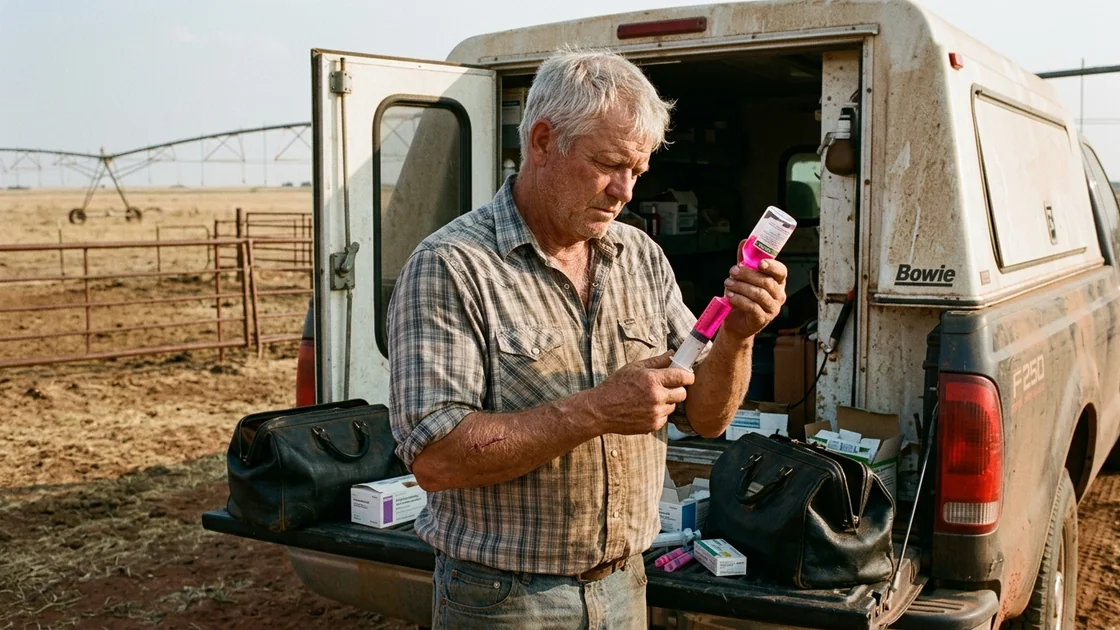
This is the story of Dr. Arthur Pendelton, a sixty-two-year-old large-animal veterinarian working in the parched, economically devastated expanse of Oakhaven County. As an unprecedented drought enters its third year and inflation drives the cost of hay and grain to impossible heights, the local farming community collapses in slow motion. Arthur’s daily rounds shift from delivering calves and treating colic to a grim, repetitive ritual of euthanizing completely healthy livestock—horses, dairy cattle, and prize breeding stock—simply because their desperate owners can no longer afford to feed them and the livestock auctions have crashed to zero. Through a grueling week in late August, Arthur travels from farm to farm with his black leather bag of pentobarbital, navigating the crushing grief of proud rural families, the haunting stillness of empty pastures, and the quiet disintegration of his own spirit as the healer of the valley becomes its reluctant executioner.
The alarm clock on Arthur’s nightstand did not ring so much as it buzzed with the tired, rattling vibration of an insect dying on a windowsill. It was four-thirty in the morning. Outside the bedroom window of the farmhouse, the darkness was absolute, thick with the smell of pulverized clay and dead weeds. Even before he opened his eyes, Arthur could feel the heat. It did not dissipate at night anymore; it merely settled into the floorboards and waited for the sun to return and stoke it back into a fury.
He swung his legs over the side of the mattress, his knees popping in the quiet room. At sixty-two, his body was a topographical map of his profession: a crooked left collarbone from a breach birth with a panicked Charolais heifer twenty years ago; a thick, white scar across his right forearm where a rusted barbed-wire fence had caught him during a midnight horse rescue; knuckles swollen and calcified from forty years of gripping obstetrical chains, syringes, and steering wheels.
Downstairs, the kitchen linoleum was gritty beneath his bare feet. No matter how often he swept, or how tightly he sealed the warped wooden frames of the windows, the Oakhaven dust found its way inside. It was the topsoil of three neighboring counties, baked to powder by thirty months without a soaking rain and blown across the flatlands in choking brown squalls.
Arthur started the coffee maker, the water gurgling through the heating element with a sound that reminded him uncomfortably of a congested lung. While it brewed, he walked out onto the back porch.
His own five acres stretched out into the gloom, though there was nothing left on them to see. After his wife, Clara, had died of ovarian cancer four years back, he had sold off their three quarter horses. At the time, it had felt like a betrayal of her memory. Now, looking at the gray, brittle stubble where chest-high timothy grass used to wave in the morning breeze, he knew it had been a mercy. He couldn't have fed them either.
Back inside, he poured the black coffee into a heavy ceramic mug and sat at the oak table. Spread across the scarred wood were the ledgers. He didn't need to open them to know what they said. Accounts Receivable was a graveyard of good intentions. Four hundred dollars from the Miller dairy from back in May; two hundred and fifty from old man Gable for sewing up his herding dog; six hundred from the Henderson boys for herd vaccinations they’d insisted on doing in the spring when everyone still believed the June rains would come.
The June rains hadn't come. Neither had the July storms. Now it was the third week of August, the corn had withered at knee-height before the tassels could even form, and the price of a large round bale of alfalfa—hauled in on flatbeds from three states away—had crossed two hundred and eighty dollars.
You couldn't feed a two-hundred- and-eighty-dollar bale to a cow worth three hundred dollars on the hoof. It was simple, brutal arithmetic. And in Oakhaven County, the math was killing everything.
Arthur drank his coffee, washed the mug in the brackish, iron-smelling water from his failing well, and walked down the narrow hallway to his clinic office. The room smelled of chlorhexidine, rubbing alcohol, and old paper. He unlocked the heavy steel narcotics safe bolted to the floor in the corner.
Inside, lined up like soldiers in rows, were the clear glass multi-dose vials of Euthasol. Sodium pentobarbital and phenytoin sodium. The label was clinical, sterile, and precise, yet the liquid inside was dyed a bright, almost cheerful fluorescent pink, meant to ensure no practitioner ever mistook it for a vaccine or an antibiotic in a poorly lit barn.
In his first thirty-eight years of practice, Arthur might have gone through a dozen vials a year. An ancient mare whose teeth had worn down to the gums; a bull with a shattered stifle joint; a farm dog riddled with hemangiosarcoma. Hard days, certainly, but natural ones. He was ending suffering. He was the merciful hand at the end of a long road.
In the last sixty days, he had ordered three cases.
He took four new hundred-milliliter vials from the safe and placed them into the padded compartments of his heavy black leather grip. The glass clinked together, a high, clear chime that made his stomach tighten into a hard knot. He grabbed a box of fourteen-gauge needles, a sleeve of sixty-cc syringes, and his stethoscope—though he knew, with a sickness that lived permanently behind his ribs now, that the stethoscope would only be used to confirm that the pink solution had done its work.
His truck was a 2012 Ford F-250 with three hundred and ten thousand miles on the odometer and a fiberglass veterinary Bowie unit mounted in the bed. As he turned the key, the diesel engine roared to life, rattling the loose tools in the side compartments. The dashboard glowed green in the cab. He pulled his daybook toward the steering wheel and angled it toward the map light.
Four names were written in his neat, cramped handwriting for Tuesday.
7:00 AM – Roy & Martha Vance. (2 horses) 10:30 AM – Caleb Miller. (Cull heifers – 6) 1:30 PM – Sarah Jenkins. (Goats) 4:00 PM – Thomas Halloway. (1 horse)
Not a single sick animal on the page. Not a single fever, not an infection, not a twisted gut or a laceration. Just mouths that needed chewing in a county that had nothing left to swallow.
Arthur put the truck in gear and rolled down the long gravel driveway. His headlights cut through the suspended dust, turning the air in front of the bumper into a glowing yellow tunnel.
The highway into the south valley was deserted. On either side of the cracked asphalt, the fence lines were drifted with dead Russian thistles and windblown soil, looking like snowbanks from a dirty winter. In the pre-dawn gray, the silhouettes of pivot irrigation systems stood frozen in the fields like the skeletons of prehistoric birds. Two months ago, the state water authority had cut off agricultural pumping rights from the aquifer; the water table had dropped forty feet since the previous autumn, and residential wells were beginning to suck air.
Roy Vance’s place was twelve miles out, tucked into a shallow draw where a creek called Indian Run used to flow. Now, as Arthur rattled across the wooden bridge at the entrance to the property, he looked down into a trench of cracked, curling mud plates and sun-bleached limestone rocks.
The porch light of the little white frame house was on. Roy was already standing by the corral gate, his hands shoved deep into the pockets of his faded overalls. He was seventy-four years old, a man who had spent fifty of those years working a sixty-acre patch of bottomland and raising registered Quarter Horses with cow-sense that buyers used to drive up from Texas to bid on.
Arthur parked the truck twenty yards back from the corral—a habit he’d learned early on, so the sound of the engine wouldn't spook the animals—and stepped out. The morning sun was just cresting the eastern ridge, a fiery, copper-colored disk glaring through the haze. It was already eighty-two degrees.
"Morning, Arthur," Roy said. His voice sounded like two dry corn husks rubbing together.
"Morning, Roy. How’s Martha?"
Roy looked back toward the house. The lace curtain in the kitchen window twitched and fell still. "Stayed inside. She said her blood pressure couldn't take it. She made you some zucchini bread, though. It’s on the porch rail in foil. From the little patch she’s been watering with the dishwater."
"Tell her thank you," Arthur said softly. He leaned his forearms on the top rail of the corral fence, beside the older man.
Inside the dry lot stood two geldings. One was a deep blood-bay with a wide white blaze; the other was a sorrel with three white stockings. They were twelve and fourteen years old—prime of life for a well-kept horse. Their coats were dusty, and their ribs were just beginning to show a faint, washboard shadow beneath the skin, though their hooves were neatly trimmed and their manes were braided free of burrs. When they saw Arthur, the bay pricked his ears forward and walked over, extending his velvety nose to sniff at the vet’s shirtsleeve, looking for a peppermint.
Arthur reached into his breast pocket, pulled out a cellophaned starlight mint, unwrapped it with trembling fingers, and let the bay lip it from his palm. The horse crunched it loudly, happily, his large, liquid brown eyes calm and trusting.
"Tried every sale barn between here and Omaha," Roy said, staring straight ahead at the sorrel. He wasn't offering an excuse; he was giving testimony. "Took 'em up to the Tri-State auction two weeks ago. The auctioneer wouldn't even start the bidding at fifty dollars. Said the kill-buyers' trucks were already full to capacity and the Mexican slaughterhouses had a three-week backlog. A guy in the parking lot offered to take 'em off my hands for free, said he had pasture up north." Roy swallowed hard, his Adam's apple bobbing in his withered throat. "I ran his plates through my nephew at the sheriff's office. Guy’s a middleman who dumps 'em in desert holding pens until the rendering plants open up a slot. Half of 'em die of thirst in the trailers on the way down."
"You did the right thing bringing them home, Roy," Arthur said.
"Did I?" Roy turned his head. His eyes were red-rimmed, sunken in caves of weathered skin. "I got four bales of grass hay left in the loft, Arthur. Four. And the social security check don't clear until the third, and even when it does, the propane company says they won't fill the tank this winter unless we pay down the four hundred we owe from last January. If I let these boys go another two weeks, they’ll be eating the bark off the fence posts. Red there—he was out of Martha’s old mare. I caught him when he was born. Dried his ears with my own shirt."
"They won't know a thing, Roy," Arthur said, the words tasting like lead in his mouth because he had said them four times yesterday, and six times the day before that. "They’ll just feel a little dizzy, lie down, and go to sleep. Here at home. With you."
Roy nodded once, a sharp, spasmodic jerk of his chin. "I dug the hole yesterday evening. Took the tractor down behind the windbreak where the ground was a little softer under the cottonwoods. Broke two teeth off the backhoe bucket on the hardpan, hydraulics were screaming the whole time, smoking like a chimney, but I got it down six feet."
"Let's walk them down there first," Arthur said, turning back to his truck to get his bag. "Saves you having to drag them with the chains. It's easier on you, and it's quieter."
They haltered the horses. Roy took the bay, Red, and Arthur led the sorrel, whose name was Banjo. The walk down to the dry windbreak took five minutes. The ground was so parched that giant cracks, wide enough to catch a horse’s hoof if you weren't careful, snaked through the dead buffalo grass. Grasshoppers—millions of them, thriving in the heat—exploded up from their boots with dry, clicking wings, pelting against Arthur’s shins like pebbles.
Beneath the dying cottonwoods,whose yellow leaves were dropping two months early, sat Roy’s ancient Massey Ferguson tractor. Beside it yawned a rectangular pit in the red clay, twelve feet long and eight feet wide. The mound of excavated dirt looked like broken bricks.
Arthur set his black bag down behind the tractor tire, out of the horses' line of sight. He worked quickly, his hands moving on muscle memory. He drew up sixty cubic centimeters of the bright pink liquid into one huge syringe, then sixty into another. He capped them and slipped them into the back pockets of his jeans, along with two small xylazine sedative syringes.
"You want to hold him, Roy, or you want to step back by the trees?" Arthur asked.
"I'll hold him," Roy whispered. "I ain't gonna leave him with a stranger at the end. No offense, Doc."
"None taken. We'll do them right together, one right after the other, so the second one doesn't have time to get anxious."
Arthur walked up to the bay first. He stroked the muscular neck, finding the jugular groove with his thumb. He pressed the vein at the base of the neck; it swelled immediately, healthy and strong, a thick cord beneath the warm hide. He slipped the small needle in and pushed the sedative.
Within two minutes, Red’s head began to droop. His lower lip went slack, trembling slightly, and his eyes grew heavy and glazed. Arthur did the same to Banjo. The two horses stood side by side at the edge of the pit, swaying gently in the hot morning breeze, leaning against each other for balance like two old friends at the end of a long ride.
"All right, Roy," Arthur said quietly. "Just keep the lead rope loose. When his knees buckle, guide his head back away from the edge so he lies down flat on the grass here. You can roll them in with the loader bucket after I'm gone."
Arthur uncapped the fourteen-gauge needle on the large syringe, slid it into the bay's jugular, drew back a plume of dark red blood to ensure placement, and depressed the plunger with the heel of his hand. It took ten seconds to push the thick fluid into the bloodstream.
Before the bay even began to sag, Arthur was on the other side of the sorrel, repeating the motion. Push. Draw. Plunge.
Red sighed—a long, shuddering exhalation that blew a little cloud of red dust off the ground—and folded his front legs. He went down onto his sternum first, then rolled heavily onto his side. Three seconds later, Banjo’s hindquarters gave way, and he collapsed beside his pasture-mate, his head coming to rest across Red’s hip.
Their flanks heaved once. Twice. Their legs stretched out stiffly in the final, involuntary reflex of the brainstem losing oxygen, hooves scraping a brief half-circle in the dirt. Then, stillness.
Roy was on his knees between their heads, one hand resting on Red’s cheek, the other gripping Banjo’s forelock. His shoulders were shaking, though he made no sound at all. Men of Roy’s generation didn't cry out loud in front of other men; they just let the grief tear them up from the inside like swallowed glass.
Arthur knelt in the dirt, placed the bell of his stethoscope behind the bay’s left elbow, and listened. Nothing. Just the rustle of dry cottonwood leaves overhead and the ticking of the tractor's cooling manifold. He moved to the sorrel. Nothing.
He stood up, his knees aching, and wiped the sweat from his forehead with his sleeve.
When they walked back up to the yard, Roy reached into his pocket and pulled out a worn leather billfold. He extracted two fifty-dollar bills, folded sharply down the middle.
"Roy, put that away," Arthur said, holding up a hand. "I'm not charging you for this."
"The hell you aren't," Roy said fiercely, shoving the money into the pocket of Arthur's work shirt. "That medicine costs you money. The diesel in that truck costs you money. I'm already putting my animals in the dirt because I'm a failure, Arthur. Don't make me a charity case on top of it. Take the hundred. It's what I got."
Arthur didn't argue. He knew that taking a man's last shred of pride was worse than taking his last hundred dollars. He walked over to the porch, picked up the warm loaf of zucchini bread wrapped in tin foil, and set it carefully on the passenger seat before driving away. In his rearview mirror, he saw the black exhaust smoke rise from the cottonwood grove as Roy started the tractor back up.
Between the Vance place and Caleb Miller’s dairy, the road climbed onto the high flats. Here, the devastation of the county was laid out in panoramic clarity.
Oakhaven had never been rich land, not like the black dirt counties over in Iowa or Illinois, but it had been steady land. Mixed farming—a hundred head of cattle, a few hundred acres of dryland winter wheat and sorghum, maybe a farrow-to-finish hog barn to tide a family through when beef prices dipped. Now, every third mailbox had a realtor’s sign hanging crookedly beneath it, the paint faded by the sun because nobody was buying.
Arthur passed the old Granger homestead. The bank had foreclosed on it in April, auctioned the machinery in May, and boarded up the house in June. The barn roof was already losing shingles to the south wind, and the yard was chest-high in fireweed.
His cell phone buzzed on the console. The screen read Tri-County Vet Supply. He let it go to voicemail. He knew it was Brenda in billing, calling gently to remind him that his sixty-day balance was four thousand dollars past due and they wouldn't be able to ship his autumn cattle vaccines on credit. He didn't have the heart to tell her that nobody in Oakhaven was going to be buying autumn vaccines anyway, because by October there wouldn't be enough cattle left in the county to justify firing up the refrigeration units at his clinic.
He turned into the Miller lane at ten-fifteen.
The Miller family had been milking Holsteins on this section since 1938. Caleb was forty, the fourth generation, with three kids under the age of twelve and a wife who drove forty miles each way into the city to work as a medical coding clerk just to keep health insurance on the family.
When Arthur pulled up to the freestyle barn, the silence was the first thing that struck him. A dairy farm is supposed to be a noisy place—the rhythmic chug-hiss of the vacuum pumps in the parlor, the clanking of stanchions, the constant lowing of cows waiting to be milked, the hum of the bulk tank compressors. Today, the parlor doors were slid shut and padlocked.
Caleb came out of the calf barn, carrying a pitchfork that he wasn't using for anything other than a walking stick. He looked fifty-five. He had lost thirty pounds since the spring, his belt cinched so tight around his jeans that the denim bunched at his waist, and dark purple hollows sat beneath his eyes.
"Hey, Doc," Caleb said, leaning on the fork handle.
"Caleb. Your dad around?"
"No. I sent him and Mom into town to take the kids school shopping. Didn't want the boys out here today, and Dad..." Caleb looked away toward the empty trench silos. "Dad had a mini-stroke two weeks ago when the milk co-op dropped our contract. Doctor said any more stress and the next one'll kill him. He thinks a buyer from Kansas is coming with a livestock pot to pick these heifers up this morning."
"The co-op dropped you?" Arthur asked, though he’d heard the rumors at the feed store.
"Dropped everybody south of the river," Caleb said flatly. "Said with fuel at five bucks a gallon, it wasn't cost-effective to run the stainless tanker trucks down here for four small herds anymore. Offered to buy out our base quota for pennies on the dollar. I dispersed the main milking herd last Tuesday through the online video auction. Got eight hundred a head for cows that cost me two thousand to raise. After the bank took their cut for the operating loan, I cleared enough to pay the electric bill through July."
"Then what are these six?" Arthur asked, walking with Caleb toward the holding pen behind the barn.
"Spring replacement heifers," Caleb said. "Eighteen months old. Bred to calve in November. When the auction truck came for the milk cows, the driver counted heads and said he was at his legal axle weight limit on the highway. Said he'd come back Thursday for the last six. Then the buyer called Friday and said don't bother, the market dropped another twelve cents a pound and it wasn't worth the freight to send a truck back down here for six head. Told me to keep 'em and refunded that part of the check."
They reached the gate. Inside the pen stood six black-and-white Holstein heifers. They were magnificent animals, deep-bodied, straight-backed, with glossy coats and bright, curious eyes. They had the ear tags of decades of careful genetic selection—daughters and granddaughters of cows Arthur himself had helped deliver in snowstorms and heatwaves over the last thirty years.
"Why not take them to the local sale barn for beef?" Arthur asked, though he already knew the answer. He just felt professionally obligated to ask it every single time, as if one day someone would say, Oh, I didn't think of that, and he could put his black bag back in the truck.
"Local barn closed its doors on the first of the month, Doc. Didn't you hear? Old man Peters couldn't pay the bond insurance after three buyers bounced checks in July. Nearest open ring is a hundred and ten miles away in Dodge. My gooseneck trailer has two dry-rotted tires and a cracked axle, and even if I paid somebody three hundred bucks to haul 'em up there, open dairy heifers are bringing thirty cents a pound right now because nobody has silage to winter them. By the time I paid the yardage fee, the commission, and the haul bill, I'd owe the sale barn money."
Caleb pointed toward the concrete bunker silo. It was swept clean, down to the bare gray cement. Not a scrap of chopped corn remained.
"I been feeding them weeds I mowed out of the road ditches since Sunday," Caleb said, his voice cracking for the first time. "Thistles and kochia weed. And yesterday the county road crew came through and sprayed the ditches with herbicide, so I can't even cut that anymore. A guy down at the tavern told me just to take the .30-06 out here and shoot 'em and save the vet bill."
Arthur looked at him sharply. "Why didn't you?"
Caleb looked down at his boots. "Because I raised these girls from bottles, Doc. Number 412 there—my little girl named her Daisy. Used to sit in the hutch with her and read her schoolbooks out loud. I tried yesterday afternoon. Walked out here with the rifle. Stood right where you're standing, put the crosshairs between 412's eyes, and she walked right up to the fence and licked the barrel of the gun because she thought I had grain in a bucket." Caleb wiped his nose roughly with the back of his wrist. "I threw up in the dirt and came inside and called you. I can't shoot them. I can't listen to the gunshot echo off the barn six times in a row. It feels like murdering my family."
"Okay, Caleb," Arthur said gently. He placed a hand on the younger man's trembling shoulder. "Okay. Go on up to the house. Go sit in the kitchen and turn the radio on loud. Have a cup of coffee. Let me handle this."
"You can't move six eight-hundred-pound heifers by yourself, Doc."
"We'll run them into the headlocks along the feed bunk," Arthur said, looking at the row of steel self-locking stanchions that ran along the outside of the pen. "Put a coffee can of whatever dusty grain sweepings you've got left in the bottom of the trough so they stick their heads through and lock themselves in. Once they're caught, you walk away. You can come back out with the skid-steer in an hour."
It took them ten minutes to sweep up two buckets of old, mouse-chewed calf starter from the corners of the empty grain bin. When Caleb dumped the dusty pellets into the concrete trough, the six heifers trotted over eagerly, thrusting their heads through the steel bars. Clack. Clack-clack. Clack. The metal latches fell into place, securing them by the neck in a neat, uniform row.
"Go on, Caleb," Arthur said, already opening his bag on the hood of a broken-down John Deere Gator nearby. "Go inside."
Caleb didn't argue this time. He practically ran toward the house, his boots kicking up little puffs of dust, the screen door slamming shut behind him like a gunshot.
Arthur was alone with the cattle.
The wind picked up, whistling mournfully through the high aluminum rafters of the empty loafing shed. A loose sheet of tin banged rhythmically against a purlin: thwack... thwack... thwack.
Arthur drew up the syringes. Cattle had thicker skin than horses; he had to use heavy sixteen-gauge, inch-and-a-half needles. Because they were locked in the stanchions, he didn't need to sedate them first, though he hated doing it to them while they were wide awake.
He walked behind the first heifer—Ear Tag 408. She was still licking the dry concrete of the trough, trying to get the last crumbs of grain powder. Arthur reached over the top rail, grabbed her nose with his left hand, and pulled her head sharply to the side against the steel pipe to expose the right jugular groove. She bawled once in annoyance, pulling back against the lock, her hooves clattering on the concrete apron.
"Easy, girl. Easy now," Arthur murmured.
He punched the needle through the tough black-and-white hide. The dark venous blood flashed into the hub. He attached the sixty-cc syringe and pushed. He had to use both thumbs, bracing the barrel against his palm, the muscles in his forearms burning with the effort.
He pulled the needle out and immediately stepped to the next cow. Tag 409. Grab the nose, pull the head, block the vein, stab, push.
Behind him, 408 suddenly went limp. Because her head was locked in the steel stanchion, she didn't fall cleanly to the side; her hindquarters dropped straight down while her neck remained suspended in the V-shaped bars for a terrible second before Arthur reached back and kicked the release lever at the top of the frame. The bar swung open, and the eight-hundred-pound animal slid backward onto the concrete with a heavy, wet thud.
Tag 410 saw her herd-mate go down and panicked. Her eyes rolled back until the whites showed, and she began to thrash violently in the lock, her steel collar banging like a bell, frothy saliva flying from her muzzle.
"Whoa, girl, whoa!" Arthur grunted, pressed between 410 and 412 as the remaining four heifers caught the scent of fear and began to lunge against the stanchions in unison. Eight hundred pounds times four was over three thousand pounds of terrified muscle slamming against the steel pipe work.
Arthur got caught against the divider rail as 410 swung her hip sideways, pinning his bad knee against the iron post. A white-hot bolt of pain shot up his thigh into his groin, nearly blinding him. He gritted his teeth, tasting blood where he bit the inside of his cheek, and jammed the needle into 410's neck purely by feel as she reared against the lock. He got the plunger down halfway before she jerked again, bending the heavy steel needle at a forty-five-degree angle inside her flesh.
Cursing under his breath, breathless and slick with sweat that turned the dust on his face to mud, he braced his chest against her shoulder and forced the rest of the pink fluid in.
By the time he reached the last heifer—412, Daisy, the little girl's pet—his hands were shaking so badly he dropped the syringe on the concrete. Fortunately, it was plastic and didn't shatter, though the needle tip blunted against the stone. He didn't have time to walk back to the Gator for a fresh needle. He had to use extra force to drive the burred tip through Daisy’s hide. She didn't even fight him; she just stood there trembling, her big black eyes fixed on his face as the five heifers beside her lay motionless in a tangled row on the manure-stained concrete.
When he released the last catch and 412 slumped down beside the others, Arthur leaned his back against the feed bunk and slid down until he was sitting in the dirt, his legs stretched out in front of him, less than a foot from the nose of the dead heifer.
His heart was hammering against his ribs at an irregular, fluttering pace. He pulled his bottle of nitroglycerin pills from his shirt pocket—prescribed by his own doctor in the spring—and stared at the little brown glass cylinder. He didn't take one. If he took one, he'd get a splitting headache for the rest of the afternoon, and he still had two more farms to go.
He sat there for fifteen minutes, listening to the tin roof bang in the wind and watching the blowflies already beginning to land on the open, staring eyes of the six dead heifers.
There would be no calves in November. There would be no milk in the tank in December. Forty years of breeding, of midnight calf-pulls in sub-zero January blizzards, of record-keeping and pasture rotation, all ended in ten minutes with three hundred milliliters of dyed barbiturate.
Arthur dragged himself to his feet, using the steel bars to pull himself up. He threw the empty vials and bent needles into the yellow biohazard sharps container in the back of his truck. He didn't knock on the farmhouse door. He just left an invoice on the kitchen porch table with NO CHARGE - HERD HEALTH CONSULT scribbled across the bottom, got into his truck, and drove away before Caleb had to come out and look him in the eye.
At noon, Arthur stopped at the Crossroads Diner at the junction of Highway 9 and County Road B. In better years, there would have been fifteen pickups parked out front at twelve o'clock, along with two or three massive green tractors idling at the edge of the gravel lot while hired hands ran in for the meatloaf special.
Today, there was only Arthur’s Ford and the rusted sedan belonging tolene, the waitress and owner.
The little brass bell over the door jangled as he walked in. The air conditioning wasn't running—only the ceiling fans, which stirred the warm air smelling of old fry oil and bleach. Jolene was sitting at the counter doing a crossword puzzle in yesterday’s newspaper.
"Well, look what the wind blew in," Jolene said, folding the paper and standing up. She was sixty, her hair dyed a defiant shade of box-red, though the roots were an inch of silver. "Sit anywhere, Artie. Though I ain't turning the grill on for just one hamburger, so you're getting chicken salad or roast beef cold cuts."
"Roast beef is fine, Jolene. And a big glass of iced tea. Unsweetened."
Arthur slid into a vinyl booth by the window, wincing as his bruised knee bumped the table pedestal. Within two minutes, Jolene set a giant red plastic tumbler of tea in front of him. He drank half of it in a single swallow, the ice cubes clicking against his teeth.
"You look like hell warmed over, Artie," she said, pulling her order pad out of her apron purely out of habit, since she didn't write anything down. "You out at the Miller place this morning?"
News traveled through Oakhaven faster than the wind. Probably the rural mail carrier had seen his white Bowie unit parked by the dairy barn.
"Yeah," Arthur said, staring out the window at the grain elevator across the highway. The towering concrete silos stood silent; the scales were closed. "Just checking on some heifers for Caleb."
Jolene wasn't fooled. Nobody in the county was fooled anymore. She sighed and slid into the opposite side of the booth, resting her elbows on the scarred Formica.
"Caleb’s wife was in here Saturday buying day-old bread," Jolene said quietly. "Said they're moving into her sister's basement in Wichita next month once school starts. Letting the bank take the land."
"That farm's been in the Miller name for nearly ninety years," Arthur said.
"Ninety years don't make it rain, Artie." She looked out the window too. "I'm closing up at the end of September. Sysco raised the minimum delivery order to a thousand dollars for the food truck, and I don't take in a thousand dollars in two weeks anymore. Half the folks who do come in just sit here for three hours drinking a dollar-fifty cup of coffee because their own wells are dry or they don't want to sit home alone looking at dead dirt."
"Where will you go?"
"My daughter’s in Phoenix. Says it's a hundred and fifteen degrees there, too, but at least they got swimming pools and grocery stores that aren't boarding up." She looked back at him, her eyes narrowing with sudden maternal sharpness. "What about you? How long are you going to keep driving up and down these roads with that black bag of yours?"
Arthur traced the rim of his plastic glass with a calloused finger. "Somebody has to be here, Jolene. If I pack up and leave, the nearest large-animal vet is young Dr. Miller up in Red Oak, and he won't drive down here unless people pay a hundred-dollar trip fee up front on a credit card."
"Artie, you aren't doctoring anymore," Jolene said, her voice dropping so low it was barely audible over the squeak of the ceiling fan. "Everybody knows what you're doing. You're the undertaker. And it’s eating you alive. You lost twenty pounds since Easter, and your shirt has blood on the cuff right now."
Arthur looked down at his right wrist. There was a quarter-sized smear of dried dark blood from Tag 410 where the bent needle had backed out. He hadn't even noticed it. He pulled his sleeve down to cover it.
"If I don't do it, Jolene, what happens?" he asked, looking up at her. "You know what happens. We saw it back in the eighties during the farm crisis, and this is ten times worse. Guys who can't bear to shoot their own stock just open the pasture gates at midnight and turn them loose on the state highway, hoping a semi-truck hits them so they can collect the liability insurance, or hoping the county sheriff impounds them. Or worse, they just stop going out to the barn. They pull the blinds down on the house and let the animals starve to death in the dark because they're too ashamed to ask for help."
He leaned back against the cracked vinyl. "When I put that needle in, it takes ten seconds. Ten seconds, and they don't feel the ribs poking through their skin anymore. They don't stand around an empty water tank licking the rust off the steel until their tongues bleed. If that makes me the undertaker, then I guess that's my job until the last barn is empty."
Jolene reached across the table and patted his rough hand once before standing up. "I'll go make your sandwich. Put some potato chips on the plate, too. You need the salt."
He ate the sandwich without tasting it, the dry bread sticking in his throat until he washed it down with more tea. Before he left, he went into the tiny restroom at the back of the diner. The mirror over the sink was spotted with black age-marks around the edges.
Arthur looked at himself. His hair, which had been salt-and-pepper when Clara died, was entirely white now, cropped short with his own horse clippers once a month to save fifteen dollars at the barber. His eyes looked like Roy Vance's eyes. They had the flat, thousand-yard stare of someone who had looked into too many trenches in the red clay.
He washed the cow blood off his wrist with cold water and pink powdered soap, dried his hands on his jeans, and walked back out into the furnace of the early afternoon.
The thermometer on the truck’s dashboard read one hundred and four degrees by the time he turned off the gravel onto the dirt two-track that led to Sarah Jenkins’s place.
Sarah wasn't generational farm folk like the Vances or the Millers. She and her husband, Mark, had moved out from the suburbs five years ago during the homesteading boom, buying twenty acres of scrubby timber and rocky pasture to raise dairy goats and make artisanal soap and chèvre cheese for the city farmers' markets.
Local farmers had chuckled at them at first—with their brand-new Carhartt overalls and their instructional books—but Arthur had grown fond of them. They worked hard, they paid their bills on time, and they treated their animals like royalty.
Then, fourteen months ago, Mark had been killed when his pickup was T-boned by a grain truck at an unmarked gravel intersection. There had been no life insurance. Sarah had tried to keep the goat operation going by herself while working night shifts at the Dollar General out on the highway, sleeping three hours a day and milking fifteen Nubian does by hand every morning and evening.
When Arthur pulled into the yard, the little cedar-sided house looked abandoned, save for Sarah’s beat-up Honda Civic parked in the shade of an oak tree. The garden fence had fallen down, and the raised beds were choked with dead lamb's-quarters.
Sarah came out of the small metal pole barn before Arthur even got his door open. She was thirty-two, a small woman with a long brown braid down her back, wearing a faded flannel shirt with the sleeves cut off. In her arms, she was carrying a two-month-old Nubian kid with long, pendulous ears and a coat the color of poured caramel.
"Dr. Pendelton," she said, walking up to the truck. She wasn't crying; she had the brittle, hyper-organized composure of a woman who knew that if she stopped moving for five seconds, she would shatter into a million pieces and never get up again. "Thank you for coming on time. I have to be at the store by three-thirty or my manager will write me up."
"How many are we looking at today, Sarah?" Arthur asked gently, stepping down from the cab.
"All of them," she said. "Fourteen does, the buck, and four kids from the late spring kidding."
Arthur stopped with his hand on the latch of the rear Bowie unit. Nineteen animals. "Sarah... surely somebody would take dairy goats. They don't eat a fraction of what cattle or horses eat. Have you tried putting them on the internet? 4-H families? Petting zoos?"
Sarah laughed—a sharp, hollow sound that scared the baby goat in her arms. "I've had them listed as 'Free to a Good Home' on every Facebook group and Craigslist page in three states for six weeks, Dr. Pendelton. Do you know how many people are trying to give away goats, sheep, and chickens right now? Hundreds. The only people who messaged me were three guys who wanted to butcher them in my yard for meat without paying me a dime."
She shifted the kid onto her hip, rubbing its ears as it nuzzled into her neck. "I wouldn't even mind if someone butchered them cleanly to feed their family, if I'm being honest. That's what livestock is for. Mark and I knew that. We ate our extra bucklings. Make stew, can the meat. What I can't do is hand my hand-raised milk does—who know their own names and come when I whistle—over to some stranger who's going to tie their legs together with baling twine, throw them in the trunk of a sedan in hundred-degree heat, and hack their throats open with a dull hunting knife in a garage."
"What about the county animal shelter?" Arthur asked weakly, grasping at straws because nineteen was too many. Nineteen meant nineteen small necks, nineteen bleats of confusion, nineteen little bodies laid out on a barn floor.
"The county shelter stopped taking livestock in May," she said, walking back toward the barn. "And the goat rescue over in Columbia shut down their phone line because people were just throwing goats over their six-foot chain-link fence in the middle of the night and driving away. The lady who runs it ran out of feed money in June."
Arthur followed her into the pole barn. It was stifling inside, smelling strongly of dry pine shavings, ammonia, and the musky scent of the buck in the corner pen.
The goats were thin, though not starving yet. Their hip bones were prominent points under their sleek coats. As soon as Sarah walked in, fourteen long-eared heads popped over the wooden slat gates, and a chorus of eager, high-pitched maaa-aaas filled the building. They thought it was feeding time. They were pressing their noses through the gaps in the boards, their hooves clicking excitedly as they stood on their hind legs.
In the corner by the door sat three fifty-pound paper sacks of pelleted sweet feed. All three were ripped open and flattened completely empty.
"I used my credit card to buy those three bags last week," Sarah said, setting the caramel kid back into a pen with its mother. "Yesterday at the grocery store, my card declined for a gallon of milk and a box of cereal. I'm maxed out. And my well pump burned up on Sunday because it was sucking mud from the bottom of the casing. I've been hauling five-gallon buckets of water in the trunk of my Honda from the spigot behind the Dollar General after my shift ends at midnight. Yesterday my manager caught me on the security camera and said if I take company water again, he'll fire me for theft."
She turned to face Arthur. Her eyes were dry, bright, and terrifyingly calm. "I can't haul forty gallons of water a day in a Honda Civic, Dr. Pendelton. And I have zero dollars and twelve cents in my checking account until Friday. If you don't do this today, they will die of dehydration in this barn by Thursday afternoon while I'm scanning cans of dog food at the cash register."
Arthur felt a cold sweat break out under his arms despite the baking heat of the tin shed. He looked at the goats. A large black-and-white spotted doe reached through the fence and chewed playfully on the corner of his pocket notebook.
"Do you have a place to bury them?" he asked.
"Mark dug a root cellar pit out behind the chicken coop the month before he died," she said. "He never got around to pouring the concrete walls. It's eight feet deep. I laid a plywood ramp down into it this morning. I have a garden cart. I can wheel them out one by one after you leave, roll them in, and push the dirt pile back over the top with the riding mower blade."
She was thirty-two years old, weighing maybe a hundred and ten pounds, and she was planning to haul nineteen dead goats in a wheelbarrow in hundred-and-four-degree heat before clocking in for an eight-hour retail shift.
"I'll help you wheel them out," Arthur said. "You won't get it done before three-thirty by yourself."
"You don't have to do that."
"I'm doing it, Sarah. Now, do you want to stay in here, or do you want to wait on the porch?"
"I'm staying," she said, picking up an empty plastic grain scoop from the floor. "If I sit on the floor in the pen with the scoop in my lap, they'll all crowd around me and put their heads in my lap. You can just do them one by one while I hold them. They won't even be scared if they think I'm hiding raisins in the scoop."
Arthur had to turn around and walk back out to his truck so she wouldn't see his face crumple.
He stood behind the raised fiberglass door of the Bowie unit for two full minutes, gripping the metal strut with both hands, his forehead pressed against his knuckles. God in heaven, he thought, though he hadn't been inside the Methodist church since Clara’s funeral. If You're up there, look down at this valley. Look at what You're doing to these people.
The sky above the oak trees gave no answer. It was the color of bleached bone, cloudless, vast, and completely indifferent.
He opened his bag. Goats were small; they only took about ten to fifteen cc's each. One full hundred-milliliter vial and part of a second would do the whole herd. He filled ten smaller twenty-cc syringes, laying them out neatly on a clean blue surgical towel inside a plastic tray so he wouldn't have to keep drawing from the bottle inside the pen. He used twenty-gauge needles—small, sharp, almost painless.
When he walked back into the barn carrying the tray, Sarah was sitting cross-legged in the wood shavings in the center of the main pen. Just as she had promised, the fourteen does and four kids were clustered around her in a tight, affectionate circle, nuzzling her hair, chewing on her shoelaces, and poking their noses into the empty blue plastic scoop she held against her chest.
She was talking to them in a low, sing-song voice. "There's my Clementine. Good girl, Fern. Don't push your sister, Clover, there's plenty of room..."
Arthur stepped over the low wooden gate. He knelt in the shavings behind Sarah.
He started with the kids at the outer edge of the circle. He didn't even have to hold them down. He just slipped a finger under the little caramel kid's collar to raise the vein, slid the tiny needle in while it was sucking on Sarah’s thumb, and pushed five cc's of pink fluid into its heart. The kid simply folded its legs beneath itself as if lying down for an afternoon nap in the sun, its chin resting on Sarah's boot, and stopped breathing.
One.
He moved to its twin. Five cc's. It lay down beside its brother.
Two.
Then the does. Sarah held each one’s head against her chest, covering their eyes with her small hands and whispering their names into their long, velvet ears while Arthur worked from behind like a thief in the dark.
Three. Four. Five.
Reload the tray from the bottle.
Six. Seven. Eight.
The other goats didn't panic. Because there was no blood, no gunshot, and no struggling, they just thought their sisters were lying down in the shavings to chew their cud out of the heat. A spotted doe actually lay down voluntarily on top of the dead body of an older white nanny, resting her chin across the still flank while waiting for her own turn at the grain scoop.
By the twelfth goat, Sarah’s flannel shirt was soaked dark with tears from the collar to the waist, though her voice never stopped its rhythmic, soothing murmur. "Good girl, Penny. Good girl. Mark's waiting for you up by the creek. Plenty of clover up there. Good girl..."
Arthur’s knees were wet where the urine of the dying goats soaked through the thin layer of pine shavings as their bladders relaxed in death. The smell of it mixed with the sweet scent of their coats and the sharp tang of rubbing alcohol.
At two-fifteen, he walked over to the corner pen and euthanized the big buck, who leaned against the wooden slats and went down with a quiet grunt.
The barn was silent. Not a single bleat. Not the click of a hoof. Just nineteen mounds of brown, black, and white fur arranged in a gentle starburst pattern around a thirty-two-year-old widow sitting in the dirt with an empty plastic scoop in her lap.
Arthur didn't let her touch them after that. He told her to go inside, wash her face, and put on her Dollar General polo shirt so she wouldn't be late.
While she was in the house, Arthur took the two-wheeled garden cart and did the work himself. The adult does weighed a hundred and thirty pounds each—dead weight, floppy and awkward to lift over the lip of the cart. His lower back screamed in protest with every lift, and his heart did that strange, skipping flutter behind his sternum again, making his vision gray out around the edges whenever he stood up too fast.
Nineteen trips from the barn to the root cellar pit behind the chicken coop. Nineteen times pushing the cart up the plywood ramp and tipping it so the bodies tumbled down into the dry clay hole.
By the time he wheeled the big buck out on the final trip at three-ten, Arthur’s gray work shirt was black with sweat, and he was panting with his mouth open like a dog. He leaned on the handle of the cart at the edge of the pit, spitting thick, cottony saliva into the weeds.
Sarah’s little green Honda rattled down the driveway toward the road. She stopped beside him and rolled down the passenger window. Her hair was neatly re-braided, and she was wearing her black store uniform with a yellow nametag that said SARAH - ASSISTANT MGR.
"I left a post-dated check on the gatepost, Dr. Pendelton," she said, staring straight ahead through the windshield. "It's dated for Friday when my paycheck direct-deposits. It's for two hundred dollars. I'll send fifty dollars a month after that until it's paid off."
Arthur walked over to the car, took the folded check from his pocket where he’d picked it up off the gatepost ten minutes earlier, and tore it cleanly in half, then in quarters, dropping the pieces into her lap.
"The clinic has a compassionate relief fund for widows, Sarah," he lied smoothly, his voice raspy from dehydration. "Set up by the state veterinary board. Doesn't cost you or me a dime. Go to work. And stop by my house on your way home tonight—my well's deep enough it's still pumping a little. You can fill your water jugs from my hydrant by the barn whenever you need to. Don't ask, just pull in and fill 'em."
For the first time all afternoon, Sarah’s composure broke. She covered her mouth with one hand, nodded once, rolled the window up to hide the sound of her sobbing, and drove out onto the dirt road in a cloud of yellow dust.
Arthur walked over to her rusted Craftsman riding mower, which had a small dirt blade mounted on the front. It took him twenty minutes to push enough loose topsoil over the root cellar pit to cover the goats so the coyotes and buzzards wouldn't get to them before the ground settled.
He didn't have anything left to drink in the truck except a half-empty plastic bottle of water that had been rolling around on the floorboards since Monday. It was hot as bathwater and tasted of warm plastic, but he drank it anyway as he drove back toward the north end of the county for his four o'clock appointment.
Thomas Halloway. (1 horse).
Of all the names on the page, this was the one Arthur had been dreading since he woke up at four-thirty.
Tom Halloway wasn't just a client; he had been Arthur’s best friend in high school forty-four years ago. They had played defensive line together on the Oakhaven Huskies football team back in 1978, when the town still had enough kids to field an eleven-man roster instead of the six-man team they barely scraped together now. Tom had been the best man at Arthur and Clara’s wedding.
Tom didn't farm anymore. He had leased his two hundred acres out to a corporate grain outfit ten years ago after both his hips were replaced, keeping just the house, the barn, and five acres of pasture for his wife, Evelyn, and their twenty-two-year-old Morgan gelding, General.
Evelyn had Alzheimer’s. She had been slipping away piece by piece for three years, and Tom took care of her at home because a memory-care facility in the city cost seven thousand dollars a month, which would have eaten through their life savings and forced the sale of the house in less than two years.
When Arthur pulled into the Halloway driveway at four-fifteen, he saw that the pasture around the white barn wasn't just brown—it was bare dirt, scoured clean by the wind.
Tom came out of the barn walking with his aluminum cane. He was a big man gone slightly stooped, his white beard neatly trimmed. He raised a hand in greeting as Arthur climbed stiffly out of the Ford.
"Afternoon, Artie," Tom said, his eyes crinkling with genuine warmth despite the occasion. "Lord Almighty, man, what happened to you? You look like you went three rounds with a hay baler."
Arthur looked down at himself. He was covered in red dust from the Vance place, black cow hair from the Millers', pine shavings and goat urine from Sarah Jenkins’s barn, and grease from the riding mower. His left knee was swollen to the size of a grapefruit inside his jeans, forcing him to limp almost as badly as Tom.
"Long day, Tom," Arthur said. "How's Evie?"
"Having a good day today, actually," Tom said softly, glancing back at the shaded porch of the house. "She's taking a nap in her recliner right now. That's why I asked you to come at four. She usually sleeps till five-thirty before I fix her supper."
They walked into the cool dimness of the barn. In the first box stall stood General.
Unlike the Vance horses, General was showing his age and the hard summer. At twenty-two, he had mild Cushing's disease, which gave him a slightly wavy coat that didn't shed out completely in the heat, and he was missing three molars on the left side, which meant he couldn't chew coarse dry hay even if Tom had been able to find any. He needed soaked alfalfa cubes and senior pelleted feed—four bags a week, at twenty-eight dollars a bag.
When General saw Arthur, he gave a low, rumbling nickering sound from deep in his chest and walked to the stall door. He had known Arthur his whole life; Arthur had gelded him as a yearling and floated his teeth every spring for two decades.
"He looks comfortable, Tom," Arthur said, reaching out to scratch the horse behind the ears. "No founder in his feet. Breathing's quiet."
"I've been soaking his pellets in warm water with a little molasses," Tom said, leaning heavily on his cane. "Keeps weight on him pretty well. Between his feed and the pergolide pills for his Cushing's, he runs me about four hundred and fifty a month."
Arthur stayed quiet, waiting.
"Evie’s new medication isn't covered by Medicare Part D," Tom said, his voice steady, conversational, as if they were discussing the weather. "And the visiting nurse who comes twice a week so I can go to the grocery store and the pharmacy raised her rates last month. Plus, the corporate outfit that leases my cropland invoked the force majeure disaster clause in the contract on August first because the corn completely failed. Means I don't get the second half of my cash rent payment this fall. Eight thousand dollars we were counting on to get through to spring."
Tom reached out and laid his big, liver-spotted hand on General’s neck beside Arthur’s.
"It came down to the horse’s feed bill or the visiting nurse and Evie’s pills, Artie. I tried to find a retirement farm for him, offered to give them my old stock trailer in trade if they'd just feed him out his last couple years, but nobody wants a twenty-two-year-old horse with no back teeth who needs daily medication. If I just stop the pergolide and try to feed him cheap ditch weeds, his hooves will laminitis-founder in a month and he'll colic on the dry stems."
"You don't have to explain it to me, Tom," Arthur said. His voice sounded hollow to his own ears. "You've given him twenty-two years that most horses never dream of having."
"Evie still asks about him," Tom said, and there was the crack—the tiny fissure in the concrete wall of the old man's stoicism. "She doesn't remember our son's name half the time when he calls from Denver, and some days she thinks I'm her father instead of her husband. But every single morning when I bring her oatmeal to the table, she looks out that kitchen window at the corral and says, 'Did you give General his apple yet, Tommy?' Every morning."
Tom swallowed, looking down at the straw. "What am I gonna tell her tomorrow morning when she looks out the window, Artie?"
"Tell her he's grazing down in the lower draw behind the barn where she can't see him from the porch," Arthur said quietly. "And the next morning, when she forgets and asks again, tell her the same thing. Every morning. In her mind, he'll still be out there eating grass."
Tom closed his eyes and nodded slowly. "Yeah. Yeah, that'll work. That's a mercy."
"Did you get somebody to dig for you?"
"Yeah, the neighbor kid with the skid-steer came over at noon and dug a spot out behind the machine shed while Evie was watching her stories on TV. He's coming back at five-thirty to cover it up."
They led the old Morgan out the back door of the barn so they wouldn't pass in view of the house windows. General walked slowly, his stiff old hocks clicking slightly with every step, enjoying the warm sun on his back. When they reached the shade behind the machine shed, there was a fresh pile of dirt and a square pit dug into the yellow subsoil.
Arthur opened his black bag for the fourth time that day.
He looked inside. The three full vials he had used at the Vance place, the Miller dairy, and Sarah’s farm were gone. Only the fourth vial remained, sitting in the bottom of the leather compartment. It had seventy milliliters left in it—just enough for one medium-sized Morgan horse.
His hands were cramping now from pushing heavy plungers all day, his thumb joints locked in an arthritic claw that he had to rub against his thigh to loosen. He drew up the sedative first, then the last of the fluorescent pink solution into a sixty-cc syringe.
"I got an apple for him," Tom said, pulling a slightly bruised Red Delicious from his cardigan pocket. He had sliced it into small, thin wedges with his pocketknife so the old horse could gum them without choking.
General lipped the slices eagerly from Tom's palm, sweet juice dribbling down his gray-muzzled chin. While the horse was chewing the last slice, Arthur slipped the sedative into his vein.
They stood there together for five minutes in the shade of the shed—two old men in their sixties, both limping, both tired to the marrow of their bones, holding up a sleepy old horse while the late-afternoon wind rattled the dry cornstalks in the failed field across the fence.
"Remember that game against Clearwater in seventy-eight?" Tom asked softly, his forehead resting against the white star between General's eyes as the horse's head dropped low. "Poured rain so hard in the third quarter you couldn't see the yard lines. Mud was six inches deep."
"You fumbled on the ten-yard line," Arthur said, his hand resting on the horse's warm shoulder, the big syringe hidden behind his back. "Coach made us run wind sprints in the dark until nine o'clock."
"God, what I wouldn't give for six inches of mud right now," Tom whispered. "Just to hear rain hitting a tin roof again."
"I'm ready when you are, Tom."
"Go ahead, Artie. Do it quick."
Arthur slid the needle in, drew the dark blood, and pushed the last of the pink liquid out of the barrel.
General didn't even flinch. Hestill had the taste of the apple on his tongue. He took one deep breath, folded his knees neatly as if lying down in his box stall, and rolled gently onto his side in the dry grass beside the pit.
Arthur didn't need the stethoscope this time, though he used it anyway for Tom's sake, kneeling in the dirt and holding the cold metal disc against the still chest for a long minute while the silence of the plains settled over them like a heavy wool blanket.
The sun was setting as Arthur drove back toward his own empty five acres. Through the dust suspended in the atmosphere, the sunset wasn't orange or gold; it was the color of a fresh bruise—deep purple and angry crimson, bleeding out across the western horizon.
Twenty-eight.
He counted them in his head as the white lines of the highway flickered under his headlights. Two horses at the Vance place. Six heifers at the Millers'. Nineteen goats at Sarah Jenkins’s. One horse at Tom Halloway’s.
Twenty-eight healthy hearts that had been beating when the sun came up were now buried in the dry clay of Oakhaven County. And tomorrow’s page in the daybook already had three names penciled in. A sheep flock out by the county line; three broodmares down by the river; an old man’s cattle dogs because he was moving into a nursing home in town after selling his land.
Arthur turned into his own gravel lane at seven-thirty. The house was dark. He hadn't left the porch light on because nobody was home waiting for him, and electricity cost fourteen cents a kilowatt-hour.
He parked by the clinic entrance at the side of the house and sat in the cab with the engine idling for a long time. When he finally turned the key off, the sudden quiet in the yard was deafening. Not even the crickets were chirping anymore; the drought had killed them off too, leaving only the dry rustle of the grasshoppers in the dead weeds.
He climbed out, his left leg dragging stiffly behind him, and carried his black bag and the foil-wrapped loaf of zucchini bread from Martha Vance inside.
In the clinic room, he didn't turn on the overhead fluorescent tubes. He just switched on the small brass desk lamp. He opened his bag to put the leftover supplies away in the safe, and his hand brushed the bottom of the leather compartment.
He pulled out a fifth vial of Euthasol that had rolled under the spare stethoscope tubing—an unopened hundred-milliliter bottle he hadn't realized was in there.
In the yellow glow of the desk lamp, the liquid inside the clear glass glowed bright, neon pink.
Arthur sat down heavily in his swivel chair behind the desk, holding the little glass bottle in both hands. His knee was throbbing in time with his pulse, his back felt as though someone had driven an iron wedge between his vertebrae, and the smell of dead animals was so deeply embedded in the pores of his skin that he knew no amount of hot water would ever wash it out.
He looked at the framed photographs on the wall above his desk. There was his diploma from Kansas State University, Class of 1986. Beside it was the Veterinary Oath, printed in calligraphy on yellowing parchment:
Being admitted to the profession of veterinary medicine, I solemnly swear to use my scientific knowledge and skills for the benefit of society through the protection of animal health and welfare, the prevention and relief of animal suffering...
And beside the oath was a photograph from 1998: Arthur, thirty-eight years old, his hair thick and dark, grinning broadly from ear to ear in a lush, knee-deep green pasture at the Miller dairy, holding up a newborn twin Holstein calf while Caleb’s grandfather clapped him on the back. Behind them, the sky was piled high with towering white cumulus clouds heavy with summer rain.
Arthur looked down from the photograph to the bottle of pink poison in his bruised hands. Then he looked at the twenty-gauge needle sitting in the tray on the corner of his desk.
How much would it take for a hundred-and- eighty-pound man? Twenty milliliters? Thirty? You wouldn't even have to hit a vein if you didn't want to; intraperitoneal injection would work in ten minutes. You'd just feel a little dizzy, lie down on the couch in the living room where Clara used to read her books, and go to sleep. No more ledgers. No more empty barns. No more watching grown men vomit in the dirt beside their own cattle.
The thought didn't frighten him. That was the terrifying part. It felt as logical, calm, and merciful as the arithmetic he had been explaining to Jolene at the diner.
He sat completely still for ten minutes, his thumb resting on the aluminum tear-off seal at the top of the vial. The grandfather clock in the front hall ticked slowly, measuring out the hot, dark seconds.
Then, from the kitchen, the landline telephone rang.
The sudden, shrill bell made Arthur jump so violently he dropped the vial onto the blotter of his desk. It didn't break; it just rolled across an unpaid feed-supply invoice and stopped against his coffee mug.
He didn't want to answer it. If it was another farmer calling to schedule five cows for tomorrow afternoon, he didn't think he could keep his voice from breaking on the line.
Ring.
Ring.
On the fourth ring, seventy years of rural habit—and forty years of being the only man on call within thirty miles—forced him out of the chair. He limped into the dark kitchen and picked up the heavy plastic receiver from the wall cradle.
"Dr. Pendelton," he said, his voice a dry croak.
"Doc? Thank God you're home!" It was young Tommy Alvarez, a twenty-four-year-old kid who lived in a single-wide trailer on five rented acres down by the railroad tracks. His voice was high and tight with panic. "Doc, can you come out? It's my little Jersey cow, Buttercup. The one I bought from the 4-H sale last year so we'd have milk for the baby."
Arthur closed his eyes, leaning his forehead against the cool wood of the kitchen cabinets. "Tommy... I don't know if I can put another one down tonight, son. Can it wait until morning?"
There was a beat of confused silence on the other end of the line.
"Put her down?" Tommy said, horrified. "Hell no, Doc, I don't want to put her down! She's calving! Two weeks early, and I got two front feet sticking out, and the nose is right there, and the calf's tongue is sticking out and moving, it's alive, Doc! Only she's a first-calf heifer and her pelvis is too tight and I pulled as hard as I dared by myself and I can't get the head past her hips! My wife's out in the shed pouring water on her to keep her cool, and I still got twenty small square bales of alfalfa stacked in my spare bedroom so nobody steals 'em! We got plenty of feed for her, Doc, I just need you to get this calf out alive!"
Arthur stood frozen in the dark kitchen.
The calf's tongue is moving. It's alive.
I got twenty bales stacked in my spare bedroom.
Slowly, Arthur lifted his head. He felt the crushing band of iron around his ribs loosen just an inch—enough to let a single, deep breath of air into the bottom of his lungs.
"Have you got a bucket of hot water and some dish soap in the shed, Tommy?" Arthur asked, and his voice wasn't an undertaker's voice anymore; it was crisp, authoritative, the voice of a doctor.
"Yes, sir, my wife's heating a kettle right now!"
"Keep the cow walking if she wants to stand, don't let her lie flat against the wall where she can't push, and don't pull on those legs again until I get there or you'll pinch the cord against her pelvis. I'm ten minutes away."
Arthur hung up the phone.
He walked back into the clinic office, picked up the unopened vial of bright pink Euthasol off his desk, shoved it all the way into the back corner of the floor safe behind the locked steel door, and spun the combination dial shut with a heavy, final clunk.
Instead of the black leather bag, he reached into the closet and pulled out his stainless-steel obstetrical bucket, the sterile brass calving chains, two bottles of calcium gluconate, a bottle of lube, and a clean cotton towel.
On his way out through the kitchen, he grabbed Martha Vance’s foil-wrapped loaf of zucchini bread off the counter, tore off a thick heel with his teeth, and chewed it as he pushed open the screen door.
As he walked across the gravel toward his truck, a sudden gust of wind swept across the yard from the northwest—stronger than the hot south wind that had blown all day. And buried deep inside that breeze, so faint that anyone who hadn't lived sixty-two years on the high plains would have missed it entirely, was a different smell. Not dust. Not dead weeds.
Ozone. And the damp, metallic scent of wet limestone three counties away.
Arthur looked up toward the northwestern horizon. There, blotting out the early stars above the ridge, a single, bruised thunderhead was building in the dark, its belly flickering once with a silent, distant vein of white lightning. It might miss them. They usually did now. It might dry up before it crossed the river, or drop ten minutes of mud-rain that evaporated before it hit the roots.
Or it might not.
Arthur threw the obstetrical chains into the back of the truck, climbed into the cab, and turned the key. The old diesel engine roared to life, headlights cutting through the dark as he pulled out onto the road, driving fast toward the living.