The Phantom Resonance of Wood and Wire
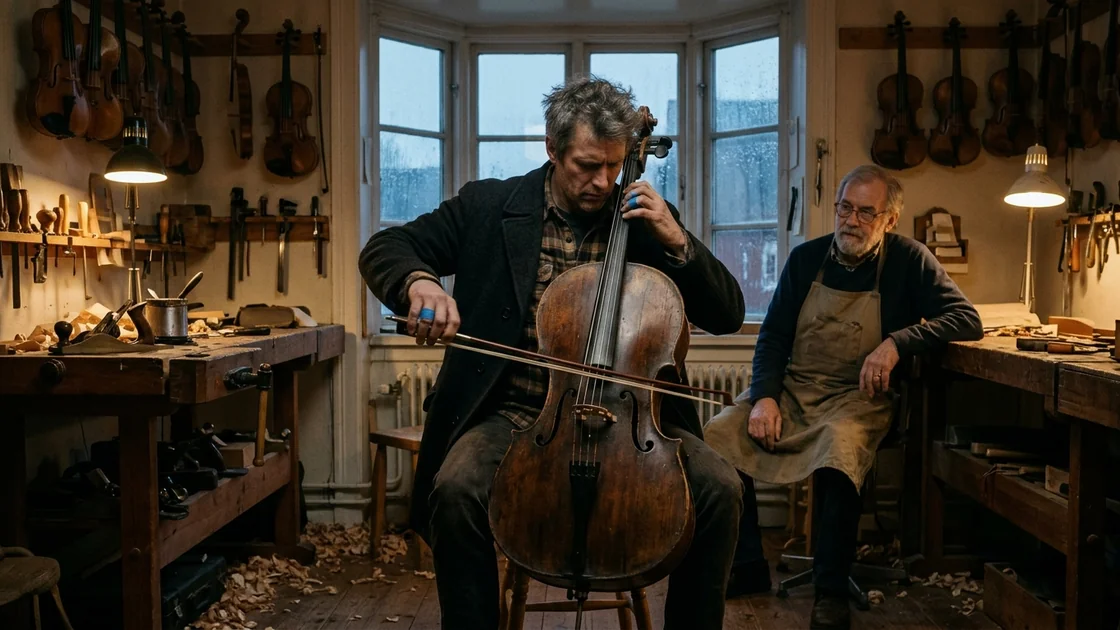
Julian Vance, a once-celebrated cellist from a war-torn eastern republic, survives in the sterile quiet of a northern sanctuary city after trading his three-hundred-year-old Gagliano cello to a smuggler for his life, a devastating sacrifice that leaves him suffering from a profound phantom limb syndrome of the soul until an unexpected encounter with a ruined instrument forces him to confront the music he left behind in the ashes.
Part I: The Anatomy of Silence
The human body has a stubborn, archaic memory. When a soldier loses an arm in the mortar-churned mud of a trench, the nerves at the ragged edge of the shoulder continue to fire into the empty air, insists the hand is still there, clenched into a fist or reaching for a canteen. The brain, refusing to accept the sudden revision of its ancient map, paints pain into the vacuum.
Julian’s vacuum was approximately four feet tall, carved from spruce and maple harvested from the Alpine forests during the reign of Louis XIV, and smelled faintly of lavender oil, dark rosin, and the cold sweat of three centuries of dead men.
He woke at four in the morning, as he did every morning, with his left thumb pressed hard against the air four inches from his collarbone. His index and middle fingers were curled, trembling with the microscopic oscillation of an E-flat vibrato in the fourth position. His knees were slightly parted under the thin, charity-issue wool blanket, braced to grip the lower bouts of a ribcage that was no longer between them.
In the dark of the room—a twelve-by-ten rectangle on the fifth floor of a municipal housing block in a city where the harbor never quite unfroze—the only sound was the rhythmic, metallic tink-tink-hiss of the radiator. It was an erratic metronome, jumping from largo to presto without warning, lacking any sense of phrasing.
Julian lowered his left hand to his chest. The calluses on the tips of his four fingers were gone. That was the greatest betrayal of his new life. For thirty-two years, since he was six years old and his grandfather had placed a quarter-size factory instrument into his arms in the conservatory basement in Oakhaven, those four pads of dead, hardened skin had been his primary interface with the universe. They were horn-thick, grooved with dark lines from the steel windings of the A and D strings, impervious to heat or needles.
They had begun to peel on the freighter across the narrows. By the time he spent three weeks in the processing center at Kestrel Point, sleeping on a vinyl cot under humming fluorescent tubes, the skin had softened. During his first month stocking shelves at the distribution warehouse on the edge of the port, the cardboard boxes had abraded the last of the old horn away, replacing it with the thin, pink, vulnerable skin of a civilian. Now, when he touched the coarse weave of his blanket, the sensation was sickeningly loud, like someone shouting into an ear that had had its drum removed.
He swung his legs out of bed and sat on the edge of the mattress. Through the single double-glazed window, the northern city was a geometry of sodium-vapor orange and slate blue. Snow was falling—not the wet, theatrical snow of his homeland that clung to the lime trees along the boulevard and muffled the sound of the artillery, but a dry, granular dust that the wind off the sea drove horizontally against the glass.
On the small laminate table beside the two-burner stove lay his residency permit, his warehouse identification badge, a half-loaf of dense rye bread, and a tin of sardines. There was no music in the room. He did not own a radio. When he walked through the streets and heard the bass-heavy thud of pop music bleeding from the headphones of teenagers on the tram, or the synthesized chimes of the pedestrian crossings, a cold, greasy nausea would rise in the back of his throat.
It was not snobbery. In the old days, he had loved the brass bands in the park, the gypsy accordionists on the bridges, even the cheap disco that drifted up from the courtyard cafes while he practiced the Kodály Solo Sonata in his high-ceilinged flat. Back then, all sound belonged to a single great commonwealth of vibration, and he was a citizen in good standing.
Now, he was stateless in more ways than the Ministry of the Interior could document.
He stood up, his tall, stooped frame casting a long shadow against the unpainted plaster wall. He had the typical build of a cellist who had started young: slightly asymmetrical shoulders, the right one lower but thicker in the deltoid from forty thousand hours of drawing horsehair across gut and steel, the left trapezius permanently knotted from supporting the scroll's weight against the neck. Without the instrument to explain his posture, he simply looked deformed—a tall, grey-haired man of forty who looked sixty, curving inward around a hollow space, as if he had taken a cannonball to the sternum and survived by growing around the hole.
He dressed in the dark: thermal trousers, two pairs of wool socks, a heavy flannel shirt, and the high-visibility yellow vest with the reflective silver stripes required by the logistics company. As he pulled the zipper of his coat up to his chin, his right hand automatically performed a martelé stroke in the empty space beside his thigh, his thumb tucked into the non-existent frog of a Sartory bow, his little finger balanced on the invisible octagonal stick.
Stop it, he told his hand in his native tongue. The words sounded rusty even inside his own skull. He had not spoken his language aloud since the night on the pier at Vlora.
He went down the five flights of concrete stairs, avoiding the elevator because its cable made a sound very close to a poorly rosined C-string being scraped behind the bridge—a high, wolf-tone shriek that made his teeth ache.
The warehouse was three miles away, out on the reclaimed marshes where the city’s old shipyards had been flattened to make room for acres of corrugated blue steel boxes. Julian walked. The tram cost two crowns forty, and though his wage as a night-shift picker was sufficient for his rent and his bread, he hoarded the small aluminum coins with a fierce, irrational desperation.
In the pocket of his trousers, he kept a small scrap of lined paper wrapped in plastic. On it was written an amount: 14,000 Euros.
It was an absurd number. In the currency of this northern country, it was nearly a year’s gross wages before tax and rent. More absurdly still, there was no address on the paper, no name, no bank account to which the money might be wired even if he had possessed it. The Gagliano was gone. It was not in a pawnshop waiting to be redeemed with a ticket.
Yet every crown he did not spend on the tram went into an empty coffee tin under his sink. When he counted the coins on Sunday afternoons, he was not saving to buy another instrument—a man does not buy a new wife after he has sold the first one to the wolves—he was paying a fine to a court that sat in permanent session behind his ribs.
The wind off the estuary cut through his trousers as he crossed the iron bridge over the canal. Below him, black water lapped against the pilings with a hollow, percussive clop-clop. Pizzicato, his mind whispered. Bartók. Fourth Quartet, fourth movement. Allegretto pizzicato.
He stopped in the middle of the bridge, gripping the frozen iron railing with his bare hands until the cold burned through his thin new skin and killed the nerve endings.
"Shut up," he said aloud to the water.
A cyclist in a yellow oilskin whizzed past him, her tires hissing in the slush, her red tail-light dwindling into the grey murk of five a.m.
He had known the Gagliano for nineteen years. It had not been his entirely—few musicians in the Republic owned instruments of that tier outright after the currency collapses of the nineties—but it had been placed in his permanent custody by the State Philharmonic Trust when he won the National Competition at twenty-one. The paper from the Ministry of Culture had called it a "Revocable Lifetime Stewardship," a piece of bureaucratic poetry that meant the state owned the varnish and the provenance for insurance purposes, while Julian owned the soul.
Its maker was Nicolò Gagliano of Naples, dated 1762. Unlike the grand, aristocratic Stradivarius instruments he had occasionally glimpsed in the hands of visiting soloists from Vienna or London—instruments that gleamed like Venetian carriages with their ruby-red varnishes and immaculate purfling—the Gagliano was a rugged, golden-brown peasant king. Its back was made of two pieces of Bosnian maple with a faint, irregular flame that looked like smoke trapped under amber ice. On the lower right bout, near the f-hole, there was a dark, crescent-shaped burn mark where some eighteenth-century church cellist had let a tallow candle drip during a long Mass.
Its voice was not polite. The A-string had a fierce, nasal brilliance that could cut through eighty pieces of brass and woodwind in the Shostakovich First Concerto like a laser through fog, while the C-string possessed a subterranean, gravelly darkness that seemed to come not from the wooden box itself, but from the floorboards beneath the endpin, as if the cello were merely a tap driven into the molten iron core of the earth.
When the war came to the capital, it had not arrived with the grand, tragic orchestrations Julian had spent his life interpreting. It came with the smell of burning tires, the failure of the municipal water pumps, and a series of dry, unmusical cracks from the hills above the television tower.
For the first four months of the siege, the orchestra had continued to play. They moved from the Great Hall, with its glass chandelier that threatened to drop three tons of crystal onto the stalls every time a howitzer fired in the suburbs, down into the rehearsal rooms below street level. They played for thirty people, then for twelve, then for three old women who came only because the basement had a coal stove.
Julian had lived in his overcoat. His fingers had cracked from the cold; he had glued the splits shut with household cyanoacrylate so the strings wouldn't slice into the meat of his pads during the Brahms Double.
Then came the Tuesday in November when an incendiary round hit the roof of the conservatory library next door. The fire did not reach the basement, but the water from the fire brigades’ hoses did. Two feet of black, ash-choked slush flooded the storage lockers, floating the double-bass trunks like coffins in a flooded crypt.
Julian had not left the Gagliano in its locker. He never did. It was strapped to his back in its white fiberglass Gewa case when he arrived that morning to find the brass section standing on the steps, watching sixty thousand scores turn into grey pulp in the gutters.
The conductor, old Maestro Voronin, had looked at Julian through spectacles coated in grease and soot. He had taken Julian by the lapels of his coat.
"Go south, Julian," the old man had said. His breath smelled of dandelion coffee and the raw alcohol they used to clean the oboe reeds. "The roster is dissolved. The Ministry burned at two o'clock this morning. There is no Trust anymore. There is no State. If you stay here, they will put a rifle in those hands, and when you are dead, some corporal from the provinces will use that Naples maple to boil his tea."
"It belongs to the people, Maestro," Julian had said, a stupid, rehearsed line from a dozen conservatory banquets.
Voronin had spat into the black water on the steps. "You are the only people left who know how to make it speak. Get it out of the country. That is an order from the Director."
At the warehouse, the shift bell rang at six sharp.
Julian stood at his station before a long aluminum roller-conveyor. Above him, a digital screen flashed green numbers: Aisle 14, Bin 08, Item 4492-B, Quantity 6.
He pushed his gray metal trolley down the canyon of steel racking. The warehouse was heated to precisely twelve degrees Celsius—warm enough that the hydraulics on the forklifts didn't sluggishly thicken, cold enough that the workers had to keep moving to stay comfortable. Most of the other pickers were like him: men with degrees in civil engineering from Aleppo, schoolteachers from the Donetsk basin, mechanics from Eritrea. They moved past one another in the narrow aisles with a polite, subterranean choreography, nodding without speaking, their eyes fixed on the blue glow of their wrist-scanners.
Item 4492-B was a six-pack of ceramic bathroom tiles, faux-carrara marble, shrink-wrapped in heavy polyethylene. Each pack weighed fourteen kilograms.
Julian slid his fingers under the plastic straps—don't pinch the tendons, keep the wrist flat, let the lats take the load—and swung the six packs onto his trolley. Six times fourteen was eighty-four kilograms.
In the old life, he had carried a glass of sparkling water with his left hand at receptions so that his right hand would remain warm and dry for shaking hands with patrons, though he always gave them a limp, dead-fish grip lest some enthusiastic banker crush the small metacarpal bones that controlled his bow balance. Now, he hauled three tons of glazed clay every morning before ten o'clock.
At nine-thirty, during the fifteen-minute break in the canteen, he sat at the far end of a long formica table, peeling the lid off his sardine tin.
Across from him sat a young man named Tariq, who had been a third-year medical student in Homs. Tariq was always trying to learn the northern language; he had a battered children's dictionary propped against his thermos and spent his breaks whispering nouns to himself.
"Skruvmejsel," Tariq murmured, tapping a finger against the table. "Screwdriver. Skiftnyckel. Wrench." He looked up at Julian, his dark eyes ringed with the violet shadows of chronic sleep deprivation. "You never study, Julian. How will you pass the level-two integration exam in May?"
"I don't need to talk to the tiles," Julian said in his halting, consonantal version of the local tongue.
"You cannot stay in Aisle Fourteen forever," Tariq said, tearing a piece of flatbread in half. "Before, in the home, what were you? An accountant? You have the glasses of an accountant. Or a professor."
Julian looked down at the three small, headless silver fish lying in their bath of yellow vegetable oil. "I worked with wood," he said.
"A carpenter?" Tariq brightened. "That is very good here! Everything is wood here. The houses, the floors. My cousin in Malmö says a man with a certificate in joinery can make two hundred crowns an hour. Why don't you go to the union office? They have a conversion course for foreign tradesmen."
"I didn't build things," Julian said. "I just... maintained one."
Tariq frowned, sensing the wall that went up whenever anyone pressed Julian about the time before the boat. The boy returned to his dictionary. "Hammare. Hammer. Spik. Nail."
Julian chewed his bread. If he told the boy the truth—that he had spent thirty-four years learning how to draw horsehair across four stretched wires so that people in velvet seats could feel sad about their mistresses for forty-five minutes before going out for oysters—Tariq would look at him as if he were a creature from the moon. Tariq had pulled shrapnel out of children's femurs using kitchen pliers and vodka. The man at the next table, an older Ukrainian named Pavlo, had driven a municipal bus through a Russian artillery barrage with forty pensioners lying on the floor between the seats.
What had Julian done? He had carried a hollow wooden box five hundred miles through the mud of the Dinaric Alps, sleeping in drainage ditches with his body curled around the fiberglass shell to keep the frost from cracking the belly glue, only to hand it over on a sleet-swept pier to a man wearing a counterfeit Rolex and a tracksuit.
The shame of it was a double blade. First, there was the shame of the uselessness of his art in the face of iron and high explosives; second, and far deeper, was the shame of his betrayal.
Because the Maestro had been wrong. When it came down to the wire, at the very end of the land where the mountains dropped into the black Adriatic, Julian had discovered that he was not the steward of a three-hundred-year-old soul. He was just forty kilograms of cold meat that wanted not to drown.
That evening, as Julian walked back from the warehouse, the snow stopped and the sky cleared to a hard, mineral violet. The cold deepened.
Instead of taking the direct route along the ring road, he turned down into the Old Quarter. He told himself he was doing it because the narrow, medieval streets blocked the wind from the harbor, which was true, though it added twenty minutes to his walk.
In the Old Quarter, the buildings were seventeenth-century brick with stepped gables, their ground floors occupied by law firms, antique shops, and small, dimly lit galleries. In the third alley behind the Cathedral of St. Olaf, there was a narrow shopfront with a bay window of thick, wavy crown glass.
Above the door hung a small wooden sign carved in the shape of a golden viol, its paint flaking in the salt air: S. Lindqvist — Violinbyggare.
Julian stopped across the street, standing in the deep shadow of a baker's awning that had been rolled up for the night.
Inside the warm, amber-lit room behind the glass, an old man in a grey canvas apron was sitting at a workbench covered in tiny brass planes, scrapers, and jars of amber crystals. Hanging from wires along the ceiling were six violins in the white—unvarnished wood that looked as pale and naked as peeled almonds—and in the corner, resting on a velvet-lined stand, was a cello.
It was nothing special. Even from twenty feet away, through two panes of glass and the gathering dusk, Julian could read its anatomy as easily as a butcher reads a side of beef. It was a late-nineteenth-century German trade instrument, probably from Markneukirchen. The scroll was carved with a heavy, uninspired hand; the pegbox was too thick; the varnish was a muddy, opaque spirit-resin that had been artificially shaded with lampblack to look old when Bismarck was still Chancellor. Its bridge was cut too high on the C-string side, and the tailpiece was modern aluminum with built-in fine tuners—the mark of a student instrument or an amateur playing in a community orchestra.
Yet as Julian stood on the frozen cobbles, his breath pluming white against the dark wool of his scarf, his eyes traced the curve of the C-bouts with a hunger so violent it made his knees weak.
The old luthier inside picked up a small camel-hair brush, dipped it into a jar of golden liquid, and began to lay a coat of varnish onto the ribs of one of the pale violins. His movements were slow, deliberate, rhythmical.
Julian could smell the shop through the brick and glass. It was an olfactory hallucination, he knew, triggered by the sight of the jars, yet his nostrils filled with the sharp, resinous tang of Venice turpentine, the sweet, nutty aroma of boiled linseed oil, the dry dust of spruce shavings, and the animal stink of the cast-iron hide-glue pot simmering on its electric ring.
He stood there for twelve minutes. When his toes inside his steel-capped warehouse boots went entirely numb, he turned and walked back toward the housing block.
Part II: The Ledger of the Pier
To understand why a man feels he has no right to his own skin, one must understand the geography of the coast at Vlora in the second week of December.
It had taken Julian nineteen days to reach the sea after the conservatory burned. The trains had stopped running at the river; from there, he had traveled in the back of a poultry lorry, then on a tractor cart behind two oxen, and for the last eighty miles, on foot through the karst passes where the partisans had fought the Germans eighty years before.
He had left behind his suitcase on the fourth day. It contained his dress tails, six white pique bow ties, his passport, his mother’s silver wristwatch, and the Urtext editions of the Bach Suites with thirty years of his own fingerings penciled into the margins in three different colors of lead. He had thrown the suitcase into a ravine near a village called Gornji Vrh because the strap had broken and he could not carry both the suitcase and the Gewa case while climbing a thirty-degree scree slope under sniper fire from the ridge.
The cello stayed strapped to his back. With the case, the two bows, the extra sets of Spirocore and Larsen strings in the interior pocket, and the heavy brass wolf-eliminator clamped below the bridge, it weighed nearly twelve kilograms. The nylon straps of the harness had sawed through the shoulders of his wool coat and into the flesh beneath until his undershirt was glued to his skin with dried serum and blood.
At night, in the burned-out haylofts and abandoned concrete bunkers where the column of refugees huddled like cattle, Julian had been hated. A man with a cello takes up the space of two men. He cannot pack tightly into a corner; the scroll pokes an old woman in the eye, the broad lower bout blocks the doorway, the fiberglass shell gleams white in the moonlight when everyone is trying to hide from the reconnaissance drones.
"Leave the coffin, Mister," a former policeman from the capital had told him on the tenth night, as they lay in a ditch beside an orchard of dead plum trees. "You can't eat it, and you can't shoot it. Tomorrow we cross the gorge. If you slip with that sail on your back, you'll take three of us down with you."
Julian had said nothing. He had simply unsnapped the seven chrome latches of the case—very quietly, cupping his hands over each latch so the click wouldn't carry in the frost—and checked the humidity gauge inside the lid. It read thirty-two percent. Too dry. The Gagliano’s belly was prone to opening along the bass-bar seam when the air dropped below thirty-five. He had taken his last half-apple from his pocket, bitten it in two, and wedged the wet, exposed flesh of the fruit into the little perforated humidifier tube beside the neck block. Then he had eaten the other half, skin and core and seeds, and gone to sleep with his cheek against the cold fiberglass.
When he finally came down out of the limestone hills above the coast, the sea looked like a sheet of hammered lead.
There was no town where the smugglers operated—only an abandoned chrome-ore loading facility from the communist era, a rusted skeletal pier jutting out into a shallow bay surrounded by salt marshes and concrete pillboxes shaped like mushrooms. Three hundred people were living in the old ore hoppers, burning driftwood and plastic bottles for warmth while they waited for the weather to drop enough for the rigid-hulled inflatables to make the forty-mile run across the strait to the Italian peninsula.
The man who ran the pier was called Leka. He was not a monster from a melodrama; he was a former customs clerk in a shearling coat who suffered from chronic sinusitis and carried a leather ledger under his arm like a bailiff on a country estate.
"Three thousand Euros," Leka had said, not looking up from his ledger as he sat on an upturned oil drum inside the weighing shed. A kerosene heater roared beside his knee. "Cash. Euros, Swiss Francs, or dollars. No Republic dinars. You can wipe your arse with dinars."
"I have four hundred Euros," Julian said. His voice was a croak; he had developed bronchitis in the passes. "And thirty grams of eighteen-karat gold—my parents' wedding rings and a conservatory medal."
Leka didn't even reach for the little digital scale on the crate beside him. "Gold is forty Euros a gram on the beach, friend. That’s sixteen hundred total. You’re fourteen hundred short. Go back to the hoppers. Maybe when the patrol boats go for Christmas dinner, we run a barge for the cheap seats. Or maybe the army comes down the road first. Who knows?"
Julian had stood by the kerosene heater, the heat making the chilblains on his ears throb like toothaches. Behind him, through the broken window of the shed, he could see a grey plume of smoke rising from the ridge ten miles inland. The mechanized brigades had taken the crossroads at Brod that morning. By dawn, their reconnaissance units would be on the coast road. They were conscripting every male between sixteen and fifty-five on the spot, and anyone found at a smuggler's embarkation point was classified as a deserter under Martial Law Decree 12.
"I have an instrument," Julian said.
Leka looked up then, his red-rimmed eyes traveling slowly from Julian’s ruined boots to the white curved dome of the Gewa case rising behind his head like a carapace.
"An accordion?" Leka asked. "My brother-in-law plays the accordion. He has a Scandalli. Very nice."
"A violoncello," Julian said. He slipped his arms out of the straps—the sudden release of the weight made him stagger forward a half-step, as if gravity had briefly failed—and laid the case flat on a stack of rotting cement sacks.
He undid the latches. When he lifted the lid, the smell of Naples and the Great Hall rose into the kerosene-stink of the shed.
The Gagliano lay in its crushed-velvet nest of royal blue. Despite the nineteen days in the mountains, the varnish still held its deep, inner sun—that optical trick of old Cremonese and Neapolitan ground-coats that makes the wood appear to be lit from three millimeters beneath the surface.
Leka stood up from his oil drum and walked over. He didn't touch it at first. He wiped his nose with the back of a gloved hand and peered down through the f-holes at the yellowed rectangle of parchment glued to the inner back.
"Nicolaus Gagliano Filius Alexandri fecit Neapoli 1762," Leka read aloud, his Latin pronunciation surprisingly decent—perhaps he had been an altar boy before the revolution, or perhaps a customs clerk simply knew how to read certificates of origin. "Is it real? Every gypsy between here and Sofia has a violin with a Stradivarius sticker he printed on an inkjet."
"It is real," Julian said. "The insurance valuation with the Lloyd’s syndicate in Vienna is four hundred and twenty thousand Euros. The bow in the top clips is by Eugène Sartory of Paris. It is worth twenty-five thousand by itself."
Leka looked at Julian for a long time. The wind rattled a loose sheet of corrugated iron on the roof overhead—clang, clang, pause, clang.
"Four hundred and twenty thousand," Leka repeated softly. "And you want to give it to me for a seat on a rubber boat that costs fourteen hundred?"
"No," Julian said, his hands trembling so violently he had to thrust them into his coat pockets. "I want you to take my four hundred Euros and the gold. And I want you to lend me the fourteen hundred against the security of the instrument. You have cousins in Bari, or Brindisi, or Trieste. Everyone knows you people move things across the water. Send the cello to your cousin on the other side. When I reach the camp in Italy, I only need forty-eight hours to contact the Philharmonic Foundation in Zurich or the Maestro’s brother in Munich. They will wire you ten thousand Euros to release it. You make six hundred percent profit in a week, and you don't have to fence a registered museum piece on the black market."
It was a reasonable plan. He had rehearsed it for sixty miles in the dark, timing his footsteps to the sentences.
Leka reached out with one thick forefinger, the nail blackened from an old hammer blow, and plucked the C-string.
Because the tailpiece was cold and the pegs had slipped slightly in the mountain air, the note was a flat, dull B-natural, yet the shed vibrated with it. The kerosene tin on the floor hummed in sympathy.
"You think I am a bank, Professor?" Leka asked, not unkindly. "If I put this box on the boat tonight, it takes the space of a woman and a child. That’s six thousand Euros cash in my pocket right now. And if the Italian coast guard intercepts the boat five miles off Otranto, they throw the passengers in a detention center and they confiscate the boat and everything in it. Then where is my ten thousand from Munich? In an Italian police warehouse."
"Then let me hold it between my knees on the pontoon," Julian pleaded. His voice broke, rising an octave into a register he hadn't used since he was twelve. "It doesn't need a seat. I'll stand. I'll hold it over the water."
"Nobody holds luggage on the pontoons," Leka said, his voice hardening into the flat recitative of a man who had had this argument ten thousand times about suitcases of wedding linen, cages of hunting dogs, and icons of the Virgin. "A wave hits the bow, you grab for your fiddle instead of the lifeline, you go over the side, you pull the man next to you into the prop. No luggage larger than a rucksack. That is the rule of the captain."
He reached down and pulled the lid of the Gewa case shut. The seven latches didn't click, because he didn't fasten them, just left the white fiberglass shell closed like a mouth that had finished speaking.
"I have a man in Tirana who buys old furniture and paintings for a dealer in Milan," Leka said, walking back to his oil drum and picking up his pen. "He comes down every Friday with a van. Maybe your sticker is real, maybe it’s a very good fake that’s worth five thousand to a dentist in Rome. I don't know music. I’ll take the box, the four hundred, and the rings. You get on Boat Three at midnight. That’s the deal."
Julian looked at the white case lying on the cement sacks.
Six miles inland, a battery of 152-millimeter howitzers fired a salvo—four distinct thuds that arrived through the soles of his boots half a second before the sound came through the wet air. The army was clearing the southern approaches to the marsh.
If he picked up the case and walked out of the shed, he would still have the Gagliano. For about nine hours. Then some nineteen-year-old conscript from the mining towns would put a bayonet through Julian's kidneys behind a concrete pillbox and kick the white fiberglass case into the salt marsh to see if it floated.
Or he could leave it on the cement sacks, walk down the rusted iron ladder onto the black rubber tube of Boat Three, and live.
"The bow," Julian whispered. "Let me take the bow. It's seventy centimeters long. It weighs eighty grams. I can tie it inside my coat sleeve along my arm. I won't drop it."
Leka sighed, a long, mucous rattle in his sinuses. "The man in Milan wants the stick with the fiddle, Professor. A car without a steering wheel is half the price. Boat Three. Midnight. Leave the case by the stove so the damp doesn't get in. I’m not a barbarian."
Julian had stood there for three minutes. He did not open the case again to say goodbye. He knew that if he saw the little candle-burn near the right f-hole, he would sit down on the cement sacks and wait for the soldiers.
Instead, he took the little piece of lined paper from his pocket—a scrap torn from the back of the Bach Suites before he threw the suitcase into the ravine—and wrote 14,000 Euros on it with a stub of pencil. He didn't write 1,400, which was the balance of the fare, nor 420,000, which was the price of the state's property. He wrote ten thousand plus the four thousand Leka had said a woman and a child would pay for the space the case occupied. It was the ransom he had proposed and failed to win.
Then he walked out of the shed into the freezing rain, leaving his spine behind him on the cement sacks.
Part III: The Shop on St. Olaf’s Alley
In the third month of the new year, the warehouse cut the night shift's hours. A shipping strike in Rotterdam had slowed the arrival of containers from China, and Julian found himself dismissed at four in the afternoon three days a week.
Going back to the room on the fifth floor while the sun was still a pale smudge on the horizon was intolerable. In the dark, the room was merely a box for sleeping; in the grey northern daylight, the bare plaster walls and the single chair looked like a cell for a man serving a life sentence for a crime he couldn't quite remember committing.
So he walked. And because a river always finds its old channel no matter how many tons of gravel you dump into the bed, his feet took him back to St. Olaf's Alley.
It was a Thursday, just after three. The streetlamps had not yet flickered on, and the shop window of S. Lindqvist — Violinbyggare was lit from within by the low, buttery glow of the bench lamps.
As Julian approached the baker's awning across the cobbles, he saw that the old luthier was not at his bench. Instead, he was standing near the front door, struggling with a large wooden crate that a delivery driver had left half-on, half-off the stone threshold. The crate was made of rough pine boards stenciled with shipping marks from an estate auction house in Uppsala. The old man was trying to lever one corner of it up with a small crowbar to slide a dolly underneath, his thin shoulders hunched under his cardigan, his face flushed a dangerous, congested purple above his grey beard.
The crate slipped off the lip of the dolly with a dry crunch of splintering pine, pinning the toe of the old man's leather slipper against the doorjamb.
Julian didn't think. Before his brain could remind him that he did not exist in the world of wooden instruments anymore, he had crossed the narrow street in three strides.
"Allow me," he said in his stiff, textbook northern.
He gripped the top cleats of the crate. It was lighter than a pallet of bathroom tiles—no more than fifty kilos—and he lifted the dead weight three inches clear of the stone threshold with a single heave of his thighs and back, holding it suspended while the old man pulled his foot free and kicked the iron tongue of the dolly under the base.
"Careful on the left side," Julian muttered automatically as he lowered it. "The bottom batten is split."
The old man leaned on the handle of the dolly, breathing hard through his nose, and looked up at Julian through bifocals specked with rosin dust. Up close, he was even older than he looked through the window—well into his seventies, with watery blue eyes and hands that were mapped with age spots and small, silvery scars across the knuckles from forty years of chisel slips.
"Thank you," the luthier said, when he had his breath. "The boy from the carrier dropped it on the step and ran off before I could sign the paper. If you wouldn't mind—just over the sill. The flagstone has a two-centimeter lip."
Julian took the front of the crate to keep it from tipping forward off the dolly and guided it backwards into the shop.
The moment the door swung shut behind him, cutting off the diesel fumes and wet slush of the alley, the air of the room hit him like a physical blow to the solar plexus.
It was warm—twenty degrees at least, with a big copper tray of water sitting atop the cast-iron radiator to keep the relative humidity at a steady fifty percent. And the smell was not an hallucination this time. It was real: hide glue, shellac, spirit of wine, aged spruce, Pernambuco dust, and the sour, metallic tang of old horsehair and brass windings.
Julian stood just inside the door, his hands hanging at his sides in his yellow high-visibility vest under his open coat, staring at the walls.
Every square inch was occupied by the anatomy of music. There were wooden templates for Stradivari, Guarneri, and Montagnana models hanging from wooden pegs like dried fish; bundles of unbleached Siberian horsehair tied with red silk thread; boxes of ebony tailpieces and boxwood pegs; a rack of fifty knives and gouges with handles worn to the exact negative impression of the old man’s palm.
And there was sound. Not music, but the ambient sympathetic resonance of thirty hollow wooden bodies hanging in the same room. When the door latched with a heavy thud, a faint, ghostly chord—a mixture of G, D, and A—hummed through the room for two seconds before dying away into the ticking of a grandfather clock in the corner.
Julian felt a sudden, terrifying pressure behind his eyes, a hot prickling that he hadn't felt since the night the conservatory library burned. He turned quickly toward the door handle.
"Wait a moment," the old man said, reaching into the pocket of his apron. "Let me give you something for a coffee. My sciatica would have had me on the floor until tomorrow morning if you hadn't crossed over."
"No," Julian said, his hand on the brass latch. "It was nothing. I work in a warehouse. It is my job."
The luthier stopped with a twenty-crown note between his fingers. He wasn't looking at Julian's yellow vest anymore; he was looking at the way Julian had stepped around the German cello on its stand near the counter.
A normal man—a warehouseman, a delivery driver, a postman—gives a cello in a narrow shop a wide berth, or else brushes past it with his coat tails, oblivious to the fragile projection of the bridge and the C-peg. Julian, turning in the cramped space between the crate and the stand, had automatically rotated his left hip back and lifted his right elbow to the exact height required to clear a cello scroll without looking at it, his body knowing the spatial geometry of the instrument in the dark.
More than that, the old man’s eyes dropped to Julian’s left hand on the brass door latch. The calluses were gone, yes, and the nails were ragged from cardboard boxes, but the nail of the index finger and the little finger were trimmed slightly shorter on the left corner than the right—the unconscious habit of a string player who cuts his nails at an angle to accommodate the slant of the fingerboard.
"You've been standing across the street under the baker's awning on Tuesday and Thursday evenings since January," Lindqvist said mildly. He didn't sound accusatory; he sounded like a naturalist who had finally gotten a good look at a rare winter bird at his feeder. "I thought you were a tax inspector from the municipality, or perhaps my ex-wife's brother-in-law, though he hasn't spoken to me since 1998."
Julian froze. The heat in his face rose to his ears. "I was waiting for someone. I am sorry to disturb you."
"You didn't disturb me. The wind on that corner comes straight off the water. It’s a hard place to wait." Lindqvist tucked the twenty-crown note back into his apron and picked up his small crowbar, inserting it under the top slats of the Uppsala crate. "Violin or viola?"
Julian didn't open the door, though he didn't take his hand off the latch. "Neither."
Lindqvist paused, looking at Julian's height, the slight droop of his right shoulder, the breadth of his span from thumb to little finger. "Ah. Of course. The big brother. Where are you from? Your accent isn't Polish. Further south?"
"The Republic," Julian said, using the old name that no longer appeared on the maps the newspapers printed.
The old man nodded slowly. He didn't say I'm sorry or How terrible, which were the two phrases that always made Julian want to smash a window when the social workers at the integration office used them. He simply pried up the first pine board with a dry screech of nails.
"They sent me a job lot from an old school estate up north," Lindqvist said, tossing the board onto the floor and pulling out handfuls of shredded newspaper. "The municipality closed three rural gymnasiums and auctioned off the music department closets. Mostly Czech skylarks from the seventies—plywood bellies you couldn't cut with a chainsaw—and half-size bows with fiberglass sticks. But the auctioneer said there was a four-quarter cello at the bottom that had been in the boiler-room cupboard since the war. The first war, he meant. Not yours."
Julian told his feet to turn the latch and step out into the alley. His feet did not move.
He watched as the old man cleared away the last of the excelsior packing straw and reached down into the coffin-shaped box.
What Lindqvist lifted out was not in a case. It was wrapped in an old, moth-eaten army blanket tied with baling twine. When he untied the knots and let the blanket fall away onto the workbench, Julian let out a short, involuntary breath that was almost a laugh, though there was no humor in it.
It was a corpse.
It was an old Scandinavian church cello, probably made by a village carpenter in Dalarna or Hälsingland around 1840 who had only ever seen a real Italian cello in an engraving or during a brief apprenticeship in Stockholm. The proportions were slightly eccentric—the upper bouts a fraction too narrow, the C-bouts long and stiff like a baroque viol's. The belly was made of wide-grained local pine rather than Alpine spruce, and the back was birch, stained with nitric acid to give it a dark, smoky curl.
And it had been murdered by fifty years of neglect in a dry school cupboard next to a coal boiler.
The neck had pulled clean out of the top block, hanging sideways by the rotted remnant of a single gut D-string like a man with a broken cervical vertebra. The belly had three major cracks running parallel to the bass bar, one of them gaping wide enough to slip a five-crown coin through, black with seventy years of coal dust and dead flies. The bridge was gone, the soundpost was rattling loose inside the ribs like a pebble in a dry gourd, and the lower left rib had come unglued from both the back and the belly, curling outward like a warped shingle on a barn roof.
"Good Lord," Lindqvist muttered, adjusting his bifocals as he turned the carcass over on the padded leather mat of his bench. "The auctioneer called this 'requiring minor setup.' I paid four thousand crowns for this crate. The ebony on the fingerboard isn't even real ebony; it’s pearwood stained with iron gall."
Julian took two steps away from the door. He didn't mean to, any more than a doctor at a highway pileup means to kneel beside a man whose femoral artery is pumping onto the asphalt.
He looked down into the gaping crack beside the f-hole.
"The bass bar isn't original," Julian said, his voice dropping into a register he hadn't heard from his own throat in six months. He pointed without touching the wood, his finger hovering three millimeters above the fractured pine. "Someone opened it around 1900 and put in a heavy German bar to handle steel strings. That’s why the top sank under the left foot of the bridge and split along the grain when the humidity dropped. The pine is too soft to fight a stiff bar like that."
Lindqvist looked sideways at him over the rims of his glasses. He didn't look at the cello; he looked at Julian's face.
"You have eyes," the old man said quietly. "Most players don't know what’s inside the box as long as the wolf-note stays between F and F-sharp. They think a bass bar is where the double-bassists go for a beer during the Tchaikovsky wind solos."
"My grandfather was the assistant archivist for the conservatory collection," Julian said, his eyes still tracing the disaster of the birch back. "Before he taught me to hold a bow, he made me sit in the repair shop with old Master Kovač so I wouldn't drop a state instrument on the stone stairs."
He reached out and touched the scroll.
It was the first time his skin had touched the wood of an instrument since the weighing shed at Vlora.
The birch was dead cold from the delivery truck, rough where the cheap spirit varnish had crazed into a million tiny dry islands like a drought-parched riverbed. The carving of the volute was clumsy—the tool marks of the village maker’s gouge were still visible in the throat of the scroll, unscraped, hasty. Yet as Julian’s thumb settled into the hollow of the pegbox cheek, a violent electric spasm shot up his median nerve, through his brachial plexus, and straight into the base of his skull.
He pulled his hand back as if the wood were wired to the municipal power grid.
"It's firewood," Lindqvist said, tapping the loose rib with a knuckle. It made a dull, cardboard thwack. "To take the top off, clean seven cracks, cleave them, bush the pegbox, reset the neck angle, and plane a new bar—that's sixty hours of bench work. At my shop rate, the repair would cost forty thousand crowns, and when you were finished, you’d have a nineteenth-century peasant box worth fifteen thousand on a sunny day. I'll strip the tuners for the parts bin and put the carcass in the stove."
He reached for the neck to lift it off the bench toward the back room where the scrap wood was piled.
"Wait," Julian said.
Lindqvist paused, his hands on the broken birch neck.
"The back has no soundpost crack," Julian said, his heart hammering against his ribs at a frantic vivace. "Look. The post fell before the belly collapsed completely. And the pine—it’s wide-grained at the flanks, yes, because it’s northern timber, but look at the center seam under the bridge. That’s slow-growth heartwood from the north side of a mountain. Whoever built this didn't know how to carve a scroll, and he used birch because he couldn't afford maple from Trieste, but he knew how to split a spruce log with a wedge so the medullary rays run straight."
Lindqvist squinted at the cross-grain of the open crack through his loupe. After a moment, he grunted. "Split timber, not sawn. You're right. The old parish carpenters up in Dalarna used the same wood for church roofs and fiddles. It won't have any run-out." He looked back up at Julian. "It’s still sixty hours of work I can’t bill to a customer, my friend. I have three orchestra violins waiting for re-hairs by Saturday and a Guarneri copy with a sunken arch that belongs to a girl auditioning for the Royal Academy in Stockholm next month. I am seventy-four years old. I only have so many hours left in my thumbs."
Julian looked down at his own hands. They were broad, strong from four months of lifting ceramic tiles, and entirely useless for anything that mattered to him.
"I know how to clean a crack with warm water without swelling the end-grain," Julian said. The words were coming out in a rush, tripping over the grammar of the northern language, his hands moving in the air to supply the nouns he didn't know. "I know how to chalk-fit a patch and clamp a cleat. I cannot cut a bridge or set a neck angle—Master Kovač never let me use the big planes—but I can do the washing, and the scraping of the old glue, and the clamping. The long work. The stupid work."
"Why?" Lindqvist asked simply. "I can't pay you. If we fix it and sell it to a high-school student for twelve thousand crowns in the autumn, it wouldn't pay you thirty crowns an hour."
"I don't want crowns," Julian said. He looked at the broken thing on the bench—the neck twisted at its grotesque angle, the belly caved in, mute, discarded in a crate of trash because the world had decided it was too expensive to save. "I just don't want you to burn it."
Part IV: The Glue Pot
For the next six weeks, Julian lived a double life conducted in two different temperatures and two different centuries.
From six in the morning until two or four in the afternoon, he was Employee 0884 at the harbor logistics center, pushing eighty-four-kilogram loads of plumbing fixtures and flat-pack particleboard furniture down Aisle Fourteen under the blue glare of LED strips.
At four-thirty, having washed the cardboard dust from his hands at the warehouse sink, he unlocked the back door of S. Lindqvist — Violinbyggare with the spare brass key the old man had given him on the third day.
Lindqvist rarely spoke to him for the first hour. The old man worked at the front bench by the window, where the afternoon light from the alley fell across his violin molds, while Julian worked at the smaller secondary bench near the glue stove at the back.
They began with the autopsy.
Under Lindqvist’s brief, grunted instructions, Julian took a thin steel palette knife, heated it over an alcohol lamp, and worked it slowly around the perimeter of the broken pine belly, breaking the brittle crystal bonds of the nineteenth-century animal glue that held the top plate to the birch ribs and the willow corner blocks.
Ting. Ting. Ting-crack.
Each time a section of the seam popped free, releasing a dry puff of dust that had been sealed inside the instrument since Tsar Nicholas I was on the throne of Russia, Julian felt a strange, quiet focus settle over his mind. The roaring phantom pain in his left shoulder—the constant, nagging sensation that the Gagliano was somewhere out in the rain waiting for him to come back to Vlora—did not vanish, any more than a widower stops missing his wife because he is bandaging a stray dog's paw.
Wait—it was precisely that. This ugly, clumsy northern cello was not the Gagliano. It could never replace the Gagliano. Its varnish was the color of dried ox-blood mixed with soot; its f-holes looked as if they had been cut with a keyhole saw by a man who had drunk three glasses of aquavit after church. Because it made no claim to beauty or greatness, Julian could touch it without feeling that he was committing adultery against the dead.
"Don't force the knife at the lower block," Lindqvist said from the front bench without turning around. He could hear the change in the pitch of the steel blade against the pine from fifteen feet away. "The grain of the block runs vertical, the belly runs parallel, and the village idiot who built it probably used hoof-glue thick enough to shoe a horse. Drop three drops of warm water into the seam with the brush and wait five minutes. We have until Easter."
"Yes, Maestro," Julian murmured automatically.
Lindqvist snorted. "Don't call me that. A Maestro waves a little white stick in the air and takes the train to Berlin with the soprano. I'm a joiner who works in millimeters. Call me Sören."
When the belly finally came off on the fourth evening, exposing the interior of the birch coffin, they both stood over it under the swing-arm lamp.
On the inside of the birch back, written directly onto the bare wood in faded brown iron-gall ink with a quill that had spluttered on the upstrokes, was an inscription in old cursive Swedish:
Gjord af Pehr Olsson i Leksand under det stora hungeråret 1867. Gud vare oss nådig.
"Made by Pehr Olsson in Leksand during the great hunger year of 1867," Sören translated softly, tracing the loops of the L with a fingernail. "God be merciful unto us."
Julian stared at the faded brown handwriting. "The hunger year?"
"The summer of 1867 never came," Sören said, picking up his magnifying loupe to inspect the willow blocks. "The ice didn't leave the lakes in the north until June, and the frost came back in August. The rye rotted green in the fields. People ate bread made from pine bark and reindeer moss. Ten thousand went to America on the timber ships, and the ones who stayed behind died of typhus in the snow."
He tapped the thick, clumsy pine belly lying upturned on the felt mat.
"And this fool Pehr Olsson sat in a cottage in Leksand with his belly full of bark-porridge and carved a cello out of a church-roof beam," Sören said, shaking his head. "Look at the corner blocks. He didn't even have willow for all four—the bottom two are alder, probably cut from a clog-maker's scrap pile. Why does a starving man build a cello, Julian?"
Julian looked at the black, coal-encrusted cracks in the pine. He thought of the basement of the Great Hall in November, with the howitzers thudding in the hills and old Voronin beating time through his grease-smeared spectacles while the three old women by the stove wept into their wool shawls during the Adagio of the Schubert Quintet.
"Because if you only make things you can eat," Julian said quietly, "then you are only an animal waiting to freeze."
Sören looked at him for a moment over his glasses, then turned back to his bench. "Wash the cracks with distilled water and a camel-hair brush. Don't let the water sit in the wood longer than thirty seconds before you blot it with the chalk. If you warp the arch, Pehr Olsson's ghost will come down the chimney and throttle you."
The weeks of washing and gluing were a study in microscopic patience.
Every evening, Julian would heat a little porcelain cup of distilled water, dip a fine sable watercolour brush into it, and gently stroke the blackened edges of the three long fractures in the pine belly. Slowly, over ten days of repeated washings and dryings under light sandbags, the seventy years of boiler-room soot floated out of the porous white fibers of the spruce.
When the wood along the fractures was clean—not white, for old wood is never white, but the pale honey-gold of a honeycomb—Sören showed him how to mix hide glue from the amber pearls in the jar: soak the granules in cold water until they swelled like frog-spawn, then warm the double-boiler to precisely sixty-two degrees Celsius.
"Taste it with your finger," Sören said, dipping his pinky into the hot, smelly jelly and touching his thumb to it, pulling them apart until tiny spider-threads of protein formed between the pads. "Too hot, the protein cooks and dies—it has no strength. Too cold, it gels before you get the clamps on and the joint stays open a tenth of a millimeter. A tenth of a millimeter in a crack is a canyon. It will buzz on every G-sharp until Judgement Day."
They worked as a four-handed organism during the clamping. Glue sets in forty seconds in a twenty-degree room. Sören would work the hot glue into the crack by pumping the two halves of the pine belly up and down with his thumbs until golden beads of sweat squeezed through to the varnished side, while Julian stood ready with twelve long-throated brass cello clamps, spinning the leather-padded screws down into place with the speed and precision of a pit crew changing tires, wiping the squeezed-out glue away with a hot damp rag before it could skin over.
When the three cracks were closed, they were invisible to the naked eye; when Julian tapped the bare pine plate with his knuckle, it no longer gave the dull thwack of wet cardboard, but a clear, ringing boing around F-natural.
Then came the cleats—forty tiny diamonds of split spruce, each eight millimeters long and two millimeters thick, which Julian had to chalk-fit to the curved inner surface of the belly across the glued cracks.
To fit a cleat, you rubbed blue carpenter's chalk on the belly over the crack, pressed the tiny wooden diamond against it, saw where the blue chalk transferred to the high spots of the diamond, shaved those microscopic high spots away with a curved thumb-plane the size of a walnut shell, and repeated the process thirty times until the entire bottom of the diamond came away uniformly blue. Then you glued it down and shaved it into a tiny, feathered pyramid so it wouldn't add dead mass to the vibrating plate.
On the third Tuesday of March, around eight in the evening, Julian was sitting at the back bench, shaving the twenty-fourth cleat with the walnut-shell plane.
The shop was entirely quiet except for the hiss of the radiator and the soft shhh-shhh of his tiny blade taking curl after curl of transparent spruce off the diamond. Each shaving was thinner than onion skin; when it fell onto his apron, the static electricity made it cling to the wool.
Without realizing it, Julian began to hum.
It was not a conscious decision. His breath simply caught the rhythm of the thumb-plane—down-stroke, lift, down-stroke, lift—and a low, gravelly baritone vibration started in his chest cavity.
It was the opening theme of the second movement of the Elgar Concerto—the Lento pizzicato chords followed by that hesitant, searching sixteen-bar recitative where the cello climbs up the fingerboard like a man feeling his way up a dark staircase with a dying candle, asking the same question three times in three different keys before the orchestra finally lets it run.
At the front bench, Sören’s scraper stopped moving across the maple scroll of his Guarneri copy.
The old man did not turn around. He sat very still, his hands resting on his apron, listening as Julian—completely absorbed in the blue chalk marks on cleat number twenty-four—hummed his way through the Allegro molto passage. Even hummed through closed lips in the back of a dusty shop, the phrasing was unmistakable. No amateur, no conservatoire washout, no provincial music-school teacher shaped the dynamics of a phrase with that kind of terrifying architectural inevitability. It was the phrasing of a soloist who had stood in front of ninety players in Berlin or Prague and bent the tempo to his own pulse.
When Julian reached the sudden, choked ritardando before the return of the Adagio, he realized what he was doing.
His throat locked shut as if someone had taken him by the windpipe. The tiny walnut plane slipped in his sweating fingers, its razor-sharp blade slicing a neat, three-millimeter flap of skin off the side of his left index knuckle.
A bright bead of arterial red welled up and dropped onto the pine belly of Pehr Olsson’s cello, right beside the chalk line for the bass bar.
"Damn," Julian whispered, grabbing a dry rag to press against his finger while trying with his other hand to wipe the blood off the raw spruce before it stained the grain.
Sören got up from his stool, walked back to the glue stove, dipped a corner of a clean linen towel into the warm water pot, and took the cello belly out of Julian’s hands.
"Never wipe blood with a dry rag," Sören said mildly, dabbing the red spot on the wood with the warm wet linen until it vanished into a faint pink halo. "Wait until you put the bass bar over it. Nobody will see it for another hundred and fifty years, and when the next luthier opens this box in 2170, he'll just think Pehr Olsson cut his thumb in Leksand."
He handed Julian a roll of blue paper tape from the rack to wrap around his bleeding knuckle.
"You played the Elgar with the State Philharmonic," Sören said. It was not a question.
Julian wrapped the blue tape twice around his finger, pulling it so tight the tip turned white. "Everybody plays the Elgar. It is the warhorse they give you when the subscribers complain about too much Bartók."
"Three years ago, before my ears started losing the top frequencies above twelve kilohertz, I used to listen to the European Broadcasting Union concerts on the radio late at night while I varnished," Sören said, leaning his hip against the edge of the bench. "They broadcast a festival concert from your capital. The orchestra played the Janáček Sinfonietta, and before the interval, a man named Julian Vanev played the Elgar on a Naples Gagliano. I remember it because the announcer spent five minutes talking about the cello before the first movement, and when the man started to play, I forgot to put the second coat of spirit on a violin and ruined the varnish."
Julian stared at the floor between his boots. He had changed the spelling of his surname from Vanev to Vance on the temporary travel document the Red Cross clerk had typed up in Bari, hoping to shed the old skin so thoroughly that no Google search in a municipal housing office would ever connect the warehouseman in Aisle Fourteen with the man in the tails on the old posters.
"Vanev died in December," Julian said, his voice flat and cold as the harbor water. "In the mountains above Vlora."
"Did he?" Sören looked down at the pine belly on the bench, where the forty tiny spruce cleats stood in three neat, staggered rows like stitches along an incision. "He still does very clean chalk-work for a corpse. Where is the Gagliano, Julian?"
Julian did not want to tell him. He had not told the UNHCR officer in Otranto; he had not told the psychologist at the refugee intake center in Malmö; he had not told Tariq over the sardines. To speak the words aloud was to ratify the bill of sale.
Yet standing in the smell of the hot hide glue and the shaved spruce, with his blood drying under the blue paper tape on his finger, the dam behind his sternum simply gave way—just like Pehr Olsson’s pine belly had given way under the pressure of the German bass bar.
"I gave it to a customs clerk in a tracksuit," Julian said.
He did not cry. His eyes were entirely dry and wide open, fixed on the jar of amber glue pearls on the shelf above the stove. In a monotone that was far worse than weeping, he told Sören about the nineteen days in the karst passes, the apple wedged into the humidifier tube, the kerosene stove in the weighing shed, the sound of the 152-millimeter howitzers at Brod, and the white Gewa case lying on the rotting cement sacks while Boat Three pushed off into the freezing chop of the Adriatic.
"Maestro Voronin told me to get it out," Julian finished. His hands were clenched so tightly into the pockets of his canvas apron that the cloth was tearing at the corner seams. "He said I was the only people left who knew how to make it speak. Four hundred years of men kept that wood safe. They kept it through Napoleon’s siege of Naples, they kept it through the cholera in Vienna, they carried it out of the burning opera house in 1944 while the Stukas were bombing the bridge. And when it was my turn—my watch—I traded it for a seat on an inflatable rubber tube because I was afraid of a bayonet."
The grandfather clock in the corner ticked twelve times before Sören spoke.
"How old was Nicolò Gagliano when he made that cello?" Sören asked.
Julian blinked, thrown off balance by the question. "Sixty-five. Around sixty-five."
"And how long did it take him to build it in his shop on the Via San Chiara?"
"A month, perhaps. Six weeks, with his apprentices roughing out the scroll and the back."
"Six weeks," Sören repeated. He reached out and laid his spotted, scarred old hand on the raw pine of Pehr Olsson’s belly. "A man named Nicolò Gagliano spent six weeks with a gouge and a plane turning twenty guilders' worth of maple and spruce into a tool. A very fine tool. One of the best ever made. Why did he build it, Julian? So that three hundred years later, another man would let himself be butchered in a salt marsh to save the varnish from getting wet?"
"It was more than a tool," Julian said fiercely. "You know it was. It had a soul."
"No," Sören said, and for the first time since Julian had met him, the old luthier’s voice was hard—the voice of a master craftsman correcting a stupid apprentice. "This is a soundpost. It’s a six-millimeter dowel of split spruce wedged between the top and the back. The French call it l'âme—the soul—because the French like to be poetic when they charge you three thousand francs for an adjustment. Wood does not have a soul, Julian. Wood is dead cellulose and lignin. When the tree falls in the forest in Bosnia, its life is over."
He tapped his own chest, right over the breastbone, with a blunt thumb.
"The soul that came out of that Gagliano in the broadcast I heard on the radio was not put there in Naples in 1762," Sören said. "It was thirty-four years of a boy standing in a cold room practicing scales until his shoulders cramped. It was the way your brain hears the interval between a minor sixth and a fifth. If Leka’s man in Milan sells that Gagliano tomorrow to a rich banker in Zurich who can’t play in tune in the thumb position, what comes out of those f-holes will be the sound of a pig being castrated under a bridge. And if Nicolò Gagliano walked through that door right now and heard you say you should have let a soldier stick a piece of iron into your liver to save his maple box from a smuggler, he would take a bass-bar clamp and break it over your thick Slavic head."
Julian stood very still under the swing-arm lamp.
"He didn't build the cello so you could die for it," Sören said, his voice dropping back into its quiet, sawdust-dry register. "He built it so you could play it. And if you had to throw the tool to the wolves so the player could swim across the river, then the tool did the very last job Nicolò made it to do. It kept you alive."
Part V: The Wolf Note
By the second week of April, the ice in the harbor began to rot, turning from white iron to grey honeycomb that broke apart under the bows of the tugboats and drifted out toward the open sea.
In the shop on St. Olaf’s Alley, the hunger-year cello was closed again.
Sören had planed a new bass bar from a wedge of eighty-year-old Alpine spruce he had bought from a retired maker in Mittenwald in the eighties—not the heavy, club-like bar the turn-of-the-century repairer had forced into it, but a light, high-bellied bar tuned specifically to support the soft northern pine without choking its vibration. He had grafted a new piece of maple onto the broken birch scroll, preserving Pehr Olsson’s crude, axe-hewn volute while giving the cello a straight, modern neck set at the proper projection.
Together, on a rainy Saturday afternoon when the warehouse was closed, they had glued the pine belly back onto the birch ribs, surrounding the instrument with thirty-two spool clamps until it looked like a wooden hedgehog sitting on the bench.
For the next ten days, Sören had worked on the varnish retouching, building up tiny, transparent glazes of seedlac, dragon’s blood, and sandalwood over the repaired cracks and the new maple neck-graft until the scars vanished into the dark, smoky patina of 1867.
On the last Friday of April, when Julian came through the back door at four-thirty, the workbenches were cleared of clamps and scrapers.
The cello stood on the velvet-lined stand in the center of the shop where the German factory instrument had once been.
It was strung. Sören had fitted it with a new Belgian-style bridge, a light boxwood tailpiece to match the warm honey of the grafted neck, and a set of medium-gauge strings—Spirocore tungsten on the bottom, Jargar on the top.
Resting across the music stand beside it was an old, octagon-stick bow with a tarnished silver-mounted frog and fresh, unrosined white hair.
Sören was sitting by the window, drinking coffee from a blue enamel mug and reading the afternoon paper. He didn't look up as Julian took off his yellow warehouse vest and hung it on the peg by the door.
"The bridge is a half-millimeter high on the A side," Sören said to his newspaper. "The pine top is going to settle a little over the first forty-eight hours under tension. I set the post three millimeters behind the right foot, fairly tight. Take the bow—it’s a nineteenth-century German stick, probably Bausch workshop, nothing fancy, has a spliced head under the lapping, so nobody will buy it, which means it’s yours—put some rosin on it, and tell me where the wolf is so I can move the post before I go home."
Julian stood by the glue stove. His hands were wet from the sink; he dried them slowly on a towel, one finger at a time.
"You can bow it yourself, Sören," Julian said, his voice barely audible over the ticking of the grandfather clock. "You play well enough to check a post."
"I play like a carpenter testing a floorboard for squeaks," Sören said, turning a page of the paper. "To find out if an instrument has a voice after you’ve had its guts out on the table, someone has to pull five kilos of weight into the string up in the fourth position. If you don't do it, I'll have to call the girl from the Royal Academy to come down on Monday, and she plays everything with that wide, greasy modern vibrato that hides every dead spot on the fingerboard."
He folded the paper, laid it on his bench, and looked at Julian.
"We put ninety hours into Pehr Olsson’s church beam, Julian," the old man said quietly. "Are you going to leave it mute on the stand?"
Julian walked over to the cello.
He had touched every square millimeter of its interior and exterior over the past two months. He knew the weight of its belly to the gram; he knew the exact angle of the medullary rays in the spruce; he had left a drop of his own blood under the bass bar.
Yet now that it had strings and a bridge—now that it was no longer lumber, but an instrument—the old terror came rushing back out of the dark corners of his skull.
What if he sat down, drew the hair across the C-string, and found that Sören was wrong? What if the soul had been in the Gagliano after all, sitting now in a dealer’s vault in Milan or at the bottom of the Adriatic Sea, and what was left inside Julian Vance was nothing more than Employee 0884—a middle-aged refugee with soft pink fingertips and a broken back who had forgotten how to speak?
He pulled the wooden stool over to the center of the floor.
He sat down, drew the endpin out to thirty centimeters—marking the height against his shin just as he had done ten thousand times before—and tightened the thumbscrew. When he leaned the cello back into his chest, the top block of the neck settled into the hollow beside his left collarbone, and the lower birch bouts locked between his knees.
The physical relief in his spine was so immediate and so violent that his breath caught in his throat. For six months, his muscles had been braced against an absence; now, the circuit was closed. His right shoulder dropped into its natural, slightly low socket; his left elbow floated up to its ancient home.
He picked up the Bausch bow, took a dark cake of Hill rosin from the tray on the stand, and drew the fresh white horsehair across the resin twenty times until a fine white cloud of pine-dust hung in the golden beam of the bench lamp.
He did not play a scale. He did not play the Elgar.
He placed the hair flat on the C-string, two centimeters from the bridge, and pulled a long, slow down-bow on the open string.
At first, there was a brief, gritty hesitation—the dry cough of pine wood that had not vibrated under string tension since the Tsar fell—and then the birch back caught the wave from the soundpost and threw it out into the shop.
It was not the Gagliano.
It did not have the golden, aristocratic sheen of Naples, nor the laser-like projection that could slice through eighty pieces of brass in a three-thousand-seat hall.
It had the voice of the north. It was dark, woody, slightly reedy—like a bassoon played in a stone vault, or the wind moving through a stand of old pines in Dalarna before a snowstorm. Because the birch back was softer than Bosnian maple, the fundamental of the C-string was enormous, warm, and immediate right under Julian’s ear, wrapping around his head like a heavy wool cloak.
Without thinking, his left hand slid up the neck.
His pink, warehouse-softened fingertips pressed the steel wire down onto the ebony fingerboard. It hurt. Without his calluses, the wire bit straight through the epidermis to the nerves beneath, a sharp, hot line of fire across the pad of his index finger and his thumb.
He welcomed the fire. He leaned harder into the string.
He began the Prelude to the Second Bach Suite in D minor—not the sunny, major-key optimism of the First Suite that every student plays at weddings, but the dark, trudging, minor-key sarabande-prelude that climbs up out of the mud three notes at a time, stops to look back at the ruins, and climbs again.
D—F—A... B-flat—A—G—F—E—F—D...
In the second bar, on the F-natural on the D-string, the cello hit a wolf note—a wild, stuttering warble where the natural resonant frequency of the pine belly fought the pitch of the string, threatening to choke the sound into a donkey’s bray.
On the Gagliano, Julian had used a brass wolf-eliminator tube below the bridge to kill the wolf. Here, on Pehr Olsson’s naked cello, there was no brass tube.
Julian didn't stop. His knees squeezed the lower bouts of the birch ribs a fraction tighter, damping the wild oscillation of the back plate with the meat of his own thighs, while his right wrist instantly lightened the bow speed and tilted the stick toward the fingerboard, coaxing the F-natural through the narrow pass of the wolf without letting it break.
You know how to do this, his hands told his brain as they climbed toward the high A-flat before the final chords. The road didn't take this. The boat didn't take this.
As he reached the five-bar sequence of broken chords near the end—where Bach stops the melody entirely and forces the cellist to wrench huge, dissonant three- and four-note harmonies across all four strings as if tearing the walls of a prison down with his bare hands—the pain in his soft left fingertips became blinding. He could feel a blister forming and bursting under the skin of his third finger on the G-sharp.
He didn't care. Within two weeks of an hour a day, the body would remember. The skin would thicken into horn again. The grooves would return.
He pulled the final, full-voiced D-minor chord across the strings—D, A, F, D—letting the bow fly off the A-string in a long, slow arc while the birch ribs hummed against his knees and chest for six full seconds before the sound finally soaked into the plaster walls and the hanging violins overhead.
In the silence that followed, Julian sat with his head bowed over the neck graft, his forehead resting lightly against the warm boxwood of the C-peg, listening to his own heart beating against the pine belly of the dead carpenter's instrument.
Across the room by the window, Sören took his spectacles off, wiped them on the corner of his canvas apron, and put them back on his nose.
"The post needs to come half a millimeter north toward the bridge to clear that F-natural on the D-string," the old man said, his voice a little thick in the quiet room. "And you bled on the fingerboard."
Julian lifted his head and looked at his left ring finger. A small smear of pink serum and blood glistened on the black ebony around the fourth position.
For the first time since the Tuesday in November when the library roof burned, the corners of Julian’s mouth moved upward—just a fraction of an inch, a stiff, rusty movement, like an old hinge being oiled after a long winter.
"It won't hurt the ebony, Sören," Julian said, setting the bow across his knees and reaching up to tune the A-string up a hair where the new gut core had stretched. "Give me ten minutes before you move the post. The wood is just waking up."