The Other Side of the River
After the sudden death of her distant, emotionally unavailable father, thirty-two-year-old Clara Vance is tasked with settling his modest estate. While sorting through the mundane artifacts of Arthur Vance's quiet life, she uncovers a set of keys and a recurring series of bank transfers tied to an unfamiliar address just across the river in the neighboring district of Maplewood. Driven by a mix of confusion and duty, Clara visits the address, expecting to find a rental property or a secret business venture, only to discover a vibrant, warm household inhabited by a woman named Sarah and her teenage son, Leo. Through painful conversations and hidden photographs, Clara learns that for the past sixteen years, her stoic, hyper-critical father had been living a parallel life as a devoted, playful, and deeply affectionate husband and dad. Forced to reckon with the devastating realization that Arthur was entirely capable of the love he had systematically withheld from her and her late mother, Clara must navigate the minefield of her own grief, resentment, and inadequacy as these two incompatible versions of the same man collide at his funeral, ultimately pushing her to confront the shadows of her past and redefine her own capacity for forgiveness and self-worth.
The rain in Oakhaven had a particular way of flattening everything it touched, turning the slate roofs, the asphalt streets, and the towering canopies of the old elms into varying shades of wet charcoal. To Clara Vance, it felt entirely appropriate that the sky should wear her father’s favorite color on the day she had to pack up his study.
Arthur Vance had died on a Tuesday, promptly at six-fifteen in the morning, of a massive coronary occlusion. Even in death, he had adhered to a schedule. His housekeeper, Mrs. Gable, had found him seated at the breakfast table, his shoes already polished and tied, an unread copy of the morning paper folded neatly beside a cold cup of black coffee. There had been no dramatic clutching of the chest, no knocked-over chairs, no desperate, last-minute phone calls. He had simply ceased to operate, like an antique pocket watch whose mainspring had finally snapped after decades of wound-up tension.
Now, it was Friday. The funeral was scheduled for Sunday afternoon, and the house—a narrow, three-story Victorian terraced home with rooms that always smelled faintly of cedarwood, floor wax, and damp wool—was suffocatingly quiet. Clara sat on the worn Persian rug in the study, surrounded by stacks of manila folders, bound ledgers, and cardboard boxes she had picked up from a storage facility that morning.
At thirty-two, Clara looked remarkably like the house she had grown up in: neat, well-maintained, and fundamentally guarded. She wore her dark hair pulled back into a low, severe knot, and her gray cashmere sweater was devoid of a single stray lint ball. She was an architectural archivist by trade, a profession she had chosen perhaps because buildings, unlike people, did not pretend to be anything other than what their blueprints dictated. You could look at the cross-section of a cathedral or a municipal courthouse and see exactly where the load-bearing walls were, where the stress fractures might occur, and what held the roof up.
With Arthur, there had never been a blueprint. Or rather, the blueprint had been drawn in invisible ink, locked in a safe to which neither Clara nor her mother, Eleanor, had ever been given the combination.
Clara reached into the bottom drawer of the heavy mahogany kneehole desk. Her fingers brushed against the cold metal of a cashbox. It wasn't locked—Arthur had trusted the sheer weight of his authority to keep people out of his things when he was alive, and it had worked. As a child, Clara would have sooner thrust her hand into a hornets' nest than open her father’s desk drawers. Even now, with his body resting in a refrigerated drawer at the Miller & Sons Funeral Home three miles away, her heart beat with a faint, residual Pavlovian dread as she lifted the lid.
Inside the box were the expected artifacts of an orderly life: his birth certificate, the deed to the Oakhaven house, Eleanor’s death certificate from six years prior, and a neat bundle of savings bonds. Beneath these, however, lay a smaller, cream-colored envelope that lacked the crisp, official creases of the other documents.
Clara picked it up. It was unsealed. Inside was a brass key attached to a braided leather fob—the kind of soft, worn leather that looked entirely out of place among Arthur’s austere, metallic possessions—and a small, black leather-bound notebook.
She set the key on the blotter and opened the notebook. It was a bank passbook, the old-fashioned kind where a teller actually stamped the date and balance by hand, belonging to a local credit union on the east side of the river. Clara frowned. Arthur had banked with First National on Commerce Street for forty years.
Flipping through the pages, she saw a pattern of meticulous, monthly deposits and withdrawals stretching back over a decade. Every month, on the first and the fifteenth, three thousand dollars was transferred into the account. And every month, sums were drawn out for utilities, a mortgage payment to an entity called Maplewood Trust, and various smaller checks. Pinned to the back cover of the passbook with a silver paperclip was a single yellow sticky note. Written on it, in Arthur’s unmistakable, architecturally precise block lettering, was an address: 412 Sycamore Lane, Maplewood.
Maplewood was not a distant city. It wasn’t a tropical tax haven or a quiet retirement community in another state. It was a neighborhood less than five miles away, just across the Hawthorne Bridge, on the sunnier, flatter side of the river where the Victorian gloom of Oakhaven gave way to mid-century bungalows, wide lawns, and elementary schools with brightly painted playground equipment.
"A rental property," Clara murmured aloud, her voice sounding thin and intrusive in the silent room.
It was the only logical explanation. Arthur had been a senior logistics manager for a regional shipping firm—a job that required him to travel three or four days a week, overseeing freight yards and distribution centers up and down the coast. Or, at least, that was what he had always told them. “I’m in Pittsburgh through Thursday,” he would say, his hand already on the doorknob, his grey Samsonite suitcase waiting on the porch. “Make sure your mother takes her iron pills, Clara. And bring that C-plus in trigonometry up before the end of the term, or we’ll have a serious discussion about your summer plans.”
No hugs. No kisses on the top of the head. Just a firm nod, the click of the heavy oak door, and the sound of his sedan pulling away from the curb. When he was home, he was a ghost who demanded silence. He read journals in his study, ate his meals with the posture of a West Point cadet, and looked at Clara and her mother with a mild, perpetual disappointment, as if they were two employees from a poorly performing branch office whom he was too polite to fire outright.
Eleanor had wilted under that gaze like a shade plant accidentally placed in a frost. She had been a watercolorist before she married Arthur, a woman who liked bright scarves and French music. By the time Clara was in high school, the scarves were in the back of the closet, the paints had dried in their tubes, and Eleanor spent her days obsession-cleaning the baseboards and trying to cook roasts that wouldn't be judged "overdone" or "under-seasoned" during the three nights a week her husband graced the dining table. When the ovarian cancer took her, she had slipped away almost apologetically, holding Clara’s hand and whispering, “Try not to upset your father, darling. He has so much on his mind.”
Clara stared at the braided leather fob. The edges were frayed, stained dark by the natural oils of someone’s thumb rubbing against it over and over again. Arthur didn't fidget. Arthur didn't rub leather fobs.
She stood up, her knees popping in the cold room, and slipped the passbook and the key into her coat pocket. The rain was still falling, a steady, drumming drizzle, as she walked out to her car. If Arthur owned an investment property in Maplewood, the estate lawyer, Mr. Henderson, knew nothing about it; they had gone over the preliminary asset list yesterday afternoon, and 412 Sycamore Lane had certainly not been on it. Which meant there was a tenant who needed to be notified that their landlord had died, and legal paperwork that needed to be untangled before probate.
That was what she told herself as she started the engine. She was being thorough. She was being her father’s daughter—checking the boxes, balancing the ledger, closing the loops.
She drove down the hill toward the river, the windshield wipers sweeping back and forth with a rhythmic, hypnotic thwack-thwack. Crossing the Hawthorne Bridge always felt like transitioning between two different centuries. Behind her lay the dark stone spires and steep, narrow streets of Oakhaven; ahead lay the sprawling, tree-lined avenues of Maplewood, where the houses sat back from the street with wide front porches and basketball hoops bolted above the garage doors. Even in the rain, Maplewood looked lighter. The trees were maples and birches rather than the ancient, brooding elms of her childhood neighborhood, their autumn leaves clinging to the branches in splashes of brilliant gold and burnt orange against the gray sky.
Her GPS directed her off the main boulevard and into a quiet residential enclave. Sycamore Lane was a cul-de-sac. As Clara turned onto the street, her foot automatically eased off the accelerator.
Number 412 was near the end of the circle. It was a charming, Craftsman-style bungalow painted a warm, buttery yellow with crisp white trim. A wide porch stretched across the front, furnished with a wooden swing suspended from heavy chains and two green Adirondack chairs. Clay pots overflowing with rust-colored chrysanthemums lined the wide front steps. In the driveway sat a slightly dented blue Subaru Outback with a bumper sticker that read My Kid is an Honor Student at Maplewood High, and beside the garage was a meticulously stacked cord of firewood covered neatly by a blue tarp.
Clara pulled her car to the curb across the street and cut the engine.
She looked at the house, then pulled the passbook from her pocket and checked the sticky note again. 412 Sycamore Lane.
She reached into her pocket and pulled out the brass key. From across the street, she could see the front door of the yellow house. It was solid oak, with a half-moon window of leaded glass at the top, and a polished brass lockset that gleamed softly in the rainy afternoon light.
It was clearly a family home. A very lived-in, well-loved family home. Perhaps Arthur had rented it to a family years ago and simply kept a spare key for emergencies. That made sense. The three thousand dollars a month going into the account, however, did not. Landlords received checks from addresses like this; they didn't funnel forty thousand dollars a year of their own salary into them.
Clara sat in the car for ten minutes, the interior growing cold as the heater died down. A golden retriever trotted past on the sidewalk, led by a woman in a bright yellow raincoat who offered Clara’s parked car a friendly, curious wave. Clara didn't wave back. Her hands were gripping the steering wheel so tightly her knuckles had turned white.
A strange, cold sensation was spreading from the base of her skull down into her fingertips. It was the feeling of standing on a frozen lake and hearing, very faintly, the first sharp crack of the ice beneath her boots.
She got out of the car, pulling her black trench coat tightly around herself, and walked across the slick asphalt. As she mounted the porch steps, she noticed the details that an archivist’s eye couldn't miss: the porch floorboards had been recently sanded and restained; the gutter downspouts were fitted with custom copper splash blocks; the wooden swing hung from heavy-duty eye bolts that had been reinforced with extra bracing beams in the porch ceiling. Someone who cared deeply about structural integrity—someone meticulous, someone handy—maintained this house.
Arthur Vance had never fixed a leaky faucet in Oakhaven without sighing as though the pipes had personally betrayed him.
Clara stood before the oak door. For a wild, uncharacteristic second, she considered putting the key in her pocket right into the lock, just to see if the tumblers would turn. Instead, she raised her hand and pressed the doorbell. A warm, two-tone chime echoed inside the house, followed immediately by the frantic, cheerful scrabbling of claws on hardwood.
A moment later, a face appeared behind the leaded glass, and the door swung open.
The woman standing in the threshold was perhaps fifty, though she possessed the kind of open, unlined face that made age difficult to pin down. She had warm hazel eyes, a scattering of freckles across the bridge of her nose, and thick, wavy chestnut hair threaded with silver, pulled back loosely with a tortoiseshell clip. She was wearing faded jeans and an oversized, paint-splattered cardigan in a shade of soft sage green. At her heels sat a barrel-chested terrier mix, its tail thumping rhythmically against the floorboards.
"Hello," the woman said, her voice a rich, welcoming alto. A smile rose naturally to her lips, though it faltered slightly as she took in Clara’s severe black coat, pale face, and the unmistakable posture of someone bearing heavy news. "Can I help you? If you're collecting for the parish drive, I think my son already—"
"I'm not collecting for anything," Clara interrupted. Her voice sounded harsh, even to her own ears. She swallowed hard, trying to find a foothold in a conversation she hadn't scripted. "I'm sorry to bother you. My name is Clara Vance. I'm... I'm looking for information regarding the owner of this property."
The woman tilted her head, a small crease appearing between her eyebrows. "The owner? Well, my husband and I own it. Did someone hit your car out front, or...?" She trailed off, her eyes dropping from Clara’s face to the hand Clara hadn't quite hidden in her pocket—the hand clutching the brass key on the braided leather fob.
The woman’s gaze locked onto the fob. The color didn't drain from her face; rather, she seemed to brighten with sudden, relieved recognition.
"Oh!" she breathed, her hand flying to her throat. "Did Artie drop his keys? Oh, thank goodness. Where did you find them? He’s been in Chicago since Monday for a conference, and he normally calls every night at eight, like clockwork, right after dinner. When we didn't hear from him Tuesday or Wednesday, I started to panic, thinking he’d lost his phone, or—well, his cell goes straight to voicemail. Did he leave his briefcase at the train station?"
The world tilted on its axis. The porch swing, the pots of chrysanthemums, the smell of wet leaves and the faint, delicious aroma of cinnamon and baking apples drifting from inside the house—all of it blurred into a nauseating swirl of color and scent.
Artie.
Nobody called him Artie. He was Arthur. Mr. Vance. To Clara, he was Father, a title delivered with the same deference one might give a magistrate.
"Your husband," Clara whispered. The words felt like broken glass in her mouth. "Arthur Vance?"
The woman’s smile faded, replaced by a sudden, sharp maternal alertness. She looked closely at Clara now—really looked at her. She took in the high, narrow cheekbones, the stubborn set of the jaw, the precise, dark-lashed gray eyes that were currently wide with horror. They were Arthur’s eyes. Clara had seen them looking back at her in the mirror her entire life.
"Who did you say you were?" the woman asked softly, her hand tightening on the edge of the door.
"Clara," she repeated, her voice trembling violently now. "Clara Vance. Arthur Vance was my father."
The silence that followed was absolute, save for the soft patter of rain on the porch roof and the terrier’s nails clicking as it shifted its weight. The woman’s face went utterly slack. She looked at Clara, then down at the key fob—a fob she had likely braided herself, or bought at some craft fair—and then back to Clara’s gray eyes.
"Was?" the woman whispered. It wasn't a question about the word father; it was a question about the tense of the verb.
"He died," Clara said, the bluntness of the statement striking the space between them like an axe. She couldn't cushion it. She didn't have the emotional reserves left to be gentle to a stranger who lived in a butter-yellow house paid for with her father’s secret bank account. "He died on Tuesday morning. He had a heart attack."
The woman made a sound—a low, breathless hitch in the back of her throat, as if someone had driven a fist into her solar plexus. Her knees buckled.
Instinctively, Clara lunged forward, catching the woman by the elbows before she could hit the doorframe. Up close, she smelled of vanilla, turpentine, and laundry detergent. She was soft and warm, entirely unlike the brittle, floral-scented fragility of Clara’s mother.
"No," the woman gasped, her fingers digging painfully into Clara’s forearms. "No, you have the wrong—Artie is fifty-eight. He just had his physical in August. His cholesterol was fine. We walked four miles on Sunday! He’s in Chicago! He’s at the Drake Hotel!"
"He wasn't in Chicago," Clara said, her own voice rising with a hysterical, terrible clarity as she guided the trembling woman backward into the foyer and kicked the front door shut behind them. "He was in his house on Elm Street. In Oakhaven. Where he has lived for thirty-five years."
The foyer of 412 Sycamore Lane was flooded with warm light from a stained-glass lamp sitting on a mission-style console table. The walls were painted a soft terracotta, covered in framed photographs, children’s artwork from years past, and a wooden plaque that read The Vance Family: Established 2008.
Clara stood frozen on the woven rag rug, still supporting the weeping woman, while her eyes raked over the walls like searchlights.
- Sixteen years ago. Clara had been sixteen years old. She had been a sophomore in high school, struggling through trigonometry, eating silent dinners with her mother while Arthur was "on the road."
And there he was.
In dozens of frames climbing the staircase wall, there was a man who shared her father’s face, yet looked nothing like him.
In one photo, he was wearing a faded flannel shirt and a baseball cap, standing knee-deep in a mountain stream with his arm slung around the shoulders of a gangly boy of about ten, both of them holding up a glistening trout and grinning so widely that Arthur’s eyes were reduced to crescent moons. Clara had never seen her father’s teeth when he smiled. In Oakhaven, a smile was a slight upward twitch of the corners of his mouth, reserved for when a stock dividend performed above projections.
In another photo, he was lying on the living room carpet—this very carpet, just a few feet away—asleep on his back with the terrier puppy curled directly on his chest, a pair of brightly colored plastic sunglasses perched crookedly on his nose.
In another, he was kissing the woman in the sage cardigan on the cheek, his hands covered in flour, the two of them standing in a bright, sunlit kitchen.
"I don't understand," the woman sobbed, sliding down out of Clara’s grip until she was sitting on the bottom step of the stairs, her face buried in her hands. Her shoulders heaved with a raw, uninhibited grief that made Clara’s skin prickle with discomfort. In the Vance house on Elm Street, crying was done behind closed doors, into a pillow, so as not to disturb the master of the house. "I don't understand what you're saying. I'm Sarah. I'm his wife. We—we met in 2006. He told me he was divorced. He told me his first marriage ended decades ago, that she moved to California and they had no children!"
Clara stood over her, feeling as though her blood had been replaced with liquid lead. "My mother’s name was Eleanor," Clara said, her voice flat, clinical, the archivist cataloging the ruins. "They were married in 1989. They were married until the day she died of cancer six years ago. I was born in 1992. I have lived in Oakhaven my entire life."
Sarah looked up, her hazel eyes swimming with tears, her face blotchy and pale. "No," she pleaded, shaking her head back and forth as if she could physically dislodge the words from the air. "Not Artie. Artie couldn't—he’s the most honest man I’ve ever known. He couldn't lie to save his life, he always ruins his own surprise parties, he—" She broke off, a fresh wave of sobs choking her as she looked back at the brass key still clutched in Clara’s white-knuckled fist.
"I made that keychain," Sarah whispered, pointing a shaking finger at the braided leather. "Leo and I made it for him at camp when Leo was eight. He carried it every day."
"He kept it in a tin box at the bottom of his desk drawer," Clara said cruelly, before she could stop herself. The words shot out of her like venom. "He locked it away whenever he came home to us. He took off his ring, too, I suppose." She glanced at Sarah’s left hand, where a simple, hammered gold band sat beneath a modest sapphire engagement ring. Arthur had never worn a wedding ring in Oakhaven; he had always claimed that as a young man working on loading docks, he’d seen a man lose a finger when a ring caught on machinery, and it had put him off jewelry forever.
A lie. Just another load-bearing lie in the grand architecture of his deceit.
"Why are you saying this?" Sarah cried, pressing the heels of her hands against her temples. "Who are you? Do you have proof? This is some kind of sick joke, a scam—"
Clara didn't argue. She reached into her purse, pulled out her wallet, and extracted her driver's license, followed by a laminated funeral home prayer card proof that Mr. Miller had given her that morning for final approval. She held them out.
Sarah took them with trembling fingers. She looked at the license: Clara Eleanor Vance, 184 Elm Street, Oakhaven. Then she turned over the cardstock proof.
There was a photograph of Arthur on the front—the corporate headshot from his company’s website, taken five years ago. In it, he wore a dark suit, a maroon silk tie, and the solemn, stern expression Clara knew by heart. Beneath it was printed: In Loving Memory of Arthur Thomas Vance. 1966 – 2024.
"That's his work photo," Sarah breathed, her thumb tracing the glossy image. "He hated that tie. He only wore it for corporate portraits. He... oh, God. Oh, my God."
She doubled over on the stairs, clutching the piece of cardstock to her chest, and let out a wail so primal and shattered that the terrier began to whine frantically, licking at her ears and paws.
Clara stood in the center of the terracotta foyer, entirely paralyzed. She had come here expecting to hold the upper hand—if she had expected to find a person at all, she had subconsciously braced herself for a mistress, some sleek, mercenary younger woman who knew she was the "other woman" and was siphoning money from an aging man. She had prepared herself for anger, for righteous indignation on behalf of her dead mother.
She had not prepared for a woman in a paint-splattered sweater who smelled like vanilla and apples, sitting beneath a wall of photographs that proved Arthur Vance actually possessed a soul.
She walked past Sarah in a daze, drawn into the living room as if pulled by a magnetic current. The room was warm and cluttered in the best possible way. A plush, slightly worn leather sofa faced a stone fireplace where a stack of birch logs waited to be lit. Built-in bookshelves flanked the hearth, crammed not with the dry corporate histories and shipping manuals that lined the study on Elm Street, but with dog-eared paperbacks, books on woodworking, field guides to North American birds, and dozens of music records.
A record player sat on a credenza in the corner. Clara walked over to it. The album resting on the turntable was Miles Davis’s Kind of Blue.
Clara felt a sharp, physical stab beneath her ribs. When she was twelve, she had joined the middle school jazz band. She had chosen the alto saxophone. After two weeks of her practicing scales in her bedroom on the third floor, Arthur had marched up the stairs, opened her door without knocking, and said, “That racket is giving your mother a migraine, and it is impossible to think in this house. Return the instrument to the school tomorrow. If you must do an extracurricular, join the debate team or the math league.”
She had returned the saxophone the next day. She had never touched an instrument again.
And yet, beside the record player in this house stood a wooden music stand, and resting on a velvet-lined stand beside it was a gleaming brass trumpet. Tucked into the corner of the mirror above the credenza was a ticket stub from a high school jazz band concert dated two weeks ago.
"He loved jazz," a quiet, devastated voice said from the archway.
Clara spun around. Sarah had pulled herself up from the stairs. She was leaning heavily against the doorframe, wiping her swollen face with a crumpled tissue, looking at Clara as though Clara were an apparition that might vanish if she blinked.
"He taught Leo how to play when Leo was seven," Sarah continued, her voice hoarse and distant, as if she were reciting facts to keep herself anchored to the earth. "They used to play duets on Sunday mornings while I made pancakes. Artie played the piano. Not well, he always said his fingers were too stiff, his mother never let him take lessons when he was a boy... so he bought that upright Baldwin over there five years ago and started taking beginner lessons alongside Leo."
Clara looked at the corner of the dining room visible through the archway. There sat a warm oak upright piano, its music rack covered in beginner and intermediate jazz books, their spines cracked from heavy use.
He didn't hate music, Clara’s mind whispered, the realization creeping through her veins like poison. He just hated the sound of you making it.
"How often was he here?" Clara asked. Her voice was barely audible.
Sarah swallowed, looking around her living room as if seeing it through a stranger's eyes for the first time. "Four days a week. Sometimes five. He told me he was a regional troubleshooter for the freight company. He said his territory covered the tri-state area, so he had to be on the road from Monday morning until Thursday afternoon, or Tuesday to Friday, depending on the schedules. When he was home, he was here. A hundred percent here. He coached Leo’s Little League team on Saturdays. He built those bookshelves. He planted the vegetable garden out back."
Four days here. Three days in Oakhaven. Or vice versa, shifting the days like puzzle pieces so that whenever one household thought he was in a hotel room in Pittsburgh or Chicago, he was simply driving fifteen minutes across the Hawthorne Bridge, stopping somewhere—a parking lot? a park?—to take off his wedding ring, change out of his suit into a flannel shirt, and become Artie.
The sheer logistical mastery of it was staggering. And, Clara realized with a sickening lurch, entirely in character. He was a logistics manager. His entire career was built on moving cargo efficiently between hubs without collisions, maximizing time, keeping separate manifests completely compartmentalized.
They were just freight to him. Two different warehouses on opposite sides of the river.
No—that wasn't true. Looking around this room, looking at the love that radiated from every sanded wooden edge and framed photograph, Clara knew the truth was much, much worse.
Maplewood was his home. Oakhaven had been his prison sentence.
"I have to go," Clara said suddenly, the walls of the yellow house beginning to press in on her. The smell of apples and cinnamon was making her gag. "The kitchen—do you have something in the oven? You should turn it off."
"What?" Sarah blinked, disoriented. "Oh. The crisp. Leo gets home from track practice at four-thirty, he's always starving..."
Sarah’s hand flew to her mouth, a fresh horror dawning in her eyes. "Leo. Oh, God, Leo. He’s sixteen. He worships the ground his father walks on. How am I supposed to tell him? What am I supposed to tell him?" She took a stumbling step toward Clara, her hands outstretched in a plea. "Wait—please, you can't just leave! Tell me where he is! Tell me what happened! Did he suffer? Was anyone with him?"
Clara backed away toward the front door, shaking her head. She couldn't bear to let this woman touch her again. She couldn't bear to be the conduit through which Sarah and this unknown boy, Leo, received closure.
"He didn't suffer," Clara said stiffly, her hand finding the brass doorknob behind her. "It was instantaneous. The funeral is on Sunday at two o'clock. Miller & Sons in Oakhaven."
"A funeral," Sarah whispered, tears spilling over her lower lashes again. "You planned his funeral without us."
"I didn't know you existed twenty minutes ago!" Clara snapped, the iron control she had maintained all week finally fracturing. Her voice echoed sharply off the terracotta walls. "And you had him for sixteen years! You had him laughing, and playing the piano, and going to fishing trips, while my mother died alone in a bedroom five miles away waiting for him to come home from Chicago! You got the best of him! I just get to put him in the ground!"
She yanked the front door open and fled down the porch steps, leaving the brass key on the braided leather fob lying on the mission-style table in the foyer.
Clara didn't remember the drive back across the Hawthorne Bridge. She only remembered the violent trembling in her legs that made it nearly impossible to work the brake and the gas pedals, and the way the grey towers of Oakhaven seemed to loom out of the mist like the bars of a cage as she crossed back onto the west side of the river.
When she reached Elm Street, she didn't go straight into the study. She stood in the narrow, dimly lit hallway of her childhood home and looked at it. Really looked at it.
The wallpaper was a muted, striped damask that had been hung in 1995; it wasn't peeling, because everything was maintained to code, but it was joyless. The only pictures on the walls were three framed architectural engravings of Roman aqueducts and a single, formal family portrait taken when Clara was ten. In it, Clara sat on a velvet stool in a stiff taffeta dress, her hands folded primly in her lap. Behind her stood Eleanor, looking wan and anxious, and beside Eleanor stood Arthur, his hand resting not on his wife’s shoulder, nor on his daughter’s, but on the wooden back of the studio chair.
Why did you stay? Clara thought, staring at the stern, unyielding face of the man in the portrait.
In 2006, when he met Sarah, Clara had been fourteen. Eleanor hadn't been sick yet; the cancer wouldn't be diagnosed for another ten years. If he had fallen in love with this vibrant, warm woman across the river, why hadn't he just asked Eleanor for a divorce? Men left their wives every day. It would have been cruel, yes; it would have been a scandal in their stuffy Oakhaven circle, and Eleanor would have been devastated.
Suddenly, Clara remembered her grandfather—Arthur’s father, Thomas Vance. He had been a deacon at the First Presbyterian Church, a man of terrifying rectitude who had disowned Arthur’s older brother in the seventies for getting a divorce. She remembered the terms of the Vance family trust, which Mr. Henderson had briefly mentioned yesterday: the Elm Street house and a substantial portfolio of blue-chip stocks had been left to Arthur by his father upon the old man’s death in 2012, with moral clauses and reputational expectations woven into the very fabric of the family name. Furthermore, in Arthur’s traditional corporate world, he had been gunning for the Vice Presidency of Operations—a role held by conservative men who valued "stability."
If Arthur had divorced Eleanor, he would have lost half his assets in alimony, fractured his standing with his dying father before the inheritance cleared, and endured the messy, public failure of his first marriage. And when Eleanor finally got sick in 2016, leaving a woman with Stage III cancer would have made him a monster in the eyes of the world.
Instead, he had chosen to be a monster in the dark.
He had kept Oakhaven as his respectable shell—his tax address, his monument to duty and family reputation—while siphoning his actual life, his warmth, his money, and his heart across the river into a butter-yellow bungalow bought under a trust. And what about after Eleanor died in 2018? Why hadn't he moved to Maplewood full-time then?
Because if he suddenly "met" Sarah and moved in with her and a ten-year-old boy who had his exact eyes, the timeline would have exposed him to Clara, to his colleagues, and to Sarah herself, who believed he had been a divorced bachelor living in tiny corporate apartments near the freight yards since 2006. He was trapped in the architecture of his own lie. To preserve the way Sarah looked at him—to remain the "most honest man she had ever known"—he had to keep pretending to go on business trips until he retired.
He was fifty-eight. Early retirement at his firm was at sixty.
Clara walked into the study and sank into her father’s leather armchair. In two years, Arthur would have retired. He would have told Clara he was moving south for his health, or selling the Elm Street house to travel. He would have packed a bag, driven across the Hawthorne Bridge one last time, and told Sarah he was finally done with the road. He would have vanished into Maplewood forever, leaving Clara behind like an old piece of furniture he no longer had room to store.
A laugh escaped Clara’s throat. It was a dry, ragged sound that quickly dissolved into a choking gasp. She swept her arm across the mahogany desk, sending the neat stacks of manila folders, the heavy brass lamp, and the tin cashbox crashing to the floor. Papers scattered everywhere like dead white leaves.
She dropped her head onto the bare wood of the blotter and wept.
She didn't cry for her father. She cried for the ten-year-old girl who had stood outside this very study door holding a watercolor painting of a robin she had spent three weeks perfecting, waiting for him to look up from his ledger, only to be told, “Very neat, Clara. Now close the door, there’s a draft.” She cried for the twenty-two-year-old woman who had graduated summa cum laude from university and received a firm handshake and a leather briefcase instead of an embrace. She cried because for thirty-two years, she had believed that her father’s coldness was simply a fundamental law of his nature—that he was a man born without the organ required to express affection, and therefore, his inability to love her was not her fault.
Now, that single, fragile shield had been obliterated. He did have the organ. He had a massive, overflowing heart that could coach Little League, and build bookshelves, and fall asleep with a puppy on his chest, and learn beginner piano at fifty-three just to sit beside his child.
He hadn't been incapable of love. He had just been incapable of loving her.
Saturday passed in a grey, alcoholic blur—something entirely foreign to Clara, who normally drank a single glass of Pinot Grigio on Friday nights and stopped there. She spent the day on the living room sofa wrapped in an old afghan of her mother’s, drinking Arthur’s ridiculously expensive twenty-year-old single malt Scotch straight from a crystal tumbler, watching the rain streak the tall Victorian windows.
Her phone rang several times. Mr. Henderson, the lawyer. Mrs. Gable, checking to see if she needed casseroles brought over. A cousin from New Hampshire confirming his flight. Clara let them all go to voicemail.
Around six in the evening, a text came through from an unknown number.
Clara, this is Sarah. I got your cell number from the funeral home. I know I have no right to ask you for anything. My whole world is upside down and I can only imagine what this is doing to yours. Please, can we just know if we are allowed to come tomorrow? Leo needs to say goodbye to his dad. If you tell us to stay away, I will respect it, maybe Mr. Miller can let us see him privately tonight before the casket is closed. I am so sorry. For everything.
Clara stared at the glowing screen. The whiskey burned in the pit of her stomach, sour and heavy.
Part of her—a petty, vicious, starving part of her—wanted to type back: Stay on your side of the river. This is my house, my name, my funeral. She wanted to bar the doors of Miller & Sons. She wanted to keep the two worlds separate, just as Arthur had, so she wouldn't have to stand beside the boy who had received everything she had been denied.
She thought of Leo. Sixteen years old. Her half-brother.
The word felt alien, heavy as a stone in her mind. She had always wanted a sibling when she was small; the house on Elm Street had been so cavernous and silent, and she had envied the girls at school who complained about their annoying little brothers stealing their bikes or ruining their homework. She had imagined having an ally against the oppressive quiet of their parents' marriage.
Now she had a brother, and he was the proof of her own insignificance.
Yet, as she stared at Sarah’s message, Clara’s logical, archival mind forced a brutal truth to the surface: the boy had done nothing wrong. Yesterday at three o'clock, Leo Vance had been running around a high school track in the rain, thinking his dad was in Chicago and would be home for the weekend to eat apple crisp and play jazz duets. By four-thirty, he had learned that his father was dead, and that his entire life was built on a foundation of fraud.
If Clara locked him out of the funeral home, she wouldn't be punishing Arthur. Arthur was gone, neatly escaping the collapse of the bridge he had built between his two lives. She would only be acting like the man in the Elm Street portrait—cold, territorial, and obsessed with appearances at the expense of human decency.
Clara picked up the phone. Her thumbs felt clumsy on the glass screen.
The service is at 2:00 PM, she typed. Viewing begins at 1:00. You should come at 12:30, before the rest of the family and his colleagues arrive, if you want time alone with him.
She hit send, turned the phone completely off, and poured another two fingers of Scotch.
Sunday morning broke clear and bitingly cold. The rain had washed the sky a brilliant, merciless blue, and the wind blowing off the river stripped the wet, heavy leaves from the Oakhaven elms in swirling showers.
Clara dressed in a tailored black wool dress, black opaque tights, and low-heeled pumps. Looking in the bathroom mirror, she applied concealer under her eyes with the steady, detached hand of a mortician preparing a corpse. She looked pale and sharp-edged, every inch the dutiful, grieving spinster daughter of a respectable shipping executive.
She arrived at Miller & Sons at twelve-fifteen.
The main chapel smelled of lilies, carnations, and ozone from the heavy velvet draperies. Arthur’s casket—solid mahogany, the exact shade of his study desk, chosen by Clara because she knew he would have disapproved of anything ostentatious like bronze or anything cheap like pine—rested on a bier at the front of the room. The lid was open.
Clara walked down the center aisle alone. Her heels made no sound on the thick burgundy carpet.
She stood at the rail and looked down at him. Mr. Miller’s staff had done a commendable job. Arthur wore his best charcoal suit and the maroon silk tie that Sarah had said he hated. His hands were folded over his abdomen—pale, long-fingered hands with neatly trimmed nails. The left ring finger was bare.
"You coward," Clara whispered.
The words didn't carry past the bed of white roses framing his shoulders. He looked entirely peaceful, his mouth set in that familiar, neutral line. He didn't have to explain himself. He didn't have to look at Eleanor’s ghost, or Sarah’s shattered face, or Clara’s lifetime of inadequate report cards and unhung paintings. He had simply checked out of the hotel before the bill arrived at the front desk.
At twelve-thirty-five, the heavy oak doors at the back of the chapel creaked open.
Clara turned from the front pew where she had seated herself.
Sarah stood in the threshold, dressed in a simple navy-blue coat over a black skirt. Her face was ravaged, devoid of makeup, her eyes red-rimmed and sunken. Beside her stood a boy.
Clara’s breath caught in her throat.
Leo was tall—already taller than Arthur had been, with Sarah’s gangly, broad-shouldered build and thick, wavy chestnut hair that fell slightly into his eyes. He was wearing a dark suit that was an inch too short at the wrists, the awkward uniform of a sixteen-year-old boy who was still growing by the month.
But his face.
Even from fifty feet away, looking at him was like looking through a time telescope at a softened, sunlit version of Arthur and herself. He had the Vance nose—straight and slightly narrow at the bridge—and the unmistakable slate-gray eyes. Yet, there was none of the pinched, defensive tightness around his mouth that Clara saw in her own reflection. Even now, terrified and grieving, his face was open, raw, and entirely unguarded.
Sarah spotted Clara in the front pew. She hesitated, her hand tightening on Leo’s arm, silently asking permission to enter the sanctuary.
Clara stood up, smoothed her black wool skirt, and walked back up the aisle toward them. With every step, her heart hammered against her ribs like a trapped bird. Up close, Leo looked even younger. There was a faint nick on his jawline where he had clearly tried to shave carefully that morning with shaking hands, and his necktie was knotted crookedly, the thin end hanging an inch lower than the wide end.
"Thank you," Sarah breathed, her voice cracking. "Clara, this is... this is Leo."
Leo looked at Clara. His gray eyes—her eyes—were wide with a mixture of grief, bewilderment, and a painful, searching curiosity. He didn't look angry at her; he looked like a shipwreck survivor who had just found another person clinging to the same piece of driftwood.
"Hi," Leo said, his voice breaking slightly into a teenage tenor. He offered a hesitant, clumsy hand.
Clara looked at his hand, then took it. His palm was warm and slightly calloused—from baseball bats, perhaps, or gardening tools, or trumpet valves. "Hello, Leo," she said.
"You look like him," Leo blurted out, before wincing as if he realized it was the wrong thing to say. "I mean—around the eyes. Mom said you did, I just... it's weird. I always thought I was an only child."
"So did I," Clara said quietly.
An awkward, agonizing silence stretched between the three of them beneath the low hum of the chapel’s fluorescent sconces. Finally, Clara stepped aside and gestured toward the front of the room. "I'll wait in the lobby. You have about twenty minutes before people start arriving."
"You don't have to leave," Sarah said softly.
"Yes, I do," Clara replied, not unkindly, just stating an architectural fact: this room was not structurally capable of holding both of their truths at the same time.
She walked out into the foyer and stood by the rain-streaked glass doors, watching the street while behind her, through the heavy oak panels, she heard the muffled, devastating sound of a sixteen-year-old boy breaking down over his father’s coffin.
She stood there with her arms wrapped tightly around her waist, her nails digging through the wool of her sleeves into her skin, listening to her brother cry for Artie, while inside the room, Arthur lay in a maroon tie he hated.
At one o'clock, the Oakhaven world began to arrive.
First came Arthur’s colleagues from the shipping firm—men in dark overcoats with silver hair and solemn expressions, accompanied by wives in pearls who kissed the air beside Clara’s cheek and murmured about what a "pillar of the company" and a "man of immense discipline" her father had been. Then came the neighbors from Elm Street, who rarely saw Arthur except when he was backing his sedan out of the driveway, and the distant cousins who spoke in hushed tones about how tragic it was that Clara was now the last of the immediate Vance line.
Sarah and Leo retreated to the very back pew on the far left side, near the exit door.
Clara watched from the front row as people filed past them without a second glance. When one of the Vice Presidents asked Clara who the woman and the teenager in the back were, Clara heard her own voice reply, smooth and automatic as a pre-recorded message: "That's Sarah Vance and her son. They're distant cousins from the east side of the state. Father helped them out with some trust matters over the years."
She caught Sarah’s eye across the sea of dark suits as she said it. Sarah looked down at her lap, a flush of profound shame and gratitude coloring her pale cheeks.
Why had she covered for him? Clara asked herself as the minister stepped up to the podium to begin the service. Why hadn't she stood up on the mahogany pew and screamed to the Board of Directors and the church deacons that the man in the box was a bigamist in spirit if not on paper, a fraud who had lived a double life five miles away?
Because, Clara realized as she stared at the spray of white lilies, exposing him wouldn't resurrect her mother. It wouldn't magically fill her own childhood with hugs and jazz music. It would only take that boy in the back row—who was currently staring at his crooked necktie, trying desperately not to sob out loud in a room full of strangers who didn't know he was the dead man’s son—and turn him into a pariah, a dirty little secret whispered about at country club luncheons.
The minister droned on. He didn't know Arthur personally; Arthur had only attended church on Easter and Christmas to keep up appearances after his father died. So the minister spoke in the sanitized platitudes of the Protestant funeral rite. He spoke of Arthur’s "quiet steadfastness," his "unwavering commitment to duty," and his "stoic resilience after the loss of his beloved wife, Eleanor."
Every time the name Eleanor echoed through the sound system, Clara felt the physical weight of the lie pressing down on the back row.
Then came the time for the eulogy. Clara had declined to give one; she had told the minister she was too distraught, though the truth was that if she had opened her mouth to speak of her father's virtues, she would have choked on the ash of them. Instead, Richard Sterling, Arthur’s direct supervisor and colleague of twenty-five years, stepped up to the lectern.
"Arthur Vance was not a man of many words," Richard began, gripping the edges of the podium and offering Clara a sympathetic nod. "In twenty-five years at Tri-State Logistics, I don't think I ever heard Arthur tell a joke in the breakroom, or waste five minutes talking about a ballgame. He was a man of precision. A man who lived for his work. When we had a crisis at the Pittsburgh hub or a strike in Toledo, Arthur was the first one to volunteer to spend the week on the road, living out of a suitcase, sacrificing his own comfort so that the trains ran on time. He kept his private life entirely private, bearing the burden of his wife's long illness with a stoic dignity that humbled us all..."
Clara couldn't take it anymore. She turned her head slightly and looked back at the last pew.
Leo was staring at Richard Sterling as if the man were speaking Mandarin. The boy looked utterly lost, as if the last remnants of the father he knew were being erased in real-time by a room full of men in dark suits, replaced by a cold, humorless corporate robot. Sarah had her arm wrapped tightly around Leo’s shoulders, her face buried against his neck, weeping silently into his cheap suit jacket.
When the service ended and they drove in a long, slow procession of headlights to the Oakhaven Cemetery, the wind had picked up, whipping the dry autumn leaves across the headstones.
Sarah and Leo didn't approach the graveside. They stood fifty yards back, beneath the shelter of a massive weeping beech tree, half-hidden by the trunk, watching from a distance as Arthur was lowered into the plot beside Eleanor’s granite marker.
Arthur Thomas Vance, the temporary metal plaque read, right next to Eleanor Grace Vance, Beloved Wife and Mother.
Even in the earth, Oakhaven had won the title deed. Eleanor got his bones; Sarah and Leo got his ghost. And Clara was left holding the paperwork for both.
After the crowd dispersed—declining a reception at the house, as Clara had requested "time for solitary reflection"—the cemetery emptied out until only the groundskeepers remained, waiting patiently by their backhoe at the end of the lane.
Clara didn't walk back to her car. Instead, she turned and walked across the wet grass toward the weeping beech tree, where Sarah and Leo still stood, frozen in place.
As she approached, Leo stepped slightly in front of his mother, a subconscious, protective gesture that made Clara’s chest ache. Up close, the boy looked exhausted, hollowed out by the sheer cognitive dissonance of the afternoon.
"Why did you tell them we were cousins?" Sarah asked quietly, the wind whipping strands of silver-threaded chestnut hair across her face. "You didn't have to protect us."
"I wasn't protecting him," Clara said, looking past them toward the fresh mound of earth where the groundskeepers were beginning to move in. "And I wasn't doing it for the people in that room. I just didn't see the point in letting them turn your son into gossip."
Leo looked down at his scuffed dress shoes, then back up at Clara. "That guy at the podium," he said, his voice shaking with a desperate need to be contradicted. "Mr. Sterling. He said my dad never talked about baseball. He said he hated small talk and lived for his job. Did he... was he really like that with you?"
Clara looked at her half-brother. She saw the terrified hope in his eyes—the hope that Clara would say, No, Mr. Sterling just didn't know him at work, he was funny with us too. Leo wanted his father back. He wanted the integrity of his memories restored.
Clara thought of the silent dinners on Elm Street. She thought of the alto saxophone she had carried back to the school band room in tears. She thought of her mother, dying by inches in a muted damask bedroom while Arthur was across the river teaching this boy how to throw a curveball.
"Yes," Clara said. Her voice was steady, devoid of malice, simply delivering the truth. "He was exactly like that with us, Leo. I never heard him laugh out loud in thirty-two years. I didn't know he liked baseball. I didn't know he liked jazz."
Leo flinched as if she had slapped him. Tears welled in his gray eyes, spilling over onto his cheeks, and he swiped at them furiously with the too-short sleeve of his jacket. "Then who was he?" the boy choked out, looking toward the grave. "Was he lying to you, or was he lying to us? Because he couldn't fake sixteen years, could he? He came to every single one of my track meets! When I had pneumonia in fifth grade, he slept in a chair next to my hospital bed for three nights straight!"
When I had my tonsils out at eight, Clara thought, he didn't even come to the hospital. He said it was a routine outpatient procedure and there was no reason for two adults to miss commitments.
"I don't know who he was, Leo," Clara said, and for the first time since Friday afternoon, her voice cracked, exposing the raw, bleeding chasm beneath her composure. "I think... I think he was a coward who built a cage for himself over here, and instead of unlocking the door and walking out like a man, he built a secret tunnel to your house so he could pretend he was a good person for four days a week."
Sarah let out a choked sob and covered her face.
"You can go down to the grave now," Clara said, stepping back and pulling her black trench coat tightly around her shoulders against the biting wind. "Everyone is gone. You can say goodbye to him properly."
She turned on her heel and walked back to her car without looking back to see them approach the headstone that bore her mother's name.
Three weeks passed.
Autumn gave way to the brittle, grey edge of early November. With the funeral behind her, Clara threw herself into the mechanical devastation of settling the estate. She took a leave of absence from the archives and spent ten hours a day in the house on Elm Street, sorting, cataloging, shredding, and boxing.
She went through the entire truth with Mr. Henderson, the family lawyer, behind closed doors. The old man had nearly dropped his spectacles onto his desk when Clara laid the credit union passbook and the Maplewood Trust documents in front of him.
After two days of legal excavation, Mr. Henderson called her back into his office.
"It’s an irrevocable living trust, Clara," he explained, rubbing his temples as ifArthur’s post-mortem deceit were giving him a migraine. "He set it up in 2008 through a firm in the city. The house at 412 Sycamore Lane is entirely paid off, and the trust names Sarah Miller—she never legally changed her last name, it seems they had a 'spiritual ceremony' in Vermont because he told her a legal marriage would complicate his nonexistent first wife's pension claims—as the sole beneficiary of the property. There’s also a separate life insurance policy for five hundred thousand dollars that pays out directly to the trust for the boy's college education and Sarah's upkeep."
Clara sat across from him, her hands folded neatly on her purse. "And the rest of the estate? The Elm Street house, the retirement accounts, the Vance family trust?"
"All yours, per his will drafted in 2019 after your mother passed," Mr. Henderson said firmly. "Everything here is completely airtight. Because they were never legally married, Sarah has no spousal claim on the Oakhaven assets, and because he funded the Maplewood trust incrementally over sixteen years with post-tax income, you would have a very difficult, expensive, and public battle trying to claw that house back into the main estate, even if you wanted to."
"I don't want their house, Mr. Henderson," Clara said quietly. "Let the trust stand. Don't contest the insurance policy. Just... keep it out of the probate court records if you can."
He had even planned his death with logistical perfection, she thought as she walked out of the lawyer's office. Two separate wills, two separate financial silos. Nobody starved, nobody went homeless, and Arthur never had to sit in a room and watch the fallout.
By the third Saturday in November, the Elm Street house was nearly empty. Clara had decided to sell it; she had her own apartment near the university archives, and the thought of living among the ghosts of the Victorian terrace made her skin crawl. She had donated Arthur’s suits to a charity for unemployed men, sold the heavy mahogany dining set to an estate liquidator, and packed her mother’s remaining watercolors and china into boxes for her own flat.
The only thing left to clear was the small cedar closet at the very back of the basement, tucked behind the boiler.
Clara had avoided it until the very last day. It was where Arthur had kept his travel gear—his extra suitcases, his winter car kits, his old shipping manifests from the nineties.
Armed with a box cutter and a roll of packing tape, she descended the narrow wooden stairs into the basement. She pulled the chain on the bare lightbulb outside the cedar closet and pulled the door open.
It was much cleaner than the rest of the basement. Inside, on a metal shelving unit, sat a row of grey plastic storage totes, each labeled with a piece of masking tape in Arthur’s neat block letters: TAXES 2010-2015, AUTO RECORDS, ELM ST. MAINTENANCE.
And on the top shelf, pushed slightly toward the back, were two totes without labels.
Clara dragged a wooden step-stool over, climbed up, and wrestled the first unlabeled tote down to the concrete floor. It wasn't heavy. She popped the plastic latches and lifted the lid.
Inside were clothes. Soft, worn flannel shirts, faded denim jeans, a fleece vest with a faint coffee stain on the lapel, and a pair of mud-caked hiking boots. Resting on top of the flannel shirts was a small, velvet-lined wooden box.
Clara opened it. Inside sat a simple, hammered gold wedding band—the twin to the one on Sarah’s finger—and an inexpensive Timex watch with a nylon strap, along with a second cell phone.
This was the airlock.
Clara stood beneath the swinging bare lightbulb, the silence of the basement pressing against her eardrums. He hadn't changed in a park or a parking lot across the river. He had come home to Elm Street, pulled his car into the detached garage at the back of the alley, walked in through the outside basement bulkhead doors before coming upstairs to greet Eleanor and Clara, and shed his skin right here behind the boiler.
When he left "for Chicago," he walked down the basement stairs in his suit with his Samsonite briefcase, stepped into this closet, put on his flannel shirt and his wedding ring, grabbed a canvas duffel bag, and walked out the bulkhead doors to drive fifteen minutes to Sycamore Lane.
All those years, the man who loved jazz and laughed in mountain streams had been literally beneath their feet, separated from Clara and her mother by twelve inches of floorboards and joists.
Feeling numb, Clara reached up and pulled down the second unlabeled tote.
She expected more clothes—perhaps winter coats or fishing gear he couldn't explain keeping in the Maplewood garage during the summer. When she pried off the lid, however, there was no fabric inside.
The bin was filled with scrapbooks, folders, and loose objects wrapped in tissue paper.
Clara knelt on the cold concrete floor and picked up the first item on top. It was a thick, three-ring binder. She opened it.
Inside, preserved in clear plastic archival sleeves, were dozens of pieces of paper.
The very first sleeve contained a crumpled, water-stained watercolor painting of a robin sitting on a pine branch. Across the bottom, in ten-year-old Clara’s careful cursive, was written: For Father.
Clara’s breath stopped completely. She remembered throwing this painting into the kitchen trash can the night he had told her to close the study door because of the draft. He must have gone down to the kitchen after she and her mother went to bed, fished it out of the bin, flattened it under heavy books, and smoothed out the creases.
She turned the page with trembling fingers.
The next sleeve held her eighth-grade report card—the one where she had gotten a B-minus in algebra and he had lectured her for twenty minutes about the importance of quantitative reasoning. Stuck to the corner of the plastic sleeve was a yellow sticky note in Arthur’s handwriting: 100% in History and English. She writes better than anyone in her class.
Page after page, she flipped through the binder. Every single honor roll certificate from high school. The program from the single middle-school jazz concert she had played in before he made her quit the saxophone, with her name highlighted in yellow. Her college commencement program. And, in the back half of the binder, dozens of printouts from the Oakhaven Architectural Review and university journals—every single article, monograph, and historical preservation report Clara had published over the last eight years. Passages were underlined in red pen, with margin notes in his block print: Brilliant analysis here. Sharp eye.
Clara dropped the binder into her lap and reached wildly into the tote, tearing away the tissue paper from the objects beneath.
There were Eleanor’s old paintbrushes, cleaned and bundled neatly with twine. There were five leather-bound journals.
Clara opened the top journal to a random page near the middle, dated October 14, 2007.
I cannot breathe in this house, Arthur’s cramped, precise handwriting read, though the ink was pressed so hard into the paper it had nearly torn through the fiber. Eleanor looks at me with my father’s eyes—waiting for me to provide, waiting for me to fail, fragile as spun glass. When I married her, I thought I was doing what a Vance is supposed to do. I built a monument and locked us both inside it. Now Clara is fifteen, and when I look at her, I see myself so clearly it terrifies me. She has my silence. She has my pride. Every time I try to speak to her without the armor on, my throat closes up, because if I drop the wall for one second in this house, twenty years of failure will come pouring through the breach and drown us all. Yesterday I made her return that damned saxophone. Watching her struggle with the notes, so desperate to please me, broke something in my chest, and the only way I knew how to stop the pain was to make the noise stop. God forgive me. With Sarah, I am nobody's son. I have no history. It is so easy to be kind when you are a stranger starting from zero. Why can't I carry that man back across the bridge? Why does he die the moment I see the spires of Oakhaven?
Clara read the passage three times until the black ink blurred into grey streaks through her tears.
She flipped to a later journal, dated November 2016, the month Eleanor was diagnosed.
I was going to end it this spring. Not with Sarah—never with Sarah—but the lie. Once Clara was settled in her career at the archives, I was going to give Eleanor the house, take half the pension, and accept the ruin of my name. Now the doctors say Stage III. If I leave now, Eleanor will simply stop fighting and die, and Clara will never forgive me. And if I tell Sarah the truth—that for ten years I have been married to another woman—I will destroy the only pure thing I have ever touched, and Leo will learn that his father is a monster. So I will stay in the basement. I will carry the trays upstairs on Elm Street, and I will coach baseball on Saturdays on Sycamore Lane, and I will pray my heart holds out until I can figure out how to pay for my sins without making my children pay the bill.
Clara sat on the concrete floor of the basement for a very long time, surrounded by the plastic totes, holding the watercolor of the robin against her chest.
It didn't make it right. Her logical mind, the mind he had praised in the margins of those academic journals, refused to absolve him. What he had done was still monstrously selfish, a masterclass in moral cowardice disguised as self-sacrifice. He had diagnosed his own paralysis in Oakhaven and, instead of doing the hard, terrifying work of tearing down the wall with the wife and daughter he already had, he had simply walked away to build an easier house on an empty lot across town.
Eleanor had still died starved for warmth. Clara had still grown up believing she was difficult to love.
And yet, as she ran her thumb over the dried, twenty-two-year-old watercolor paint on the crumpled paper, the jagged, rusted hook that had been lodged in her chest since the afternoon she knocked on the door of 412 Sycamore Lane slowly began to loosen.
He hadn't withheld his love because she was defective. He hadn't hated her music because she was untalented.
He had looked at her and seen a mirror of his own trapped soul, and he had been too broken, too cowardly, and too bound by the ghosts of his own upbringing to know how to hold her without breaking his own facade. In Maplewood, he could play the role of Artie because Sarah and Leo didn't know the history of Arthur Vance. They were his fantasy of who he could have been if he had been brave enough to defy his own father thirty years earlier.
Clara was the reality. And even if he couldn't bear to look at the reality while he was alive, he had kept every scrap of her in the dark behind the boiler, hoarding her triumphs in secret like a miser counting gold he didn't dare spend in the daylight.
At three o'clock that afternoon, Clara loaded two cardboard boxes into the trunk of her car and drove down the hill toward the river.
The autumn leaves were mostly gone now, leaving the skeletal branches of the Oakhaven elms stark against the pale November sky. As she crossed the Hawthorne Bridge, the river below looked like hammered pewter, cold and fast-moving, dividing the city in two. For the first time in her life, however, the west side and the east side didn't feel like two separate worlds. They were just two banks of the same water.
She turned onto Sycamore Lane and pulled up in front of number 412.
The chrysanthemums in the clay pots on the porch had died back with the frost, and the blue tarp over the firewood was covered in a layer of brown maple leaves that no one had raked. The house looked quieter than it had a month ago, as if the buttery yellow paint had dimmed by a single shade.
Clara got out of the car, opened her trunk, and lifted out a medium-sized cardboard box.
As she walked up the driveway, she heard a sound coming from the backyard—a rhythmic, dull thud... thud... thud.
Instead of going up the front porch steps, she followed the gravel path around the side of the garage.
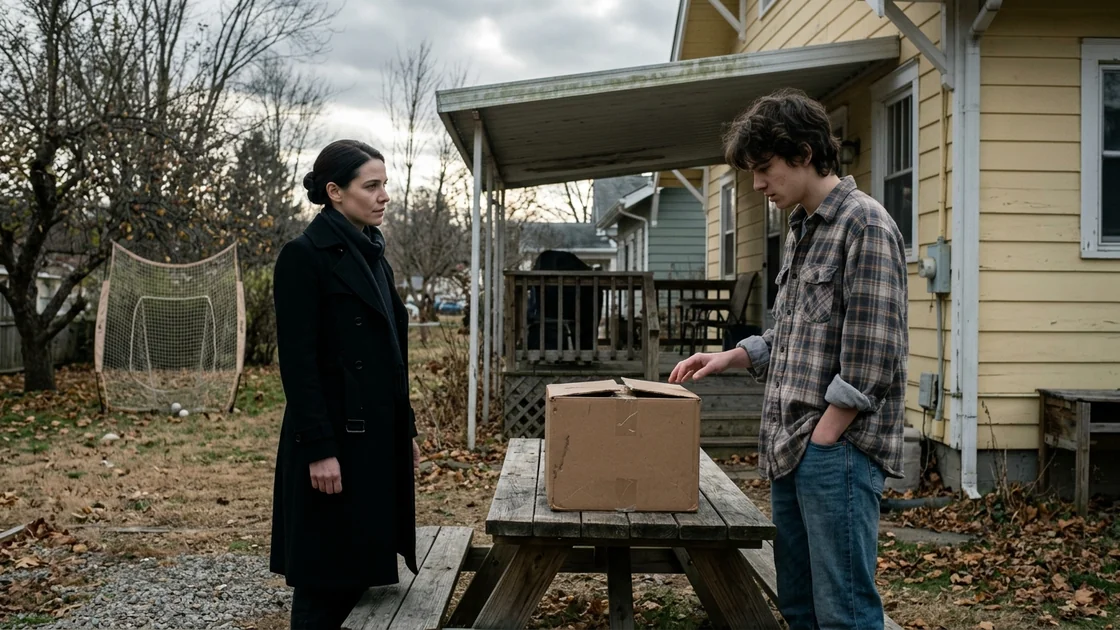
In the backyard, beneath a bare apple tree, stood Leo. He was wearing an oversized flannel shirt—one that clearly belonged to his father, the sleeves rolled up twice over his forearms—and he was throwing a baseball against a canvas pitch-back net set up near the shed. Throw, catch, throw, catch. His face was set in a hard, stony mask of concentration, his gray eyes fixed on the white square painted in the center of the nylon netting.
He looked so much like Arthur in that moment—not the happy Artie of the photographs on the stairs, but the silent, compartmentalized man of Elm Street—that a cold shiver ran down Clara’s spine. The boy was building a wall. She could see the bricks going up with every throw of the ball.
"You're dropping your elbow on the release," Clara said quietly, though she knew nothing about baseball.
Leo spun around, dropping the ball into the dry grass. When he saw her standing by the corner of the garage holding a cardboard box, he stiffened, his shoulders pulling back defensively.
"My mom's at the grocery store," he said, his voice flat and guarded. "If you're here to yell at her again, or take the house, or whatever—"
"I'm not taking the house, Leo," Clara said, walking across the lawn and setting the cardboard box down on the wooden picnic table under the patio awning. "The house is yours. Your dad made sure of that."
Leo stayed by the pitch-back net, his hands shoved deep into the pockets of his jeans. He looked at the box on the table as if it might contain explosives. "What's in there?"
"His other clothes," Clara said simply. "The ones he kept in my basement to change into before he came over here. His hiking boots. His watch. His wedding ring." She paused, looking at the boy’s bruised, exhausted eyes. "And some journals. I took the pages that belonged to my mother and me, and I left the ones that belong to you and your mom. I think you should read them when you're ready."
Leo swallowed hard, his Adam's apple bobbing in his thin throat. He took a hesitant step toward the picnic table, then stopped. "Did they say why he did it?"
"Yes," Clara said.
"Was he..." Leo’s voice broke, the stony mask cracking right down the middle to reveal the terrified sixteen-year-old underneath. "Was he just pretending with us? Because at school, I don't even know how to talk to my friends anymore. Everything I know about myself—the music I like, the way I fix my bike, everything he taught me—it feels like it's fake. Like I came from a ghost."
Clara looked at her brother, standing in their father’s flannel shirt in the November chill. She thought of the thirty-two years she had spent trying to interpret the blueprint of a man who hid his load-bearing walls underground. She couldn't rewrite her own childhood, and she couldn't bring back the mother who had faded away in the dark on Elm Street.
But she was an archivist. Her job was to preserve what was real so that the future could understand the past without being crushed by it.
"It wasn't fake, Leo," Clara said, taking a step closer to him. "I found a box in the basement today. He kept every article I ever wrote, every drawing I made when I was a kid. He loved me, in his own broken, terrified way—he just didn't know how to do it out loud in our house because he was too afraid of failing the people who knew who he used to be."
She gestured toward the yellow bungalow behind them, where the upright piano sat visible through the dining room window.
"With you and your mom, he got to start over without the armor," she continued softly. "The way he was with you—the jazz, the fishing, the baseball—that wasn't a mask he put on to trick you. That was who he actually wanted to be. It was unfair as hell to my mother and me that he stole our time to do it here instead of fixing things at home. I'm going to be angry at him for that for a very long time. Maybe forever."
She looked straight into Leo’s gray eyes—the eyes they shared.
"You don't have to hate him to respect what happened to us," Clara told him firmly. "And you don't have to throw away the things he taught you just because he was a deeply flawed man. The love he gave you was real, Leo. Don't let his lies turn you into the version of him that I grew up with. One of us being like that is more than enough."
Leo stared at her, his lower lip trembling violently. Slowly, he walked over to the picnic table and rested his calloused hand on the cardboard flap of the box.
"I don't know how to play the duet part on the trumpet by myself," he whispered, looking down at the faded cardboard. "The house is so quiet on Sundays now. It makes my ears ring."
Clara looked at the dining room window, remembering the gleaming alto saxophone she had handed back to her band director twenty years ago. She hadn't read sheet music in two decades, and her fingers would undoubtedly be stiff and clumsy on piano keys or brass valves.
"I used to play the alto sax," Clara said, surprised by the steadiness of her own voice. "In seventh grade. I was terrible at it, according to him, though I suspect I was just average and loud."
Leo looked up, a tiny, fragile spark of curiosity flickering through the grief in his eyes. "Do you still have it?"
"No. Put it back in the school locker room in 2004," Clara said. A small, dry smile—a real one, not the slight upward twitch of the Oakhaven portrait—touched the corners of her mouth. "They probably rent them down at the music shop on Commerce Street, though. And I have a lot of free weekends coming up now that I'm done packing boxes."
Leo wiped his nose on the flannel sleeve of Arthur’s shirt and nodded once, a tentative, jerky movement of his chin. "My mom makes really good pancakes on Sundays," he offered quietly. "Or apple crisp. She makes way too much of it now that it's just the two of us."
"I'd like that," Clara said. "Not tomorrow—I need a little time on my own side of the river first. Maybe the Sunday after Thanksgiving?"
"Yeah," Leo said, and for a fleeting second, when his mouth relaxed into a grateful, crooked half-smile, Clara saw the boy from the mountain stream photograph. "Yeah, the Sunday after Thanksgiving works."
Clara gave the top of the cardboard box a light tap with her gloved hand, offered her brother a nod, and walked back down the gravel driveway toward the street. As she started her car and pulled away from the curb of Sycamore Lane, the afternoon sun broke briefly through the heavy cloud cover over the river, catching the yellow siding of the bungalow in the rearview mirror, warm and bright against the fading autumn gray.