The Nocturne of Aethelgard
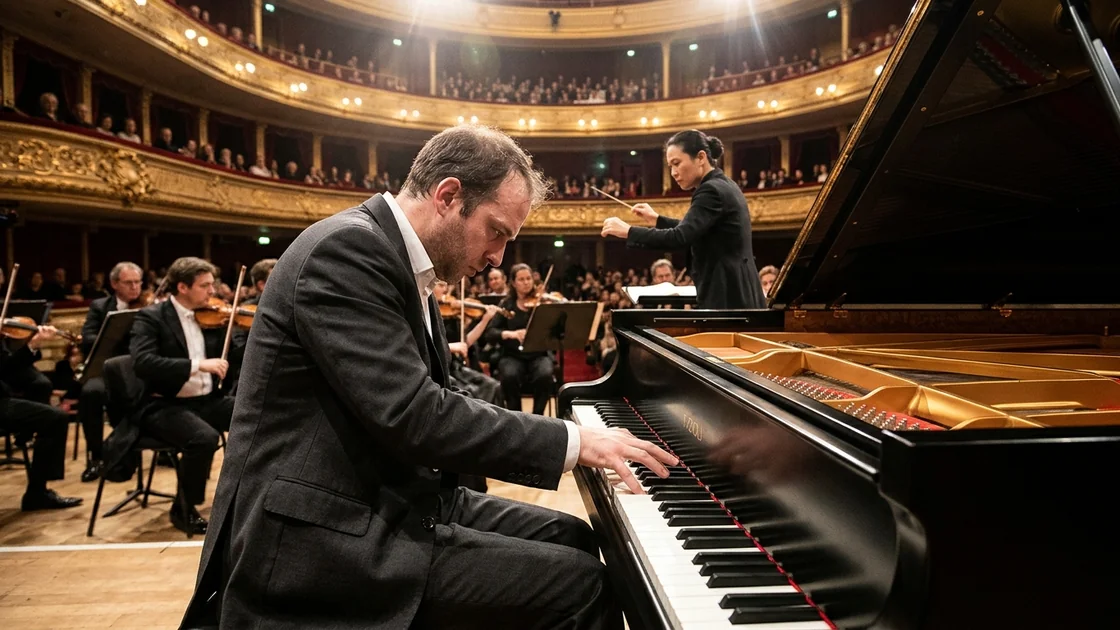
Arthur Pendelton was once hailed as the greatest piano prodigy of his generation, a boy whose fingers seemed to channel the very ghosts of the Romantic era before a catastrophic focal dystonia ended his career at nineteen. Now thirty-four, Arthur spends his nights waxing the linoleum floors of a decaying commuter terminal and monitoring security feeds, while his childhood conservatory cohorts, Julian Vance and Clara Lin, dominate the global classical circuit. This is the story of a single, relentless week in late November when an unannounced cargo delivery at the terminal, a chance live broadcast from Berlin, and an unexpected encounter in the dead of night force Arthur to confront the suffocated music within him and the vast gulf between the life he was promised and the quiet, anonymous existence he now inhabits.
The floor buffer had a faulty capacitor that hummed in a ragged, slightly flat B-flat. It was not the pure, resonant B-flat of a Bösendorfer Imperial’s sub-contra octave, nor even the bright, brassy B-flat of an over-tuned upright in a damp church basement. It was an industrial, sixty-hertz drone complicated by loose housing screws and forty years of accumulated floor wax. Yet, for six hours every night, between eleven in the evening and five in the morning, it was the primary accompaniment to Arthur Pendelton’s life.
Arthur walked behind the machine with the loose, unhurried gait of a man who had long ago learned to conserve his knees. The Great Concourse of the Saint Jude Transit Terminal stretched out before him like a sunken cathedral. Its vaulted ceiling, once painted with heroic murals of steam locomotives and winged mercury figures, was now obscured by a thick patina of diesel soot and pigeon droppings. The tall, arched windows let in the sodium-vapor orange of the city’s streetlights, slicing the darkness into long, geometric trapezoids across the terrazzo floor.
To keep his mind from drifting into the dangerous waters of memory, Arthur practiced polyrhythms with his footsteps. While the buffer droned its flat B-flat in a steady, implied four-four time, Arthur scuffed his steel-toed boots in a five-against-four cross-rhythm, tapping his left heel on the off-beats. One-two-three-four-five. One-two-three-four-five. It was an old habit from the Thorne-field Institute, an exercise Dr. Aris Thorne used to assign to his prepubescent charges to make their brains independent of their limbs. “If your left hand knows what your right hand is doing,” Dr. Thorne used to say, tapping his mahogany baton against the music stand with sharp, gunshot cracks, “then you are merely typing, Arthur. You are a secretary, not an artist.”
Arthur swung the buffer in a wide, practiced arc, guiding the swirling bristles around a row of bolted-down plastic chairs. His right hand—the traitor, the ruin—rested lightly on the rubber grip. Even now, fifteen years after the night in Munich when the fourth and fifth fingers had curled inward like dying spiders and refused to release the keys during the third movement of Rachmaninoff’s Third, the hand felt alien. In the cold drafts of the terminal, the ulnar nerve would occasionally twitch, a phantom arpeggio firing down the forearm only to die in the thickened tendons of the palm.
At 1:15 AM, Arthur clicked off the buffer. The sudden silence in the concourse was massive, rushing in to fill the space left by the motor. For a few seconds, the building seemed to breathe—a low, whistling sigh through the broken louvers of the ventilation shafts, followed by the distant, rhythmic clack-clack of a freight train bypassing the passenger platforms half a mile to the east.
He coiled the heavy orange extension cord around his elbow and shoulder, his movements precise and economical. Pushing the machine into the janitor’s closet beneath the grand staircase, he wiped his hands on a greasy rag and walked toward the security booth near the north entrance.
Inside the glass-walled booth, Harry was asleep. Harry was sixty-eight, retired from the postal service, and possessed the remarkable ability to sleep sitting bolt upright while appearing, from a distance of twenty feet, to be diligently scanning the twelve monochrome monitors stacked on the desk. A small portable television sat wedged between the time-card punch and a grease-stained microwave.
Arthur slid into the second swivel chair, the vinyl cracking beneath his weight, and poured lukewarm coffee from his thermos into its plastic cap. He glanced at the small television. Harry usually left it on the classic movie channel or late-night local news, the volume turned down to a whisper so as not to disturb his naps. Tonight, however, the local public broadcasting affiliate was running a special.
Arthur’s hand froze halfway to his mouth.
On the twelve-inch screen, bathed in the warm, golden glow of the Berlin Philharmonie’s stage lighting, sat Julian Vance.
Julian was thirty-four, the exact same age as Arthur, though time had treated them with wildly different intentions. Where Arthur had grown lean and slightly stooped, his hair thinning at the temples and his skin taking on the tallow hue of the perpetually nocturnal, Julian looked like a romantic engraving brought to life. His dark hair fell in a carefully careless sweep across his forehead. He wore a bespoke tailcoat that didn't bunch at the shoulders when he leaned into the keyboard.
The camera panned slowly around the glossy black curve of the Steinway D. The orchestra behind Julian was silent; he was in the middle of a cadenza. Even through the tinny, two-inch speaker of Harry’s portable television, the sound was unmistakable. It was Brahms’s Second Piano Concerto—a monster of a piece, four movements of symphonic weight that required the stamina of a long-distance runner and the touch of a surgeon.
Arthur set his coffee cup down carefully. His palm was sweating.
He didn't need to hear the audio clearly to know what Julian was doing. He knew Julian’s playing better than he knew his own voice. They had shared a suite at Thorne-field for six years. They had fought over practice room schedules, stolen each other’s metronomes, and stayed up until three in the morning analyzing Glenn Gould’s contrapuntal phrasing versus Richter’s structural architecture.
Julian had always been a slightly frantic player in his youth—brilliant, fast, possessing a natural facility that made sight-reading Liszt look like child’s play, but he had lacked weight. Dr. Thorne used to mock him for it. “Skating on the pond, Julian! You are skating on the ice! Look at Arthur—Arthur breaks the ice and drowns in the dark water beneath! That is where the music is!”
Watching the screen now, Arthur saw that Julian had learned to break the ice. His shoulders were dropped, his back a solid pillar, transferring the weight of his torso directly through his relaxed arms into the keys. The trills in his right hand were liquid, effortless.
A small craw-text appeared at the bottom of the screen: LIVE REBROADCAST: GALA FOR THE CENTENARY OF THE PHILHARMONIE. SOLOIST: JULIAN VANCE. CONDUCTOR: CLARA LIN.
The camera cut to the podium, and Arthur felt a second, sharper lance of cold pass through his chest.
Clara.
She stood with her baton poised in the air, waiting for Julian to finish the descending scale that would signal the orchestra's re-entry. Her black hair was pulled back into a severe, gleaming knot. Even on the low-resolution screen, her eyes were fierce, locked onto Julian’s hands with an intensity that excluded the two thousand people sitting in the hall around them. As Julian struck the final trill, Clara’s left hand rose—a slow, breathing gesture that seemed to pull the cellos up out of the floor—and her right arm swept down.
Arthur watched for twenty minutes. He watched the third movement, with its aching, transcendent cello solo, where Clara leaned toward the principal cellist as if drawing the melody from his bow with her bare fingers. He watched Julian answer from the piano, his head tilted back, eyes closed, his fingers whispering over the ivory in a pianissimo so delicate it barely registered on the television’s poor microphone.
This was the trio. The Thorne-field Three, the music press had called them back in the late nineties, when they were winning every junior competition from Warsaw to Fort Worth. Arthur, the poet-titan; Julian, the virtuoso; Clara, the structural genius who had abandoned the violin at seventeen because she realized the only instrument large enough for her mind was a hundred-piece orchestra. They were supposed to conquer the twenty-first century together.
Instead, two of them were in Berlin, dining with ambassadors and recording for Deutsche Grammophon, while the third was sitting in a glass box smelling of burnt coffee and Harry’s cheap menthol cigarettes, watching them through a layer of dust on a curved cathode-ray tube.
When the final movement ended, the television erupted into the white noise of distant, thunderous applause. Julian stood, wiping his brow with a white handkerchief, and walked to the podium. Clara stepped down, and they embraced. It wasn't the stiff, formal bow-and-shake of professional colleagues; Julian buried his face in her neck for a second, and Clara’s hand came up to cup the back of his head, her thumb brushing his hair. They were laughing, breathless, radiant with the shared adrenaline of having conquered a mountain together.
Arthur reached out with his left hand and pressed the power button. The image collapsed into a bright white dot in the center of the black glass, then vanished.
Harry snorted in his sleep, his head lolling to the left before his neck muscles caught it and jerked him upright again. "Clear on three," the old man mumbled to the empty air, then subsided back into rhythmic snoring.
Arthur stood up. The security booth suddenly felt airless, a coffin made of safety glass and laminated particleboard. He needed to walk the lower levels.
The subterranean baggage tunnels of the Saint Jude Terminal were a labyrinth of poured concrete, sweating pipes, and flickering fluorescent tubes that buzzed like dying cicadas. Because the terminal now only served three regional commuter rail lines and a handful of Greyhound buses, eighty percent of the underground infrastructure had been abandoned since the seventies.
Arthur walked with his flashlight beam pointed at his feet, listening to the tap of his heels. In his mind, the Brahms concerto was still playing, except now it wasn't Julian’s version. It was the version Arthur had worked on in the summer of his eighteenth year, just before the muscle spasms began.
He remembered the heat of that summer in Philadelphia. The air conditioning in the conservatory’s fourth-floor annex had broken, and he had practiced in his undershirt, sweat dripping from his chin onto the fallboard. Clara used to sit on the windowsill, her long legs drawn up to her chest, eating green apples and following the full orchestral score in her lap.
"You're rushing the transition at bar one-forty-two," she had said, her voice cutting through the ringing overtones of the chords.
"I'm not rushing," Arthur had replied, not taking his hands off the keys. "I'm pushing the phrase. It's an agitato."
"Brahms didn't write agitato. He wrote allegro appassionato. If you spend all your passion in the first thirty bars, Arthur, you’ll have nothing left when the horns come back in. You play like you’re trying to break the piano’s teeth."
She had hopped down from the sill then, walking over to stand behind him. She smelled of green apples and resin and the cheap lavender soap they bought at the pharmacy on Walnut Street. She had placed her cool, dry hands over his shoulders, pressing down firmly into his trapezius muscles.
"Breathe," she had whispered against his ear. "Let the tempo come from your ribs, not your wrists. Play it for me again."
And he had. With her hands on his shoulders, the manic urgency that always haunted his playing—the terrifying, unspoken knowledge that he was a kid from a bankrupt machinist’s family in Ohio who only existed in this gilded world as long as his fingers worked miracles—had melted away. The music had broadened, becoming vast and golden and unhurried.
Arthur stopped at the end of Tunnel C. Before him stood the heavy iron fire doors that separated the active terminal from the old freight depot.
His right hand was aching. Looking down in the spill of the flashlight, he saw that his fourth and fifth fingers had curled tightly into his palm, the knuckles white. Focal task-specific dystonia. That was the clinical name the neurologists in Boston, Zurich, and Tokyo had given it. A misfiring of the basal ganglia. The brain, having been forced to repeat microscopic, high-speed movements millions of times since the age of four, had essentially smudged the map of the hand. When Arthur’s brain sent the signal to extend the ring finger, the adjacent neural pathways fired simultaneously, ordering the flexor tendons to contract with maximum force. The harder he tried to play, the tighter the fist became.
"It is not in your hand, Arthur," the doctor in Zurich had told him gently, looking at the MRI scans. "Your hand is perfectly healthy. It is in the software. Your brain has learned the movement so deeply that it has fused the circuits together. If you are a carpenter, you can still hold a hammer. If you are a waiter, you can carry a tray. You can do anything in the world with this hand—except play the piano."
Arthur had tried everything. Botox injections that left his fingers hanging like dead meat for months. Splints that stretched the tendons until he wept into his pillow at night. Sensory retraining—spending four hours a day rubbing different grades of sandpaper and velvet with his eyes closed to try and trick his cortex into redrawing the sensory map.
Nothing worked. The scholarship dried up within six months. Dr. Thorne, who viewed biological failure as a form of moral weakness, stopped returning his calls after the second failed attempt at a comeback recital. Julian and Clara had stayed by his side for a year, bringing groceries to his cramped studio apartment, trying to include him in their theoretical discussions, offering to help him transition into musicology or arts administration.
Arthur couldn't bear it. He couldn't bear the pity in Julian’s eyes when Julian tried to hide his own bruised knuckles after an eight-hour practice session. He couldn't bear the way Clara looked at him—as if he were a widower at his own funeral. Most of all, he couldn't bear being near the sound. Being a musicologist when you were born to be a soloist was like being asked to critique food through a glass wall while starving to death.
So, one rainy Tuesday when Julian and Clara were in London for a competition, Arthur packed two suitcases, sold his upright Steinway to a local dealer for four hundred dollars less than it was worth, and got on a bus heading west. He changed his phone number. He didn't leave a forwarding address. He simply stepped off the stage of the world and walked into the wings, finding comfort in places where the ceilings were high, the work was mindless, and the only music was the hum of machinery.
With his left hand, Arthur gently pried his right ring finger and pinky open, massaging the cramped muscle at the base of his palm until the spasm subsided.
He turned to walk back toward the concourse when the freight elevator at the end of the corridor gave a loud, mechanical groan.
Arthur frowned, shining his beam toward the elevator shaft. The freight lift connected to the street-level loading dock on Fourth Street, which was supposed to be chained shut after midnight. Yet the steel cables were thrumming, grease-stained counterweights sliding past the wire-mesh cage as the car descended.
He walked back toward the main luggage sorting room, reaching for the heavy Maglite at his belt. Occasionally, copper thieves broke through the street grates to strip the old wiring from the abandoned sectors, though they rarely knew how to operate the three-phase switchgear for the freight lift.
The elevator reached the basement level with a heavy metallic thud. The inner safety gate rattled open.
"Watch the caster! Left side, left side—don't let it drop into the gap!"
The voice wasn't a copper thief's. It was crisp, authoritative, and carried a slight German inflection.
Arthur stepped around the concrete pillar into the sorting bay, where the overhead lights had been switched on. Three men in navy-blue coveralls with Klingmann & Söhne Fine Instrument Transport stenciled in white across their backs were maneuvering a massive, padded object off the elevator platform. Behind them stood Roy, the terminal’s night manager, holding a clipboard and looking thoroughly bewildered, as he rarely left his heated office on the mezzanine.
"Arthur! Good, you're down here," Roy called out, waving his pen. "Give us a hand with the double doors on Bay Four, will you? Key’s on your ring."
Arthur approached slowly, his eyes fixed on the cargo.
Even wrapped in three layers of quilted blue moving blankets and strapped horizontally onto a heavy oak skid board, the silhouette was as familiar to him as his own shadow. Nine feet long. The sweeping, asymmetrical curve of the rim. The heavy crate attached to the side containing the lyre and the three turned legs.
"What is this doing here?" Arthur asked, his voice sounding rusty in his own ears.
"Flight out of O'Hare got grounded because of the blizzard in Buffalo," the German foreman said, wiping sweat from his forehead with the back of his wrist. He looked exhausted. "We are driving it down from Chicago to the symphony hall here. Then we get to the hall at midnight, and the water main on the street has burst! The loading dock at the hall is under four inches of freezing water. The city crew says six hours to pump it out."
"And my cousin works dispatch for the symphony's logistics company," Roy chimed in with a proud little nod, tapping his clipboard. "Called me up in a panic. They couldn't leave a half-million-dollar piece of lumber sitting in the back of a truck in twelve-degree weather—the soundboard would crack before sunrise. Needed a climate-controlled vault with a loading dock for eight hours until the symphony hall dries out. Two hundred bucks cash for the terminal fund, fifty for me, fifty for you and Harry to keep an eye on it."
"Bay Four is seventy degrees," Arthur said automatically, his eyes still tracing the blue quilt. "Because of the steam main running through the ceiling. It's too dry, Roy. The humidity down here is below twenty percent."
The German foreman stopped strapping the dolly and looked sharply at Arthur. He took in the faded gray janitor's uniform, the name patch that read ART, and the calloused hands holding the key ring.
"He is right," the foreman said, pulling a small digital hygrometer from his vest pocket and glancing at it. "Eighteen percent. That is desert air. Is there a room without the steam pipes?"
"The old Customs Room," Arthur said before Roy could answer. "Through Bay Four, at the back. It’s got three-foot brick walls, no overhead steam lines, and the damp from the river keeps it around forty-five percent year-round. Sixty-two degrees."
The foreman stared at him for a moment, then nodded slowly. "Show us, please."
Arthur unlocked the heavy oak doors of the old Customs Room—a space unused since the days when trains came directly down from Montreal—and flipped the switch. Only half the bulbs worked, casting a dim, amber glow over the wood-paneled walls. The air smelled of old paper and damp mortar, cool and stable.
The foreman checked his meter, grunted in satisfaction, and waved his crew inside.
"Do we leave it on the skid?" one of the younger movers asked in German.
"No," the foreman replied in English, for Roy's benefit. "The technician from New York is coming at six in the morning to check the action before it goes to the hall at nine. The Maestro insisted the piano be on its legs for four hours before the tuning so the frame settles. Put it up."
Arthur stood in the shadow by the door frame, motionless, as the three men worked with the terrifying, balletic efficiency of roadies who handled priceless artifacts daily. They unstrapped the quilted shroud.
When the fabric fell away, Arthur felt his breath catch.
It wasn't a standard concert Steinway. The rim wasn't the thick, polyester-resin black that reflected light like a mirror. It was a satin-finish ebony, hand-rubbed, with the subtle grain of the wood visible beneath the lacquer. On the side of the fallboard, inlaid in pale brass, was the name: Fazioli.
It was a Fazioli F308. The largest grand piano in the world, ten feet two inches from the nose to the tail, possessing a fourth pedal that brought the hammers closer to the strings without shifting the keyboard. There were fewer than a dozen of them on the North American continent.
The movers tipped the massive body onto its three legs, locking the heavy brass bolts into place and securing the pedal lyre. When they lifted the lid onto its half-stick prop, the interior gleamed like a jewelry box—the gold-leaf cast-iron plate, the pristine red felt, the copper-wound bass strings as thick as ships' cables.
"Who is playing this tomorrow?" Arthur asked. He hadn't meant to speak out loud.
The foreman, who was signing Roy’s clipboard, glanced over his shoulder. "The Gala tomorrow night at the Symphony Center. Julian Vance is flying in from Berlin this afternoon. He only plays this instrument when he is in the States. We drive it wherever he goes."
The foreman capped his pen, handed Roy a thick envelope, and looked back at Arthur. "Nobody touches it. You understand? The lid stays on the half-stick so the wood breathes the room air, the fallboard stays unlocked so the felt doesn't compress, and nobody goes within five feet of it. My man will be back at 0600 with the technician."
"Nobody's going near it, pal," Roy said, patting his breast pocket where the envelope now resided. "Art here is the quietest guy on the payroll. He'll just lock the door and do his rounds."
Wait until they leave. Just wait until they leave.
The thought didn't even feel like his own; it rose from the base of his skull, urgent and hot.
It took twenty minutes for the German crew to haul their empty skid back to the elevator, and another ten for Roy to waddle back up the stairs to his mezzanine office, after slipping two crisp twenty-dollar bills and a ten into Arthur’s breast pocket.
"Keep the door locked, Artie," Roy said, panting slightly at the top of the stairs. "I'm gonna catch forty winks before the five-thirty commuter comes in."
"Sure thing, Roy."
Arthur stood at the bottom of the stairs until he heard the distant click of Roy’s office door latching. The terminal was dead still. Up in the booth, Harry would be entering his third hour of REM sleep. The next bus didn't arrive until 4:40 AM from Toledo.
Arthur walked back down the concrete corridor. His footsteps weren't tapping five-against-four anymore. They were silent, his rubber soles gliding over the dust.
He unlocked the Customs Room door, stepped inside, and pulled it shut behind him.
The Fazioli sat in the center of the room under a single working chandelier bulb, looking like a black swan that had wandered into a slaughterhouse. The contrast between the instrument’s perfection and the peeling paint and water-stained plaster of the room was almost violent.
Arthur approached it slowly, keeping his hands in his pockets. He stopped three feet away and just breathed. The scent of a great piano is unlike anything else: a mixture of aged Val di Fiemme spruce, beeswax, wool felt, and cold brass. It was the smell of his childhood. It was the smell of promise.
He hadn't touched a keyboard in nine years. Not since a drunken night in a roadhouse outside of Gary, Indiana, when he had tried to play a Chopin nocturne on a battered Baldwin spinet with three missing ivories, only to have his right hand lock into a claw within twelve bars while a waitress asked him if he knew any Billy Joel. After that night, he had made a pact with himself. If he didn't touch the keys, he wasn't crippled; he was simply retired. As long as the fallboard remained closed, he was still, in some theoretical quantum state, the boy who had made Aris Thorne weep during the finals of the Queen Elisabeth Competition in Brussels.
He pulled the heavy leather concert bench back from beneath the keyboard. It was a hydraulic bench, set precisely to Julian’s height. Julian had longer legs than Arthur, by about an inch and a half.
Arthur sat down. The leather was cold through his thin uniform trousers. Without thinking, his left hand reached down to the brass knob on the side of the bench and gave it three half-turns counter-clockwise, dropping the seat to his own exact geometry.
He lifted the fallboard.
Eight-eight keys gleamed in the dim amber light. The naturals were covered in genuine ox-bone rather than plastic, the sharps carved from dense African ebony.
Arthur raised his left hand—his good hand, his faithful servant—and rested the fingertips on the surface of the keys in the bass register, without depressing them. The bone was cool, slightly porous, drinking in the warmth of his skin.
Just the left hand, he told himself. There is a whole repertoire for the left hand. Ravel wrote a concerto for Wittgenstein. Scriabin wrote the Prelude and Nocturne after he ruined his right hand practicing Liszt.
Slowly, with a control that made the hairs on his arms stand up, Arthur let the weight of his left arm sink into a low C-sharp.
The hammer rose, kissed the three unison strings, and fell back.
The sound didn't just fill the room; it seemed to push the brick walls outward. It was a dark, velvety purr that started in the floorboards, traveled up through the soles of his boots, vibrated in his femur bones, and settled directly behind his sternum. A cheap piano makes a noise when you hit it; a great piano reveals a sound that feels as though it was already waiting in the air, needing only to be uncovered.
Before the C-sharp had decayed, Arthur’s left thumb reached up an octave and a fifth to strike the G-sharp, and then his fingers began to walk—rolling the wide, arpeggiated accompaniment of Scriabin’s Nocturne for the Left Hand alone, Opus 9, Number 2.
His right hand stayed safely tucked between his knees, clamped tight so it couldn't interfere.
For the first four bars, his left hand was clumsy. The calluses from the mop handle and the floor buffer made the pads of his fingers insensitive, like he was playing through gardening gloves. The leaps from the bass notes to the singing upper register were hesitant, his muscle memory rust-bound and creaking.
By the eighth bar, the rust began to flake off.
His left foot found the una corda pedal, and his right foot worked the sustain with microscopic half-pedaling flutters, catching the bass notes while clearing the mud from the upper melody. The trick of the Scriabin Nocturne is that one hand must pretend to be two: the thumb and index finger must sing a floating, operatic soprano line at the top of the keyboard while the pinky and ring finger dive down to the basement to provide a rich, surging harmonic foundation, all connected by lightning-fast lateral leaps that must sound completely unhurried.
Arthur closed his eyes. The Customs Room vanished.
He wasn't thirty-four anymore, and he wasn't in a basement. His brain, starved for fifteen years of the complex neurochemical cocktail that only high-level musical execution provides, lit up like a city grid coming back online after a blackout. He remembered every marking on the score, including the pencil smudges Dr. Thorne had made in the margins in 1996. Con languido. With languor.
The melody rose, aching and nostalgic, sliding through Scriabin’s lush, decadent chromaticism. When the cadenza arrived—a cascading waterfall of thirty-second notes that required the five fingers of the left hand to cross over and under one another with the speed of a hummingbird's wings—Arthur didn't hesitate. He let the arm drop, rotated his forearm with the supple whip-motion he had spent twenty thousand hours perfecting as a child, and let the notes fly.
They were clean. God in heaven, they were clean. Every note was a pearl on a silk string, shimmering in the damp subterranean air.
And then, as the music swelled toward its central, passionate climax in D-flat major, the ghost of the right hand woke up.
The Scriabin was written for one hand, yes, but the sheer density of the sound Arthur was pulling from the Fazioli made his brain forget the restriction. In his mind, the score expanded, demanding the full ten-fingered orchestral roar of a Rachmaninoff climax. Without conscious thought, pulled by a gravitational force stronger than his fear, Arthur’s right hand slipped out from between his knees and rose toward the treble register.
For three glorious seconds, as both hands came down in massive, sprawling tenths across the upper and lower halves of the keyboard, he was whole. The sound was volcanic. The ten-foot soundboard roared, the brass chandeliers overhead humming in sympathetic resonance. Arthur’s heart hammered against his ribs like a trapped bird, a sob rising in his throat from the sheer physical ecstasy of commanding that much beauty.
On the fourth bar, during a fast chromatic run in the upper octave, the trap snapped shut.
It felt like an ice pick driven into the ulnar tunnel of his right wrist. His fourth finger struck an F-sharp, and instead of rebounding, it locked straight down into the keybed while his fifth finger curled violently inward, tucking itself beneath the third finger like a broken wing. His index finger shot straight up into the air, rigid as a bone.
The run collapsed into a hideous, cluster-chord smash of adjacent notes—a grotesque, dissonant splat that sounded like someone dropping a tray of silverware down a flight of stairs.
Arthur gasped, ripping his right hand back from the keyboard as if the ox-bone keys had turned to white-hot iron.
The left hand stopped dead. The sustain pedal remained down for a second too long, allowing the ugly, mangled dissonance to hang in the air, vibrating against the brick walls, mocking the beauty that had preceded it.
Arthur sat hunched over the bench, cradling his right forearm against his chest, panting in the sudden, ringing silence. His right ring finger and pinky were clamped so tightly into his palm that his fingernails were cutting half-moon indentations into his flesh. Tears—hot, furious, and humiliating—spilled over his lower lashes and dropped onto the polished ebony of the key slip.
He reached into his pocket with his left hand, pulled out his dirty handkerchief, and frantically wiped the two drops of salt water from the wood, terrified of leaving a trace.
That was when he heard the click of a heel on the concrete outside the door.
Arthur froze. The door was locked from the inside—or so he had thought. In his trance, he had only pulled it shut without turning the deadbolt.
The heavy oak door swung inward two inches, then stopped, as if the person on the other side were hesitating. Then it pushed all the way open.
Standing in the threshold, silhouetted against the harsh white fluorescent light of the baggage tunnel, was a woman in a long camel-hair coat. A silk scarf was wrapped loosely around her throat, and her dark hair was pulled back into a low, slightly disheveled knot, as if she had just come off a nine-hour transatlantic flight.
Arthur didn't breathe. His right hand remained tucked inside the fold of his gray janitor’s jacket, hidden like a weapon.
Clara Lin stepped into the room.
She didn't look at him at first; her eyes went straight to the Fazioli, drawn by the lingering vibrations in the air. Then her gaze shifted to the man sitting on the bench.
In the dim amber light, she saw the gray trousers, the steel-toed boots, the faded blue work shirt, and the thinning hair. She frowned, taking a half-step back, her hand tightening on the strap of her leather briefcase.
"Excuse me," she said. Her voice was lower than it had been at nineteen, richer, carrying the natural projection of someone accustomed to speaking to the back row of a brass section without a microphone. "The night manager upstairs told me the instrument was secured here. You shouldn't be—"
She stopped.
Arthur hadn't moved his head, which was bowed slightly, the light from the single bulb catching the sharp bridge of his nose and the deep, familiar hollow beneath his left cheekbone.
Clara’s briefcase slipped from her fingers, hitting the concrete floor with a dull thud.
"Arthur?"
It wasn't the conductor's voice anymore. It was the girl on the windowsill on Walnut Street, whispering through the heat.
Arthur slowly closed the fallboard over the keys, easing it down on its hydraulic hinges until it kissed the keybed in silence. He stood up, keeping his right hand jammed deep into his trouser pocket, and turned to face her.
"Hello, Clara."
For a full ten seconds, neither of them moved. The subterranean drip of river water somewhere behind the brickwork ticked like a slow metronome. Clara stared at him as if he were an apparition conjured out of the coal dust and shadows of the terminal. Her eyes traveled from his face down to the oval name patch sewn over his left breast—ART—and then to the broom leaning against the wall near the door.
"My God," she breathed, her hand rising to cover her mouth. She took two unsteady steps toward him, then stopped, as if afraid that coming too close would cause him to evaporate, just as he had thirteen years ago. "Arthur... is it really you?"
"It's me," he said. He tried to smile, to offer some jaunty, self-deprecating shrug that would defuse the terrible weight in the room, but his face felt like dried clay. "You're supposed to be in Berlin. I saw you on television three hours ago."
"That was taped on Tuesday," she said, her voice trembling. Her eyes were wide, shining with a sudden, fierce moisture in the amber light. "We flew into Chicago this morning after the concert, then drove down when the flights were canceled. Julian went to the hotel to sleep. I... I couldn't sleep. The airline lost my baton case in Frankfurt, and I was worried about the piano after the water main broke at the hall, so I took a cab here to check the humidity myself..."
She trailed off, shaking her head as if the logistics of her evening were an absurd joke in the face of what she was looking at.
"Forty-four percent," Arthur said quietly, nodding toward the wall. "Sixty-two degrees. The soundboard is fine. The fourth octave G-sharp is a little flat, probably from the temperature change on the truck, but the technician will fix that in two minutes."
Clara wasn't listening to the tuning report. She crossed the remaining distance between them. She didn't ask permission; she reached out with both hands and took his face between her palms.
Her hands were warm and smelled faintly of expensive hand cream and the wool of her coat, instead of the lavender soap of his memories, yet the touch of her thumbs against his cheekbones was a physical shock that nearly buckled his knees. Arthur stood rigid, enduring the touch like a man standing in a high wind.
"Where did you go?" she whispered, searching his eyes with a desperate, almost angry intensity. "Arthur, we looked everywhere. Julian hired a private investigator in New York. We went to Ohio, to your uncle's house, and he said he hadn't heard from you in two years. We thought—after the second year, Julian thought you had done something to yourself."
"I'm sorry," Arthur said, looking past her shoulder at the peeling paint on the door. "I didn't mean to make you think that. I just needed to get away from the conservatory. From the noise."
Clara’s hands dropped from his face to his shoulders, her fingers gripping the cheap polyester blend of his uniform jacket. "For thirteen years, Arthur? Thirteen years without a postcard? Without a phone call to say 'I am alive, don't look for me'?"
"If I had called," Arthur said, his voice dropping an octave, rough and raw, "you would have come. Just like this. You would have stood in front of me in that coat, smelling like concert halls and airplanes, and you would have tried to save me. And I couldn't be saved, Clara."
"I heard you from the hallway," she said fiercely, her chin coming up in that stubborn, defiant angle he knew so well. "Before the door opened. I was walking down that awful tunnel, and I heard the Scriabin. I thought I was hallucinating from jet lag. Nobody on this earth plays a left-hand rubato like you do, Arthur. Nobody pulls the tempo back on the sixth beat and still keeps the pulse alive. Julian can't do it. Kissin can't do it. You're standing here in a janitor's uniform telling me you're dead, and thirty seconds ago you were making a Fazioli sing like it was the nineteenth century!"
"And did you hear the end of it?" Arthur snapped, the quiet veneer cracking.
Before he could stop himself, he yanked his right hand out of his trouser pocket and held it up between them, inches from her face.
The spasm hadn't fully released. The ring and pinky fingers were still hooked violently into the palm, the tendons on the underside of his wrist standing out like taut steel wires, quivering with a microscopic tremor.
"Did you hear that part, Maestro?" he asked, his voice shaking with a bitterness he had kept corked in the dark for over a decade. "That’s the coda. That’s what happens when I forget what I am for three seconds. I can wax a floor for six hours with this hand. I can change a ballast in a fluorescent fixture. I can scrub a toilet. Give me fifty-two white keys and thirty-six black ones, and my brain turns it into a claw."
Clara looked down at the crippled hand. She didn't flinch away from it, as Dr. Thorne had done in the green room in Munich, looking at Arthur’s hand as if it had contracted leprosy. Instead, Clara reached up and wrapped her slender fingers around his clenched fist, bringing it against her own chest, right over the lapel of her camel-hair coat.
She held it there, pressing her palm over his rigid knuckles, applying a steady, warm pressure, just as she had done to his shoulders in the sweltering practice room in Philadelphia.
"Breathe, Arthur," she murmured, a tear finally escaping her eye and tracking a bright path down her cheek. "Just breathe."
Arthur closed his eyes, his forehead dropping forward until it rested against the crown of her head. Her hair smelled of rain and cold night air. Beneath the wool of her coat, he could feel the steady, rhythmic thud of her heartbeat—andante sostenuto, seventy-two beats per minute. Gradually, almost imperceptibly, as the warmth of her hands soaked into his skin and the panic in his basal ganglia subsided, the vice in his palm loosened. The fourth and fifth fingers uncurled, straightening out against the fabric of her coat until his hand lay flat over her heart.
They stood like that in the center of the Customs Room for a long time, the disgraced prodigy and the world-renowned conductor, leaning against each other in the dust while the ten-foot Fazioli gleamed silently beside them.
At 3:30 AM, Arthur took her to the only place in the neighborhood that was open: an all-night diner across the street from the terminal’s south taxi stand, a narrow stainless-steel box called the Silver Rail where third-shift factory workers and insomniac cabbies drank chicory coffee under harsh white neon.
Clara looked absurdly out of place in the red vinyl booth, her camel-hair coat folded neatly beside her, her diamond stud earrings catching the light from the pie display case. Yet she seemed entirely oblivious to the grease on the laminated menu or the curious glances from the short-order cook. She had spent her youth eating seventy-cent ramen out of hot pots in conservatory dorm rooms; the glamour of her current life sat on her lightly, like a costume she wore only for the stage.
Arthur sat across from her, his hands wrapped around a heavy ceramic mug.
"Tell me what happened after you left," she said, stirring sugar into her black tea without drinking it. "Everything. Where did you go on that bus?"
"Pittsburgh first," Arthur said, looking down into the black circle of his coffee. "I washed dishes in an Italian restaurant for six months. Then I worked on a loading dock in Columbus. Then a lumberyard in Toledo. I moved every year or two at first, mostly because someone would eventually ask too many questions, or there would be a radio playing classical music in the break room and I’d have to walk out."
"And how long have you been here?"
"Seven years. I have a one-bedroom apartment on the third floor of a brownstone about four blocks east. It’s right next to the elevated train tracks. Every twenty minutes, the windows rattle so loud you couldn't hear a Mahler symphony if it was being played in the living room. I like it."
Clara winced at that. "Do you have... anyone, Arthur? Are you married?"
Arthur gave a dry, humorless chuckle. "Who would I marry, Clara? And what would I tell her? 'Hello, I'm Arthur, I clean the bus station at night, and by the way, I have an imaginary orchestra playing inside my skull twenty-four hours a day that makes it impossible for me to hold a normal conversation without analyzing the cadences of your voice'?" He shook his head. "I tried dating a girl who worked at the pharmacy down the street about four years ago. She was very kind. One night we went to a movie, and they used the second movement of Beethoven's Seventh in the soundtrack. I started crying so hard in the theater I threw up in the lobby trash can. People don't want to live with a ghost."
He looked up at her then, taking in the faint lines at the corners of her eyes, the poised authority in the way she held her shoulders, and the bare ring finger on her left hand.
"What about you and Julian?" he asked softly. "I saw the broadcast tonight. When the Brahms ended. You two looked... together."
Clara looked down at her tea, a faint, sad smile touching her lips. "We tried," she admitted. "About two years after you disappeared. We were in Vienna, both of us lonely, both of us still mourning you, though we didn't realize at the time that that was what we were doing. We stayed together for three years. The press loved it, of course. The golden couple of the podium and the keyboard."
"Why didn't it last?"
"Because Julian is in love with the audience," she said simply, without malice. "There is no room for a third person in that marriage. When Julian walks offstage, if the applause wasn't loud enough, he ceases to exist until the next concert. He needs someone who will spend their life holding up a mirror to tell him he is still gleaming. And I..." She looked up, meeting Arthur's eyes directly. "I was spoiled when I was eighteen by a boy who didn't care if there was anyone in the hall at all, as long as the phrasing was honest."
A heavy silence fell over the booth, broken only by the hiss of bacon hitting the flat-top grill behind the counter and the low murmur of the police scanner the cook kept by the register.
"He still talks about you, you know," Clara continued, her voice softening. "Whenever he records something we all learned at Thorne-field. Last year, in London, he was recording the Chopin Ballades for Decca. We spent six hours on the Fourth Ballade—the F minor. He did fourteen takes of the coda, and the producer was thrilled, saying it was the fastest, cleanest version since Zimerman. And Julian sat in the control room listening to the playback, and he threw his pencil across the room and said, 'It sounds like a sewing machine. Arthur used to make the left hand sound like church bells under water. How did he do the pedaling on bar two-oh-two?'"
Arthur stared at the table, his throat constricting. "You use the middle pedal to catch the low F before the right hand starts the chromatic thirds," he whispered automatically. "Then you flutter the damper at the top of the phrase so the overtones bloom without blurring the soprano."
"I know," Clara said softly. "I told him that. He couldn't do it. His foot isn't fast enough."
She reached across the Formica table and laid her hand over his left wrist.
"Come to the hall tomorrow, Arthur. Not just for the concert. Come to the rehearsal at ten. Come see Julian. Come back to the world. You don't have to play. You have the greatest ear of anyone alive—you could teach, you could produce recordings, you could work with me on scores! Do you have any idea how many twenty-year-old kids at Juilliard and Curtis are playing like robots right now because there’s nobody left who understands the old Russian school the way Thorne taught you?"
Arthur looked at her hand on his wrist. For a wild, dizzying moment, the door of his prison swung open, and he saw the sunlit country beyond it. He saw himself sitting in the warm wood-paneled studios of a conservatory, talking about voice-leading in late Schubert with kids whose eyes burned with the same fire his once had. He saw himself sitting in the front row of the Philharmonie, watching Clara conduct, having dinner with her afterward in little restaurants in Berlin and Paris, arguing about tempo markings over wine until two in the morning.
Then he looked down at his own sleeve—stained at the cuff with industrial floor stripper—and felt the dull, constant ache in the ulnar nerve of his right forearm.
If he went back into that world, he would be "Poor Arthur." He would be the cautionary tale whispered about by conservatory freshmen in the hallways: See that guy teaching the sight-singing seminar? That’s Arthur Pendelton. He used to be better than Julian Vance before his hand broke. And worse, he would have to sit ten feet away from pianos every single day, smelling the spruce and the wool felt, knowing he could never possess them again. In the bus terminal, he was an anonymous man with a broom. In the music world, he was a eunuch in a harem.
"I have to get back across the street, Clara," he said, gently sliding his wrist out from under her fingers. "The 4:40 from Toledo is pulling in soon, and if Roy wakes up and finds the concourse hasn't been mopped by gate six, he'll dock my pay."
Clara’s face fell, the frustration and grief warring in her dark eyes. She reached into her purse, pulled out a thick cream-colored envelope with the logo of the Symphony Center embossed in gold on the flap, and slid it across the table until it touched his coffee mug.
"There are two house seats in there for tomorrow night," she said, her voice tight, holding back tears through sheer conductor's discipline. "Box A, right over the keyboard. And my cell phone number is written on the back, along with our room numbers at the Drake. The technician comes for the piano at six. We rehearse the Brahms from ten until noon. If you don't come tomorrow night, Arthur... I swear to God, I will bring the entire brass section of the symphony down to that bus station and have them play Mahler Five in your lobby until they fire you."
Despite everything, a real smile—small and rusted, but genuine—pulled at the corner of Arthur’s mouth. "The acoustics in the main concourse are actually quite good for brass," he said. "About a four-second reverb decay. Though the trombones might wake up Harry."
He picked up the cream envelope and slipped it into his jacket pocket, right next to Roy’s fifty dollars.
At 6:00 AM sharp, the German moving crew returned, accompanied by a gaunt, bespectacled man carrying a leather toolkit—Julian’s traveling Steinway-and-Fazioli technician.
Arthur stood twenty feet away in the baggage tunnel, leaning on his push broom, watching through the open door as the technician ran a series of rapid, mechanical chromatic scales up and down the Fazioli to test the action after its night in the damp vault. The man wasn't playing music; he was testing machinery, striking each key three times—fortissimo, mezzo-forte, pianissimo—listening for any sluggishness in the whippen assemblies or changes in the hammer voicings.
Yet, when the technician reached the fourth octave G-sharp, he paused, frowned, tilted his head, and pulled his tuning lever from his roll to bring the string up three cents, just as Arthur had told Clara he would.
By 6:45 AM, the Fazioli was wrapped once more in its quilted blue armor, strapped to the oak skid, and swallowed by the freight elevator. When the iron gate clanged shut and the cables groaned, pulling the great black swan back up into the daylight world where it belonged, the Customs Room looked smaller, dirtier, and infinitely more desolate than it had the night before.
Arthur punched out at 7:00 AM, walked the four blocks through the gray, slush-filled streets of the waking city, and climbed the three flights of stairs to his apartment.
The room was small, impeccably neat, and utterly devoid of anything that produced sound. There was no television, no radio, no laptop. The walls were lined from floor to ceiling with second-hand paperbacks—histories of the Roman Empire, books on botany, treatises on civil engineering and bridge construction, subjects as far removed from counterpoint and harmony as humanly possible.
Normally, Arthur would drink a glass of water, pull the heavy blackout curtains across the window facing the elevated train tracks, and sleep until three in the afternoon.
Today, he didn't draw the curtains.
He sat on the edge of his narrow iron bed, took the cream-colored envelope from his pocket, and laid it on the bedside table. Inside were two heavy cardstock tickets printed in gold ink: SYMPHONY CENTER GALA. CLARA LIN, CONDUCTOR. JULIAN VANCE, PIANO. BRAHMS: CONCERTO NO. 2 IN B-FLAT MAJOR, OP. 83.
On the back of the envelope, in Clara’s sharp, forward-leaning hand—the same handwriting that used to fill his margins with critiques in green ink—was a Berlin mobile number with a plus-forty-nine country code, and below it: Room 1412. Please.
Arthur lay back on the bedspread in his work clothes, staring up at the water stain on the plaster ceiling while the 7:15 commuter train roared past twenty feet outside his brick wall, rattling the windowpanes in their frames.
His brain wouldn't shut off. The Scriabin Nocturne was still vibrating in the nerves of his left arm, and beneath it, like an approaching thunderstorm, the opening horn call of the Brahms Second Concerto kept sounding in his inner ear. B-flat, F, B-flat, D... answered by the solo piano in quiet, noble chords before exploding into the massive opening cadenza that set the tone for the next fifty minutes of music.
He didn't sleep. He lay there as the grey morning light turned to the flat white of noon, and then slowly bruised into the purple dusk of a November evening.
At five o'clock, Arthur stood up, walked to the back of his small closet, and pushed aside the row of grey and navy work shirts.
At the very back, sealed inside a heavy plastic dry-cleaning bag yellowed with age, hung a black wool suit. It wasn't a tailcoat—he had left his concert tails in a dumpster behind the Philadelphia apartment thirteen years ago—but it was the dark charcoal suit Dr. Thorne had bought for him in Milan when he was eighteen, for press conferences and preliminary rounds.
Arthur unzipped the bag. A faint ghost of cedar and old cologne drifted out.
He showered, shaving with slow, deliberate strokes in the cracked bathroom mirror, trimming the grey hairs at his temples with small scissors. When he put on the white dress shirt, the collar was half an inch too big for his neck, which had lost the thick muscularity of his youth, and the trousers hung slightly loose around his waist, requiring him to cinch his belt to the tightest notch. Yet the Milanese wool still had its drape, falling cleanly from his shoulders.
He stood by the bedside table, looking down at the tickets.
It was a twenty-minute subway ride downtown to Michigan Avenue. The concert began at eight. If he left at seven, he could slip into the hall just as the house lights went down, sit in the back of the box where Julian wouldn't see him from the stage, listen to the music, and slip out during the applause before the stage door opened. He wouldn't have to speak to anyone. He could just hear Clara and Julian one last time, with his own ears instead of through Harry’s two-inch television speaker, and then return to his broom and his buffer.
At 6:35 PM, his apartment door shook under a series of sharp, urgent knocks.
Arthur froze, his hand halfway into the sleeve of his wool overcoat. Nobody had ever knocked on his apartment door. The landlord slipped rent receipts under the sill; the neighbors on the third floor were an elderly Polish couple who didn't speak English.
"Arthur! Arthur, open the door, I know you're in there!"
Arthur’s heart dropped into his stomach.
He walked slowly to the door, unlatched the deadbolt, and pulled it open.
Clara stood in the narrow, dimly lit hallway, smelling of cold wind and panic. She wasn't dressed in her concert attire yet; she wore black trousers and a heavy turtleneck sweater under her unbuttoned camel coat. Her face was pale, her dark eyes wide and frantic.
"How did you find out where I live?" Arthur asked, bewildered.
"You told me last night—four blocks east of the terminal, third floor, next to the train tracks! There are only six brownstones on this block with three floors, Arthur, I rang every bell until I found a mailbox with 'Pendelton' written in pencil!"
She pushed past him into the tiny apartment, barely glancing at the spartan walls of books before spinning around to face him. When she saw that he was wearing the Milanese suit, a flicker of relief crossed her face, instantly replaced by the returning wave of terror.
"What's wrong?" Arthur asked, his instincts immediately sharpening. "Is it the piano? Did the soundboard crack when they moved it into the hall?"
"No, the piano is fine," Clara said, her hands shaking as she pushed a loose strand of hair back from her forehead. "It’s Julian."
"What happened to him?"
"He’s in the emergency room at Northwestern Memorial," she said breathlessly. "We had a late lunch after the rehearsal around three o'clock, and by five he was doubled over on the floor of his suite at the Drake with a hundred-and-three-degree fever. Acute appendicitis. They’re prepping him for laparoscopic surgery right now."
Arthur stared at her, processing the words. "Then you have to cancel the concerto. Play an overture and put the symphony on the first half."
"We can't!" Clara’s voice rose, echoing off the bare plaster walls. "Arthur, this isn't a subscription concert! It's the annual donors' gala and the live international broadcast for the European Broadcasting Union! The President of the Board told me twenty minutes ago that thirty percent of the endowment pledges for the next five years are sitting in the hall right now eating caviar, and the satellite feed to Munich, London, and Tokyo goes live at 8:15! If we don't put a soloist on that stage, it’s a two-million-dollar catastrophe for the orchestra!"
"Then call the dean at the conservatory downtown," Arthur said reasonably. "Or get the orchestra's principal keyboardist to play a Mozart concerto from the score—"
"The EBU contract is for a major Romantic piano work, and the orchestra has only rehearsed the Brahms and the Ravel Left-Hand Concerto from our tour program last month!" Clara stepped right up to him, grabbing the lapels of his charcoal suit. Her eyes burned into his with a terrifying, fanatical brightness. "Do you hear what I just said, Arthur?"
The room went dead silent. Even the traffic outside seemed to fade away.
"The orchestra," Clara repeated slowly, her voice dropping to a fierce, hypnotic whisper, "just came off a three-week tour where the alternate concerto on the program was the Ravel Concerto in D Major. For the Left Hand."
Arthur felt the blood drain from his face, leaving his skin icy cold. He took a step back, pulling his lapels out of her grip, until the backs of his knees hit the iron frame of the bed.
"You're out of your mind," he whispered.
"The parts are in the library downstairs at the hall! The librarian is putting them on the stands right now!"
"Clara, stop! Listen to yourself!" Arthur held up his hands, backing away as if she were holding a loaded gun. "I haven't played with an orchestra since 2009! I haven't played the Ravel since I was twenty-one, during the first year after my hand went bad, when I still thought I could have a career playing one-handed repertoire! That was thirteen years ago!"
"You know every note of that score," she said relentlessly, advancing on him. "We studied it together for four months after Munich! You used to play the jazz trombone glissandos in the middle section on the upright in your apartment until the neighbors banged on the pipes with a wrench! It’s twenty minutes of music, Arthur. One continuous movement. And your right hand doesn't have to come within two feet of the keyboard."
"I am a janitor!" he shouted, the volume of his own voice shocking him in the quiet room. "Look at my fingers, Clara! Look at them!"
He thrust his left hand under the lampshade. The skin was roughened by bleach, the nail of the index finger slightly split from prying open a jammed paper towel dispenser three nights ago, a thick yellow callus running along the ridge of the palm.
"You think I can walk out onto the stage of the Symphony Center in front of two thousand people and a global satellite feed and play Ravel with a hand that spent last night pushing a three-hundred-pound floor buffer?"
"I heard you play Scriabin on that very piano sixteen hours ago!" she shouted back, refusing to yield an inch. "The Ravel isn't about pretty conservatory fingers, Arthur! Ravel wrote it for a man who had his right arm blown off in the trenches of Poland! It’s supposed to sound like war, and iron, and survival! It requires a left hand with the strength of a blacksmith and a brain that understands architecture! Who in the world knows more about surviving in the dark than you do?"
"I'll have a memory slip in the first cadenza," he said, his chest heaving, though a terrifying, treacherous spark had already caught in the dry tinder at the back of his mind—the low, murky double-bass contrabassoon rumble that opens the Ravel, rising out of the primordial ooze before the piano enters like a thunderbolt. "I'll freeze under the lights, Clara. I’ll ruin your gala, and I’ll humiliate myself all over again."
"I will be standing three feet away from you," Clara said, her voice suddenly gentle, her hands coming up to rest lightly on his chest. "I know how you breathe, Arthur. If you push the tempo, I'll follow you. If you forget a bar in the allegro, I’ll bring the brass in early to cover you. You don't have to look at the audience. You just look at me. Just like Philadelphia."
She glanced at her watch. It was 6:52 PM.
"I have a car idling downstairs," she said. "If you tell me no right now, I will walk out that door, go back to the hall, tell the board we're canceling the broadcast, and I will never bother you again. You can pull your curtains shut and wait for the trains to pass for the rest of your life. Or you can give me twenty minutes of the man I used to know."
She stepped back, dropping her hands to her sides, waiting.
Outside, the 6:55 elevated train roared down the tracks. The entire apartment shook, the water glass on the sink chattering against the porcelain, the lights flickering as the steel wheels screamed against the curve.
In his mind, Arthur didn't hear a train. He heard the French horns playing the menacing, three-note military motif in the center of the Ravel, answered by the piano’s savage, percussive five-fingered chords in the bass. Bum-bum-bum-BUM.
He looked down at his left hand. The fingers were trembling slightly, not from palsy, but from a surge of pure, uncut adrenaline that was flushing fifteen years of ash out of his veins.
Without saying a word, Arthur reached out, picked up his wool overcoat from the chair, and slipped his arms into the sleeves.
The backstage corridors of the Symphony Center smelled of rosin, dry-cleaning fluid, and nervous sweat.
When Clara led Arthur through the stage door at 7:20 PM, a knot of tuxedo-clad stagehands and frantic management executives in evening gowns parted before them like the Red Sea. The Executive Director, a silver-haired man whose face was the color of skim milk, hurried alongside them down the carpeted hallway.
"Clara, the EBU producer in Geneva is threatening to pull the plug on the relay if we don't give them a name for the lower-third graphics in five minutes! Who is this? Did you fly him in from New York?"
"His name is Arthur Pendelton," Clara said without breaking stride, unlocking the door to the soloists' green room and pushing Arthur inside. "Tell Geneva he was the gold medalist at the 1998 Busoni Competition and a finalist at the Queen Elisabeth. Tell them he has been in private sabbatical for a decade and is making his return tonight as a personal favor to Julian Vance and myself. The European critics over fifty will know the name—they'll lose their minds. Give him the room until 8:10."
She slammed the door in the director's face and turned to Arthur.
In the corner of the green room stood a Steinway B practice grand.
"You have forty minutes," she said, her eyes bright. "I have to change into my tails and talk to the concertmaster about the bowings for the Ravel. The score is on the stand if you need to check the rehearsal numbers."
"Take the score with you," Arthur said quietly, unbuttoning his overcoat and laying it over the velvet sofa. "If I look at the paper now, I'll start thinking with my eyes instead of my ears. Just tell the contrabassoonist not to rush the sixteenth-notes in bar twelve, and tell the principal trombone I want the jazz slide in the middle section as dirty as he can make it."
Clara stopped with her hand on the doorknob, looking back at him. Standing beside the Steinway in his slightly loose Milanese suit, his face pale and set in lines of fierce concentration, the janitor from the Saint Jude Terminal had vanished completely. The boy who used to terrify the faculty at Thorne-field with his intensity was back in the room.
She nodded once, slipped out, and clicked the door shut.
Arthur didn't touch the practice piano. He knew that if he started warming up now, the sheer terror of what he was doing would tighten his left shoulder before he ever walked onstage. Instead, he went into the small private washroom, turned on the hot water tap as high as it would go, and held his left hand and forearm under the steaming flow for ten minutes, letting the heat penetrate deep into the flexor muscles, softening the calluses, waking up the nerve endings.
Through the ceiling speaker in the green room, he heard the low, rising murmur of two thousand people filling the hall, followed by the oboe sounding the A-440, and the glorious, chaotic wall of sound as ninety musicians tuned their strings and brass.
He dried his hand on a white towel, walked out, and sat in the leather armchair, closing his eyes.
He ran the entire twenty-minute concerto through his head in real time. Every thumb-crossing, every wide leap where the pinky had to strike a low D and the rest of the hand had to fly three octaves up in a tenth of a second to catch a chord before the damper pedal cleared. The Ravel Left-Hand Concerto is a work of supreme illusion; the listener, if they close their eyes, must swear that two hands are playing. To achieve this, the left thumb is used almost continuously as a melody finger, singing out the main themes in the rich middle register while the remaining four fingers dart above and below it like swallows, filling in the harmony and the bass simultaneously.
At 8:05 PM, a soft knock sounded at the door.
"Five minutes, Mr. Pendelton," the stage manager said, poking his head in with a headset clamped over one ear. "Ms. Lin is walking out now to make the announcement to the house."
Arthur stood up. He smoothed the front of his charcoal suit jacket, walked out of the green room, and followed the stage manager into the dimly lit wings.
From the side of the stage, through the heavy black velour curtains, he could see the massive expanse of the stage. The Fazioli F308 sat at the lip of the apron, gleaming under the concentrated white beams of the overhead spots, its lid now raised to the full concert stick. Beyond it, rising in tiered rows of crimson velvet and gold leaf, the hall was packed to the rafters, a sea of white shirtfronts, sparkling jewelry, and upturned faces. Three robotic television cameras glided silently on tracks along the front of the stage pit.
Clara stood at the edge of the podium with a handheld microphone. Her voice echoed out into the vast hall, calm and commanding.
"...and while we are relieved to report that Mr. Vance’s surgery was completely successful and he is resting comfortably, we know he shares our disappointment that he cannot play the Brahms for you tonight."
A collective groan of disappointment rippled through the audience.
"However," Clara continued, turning her head slightly toward the stage-left wings where Arthur stood in the shadows, "history sometimes offers us unexpected miracles. Fifteen years ago, there were three of us who studied together under the great Aris Thorne. You know Julian, and you know me. Tonight, playing Maurice Ravel’s Concerto for the Left Hand, it is the greatest privilege of my life to welcome back to the concert stage the finest musician I have ever known—Arthur Pendelton."
She handed the microphone to the concertmaster and turned toward the wings, leading the applause.
The audience clapped—politely at first, confused by the unfamiliar name and the sudden change of program, though from the upper balcony, where the conservatory students and older subscribers sat, a few sharp gasps and sudden, frantic bursts of cheering broke out as the name registered.
The stage manager touched Arthur’s elbow. "Whenever you're ready, sir."
Arthur did the one thing he had done since he was twelve years old before stepping into the light: he slipped his right hand deep into the side pocket of his suit trousers, curling the fingers gently around a loose thread in the lining so it had something to hold onto, safe and hidden from the world.
Then he stepped out from behind the velvet curtain.
The heat of the stage lights hit him first, followed by the terrifying, physical wall of two thousand pairs of eyes focusing on a single moving point. His boots—no, his old leather dress shoes, whose soles were slightly slick on the polished pine floorboards—carried him past the first violin section. Several of the older players in the orchestra, veterans who had been in the symphony when a seventeen-year-old Arthur had played Prokofiev’s Third with them in the nineties, stared at him in open-mouthed shock, tapping their bows fiercely against their music stands in the traditional orchestral salute.
Arthur didn't look at the hall. If he looked out into that glittering abyss, he would remember the broom closet under the stairs at Saint Jude.
He walked straight to the Fazioli, bowed once—stiffly, quickly—accepted Clara’s brief, crushing grip on his left hand at the foot of the podium, and sat down on the leather bench.
He didn't need to adjust the height knob. Nobody had touched it since he had lowered it three half-turns in the Customs Room the night before.
He sat completely still, his right hand buried in his trouser pocket, his left hand resting on his left thigh. He looked up at Clara.
Clara raised her baton. The hall fell into a silence so absolute that Arthur could hear the faint sixty-hertz hum of the television camera motors in the pit—a pure, slightly flat B-flat, just like his floor buffer.
The corner of his mouth twitched upward.
Clara’s baton moved—a microscopic flick in the murky depths of the stage—and the double basses began to rumble on a low E and G, so quiet it was more a vibration in the floorboards than a sound. Out of that primeval soup, the contrabassoon crept in, groaning its dark, winding theme in the lowest register of human hearing.
For two minutes, the orchestra built the tension, the music growing thicker, darker, swirling like black water rising against a dam, the brass snarling in dissonant waves as Ravel painted the horror of the Great War breaking over Europe. Arthur sat like a statue carved from charcoal, his eyes locked on the white tip of Clara’s baton, feeling the familiar, terrifying electricity building at the base of his spine as the orchestral crescendo climbed toward its breaking point.
At bar thirty-eight, the entire orchestra slammed into a massive, shrieking climax—and cut off dead.
In the sudden, breathless vacuum, the stage belonged to him.
Arthur raised his left hand high above his head and brought his thumb and pinky down like a pair of iron tongs onto the lowest A and E on the Fazioli’s ten-foot frame.
BOOM.
The fourth bass string, longer and heavier than any Steinway’s, roared through the hall like a cannon shot. Before the shockwave had even hit the back wall of the balcony, Arthur’s left hand was flying up the keyboard in a thunderous, surging arpeggio that spanned five octaves, catching the damper pedal with his right foot so the entire instrument seemed to catch fire with overtones.
There was no hesitation. There was no rust.
This was the massive solo cadenza at the beginning of the concerto—five minutes where the pianist plays completely alone, establishing the heroic, tragic themes of the work with five fingers doing the work of ten.
Arthur leaned his torso into the keys, his right shoulder pulled slightly back to counterbalance the massive leverage of his left arm. As the thumb began to sing the main theme in the baritone register—those long, noble, heart-rending chords that sound like a lone soldier walking across a ruined battlefield—his pinky kept diving back down to the sub-contra bass to keep the foundation trembling, while his index, middle, and ring fingers spun webs of shimmering thirty-second notes across the treble.
The calluses didn't hinder him; they gave his attack an ironclad percussive bite that no pampered conservatory student could produce. And the fifteen years he had spent tapping five-against-four polyrhythms in his boots while waxing floors in the dark had turned his internal clock into a diamond. He pulled the rubato back to the very edge of a cliff, letting the chords hang in the air until the audience forgot to breathe, before sweeping down in a glissando that ripped from the top of the keyboard to the bottom on the back of his thumbnail.
Out of the corner of his eye, he saw Clara on the podium. She wasn't even holding her baton up; she was just watching his left hand, her lips slightly parted, tears shining openly on her cheeks under the stage lights.
When he reached the top of the cadenza’s final trill, he looked up at her, his eyes blazing, and dropped his chin a fraction of an inch.
Clara’s arm swept down, and the ninety-piece orchestra crashed back in over him like a tidal wave.
What followed was fifteen minutes of pure, delirious war.
In the central allegro—a savage, grotesque march that mixes French jazz with military fanfare—Arthur played like a man possessed by every demon he had swallowed since his nineteenth year. His left hand became a blur, leaping three feet laterally across the ox-bone keys with terrifying accuracy, hammering out the syncopated rhythms against the snarling trumpets and trombones. There was a spot in the score where the piano had to play a violent, rising scale in double notes with one hand while the woodwinds shrieked above it; Arthur took it a fraction faster than Ravel’s metronome marking, pushing Clara, daring her to keep up with him.
Clara bared her teeth in a fierce, triumphant grin on the podium and drove the orchestra harder, the two of them locked in the old, telepathic game they used to play in the practice rooms at two in the morning, feeding off each other’s energy until the air between the piano and the podium seemed to crackle with ozone.
And then came the final cadenza.
The orchestra faded away into a quiet, mysterious hush, leaving Arthur alone once more in the spotlight.
This was the hardest page in the entire left-hand repertoire. A quiet, ominous pedal point on a low E in the bass, over which the thumb has to play the tragic main theme softly, while the remaining three fingers of the same hand weave a continuous, blindingly fast filigree of ascending and descending scales that sound like mist rising off a lake at midnight.
Arthur’s left forearm was burning now. No matter how strong he was from manual labor, fifteen minutes of nonstop one-handed fortissimo playing had flooded his flexor muscles with lactic acid. His pinky trembled slightly as it reached down for the low E.
Breathe, he heard her voice in his memory. Let the tempo come from your ribs, not your wrists.
Arthur dropped his left wrist low, below the level of the keybed, changing the leverage from his exhausted finger muscles to the heavy rotation of his back and shoulder blades. He touched the Fazioli’s fourth pedal with his left foot, bringing the hammers millimeters from the strings, and began the final ascent.
The sound he pulled from the instrument was so quiet, so impossibly translucent, that two thousand people in the hall leaned forward in their seats as one body. The fast scales didn't sound like notes anymore; they were a shimmering wash of silver light, through which his thumb sang the melody with a weight and sorrow that contained every lonely night in the baggage tunnels, every unplayed concerto, every year he had spent hiding from the thing he was born to do.
Inside his right trouser pocket, his crippled right hand was completely relaxed, the fingers lying flat and warm against his thigh. It didn't try to rise. It didn't spasm. It didn't need to; the left hand was saying everything that needed to be said.
As the cadenza built to its final, towering roar, Arthur released the soft pedal and let the full weight of his body fall into the massive, cascading chords, driving the music upward until Clara brought the entire orchestra crashing in for the final, brutal six bars—a jagged, triumphant explosion of brass, percussion, and piano that ended on a single, whip-crack chord.
Arthur’s left hand ripped off the keys at the exact microsecond Clara’s baton froze in the air.
For three full seconds, nobody in the hall moved. The silence was stunned, absolute, the last overtones of the Fazioli’s bass strings dying away into the gilded plaster of the dome.
Then a man in the front row of the balcony leaped to his feet and screamed "BRAVO!" at the top of his lungs, and the hall detonated.
Two thousand people rose at once, a roaring, terrifying wall of sound that washed over the footlights like heat from a blast furnace. In the orchestra, the violinists weren't tapping their bows anymore; they had set their instruments down on their chairs and were standing, clapping their hands above their heads, the principal trombonist wiping his eyes with the sleeve of his tailcoat.
Arthur sat on the bench for a moment, his chest heaving, sweat dripping from his chin onto the Fazioli’s fallboard, just as it had in Philadelphia seventeen summers ago. His left hand lay motionless in his lap, red and swollen, throbbing with a glorious, living ache.
Clara stepped down from the podium and walked to the bench. She held out both her hands to him.
Arthur stood up, keeping his right hand in his pocket, and took her right hand with his left. Together, they turned to face the screaming house and bowed.
When they straightened up, Clara didn't let go of his hand. She pulled him against her, wrapping her arms around his neck in full view of the cameras and the two thousand patrons, pressing her wet cheek against his jaw.
"Stay," she whispered into his ear, her voice barely audible over the thunder of the hall. "Don't you dare get back on that bus, Arthur. Stay with me."
Arthur looked out over her shoulder into the blinding white glare of the spotlights. Somewhere out beyond the marble foyer of the Symphony Center, four miles across the dark, slushy streets of the city, Harry was just clocking in at the security booth of the Saint Jude Terminal, turning on his portable television, and wondering why Arthur hadn't punched his time card yet. The floor buffer with the flat B-flat capacitor was sitting in the closet under the stairs, waiting for someone to unwind its orange cord.
Arthur closed his eyes, let his left hand slide up to the small of Clara’s back, and held her as the curtain calls went on and on.