The Ledger of Oakhaven
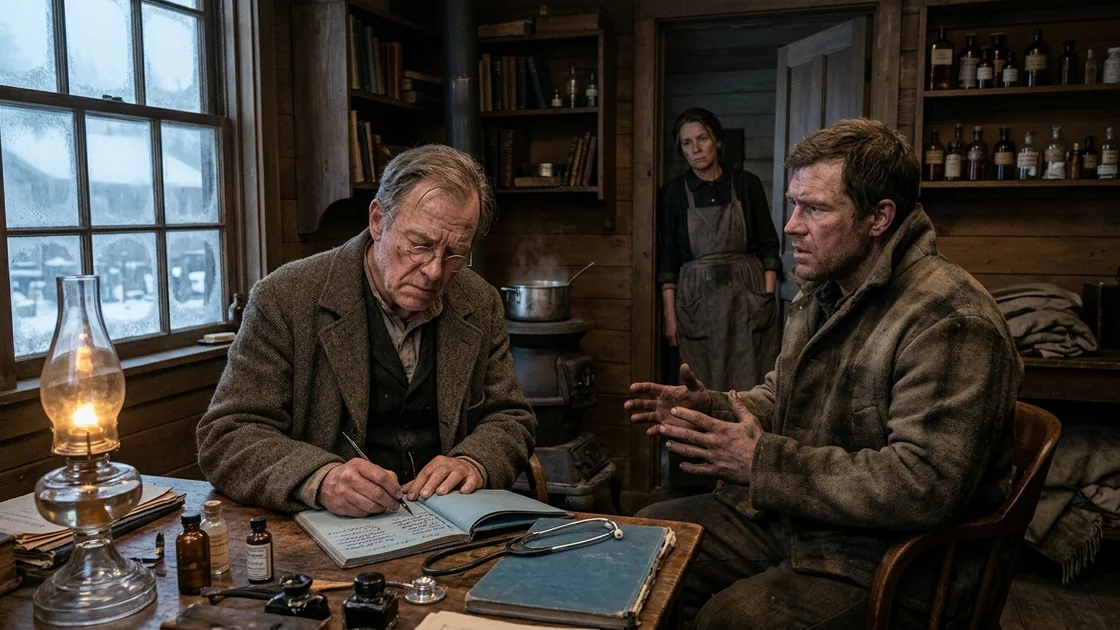
Dr. Aris Thorne is the sole physician in the isolated logging town of Oakhaven when the Grey Cough strikes, severing their community from the outside world behind a military quarantine. As the relentless epidemic ravages the population and the delivery trucks fail to arrive, Aris finds himself guarding a rapidly dwindling supply of Silvaine, the only drug capable of halting the disease's fatal progression. Forced to abandon the traditional oath of treating all equally, he must institute a grim triage system, weighing the lives of his lifelong neighbors, friends, and town leaders against the cold calculus of survival. Through sleepless nights and agonizing confrontations, Aris navigates a labyrinth of moral compromise, community desperation, and personal grief, ultimately discovering that surviving the plague may cost the town its very soul.
Part I: The Closing of the Pass
The frost came early to Oakhaven in the autumn of 1924, biting at the heels of a wet, miserable September. It did not arrive as a crisp, crystalline blanket, as it did in the years the elders liked to remember over their cider, but as a greasy, suffocating fog that rolled down from the Ironwood Peaks and settled into the bowl of the valley like cold lard in an iron skillet.
Dr. Aris Thorne stood on the porch of his clinic, a converted two-story timber structure on the north end of Elm Street, watching the mist devour the yellow leaves of the birches. In his hand, he held a telegram that had come through the mill’s wire an hour before the line went dead. The paper was damp, the purple ink of the ticker tape already bleeding into the cheap wood-pulp fibers.
QUARANTINE ESTABLISHED AT MILE TWELVE. BRIDGE AT CLEARWATER DESTROYED BY STATE MILITIA TO PREVENT EGRESS. SHIPMENT 404 DELAYED INDEFINITELY. GOD KEEP YOU. — COUNTY HEALTH BOARD.
Aris folded the slip of paper into a neat square, then another, until it was the size of a postage stamp, and tucked it into his waistcoat pocket beside his silver watch. He did not need the telegram to tell him they were alone. He had heard the dull, chest-rattling thud of the dynamite three hours ago, a sound that had sent the crows screaming from the hemlocks and caused the glass bottles in his dispensary to chime against one another in a brief, minor chord.
"Are they coming, Doctor?"
Aris turned. Martha Vance stood in the doorway behind him, wiping her raw, red hands on her apron. She had been his nurse, housekeeper, and general bulwark against the chaos of rural practice for twelve years, ever since Aris’s wife, Clara, had died in childbirth, taking their son with her into the rocky soil of the hillside cemetery. Martha’s eyes, usually sharp as boot-tacks, were filmed with the exhaustion of seventy-two hours without a proper bed.
"The bridge is down, Martha," Aris said, his voice low, trained by decades of sickrooms not to carry through thin walls. "They’ve blown the Clearwater span."
Martha’s hands stopped moving in the folds of her apron. She looked past him, out toward the logging road that wound up the mountain like a brown ribbon before vanishing into the grey belly of the clouds. "Blown it? But my sister’s boy is in Miller’s Falls. And the supply wagon..."
"There won't be a wagon," Aris said. He stepped back inside, shutting the heavy oak door against the creeping damp, and threw the iron bolt. The sound seemed excessively loud in the small hallway. "Whatever we have in the cellar and the cabinet is what we have until the spring thaw, or until the state decides we’ve stopped dying."
From the back room—what used to be the parlor before the first logger was carried in spitting blood and grey phlegm—came the sound that had become the heartbeat of Oakhaven. It was not a sharp, barking cough like croup, nor the wet, rattling heave of consumption. It was a dry, rhythmic scraping, like a rusted saw being drawn back and forth across green pine. Huff-scriiiitch. Huff-scriiiitch.
It was Tommy Miller, sixteen years old, a boy who three days ago had been able to heft the butt-end of a twelve-foot hemlock log onto a skidder without losing his wind. Now, his lungs were filling with a leathery, grey membrane that slowly starved the blood of air until the lips turned the color of a bruised plum and the heart simply gave up from the effort of beating against a wall.
"How many vials?" Martha asked. She didn't need to specify which ones.
"Come," Aris said. "Let us do the arithmetic before the town knows the bridge is gone."
They went down into the cellar. It was a cool, earthen-floored space smelling of turnips, carbolic acid, and damp stone. In the corner, secured by a heavy brass padlock that Aris now unlocked with a key from his watch chain, stood an zinc-lined icebox. The ice had melted two days ago, leaving three inches of frigid water at the bottom, in which floated two dozen brown glass bottles, each the size of a man’s thumb, stoppered with red rubber.
Silvaine. A compound of silver nitrate, belladonna, and a synthetic alkaloid developed in the chemical works of Dresden just after the Great War. It was expensive, unstable if exposed to light or warmth, and wickedly hard on the kidneys. If given after the patient’s fingernails had turned blue, it did nothing at all except hasten the end with violent convulsions.
Wait too long, and you wasted the dose. Give it too early, when a common cold might look like the first stage of the Grey Cough, and you wasted the dose.
But given in that narrow window—when the fever spiked past one hundred and three and the first grey flecks appeared on the handkerchief—three injections over forty-eight hours would dissolve the membrane in the lungs like vinegar on lime.
Aris lifted the wooden rack from the water and set it on the rough pine table beneath the single kerosene lamp. He counted them twice, his long, ink-stained fingers touching the top of each rubber stopper as if he were a priest blessing a tiny congregation.
"Twenty-six," he said.
Martha leaned over the table, the yellow lamplight carving deep trenches around her mouth. "Twenty-six bottles. Three bottles to a cure."
"Eight lives," Aris said. "And two vials over."
"Unless we use half-doses for the children," Martha whispered.
"I tried a half-dose on the Gable girl last Tuesday," Aris said, his voice flat. "She died on Thursday morning. The membrane came back thicker than before. A half-measure is worse than none at all; it only prolongs the suffocation and robs someone else of a full chance."
Upstairs, the brass bell over the clinic door jangled. Someone was rattling the latch, pounding on the oak panels with the flat of a fist.
"Dr. Thorne! Aris! Open up, for God's sake!"
It was the voice of Silas Vance—no relation to Martha, though in a town of four hundred souls, everyone was tangled together by marriage or debt if you dug deep enough. Silas owned the timber mill, the general store, and forty percent of the roofs over the heads of the men who worked for him.
Aris carefully lowered the rack back into the dark water of the icebox and snapped the brass padlock shut. The click sounded like the cocking of a pistol.
"Do not mention the bridge," Aris told Martha as he blew out the cellar lamp. "And do not, under any circumstances, let anyone behind the dispensary counter. From this hour on, you carry the key to the back room, and I carry the key to the cellar."
"Eight people, Aris," Martha said out of the dark, her voice trembling for the first time since the sickness came down the river. "There are four hundred and twelve people in this valley. I took the census for the parish last Christmas."
"Not everyone will catch it," Aris said, though he knew the lie was thin. The fog kept the smoke from the chimneys pressed down into the streets; the houses were small, poorly ventilated shacks where six people slept to a room for warmth. "And some have the constitution to fight it through without the needle."
"How many have fought it through so far?"
Aris did not answer her. He climbed the cellar stairs toward the pounding at the door. Both of them knew the number was zero.
Silas Vance was a large man whose clothes always seemed too tight for the force of his personality, though today his broadcloth coat hung loose around his shoulders. His face, usually the color of a well-cured ham, was mottled with grey patches beneath the eyes. He was not sick—not yet—but terror had a way of mimicking the plague. Behind him on the porch stood two of his foremen, holding between them a boy of about twelve wrapped in a filthy horse blanket.
"It’s my Arthur," Silas gasped, shoving past Aris into the narrow vestibule before the doctor could block him. The smell of wet wool, woodsmoke, and the unmistakable, coppery stench of the Cough filled the hallway. "He was fine at breakfast, Aris. Ate two eggs and a slab of salt pork. By noon he was shivering by the stove, and an hour ago..."
Silas held out a crumpled linen handkerchief. In the center of the white cambric was a smear of substance that looked like wet ashes mixed with blood.
Aris didn't look at the handkerchief; he looked at the boy. Arthur’s head lolled against the shoulder of the larger foreman, a Swede named Lindqvist whose own wife was currently buried under six feet of dirt on the hill. The boy’s mouth was open, his chest heaving with that terrible, silent effort that preceded the rasping stage. His lips were dry and cracked, cherry-red with fever, not yet blue.
"Bring him into the surgery," Aris said, turning on his heel. "Lindqvist, leave him on the oilcloth table and go wash your hands in the basin on the porch. Use the yellow soap until your skin burns, then go home and burn that coat."
"That's a four-dollar Mackinaw, Doctor," the Swede rumbled, though there was no real protest in his voice.
"It’s a wooden box if you keep wearing it," Aris snapped. "Do as I say."
Once the boy was on the table and the foremen had retreated into the fog, Aris shut the surgery door. Silas hovered over his son, his heavy gold watch chain swinging as he leaned down to stroke the boy’s sweat-plastered hair.
"Give him the silver stuff, Aris," Silas said, reaching into his pocket and pulling out a thick fold of greenbacks. He dropped them onto the instrument tray beside a bowl of forceps. "I know it comes from Germany. I know what the freight costs. There’s two hundred dollars there. If it takes more, name it. You can have the deed to the widow’s pasture behind your orchard."
Aris picked up the stack of bills with two fingers and set it on the corner of his desk, away from the clean linen. He took his stethoscope from around his neck, warmed the bell in his palm for a second—an old habit that refused to die even at the end of the world—and pressed it to Arthur’s chest.
Huff-scriiiitch.
The membrane was forming in the lower lobe of the left lung. The right was still relatively clear, merely whistling with fluid. He checked the boy’s eyes, felt the swollen, rock-hard lymph nodes beneath the angle of his jaw, and looked at his fingernails. Pink. Fever at one hundred and three point eight.
In terms of the pathology, Arthur Vance was the textbook candidate for Silvaine. He was young, well-fed, and caught within the first six hours of the pulmonary stage. If Aris gave him the first vial now, the second at midnight, and the third tomorrow at noon, the boy had an eighty percent chance of walking out of the clinic in a week.
Aris stood up and removed the stethoscope from his ears.
"Well?" Silas demanded. "Get the needle, man! Why are you staring at him like that?"
Aris looked at Arthur. He knew the boy well. He had delivered him; he had set his collarbone when he fell out of the hayloft at seven; he had watched him grow into a cruel, dull-witted child who liked to tie tin cans to the tails of stray dogs and who had, just last month, thrown rocks at the simple-minded daughter of the blacksmith until she fell into the mill race and nearly drowned. He was his father’s only heir, a boy who would one day inherit the mill and likely run it into the ground with his temper and his laziness.
And in the back room, twenty feet away, lay Tommy Miller. Tommy, who supported a blind mother and three younger sisters on his wages as a choker-setter, who sang baritone in the church choir, and who had stayed up for two nights straight last spring helping Aris dig out the widow Gable’s root cellar after the mudslide.
Tommy had received his first dose four hours ago. He needed two more to live.
"I will admit him, Silas," Aris said slowly. "Martha will make up a cot in the parlor. We will use steam inhalations with creosote and mustard plasters on his chest to try to break the congestion."
Silas stared at him, his small eyes narrowing beneath his bushy grey brows. "Steam? Mustard? That’s old-woman physics, Thorne! You gave the Miller boy the German medicine. Lindqvist told me he saw you drawing it up through the window."
"Tommy Miller has been here since yesterday," Aris said, his heart beginning a slow, heavy thud against his ribs. "His condition was more advanced."
"My boy is spitting grey!" Silas roared, his fist coming down on the edge of the desk so hard the inkwell jumped. "I am the man who paid for the roof over this clinic, Aris! When the parish couldn't raise your stipend in 'nineteen, who made up the shortfall? Who brings the coal down from the spur line for your stove without charging you haulage?"
"You did, Silas," Aris said quietly. "And I have treated your workmen’s crushed hands and your wife’s dropsy for fifteen years without sending you a bill."
"Then get the medicine!"
Aris looked down at his own hands. They were shaking slightly; he tucked them into his coat pockets. "The bridge at Clearwater is gone, Silas. The militia dynamited it at noon."
The color drained from the mill owner’s face, leaving the grey patches looking like smudges of soot on lard. "Dynamited? Why?"
"Because the Cough is in three counties now, and the governor is trying to keep it out of the capital," Aris said. "There is no train coming. There is no wagon coming. What I have in this house is all the medicine that exists in this valley."
Silas was a businessman; he understood scarcity better than he understood medicine. His eyes darted toward the door, then back to the doctor. His voice dropped to a hoarse whisper. "How much do you have?"
"Not enough," Aris said.
"You have enough for him," Silas said, pointing a thick, trembling finger at the table where Arthur was beginning to moan, tossing his head from side to side. "You have enough for my son. Give him the Miller boy's share if you’re that short! Miller’s a brush-ape’s son! There’s ten families like his down in the shanties—breed like rabbits and die by thirty anyway from the dust or the drink. Arthur is the future of this town! When I’m gone, who runs the saws? Who keeps the store credit going through the winter?"
"If I stop Tommy’s treatment now, the first dose is wasted, and he dies," Aris said. "I will not murder a patient under my roof to make room for another."
"You have more than two vials down there, Aris. I know you. You’re a hoarder. You always kept a full larder." Silas stepped closer, so close Aris could smell the sour whiskey on his breath. "Listen to me. If Arthur dies while you’ve got a single drop of that stuff under lock and key, I will tell every man at the mill that you’ve got a cellar full of cures that you’re saving for yourself and the parson. They’re scared, Aris. A scared logger with an axe in his hand isn't a Christian anymore. He’s a wolf. How long do you think that oak door of yours will hold if fifty men come down here to get medicine for their brats?"
It was not an idle threat. Aris had seen strikes at the mill; he had stitched up the faces of men who had been beaten with pick-handles over ten cents an hour. What would they do for the lives of their children?
Aris looked back at the boy on the table. Arthur’s chest gave a sudden, violent hitch, followed by that dry, sawing scrape. Huff-scriiiitch.
He was twelve years old. Whatever he might become, whatever sins of his father were written into his pugnacious jaw and mean little eyes, he was a child who was terrified and drowning in the dark of his own lungs.
Eight lives, the ledger in Aris’s head whispered. Tommy is one. If you take Arthur, that leaves six.
"Wait outside, Silas," Aris said, his voice sounding to his own ears like it was coming from the bottom of a well. "And take your money off my desk. If you leave it there, I’ll throw it into the stove."
Silas hesitated, looked at his son, then snatched up the roll of bills and backed out of the room, his eyes never leaving Aris’s face.
When the door clicked shut, Aris stood alone in the quiet surgery for a long time. The rain had begun to fall outside, tapping against the dark glass like thousands of small, impatient fingers. He reached into his pocket, took out the brass key on his watch chain, and went down into the cellar.
Part II: The Calculus of Flesh
By the fifth day of the quarantine, the fog had not lifted; it had merely frozen onto the branches of the hemlocks, turning the forest around Oakhaven into a cage of grey glass. Occasionally, a bough would snap under the weight of the rime, the sound cracking through the valley like a rifle shot, making the people huddled in their kitchens flinch and look toward the windows.
Thirty-four people were dead.
The sexton, old Manus O’Connor, had died on the third day—not of the Cough, though he had it, but of a stroke brought on by trying to dig graves in the iron-hard clay behind the Methodist church. After that, Reverend Halloway and four volunteers from the temperance league had used blasting powder to blow a trench thirty feet long at the edge of the woods. They didn't use coffins anymore; Silas Vance needed the sawyers who remained healthy—and there were fewer every morning—to cut cordwood for the stoves, as the coal cars were sitting stranded on the wrong side of the Clearwater gorge.
In the clinic, the parlor had become a charnel house of steam and carbolic. Four cots were jammed between the horsehair sofa and the bookshelves where Aris kept his bound volumes of The Lancet.
Tommy Miller was sitting up in the corner, pale as lard and thirty pounds lighter than he had been on Monday, sipping weak mutton broth from a tin cup. His breathing was shallow and whistled like a teakettle, his kidneys were passing dark, painful urine from the silver poisoning, and his hands shook so badly Martha had to hold the cup to his lips—but the grey membrane was gone. He would live.
Beside him, Arthur Vance was also alive, though the boy was meaner in recovery than he had been in health, cursing Martha with a logger’s vocabulary whenever she changed the mustard plasters on his raw chest.
That was six vials gone. Twenty remained.
Aris sat at his desk in the surgery, a ledger open before him. It was not his regular account book—the one filled with entries like 1 bushel potatoes (for setting Sam Carter's tibia) or Paid on account, $2.00 (Mrs. Higgins, confinement). This was a fresh blue-covered exercise book he had taken from the schoolhouse after Miss Clara Perkins, the teacher, had been carried to the trench on Wednesday morning.
Miss Perkins had been twenty-two. Aris had not given her the Silvaine.
By the time her landlady had found her delirious in her cold upstairs room and dragged her through the mud to the clinic, her fingernails were the color of slate and her pulse was a fluttering thread at her wrist. Aris had known, with the cold certainty of thirty years’ clinical experience, that three vials of Silvaine would only give her six hours of convulsions before she died anyway.
Yet, when he had stood over her cot with his hands folded behind his back, telling the weeping landlady that there was nothing to be done, he had felt the brass key in his pocket burning against his thigh like a coal. He had watched her die through the night, wiping the grey froth from her lips with a rag dipped in vinegar, while twenty bottles of the drug sat in the dark water beneath his feet.
Now, he looked at the names written in the blue book.
He had divided the town into four columns: Essential, Youth, Fragile, and Expendable.
He had written the headings at three in the morning by the light of a guttering stub of tallow, and the moment the ink had dried on the word Expendable, he had been violently ill into his washbasin, heaving up nothing but bile and the bitter dregs of chicory coffee.
Who made you God, Aris Thorne? he had asked the grey-faced ghost in the washstand mirror. You’re a country sawbones who barely passed his boards in Philadelphia thirty-two years ago. You couldn't save your own wife from a breech birth, and now you sit here with a steel pen deciding who sees the spring.
"Doctor?"
Martha stood in the doorway. She looked ten years older than she had on Monday. Her grey hair had come loose from its pins and hung in limp strings around a face that seemed to have been whittled down to the bone. She was wearing a gauze mask soaked in camphor over her nose and mouth, as Aris had insisted, though both of them suspected it did little more than mask the smell of decaying lung tissue.
"Who is it?" Aris asked without looking up from the book. He closed the cover over the columns, a reflexive gesture of shame.
"Sarah Miller and her youngest. And Caleb Irons."
Aris’s stomach contracted. Sarah Miller was Tommy’s mother—the blind woman. Caleb Irons was the town blacksmith, a widower of forty-five with arms like peeled oak logs and four children between the ages of six and fourteen.
"Bring them into the hall, keep them apart, and let me look at them one at a time," Aris said, pulling his own mask up over his beard.
He saw the blacksmith first. Caleb didn't sit on the examination table; he sat on the wooden chair beside the door, hunched over with his massive hands dangling between his knees. He was breathing through his mouth, his broad chest hitching with that terrible, familiar pause at the top of every inhalation.
"I didn't want to come, Doc," Caleb wheezed. Every word sounded like gravel being turned with a shovel. "Got the horses at the mill to shoe for the ice. Can't haul wood without calks on the shoes. The beasts’ll slip and break their legs on the skid-road."
"Let me listen, Caleb," Aris said.
He didn't really need the stethoscope. He could hear the dry rattle from three feet away. When he looked into Caleb’s throat with the mirror and the lamp, he saw the grey patches already coalescing behind the tonsils, creeping down toward the windpipe like lichen on a tree trunk. Fever: one hundred and four. Nails: still pink at the beds, though the tips were pale.
"How are the children?" Aris asked, setting the tongue depressor into the carbolic tray.
"Mary’s fourteen now. She’s keeping the fire up," Caleb said, looking up at Aris with eyes that were bright and wet with fever, yet entirely clear. "I locked the shed so they can't get near the forge where I been working. Doc... I seen what they’re putting in that trench up by the woods. If I go in there, there ain't nobody to look after those four. My sister’s in Ohio. Might as well be on the moon."
"Wait here, Caleb. Don't touch anything."
Aris went into the vestibule. Tommy’s mother, Sarah, was sitting on the deacon’s bench, her sightless, milky eyes fixed on the ceiling, while her eight-year-old daughter, Lily, leaned against her hip, coughing into a rag.
Aris examined them both right there in the cold draft of the hallway.
Sarah did not have the Cough. She had a chronic winter bronchitis that Aris had treated with squill and ipecac for a decade, and she was terrified, which made her hyperventilate, but her lungs were clear of the grey friction rub.
Lily, however, was burning up. Her small hand in Aris’s palm felt like a bird pulled straight from an oven. When she coughed, there was no mistaking the sound. Huff-scriiiitch.
"Tommy's in the back, isn't he, Dr. Thorne?" Sarah asked, her hand groping out into the empty air until Aris took it gently and placed it back in her lap. "I can hear him breathing through the wall. I know my boy's wind. He's better, isn't he?"
"Tommy is going to live, Sarah," Aris said.
Tears spilled out of the blind woman's eyes, tracking through the coal dust on her cheeks. "Thank the Lord. Thank the good Lord and you, Doctor. Now you fix my Lily. She's the only one left who can thread my needles and read me the Psalms. The other two girls are down with it at the house, too weak to walk, so I brought the little one first."
Aris froze. "The other two? Annie and Ruth?"
"They started spitting the grey stuff yesterday morning," Sarah said simply. "Annie’s fingernails are all dark, Annie told me so before we left. She couldn't get off the mattress. I told her the Doctor would come down to the shanty with the needle as soon as he fixed Lily."
Aris closed his eyes behind his spectacles.
Annie was fourteen; Ruth was twelve. If Annie’s nails were already dark, she was gone. Ruth, if she had been spitting grey since yesterday morning without treatment, was almost certainly past the window where Silvaine could halt the membrane.
If he went down to that shanty, he would find one corpse and one dying girl who might—if he poured four or five vials into her—have a ten percent chance of surviving with ruined lungs and failed kidneys.
And here on the bench sat Lily, right at the beginning of the crisis. Three vials.
And in the surgery sat Caleb Irons. Because of his size—over two hundred and twenty pounds of muscle and bone—three vials would not be enough to reach the therapeutic threshold in his blood. It had taken three to save Tommy, who weighed a hundred and四十. Caleb would need four. Perhaps five.
Aris walked back into the surgery, shut the door behind him, and leaned his forehead against the painted wood.
Caleb looked up from the chair. "Bad out there?"
"Yes," Aris said.
He walked to his desk and opened the blue schoolbook.
Caleb Irons was at the top of the Essential column. Without the blacksmith, the logging horses could not be shod for the ice. Without the horses, the cordwood could not be hauled down from the ridges. The temperature was already dropping into the teens at night; by December, it would hit twenty below zero. In Oakhaven’s drafty, uninsulated shacks, if the wood stopped coming, people wouldn't wait for the Grey Cough to kill them; they would freeze to death in their beds. Furthermore, Caleb had four children who would become wards of a starving, plague-ridden parish if he died.
Lily Miller was eight. She was in the Youth column. Her only function in the brutal economy of the valley was that she threaded needles for a blind widow and had eighty years of life ahead of her—if she didn't starve when the winter deepened.
Twenty vials in the cellar.
If he treated Caleb (4 vials) and Lily (3 vials), he would have thirteen left. Four more lives. And the epidemic had not yet peaked; the incubation period was five to seven days, which meant everyone who had attended Miss Perkins’s funeral on Thursday before the church was closed was just now beginning to feel the tickle in the back of their throats.
"Aris," Caleb said quietly.
The doctor turned. The blacksmith had stood up, though he had to brace one huge, calloused hand against the wall to keep from swaying. He was looking at the blue notebook on the desk. He couldn't read it upsidedown from six feet away, but Caleb was no fool. He had shod horses for the army during the Spanish war; he knew what a quartermaster’s list looked like.
"How much of the medicine do you have left?" Caleb asked.
Aris didn't lie to him. He couldn't lie to a man whose eyes were on a level with his own and who had never cheated a neighbor of a penny in forty years. "Enough for six people, Caleb. Maybe seven, if they're small."
Caleb nodded slowly. He looked down at his own massive chest, then toward the door behind which Lily Miller was coughing that dry, sawing cough.
"Takes more to kill a horse than a pony," Caleb rasped. "Takes more physic to cure him, too, don't it?"
"Yes," Aris whispered.
"Tommy’s in the back room?"
"Yes. He’s over the crisis."
"A boy that weak won't be able to swing an axe or haul a sled for a month," Caleb said, thinking it through with the slow, methodical cadence of a man working hot iron on an anvil. "If the little girl dies, and the other two at home are already gone, Sarah’s got nobody while the boy gets his strength back. She’ll wander into the stove and burn the shack down."
"Caleb, if you die, the horses can't haul the wood," Aris said, his voice breaking. It was the first time the doctor had spoken the calculus aloud, and the words tasted like copper in his mouth. "And you have four children at home."
"My Mary is fourteen, and my boy Luke is twelve," Caleb said, wiping a thread of grey saliva from his chin with the back of his sleeve. "Luke’s been blowing the bellows and turning shoes since he was nine. He can't weld an axle yet, but he can drive nails into a hoof if the men hold the horse for him. And I already winter-shod the two big Belgians for Silas yesterday when I felt the chill coming on. Those two teams can haul enough birch to keep the town warm till January if they don't overwork 'em."
"Caleb, sit down," Aris pleaded, stepping toward him. "You are forty-five years old. You are a strong man. With the medicine, your chances are very good."
"And without it?"
Aris stopped. His hands hung uselessly at his sides. "No one has recovered once the membrane forms in the lower lobes without the silver, Caleb. You have a larger lung capacity than most. You might fight it longer. Four days, maybe five. It... it is not an easy death."
Caleb looked toward the window, where the grey ice clung to the hemlock needles. "My wife died of the lockjaw in 'eighteen, Doc. Remember? Took her three days. I watched her arch her back until the bones snapped, and you didn't have nothing in your bag for that, neither. Man don't get to pick how he goes out of the woods. He just gets to pick whether he drops his end of the log before the whistle blows."
He turned back from the window and walked to the door, his heavy boots thudding on the floorboards.
"Look after the Miller kid," Caleb said, his hand on the brass knob. "And when Luke comes down here in a couple days—and he won't come till I’m cold, 'cause I’ll tell him not to—you give him a bottle of that stuff to keep in the house in case Mary or the little ones start coughing. You owe me four vials, Aris. Put it in your book under my name. My kids get my share."
"I can't give out the vials, Caleb," Aris said desperately. "They have to be kept on ice, and the injection goes into the vein—"
"Then you save it for 'em down in your cellar," the blacksmith growled, pulling the door open. "Swear to me, Doc. On your dead wife’s stone up on the hill. You save four bottles for the Irons kids, or I’ll come back from wherever I’m going and pull this house down around your ears."
Aris looked into the blacksmith’s fever-bright eyes. "I swear it, Caleb."
Caleb nodded once. In the hallway, he stepped wide around the bench where the blind woman and her little girl sat, holding his breath until he had wrenched the front door open and vanished into the freezing mist.
Aris stood in the doorway of the surgery. Martha looked at him from the end of the hall, her eyes wide and dark above the camphor mask. She had heard every word.
"Bring Lily into the back room, Martha," Aris said, turning back to his desk. "Put her on the horsehair sofa. Then I’m going down to the Miller shanty with the morphia."
"Not the silver?" Martha whispered.
Aris picked up his pen, dipped it into the inkwell, and drew a single, heavy black line through the name Caleb Irons. Above it, in the margin of the Essential column, he wrote: Irons Children (Reserved - 4).
"No," Aris said. "Not the silver."
Part III: The Riot at the Gate
By the twelfth day, the town had stopped ringing the church bell for the dead because the constant tolling was driving the sick into delirium.
The silence in the valley was worse. No saws whined at the mill; no teams jangled their harness bells on Main Street; no dogs barked, because the townspeople had begun shooting the strays after someone started a rumor that dogs carried the Cough in their fur. The only sound was the wind rattling the ice-sheathed branches and the occasional rumble of the handcart that Reverend Halloway and young Luke Irons pushed up the hill twice a day, loaded with shapes wrapped in bedsheets and tarpaulins.
Caleb Irons had gone up the hill in that cart on the ninth day. Luke had pushed the handles himself, his twelve-year-old face set like grey granite, refusing to let the parson take his end until they reached the edge of the blasted trench. True to his father’s word, none of the Irons children had yet fallen ill; they stayed barricaded behind the smithy, eating salt pork and dried apples, while Luke shod the mill horses one at a time in the open yard with a bandana tied across his face.
In the clinic, the number of vials in the zinc box was down to eleven.
Four were promised to the Irons children by an oath sworn on Clara Thorne’s grave.
That left seven. Two lives, and one leftover vial that was useless on its own.
Aris had not taken off his boots in four days. His feet were swollen inside the leather, his eyes felt as though they had been rubbed with sand, and he had developed a slight, nervous tremor in his left hand that he hid by keeping it tucked into his waistcoat. Neither he nor Martha had contracted the Cough—a miracle of acquired immunity from thirty years of breathing every contagion in the mountains, or perhaps simply the devil looking after his own—but they were both slowly starving. They had given the last of the clinic’s milk and eggs to Lily Miller and the two new patients in the parlor: the wife of the telegraph operator (who was three months pregnant) and the baker’s seventeen-year-old apprentice.
Both were recovering. Both had cost three vials each.
On the afternoon of the twelfth day, as the early November dusk was settling down like wet soot at four o'clock, the trouble Silas Vance had promised arrived at the gate.
It started as a low murmur down by the closed doors of the tavern, then grew into the rhythmic crunch of thirty pairs of hobnailed boots on the frozen mud of Elm Street. Torchlight—kerosene-soaked rags wrapped around axe handles—flared yellow and smoky through the fog.
Aris was in the surgery, boiling glass syringes in a pan over a spirit lamp, when Martha came running from the front window.
"They’re coming, Aris," she said. She didn't sound frightened; she had passed beyond fear days ago into a region of fatalistic calm. She carried Aris’s double-barreled ten-gauge duck gun, which she had taken down from the antlers in the upstairs study. "It’s Big Jack Connelly and the men from the lower bunkhouse. And Mrs. Gable is with them."
Aris took the shotgun from her, broke it open to check the brass shells in the chambers, and snapped it shut. He didn't want to shoot anyone—he had spent his life patching up holes in human flesh, not making them—but he knew Big Jack Connelly. Connelly was a saw-filer who drank wood alcohol strained through loaf bread when he couldn't get rye, and his brother had died in the bunkhouse two hours ago after Aris had refused to use the Silvaine on him.
Connelly’s brother had been sixty-two years old, his lungs already half-solid with sawdust and black tobacco tar, and he had been coughing blood for three days before anyone bothered to fetch the doctor. It would have been pouring the silver into a sieve.
Aris walked to the front door, threw back the bolt, and stepped out onto the porch just as the crowd reached the split-rail fence at the edge of the yard.
There were about twenty-five of them. Not all were mill hands; he saw the wife of the cobbler, her face scratched and bleeding where she had torn at her own cheeks after losing two children in one night; he saw old Mr. Henderson, the town clerk, shivering in a threadbare overcoat; and in the front, holding a pitchfork like a pike, stood Connelly, his beard matted with frozen spit.
"That’s far enough, Jack," Aris called out. He didn't raise the shotgun; he let the barrels rest across the crook of his left arm, pointed at the porch floorboards, his right thumb hooked over the hammers.
"My brother’s stiff on his bunk, Thorne!" Connelly bellowed, a plume of white steam shooting from his mouth into the torchlight. "And you didn't give him a drop! Didn't even open your bag! Just looked at his hands and walked out like he was a gut-shot deer!"
"Your brother was dying before you ever sent for me, Jack," Aris said, projecting his voice so the people in the back could hear. "His lungs were gone. If I had given him the medicine, it would have killed him faster and robbed someone who could actually be saved."
"Saved like Silas Vance’s brat?" screamed a woman from the middle of the pack—it was Mrs. Gable, whose little girl had died on the half-dose in the first week. "You saved the rich man’s boy! You saved the telegraph woman! My Annie was seven years old and you gave her water! You gave her water to save the good stuff for the folks up on the hill!"
A low, ugly growl rippled through the crowd. The pitchfork in Connelly’s hand came up two inches. Several men in the back shifted their grip on their axe handles.
"I gave your daughter half a dose because I was trying to stretch the supply to save two children instead of one," Aris said, and for a second the iron mask of the physician cracked, letting the agony underneath bleed into his voice. "And I was wrong. It didn't work, and she died, and I will carry that to my judgment day, Mary Gable! Would you have had me repeat the mistake so two more children could choke to death for nothing?"
"We want to see the cellar!" shouted Henderson, the clerk, his voice cracking like an adolescent’s. "Silas told the vestry you had a box full of it when the bridge went down! Every house on Water Street has got someone down with the rattle, Doctor! You have no right to sit on it like a miser on gold! It belongs to the town!"
"There are seven vials left in this house," Aris said clearly.
The crowd went quiet for a beat, save for the crackle of the kerosene torches and the wet, bubbling cough of a man leaning against the fence post in the back.
"Seven," Connelly spat. "You’re lying."
"Seven," Aris repeated. "And four more that are promised to Caleb Irons’s children because Caleb refused treatment so the Miller girl could live and so you people would have horses shod to haul your firewood. Those seven vials are enough to save two people. Only two."
He stepped to the edge of the porch steps, the lamplight from the window behind him throwing his long, gaunt shadow out across the frost-whitened mud between them.
"If you come through that gate and take me down," Aris said, "you will get those seven bottles. Who gets them, Jack? There are twenty-five of you standing there. Twelve of you have sick people at home right now. Which two of you get the three vials each? Do you fight for them in the street with your axes? Do you divide them up so everyone gets half a bottle and everyone dies, just like Mary Gable’s little girl?"
The men looked at one another in the flickering orange light. The solidarity of the mob—built on the simple myth that the doctor was hoarding a limitless cure—suddenly fractured against the hard rock of arithmetic. Connelly looked sidelong at the two loggers standing next to him, both of whom had wives down with the fever.
"Even if you don't break the bottles fighting over them," Aris continued, his voice dropping an octave, cold as the creek water under the ice, "who is going to administer them? You, Jack? Can you find a collapsed vein in the arm of a thrashing six-year-old child with a steel needle? If you miss the vein and put Silvaine into the muscle, the arm rots off from gangrene inside of three days. If you push it too fast, the heart stops on the spot. If you kill me, or if you break my hands, those seven bottles are just poison in glass."
Nobody moved. The man leaning against the fence post doubled over, coughing until he fell to his knees in the mud, retching up grey strings onto the frozen ruts. The men nearest him shrank back, pulling their coat collars up over their mouths.
Aris looked at the man on his knees. It was Peter Lindqvist, the Swedish foreman who had carried Arthur Vance into the clinic twelve days ago. He hadn't burned his four-dollar Mackinaw; he was still wearing it.
Aris lowered the hammers on the shotgun, handed the weapon back through the door to Martha without taking his eyes off the crowd, and walked down the porch steps.
Connelly tensed, raising the pitchfork as Aris approached the gate, his boots crunching on the frost.
"Put that down, Jack, and help me carry him inside," Aris said, unlatching the gate and stepping right past the steel tines of the fork as if they were willow twigs.
"He’s... he’s spitting the grey, Doc," Connelly stammered, backing away a step as Aris knelt in the mud beside the big Swede.
"He’s been spitting it since noon, by the sound of his chest," Aris said, pulling back Lindqvist’s eyelid and feeling the bounding, frantic pulse in his neck. "Which means if we don't get the first needle into him within the hour, he’ll be in the trench by Sunday. Pick up his feet. If you’re brave enough to come down here to murder an old man, you’re brave enough to carry your friend thirty yards."
Shamed, terrified, and suddenly stripped of his rage, Connelly laid the pitchfork in the grass, pulled his bandana tight over his nose, and took Lindqvist by the ankles.
Together, the doctor and the rioter carried the foreman up the steps and into the house, while the crowd at the gate slowly broke apart, their torches winking out one by one as they drifted back into the fog toward their cold, dark houses.
Part IV: The Weight of the Last Three
Peter Lindqvist took four vials. Like Caleb Irons, he was a giant of a man, and when the third dose at twenty-four hours failed to break the fever, Aris stood over the zinc box in the cellar for ten minutes in the dark, listening to the Swede’s ragged, drowning breaths through the floorboards above.
If he didn't give the fourth vial, the first three were wasted, and Lindqvist would die.
If he gave the fourth vial, he was down to three—plus the four reserved for the Irons children.
One life left in the box.
He gave Lindqvist the fourth vial. By morning, the big Swede was coughing up huge, rubbery casts of dissolving grey membrane into a basin, his fever broken, weeping in broken Swedish for his dead wife while Martha bathed his forehead with cold water.
On the sixteenth day of the quarantine, the weather broke—not into a thaw, which might have cleared the air, but into a howling blizzard that roared down from the Canadian border and buried Oakhaven up to the eaves of the second-story windows. The snow was a blessing in disguise; it acted as a natural quarantine within the quarantine. Nobody could leave their houses without snowshoes and a shovel, which meant the transmission of the Cough from shack to shack finally ground to a halt. The fire had burned through the dry brush and was now starving for fuel among the snowdrifts.
The clinic was quiet now. Tommy Miller and Lily had gone home, pulled on a toboggan by Luke Irons to their mother’s shanty, which Martha had scrubbed top to bottom with lye before allowing them inside. The telegraph operator’s wife and the baker’s boy were gone too, convalescing in their own beds. Only Lindqvist remained in the parlor, sleeping twenty hours a day as his kidneys slowly cleared the silver.
Seven vials remained in the cellar. Four for the Irons children. Three for the last soul in Oakhaven.
Aris sat by the surgery stove, his chin resting on his chest, dozing in five-minute snatches while the wind shrieked around the eaves and rattled the storm shutters. He was dreaming of Clara—not as she had looked at the end, soaked in sweat and blood on their upstairs featherbed, her teeth clenched on a leather strap—but as she had looked the first summer they came to Oakhaven, standing in the orchard with her apron full of green pippins, laughing because a honeybee had tangled itself in his beard.
Huff-scriiiitch.
Aris’s eyes snapped open.
The stove had burned down to red embers, throwing a dull, bloody glow across the linoleum floor of the surgery. The clock on the mantel ticked steadily: two-fifteen in the morning.
In the parlor, Lindqvist was snoring—a wet, deep, healthy sound.
Huff-scriiiitch.
It came from the kitchen at the back of the house.
Aris stood up so fast the blood rushed from his head, forcing him to catch the edge of the desk until the black spots cleared from his vision. He didn't take the lamp. He walked down the narrow hallway in the dark, guided by the strip of yellow light showing beneath the kitchen door.
He pushed the door open.
Martha was sitting at the scrubbed pine table. She had taken off her camphor mask; it lay beside her elbow next to a teacup half-full of cold water. In her right hand, she held a white linen square pressed to her mouth.
When she saw him standing in the doorway, she tried to fold the handkerchief quickly and slip it into her apron pocket, just as she had done a hundred times when hiding a scorched linen or a broken thermometer from his sharp eyes.
"Don't, Martha," Aris said.
She stopped. Her shoulders sagged, as if the starched cotton of her dress were the only thing holding her upright and the damp had suddenly gotten into it. Slowly, she laid the linen square flat on the table under the kerosene lamp and smoothed out the corners with her thumb.
In the center was a dime-sized spot of bright arterial blood mixed with a gelatinous, ash-grey fleck.
Aris walked across the room, pulled out the chair opposite her, and sat down. He didn't reach for his stethoscope. He didn't need to. Now that he was within four feet of her, he could see the glassy, unnatural sheen in her grey eyes and the faint, plum-colored flush high on her cheekbones.
"How long?" he asked softly.
"I felt the chill while you were out on the porch with Jack Connelly and the men," she said. Her voice was still steady, though there was a dry catch at the end of the sentence that made her wince and press two fingers to her breastbone. "I thought it was just the draft from the door. Then the fever came up while the snow was starting yesterday morning."
"Thirty-six hours," Aris said. "Martha, why in the name of God didn't you tell me yesterday?"
"Because you had Lindqvist," she said simply. "And if you’d known I had the chill, you wouldn't have given him that fourth bottle last night. You’d have let that big fool choke so you could save the full three for me."
Aris stared at her. She knew him better than anyone alive—better, perhaps, than Clara had known him, for Clara had only seen the young man with ideals, while Martha had seen the old man who had survived them.
"I still have three vials," Aris said, standing up and reaching for his watch chain. "Seven in the box. Four for Caleb’s children, three for you. You are right inside the window, Martha. Your nails are pink. Go upstairs to the spare bed—not the parlor, it’s too drafty—and I’ll bring the spirit lamp and the syringe."
"Sit down, Aris," she said.
Something in her tone made his fingers freeze on the brass key. It was not the voice of his nurse; it was the voice of an equal who had walked through the same valley of shadow for two weeks and had done the same arithmetic in the dark.
"Before the snow blocked the road," Martha said, pausing to let a shallow, scraping cough pass through her chest, "Luke Irons came down to the woodshed with the last load of split birch. You were asleep in your chair. I went out to pay him."
Aris felt a cold draft seep under the kitchen door, wrapping around his ankles like creek water. "They’re sick?"
"Not the Irons children," Martha said. "They’re fine. Luke’s got them living on garlic water and salt pork like little badgers in a hole. No... Luke came past the parsonage on his way down."
She picked up the teacup with both hands to stop its rattling against her teeth and took a sip of water.
"Reverend Halloway collapsed in the vestry yesterday noon after he came back from burying the Gable baby," she said. "And when Luke looked in the kitchen window because nobody answered his knock... the parson’s little girl, Grace, was sitting on the floor by the dead stove trying to wake her father up. Luke carried them both into the parson’s study where there’s a fireplace, built up a blaze with the church pews, and came here to tell us."
Aris didn't move. "Why didn't you wake me?"
"Because the blizzard hit twenty minutes after the boy left," Martha said. "The drifts in the cut by the church were six feet deep by dark. Even if you’d gone out with the snowshoes, you wouldn't have made it up that hill and back in that wind. You’d have frozen in the ditch, and then who’d look after Lindqvist?"
"The wind has dropped," Aris said, looking toward the frosted square of the kitchen window. The howling had indeed died down to a low moan in the chimney flue. "I can get through the cut now."
"Yes," Martha said. "You can. If you take the three bottles."
Aris looked down at her. "There are two of them, Martha. Halloway and the child. Three vials won't save them both."
"Halloway is fifty-eight years old and his heart has had a murmur since he had the rheumatic fever in 'sixteen," Martha said, reciting the clinic’s case notes from memory with terrible precision. "And if he collapsed at noon yesterday after pulling that handcart through the frost for two weeks, his lungs are already solid. You know that, Aris. Don't pretend with me."
"And Grace is nine," Aris whispered.
"She’s nine," Martha agreed. "Her mother died three years ago. She’s the sweetest child in this parish, Aris. She brings me wild strawberries in a birch-bark cone every June and never asks for a penny or a sweet in return. If Luke saw her yesterday at noon, she was just starting the fever. If you go up there now with the snowshoes, you’ll catch her right where you caught Lily Miller."
The kitchen was so quiet Aris could hear the tiny tink-tink of the cooling stove iron and the rasping rhythm of Martha’s breath. Huff-scriiiitch. Huff-scriiiitch.
"Martha," Aris said, and to his horror he felt a hot, salt tear spill over his lower lid and run down into his grey beard. "You are fifty-four. You have no heart murmur. You are in this house, right now, within ten feet of the medicine. If I go up that hill in the dark through six-foot drifts, Grace Halloway may already be dead. Or too far gone. And by the time I walk back down, the membrane will have closed your bronchi."
"If she’s dead when you get there, then you bring the bottles back in your pocket and stick me with the needle," Martha said, though a faint, sad smile touched the corners of her mouth. Both of them knew it would take him three hours to break a trail through the drifts to the church and back; in the pulmonary stage of the Grey Cough, three hours was the difference between pink nails and blue.
"I have four more vials in the box," Aris said, his voice rising, desperate and ragged. "The Irons children aren't sick! The snow has stopped the spread! They are barricaded in the smithy; they aren't going to catch it now! I can use three of their vials for you and take the other three up the hill for Grace!"
Martha reached across the table. Her hand was dry and burning hot as she laid it over his trembling fingers, pressing the brass key flat against the pine boards.
"You swore an oath to Caleb Irons on Clara’s grave, Aris Thorne," she said softly. "I stood in that hall and I heard you do it. Caleb walked out that door and choked to death over four days in his woodshed so you would keep those four bottles in that box until the quarantine is lifted. If Luke or Mary comes down with the rattle next week because a rat gets into their cellar or the wind blows smoke from the shanties into their yard, and you tell that boy you used his father’s blood-price on your housekeeper... what becomes of you then?"
"I don't care what becomes of me!" Aris cried out, pulling his hand back as if her fever had blistered him. "I have killed thirty people in that blue book in the surgery, Martha! I let Miss Perkins choke! I let Jack Connelly’s brother die in his own filth! I drew lines through names like a butcher marking hogs for the slaughter! I will not stand here and watch the only person left in my life die on my kitchen floor while I have seven bottles of the cure sitting under the stairs!"
"You didn't kill those people, Aris," Martha said, leaning back in her chair because sitting upright was becoming too hard a work for her lungs. "The sickness killed them. And the militia that blew the bridge. You saved Tommy. You saved Lily. You saved the Vance boy, and the baker’s lad, and the telegraph woman and her baby, and that big Swede snoring in the parlor. That’s seven lives walking the earth who would be frozen in that ditch up by the woods if you hadn't had the spine to lock that cellar door and hold the key."
She closed her eyes, her chin tipping up slightly as she fought to draw the thin, hot kitchen air past the thickening lining in her chest.
"I’m fifty-four, Aris," she whispered. "My husband died in the mine at Blackwater before I ever came to keep your house. Never had a child of my own. Spent twelve years washing your shirts and boiling your needles. It wasn't a bad life. Better than most women get in these mountains. Don't you ruin the work we did here over the last two weeks by turning coward at the end. Take the three bottles. Leave the four for Caleb’s boy. Go up the hill and get that child."
Aris stood by the table. The kerosene lamp was beginning to smoke, a thin black ribbon of soot rising toward the ceiling as the oil ran low.
He looked at Martha’s hands, folded in her lap over the bloodied handkerchief. The beds of her fingernails were still pink, except at the very base of the moons, where a faint, violet shadow was just beginning to gather, like the bruise on a fallen peach.
He thought of the blue notebook on his desk.
If he had written Martha Vance in that book twelve days ago, where would he have put her? In the Essential column, without hesitation. She was his nurse; without her, he could not have managed the ward.
Now, the ward was empty except for a man who only needed soup and sleep. The epidemic was burning out under two feet of snow. By his own terrible, cold logic—the logic he had used to condemn Caleb Irons and sixty-two-year-old Tom Connelly—Martha was no longer essential to the survival of Oakhaven. And she was fifty-four. And Grace Halloway was nine.
The calculus had turned around in his hand and bitten him to the bone.
"If I go up that hill," Aris said, his voice a dry rattle that sounded almost like the Cough itself, "you will be alone here if the crisis comes."
"I won't be alone," Martha murmured without opening her eyes. "Lindqvist is in the parlor. And you’ll leave the brown bottle of morphia on the table before you go, with the little glass measure beside it. I know how many drops to take when the blue gets into my fingers. I watched you give it to Miss Perkins. She went to sleep real quiet, Aris. Didn't thrash at all."
Aris walked around the table. He leaned down and pressed his lips to her forehead, right where the grey hair parted. Her skin tasted of salt and camphor and the terrible, sweetish heat of the fever.
"I will be back before dawn," he said. "Do not touch the morphia until you hear the church bell ring once. If Grace is alive and can take the medicine, I will pull the rope in the vestibule so you know it wasn't wasted. If you don't hear the bell within an hour... wait for me."
Martha didn't open her eyes, because if she opened them she would weep, and weeping filled the passages with fluid and brought the suffocation on faster. She simply reached up and patted his cheek once with her rough, work-hardened palm.
"Put on your heavy muffler, Aris," she whispered. "And take the lantern with the bull's-eye glass. The wind’s treacherous in the cut."
The snow was chest-deep where it had drifted between the high banks of Church Lane, a blinding, blue-white wilderness under the stars that had come out now that the storm had blown itself southward.
Aris did not feel the cold, though the mercury in the thermometer outside his door had shrunk down into the bulb at twenty-two below zero. Inside his sheepskin coat, tucked into an inner pocket against his ribs so his body heat would keep the fluid from freezing and cracking the glass, were three brown vials stoppered with red rubber, wrapped in a piece of flannel alongside a boiled syringe in a tin case.
In the cellar behind him, four vials remained in the dark water.
And on the kitchen table, beside the smoking lamp, sat a four-ounce bottle of laudanum and a graduated minim glass.
He moved with the clumsy, wide-striding shuffle of the ash-framed snowshoes, his breath roaring in his own ears inside the wool muffler wrapped around his face. Every hundred yards, his boots—still swollen from days without removal—cramped violently, and his sixty-year-old heart hammered against his breastbone like a bird trapped in a chimney. Twice he fell when the webbing of a shoe caught on a buried stump beneath the crust, pitching face-first into the powder, lying there for ten seconds in the dark while the snow melted against his burning cheeks, tempted beyond measure to simply close his eyes and let the mountain finish the ledger.
Then he heard, or thought he heard through the stillness of the frozen trees, that dry, sawing scrape from his kitchen. Huff-scriiiitch.
He dragged himself up on his elbows and kept climbing.
The Methodist church stood on the knoll above the town, its white clapboards gleaming like bone against the black wall of the hemlocks. Near the edge of the trees, the long trench where thirty-four of his neighbors lay was nothing now but a smooth, gentle swell in the snowfield, erased by the drift.
No smoke came from the parsonage chimney.
Aris’s heart gave a sickening lurch. He unbuckled the snowshoes at the parsonage porch, kicked them aside, and threw his shoulder against the front door. It wasn't locked. He stumbled down the dark hallway, holding the bull's-eye lantern high, following the smell of cold wood-ash and the unmistakable, coppery stench of the plague.
He pushed open the door to the study.
The fire Luke Irons had built from the broken church pews had burned down to a heap of grey ash hours ago, though the small room with its low ceiling and heavy velvet curtains still held a pocket of stale, forty-degree warmth.
Reverend Halloway lay on the leather sofa under a pile of horse blankets. Aris didn't need to bring the lantern close to see that the parson had been dead since midnight; his jaw had dropped open, and the frost from his own breath had rimed the grey stubble on his chin.
In the corner, wedged between the bookcase and the brick hearth where the bricks still held the last ghost of the fire's heat, was a nest of patchwork quilts.
Aris knelt on the hearthstones, setting the lantern down, and pulled back the top quilt with hands that had lost all feeling from the wrist down.
Grace Halloway lay curled on her side, her knees drawn up to her chest, hugging her father’s heavy black family Bible against her stomach as if it were a doll.
She was breathing.
It was the rapid, shallow panting of a rabbit run down by hounds, interrupted every third breath by a hitch and that terrible, dry scrape at the base of the throat. Huff-scriiiitch.
Aris stripped off his mittens with his teeth and fumbled for her small wrist. The skin was dry and hot as a stove-lid—one hundred and four, perhaps one hundred and five. He lifted the bull's-eye lantern and shone the concentrated beam of yellow light onto her hand where it gripped the gilded edge of the Bible.
Her fingernails were pink. Pale, bloodless from the cold of the room, but pink.
And when he listened to her chest with his ear pressed directly against the flannel of her nightgown—the metal of his stethoscope was too freezing cold to touch her skin—he heard the friction rub in the right lung, while the left still drew air with a clear, high whistle.
She was right on the edge of the cliff, her toes hanging over the drop, just where Arthur Vance and Lily Miller had been.
"Grace," Aris rasped, pulling his muffler down from his mouth. "Grace, wake up, little bird."
The girl’s eyelids fluttered. Her eyes were gummed with fever-matter, dark and terrified in the lantern light. She looked past him toward the sofa. "Papa’s cold, Dr. Thorne," she whispered, her voice no louder than the rustle of dry leaves. "I put my quilt on him, but he wouldn't get warm."
"Your papa’s asleep, Grace," Aris said, already unbuttoning his sheepskin coat with numb, clumsy fingers to get at the flannel bundle against his ribs. "And I need to give you a little prick in the arm so you don't catch his chill. Hold very still for me."
He didn't have hot water to warm the Silvaine, so he held the first brown vial inside his own mouth for two minutes, rolling the cold glass under his tongue until the viscous liquid inside was blood-warm, while with his hands he split the remaining back of a mahogany church pew with the parson’s kindling hatchet and got a blaze roaring in the hearth.
When the fire was throwing heat and light across the rug, he tied his handkerchief around Grace’s thin upper arm, found the small blue thread of the vein in the crook of her elbow—thank God, he could still see through his spectacles—and slid the steel needle home.
She didn't even cry out; she merely whimpered once and buried her face in the wool of his waistcoat while he depressed the plunger, slowly, counting sixty seconds by the hammering of his own pulse so the silver wouldn't shock her heart.
When it was done, he wrapped her in every blanket in the room—except the ones over the dead man on the sofa, which were contaminated—and laid her directly in front of the hearth on the braided rug.
Then he picked up the lantern, walked out of the parsonage, and waded through the waist-deep drift between the house and the back door of the church.
The vestibule of the church was like an icehouse, smelling of frozen hymnals and mouse droppings. Overhead, disappearing through a square hole in the ceiling into the blackness of the belfry, hung the thick hemp rope, stiff with frost.
Aris set the lantern on the collection table. He reached up and took the rope in both hands.
For ten seconds, he stood there without pulling it.
If he pulled this rope, the iron tongue above him would strike the bronze lip of the bell. The sound would roll down the hill through the crisp, twenty-below air, straight over the roofs of the sleeping town, through the frosted glass of his own kitchen window.
And Martha, sitting by the cooling stove with her blue fingernails and her drowning lungs, would pick up the little minim glass beside the brown bottle of laudanum.
I could just walk back, a voice inside his head whispered—a voice that sounded like a frightened boy, not a doctor. I could leave the rope alone. She will wait for me. I have the other two vials in my pocket for Grace’s second and third doses, and I have four in the cellar. I can give Martha one now, and two from Caleb’s share tomorrow, and maybe—just maybe—she’ll pull through even though it’s late.
He saw the blue schoolbook in his mind. He saw Caleb Irons standing by the surgery door with his hand braced against the wall: Man don't get to pick how he goes out of the woods. He just gets to pick whether he drops his end of the log before the whistle blows.
He saw Martha smoothing the corners of the bloodied handkerchief on the pine table: Don't you ruin the work we did here over the last two weeks by turning coward at the end.
Aris closed his eyes. He leaned his weight back and pulled the hemp rope down with all the strength left in his arms.
High overhead in the dark belfry, the frozen axle groaned, the wheel turned, and the iron clapper struck the bronze.
BONG.
One single, massive note burst out of the louvers of the steeple. It rolled out over the white valley, echoing off the sheer rock face of the Ironwood Peaks and coming back across the frozen river like an answer from another world, vibrating in the floorboards beneath Aris’s boots until it slowly faded into the vast, starry silence of the snow.
Aris let go of the rope. It slid upward through his palms, burning the skin, and hung still in the dark.
He stood in the freezing vestibule for a long time, his forehead pressed against the rough pine framing of the inner doors, weeping without a sound until his tears froze into hard little beads in the wool of his muffler.
Then he picked up the bull's-eye lantern, went back into the parsonage study, and sat down on the floor beside Grace Halloway to wait for the dawn and the twelve-hour mark for her second dose.
Part V: The Thaw
The state militia rebuilt the bridge at Clearwater on the nineteenth of December, using heavy pine timbers felled from the state forest on the south bank.
The first vehicle across was an army ambulance painted olive-drab, its tires wrapped in iron chains, followed by two flatbed trucks loaded with sacks of flour, cases of condensed milk, and four wooden crates stamped with the red cross of the State Board of Health. Inside the crates were two hundred vials of Silvaine, packed in sawdust and dry ice.
There was no one left in Oakhaven who needed them.
The epidemic had ended three weeks earlier, starved out by the great November blizzard and the brutal isolation that followed it. Of the four hundred and twelve souls Martha Vance had counted in her parish census the previous Christmas, three hundred and forty-one remained alive. Seventy-one lay in the blasted trench behind the Methodist church—Wait, seventy-two.
The seventy-second was in a separate grave, ten yards up the slope under the roots of a yellow birch, beside the granite stone of Clara Thorne and her infant son. Luke Irons and Peter Lindqvist had spent two whole days with crowbars and a bonfire of pine knots thawing that patch of ground so Dr. Thorne wouldn't have to put his housekeeper in the common ditch.
Major Vance—a cousin of Silas’s from the state capital who had come up with the militia column—sat in the clinic surgery with his boots propped near the stove, smoking a cigar that smelled of real Havana leaf, a scent so rich and foreign after six weeks of pine smoke and carbolic that it made Aris slightly dizzy.
"Seventy-two out of four hundred," the Major said, flipping through his clipboard. "Roughly seventeen percent mortality. Do you know what happened in Miller’s Falls, Doctor? Forty-five percent. The doctor there died in the first week, the town council broke into his dispensary and drank the Silvaine like patent tonic—which poisoned half of them and did nothing for their lungs—and then they tried to rush the militia barricade at the county line. We had to use a Browning gun to turn them back. It was a slaughterhouse."
Aris sat behind his desk. He looked smaller than he had in October; his broadcloth coat had been pinned over an inch at the waist with a safety pin because there was no one in the house to move the buttons for him. His left hand, resting on the blotter, had a permanent, rhythmic tremor now, tapping softly against the wood like a telegraph key.
"We were fortunate with the snow," Aris said quietly. "It kept people indoors during the peak infectious period."
"Snow had nothing to do with it," said Silas Vance, who was standing by the window looking out at the army trucks unloading flour in front of his store. Silas looked older, too; his hair had gone entirely white during the week Arthur was in the clinic, though the boy was now back at home, fat and surly as ever. "He rationed the medicine, Major. Held us off with a ten-gauge shotgun when the bunkhouse hands tried to rush the porch. Kept this town together by main force."
The Major looked at Aris with genuine respect over the rim of his spectacles. "The Governor is going to hear about this, Dr. Thorne. The State Medical Society is issuing citations in the spring. You must have kept meticulous clinical records of the dosage regimens—we’re still trying to figure out why the drug fails in so many adult males."
"Body weight," Aris said automatically, looking at the stove. "The standard three-vial protocol is calibrated for a man of one hundred and fifty pounds. Our loggers and smiths weigh over two hundred. If you don't give a fourth vial at the twenty-fourth hour, the membrane reforms."
The Major scribbled rapidly on his pad. "Remarkable. Did you keep a log of the cases? The Board would pay handsomely for your notes."
Aris looked down at his desk.
The blue schoolhouse exercise book was not there. Two nights ago, when the smoke from the militia’s campfires had first appeared on the south ridge across the Clearwater gorge, Aris had taken the blue book, walked into the kitchen, lifted the iron lid of the range where Martha had sat on that last night, and dropped it into the firebox. He had watched the columns—Essential, Youth, Fragile, Expendable—curl into black ash and get sucked up the chimney into the winter sky.
"No," Aris said to the Major. "I was too busy to keep notes."
When the Major and Silas had finally gone, leaving two crates of the new Silvaine stacked neatly against the surgery wall like cordwood that had arrived after the house had burned down, Aris put on his sheepskin coat.
He went down into the cellar one last time, unlocked the zinc icebox, and lifted out the four brown vials that sat at the bottom.
He walked down Elm Street in the pale December sunlight. The town was waking up; women in shawls were standing in line at the tailgates of the army trucks, holding out aprons and pillowcases for flour and dried beans, while children—pale and thin after six weeks in dark shanties—watched the soldiers with huge, solemn eyes.
As Aris passed the crowd, the chatter died down. Men who had stood at his gate with axe handles and pitchforks three weeks ago stepped back out of the beaten path in the snow and took off their wool caps, holding them against their chests as the old man walked by. Mary Gable, holding a sack of army meal against her hip, looked at him with red-rimmed eyes, hesitated, and then dipped her head in a brief, awkward nod of peace before turning away.
They did not love him anymore; perhaps a town could never truly love a man who had held the keys of life and death over their heads and said no to so many of them. He was no longer good old Dr. Thorne who delivered the babies and took his pay in turnips. He had become something cold and terrifying, like the mountain itself, or the winter—a force that had pruned the dead wood so the roots might survive until spring.
Aris walked past the store, past the silent mill, and turned into the yard of the smithy.
The forge was lit. Young Luke Irons, wearing his father’s leather apron with the bottom six inches rolled up and tied with twine so he wouldn't trip over it, was pumping the great bellows with both hands, his twelve-year-old shoulders straining as the coals roared white-hot. Inside the shed, his sister Mary was stirring a pot of venison stew over a brazier while the two younger children played with horse-nails in the dirt.
Luke stopped pumping when Aris stepped into the wide doorway. The boy wiped his sweaty forehead with a soot-blackened forearm and looked at the doctor.
Aris reached into his coat pocket and took out the four brown vials with the red rubber stoppers. He walked over and set them in a neat row on the cold horn of Caleb Irons’s anvil.
"The army brought two hundred bottles of this today, Luke," Aris said. "The quarantine is over. Your family didn't need them."
Luke looked down at the four tiny bottles glinting in the red light of the forge. He reached out with one thick, calloused finger—his father’s finger in miniature—and touched the first vial.
"He paid for 'em, though," the boy said quietly.
"Yes," Aris said. "He paid for them in full. They are yours. You can smash them with that hammer, or you can give them back to the clinic for the next time the sickness comes down the river. It is your word that counts here, not mine."
Luke looked at the vials for a long time. Then he looked through the back window of the shed toward the hill where the white steeple of the church rose above the trees, and where Grace Halloway—who was currently living with the widow Miller while her lungs healed—had been seen walking in the sun that morning, leading the blind woman by the hand.
The boy picked up the four vials in his soot-stained fist and held them out to the doctor.
"Keep 'em in your box, Dr. Thorne," Luke said, turning back to the bellows handle. "Iron’s getting cold. Got two teams to shoe for Mr. Vance before dark."
Aris took the vials. His left hand shook as he closed his fingers around the glass, so he used his right hand to steady it, tucking them back into his waistcoat pocket beside his silver watch.
He walked out of the smithy into the bright, blinding glare of the snowfield, turned his face toward the north end of Elm Street where his empty house waited, and went back to work.