The Last Signal from Miller’s Pond
Clara Vance discovers an unplayed, forgotten voicemail on an obsolete cell phone from her childhood best friend, Maya Lin, who died in a winter car crash five years ago. When her regional mobile carrier announces an imminent network migration that will permanently erase all legacy voicemail boxes within seventy-two hours, Clara is thrown into a frantic race against technological obsolescence. Desperate to preserve the final recording of Maya’s voice, she embarks on a physical and emotional journey across her snowbound New England state to track down vintage audio hardware, eccentric telecommunications engineers, and the estranged people from their shared past, ultimately confronting the survivor's guilt that has kept her frozen in time since the night of the accident.
The shoebox smelled of dried lavender, cedar shavings, and the faint, metallic tang of deteriorating lithium-ion.
Clara sat cross-legged on the floorboards of her third-floor walk-up in Somerville, surrounded by the archaeological strata of her twenties. Outside, a bleak November drizzle was turning the porch railings into bars of black ice, the first real threat of a Massachusetts winter settling into the brick and mortar of the neighborhood. She had intended to spend the Saturday purging her hall closet before the holiday season arrived with its mandatory cheer, a season she had spent the last five years enduring through gritted teeth and double shifts at the architectural restoration firm where she worked as a draftsman.
At the bottom of the box, beneath a tangle of white tangled earbuds that had yellowed with age, a stack of faded Polaroids from a trip to Cape Cod, and three ticket stubs from the Middle East Downstairs, lay the Samsung slider phone. It was midnight blue, its plastic casing spiderwebbed with fine silver scratches around the directional pad.
Clara picked it up. It was heavy in a way modern phones weren’t—compact, dense, built like a pebble from a river bed. With her thumb, she pushed the upper half of the casing. It slid upward with a crisp, mechanical snick that sent a sudden, violent shiver down her spine. Muscle memory was a cruel thing; her thumb immediately hovered over the left soft-key, the exact sequence required to open a text thread with a girl who had been dead for one thousand, eight hundred, and twenty-seven days.
She shouldn't have kept the line active. Every month, an automatic withdrawal of fourteen dollars and ninety-nine cents left her checking account, paid to BayState Wireless, a shrinking regional carrier that had somehow resisted being swallowed by the national conglomerates. It was a legacy plan—the "Family & Friends Nights and Weekends" tier that her mother had helped her set up when she went off to college at Tufts. When Clara had finally upgraded to a sleek glass smartphone four years ago, she had gotten a new number on a new carrier. She couldn't bear the thought of transferring the old number over, terrified that some invisible digital hand would scrub the call logs and text histories during the porting process. So, she had simply put the slider phone in the box and paid the fifteen-dollar penance every thirty days to keep the ghost in the machine alive.
Curiosity, sharp and sudden, made her rummage through the tangled cord bag until she found the proprietary flat-pronged charger. The rubber insulation near the plug was frayed, exposing tiny copper hairs, but when she plugged it into the baseboards and fitted the wide teeth into the side of the phone, a tiny red LED on the top corner blinked once, twice, and held steady.
Clara leaned back against the radiator, pulling her oversized wool cardigan tighter around her shoulders. She watched the small rectangular screen. After three minutes, the backlight flared to life with a harsh, pixelated white glow, accompanied by a polyphonic, four-note arpeggio that belonged entirely to the year 2011.
The home screen resolved. It was a low-resolution photo of two twenty-two-year-old girls squinting into the sun on the bow of a whale-watching boat out of Gloucester. On the left was Clara, her dark hair whipped across her mouth by the Atlantic wind. On the right was Maya, grinning so wide her eyes were crescents, holding up a half-eaten lobster roll like a trophy.
Clara’s breath caught in her throat. She had forgotten that was the wallpaper.
The phone took another minute to handshake with the local cell tower. The little antenna icon in the top left corner flickered, searching, before settling on two bars of 1X service. Then, the phone vibrated—a long, rattling buzz that made it skitter an inch across the hardwood floor.
A text message had arrived. Follow by another.
Clara picked the phone up. The first message was from an automated five-digit number: BayState Wireless Alert: Urgent Account Notice. As part of our 3G/Legacy Network Sunset and Voicemail Platform Migration, all legacy voice mailboxes (System 4) will be permanently decommissioned on Tuesday, Nov 19 at 12:00 AM EST. Saved messages will NOT transfer to the new cloud architecture. Please update your device.
She blinked at the tiny, jagged font. Tuesday was three days away.
She clicked back to the inbox to read the second notification, which wasn't a text at all, but a network system ping that had been sitting in a delivery queue since the last time the phone had lost power years ago, or perhaps shaken loose by the carrier's final sweep of the old servers.
At the top of the screen, next to the battery meter, a tiny icon of a cassette tape had appeared.
1 Unheard Message. Mailbox Full.
Clara stared at the cassette icon. Her heart began to hammer against her ribs, a slow, heavy thudding that made her fingertips go cold.
Her mailbox had been full since November 2019—clogged with nineteen saved messages from her mother, her landlord at the time, and a half-dozen mundane check-ins from Maya ("Hey, picking up Thai, do you want drunken noodles or pad see ew? Answer in five or you’re getting both"). Clara knew every single one of those nineteen messages by heart. During the first year after the crash, she had called into the system once a week, entering her four-digit PIN just to hear Maya’s voice complain about the line at Trader Joe's. Eventually, her therapist, Dr. Mercer, had gently suggested she put the phone away. Grief needs air to move, Clara, she had said. You’re keeping it in a vacuum.
So Clara had let the battery die in the spring of 2021. She had never heard a twentieth message.
With trembling fingers, she pressed and held the 1
key.
The call connected with a hollow, distant click. The automated voice of the BayState system—a flat, synthesized woman’s voice from the late nineties that sounded like it was speaking through a tin can—came on the line.
"Welcome to the BayState Wireless Messaging Center. Attention: This system will be permanently terminated in... sixty-two hours. All messages will be erased. You have... one... unheard message, and... nineteen... saved messages."
Clara pressed 1 to listen.
"First unheard message. Message marked... synchronization recovery. Received... December fourteenth... at... eleven-forty-two PM."
The phone nearly slipped from Clara’s sweat-slicked palm.
December fourteenth.
Maya’s Honda Civic had gone through the guardrail on Route 2, just past the Concord rotary, at 12:10 AM on December fifteenth. The state police had estimated the time of the crash based on when a snowplow driver had spotted the taillights glowing beneath four feet of freshly plowed slush in the ditch.
Eleven-forty-two PM was twenty-eight minutes before Maya died.
The synthesized voice stopped. A burst of static filled the tiny earpiece, followed by the unmistakable, rhythmic thump-thump, thump-thump of windshield wipers fighting heavy snow, and the low, tinny hum of a car heater running at full blast.
"Clair-Bear?"
It was Maya. Her voice wasn't the bright, invincible alto from the Trader Joe's message. It was tight, slightly breathless, pitched low over the groan of the Civic’s straining engine.
"Hey, it's me. Obviously. Look, my phone is showing no service out here past Acton, so I don't even know if this is going through, or if it's doing that weird delayed thing my network does, but I just wanted to talk to you. I turned back. I didn't go to Ethan's."
Clara clapped a hand over her mouth, a sob tearing straight up from her diaphragm. For five years, she had believed Maya had been driving out to Fitchburg to see her on-again, off-again boyfriend Ethan during the blizzard—a trip Clara had furiously told her she was an idiot for making. They had fought about it in the kitchen of their shared apartment at ten o'clock that night. Clara had slammed her bedroom door. Maya had left without saying goodbye.
"You were right," Maya’s voice continued, five years old and impossibly clear through the tiny speaker. "I got halfway past the prison in Concord and the roads are just... they're totally gone, Clara. I couldn't see the hood of my car. And I realized I wasn't even driving out there because I wanted to see him. I was just driving because I was mad at you for knowing me better than I know myself. Which is stupid. So I pulled into that little rest stop by Miller's Pond to turn around. I'm heading home now."
There was a pause. In the background, the wipers scraped over ice—scritch-thump, scritch-thump. Maya let out a small, self-deprecating laugh that broke Clara’s heart into a thousand jagged pieces.
"Don't be mad when I get back, okay? Put the kettle on. I found that tin of peppermint bark we hid behind the flour canister. I'll be home in like forty minutes if I go twenty miles an hour the whole way. I love you, Clair. I'm sorry I slammed the door. See you soon."
The recording clicked.
"End of message," the robot woman said. "To delete this message, press seven. To save this message, press nine."
Clara jabbed the 9 key so hard the plastic creaked.
"Message saved. Warning: This mailbox will be permanently deleted on November nineteenth."
Clara didn't hang up. She pressed 1 and listened to it
again. And then again. She sat on the cold hardwood floor for an hour,
the ancient phone pressed so tightly against her ear that the cartilage
ached, listening to her best friend come home to her through a snowstorm
that had ended half a decade ago.
I turned back. I'm heading home now.
The entire architecture of Clara’s grief—built on the foundation of a petty argument, on the belief that Maya had died running away from her—collapsed in the span of forty-five seconds of compressed audio. Maya had been coming home. She had died on the eastbound side of the highway, not the westbound. Wait—had the police report said eastbound? Clara had been in such shock at the hospital, sedated and hysterical while Maya’s parents flew in from Chicago, that she had never read the actual troopers' reconstruction. She had just assumed. She had spent five years punishing herself for driving Maya out into the storm, when the truth was that Maya had died trying to get back to their kitchen for peppermint bark and tea.
"Warning: This session will time out," the automated voice droned, snapping Clara out of her trance.
She ended the call and stared at the phone.
Sixty-one hours.
In sixty-one hours, some technician in a climate-controlled server farm would execute a script, and System 4 would cease to exist. The magnetic platters or solid-state arrays holding that forty-five-second string of ones and zeros would be wiped, decommissioned, or sold for scrap.
"No," Clara whispered to the empty apartment. Her voice was hoarse. "No, no, no."
She scrambled to her feet, her knees popping, and grabbed her modern iPhone from the kitchen counter. She opened the Voice Memos app, hit record, dialed the voicemail on the Samsung, and put the old phone on speaker.
It was a disaster. The Samsung’s external speaker had evidently blown out years ago, or the foam surround had dry-rotted in the closet. When switched to speakerphone, Maya’s voice dissolved into a horrific, buzzing rattle—like someone screaming through a kazoo wrapped in wax paper. Over half the words were completely unintelligible, drowned out by the physical vibration of the ruptured speaker cone.
Clara switched it back to the regular earpiece. Held directly against her ear, the tiny internal receiver was crystal clear. She tried pressing the top of the Samsung directly against the bottom microphone of her iPhone.
When she played back the Voice Memo, it was barely a whisper—a ghostly, muffled murmur buried beneath the sound of her own heavy breathing and the plastic-on-glass scraping of the two casings. You could hear the cadence of a voice, the rhythm of the wipers, but the words were lost in the acoustic gap. It sounded like a ghost box recording from a paranoid late-night television show, not Maya.
She needed a direct line out. A physical transfer.
Clara looked at the side of the Samsung. There was no standard circular headphone jack. Below the wide, flat charging port, there was only the same port itself—a proprietary 20-pin rectangular slot from the dark ages before the industry had standardized on micro-USB, let alone USB-C.
She glanced at the clock on her microwave. It was 11:15 AM on Saturday.
Clara didn't bother washing her face. She pulled on a pair of jeans, shoved her feet into her boots, wrapped the Samsung and its frayed charger in a clean dish towel like a religious relic, and ran down the three flights of stairs into the freezing rain.
The nearest BayState Wireless retail store was in a strip mall in Medford, wedged between a dry cleaner and a tax preparation office that looked like it had been abandoned since April.
When Clara pushed through the glass door, a little electronic chime sounded. The store was aggressively beige, lit by flickering fluorescent tubes that buzzed in the key of F. Promotional posters featuring stock photos of smiling families holding phones that were at least three generations out of date peeled slightly at the corners from the humidity.
Behind the laminate counter stood a boy who couldn't have been more than nineteen. He had a wispy mustache, a lanyard full of enamel pins from various anime series, and a nametag that read TYLER.
"Welcome to BayState," Tyler said, not looking up from his own phone. "Upgrading for the sunset?"
"The what?" Clara asked, breathless, raindrops dripping from the hem of her coat onto the industrial carpet.
"The 3G sunset. The migration." Tyler finally looked up, taking in her wild eyes and damp hair with mild retail worker alarm. "Everybody with the old flip phones is coming in this weekend. We got a promo on the Motorola Moto G. Free with a two-year extension."
Clara unwrapped the dish towel on the counter, revealing the midnight-blue Samsung. "I don't want a new phone. I have a voicemail on this device. On the old system. I need to download the audio file directly from the server, or transfer it off the phone cleanly before Tuesday."
Tyler stared at the slider phone as if she had just placed a flintlock pistol on the laminate. "Whoa. Is that a Samsung Rant? No, wait, an Exclaim?"
"It's a Samsung," Clara said, her hands flat on the counter. "Look, the text message said System 4 is being wiped at midnight on Monday. There is a voicemail on my account from five years ago that just came through the queue. The person who left it is dead. I need the file. Can you pull it up on your computer?"
Tyler’s expression shifted from bored amusement to uncomfortable sympathy. He stepped back toward the terminal and tapped a few keys, the blue light reflecting in his glasses. "Okay, what's the ten-digit number?"
Clara rattled it off.
Tyler typed it in, squinted at the screen, and clicked through several windows. "Yeah, okay, I see the line. Grandfathered loyalty plan. Wow, fourteen bucks a month, they don't let us touch these." He clicked again, then winced. "Uh, ma'am, from the retail portal, I can only see billing, data usage, and ESN swaps. I don't have access to the voicemail servers. Nobody in retail does, for privacy reasons."
"Then who does?" Clara demanded. "Customer service? Tech support?"
"You can call 611," Tyler said, though his tone suggested how useful
that would be. "Wait time right now is like three hours because five
thousand grandmas in Western Mass just realized their flip phones
stopped making calls this morning. And honestly? Even Tier 2 support
can't export an .amr or .wav file from a
legacy voicemail box. That system isn't cloud-based. It’s not like
visual voicemail on an iPhone where it downloads a packet to your
handset. When you dial in, you're literally calling a bank of physical
servers that play the audio over a voice circuit."
Clara felt a cold pit opening in her stomach. "What does that mean? In plain English."
"It means the file doesn't live on your phone," Tyler said gently. "And it's not on the internet. It's sitting on a hard drive in a switching station somewhere, running on software from like 2004. The company we got bought out by—Liberty Telecom—they're tearing all that old copper and legacy gear out this week to make room for 5G racks. There's no 'export' button on System 4. You just listen to it over the phone line."
"Then I'll record it off the phone," Clara said, her mind racing. "The external speaker is blown, so I can't use a microphone in the room. I need a cable that goes from this port—" she tapped the flat, twenty-pin slot on the side of the Samsung "—to a regular headphone jack, so I can plug it into my laptop's audio-in port and record it on Audacity."
Tyler leaned down, peering closely at the port. "Man. That’s a Samsung M-series proprietary jack. We haven't carried accessories for that since I was in third grade. You could try eBay?"
"It’s Saturday afternoon!" Clara’s voice cracked, rising an octave. She gripped the edge of the counter until her knuckles turned white. "The mail doesn't run on Sunday. Even if I overnighted it from somewhere, it wouldn't get here until Tuesday afternoon. The system wipes Monday night at midnight! Think, Tyler, please. Is there a warehouse? A repair center? A junk drawer in the back room?"
Tyler looked genuinely rattled by the sheer desperation radiating off her. He glanced toward the back door marked EMPLOYEES ONLY. "Hold on. Don't move."
He disappeared into the back. For five agonizing minutes, Clara stood under the buzzing fluorescent lights, listening to the muffled sounds of cardboard boxes being shoved around and plastic bins clattering to the floor. She pulled the Samsung out of her pocket just to check the screen. Two bars. The little cassette tape icon sat there, stoic and mocking.
Tyler emerged, wiping dust from his hands onto his khakis. He was shaking his head. "I'm sorry. We cleaned out the legacy bin last summer when the district manager did an audit. Threw away three garbage bags full of old Nokia and Samsung cords."
Clara closed her eyes, feeling the dizzying spin of panic.
"Wait," Tyler said, snapping his fingers. "Have you tried the Swap Shed out in Framingham? Or better yet—do you know Artie’s?"
Clara opened her eyes. "What is Artie's?"
"Artie's Pagers and Cellular, over in Waltham, down near Moody Street," Tyler said, grabbing a yellow sticky note and scribbling an address on it. "The guy has been fixing phones and car stereos since the eighties. We send people there when they shatter the screen on some bizarre imported phone we don't have parts for. His shop is basically a hoard. If there is a twenty-pin Samsung audio adapter left within fifty miles of Boston, it’s buried under a pile of Motorola Razrs in Artie’s basement."
Clara snatched the sticky note from his hand. "When does he close?"
"Saturdays? Usually five. Unless the Bruins have a matinee game, then he closes at four to go to the bar next door."
Clara looked at her watch. It was 1:30 PM. The Bruins were playing an afternoon game against Montreal.
"Thank you," Clara breathed, already backing toward the door, wrapping the phone in its dish towel. "Thank you, Tyler."
The drive from Medford to Waltham via Route 128 should have taken twenty-five minutes. In the slushy, gray misery of a Saturday afternoon before Thanksgiving week, with the sky spitting a mix of sleet and freezing rain that turned the asphalt into greasy black glass, it took an hour and ten.
Clara drove her aging Subaru with both hands locked at ten and two, the defroster roaring just like Maya’s had in the recording. Every time the wipers swept across her windshield—thump-thump, thump-thump—her chest tightened.
She hadn't driven in heavy winter weather unless strictly necessary since 2019. Usually, if a storm was forecast, she took the MBTA or worked from home, citing the drafty windows in her office or a phantom migraine. Her coworkers thought she was just a cautious city driver. None of them had known her when she was twenty-two, when she and Maya used to pack Maya’s dented Civic with thrift-store skis and drive up to New Hampshire in the middle of nor'easters just to get first tracks on powder mornings.
Maya had been the fearless one. Maya, who studied urban planning and wanted to redesign bus routes so single mothers didn't have to wait in the cold; Maya, who couldn't parallel park to save her life on a sunny day in Cambridge, yet somehow navigated mountain switchbacks with a cup of Dunkin' coffee wedged between her knees and Indie rock blasting from a cassette adapter.
I realized I wasn't even driving out there because I wanted to see him. I was just driving because I was mad at you for knowing me better than I know myself.
"You idiot," Clara whispered to the windshield as she merged onto Trapelo Road, her eyes blurring with hot tears. "You absolute idiot. You could have just called me from the couch."
By the time she found a parking spot three blocks off Moody Street in Waltham, it was 2:55 PM. The sleet had transitioned into heavy, wet snow that clung to her eyelashes as she sprinted down the uneven brick sidewalk.
Artie’s Pagers and Cellular occupied a narrow, wedge-shaped storefront beneath a rusted neon sign that was missing the 'P' and the 'U', advertising AGERS & CELL LAR. The display window was yellowing plexiglass, behind which sat a sun-bleached cardboard cutout of a nineties-era businesswoman holding a brick phone, surrounded by dead houseplants and stacks of stereo receivers.
Clara lunged for the brass handle and pushed. The door rattled against the deadbolt.
Locked.
Inside, the shop was dim, save for the amber glow of a space heater behind the counter and the flicker of a small CRT television mounted near the ceiling. Sitting on a stool, pulling a fleece Bruins jacket over his portly frame, was a man in his late sixties with a fringe of white hair and thick bifocals.
Clara hammered on the glass with the flat of her fist. "Wait! Please!"
The man paused, one arm halfway into his sleeve, and scowled at her through the plexiglass. He pointed a stubby finger at a plastic clock hanging on the door, then held up three fingers, miming shutting the shop down.
"Please!" Clara shouted through the glass, pulling the Samsung out of the dish towel and pressing it flat against the window like a badge. "It's an emergency! Just one cable! I'll pay you a hundred dollars for a five-dollar cord!"
Artie stopped. He squinted through his bifocals at the midnight-blue slider phone pressed against the wet glass. Slowly, he pulled his arm out of his jacket sleeve, ambled over to the door, and flipped the deadbolt.
"A hundred bucks?" Artie grunted, holding the door open a crack. The smell of solder flux, stale cigar smoke, and peppermint schnapps wafted out into the snow. "What are you, a cop trying to pull burner data? You need a warrant for that."
"I'm an architect," Clara said, shivering violently as she squeezed past him into the cramped warmth of the shop. "And this is my old phone. My best friend died five years ago, and the network just pushed through a voicemail she left me right before her car crashed. The carrier is wiping the voicemail servers Monday night. The external speaker on the phone is blown, so I can't record it with a microphone. I need a Samsung twenty-pin-to-three-point-five-millimeter female adapter so I can run an aux cord from the earpiece channel straight into a digital recorder."
Artie stared at her for a long, quiet moment. The television above them roared with the sound of crowd noise from TD Garden.
He reached over, clicked the deadbolt shut again, and flipped the OPEN sign to CLOSED.
"Let me see the handset," he said, his gruff voice softening by a fraction of a degree.
He walked behind a counter that was practically a geological formation of circuit boards, magnifying lamps, and magnetic mats covered in tiny screws. Clara handed him the phone. She watched it leave her fingers with a visceral spike of anxiety, as if dropping it would somehow shake the voicemail loose from the distant server.
Artie flipped the phone over, inspecting the model number under the battery cover after popping it off with a practiced thumbnail. "SCH-u740? No, u650. Middle-tier CDMA slider, circa 2009. And you said the external speaker is blown?"
"It buzzes horribly when I put it on speakerphone," Clara said. "You can't make out the words. Only the little ear speaker at the top works clearly."
Artie grunted. "That's because this model used a dual-coil transducer on the main board for the polyphonic ringer and speakerphone, and a separate piezo receiver on the upper slide ribbon for the ear. The foam on the main driver always rots out after ten years. Wait here. Don't touch the soldering iron, it's at seven hundred degrees."
He lifted a hinged section of the counter and disappeared down a narrow wooden staircase at the back of the shop.
Clara stood alone in the cluttered museum of dead communication. All around her were the relics of how people used to reach each other: translucent purple Motorola pagers, Nokia candy-bar phones with changeable faceplates, bulky Bag Phones designed to be bolted to the transmission hump of a 1994 Ford Taurus. Each one had once held someone’s urgent news, someone’s late-night confession, someone’s final words, before being rendered mute by the relentless march of bandwidth.
Ten minutes passed. On the television, the Bruins scored a power-play goal. Artie didn't come up.
Fifteen minutes. Clara began to pace the four-foot-wide aisle, her boots leaving dark puddles on the linoleum. She checked her watch. 3:20 PM.
Finally, heavy footsteps thudded on the cellar stairs. Artie emerged, carrying a dusty yellow plastic parts bin and coughing into his fist. He set the bin on the counter with a rattle.
"Good news and bad news," Artie said, pushing his glasses up his nose. He reached into the bin and pulled out a tangled, gray adapter cable with a wide, flat plug on one end and a circular headphone jack on the other. "Good news is, I never throw anything away, no matter what my ex-wife said in the divorce."
Clara let out a massive breath, reaching for it. "Oh, thank God—"
"Ah, ah," Artie said, pulling it back slightly. "Bad news. Look at the port on your phone."
He switched on his articulated magnifying lamp and swung the heavy glass lens over the Samsung. Clara leaned in. Peer through the thick glass, she saw the twenty tiny gold pins inside the phone’s side port. On the far left side—the side away from the charging pins she had used that morning—three of the microscopic metal teeth were bent flat and green with crusty oxidation.
"Water damage, or somebody jammed a charger in upside down back during the Obama administration," Artie said matter-of-factly. "Pins one through four are your DC power in—that’s why it still charges. Pins fourteen through nineteen on the other side are your analog audio right, audio left, and microphone ground. They’re corroded right off the pad. If you plug this adapter in, the phone won't even know it's there. No audio is coming out of that jack."
The room seemed to tilt. Clara grabbed the edge of the counter to steady herself. "Can you fix the port? Can you solder new pins in?"
"On a twenty-pin micro-pitch surface mount with no schematic and a fifteen-year-old brittle ribbon cable?" Artie shook his head slowly. "Kid, if my hands were twenty years younger, maybe. If I put heat on that board right now to pull that port, there's a fifty-fifty shot I delaminate the traces and brick the whole phone. Then it won't even turn on to make the call."
"Then replace the blown speaker!" Clara pleaded, tears finally spilling over her lower lashes. "Take a speaker out of another phone and put it in this one so I can use speakerphone!"
"I don't have another u650 in the basement, I looked. And even if I wired up an external speaker, those old CDMA chips compress the hell out of the audio when you switch to speakerphone mode to prevent feedback loop," Artie explained, tapping the top of the phone. "You want the clean signal that's going to this little earpiece right here. Right?"
"Yes," Clara choked out. "It's so clear in the earpiece. It sounds like she's sitting right next to me."
Artie scratched his stubbled jaw, looking from the phone to Clara’s tear-streaked face. He sighed, glanced up at the hockey game, and then reached for a small precision screwdriver.
"Alright. Forget the port. We go around it."
"How?"
"There are two ways to get that voice out of this box before Monday night," Artie said, his tone shifting into the focused cadence of an old engineer solving a problem. "Way number one: an induction pickup coil. Like they used in the old days to tap landlines without stripping the wire. The tiny speaker in the earpiece works by running an electrical current through a copper coil around a magnet to vibrate a diaphragm. That creates a weak electromagnetic field. If you put a high-sensitivity telephone pickup suction cup right over the plastic, it reads the magnetic field and turns it back into an electrical audio signal on a standard wire."
"Do you have one?"
Artie rummaged under the counter and pulled out a small, beige suction cup attached to a thin black wire ending in a standard headphone plug. The rubber of the suction cup was stiff and cracked around the edges. "I got this one from a RadioShack going-out-of-business sale in 2015. Let's test it."
He plugged the wire into a small benchtop amplifier on his counter, turned the dial on, and pressed the suction cup against the top of Clara's phone. "Dial the number. Don't play the message yet, just get to the menu."
Clara’s fingers flew over the keypad, holding 1. As soon
as the call connected, the benchtop speaker erupted with a deafening,
rhythmic BZZZZT-POP-POP-POP-BZZZZT—the classic, aggressive
digital chatter of cellular interference. Beneath it, the automated
robot woman’s voice was barely audible, completely drowned out by the
radio frequency noise of the phone’s antenna communicating with the
tower.
Artie winced and turned the amp down. "Damn. I forgot how dirty the RF shielding was on these old sliders. The antenna is right behind the earpiece at the top of the housing. The pickup coil is just acting like an antenna for the cell signal interference. If you record that, it’ll sound like a helicopter landing on a tin roof."
Clara felt her knees go weak. "What's way number two? You said there were two ways."
Artie turned off the amp and pointed the tip of his tiny screwdriver at the two microscopic Phillips-head screws hidden beneath tiny rubber plugs on the back of the upper sliding screen.
"Direct tap," Artie said. "I open the upper clamshell, expose the two solder pads on the back of the earpiece receiver itself, and I solder two hair-thin jumper wires directly onto the positive and negative leads of the speaker, running them out through the seam of the plastic to an RCA jack. We bypass the broken port, and we bypass the air entirely. Pure analog signal straight off the voice coil into a recorder."
"Do it," Clara said instantly. "Please, Artie, do it right now."
Artie held up a hand. "Hold your horses. Listen to the risk. In these slider phones, the top half with the screen and the earpiece is connected to the bottom half with the motherboard by a paper-thin flexible ribbon cable that slides back and forth every time you open the phone. That ribbon has been folded in your closet for fifteen years. It's dry. If I unscrew the top housing and lift it off, and that ribbon snaps? Your screen goes black and your earpiece dies permanently. And since your side port is dead, you won't have any way to hear the phone at all."
Clara looked down at the midnight-blue plastic.
"Can't I just swap the SIM card into another phone?" she asked desperately.
"There is no SIM card," Artie said gently. "BayState was a CDMA network back then. Sprint architecture. The phone number is hardcoded onto a chip inside this specific handset. And Tyler at the retail store is right—if you try to get the carrier to move this number to a modern phone right now, in the middle of a network migration weekend, their automated provisioning system will automatically upgrade your account profile to the new VoLTE system. Which immediately deletes your legacy System 4 voicemail box before you can dial in."
It was a trap from every angle. A digital catch-22 built out of obsolete corporate infrastructure. If she changed phones, the system wiped the box. If she used a microphone, the interference and small speaker ruined the voice. If Artie opened the phone, the ribbon might snap.
" wait," Artie muttered, squinting at the phone again. "Why did the RF interference spike so hard? Look at your screen."
Clara looked. The phone only had one bar of service inside the brick building.
"When a CDMA phone has low signal, it ramps its internal transmitter power up to the maximum—almost two watts—trying to reach the tower," Artie said, tapping his temple. "That's why the magnetic pickup coil got swamped with static! If you were standing directly underneath a legacy cell tower with five full bars of signal, the phone would drop its transmit power down to milliwatts. And if we wrap the bottom half of the phone in copper foil to shield the antenna from the top half..."
He trailed off, looking through his parts bin until he found a roll of adhesive copper tape used for guitar electronics.
"Take this," Artie said, handing her the induction suction cup, the roll of copper tape, and a small plastic box with two knobs on it—an inline audio ground-loop isolator. "This still isn't going to be studio quality with this cheap RadioShack coil. What you really need, if you don't want me cracking the shell open until the last possible second on Monday, is a professional acoustic coupler or a shielded telecom test set. Who do you know that works in audio or phones?"
Clara’s mind went entirely blank for three seconds, and then a name surfaced from the deep, dark water of 2019.
Ethan.
Maya’s Ethan.
Before he and Maya had started their doomed, passionate, exhausting relationship in their senior year of college, Ethan Miller had been an audio engineering major at Berklee. He had spent his twenties building custom modular synthesizers, restoring vintage reel-to-reel tape machines, and working as a broadcast engineer for college radio stations before moving out to a converted mill building in Lowell or Lawrence—somewhere up near the New Hampshire border.
She hadn't spoken a single word to him since the funeral in Evanston. At the reception, she had looked at him across a room full of Maya’s weeping relatives and felt such a blinding, suffocating rage—blaming him for being the destination Maya had died trying to reach—that she had walked out into the Illinois snow without her coat rather than let him speak to her.
I turned back. I didn't go to Ethan's.
Ethan didn't know. For five years, Ethan had probably thought Maya died on her way to his apartment, too. Or worse, he thought she had never come at all because she didn't care enough to brave the snow.
"I know someone," Clara whispered.
"Good," Artie said. He refused to take her hundred-dollar bill, taking a twenty instead for the parts and shoving her gently toward the door. "Listen to me, kid. Don't slide that phone open and closed anymore. Leave it locked in the open position so you don't stress the ribbon cable. Keep it warm inside your coat—cold makes the battery voltage drop, and if that fifteen-year-old battery dies completely, it might not take a charge a second time. If your friend can't pull the audio cleanly with his gear by Monday afternoon, you bring it back here at four o'clock and I'll do the surgery on the speaker leads. Godspeed."
Finding Ethan wasn't hard; he hadn't changed his phone number either, though when Clara dialed it from her car in the Waltham parking lot, it went straight to a generic voicemail. She didn't leave a message. How could she possibly summarize five years of silence and a ghost on a dying network in thirty seconds?
Instead, she did what any desperate millennial would do: she looked up his business registry. Miller Analog & Tape Restoration LLC. The registered address wasn't in Lowell anymore; it was an old shoe factory building on the banks of the Assabet River in Maynard, forty minutes west.
And directly off Route 2.
Clara sat in the idling Subaru, watching the snow pile up on the hood. To get to Maynard from Waltham, the fastest way was to take Route 128 North to Route 2 West—driving the exact stretch of highway through Lincoln, Concord, and Acton where the guardrails had been replaced with shiny, unweathered galvanized steel in the winter of 2019.
Her hands shook on the steering wheel. The rational part of her brain—the part sounded like Dr. Mercer—told her that she was having a trauma response. That the voicemail, while precious, didn't change the fact that Maya was gone. That she already knew what the message said; she could write the transcript down in a journal and keep the words forever without risking her neck in a November squall or ripping open old wounds with Ethan.
Then she looked down at the passenger seat, where the Samsung lay nestled in the dish towel, plugged into a portable USB battery bank via an adapter Artie had thrown in for free.
It wasn't just the words. It was the laugh. That tiny, breathless, self-deprecating scoff right after Maya said mad at you for knowing me better than I know myself. If Clara didn't save the audio, she would eventually forget the exact pitch of that laugh. Human memory was like a cassette tape played too many times; every time you recalled a dead person's voice in your head, you weren't hearing them anymore—you were hearing your own memory of the last time you remembered them, each generation degrading a little further until the voice in your mind was just an echo of yourself.
She put the Subaru in gear and pulled out into the storm.
By the time she hit the Concord rotary, dusk had fallen early under the heavy cloud cover, turning the world the color of a bruise. The snow was coming down sideways now, illuminated in hypnotic cones by her headlights.
As she passed the state prison, her heart rate spiked so high she could hear the pulse in her ears. Half a mile ahead on the right, almost completely obscured by pine trees heavy with wet snow, was the small, unpaved pull-off for Miller’s Pond. And a quarter-mile past that, on the eastbound lane heading back toward Boston, was the gentle, deceptive curve where the black ice pooled beneath the overpass.
Clara kept her eyes fixed straight ahead on the tail lights of a salt truck, her jaw clenched so hard her molars ached, whispering Maya’s message under her breath like a liturgical chant until she saw the exit sign for Maynard.
The old clock tower of the Maynard mill complex loomed out of the snow like a Victorian fortress, its brick walls glowing amber under the streetlights along the river. The complex had been carved up into artist lofts, microbreweries, and small workshops. According to the directory inside the cavernous, echoing entryway of Building 4, Miller Analog was on the fourth floor, Unit 412.
Clara rode the massive, clanking freight elevator up alone, holding the dish towel bundle against her sternum. The fourth-floor corridor smelled of turpentine, sawdust, and espresso. Halfway down the hall, light spilled through the frosted glass panel of a heavy wooden door with 412 stenciled on it in black paint. From inside came the faint, warm sound of a bill Evans piano trio playing through speakers that cost more than her car.
Clara raised her fist and knocked.
The music dropped in volume. Footsteps approached, and the door swung open.
Ethan stood in the doorway, holding a soldering wick in one hand and a mug of tea in the other. He looked older in a way that startled her—not because five years was a lifetime, but because in her mind, they were all still twenty-two. His sandy hair was thinner at the temples, and he wore a thick flannel shirt with the sleeves rolled up over forearms scarred from tiny solder burns. A pair of reading glasses hung from a cord around his neck.
When he saw her, the color drained completely from his face. The mug in his hand tilted, sloshing hot water over his knuckles, though he didn't seem to feel it.
"Clara?" he said, his voice rough, as if he hadn't used it all day.
"Hi, Ethan," she said. Her voice was trembling, from the cold and from the sudden, overwhelming weight of his face—a face that had loved Maya almost as much as she had, and had been exiled for it.
He looked past her into the empty hallway, as if half-expecting to see someone else standing in the shadows, before looking back at her snow-covered coat and the frantic, haunted look in her eyes. "What... what are you doing here? Are you okay?"
"No," Clara said honestly. "I'm really not. Can I come in?"
He stepped back immediately, sweeping an arm toward the interior of the workshop. It was a vast, high-ceilinged room with tall factory windows looking out over the swirling snow above the mill pond. Every wall was lined with heavy steel shelving holding Ampex and Studer reel-to-reel tape decks, oscilloscopes with glowing green circular screens, and patch bays bristling with braided cables. It was warm, dry, and smelled of ozone and cedar.
Clara walked to the center of his main workbench and set the dish towel down.
"I owe you an apology," she blurted out, before he could even set his mug down. "A five-year-old apology. At the funeral... I couldn't look at you because I thought she died driving out to Fitchburg to see you. We had a fight that night about you, and she walked out, and I spent the last five years blaming you for pulling her out into that storm, and blaming myself for pushing her out the door."
Ethan stood very still near the door, his hands hanging at his sides. A muscle feathered in his jaw. "Clara... she was driving to my place. She called me at ten-fifteen when she left Somerville. I told her not to come, that Route 2 was a sheet of ice, and she laughed and said the Civic was basically a tank. When she didn't show up by one in the morning, I drove out looking for her. I'm the one who saw the state troopers' lights by the Concord line."
His voice cracked on the last word. He looked down at the floor. "I haven't driven on Route 2 since that night. I moved out of Fitchburg the next month. You didn't have to apologize for hating me, Clara. I hated me, too."
"She turned around," Clara said, her voice ringing out in the quiet workshop.
Ethan’s head snapped up. "What?"
Clara unfolded the dish towel, revealing the midnight-blue Samsung, its red charging light glowing softly from the portable battery pack.
"I kept her old carrier line open on my college phone," Clara said, the words tumbling out in a rush. "They're shutting down the legacy 3G network and the old voicemail servers on Monday night at midnight. When I turned this phone on this morning, the system pushed through an unplayed voicemail that got stuck in a synchronization buffer on December fourteenth, 2019, at 11:42 PM."
Ethan took a slow step toward the workbench, staring at the phone as if it were radioactive. "Eleven-forty-two?"
"She called me from the rest stop at Miller's Pond," Clara said, tears sliding freely down her cheeks now. "She had no service, so her phone must have cached the voicemail or hit a micro-repeater just before it dropped, and it got stuck in BayState's legacy server routing until they started flushing the queues for the shutdown this weekend. Ethan, she turned around at Miller's Pond. She was driving eastbound back to Somerville when she hit the ice. She wasn't running away from me, and she wasn't ignoring your warning to stay off the roads. She listened to you. She was going home."
Ethan reached the bench and braced both hands on the butcher-block wood, leaning over the tiny phone. His shoulders were shaking. "You heard her? Her voice?"
"Forty-five seconds of it," Clara whispered. "And in fifty-five hours, Liberty Telecom is wiping the server it's sitting on. The phone's external speaker is blown, the twenty-pin audio port on the side has three corroded pins, and when we tried to use an induction coil in Waltham, the CDMA antenna interference drowned out the earpiece."
She looked up into his wet, reddened eyes. "You're the only person I know who understands how old sound works. Help me get her off this server, Ethan. Please."
For the next twenty minutes, Ethan didn't say a word about the past. Grief, when given a technical problem to solve, converts itself into a terrifying, laser-focused energy.
First, he insisted on hearing it himself. Clara dialed the number, navigated the automated prompts with practiced speed, and handed him the phone.
She watched Ethan’s face as he pressed the midnight-blue plastic to his ear. The moment Maya’s voice said "Clair-Bear?", Ethan’s eyes squeezed shut. His free hand came up to grip the edge of his workbench so tightly his fingernails turned white. When Maya laughed that tiny laugh in the middle of the message, a sound escaped Ethan’s throat that was half-sob, half-laugh—the sound of a man who had been holding his breath under black ice for five years and had just broken the surface.
When the robot voice announced the end of the message, Ethan pressed
9 to save it again, just to be sure, and carefully set the
phone down on a soft anti-static mat. He wiped his face with the sleeve
of his flannel shirt, took a deep, ragged breath, and pulled his reading
glasses onto his nose.
"Okay," Ethan said, his voice thick but steady. "Okay. Artie in Waltham knew what he was talking about. Let's look at the physics of what we're dealing with."
He wheeled a tall rack of equipment over to the bench and switched on a digital oscilloscope and a high-end Tascam solid-state field recorder.
"First problem: the RF interference from the CDMA antenna swamping the induction coil," Ethan said, examining the cheap RadioShack suction cup Artie had given her. "This is an unshielded single-coil pickup. It's basically a tiny guitar pickup, and just like a single-coil Fender Stratocaster, it picks up every stray sixty-cycle hum and radio wave in the room. What we need is a humbucker configuration—two coils wound in opposite directions to cancel out the electromagnetic interference while keeping the local magnetic variance from the speaker voice coil."
"Can you build one?" Clara asked, pulling up a metal stool beside him.
"I can do better than that. I have a medical-grade acoustic coupler from an old dictaphone transcription rig I restored for a hospital archive last year," Ethan said, walking over to a wall of labeled grey bins. He pulled down a heavy aluminum cylinder lined with dense, black open-cell acoustic foam, attached to a thick, braided steel XLR cable. "Instead of reading the magnetic field—which is dirty because of the antenna—this seals completely around the earpiece in an airtight chamber and uses a hyper-cardioid condenser capsule millimeters from the grille to capture the actual air pressure waves from the tiny speaker."
"Will it pick up the blown speaker?"
"No, because you won't have the phone on speakerphone mode," Ethan explained, plugging the XLR cable into a preamp on his bench. "The tiny earpiece receiver isn't blown, right? Just the loud ringer speaker on the back."
"Right."
"The only catch with acoustic coupling on an old phone is frequency roll-off and ambient vibration from your hand holding it," Ethan said. He grabbed a weighted microphone stand with a rubberized clamp and carefully secured the bottom half of the Samsung in its jaws, making sure not to put any pressure on the upper sliding screen. Then, he took Artie's copper foil tape and meticulously wrapped the lower chassis where the internal antenna lived, grounding the copper tape to the metal chassis of his preamp with an alligator clip lead.
"There," Ethan said, stepping back. "We've got a makeshift Faraday shield over the main transmitter board, and an airtight acoustic chamber ready to go over the earpiece. When you dial in and press play, you press this foam cylinder right against the top of the phone. I'll run the signal through a parametric equalizer to notch out the 300-hertz telephone line hum and record it straight to dual SD cards at 96 kilohertz."
Clara’s chest swelled with the first genuine hope she had felt since eleven o'clock that morning. "That's it? We can do it right now?"
"Let's run a test on the automated menu voice first before we pull up the actual file," Ethan said, his fingers poised over the gain knobs on the Tascam recorder. "Go ahead. Dial."
Clara reached out to the clamped phone. The screen had gone dark to save power. She pressed the center key to wake it up.
The screen lit up.
No Service. Searching for System...
Clara froze. Her hand hovered an inch from the keypad. "Ethan."
Ethan looked over the top of his glasses at the tiny screen. The two bars of 1X service were gone, replaced by a tiny flashing red circle over the antenna icon.
"It's the mill building," Clara said, panic rising like bile in her throat. "The brick walls are three feet thick. Undo the clamp, we need to take it over to the window!"
Ethan quickly loosened the microphone stand and carried the phone over to the tall factory windows overlooking the river. They waited for sixty seconds, watching the snow swirl against the glass.
Searching for System...
"Wait," Ethan said, pulling his own smartphone out of his pocket and opening a network cell-mapper app he used for testing remote radio links. He typed in BayState Wireless's legacy MNC codes. He stared at the map of Middlesex County, zooming out, his brow furrowing deeper and deeper.
"Clara," he said quietly. "Look at the text message they sent you again. The exact wording."
Clara grabbed the Samsung, clicked out to the inbox, and read it aloud: "As part of our 3G/Legacy Network Sunset and Voicemail Platform Migration, all legacy voice mailboxes (System 4) will be permanently decommissioned on Tuesday, Nov 19 at 12:00 AM EST."
"The voicemail servers go down Monday night," Ethan said, turning his smartphone screen toward her. The map of Massachusetts was covered in little red triangles marking cell tower sites. Starting from the western border in the Berkshires and moving steadily east toward Route 495 and Route 128, the triangles were turning grey.
"The voicemail servers are in Boston, so they stay up until Monday night," Ethan said, his voice dropping into a register of pure dread. "Because you can still access a voicemail server from a landline if you know the backdoor access number and have a PIN. Calling from the handset is just a shortcut. They aren't waiting until Monday night to shut down the radio towers, Clara. They're shutting down the legacy CDMA 1X cell transmitters county by county all weekend. The tower in Maynard just got switched off while we were talking."
"No," Clara breathed. "No, that's impossible! I had service in Waltham an hour ago!"
"Waltham is inside the 128 belt," Ethan said, refreshing the coverage map. "They always shut down the rural and suburban outer rings first and work their way into the dense urban core last. Look—Concord, Acton, Maynard, Framingham... all the legacy 800-megahertz CDMA transmitters went dark at 4:00 PM today."
Clara grabbed the Samsung. "Wait—you just said you can access a voicemail box from a landline! If you have the backdoor access number and a PIN!"
"Do you know your four-digit PIN?" Ethan asked urgently.
"Wait—no. No, when I called it from the Samsung this morning, it didn't ask for a PIN! Because I was calling from the registered handset itself!" Clara’s hands flew to her hair, tangling in the damp strands. "I had a PIN five years ago when I used to call it from my apartment phone, before my therapist told me to stop. What was it? It was a year, or an address—"
"Don't guess!" Ethan warned sharply, grabbing her wrists gently to stop her from spiraling. "Legacy telecom systems like Lucent or Nortel—if you dial in from an outside line and enter the wrong four-digit PIN three times in a row, the system locks the mailbox for twenty-four hours or requires a manual reset by a network administrator. And since there are no network administrators working on a dying system this weekend, locking it means losing it until after the wipe."
Clara stared at him, her chest heaving. "So the only way into the mailbox without a PIN is from this specific phone, because the tower recognizes its hardcoded electronic serial number and bypasses the password screen."
"Yes," Ethan said. "Pass-through authentication. Which means this phone has to connect to an active legacy BayState CDMA tower."
He looked back at his map, zooming in on the Greater Boston area. "The inner-ring towers inside Route 128—Waltham, Watertown, Cambridge, Somerville, Boston—they're scheduled for the final phase of the radio cutover tomorrow morning at 6:00 AM."
Fifty-five hours had just become thirteen hours.
Clara looked out the window. The November storm had intensified into a full-scale early-winter gale; the streetlights down on Main Street in Maynard were barely visible halos through the driving white curtain of snow. The wind howled through the brick canyons of the old mill, rattling the heavy glass panes in their iron frames.
"We have to pack your gear," Clara said, her voice deadly calm. "We have to pack the coupler, the preamp, and the recorder into my car and drive back inside the 128 belt right now."
"Clara, look outside," Ethan said, though he was already unplugging the XLR cables and reaching for a Pelican case under his bench. "They just declared a snow emergency in Concord. If the plows can't keep up on Route 2—"
"Then we take Route 117," Clara said, grabbing the roll of copper tape and shoving it into her coat pocket. "Wait—look at your map. Where is the absolute closest active tower to us right now? We don't have to go all the way back to Somerville. We just need to get within two miles of a tower that's still broadcasting 1X."
Ethan bent over his screen, cross-referencing the active green triangles with the highway map. "Lincoln is dark. Concord is dark... Hold on. Right here."
He pointed to a solitary green triangle sitting on the border between Lincoln and Waltham, up on a high ridge of conservation land just north of Route 117.
"Zion Hill reservoir tower," Ethan read from the FCC database info popup. "It's a high-elevation repeater site owned by a regional transit utility that leases rack space to BayState. Because it's tied into the commuter rail emergency signaling system on the Fitchburg Line, its legacy radio isn't scheduled to power down until tomorrow afternoon at noon. And it's only nine miles from here down back roads."
Nine miles. Through the woods of Concord and Lincoln, at night, in a blinding snowstorm, with the ghost of Maya Lin sitting on the dashboard.
Clara looked at Ethan. For five years, neither of them had been able to drive these roads in the winter. They had built entire lives around avoiding the geography of their shared tragedy—Ethan hiding in a brick fortress in Maynard surrounded by fifty-year-old tape machines, Clara hiding in a walk-up in Somerville paying fifteen dollars a month to an empty sky.
"I'll drive," Clara said, holding out her hand for the Pelican case. "Subarus are basically tanks."
Ethan looked at her, a flicker of a sad, crooked smile touching the corner of his mouth—the first time she had seen the boy Maya loved in five years. "Yeah," he said softly, slinging the heavy recorder bag over his shoulder. "That's what she always said."
The nine miles down Route 117 took an hour and a half.
It wasn't a highway; it was a winding, two-lane country road that cut through dense tunnels of eastern white pine and stone walls built by eighteenth-century farmers. The snow fell so thick and fast that using the high beams was like shining a flashlight into a bucket of milk. Clara had to hunch forward over the steering wheel, navigating by the faint contour of the snowbanks and the occasional reflective yellow chevron marking a sharp bend.
In the passenger seat, Ethan held the Samsung inside his flannel shirt against his chest to keep the ancient battery warm, checking it every five minutes.
As they crawled through the dark center of Lincoln, passing the white steeple of the parish church, the Subaru’s rear tires broke traction on a patch of rutted ice on a downhill grade. The back end of the wagon fishtailed four feet to the left, toward a stone wall.
Ethan gasped, his hand braced against the dashboard.
Clara didn't slam on the brakes. Five years of terror vanished in the span of a heartbeat, replaced by the quiet, instinctive muscle memory of a hundred ski trips up I-93 with Maya singing in the passenger seat. She eased off the accelerator, steered smoothly into the skid, felt the winter tires bite into the fresh powder on the shoulder, and straightened the car out without a sound.
She let out a long breath through her nose. Her hands weren't shaking anymore.
"Nice recovery," Ethan murmured, his voice tight.
"Maya taught me," Clara said, her eyes locked on the road ahead. "In the high school parking lot in Evanston when we were sixteen. She used to pull the e-brake in her mom's station wagon just to make us spin in circles until we weren't scared of sliding anymore."
"She told me that story," Ethan said quietly into the dark cab of the car, lit only by the green glow of the dashboard. "She told me everything about you, Clara. You know that, right? Even when we were fighting. Especially when we were fighting. She always said that men were like bus transfers—you take them for a few stops until the route changes—but you were the terminal. You were where she lived."
Clara swallowed hard against the lump in her throat. "Why were you two fighting that week? Before the fourteenth? She wouldn't tell me. That's why I was so angry at her that night. I knew she was miserable, and I thought you were stringing her along."
Ethan looked out the side window at the passing ghosts of snow-laden pines. "I got offered a job in Nashville. Working at a big mastering studio on Music Row. I wanted her to come with me after she finished her thesis in the spring. And she... she panicked. She loved Boston. She loved her work here. And honestly, she didn't want to leave you behind after your dad died the year before."
Clara glanced at him in shock. Her father had died of a sudden stroke in 2018; Maya had practically moved into Clara's bedroom for three months to make sure she ate and went to work. "She never told me you were moving to Nashville."
"Because she knew you'd tell her to go," Ethan said simply. "She knew you'd put on a brave face and pack her boxes and tell her it was a great adventure, and she didn't want to go. So she picked a fight with me about my lack of ambition so it would be my fault when we broke up. That night... she wasn't coming out to Fitchburg to get back together with me, Clara. She told me on the phone at ten-fifteen that we needed to talk in person. She was coming out to end it cleanly so we wouldn't hate each other."
The windshield wipers swept back and forth—thump-thump, thump-thump.
All those years. All that silence, and all neither of them had needed to do was sit in a car for thirty minutes and compare the halves of the map Maya had left them.
Suddenly, the dark interior of the Subaru was illuminated by a faint, pixelated white glow from inside Ethan’s coat, accompanied by a sharp electronic chirp.
Ethan pulled the Samsung out.
"Look!" he said, holding it up.
Five solid bars of 1X service stood in the top left corner of the screen. Through the trees to their right, high up on the crest of a wooded hill, the red aviation warning strobe of the Zion Hill repeater tower pulsed steadily through the falling snow.
"Turn right up there," Ethan pointed toward a narrow, unplowed fire lane gated with a yellow steel bar at the base of the hill. "Pull right into the turnout in front of the gate. We're less than four hundred yards from the transmitter array. The signal-to-noise ratio here is as good as it's ever going to get in 2024."
Clara pulled the Subaru off the road into six inches of fresh powder in front of the chain-link gate and shifted into park. She left the engine idling to keep the heat running, turning the fan down to its lowest setting so the blower motor wouldn't rumble through the car's frame.
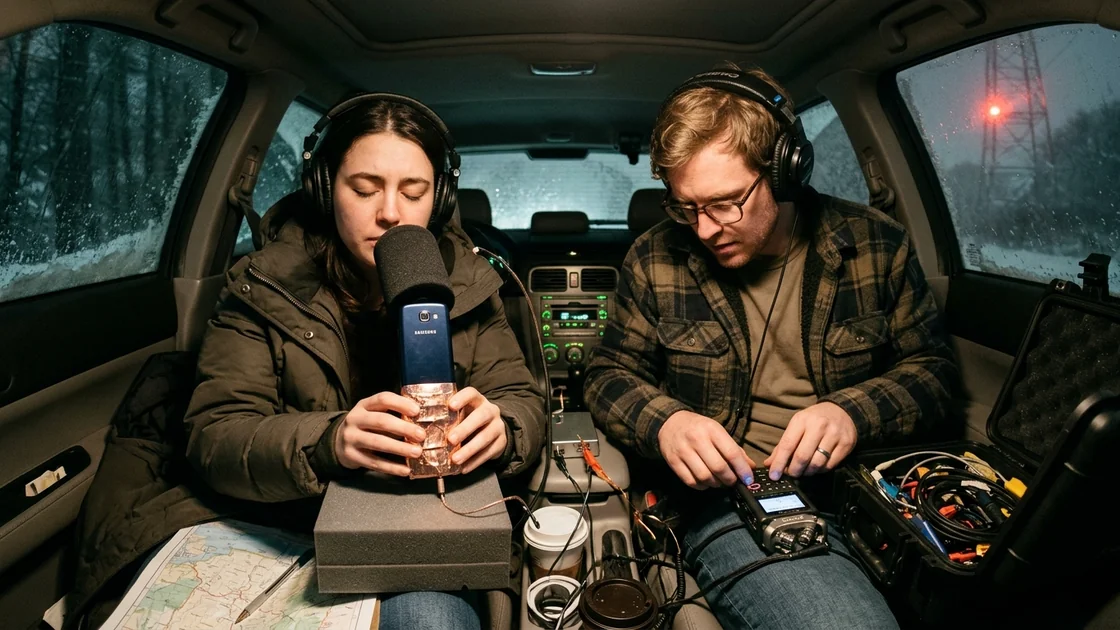
They worked in the cramped space like a surgical team in a field tent. Ethan opened the Pelican case on his lap in the passenger seat, powering up the Tascam recorder via an inverter plugged into the car's twelve-volt cigarette lighter. He put on a pair of heavy, closed-back Sennheiser studio headphones, plugged the giant aluminum-and-foam acoustic coupler into Channel 1, and handed the coupler to Clara.
"Hold the phone in your left hand, resting it on this foam block on the center console so your pulse doesn't vibrate the casing," Ethan instructed, slipping a second pair of monitoring headphones over Clara’s ears. The world outside—the wind, the snow, the idling Subaru engine—vanished completely inside the plush leather earcups.
"Now," Ethan said, his voice coming through her headphones via his talkback mic as he adjusted the copper shielding tape around the base of the phone. "Dial the voicemail. Wait until you get to the main prompt before pressing the coupler over the earpiece so you can see the screen."
Clara looked down at the glowing blue keypad. She pressed and held
1.
She brought the phone toward the acoustic coupler. The instant the dense black foam sealed over the top half of the slider phone, the sound inside her headphones bloomed with startling, cavernous clarity.
There was no buzzing. No helicopter-blade CDMA chatter. Because the tower was practically directly above their heads, the phone’s internal transmitter was barely whispering, and the copper tape shunted the tiny remainder straight to the ground plane of the preamp.
"Welcome to the BayState Wireless Messaging Center," the synthesized woman said inside their headphones, so loud and clear it sounded like she was sitting in the backseat of the Subaru. "Attention: This system will be permanently terminated in... fifty-one hours. You have... twenty... saved messages."
Clara reached under the edge of the foam to press 1 to
play the messages. Since she had saved Maya's message earlier, it had
moved from the "Unheard" queue to the very end of the "Saved"
queue—message number twenty.
She didn't have to listen to the first nineteen. She knew the
shortcut key. Pressing 3 three times skipped to the end of
the message queue.
She pressed
3—skip—3—skip—until the
automated voice announced:
"Twentieth saved message. Received... December fourteenth... at... eleven-forty-two PM."
Ethan hit the glowing red RECORD button on the Tascam.
On the tiny OLED screen, the dual WAV file meters began to dance,
tracking the incoming signal in uncompressed, studio-grade 24-bit
digital audio.
Clara closed her eyes and leaned her forehead against the steering wheel, listening through the studio headphones as Ethan rode the equalizer knobs with the delicate touch of a safecracker.
He rolled off the low-end mud below 100 hertz, and suddenly the rumble of the Civic's heater didn't drown out her breath anymore. He boosted a gentle shelf around 3 kilohertz, and it was as if a pane of frosted glass between 2019 and 2024 had simply been wiped clean.
"Clair-Bear?"
In the headphones, you could hear the tiny click of Maya’s turn signal lever dropping down. You could hear the rustle of her down jacket against the seatbelt as she shifted in her seat.
"Hey, it's me. Obviously. Look, my phone is showing no service out here past Acton, so I don't even know if this is going through, or if it's doing that weird delayed thing my network does, but I just wanted to talk to you. I turned back. I didn't go to Ethan's."
Next to her, in the dim light of the car, Clara saw Ethan’s hand resting on the recorder, a single tear tracking down his cheek and dropping onto the metal chassis, though he was smiling—a look of profound, devastating peace settling over his features.
"You were right. I got halfway past the prison in Concord and the roads are just... they're totally gone, Clara. I couldn't see the hood of my car. And I realized I wasn't even driving out there because I wanted to see him. I was just driving because I was mad at you for knowing me better than I know myself. Which is stupid. So I pulled into that little rest stop by Miller's Pond to turn around. I'm heading home now."
Scritch-thump. Scritch-thump. And then, the laugh. Warm, bright, alive, captured forever in two redundant solid-state memory cards and backed up simultaneously to Ethan's phone via a line-out splitter.
"Don't be mad when I get back, okay? Put the kettle on. I found that tin of peppermint bark we hid behind the flour canister. I'll be home in like forty minutes if I go twenty miles an hour the whole way. I love you, Clair. I'm sorry I slammed the door. See you soon."
"End of message," the robot said. "To delete this message, press seven. To save this message, press nine."
Ethan pressed STOP on the recorder. He tapped two
buttons to finalize the file headers, verifying the checksum on both SD
cards, before looking up at Clara and nodding once.
"We got it," he whispered. "I got the whole thing, Clara. Plus the other nineteen messages before it, if you want to run through the queue right now."
They sat there for another fifteen minutes under the blinking red light of the Zion Hill tower, recording every single one of the nineteen older messages—Maya complaining about the line at Trader Joe's, Maya singing a terrible rendition of "Happy Birthday" from a noisy bar in Allston, Maya asking where the spare key to the bike lock was.
When the twentieth message finished playing one final time, the automated voice asked its final question:
"To delete this message, press seven. To save this message, press nine."
Clara pulled the acoustic coupler away from the Samsung. As she did, the aged, dry-rotted ribbon cable inside the slider mechanism—stressed by the cold, the heat, and a dozen openings and closings after fifteen years in a shoebox—finally gave up the ghost.
The little rectangular screen flickered once, turned a violent shade of magenta, and went completely black.
Clara didn't panic. She didn't even flinch.
Without looking at the dead screen, her thumb found the
9 key one last time, and then the red END
button. She held it down until the tiny LED at the top corner winked
out, powering the midnight-blue pebble down for good.
On Monday night at midnight, a script would run in a server farm in South Boston, and System 4 would be erased. On Tuesday morning, the Zion Hill tower would stop broadcasting on 800 megahertz, turning the airwaves over to faster, newer things.
Clara took off the heavy headphones and looked out the windshield. The snow was already beginning to taper off, the clouds breaking apart to reveal a few cold, sharp November stars above the pine trees of Lincoln.
"Hey," she said softly, turning to Ethan as she put the Subaru into reverse and backed out onto the snowy road toward home. "Do you want to come back to Somerville? I can put the kettle on."