The Last Loaf of Oakhaven
Arthur Pendelton, a fourth-generation baker in the isolated mountain town of Oakhaven, watches his century-old family bakery succumb to bankruptcy during the worst winter in fifty years. As a modern supermarket drain his customer base and skyrocketing heating costs devour his meager savings, Arthur fights a losing battle to keep his ancestral brick ovens warm. Over the course of three brutal winter months, he is forced to liquidate recipes, antique equipment, and the very building his great-grandfather raised from the timber and stone of the valley. Despite a final, desperate attempt to rally the town during a catastrophic four-day blizzard, the crushing weight of financial insolvency prevails, culminating in a painful public auction where Arthur must surrender the keys to his heritage and walk out into the snow to start over from nothing.
The starter was one hundred and twelve years old, and it was the only thing in the building that didn’t know they were dying.
It sat in its heavy stoneware crock on the oak worktable, bubbling with a slow, lactic patience that smelled of crushed apples and damp wheat. Outside, the November wind came down off the Ironback Ridge like a scythe, rattling the wavy, hand-blown glass of the front windows and driving needles of sleet into the mortar between the bricks. Inside, Arthur Pendelton stood before the mouth of the hearth oven, a wooden peel balanced across his calloused palms, watching the thermometer needle refuse to climb past three hundred degrees.
"Come on, you old bastard," Arthur whispered to the iron door. His breath plumed white in the kitchen, a room that for four generations had never dropped below seventy-five degrees, even in the dead of January.
The oil tank out back was down to an eighth of a measure. The coal bin in the cellar—which fed the massive masonry oven his great-grandfather, Thomas Pendelton, had built with firebricks hauled up the mountain by mule in 1912—contained less than a ton of anthracite. A pile the size of a sleeping hound, dusted in frost.
Arthur slid the peel under the last four loaves of country rye. The crusts were pale, lacking the blistered, mahogany crackle that had defined Pendelton bread since William Howard Taft was in the White House. When he tapped the bottom of a loaf with his knuckle, it gave back a dull, heavy thud instead of a hollow drum-note. Under-baked. The hearth floor was losing its deep core heat, the thermal mass bleeding away into the frozen stone foundation because Arthur had been rationing the night-fires for three weeks.
He set the loaves on the cooling rack and wiped his forehead with the corner of his apron, leaving a smudge of unbleached flour across the deep creases above his eyebrows. He was fifty-four years old, though the gray in his beard and the pronounced stoop in his right shoulder—the peel shoulder, his father had called it—made him look closer to sixty-five. He had been standing on these wide pine floorboards since he was tall enough to see over the kneading trough.
On the small desk tucked beneath the stairs, a stack of envelopes sat weighted down by a brass two-pound scale weight. The top three were printed on that specific shade of pale pink paper that creditors used to simulate urgency without quite crossing into the violence of red.
Mid-Valley Flour & Grain: 90 Days Past Due. Oakhaven Municipal Power & Light: Final Notice before Winter Moratorium. First Mountain Bank & Trust: Notice of Default and Intent to Foreclose.
The brass bell above the front door jangled, a sharp, tinny sound that made Arthur flinch. He wiped his hands on his thighs, forced his shoulders back, and pushed through the swinging wooden doors into the retail shop.
The shop smelled of stale cinnamon and cold linoleum. The glass display cases, which in his grandfather’s time had required two girls in starched aprons just to keep stocked until noon, were mostly barren. A single tray of bear claws sat on the middle shelf, their almond paste glazing gone opaque from the chill. Three loaves of yesterday’s white sandwich bread sat in waxed paper bags marked Half Price.
Clara Higgins stood by the register, her wool coat buttoned to her chin, a knitted muffler wrapped twice around her neck so only her watery blue eyes and pinched red nose were visible.
"Morning, Clara," Arthur said, his voice booming slightly in the empty space, an old habit from when the room was noisy with twenty people waiting for numbers. "Nasty one out there. The radio says it's going to turn to snow before noon."
"It’s already snowing up by the gap, Arthur," Clara said. She didn't unwind her scarf. In the old days, Clara would take off her coat, sit at one of the two wire-backed tables by the window, drink a five-cent cup of coffee—later a fifty-cent cup, then a dollar—and tell him about her sciatica while the steam from the bake-room fogged the glass. Now, she shifted her weight from one orthopedic boot to the other, looking toward the door as if she had left a cab running. "Just a half-loaf of the seeded rye today, if you can slice it thin."
"The rye just came out," Arthur said, his heart sinking. "It needs another forty minutes to set, Clara, or the slicer’ll tear the crumb right out of it. I’ve got a lovely salt-rising loaf from this morning, though. Or the honey-wheat."
Clara hesitated, her gloved fingers drumming on the glass top of the counter, right over a crack that Arthur’s younger brother, Danny, had made with a toy truck in 1978. "Oh. Well. Tell you what, Arthur, don't trouble yourself. I have to go down by the highway anyway to pick up Harold’s prescription at the big store. I’ll just grab something there."
The big store.
Nobody in Oakhaven called it the Shop-Rite SuperCenter, at least not to Arthur’s face. They called it "down by the highway" or "the new place," as if it were an inconvenient geographical feature rather than a seventy-thousand-square-foot hangar of corrugated steel that had opened eighteen months ago at the junction of Route 9. It had a pharmacy, a bank branch, four acres of plowed asphalt parking, and an "In-Store Artisan Bakery" where frozen par-baked dough cylinders from a factory in New Jersey were misted with water and browned in electric convection ovens while a vent pumped artificial vanilla-butter scent into the produce aisle.
They sold French baguettes for a dollar forty-nine. Arthur couldn’t buy the flour and yeast to make a baguette for a dollar forty-nine.
"Take a bear claw for Harold, at least," Arthur said, reaching into the case with a sheet of wax paper before she could refuse. "On the house. Tell him I asked after his knee."
Clara’s eyes softened with a terrible, suffocating pity. That was the worst part of the last six months. Not the anger of the flour distributor on the phone, not the cold numbers in the ledger, but the way the town looked at him as if he were a dog that had been hit by a logging truck and hadn't quite finished dying in the ditch.
"You’re a good man, Artie," she murmured, taking the small white bag. She dropped a crumpled dollar bill into the glass tip jar—a jar Arthur had only put out in August, a humiliation that still burned his ears whenever he looked at it—and hurried out into the wind.
Arthur stood behind the counter for a long time after the bell stopped vibrating. Across the street, the dry goods store was boarded up, its windows painted dark green from the inside. Next to it, Miller’s Hardware was having a "Retirement Sale" that everyone knew was a liquidation. Oakhaven wasn't dying; its blood had simply drained three miles down the mountain to the four-lane highway, leaving the old brick Main Street dry and brittle as an autumn husk.
He walked back into the kitchen, picked up one of the pale rye loaves, and threw it as hard as he could against the cast-iron door of the oven. The crust split, the dense, gummy interior smearing against the soot-blackened iron before the loaf fell to the floor in two steaming, ruined halves.
The history of the Pendelton Bakery was written in the wood and masonry of 42 Main Street like rings in an oak tree.
Thomas Pendelton had arrived in Oakhaven in 1911 with a tin trunk, a German-language bible, and a stoneware jar of sourdough culture wrapped in his spare woolens. The town was a logging and coal camp then, raw and mud-choked, full of men burning six thousand calories a day swinging double-bit axes in the high timber. Thomas built the oven first, living in a canvas tent pitched over the warm bricks during his first autumn while he raised the timber-frame walls around it.
Arthur’s grandfather, Edward, had survived the Great Depression by trading loaves for cordwood, venison, and sacks of potatoes when cash disappeared from the valley altogether. He had expanded the shop in 1948, putting in the curved glass cases from Pittsburgh and the soda fountain that had been removed during the seventies. He had died of a massive coronary right in front of the Hobart mixer in 1966, falling into a hundred-pound batch of white dough with his boots still laced.
Arthur’s father, Walter, had been a careful, quiet man who wore a bow tie under his apron every day of his life. He had navigated the era of Wonder Bread by doubling down on wedding cakes, Kaiser rolls for the local diners, and the heavy, dark pumpernickel that the second-generation immigrant families down in the hollow still craved. Walter had paid off the mortgage on the building in 1983. They had burned the paper in the big hearth oven, watching the green-bordered bond curl into black ash before sliding in the morning’s first run of cinnamon buns.
It was Arthur who had put a mortgage back on it.
Seven years ago, the state health inspector had come through with a new set of regulations from the capital. The old maple worktables had too many knife-scores; they needed stainless steel. The three-compartment sink in the back wasn't large enough to submerge the sixty-quart mixing bowls; the plumbing had to be ripped out to the street main to install a grease trap. And the roof—slate tiles that Thomas had laid himself—had finally begun to shale off into the alley during the spring thaws, letting water trickle down behind the lath and plaster.
Arthur had gone to First Mountain Bank & Trust. Back then, the bank was still owned by the Vance family, and old Mr. Vance had grown up eating Pendelton jelly doughnuts every Sunday after church. The loan was sixty-five thousand dollars. A sensible modernization loan. The bakery was clearing forty thousand a year after expenses; the payments were seven hundred dollars a month. Manageable. Safe.
Then old Mr. Vance died. First Mountain was bought by a regional conglomerate out of Charlotte, North Carolina. Three years later, the county council—hungry for tax revenue after the last sawmill closed—rezoned the agricultural flatlands at the base of the mountain for commercial development, paving the way for the SuperCenter.
Then came the wheat spike of last summer, followed by the heating oil surge of the autumn. And then, three weeks before Thanksgiving, the bearings in the thirty-year-old walk-in retarder-proofer had seized with a shriek like a dying pig, filling the back room with acrid blue smoke and ruining four hundred dollars' worth of laminated croissant dough prepared for the holiday rush.
To fix the compressor had taken the last twenty-two hundred dollars in the business checking account. That was the money meant for the November mortgage and the winter coal delivery.
That night, after locking the shop at six—having taken in a grand total of thirty-eight dollars and forty cents across nine hours—Arthur climbed the narrow, creaking stairs to the apartment above the bakery.
The apartment had been his boyhood home. He had moved back into it after his divorce from Sarah five years ago. Sarah hadn't hated the bakery, at first; she had loved the romance of it when they were twenty-two, loved the warm bread at midnight and the flour in his hair. By thirty-five, she hated the hours—Arthur went to bed at seven in the evening and rose at one-thirty in the morning, six days a week. By forty-five, she hated the smell of yeast that never quite washed out of the sheets, the vacations they could never take because nobody else knew how to manage the hearth oven’s temperamental dampers, and the slow, grinding shrinkage of their bank account. She lived in Albany now, married to an accountant who slept in the dark like a normal human being.
The apartment was cold. In the old days, the radiant heat rising through the floorboards from the big brick oven below kept the upstairs so warm that Arthur used to sleep with his bedroom window cracked open a quarter-inch in January. Now, the pine planks under his wool socks felt like slabs of river ice.
He sat at the kitchen table—he never cooked up here; the stove was pristine, its white enamel yellowing only from age—and opened the black leather ledger.
The math didn't change, no matter how many times he ran the stub of his carpenter's pencil down the columns.
He owed the bank $41,200 on the principal, plus three months of missed payments and late fees totaling $2,450. He owed Mid-Valley Flour $3,800. He owed the electric company $1,100. He owed the county $2,900 in second-half property taxes.
In his personal savings account, he had $412.19. In the cash drawer downstairs, there was $100 in small bills and rolled coins for change, plus today’s $38.40.
He was fifty-four years old, and he was worth less than nothing.
On the first Tuesday of December, the snow began in earnest, and Richard Miller came through the front door carrying a leather briefcase instead of a coffee cup.
Richard wasn't related to the Millers who owned the hardware store; he was thirty-one, had moved to the valley from somewhere in Ohio after the conglomerate bought the bank, and wore camel-hair overcoats that looked ridiculous on a street where every other man wore Carhartt duck canvas or oiled wool.
"Mr. Pendelton," Richard said, stamping the slush from his wingtips onto the frayed cocoa mat. He glanced around the empty shop. It was ten-thirty in the morning. The air was dead still. "Do you have a few minutes? Somewhere we can sit?"
Arthur didn't invite him into the back. The kitchen was his sanctuary, and more importantly, if Richard saw the size of the coal pile or the empty flour racks in the storeroom, the conversation would be over before it began. Instead, Arthur gestured to the wire-backed table by the front window.
"Coffee, Mr. Miller? It’s fresh."
"No, thank you. I have to get back before the plows come through and block the side street." Richard sat down, wincing slightly as the cold iron of the chair bit through his slacks. He snapped open the brass latches of his briefcase and pulled out a manila folder. "Arthur, I’ve been trying to reach you by phone since the twentieth of last month."
"I’m in the back from two in the morning until noon, Mr. Miller. I don't hear the phone over the mixer." That was a lie. The mixer had only run for twenty minutes today, mixing a single ten-pound batch of white bread. Arthur had simply let the answering machine take the calls until the tape filled up.
"I understand," Richard said, though his tone suggested he understood nothing of the sort. "The problem is that the regional loss-mitigation department in Charlotte has flagged your commercial note. Because the loan is cross-collateralized against the real estate—both the commercial storefront and the residential unit upstairs—and because you’re now ninety-two days delinquent, it’s out of the local branch’s hands."
Arthur folded his thick forearms on the small marble tabletop. A scar from a sheet pan burn, thirty years old, ran like a pale worm from his wrist to his thumb. "It’s a slow autumn, Richard. The road work on Route 9 kept the leaf-peepers out in October, and the weather turned early. If I can just get through the Christmas bake—stollen, gingerbread, the yule logs, the dinner rolls—I always clear six, seven thousand in December. I can bring the note current by New Year’s."
Richard looked down at the papers in his folder. He wasn't a cruel young man, just an instrument of a distant spreadsheet. "Arthur, we have your merchant processing statements because your credit card terminal runs through our commercial services division. Your gross receipts in November were down sixty-eight percent from November of two years ago. They’re down forty percent from last year."
Arthur’s throat went dry. He hadn't realized they looked at the daily terminal batches.
"Even if you did triple your current weekly volume for the next three weeks," Richard continued quietly, "it wouldn't cover your operating overhead, let alone the arrears and the property tax lien the county filed last Friday. The bank had to advance the funds to clear that tax lien to protect our first-position mortgage. That added another three thousand to your default balance."
"My family has banked at that building on the corner since 1914," Arthur said, his voice dropping an octave, rough as mill-stone. "My grandfather helped carry the sandbags when the river rose in '55 to keep your vault dry."
"And if it were up to me, we’d work out a forbearance," Richard lied smoothly. "But commercial loans under a hundred thousand dollars are managed by an automated risk algorithm in Charlotte. Once the tax lien hit and the debt-service coverage ratio fell below zero for two consecutive quarters, the system generated a mandatory foreclosure referral. I’m here as a courtesy, Arthur, because the branch manager wanted someone to tell you in person before the sheriff serves the papers on Thursday."
Outside, the snow was falling thicker now, great wet flakes the size of silver dollars that clung to the glass, blurring the view of the boarded-up dry goods store across the way.
"What does that mean?" Arthur asked. "The sheriff?"
"You have thirty days to cure the default in full—which, with legal fees and the tax advance, is currently $8,140—or refinance the entire principal balance of $46,850 with another lender. If you can't do that by January sixth, the bank takes possession under the power-of-sale clause in your commercial deed of trust. They’ll schedule an auction for the fixtures, equipment, and real estate in late January."
"Where the hell am I supposed to get forty-seven thousand dollars by January sixth, Richard? Rob the post office?"
"There is another option," Richard said, pulling a single crisp sheet from the back of the folder. "A deed-in-lieu of foreclosure, combined with a voluntary liquidation of the chattel assets. Basically, if you don't contest the seizure and you keep the building heated so the pipes don't freeze between now and the sale, the bank will waive any deficiency judgment if the property sells for less than what you owe. And they’ll give you a fifteen-hundred-dollar relocation stipend once the keys are handed over."
Fifteen hundred dollars. Four generations. One hundred and twelve years of rising in the dark, of breathing flour dust until your lungs rattled in the winter, of missing Little League games and funerals and wedding anniversaries because the yeast didn't care who died or who got married. Four generations, valued at fifteen hundred dollars and a pat on the back for keeping the pipes from bursting.
"Get out of my shop," Arthur said.
Richard sighed, sliding the paper across the marble. "Think about it, Arthur. If it goes to a contested foreclosure, the legal fees will eat whatever tiny equity might be left in the building, and you’ll walk away with zero. Or worse, owing the bank ten grand if the auction goes poorly. Have you looked at commercial real estate on Main Street lately? Miller’s building has been on the market for a year without a single showing."
"I said get out."
Richard stood, buttoned his camel-hair coat, and left the paper on the table. When the door closed behind him, the little brass bell gave a single, choked ring.
A man does not surrender a century in an afternoon. He surrenders it in pieces, like throwing furniture into a firebox to keep a train moving a few miles further down the track.
On Friday, after the county sheriff—a man named Jim Vance, who had gone to high school with Arthur and who looked at his own boots the entire time he handed over the blue-backed legal summons—left the shop, Arthur went down into the cellar with a flashlight.
The cellar was dirt-floored outside the concrete pad that supported the great brick oven above. Along the damp stone walls were stacked the relics of the bakery’s past, things too heavy or too sacred to throw away when styles changed.
Arthur spent four hours down there in the forty-degree gloom, coughing on coal dust and spiderwebs, hauling artifacts up the bulkhead steps into the alley.
On Saturday afternoon, after closing the shop at two, he loaded the bed of his 1998 Ford F-150. The truck had two hundred andสิบ thousand miles on it, and the rear wheel wells were eaten through with road-salt rust, the metal flaking away like puff pastry. He threw a blue tarp over the load, tied it down with hemp twine, and drove forty miles south through the snow-slicked mountain pass to an architectural salvage and antique dealer outside of Hudson.
The dealer, a man named Gable who wore round wire-rimmed glasses and a fleece vest inside a heated warehouse full of stripped church pews and clawfoot tubs, walked around the open tailgate of Arthur’s truck with a flashlight.
"This is the good stuff, Artie," Gable said, running his thumb over a six-foot-long dough trough carved from a single trunk of white poplar. Thomas Pendelton had bought it used from a bakery in Utica in 1920. The wood on the inside was worn as smooth as river soapstone from a hundred thousand pounds of hand-kneading before they got electric power in the thirties. "No wormholes. Nice patina. What else you got under there?"
Arthur pulled back the tarp, his fingers stiff and aching from the cold. "Three sets of cast-iron Springerle molds from my great-grandfather’s kit. Twelve heavy copper Charlotte molds, tinned on the inside—they need re-tinning, maybe, haven't been used since my dad died. The old brass National Cash Register from the soda fountain days. And twenty-four wooden peel blades, hand-planed ash, mostly cracked, some whole."
Gable picked up one of the copper molds, turning it in the light. "People like the wooden peels. They hang 'em on the wall in their ski chalets up at the mountain. Put dried flowers on 'em."
Arthur felt a sour rising in the back of his throat. Those peels had been shaped by his grandfather’s drawknife during slow summer afternoons. Each one was balanced to the weight of the baker who used it.
"How much for the lot?" Arthur asked.
Gable squinted, calculating what he could get from the weekenders driving up from Manhattan, and then dividing by four because he could smell the desperation coming off Arthur’s wool coat like kerosene. "The register doesn't have the top marquee sign. And the trough is tough to move—takes up a lot of floor space until the right restaurant designer comes along. I can do eight hundred cash."
"The register alone is worth six, Gable. You know it is."
"In July, maybe, when the tourists are browsing. It’s December, Artie. Nobody’s buying five-hundred-pound wooden troughs before Christmas. Eight-fifty. Hundred-dollar bills."
Arthur looked out the open roll-up door of the warehouse. The snow was coming down sideways now, illuminated by the orange sodium lights of the highway. He thought of the oil truck driver who had refused to drop less than a hundred-and-fifty-gallon minimum without cash on the barrelhead.
"Eight-fifty," Arthur said.
Driving back up the mountain with the truck bed empty, the rear axle hopped and skittered on the slush without the weight of his ancestors' tools to hold it to the road. He stopped at the fuel depot at the edge of town and paid six hundred dollars for two hundred gallons of heating oil and half a ton of nut coal, delivered Monday morning. The remaining two hundred and fifty dollars went to Mid-Valley Flour, just enough to convince the dispatcher to release ten fifty-pound sacks of high-gluten patent flour and two cases of butter from the back of the regional delivery truck on Tuesday.
He was buying days. That was all. Trading a century of oak and copper for ten days of fire and five hundred pounds of ground wheat.
The second week of December brought a deep, arctic high-pressure system that cleared the skies and dropped the temperature in Oakhaven to fourteen below zero at night.
The old building groaned in the cold. The frost on the inside of the front display windows grew a quarter-inch thick, forming intricate, fern-like patterns that completely hid the interior of the shop from the street. Arthur had to set a small electric space heater on the window ledge just to melt a clear circle in the glass so anyone walking by could see the neon OPEN sign—which itself had lost the N tube, flickering OPE in a buzzing, dying orange against the gray mornings.
He was working entirely alone now. Until October, he had kept Maggie Jenkins on for fifteen hours a week to work the counter in the mornings and wash the sheet pans. Letting her go had been like cutting off his own left hand; Maggie had worked for his father before him, knew every diabetic and gluten-intolerant cousin in three townships, and could tie a pastry box with red-and-white baker’s twine in four seconds flat with her eyes closed.
Without her, Arthur had to run back and forth between the hearth and the counter every time the bell rang. Not that it rang often.
On December fourteenth, he stood at the stainless-steel workbench—the very table that had helped bankrupt him—rolling out marzipan for the Christmas stollen. His hands were cracked across the knuckles from washing pans in bleach water without lotion, tiny red fissures that stung fiercely whenever he handled lemon zest or salt.
The bell rang. Arthur wiped his hands on his apron, checked the clock—eleven-fifteen—and walked out front, hoping for an order of holiday pies.
It wasn't a customer. It was Marcus Vance, Jim the sheriff’s younger brother, who owned the Shell station and towing service down by the bridge. Beside him stood a man Arthur didn't know—thick-necked, wearing a black leather jacket with a quilted lining, smelling strongly of menthol cigarettes and expensive aftershave.
"Morning, Artie," Marcus said, not meeting his eyes. "Cold enough for you?"
"It’s winter, Marcus. What can I get you? Coffee’s on."
"We're good, Artie. Listen, this is Tony Moretti. He owns those three pizzarias over in County Seat, plus the bagel place by the community college."
Moretti stepped forward, ignoring Arthur’s flour-dusted hand, and looked up at the pressed-tin ceiling, then down at the black-and-white hex tile by the door. "Nice bones," Moretti said, his voice gravelled. "You got three-phase power coming into the back, or single?"
Arthur looked at Marcus, then back at Moretti. "We put three-phase in when we upgraded the walk-in seven years ago. Why?"
"Marcus tells me you’re winding things down," Moretti said, walking past the end of the counter to peer through the round porthole window into the kitchen. "Says the bank’s got you on the short list for January. I like to buy equipment before the auctioneers get their claws in it. Once those guys tag everything into lots, they charge a fifteen percent buyer's premium and half the time some idiot from out of state bids the mixers up past retail. What is that in the back, a sixty-quart Hobart? Classic H-600?"
Arthur didn't move. His feet felt bolted to the floor. "That’s my father’s mixer. Bought it new in '74. Rebuilt the gearbox three years ago."
"Yeah, the old gray iron ones are tanks. New ones have circuit boards that fry if you look at 'em funny," Moretti said, nodding approvingly through the glass. "What about the retarder-proofer? Single rack or double?"
"Double. Victory stainless. Just put a new Tecumseh compressor in it last month." Arthur wasn't sure why he was answering. His voice sounded like it was coming from the bottom of a well.
"I’ll give you three grand for the Hobart and the proofer right now," Moretti said, turning back and slipping his hands into the pockets of his leather jacket. "I bring my box truck up Sunday night with four guys and a liftgate. Nobody in town has to see us loading it out during business hours. Cash. No receipts."
"That proofer cost eleven thousand dollars," Arthur said, his blood beginning to thrum behind his temples. "The compressor alone just cost me twenty-two hundred. And if I sell you my mixer and my proofer on December fourteenth, how the hell do I bake my Christmas orders?"
Moretti shrugged. "Look around, pal. What Christmas orders? You got four loaves of bread and six muffins in a twelve-foot case. And here’s the thing you haven't figured out yet, Mr. Pendelton—if you wait until January sixth, the bank owns that mixer. It’s listed on your UCC-1 financing statement as business fixtures and equipment. You wait three weeks, I buy it from the auctioneer for twenty-five hundred, the bank takes the money, and you get zero. You sell it to me Sunday night, you put three grand in your sock drawer where the bankruptcy trustee can't see it, and when the sheriff comes, you tell 'em the compressor blew up and you scrapped it."
It was criminal. Technically, selling encumbered collateral before a foreclosure was fraud.
It was also the smartest piece of financial advice Arthur had heard in five years. Three thousand dollars in cash was first month’s rent, security deposit, and two months of groceries somewhere else. It was the difference between living in the cab of his F-150 in February and having a room with a radiator.
Arthur looked through the little round window into the kitchen. The big gray Hobart stood in the corner by the flour bins like an iron gorilla. Its paint was chipped around the base where forty years of steel bowls had banged against the pedestal. Around the gear lever, the metal was polished to a mirror shine by Walter Pendelton’s thumb, and then Arthur’s thumb. When it ran on second speed with a heavy rye dough, it had a specific rhythm—chug-whir, chug-whir, chug-whir—that had been the heartbeat of Arthur’s mornings since he was twelve years old.
If the mixer left on Sunday, the bakery was dead on Monday. He couldn't hand-knead enough dough to pay for the oil it took to heat the oven, not with his bad shoulder. Selling the mixer meant turning off the oven. It meant letting the bricks go cold before Christmas for the first time since the Kaiser was on the throne of Germany.
"No," Arthur said.
Moretti blinked. Marcus shifted uncomfortably by the door.
"Okay," Moretti said, misinterpreting the refusal as a negotiation. "Thirty-five hundred. And I’ll take the stainless worktables for another four hundred apiece. You leave the junk—the old pie racks and the scales—so the bank has something to look at."
"I said no, Mr. Moretti. I have Christmas orders on the board. Mrs. Gable ordered two stollen. The Methodist Church ordered twelve dozen dinner rolls for the Christmas Eve supper. I am the baker in this town. We bake until the doors close."
Moretti stared at him for a long five seconds, then shook his head with a short, humorless laugh. "Twelve dozen rolls. What is that, forty bucks? You’re throwing away four grand in untraceable cash for forty bucks of church rolls? Now I see why you're going broke, old man."
He pushed past Marcus and went out into the cold. Marcus lingered a second, his hand on the brass doorknob.
"Artie," Marcus said softly. "He’s right, you know. Nobody’s coming to save this street. Even the church... my wife’s on the supper committee. They only ordered twelve dozen from you because Reverend Pike felt bad. They bought the other forty dozen from the SuperCenter because they were ninety-nine cents a bag."
The door clicked shut.
Arthur walked slowly back into the kitchen. On the clip-board hanging by the prep table were the green holiday order slips.
Six years ago, by December fourteenth, there would have been three hundred slips hanging on four separate nails, thick as autumn leaves. He and Maggie and two high school kids hired for the holidays would have been working sixteen-hour shifts, sleeping on flour sacks in the storeroom for three hours at a stretch while the ovens ran twenty-four hours a day.
Today, there were nineteen slips on the clipboard. Total value: four hundred and twelve dollars.
He walked over to the Hobart mixer and laid his forehead against the cold, grease-smelling cast iron of its motor housing. He didn't cry—he was too dehydrated and too tired to cry—he just stood there with his eyes closed, listening to the silence of the pipes cooling in the walls.
The starter was dying, too. Or rather, it was going to sleep.
Because the kitchen was now dropping into the forties overnight between bakes, the wild yeasts and lactobacilli in the stoneware crock had grown sluggish. The sharp, bright vinegar-and-apple tang had flattened into a cold, sour paste.
On the night of December nineteenth, Arthur carried the heavy thirty-pound crock up the narrow stairs to his apartment, grunting as his bad knee popped on the landing. He set it on the chair next to his bed and wrapped his own spare wool blanket around it, tucking his electric heating pad underneath the stoneware base on the Low setting.
He slept in his flannel shirt, wool sweater, and long johns under three quilts, listening to the faint, occasional plop of a gas bubble breaking the surface of the batter in the dark beside him.
"You and me," he whispered into the dark room. "We're the last ones."
His great-grandfather Thomas had brought the mother culture from a bakery in the Black Forest where he had apprenticed in 1904. For over a century, every twenty-four hours, someone with the last name Pendelton had poured off half the crock, added ten pounds of spring wheat flour and a gallon of well water, and stirred it with the same long-handled birch paddle.
When his grandfather Edward was in the hospital with his first heart attack in '62, Arthur’s grandmother—who didn't know how to bake anything more complicated than biscuits—had walked down the stairs in her nightgown every midnight to feed it. When Walter died in '98, they had held the wake at the funeral home down the street, and at eight o'clock in the evening, Arthur had slipped out the back door in his black suit, walked up the hill in the rain, fed the starter, and walked back to shake hands with the mourners.
What did you do with a hundred-and-twelve-year-old living thing when there was no more flour to feed it? You couldn't pour it down the sink; it would harden like cement in the cast-iron trap, and besides, it felt like drowning a child. You couldn't sell it at auction; nobody at a bankruptcy sale wanted a bucket of fermenting gray slop.
Around three in the morning, the wind changed.
Arthur knew the sounds of the valley’s winds the way a sailor knows the pitch of rigging. A west wind off the plateau boomed in the big brick chimney like a bass organ pipe. A north wind whistled shrill and thin through the gaps in the upstairs sash windows.
This wind came from the northeast, low and heavy, carrying the wet, metallic smell of the Atlantic three hundred miles away colliding with the polar air trapped against the mountains. It didn't whistle; it pressed against the eastern brick wall of the building with a steady, immense weight that made the horsehair plaster in the hallway groan.
When Arthur went downstairs at three-thirty to rake out the ashes in the hearth oven and lay the morning fire, the kitchen floor was covered in a fine white powder that wasn't flour. Snow, dry as pulverized glass, had been driven horizontally right through the keyhole and under the threshold of the back alley door, forming a neat, curved drift four feet long across the linoleum.
He turned on the little battery-powered transistor radio he kept on top of the spice rack. Static hissed over the voice of the announcer from the county seat station.
...upgraded to a Blizzard Warning for all of Ironback, Greene, and Upper Valley counties through Thursday morning. A stalled coastal low is bombing out off the Jersey coast, locking against the ridge. Expect snowfall rates of three to four inches per hour by daybreak, with winds gusting to sixty miles per hour in the high passes. Travel is strongly discouraged...
Arthur looked at his nineteen order slips.
In a normal year, a storm forecast two days before Christmas meant panic buying. The shop would be mobbed by seven in the morning with people buying three loaves at a time in case the roads stayed closed through the holiday.
Now, he knew, the panic buying had happened yesterday afternoon down at the SuperCenter. Four hundred cars had lined up at the traffic light on Route 9, filling their trunks with shrink-wrapped flats of bottled water, batteries, and plastic bags of squishy white bread injected with calcium propionate so it wouldn't mold until Easter. Nobody came up Main Street for storm supplies anymore; Main Street wasn't even on the state DOT’s primary plow route since the highway bypass went in.
Still, a baker bakes.
He shoveled forty pounds of coal into the firebox beneath the baking chamber—nearly a third of what remained in the cellar—and opened the lower draft wide. If he was going down, he wasn't going down serving pale, raw-centered bread. He was going to get the deck to four hundred and fifty degrees if it burned the last lump of anthracite on the mountain.
At six-fifteen in the morning, the sky didn't lighten; it simply turned the color of dirty pewter. The snow wasn't falling in flakes anymore; it was a solid, screaming white wall moving sideways down Main Street at fifty miles an hour. You couldn't see the boarded-up windows of the dry goods store thirty feet away.
At six-forty-five, just as Arthur was pulling his first batch of sourdough boules from the hearth—magnificent loaves, their ears curled sharp and dark as mahogany, singing and crackling on the cooling rack as the cold air hit their crusts—there was a dull, distant thump from the direction of the ridge.
Three seconds later, another thump, closer this time, accompanied by a flash of eerie blue-green light that briefly illuminated the swirling white void outside the alley window.
The lights in the kitchen flickered once, dimmed to a dirty orange thread in the bulbs, and went out.
The hum of the walk-in proofer died. The buzz of the neon sign in the front window ceased. The ancient building settled into a profound, subterranean silence, broken only by the roar of the wind against the bricks and the crackle of the coal fire in the hearth.
"Transformer up at the substation," Arthur muttered to himself, reaching to the shelf above the sink where his father had kept the kerosene Hurricane lamps since the Great Ice Storm of '79.
He struck a wooden match on the side of the stone sink, lit the wick, and adjusted the glass chimney. The yellow flame threw long, wavering shadows across the flour bins and the silent gray bulk of the Hobart mixer. Seen by oil lamp, the kitchen didn't look like 2024 anymore. The stainless steel tables faded into the gloom, and the brick face of the oven, with its heavy iron doors and brass pyrometer dial, looked exactly as it had when Thomas Pendelton stood here in the winter of 1912.
Arthur carried the lamp out to the front shop. The thermometer on the wall by the door already read forty-eight degrees; without the electric baseboard heaters in the front room and the forced-air oil furnace in the basement—whose blower fan required electricity even if the tank had oil—the storefront would be below freezing by noon.
He unlocked the front deadbolt anyway, purely out of reflex, and turned the little cardboard sign on the door from CLOSED to OPEN, though no human eye could see it from five feet away on the sidewalk.
He went back to the kitchen, pulled a wooden stool up to the front of the hearth oven, opened the small ash-pit door an inch to let the radiant heat wash over his shins, and drank a mug of lukewarm coffee from the thermos he had filled at four.
He thought about the bank auction. He wondered who would buy the building. Probably nobody at the first sale; the bank would take it back as Real Estate Owned, board up the front glass with unpainted plywood like the dry goods store across the street, and let it sit for five years until the roof slate gave way completely and the black mold took the upstairs plaster. Eventually, the town would condemn it and tear it down for twenty parking spaces nobody needed.
And the oven—twenty tons of firebrick and sand and lime mortar—would be broken up with a hydraulic excavator bucket and hauled to the county landfill to be used as clean fill.
By noon, the snow drift in the front doorway was four feet high, pressed tight against the glass like wet concrete. The radio said the main transmission line coming over Ironback Gap had lost three steel towers to an ice-slide, and the secondary substation at the highway junction was underwater from a frozen creek backing up into the switchyard. The entire valley—all four thousand people—was dark. And with forty-inch drifts blocking Route 9 and the state plows pulled off the roads until the wind dropped, nobody was coming up the mountain from the county seat.
Arthur ate a heel of cold rye bread with a slice of cheddar from the dead refrigerator, banked the oven fire with ashes to hold the heat, and went upstairs to lie down under his quilts.
He was woken at four in the afternoon—it was already pitch black outside—by a sound that didn't belong to the storm.
Bam. Bam. Bam.
Not the wind. Someone was kicking the lower wood panel of the front door with a heavy boot because the glass above was buried to the transom in drifted snow.
Arthur swung his legs out of bed, pulled his wool coat on over his sweater, grabbed a flashlight, and went down the stairs.
Through the top eighteen inches of glass that remained above the snowbank, he saw the beam of a headlamp and the orange reflective stripes of a volunteer fire department parka.
Arthur unlocked the door and pulled, but the drift held it fast. Wait—the door opened inward. He braced his boot against the base of the counter, grabbed the brass handle with both hands, and yanked. The door came back with a loud crunch of breaking ice, and half a ton of powder collapsed into the shop across the black-and-white tiles, followed closely by Jim Vance, the sheriff, and Bill Miller from the hardware store.
Both men were covered in ice from eyebrows to boots, their faces raw and beet-red where the wind had found skin between their goggles and scarves.
"Jesus Christ, Artie, it’s warmer in here than my truck," Jim panted, pulling down his frozen balaclava and kicking the door shut against the howling white dark. "You got heat?"
"Not in the front," Arthur said, shining his flashlight on them. "The furnace blower’s dead without power. Come in the back. The hearth’s still at three-fifty."
The two men stumbled behind him through the swinging doors into the kitchen. The moment they crossed the threshold, they stopped and pulled off their gloves, holding their stiff, white fingers out toward the brick face of the big oven. The kitchen was sixty-five degrees, smelling richly of woodsmoke, coal gas, and the twenty loaves of sourdough sitting on the pine racks.
"My God," Bill Miller breathed, looking at the bread racks in the yellow glow of the hurricane lamp. "You baked today?"
"Before the power went," Arthur said. "What the hell are you two doing out in this? The radio said the roads are closed."
"We're on snowmobiles," Jim said, his teeth chattering slightly as the heat hit him. "The town emergency generator at the firehouse threw a rod an hour ago. Diesel gelled up in the feed line, and when they tried to jump it with starting fluid, it cracked the block. The school gym has no emergency power either—they took the old boiler out two years ago and put in high-efficiency heat pumps."
"What about the SuperCenter?" Arthur asked, a strange, cold stillness settling into his chest. "They have those big Generac units out behind the loading dock."
Jim looked at Bill, then back at Arthur. "The roof over the produce section collapsed at two o'clock under the drift load. Snapped the main sprinkler pipe. The whole store has six inches of freezing water on the floor, and the corporate manager locked the gates and drove out in his four-wheel-drive before the pass closed. Even before the roof went, their registers were down when the internet fiber snapped on the ridge. Couldn't open the cash drawers, couldn't scan a barcode, so they locked the doors and turned people away in the parking lot."
Arthur stared at him. "They had forty thousand square feet of food and they locked the doors because the barcode scanners didn't work?"
"Corporate policy," Bill spat, rubbing his ears. "And their fancy bakery ovens are all three-phase electric. Cold as a tomb by seven this morning."
"We’ve got a real problem, Artie," Jim said, stepping closer to the oven. "Half the houses down in the hollow switched to electric heat pumps or pellet stoves over the last ten years when the state gave out those rebates. Pellet stoves don't run without electricity to turn the auger. By midnight tonight, those houses are going to be twenty degrees inside. We're bringing the older folks—Clara Higgins, the Gable sisters, old man Henderson—up to the Methodist Church basement because they still have the old gravity-fed oil burner down there that runs without a blower. We've got thirty-five people in the church basement right now, and probably sixty by morning when we finish the snowmobile sweep."
Jim looked at the twenty loaves of bread on the rack.
"Nobody cooked today, Artie. Nobody can cook. They have electric ranges and microwaves, and the people at the church have a two-burner camp stove and four cans of coffee. Have you got anything you can spare? We’ll have the town council cut you a voucher as soon as the storm clears."
Arthur looked at the twenty loaves. Then he looked through the open cellar door toward the dark stairs where he had maybe seven hundred pounds of coal left—three days of hard firing—and eight fifty-pound sacks of flour in the storeroom.
Four hundred pounds of flour. With water, salt, and his starter, four hundred pounds of flour was roughly six hundred and fifty pounds of dough. Three hundred and twenty two-pound loaves.
HeDidn't need the Hobart mixer to turn the dough if he had extra hands. He didn't need the electric proofer if the kitchen itself was warm from the hearth. Thomas Pendelton hadn't had electricity in 1912. He had coal, firebrick, wood, water from the gravity main coming off the mountain reservoir, and muscle.
And in sixteen days, the bank was going to take the building anyway.
Whether he saved those eight sacks of flour or baked them, on January sixth the sheriff standing in front of him—his old high school classmate—was going to have to change the locks on the front door. If he didn't bake them, the flour would sit on a pallet until late January and get sold to Tony Moretti for three dollars a sack.
"Don't talk to me about town vouchers, Jim," Arthur said, untying his apron and tossing it onto the workbench before reaching for a fresh, clean one from the drawer. "How many men have you got down at the church who still have two good arms and aren't eighty years old?"
"Six or seven," Jim said, blinking. "The road crew guys can't run the plows, so they're sitting in the church basement playing cards."
"Go get two of them on the snowmobiles. Bring them back here. And Bill—you still got coal in your shed behind the hardware store? For the floor stoves you couldn't sell?"
Bill stood up straighter, his eyes widening behind his wire-rimmed glasses. "I got two tons of bagged blacksmith nut coal under a tarp out back. Been sitting there since '21."
"Have the boys with the snowmobiles tow a sled behind them and haul ten bags of it down the alley to my chute," Arthur said, walking over to the massive, six-foot oak workbench—not the stainless one, the original maple-and-oak framing in the back corner that the health inspector had told him only to use for dry storage—and sweeping the cardboard boxes off its surface with one arm.
"Take these twenty loaves and the tray of stollen back to the church right now," Arthur told them, grabbing two heavy canvas flour sacks to pack the bread so it wouldn't freeze on the sleds. "Tell them to boil water on that camp stove. Bread and coffee’ll keep 'em warm until two in the morning. At two, send someone back with the sleds. I’ll have seventy loaves of hot hearth bread and twenty pans of lard biscuits coming out every four hours as long as the coal holds out."
Jim Vance looked at Arthur, and for the first time in five years, the terrible, suffocating pity was gone from the sheriff's eyes. In its place was the look men in Oakhaven used to give Walter and Edward Pendelton when the valley was cut off by the floods of '55.
"Artie," Jim said quietly. "The town’s broke too. I don't know if the council will actually pay you retail for three hundred loaves."
"I don't give a damn about the council, Jim," Arthur said, picking up his great-grandfather’s iron coal shovel. "Get out of my kitchen and send me two men who know how to knead."
For seventy-two hours, it was 1936 again inside 42 Main Street.
At six o'clock that evening, the back alley door burst open in a whirl of snow, and in came Danny Miller—Bill’s twenty-four-year-old grandson, who worked at the state highway garage—and Marcus Vance, the same man who had brought Tony Moretti into the shop five days earlier to vulture the equipment. Behind them, they dragged a plastic deer-hauling sled piled high with fifty-pound sacks of hardware-store coal.
Marcus didn't say a word about Moretti. He just shed his parka, washed his grease-stained hands up to the elbows in the cold water of the deep sink, and stood across the table from Arthur in the lantern light, waiting to be told what to do.
"No machines," Arthur told them, his voice calm, authoritative, stripped of every hesitation that had plagued him at the bank desk. He was the master in his house again. "We mix in the sixty-quart bowls on the floor with the wooden paddles, then turn it out onto the board. Fifty pounds of flour at a time. Thirty-two pounds of water—I’m warming it in the copper kettle on top of the firebox so the dough temp hits seventy-eight degrees. A pound of salt. And ten pounds of the mother starter."
He had brought the stoneware crock down from his bedroom. Fed with warm water and fresh spring wheat, sitting three feet from the roaring cast-iron doors of the coal furnace, the hundred-and-twelve-year-old culture had woken up like a bear in April. It was frothing over the lip of the crock, smelling fiercely of green apples, yeast, and life, rising so fast you could almost watch the dome swell in the yellow lamplight.
They worked in their shirtsleeves while the blizzard tore the tin siding off the SuperCenter down on Route 9.
Every twenty minutes, Danny shoveled coal into the lower chamber until the iron doors glowed a dull, cherry red in the dark. The great brick vault above drank the heat, storing it in twenty tons of century-old masonry until the pyrometer needle climbed past four hundred, then four-fifty, then five hundred degrees—a temperature the old oven hadn't seen since the nineties.
Across the table, Arthur taught Marcus and Danny the rhythm of the hand-fold. Stretch, slap, fold, quarter-turn. Stretch, slap, fold, quarter-turn.
At first, the two younger men tried to muscle the heavy eighty-pound masses of wet dough, grunting and sweating until their forearms cramped within ten minutes.
"Don't fight it," Arthur said, moving seamlessly down the line, his own hands moving with a liquid, effortless economy learned from forty years at the trough. His bad shoulder didn't hurt anymore; the ninety-degree heat of the kitchen had soaked deep into the joint, loosening the old tendons like warm tallow. "Use your hips. Drop your weight when you push, let the gluten pull back when you rock onto your heels. It’s a dance, Danny, not a bar fight."
By midnight, the three of them were moving in silent synchronization in the dim orange glow of the kerosene lamps. The only sounds were the rhythmic thwack-slap, thwack-slap of the dough against the wood, the roar of the chimney draft, and the hiss of steam when Arthur threw a cup of water onto the hot bricks before sliding twelve loaves off the long wooden peel into the cave of the oven.
They didn't make fancy bread. There were no croissants, no bear claws, no cinnamon buns. They made two-pound round boules of sourdough country bread with crusts a quarter-inch thick that would hold their heat for two hours wrapped in wool blankets on the back of a snowmobile. And between the bread runs, while the big batches fermented in covered plastic tubs stacked around the warm chimney breast, Arthur cut forty pounds of lard and butter from the dead walk-in into flour to make hundreds of heavy, high-calorie drop biscuits and pans of cornbread sweetened with the last of his honey pails.
At two in the morning, Jim Vance returned on the snowmobile. When he opened the back door, a cloud of steam rolled out of the kitchen into the sub-zero alley like smoke from a locomotive.
They loaded sixty hot loaves into insulated coolers and canvas mailbags, along with four galvanized wash-tubs full of biscuits covered in foil.
"How is it out there?" Marcus asked, leaning against the doorframe, his T-shirt soaked through with sweat and white up to the chest with flour.
"Eighteen below with the wind," Jim said, his goggles frosted solid around the rims. "We had to pull the Rossi family out of their mobile home up on Creek Road—their kerosene heater ran dry at midnight and the water in their toilet bowl was frozen solid. There’s ninety people at the church now, and another thirty in the basement of the Masonic Lodge because they’ve got a woodstove. Artie, Clara Higgins says to tell you that stollen was the best thing she’s eaten since 1980."
Arthur didn't smile, just nodded and wiped his face with a rag. "Tell the women at the church to save the lard tins and the canvas sacks. I need them back on the six o'clock run. And if anyone down there has coffee or tea in their pantry at home, have your deputies grab it when they evacuate people. We’re out of coffee here."
They didn't sleep on Wednesday.
At eight in the morning, the storm hit its peak—a whiteout so dense that Danny tied a nylon rope from the back door handle to the coal sled ten feet away in the alley so he wouldn't get disoriented in the swirling vortex when he went out to fill the scuttle.
By noon on Wednesday, word had spread through the snowbound houses within walking distance of Main Street that there was fire at Pendelton’s.
People didn't come for free bread; they came because the drywall in their living rooms was cracking from the frost and their children’s fingers were turning blue under four blankets.
First came the Morales family from the apartments above the closed laundromat two doors down—a young mother, her husband who worked at the warehouse down the mountain, and two toddlers wrapped in sofa cushions tied with extension cords. Arthur didn't put them in the cold front shop; he cleared the empty flour pallets out of the back storeroom right behind the rear wall of the brick oven, where the masonry radiated a steady, dry eighty degrees, and told them to lay their blankets on the warm pine floor.
By four o'clock Wednesday afternoon, there were nineteen people camped in the bake-room and the storeroom. Old Mr. Henderson sat in a folding chair two feet from the ash-pit door with a sleeping toddler in his lap, while his wife and Maggie Jenkins—who had walked three blocks down the middle of Main Street on snowshoes she hadn't used since the Carter administration—took over the shaping table, rounding two-pound dough balls with her arthritic fingers as fast as Arthur could scale them out on the brass balance weight.
"You missed a spot on the seam, Artie," Maggie snapped, her voice cracking with age and triumph as she pinched the bottom of a boule he had just handed her. "Your father would have docked your allowance for a seam like that."
"My hands are tired, Maggie," Arthur said, and for the first time in three years, he laughed out loud.
They ran out of bread flour at nine o'clock Wednesday night.
Arthur didn't stop. He went into the dry storage closet and hauled out the fifty-pound sacks of pastry flour, the dark rye meal, the whole-wheat graham flour, the cornmeal, and even a twenty-five-pound bag of rolled oats. He mixed them all together into what his grandfather had called Crisis Bread during the war years—a dense, dark, sweet-smelling peasant loaf that weighed three pounds when it came out of the hearth and could keep a logging crew alive for a week on nothing but bread and water.
When the butter and lard ran out at midnight, Mrs. Morales sent her husband back up the street through the chest-deep drifts to their freezing apartment, and he returned with two gallons of corn oil and twenty cans of black beans, which they baked in deep hotel pans right on the hearth stones behind the bread, filling the dark kitchen with the rich smell of garlic, cumin, and woodsmoke.
At four o'clock on Thursday morning, Arthur slid the last twelve loaves of the oat-and-rye bread out of the oven.
He stood up, resting the long wooden handle of the peel against the floor like a spear, and looked into the firebox. The grates were bare gray ash. The coal bin in the cellar was swept clean down to the dirt floor. Every flour bin in the storeroom was empty, turned upside down and tapped on the table to get the last ounces of dust for the shaping board.
Even the hundred-and-twelve-year-old starter crock had been scraped down to a single quart of batter at the very bottom.
Outside, the howling in the chimney had stopped.
Arthur walked to the back alley window and wiped away the condensation with his sleeve. The clouds had parted. Above the jagged black silhouette of Ironback Ridge, the sky was an impossibly clear, bruising indigo, crowded with winter stars that burned like shards of white diamond. The wind was dead. The valley lay buried under fifty-two inches of snow, silent and white and still as the first morning of the world.
Around the warm brick flanks of the great oven, twenty-two of his neighbors were asleep under coats and flour sacks, breathing in the warm, sweet air of the last bake.
The power came back on at noon on Friday, preceded by the distant, grinding roar of two state DOT rotary snowblowers chewing their way up Main Street from the highway junction, throwing thirty-foot rooster tails of white powder over the telephone wires.
When the fluorescent tubes in the kitchen ceiling buzzed, flickered, and snapped on with their harsh, clinical white glare, everyone left in the kitchen blinked and winced as if waking from a warm dream into an operating room.
In the fluorescent light, the magic vanished instantly.
The kitchen looked like a bomb had gone off in a flour mill. Every surface was caked in dried dough scraps, soot, and coal ash. Muddy snowmelt from a hundred boots had turned the spilled flour on the linoleum into a gray, slippery paste. The empty sacks lay in heaps in the corner, and the big brick oven—its fire dead for thirty hours now—was already dropping past a hundred and twenty degrees, its iron doors streaked with rust from the steam.
By three o'clock, the town had gone home to check their pipes, reset their digital clocks, and shovel out their driveways. They shook Arthur’s hand as they left—shook it hard, with both hands, telling him they’d never forget it, telling him he was a lifesaver, telling him they’d be back on Monday as soon as the banks opened to pay him for the bread.
Arthur knew they meant it when they said it. He also knew that by Monday, when their pipes had burst and soaked their drywall, and their cars needed new batteries, and the insurance deductibles came due, five dollars for a loaf of bread they had already eaten four days ago would fall to the very bottom of their worries.
And even if every one of the three hundred people who had eaten his bread during the storm walked through the door on Monday morning and handed him five dollars, fifteen hundred dollars wouldn't even pay the flour bill he had just burned through, let alone the forty-seven thousand dollars he owed First Mountain Bank & Trust.
In fact, by baking every ounce of inventory in the building and burning every lump of fuel without taking a dime at the register, Arthur had officially destroyed his ability to open for business on Saturday. He didn't have enough flour left to dust a pie tin, and he didn't have enough cash to buy a ten-pound bag of King Arthur at the gas station.
On Tuesday morning, December twenty-fourth, the local weekly newspaper, The Valley Courier, ran a front-page story with a headline in thirty-six-point bold type: THE MIRACLE ON MAIN STREET: PENDELTON’S OVEN SAVES OAKHAVEN. There was a photograph Jim Vance had taken on his phone during the height of the storm—Arthur, Marcus, and Danny standing in front of the glowing hearth by lantern light, looking like men out of a WPA mural from the thirties.
Twenty minutes after the paper hit the racks at the post office, Maggie Jenkins marched into the cold, empty bakery carrying a three-pound coffee can with a slot cut in the plastic lid and a hand-lettered sign taped to the side: SAVE PENDELTON’S BAKERY.
"Don't you say a word to me, Arthur Pendelton," she said fiercely, slamming the can down next to the silent cash register. "I’m putting this at the post office, and I’ve got another one down at Bill’s hardware store, and Reverend Pike is taking up a special collection at the Christmas Eve service tonight. This town owes you its life, and we aren't letting those vultures in Charlotte take this building."
Arthur looked at the coffee can. For a brief, treacherous hour that afternoon, sitting alone in his cold apartment upstairs while he watched townspeople stop on the sidewalk below to shake hands with Maggie and drop folded bills into her can, a tiny, fragile shoot of hope tried to uncurl in his chest.
He had seen the movie. Everyone knew the movie. The good man gives everything he has for his neighbors on Christmas Eve, and at the last second, the whole town marches through the front door with a laundry basket full of cash, the greedy banker is shamed into tearing up the foreclosure notice, and the bells ring out over the snow.
On December twenty-sixth, Maggie and Reverend Pike came up the stairs to his apartment.
They didn't have a laundry basket. They had the two coffee cans and an envelope from the church.
When they dumped it out on Arthur’s kitchen table and counted the crumpled ones, fives, tens, and the handful of personal checks, the total came to two thousand,one hundred and forty-six dollars.
In a town where the median household income was thirty-four thousand dollars a year, right after Christmas and a catastrophic storm that had collapsed carports and burst copper water mains in forty basements, two thousand dollars was a heroic, sacrificial sum. Clara Higgins had written a check for fifty dollars, which Arthur knew was her grocery money for two weeks. Danny Miller had put in a hundred-dollar bill from his snow-plowing overtime.
Reverend Pike looked at the pile of small bills on the table, his old face lined with a quiet, helpless grief. "I asked how much the arrears were down at the bank this morning, Arthur. Richard Miller wouldn't tell me the exact figure because of privacy laws, but he told me two thousand wouldn't stop the filing."
Arthur picked up Clara Higgins’s fifty-dollar check and tore it gently in half, then tore it again.
"No, Reverend," Arthur said softly, his voice completely steady. "It takes forty-seven thousand to stop the filing. And another ten thousand to restock the cellar and fix the roof in the spring. And even if you raised fifty-seven thousand dollars tonight, by April everyone will still buy their bread down at the SuperCenter because it costs a dollar forty-nine and they can get their prescriptions at the same time."
Maggie started to cry, covering her face with her crooked, flour-scarred hands.
"Take the cash back to the church, Reverend," Arthur said, pushing the pile of bills across the formica table toward the minister. "Put it in the deacon’s fund to pay for the oil you burned keeping the basement warm during the storm, and use the rest to help the Morales family replace the clothes they lost when the pipes burst over the laundromat. I don't want charity for doing my job."
On January sixth, at ten o'clock in the morning, Arthur walked into First Mountain Bank & Trust and signed the deed-in-lieu of foreclosure across Richard Miller’s desk.
The bank was warm, smelling of lemon carpet cleaner and burnt coffee. Outside the plate-glass window, the snowbanks from the great blizzard were already turning gray with diesel soot from the logging trucks.
"You’re making the smart choice, Arthur," Richard said, sliding the check for the fifteen-hundred-dollar relocation stipend across the blotter. "The auction company—Kramer & Sons out of Albany—will be at the property on Friday the seventeenth to tag the lots, and the public auction will take place on the premises on Saturday the twenty-fifth at ten a.m. You have until the thirty-first to vacate the residential unit upstairs, provided you don't interfere with the auction crew."
Arthur took the check, folded it once, and put it in his shirt pocket without looking at it.
Over the next two weeks, he packed his life into the back of the F-150 and a small six-by-ten utility trailer he borrowed from Bill Miller. It didn't take long; when your family has lived in one building for four generations, you think you own a great deal, until you realize that ninety percent of what you own is the building itself.
He took his clothes, his mother’s wedding china, the framed black-and-white photographs of Thomas, Edward, and Walter standing in front of the delivery wagons and trucks through the decades, and his father’s leather-bound recipe ledgers.
Wait—on the morning the auction crew arrived with their rolls of yellow numbered stickers, the lead appraiser, a brisk man with a clipboard, stopped Arthur at the bottom of the stairs as he was carrying the recipe boxes out to his truck.
"Whoa, hold on there, chief," the appraiser said, tapping his pen against the clipboard. "Those the shop formulas?"
"These are my father’s and grandfather’s personal notebooks," Arthur said.
"Let me check the schedule," the man said, flipping through the bank’s default collateral list. "Yeah, sorry, pal. Your commercial security agreement covers 'all tangible and intangible business assets, goodwill, trade names, customer lists, and proprietary formulas or recipes utilized in the operation of Pendelton Bakery.' If it’s written down and used in the shop, it goes in Lot 44 with the office desk and the filing cabinet. Tony Moretti’s already called twice asking if the sourdough stollen and the salt-rising bread formulas are in the sale."
For the first time since the night he threw the rye loaf against the oven door, Arthur felt the urge to commit violence. His knuckles whitened around the bottom of the cardboard box. He was fifty-four and had a bad shoulder, wait—he had kneaded six hundred pounds of dough by hand in the dark two weeks ago; he could still put this little bastard with the clipboard right through the front display case.
Then he stopped. He looked down at the four grease-stained composition notebooks in the box.
He had read those notebooks a thousand times since he was ten years old. He knew the weight of the mace and cardamom in the stollen to the half-gram. He knew the exact temperature of the cornmeal mash for the salt-rising starter, and how it had to smell like old cheese before you added the sponge. You couldn't steal forty years of muscle memory with a yellow sticker. Moretti could buy the books, and his teenage pizza-makers would still turn out bricks because the recipes were written for a coal-fired masonry hearth that nobody knew how to fire anymore.
Arthur set the cardboard box down on the floor at the appraiser's feet, turned without a word, and walked back upstairs.
Saturday, January twenty-fifth, dawned clear and bitter cold, the sky a hard, bright blue that made the eyes water.
Arthur didn't want to stay for the auction, had planned to drive down to Hudson early that morning—he had rented a studio apartment above a garage near the industrial park there, where a commercial wholesale bakery that supplied hospital cafeterias had hired him as a third-shift mixer operator starting Monday at nineteen dollars an hour.
Instead, at nine-forty-five, he found himself standing in the back corner of the kitchen, leaning against the cold brick flank of the oven with his hands shoved deep into the pockets of his wool coat, watching strangers walk through his life with paper coffee cups from the gas station.
There were about forty people crowded into the shop and the bake-room. None of them were from Oakhaven; the townspeople had stayed away out of shame, leaving their curtains drawn along Main Street as the out-of-town box trucks and flatbed trailers double-parked along the snowbanks.
These were restaurant liquidators from Syracuse, scrap-metal dealers in greasy Carhartt bibs, a young couple from Brooklyn who were opening a "farm-to-table micro-bakery" in the Catskills and wanted vintage decor, and Tony Moretti in his quilted leather jacket, chewing on an unlit cigar by the walk-in proofer.
At ten o'clock sharp, the auctioneer climbed onto a milk crate set right on top of the stainless-steel workbench.
"Alright, folks, let’s get started, it’s cold in here and we’ve got eighty-two lots plus the real estate," the auctioneer barked into a portable PA speaker slung over his shoulder. His voice echoed terribly off the bare walls. "Everything sells absolute, as-is, where-is, no warranties expressed or implied, fifteen percent buyer’s premium on all chattel lots, cash or certified check before anything leaves the building. Let’s start right here in the front—Lot Number One, the 1948 Columbus curved-glass bakery display cases, twelve-foot pair..."
It took forty-five minutes to erase one hundred and twelve years.
The curved glass cases went to the Brooklyn couple for four hundred dollars; they planned to rip out the shelving and use them as terrariums in their lobby.
The forty-sheet aluminum pan racks went for thirty dollars apiece to a man who owned a catering hall.
The stack of sixty-year-old steel baguette pans, black as obsidian from a million bakes, didn't get a single bid as bakeware and were bundled with the cast-iron coal shovels and sold for twenty-five dollars to a scrapper who was going to sell them by the ton at the shredder yard.
When they reached Lot 38—the gray 1974 Hobart H-600 sixty-quart mixer—Tony Moretti didn't even have to take the cigar out of his mouth. He raised two fingers against the Brooklyn couple until they dropped out at sixteen hundred dollars.
"Sold to number fourteen for sixteen hundred," the auctioneer rattled, slapping the side of the mixer’s cast-iron head.
Moretti glanced across the room at Arthur, gave a tiny, almost imperceptible shrug that said Told you so, and went back to marking his catalog. He had just saved himself nineteen hundred dollars by waiting three weeks.
Lot 44—the oak desk under the stairs, the brass scale, and the box containing Walter and Edward Pendelton’s handwritten recipe ledgers—sold for eighty-five dollars to an antique mall vendor who didn't even open the notebooks, interested only in the dovetailed drawers of the desk.
Then the auctioneer walked out the front door onto the shoveled sidewalk, followed by the shivering crowd, to sell the building itself.
"Folks, we are selling the real estate located at 42 Main Street, tax parcel 14-2-9, consisting of a two-story brick-and-timber commercial building built circa 1912, approximately twenty-eight hundred square feet including the three-bedroom apartment upstairs and the masonry hearth oven in the rear. Opening bid from the lender is forty-six thousand, eight hundred and fifty dollars. Do I hear forty-seven?"
Silence.
The wind came down off Ironback Ridge, blowing dry snow across the toes of the bidders' boots. Across the street, the green-painted windows of the dry goods store stared back blindly.
"Forty-five? Do I hear forty thousand to start? Come on, folks, brick building on Main Street, newer slate repair on the west side, three-phase power..."
Nobody raised a card. Nobody wanted a century-old brick building with twenty tons of unmovable masonry in the back room on a street where no cars drove anymore.
"Lender bids forty-six eight-fifty," the auctioneer said flatly after sixty seconds of dead air. "Going once, going twice, sold back to the bank."
Within ten minutes, the chaos of extraction began. Men with hand-trucks and cordless drills swarmed through the doors, unbolting the stainless tables from the walls, cutting the copper refrigerant lines on the walk-in proofer with reciprocating saws that shrieked through the cold air, and dragging the six-hundred-pound Hobart mixer across the pine floorboards on a pallet jack, gouging deep, raw white tracks through a century of linseed oil and flour patina.
Arthur didn't watch them load the trucks.
When the last box truck pulled away from the curb at two in the afternoon, leaving the front doors propped open and snow swirling across the bare, scarred floor where the display cases had stood since Harry Truman was president, Richard Miller walked in from his car holding a brass padlock and a hasp for the back door.
Arthur walked out of the kitchen to meet him.
The building was completely hollow now, except for the great brick oven at the back. You couldn't unbolt the oven. It sat there in the stripped, echoing room like the ruin of a Roman aqueduct, its iron doors cold, its brick face scarred where someone had backed the pallet jack into the corner while hauling out the sink.
Arthur reached into his pocket, pulled out the iron skeleton key that unlocked the front mortise lock—a key worn so thin at the bow by four generations of Pendelton thumbs that it was nearly a crescent moon—and laid it on the windowsill.
"Pipes are drained," Arthur said. "I shut the main valve off at the street curb and poured RV antifreeze in the traps upstairs and down so they won't split before spring."
Richard looked at the key, then at Arthur. He looked uncomfortable, small inside his camel-hair coat in the freezing, empty room. "Thank you, Arthur. You didn't have to do that after the auction failed."
"The building didn't foreclose on me, Richard," Arthur said, looking up at the pressed-tin ceiling one last time. "It did its job for a hundred and twelve years."
He walked out the front door without looking back, stepped over the ridge of dirty ice left by the snowplows, and climbed into the cab of his old Ford pickup.
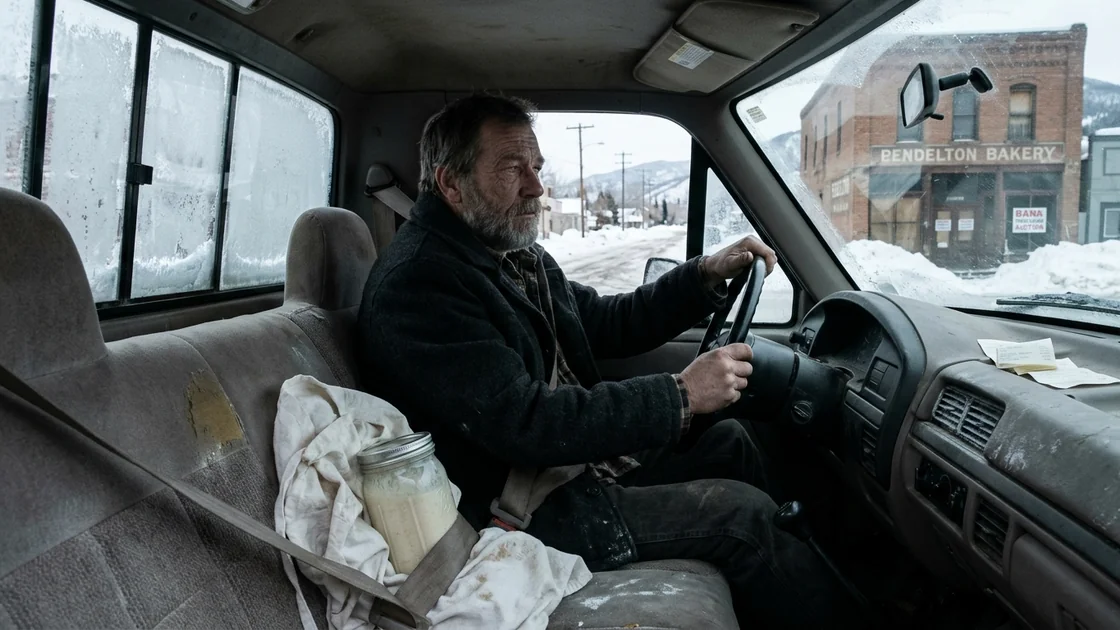
The truck took three tries to turn over in the ten-degree air before the V8 caught with a puff of blue exhaust. He turned the heater fan on—it squeaked on high, just like the bearings in the old proofer used to before it died—and looked down at the passenger seat.
Buckled neatly under the shoulder belt, wrapped in his father’s cleanest white baker’s apron to keep the frost off the glass, was a single one-quart Mason jar.
Inside the jar, two inches of pale, creamy batter sat quiet and dormant in the cold. Before the auctioneer had arrived at eight that morning, Arthur had gone down to the bottom of the stoneware crock, scooped out the last twelve ounces of the 1912 mother culture, and mixed it with the final two handfuls of flour he had swept from the corners of the wooden bin, kneading it into a stiff, dry ball that could survive a month in the cold without feeding.
Where he was going down in Hudson, he would be running a computer-controlled giant steel mixer in a windowless cinderblock factory, dumping fifty-pound bags of chemical dough conditioners and instant dry yeast into five-hundred-pound batches of hamburger buns for three counties of hospitals and prisons. He wouldn't need a century-old sourdough culture there.
Wait—he had a refrigerator in the studio apartment above the garage. And the apartment had a tiny electric oven that probably didn't hold its heat worth a damn, and he could buy a five-pound bag of flour at the grocery store every Friday with his nineteen-dollar-an-hour paycheck, and he could put a piece of quarry tile on the wire rack to bake a single loaf for himself on Sunday mornings.
Arthur put the truck in gear, pulled away from the curb in front of 42 Main Street, and drove down the mountain toward the highway, one hand on the wheel and the other resting on the wool apron to keep the jar from tipping on the curves.