The Last Breath of the Ironwood
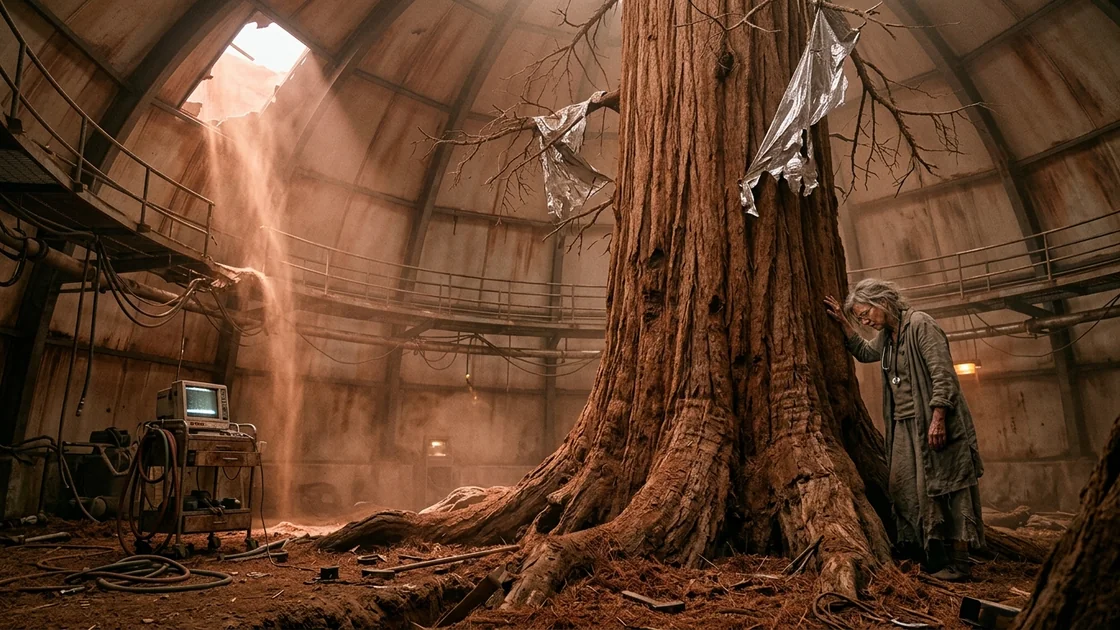
In a parched future where the oceans have retreated into memory and the continents are swallowed by shifting red dust, Dr. Aris Thorne spends her final years inside Bio-Dome Four tending to Methuselah, the last living Coast Redwood on Earth. Despite her relentless efforts, advanced hydroponics, and the sacrifice of her own water rations, the ancient giant succumbs to the systemic failure of the facility's aging machinery and the inescapable heat of a dying planet, forcing Aris to confront the ultimate futility of preservation and the quiet dignity of extinction.
The dust storm had been hammering the polycarbonate ribs of Bio-Dome Four for seventy-two hours, a relentless, shrieking percussion that Aris no longer heard with her ears, but felt in the calcified joints of her knees. Outside the triple-glazed acrylic panels, the world was the color of dried arterial blood. The Great Basin had expanded centuries ago, devouring the Sierra Nevadas in a slow, grinding digestive process of erosion and thermal fracturing, leaving behind a flat, scorching expanse that stretched from the salted flats of the Pacific bed to the shattered spine of the Rockies.
Inside the dome, however, the air tasted of wet peat, ozone, and the sharp, astringent tang of terpenes. It was an expensive smell. It cost forty-two kilowatts of geothermal draw per hour just to keep the humidity at sixty-five percent, and another nineteen to run the fog-harvesters that mimicked the coastal mists of a vanished northern California.
Aris stood on the third-tier aluminum catwalk, forty meters above the synthetic forest floor. Her calloused fingers, stained permanently brown at the cuticles from decades of soil sampling, rested lightly against the fibrous, cinnamon-colored bark of Sequoia sempervirens Specimen 001.
She called him Methuselah, though she knew the name originally belonged to a bristlecone pine that had burned to ash during the Thermal Spike of 2104. Names were like water now; you recycled them until nothing of the original carrier remained.
"Your sap pressure is down three kilopascals at the crown, old man," Aris whispered. Her voice was like two dry leaves rubbing together. She hadn't spoken to another human being in person since the courier ship had dropped off the last crate of chelating agents fourteen months ago. "The xylem in your northern leader is cavitating. I can hear it."
She pressed her stethoscope—an ancient, analog thing of cold stainless steel and cracking rubber tubing—against a shaved patch of cambium. Beneath the low, rhythmic thrum of the subterranean water pumps and the whine of the atmospheric scrubbers seventy meters above, she heard it: tick... tick-pop... tick.
Microscopic air bubbles were forming in the water columns inside the wood, snapping the continuous chain of moisture being pulled from the roots to the needles a hundred meters up. Embolisms. The tree was having tiny, silent strokes.
Aris pulled the earpieces out and let them hang around her scrawny neck. At sixty-eight, she looked not unlike the tree she guarded—tall, stooped, wrapped in loose layers of faded gray hemp cloth, her skin lined with deep vertical fissures from the harsh UV lamps that supplemented the filtered sunlight.
She turned back to her diagnostic cart, its solid-rubber wheels squeaking on the grated metal walkway. The screen of her tablet flickered, a dead pixel line bisecting a three-dimensional vascular map of the redwood. Over the last six months, the blue zones indicating active transpiration had retreated from the upper canopy like a receding tide, leaving behind gray, necrotic branches that shed brittle, rust-colored needles onto the maintenance nets below.
"The chillers are failing on Sector C," she told the tree, tapping the screen to log the pressure reading. "The brine in the heat exchangers is too thick. I flushed the lines on Tuesday, but the silica keeps precipitating out of the well water. It’s choking us both."
Methuselah did not answer, save for the slow, groan-like creak of his massive trunk shifting a fraction of a millimeter against the structural steel guy-wires that anchored him to the dome’s foundation. He was eight hundred years old. He had been a sapling when the first European ships had sighted the Mendocino coast, had survived the great clear-cuts of the nineteenth century, the megafires of the twenty-first, and the Great Desiccation of the twenty-second, when the Forestry Syndicate had dug a trench forty meters deep around his root ball, encased it in titanium-reinforced polymer, and hauled him on a crawler-transporter across four hundred miles of dying desert to this geothermal oasis.
Back then, there had been twelve trees in the dome. Now, eleven enormous, sawed-off stumps served as tables for Aris’s equipment, their flat surfaces covered in dusty glass carboys, disassembled pump housings, and piles of printed telemetry data from decades when someone in Geneva or New Anchorage still cared to read them.
Aris pushed the cart along the catwalk toward the central elevator shaft. As she moved, her eyes automatically scanned the lower tiers of branches. The foliage here was still green, a dark, waxy viridian that seemed almost violently unnatural against the pale, bleached gray of the dome’s steel superstructure. Small, dripping nozzles wired to the undersides of the boughs hissed intermittently, misting the needles with deionized water spiked with nitrogen and trace magnesium.
It was a life-support system in an intensive care unit. There were no mycorrhizal fungi sharing sugars between neighboring root systems anymore; Aris had to inject synthetic glucose and lab-cultured Glomus spores directly into the feeder roots via perforated PVC pipes. There were no spotted owls nesting in the crooks of the limbs, no banana slugs breaking down the leaf litter, no winter rains washing the dust from the stomata. There was only Aris, the pumps, and the humming geothermal well three kilometers beneath the basalt floor.
The elevator rattled as it descended, its counterweight clanking against the guide rails. When Aris reached the ground level, the heat hit her—not the sixty-degree celsius furnace of the outside world, which would have cooked the tree’s proteins in an hour, but a heavy, stagnant thirty-two degrees. The dome’s cooling towers were losing the war against the ambient radiation of the basin.
She walked across the sponge-like layer of duff—sixty years of dead needles that refused to rot properly without a full ecosystem of detritivores—and entered the control bunker, a concrete hemisphere poured directly against the base of the dome's northern wall.
The communications console was blinking with a low-priority amber light. Aris stared at it for a long moment before setting her clipboard down next to a mug of cold chicory root tea. An amber light meant an automated packet from the Preservation Authority at McMurdo.
She sat in the torn vinyl swivel chair and tapped the receive key. No video came through; bandwidth on the surviving satellite constellation was reserved for military reconnaissance and atmospheric engineering telemetry. Instead, green monospace text scrolled across the black CRT monitor.
FROM: CENTRAL BIOSPHERE ARCHIVE – ANTARCTIC SECTOR TO: STATION 04 (HUMBOLDT REMNANT) ATTN: THORNE, A. (DR.) SUBJ: DIRECTIVE 88-OMEGA / RESOURCE REALLOCATION
Aris adjusted her wire-rimmed spectacles and leaned in.
TEXT: Telemetry indicates geothermal output at Station 04 has degraded below the 1.2 MW threshold required for Class-A Macro-Flora maintenance. Current atmospheric projections for Latitude 39°N show zero probability of precipitation recovery within the next 300-year cycle. In accordance with Protocol 9, you are instructed to harvest viable meristematic tissue from Specimen 001, vitrify said samples in the liquid nitrogen dewar provided in supply drop 2182-B, and initiate controlled shutdown of the life-support grid. Extraction transport will arrive at your coordinates on October 14 to recover the genetic bank and station personnel.
Aris read the message three times. Her heart didn't race; at her age, and in this heat, the body conserved energy even in grief.
"Vitrify," she said aloud to the empty room.
She looked past the monitor, through the thick observation window of the bunker, out at the base of the redwood. The trunk was four meters in diameter here, its bark deeply furrowed, shaggy, and scarred from ancient fires that had burned when the sky was still blue. It was not a sequence of base pairs to be stored in a metal thermos at minus one hundred and ninety-six degrees. It was a column of living history, a slow-motion fountain of carbon and water that had spent eight centuries learning how to hold up the sky.
If they froze its cells in Antarctica, there would never be a world to thaw them into. She knew the climate models better than the bureaucrats at McMurdo did. The methane clathrates had finished venting fifty years ago; the albedo flip was permanent. Earth was becoming Venus’s cooler, dustier sister. The gene banks were just funerary urns for a species too arrogant to admit it had murdered its mother.
Today was August 3rd. October 14th was seventy-two days away.
Aris reached out and flipped the main breaker for the communications array. The amber light died. The green text vanished into a pinpoint of light in the center of the phosphor screen, then faded to black.
"Faulty receiver," she murmured, picking up her wrench set from the workbench. "Sand in the dish actuator. Tragic, really."
The next morning, the primary misting manifold on the eighty-meter level ruptured.
Aris woke in her cot to the sound of it—a high-pitched, screaming hiss that echoed off the dome’s curved roof like a jet engine, followed by the heavy, erratic thwack-thwack-thwack of high-pressure water flailing through the upper branches, stripping living needles and dead twigs alike and sending them raining down onto the bunker roof.
She didn't bother with her boots. She ran out onto the duff in her wool socks, her gray hair flying wildly around her shoulders, and threw the manual bypass valve at the base of Rise Pipe 2. The screaming above subsided into a wet, gurgling cough, and then silence, save for the patter of thousands of droplets falling through the canopy.
It was the sound of rain. Real rain. For ten seconds, Aris stood still, tilting her face up, letting the warm, mineral-heavy water splash against her cheeks and eyelids. It smelled of iron and old PVC, not the sweet ozone of a sky-born thunderstorm, but it wet her skin. It soaked through the shoulders of her tunic.
Then she looked at the pressure gauge on the main reservoir tank. They had lost four thousand liters in less than three minutes. Four thousand liters of deionized, distilled water that had taken the reverse-osmosis membranes a week to squeeze out of the toxic, hypersaline brine of the deep aquifer.
Her bare feet sank into the wet needles as she limped back to the tool shed. She strapped on her climbing harness, loaded her canvas bag with copper sleeves, neoprene gaskets, and a blowtorch, and took the elevator to the top platform.
The eighty-meter catwalk was a narrow ring of expanded metal suspended directly beneath the apex of the dome. Up here, the heat was ferocious—forty-four degrees, rising into a shimmering thermal pocket trapped under the acrylic zenith panels. The air was so dry that her nostrils immediately stuck together when she inhaled.
Methuselah’s crown reached five meters above the catwalk, his topmost leader bent slightly to the east where it had once tried to grow through the glass before Aris’s predecessor had pruned it back forty years ago. Up close, the damage from the heat was catastrophic. The needles here weren't even brown; they were bleached a bone-white by the relentless radiation filtering through the degraded UV coatings of the roof panels. They crumbled to powder when her sleeve brushed against them.
She found the break quickly. A copper elbow on the main feed line had split along its seam, corroded from the inside by the slight acidity of the nutrient solution and fatigued by the constant vibration of the water hammer.
As she worked, straddling a horizontal limb as thick as her torso while she cut away the ruined pipe with a hacksaw, she looked down at the bark beneath her thighs. It was gray and smooth here—young bark, relatively speaking, perhaps only a century old—and it was covered in small, resinous blisters.
Phomopsis, she thought, her stomach tightening. Or Botryosphaeria. Canker fungi. They lived dormantly inside the wood of healthy redwoods for centuries, kept in check by the tree's turgor pressure and defensive sap production. Only when the host was severely drought-stressed did the fungi wake up, turning sapwood into dry, crumbling punk and girdling the branches from the inside out.
She paused her sawing and pressed her thumb against a blister. It didn't yield with sticky, aromatic pitch. Instead, the bark cracked with a dry snap, revealing a lesion of dead, chocolate-brown cambium underneath. No sap flowed to drown the intruder. The tree didn't have the water to spare for tears.
"I'll prune the upper five meters," she told the branch, her sweat dripping onto the dry wood and vanishing instantly into the thirsty grain. "Reduce your transpirational load. You don't need this height anymore, old friend. There's no competition for light. You’re the tallest thing for six hundred miles."
She soldered the new copper fitting into place, the blue flame of her butane torch nearly invisible in the glaring white light streaming through the dust-caked dome roof. When she finished and opened the bleed valve, the water returned with a weak, sputtering sigh. The mist nozzles along the limb began to spray again, but within thirty centimetres of the brass orifices, the fine droplets simply evaporated into the superheated air of the apex, never even touching the needles.
The dome was a greenhouse in the worst sense of the word. Without the secondary evaporative coolers on the exterior shell—which had been shut down two years ago when the well's flow rate dropped by half—the sun was turning the upper third of the structure into a kiln.
Aris climbed down four hours later, her hands blistered from the hot metal of the catwalks, her tongue swollen in her mouth. In the bunker, she drank half a liter of warm water from her personal ration jug, then sat down at the engineering terminal to calculate the surface area of the upper canopy.
If she cut the top fifteen meters off the tree, she could lower the misting array to the sixty-five-meter mark, abandoning the thermal trap at the apex entirely. She could hang aluminized mylar tarps across the upper catwalk ring to create a false ceiling, reflecting the worst of the solar radiation back out through the glass and trapping the cool air and humidity in the lower two-thirds of the dome.
It was a mutilation. A redwood's crown was its hormonal brain, the source of the auxins that directed root growth and vascular repair. Topping an eight-hundred-year-old giant was like performing a lobotomy to save a patient from a stroke. Often, a topped redwood would panic, throwing out dozens of frantic, weakly attached epicormic sprouts that drank up the last of its starch reserves before collapsing under their own weight.
"It's that or let him cook from the head down," she muttered, pulling the manual for the high-amp electric chainsaw from the bottom drawer of her desk.
The amputation took six days.
Aris couldn't use the gasoline saws; the carbon monoxide and unburned hydrocarbons would poison the closed atmosphere of the dome and clog the catalytic scrubbers. She had to haul forty meters of heavy-gauge three-phase power cable up into the rigging, tying it off to the structural struts every three meters so its weight wouldn't pull her off the branches.
On the fourth day, at seventy-two meters up, she made the main cut through the central trunk.
The wood at this height was forty centimeters thick. As the tungsten-carbide teeth of the saw bit through the fibrous outer bark and hit the pale yellow sapwood, a cloud of sawdust erupted—not the damp, clumping sawdust of a living tree, but a fine, bone-dry flour that smelled faintly of pencil shavings and old closets. It coated her goggles and turned the sweat on her arms into a gritty red paste.
Halfway through the cut, the saw bound. The tree had leaned slightly over the decades, putting the eastern side of the trunk under immense compression. Aris had to shut off the motor and drive two magnesium wedges into the kerf with a four-pound sledgehammer. Each strike rang out through the dome like a church bell, vibrating down the trunk into the bedrock and echoing back from the curved acrylic walls.
Clang.
A flake of dry bark drifted down into the abyss below.
Clang.
The wood groaned—a high, violin-string tension sound that made the hairs on the back of her scrawny neck stand up. She had rigged a block-and-tackle system to the dome's central steel hub above her to catch the five-ton top section when it parted, so it wouldn't crash through the lower branches and smash the irrigation grid on its way down. If the thirty-year-old nylon webbing of the slings snapped under the shock load, the recoil would whip the steel cable across the narrow platform where she was tied in, slicing her in half before she even heard the sound.
She hit the wedge one more time.
With a sharp, rifle-shot crack, the heartwood surrendered. The fifteen-meter crown tilted slowly to the west, gracefully at first, like a dancer bowing, and then dropped two meters as the slack in the rigging played out.
The nylon slings screamed as they took the weight. The entire dome shuddered. Up in the zenith, a dozen sixty-year-old polycarbonate panels popped out of their neoprene gaskets with loud reports, letting in a sudden, blinding shaft of unfiltered sunlight and a swirling funnel of red desert dust. The steel catwalk beneath Aris’s boots bucked like the deck of a ship in a gale, throwing her against the trunk. Her ribs slammed into the handle of the chainsaw, knocking the wind out of her lungs in a ragged wheeze.
Above her, the severed crown hung suspended from the roof trusses like a gigantic chandelier of dead bone and brittle needles, swaying slowly in a shower of falling dust and shattered acrylic.
Aris hung in her harness for ten minutes, clutching the warm, vibrating stump of the trunk, waiting for the dizziness to pass and for the sharp pain in her left side to settle into a dull throb. Cracked rib. Maybe two.
When she finally pulled herself upright and looked at the flat, raw circle of wood at chest height, she began to cry. It was the first time she had wept since her husband, Julian, had died of renal failure during the salt-intrusion crisis at Station 02 twelve years ago. She didn't sob—that wasted moisture—she just let the hot, salty water leak from the corners of her eyes and run down into the respirator mask covering her mouth.
The cross-section of the trunk was a calendar of the world’s slow murder. Near the center, the rings were wide—three, four millimeters across—laid down in the wet, foggy summers of the late twentieth century. Further out, they grew tighter, stained with the dark crescents of wildfire scars from the 2030s and 2040s. And then, the last eighty rings, corresponding to the tree’s life inside this glass tomb: microscopic, frantic lines of cells, so thin she would need a hand lens to count them, warped and eccentric where the artificial light had failed to mimic the true arc of the sun.
The sapwood, which should have been wet and creamy, glistening with resinous beads, looked like old parchment. Only a thin crescent on the northern side—less than three centimeters wide—was even damp to the touch.
"Look what we did to you," she whispered through the respirator, laying her bruised cheek against the raw wood. It was hot from the friction of the saw blade. "We put a mountain in a birdcage and wondered why it forgot how to breathe."
It took her two more days, working with one arm strapped tightly to her ribs with duct tape, to winch the severed crown down to the floor in two-meter sections, and another week to stretch the reflective mylar sheets across the eighty-meter ring and patch the blown roof panels with sheet metal and silicone sealant.
When she was done, the interior of the dome had changed forever. Gone was the soaring, cathedral-like illusion of a sky above the canopy. Now, sixty-five meters up, a flat, shimmering ceiling of silver plastic sagged between the steel ribs, reflecting the greenish glow of the sodium-vapor grow lamps back down onto the mutilated stump of the tree's leader. The temperature on the floor dropped six degrees in forty-eight hours, and the humidity climbed back to seventy percent, condense-dripping off the underside of the mylar in a steady, metallic drizzle.
Technically, the operation was a success. The sap pressure in the middle canopy stabilized at minus一点四 megapascals.
Yet when Aris walked the lower catwalks now, the silence inside the dome felt different. It wasn't the hushed, sacred quiet of a redwood grove anymore. It was the cramped, sterile silence of a cellar.
In late August, the aquifer died.
It didn't happen all at once with a dramatic grinding of gears. Instead, the salinity alarms on the reverse-osmosis skid began to chirp every four hours, then every two, and finally settled into a continuous, shrill whine that forced Aris to clip the wire to the piezo buzzer just to keep her sanity.
She spent three days in the sub-basement beneath the bunker, a claustrophobic concrete vault where the main wellhead emerged from the basalt. The pipes down here were encrusted with inches of white and yellow mineral scale—calcium carbonate, gypsum, and heavy, toxic salts leached from the dying earth three kilometers down.
She pulled the cellulose-acetate membranes from the pressure vessels. They were ruined, coated in a thick, gelatinous slime of iron-oxidizing bacteria and silica gel that had polymerized under the forty-bar operating pressure, turning the microscopic pores into solid plastic.
She had two spare membrane sets left in the inventory crates. Each set was rated for six months of normal service. At the current total-dissolved-solids level of the well water—which had spiked from twelve thousand parts per million to nearly forty thousand, thicker than the ancient oceans—a new membrane would foul in less than ten days.
As she wrestled the heavy stainless-steel end-caps back onto the vessels, her cracked ribs screaming with every turn of the spanner, she did the math in her head.
Methuselah drank nine hundred liters a day now that his crown was gone and the mylar ceiling was trapping the moisture. The closed-loop dehumidifiers and condensate traps recovered about six hundred liters of that from the air and the runoff drains under the root ball. That left a net deficit of three hundred liters a day—water lost through the microscopic leaks in the dome's seals, bound up in the tree's cellulose, or vented out through the heat exchangers.
Three hundred liters a day. Twenty days of membrane life left.
After that, the only way to get pure water from the well would be distillation—boiling the brine in the emergency steam-kettle and condensing the vapor.
Aris looked over at the distillation unit in the corner of the vault. It was a backup system intended for human survival—two crew members, four liters a day each. Even if she ran its heating elements at maximum capacity twenty-four hours a day, bypassing the safety thermostats until the nichrome coils melted, it couldn't produce more than eighty liters every twenty-four hours.
She sat down on the wet concrete floor, her back against the warm casing of the geothermal return pipe, and wiped her greasy hands on her trousers.
"Two hundred and twenty liters short," she said to the empty vault.
The numbers were absolute. That was the terrible beauty of physics and botany; unlike politics or theology, you couldn't negotiate with a mole of water or the osmotic potential of a root hair. If the soil moisture around Methuselah’s roots dropped below twelve percent volumetric content, the remaining water would be held so tightly by the clay and peat particles that the tree wouldn't be able to pull it in. In fact, if the salt concentration in the soil rose even slightly, osmosis would reverse: the dry earth would literally suck the water out of the living roots, desiccating the giant from the bottom up.
There was one other reserve.
Aris stood up slowly, using the pipe to haul herself to her feet, and climbed the ladder back to the bunker. She walked past the control consoles, through the small galley, and into the sanitation module. Behind a locked steel door sat the Potable Reserve Tank—a ten-thousand-liter stainless-steel cylinder filled at the station's commissioning with triple-distilled, UV-sterilized drinking water for the six-person research team that had originally staffed the dome.
The sight-glass on the side of the tank showed it was still two-thirds full. Six thousand, four hundred liters. Enough for one old woman to drink and cook with for another fifteen years.
Or enough to cover Methuselah's deficit for twenty-one days.
Aris didn't even hesitate. She didn't think about October 14th, or the extraction transport from McMurdo, or what would happen if they arrived to find the station's emergency human life-support reserves pumped into a flowerbed. She simply walked back to the tool shed, dragged out thirty meters of flexible food-grade silicone tubing, and coupled the outlet valve of her drinking water tank directly into the suction side of the tree's primary nutrient-dosing pump.
She left herself four five-gallon jerrycans in the galley. Twenty gallons. Seventy-five liters.
Seventy-two days until October 14th, minus the twenty-six that had already passed since the directive arrived. Forty-six days left. A liter and a half a day for a woman working fourteen hours of heavy labor in thirty-five-degree heat.
"We'll go on half rations together, old man," she said as she opened the brass gate valve at the base of the potable tank. The clean, hoarded water rushed through the clear tubing with a soft hiss, carrying tiny silver bubbles that vanished into the main manifold.
September came, though the seasons outside the dome had long since collapsed into a binary cycle: the Scorch and the Grit. This was the transition between the two, when the hemispheric pressure gradients shifted and the superheated air of the equatorial belt collided with the cold, dead mass of the polar vortex over the ruins of the Canadian shield.
The wind didn't blow in gusts anymore; it moved like a solid river of pulverized granite and dried sodium sulfate from the dead lake beds. The sky disappeared completely. Even at noon, the light inside the dome was a murky, sepia twilight, supplemented only by the flickering yellow glare of the high-pressure sodium lamps hanging from the catwalks. Over half the bulbs had burned out over the last decade, and Aris had no replacements.
Under the dim, artificial sky and the low mylar ceiling, Methuselah began to shed his inner cloak.
Redwoods were evergreens, but they didn't keep every needle forever. Every autumn in the old world, a healthy tree would allow its oldest, shaded sprays of needles—those three or four years old, close to the trunk—to turn a rich, burnished copper and fall to the forest floor to feed the soil. The loggers had called it "the red fall."
Now, however, it wasn't just the interior sprays letting go. Entire boughs on the lower tiers—branches as thick as a man's thigh that had been green and supple in July—turned the color of dried blood in the span of a week.
Aris spent her mornings walking the duff with a bamboo rake, clearing the dead foliage away from the intake grates of the floor drains so the precious condensate wouldn't pool and evaporate. She was losing weight rapidly. Her hemp tunic hung off her collarbones like a tent on a broken pole, and her urine had turned the dark, rusty orange of the needles she was raking. Her lips were permanently split in the center, tasting of iron whenever she forgot herself and licked them.
She had stopped climbing the stairs to the upper catwalks; the elevator motor had burned out a commutator brush on September 8th, and she no longer had the glycogen in her muscles to haul herself sixty meters up the vertical service ladders. She lived entirely on the ground floor now, sharing the stagnant, humid dimness with the base of the trunk.
On September 19th, the last reverse-osmosis membrane ruptured under the osmotic pressure of the brine, sending a slug of forty-thousand-ppm salt water straight into the mixing tank before the conductivity interlock could trip the dump valve.
Aris was asleep on a pile of empty fertilizer sacks near the root crown when the alarm went off. She scrambled into the bunker, tripping over her own boots, and slammed the emergency cutoff switch on the panel.
Her hands were shaking so violently she could barely draw a sample from the main header line into a glass test tube. She dropped two tablets of silver nitrate reagent into the water. Instantly, a thick, curdy white precipitate of silver chloride bloomed in the tube, sinking to the bottom like snow.
"No, no, no," she whimpered, checking the flow totalizer on the main irrigation pump.
The pump had been running for twelve minutes since the membrane blew. Two hundred liters of brine had already been injected into the northern quadrant of the root zone.
For the next eighteen hours, Aris became a frantic machine. She severed the main feed lines to the misting nozzles in the canopy—the branches up there would have to fend for themselves on ambient humidity—and diverted every drop of remaining water from her personal potable tank into the northern root injection pipes. She needed to leach the salt down past the feeder roots into the gravel drainage sump before the chloride ions crossed the root membranes and poisoned the tree’s cytoplasm.
She dug into the peat and clay with a garden trowel and her bare hands, uncovering the pale, fibrous mats of the feeder roots a meter below the surface. Usually, living redwood rootlets had bright, creamy-white tips where the meristematic cells were actively dividing, pushing through the dark soil in search of moisture.
The roots she pulled up in her trembling, mud-caked fingers were black, slimy, and smelled of vinegar and rotting cabbage. The outer cortex slipped off the central vascular cylinder like wet paper when she pinched them.
Phytophthora. Root rot. The warm, stagnant water she had been recycling through the closed loop for months, combined with the lack of oxygen in the compacted artificial soil, had bred an anaerobic oomycete bloom. And now the salt had finished them off.
She sat in the trench she had dug, waist-deep in the warm, stinking mud at the foot of the giant, and stared at the massive buttress roots rising above her like the knees of a sleeping god. They were still hard as iron beneath their fibrous bark, immovable, eternal-seeming. A tree of this size had millions of kilocalories of starch stored in its trunk and big roots; it could technically remain standing, green in patches, for a year or two after its root system died, living off its own flesh like a starving man digesting his own heart muscle.
Wait, she thought. The directive.
...harvest viable meristematic tissue from Specimen 001, vitrify said samples in the liquid nitrogen dewar...
If the roots were dead and the crown was gone, the only actively dividing cells left on the tree were the axillary buds at the tips of the middle-canopy twigs—forty meters above her head. And if the salt was already moving up the xylem column via the residual tension in the sapwood, those buds would be dead and pickled within forty-eight hours.
Aris looked up through the gloom at the underside of the first catwalk ring, twenty meters above. The vertical steel ladder was bolted to the main structural column of the dome, fifty paces away. Each rung was thirty centimeters apart. One hundred and thirty rungs to the middle canopy.
She looked down at her hands. Three of her fingernails were torn back and bleeding from digging in the gravel. Her calf muscles were twitching with sodium-depletion cramps.
"Not for them," she whispered, looking at the dark wall of the trunk beside her. "Not for McMurdo. They'll never plant you. They just want a trophy in a freezer so they can check a box on the Anthropocene liquidation ledger."
She leaned her head back against the flared base of the redwood. Through the thick bone of her skull, she could still hear the faint, erratic tick... pop... tick of the dying xylem vessels inside the wood, much lower down the trunk now than it had been in August. It sounded like a watch running down in an empty house.
If she didn't harvest the buds, the genetic line of Sequoia sempervirens—a lineage that had watched the tyrannosaurs walk through the Jurassic ferns two hundred million years ago—would end right here, in this mud pit, with her. There were no viable seeds left in the Svalbard vault; the permafrost melt of 2088 had flooded the tunnels and cooked the gymnosperm collection before the relocation to Antarctica could be completed. Methuselah was a sterile triploid clone anyway; he hadn't produced a viable cone in fifty years. Tissue culture was the only bridge left across the abyss.
Could there be a world in ten thousand years? Ten million? Continental drift wouldn't stop just because humanity had choked itself on carbon. Eventually, the silicate rocks would weather, the carbon dioxide would be locked back into limestone at the bottom of whatever new seas formed in the rift valleys, and the ice would return to the poles. Without humans to burn the coal seams, the Earth would heal. It had survived the Permian-Triassic extinction when ninety-five percent of all life had boiled away; it would survive the primates.
Wait. If she put the tissue in a liquid nitrogen dewar in McMurdo, who was going to top up the nitrogen for ten million years?
Aris let out a dry, rattling laugh that turned into a coughing fit, doubling her over in the mud. Of course. The dewar required active refrigeration or a liquid air plant to replace the boil-off every six weeks. Within five years of the last human technician dying in the Antarctic bunkers, the tanks would warm up, the ice crystals would recrystallize inside the cells, and the meristems would turn to brown mush inside their plastic vials.
The Preservation Authority wasn't saving the future. They were performing a religious ritual to absolve themselves of the present.
"You don't belong in a thermos, old man," Aris said, patting the rough, warm bark beside her knee. "A tree is a process, not a blueprint. Without the fog, and the salmon bringing nitrogen up the rivers, and the fungus in the dirt, your DNA is just a sentence written in a language nobody speaks anymore."
She climbed out of the trench, dragging her shovel behind her, and went back into the bunker to turn off the main irrigation pump.
The silence that fell over Bio-Dome Four when the pumps stopped was absolute.
For forty years, the subterranean thrum of the sixty-horsepower impellers and the hiss of the high-pressure headers had been the heartbeat of Aris’s world, a constant mechanical tinnitus that underlay every dream, every meal, every page of every book she read. When the magnetic contactors clanked open and the flywheels spun down with a final, decaying sigh, the sudden absence of vibration felt like falling off a cliff.
Aris stood with her hand on the main disconnect lever for a long time. Now, the only sound in the universe was the dry, rasping shriek of the desert wind scouring the outside of the dome, and the occasional pock of a cooling pipe contracting in the floor.
She walked back out into the cathedral.
Without the misting nozzles running, the air cleared within an hour. For the first time in decades, there was no artificial fog haloing the sodium lamps. The light fell sharp, yellow, and merciless through the sparse, dying boughs.
Over the next two weeks, Aris watched the giant die with the clinical detachment of a physician and the devotion of a widow.
She dragged her cot out of the concrete bunker and set it up at the base of the trunk, right between two massive root spurs that formed a natural cradle. She brought her notebooks, a box of mechanical pencils, and the last three jerrycans of water. She didn't need to ration it so strictly now; she wasn't working anymore. Her job was finished. Now she was simply keeping vigil.
Every six hours, she took readings and wrote them down in her neat, cramped hand in the physical logbook, though she knew no one would ever read the paper.
September 28. Ambient temp: 39°C. Relative humidity: 28%. Soil moisture at 50cm: 4.2%. Cavitation acoustic emissions have ceased in the lower bole; the vascular columns are completely air-locked. No sap flow detectable via thermal dissipation probes. Foliage loss estimated at 85%. The smell of alpha-pinene and limonene is extremely strong today—the cells in the needles are rupturing from heat stress, releasing all their volatile oils at once. It smells like a summer afternoon in the Santa Cruz mountains when I was a girl. My father took me to Big Basin before the fire of '42. I remember the dust motes in the sunbeams.
On October 2nd, the great branches began to drop.
There was a phenomenon in old-growth redwoods called "summer limb drop"—even in healthy forests, during hot, still afternoons, massive horizontal boughs weighing several tons would suddenly snap off near the trunk without warning, driven by subtle shifts in internal water tension and wood elasticity.
Now, desiccated to the point where the wood fibers were shrinking and splitting lengthwise along the grain, Methuselah began to shed his arms.
Aris was lying on her cot, half-delirious from the heat, which had climbed to forty-six degrees now that the geothermal chillers were completely dry, when a sound like a cannon shot echoed from forty meters up.
She rolled off the cot and pressed herself flat into the hollow between the buttress roots just as a limb fifty centimeters thick and twelve meters long came scything down through the lower canopy. It smashed through the twenty-meter aluminum catwalk, tearing the steel grating from its brackets in a shower of sparks, and hit the forest floor ten meters from her feet with an impact that bounced her body three inches off the dirt.
A cloud of red dust, decades of dried spores, and pulverized needles boiled up to the roof, turning the yellow light of the remaining three sodium lamps into a murky orange soup.
Aris coughed into the crook of her elbow and looked out at the fallen limb. Where it had torn away from the trunk, the wood was splintered into long, jagged spears the color of dried beef. It wasn't rotten; redwood heartwood was so packed with polyphenolic compounds that even the fungi inside the dome couldn't digest it quickly. It had simply failed mechanically, too dry to hold its own cantilevered weight without the hydraulic skeleton of water pressure inside its cells.
"Let it go," she croaked, her throat so dry it clicked when she swallowed. "Put it down, boy. You've carried it long enough."
Two days later, another limb went on the southern side, taking out the main electrical busbar for the grow lamps. The remaining lights flickered, buzzed violently as a transformer shorted out in the control room with a smell of burning PCB oil, and died.
Now the only light inside the dome was what filtered through the three-millimeter crust of red clay baked onto the outer acrylic panels and crept around the edges of the mylar sheets hanging at the sixty-five-meter mark. It was the light of an eclipse—eerie, shadowless, and bruised purple-brown.
In the darkness, the tree began to sing.
As the massive four-meter trunk dried out, the outer sapwood shrank faster than the dense, ancient heartwood at the core. The resulting radial tension was immense—hundreds of tons of force pulling the circumference of the tree taut like an iron tire shrinking onto a wagon wheel.
Every few minutes, a vertical check—a split in the wood—would rip open somewhere along the seventy-meter column. From the outside, hidden beneath thirty centimeters of spongy, fibrous bark, the cracks were invisible. But from where Aris lay with her ear pressed against the bare root flare, the trunk acted as a giant wooden sounding board, a seventy-meter cello body resonating in the dark.
Bong. A deep, bass note that vibrated in her sternum when a deep heartwood check propagated near the base.
Twang-zing. A higher, metallic snap from fifty meters up as a spiral grain parted under torsion.
And between the great structural cracks, there was a continuous, soft whispering—millions of tracheid cells, tiny microscopic wooden straws that had held water since the Renaissance, collapsing inward one by one as the last bound moisture was baked out of their cellulose walls by the fifty-degree heat.
Aris lay on her side, her knees drawn up to her chest, sipping warm water from a plastic tube leading into the last jerrycan. Her skin had stopped sweating days ago; she was a dry, leathery husk now, her blood thick as syrup, her mind floating in a pleasant, hypernatremic haze where time lost its linear tyranny.
She wasn't in Bio-Dome Four anymore. She was twenty-four years old, walking through the Muir Woods remnant with Julian before they were married, before the sky turned yellow. It had been raining—a cold, miserable November drizzle that soaked through their cheap nylon parkas and turned the trail into a ribbon of slick clay. She remembered complaining about her cold feet. She had actually stood beneath a tree three hundred feet tall, with cold, clean water falling out of the atmosphere for free, and she had complained that her socks were wet.
She smiled in the dark, her cracked lips bleeding slightly onto the canvas of the cot. What an extraordinary luxury it had been, to be annoyed by rain.
She reached out her hand and pushed her fingers into the deep, V-shaped furrow of the bark beside her face. Down at the very bottom of the crevice, shielded from the hot air by six inches of insulating fiber, the wood still felt faintly cool. Not wet—the moisture was gone—but cool with the thermal inertia of eighty tons of dead carbon.
On October 10th, the mylar ceiling gave way.
The adhesive tape and nylon zip-ties Aris had used to secure the sheets had degraded in the fifty-five-degree oven at the top of the dome. One corner peeled back, caught a convective updraft from the scorched floor, and ripped across the sixty-five-meter ring like a sail splitting in a hurricane.
Three hundred square meters of aluminized plastic drifted down through the shattered, skeletal branches of Methuselah, snagging on the broken stubs of limbs and draping the dead giant in a grotesque, shimmering shroud of silver foil.
Through the gap above, the afternoon sun—abloated, fuzzy white disc behind the high-altitude dust veil—struck the lower trunk directly for the first time in forty years.
Aris squinted up into the glare. There was not a single green needle left on the tree. Not one. Every twig was bare, gray, and skeletal, etched against the dirty glass of the roof like crackle-glaze on an old plate, wrapped in fluttering ribbons of silver plastic that caught the dead light and threw it around the dome in blinding shards.
The air smelled of baked dirt, hot aluminum, and charcoal.
Her water can was empty. She had sucked the last warm drops filled with plasticizer residue from the bottom of the jug that morning.
She pulled her logbook onto her lap. Her vision was tunneling, the edges of the page blackening into a vignette of dancing purple spots, and she couldn't feel her feet inside her wool socks anymore. She didn't bother looking at the thermometer on the post; the alcohol column had hit the top of the glass tube at sixty degrees and separated.
With a hand that felt like it belonged to someone else—a wooden puppet’s hand, carved from dry pine—she pressed the lead of the pencil against the paper. The graphite snapped. She didn't have the strength in her thumb to click the button on the end to advance a new piece of lead, so she simply used the sharp metal tip of the pencil sleeve to scratch the words into the surface of the paper without ink.
Oct 11. Specimen 001. Complete desiccation achieved. No viable tissue remains.
She dropped the pencil into the dirt. That would save them some trouble when they landed in three days. They wouldn't have to climb the ladders with their sterile scalpels and their liquid nitrogen flasks. They could just get back in their tilt-rotor, drink their recycled urine, and fly back to the ice.
She rolled back toward the trunk, pressing her chest and stomach flat against the bark, hugging the curve of the root spur as if she were trying to climb inside the wood.
"We did alright, didn't we?" she whispered, though her vocal cords made no sound at all, only a dry click of her tongue against the roof of her mouth. "Eight hundred and forty-two years. Not bad for a weed in a jar."
Above her, a panel of acrylic at the very apex of the dome finally succumbed to thermal expansion and dropped out of its frame. It fell seventy meters, hit the sawed-off stump of the tree's crown with a dull thump, and shattered into a thousand dull, harmless cubes of plastic that rained down through the silver-draped branches like dry hail.
Through the hole in the roof, a funnel of red desert sand poured in, riding a downdraft of scorching wind. It swirled down around the dead trunk, coating the silver mylar, filling the trenches where the rotted roots lay, and settling gently into the creases of Aris’s gray tunic and the open, unblinking corners of her eyes.
Deep inside the center of the four-meter bole, where the wood had been laid down in the year 1340 while the Black Death was marching across Europe, the very last microscopic column of water—trapped between two bordered pits in a single tracheid cell—finally surrendered to the heat, flashed into vapor, and let go with a tiny, inaudible tick.
Then the ironwood was still, and the desert came in to claim its own.