The Language of Cut Stems
Clara Vance spent forty years behind the counter of The Glass House, translating the townspeople's loudest joys and quietest griefs into bouquets of roses and lilies while keeping her own decades-long sorrow pressed tightly behind her ribs. Every morning she trimmed stems for newlyweds who believed they were invincible and mourners who knew they were not, all the while waiting for a letter or a footstep from Julian, the boy who had walked out of Oakhaven in the rain of 1984 with a pocketful of her dried lavender and a promise he never kept. When an order arrived for a funeral wreath bearing a ribbon that only Julian would have known to ask for, combined with the simultaneous arrival of his estranged daughter planning her own wedding, the careful architecture of Clara’s solitude finally began to give way, forcing her to confront the difference between preserving a memory and actually living a life.
The bell above the door of The Glass House did not ring; it chimed with the low, bruised resonance of a brass plumb bob hitting an oak frame. Clara liked it that way. A bright silver jingle belonged to bakeries and hardware stores, places where people went with simple, practical intentions. People came into a flower shop because someone had been born, someone had died, someone was trying to be forgiven, or two people were about to make a promise they had no way of knowing if they could keep. Those errands required a heavier sound.
At five-thirty in the morning, the chime was still. The shop smelled of river silt, crushed eucalyptus, and the sharp, peppery bite of chrysanthemum leaves that had spent the night in the walk-in cooler at thirty-eight degrees. Clara stood at the zinc-topped worktable, an unbleached linen apron tied twice around her waist, her fingers already stained the faint, indelible greenish-brown that no amount of lemon juice or pumice ever truly removed.
On her left lay the buckets for the Miller-Hayes wedding: four hundred stems of ‘Quicksand’ roses, the color of rainwater trapped in a dusty saucer, alongside frothy bundles of astilbe and silver-dollar eucalyptus. On her right sat the dark green Oasis foam rings for Arthur Pendelton’s casket spray, waiting for the heavy-headed white Oriental lilies that were still stubbornly tight in their buds.
Clara picked up her shears—heavy Japanese steel with looped handles that fit her knuckles like a second set of bones—and began the morning liturgy. Cut at a forty-five-degree angle under running water. Strip the lower foliage so the leaves wouldn't rot in the bucket and sour the water with bacteria. Check the guard petals on the roses, thumbing away the bruised outer layers that had protected the heart of the bloom during its flight from the high valleys of Ecuador to this damp corner of coastal Maine.
"You're late opening up, Clara-belle," a voice called from the alley door.
Clara didn't jump. She knew the sound of Eddie’s Ford transit van idling by the dumpsters before the brakes even squeaked. She walked to the back, slid the heavy iron bolt, and let in a rush of raw October air that smelled of low tide and diesel.
Eddie came through sideways, his arms wrapped around two long corrugated cardboard boxes strapped with yellow plastic tape. He was sixty, five years older than Clara, with a grey beard trimmed close to a wind-chapped jaw. He had been driving the wholesale route from Portland since Clara’s father was the one unlocking the back door.
"Ferry fog," Eddie said, dropping the boxes onto the low wooden pallet near the sink. He pulled a clipboard from his canvas vest. "Had the turnpike down to thirty miles an hour south of Brunswick. Got your white ranunculus, though. The grower in New Hampshire had three flats left before the frost hit his hoop houses."
"How do the stems look?" Clara asked, taking the ballpoint pen from his fingers and signing the bottom of the pink carbon sheet without looking at the itemized invoice. She knew to the penny what Eddie charged, and Eddie knew that if he ever brought her hollow-stemmed ranunculus, she would drive them back to Portland herself and leave them on his boss's desk.
"Straight as church pews," Eddie said. He lingered for a second, wiping his nose with the back of a gloved hand, his eyes drifting toward the front of the shop where the streetlamp light was beginning to thin into the pewter grey of dawn. "Heard about the Pendelton place?"
"I’m doing Arthur’s spray this morning," Clara said, already slicing the yellow straps with a box cutter. "His sister called yesterday from Boston. White lilies, blue delphinium. Nothing flashy."
"Not Arthur," Eddie said softly. "Well, Arthur too, God rest him, ninety-two is a good run. I meant the other house out on the Neck. The old Mercer cottage."
Clara’s thumb stopped on the cardboard lid. The cardboard was cold and slightly damp from the refrigerated truck. Inside, wrapped in crisp white tissue paper, the ranunculus were sleeping.
"What about it?" she asked. Her voice didn't change pitch. Forty years of quoting prices on baby-sized coffins had taught her how to keep her vocal cords level when the floor tilted.
"Lawyer’s truck was out there yesterday afternoon when I came through with the afternoon freight for the hardware store," Eddie said. "And a girl in a rental car with Massachusetts plates. Thought maybe you knew. Since you used to keep an eye on the hydrangeas out there after Mrs. Mercer passed."
"I haven't gone out there since the town paved the lane," Clara said. She lifted the lid off the box. The tissue paper rustled like dry leaves. "Five years, maybe six. The salt air probably took the macrophylla by now anyway."
"Probably," Eddie agreed. He didn't press. People in Oakhaven had long memories, the kind that grew like lichen over granite—slow, flat, and impossible to scrape off entirely. Nobody in town had spoken Julian Mercer’s name to Clara’s face since the first Bush administration, yet everyone over fifty knew why Clara Vance lived alone in the apartment above the shop, why her hair had gone from copper to salt-and-pepper in a single braided coil down her back, and why she never went out to the granite point at the end of Mercer's Neck, even when the wild rugosa roses were in full June riot.
"See you Tuesday, Clara."
"Tuesday, Eddie. Tell Martha to use warm water on those dahlias if she’s cutting the last of her yard for Sunday church. The stems are woody this late in the season."
When the back door latched behind him, the silence of the shop returned, thicker now. Clara stood over the open box of ranunculus. Each bloom was the size of a walnut, composed of a hundred paper-thin layers whorled tightly around a dark green center. If you forced them open with your fingers, they tore. You had to put them in lukewarm water in a bright room and wait for them to decide to trust the air.
She carried them to the sink, her rubber clogs making a hollow clomp-clomp against the wide pine floorboards her grandfather had laid in 1928.
The Glass House wasn't entirely glass. Only the back third, which jutted out toward the harbor over a foundation of stacked fieldstone, was a true conservatory. In her grandfather’s day, they had grown their own carnations and snapdragons back there, feeding a coal boiler through the long Maine winters. Now, the heating oil cost too much to keep the glass house tropical past November, so Clara used it for hardy ferns, rosemary topiaries, and the potted cyclamen and paperwhites that people bought to convince themselves January wouldn't last forever.
At eight o'clock, Clara flipped the wooden sign on the front door from CLOSED to OPEN and turned on the small brass lamps in the window. She never used the overhead fluorescents; they made the red roses look like raw liver and turned the white lilies the color of skim milk.
Her first customer was Mrs. Gable, who came every Friday for a three-dollar bunch of alstroemeria to put on the dresser beside her late husband’s Navy photograph. Her second was the mother of the Miller bride, a woman with brittle blonde hair and a spreadsheet inside a leather binder who wanted to make sure the ‘Quicksand’ roses didn't look "too dead" in the autumn light of the Congregational church.
"They’re an antique rose, Mrs. Miller," Clara said, holding a single stem up against the sleeve of her grey cardigan so the woman could see the subtle blush at the center of the taupe petals. "Once I reflex the outer petals and put them next to the white ranunculus and the dark burgundy scabiosa, they’ll look like old silk. Not dead. Just quiet."
Mrs. Miller squinted, sighed, and tapped her gold pen against her teeth. "My daughter saw it on the internet. In my day we had baby's breath and pink sweethearts and nobody looked like they were going to a Gothic novel. We’ll see you at the church at ten tomorrow?"
"Nine-thirty," Clara said. "The sanctuary radiator dries out the boutonnieres if we don't pin them right before the prelude."
It was eleven-fifteen, during the lull when the town was either at the post office or eating early chowder at the diner, that the brass plumb bob hit the oak frame again.
Clara was in the cooler, her arms elbow-deep in a bucket of hypericum berries. Through the triple-paned glass door of the refrigerator, distorted by the condensation and the shelving of greenery, she saw a young woman standing in the center of the shop.
She was maybe二十-eight or thirty, wearing an oversized camel wool coat over jeans and muddy Chelsea boots. She had her hands shoved deep into her pockets, her shoulders hunched slightly against the damp chill that always lingered in the shop, and she was looking up at the drying racks suspended from the tin ceiling—great hanging bundles of blue globe thistle, yarrow, strawflower, and dusty silver artemisia that Clara harvested every August for winter wreaths.
Clara pushed open the heavy cooler door. The pneumatic hinge hissed.
The young woman turned.
Clara did not drop the bunch of hypericum berries. Instead, her grip tightened until one of the woody stems snapped against her palm with a sharp crack.
The girl had a stranger’s mouth—wide, slightly impatient, painted a matte berry color—and a stranger’s chin, small and pointed. But her eyes were the exact color of wet slate after a storm, set beneath eyebrows that winged upward at the outer corners as if she were perpetually asking a question she already knew the answer to. And when she pushed her dark, salt-curled hair back behind her ear, she did it with the back of her wrist, not her fingers, the exact way Julian used to do it when his hands were covered in charcoal or turpentine.
"Hi," the woman said. Her voice was lower than Clara expected, carrying the flat, brisk cadence of Boston or New York. "Are you Clara Vance?"
"I am," Clara said. She walked to the worktable and laid the berries down on the zinc. She wiped her wet hands on her apron, mostly to give them something to do. "What can I help you with?"
The woman looked around the shop again, her slate eyes catching on the tall galvanized buckets of white lilies destined for Arthur Pendelton, then moving to the glass apothecary jars filled with mosses and lichen on the counter.
"My name is Mara," she said. "Mara Mercer. I’m down at the house on the Neck."
"I heard someone was out there," Clara said. "Eddie—the delivery driver—mentioned the lawyer's truck."
Mara let out a short, humorless breath that fogged slightly in the cool air of the shop. "Yeah. Mr. Henderson. He’s about a hundred years old, isn't he? He spent forty minutes yesterday looking for the key to the cellar bulkhead before we realized the wood had rotted right around the padlock." She paused, shifting her weight from one muddy boot to the other. "My father died. Two weeks ago. In Seattle."
The shop did not change. The cooler compressor kicked on with its low, familiar hum. Out on Main Street, a lobster truck shifted gears at the bottom of the hill, the diesel engine groaning as it climbed toward the route one intersection. A single petal from an overblown cabbage rose on the display counter detached itself and fell three inches to the waxed wood without making a sound.
Two weeks ago.
For fourteen days, Clara had made coffee in her blue enamel pot. She had deadheaded the geraniums on the back steps. She had wired seventeen corsages for the regional high school homecoming dance. She had slept under her grandmother’s Double Wedding Ring quilt, listening to the wind come off the bay, believing that somewhere on the same continent, under the same moon, Julian Mercer was breathing in and out.
"I see," Clara said. Her mouth felt as if she had chewed on alum root. "I’m sorry for your loss."
It was the sentence she had said four thousand times. It came out smooth as a river stone, worn down by decades of other people's funerals.
"We weren't close," Mara said quickly, almost defensively, as if Clara had accused her of something. "My mom and I stayed in Brookline after they split up when I was ten. He went out to Washington state. Taught printmaking at a small college near Bellingham. I saw him maybe once every three years for forty-eight hours of awkward seafood dinners."
Printmaking, Clara thought. Not painting. He always said oil paint took too long to dry when you were in a hurry to change your mind.
"Still," Clara said, picking up her shears and setting them down again so the blades aligned with the edge of the table. "A father is a father. Did he—is there going to be a service out at the point?"
"No. He was cremated out there," Mara said. She reached into her camel coat and pulled out two envelopes. One was thick, cream-colored linen—stationery from a shop that charged by the pound. The other was a cheap, standard business envelope, the kind you bought in boxes of a hundred at the drugstore, gone soft at the corners and yellowed slightly from sitting in a desk drawer.
"Actually, I’m here for two reasons," Mara said, setting both envelopes on the counter between a jar of raffia and a brass scale. "First, I have to clean out the cottage so we can put it on the market, or... well, actually, I’m getting married on Saturday. This Saturday. Day after tomorrow. Out on the rocks behind the cottage."
Clara blinked. "Day after tomorrow."
"It’s just twelve people," Mara said, her hands fluttering upward in a quick, nervous gesture that belonged entirely to her mother, whoever her mother was. "My fiancé, Sam, and his parents, my mom, and six friends driving up from the city. We were supposed to get married at City Hall in Boston next month, and then the lawyer called about the deed to the cottage, and when Sam and I drove up here on Tuesday and saw the view from the porch... I don't know. It felt stupid not to use it before we sell it. It’s the only nice thing my dad ever left me, even if the roof leaks in the pantry."
"And you need flowers for Saturday," Clara said, the florist in her stepping reflexively into the breach before the woman in her could collapse onto the pine floor.
"Just a bouquet for me, and maybe something for the fireplace mantel inside in case it rains," Mara said. "Mr. Henderson said you were the only florist within twenty miles, and then... well, then I found this in my dad’s cedar box with the house deed."
She pushed the cheap, yellowed drugstore envelope across the counter.
On the front, written in black fountain pen ink that had oxidized over the years to the color of dried cloves, was a single word: Clara.
Clara did not touch it. She looked at the downstroke of the C, the way the nib had caught slightly on the cheap paper fibers at the bottom curve.
"There was a sticky note on the outside of the cedar box," Mara said, her voice dropping a fraction of an octave as she watched Clara’s face. "Written in Sharpie. His handwriting was pretty shaky at the end—he had Lewy body dementia the last two years, it went fast—and the note said, Give Clara fifty dollars for a winter wreath for the water. White pine and rosemary. Tell her the tide goes out at four."
Clara looked past Mara’s shoulder, through the front window of the shop. Across the street, the hardware store had its display of orange plastic leaf rakes chained to the porch posts. The sky above the roofs was the color of a gull’s back.
"A winter wreath costs eighty-five now," Clara heard herself say. "Lumber camps charge more for the brush than they used to in the eighties."
Mara stared at her for a beat, then let out a weird, choked laugh that sounded remarkably like a sob she had swallowed halfway up her throat. "Okay. Eighty-five. I have a credit card."
"No," Clara said, her hand finally moving forward to rest flat over the yellowed envelope, hiding her name beneath her stained knuckles. "I have the pine out back. And the rosemary in the glass house needs pruning before I bring the pots inside for the frost. Did you have colors in mind for your bouquet?"
She did not open the letter while the shop was open.
She knew herself well enough to know that if she broke that seal while the wooden sign on the door said OPEN, she would never flip it back again. She had survived forty years by obeying the rhythm of the buckets. You stripped the stems, you conditioned the hydrangeas in alum, you misted the stephanotis, you swept the leaves into the compost bin at five-thirty, and you went upstairs at six. Routine was the wire cage you built around a peony bush so the June rain wouldn't beat the blossoms into the mud. Take away the wire, and the whole thing flattened in an hour.
So she finished the Miller-Hayes centerpieces. Twelve low compote bowls in antique brass, each fitted with chicken wire—never green foam for compotes, the stems drank better in clean water with a grid of wire—and filled with ‘Quicksand’ roses, white ranunculus, copper beech leaves she had preserved in glycerin back in September, and trailing vines of wild clematis whose seed heads looked like puffs of grey smoke.
At two o'clock, she built Arthur Pendelton’s casket spray.
Arthur had been the harbormaster when Clara was sixteen. He used to give her and Julian leftover bait salt for the ice on the shop steps in January, yelling at them from the pilings if he caught Julian’s sixteen-foot skiff out past the breakwater when the small craft advisory flags were flying. As she jammed the thick, fibrous stems of the white Oriental lilies into the wet green brick, she remembered the way Arthur’s left thumb had been missing its top joint from a lobster trap hauler in 1962. She tucked three sprigs of blue delphinium deep into the base of the spray—Harbormaster blue, dark as six fathoms of water—and added a branch of bayberry from the marsh behind the cemetery, even though his sister from Boston hadn't paid for it. Arthur would have hated smelling only of greenhouse lilies. He belonged to the mudflats and the bayberry scrub.
At five-thirty, she swept the floor. There were rose thorns caught in the wide cracks between the pine boards, along with the papery brown husks of ranunculus buds and a scatter of bright green hypericum leaves. She dumped the dustpan into the green barrel by the alley door, checked the thermostat on the cooler—thirty-eight degrees, steady—and turned off the brass lamps in the front window.
She slid the bolt on the front door. The street outside was already dark, the October twilight vanishing as fast as water down a drain.
Clara took the yellowed envelope from her apron pocket and walked up the narrow enclosed staircase at the back of the shop.
Her apartment smelled of beeswax, boiled kettle water, and old paper. It was three rooms tucked under the eaves of the building, with dormer windows that looked out over the slate roof of the glass house toward the harbor. In the summer, when the windows were open, you could hear the halyards slapping against the aluminum masts in the yacht basin and the low grunt of the Seguin Island foghorn five miles out. Tonight, the windows were latched against the northeast wind, and the only sound was the radiators clanking as the boiler in the cellar kicked on.
She didn't turn on the kitchen light. She sat at the small drop-leaf maple table by the east dormer, where the sodium glow from the town dock lights cast a pale, watery orange square across the linoleum.
She used a bone folder—the one she used for creasing satin ribbon on funeral banners—to slit the top of the envelope.
Inside was a single sheet of heavy rag sketching paper, torn from a spiral pad—the little semi-circular perforations along the left edge were slightly frayed—and a small, flattened sprig of something that had crumbled almost entirely into grey dust at the crease of the paper.
Clara knew what the dust was without smelling it. Lavandula angustifolia. Munstead strain. From the row her mother had planted along the south foundation of the shop in 1979.
She unfolded the sketching paper. There were two dates at the top. The first was November 14, 1984. It had been crossed out with a single line. Beneath it, in the same fountain pen, was March 3, 1991. Crossed out. Beneath that, August 19, 2004. Not crossed out.
Clara,
If I mail this from Portland tonight, you’ll get it on Friday, and by Saturday morning I’ll be on the bus back up Route 1 because I won't be able to stand the thought of you reading it alone in that kitchen over the shop.
I don't have it in me to be a harbor person, Clara. My father spent forty years watching the tide come into that cove on the Neck and go back out again, painting the same three granite ledges in different weather until he put a shotgun in his mouth because the grey got inside his skull. Yesterday when your dad had that coughing fit in the boiler room and handed me the wrench for the steam valve, saying I’d have to know how to bleed the pipes when you and I took over the place, I couldn't breathe. I looked out through the glass house and saw the fog coming in past the buoy and I knew if I stayed through another winter I’d end up hating the smell of wet dirt. And if I hated the shop, I’d end up hating you for loving it so much.
You can't leave. I know that. Since your mother died, your father is held together with twine and aspirin, and those greenhouses are the only thing keeping him vertical. And I can't ask you to let them freeze.
(1991) I came back as far as Bath last week when I read in the paper that your father passed. I sat in the parking lot by the ironworks for three hours watching the rain hit the windshield. Sarah is four months pregnant. We’re living in Somerville. I didn't come up the coast because I knew if I walked through that door and heard that heavy brass bell of yours, I wouldn't go back to Massachusetts, and a man shouldn't ruin two women’s lives in one decade.
(2004) Mara is sixteen now. She has my eyes, poor kid. I still have the lavender from your apron pocket in my charcoal box. It doesn't smell like anything anymore unless you crush a seed between your thumbnails, and I’m running out of seeds. I never painted anything worth looking at, Clara. Turns out the grey wasn't in the Maine water. It was just in me. Don't forgive me. Just throw some rosemary off the point when I’m gone so the water smells like your hands.
J.
Clara sat at the maple table until the radiator stopped clanking and the pipes ticked themselves cold.
The orange square of dock light shifted two inches to the west as a fishing boat tied up at the pier below, its deck floodlights swinging across the black water before cutting out.
For forty years, she had imagined a dozen different stories.
In her thirties, when the loneliness was sharp and metallic, like a wire twisted too tight around a stem, she had imagined he had met someone brilliant in New York or Chicago—a woman who wore black silk and understood gallery openings and didn't have potting soil under her fingernails. In her forties, when her own body began to thicken at the waist and the first silver hairs appeared at her temples, she had imagined he had simply forgotten the name of the town, that Oakhaven was just a smear of green and grey he looked down on from thirty thousand feet when flying to Europe.
She had never imagined him sitting in a car in Bath, twenty miles down the road, watching the rain on the windshield while she stood in the Congregational cemetery in her mother’s black wool coat, watching them lower her father into the March mud.
Twenty miles. Twenty-five minutes up Route 1, past the taste-freeze and the boatbuilders and the salt marsh at Wiscasset.
Clara looked down at her hands on the tabletop. The skin over her knuckles was dry and crosshatched with tiny white scars from rose thorns and floral wire.
He wasn't grand, she thought. The realization arrived not like a thunderclap, but like the slow settling of silt at the bottom of a bucket. He wasn't brave, and he wasn't cruel. He was just scared of the dark.
She carefully folded the paper back along its original creases, trapping the grey dust of the 1984 lavender inside, and slid it back into the drugstore envelope. She didn't cry. You didn't water a plant that had been dead at the roots since the Reagan administration; all you did was rot the pot.
Instead, she stood up, turned on the small brass lamp over the stove, and put the kettle on for tea. Tomorrow was Friday. She had a wedding on Saturday morning, a funeral at noon, and now, another wedding on the rocks at four o'clock when the tide went out.
On Friday morning, the rain came—not a downpour, just a fine, horizontal mist blown in off the Atlantic that made the granite curbs along Main Street shine like whale skin.
Clara went into the glass house at six with a pair of heavy pruning loppers and a flat wicker trug.
The rosemary bushes at the back of the conservatory were older than Mara Mercer. Clara had rooted them from cuttings in the spring of 1988, during the year she couldn't sleep past three in the morning and had spent the dark hours propagating anything that would take root in wet sand. They stood four feet high in massive terra-cotta tubs, their trunks twisted and silver-barked like miniature olive trees, their needles dark green and sticky with resin.
As she clipped the long, woody lateral branches, the oil bruised onto her fingers, releasing a scent so sharp and resinous it cleared the back of her throat. Rosemary for remembrance. Every Victorian flower dictionary had that written on the first page, right next to pansies for thoughts and rue for regret. People loved the idea that flowers had a secret dictionary, a neat little code you could look up in the library.
Clara knew better. Flowers didn't have words. Words were things people used to explain why they stayed in a parking lot in Bath while you buried your father. Flowers were just living things that drank water after you cut them off from their roots, holding their shape for three or four days out of sheer cellular stubbornness before they let go. That was why people wanted them at weddings and funerals. Everyone wanted to believe that beauty could survive being severed.
She carried the trug of rosemary back into the workroom, then went out the alley door to the cedar shed where Eddie had stacked the first bundles of white pine boughs from the northern townships. The pine needles were long, soft, and bluish-green, clustered in fives, weeping tiny beads of clear pitch where the axes had taken them off the trunks.
For the next two hours, before she unlocked the front door, Clara built the wreath.
Usually, for water wreaths—the ones lobstermen’s widows dropped off the stern of a boat past the three-mile limit—she used biodegradable papier-mâché forms and natural jute twine so no metal wire would sit at the bottom of the bay fouling the traps. Today, she didn't even use the form. She took three long, supple branches of weeping willow she had cut from the riverbank earlier in the week and braided them into a double hoop the size of a steering wheel.
Into the willow weave, she tucked overlapping fans of white pine, binding them down with heavy hemp cord, pulling each knot tight against her hip until the hemp bit into the calluses on her little fingers. Over the pine went the twenty-year-old rosemary, its pale blue autumn blossoms—tiny, two-lipped flowers no bigger than a grain of rice, blooming out of season in the shelter of the glass house—speckling the dark needles like salt spray.
She didn't put a ribbon on it. The sea didn't care about satin, and Julian had never liked anything shiny.
Instead, right at the bottom where the willow branches crossed, she wired in three dried seed heads of sea holly she had gathered from the shingle beach at the base of Mercer's Neck five summers ago, the last time she had walked out there before her knees started aching in damp weather.
When the wreath was finished, she didn't put it in the cooler with the Miller wedding flowers or Arthur Pendelton’s casket spray. She laid it on the stone floor of the glass house, under the potting bench where the mist from the overhead vents would keep the needles fresh, and threw a damp burlap sack over it.
At ten o'clock, the second envelope Mara had left on the counter—the heavy cream linen one—turned out to contain three photographs torn from a bridal magazine and a hundred-dollar bill.
Clara spread the magazine tears on the zinc table while she ate a cold boiled egg over a piece of wax paper.
The pictures showed bouquets that looked as if someone had walked through an expensive meadow in England during a windstorm: loose, asymmetrical tangles of garden roses, blackberries on the vine, crooked stems of cosmos, and cascading ribbons of hand-dyed silk the color of bruised plums.
A hundred dollars, Clara thought, looking at the single crisp bill. In Boston, the bouquet in that photograph would have cost three hundred and fifty, minimum, plus a delivery fee and a "foraging surcharge." Mara Mercer clearly had no idea what flowers cost, or perhaps she had spent all her money on the lawyer and the rental car and the flight back from Seattle with her father’s ashes in a cardboard box under the seat in front of her.
Clara picked up the hundred-dollar bill, opened the brass cash drawer under the counter, and swapped it for two twenties and a ten. She slipped the fifty back into the cream envelope to give back to the girl tomorrow. You didn't charge family retail on greenery you grew yourself, and even though Julian had never married her, Clara figured forty years of keeping his secrets gave her wholesale privileges on his daughter.
She walked back into the glass house, her eyes scanning the benches.
She couldn't give the girl ‘Quicksand’ roses; those belonged to the Miller wedding, and besides, Mara wasn't a taupe-and-beige kind of girl. She had that fierce, dark-browed Mercer look that needed something with bone structure and teeth.
In the corner behind the rainwater barrel, where the glass met the old fieldstone wall, grew a tangle of Rosa glauca that Clara kept strictly for her own pleasure. Its leaves weren't green; they were a smoky, dusty purplish-blue, like the bloom on a Concord grape, and by October the flowers were long gone, replaced by clusters of small, flasks-shaped rosehips the color of sealing wax.
She cut six long, arching canes of the rosehips.
From the cold frame outside the alley door, where she grew the perennials that laughed at frost, she cut a dozen stems of ‘Sheffield Pink’ chrysanthemums—not the tight, pom-pom football mums from the grocery store, but single-petaled daisies the color of an apricot skin, with dusty golden centers and a smell like camphor and woodsmoke. She added dark purple anemones with black velvet centers from Eddie’s Wednesday bucket, a handful of silvery-grey sage leaves, and three trailing vines of porcelain berry, whose tiny fruits were mottled in shades of turquoise, lilac, and slate blue—the exact color of Mara’s eyes.
She didn't build the bouquet on Friday. Anemones were temperamental; if you tied them up too early, their stems continued to grow toward the light inside the cooler, twisting themselves into crooked swan necks overnight. She placed all the cut stems together in a separate grey plastic bucket at the back of the refrigerator, behind the milk crates of boutonnieres, so they could drink together in the dark.
Saturday broke clear and hard.
The wind had hauled around to the northwest during the night, scouring the sky until it was a high, thin cobalt blue that made your teeth ache just looking at it. Every clapboard house on Main Street looked newly painted in the sharp morning sun, and the sugar maples up by the Congregational church were dropping their leaves in steady, golden sheets every time a gust came off the water.
By noon, Clara had already lived two different lives.
At nine-thirty, she had stood in the narthex of the church with a magnetic cushion of pearl-headed pins strapped to her wrist, pinning white ranunculus to the lapels of six twenty-four-year-old groomsmen whose hands smelled of cheap shaving lotion and nervous sweat. She had adjusted the veil of the Miller girl, handing her the bouquet of ‘Quicksand’ roses after drying the stems with a clean linen towel so the water wouldn't spot her ivory silk skirt. She had watched the heavy oak doors swing open as the organ hit the first bass chord of Pachelbel, seeing the way the autumn light caught the copper beech leaves in the altar urns, and then she had slipped out the side door before the bride reached the third pew.
At eleven, she had driven her green station wagon down the hill to the funeral home on Water Street, backing up to the side ramp where the hearse was already idling. She and Tommy Higgins, the funeral director’s nephew, had lifted the six-foot spray of white Oriental lilies and blue delphinium onto the polished mahogany lid of Arthur Pendelton’s casket.
"Smells like the marsh in here, Clara," Tommy had whispered, straightening his black tie as he looked at the bayberry branches tucked beneath the lilies. "My uncle’s gonna think somebody tracked mud on the carpet."
"Tell your uncle Arthur spent seventy years on the water and he wouldn't want to go into the ground smelling like a French whorehouse," Clara said mildly, tucking a stray fern frond back into the wet foam.
She stood in the back row of the chapel during the service, her hands folded over her handbag, listening to the minister read the twenty-third Psalm while thirty retired lobstermen in suits that were too tight across the shoulders stared down at their polished shoes. When they carried Arthur out into the bright noon wind, the blue delphinium petals quivered against the mahogany like small blue flames.
By two o'clock, she was back at the shop.
She locked the front door two hours early, flipping the sign to CLOSED despite the tourists who were still wandering up from the schooner wharf looking for postcards and dried lavender sachets.
She went into the back room and took off her grey cardigan and her linen apron. Upstairs, she washed her face with cold water, brushed her silver-streaked copper braid out until it hung like a heavy shawl past her shoulder blades, and pinned it up into a neat French twist with four tortoise-shell pins. From the back of her closet, behind the everyday wool skirts and cotton blouses, she took out a dress the color of pine needles—heavy wool crepe with long sleeves and a small pearl button at each cuff. She had bought it in Portland six years ago for the Chamber of Commerce dinner when they gave her father a posthumous plaque for fifty years of business, and she hadn't worn it since.
Downstairs, she wrapped the willow-and-rosemary wreath in two layers of damp unbleached muslin and laid it flat in the back of the station wagon.
Then she tied Mara Mercer’s bouquet.
She stood at the zinc table in her good wool dress, spiraling the stems in her left hand—chrysanthemum, rosehip cane, anemone, sage, porcelain berry—turning the bunch a quarter-turn after every three stems so the heads fanned out in a natural dome while the stalks below her fist locked together like a bundle of tepee poles. The black-centered anemones had opened halfway in the cooler, their petals curved like shallow cups around their dark velvet hearts. The porcelain berries hung three inches below the cuffs of the greenery, tiny beads of slate and turquoise swinging gently against her wrist.
She wrapped the stems tightly with green floral tape, then covered the tape with a two-inch-wide ribbon of raw, unbleached linen she had frayed at the edges with a needle, securing it up the spine with five brass pearl pins.
It didn't look like the magazine pictures from Boston. It looked like October on a granite point in Maine—salt-bitten, bright-berried, and stubborn enough to survive a frost.
At three-fifteen, Clara backed the station wagon out of the alley and turned left, away from the harbor, toward the road that led out to Mercer's Neck.
The town had indeed paved the lane five years ago, up to the point where the summer people from Connecticut had built a three-car garage and a shingle-style mansion with a copper cupola. Past their stone pillars, however, the road reverted to what it had always been: two ruts of crushed clam shells and granite gravel winding through a tunnel of stunted black spruce and cinnamon fern.
The undercarriage of the station wagon brushed against the dry stalks of goldenrod growing along the crown of the road—shhh-shhh-shhh, a dry, whispering rhythm that sent a jolt of memory straight up through the soles of Clara’s leather shoes.
When she was nineteen, she used to ride out here on the crossbar of Julian’s ten-speed bicycle, her fingers hooked into the waistband of his faded flannel shirt while her basket of cold chicken and bruised peaches banged against the front tire. In the autumn of 1984, when he had a borrowed blue Datsun pickup with a rusted-out floorboards on the passenger side, you could look down between your boots and see the clam shells blurring past underneath while the heater blew the smell of burning oil against your shins.
The trees broke suddenly, the spruce giving way to low junipers and bayberry scrub, and then there was nothing between the hood of the car and Spain except three thousand miles of tumbling green water.
The cottage sat fifty yards back from the granite ledges, hunkered down into a hollow of the rock to keep out of the northeast gales. It was smaller than Clara had kept it in her head. The cedar shingles had gone the silver-grey of an old wasp nest, curled at the bottom edges where the salt spray ate the nails, and the porch roof sagged slightly over the front steps like a tired eyelid.
Along the south wall, right where the rainwater poured off the rusted gutter, stood the three Hydrangea macrophylla bushes Clara had mulched with pine needles every November for fifteen years after Julian’s mother died, until the day she looked at her own grey hair in the mirror and decided she was being a fool.
They weren't dead. The bushes were waist-high, woody and scarred from winter kill, their leaves blackened at the edges by last week's frost, but dangling from the top branches were a dozen huge, papery flower heads that had dried on the stalks to the color of old burgundy wine and tarnished pewter.
Four cars with Massachusetts plates were parked skewed across the crushed-shell turnaround, their tires resting on the wild thyme.
As Clara shut off the station wagon’s engine, the front screen door of the cottage banged against its frame, and a tall, thin man in a dark blue suit came down the steps carrying two folding wooden chairs. He had red hair that stood up in the wind and kind, worried eyes behind wire-rimmed glasses.
"You must be the flower lady," he said, setting the chairs down in the salt grass to shake her hand. "I’m Sam. Mara’s... well, in forty minutes, husband."
"Clara Vance," she said. She reached into her coat pocket and took out a small white card with a sprig of rosemary and a miniature white rosebud wired to a brass pin. "Stand still a second, Sam. Your collar’s turned under in the back."
She smoothed the wool of his jacket lapel with the practiced authority of a woman who had dressed a thousand nervous men, then slid the pin through the buttonhole, making sure the stem didn't poke through the underside of the fabric to scratch his collarbone.
"How is she?" Clara asked, giving the rosebud a tiny tap to settle it.
Sam looked back up at the small window under the eaves of the cottage. "Trying to get her mother to stop talking about how cold the wind is, mostly. And looking for a corkscrew. Nothing in this house has been opened since 1995, I think."
"Bottom drawer to the left of the soapstone sink," Clara said before she could stop herself. "Under the tin cake pans. If the wooden handle hasn't split."
Sam blinked at her behind his glasses, a slow, quiet comprehension moving across his freckled face. "Right. Bottom drawer. Thank you, Miss Vance."
"Take your chairs down to the flat ledge below the juniper," she told him, nodding toward the water. "The granite rises up about four feet on the north side there. It’ll cut the wind off her shoulders while the justice of the peace is talking."
She lifted the glass vase holding Mara’s bouquet from the front passenger floorboard, leaving the muslin-wrapped wreath in the back for now, and walked up the three sagging porch steps.
Inside, the cottage smelled of cold chimney soot, damp horsehair plaster, and someone’s expensive French perfume—the mother’s, undoubtedly.
In the small living room, seven or eight young people in wool coats and bright scarves were huddled around the fieldstone fireplace where a fire of driftwood and birch logs was smoking slightly before the draft caught. On the mantel, where Julian’s father used to keep a row of bleached gull skulls and a brass barometer, stood a plain square box of dark cherrywood, about the size of a dictionary.
Clara looked at the cherrywood box as she walked past the foot of the stairs. It didn't look like Julian. It was too square, too polished, too final. Julian had been all rough charcoal smudges and unraveling sweater cuffs and long, restless legs hooked over the arms of chairs. You couldn't fit six feet of twenty-two-year-old boy into a box no bigger than a loaf of bread, no matter how many years had dried him out in Washington state.
A woman in her sixties with a sharp, handsome profile and a cream cashmere wrap was standing at the bottom of the narrow staircase, calling up, "Mara, honey, judge says he has a dinner in Wiscasset at six, we really can't wait for the sun to get any lower—"
"I’m coming, Mom, just go down to the rocks with Sam’s parents," Mara’s voice came from above, tight as a violin string.
Clara stepped around the mother, giving her a polite, small-town nod that brooked no interference, and went up the six steep steps to the landing.
The bedroom under the eaves was the one that faced the open ocean. The wallpaper—faded blue sprigs of cornflowers on a background that had yellowed like old cream—was peeling slightly at the ceiling seam where the winter ice dams had leaked.
Mara stood in front of the wavy, silver-spotted mirror bolted to the back of the closet door. She was wearing a slip dress of heavy, matte ivory silk with a cropped cardigan of soft grey mohair over her shoulders. She was trying to fasten a thin gold chain around her neck, and her fingers were shaking so badly the tiny spring clasp kept slipping off her thumbnail.
Clara set the vase down on the painted pine bureau, lifted the bouquet from the water, and dried the stems carefully on the linen towel she had brought over her arm.
"Here," Clara said quietly, stepping behind her in the wavy mirror. "Let me. My fingers are stiffer than yours, which helps with small clasps."
Mara dropped her hands to her sides with a long, shuddering exhale, watching Clara in the glass as Clara’s work-roughened thumbs caught the tiny gold ring and clicked it shut in a single movement.
"My mom hates it here," Mara said to the mirror. "She hasn't been inside this house since 1989. She says the draft through the floorboards gives her sciatica and the whole place smells like dead crabs."
"It smells like salt in the horsehair plaster," Clara said, smoothing the mohair cardigan over Mara’s collarbones. "Once you get a coal fire going in the kitchen stove for three days, it goes away."
She picked up the bouquet from the bureau and placed it in Mara’s hands, showing her how to hold her wrists—down near the hip bones, not clutched up against the breastbone like a shield, so the ivory silk of her dress would show and the porcelain berries could trail against her skirt.
Mara looked down at the apricot mums, the velvet-black eyes of the anemones, and the wild, thorny canes of the sealing-wax rosehips.
"They look like they grew right outside the window," Mara whispered. She touched one of the tiny turquoise berries with the tip of her index finger. "How did you know I hated white roses?"
"You have your father’s eyebrows," Clara said, reaching into her pocket for the cream linen envelope with the fifty dollars inside and tucking it into Mara’s beaded handbag on the bed. "People with eyebrows like that look silly holding greenhouse roses."
Mara turned around. Up close, in the bright, cold reflection off the sea through the dormer window, the resemblance was almost violent. Not just the slate-grey eyes, or the way the hair curled at the temples from the damp air, but the slight unevenness of the shoulders—the right one a quarter-inch lower than the left, from carrying a heavy canvas portfolio against the wind.
"Did you love him?" Mara asked.
There was no malice in it, and no pity either. She was twenty-eight years old, about to walk down a rocky hill to marry a tall boy with red hair and kind eyes, and she was terrified that whatever had made her father walk away from people was lurking somewhere in her own bloodstream like a recessive gene.
Clara looked past the girl's shoulder, out the four-paned window to where the whitecaps were breaking over the submerged ledge a quarter-mile off the point. The tide was nearly dead low; the black bladderwrack seaweed along the waterline was exposed, shining like wet leather in the three-o'clock sun.
"Yes," Clara said. "When I was twenty. Very much."
"And after?"
Clara thought of the letter in the maple table drawer back in town. I sat in the parking lot by the ironworks for three hours watching the rain hit the windshield.
She thought of forty springs of unloading Eddie’s truck in the alley. Forty summers of deadheading geraniums and cutting blue thistle for the drying racks. Forty autumns of wiring boutonnieres for boys whose grandfathers she had gone to high school with. She thought of the way she knew the exact day in April the marsh marigolds would open in the ditch behind the cemetery, and the exact weight of a pair of Japanese steel shears in her palm, and the way the town of Oakhaven trusted her to know what Arthur Pendelton’s casket should smell like without having to be told.
"After," Clara said gently, "I mostly loved the flowers, Mara. It’s harder to love a ghost than people think. After a while, you’re really just loving your own habits."
Something in Mara’s shoulders loosened—not much, just an inch, enough for her to draw a full breath into the ivory silk dress. She looked down at the thorny stems in her hands, wrapped in the frayed linen ribbon.
"He told me once, when I was in high school and got dumped by a boy before junior prom," Mara said, her voice very small, "that if you ever want to know if someone is worth keeping, you should look at how they treat things that can't talk back. Like dogs, or old houses, or plants." She looked up at Clara’s face, at the fine net of wrinkles around her eyes and the neat silver-and-copper coil of her hair. "I think he spent forty years trying to figure out how to be the kind of person who didn't leave the greenhouse door open in the winter, and he just never managed it."
"Some plants are annuals," Clara said. "You get one good summer out of them, and then the frost comes, and it’s nobodies fault. They just don't have the woody stems for January. Go on down now. Your Sam’s got his collar straight, and the wind’s dying down before the turn of the tide."
Clara did not go down to the flat ledge below the junipers.
She stood at the corner of the sagging front porch, her hands tucked into the sleeves of her dark green coat, leaning her shoulder against a cedar post whose grey paint had flaked off into the salt grass decades ago.
Below her, the twelve people from Boston stood in a small, wind-ruffled semicircle on the pink granite shelf where the rock met the kelp line. The women held their coat collars closed with one hand; the men stood with their feet wide apart like sailors on a rolling deck. The justice of the peace—a woman from the town clerk’s office whom Clara sold a poinsettia to every December tenth—had her black robe tucked between her knees so it wouldn't blow into the tide pools.
From fifty yards away, the wind carried the words off toward the spruce woods before they could reach the porch. Clara couldn't hear the vows. She only saw Sam reach out with both hands to take Mara’s right hand, while Mara shifted the bouquet of apricot mums and rosehips into the crook of her left arm.
A herring gull planed down on stiff white wings, riding the updraft off the granite cliff until it hovered ten feet above their heads, looking down with its cold yellow eye before banking away toward the lobster buoys in the cove.
When Sam leaned down to kiss her, the six young friends in the bright scarves clapped their gloved hands—the sound coming up the hill a half-second late, flat and small against the huge rhythmic shhh-boom of the Atlantic swells hitting the outer point.
They didn't stay on the rocks long. The October sun was dropping toward the Camden hills across the bay, turning the water from cobalt to dark bruised violet, and the chill was rising out of the wet bladderwrack. Laughing, holding onto each other’s elbows over the slippery patches of rockweed, the wedding party climbed back up the narrow path through the bayberry bushes toward the cottage, where someone had finally found the corkscrew under the cake pans and opened four bottles of champagne on the kitchen table.
Mara stopped halfway up the path, looking toward the corner of the porch.
Clara stepped down into the turnaround by the station wagon, opened the tailgate, and lifted out the three-foot wreath of braided willow, white pine, and twenty-year-old rosemary. She peeled off the damp muslin cloth and tossed it onto the rubber mat in the back of the car.
Mara handed her wedding bouquet to Sam, whispered something against his cheek, and walked over through the crushed clam shells alone.
"Do you want me to come down with you?" Mara asked, looking at the heavy green circle in Clara’s arms. In the slanting four-o'clock light, the tiny pale blue blossoms of the rosemary looked like frost crystals caught in the dark needles.
"No," Clara said. "Those silk shoes of yours won't take the barnacles on the lower shelf. Stay inside by the fire and drink your champagne."
"His ashes are on the mantel," Mara said softly. "I wasn't sure if I was supposed to—"
"Take him back to Massachusetts with you, or scatter him up in the spruce woods behind the house," Clara said, shifting the weight of the wreath onto her hip the way she had carried flower buckets since she was twelve years old. "He hated the water, Mara. It was his father who loved the rocks. Julian always got seasick the minute we cleared the breakwater."
Mara stared at her, then smiled—a quick, crooked flash of teeth that belonged entirely to a boy in 1984 who had just stolen two peaches from the grocery store crate. "Yeah. He threw up on the ferry to Martha's Vineyard when I was eight. I forgot about that."
Clara turned and walked down the path toward the point.
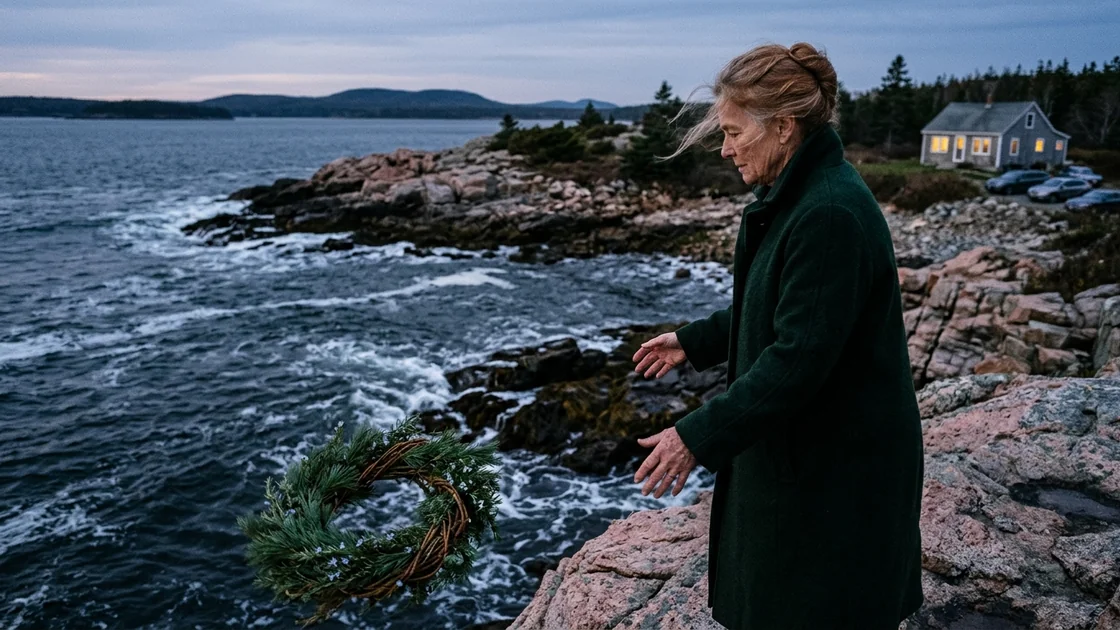
She didn't go to the flat wedding ledge. She took the narrow goat track to the left, through the waist-high juniper bushes that caught at the hem of her green wool dress, out to the farthest nose of the granite where the rock dropped twelve feet straight down into deep water even at dead low tide.
Here, the wind wasn't blocked by the hill. It came straight off the bank, smelling of kelp, cold iron, and five hundred miles of empty water. A few pins had worked loose from her French twist during the afternoon, and a strand of copper-and-silver hair blew across her mouth. She didn't bother to tuck it back.
Below her boots, the water sucked down into the crevices of the granite, exposing the purple crust of coralline algae and the green beards of sea lettuce, then surged back up with a heavy, hollow thump that vibrated through the stone into the bones of her ankles.
The tide had reached the bottom of its ebb. For ten minutes, maybe fifteen, the water in the cove wasn't going out and it wasn't coming in; it was just breathing in place, gathering itself for the turn.
Clara looked down at the wreath in her hands.
The sticky resin from the white pine and the crushed oils from the rosemary had soaked through the skin of her palms. Her hands smelled the way they had smelled every day of her life—bitter, green, and alive.
She didn't say a prayer, and she didn't say his name out loud to the gulls. The gulls didn't care, and Julian was gone, and the boy who had sat on this rock with a sketchpad across his knees had actually been gone for forty years anyway, long before the dementia found him in a rainy college town three thousand miles away. She had been keeping a vase of water on the counter for a stem that had been taken out of the shop before her hair ever turned grey.
Clara swung the heavy willow hoop back once against her skirt, leaned out into the salt wind, and let it go.
It fell flat, spinning slowly once in the air, and hit the dark green swell with a crisp slap.
For a moment, the cold foam closed over the pine needles. Then the wave lifted the braided willow back to the surface. It sat buoyant and dark against the violet water, the three blue-grey seed heads of sea holly bobbing upright like tiny buoys as the undertow caught the bottom of the circle and pulled it five yards out from the granite wall.
A second swell took it farther, past the lobster pot markers with their yellow-and-black painted styrofoam floats, out into the main current of the channel where the water was already beginning to slide southward toward the open bay.
Clara stood on the rock until the green circle was no bigger than a dinner plate, then a teacup, and then it was lost in the dark chop between the ledges and the outer bell buoy.
She rubbed her palms together to brush off the dry bits of willow bark, turned her back on the water, and walked up the hill toward the station wagon.
By the time she reached the turnaround, the yellow squares of the cottage windows were glowing warmly against the blue twilight, and through the wavy glass of the front parlor, she could see the tall red-haired boy with his arm around Mara’s waist, holding a glass up toward the stone fireplace.
Clara didn't go back to the porch. She got into the front seat of the wagon, started the engine, and turned the heater fan on low.
As she bumped back down the clam-shell lane through the dark spruce woods, she thought about Monday morning. The frost tonight would be a hard one—thirty degrees by midnight, according to the radio—which meant Mrs. Gable’s dahlias would be black by sunrise, and the summer people would be calling all week to have their window boxes emptied and stuffed with spruce tips and winterberry before they locked their shutters for Boston. And in the back of the glass house, the fifty pots of paperwhite bulbs she had set in gravel two weeks ago would be showing their first green noses above the stones, ready to be brought out into the light on the front counter.
She reached the paved road, turned the headlights on against the gathering dark, and drove back toward the harbor, where the brass bell above her door was waiting for the morning.