The Keeper of the High Ground
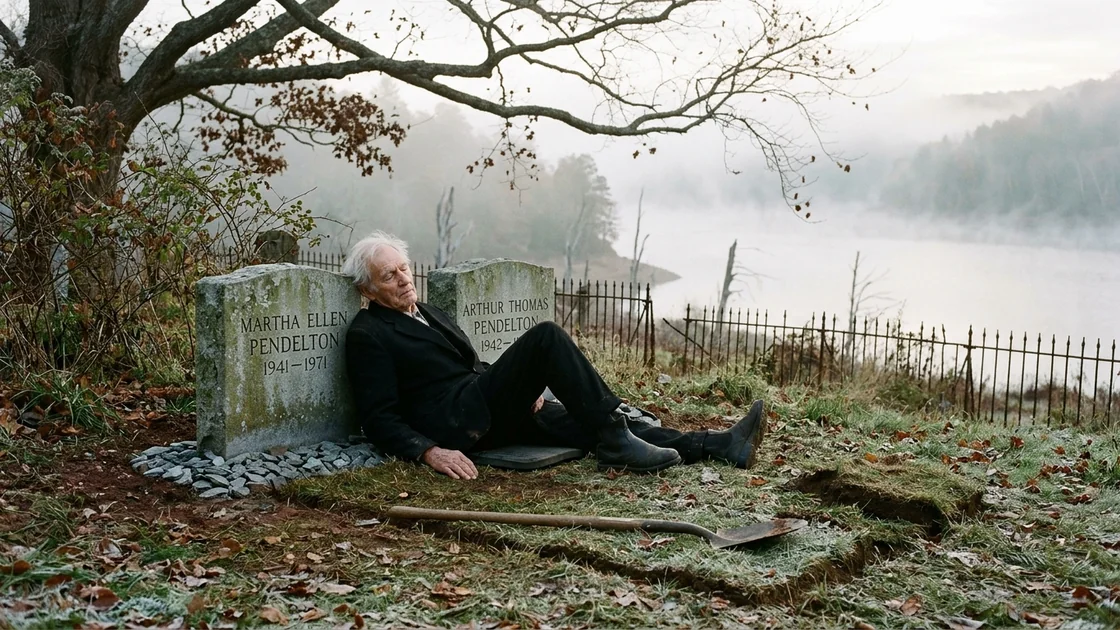
Arthur Pendelton is the last remaining soul of Oakhaven, a valley town intentionally flooded fifty years ago to create a massive hydroelectric reservoir. Living in a stone cottage on the only hill that survived the rising waters, he serves as the solitary groundskeeper for the town cemetery, which was painstakingly relocated to the island peak before the dam was sealed. Every day, Arthur tends to the headstones of everyone he ever knew, loved, or despised, carrying the entire history of a drowned community within his aging memory as the surrounding waters slowly eat away at the edges of his sanctuary. This is the story of his final autumn on the island, the ghosts that live in the roots of the yew trees, and the quiet realization that his duty as the vessel of Oakhaven’s past is finally reaching its natural end.
Chapter I: The Geography of Memory
The morning fog did not roll in over the island so much as it rose directly out of the black water, thick and smelling of cold iron and decaying pine needles. Arthur stood on the flagstone porch of the cottage, a tin mug of chicory coffee warming his knotted fingers, and watched the world disappear. Down below, beyond the steep, weed-choked incline of the bluff, the Blackwater Reservoir lay dead still. On clear days, when the autumn sun cut through the mountain passes at just the right angle, Arthur could look down from the western edge of the cemetery and see the faint, ghostly geometry of the old county road leading straight into the abyss, vanishing beneath eighty feet of glacial melt and trapped river water. Today, there was only the white wall of mist.
He was eighty-two years old, and his knees predicted the rain better than the barometer hanging beside the front door. They ached with a dull, rhythmic throb that matched the distant, low-frequency hum of the turbines five miles south at the McAllister Dam. Even after half a century, he had never quite tuned out that sound. It was a vibration in the bedrock, a constant reminder that the water holding him prisoner was working for a living, lighting up cities three hundred miles away that didn't know the name of the valley they were burning through their wires.
Arthur finished his coffee, set the mug on the splintered railing, and reached for his canvas jacket. His tools were already waiting in the wooden wheelbarrow by the gate: the long-handled shears, the brass wire brush, a Mason jar of boiled linseed oil, a stiff-bristled broom, and a kneeling pad made from an old tractor tire wrapped in burlap.
The cemetery of St. Jude-in-the-Vale occupied four acres of undulating granite and red clay at the crown of Huckleberry Hill. Before 1974, Huckleberry Hill had been the highest point on the eastern ridge of Oakhaven, a place where teenagers went to drink warm beer and watch the lightning storms roll across the cornfields. When the state legislature signed the Eminent Domain Act of 1971, the engineers had drawn a blue line around the valley at the twelve-hundred-foot elevation mark. Everything below that line—the brick schoolhouse, the Methodist church, Miller’s Feed and Seed, the cast-iron bandstand, and four hundred and twelve clapboard houses—was scheduled for erasure.
The living were given modest checks and told to find new lives in the sprawling suburbs downstate. The dead, however, required more delicate bureaucracy. Under state law, the Authority was required to relocate every marked grave in the valley to ground above the flood line. It had taken two summers of grim, muddy labor. Arthur, then thirty-two and newly widowed, had signed on with the relocation crew because he could not bear the thought of strangers handling Martha’s cedar box with mechanical backhoes. When the last vault was lowered into the red clay of Huckleberry Hill and the water began to creep over the valley floor like a spilled inkwell, everyone else drove out across the temporary causeway. Arthur simply moved his things into the sexton’s stone cottage at the top of the hill and locked the iron gate behind them. The Authority, realizing they needed someone to maintain the property to fulfill their perpetual-care bond, put him on a tiny monthly stipend and left him to the silence.
He pushed the wheelbarrow through the rusted iron arch. The cemetery was organized not by family plots, as the old churchyard had been, but by the chronological order of the exhumations, though Arthur had spent decades mentally rearranging them back into the neighborhoods of his youth.
"Morning, Mr. Henderson," Arthur muttered, his voice raspy from disuse as he passed a tall, grey obelisk near the gate.
Silas Henderson had owned the bank. He had died of a stroke in 1958 when Arthur was sixteen. Silas had been a hard man with a pinched mouth who always smelled of peppermint and wool, and he had foreclosed on the Pritchard farm during the drought of '54. Even in the relocation, the Authority had given him the prime corner lot near the entrance, as if his dead eyes still needed to keep watch over the traffic.
Arthur didn't stop for Silas today; he had scraped the lichen off the banker’s name back in August. Instead, he wheeled his barrow down the central gravel path, the iron wheel crunching loudly in the wet hush, toward the third tier where the soil was softer and the maples were dropping their heavy, wet leaves in suffocating drifts.
He stopped beside a small, lamb-topped stone that was leaning slightly to the left. Clara Mae Gable, 1942–1949.
Arthur set the handles of the barrow down, groaned as he lowered his lanky frame onto the rubber pad, and pulled the small hand-trowel from his belt. The ground had frozen and thawed twice already this October, heaving the frost-heavy clay and tilting the smaller markers that didn't have deep concrete footers. Clara Mae had been in his first-grade class at the Oakhaven Elementary School. He remembered her mostly as a pair of thin legs in brown ribbed stockings and a laugh that sounded like a hiccup. She had fallen through the ice on Miller’s Pond chasing a stray terrier.
"Got you leaning into the wind again, Clara," Arthur said softly, digging a narrow trench along the high side of the limestone base. The clay was slick and cold, staining his knuckles the color of dried blood. He worked the blade of the trowel underneath the base, levering it up half an inch while wedging three flat pieces of slate he’d gathered from the shoreline into the gap on the low side. He leaned his weight against the stone until it sat plumb, judging its verticality against the trunk of a nearby Scotch pine.
Once she was straight, he took the stiff broom and swept the wet maple leaves away from her inscription, then used a wooden popsicle stick to gently clear the dark green moss out of the carved letters of her name.
Suffer the little children.
The limestone was soft, local rock quarried from the bluffs three miles north—bluffs that were now forty feet underwater, home to channel catfish and silt. Over the years, the acid rain and the constant dampness rising off the reservoir had blurred the edges of the lamb’s wool on top of the stone until the creature looked less like a sheep and more like a smooth river boulder with ears. Soon, Arthur thought, in another twenty or thirty years, the letters would be gone entirely. The stone would just be a white tooth sticking out of the grass.
Who would know it was Clara Mae then? The ledger books were in the cottage, wrapped in oilcloth inside an old ammunition box, and the state had microfiched the plot maps back in the seventies, though Arthur doubted anyone in the capital knew which basement cabinet held the reels. When the letters wore away, Clara Mae lived only in the grey matter behind Arthur’s forehead. He was the only person left on earth who knew that she had been missing her left front tooth the winter she died, or that her mother had buried her with a blue celluloid hair-ribbon she’d won at the county fair.
He stayed on his knees for a moment longer than necessary, resting his hands on his thighs, looking out through the wrought-iron fence at the water. The fog was beginning to thin, tearing itself into long, ragged ribbons on the branches of the drowned deadwood that still stuck up near the shallows.
To his left lay the entire roster of the 1960 Oakhaven High School baseball team, though they had arrived here across a span of forty years. Bobby Vance, the shortstop, had come back from Vietnam in an aluminum box in 1968; his bronze plaque was always the easiest to clean, requiring only a rub with the linseed rag to keep the green patina from eating the relief of the crossed rifles. Next to him was Billy "The Whip" Miller, who had pitched three no-hitters before throwing his arm out baling hay; Billy hadn't died until 1998, down in Bakersfield where he’d moved after the flood. He had left instructions in his will to be cremated and shipped back to Arthur via registered mail.
That was how the town had returned to him over the decades. While the valley was still dry, only the ancestors were here—the nineteenth-century pioneers with their weeping willow carvings and the victims of the 1918 influenza. After the flood, the diaspora began to trickle back. A wooden urn from Akron in '82; a hearse barged across the water on the Authority’s work-ferry in '89; a daughter driving up from Florida in 2004 with a velvet bag of ash in her glovebox, looking bewildered and frightened by the sheer emptiness of the water surrounding the hill.
They hadn't wanted to live in Oakhaven when the state offered them twenty-two dollars an acre, Arthur thought without malice, only a dry, settled irony. They had taken their checks and bought split-levels in towns with shopping malls and four-lane highways. They had lived their lives under neon lights and on asphalt, yet when the doctors gave them the bad news, the first thing they asked for was the hill. They wanted to be put back beside the people who knew who their grandfathers were.
And for the last six years, the deliveries had stopped entirely.
In November of 2018, the barge had brought old Mrs. Gable—Clara Mae’s mother, who had lived to be ninety-nine in a nursing home in Toledo. Arthur had dug the hole himself with the post-hole digger to take the square bronze box, setting her down right beside the little lamb stone after seventy years apart. Since that gray afternoon, the ledger had remained closed. According to the last mimeographed newsletter of the Oakhaven Historical & Alumni Association—which had folded in 2015 after its secretary broke her hip—there was no one left on the mailing list.
The census of Oakhaven was complete. Four hundred and eighty-six below the grass; one above it.
Chapter II: The Drowned Streets
By noon, the sun had burned off the mist, leaving the sky a hard, porcelain blue that hurt the eyes. The wind came up from the south, chopping the reservoir into millions of tiny, glittering scales of silver and slate.
Arthur ate his lunch—two slices of salt-rising bread smeared with lard and a small, mealy apple from the half-wild orchard behind the cottage—sitting on the horizontal slab of the McAllister family vault. This was the highest point of the hill, twelve hundred and sixty feet above sea level. From here, the island looked like the back of a green turtle swimming through an inland sea. The water stretched four miles to the east and six to the west, filling the bowl of the Blue Ridge foothills up to their timbered waists.
When he closed his eyes, he didn't see the water. The human brain is a stubborn architect; it refuses to demolish a house just because the rafters are gone.
Arthur looked down the eastern slope, past the shoreline of rusted shale and drift-logs, and let his gaze sink through the surface.
Directly below the big buoy by the point, he thought, is the intersection of Main and Elm.
If you dropped a plumb line from a rowboat right where the gulls were wheeling over a school of shad, the lead weight would bounce off the roof of the Rexall Drugstore. That was where Mr. Peterson had kept a soda fountain with green marble counters that stayed cold even in July. Arthur could still taste the phosphate—cherry, sharp and metallic on the back of the tongue—and hear the specific, heavy clack-whir of the ceiling fans turning on their long brass rods.
Two hundred yards north of that, deeper down where the old creek bed had been, was the white frame house where he had been born. The Authority hadn't bothered to knock the houses down in the lower village; they had only stripped the roofs to keep the rafters from floating up and fouling the boat propellers, and taken the doors and windows out so the silt could settle evenly inside the rooms.
Sometimes, during the great drought of '88, when the reservoir dropped thirty feet and left a wide, stinking collar of bleached mud around the island, the chimneys of the upper town had poked through the surface like broken fingers. Arthur had taken his flat-bottomed skiff out that August, rowing quietly between the brick flues of his neighbors' parlors. He had looked down through the clear, warm shallows and seen the concrete steps of the Baptist church still standing, covered in zebra mussels and green hair-algae, leading up to a doorway that opened onto nothing but liquid green light. A largemouth bass as big as his forearm had been hovering right where Deacon Miller used to stand to shake hands after the benediction.
He hadn't liked that summer. It was better when the water was high and opaque. The dead should stay covered, whether by six feet of red clay or eighty feet of the Blackwater River. Having the town half-exposed had felt indecent, like a poorly dug grave after a hard rain.
"You always hated the heat anyway, didn't you, Martha?" he said aloud, tossing his apple core into the sweetbriar bushes that grew wild along the fence line.
Martha’s stone was forty yards away, under the shade of the largest weeping beech on the island, though he didn't need to walk over there to talk to her. The whole island was her parlor now.
Martha hadn't lived to see the water. The leukemia had taken her in the spring of '71, just as the surveyors in their orange vests were beginning to drive wooden stakes with pink ribbons into the front yards along Elm Street. In those last weeks, when she was too weak to leave the iron bedstead in their downstairs bedroom, she used to watch the surveyors through the lace curtains.
“What are they measuring for, Artie?” she had asked him, her fingers picking at thechenille bedspread, her skin the color of skim milk.
He hadn't had the heart to tell her that the governor had signed the bill. He knew how much she loved her peonies—the big, heavy-headed Sarah Bernhardts that her grandmother had brought from Pennsylvania in a lard bucket. If she had known that in three years those peonies would be under ninety feet of dark mud, she would have died with a bitter taste in her mouth.
“Just widening the highway, Marth,” he had lied, sitting beside her and wiping her forehead with a cool rag. “Putting in new culverts for the county.”
When they moved her from the churchyard to the hill in the autumn of '73, Arthur had dug up every one of those peony tubers himself. He had packed them in damp sawdust over the winter and planted them in a long row around her new plot on the island. Fifty years later, they had gone half-wild, spreading through the grass among the stones of the third tier, their heavy pink and white blossoms exploding every May in a riot of sweet, ant-crawling scent that smelled entirely of 1965.
A low, rhythmic thudding broke across his thoughts, coming from the south.
Arthur shaded his eyes with a hand that looked like a bundle of dry birch twigs. Miles away, near the concrete wall of the dam, a small white dot was detaching itself from the maintenance dock, kicking up a V-shaped wake that scarred the mirror of the reservoir.
He frowned, pulling a heavy silver Waltham pocket watch from his bib overalls. It was Tuesday, the fourteenth of October.
"Not the third Friday," he muttered.
Charlie Vance—Bobby Vance’s nephew, who worked for the Water Authority and was the only person who ever set foot on the island anymore—only brought the supply boat out on the third Friday of every month. He brought fifty pounds of flour, cornmeal, coffee, kerosene for the lamps, two gallons of white gas for the mower, and whatever mail had accumulated at the post office box in the new town of New Oakhaven, twelve miles below the dam.
A boat on the second Tuesday meant either a mistake, or the state. And at eighty-two, Arthur knew that the state never came out in a boat unless they had a clipboard with a piece of paper he wasn't going to like.
He stood up, his hip giving a sharp, dry pop, and walked back to the wheelbarrow. He had four more stones to level before the light went flat, and he wasn't going to let a man with a clipboard put him behind schedule.
Chapter III: The Messenger from the Valley Below
It took the motorlaunch forty minutes to cross the five miles of open water. Arthur heard the two-stroke Johnson outboard long before the boat rounded the rocky spit on the south side of the island where the wooden pier jutted out into a small cove.
He didn't go down to meet it. He stayed on the second tier, working the brass wire brush over the sunken lettering of Ephraim Vance, 1888–1963, watching through the gaps in the boxwood hedges as the boat bumped against the old rubber tires nailed to the pilings.
It was Charlie Vance, all right, recognizable by his orange hunting cap and the slight limp he’d gotten from a logging accident twenty years back. But there was someone else in the bow—a younger man wearing a dark blue windbreaker with the yellow seal of the Department of Natural Resources on the chest, carrying a leather portfolio under his arm like a Bible.
They tied up the boat and started up the switchback trail. It was a steep climb—two hundred yards of wooden steps set into the shale that Arthur had replaced board by board three times over the decades—and by the time they reached the wrought-iron gate, the young man from the state was breathing hard, his face flushed red beneath a neat haircut.
"Afternoon, Uncle Artie," Charlie said. He wasn't Arthur’s nephew—he was a Vance, and Arthur was a Pendelton—but everyone from the old valley who was younger than sixty had called Arthur Uncle for as long as he could remember. It was as if, by staying with the dead, he had become a blood relative to everyone’s ancestors.
"Charlie," Arthur said, not getting up from his kneeling pad. He blew the grey dust out of the 8 in Ephraim’s birth year. "You’re ten days early. And you didn't bring the kerosene."
"Didn't come on the supply run today, Artie," Charlie said, looking Down at his boots. He took off his orange cap and wiped his forehead with his sleeve, though the wind off the water was brisk. "This here is Mr. Miller. Not our Millers—he’s from down around Harrisburg. Works for the Land Management Bureau."
The young man stepped forward, extending a hand that had never held a shovel handle. "Mr. Pendelton. It’s an honor to finally meet you. Actually, my name is Thomas—Thomas Miller. You’re something of a legend down at the regional office."
Arthur looked at the hand for a second, then wiped his own clay-caked palm on the knee of his overalls before giving the boy’s fingers a brief, dry squeeze. "Legends are for people who ain't here to correct the lies, Mr. Miller. What’s in the folder?"
Thomas Miller glanced at Charlie, who was suddenly very interested in the bark of a nearby white oak, then looked back at Arthur with a practiced, sympathetic smile—the kind doctors and funeral directors learned in school.
"Mr. Pendelton, the Authority is undergoing a comprehensive infrastructure and liability audit for the 2025 fiscal cycle," Miller began, his voice dropping into the smooth cadence of a public hearing. "As you know, the perpetual-care agreement under which your residency was established in 1974 was classified as a temporary caretaker variance."
"Fifty years is a long time for temporary," Arthur said, turning back to Ephraim’s stone. Ephraim had been a blacksmith, Arthur remembered. Had a thumb missing on his left hand from a mule kick. Used to give the boys horseshoe nails twisted into rings.
"Well, yes, precisely," Miller said, stepping closer onto the grass, before realizing he was standing squarely on the chest of Martha Jane Higgins (1901–1970) and hopping awkwardly to the gravel path. "The truth is, Mr. Pendelton, your variance fell through the cracks three administrations ago. You’re the last full-time resident on a Category Four watershed parcel in the entire commonwealth. When the new director reviewed the insurance schedules last month, it raised several red flags."
"I don't cost you nothing," Arthur said, his brush going scritch-scritch-scritch against the granite. "Four hundred dollars a month and five gallons of gas. You spend more than that painting the fence down by the spillway."
"It’s not the stipend, sir. It’s the liability," Miller said gently. "You’re eighty-two years old. You’re five miles from the nearest paved road across open water that freezes over in January. There’s no electricity on this island, no landline, and cell service down in this bowl is spotty at best. If you were to have a fall—or a medical event—in the middle of December, nobody would know until Charlie here tried to break through the ice in January."
"And if I fall in December, I’m already in the cemetery," Arthur said, finally looking up. His eyes were the pale, washed-out blue of a winter sky, and they didn't blink. "Saves the state the trouble of hiring a barge."
Charlie let out a short, nervous bark of a laugh that he quickly turned into a cough.
Miller didn't smile. He unzipped the leather portfolio and pulled out a sheaf of papers held together with a heavy brass clip. "The state cannot assume the moral or legal responsibility of leaving an octogenarian isolated on an unserviced island, Mr. Pendelton. Furthermore, since the last interment took place in 2018, the St. Jude cemetery has been officially reclassified from an Active Municipal Burial Ground to a Historic Monument. Under the new classification, daily groundskeeping is no longer required. A seasonal crew of three men will come out twice a summer with commercial trimmers to clear the brush."
Arthur stopped brushing. Slowly, using the top of Ephraim’s stone for leverage, he pushed himself to his feet. He was still a tall man, six-foot-two even with the stoop in his shoulders, and he looked down at the young bureaucrat from under the frayed brim of his felt hat.
"Commercial trimmers," Arthur repeated. His voice was very quiet. "You mean those string-whippers with the plastic wire."
"Weed-eaters, yes, sir. A crew can knock out four acres in an afternoon."
"You put a string-whipper against a hundred-year-old limestone tablet, Mr. Miller, and you’ll chew the base right out of it in three summers," Arthur said, pointing a crooked finger toward Clara Mae’s little lamb. "That stone there is soft valley lime. A boy making minimum wage who don't know Clara Mae from a fence post will run his machine right up against her name and chip the corners off. He won't know where the sunken graves are in the old section, neither. He’ll run a heavy riding mower over the 1918 flu row and drop an axle right through the cedar boxes because the vaults rotted out forty years ago. You can't mow that row with a machine. You have to do it with a scythe and sheep-shears."
"Mr. Pendelton—"
"And what about the peonies?" Arthur asked, his voice rising just enough to carry to the crows sitting in the black walnut tree by the wall. "A crew coming out in June will mow Martha’s peonies flat to the dirt because they think they’re weeds after the blooms drop. What about the frost heave in April? Who’s going to wedge the slates under the Perkins babies when the thaw tilts 'em toward the ditch?"
"Artie, listen to the man," Charlie said softly, stepping between them. His weathered face was creased with genuine misery. "They ain't throwing you on the street. Tell him about the place in New Oakhaven, Mr. Miller."
Miller cleared his throat, grateful for the intervention. "The Authority has worked with the County Department of Aging. Because of your fifty years of service, we’ve secured a one-bedroom unit at the Sycamore Glen Senior Living Community in New Oakhaven, fully subsidized by the state pension fund. It has central heat, Mr. Pendelton. A cafeteria. Doctors on call twenty-four hours a day. You’d be ten minutes from the grocery store."
"I don't know nobody in New Oakhaven," Arthur said.
"You know me, Artie," Charlie said. "Me and Sarah live four blocks from Sycamore Glen. My boys come around on Sundays. You could watch the ballgames on television."
Arthur looked past Charlie, past the iron gate, out over the water.
"I know four hundred and eighty-six people," Arthur said. "And they’re all right here. The folks down in that new town behind the strip mall—they’re strangers, Charlie. Even the ones who came out of this valley. When they left the water behind, they turned into somebody else."
"The notice is for November fifteenth, Mr. Pendelton," Miller said, holding out the sheaf of papers. "That gives you thirty days. Charlie and a crew from the maintenance yard will come out with the flat-barge on the fourteenth to help you pack whatever personal effects you want to take from the cottage. After that, the cottage will be boarded up and the pier will be removed to prevent trespassers from docking."
Arthur didn't take the papers. After an awkward ten seconds, Miller laid them on top of Ephraim Vance’s headstone, weighted them down with a small piece of loose gravel so the wind wouldn't take them into the reservoir, and stepped back.
"I’m sorry, sir," the young man said, and to his credit, he sounded like he meant it, in the way a man feels sorry for an old dog that has to be tied up for its own good. "Times change. The state has to close the books on the valley eventually."
"The books ain't in Harrisburg," Arthur said, turning his back on them and bending down to pick up his wire brush. "And they ain't made of paper."
He didn't watch them walk back down the steps. He listened to the crunch of their boots on the shale, the hollow thump of them boarding the launch, and the coughing roar of the outboard motor firing up. He waited until the sound of the engine had faded into the general, eternal hum of the dam five miles away before he picked up the papers from Ephraim’s headstone, folded them twice without reading a single word, and shoved them into his back pocket to use for starting the kitchen stove in the morning.
Chapter IV: The Census of the Quiet
That night, a cold front dropped down from Canada, bringing a hard, clear freeze that turned the red clay of the paths as hard as brick.
Inside the stone cottage, the cast-iron woodstove ticked and popped as it digested a log of seasoned hickory. The cottage was two rooms—a kitchen with a hand-pump at the soapstone sink that drew from a deep cistern, and a bedroom just large enough for a narrow rope-bed, a pine chest of drawers, and the wooden table where Arthur kept the ledgers.
He didn't light the kerosene lamp at first. He sat in the hickory rocker by the window, a wool quilt pulled across his knees, watching the moonlight lay a wide, silver highway across the black water of the reservoir.
Thirty days.
He knew how the law worked. He had seen it in 1973 when old man Pritchard had sat on his front porch down by the creek with a double-barreled ten-gauge across his lap, swearing he’d shoot the first bulldozer driver who crossed his bridge. The state hadn't sent a bulldozer. They had sent three county deputies who knew Pritchard’s sons, and a doctor with a needle, and they had waited until the old man fell asleep in his chair at two in the afternoon. They had taken him out in the back of a Ford station wagon while the movers threw his grandfather’s clock into a stake-bed truck. Pritchard had died four months later in a rented room over a hardware store in Mechanicsburg, staring at a brick wall six feet from his window.
Arthur didn't have a shotgun, and he had no intention of fighting Charlie Vance’s boys when they came with the barge. If they dragged him off the island and put him in a room with beige carpet and a television bolted to the wall, he knew he wouldn't last the winter either. A man who has spent eighty-two years listening to the wind in the pines cannot sleep with the hum of a refrigerator in his ear and strangers walking down a hallway outside his door.
He got up, struck a kitchen match on the side of the stove, and lit the brass lamp on the table. The yellow light bloomed softly against the whitewashed stone walls.
He opened the green metal ammunition box and lifted out the three ledger books. They were heavy, leather-bound volumes with marbled endpapers that had originally belonged to the parish clerk of St. Jude’s back in 1840, when the valley was first cleared of timber.
Arthur sat down, put on his wire-rimmed spectacles, and opened the first book.
The ink on the early pages had turned the color of rust, written in the looping, copperplate hand of a preacher who had been dead for a century and a half.
October 12, 1844 — Infant son of Thomas and Sarah Pendelton. Stillborn. Plot 4, Row 1.
That was his great-grandfather’s older brother, a baby who hadn't even lived long enough to get a name before going into the dirt down by the river. When the relocation crew had dug up Row 1 in '72, there hadn't been anything left of that baby—no bone, no wood, not even a brass coffin tack. Just a slightly darker smudge in the yellow river subsoil where the pine box had rotted away. The foreman from the Authority had wanted to skip it—"Ain't nothing there to move, Artie, we’re burning daylight"—but Arthur had taken a flat shovel and scooped up six spadesful of that dark earth, put it in a burlap sack, and buried it on the hill under the original fieldstone marker.
If he hadn't been there that day, the unnamed Pendelton baby would still be at the bottom of the lake.
He turned the pages slowly, decades slipping past under his calloused thumb. Every name was an anchor, and every anchor had a story that wasn't written in the margin. The ledger only gave the dates: the hatch and the dispatch, as old Doc Miller used to call them. The ledger didn't say why or how, and it didn't say what the person’s voice had sounded like when they called their dogs in at dusk.
June 4, 1924 — Caleb Vance, aged 19 years. Drowned in the Blackwater.
Arthur knew about Caleb from his father. Caleb had been trying to break a logjam during the spring drive and had gotten his boot caught between two hemlock butts. They hadn't found him for three days, down by the bend where the McAllisters later built their sawmill. Caleb’s fiancée, a girl named Nettie Perdue, had never married; she had lived in a little green house behind the post office, making lace tablecloths until she died in 1966. In the old cemetery, Nettie had been buried three rows away from Caleb because her family plot was on the north side and the Vances were on the south.
When they moved the graves to the island in '73, Arthur had been the one driving the stakes for the new layout. Late one night, by the light of a Coleman lantern, he had pulled up the stake for Nettie Perdue and moved it twelve inches from Caleb Vance’s headstone. Nobody from either family had noticed when the stones were reset. For the last fifty-one years, Caleb and Nettie had been sleeping side by side under the same cedar tree, a secret kept entirely between Arthur and the red clay.
He turned to the third volume—his volume, written in a blunt No. 2 pencil because pencil doesn't run if the roof leaks.
May 14, 1971 — Martha Ellen Pendelton. Aged 29 years.
His thumb stopped on the paper, resting just below her name where the page was slightly darkened from fifty years of his skin oil touching the same spot.
Twenty-nine. She had been twenty-nine for half a century, while he had turned into an old tree trunk with white hair and veins like blue rope on the backs of his hands. If she walked through the door right now in her yellow gingham dress, she would look like his granddaughter.
He remembered the day they met—not officially, since they had grown up two miles apart and had seen each other in church every Sunday since they were in diapers—but the day he saw her. It was the Oakhaven Founders' Day picnic in 1961, down in the sycamore grove by the covered bridge. Both the grove and the bridge were under ninety feet of water now, rotted away to black sticks in the thermocline. Martha had been nineteen, standing by the lemonade barrel with the sun coming through the sycamore leaves and making green-gold spots on her bare arms. She had laughed at something Bobby Vance said, throwing her head back so her dark braid swung between her shoulder blades, and Arthur, standing twenty feet away with a half-eaten ham sandwich in his hand, had felt something inside his ribs shift two inches to the left and lock into place forever.
Ten years they had gotten. Ten years in the little white house at the foot of Elm Street, with the river talking over the stones at the bottom of the garden and the train whistling at the crossing every night at nine-fifteen. No children—they had lost one in '65, a little girl they’d named Sarah who lived three hours and was buried in the same box with Martha now—just the two of them, a Jersey cow, two acres of sweet corn, and the quiet certainty that they would grow old on that porch until they were carried up the street to the churchyard.
Then the blood went bad in her veins, and the men in the orange vests came with their tripods, and the river they had listened to at night rose up out of its banks and swallowed the garden, the porch, the sycamore grove, and the covered bridge, until the whole world was nothing but water and this four-acre rock.
Arthur closed the ledger.
If he left on November fourteenth, who would know why Nettie Perdue was buried next to Caleb Vance? Who would know that the little uncarved piece of river-slate at the foot of Martha’s stone was for Sarah? Who would remember the sound of the nine-fifteen freight whistling for the crossing at Miller’s Mill?
A town doesn't die when the water covers the roofs, Arthur thought, staring at his own dim reflection in the dark windowpane. A town dies when the last person who remembers the names of the dogs and the taste of the well-water stops breathing.
As long as he was on the hill, Oakhaven was still on the map, even if the map was only six inches wide inside an old man’s skull.
Chapter V: The Autumn Cleaning
Over the next three weeks, Arthur worked from the first grey smear of dawn until the stars came out in the frosty sky.
He wasn't preparing to leave; he was preparing the island for a long winter without him, whatever form that absence might take. If the boys with the string-whippers were coming in June, he was going to make sure they had no excuse to touch the stones.
He started at the northern boundary wall and worked his way south, row by row, plot by plot, with a methodical, back-breaking ferocity that left him trembling in his bed at night, his muscles knotting with cramps that he rubbed out with horse liniment.
Using the heavy grub-hoe, he cut a six-inch-wide trench into the sod around the base of every single limestone and marble tablet on the island—four hundred and eighty-six trenches—and filled them with crushed shale he hauled up in buckets from the beach. It was fifty tons of rock, moved twenty pounds at a time in the iron wheelbarrow up a twenty-degree grade. The shale collar would keep the grass from growing flush against the stones for at least five years; even the laziest county worker wouldn't need to bring a spinning wire near the inscriptions if there was nothing green growing against the marble.
It took him twelve days just to haul the shale. His hands cracked open across the palms from the cold stone and the wooden handles of the barrow; he wrapped them in strips of an old bedsheet soaked in turpentine and lard, pulled his leather work gloves over the bandages, and kept hauling.
While he worked, he conducted the final roll call. He didn't just clean the stones; he spoke to every resident of Oakhaven, telling them the news as if he were the town crier walking down Elm Street before supper.
"They’re shutting down the post office Box, Abner," he told Abner Perkins (1895–1969) as he packed grey shale around the old mail carrier’s granite marker. "Going to board up the cottage, too. You won't have to listen to me chopping kindling behind your head no more come December."
He spent a whole afternoon with the 1918 influenza row on the eastern slope. There were twenty-two of them there, mostly children and young mothers who had died in the bad October of that year when the camp fever came up the railroad line from the city. Their wooden markers had rotted away before Arthur was born, replaced in the nineteen-thirties by small, uniform concrete blocks poured by the WPA, with only numbers stamped into the wet cement—1 through 22—because by the time the government got around to marking them, the old sexton who knew which child was in which hole had died himself.
The WPA blocks were crumbling at the edges now, the aggregate pebbles showing through like old teeth. Arthur mixed a bucket of rich hydraulic cement he’d been saving in the tool shed, got down on his stomach in the cold grass, and patched the corners of all twenty-two blocks with a putty knife. Before the cement set, he used a ten-penny nail to re-score the numbers deep into the faces, then opened the 1918 ledger beside him and read all twenty-two names aloud to the group as a whole, figure by figure, so that each soul could claim its own syllable out of the wind.
"Mary Alice Vance. Seven years. Thomas Edward Miller. Four years. Ruth Anne Higgins. Twenty-four years..."
The wind off the reservoir took the names and carried them across the water toward the mountains, where they echoed faintly against the timberline before dropping into the deep channel.
By the first week of November, the trees on the island were bare except for the white oaks, which held onto their brown, leathery leaves that rattled like dry paper in the gales. The sky turned the color of a lead sinker and stayed that way. Skim ice began to form in the sheltered pockets of the cove overnight, thin panes of glass that tinkled like wind chimes when the morning waves broke them against the rocks.
With the shale collars finished, Arthur turned his attention to the sunken graves in the nineteenth-century section. He hauled thirty barrows of good red clay from the pit behind the orchard, mounding it high over the collapsed vaults of the old pioneers, tamping it down with the flat of his spade, and laying fresh sod cut from the meadow over the mounds so they wouldn't wash out in the spring rains.
On the tenth of November, the first snow came—not a heavy drift, just a hard, dry spitting of white pellets that collected in the carved roses of the Victorian stones and made the iron fence look like it had been sketched in charcoal and chalk.
That afternoon, while lifting a heavy piece of cap-rock to reset a corner post on the McAllister plot, something inside Arthur’s chest gave a sharp, fluttering tear, like a wet sheet ripping on a clothesline.
He didn't fall, though the horizon tilted forty-five degrees to the left and the grey water of the reservoir seemed to rush upward toward his face. He dropped to one knee on the frozen sod, his hand clutching the front of his canvas coat, his breath coming in short, shallow whistles that tasted of copper.
The pain ran down his left arm into his ring finger—the finger where his plain gold band was worn so thin it was sharp as a knife blade—and settled behind his breastbone like a hot smoothing iron.
He stayed there for twenty minutes with his forehead pressed against the cold granite of old Judge McAllister’s monument, waiting to see if the iron would cool down.
Slowly, the roaring in his ears subsided to the familiar, low hum of the turbines at the dam. The horizon leveled out. The snow pellets ticked dryly against the brim of his hat.
"Not yet," Arthur whispered to the granite. "I ain't done the accounts."
He left the wheelbarrow where it sat—for the first time in fifty years, a tool was left out overnight in the yard—and walked back to the cottage, stopping every ten paces to lean against a tree trunk or a headstone until he reached the porch.
Chapter VI: The Final Entry
He didn't go out with the barrow on the eleventh, or the twelfth.
The hot iron in his chest had cooled to a heavy, bruised ache, as if a mule had kicked him in the ribs, and his legs felt strangely distant, like they belonged to a man walking ten feet behind him. He knew what it was. His father had gone the same way at sixty-eight, sitting on the tongue of a hay wagon down in the bottomland: a sudden grey look around the mouth, a hand to the shirt pocket, and then a long quiet.
Instead of working the stones, Arthur spent those two days putting the cottage in order for the strangers from Harrisburg.
He scrubbed the pine table with lye soap until the wood was white. He emptied the ashes from the stove, polished the iron plates with stove-blacking, and stacked the woodbox full of dry hickory and birch bark so that if anyone ever got stranded on the island in a winter storm, they’d have a dry fire waiting for them. He washed his two plates, his tin mug, and his cast-iron skillet, setting them upside down on a clean dish towel by the sink.
Then he took a piece of white chalk and walked out into the cemetery one last time, carrying the three leather ledgers under his arm.
Wait as they might in Harrisburg, microfiche reels get lost. Computers get wiped when the software changes. Clerks throw out boxes of old paper when they remodel the basement. If the state was going to turn St. Jude’s into an unstaffed monument, the connection between the stones and the stories was going to snap the moment the barge pulled away from the pier on the fourteenth.
Unless the stories were on the island itself.
He couldn't carve four hundred and eighty-six biographies into the granite, and he knew chalk wouldn't last past the next rain. Instead, he went into the tool shed attached to the back of the cottage—a solid structure built of two-foot-thick fieldstone with a slate roof that would stand for another hundred years after the wooden rafters of the house rotted—and cleared off the long workbench.
He took twenty-four quart-sized Mason jars from the pantry shelves where he used to put up green beans and peaches when his garden was bigger. He tore the pages out of the back of an old Sears, Roebuck catalog no longer needed for the outhouse, and spent the whole of November twelfth and thirteenth sitting by the stove, writing with a heavy carpenter’s pencil that wouldn't fade in the damp.
He didn't duplicate the ledgers; the ledgers could stay in the ammunition box on the table for Mr. Miller to take back to the capital. In his big, square, carpenter’s block letters, Arthur wrote the things the state didn't care about.
PLOT 14, ROW 3: CLARA MAE GABLE. DIED CHASING A LITTLE BROWN DOG ON MILLER'S POND. HER MOTHER GRIEVED SEVENTY YEARS FOR HER. DO NOT USE A STRING TRIMMER NEAR THE LAMB, THE STONE IS SOFT.
PLOT 88, ROW 6: CALEB VANCE AND NETTIE PERDUE. I MOVED NETTIE TWO ROWS OVER IN 1973 BECAUSE THEY WERE SWEETHEARTS BEFORE THE LOG DRIVE OF '24. LEAVE THEM BE.
PLOT 102, ROW 9: SILAS HENDERSON. HE WAS A HARD MAN ABOUT MONEY BUT HE PAID FOR THE ROOF ON THE METHODIST CHURCH IN '52 WITHOUT TELLING NOBODY.
PLOT 210, ROW 12: MARTHA ELLEN PENDELTON. THE PEONIES ARE HERS. THEY CAME FROM PENNSYLVANIA IN 1890. IF YOU CUT THEM DOWN BEFORE JULY THEY WON'T BLOOM THE NEXT SPRING. THE LITTLE SLATE STONE AT HER FEET IS OUR DAUGHTER SARAH.
His hand cramped so badly by midnight on the thirteenth that he had to tie the pencil to his fingers with a piece of twine to keep the lead on the paper. The lamp burned low, sucking the last of the kerosene from the font until the wick smoked red and smelly, and he had to light two tallow candles he’d dipped himself three winters ago.
Every person got a slip of paper. Four hundred and eighty-six slips. Even the ones he hadn't liked—like Jim Purdy, who had poisoned Arthur’s hound dog in 1956 over a boundary dispute—got a fair shake (JIM PURDY. HAD A MEAN STREAK WHEN HE DRANK BUT HE PULLED FOUR KIDS OUT OF THE SCHOOLHOUSE FIRE IN '48).
When the last slip was written, just as the grey light of November fourteenth was beginning to turn the windowpanes the color of dirty dishwater, Arthur rolled the papers into tight cylinders, stuffed them into the twenty-four Mason jars, screwed the zinc lids down over fresh rubber rings as tight as his swollen wrists would turn them, and dipped the tops of the jars into a coffee can of melted paraffin wax to seal out the moisture for a century.
He carried the jars out into the cold morning, two at a time, and packed them into the hollow stone base beneath the altar-table of the McAllister vault—a dry, secret cavity behind a loose slab of marble where he used to keep his extra pruning shears out of the rain.
Then he walked back to the cottage, put on his Sunday suit—a heavy black wool Sears suit he had bought for Martha’s funeral in 1971, which hung on his shrunken frame like a sack on a fencepost—combed his white hair with water from the pump, and picked up the sharp spade from the porch.
There was one more hole to dig, or at least to mark out, though he knew he didn't have the wind left in his bellows to go six feet down through the frost.
Chapter VII: The High Water Mark
The fog was back that morning, thicker than it had been in October, smelling of snow and the deep, dead cold of the hundred-foot channel.
Arthur walked slowly down the central path to the third tier, under the bare, weeping branches of the great beech tree.
Beside Martha’s stone—between her headstone and the fence line where the sweetbriar grew—there was a six-foot strip of grass that had never been broken since the hill was cleared. His own stone had been sitting there since 1974, carved at the same time as hers by old man stone-cutter Higgins before he moved to Ohio.
ARTHUR THOMAS PENDELTON 1942 –
For fifty years, he had mowed around his own name every Saturday in the summer, and swept the leaves off his own birth date every autumn. It was an odd thing for a man to do, to tend his own headstone for half a century until the 1942 was just as weathered and lichen-stained as the dates of the people who were actually under the sod. He had grown so used to seeing his name in the granite that sometimes he felt he was already down there, and the tall old man with the wheelbarrow was just a persistent shadow that the sun hadn't burned off yet.
He took the sharp spade, set the blade into the frozen turf six inches in front of his stone, and stepped on the shoulder of the iron with his good boot.
The sod gave way with a crisp crunch. He lifted a square of frozen grass and red clay and set it neatly to the side, just enough to show Charlie Vance and his boys where the edges were supposed to go so they wouldn't crowd Martha’s peony roots when they brought the backhoe over on the barge.
He cut four corners—a neat rectangle six feet long and three feet wide—scoring the frost line cleanly.
As he lifted the fourth square of sod, the tearing sensation in his chest returned, not like a ripping sheet this time, but like a great, heavy timber giving way in the roof of an old barn.
The spade slipped from his mittens and fell across the boundary trench with a dull clink.
Arthur didn't try to catch himself against the monument. He eased himself down onto the rubber kneeling pad he had left beside Martha’s stone two days ago, then rolled his shoulder against the base of her marker so he was sitting upright on the cold ground, his long legs stretched out across the rectangle he had just marked in the grass, his back resting squarely against her name.
The cold from the earth came through the black wool of his trousers almost instantly, sharp at first, and then not cold at all—just solid, like a firm mattress after a long day in the hayfields.
Down on the water, miles away through the cottony wall of the fog, he heard it: the low, throaty rumble of the diesel engine on the Authority’s work-barge leaving the maintenance slip at the dam.
Chug-chug-chug-chug.
It would take the barge an hour and a half to push its flat iron nose across the five miles of water against the north wind. Charlie would be standing in the wheelhouse with a thermos of coffee, dreading the job ahead of him, wondering how he was going to talk Uncle Artie into getting on that boat without breaking the old man’s heart. And young Mr. Miller would be there in his blue windbreaker, checking his watch, ready to padlock the cottage door and cross Oakhaven off the state’s insurance rolls forever.
Arthur tilted his head back against the limestone. Through the intricate, black lacework of the beech branches overhead, the fog was beginning to glow with a pale, pearly light as the sun rose behind the mountains.
Funny, he thought, how loud the river was this morning.
He hadn't heard the river since they closed the sluice gates at the McAllister Dam in the autumn of '73. For fifty years, the water had been silent, a dead lake that only lapped at the shale like water in a slop bucket.
Now, clear as a bell, he could hear the Blackwater running fast and shallow over the limestone riffles down behind the covered bridge. He could hear the waterwheel turning at Miller’s Mill, groaning on its wooden axle, and the screen door slapping shut at the Rexall Drugstore as the kids ran out with their penny candy.
Somewhere down the hill, a dog barked—old Spot, the blue-tick hound Jim Purdy hadn't poisoned yet—and from the bottom of Elm Street came the long, mournful, two-note cry of the nine-fifteen freight blowing for the crossing, echoing off the valley walls that were green with June corn.
A warm wind, smelling strongly of bruised peony petals and damp river mud, blew up the slope through the iron fence, rustling the dry oak leaves around his boots.
"They weren't widening the road after all, Marth," Arthur murmured, his eyes closing as his chin dropped toward his chest, his right hand slipping off his knee to rest palm-down in the red clay of the trench, his fingers brushing the cold edge of her stone. "Just letting the creek up to the porch."
When the flat-bottomed barge finally nosed through the mist and bumped heavily against the rotting pilings of the pier at nine-thirty, the island was entirely silent. The crows had left the walnut tree, and the wind had died down to nothing, leaving the reservoir as smooth and dark as a sheet of polished slate.
Charlie Vance climbed the two hundred wooden steps first, carrying a cardboard moving box folded flat under his arm, with Thomas Miller trailing twenty yards behind him, his breath smoking in the freezing air.
When Charlie reached the rusted iron arch of the gate, he stopped dead, the cardboard box slipping from his fingers to slap onto the gravel path.
"Mr. Vance?" Miller asked, catching up and adjusting his glasses as he looked across the four acres of frost-white grass, where every single headstone sat plumb and straight inside a neat, grey collar of freshly hauled river shale. "Where is he? In the house?"
Charlie didn't answer. He was looking down the central path toward the big weeping beech on the third tier, where a tall figure in a black Sunday suit was sitting quietly against a limestone tablet, a sharp spade lying across the freshly cut sod at his feet, looking out over the water as if he had just sat down for a minute to rest his knees before starting the next row.
Charlie took off his orange hunting cap, held it against his chest with both hands, and looked down at the young man from Harrisburg.
"You can put your clipboard away, son," Charlie said, his voice echoing strangely in the vast, water-bound hush of the hills. "And go on back down to the boat and tell the boys to bring up the shovels. Uncle Artie ain't going to New Oakhaven."