The Iron Ribbon Between Us
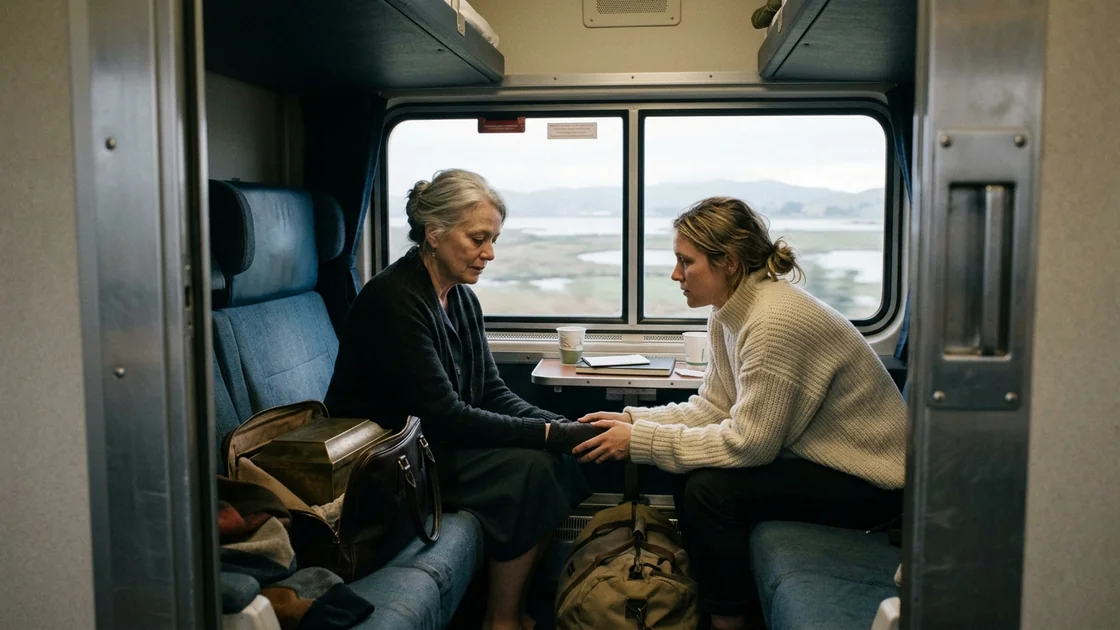
Eleanor and her thirty-two-year-old daughter, Clara, board a westbound train in Chicago for a three-day journey to San Francisco to scatter the ashes of Arthur, Eleanor’s late husband and Clara’s father. Confined to a cramped sleeper compartment, the two women are forced to confront decades of festering resentment, unspoken grievances, and incompatible versions of their family history. Over the course of seventy-two hours rolling across the American plains, climbing the Rockies, and descending into the Sierra Nevada, their polite veneer disintegrates through a series of escalating arguments in the dining car, the observation lounge, and their claustrophobic roomette. As the miles strip away their defenses, they discover the painful secrets each kept to protect the other during Arthur’s prolonged illness, ultimately reaching the Pacific coast not entirely healed, but bound by a fragile, hard-won truce.
The stainless-steel flank of the California Zephyr gleamed under the fluorescent cavern of Chicago’s Union Station, smelling of diesel exhaust, hot brakes, and the damp wool of hundreds of travelers. Eleanor stood on the concrete platform, her gloved hands clasped tightly over the handle of her structured leather carry-on. Inside that bag, nestled between two cashmere cardigans and a plastic zip-top bag of prescription bottles, was a heavy brass box containing what remained of her husband of forty-one years.
Beside her, Clara shifted her weight from one scuffed suede boot to the other, the strap of an overstuffed canvas duffel cutting into her shoulder. She was looking at her phone, her thumb flicking upward in a rhythmic, detached motion that set Eleanor’s teeth on edge before the train had even lurched an inch.
"If you intend to spend the entire two thousand miles staring at that screen, Clara, you could have stayed in Brooklyn and mailed me a sympathy card," Eleanor said, her voice pitched to that precise frequency she had perfected over three decades—loud enough to pierce the ambient roar of the boarding platform, quiet enough that the red-capped porter three feet away could pretend he hadn't heard.
Clara didn’t look up immediately. She finished reading whatever triviality occupied her pixels, locked the screen with a sharp click, and slid the device into the pocket of her oversized corduroy coat. When she turned her eyes to her mother, they were the exact grey-green of Arthur’s, though lacking his habitual crinkle of amusement.
"I was checking my work email, Mom. Because unlike you, I don’t have a pension and a paid-off brownstone in Evanston. I have a creative director who thinks bereavement leave is a four-day weekend."
"You took a train," Eleanor pointed out, gesturing toward the steep metal steps of Sleeper Car 0531. "A plane takes four hours."
"You refused to fly with the urn."
"The TSA guidelines are deliberately opaque regarding brass containers," Eleanor said, lifting her chin as she stepped onto the yellow metal footstool provided by the attendant. "I was not going to have your father X-rayed, swabbed for explosives, and potentially confiscated by a twenty-two-year-old in a polyester shirt at O'Hare."
"He’s carbon and calcium phosphate now, Mom. He wouldn't have minded the X-ray."
Eleanor didn't answer. She climbed the narrow, winding stairs to the upper level of the Superliner, her knees clicking audibly in the tight stairwell. Behind her, she could hear Clara’s heavy, impatient breathing, the canvas bag scraping against the carpeted walls.
Their accommodation for the next fifty-two hours—assuming the Burlington Northern Santa Fe freight trains didn't delay them, which turns out to be a fool's hope—was Roomette 4. When Eleanor slid back the rattling metallic door, they both stopped dead in the narrow corridor.
"This is it?" Clara asked, her voice dropping an octave.
"It is a roomette," Eleanor said, though her own heart sank slightly at the sight of the two narrow blue upholstered seats facing each other, separated by scarcely twenty inches of legroom. "The bedrooms were completely booked when I made the reservation."
"When we turn these chairs into a bed, our knees are literally going to touch."
"Only the lower berth," Eleanor corrected, stepping inside and hoisting her leather bag onto the narrow shelf beside the window. "One of us will sleep on the upper bunk. It folds down from the ceiling."
Clara stared at the recessed panel above their heads, which looked less like a bed and more like an oversized luggage rack in a regional commuter jet. "There’s no window up there. It’s a coffin with a safety net."
"Then by all means, take the bottom," Eleanor said, sitting down stiffly and smoothing her wool skirt over her knees. "My sciatica will simply have to adapt to the ladder."
Clara closed her eyes for a full three seconds, her jaw clenching until the muscle jumped beneath her pale skin. She shoved her duffel onto the floor in the tiny vestibule area, wedging it against the thin curtain that separated their space from the public corridor, and sat down opposite her mother. Sure enough, her boots brushed the hem of Eleanor’s sensible loafers. Clara immediately tucked her feet backward under her seat, folding herself into a defensive pretzel.
With a jolt that rattled the thin aluminum frame of the window, the train began to move. The subterranean gloom of Union Station slid backward, replaced gradually by the rusted industrial spine of West Side Chicago—abandoned brick factories, chain-link fences choked with dead winter weeds, and gray slush melting in the ruts of gravel parking lots.
For the first forty minutes, as the train cleared the sprawling suburbs of Naperville and Aurora, neither woman spoke. The silence between them was not the comfortable, worn-in quiet of two people who knew each other well; it was an pressurized atmosphere, thick with thirty years of grievances cataloged and cross-referenced. Eleanor looked out the window, her reflection superimposed over the flat, brown Illinois farmland. She saw a woman of sixty-six with silver hair pinned in a neat French twist, a mouth that had settled into a permanent parenthesis of disapproval, and eyes that felt perpetually dry. Looking slightly to her left in the glass, she could see Clara’s reflection: dark blonde hair pulled into a messy knot at the nape of her neck, purple shadows beneath her eyes, and the slouching posture that Eleanor had spent thousands of dollars on ballet lessons in the nineties trying to eradicate.
"Did you bring the itinerary?" Clara asked suddenly, breaking the seal of their quiet.
"It is in my purse. Why?"
"I want to see when we get into Denver tomorrow. A friend from college lives in LoDo. If the layover is long enough, I thought I might step off the platform and get a real cup of coffee."
"The stop is thirty minutes, Clara. Barely enough time for them to pump the septic tanks and water the cars. You cannot wander off into Denver."
"I'm thirty-two years old. I'm not going to get lost at a train station."
"You left your passport in a Pret A Manger in Heathrow when you were twenty-six," Eleanor reminded her smoothly. "Your father had to spend four hours on the phone with the consulate while you sat on your suitcase and cried."
"That was six years ago!" Clara’s voice spiked, drawing the attention of a man in a flannel shirt walking past their open door. Clara glared at him until he hurried past, then leaned forward, grabbing the handle of the sliding door and yanking it shut with a loud clack. She pulled the velcro curtains across the interior glass for good measure, sealing them into a gray-carpeted box measuring three feet by six feet. "Why do you do that? Every single time I state a basic intention, you reach into the archives to find proof that I'm an incompetent child."
"I am merely stating that the train does not wait for stragglers," Eleanor said, her pulse quickening with a familiar, bitter adrenaline. "And if you are left behind in Colorado while I am carrying your father’s ashes to California, I will not turn back for you."
"God forbid anything interrupt the grand funerary procession," Clara muttered, slumping back against the stiff upholstery. "Which, by the way, he didn't even ask for."
Eleanor’s hand went instinctively to the leather bag beside her hip. "What is that supposed to mean?"
"It means Dad hated the ocean. He got sunburned through a cotton shirt in fifteen minutes. The only reason we're going to Baker Beach is because you have some romanticized obsession with that one weekend you two spent in Sausalito in 1984."
"That weekend was the happiest of your father's life before you were born," Eleanor said, her voice dropping into a cold register. "He told me three weeks before he died that he wanted to see the Golden Gate one last time. Since the oncology ward at Northwestern didn't offer that view, I am doing the next best thing."
Clara looked away, her gaze fixing on the metal latch of the fold-out table between them. The mention of the oncology ward was the trump card, and they both knew it. During the last four months of Arthur’s life, when the pancreatic cancer had turned a vigorous, broad-shouldered history professor into a yellowed skeleton who couldn't keep down crushed ice, Eleanor had been there every single day from six in the morning until ten at night. Clara had flown in from New York three times—for forty-eight hours in October, four days at Thanksgiving, and the final week in January.
Every conversation they had had since the funeral in February orbited this central, gravitational fact: Eleanor had stayed, and Clara had stayed away.
"I couldn't get the time off, Mom," Clara whispered, answering the accusation that Eleanor hadn't even spoken aloud yet. "We were pitching the pharmaceutical account. If I had dropped the ball, they would have let me go. And I don't have a safety net."
"Your father and I were always your safety net."
"With strings attached so thick they were practically nautical rope," Clara shot back. "Remember when you helped me with my security deposit in Greenpoint? You called me every Sunday for eight months to ask how much I was spending on groceries and why I needed a gym membership when the park was free."
"I was trying to teach you fiscal discipline! A concept that remains entirely foreign to you, judging by the fact that you arrived at your father’s wake wearing a coat that costs more than my monthly utility bill."
"It was thrifted, Eleanor! It cost forty dollars!" Clara’s use of her mother’s first name hung in the small space like the smell of burnt toast. She only used it when she was genuinely furious.
Before Eleanor could formulate a reply that would adequately punish the disrespect, a knock sounded on the thin metal door. The curtain parted slightly as the car attendant, a tall man with a nametag reading Marcus, peered in with practiced cheerfulness.
"Afternoon, ladies. Just coming through to take dinner reservations for the dining car. I have a five-thirty, a six-fifteen, and a seven-forty-five."
Eleanor smoothed her hair, her face instantly rearranging itself into the polite, gracious mask of a faculty wife. "Six-fifteen would be lovely, thank you, Marcus."
"Two for six-fifteen," Marcus said, scribbling on a small pad and handing her a slip of paper. "We’ll cross the Mississippi at Burlington around five. Pretty view if you're looking out the right side. Let me know when you're ready for me to turn down the beds tonight."
When the door slid shut again, the silence returned, heavier than before. Outside, the Illinois prairies unspooled in a monotonous ribbon of harvested cornfields, the stubble poking through thin patches of dirty snow. Gray farmhouses sat isolated beneath clusters of bare oak trees, their windbreaks offering little protection against the vast, indifferent sky.
At five o'clock, the train slowed as it approached the great steel bridge at Burlington, Iowa. Below them, the Mississippi River was a wide, sluggish expanse of slate-colored water choked with slabs of jagged ice that bumped and ground against the stone pilings.
Clara stood up in the tiny space, her head nearly brushing the ceiling, and reached for her coat. "I'm going to the observation car. If I stay in this box for another hour before dinner, I’m going to claw through the aluminum."
"Leave the coat," Eleanor said. "The cars are heated. You look like a refugee when you bundle up indoors."
Clara dropped the coat back onto her seat without a word, wrenched the door open, and disappeared down the swaying corridor.
Left alone, Eleanor let out a long, ragged breath that she felt she had been holding since they left the driveway in Evanston. Her posture collapsed slightly. She reached into her leather carry-on, past the cashmere, and rested her palm on the cold brass top of the urn.
You left me with her, Arthur, she thought, a surge of anger directed not at her daughter, but at the dead man beneath her hand. You were always the translator. You were the buffer.
It was true. For thirty-two years, Arthur had stood between the two women like a control rod in a nuclear reactor, absorbing their stray neutrons before a meltdown could occur. When Clara was sixteen and had come home with a pierced navel and a C-minus in AP Chemistry, it was Arthur who had intercepted Eleanor at the kitchen door, pouring her a glass of Pinot Grigio and talking her down from grounding the girl until graduation. When Clara was twenty-four and had stopped calling home for three months after Eleanor criticized her live-in boyfriend—a drummer who didn't own a suit and smelled faintly of patchouli and stale beer—it was Arthur who had secretly taken the train into the city, met Clara at an art institute café, and kept the lines of communication open.
Without him, they didn't speak the same language. Eleanor looked at Clara and saw wasted potential, carelessness, and a baffling refusal to build a stable life. She saw a girl who had been given private cello lessons, summers at Interlochen, and a debt-free degree from Northwestern, who now lived in a fourth-floor walk-up with two roommates and designed digital banners for toothpaste brands.
She pulled her hand back from the urn, took out her compact mirror, and reapplied her lipstick. She would not sit here and wallow. She was sixty-six years old, her husband was dead, and she had to eat a railroad steak across from a woman who despised her.
When six-fifteen arrived, Eleanor made her way through three swaying sleeper cars toward the dining car. Walking on a moving train was an indignity she hadn't fully anticipated; the sudden lateral lurches threw her hips against the narrow walls, and opening the heavy pneumatic doors between the cars required both hands, exposing her to blasts of freezing noise and the terrifying sight of the gravel ballast blurring past beneath the iron coupling plates.
She found Clara already waiting by the maître d' stand in the dining car, nursing a plastic cup of white wine from the lounge below.
"Right this way, ladies," the hostess said, leading them down the aisle between white-linened tables. "With the train full tonight, we’re doing communal seating. You’ll be joining the Hendersons."
Clara shot Eleanor a look of pure horror. If there was anything worse than being trapped in a private box together, it was being forced to perform functional family dynamics in front of strangers from the Midwest.
The Hendersons were a retired couple from Omaha in their seventies, wearing matching fleece vests and possessing the relentless, unbothered cheerfulness of people who spent their winters in Scottsdale and had three grandchildren who called them every Sunday.
"Well, hello!" Mrs. Henderson beamed, sliding her water glass over to make room as Eleanor and Clara squeezed into the booth. "Always nice to meet tablemates. I’m Brenda, and this is Gary. Where are you two headed?"
"San Francisco," Eleanor said, unfolding her napkin with crisp efficiency. "I am Eleanor, and this is my daughter, Clara."
"Oh, a mother-daughter trip! Isn't that special, Gary?" Brenda turned to her husband, who nodded amiably around a mouthful of dinner roll. "Our daughter lives in Seattle. We try to get out there twice a year, though with Gary’s knee replacement, the flying gets harder. Are you going out for a vacation? Seeing the redwoods?"
A beat of silence stretched across the white tablecloth. The rattle of the silverware against the plates seemed suddenly deafening. Eleanor opened her mouth to offer a smooth, evasive lie—Yes, just a little sightseeing, getting away from the Chicago winter—because one did not burden strangers over prime rib with the mechanics of grief.
"My dad died," Clara said, taking a large gulp of her lukewarm Chardonnay. "We're dumping him in the bay."
Gary stopped chewing. Brenda’s hand flew to the base of her fleece-covered throat, her face crumpling into profound, horrified sympathy. "Oh. Oh, my dear, I am so, so sorry. How terrible for you both."
Under the table, Eleanor pressed the toe of her shoe sharply against Clara’s shin. Clara didn't flinch; she just picked up the laminated menu and squinted at it.
"Thank you, Brenda," Eleanor said smoothly, her cheeks burning beneath her powder. "My husband passed away last month after a long illness. He was very fond of Northern California, so we are fulfilling his wishes. Now, what looks good on the menu? Have you tried the salmon?"
It was a masterclass in social redirection, the kind Eleanor had used for decades at university faculty dinners when some tenured Marxist from the sociology department had too much scotch and started ranting about the board of trustees. Gary, desperate for the lifeline, launched into a five-minute critique of Amtrak’s culinary program over the last decade, detailing the tragic transition from freshly cooked meals to convection-heated trays, and their subsequent return to traditional dining on the western routes.
Clara sat through the monologue in stony silence, tearing her dinner roll into microscopic shreds and arranging them in a neat line beside her butter knife. When the server arrived, she ordered the vegetarian pasta and another glass of wine. Eleanor ordered the flat iron steak, medium-rare, and iced tea.
"So, Clara," Brenda ventured once the plates were cleared and the server was taking dessert orders. She clearly felt a Christian duty to bring the sullen younger woman back into the fold of human warmth. "Do you live near your mom in Chicago? It must be wonderful to have each other right now."
"I live in New York," Clara said.
"Oh, the Big Apple! How exciting. Though it must be hard to be so far from home when family needs you."
Brenda meant nothing by it; it was the standard small talk of a woman whose entire worldview was centered on proximity to kin. But across the table, Eleanor saw the blood drain from Clara’s face, leaving two bright spots of hectic red high on her cheekbones.
"Clara has a very demanding career in advertising," Eleanor interjected quickly, sensing the impending detonation. "She was rarely able to leave the city this past autumn. Thankfully, we had wonderful hospice nurses at Northwestern."
Clara looked at her mother then, a slow, terrifying smile spreading across her lips. "Yes. Mom was a saint. She’ll tell you all about it if you have three hours. She slept in a vinyl recliner next to his bed while I was in Manhattan designing banner ads for irritable bowel medication. That’s the narrative, right, Mom? The devoted martyr and the prodigal, selfish daughter."
Gary stared intently at his coffee spoon. Brenda looked as though she wanted to crawl out the window onto the dark Iowa plains.
"Clara, that is quite enough," Eleanor said, her voice trembling for the first time. "You have had two glasses of wine on an empty stomach."
"I just want Brenda and Gary to get the full picture, since we're all sharing," Clara said, throwing her cloth napkin onto the table. "I wouldn't want them thinking this is a Hallmark movie. Excuse me. Enjoy your cheesecake."
She slid out of the booth, bumping the table hard enough to slosh Gary’s decaf into his saucer, and strode away down the swaying aisle toward the sleeper cars.
For ten seconds, nobody at the table moved. The train whistle blew a long, mournful sequence—two longs, a short, and a long—as they rocketed through a rural crossing, the red flashing lights of the gate strobing briefly across the dining car windows like an ambulance in the dark.
"Grief," Brenda whispered finally, reaching across the table to pat Eleanor’s rigid, blue-veined hand, "does funny things to young people. When my mother passed, my sister didn't speak to me for a year over a gravy boat."
"She isn't grieving over a gravy boat," Eleanor said, pulling her hand back gently and placing it in her lap. "She is angry at me because I survived him, and she always preferred him."
She stood up, signed her room number to the check without waiting for her tea to be refilled, and walked back through the train.
When she reached Roomette 4, the door was locked from the inside. Marcus had already been through to convert the seats into beds; through the narrow crack between the velcro curtains, Eleanor could see the lower berth made up with crisp white sheets, and the upper bunk dropped down from the ceiling.
She tapped on the glass. "Clara. Open the door."
There was a rustle of fabric, and the lock clicked. Eleanor slid the door open. Clara was already climbed into the upper bunk, lying flat on her back in the two-foot clearance between the mattress and the ceiling, staring up at the air conditioning vent.
"You humiliated me in there," Eleanor said, stepping inside and locking the door behind her. There was barely enough floor space left to stand and undress.
"You humiliated me first," Clara said to the ceiling. "'She was rarely able to leave the city. Thankfully we had wonderful hospice nurses.' You might as well have told that woman in the fleece vest that I left him to die alone."
"I was defending you!"
"You were indicting me with polite adjectives! It’s what you’ve done my entire life. You never yell, Mom. You never throw things. You just use that awful, measured NPR voice to make me feel like a moral failure."
Eleanor struggled out of her wool skirt in the cramped space, her elbow hitting the metal door of the tiny closet with a sharp bang that made her wince. She pulled her flannel nightgown over her head before unclasping her brassiere beneath it, maintaining the strict modesty she had practiced even when Clara was a child.
"If you feel like a failure regarding your father’s illness, Clara, that is between you and your conscience," Eleanor said, sitting heavily on the edge of the lower mattress to remove her stockings. "I did not forbid you from coming home. Every time I called to give you an update, you sounded breathless and inconvenienced. 'Mom, I'm walking into a client meeting, can I call you at eight?' And then at eight, you were too exhausted to talk."
Above her, the metal frame of the upper bunk creaked as Clara rolled onto her side, looking down over the edge of the canvas safety straps. In the dim blue nightlight of the compartment, her face looked shockingly young, stripped of its New York armor.
"Do you know why I couldn't talk to you for more than five minutes?" Clara asked, her voice thick. "Because you gave me medical reports like you were reading the stock ticker. 'His bilirubin is up to four point two. His platelets are down. The doctor says the biliary stent is occluded.' You never once asked me how I was handling the fact that my father was disappearing. You acted like you were the project manager of his death, and I was an underperforming subcontractor."
"Someone had to manage it!" Eleanor snapped, looking up into the shadows. "Do you have any idea what happens when a person dies in the American healthcare system, Clara? Do you think you just sit by the bed holding hands and weeping like in an opera? There are six different specialists who don't read each other's charts! There are insurance denials for anti-nausea medication that costs twelve hundred dollars a box! There is the palliative care team asking for DNR signatures while your father is still trying to grade midterms from his bed! If I had fallen apart—if I had indulged in the kind of emotional collapse you wanted—he would have died in agony in a hallway three months earlier than he did!"
Clara pulled her head back over the edge of the bunk. The silence returned, punctuated by the rhythmic clack-clack, clack-clack of the wheels over the welded rail joints as the train sped through the dark heart of Iowa.
Eleanor turned off the reading light, crawled beneath the stiff white sheet, and lay on her back. A foot above her face, the bottom of Clara’s bunk was a solid slab of gray plastic.
They passed through Omaha at midnight. Eleanor didn't sleep. She watched the amber sodium lights of the railyard slide across the edge of the window curtain, listening to the hiss of the air brakes and the distant voices of the crew changing shifts in the freezing cold. Above her, she could hear the occasional, almost imperceptible hitch in Clara’s breathing that meant her daughter was awake and crying silently into a railroad pillow.
Thirty years ago, when Clara was two and had waking nightmares in the middle of the night, Eleanor would go into her nursery, lift her out of the crib, and rock her by the window until the streetlights calmed her down. Now, separated by eighteen inches of steel and foam, Eleanor kept her hands folded over her stomach and stared into the dark.
Morning broke over the high plains of eastern Colorado, and the world outside the window had flattened into an infinite disk of bleached grass and pale blue sky.
Eleanor woke from a shallow, two-hour doze around six-thirty to find the upper bunk empty and folded back into the ceiling wall. Her leather carry-on was still on the shelf, the brass urn undisturbed. She dressed slowly, her joints stiff from the narrow mattress and the constant vibration of the floor, and used the tiny, aircraft-style washroom down the hall to splash cold water on her face.
She found Clara in the Sightseer Lounge car, three coaches back.
The lounge was nearly empty at this hour, save for a few early risers with thermoses and DSLRs waiting for the Rockies to appear on the horizon. The car was built with wrap-around windows that curved up into the ceiling, flooding the space with the harsh, brilliant light of the plains morning. Clara was sitting in one of the swiveling armchairs, her feet propped up on the low rail beneath the glass, her sketchbook open in her lap. She wasn't drawing on an iPad; she had an actual stick of vine charcoal between her fingers, smudging the gray horizon onto heavy cream paper.
Eleanor stood at the top of the spiral staircase leading down to the café counter, watching her daughter for a moment before Clara noticed her.
It had been years since Eleanor had seen Clara draw by hand. When Clara was in high school, her bedrooms walls had been covered in charcoal studies—mostly of Arthur reading in his wingback chair, or the gnarled crabapple tree in the backyard. Eleanor had been the one to insist that if Clara wanted to go to art school, she had to major in commercial graphic design rather than fine arts. "Nobody buys charcoal drawings of trees, Clara. You need a skill that pays rent."
Eleanor descended the stairs, bought two black coffees and two pre-packaged blueberry muffins from the sleepy attendant in the lower café, and carried them up to the lounge. She sat in the chair beside Clara’s and set one of the paper cups on the small triangular table between them.
"Peace offering?" Clara asked without looking up from her paper. Her fingers were stained black at the tips.
"Caffeine," Eleanor corrected mildly. "Though you may interpret it however you wish. The dining car is serving breakfast until nine, if you want actual eggs."
"I'm fine with this. Thanks." Clara set the charcoal down in the crease of the spiral binding and picked up the coffee. "We're about an hour outside Denver."
"Yes. We lost forty minutes in Nebraska behind a coal train, according to the conductor."
Eleanor looked down at the sketchbook. Clara had captured the eerie emptiness of the eastern Colorado plains with just a few horizontal strokes—a solitary wooden fence post leaning into the wind, a telephone pole diminishing into a vanishing point, and the massive, pressing weight of the sky above it. It was genuinely good. It made Eleanor’s chest ache with a strange, sharp pride that she had no idea how to vocalize without sounding patronizing.
"You haven't lost your hand," Eleanor said instead.
Clara immediately closed the sketchbook, trapping the charcoal inside. "It’s just doodling. The Wi-Fi doesn't work out here, and there's no cell service."
"You don't have to put it away on my account."
"Yes, I do," Clara said, taking a sip of the scalding coffee. "Because in about thirty seconds, you're going to say something like, 'It’s a shame you don't keep up with your watercolors, Clara, Margaret’s daughter sells her landscapes on Etsy for three hundred dollars a piece.'"
Eleanor looked out the window, her jaw tightening. "I have never mentioned Etsy in my life. I barely know what it is."
"You know what I mean. Nothing can just be with you, Mom. Everything has to be evaluated, graded, and compared to some invisible rubric where I always get a B-minus."
"I wanted you to be self-sufficient," Eleanor said, keeping her eyes fixed on a herd of pronghorn antelope grazing near a barbed-wire fence half a mile away. "When I was growing up in Peoria, my mother couldn't even open a checking account without my father's signature until 1974. When he left her for his secretary, she had forty dollars in a cookie jar and no resume. She spent the rest of her life working the cosmetics counter at Sears with varicose veins so bad she cried every night soaking her feet in Epsom salts. I swore on my life that if I ever had a daughter, she would never be at the mercy of a man, or the world, because she didn't know how to support herself."
Clara turned her head, looking at her mother’s profile against the bright glass. "I know the story about Grandma Ruth, Mom. You told me a hundred times. And I do support myself. I haven't asked you or Dad for a dime since I was twenty-five."
"You live with two strangers at thirty-two! You don't have a retirement account! You don't own a stick of furniture that didn't come from a Swedish warehouse in flat cardboard boxes!"
"Because I live in New York City in the twenty-first century, not Evanston in 1982!" Clara’s voice rose, though she caught herself and hissed the rest through her teeth so the man with the Nikon three seats down wouldn't hear. "Do you know what a one-bedroom apartment costs in Brooklyn? Three thousand dollars a month! Dad understood that. Whenever he came to visit, he loved my neighborhood. He loved the little Polish bakery on the corner and the fact that we had roof access. You came once, looked at the clawfoot tub in the kitchen of my first place, and looked like you were going to call the board of health!"
"The bathtub was in the kitchen, Clara! With a piece of plywood over it for a counter! That isn't bohemian charm, that is squalor!"
"It was twenty-two-year-old freedom!" Clara said fiercely. "And I was happy! Which is the one thing you have never cared about. You don't care if I'm happy, you just care if I'm safe. And to you, safe means living in a three-bedroom colonial with a golden retriever and a husband who works in actuarial science, waiting around to die of boredom!"
Eleanor turned in her swivel chair to face her daughter fully. The harsh high-altitude sunlight showed every line around her mouth, every silver thread in her eyebrows.
"You think I was bored?" Eleanor asked quietly. "You think my life with your father was boring?"
"I think you built a fortress in that house on Ridge Avenue and refused to let anything messy or unpredictable inside it," Clara said, though she faltered slightly under the intensity of her mother’s gaze. "Even Dad had to tiptoe around your schedules. Dinner at six-thirty. Symphony on alternate Fridays. Cape Cod for two weeks in August, staying at the exact same bed-and-breakfast for twenty years."
"Your father," Eleanor said, each word dropping like an icicle onto concrete, "had severe, clinical generalized anxiety disorder."
Clara blinked. "What?"
"He had panic attacks, Clara. Starting when he was in graduate school at Yale, long before you were born. If his routine was disrupted—if we missed a flight, if the department chair threatened to cut his research budget, if the roof leaked—he would lock himself in his study and hyperventilate until his fingers went numb."
Clara stared at her, her mouth slightly open. "That’s not true. Dad was the calmest person I ever knew. He was a rock."
"He was a rock for you," Eleanor said, a bitter triumph rising in her throat as she finally broke a forty-year vow of marital confidentiality. "Because I built that fortress around him! Because I paid the bills, and argued with the contractors, and made sure we went to the same inn on Cape Cod every August so he wouldn't spend the entire vacation awake at three in the morning worrying about unfamiliar roads! He got to be the fun, spontaneous, gentle professor who took you for ice cream when you failed a math test, because I was at home holding the sky up so it wouldn't crush him!"
The train lurched as it crossed a switchyard on the outskirts of Denver, the urban sprawl suddenly rising up around them—grain elevators, graffiti-covered boxcars, and in the distance, the jagged, snow-covered wall of the Front Range jutting into the cloudless sky.
Clara shook her head slowly, her knuckles white around her paper coffee cup. "You're making that up. You're trying to rewrite him now that he's not here to defend himself."
"There is a bottle of lorazepam in his dopp kit at home with a prescription history going back to 1991," Eleanor said flatly. "Call Dr. Miller at Northwestern if you think I am a liar. Your father was a brilliant, kind, deeply fragile man who loved you more than his own life. And he asked me never to tell you, because he wanted you to feel secure. He didn't want you inheriting his fear of the world. So I played the warden. I played the rigid, joyless nag so he could be your hero. And you have hated me for it since you were fourteen years old."
Eleanor stood up, leaving her untouched muffin in its cellophane wrapper on the table.
"We are pulling into Union Station," she said, her voice steady despite the violent trembling in her calves. "If you still wish to meet your college friend for coffee, you have thirty minutes. Try not to miss the boarding call."
They did not get off in Denver.
Eleanor watched from the window of Roomette 4 as passengers stretched their legs on the concrete platform, puffing on vapes and walking their service dogs in the crisp mountain air while the crew switched out the locomotives. Clara didn't come back to the roomette, nor did Eleanor see her on the platform. She remained somewhere in the belly of the train while the engines coupled with a heavy thud and they began to pull out of the city, heading toward the giant wall of rock to the west.
Half an hour outside of Denver, the train began to climb the Big Ten Curve, spiraling upward through dry foothills dotted with ponderosa pine. Below them, the city flattened into a brown smudge on the plains, and ahead, the tracks carved directly into the granite cliffs of the Front Range.
The door to the roomette slid open. Clara stood there, her face pale, holding two foil-wrapped breakfast burritos from the café car. She stepped inside, slid the door shut, and handed one to Eleanor.
"You didn't eat your muffin," Clara said quietly, sitting down in the opposite seat.
Eleanor looked down at the warm foil cylinder in her lap. It smelled of processed cheddar and green chilies—the exact kind of gas-station food she had spent a lifetime avoiding—but she peeled back the foil and took a bite. It was salty and hot, and she realized she was ravenous.
For twenty minutes, they ate in silence as the train climbed through twenty-eight tunnels blasted through solid rock in the early twentieth century. The compartment plunged repeatedly from blinding snow-glare into pitch blackness, the roar of the diesel engines echoing back off the narrow stone walls just inches outside the glass, before bursting back out into the light over dizzying drops into South Boulder Creek.
When they emerged from the six-mile darkness of the Moffat Tunnel at the Continental Divide, emerging into the brilliant, snow-choked valley of Winter Park, Clara finally spoke.
"When I was ten," she said, looking out at the skiers coming down the slopes just across the highway from the tracks, "remember when we went to Washington D.C. for Spring Break?"
"Yes," Eleanor said, wiping her fingers on a paper napkin. "We stayed at the Mayflower."
"We were on the Metro, going to the Smithsonian. The train stopped in a tunnel between stations for twenty minutes. The lights flickered, and it got really hot in the car. I remember looking at Dad, and he was sweating through his trench coat, holding onto the metal pole so hard his knuckles were purple. You stood right in front of him so nobody could see him, and you started quizzing me on the state capitals until the train started moving again. And when we got to the hotel, Dad went to bed for the rest of the day. You told me he had food poisoning from the oyster bar at Union Station."
Eleanor looked at her hands. "He hadn't eaten any oysters. He was allergic to shellfish."
"I know," Clara said softly. "I figured that out a few years ago when I was ordering pad thai with him in New York and he told the waiter no shrimp. I just... I never put it together with D.C."
She pulled her knees up to her chest, resting her chin on the corduroy of her pants. The hostility that had animated her since Chicago seemed to have drained out of her in the dark of the Moffat Tunnel, replaced by a bewildered exhaustion.
"Why didn't you tell me when I got older, Mom? When I was twenty-five? Why did you let me think you were just controlling him?"
"Because habits calcify, Clara," Eleanor said, leaning her head back against the headrest. The altitude was giving her a dull headache behind her eyes. "When you spend thirty years keeping a secret to protect someone's dignity, you don't just wake up on your daughter's twenty-fifth birthday and hand over the file. Besides, by then, you and I had already chosen our parts in the play. You were the rebel who escaped Evanston, and I was the dragon guarding the suburbs. If I had told you then, you would have done exactly what you did an hour ago in the lounge car—accused me of manipulating you."
Clara flinched slightly, acknowledging the direct hit. "You didn't make it easy to give you the benefit of the doubt."
"I am aware of my limitations," Eleanor said drily. "I was not blessed with your father’s warmth. My mother wasn't warm, and her mother was a Lutheran farmer's wife from Schleswig-Holstein who thought hugging children gave them rickets. I showed you I loved you by making sure your teeth were straight, your college was paid for, and your hem didn't sag. It was the only vocabulary I had."
The train slowed as it entered Fraser, the snow piled five feet high along the wooden station platform. Ahead of them lay Gore Canyon and the long, winding descent along the Colorado River toward Utah.
"The summer after I graduated from college," Clara said, her voice dropping so low Eleanor had to lean forward over the folded table to hear her over the rumble of the wheels. "Before I moved to New York. Do you remember when Dad came to stay with me in my sublet in Wicker Park for two nights because you were in Peoria settling Aunt Linda's estate?"
"Vaguely," Eleanor said. "He helped you pack the U-Haul."
"He didn't help me pack. He came over with a six-pack of Old Style and sat on my mattress on the floor, and he cried for three hours."
Eleanor stiffened, her spine pulling away from the cushion. "Why? Because you were leaving?"
"No," Clara said, turning her grey-green eyes directly onto her mother. "Because he had just found a lump in his groin, and he was terrified it was lymphoma, and he couldn't bring himself to tell you because Aunt Linda had just died and you were already stressed to the breaking point. I was twenty-two years old, Mom. I had to drive my own father to the immediate care clinic on Clybourn and sit in the waiting room pretending to read Us Weekly while they did an ultrasound on an inguinal hernia."
The air in the roomette seemed to thin even further. Eleanor stared at her daughter, her mind racing back ten years to that sweltering July when she had spent a week emptying her sister’s townhouse of Hummel figurines and old newspapers. Arthur had never mentioned a hernia. He had had surgery for one two years later, claiming he had pulled something shoveling the driveway.
"He made me swear on my life not to tell you," Clara continued, a tremor entering her voice. "And that wasn't the only time. When I was twenty-seven, he wired me three thousand dollars—not for rent, Mom, I paid my own rent—he wired it to me to hold in my savings account because he had backed the Volvo into a pillar in the faculty parking garage and he didn't want you to see the body shop charge on the joint credit card! He paid the mechanic in cash when he visited me, and I gave him a cashier's check! Do you know what he used to call me when we had lunch in the city? His pressure valve. He told me that being around you was like taking a final exam that never ended, and that I was the only person he could be weak around!"
"Stop it," Eleanor whispered.
"No! You just blew up my entire childhood in the observation car, so you get to hear my half of the story!" Tears were spilling freely down Clara’s cheeks now, cutting clean tracks through the faint smudge of charcoal dust near her jaw. "Do you want to know why I didn't come home in October and November when he was sick? Do you really want to know?"
"Because of the pharmaceutical pitch," Eleanor said, though the words felt hollow in her mouth.
"There was no pitch! I was designing internal newsletters for a regional bank in New Jersey! I could have worked from a laptop in your guest room for two months!" Clara leaned forward, her hands gripping the edge of her seat until her fingers turned white. "I didn't come home because in September, right after they put the biliary stent in and you went down to the cafeteria to get coffee, Dad grabbed my wrist in that hospital room and begged me to go back to New York."
Eleanor shook her head, her hand rising to cover her mouth. "No. No, he missed you terribly. Every day he asked if you had called."
"He told me that watching you watch him die was killing him faster than the tumor!" Clara sobbed, the sound raw and ugly in the tiny metal box. "He said that when I was in the room, we both broke down, and it made you panic, and when you panicked, you got mean with the nurses and obsessed over his charts. He said, 'Clara, your mother needs to win this. Even if I die, she needs to feel like she fought the hospital to a draw. If you stay here crying over me, it breaks her concentration. Go back to New York, live your life, and let me do this for her.'"
Eleanor couldn't breathe. Outside the window, the train entered the vertical red rock walls of Glenwood Canyon, the turquoise ribbon of the Colorado River churning through rapids just feet below the tracks. The sheer cliffs blocked out the afternoon sun, plunging the car into a deep, reddish gloom.
For forty-one years, she had believed she was the strong one. She had believed she was the scaffolding holding up a brilliant, fragile man. And all along, Arthur had been managing her. He had seen her terror of chaos—the terror born in a little girl in Peoria watching her mother soak her swollen feet in a plastic basin while bill collectors pounded on the screen door—and he had fed her his own anxieties in manageable, curated doses so she would always have a project. He had given her a fortress to defend so she wouldn't have to look at the emptiness inside herself. And at the very end, when his body was dissolving from the inside out, he had sent his own daughter away just to let Eleanor keep her armor on.
Eleanor bent forward at the waist, her forehead coming to rest against the cold aluminum latch of the folded table between them, and made a sound she hadn't made since she was a child—a dry, wrenching gasp that tore at the back of her throat.
Above her, she felt the shift of weight in the opposite seat. A moment later, Clara dropped to her knees in the twenty-inch gap between the chairs, her corduroy-clad legs wedged awkwardly against the heater grate, and wrapped her arms around her mother’s rigid shoulders.
Eleanor didn't pull away. She reached up with both hands and clutched the front of Clara’s oversized flannel shirt, burying her face in the crook of her daughter’s neck, which smelled of cheap train soap, charcoal dust, and the distinct, warm scent of Arthur’s child.
They stayed like that all the way through Glenwood Springs, the train swaying gently on the curved tracks along the river, rocking them together as the mountains gave way to the high, red desert of the Western Slope.
By the time the train crossed the Utah border near Grand Junction at twilight, the landscape had transformed into another planet entirely. Gone were the pines and the snow; outside the glass lay the Book Cliffs, a two-hundred-mile escarpment of striated sandstone glowing a violent, bruised violet in the dying light.
Neither woman felt capable of facing the communal tables of the dining car again—not with Brenda and Gary potentially lurking over the salad bowls—so when Marcus came by at six, Eleanor politely requested room service, a privilege included with the sleeper tickets that she had previously dismissed as lazy.
They ate their dinners on the narrow fold-out table between them, their knees bumping with every sway of the car, no longer pulling back when they touched. Clara had the flat iron steak this time; Eleanor had the roasted chicken. They shared a half-bottle of cabernet that Clara had fetched from the café car, pouring it into the waxy paper water cups provided in the roomette’s dispenser.
"He really backed the Volvo into a pillar?" Eleanor asked around a mouthful of mashed potatoes, her eyes puffy and red-rimmed without her glasses.
"Crushed the entire rear quarter panel," Clara said, a faint, genuine smile touching her mouth. "He told the guy at the body shop in Evanston that a snowplow hit him on Sheridan Road, and made the guy promise not to mail the receipt to the house."
"I wondered why the bumper was a slightly different shade of silver for the last five years," Eleanor murmured, shaking her head. She took a sip of the terrible railroad wine from her paper cup. "What a ridiculous man. He had tenure at a Big Ten university and two books published by the University of Chicago Press, and he was more afraid of me finding out about a dented fender than he was of peer review."
"He wasn't afraid of you, Mom," Clara said gently, pushing her plastic fork through her green beans. "He just hated disappointing you. We both did. You have this face you make when someone messes up—your left eyebrow goes up about a sixteenth of an inch, and you purse your lips like you just bit into an unripe persimmon. It’s devastating."
"I do not make a persimmon face."
"You're doing it right now."
Eleanor consciously relaxed her mouth, looking out at the darkening desert where the silhouettes of flat-topped mesas stood against a sky of deep indigo. "I suppose I learned that from my father before he left. He was a Certified Public Accountant. If my report card had four A's and a B, he would point at the B with his mechanical pencil and ask what happened to the other ten percent."
"Well," Clara said, raising her paper cup in a small toast. "Here’s to the other ten percent."
Eleanor tapped her cup against her daughter’s. "What actually happened with the boyfriend who played the drums? The one with the beard when you were twenty-four."
Clara groaned, slumping back against the blue upholstery. "God, Julian. You were completely right about him, which is why I didn't call you for three months after we broke up. I couldn't bear the 'I told you so.'"
"I wouldn't have said 'I told you so,'" Eleanor protested, then stopped herself as Clara raised her left eyebrow a sixteenth of an inch. "Very well. I might have implied it. What did he do?"
"He used my debit card to buy a vintage Zildjian cymbal on eBay for eight hundred dollars without asking, and then told me I was being bourgeoisie and materialistic when I got mad because my rent check bounced."
"Good lord," Eleanor said, genuinely horrified. "Did you get the money back?"
"Dad bought the cymbal off him for eight hundred dollars and sold it to a kid in the Northwestern jazz band for six-fifty," Clara confessed, wincing. "See? That’s what we did. We ran a whole underground economy of conflict avoidance behind your back."
Eleanor looked down at her plate, a complicated mixture of amusement and lingering sorrow tightening her chest. "It must have been exhausting for both of you. Treating me like the Sovereign State of Eleanor, with customs declarations and smuggling routes."
"We didn't know how else to do it," Clara said quietly. "You never let us see you drop a plate, Mom. When you don't drop plates, everyone around you feels like a bull in a china shop."
After Marcus came to clear the trays and pull down the berths for their second night on the rails, they didn't turn off the lights immediately. As the train rolled through the pitch-black emptiness of Green River and climbed toward the Wasatch Range toward Salt Lake City, Eleanor sat on the lower bunk in her flannel nightgown, and Clara sat cross-legged at the foot of the same mattress in her oversized sweatpants, their backs propped against opposite walls, their feet overlapping in the middle.
Eleanor reached into her leather carry-on, unzipped the main compartment, and lifted out the heavy brass box. She set it on the white blanket between their ankles.
Clara looked down at it, her expression sobering. For thirty-six hours, the urn had been an invisible bomb ticking in the luggage rack; now, in the dim yellow light of the reading lamps, it was just a rectangular piece of brushed metal, about the size of a dictionary, weighing six pounds.
Clara reached out hesitantly and laid her charcoal-stained fingers on the top edge. "It's cold."
"The baggage area by the window isn't well insulated," Eleanor said. She placed her own hand beside Clara’s on the brass. Her skin was spotted with age and translucent over the tendons; Clara’s was smooth, with a tiny white scar across the knuckle from an X-Acto knife accident during her freshman year at Northwestern. They had the exact same square nail beds.
"Are you going to sell the house on Ridge?" Clara asked, her thumb tracing the beveled seam of the lid.
"Not right away," Eleanor said. "Everyone tells you not to make major financial decisions in the first year. Though it is absurdly large for one person. The furnace kicks on at night and sounds like a freight train in the basement. And I certainly don't need four bedrooms."
"You could get a condo near the lake," Clara suggested carefully. "Or... you could come stay in New York for a month in the spring. Sublet a place in Park Slope. I don't have a bathtub in my kitchen anymore, I promise. And my roommate Sarah is moving to Austin in May, so I'm actually looking for my own one-bedroom in Queens."
Eleanor looked at her daughter’s bent head. Six months ago, she would have immediately launched into a lecture about the property taxes in the outer boroughs or the folly of renting past thirty. Tonight, she felt the criticism rise to the back of her tongue by sheer reflex, tasted its familiar vinegar, and swallowed it back down.
"Queens might be nice," Eleanor said instead. "Do they have good grocery stores near the subway?"
Clara laughed, a bright, startled sound that seemed to fill the tiny roomette with oxygen. "Yes, Mom. People in Queens eat vegetables. They even have pharmacies and dry cleaners."
"Well. Perhaps in May, then. After the spring term ends and the department holds his memorial lecture."
They didn't talk much after that. Clara climbed the narrow metal steps into the upper bunk, and Eleanor switched off the lamp.
They passed through Salt Lake City at three in the morning. Eleanor woke briefly as the train stopped at the station, looking out past the edge of the curtain at the glowing neon sign of the Rio Grande Depot in the distance. For the first time since the night in January when the hospice nurse had listened to Arthur’s chest for two full minutes before quietly pulling the sheet up to his chin, the crushing iron band around Eleanor’s ribs felt slightly looser. She rolled onto her side, listened to the steady, deep rhythm of Clara’s breathing eighteen inches above her head, and went back to sleep.
The third day began in the high basin and range country of Nevada, following the old trail of the Forty-Niners along the Humboldt River.
Outside, the world was a monochrome study in sagebrush, alkali flats, and distant, treeless mountains that looked like crumpled brown paper bags thrown onto a dusty table. Inside the train, a subtle shift had occurred among the passengers. After forty-eight hours together in a rolling metal tube, the boundaries of normal society had softened; people wandered through the cars in their socks, swapping paperback books in the lounge and complaining with veteran camaraderie about the lack of hot water in Car 0532.
Eleanor and Clara ate breakfast together in the dining car, seated this time with a young Lutheran minister from Minnesota and a solo backpacker from Munich who spoke very little English. When the minister politely asked what brought them out west, Eleanor looked across the table at Clara before answering.
"We are taking my husband—Clara’s father—to San Francisco," Eleanor said simply, without the brisk social armor she had used on Brenda two nights before. "He loved the coast, and we are going to let him go there."
Under the table, Clara’s suede boot pressed gently against the side of Eleanor’s loafer, and stayed there through the scrambled eggs.
By early afternoon, the train stopped briefly in Reno, resting in the concrete trench that cut through the center of the casino district, before beginning the great, groaning ascent of the Sierra Nevada along the Truckee River.
As the elevation climbed past six thousand feet toward Donner Pass, the brown desert vanished beneath a blinding white blanket of Sierra cement—snow drifts ten and twelve feet deep that reached halfway up the trunks of the towering red firs and lodgepole pines. The train slowed to a crawl, its two massive diesel engines roaring at full throttle as it clung to the granite ledges blasted out by Chinese laborers a century and a half ago.
They spent the afternoon in the Sightseer Lounge. It was packed with passengers photographing the frozen expanse of Donner Lake far below, where the pioneer wagons had been trapped in the winter of 1846. Eleanor and Clara shared a double seat near the center of the car. Clara had her sketchbook out again, her charcoal flying across the page as she tried to capture the violent contrast between the black granite cliffs and the blinding snowfields before the train rounded the next curve.
Eleanor didn't offer any suggestions about Etsy or watercolors. She simply watched her daughter’s hand move—the sure, confident strokes of the wrist, the way Clara squinted her grey-green eyes to judge the values of the shadows, looking so fiercely like Arthur when he was lecturing at the podium that Eleanor had to look away toward the ceiling glass for a moment to keep her composure.
"Here," Clara said as the train crested the summit at Norden and began the long, braking descent through the snowsheds toward the western slope. She tore the perforated page cleanly from the spiral binding, blew the loose charcoal dust off the bottom, and handed it to Eleanor.
It wasn't a drawing of the mountains. While Eleanor had been looking out the glass at Donner Lake, Clara had drawn her mother’s reflection in the window—her silver hair slightly mussed from three days without a proper shower, her chin resting on her hand, superimposed over the ghostly outlines of the pine trees blurring past outside. There was no persimmon mouth in the drawing; Eleanor looked tired, sad, and remarkably gentle.
"I don't have anything to put it in so it won't smudge," Eleanor said, holding the heavy paper carefully by the edges.
"I have a can of workable fixative in my duffel," Clara said, wiping her blackened fingers on a baby wipe she pulled from her pocket. "We can spray it on the platform in Emeryville."
As the afternoon wore on, the snow line receded behind them like a tide going out. Within two hours, they had dropped five thousand feet through the gold country of the foothills, where the pines gave way to gnarled California live oaks and hillsides turned a brilliant,impossible emerald green by the winter rains. Outside Auburn and Roseville, orange trees heavy with bright fruit appeared in the backyards of suburban ranch houses, and palm trees stood incongruously against the mild gray sky.
After three days of winter, they had rolled straight into spring.
The conductor’s voice crackled over the PA system as the sun began to sink toward the coastal range: "Folks, we are just passing through Sacramento, the capital of California. From here we’ll be crossing the Yolo Bypass and heading down along the Carquinez Strait toward Martinez, Richmond, and our final destination at Emeryville. For those of you continuing on to San Francisco via our Thruway motorcoach connection, the buses will be waiting right trackside when we pull in around five-fifteen. We thank you for riding the California Zephyr."
In Roomette 4, they packed their bags in a quiet, coordinated choreography that would have been unthinkable in Chicago. Clara stood in the corridor while Eleanor changed out of her travel slacks into a fresh black wool dress, and then Eleanor stepped out while Clara pulled on clean jeans and a heavy fisherman’s sweater over her shirt.
As the train glided along the water's edge of San Pablo Bay, the vast, gray-green expanse of the Pacific estuary opened up beside the tracks. Great blue herons stood motionless in the salt marshes, and in the distance, emerging through the late-afternoon marine layer that rolled in through the Golden Gate, the faint orange-red towers of the bridge rose above the water like two tuning forks waiting to be struck.
Eleanor sat by the window with her leather bag between her feet. Clara sat opposite her, leaning forward with her elbows on her knees, both of them looking out the same pane of glass as the bay widened.
"Are you ready?" Clara asked softly.
"No," Eleanor said honestly. "I don't think I will ever be ready to put him down. Once we open that box on the beach, I am just an old woman living alone in Illinois."
Clara reached across the narrow gap between the seats—the twenty inches that had felt like a prison cell in Naperville—and took her mother’s gloved hand in hers, lacing their fingers together despite the wool and the leftover charcoal smudge on her thumb.
"You're not alone, Mom," Clara said. "And I'm not letting you go back to Evanston on this train by yourself. I already texted my boss from Sacramento. I told him I'm taking my full bereavement week, and if he doesn't like it, he can find someone else to design the toothpaste banners. I'm flying back with you on Sunday."
Eleanor squeezed her daughter’s hand, feeling the solid, sharp bones beneath the skin—the architecture they shared, forged from the same stubborn Midwestern iron and tempered by the same quiet man.
The air brakes hissed underneath the car as the train slowed into the Emeryville yard, the steel wheels singing a high, metallic note before finally grinding to a dead stop after two thousand, four hundred and thirty-eight miles. Outside, the San Francisco bus was waiting with its luggage bays open in the cool salt air. Eleanor picked up the leather bag containing the past, Clara slung the canvas duffel over her shoulder, and together they stepped down onto solid ground.