The Iron Gates of Saint Jude
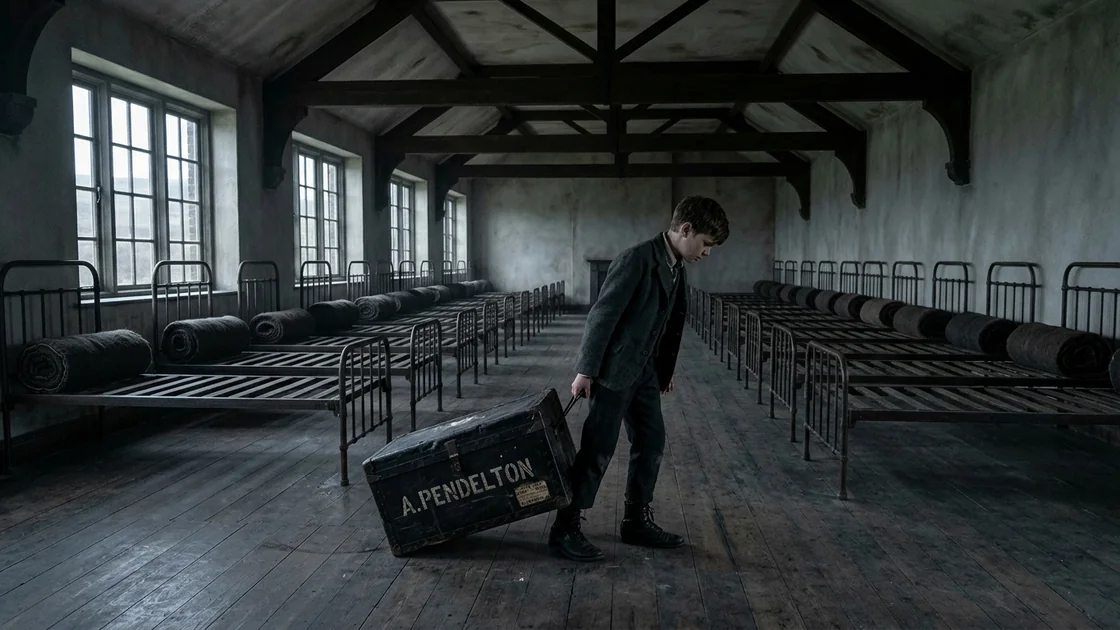
This is the story of Arthur Pendelton, a twelve-year-old boy enduring the suffocating, militaristic regime of Saint Jude’s Academy for Boys. Throughout a brutal academic year defined by freezing dormitories, sadistic masters, and grueling routines, Arthur maintains his sanity through a single, unwavering ritual: carving notches into the underside of his wooden bedframe to count the days until the summer holidays. Surrounded by the grey stone walls of the Yorkshire moors, he dreams of home, warmth, and his parents' return. However, on the eve of the summer exodus, as his classmates pack their trunks, Arthur receives a cream-colored envelope bearing a foreign postmark. Inside is a cold, pragmatic letter from his parents informing him that due to his father’s sudden diplomatic reassignment and the inconveniences of travel, he will not be coming home for the summer, nor for the foreseeable future, leaving him entirely institutionalized and alone in the hollow, echoing halls of the academy.
The bell of Saint Jude’s did not ring; it clanged with the dull, heavy finality of an iron skillet striking an anvil. It sounded precisely at five-thirty every morning, cutting through the thick, damp fog that rolled off the Yorkshire moors and seeped through the ill-fitting casement windows of the Third Form dormitory.
Before the first vibration of the bell had fully died away, Arthur Pendelton was awake. In truth, he had been awake for ten minutes, staring up at the water-stained plaster of the ceiling, watching his breath plume white in the frigid air. His fingers were already curled around the rusted handle of an old penknife he kept wedged inside the horsehair stuffing of his mattress.
Quietly, before the heavy boots of the dormitory prefect could begin their rhythmic thudding down the central aisle, Arthur rolled onto his stomach. He reached beneath the iron rail of his bed, finding the hidden strip of untreated pine that supported the slats. His fingertips traced the jagged braille of his own survival. One hundred and eighty-four notches. Each group of seven was crossed by a deeper, diagonal slash. Twenty-six weeks.
He pressed the dull blade against the wood, just beside the last mark. With a practiced, silent rocking motion of his wrist, he gouged a fresh groove into the soft pine. A tiny curl of pale wood fell onto the dusty floorboards. One hundred and eighty-five. That left precisely fourteen days. Two weeks until the heavy iron gates at the end of the gravel drive would swing inward, and the fleet of hired motorcars would carry the boys of Saint Jude’s down to the train station in the valley. Two weeks until London. Two weeks until his mother’s lavender-scented drawing-room, warm toast with marmalade that didn't taste of tin, and a bed where the blankets didn't feel like coarse sandpaper.
"Up! Up, you idle wretches! Feet on the floorboards!"
The voice belonged to Finch, the Sixth Form prefect assigned to their barracks. Finch was seventeen, possessed the build of a dockworker, and carried a knotted ash stick which he now brought down with a sharp crack against the iron foot-post of the bed nearest the door.
Forty boys moved as one. To hesitate was to invite a demerit, and three demerits meant a visit to the study of the Headmaster, Dr. Vance, or worse, an appointment with Mr. Garrett’s leather strap. Arthur slid the knife back into the narrow slit in the mattress ticking, swung his thin legs out from under the thin grey wool blanket, and stood at attention beside his cot. The floorboards were like slabs of river ice beneath his bare soles.
"Washroom! Three minutes!" Finch barked, pacing down the center aisle, his eyes darting left and right, looking for an untucked nightshirt, a slouching shoulder, a trace of rebellion.
The boys filed out in silence, a ghost-parade in faded flannel. The washroom was a vaulted chamber of cracked white tiles that smelled permanently of carbolic soap and wet slate. A long galvanized iron trough ran the length of the room, fed by a series of brass taps that produced only one temperature of water: the exact, numbing cold of the moorland streams from which it was pumped.
Arthur stood between Barnaby, a small, perpetually sniffling boy whose father owned a textile mill in Manchester, and Sterling, a tall, sharp-featured youth who had already mastered the art of surviving Saint Jude’s by becoming indistinguishable from its stones.
Arthur twisted the brass tap. The water hissed and spat before gushing out in a solid, freezing stream. He cupped his hands, splashed his face, and suppressed a gasp as the cold bit into his skin, making his cheekbones ache. He scrubbed at his neck and ears with a square of grey soap that refused to lather.
"Fourteen," Barnaby whispered, his teeth chattering so violently he could barely form the word. He was looking at Arthur through the spotted mirror above the trough. Everyone in the Third Form knew Arthur kept the count. He was their human calendar, the keeper of the only hope that mattered.
"Thirteen and a half, really," Arthur murmured back, barely moving his lips as he reached for his rough linen towel. "We leave at noon on Saturday fortnight. The morning doesn't count."
"My mother wrote that we're going to Brighton," Barnaby said, a wistful, dangerous softness entering his eyes. "For the whole of July. She says there’s a pier with electric lights and machines that show moving pictures for a penny."
"Silence at the trough!" Finch’s voice echoed off the tiles. "Barnaby! Is that your tongue wagging? Give me ten press-ups on the wet floor. Now!"
Barnaby didn't protest. He dropped immediately to the freezing, puddled slate, his thin arms trembling as he lowered his chest toward the grime. Arthur kept his eyes fixed on the mirror, his face a mask of blank compliance. To show sympathy at Saint Jude’s was to paint a target on one's own back. Here, weakness was a contagion, and the masters were determined to quarantine it through sheer brutality.
Saint Jude’s Academy had been founded in the late eighteenth century by a clergyman who believed that original sin could be frozen and beaten out of young boys before they reached manhood. Situated five miles from the nearest village, perched upon a bleak plateau of heather and granite, the school looked less like a place of learning and more like a correctional fortress. Its walls were built of the local gritstone, which turned black when it rained—and in this corner of Yorkshire, it rained four days out of five. There were no trees within the quadrangle, only a vast expanse of raked grey gravel where the boys were required to march for an hour every afternoon if the weather was too foul for the rugby pitches.
They dressed in silence: scratchy wool trousers, flannel shirts with stiff detachable collars that chafed the neck raw, heavy grey worsted jackets, and boots that required twenty minutes of polishing every evening until they reflected the gaslights.
At six-fifteen, the school assembled in the chapel. The chapel was the coldest room in the entire complex, a cavern of dark oak pews and stained-glass windows depicting various martyrs being broken on wheels or pierced with arrows. Arthur always sat beneath St. Sebastian, whose painted eyes rolled heavenward in an expression of pious agony that Arthur found deeply relatable.
Dr. Vance stood at the brass lectern, which was shaped like an eagle with spread wings. The Headmaster himself resembled a bird of prey—a tall, stooped man in a black academic gown that billowed around him like folded wings, with a hooked nose and spectacles that caught the candlelight, hiding his eyes behind twin discs of white fire.
"‘Man is born unto trouble, as the sparks fly upward,’" Dr. Vance read from the heavy Bible, his voice a dry, resonant baritone that needed no amplification to reach the furthest corners of the nave. "The Book of Job, chapter five, verse seven. Let those words sink into your soft, undisciplined minds as we approach the conclusion of the Trinity term."
He paused, gripping the edges of the lectern. The silence in the chapel was absolute; three hundred boys held their breath, suppressing coughs that had lingered since November.
"I observe among you," Dr. Vance continued, his voice dropping to a menacing purr, "a growing laxity. A wandering of the eye toward the windows. A foolish, juvenile preoccupation with the approaching cessation of lessons. You imagine that the summer holiday is a license for sloth. You imagine that beyond the gates of this institution, the watchful eye of Providence ceases to record your failings. You are mistaken. Idle hands are the devil's workshop, and I shall personally ensure that any boy who slacks in his Latin composition or his mathematical drills during these final fourteen days shall remain behind to complete them while his peers are departing."
A collective, imperceptible shudder ran through the pews. The threat of detention on Departure Day was the ultimate terror.
Arthur stared straight ahead at the back of the boy in front of him, counting the little knots in the dark oak of the pew. Fourteen days. Three hundred and thirty-six hours. His father would be waiting at King’s Cross. Or perhaps his mother would come alone in the Daimler, with Parker driving. She would wear one of her wide-brimmed summer hats, and when she hugged him, he would bury his face in the silk of her shoulder and breathe in the scent of the outside world—a world where things grew, where colours existed beyond slate-grey and mud-brown, where people spoke in normal voices instead of barks and whispers.
It had been ten months since he had seen them. He had not gone home for Christmas, nor for Easter.
In November, a letter had arrived from his father, written on the heavy, cream-colored stationery of his club in St. James’s. My dear Arthur, it had read in his father's sharp, slanting hand. Your mother’s nerves have been wretchedly frail this autumn, and Dr. Pritchard has strongly advised that she winter in Menton, away from the London fogs. Naturally, I must accompany her to see her settled, and my obligations at the Foreign Office make a return before January quite impossible. Dr. Vance has graciously agreed to allow you to remain in residence over the Yuletide break. I have enclosed a postal order for five shillings. Apply yourself to your Greek.
Christmas at Saint Jude’s had been an exercise in sensory deprivation. Only four boys had remained behind: Arthur, two brothers whose parents were stationed with the civil service in Bombay, and a boy named Miller whose father was in prison for embezzlement, though no one was supposed to know it. They had rattled around the vast, unheated buildings like dry peas in an empty tin. Most of the servants had been given leave, so the four boys had been required to haul their own coal and eat cold mutton in a corner of the cavernous dining hall while Mr. Garrett, the Latin master who had no family of his own, read The Times at the high table and ignored them entirely.
At Easter, the excuse had been a sudden diplomatic conference in Geneva. It simply isn't practical to open the Kensington house for a mere fortnight, Arthur, his mother had written in her looping, violet-ink script. The servants are on board wages and half the furniture is still under dust sheets. You will be much more comfortable at school with your little friends. Come summer, we shall have a grand time of it. Perhaps we shall rent a cottage in the Lake District.
Arthur had kept that Easter letter inside his Latin grammar book. He had read the last sentence so many times that the paper was soft as flannel along the folds and the violet ink had smudged where his thumb rested. Come summer, we shall have a grand time of it. It was a contract. A promise written in ink.
Breakfast followed chapel. It was the same breakfast they had eaten every morning since September: a pewter bowl of grey oatmeal porridge that was somehow both burnt at the bottom and watery at the top, accompanied by a thick slab of dry bread smeared with a microscopic scraping of dripping, and a mug of weak, lukewarm tea that tasted predominantly of the iron cauldron in which it was boiled.
Conversation was permitted during the last ten minutes of the meal, signaled by the striking of a small brass bell by the master on duty. Today, it was Mr. Garrett. He was a short, bull-necked man with a bristling grey moustache and eyes the colour of stagnant pond water. He struck the bell with a spoon, and a low, cautious hum of voices rose in the hall.
"I heard the groundsman talking to the cook's boy," Sterling said, leaning across the scarred pine table toward Arthur and Barnaby. He kept his voice low, his eyes fixed on his porridge bowl. "The typhus is in the village down in the valley. Three dead."
Barnaby went pale, his spoon stalling halfway to his mouth. "Will they quarantine us? Can they keep us here if there's fever in the valley?"
"Don't be an ass, Barnaby," Arthur said, though a sudden cold spike of dread had just pierced his stomach. "We don't go through the village to reach the station. The road branches off two miles north of the crossroads. Even Vance wouldn't keep three hundred boys here over the summer without their fees being paid for the extra months. The bursar would have a fit."
"True enough," Sterling agreed, tearing a crust of bread with his teeth. "Old Vance loves his discipline, but he loves twenty-five guineas a term even more. My governor says the school is half-bankrupt anyway. That's why the roof in the west wing leaks and we get horsemeat in the Tuesday stew."
The great double doors at the end of the dining hall swung open, and the post-corporal—a Sixth Former named Davies—marched in carrying the leather mailbag.
The hum of conversation died instantly. Three hundred heads turned toward the high table.
The distribution of the post was the most agonizing ritual of the day. Davies would dump the contents of the bag onto a silver tray before the duty master. The master would then sort through the envelopes at an excruciatingly slow pace, examining the postmarks, occasionally holding an envelope up to the light if he suspected it contained prohibited bank notes or contraband, before calling out the names.
Letters at this time of the term were critical. They contained the traveling money, the train tickets, the final instructions regarding which trunk was to be sent ahead via Carter Paterson and which valise kept for the carriage.
Mr. Garrett wiped his moustache with a napkin, adjusted his pince-nez, and picked up the first pile.
"Abrahams," he barked. A boy from the Second Form scrambled up, bowed at the waist as regulations required, took his letter, and hurried back to his seat.
"Beresford. Clarke Major. Clarke Minor. Davenant."
Arthur sat with his hands tightly clasped beneath the table, his knuckles white. He hadn't heard from his mother since the first week of May, when she had sent a brief postcard of the Palais des Nations in Geneva, saying the weather was unseasonably warm and his father was terribly busy with the trade delegation. Surely, the letter with his train fare and his travelling instructions would arrive this week. It had to. The bursar required a signed confirmation of departure arrangements from every parent at least seven days before the end of term.
"Finch. Garroway. Henderson. Llewelyn."
Mr. Garrett moved to the P's. Arthur’s heart hammered against his ribs like a trapped sparrow.
"Palmer. Parsons." Mr. Garrett paused, squinting at a small blue envelope. "Price."
He moved on to the R's. "Radcliffe. Reynolds."
Arthur let out a slow, silent breath, his shoulders sagging half an inch before he caught himself and straightened his spine. Nothing today.
"Tomorrow," Barnaby whispered beside him, clutching a thick envelope from Manchester that had just been tossed to him. "London post is always delayed when the fogs are on the line at Crewe. Everyone knows that."
"I don't care about the letter," Arthur lied smoothly, taking a sip of his cold, metallic tea. "My father’s secretary handles the tickets directly with the bursar's office. Saves the trouble of posting them."
It was a plausible lie. Arthur’s father, Lord Henry Pendelton—a minor title, an impoverished barony that carried more prestige than land—was an Under-Secretary in the diplomatic service. The boys in the Third Form knew Arthur’s family had connections in Whitehall, though Arthur was careful never to boast of it. In truth, his father was a distant, severe man whom Arthur saw mostly across the expanse of a polished mahogany dining table when he was home, or disappearing into a hansom cab in a cloud of cigar smoke. His mother, Lady Evelyn, was twenty years younger than her husband—a delicate, flighty creature who treated Arthur less like a son and more like an unexpectedly large and somewhat noisy lapdog that she was fond of in theory, provided someone else walked it.
Yet, in the grey purgatory of Saint Jude’s, Arthur’s memory had alchemized them into deities of warmth and affection. He had forgotten the long afternoons in Kensington when he was confined to the nursery because his mother had a migraine; he had forgotten the way his father’s eyes would glaze over with boredom whenever Arthur tried to tell him about a book he had read. Here, in the freezing dark, Kensington was Paradise, and his parents were the angels who guarded its gates.
The morning lessons were an exercise in endurance. The Third Form spent three hours in Mr. Garrett’s classroom, a long, narrow room that smelled of chalk dust, inkwells soured with dead flies, and old sweat. The tall windows were frosted up to the first six feet so that the boys could not look out at the moors—a preventative measure against daydreaming.
They were translating Caesar’s Gallic Wars.
"Pendelton," Mr. Garrett’s voice cracked like a whip. He was pacing the raised dais at the front of the room, tapping his leather strap against his palm. "Line forty-two. Begin. Parse profectus and give me the English."
Arthur stood up beside his scarred oak desk, holding the battered textbook in one hand. He had prepared the passage the night before by the dim, flickering light of the single gas jet in the prep room, his fingers blue with cold.
"‘Profectus,’ sir. Perfect active participle—no, deponent participle, nominative singular masculine, from proficiscor, to set out, to depart."
"And the translation?"
"‘Having set out at the third watch...’" Arthur’s voice was steady, though the words themselves felt like a cruel mockery. Having set out. To depart. "‘...Caesar marched with three legions toward the river, hoping to catch the Helvetii while they were still encumbered with their baggage.’”
"Adequate," Mr. Garrett grunted, sounding disappointed. He loved nothing better than a botched ablative absolute; it gave him an excuse to summon a boy to the dais for six strokes across the palms. "Sit. Barnaby! Continue from line forty-five."
Barnaby stood, his knees visibly knocking together beneath his woollen shorts. He stumbled over the first verb, stammered, and went entirely blank.
"Up here, boy," Garrett said softly, a terrible, predatory smile touching the corners of his grey moustache.
Arthur looked down at his desk as Barnaby walked to the front. He stared at a deep groove someone had carved into the oak decades ago—initials, J.M. 1874. Where was J.M. now? Probably a clerk in London, or an officer in India, or dead of fever in Africa. Either way, he had escaped. The years had passed, the days had been notched away, and eventually, 1874 had ended.
Thwack.
The sound of the heavy leather strap striking Barnaby’s small, chapped hand echoed through the room. Barnaby made a high, whimpering noise in the back of his throat.
Thwack. Thwack.
Arthur clenched his jaw. He did not look up. In his head, he walked through the front door of 14 Cranley Gardens, South Kensington. He saw the black-and-white checkered tiles of the vestibule. He saw the brass umbrella stand shaped like a heron. He walked up the carpeted stairs, his hand sliding along the smooth mahogany banister—so different from the splintered pine of the dormitory stairs. He smelled the beeswax polish that Mrs. Gudgeon, the housekeeper, used on the wainscoting. He went up to the third floor, to his own room with the wallpaper patterned with little blue sailing ships. His tin soldiers would still be arrayed on the window seat, right where he had left them last September, locked in a perpetual Battle of Waterloo.
Thwack.
"Return to your seat, Barnaby," Garrett sneered. "And stop blubbering like a nursery maid, or I’ll give you six more to dry your eyes."
The days dragged on, each one a carbon copy of the last, distinguished only by the slow, agonizing addition of notches beneath Arthur’s bed.
Twelve days. Eleven. Ten.
As the single digits approached, the atmosphere within the school began to shift, despite Dr. Vance’s best efforts to suppress it. It was a subtle electricity, a subterranean tremor of anticipation that ran beneath the flagstones. In the cloakrooms, boys compared the labels for their trunks. In the dormitories after lights-out, when Finch was down in the prefects' common room drinking cocoa, the darkness was filled with whispered plans of summer cricket matches, seaside bathing, pony rides, and feasts of strawberries and cream.
On the Friday one week before the end of term, the box-room was unlocked.
The box-room was a vast, subterranean cellar beneath the east wing where the boys’ travelling trunks were stored during the term. After afternoon lessons, the forms were marched down in rotation to haul their trunks up to the dormitories so that the matron could inspect their linen before packing began on Wednesday.
The cellar smelled of damp earth, mildew, and old leather. Three hundred trunks were stacked to the vaulted brick ceiling like coffins in a catacomb.
Arthur waded into the P section, pushing past boys who were grunting and swearing under the weight of brass-bound cabin trunks. He found his own wedged near the back wall—a medium-sized black tin box with A. PENDELTON painted in peeling white block letters across the lid.
With Sterling’s help, he dragged it out and took one iron handle while Sterling took the other. Together, they muscled it up the three flights of narrow stone stairs to the Third Form dormitory, setting it down at the foot of Arthur’s cot.
Just looking at the trunk made Arthur’s chest tighten with a fierce, aching joy. It was a tangible piece of the outside world. The tin was dented from the porters at King’s Cross; there was still a torn, faded Great Northern Railway label pasted to the side from the previous September. It was the vessel of his deliverance.
That night, when he made his notch—leaving only seven days—his hand trembled so much that the blade slipped, slicing a shallow groove across the knuckle of his left thumb. In the dark, he sucked the warm, salty blood from the cut, smiling to himself. One week. Just one more Sunday chapel, one more Tuesday stew, one more Friday Latin test.
Yet, by Tuesday, with four days remaining, the postbag had still yielded nothing for Arthur Pendelton.
A cold, creeping unease began to settle in the pit of his stomach, heavier than the morning porridge. On Tuesday afternoon, instead of marching in the quadrangle with the rest of his form, Arthur requested permission from Finch to visit the Matron’s office, claiming a loose boot-heel that needed the cobbler’s box. Once out in the stone corridor, however, he slipped down the main staircase toward the administrative wing.
The bursar’s office was located next to the Headmaster’s study. The corridor here was carpeted in faded red baize—the only carpet in the school—and smelled of floor wax and dry paper.
Arthur stopped outside the frosted glass door marked BURSAR. His heart was thudding against his ribs. For a Third Former to approach the bursar without a master’s note was a breach of protocol punishable by two hundred lines, at the very least. He wiped his damp palms on his grey trousers, raised a fist, and knocked twice.
"Enter," called a dry, reedy voice.
Arthur turned the brass knob and stepped inside. The room was lined from floor to ceiling with green cardboard filing boxes and smelled strongly of peppermint lozenges. Behind a high partners' desk sat Mr. rattle-boned Mr. Crump, a man so old and parchment-skinned he looked as though he had been pressed between the pages of his own ledgers.
Mr. Crump looked over the rims of his half-moon spectacles, his fountain pen hovering over a column of figures. "Well? What is it, boy? Don't hover by the door like a draught."
"Pendelton, sir. Third Form." Arthur stood at strict attention. "I beg your pardon for the intrusion, sir, only—I was inquiring as to whether my travelling voucher and railway warrant had arrived from my father’s secretary. They haven't come in the morning postbag, and as it is Tuesday..."
Mr. Crump’s watery blue eyes blinked slowly. He set his pen down in its brass groove with maddening deliberation, stood up, and shuffled over to a long pigeonhole cabinet labelled DEPARTURES - TRINITY.
He pulled a thick sheaf of papers from the M-P slot and brought it back to the desk. Wetting his thumb on his tongue, he began to leaf through them.
"Palmer... Parsons... Payne... Pemberton... Price." Mr. Crump flipped back a page. "Pendelton, you said? Arthur?"
"Yes, sir. My father is Lord Henry Pendelton."
"I am aware of your father's style and title, boy," Crump said tartly. He frowned at the papers, then opened a large black ledger bound in red leather. He ran a gnarled, ink-stained finger down the page. The clock on the mantelpiece ticked loudly—a slow, rhythmic clack-clack, clack-clack that seemed to measure out the remaining drops of blood in Arthur’s veins.
"Nothing here," Mr. Crump said, closing the ledger with a soft thud that sent a puff of dust into the air. "No railway warrant. No carriage reservation for the Saturday trap to the station."
The room seemed to tilt slightly. The green filing boxes blurred. "Perhaps... perhaps it went to the Headmaster’s office by mistake, sir?" Arthur’s voice sounded very small and far away. "My father has been in Geneva, sir. With the Foreign Office. The continental post can be irregular."
"If Dr. Vance had received instructions regarding your transit, they would be on my desk," Mr. Crump replied, already picking up his fountain pen again. "There are four days remaining of the term, Pendelton. I suggest you wait for the morning deliveries rather than wasting my time. Good afternoon."
"Yes, sir. Thank you, sir."
Arthur backed out of the room and pulled the door shut. He stood alone in the red-carpeted corridor for a moment, his hand still on the cold brass knob.
The continental post is irregular, he told himself fiercely. That was all it was. Or perhaps his father had already returned to London and was sending Parker with the motorcar to fetch him directly from the gates! Yes, that made complete sense. If they were driving up to the Lake District, as his mother had promised in her Easter letter, why would he take the train south to London only to travel north again? They would drive up the Great North Road in the Daimler, stop at Saint Jude’s on Saturday morning, load his trunk onto the luggage rack at the back, and drive straight across the Pennines to Windermere!
The relief that washed over him was so intense it made his knees weak. Of course. That was why there was no railway warrant with the bursar. His father wasn't going to waste money on a first-class train ticket to King’s Cross if he was coming in the car himself.
By the time Arthur returned to the quadrangle, he had constructed the entire scenario in vivid, technicolour detail. He could practically hear the deep, throaty purr of the Daimler’s engine idling outside the iron gates. He could see the envious faces of Sterling and Finch as he climbed into the leather-upholstered back seat beside his mother.
On Wednesday afternoon, the Matron, Mrs. Garside—a woman built like a barrel and possessing the temperament of a badger—oversaw the packing of the trunks.
The Third Form dormitory was a hive of chaotic activity. Boys were folding shirts, rolling stockings, and consulting the printed inventory lists pasted inside the lids of their trunks. Every boy was required to bring home the exact number of garments he had arrived with in September; any missing handkerchiefs or torn collars were meticulously noted by Mrs. Garside and added to the parents’ final bill at inflated prices.
Arthur knelt beside his black tin box, folding his spare flannel shirts with military precision. He laid his prize possession—a bound volume of The Boy’s Own Annual that he had won for Scripture Knowledge in the Michaelmas term—carefully between two layers of woollen combinations so the corners wouldn't get bruised in transit.
"Have your people sent your labels yet, Pendelton?" Barnaby asked from the next bed over. Barnaby was struggling to sit on the lid of his trunk to force the brass hasp closed over a bulge of dirty laundry. "My mother sent three luggage tags. We're changing trains at Leeds."
"No need for railway labels," Arthur said airily, smoothing down the sleeves of his Sunday jacket before laying it on top of the pile. "My governor is bringing the Daimler up. We're motoring straight to Westmorland. To the Lakes."
Several boys nearby stopped packing and looked over. In 1908, private motorcars were still a rare and glamorous luxury, the preserve of the genuinely wealthy.
Sterling raised a skeptical eyebrow. "Motoring? All the way from London? The roads over the moors will shake the axles off before they reach the gates."
"It’s a thirty-horsepower Daimler," Arthur said, lifting his chin slightly, imitating the cool, patrician drawl he had heard his father use with shopkeepers. "It went over the Alps two summers ago without blowing a single tyre. A little Yorkshire gravel won't trouble it."
Sterling didn't have a reply to that. He turned back to his own trunk with a sour look. Arthur felt a warm glow of triumph in his chest. For ten months he had been just another freezing, ink-stained nonentity in a grey uniform, indistinguishable from the sons of merchants and country solicitors. On Saturday, they would see.
Thursday came, and with it, three notches remaining.
The morning postbag brought a flurry of late letters, but none for Arthur. He didn't even feel the pang of anxiety this time. Why write when you are already on the road? The journey from London by car would take at least two days, stopping at an inn in Grantham or York along the way. Right now, at this very moment, his father was probably pulling on his leather driving gauntlets, and his mother was tying a chiffon veil over her hat to keep the dust off her complexion.
Friday morning. Two notches left. Only one more night to sleep under the scratchy grey blanket.
The final full day of term was traditionally devoid of standard lessons. Instead, the morning was spent cleaning out desks, returning inkwells and frayed textbooks to the stationery cupboard, and scrubbing the ink stains off the oak desktops with pumice stones and lemon juice.
At eleven o'clock, the entire school assembled in the Great Hall for the Reading of the Marks—a two-hour marathon of public humiliation in which Dr. Vance read out the class rankings of every boy from the Sixth Form down to the First, accompanied by scathing commentary on their moral and intellectual deficiencies.
Arthur placed fourth out of forty-two in the Third Form.
"Pendelton," Dr. Vance intoned from the stage, peering over his spectacles at the rows of boys. "Fourth. A respectable showing in Latin and History, marred by a lamentable mediocrity in Euclid. A boy of your parentage should be first, Pendelton, not fourth. You possess a dangerous tendency toward abstraction. See that you return in September with a sharper focus."
"Yes, sir," Arthur called back from his bench. If I return at all, he thought wildly. Perhaps over the summer, by the shores of Lake Windermere, he could convince his mother that Saint Jude’s was ruining his constitution. He was thin—his ribs showed like the slats of a basket when he washed at the trough—and he had a lingering cough. If he coughed just a little harder while they were on the boat at Bowness, perhaps Dr. Pritchard would recommend a tutor at home instead.
Lunch on Friday was the only meal of the year that approached edibility: roast beef that was only slightly grey, boiled potatoes, and a spotted dick pudding with actual treacle instead of watered-down molasses. The dining hall was deafening. The masters had largely given up on enforcing the silence rule, sitting together at the high table and drinking sherry while the boys shouted across the benches, trading addresses, swapping pocket-knives and foreign stamps, and boasting about their holiday plans.
Arthur was in the middle of trading three Cape of Good Hope triangular stamps to Barnaby in exchange for a brass compass with a cracked glass face when the double doors at the back of the hall opened.
It wasn't Davies, the post-corporal. The morning mail had already been distributed at breakfast.
It was Mr. Crump, the bursar. And in his crooked, liver-spotted hand, he held a single envelope.
Arthur didn't notice him at first. He was testing the needle of the compass on the scarred pine table, watching it swing sluggishly toward the north window.
Mr. Crump shuffled up the steps of the dais and whispered something into the ear of Dr. Vance, who sat at the center of the high table. Dr. Vance took the envelope, turned it over in his long, pale fingers, and looked down the length of the hall toward the Third Form bench.
Dr. Vance picked up the small brass bell and struck it twice with the handle of his butter knife.
The roar of three hundred voices died away into an uneasy silence. Boys looked around, wondering who had broken a window or been caught smoking behind the fives courts on the very last day.
"Pendelton," Dr. Vance’s voice cut through the quiet hall. "Step forward."
Arthur’s heart gave a violent, sickening lurch. Every eye in the Third Form turned to him. He laid the brass compass down on the wood, slid off the bench, and walked up the long central aisle between the tables. His boots sounded impossibly loud on the flagstones: clack, clack, clack.
It was a telegram, he thought. A telegram from York or Doncaster, saying the Daimler had arrived early and was waiting at the Red Lion Inn down in the valley. No—it wasn't a yellow telegram envelope. As he drew closer to the dais, he could see that the envelope in the Headmaster’s hand was large, square, and made of thick, cream-colored paper. And in the upper right-hand corner, there were three stamps—bright blue and carmine, foreign stamps, crossed with the heavy black cancellation marks of the French Republic.
Dr. Vance was also holding a second sheet of paper, which had clearly been enclosed in the same outer packet addressed to the school. The Headmaster’s face was entirely unreadable, a mask of grey granite beneath his mortarboard.
"This arrived by the midday carrier from the station," Dr. Vance said quietly, so that only Arthur and the masters at the high table could hear. "It was enclosed within a communication to myself from your father’s solicitors in Lincoln’s Inn. You are excused from afternoon assembly, Pendelton. You may take this to the library to read it. Report to my study at four o'clock."
Arthur reached up. His hand looked very small and dirty as he took the cream-colored envelope from the Headmaster’s fingers.
Master Arthur Pendelton, it read, in his mother’s looping, violet-ink handwriting.
He remembered his manners. He bowed from the waist, turned on his heel, and walked back down the center of the hall. He didn't look at Barnaby or Sterling. He walked straight out through the great oak doors into the cool, shadowy silence of the entrance hall.
The library was on the first floor, overlooking the front drive. During term time, it was off-limits to the Lower School, used only by the Sixth Form for private study. Today, it was entirely deserted. Dust motes danced in the shafts of pale, watery sunlight that slanted through the tall gothic windows. The room smelled of dry calfskin bindings and dead coal fires.
Arthur walked over to the window embrasure. From here, you could see the long, straight ribbon of grey gravel that led for half a mile through the heather to the tall wrought-iron gates. The gates were still closed, chained and padlocked as they had been since September.
His fingers were trembling so violently that he couldn't get his thumb under the wax seal at first. The seal was stamped with his father’s crest—a Demi-Lion Rampant holding a broken spear. Finally, the heavy paper tore with a crisp, dry rip.
Inside were two sheets of thin, deckle-edged paper, covered on both sides in his mother’s sprawling, violet script. A faint, ghost-like trace of lavender water rose from the folds—so real, so devastatingly familiar, that Arthur’s eyes instantly blurred with hot tears. He blinked them back angrily and smoothed the pages out on the oak windowsill.
Hôtel de Paris, Monte Carlo June 18th
My dearest darling boy,
I am writing this from the terrace overlooking the casino gardens, where the sun is shining so brightly it quite hurts my eyes, though Dr. Pritchard says the Mediterranean air is the only thing keeping my bronchial tubes from collapsing entirely after that dreadful damp spring we had in Geneva. You cannot imagine how beastly the Swiss wind is off the lake; it quite ruined my nerves.
Arthur frowned, his eyes skimming faster down the page. Monte Carlo? June 18th was five days ago. How could they be in the south of France if they were supposed to be driving up the Great North Road?
Your father has received the most thrilling, though terribly inconvenient, news from the Minister. Sir Edward has appointed him as Special Envoy to the legation in Buenos Aires to oversee the new railway trade treaties! It is a tremendous step up, darling, and means we shouldn't have to worry about those beastly death duties on the Shropshire estate anymore, though of course Argentina is quite at the other end of the earth and I am already dreading the sea voyage. We have to sail from Cherbourg on the twenty-fourth—that is next Wednesday—on the Royal Mail steamer, which leaves no time at all to return to England.
The words on the page seemed to detach themselves from the paper, floating and swirling like black gnats before Arthur’s eyes. Sail from Cherbourg on the twenty-fourth. No time at all to return to England.
He gripped the edge of the windowsill so hard a splinter drove itself beneath his fingernail. He didn't feel it. He forced his eyes back to the violet ink.
Naturally, we have had to let the house in Cranley Gardens for the next two years, as it would be madness to keep a full staff of servants in Kensington while we are in South America. Messrs. Coutts & Co. have arranged for the tenants to take possession on the first of July, and Mrs. Gudgeon has packed up all your little things from the nursery and sent them into storage at the Pantechnicon, so you needn't worry that your toy soldiers will be broken by strangers.
Your father and I talked it over at great length, darling, and we both agreed that it would be utterly wicked to drag a boy of your age out of school and across the tropics, where they have yellow fever and all manner of dreadful insects, to say nothing of the interruption to your Latin and Greek just when you are preparing for the Upper School. And as there is no home in London for you to come to, and your Aunt Beatrice has gone to Marienbad for her gout, we have arranged with Dr. Vance and the solicitors for you to remain at Saint Jude’s for the summer holidays.
The silence in the library was suddenly roaring in Arthur’s ears, like the sound of the sea trapped inside a shell.
Dr. Vance has assured your father in his most recent wire that the moorland air in July and August is exceptionally bracing and healthy for a growing boy, and that Mr. Garrett has kindly consented to oversee your vacation reading so that you will be quite ahead of your form when the new term begins in September! Is that not splendid? Your father has instructed the solicitors to allow you half-a-crown a week pocket money during the holidays, which is terribly generous of him considering the expense of our outfit for the tropics.
Do be a brave, sensible boy, Arthur, and don't make a fuss. You know how any unpleasantness brings on my palpitations, and I must conserve all my strength for the Atlantic crossing. Write to us care of the British Legation, Buenos Aires, and tell us all about your nature walks on the moors. I am sending you a box of crystallized violets from Nice under separate cover.
With fondest love and a thousand kisses, Your affectionate Mother.
P.S. Your father says you are to pay particular attention to your Euclid, as Dr. Vance’s mid-term report was most unsatisfactory in that regard.
Arthur stood by the window for a very long time.
The shaft of sunlight moved slowly across the dusty carpet, crept up the leg of a leather armchair, and faded out entirely as a heavy bank of grey moorland cloud rolled over the sun.
For the next two years.
He read that line again. We have had to let the house in Cranley Gardens for the next two years.
That didn't just mean this summer. That meant Christmas. That meant Easter. That meant next summer, too. Seven hundred and thirty days. There wasn't enough room on the pine slat beneath his bed for seven hundred and thirty notches. The wood would be whittled away to sawdust before he reached the end of it.
And the house was gone. The black-and-white tiles in the vestibule, the heron umbrella stand, the wallpaper with the little blue sailing ships—strangers were walking on those floors. His soldiers were locked in a dark crate in a warehouse in Belgravia, buried under dust sheets in the dark, just like him.
He wasn't going home. There was no home to go to.
He looked down at the letter. The violet ink blurred as a single, heavy tear dropped from his eyelashes and splashed directly onto the word darling, turning the purple dye into a pale, weeping bruise on the paper.
He didn't cry out. Ten months at Saint Jude’s had trained his throat to strangle every sound before it could reach his lips. Instead, a cold, hollow sickness spread outward from his chest, moving down into his stomach and out to the tips of his fingers, until he felt as though he had been hollowed out with a scoop and packed full of wet snow.
The library door creaked open.
Arthur shoved the letter deep into the pocket of his grey worsted jacket and wiped his sleeve violently across his eyes, turning toward the bookshelves and pretending to examine a row of bound Hansard parliamentary debates.
It was Finch, the prefect.
Finch didn't have his ash stick. He stood just inside the door, looking uncharacteristically awkward. Even a bully of Finch’s caliber understood certain sacred boundaries among schoolboys, and by now, the rumor of the foreign letter delivered by the bursar had clearly circulated through the Upper School.
"Pendelton," Finch said, his voice gruff but lacking its usual bark. "It’s ten minutes to four. You’re due in Vance’s study."
"I know," Arthur said. His voice sounded remarkably normal, though a little hoarse. "I was watching the clock."
He walked past Finch without looking up. As he passed, he heard the older boy mutter under his breath, "Rotten luck, young 'un."
It was the only expression of sympathy Arthur had ever heard inside the walls of Saint Jude’s, and somehow, it was infinitely worse than the ash stick. It made the catastrophe real. It meant everyone knew.
At four o'clock precisely, Arthur knocked on the heavy oak door of the Headmaster’s study.
Dr. Vance sat behind a vast desk covered in green baize. Unlike the bursar's office, this room was warm; a small coal fire burned in the grate even in June, to keep the damp out of the Headmaster's theological books. On the wall behind him hung a large engraving of the Martyrdom of St. Jude, showing the apostle being beaten to death with a club.
"Ah. Pendelton," Dr. Vance said, steepling his long fingers beneath his hooked nose. "Close the door and come forward."
Arthur obeyed, standing before the desk with his hands clasped behind his back.
"You have read Lady Evelyn’s communication?"
"Yes, sir."
"Then you are apprised of the situation," Dr. Vance said briskly, as if discussing a minor alteration in the cricket schedule. "Lord Henry’s solicitors, Messrs. Farrer & Co., have executed a banker’s draft covering your board, tuition, and holiday maintenance for a period of twenty-four calendar months, renewable upon your father’s discretion from his post in the Argentine Republic."
Dr. Vance picked up a sheet of blue legal paper from his blotter and adjusted his spectacles.
"During the summer recess, the main dormitory wings will be closed for whitewashing and the saving of fuel. You will move your kit tomorrow afternoon into the small box-room adjacent to Mr. Garrett’s quarters in the East Turret. You will take your meals with Mr. Garrett and Mrs. Garside in the housekeeper’s parlour. Four hours each morning will be devoted to classical composition and geometry under Mr. Garrett’s supervision. In the afternoons, provided your morning conduct has been satisfactory, you will be permitted the liberty of the grounds within the perimeter wall."
Dr. Vance lowered the paper and looked at Arthur over the rims of his glasses. The twin discs of light had gone; Arthur could see the old man’s eyes now. They were small, grey, and entirely devoid of malice—not because he was kind, but because to Dr. Vance, a twelve-year-old boy was not a creature capable of suffering; he was simply a lump of raw, unformed clay to be baked in the kiln of routine until he hardened into an Englishman.
"It is a singular privilege, Pendelton," Dr. Vance said solemnly, "to be spared the frivolous dissipations of the summer season. While your peers are softening their brains and corrupting their morals in London drawing-rooms and seaside resorts, you will have the opportunity to forge your character through uninterrupted industry. Your father’s service to the Empire requires sacrifice. Let your sacrifice be your diligence."
"Yes, sir," Arthur whispered. "Am I... am I the only boy remaining this summer, sir?"
"The MacPherson brothers have gone to an aunt in Inverness," Dr. Vance said, turning back to his correspondence. "And Miller has been removed from the school rolls due to financial irregularities on the part of his guardian. You will be the sole pupil in residence until the twentieth of September. You may go, Pendelton. Do not return to the Third Form dormitory until after the boys have departed tomorrow at noon; I do not wish the excitement of their packing to unsettle your mind. You will sleep tonight in the infirmary annex, and move your trunk tomorrow."
It was a sentence of solitary confinement, delivered under the guise of consideration. Dr. Vance didn't want a weeping, abandoned boy spoiling the festive mood of Departure Day when the parents' carriages and hired motorcars arrived at the gates. It would look bad for the school.
"Thank you, sir," Arthur said mechanically.
He didn't have to face Barnaby and Sterling that night. He didn't have to explain why the thirty-horsepower Daimler wasn't coming over the moors, or why his trunk wouldn't be carried down to the front drive.
Mrs. Garside gave him a bowl of bread and milk in the little room off the infirmary that smelled strongly of iodoform and camphor. He lay awake all night on the narrow iron cot, staring at the unfamiliar ceiling. He didn't have his penknife—it was still wedged inside the horsehair mattress of his bed in the Third Form dormitory—and even if he had it, there was nothing left to count. Time had stopped. It had congealed into a vast, grey ocean without a shore on the other side.
At six o'clock on Saturday morning, the bell clanged.
From the high, narrow window of the infirmary annex, Arthur heard the school wake up for the last time. It was a different sound from every other morning of the year. There was no silence rule today. He heard the roar of three hundred boys cheering in the dormitories; he heard boots thundering down the stone staircases four at a time; he heard someone singing Dulce Domum at the top of his lungs in the quadrangle without Finch shouting at him to shut up.
By nine o'clock, the black tin trunks and leather valises were piled in a great mountain beside the main porch.
Arthur knelt on the wooden chair beside the infirmary window, his chin resting on his forearms, watching through a pane of wavy glass.
At ten, the old groundsman walked down the half-mile gravel drive with a heavy iron key ring. Even from this distance, Arthur could see him wrestling with the rusted padlock on the main gates. Then, slowly, the two great wrought-iron wings swung inward, opening a gap in the high stone wall that surrounded their world.
Through that gap came the carriages, the station wagons, the hired landaus from the valley, and three shining motorcars, their brass headlamps gleaming in the pale morning sun.
For two hours, the quadrangle was a churning sea of life. Mothers in feather boas and summer silks stepped out onto the gravel, holding out gloved arms; fathers in bowler hats and tweed suits clapped their sons on the shoulders and handed tips to the porters.
Arthur spotted Barnaby near the fountain. His mother—a plump, rosy-cheeked woman in a blue coat—was kissing the top of his cap while Barnaby tried desperately to look grown-up and embarrassed, though he was grinning from ear to ear. Before climbing into the station fly, Barnaby turned and looked back up at the grim, soot-blackened facade of the school, scanning the rows of dark windows.
He was looking for Arthur. He wanted to wave goodbye, or perhaps he was still looking for the grand Daimler that was supposed to take Arthur to the Lakes.
Arthur shrank back into the shadow of the infirmary curtain so he wouldn't be seen. He couldn't bear the thought of Barnaby seeing him up here like a ghost in an attic.
One by one, the carriages turned on the gravel circle, crunched down the long drive, and passed through the open gates. The pile of trunks by the porch melted away. The shouting and laughter grew thinner, more sporadic, until only the last station omnibus remained, waiting for the masters who were going down to catch the twelve-forty train to York.
Mr. Crump climbed in. Several of the younger masters followed, carrying Gladstone bags and tennis rackets in wooden presses. The driver cracked his whip, the horses leaned into their traces, and the heavy omnibus rolled away down the drive.
As the rear wheels of the omnibus cleared the stone pillars at the end of the road, the groundsman stepped out from his lodge. He pulled the left wing of the iron gate shut. Then he pulled the right wing to meet it.
Even across half a mile of moorland air, in the sudden, suffocating silence that had fallen over the plateau, Arthur heard the heavy iron chain rattle through the bars, and the sharp, metallic click of the padlock snapping shut.
The silence that followed was not like the silence of chapel or the silence of night. It was the silence of a tomb after the mourners have gone home.
The wind off the moors seemed to grow louder, whistling through the empty bell tower and rattling the slates on the roof. Down in the quadrangle, a single piece of white paper—a dropped luggage label—skittered across the raked gravel, caught against the base of the dry fountain, and lay still.
At one o'clock, the lock on the infirmary door turned. Mrs. Garside stood in the doorway, wiping her red hands on her apron.
"Come along then, Pendelton," she said, not unkindly, though her voice echoed strangely in the empty corridor. "No sense sitting in the dark. You've got to shift your trunk over to the East Turret before dinner. Mr. Garrett wants to see what books you've got at half-past two."
Arthur stood up from the chair. His legs were stiff from kneeling for three hours.
He walked out of the infirmary and down the long corridor toward the Third Form dormitory to fetch his things. The building felt colossal now, as if the stone walls had expanded the moment the boys left. His footsteps echoed off the high ceilings, following him like an unseen companion.
He pushed open the heavy door of the Third Form dormitory.
Forty iron beds stood in two neat, parallel rows. The mattresses had all been stripped of their sheets and rolled up into tight horsehair cylinders at the head of each frame, exposing the bare pine slats beneath. The air smelled of carbolic, dust, and the ghosts of forty boys who were currently hurtling south on the express train toward London, eating sandwiches from wicker hampers and watching the green fields of England flash past the carriage windows.
Arthur’s black tin trunk sat alone at the foot of the seventh bed on the left, the only solid object in a skeleton room.
Before lifting the trunk, Arthur walked to the head of his bed. He reached into the tight roll of his horsehair mattress, his fingers finding the familiar slit in the ticking. He pulled out the rusted penknife.
Then he knelt on the cold floorboards and looked at the underside of the pine slat.
In the grey light filtering through the tall casements, he could see the whole year laid out in miniature valleys across the wood. Twenty-six groups of seven notches, each crossed with a diagonal slash, and five single notches at the end, leading right up to the edge of a knot in the timber. One hundred and eighty-nine days. He had missed carving Friday's notch in the infirmary, and today was Saturday.
He opened the dull blade of the knife. He held it up to the wood, just beyond the knot, where the pine was smooth and unmarked, waiting for the next seven hundred days to begin.
He stared at the bare wood for a long time.
Then, slowly, he folded the blade back into the rusted handle until it clicked shut. He didn't make the mark. A boy only counted the days when there was something at the end of the counting. To carve a notch into this wood now would be to admit that he still believed in the world beyond the iron gates—that he still believed in lavender-scented drawing-rooms, and promises written in violet ink, and mothers who came back for their sons.
Arthur stood up. He walked over to the tall casement window at the end of the dormitory, unlatched the iron catch, and pushed it open an inch against the damp moorland wind. He slipped the penknife through the gap and let it go. He didn't watch it fall into the nettles three stories below.
He walked back to his bed, gripped both iron handles of his black tin trunk, and began to drag it across the bare floorboards toward the door, the metal scraping a long, pale scar into the wood that no one would see until September.