The Inventory of What Remains
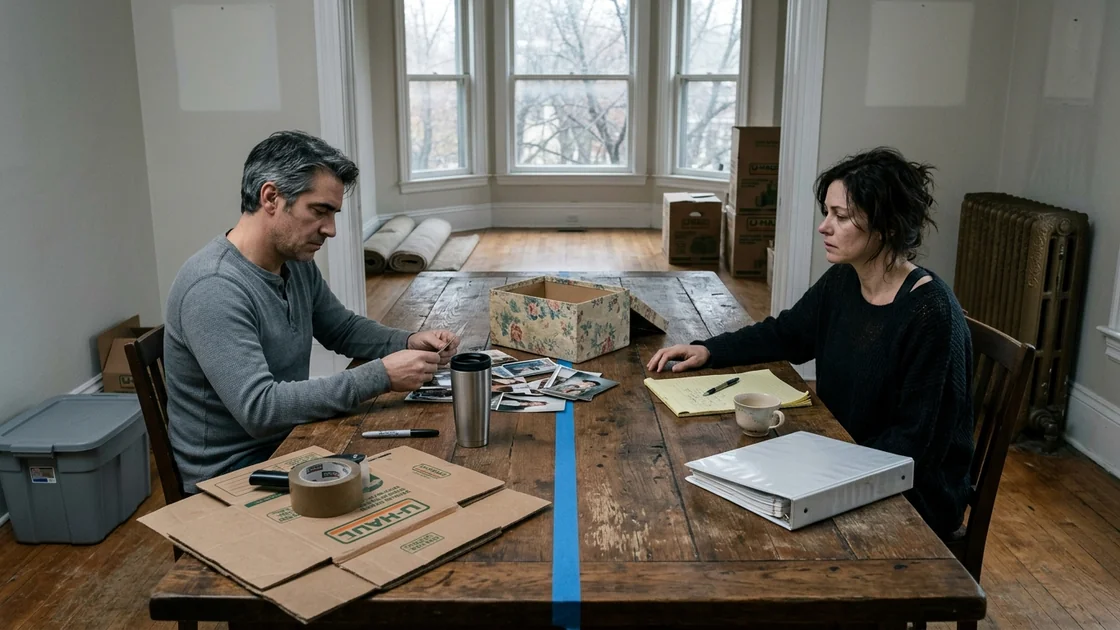
After sixteen years of marriage, Clara and Julian must spend one final, grueling weekend in their sold Victorian home to divide a lifetime of shared photographs, cherished heirlooms, and fractured memories. As their bitter divorce reaches its bureaucratic conclusion, the simple act of sorting through cardboard boxes transforms the dusty living room into an emotional battlefield where every ceramic plate and faded Polaroid serves as a weapon of resentment. Guided only by yellow legal pads and decades of accumulated grief, Clara must navigate Julian’s cold hostility to claim the physical pieces of her own history before the house is handed over to strangers. Through the agonizing process of inventorying their dead relationship, she ultimately discovers that letting go of the past is the only way to survive the future.
The dining room table had always been too large for the two of them, a ten-foot expanse of reclaimed barn oak that Julian had insisted on buying during the third year of their marriage, back when they still believed their lives would eventually fill the space. They had imagined dinner parties with ten guests, holidays cluttered with serving platters, and eventually, children doing homework at one end while supper simmered in the kitchen. None of those things had materialized, save for a handful of strained Thanksgiving dinners where the silence between courses was louder than the clinking of silverware. Now, the table served its final, most practical purpose: a demilitarized zone.
A strip of blue painter’s tape ran down the exact center of the wood, dividing the scarred planks into two equal territories. On the north side sat Julian’s stainless-steel travel mug, a fresh black Sharpie, a roll of heavy-duty packing tape, and a neat stack of flattened U-Haul boxes. On the south side sat Clara’s chipped ceramic teacup, a yellow legal pad already dog-eared and ink-stained, and the three-ring binder provided by her mediator, its plastic spine cracking every time she opened it to the section labeled Schedule C: Uncontested Personal Property.
Outside, a relentless November rain lashed against the bay windows, blurring the barren maples lining the street into gray smudges. The radiator in the corner hissed and clanked, fighting a losing battle against the draft that had plagued the old Victorian since the day they signed the mortgage twelve years ago. The house was already mostly empty. The sofas were gone, sold to a young couple from Craigslist who had bounced on the cushions with an enthusiasm that made Clara want to weep. The rugs were rolled up and stacked in the hallway like shrouds. Without the fabric and furniture to absorb the sound, every footstep, every sigh, and every clearing of a throat echoed off the plaster walls with violent clarity.
Julian came down the stairs, his boots thudding heavily on the bare oak treads. He was carrying a plastic storage tote—one of the heavy-duty gray ones from the basement—and his jaw was set in that familiar, rigid line that meant he was preparing to be unreasonable while believing he was being entirely logical.
"This is the last of the closet under the stairs," Julian said, dropping the bin onto the floor at the head of the table. The plastic cracked against the floorboards. He didn't look at her. For the past four months, Julian had mastered the art of looking roughly three inches to the left of Clara’s ear, addressing the empty space beside her as if she were a ghost he was politely trying to ignore. "Once we get through these three boxes and the hutch, I’m calling the junk removal guys for whatever’s left in the garage. I’m not spending Sunday here."
"The agreement says we have until Sunday at five," Clara said, her voice sounding thin and reedy in the cavernous room. She hated how defensive she sounded, how quickly she reverted to the tone of a scolded child whenever he used his boardroom cadence. "We haven't even touched the attic."
"The attic is mostly Christmas decorations and your old studio canvases," Julian replied, pulling the lid off the gray tote. A smell of damp cardboard, cedar chips, and old paper drifted up between them. "You can have the canvases. Obviously. And I don't want the ornaments. If you don't want them, leave them for the staging company or throw them in the dumpster. I’m moving into a twelve-hundred-square-foot condo, Clara. I don't have an attic. I don't have a basement. I’m paring down."
Paring down. It was the phrase he had used when he moved his clothes into the guest room in April. It was the phrase his lawyer had used when discussing the liquidation of their joint brokerage account. Everything to Julian was an exercise in efficiency, a trimming of dead weight. And after sixteen years together—fourteen of them married, two spent in a slow, suffocating decline after the second failed round of IVF—Clara was the heaviest dead weight of all.
"Fine," Clara said, uncapping her pen. "Let's just start."
Julian reached into the gray tote and pulled out a smaller, decorative cardboard box covered in faded floral fabric. He set it precisely on the blue line of painter's tape.
Clara’s stomach gave a sharp, unpleasant lurch. She knew that box. She had bought it at a stationery store in Boston during their first year of dating, back when she was finishing her art history degree and he was a newly minted associate at an architectural firm, working seventy hours a week and smelling perpetually of cheap espresso and drafting paper.
"Photos," Julian said, his tone flat. "Pre-digital. Mostly the nineties and early two-thousands. How do you want to do this? One for one?"
"You can't go one-for-one on photographs, Julian. They aren't poker chips. They have context."
"Everything has context," he snapped, his eyes briefly flicking to hers before retreating to the wall behind her. It was the first direct eye contact of the morning, and the sheer exhaustion in his dark eyes startled her. He looked older than forty-four. The silver at his temples had advanced like frost over the past six months, and the lines bracketing his mouth were carved deep. "If we stop to discuss the 'context' of every four-by-six print from twenty years ago, we’ll be here until the new owners show up with the sheriff. We divide them by subject. Your family goes to you. My family goes to me. Landscapes and vacations, we split down the middle."
"And the ones of us?" she asked quietly.
Julian paused, his hand resting on the floral lid. A muscle feathered in his cheek. "Why would either of us want those?"
The cruelty of it wasn't explosive; it was clinical, delivered with the mild confusion of a man asked why he wouldn't keep a broken toaster. Clara felt the familiar burn behind her sternum, the acid reflux that had become her constant companion since the papers were served in July. She wanted to tell him that erasing sixteen years didn't make him twenty-eight again. It just made him a man with a sixteen-year hole in his biography. Instead, she reached across the table, her fingers brushing the rough fabric of the box, and pulled it an inch toward her side of the blue tape.
"Open it," she said.
The first stack was held together by a petrified rubber band that snapped and crumbled into dry beige worms the moment Julian touched it. The photos spilled across the oak like a deck of cards.
They were glossy drugstore prints with the dates stamped in glowing orange digits in the bottom right corner. 07 14 '99. 07 15 '99.
Cape Cod. They had rented a cottage in Truro that smelled of mildew and pine needles, so small that their knees bumped the wall when they sat on the toilet. They had been poor then, living on peanut butter sandwiches and cheap Portuguese wine, spending ten hours a day on the beach until their skin was tight and radiating heat.
Julian picked up the top photo. It showed Clara standing in the surf at Marconi Beach, wearing an oversized flannel shirt over a black bikini, her hair—much longer then, dark and wild in the wind—whipping across her face. She was laughing at the camera, holding up a dead horseshoe crab by its tail.
Without a word, Julian slid the photo across the blue tape to her side.
"Why are you giving that to me?" Clara asked. "You took it."
"It’s a picture of you," Julian said, already sorting through the next five prints. "I don't need a picture of you holding a dead crab, Clara."
"You used to have that framed on your desk at the firm."
"That was fifteen years ago. Before they renovated the fourth floor." He tossed a photo of himself sleeping on a beach towel into her pile, then caught himself, frowned, and pulled it back to his side, dropping it instead into a small trash bag he had hooked over the arm of his chair.
"Stop," Clara said, her hand shooting out to grab his wrist.
They both froze. Her fingers were wrapped around the cuff of his gray thermal shirt, right above the silver watch she had bought him for his thirtieth birthday. His skin was warm. It was the first time she had touched him since a horrific, screaming argument in the kitchen in May, when she had tried to block the doorway to keep him from walking out in the middle of a sentence, and he had gently, firmly lifted her by the elbows and set her aside like an umbrella stand.
Julian looked down at her hand. She let go immediately, pulling her arm back to her chest as if she’d touched a hot stove.
"Don't throw them away," she said, her voice shaking. "If you don't want the pictures of yourself, put them on my side. Don't put them in the trash right in front of me."
"Why do you want them?" Julian asked, and for the first time, the boardroom veneer cracked, revealing a jagged edge of genuine anger. "Seriously, Clara, what is the point? Are you going to build a shrine in your new apartment? Are you going to sit around looking at pictures of me when I was twenty-nine so you can tell your sister what a bastard I turned out to be?"
"No," she said, though the mention of her sister made her wince. Sarah had been vocal during the separation, sending Julian a blistering three-page email that had permanently poisoned any hope of an amicable split. "Because it happened, Julian. Because that was my life, too. I was there on that beach looking at you. It’s my memory. You don't get to throw my memories into a Hefty bag just because you want to pretend you hatched out of an egg last Tuesday."
Julian stared at her for a long moment. The rain drummed harder against the glass, water pooling on the warped interior sill where the caulk had failed. Slowly, he reached into the trash bag, retrieved the photo of his younger self asleep in the sun, and tossed it onto her side of the table. It skittered across the wood and stopped against her teacup.
"Take them all, then," he muttered, shoving the rest of the Truro stack across the blue line. "Except the ones of my dad's boat. I want the ones of the boat."
For the next hour, the only sound in the dining room was the whisper of glossy paper sliding against wood and the occasional scratch of Clara’s pen as she updated her legal pad, though the mediator didn't care about photographs. The mediator cared about the 2018 Subaru Outback, the Eames lounge chair (authentic, inherited from Julian’s uncle, fiercely contested until Clara traded it for the entirety of the wine cellar), and the antique silver. Yet Clara felt a compulsive need to document the carnage. 1999 Truro – Clara. 2001 Chicago trip – Clara. 2003 Julian’s brother’s wedding – Julian.
It was like performing an autopsy on a body that was still warm. Here they were in 2002, standing in front of this very house on closing day, holding the keys. Clara was wearing low-rise jeans and a green sweater she had completely forgotten she owned; Julian had his arm slung tightly around her neck, pulling her cheek against his chest, his grin wide and terrified. The porch behind them was rotting, painted a hideous shade of mustard yellow that they had spent the entire first summer scraping off with heat guns until their palms were blistered.
Look at them. They had no idea. They didn't know that the mustard paint contained lead that would cost four thousand dollars to abate. They didn't know that in seven years, in the upstairs bathroom with the clawfoot tub, Clara would sit on the tile floor bleeding out a ten-week pregnancy while Julian hammered on the locked door, begging her to let him in. They didn't know that her refusal to unlock that door would be the hairline fracture that eventually brought the whole foundation down.
Julian picked up the house-closing photo. He looked at it for five seconds—longer than he had looked at anything else that morning. His thumb brushed the corner of the print, right over the mustard-colored porch rail.
"Do you want this one?" Clara asked softly.
Julian’s face hardened instantly, the vulnerability slamming shut like a bank vault. "No. The house is sold, Clara. Why keep the receipt?" He slid it to her side.
"You're really going to leave here with nothing," she marveled, a bitter laugh escaping her throat. "You're going to walk into your sterile little condo with your clothes, your Eames chair, and fifty pictures of your brother's golden retriever, and that's it. You're actually proud of how little you care."
"I care about surviving this," Julian said, his voice dropping an octave, dangerously quiet. "And unlike you, I don't find joy in picking at scabs. We failed, Clara. The marriage died years ago; we’ve just been living in the corpse. Forgive me if I don't want to frame the autopsy photos."
He stood up abruptly, his chair scraping loudly against the floorboards. "I’m going to get the stuff out of the china cabinet. Sort the rest of that box however you want. Just leave me the ones from my parents' fortieth anniversary."
He walked out of the dining room, heading toward the butler's pantry. Clara looked down at the photo of the two of them in front of the yellow porch. Her eyes were stinging, hot and dry, exhausted from months of crying in parked cars and shower stalls. With a sudden, vicious impulse, she picked up the black Sharpie from Julian’s side of the table, uncapped it, and drew a thick black line right between their standing figures, severing his arm from her shoulders. The chemical smell of the ink rose up, sharp and dizzying. She threw the marker back onto his territory and shoved the ruined photograph to the bottom of her pile.
The china cabinet had been built into the butler's pantry in 1912, a towering structure of dark mahogany with wavy leaded-glass doors that had survived three generations of previous owners. For fourteen years, its shelves had held the accumulated artifacts of their respectable, upper-middle-class aspirations.
When Julian returned, he was carrying two banana boxes he had scavenged from the grocery store, along with a giant roll of bubble wrap that looked like a bolt of industrial fabric. He set them down and went back for the first load of dishes, returning with a stack of Wedgwood dinner plates—white bone china rimmed in a delicate, geometric platinum band.
Schedule C, Item 14: Wedding China (Vera Wang for Wedgwood, 12 place settings).
"The mediator's sheet says we’re splitting the service," Julian said, setting the plates down on his side of the blue tape with a heavy ceramic clatter. "Six settings each."
Clara stared at the plates. "What are you going to do with six place settings of formal bone china, Julian? You don't even use coasters unless I yell at you. You eat takeout out of the foil tin while standing over the sink."
"And what are you going to do with twelve?" he countered, tearing off a sheet of bubble wrap with a violent rip. "Host a state dinner in your two-bedroom rental over the bakery?"
"It’s a set," Clara said, her voice rising. "If you split a twelve-piece service into two six-piece services, you ruin the value of the whole thing. Nobody wants half a set of wedding china. You can't even wash them in the dishwasher because of the platinum rim. You're going to put them in a cabinet in your condo, never touch them, and eventually your new girlfriend is going to throw them out because they have bad energy!"
"There is no girlfriend, Clara, for the hundredth time," Julian said, pinching the bridge of his nose. "Stop inventing characters to be mad at. I’m taking six settings because the lawyer said to split the high-value household goods fifty-fifty so we don't have to pay the appraiser another four hundred dollars to calculate offsets. It’s math. It’s not personal."
"It is wedding china! How is wedding china not personal?"
"Because we bought it at Bloomingdale's with a barcode scanner!" Julian shouted, the roar echoing off the bare plaster walls and making the glass chandelier overhead give a faint, sympathetic chime. He braced his hands on the table, leaning over the blue tape, his face flushed dark red. "We walked around a department store for three hours on a Saturday in 2008, hungover, pointing a laser gun at gravy boats because your mother said it was tacky to only ask for cash! We have used these plates four times in fourteen years! I don't care about the plates! You don't care about the plates! You just want me to fight you for them so you can feel like we’re still married!"
The silence that followed was absolute, save for the ticking of the cooling radiator and the steady drum of the November rain.
Clara sat frozen in her chair, her hands gripping the edges of her yellow legal pad so tightly her knuckles were white. The accuracy of his accusation hit her with the force of a physical blow, knocking the wind out of her lungs.
Was that what she was doing? Since the day in April when Julian had sat on the edge of their bed, fully dressed at nine o'clock at night, and said, I can't do this anymore, Clara, I'm empty, she had felt as though she were sliding down a steep, icy roof with nothing to grab onto. He had been so polite at first. So apologetic. He had offered her the larger share of the savings; he had offered to let her stay in the house until the spring market if she wanted. And his politeness had driven her insane. It meant he was already gone. It meant he had processed the grief months, maybe years ago, in the private rooms of his own mind while lying next to her in the dark, leaving her to go through the crash entirely alone.
Fighting was the only way to drag him back into the room. When he yelled, his face colored. When he yelled, he looked right at her. Anger was warm; it was an umbilical cord connecting them across the blue painter's tape. Politeness was the cold dirt shoveled over a coffin.
Clara looked down at her lap. A tear, hot and heavy, finally escaped andsplashed onto the legal pad, turning a blue line green.
"Take the mugs, at least," she whispered, unable to look up. "You never drank tea out of the teacups anyway. Take six dinner plates, six salad plates, and the platter you use for the turkey. Leave me the teacups and the saucers."
Julian stood motionless for a long moment. Slowly, he straightened up, running a hand through his silver-streaked hair. When he spoke again, the fury was gone, replaced by a hollow, raspy exhaustion.
"Fine," he said. "Keep the whole set, Clara. Write it down on the pad that I ceded Item 14. I don't need them."
"No, if your lawyer—"
"I’ll tell my lawyer I didn't want them. Just pack them on your side."
He walked back toward the pantry, his shoulders slumped. Clara reached across the tape and pulled the stack of twelve plates toward her, the porcelain cold and heavy in her hands. Winning had never felt so much like losing.
By two o'clock, the light outside had begun to fade from slate gray to a bruised, premature twilight. The piles on either side of the table had grown into teetering monuments of cardboard and newsprint.
They had moved through the living room bookshelves with surprising speed—Clara taking the art monographs, the museum catalogs, and the literary fiction; Julian taking the architectural histories, the biographies of dead presidents, and the cookbooks. There had been brief skirmishes over the overlapping territories: who got the signed copy of The Power Broker (Julian, though Clara had waited in line for two hours at the strand to get it signed for his birthday), and who got the collection of vinyl records they had accumulated at flea markets up and down the East Coast.
The vinyl had required a coin toss for the shared favorites. Julian won Blue by Joni Mitchell, which felt like a war crime given that Julian didn't even like Joni Mitchell; he just liked the specific pressing they had found in a barn in Vermont. Clara won Astral Weeks and all the Talking Heads records.
Now, sitting in the center of the table, was the brown leather valise.
It wasn't on the mediator's list because it had no monetary value, yet they had both avoided it all afternoon, moving it from the floor to the windowsill and finally to the table as the rest of the room was cleared. It was an old doctor’s bag with broken brass clasps that Clara had bought at an estate sale a decade ago. Inside was what they had always jokingly referred to as "The Archive"—the non-photographic detritus of their shared life.
Julian popped his knuckles, looking at the bag. "I’m ordering Thai from the place on Elm. Do you want Pad See Ew?"
Clara blinked, disoriented by the sudden domesticity of the question. He knew her order. Spicy, no broccoli, extra peanuts on the side. It was a reflex, a muscle memory twitching in a severed limb.
"Yes," she said. "Thank you. I have cash."
"It’s going on the joint Amex," Julian said, tapping on his phone. "We’re closing the account on Monday anyway. Might as well use the points." He finished the order, set his phone down, and pulled the leather valise to the center line. "Let's finish this before the food gets here."
He pulled the leather flaps apart. Unlike the photo box, which had some chronological integrity, the valise was a chaotic landfill of paper and small objects.
Julian reached in and pulled out a handful of laminated passes on lanyards. Outside Lands 2011. Boston Calling 2014. MoMA Member Guest Pass. He tossed them straight into the trash bag without looking at Clara. This time, she didn't stop him.
Next came a bundle of programs from weddings, funerals, and plays. There was the heavy cardstock program from Julian’s father’s memorial service in 2016, featuring a picture of Arthur smiling on his sailboat. Julian set that gently on his side. Beneath it was a crumpled Playbill from August: Osage County—they had seen it on Broadway during a blizzard, arriving twenty minutes late with snow melting in their hair, laughing hysterically as they tried to squeeze past an entire row of furious theatergoers in the dark.
Clara reached for the Playbill, took a quick photo of the cover with her phone, and then dropped the physical booklet into Julian’s trash bag.
"Look at you," Julian said, a faint, sad smile touching his lips. "Paring down."
"Don't get used to it," she muttered, reaching into the bag herself.
Her fingers closed around something hard and cold, wrapped in an old cloth napkin from a restaurant they used to love in Montreal. She pulled it out and unfolded the faded blue linen on the table.
Sitting in the center of the cloth was a smooth piece of white marble, roughly the size of a bar of soap, broken irregularly along one edge where it looked as though it had been chipped off a larger structure.
Julian stopped sorting. His hand hovered over the valise, then slowly dropped to the table.
"Jesus," he breathed. "I thought we lost that in the move from the apartment."
"No," Clara said, her thumb tracing the crystalline grain of the broken edge. "I put it in here so the movers wouldn't throw it out."
It was a piece of the Parthenon—or, more accurately, a piece of rubble from the construction restoration site on the Acropolis that Julian had illicitly pocketed during their honeymoon in 2008. They had been drunk on ouzo and jet lag, wandering through the ruins in the blazing October heat. Julian, ever the architect, had been lecturing her on the entasis of the columns—how the Greeks built them with a slight, almost imperceptible swelling in the middle so they would appear straight to the flawed human eye from a distance. Everything perfect is actually crooked up close, he had told her, kissing the sweat from her temple while a guard blew a whistle at a German tourist twenty feet away. Then he had stooped down, picked up a chunk of discarded Pentelic marble from behind a rope, and slipped it into her canvas tote bag like a schoolboy stealing a candy bar.
For years, it had sat on the mantelpiece in their first apartment, a joke between them whenever they watched the news about the British Museum refusing to return the Elgin Marbles. We are harbouring stolen antiquities, Julian would say solemnly, pouring cheap Pinot Noir into coffee mugs. Interpol is going to kick the door down any minute.
"Who gets the contraband?" Clara asked softly.
Julian looked at the stone, then up at her. The hostility that had armored him all morning seemed to dissolve in the gray afternoon light, leaving him looking impossibly tired, like a traveler stranded at an airport where all the flights had been canceled.
"You take it," he said. "You were the getaway driver. It was your tote bag."
"You were the thief. And you're the one who cares about Doric columns."
"It was our honeymoon, Clara."
"We were both on the honeymoon, Julian."
"Yeah," he said, looking back down at the white stone. His voice cracked slightly on the word. "We were."
He reached out and touched the marble with the tip of his index finger, just beside hers. Their hands didn't touch, separated by a quarter-inch of cold Greek rock, yet the proximity made the hair on Clara’s arms stand up.
"What happened to us?" she whispered. She hadn't meant to ask it. They had spent forty hours in marriage counseling between 2019 and 2021 asking that exact question in a stuffy office that smelled of lavender diffuser oil, paying a woman named Dr. Weinberg two hundred dollars an hour to watch them talk in circles until the timer chimed. They had dissected the miscarriages, the IVF hormone crashes, Julian’s sixty-hour workweeks when he made partner, Clara’s retreat into her studio, the dead bedroom, the simmering resentments over dishes and holidays and in-laws. They knew the clinical answers. Yet looking at the stolen marble, none of the clinical answers made any sense. How could two people who stole rocks in Athens become two people who used blue painter's tape to divide forks?
Julian didn't pull his hand back. He kept his finger on the stone, his gaze fixed on the broken edge.
"We got too sad," he said simply. "And whenever I looked at you, I saw how sad I made you. And whenever you looked at me, you saw everything we didn't get."
"You didn't make me sad, Julian. The things that happened to us made me sad."
"It felt the same," he said, finally pulling his hand away and rubbing his eyes with his palms. "By the end, walking through the front door at six o'clock felt like walking into a church where a funeral was going on, and I was the guy who had run over the body. I couldn't breathe in this house anymore, Clara. Every room was just another place where I couldn't fix it."
"I never asked you to fix it," she cried, the tears spilling over her lashes now, hot and fast. "I just wanted you to sit in the dark with me! I was in the dark, Julian, and you kept standing in the hallway flipping the light switch on and off, telling me it was time to get up, time to remodel the kitchen, time to plan a trip to Italy, time to move on! And when I couldn't get up fast enough for you, you just closed the door and left me in there!"
"Because if I sat down in the dark with you, neither of us was ever getting up!" Julian’s voice broke completely, a wet, ragged sound that terrified her because Julian never cried. He hadn't cried when his father died; he hadn't cried in the hospital parking garage after the second failed embryo transfer. Now, his eyes were bright red, a single tear tracking slowly down the deep crease beside his mouth. "You were drowning, Clara. I tried to pull you out for three years. And then I realized that if I stayed, I was just going to drown too."
He looked at her, no longer three inches to the left of her ear, but straight into her eyes. It was the look she had been starving for since April, the raw, unvarnished truth without the lawyers or the mediator's terminology. And seeing it, she realized with a sickening drop in her stomach that it changed nothing. Understanding why the building collapsed didn't put the roof back up.
He was right. They had become toxic to one another, not out of malice, but out of an accumulation of sorrow too heavy for the architecture of their marriage to bear. The entasis had failed; the columns had buckled under the weight of the roof.
Clara reached into the leather valise, wanting to break the gaze before she did something humiliating like walk around the table and beg him to try one more time. Her fingers brushed the bottom of the bag and pulled out a small velvet box, crushed and faded at the corners, along with a thick stack of cards held together with white satin ribbon.
Wedding cards. And the velvet box that had held her grandmother’s locket—the "something old" she had worn on her wedding day.
She popped the velvet box open. It was empty.
Clara frowned, her tears drying in the sudden chill of panic. "Wait. Where is the locket?"
Julian blinked, wiping his cheek quickly with the back of his sleeve, grateful for the pivot back to logistics. "What locket?"
"My grandmother’s gold locket. The oval one with the little seed pearls on the front. It was always in this box at the bottom of the bag."
"Did you put it in your jewelry box upstairs?"
"No, the clasp was broken right after the wedding. I kept it in the presentation box so the chain wouldn't get tangled with my other stuff. It was in here, Julian. When we packed up the hall closet in the spring, I saw the blue box inside the leather bag."
Julian frowned, leaning over to look inside the valise. He dumped the remaining contents onto the table: a tangle of foreign coins—Euros, Canadian quarters, a few crumpled Mexican pesos—three dried corsages that disintegrated into brown dust upon impact, a pair of broken sunglasses, and their expired passports from 2004.
No gold locket.
"It's not here," Clara said, her breathing shallowing out into rapid pants. She began frantically shuffling through the piles of paper on her side of the table, knocking a stack of 1999 Truro photos onto the floor. "Julian, it’s not here. Where is it?"
"Calm down, it’s got to be here somewhere," he said, dropping to his knees to check under the table, running his hands over the bare floorboards where the dust bunnies gathered. "Maybe it fell out when we moved the bag earlier."
"The box was closed!" Clara said, dropping to her knees beside him, ignoring the sharp pain in her kneecaps as they hit the oak. She tore open the plastic trash bag hooked to his chair, plunging her hands into the discarded Playbills, laminated passes, and dusty tissue paper. "Did you throw it out? Were you going through this bag earlier when I was upstairs?"
"What? No!" Julian sat back on his heels, offended. "Why the hell would I throw out your grandmother’s necklace, Clara? I didn't touch this bag until ten minutes ago!"
"Then where is it?!" she screamed, overturning the trash bag completely. Paper and dust spilled across the floor between them. She was sobbing openly now, tearing through the garbage like a raccoon, her hands shaking so badly she couldn't separate the pages of the August: Osage County program. "That was my mother’s! That’s the only thing I have left from Nana! Everything else in this goddamn house is just stuff we bought, Julian, that was actually mine!"
"Wait," Julian said, grabbing her wrists to stop her from shredding a handful of old concert tickets. "Clara, stop. Think. Stop moving for a second and think."
"Let go of me!" She wrenched her hands free, scrambling backward until her spine hit the wainscoting beneath the bay window. She pulled her knees to her chest, burying her face in her arms, weeping with a violence that shook her entire ribcage. It wasn't just the locket. It was the house. It was the babies that never existed, whose names—Eleanor, Leo—were still written in the notes app on her phone. It was the realization that in three hours, Julian was going to load his car and drive away to a building she had never seen, to sleep in a bed she had never touched, and she wouldn't even know what brand of dish soap he bought anymore.
Julian stayed on his knees among the scattered Playbills and dried corsage dust. He looked at her huddled against the wall, then looked back at the empty velvet box on the table. His brow furrowed in concentration, the architect’s mind working backward through blueprints, retracing steps.
"The estate sale," he said suddenly.
Clara didn't look up. "What?"
"In September. When the consignment people came to look at the silver tea service and the rugs. Remember? You were in New York for your friend's gallery opening, so I met the woman here."
Clara lifted her head, her face wet and blotchy. "You didn't sell my grandmother's locket to a consignment shop."
"No, of course not!" Julian scrambled to his feet, crossing the dining room toward the kitchen. "Wait right there."
She heard him apertura the pantry doors in the kitchen, followed by the rummaging of cardboard and the clinking of glass jars. A moment later, he walked back in, holding a blue ceramic Mason jar that had always sat on the back counter next to the toaster—the jar where they threw spare keys, rubber bands, loose screws, and buttons that had fallen off coats.
Julian walked over to where she sat on the floor, knelt down in front of her, and tilted the jar, pouring its contents out onto the bare wood between her sneakers.
A cascade of hardware Store keys, dead AA batteries, pennies, bread clips, and wine corks spilled out. And gleaming dull gold in the center of the pile, tangled around an Allen wrench from an IKEA bookcase, was the oval locket with the seed pearls.
Clara gasped, her hand darting out to snatch it up. She untangled the delicate gold chain from the grey metal wrench and clutched the locket to her collarbone, her eyes wide as she stared up at him.
"How..."
"The consignment lady knocked the leather bag off the dining table when she was measuring the rug," Julian explained quietly, sitting cross-legged on the floor in front of her. "The velvet box popped open and the locket slid across the floor. I picked it up and put it in the key jar in the kitchen so it wouldn't get stepped on while they were hauling the rugs out. I meant to tell you when you got back from New York, and then... that was the week our lawyers started fighting about the retirement accounts, and we stopped speaking unless it was through email. I forgot."
Clara opened her palm, looking down at the tiny seed pearls. Using her thumbnail, she pried open the two halves of the gold oval.
Inside, protected by two tiny curved discs of scratched glass, were two miniature photographs. She had always remembered her grandfather’s picture being in there, a sepia print from World War II. It was still on the left side.
On the right side, however, covering the faded picture of her grandmother, was a tiny, meticulously cut circle from a drugstore photo booth strip. It showed Julian and Clara from ten years ago, their cheeks squished together so tightly their noses were deformed, both of them cross-eyed, sticking their tongues out at the lens.
"I forgot you put that in there," Julian said softly, looking down at the open locket in her palm. "We did that at the arcade at Salisbury Beach. I cut it out with your manicure scissors."
"The picture of Nana is still underneath it," Clara said, her voice barely a whisper. "I didn't glue it. I just wedged it under the brass rim."
She waited for him to tell her to take it out. She waited for him to say that she should throw the tiny circle of paper into the overturned trash bag ten feet away, alongside the Broadway programs and the museum passes.
Instead, Julian reached out and gently closed the locket with the tip of his finger, clicking the two halves shut over their younger, stupider faces.
"The clasp is just a broken jump ring," he said, his voice thick. "Any jeweler can fix it for ten bucks. You should wear it."
The doorbell rang, a sharp, jarring buzz that echoed through the empty hallway.
They both flinched.
"That’s the Thai food," Julian said, clearing his throat and standing up, brushing the dust from the knees of his jeans. He didn't look three inches to the left of her ear, and he didn't look straight into her eyes with that raw, terrifying grief. He just looked at her the way you look at an old friend you’ve run into at a funeral—with fondness, with pity, and with the quiet acknowledgement that you will both be going home to different houses when the service is over. "Stay there. I’ll grab it and bring some paper towels."
They ate sitting on the bottom steps of the front staircase because the dining room table was too buried in paper and bone china to clear a space.
Outside, it was completely dark now. The streetlamps cast long, watery bars of orange light across the floorboards of the foyer, broken by the shadows of the rain running down the glass of the front door. They ate out of the plastic containers with white plastic forks, passing the small tub of crushed peanuts back and forth without speaking.
It was strangely peaceful. The exhaustion of the afternoon’s screaming match had burned off the last of their adrenaline, leaving behind a heavy, sedated calm.
"The buyers are a young couple," Julian said eventually, twirling a flat rice noodle around his plastic fork. "The realtor told me on Tuesday. She’s a pediatric nurse at Mass General, and he teaches high school history."
Clara swallowed a bite of tofu. "Do they have kids?"
"One. A toddler. And she’s pregnant with the second."
Clara nodded slowly, looking up the dark stairwell toward the second-floor landing. In the spring, when they had decided to sell, the thought of another woman carrying a baby up those stairs—putting a crib in the sunny front room that Clara had turned into a painting studio because she couldn't bear to look at its empty yellow walls—had made her physically ill. She had hoped the house would be bought by a pair of childless tech executives who would gut the historic woodwork, paint everything gray, and turn it into something unrecognizable.
Now, listening to the house groan against the November wind, she found she didn't want that at all. The house wasn't cursed; it was just tired of waiting.
"Tell them about the radiator in the back bedroom," Clara said, wiping her mouth with a paper towel. "If you don't bleed the valve before the first hard freeze in December, it sounds like somebody's hitting the pipes with a wrench all night. You don't want that waking up a baby."
"I left a whole folder for them on the kitchen island," Julian said. "All the manuals for the boiler, the paint colors we used in the living room, the number for the guy who cleans the gutters. I wrote down the thing about the radiator valve."
Of course he had. Julian was nothing if not thorough.
"What's your new place like?" she asked. She had refused to look at the Zillow listing when her sister found the address on the divorce filings.
Julian hesitated, setting his empty plastic container on the step beside him. "It’s... modern. It’s in that converted brick factory near the river. Big windows. Exposed ductwork. The kitchen is basically just one wall of the living room. There’s a gym on the ground floor."
"Sounds very bachelor-architect."
"It sounds like a Marriott Residence Inn," Julian admitted with a dry, humorless chuckle. "Everything is beige granite and stainless steel. There isn't a single draft. When the heat comes on, it just makes a quiet whoosh out of a vent in the ceiling. I couldn't sleep the first three nights I was there because the floor didn't creak when the temperature dropped."
Clara looked over at him in the dim orange light of the streetlamps. His profile was sharp against the shadow of the banister. For the first time in seven months, she pictured him in that sterile apartment—not drinking champagne with a twenty-eight-year-old paralegal, not gloating over his freedom, just lying awake in a silent room, listening for the creak of a hundred-year-old floorboard that wasn't there.
"My place has drafts," she offered quietly. "It’s above a Portuguese bakery on Washington Street. The baseboards are completely crooked; if you drop a marble by the front door, it rolls all the way into the bathroom. And at five in the morning, the whole apartment smells like yeast and frying dough."
"That sounds like a dangerous place to live," Julian said softly. "You’re going to eat three malasadas a day."
"That's the plan."
They sat in silence for a few minutes, listening to the rain slacken into a light drizzle. The clock on the kitchen stove—the only clock left in the house—blinked 5:42 down the long hallway.
"We have one more room," Clara said, standing up and picking up their empty takeout containers. "The attic."
Julian sighed, rising to his feet with a groan as his knees popped. "Clara, it’s dark up there. I took the lightbulbs out of the pull-chain fixtures for the inspection because the wiring was frayed. Leave the Christmas stuff for the junk guys. I’ll pay the extra fee."
"I don't want the garlands or the fake wreath," she said, walking into the kitchen to drop the trash into the big contractor bag by the back door. "I want the ornament box. Just the small red plastic one."
Julian followed her into the hallway, pulling his phone out to use as a flashlight. "Fine. Ten minutes. My back is killing me, and I still have to load the Subaru before the rain starts up again."
The attic smelled of baked pine, mouse droppings, and dust that had settled during the Eisenhower administration. They climbed the narrow, unpainted stairs behind the guest bedroom door, the beams of their cellphones cutting white cones through the gloom.
It was freezing under the eaves. The roof timbers rose above them like the ribs of a whale, studded with rusty nails pushing through from the shingles outside. Pushed against the brick chimney stack were Clara’s old stretcher bars, rolls of raw linen canvas, and four red-and-green plastic tubs.
Clara went straight to the smallest tub, snapping the green handles back. Inside, nestled in layers of yellowed tissue paper and cardboard egg cartons, were the ornaments.
"Don't unpack them all here," Julian said, shivering in his thermal shirt as he held his phone high to light the box for her. "Just take the whole tub, Clara. I told you, I’m not putting up a tree in a loft apartment."
"You will eventually," she said, her fingers deftly unwrapping tissue paper. "Maybe not this year. Maybe not next year. But you love Christmas, Julian. You’re the one who always insisted on getting a Fraser fir so tall we had to saw six inches off the top just to get it to stand up straight in the bay window."
"That was when we had twelve-foot ceilings," he murmured.
"Here," she said, pulling out a heavy pewter snowflake engraved with Our First Home, 2002. She dropped it back in the box. She wasn't looking for the wedding ornaments or the couples' milestones. She dug down to the bottom layer, where the older things were kept—the fragile blown-glass spheres from the 1960s that Julian’s mother had given them when she downsized to Florida after Arthur died.
She unwrapped a faded silver bird with a real feather tail that was missing one eye, held onto the branch by a rusty alligator clip. Next to it was a plastic Santa Driving a station wagon with a surfboard on the roof, and a delicate glass teardrop painted with a snowy village that Julian had accidentally dropped his elbow on in 1984, leaving a jagged hole in the side that his father had patched with silver duct tape.
Clara pulled out an empty Amazon box sitting near the chimney, lined it with a handful of tissue paper, and placed the silver bird, the surfer Santa, and the duct-taped teardrop inside. She added a dozen more of his childhood ornaments, leaving the ones from her own parents—the macaroni angels, the felt mice—in the red tub.
She stood up and handed the Amazon box to Julian.
He looked down at the silver bird gleaming in the white LED light of his phone. "You didn't have to do that."
"They're yours," she said simply. "Your mom gave them to us for you, not for me. Even if you just put them in a bowl on the counter in December, you should have them."
Julian took the box with his free hand, tucking it against his ribs. In the harsh beam of the phone lights, the shadows under his eyes looked like bruises.
"There’s one more thing up here," he said, turning his light toward the far corner of the eaves, behind the brick chimney where the roofline sloped down to meet the floorboards. "I put it back there in May when the realtor told us to declutter the bedrooms."
Clara followed him across the plywood floor, ducking under a low rafter. Tucked behind a stack of old Architectural Digest magazines was a flat package wrapped in brown kraft paper and tied with kitchen twine, roughly two feet square.
Julian set the ornament box down, knelt, and pulled the package out. Using his car keys, he sawed through the twine and folded back the brown paper.
It was a painting. Not one of Clara’s abstract landscapes from art school, which were big and messy and pretentious, painted with palette knives and too much cadmium red. This was a small oil on panel she had painted in 2014, during a week they spent on Monhegan Island in Maine.
It showed the interior of their rented room at the inn—specifically, the unmade iron bed in the morning light, with Julian’s boots kicked off on the braided rug beside the nightstand, and a half-empty glass of water catching the sun on the windowsill. Julian wasn't in the painting, and neither was she, yet the whole panel vibrated with their presence. It was the best thing she had ever painted, the only piece she had ever made that didn't feel like she was trying to prove something to her old professors.
"You told me you packed this with the stuff that went to the storage unit," Clara said, staring at the panel.
"I lied," Julian said quietly. He stood up, holding the painting by its edges. "I knew if it went into the storage unit, you'd claim it under the 'artist's studio contents' clause on the mediator's sheet. And I... I really wanted it, Clara."
She looked from the painting to his face. All day, he had been shedding their history like a snake shedding a dry, tight skin—throwing out photos, ceding the wedding china, refusing the honeymoon marble. She had thought he was erasing her. She had thought he wanted to walk out of this house clean, unburdened by any evidence that he had ever loved a woman named Clara.
Now, looking at the way his thumbs carefully avoided the varnished surface of the panel, she realized how wrong she was. He didn't want the Vera Wang plates because the plates had nothing to do with her. He didn't want the posed photos from beaches where they were squinting into the sun for strangers. He wanted the unmade bed. He wanted the morning light on a braided rug in Maine, seen through her eyes.
That was the piece of the wreckage he was trying to smuggle out under his coat.
A profound, aching tenderness washed over her, so sudden and clean that it washed away the last bitter dregs of her anger. It didn't mean they were going to get back together. In fact, it was the final seal on their divorce—because you only steal a souvenir when you know you are never coming back to the country.
"You can have it," Clara said.
"I’ll give you the Eames chair," Julian said quickly, as if afraid she would change her mind. "Or you can keep the whole tax refund when we file in April. It’s worth something, Clara, I’m not trying to cheat you out of—"
"Julian, shut up," she said gently. She reached out and folded the brown kraft paper back over the painted boots and the sunlit water glass, smoothing the creases down with the flat of her hand. "It’s a gift. You don't have to put it on the legal pad."
He looked down at her hand resting on the brown paper over his chest. Slowly, he set his phone down on the chimney brick, its beam pointing up at the rafters, and wrapped his arms around her, pulling her against him with the painting sandwiched flat between their chests.
Clara closed her eyes and buried her face in the crook of his neck. He smelled of dust, rain, peanut sauce, and the cedar closet in the basement—the scent of their house, of their thirty-something years, of a life that was now officially in the past tense. She held onto the back of his gray thermal shirt, feeling the solid, familiar rise and fall of his ribs. They stood like that under the freezing eaves for a long time, not kissing, not crying, just holding the weight of each other one last time before they had to put it down forever.
By seven o'clock, the dining room was completely empty.
The blue painter’s tape had been peeled off the reclaimed oak table, leaving behind a faint, sticky residue that the new owners would have to scrub off with Goo Gone. Clara had rolled the tape into a tight blue ball and thrown it into the contractor bag with the rest of the trash.
The loading had gone quickly in the dark. They had worked like a seasoned moving crew, lifting the heavy banana boxes of china together, calling out watch the step and got the corner as they navigated the wet front porch. Julian’s Subaru was packed to the roof lining with cookbooks, record albums, two suitcases of winter clothes, a box of childhood Christmas ornaments, and a brown-paper package slid carefully behind the driver’s seat. Clara’s rented SUV, parked behind him in the driveway, held the Wedgwood china, the leather doctor's bag, the red tub of ornaments, and three floral boxes containing sixteen years of glossy four-by-six photographs.
They stood in the foyer beneath the bare bulb of the ceiling fixture. The yellow legal pad sat on the bottom stair, signed at the bottom by both of them in black Sharpie—a messy, legally dubious addendum to Schedule C that neither of their lawyers would probably approve of, and neither of them would ever contest.
Julian pulled his keyring out of his pocket. With a practiced twist of his thumbnail, he slid the brass Schlage key—the one with the little chip on the bow that worked on the sticky deadbolt of the front door—off the split ring.
He walked over to the kitchen island and set it down next to the blue folder of boiler manuals he had left for the nurse and the history teacher.
"I guess that’s it," Julian said, walking back into the foyer. He had his waterproof jacket zipped up to his chin, his hands shoved deep into his pockets.
"That's it," Clara agreed. Her own coat was buttoned, her purse slung across her body, the gold locket resting cold and solid in her right coat pocket, still tangled around the IKEA Allen wrench.
"The closing is Tuesday at ten," he said. "Since we already signed the power of attorney papers with the title company, neither of us has to be there. The wire transfer should hit your account by Wednesday afternoon."
"Okay."
"If any mail still comes here, the forwarding order should catch it, but if something slips through to my condo that’s yours, I’ll... I’ll drop it in the mail to your sister's house, or your new place if you want to text me the address."
"It’s 412 Washington Street. Apartment 3B," Clara said. "You don't have to send it to Sarah’s. You can just mail it to me."
Julian nodded, pulling his phone out to type the address into his contacts, overwriting the entry that had listed this house for twelve years. "Got it. 412 Washington." He slipped the phone back into his pocket and looked around the empty hall—at the paler squares on the wallpaper where her framed prints had hung, at the scuff marks on the baseboards from a decade of vacuuming, at the front door with its wavy antique glass.
"Take care of yourself, Clara," he said, his voice tight. "And... good luck with the studio space. Really."
"Enjoy the quiet heat," she said, managing a small, crooked smile. "Don't forget to buy coasters."
"I won't."
He reached for the brass doorknob, pulled the heavy oak door open to the damp November night, and stepped out onto the porch. He didn't look back as he walked down the wooden steps, his boots crunching on the wet gravel of the driveway. A moment later, the red taillights of the Subaru flared against the wet rhododendron bushes, backed down the narrow drive, and disappeared into the dark street.
Clara stood alone in the center of the foyer.
The silence rushed back in to fill the space he had left behind, vast and echoing, bouncing off the plaster walls and the bare oak floors. She waited for the panic to hit—the suffocating terror that had ambushed her every night since April whenever she was left alone with her own thoughts.
Instead, she felt only a profound, bone-deep heaviness, like the ache in your legs after climbing down a very tall mountain.
She walked into the kitchen, took her own house key off her ring, and laid it on the granite island beside Julian’s. Two pieces of worn brass, side by side, waiting for strangers to pick them up and start the whole terrifying, hopeful process all over again.
Clara walked back to the front door, flipped the wall switch to plunge the Victorian into darkness, and stepped out into the rain, pulling the door shut behind her until the deadbolt clicked.