The Ink of the Ceded Valleys
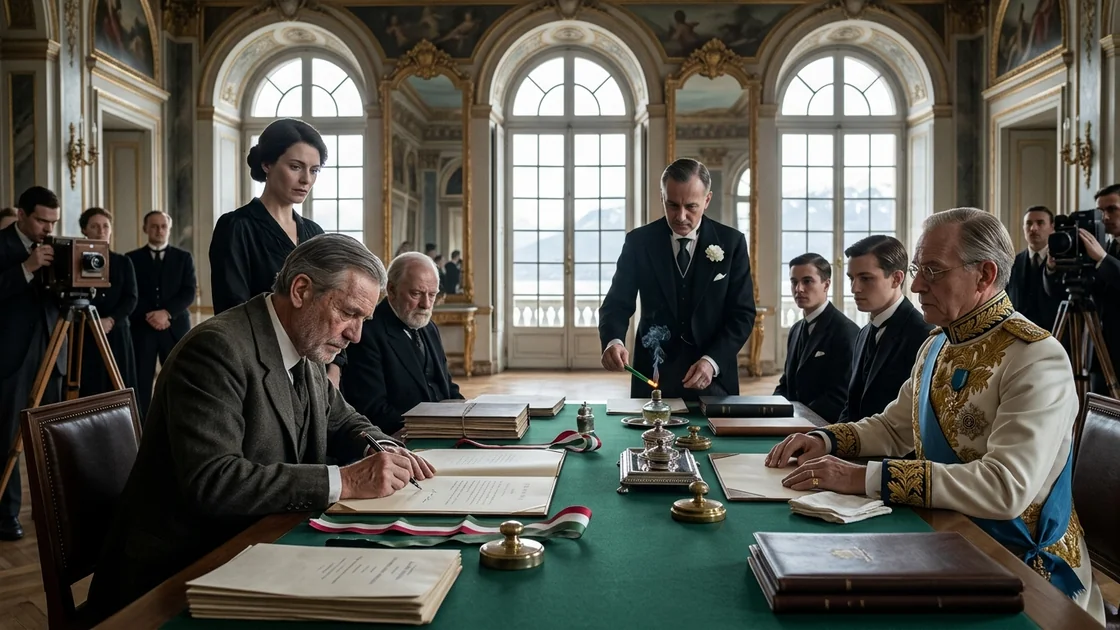
This is the story of Ambassador Julian Vane, a lifelong diplomat of the Republic of Oakhaven, who is sent to the neutral city of Geneva to negotiate the Treaty of the Sunken Pass with the expansionist Solaris Empire. With Oakhaven’s defenses broken and its capital surrounded, Julian is ordered by his provisional government to sign away his own ancestral homeland, the Cinder Valleys, in exchange for the survival of the core republic. Throughout seven agonizing days of technical cartography, linguistic manipulation, and cruel diplomatic pageantry, Julian battles the cold imperial envoy, Lord Malakor, while privately carrying the immense grief of condemning two million of his own people to permanent displacement, ultimately sacrificing his name and honor to buy them forty-eight extra hours to flee with their history intact.
I. The Cartography of Defeat
The parquet floor of the Galerie des Glaces in the Palais des Nations did not creak; it absorbed footsteps with the practiced discretion of a century of quiet betrayals. Julian Vane stood before the tall, arched window looking out over Lake Leman, where the winter fog hung like dirty wool over the grey water. Behind him, four young attachés in the charcoal livery of the Solaris Empire were unrolling a map across the mahogany table. The map was twelve feet long, printed on heavy linen backed with silk, and smelled faintly of linseed oil and the basement vaults of the Imperial War College.
Julian did not turn around when the brass weights clinked against the corners of the linen. He knew the map. He had grown up inside its lower-left quadrant, in the space where the cartographers used a muted sage green to indicate the terraced apple orchards and silver-mine tailings of the Cinder Valleys. By Friday, if he did his job with the skill forty years of foreign service had hammered into him, the sage green would be overlaid with the crosshatched crimson of the Solaris Third Administrative District.
"The light is poor on the western edge, Ambassador Vane," a voice said from the doorway.
Lord Vesper Malakor, Special Plenipotentiary of the Sun Throne, walked in without his cane—a deliberate point of pride after the leg wound he had taken thirty years ago during the annexation of the Salt Marches. Malakor was seventy, five years older than Julian, though the dry mountain air of the imperial capital had preserved him like cedarwood. His hair was cut so short his scalp showed through like pink slate, and his spectacles were rimmed in plain iron.
"The light in neutral cities is always poor, Malakor," Julian said, turning from the window. His left hand went instinctively to his waistcoat pocket, where he kept a small, dried walnut from the tree outside his sister’s house in High Oakhaven. The shell was worn smooth as river glass by his thumb. "It saves the hosts from having to look us in the eye while they sell us the mineral water."
Malakor offered a thin, professional smile that did not reach the pouches beneath his eyes. "They charge four francs a bottle for the carbonated. Even the Empire finds the Swiss extortionate. Shall we dispense with the credentials? My clerks examined your seals at nine. The Provisional Council’s wax is somewhat brittle this winter."
"Coal is rationed in the capital," Julian replied evenly, taking his seat at the middle of the long table. Behind him sat his only remaining staff: Clara Lind, a thirty-year-old specialist in agrarian law whose brother had died at the Battle of the Ford three weeks ago, and Arthur Pendelton, a seventy-year-old archivist whose hands shook so badly from palsy that he could no longer use a fountain pen and had been reduced to sharpened pencils. "We use pine resin in the tallow now. It holds the stamp well enough to give away five thousand square miles."
Malakor sat opposite him, folding his long, spotted hands on the linen right over the town of Veris, where Julian had been baptized. "Four thousand, eight hundred and twelve, according to our trigonometrical survey of nineteen-twelve. Your people always overestimated the acreage of the northern scree slopes. You cannot tax goats on a forty-degree incline, Julian."
"We didn't tax them," Julian said, looking down at the black ink line of the River Vyr running beneath Malakor’s left cuff. "We just let them graze."
"An inefficiency we shall shortly remedy," Malakor said, nodding to his chief clerk. "Let us begin with Article Four. The demarcation of the high-water mark along the eastern gorge. The Ministry of Hydrography insists upon the spring flood line of eighteen-ninety, not the mean autumn channel."
Clara Lind leaned forward, her pencil poised over a yellow pad. Her voice was slightly too loud in the vast room, brittle with the effort of sounding like a lawyer instead of a mourner. "The spring flood line of ninety includes the entirety of the lower meadowlands in the parish of Saint Jude. That is four hundred hectares of winter rye. Without the bottomland, the villages on the shelf above the gorge are economically non-viable before the evacuation window even closes."
Malakor did not look at Clara; he looked at Julian’s necktie. "The villages on the shelf above the gorge, Miss Lind, are within the twelve-mile security buffer stipulated in the Preliminary Armistice signed at Meriden. Whether they are economically viable in March is immaterial, as they will be uninhabited by April."
The word uninhabited hung in the tall room, rising toward the painted nymphs on the ceiling. It was a clean word. It had no smell of wet wool steaming on the backs of mules; it did not sound like an iron wheel rim striking a frost-heaved rut at three in the morning while a child coughed under a tarpaulin.
"The Armistice of Meriden," Julian said softly, "stipulated the military evacuation of the buffer zone and the transfer of civil sovereignty. It did not stipulate the immediate expropriation of private chattels and immovable agricultural fixtures without municipal arbitration."
"Read Paragraph Six of the Secret Annex, Julian," Malakor murmured. "The one your General Vance signed on the hood of an ambulance while my artillery was zeroing in on the waterworks. The term used is vacant possession. It is a term borrowed from your own municipal housing codes. When a tenant is evicted for non-payment, he does not leave his winter rye in the cellar and return in July with a scythe."
Julian felt the walnut in his pocket press against the palm of his hand. He had known General Vance for twenty years; Vance was a brave man who understood logistics and mortar trajectories, and who did not know the difference between sovereign cession and vacant possession in three-hundred-year-old treaty French. By signing the Secret Annex to stop the shelling of the capital’s typhus hospitals, the general had legally transformed two million citizens into trespassers on the soil where their grandfathers were buried.
"General Vance was under the impression," Julian said, his voice dropping half an octave into the register he had once used to lecturing undergraduate students at the University of Oakhaven, "that he was surrendering the fortifications and the tax rolls. If the Empire intends to clear the Cinder Valleys of their human population entirely before the spring thaw, you will have three hundred thousand people dying of exposure in the passes of the White Spine."
"Then I suggest," Malakor said, adjusting his iron spectacles, "that we spend the morning discussing the railway timetables of the White Spine, rather than the rye harvest of Saint Jude."
II. The Arithmetic of Baggage
At noon, the Swiss protocol officer brought in a tray of cold veal, pickled cucumbers, and hard rolls. The two delegations ate at opposite ends of the ante-chamber while snow began to tick against the tall windows like dry rice.
Arthur Pendelton sat by the radiator, trying to warm his translucent fingers against the cast iron. "In the Cession of eighty-four," the old archivist whispered to Julian, refusing the veal and nibbling only the crust of a roll, "when we lost the southern salt pans to the Kingdom of the Isles, we secured a nineteen-month transition period. People were allowed to sell their cottages to incoming settlers through a mixed tribunal in Antwerp. I was third clerk on the commission. It was very orderly. Even the orchard trees were valued individually—four shillings for a bearing pear, six for a walnut."
"The Kingdom of the Isles wanted taxpayers, Arthur," Julian said, pouring lukewarm coffee into a porcelain cup so thin he could see the shadow of his fingers through the side. "The Empire does not want Oakhaveners near the coal seams. They are bringing in thirty thousand miners from the steppes next month. They want the cottages empty so their foremen don't have to build barracks."
Clara Lind stood by the window, her back to the room. She was holding a telegram that had arrived through the legation cipher twenty minutes before. "My mother writes from Veris," she said, without turning. "The burgomaster has told the parish that you are here to arrange an autonomy statute. Like the Duchy of Saxe-Lowen. They think they’ll have to put the Sun Throne’s stamp on their cider barrels and let an imperial provost sit in the courthouse, and that will be the end of it. My mother has just paid the tiler twelve crowns to mend the slate over the dairy."
Julian looked down at his coffee. "Your mother shouldn't have listened to the burgomaster."
"He’s your cousin, Ambassador," Clara said, turning her pale, narrow face toward him. Her eyes were dry, bright with a fierce, helpless accusation that Julian had seen on the faces of everyone in the legation since he arrived from the capital on Tuesday. "It’s Thomas Vane. He told them at the market cross that Julian Vane would never sign a piece of paper that turned a Vane out of the valley where our great-uncle built the stone bridge."
"Thomas always had a gift for municipal politics," Julian said quietly. "It requires an ability to believe that the world beyond the tollgate operates by the same rules as the vestry committee."
"Can we not break off?" Clara asked, stepping closer to him, lowering her voice so the imperial clerks across the carpet wouldn't hear. "If we walk out of the Palais tonight—if you hold a press conference at the Hotel Beau-Rivage and read the Secret Annex to the correspondents from London and New York—the international outcry—"
"The correspondents from New York," Julian interrupted, "are currently writing three thousand words a day about the naval armaments conference in Washington. The correspondents from London are interested in our tungsten mines, which Malakor has already privately assured the British ambassador will remain open to City investment under imperial management. If I walk out of this room tonight, Clara, the armistice expires at dawn. Malakor’s third corps is parked four miles from the Oakhaven reservoir. By Thursday afternoon, the capital will have no water. By Saturday, it will be burning. And they will take the Cinder Valleys anyway, without railway timetables."
"Then why are we here?" she asked, her voice cracking on the last word. "Why didn't they just send a corporal with a rubber stamp?"
"Because the Empire wishes to float a reconstruction loan on the Amsterdam exchange in May," Julian said, setting his cup down without having drunk from it. "And the Dutch bankers are fastidious Calvinists who dislike lending money on the security of territory acquired without a properly notarized conveyance signed by a plenipotentiary of cabinet rank. I am the notary, Clara. My fee is the lives of the four hundred thousand people currently trapped inside the capital’s ring-road, plus whatever boxcars I can beg from Malakor to carry your mother’s blankets over the pass."
When they returned to the table at two o'clock, the map had been replaced by schedules of rolling stock.
"The Imperial State Railway can allocate twelve locomotives of the mountain class," Malakor read from a mimeographed sheet, his voice as level as a carpenter’s spirit level. "Each capable of hauling eighteen goods wagons over the three-percent grade at the Sunken Pass. Given the coal shortage on your side of the frontier, our engineers will operate the trains as far as the summit tunnel, where your crews will take possession. We calculate four departures per twenty-four-hour period."
Julian did the arithmetic in his head before Clara’s pencil had touched her pad. "Seventy-two wagons a day. At forty persons per wagon, that is less than three thousand souls a day. Over a fourteen-day evacuation window, that accounts for forty thousand people. The census of the Cinder Valleys is two million, one hundred thousand."
"The remainder have feet, Julian," Malakor said mildly. "And thirty-two thousand registered farm carts, according to the livestock returns your Ministry of Agriculture kindly surrendered to us at Meriden. The railway is intended for the infirm, the municipal archives, and persons of the first and second property classes."
"The road through the Sunken Pass is eighteen feet wide between the snowbanks in February," Julian said. "If you put thirty thousand farm carts on that road in a two-week period, the first broken axle at the Devil’s Elbow will back the column up for nineteen miles into the gorge. People will freeze in their traces before they reach the timberline."
"Then you must instruct your gendarmerie to strictly limit the weight of household effects per cart," Malakor replied. "When we relocated the population of the Fenland provinces in ninety-eight, we found that peasant delays were almost entirely caused by a sentimental attachment to cast-iron stoves and oak dressers. Limit each family to fifty kilograms of personal baggage per adult, prohibit livestock on the paved highway, and the column moves at three miles an hour."
"Prohibit livestock," Clara repeated, her knuckles white around her pencil. "Their cattle are their only capital. If they walk into the eastern provinces without their breeding stock, they are beggars for three generations."
"The Empire is prepared to purchase all horned cattle left in the stalls at a flat valuation of twelve marks per head," Malakor said, turning a page. "Payable in three-year treasury bonds of the Provisional Republic, which we will credit against the war indemnity stipulated in Article Nine."
Julian looked at the old man across the table. They had met for the first time in Vienna thirty-four years ago, when both were second secretaries at their respective embassies. They had shared a box at the opera once to hear Don Giovanni; Malakor had known the libretto by heart and had tapped his program gently against his knee during the supper scene.
"Twelve marks," Julian said, "is the price of a calf's hide in a bad year, Vesper. And crediting it against an indemnity we can never pay means my government has to print unbacked paper to reimburse the farmers, which will be worth less than the wallpaper in their kitchens by the time they reach the plain."
"It provides them with a receipt," Malakor said, looking over his spectacles at Julian. "My experience of administration, Julian, is that displaced populations are vastly more tractable during the march if they are carrying a stamped piece of paper with a number on it. It gives them something to keep dry inside their coats. Whether the paper buys a loaf of bread in April is a problem for your Ministry of the Interior, not for this boundary commission."
Julian leaned back in his chair. For a moment, the gilt mirrors of the room seemed to tilt inward, reflecting not the snow-light off the lake, but the kitchen of the house in Veris—the long pearwood table with the burn mark on the corner where his grandfather had set down a soldering iron in eighteen-sixty; the blue delft tiles around the hearth showing scenes from the Book of Ruth; the stone cellar that smelled forever of russet apples and damp flagstones. Under Malakor’s fifty-kilogram rule, his sister Margaret would have to choose between the family Bible—which weighed nine pounds because of the brass clasps and the twelve pages of births and deaths written in iron-gall ink at the front—and her winter woolens.
"Twenty-eight days," Julian said.
Malakor shook his head once. "Fourteen. My miners are already staged at the railhead in Krossen. Every day they sit in barracks costs the Ministry of Mines forty thousand marks in idle wages. Furthermore, our meteorologists tell us the thaw will begin in the lower valleys by the twentieth of March. Once the roads turn to mud, your carts won't move at all, and my sanitary corps will have to deal with typhus along the line of march. Fourteen days while the ground is still frozen hard enough to bear the wheels. It is a mercy, Julian. Mud kills more refugees than frost."
"Twenty-one days," Julian countered, his voice dropping to a dry rasp. "And the Empire provides four hundred tons of anthracite coal at the summit station so our locomotives can haul the empty cars back down the eastern slope without waiting for wood-cutters. And the valuation on dairy cows in calf is raised to forty marks, payable in Swiss francs directly to the parish reeves upon delivery of the herd to the imperial veterinary post."
Malakor stared at him for ten seconds. The only sound in the room was the dry scratching of Arthur Pendelton’s pencil as he tried to take down the figures with his trembling hand.
"Seventeen days," Malakor said finally. "Two hundred tons of brown lignite, not anthracite. And we will pay ten Swiss francs in silver per beast, for up to five thousand head of registered pedigree stock only; the rest go onto the indemnity ledger at twelve marks. If you argue for another five minutes, Julian, I will strike the silver altogether and we will move on to the surrender of the diocesan libraries."
Julian looked at Clara. Her eyes were fixed on the linen map, right where the little black cross of Saint Jude’s church sat beside the blue thread of the Vyr.
"Agreed on the seventeen days and the lignite," Julian said. "Make it eight thousand head on the silver schedule, and I will concede the spring flood line of eighteen-ninety at Saint Jude."
Clara flinched as if he had struck her across the mouth. The four hundred hectares of winter rye in her home parish vanished with the movement of Malakor’s fountain pen as he wrote 8,000 (Silver) in the margin of his sheet.
"Done," Malakor said. "Now, regarding the church bells. Our ordnance department claims them as potential bronze reserves under the disarmament clauses, unless you can prove they were cast prior to seventeen-hundred and therefore qualify as antiquities under the Hague convention."
III. The Night Cables
By nine o'clock that evening, the temperature in Geneva had dropped twelve degrees. The wind off the Jura mountains drove the fog away, leaving the sky black and hard as anthracite above the streetlights along the Quai du Mont-Blanc.
Julian walked back to the legation alone, having sent Clara and Arthur ahead in the hired Opel to save the petrol allowance. His knees ached—the wet cold of the lake basin always found the old cartilage injury from his mountaineering days—and he walked slowly, his hands buried deep in the pockets of his Astrakhan-collared coat. The coat itself was twenty years old, bought in St. Petersburg during his first ambassadorship; the fur at the cuffs was worn down to the grey hide, much like the Republic he represented.
Along the Grand-Rue, the shop windows were brightly lit. Watchmakers displayed gold chronometers on velvet pads; confectioners had built pyramids of marrons glacés and chocolate truffles wrapped in silver foil. Through the steamed glass of the Brasserie Lipp, Julian saw Swiss burghers in heavy tweed suits drinking blonde beer and reading the evening edition of the Journal de Genève. To them, the war in the east was a three-inch column on page four, sandwiched between the municipal tramway budget and an advertisement for liver salts. Border Rectification Talks Continue at Palais, the headline had read that morning.
Rectification. It was a surveyor's word. It meant taking a crooked fence line between two turnip fields and pulling the wire taut so both farmers could plow a straight furrow.
At the Oakhaven Legation—a narrow, four-story townhouse on a side street behind the Russian church, rented in happier days when the Republic’s main business in Geneva was the International Postal Union—the hall smelled of boiled cabbage and burned paper. The third secretary had spent the afternoon in the courtyard with an iron wash-tub, burning fifty years of commercial consular archives because they could no longer afford the rent on the basement storage rooms after the first of next month.
Julian climbed the stairs to the cipher room on the second floor. Clara was still there, sitting at a deal table under a green glass lampshade, her wool shawl pulled tight around her shoulders because the legation furnace was turned off at eight. A stack of decoded flimsies lay beside her elbow like dead white moths.
"The Prime Minister called on the trunk line from Zurich via the military relay," she said, not looking up as Julian unbuttoned his coat. "The line was very bad. There is sleet in the eastern cantons."
"What did Holst have to say?" Julian asked, picking up the top flimsy.
"He says the railway workers’ union in the capital has threatened a general strike if the terms of the treaty are published before the bread ration is restored to three hundred grams. He wants you to get Malakor to insert a clause guaranteeing thirty thousand tons of imperial grain deliveries before the ratification vote in the Assembly."
Julian let the tissue paper flutter back to the table. "Did you tell him Malakor is charging us ten francs a head for our own cows?"
"I told him," Clara said. She finally looked up at him. In the green light of the lamp, her face looked thirty years older, the skin drawn tight over her cheekbones. "He said that the cows belong to the valley provincials, whereas the bread ration is for the capital, and if the capital falls to a Bolshevik council before Sunday, there won't be a Republic left to ratify anything. He said to trade the timber rights in the Upper Vyr if necessary."
"The Upper Vyr is already inside the ceded zone," Julian said dryly. "Holst hasn't looked at a map since the ministry moved into the cellar of the Corn Exchange. You cannot trade away the apples on a tree after you’ve already sold the orchard."
"There was another message," she said, reaching into the pocket of her skirt. She pulled out a blue postal telegraph form—not a diplomatic cipher, just an ordinary commercial wire routed through the neutral post office in Basel before the frontier telegraph lines were cut at noon. "It came addressed to you personally. The clerk at the main post office recognized your name and sent a boy round with it."
Julian took the blue paper. It had been sent from the post office in Veris at eleven-fifteen that morning—probably the last batch of civilian traffic allowed over the wire before the imperial signal corps took over the exchange under the armistice terms.
JULIAN VANE LEGATION OAKHAVEN GENEVA. PARISH COUNCIL MET SAINT JUDES VESTRY THIS MORNING. IMPERIAL HULANS AT CROSSROADS SAY WE MUST CLEAR OUT BY FIFTH MARCH. THOMAS TOLD CAPTAIN YOU ARE IN GENEVA FIXING THE LINE AT THE OLD TOLLGATE LIKE EIGHTEEN SEVENTY. CAPTAIN LAUGHED. JULIAN DO NOT LET THEM TAKE THE VALLEY FLOOR WE HAVE SOWN THE WINTER WHEAT AND MARGARETS ARTHRITIS WILL NOT BEAR THE WAGON OVER THE SPINE. YOUR AFFECTCOUSIN THOMAS VANE BURGOMASTER.
Julian read it twice. He noticed that the telegraph clerk in Basel had misspelled affectionate to save characters, or perhaps Thomas had run out of copper coins at the counter in Veris. He could see the post office in Veris clearly: it was in the back of Widow Garside’s stationery shop, where the brass scales smelled of sealing wax and peppermint drops, and the telegraph key sat between stacks of twine and penny exercise books.
"Margaret is my sister," Julian said to the empty air between himself and the bookshelf. "She is sixty-eight. When she was twelve, she fell through the ice on the millpond and has walked with a stick ever since. She has forty hives of black mountain bees behind the currant bushes. You cannot move beehives in February, Clara. If you shake the combs when the cluster is dormant, they break formation and freeze to death in an hour."
Clara looked down at her hands. The anger that had kept her rigid all afternoon seemed to drain out of her, leaving only a grey exhaustion. "My mother has three hives by the wall," she whispered. "My father built the stands out of old cider-press timbers the year I was born."
Julian folded the blue telegram into a small square, then another, until it was the size of a postage stamp, and slipped it into his waistcoat pocket beside the walnut.
"Go to bed, Clara," he said gently. "Tomorrow we have the ecclesiastical and cemetery clauses. Malakor will try to claim the churchyard lead as roofing material for his barracks unless we have the parish registers dated before the Reformation."
"Does it matter?" she asked, her voice barely audible above the ticking of the radiator as it cooled. "If there is no one left in Veris to put flowers on the graves on All Souls’ Day, does it matter if the soldiers strip the lead off the lychgate?"
Julian stood over her for a moment, his hand resting on the back of her wooden chair. "In nineteen-fifteen," he said, "when I was minister in The Hague, I met an old man who was a scholar of the Peloponnesian War. He told me that when the Athenians evacuated Attica before the Spartan invasion, the people of the country demes didn't weep when they left their cornfields. They wept when they had to leave behind the little wooden shrines that stood by the crossroads, because a man can grow wheat in any dirt, but his gods only live where his father’s bones are in the clay. If we cannot leave the people in the valley, Clara, we must at least leave the stones upright. Someday—perhaps fifty years after you and I are in the Protestant cemetery here in Geneva—someone with our name might walk back down the Sunken Pass. They will need to know where the village was."
IV. The Price of Dead Men’s Bones
On Wednesday morning, Lord Malakor had a cold. He kept a large linen handkerchief steeped in eucalyptus oil beside his inkwell, and his voice had a wet, gravelly edge that made him less patient with diplomatic circumlocution.
"The Imperial Ministry of Cults and Public Instruction," Malakor read from a buff folder, blowing his nose once before turning the page, "cannot recognize the perpetual inviolability of municipal and parochial burial grounds within the Third Administrative District. In the townships of Veris, Ironbridge, and Lower Cinder, the geological survey indicates that the six-foot anthracite seam runs directly beneath the alluvial shelf occupied by the medieval settlements. Open-cast mining operations will commence in June. The cemeteries will be excavated by mechanical shovel."
Arthur Pendelton’s pencil snapped. The lead point rolled across the polished mahogany and stopped against the brass weight holding down the corner of the map.
"Mechanical shovel," Julian repeated. His voice was entirely colorless.
"We are prepared to be reasonable regarding the disposition of the remains," Malakor said, dabbing at his nostrils with the eucalyptus cloth. "Any family wishing to disinter their ancestors prior to the expiration of the seventeen-day evacuation period may do so at their own expense, provided they use hermetically pitch-sealed pine boxes approved by the sanitary inspector and transport said boxes as part of their fifty-kilogram personal baggage allowance."
"A full-grown man’s skeleton," Julian said, "together with a pitch-sealed pine box three-quarters of an inch thick, weighs thirty-eight kilograms, Vesper. You are asking a farmer’s son to dig his mother out of the frozen clay with a pickaxe and carry her coffin on his back over a seven-thousand-foot mountain pass instead of his winter oats."
"I am not asking him to do anything of the kind," Malakor replied briskly. "I am stating the sanitary regulations for those whose piety exceeds their common sense. For the remainder, the Imperial Construction Corps will collect all osteological material uncovered during the stripping of the overburden and deposit it in a common ossuary to be erected three miles south of the railhead at Krossen. We will even allow your bishop to send a priest to bless the pit before the concrete is poured."
Julian looked at the map. The town of Ironbridge was six miles down the river from Veris. Its churchyard stood on a bluff above the water, shaded by three immense yew trees that were already old when the first Republic was proclaimed in sixteen-forty. His mother’s people, the Haldanes, lay there in four neat rows under flat slabs of grey river slate. The frost in February went down twenty inches in that heavy loam; to dig up a grave took two men with iron crowbars and a brazier of charcoal to thaw the turf foot by foot.
"The Treaty of Utrecht," Julian said, leaning forward until his wrists rested on the linen map, "the Treaty of Paris, the Congress of Vienna, and the Treaty of Frankfurt in eighteen-seventy-one all contained explicit guarantees for the sanctity of civilian sepulchers in ceded territories. Even when Bismarck took Alsace, he did not turn steam-shovels into the village churchyards."
"Bismarck was not sitting on forty million tons of low-sulfur coking coal lay twelve feet under the turnips, Julian," Malakor snapped, his irritation finally breaking through his Mandarin veneer. "Be realistic. Your country fought a war of attrition for four years on borrowed money and lost. My country spent four hundred thousand young men breaking through your mountain forts, and our treasury is empty. The coal under Veris and Ironbridge is going to pay the pensions of four hundred thousand imperial widows. Do you think the Chancellor gives a damn about your great-grandfather’s shinbones when the steel mills in Essen are working three-day weeks for lack of coke?"
"Your Chancellor," Julian said, his eyes locked on Malakor’s iron-rimmed spectacles, "is currently negotiating with the Vatican for a concordat to stabilize the Catholic vote in your southern provinces. And the papal nuncio in Berne is an old friend of mine from my days in Madrid—Monsignor Pacelli’s understudy, a man with a very keen interest in canon law regarding the desecration of consecrated ground."
Malakor stopped with his handkerchief halfway to his face. His small, pale eyes narrowed behind the lenses.
"Oakhaven is a Protestant republic," Malakor said slowly. "Calvinist, mostly, of a particularly sour and litigious variety."
"Seventeen percent of the population in the Cinder Valleys are Old Catholics who never accepted the Reformation," Julian lied smoothly. In reality, there were perhaps four hundred Catholics in the entire province, mostly Italian stonemasons who had stayed behind after building the viaduct in ninety-two, and the churches had been stripped of their altars three centuries ago. "And more importantly, the ground in all thirty-two parishes was consecrated by the Bishops of Basel prior to fifteen-twenty-four. In the eyes of Rome, it remains terra sancta under interdict. If I walk over to the apostolic delegation in Berne this afternoon with a sworn deposition from my archivist here that the Solaris Empire intends to use steam-excavators on pre-Reformation graveyards to dig coal for Krupp’s furnaces, the Osservatore Romano will have it on the front page by Friday morning. Your Centre Party deputies in the Reichstag will walk out of the budget committee before lunch."
The silence in the Galerie des Glaces lasted for nearly a minute. Behind Malakor, the young chief clerk began to whisper urgently into his ear, flipping through the statistical appendix of the imperial survey to check the religious census of the Cinder Valleys. Malakor raised two fingers to silence the boy without taking his eyes off Julian.
He knew Julian was lying, or at least stretching a sixteenth-century legal technicality to the breaking point. And Julian knew that Malakor knew. It was a game of poker played with dead men's bones: would Malakor risk a three-week delay in the Reichstag while canon lawyers in Rome argued over sixteenth-century parish boundaries, just to save his mining engineers the trouble of sinking a diagonal shaft from outside the churchyard wall?
"The seam at Veris," Malakor said softly, "can be worked by gallery-and-pillar from the northern slope without disturbing the surface within three hundred yards of the parish church. Ironbridge is more difficult; the coal outcrops right under the vicarage garden."
"Then take the vicarage garden," Julian said, his heart hammering against his ribs with such violence he was afraid the watch-chain across his waistcoat would tremble. "Leave the yew trees and the walled enclosure of the burying ground. Four acres at Ironbridge, six at Veris, and the thirty smaller churchyards as marked on the cadastral survey of eighteen-eighty. Surrounded by a brick wall six feet high at imperial expense, with a right of access once a year on the first Sunday in November for a delegation of ten former parishioners under gendarmerie escort."
Malakor picked up his pen, dipped it into the crystal inkwell, and held it poised over the buff folder.
"If I fence off the churchyards," the imperial envoy said, "my engineers lose twelve percent of the surface access along the valley floor. They will have to build an extra four miles of narrow-gauge tramway along the river levee to haul the spoil. To build that tramway before the spring floods, they will need laborers. And my pioneer battalions are scheduled to demobilize on the tenth of March."
"You have thirty thousand steppe miners arriving on the trains," Julian said.
"Miners do not lay sleeper-ties in frozen mud, Julian; they are guild workers under contract. If you want your ancestors left in the dirt, I need four thousand able-bodied men from the Cinder Valleys to stay behind for sixty days after the general evacuation to grade the tramway bed along the Vyr."
Clara drew in her breath sharply. "Forced labor," she said. "That is slavery."
"Conscripted civil corvée at standard municipal day-wages," Malakor corrected her coldly. "Two marks fifty a day and an army ration of horsemeat and rye biscuit. On the tenth of May, they are put on goods wagons and shipped across the frontier at the Sunken Pass."
Julian looked down at his own hands. They were clean, white, manicured by the hotel barber on Monday morning. If he said yes, four thousand young men from the valleys—the ones who hadn't already lost a leg at the Ford or died of gangrene in the field hospitals—would spend March and April standing waist-deep in the icy slush of the River Vyr, driving iron spikes into oak sleepers under the rifles of imperial pioneers, watching the cottages they had grown up in being dynamited along the hillside to clear the overburden for the steam-shovels.
If he said no, the steam-shovels would go through the yew trees at Ironbridge in June, and his mother’s skull would be dumped out of an iron bucket into a lime-pit at Krossen alongside four hundred years of Haldanes and Vanes.
Which did a diplomat save? The living men’s backs for sixty days, or the dead men’s memory forever? If the graves were gone, the valley was wiped clean as a slate; within ten years, the imperial cartographers would rename Veris Neukrossen or Sonnenberg, and there would not be a single cut stone left between the river and the ridge to prove that anyone speaking the Oakhaven tongue had ever lived there.
"Not sixty days," Julian heard himself say. His voice sounded as if it were coming from the far end of the lake, across the water. "Thirty days. Two thousand men, volunteers only, to be selected by the parish reeves. And in exchange for the labor corvée, the evacuation window for the general population is extended by forty-eight hours—from seventeen days to nineteen."
Malakor’s pen hovered. He calculated the math of coal tonnage against the political nuisance of the papal nuncio in Berne.
"Forty-eight hours," Malakor murmured. "And if your parish reeves fail to produce two thousand volunteers by the fifth of March, my gendarmes take them by lot from the tail of the refugee column at the Sunken Pass."
"The reeves will find them," Julian said. He knew his people. If you told the men of Veris that staying behind for a month with a shovel would buy their mothers and wives two extra days to get the wagons over the ice at the Devil’s Elbow—and keep the soldiers from digging up the churchyard—every man between sixteen and fifty would step out of the ranks before the priest had finished reading the notice.
"Initial the margin, then," Malakor said, pushing the buff sheet across the mahogany.
Julian took his own pen—a heavy black Swan that his wife had given him on their twentieth anniversary, five years before the cancer took her—and wrote J.V. in the cramped space beside the paragraph on osteological material. His hand did not shake. He almost wished it would, like old Arthur’s; a shaking hand was at least a visible protest against what the fingers were doing.
V. The Delegation from the Valley
On Thursday afternoon, the snow stopped, replaced by a thaw wind from the south—the föhn—that turned the slush on the Geneva streets to the color of dishwater and gave everyone in the Palais des Nations a dull headache behind the eyes.
When Julian returned to the legation at six, having spent five hours arguing over the valuation of municipal gasworks and fire-engines (Malakor had insisted that the brass nozzles on the Veris volunteer fire-hose belonged to the state as war material), the third secretary met him at the front door with a frightened face.
"There are three men in the small drawing room, Excellency," the boy whispered, glancing nervously toward the closed double doors at the back of the hall. "They arrived on the afternoon train from Berne. I told them you were at the conference and could receive no one without an appointment from the Ministry, but the old one sat down on the coal-scuttle and said he wouldn't move until you came home, even if I called the Swiss police."
"How did they get across the frontier?" Julian asked, taking off his wet galoshes.
"Cattle drovers’ passes through the neutral zone at Schaffhausen, sir. They smelled of sheep-dip when they came in."
Julian walked down the hall and opened the drawing-room door.
The room was unheated, and the dust sheets were still over the sofa and the gilt chairs, because the legation hadn't given a reception since the summer of nineteen-eighteen. Standing by the empty grate were three men in heavy, greasy frieze coats that reached to their ankles. Their boots were caked with dried grey mud—not the limestone slush of Geneva, but the dark, gritty coal-shale mud of the Cinder Valleys.
The oldest of them was Thomas Vane, the burgomaster of Veris. He was seventy-two, seven years older than Julian, with a great bush of white whisker around his jaw and the broad, flattened thumb of a man who had worked his own cider-press for fifty autumns. Beside him stood young Matthew Haldane, the blacksmith from Ironbridge, whose left sleeve was pinned up empty to his shoulder—he had left the arm at the River Marne two winters ago—and Father Simeon, the frail, seventy-year-old pastor of Saint Jude’s, wearing his rusty black cassock tucked into farmer’s leggings.
"Julian," Thomas said. He didn't bow or use the title; when Julian was eight years old, Thomas had thrown him into the sheep-wash for leaving the pasture gate unlatched, and sixty years of grand crosses and privy councilor’s uniforms had never quite dried the water off Julian’s ears in his cousin’s eyes.
"Thomas," Julian said, closing the door behind him. He did not offer his hand; he knew that if he touched the rough frieze of his cousin’s sleeve, something inside his chest that had been held together by starch and protocol since Tuesday morning would give way entirely. "How did you get through the cordons at the pass?"
"Walked over the Goat’s Back by night with Matthew here," the old man said, his voice booming slightly in the small, bare room, though his breathing was wheezy at the bottom of his lungs. "The imperial sentries stay by their braziers on the main road when the sleet blows. We took the milk-train from the Swiss border down to Zurich and sold Matthew’s silver watch to a Jew near the station to pay the third-class fare here. You didn't answer my wire, Julian."
"The wires into the valley were cut by the Imperial Signal Corps at noon yesterday, Thomas," Julian said, pulling three dust sheets off the chairs and gesturing for them to sit. None of them did. Farmers in the Cinder Valleys only sat down in the presence of a gentleman when they were in church or dead, even if the gentleman was their cousin.
"They posted the placards on the town hall door at eight o'clock yesterday morning," Matthew Haldane said. The young smith’s single hand was knotted around the brim of his felt hat until the felt was crushed out of shape. "Printed in both tongues, with the Sun Eagle at the top. Seventeen days to clear the parish. Every soul out by the fifth of March. Fifty-pound sacks on the wagons, no pigs, no sheep, no iron tools except one axe per cart. My forge has three anvils, Mr. Vane. The big Peter Wright anvil weighs four hundredweight. My grandfather hauled it up from the river on an ox-sled in forty-nine. The captain of the Hulans—a littleperfumed dandy from the south—came into my yard yesterday with a piece of white chalk and wrote Imperial Ordnance Reserve across the horn of it."
"He had no right to do that until the treaty is signed tomorrow," Julian said automatically, the lawyer in him rising like bile before he could stop it. "Technically, private industrial implements—"
"Technically!" Thomas Vane spat the word onto the Turkey carpet. "Do you hear yourself, Julian? We walked forty miles over the ice with our boots tied up in binder-twine to tell you what they’re doing to our homes, and you talk to us like a clerk in the excise office! The people at the market cross yesterday wanted to ring the backwards-bell and go at the Hulans with hay-forks. It took me and Pastor Simeon three hours standing on the horse-block in the sleet to keep the boys from shooting the captain with birdshot from the loft of the smithy. I told them—I swore to them on Pastor’s Bible—that it was a bluff by the generals to make you sign over the mines. I told them Julian Vane was in Geneva with the English and the French behind him, and that by Sunday the soldiers would fall back to the old seventy-one stone by the tollgate."
Julian looked from Thomas’s wind-burned, furious face to the quiet, watery eyes of old Pastor Simeon.
"The English and the French are not in Geneva, Thomas," Julian said. He felt very cold, colder than he had been on the street. "The English ambassador in Berne wouldn't even see our chargé d'affaires on Monday. Our army has four days’ worth of rifle ammunition left in the magazines at Oakhaven, and half the guns on the eastern ridge have no breech-blocks because the steel was bad. There is no one behind me in that room at the Palais except Clara Lind and an old clerk who can't hold a pen."
"Then don't sign it!" Matthew Haldane cried out, taking a step forward, his empty sleeve swinging across his chest. "Let them come into the valley without your name on their paper! If they have to drive two million people out of their houses at the point of the bayonet, let the whole world see them do it like brigands! When you put the Republic’s seal on that treaty, Mr. Vane, you make us outlaws on our own land! The captain told us so—he said, Wait until Friday, your own ambassador is signing the eviction order in Geneva, and if you’re here on the sixth of March you’re bandits under your own law as well as ours!"
"If I don't sign it on Friday, Matthew," Julian said, his voice rising for the first time in four days, "at six o'clock on Saturday morning, twelve batteries of eleven-inch howitzers on the heights of Meriden will open fire on the tenements in the South Ward of Oakhaven! Do you know who is in the South Ward right now? Your sister Sarah’s husband’s regiment is quartered in the schools there, with three hundred men down with the spotted fever and no quinine! And sixty thousand women and children from the northern border who ran away when the lines broke in January are sleeping six to a room in the cellar of the textile mills! If I don't signaway the Cinder Valleys tomorrow afternoon, Malakor will turn the capital of this republic into a slaughterhouse before Sunday church, and on Monday morning his Hulans will still march into Ironbridge and take your anvil!"
The room went dead still. Outside in the narrow street, a milk-cart rattled past over the cobbles, the driver whistling a snippet of a French music-hall tune.
Thomas Vane’s shoulders seemed to drop two inches inside his heavy coat. He looked old—older than the mountains above Veris. He reached into his coat pocket and pulled out a small parcel wrapped in greased mutton-cloth and tied with hemp string.
"Margaret sent you this," Thomas said, his voice thick and dead. He laid it on the corner of the dust-sheeted table. "It’s a jar of the heather honey from the late comb in September. Before the frost came. She said to tell you she’s given the bees to the Swiss miller’s boy who came over the pass with the flour carts on Monday, so the soldiers wouldn't burn the skeps for firewood. She said to tell you she isn't coming over the pass."
Julian stared at the greasy parcel. "What do you mean, she isn't coming?"
"She went up to the garret on Tuesday night after the Hulans rode in," Pastor Simeon spoke for the first time, his voice like dry leaves blowing across a gravestone. "She took her big Bible and the brass candlestick that belonged to your mother, Julian, and she lay down on the flock bed under the eaves and turned her face to the rafters. Dr. Miller went up to see her yesterday morning before we left. Her heart is very weak, you know, since the pleurisy last winter. He says if we put her in a springless cart and haul her up into the thin air at seven thousand feet in a February gale, she will die before we pass the second milestone above the gorge. And Margaret says that if she has to die between Tuesday and Friday, she will die under the slate roof her grandfather nailed on, and go into the ground beside your father at Saint Jude’s before the fifth of March."
Julian reached out and touched the mutton-cloth. The glass inside was still cold from the luggage rack of the third-class carriage.
"I bought you forty-eight extra hours," Julian whispered, looking down at the hemp knot. "You have until the seventh of March now. Not the fifth. And I saved the churchyard at Saint Jude’s, Simeon. And the one at Ironbridge. They have to build a brick wall around them. They aren't allowed to touch the graves with the steam-shovels."
Matthew Haldane looked at him with an expression that Julian knew he would see on the inside of his eyelids until the hour of his own death. It was not hatred; it was a vast, bottomless pity mingled with disgust, the look a man gives a dog that has been run over by a cart and is still trying to lick the wheel.
"Two thousand of us have to dig their coal-tramway for a month to pay for that wall," the one-armed smith said quietly. "Wait till the boys in Veris hear that on Sunday. You traded two thousand live men into the chain-gang for thirty days so your sister could have a brick fence around her grave."
"I will be one of the two thousand, Matthew," Pastor Simeon said gently, laying a veined hand on the young man’s good arm. "And you have only one arm, so the reeve won't call your name. Come along. The train back to Berne leaves at eight, and if we miss the milk-cart at Schaffhausen tomorrow night, we’ll never get back over the Goat’s Back before the thaw brings the avalanches down."
Thomas Vane turned toward the door without another word. When his hand was on the brass knob, he stopped and looked back over his shoulder at Julian.
"When you were a boy, Julian," the old man said, "and went off to the college in the city with your Latin books, your father told me at the sheep-shearing that it was a grand thing to have a Vane in the government, because the city lawyers would never be able to cheat the valley folk over the water-rights again. I’m glad the old man is under the sod at Saint Jude’s. Even with the brick wall around him, I think he’d turn over on his face if he knew it was your hand that wrote the deed."
The door clicked shut. A moment later, the heavy street door slammed, and Julian heard their hobnailed boots scraping across the wet pavement toward the tram-stop at the corner of the rue de la Croix-d’Or.
He stood alone in the cold drawing room for a long time. Then he picked up his pocket-knife, cut the hemp string on the parcel, and unwrapped the mutton-cloth. It was an ordinary half-pound preserve jar with a chipped rim, sealed with beeswax over brown paper. Inside, the dark amber honey was beginning to crystallize around the edges from the cold of the mountain pass, holding tiny, suspended air bubbles that had been trapped when the bees capped the cells in the warm September sun behind the currant bushes in Veris.
VI. The Protocol of Signature
Friday, the twentieth of February, dawned clear and blindingly bright. The föhn had blown itself out during the night, and the fresh snow on the Savoy Alps across the lake gleamed like newly minted silver against a sky of hard, porcelain blue.
When Julian arrived at the Palais des Nations at ten o'clock, the building had undergone a subtle transformation. The Swiss guards at the porte-cochère were wearing their dress white gloves and cocked hats. In the vestibule, three photographers from the French and German illustrated weeklies were setting up magnesium flash-pans on wooden tripods, smoking cheap cigarettes and joking with the janitors in patois.
Inside the Galerie des Glaces, the twelve-foot linen map had been removed. In its place, the long mahogany table was covered in green baize, freshly brushed. At the center stood two massive silver inkstands borrowed from the Canton of Geneva, flanked by four sheaves of heavy cream vellum bound with wide ribbons of scarlet and white silk—the colors of the Solaris Empire—and narrow, faded threads of forest green for the Republic of Oakhaven.
Behind the table stood a representative of the Swiss Federal Political Department in a morning coat with a white carnation in his lapel, looking like an undertaker who had been hired for a wedding by mistake.
"Everything is engrossed and collated, Ambassador Vane," the Swiss official murmured, bowing slightly as Julian took off his overcoat. "The French text is the authoritative version in case of divergence, as agreed at six o'clock last evening. We had six calligraphers from the university working until four this morning on the Annex of Parish Boundaries. If your archivist wishes to verify the cadastral numbers before the seals are heated—"
"We verified the carbons at midnight, Monsieur," Clara Lind said from behind Julian. She was wearing a black silk dress—mourning for her brother, or for the valley, Julian did not know—and her hair was pinned back so tightly it pulled at the corners of her eyes. "The numbers are correct."
Lord Malakor entered from the eastern anteroom three minutes later. He had abandoned his tweed working suit for the full diplomatic uniform of the Sun Throne: a high-collared tunic of white broadcloth heavy with gold oak-leaf embroidery across the chest, the blue riband of the Order of the Dawn slanting from his right shoulder to his hip, and a small ceremonial court-sword with a mother-of-pearl grip hanging at his left thigh. His cold seemed better, though the skin beneath his iron spectacles had the yellowish cast of old tallow.
He walked over to Julian before taking his place at the table, drawing Julian two paces aside toward the tall window where they had stood on Monday morning.
"My telegraph clerks intercepted a military police report from the frontier post at Schaffhausen at five o'clock this morning," Malakor said in a low, conversational tone, looking out at a white paddle-steamer cutting across the blue water of the lake toward Evian. "Three peasants from the Veris district were arrested by my border guards at two a.m. while attempting to cross the gorge above the railway tunnel on foot. An old man named Vane, a one-armed blacksmith, and a Protestant pastor."
Julian’s fingers closed around the walnut and the folded telegram in his pocket. He did not turn his head from the window. "Are they alive?"
"Oh, yes," Malakor said lightly. "My guards are regulars from the Seventh Jägers, not irregulars. They don't shoot unarmed old men in the dark unless they run. They are currently in the guardhouse at the Krossen railhead. Naturally, crossing a military cordon during an armistice without an imperial pass is espionage under martial law. The provost-marshal wanted to convene a drumhead court at eight."
Julian turned his head slowly and looked down into Malakor’s pale eyes. "If you shoot my cousin and a seventy-year-old clergyman on the morning of the treaty signing, Vesper, I will take that silver inkstand over there and smash it through that mirror, and you can explain to the bankers in Amsterdam why the plenipotentiary of Oakhaven had to be carried out of the Palais des Nations in a straitjacket without signing your conveyance."
Malakor’s mouth twitched—the ghost of the smile he had worn in the opera box in Vienna thirty-four years ago.
"I told the provost-marshal by wire at six-thirty," Malakor murmured, "that they were members of your technical agricultural advisory panel who had lost their way in the fog while inspecting the livestock routes. They will be put on the first lignite train up to the Sunken Pass tomorrow morning and handed over to your gendarmes. However, the old man—your cousin—apparently struck a corporal in the teeth when they searched his coat and broke a jar of honey he was carrying."
"No," Julian said softly. "He gave the honey to me last night. Whatever he had in his pocket was probably a stone from his orchard wall."
"A rock from a pasture wall," Malakor said, shaking his head slightly as he turned back toward the green baize table. "You people are extraordinary, Julian. Truly. We are going to spend the next fifty years trying to digest you, and I have no doubt it will give the Empire dyspepsia. Shall we sit? The photographers have another appointment at eleven with the International Red Cross."
They took their seats opposite each other. The Swiss official signaled to the clerk at the door, and the three photographers shuffled in, setting their tripods ten feet back from the table.
"Gentlemen," the Swiss official intoned, clearing his throat, "in the name of the Federal Council, I invite the Plenipotentiaries of the Solaris Empire and the Republic of Oakhaven to affix their signatures and seals to the Treaty of Peace and Frontier Rectification concluded at Geneva this twentieth day of February, nineteen hundred and twenty."
A clerk in black knee-breeches stepped forward and laid the first copy of the treaty open before Lord Malakor. The vellum was stiff and made a dry, crackling sound—like frost breaking under a boot heel—as the pages were turned to the last leaf.
Malakor did not use the ceremonial silver pen provided by the canton. He unscrewed his own gold-nibbed Pelikan, leaned forward with his gold-embroidered cuff held back by his left hand, and wrote Vesper von Malakor in a small, upright, gothic script. The clerk held a stick of scarlet wax over a spirit lamp; the smell of burning shellac and turpentine drifted across the green baize, sharp and medicinal. Malakor pressed his heavy signet ring into the red puddle and leaned back.
The clerk lifted the heavy leather portfolio, walked around the end of the table, and laid it down in front of Julian.
Julian looked down at the page.
Above the space left for his name was the last paragraph of Article Twenty-Two: Done in duplicate at Geneva, the High Contracting Parties declaring that upon the exchange of ratifications, all prior claims, titles, charters, and municipal franchises within the ceded territories enumerated in Annex A shall be and remain forever extinguished.
Forever extinguished.
In his mind’s eye, Julian did not see the map anymore. The map was a lie of sage-green ink and trigonometrical triangles. He saw the water-meadows below Saint Jude’s on an April morning when the cuckoo-pint was coming up through the ditch-grass; he saw the grey stone bridge at Veris with the iron ring leaded into the parapet where the drovers tied their bullocks while they drank a pint of small beer at the Three Tuns; he saw the little garret room under the slate roof where his sister Margaret was lying at this exact moment, listening to the iron-shod hooves of the imperial Hulans clattering down the high street toward the river, waiting for her heart to stop before the fifth of March so she wouldn't have to see the strangers plowing up the winter wheat.
Behind him, he heard Arthur Pendelton let out a long, shuddering breath that ended in a dry sob the old man muffled against his sleeve. Clara Lind did not make a sound; she stood as still as the marble busts in the corridor outside.
"Ambassador Vane?" the Swiss official whispered gently, glancing at his gold pocket-watch.
Julian reached into his breast pocket and took out the black Swan fountain pen his wife had given him. He unscrewed the cap.
If he signed his name, the history books of the Republic—if the Republic survived in its truncated, beggarly remnant on the eastern plain—would record him forever in a single sentence: The Cinder Valleys were surrendered by the Vane-Malakor Treaty of 1920. Schoolchildren fifty years hence, memorizing the list of national humiliations for their civil service exams, would associate the name Vane not with the stone bridge his great-uncle built, nor with the thirty years Julian had spent keeping the great powers from swallowing them earlier, but with the week the mountains were given away. In the refugee camps that were already springing up around the railway sidings outside the capital, mothers whose children died of croup in the unheated boxcars at the Sunken Pass would curse the name of Julian Vane when they boiled their weeds in tin cans.
And nobody in those boxcars would ever know that the extra forty-eight hours that allowed their wagon to clear the Devil’s Elbow before the blizzard had been bought by Julian Vane at two o'clock on Wednesday afternoon in exchange for four hundred hectares of winter rye and a lie about the Pope. That was the nature of the trade. A soldier died on a parapet in the mud, and they cast his name in bronze on the market cross; a diplomat died in a gilded room in a neutral city, and they used his name to frighten children.
Julian touched the gold nib to the heavy cream vellum, half an inch below Vesper von Malakor.
The ink flowed out, dark blue-black, sinking instantly into the calfskin. Julian Haldane Vane. Every letter was clear, round, and legible—the handwriting of an old-fashioned first-class clerk in the Foreign Ministry who had been taught that an illegible dispatch was a breach of manners.
The clerk brought the spirit lamp around the table. He held the stick of forest-green wax into the blue flame. As required by the instructions from the capital, the wax had been mixed with cheap pine resin; it sputtered and popped, letting off a thin curl of black, oily smoke that smelled suddenly, piercingly, of the pine woods above the Sunken Pass when the charcoal-burners lit their kilns in the autumn.
A drop of green wax fell onto the silk ribbon beside Julian’s name. Julian took the heavy brass seal of the Republic from the table and pressed it down with both hands, leaning his weight onto his wrists until the hot wax oozed up around the bevel of the die.
boom.
The magnesium flash went off with a white, blinding sheet of light and a puff of grey, sulfurous smoke that rolled up toward the ceiling nymphs.
Malakor stood up, hooked his thumbs into his white uniform belt to settle the crease, and extended his right hand across the green baize for the second photograph.
Julian did not look at the hand. He picked up the blotter, laid it carefully over his signature, pressed it once, and then screwed the cap back onto his fountain pen.
"The livestock silver," Julian said, looking directly at the lens of the middle camera while the photographer changed his glass plate, "is to be delivered to the Swiss National Bank branch in Berne by noon tomorrow, Lord Malakor. My secretary will be there with the veterinary receipts from the northern parishes. If the silver is one franc short, I have instructed our engineers at the Sunken Pass to blow the roof of the summit tunnel onto your twelve mountain locomotives before they cross the ridge."
Malakor slowly lowered his unshaken hand to the table. The photographers, sensing that the second pose would not be forthcoming, began to pack their black cloths into their leather cases with embarrassed haste.
"The silver is already in the vault at Berne, Julian," Malakor said quietly. "Goodbye. If you decide not to return to Oakhaven—and if I were you, given the temper of your newspapers this morning, I would not—the University of Heidelberg still has a vacant chair in International Law. A word from me to the Minister of Education in Baden—"
"I have a house to close up in the capital, Vesper," Julian said, turning away from the table and reaching for his worn Astrakhan coat. "And two thousand men coming over the pass on the tenth of May who will need someone at the station to see that the Ministry of the Interior pays them for their cows."
VII. The Sunken Pass
Nine days later, on the twenty-ninth of February—it was a leap year, an extra day of winter tacked onto the calendar like a codicil to a bad will—Julian stood on the wooden platform of the customs shed at the Sunken Pass.
They were seven thousand two hundred feet above the sea. Around them, the peaks of the White Spine rose like broken teeth into a sky the color of lead. The wind coming up the gorge from the west did not blow steadily; it came in great, slamming gusts that drove dry snow crystals sideways through the cracks in the plank walls of the shed and made the telegraph wires along the railway embankment hum like cello strings.
Inside the shed, Clara Lind sat on an upturned ammunition crate behind a deal table, wrapped in two horse-blankets, stamping yellow indemnity vouchers with a purple ink-pad that had to be kept over a kerosene lantern to keep the glycerine from freezing solid.
Outside on the eighteen-foot road, the column was moving.
It had been moving for six days and six nights without a gap of more than ten yards between the tailboard of one cart and the nose of the mule behind it. Because of Malakor’s rule against livestock on the highway, there were no oxen; the carts were drawn by old farm horses whose ribs showed through their winter coats like barrel-staves, or else by the men and women themselves—four or five to a shaft, leaning forward at a forty-five-degree angle against ropes looped across their chests, their boots wrapped in sacking to keep a purchase on the glazed ice of the ruts.
They made almost no sound. That was what struck Julian most as he stood by the frontier barrier with his hands in the pockets of his Petersburg coat. There was no shouting, no cracking of whips, no singing. Only the endless, rhythmic crunch-squeak, crunch-squeak of iron-shod wheels grinding into hard-packed snow, the dry rasping of thousands of lungs fighting the thin mountain air, and the occasional metallic clatter when a bundle of spades or a copper wash-boiler slipped against the side of a handcart.
Each cart was a miniature, desperate summary of a household reduced to fifty kilograms per head: a feather-bed tied over two sacks of seed-potatoes; a wooden cradle lashed to the axle-tree with a three-year-old child sitting inside it under a sheepskin; an oil portrait of a grandfather in an eighteen-sixty militia uniform sticking out of a barrel of salt pork.
Every twenty minutes, the ground under the customs shed shook as one of the twelve imperial mountain locomotives came grinding up the three-percent grade from the valley below, its smokestack belching thick, greasy black smoke from the brown lignite Julian had bargained for in Geneva. The goods wagons behind the tender were packed so tightly with old women and infants that white frost formed on the outside of the sliding doors from their breath Inside. At the summit switch, where a platoon of Oakhaven soldiers in ragged grey greatcoats stood around a bonfire of broken railway sleepers, the imperial engine uncoupled, whistled twice—a sharp, mocking hoot that echoed off the cliffs—and rolled back down the western slope toward the Cinder Valleys to fetch another load.
Julian had been at the pass since Wednesday. Prime Minister Holst had ordered him to remain in Berne to negotiate a commercial modus vivendi with the Swiss, which was Holst’s polite way of saying that the Provisional Government did not want the man who had signed the Treaty of Geneva showing his face in the capital before the elections. Julian had ignored the cable, drawn the last four hundred francs of the legation’s contingency fund, and taken the mountain train up to the eastern railhead.
He wasn't there as an ambassador. The Oakhaven major in command of the summit post barely saluted him when he arrived; the soldiers around the sleeper-fire looked at his fur collar with sullen, bloodshot eyes and spat into the snow when he walked past. He was there because nobody from the Ministry of the Interior had come up from the plain to organize the soup-coppers or check the tallies on the pedigree cattle trains, and if someone with cabinet rank didn't bully the railway stationmaster at the bottom of the eastern grade into sending up empty coal-cars, the people coming off the road would pile up in the snowdrifts around the customs shed and die before morning.
At three o'clock in the afternoon, when the grey light was already beginning to thicken toward the long mountain night, a single horse-drawn sleigh belonging to the Veris parish council came creaking up out of the gorge at the tail of a long string of handcarts from Ironbridge.
Thomas Vane was walking at the horse’s head, leading it by the bit because the mare was blind in one eye and shied at the drop-off along the outer edge of the road. His left cheek was purple and swollen where the imperial corporal had hit him with a rifle-butt at Schaffhausen, and his frieze coat was white to the knees with frozen rime.
Walking behind the sleigh was Matthew Haldane, using his single arm to steady the back runner over the ice-heaves, and four boys from Veris who weren't yet sixteen and therefore hadn't been kept behind for the tramway corvée.
There were no sacks of oats or feather-beds on the parish sleigh. Lashed lengthwise down the middle of the plank bed was a long, narrow box made of unplaned pine boards—not the pitch-sealed sanitary coffin of Malakor’s Article Twelve, just three apple-packing crates knocked apart and nailed back together with horseshoe nails.
Thomas saw Julian standing by the striped frontier pole. The old man didn't stop; if you stopped a horse on the six-percent pitch fifty yards below the summit, the runners froze to the ice in thirty seconds and you could never get the beast to start the load again. He kept walking until the mare’s steaming nostrils were past the customs shed and onto the flat snow of the Republic’s side of the watershed.
"Whoa, Bess," Thomas croaked, leaning his forehead against the mare’s wet neck for a moment to catch his wind.
Julian walked over through the trampled brown slush. He took off his fur hat and held it against his coat.
"She went on Thursday night, Julian," Thomas said without looking up from the buckle of the hame-strap. "Just after the boys got back from telling them you’d signed. Quiet as a mouse when the candle goes out. Pastor Simeon read the service over her in the kitchen on Friday morning before they locked the church doors."
Julian looked down at the rough pine boards. Somebody—one of the neighbor women, probably—had tucked a small sprig of dried boxwood from the garden hedge under the hemp rope that held the lid down.
"Why didn't you leave her at Saint Jude’s, Thomas?" Julian asked softly, the wind tearing the words from his lips and carrying them away toward the eastern plain. "I told you. The churchyard is safe. The wall—"
"She’s a Vane," Thomas said, finally raising his swollen, wind-raw face to look at his cousin. His eyes were red-rimmed from six days of wood-smoke and snow-glare, but they were quite clear. "We talked it over at the well before we harnessed up on Saturday morning. Pastor Simeon stayed behind with the two thousand boys on the river—he said they’d need a minister when the typhus starts in the mud-camps next month—and he told us a brick wall in the middle of a coal-pit isn't a parish, Julian. It’s just a prison for dead folk. Where the parish goes, the Vanes go. Even the dead ones. We took the floorboards up in the dairy to make the box, and we left the seed-barley in the barn so the mare could pull her weight."
Matthew Haldane came around the back of the sleigh, his breath coming in great white plumes. He looked at Julian’s bare head in the freezing wind, then down at the ambassador’s boots, which were soaked through with slush from four days of standing by the cattle-pens.
"The reeve at Lower Cinder told us as we came through," the one-armed smith said gruffly, looking away toward the railway siding where Clara Lind was arguing with an engine-driver over a manifest, "that the imperial veterinary officer at the tunnel paid out four thousand silver francs for the valley heifers on Monday morning. Real Swiss five-franc pieces. Enough to buy seed-corn when we get down to the flatland. And the Hulans let the tail of our column through the gorge this morning even though the seventeen days were up on Saturday night. The captain said you’d squeezed two more days out of the old fox in Geneva."
"Forty-eight hours," Julian said.
"Aye," Matthew said. Without those two days, Mr. Vane, the three hundred carts behind us from Upper Saint Jude’s would still be down at the Devil’s Elbow tonight, and the pioneers are dynamiting the rock-overhang at midnight to close the road. My brother’s wife and her three little ones are in the last cart."
The young smith hesitated, then reached out with his single, calloused hand and touched the sleeve of Julian’s coat—not a handshake, just a brief, heavy brush of the knuckles against the wet wool, the way one teamster signals to another in the dark that the trace-chain is hooked. Then he spat into the snow and went forward to help Thomas grease the sleigh-runners for the five-mile descent to the eastern railhead.
"Are you coming down to the plain with us, Julian?" Thomas asked, straightening up with the grease-horn in his mitt. "We’re going to try and get land near the river at New Veris, if the government bastards in the capital haven't sold it all to the speculators. You’ve got no house in the valley now; the captain of the Hulans moved his horses into your parlor on Sunday afternoon."
Julian looked back down the road into the gorge. Through the swirling grey curtains of the snow-squall, he could still see the dark, crawling thread of the column winding up out of the abyss—another mile of carts, another three thousand people dragging their cradles and their grandfathers’ portraits up out of the sage-green square on Malakor’s map before the telegraph clock inside the shed struck midnight and the frontier barrier came down forever.
Behind them, seven miles down in the dark below the clouds, the electric arc-lamps of the Imperial Construction Corps were probably already being strung along the banks of the Vyr so the steam-shovels could begin stripping the turf off the winter rye at dawn.
"I’ll come down on the last train after midnight, Thomas," Julian said, putting his hat back on and reaching into his pocket to touch the smooth walnut and the little glass jar of heather honey. "Go on ahead and find a dry barn for Margaret. I have to stay here until twelve to sign the receipt for the locomotives."