The House the Pines Built
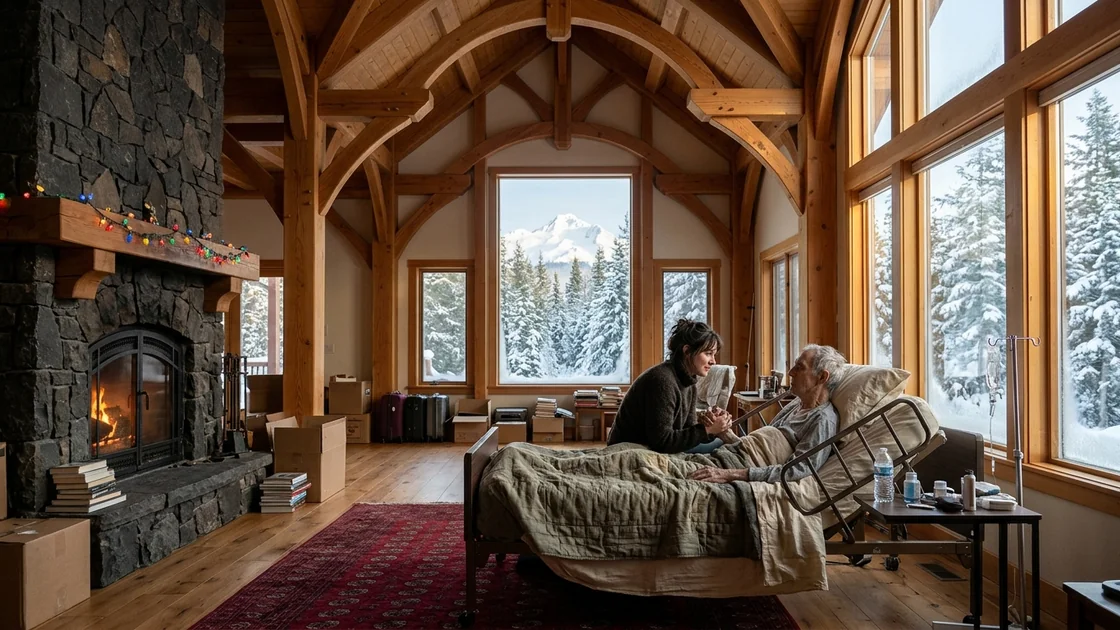
Arthur Pendelton spent forty years saving every spare penny to build a custom timber-frame sanctuary deep within the Oregon wilderness, a quiet monument to his lifelong dream of solitude and peace. However, the very week the final inspection was signed and the smell of fresh cedar still hung heavy in the mountain air, a persistent cough led to a diagnosis of stage four pancreatic cancer. With only months left to live, Arthur retreated into the pristine, empty rooms of the house he built for a future that would never arrive, forced to reckon with the bitter irony of his labor. Through the changing of the final autumn leaves into the brutal isolation of winter, he discovered that the home was not meant to be his monument, but rather a vessel of healing for the estranged family he had neglected while chasing his solitary dream.
The brass key felt heavier than it had any right to be. It sat in the center of Arthur’s calloused palm, catching the pale, slanted light of an October Tuesday in the Cascades. Beside him on the passenger seat of his aging pickup truck lay two envelopes.
The first envelope was thick, cream-colored, and bore the embossed seal of the county building department. Inside was the Certificate of Occupancy—the final, legal blessing that transformed thirty-two acres of raw, forested land and three hundred thousand board feet of Douglas fir and western red cedar into a home. It was the culmination of forty-two years of skipping vacations, driving rusted sedans until their frames snapped, eating lukewarm soup from tin cans under the fluorescent lights of the drafting office, and watching the world go by through a rain-streaked window in Portland.
The second envelope was standard white bond, thin and sharp-edged, bearing the sterile blue logo of St. Jude’s Oncology Center. It was unopened, though Arthur already knew what it contained. He had sat in the leather chair across from Dr. Aris three hours ago. He had watched the younger man’s mouth move, forming words like adenocarcinoma, metastatic, inoperable, and palliative.
Arthur closed his fingers around the brass key until the teeth bit into his skin. He stepped out of the truck.
The air here, at four thousand feet, tasted of damp pine needles, woodsmoke, and the coming snow. It was a sharp, clean contrast to the antiseptic recycling of the hospital’s climate control. Before him stood the house.
Even now, with the cold weight of a death sentence settling into the marrow of his bones, the sight of it took his breath away. He had designed it himself, over decades of late nights at his drafting table. It did not sit upon the land so much as it grew out of it. The foundation was built from massive slabs of local basalt, mortared so deeply into the granite ridge that it looked like a natural outcropping. Above the stone rose the timber frame—great, sweeping arches of golden fir joined not with nails or steel plates, but with traditional mortise and tenon, pinned together by hand-carved oak pegs. A wall of triple-paned glass faced west, looking out over a plummeting valley of old-growth hemlock toward the distant, jagged tooth of Mount Jefferson.
He had built a fortress against time, only to find the enemy was already inside the gates.
Arthur walked up the wide stone steps. His boots made a hollow, lonely sound against the fresh cedar decking of the wraparound porch. He fitted the key into the heavy iron lock of the front door—a slab of reclaimed walnut he had salvaged from a demolished barn in the Willamette Valley ten years ago—and turned it. The bolt slid back with a well-oiled, satisfying click.
He pushed the door open and stepped into the great room.
Silence greeted him. Not the dead silence of an empty city apartment, which was always underscored by the hum of refrigerators, distant sirens, and the muffled footsteps of neighbors, but a vast, resonant quiet. The house smelled intensely of raw wood, linseed oil, and the faint, chalky scent of newly cured plaster. Dust motes danced in the amber shafts of afternoon sunlight that pierced the high clerestory windows.
"I'm home," Arthur whispered.
His voice rose into the vaulted ceiling, thirty feet above, bouncing off the massive king-post trusses before dying away into the corners. There was no furniture to absorb the sound. No rugs on the wide-plank oak floors, no curtains on the windows, no pictures on the walls. He had liquidated his last money market account in August to pay the masonry crew for the sixty-foot chimney that dominated the north wall. His plan—the great, foolish plan—had been to spend the winter living simply on a cot, building his own furniture piece by piece in the basement workshop with his pension checks.
A sudden, violent spasm seized his chest. Arthur doubled over, bracing a hand against the smooth, cool stone of the hearth, and coughed. It was a wet, tearing rattle that seemed to scrape the very lining of his ribs. When it passed, he stayed bent for a long moment, his forehead pressed against the basalt, listening to the ragged whistle of his own breathing.
A drop of bright red blood speckled the gray stone between his feet.
"Six months," Dr. Aris had said, his eyes full of practiced, professional pity. "Maybe eight, if you respond well to the palliative chemo. It will buy you time, Arthur, though it won't be easy time."
"And if I don't?" Arthur had asked, his voice remarkably steady. "If I just walk out of here and go up the mountain?"
Dr. Aris had sighed, removing his wire-rimmed glasses and rubbing the bridge of his nose. "Three. Perhaps four. The pain will become significant toward the end. You'll need hospice care. You can't be alone up there in the woods."
Arthur straightened up slowly, wiping his mouth with the back of a flannel sleeve. He looked around the vast, empty room. You can't be alone up there. The irony was so sharp he almost laughed. Being alone up here was the entire point. It was the North Star by which he had navigated his entire adult life. Every sacrifice, every broken relationship, every missed birthday had been justified by the vision of this room, this silence, this absolute sovereignty over his own existence.
He walked back out to the truck, his legs feeling like they were filled with wet sand, and began to unload his life. It didn't take long. A military-surplus canvas cot. A heavy down sleeping bag rated for twenty below. A cast-iron skillet, a Dutch oven, a tin percolator, and a wooden crate filled with dry goods—oats, rice, canned beans, coffee, and three bottles of twenty-year-old single malt Scotch he had been saving for the housewarming party of one.
In the bed of the truck, beneath a tarp, were his tools. Those took longer. His chest of Japanese chisels, his hand planes, his saws, and the heavy cast-iron lathe he had inherited from his father. He couldn't lift the lathe anymore; the tumor pressing against his spine and organs had robbed him of the wiry strength he had possessed just six months ago, back when he was still helping the framers hoist the rafters. He left the lathe in the truck. He wouldn't be turning any table legs this winter.
By the time he had set up the cot in the center of the great room, facing the massive western windows, the sun was dipping below the jagged line of the mountains. The sky turned the color of a fresh bruise—deep purple bleeding into crimson, then fading to a cold, starry indigo.
Without furniture, the house felt like a museum of an extinct civilization. Arthur knelt before the hearth and built a fire. He used scraps of kiln-dried cedar left behind by the trim carpenters. They caught instantly, the flames leaping up with a greedy crackle, throwing long, dancing shadows across the bare floors. He pulled his sleeping bag around his shoulders and sat on the edge of the cot, pouring three fingers of the Scotch into a tin camp mug.
The whiskey burned going down, a warm tether to the physical world. He raised the mug toward the dark glass of the windows, where his own gaunt reflection stared back at him, superimposed over the black silhouettes of the pines.
"To the mortgage-free life," he said to the ghost in the glass.
He slept poorly that first night. The house was still settling, adjusting to the weight of its own existence and the drop in temperature. Every hour, a timber would contract with a sound like a pistol shot, echoing through the hollow rooms. In the dark, with the fire reduced to a bed of pulsing red coals, Arthur lay awake and felt the thing inside him.
Before today, it had just been an ache—a dull, persistent pressure behind his stomach that he had chalked up to sixty-five years of bad posture, cheap food, and the stress of managing subcontractors who never showed up on time. Now that it had a name, it had a personality. It felt like a cold stone with roots, slowly wrapping itself around his vitals, drinking the warmth from his blood.
When dawn broke, it came with a thick, weeping mountain fog that pressed right up against the triple-paned glass, erasing the valley and the mountain beyond. The house was an island floating in a sea of gray milk.
Arthur rose, his joints stiff, and made coffee on the hearth, setting the percolator directly onto a flat stone he raked into the embers. For the first time in forty-two years, he had nothing to do.
There were no blueprints to draw. There was no site supervisor to argue with over the grade of the gravel in the driveway. There were no bank statements to balance, no overtime shifts to pick up at the architectural firm. The house was finished. Every outlet worked. Every faucet ran clear, cold well water heated by a state-of-the-art geothermal system buried twelve feet beneath the meadow out back. The pantry was framed and shelved, waiting for food he would never eat. The master bedroom upstairs had a balcony designed for watching the Perseid meteor showers in August—a month he would never see again.
He spent the morning walking from room to room, running his hands over the woodwork. He had insisted on clear- vertical-grain fir for all the trim, free of knots, finished only with tung oil so the wood could breathe. His fingers traced the seamlessly mitered corners of the window casings. His mind, trained for decades to spot flaws, searched desperately for something to fix. A gap in the baseboard. A sticky hinge. A drip under the sink.
There was nothing. The builders he had hired—a crew of Mennonite craftsmen from down in the valley—had respected his obsession and matched it with their own. The house was perfect.
By noon, the perfection was driving him mad.
He went down into the basement. The concrete floor was smooth and cool. Along the north wall sat the massive geothermal unit, humming so quietly he had to put his hand on the green metal casing to feel it working. The rest of the two-thousand-square-foot space was empty, save for the boxes of books and old personal effects he had hauled up from his storage unit in Portland the week before.
He hadn't opened those boxes in twenty years. When Sandra had left him—taking ten-year-old Clara with her—he had packed up the remnants of their shared life in a tiny, cramped rental house in Sellwood, shoved them into a ten-by-ten locker, and moved into a studio apartment the size of a prison cell so he could double his monthly land payments.
Arthur pulled a folding chair up to the nearest cardboard box. The tape was yellowed and brittle; it snapped under the pressure of his thumbnail.
On top lay a stack of blueprints—early, rejected drafts of the house. He tossed them aside. Beneath them was a tangled mass of extension cords, an old brass desk lamp, and then, wrapped in faded tissue paper, a cedar cigar box.
He lifted the box onto his knees. He didn't need to open it to know what was inside, yet his fingers trembled as he flicked the little brass latch.
Photographs. Hundreds of them, unsorted, spanning the late eighties and nineties.
On top was a picture of Sandra at Cannon Beach. She was wearing an oversized cable-knit sweater, her dark hair whipping across her face in the coastal wind, laughing at whoever was holding the camera. Arthur remembered that day. He had been reluctant to go because the gas for the drive cost fifteen dollars, and he had spent half the afternoon calculating the square-footage cost of copper roofing on a napkin in a clam chowder shack while she walked the tide pools alone.
Beneath Sandra was Clara. Clara at three, gap-toothed and covered in blackberry juice. Clara at six, holding up a poorly painted birdhouse he had helped her nail together from scrap pine. Clara at nine, her eyes already growing distant and guarded, sitting on the porch of the Sellwood house while in the background, through the window, you could see the back of Arthur’s head, bent over his drafting table.
“You’re building a tomb, Arthur,” Sandra had said the night she told him she was filing for divorce. She hadn't even been angry anymore; the anger had burned itself out years prior, leaving behind a cold, flat exhaustion. “You’re sacrificing our lives for a pile of lumber in the woods. By the time you build it, there won’t be anyone left to live in it with you.”
“It’s an investment,” he had argued, his voice tight and defensive. “It’s for us. A place that’s truly ours, where no landlord can raise the rent, where we can have peace.”
“I don’t want peace in thirty years, Arthur. I want a husband today. Clara wants a father who comes to her soccer games instead of working Saturday shifts to pay for imported German window hardware.”
He had let them go. That was the sin that sat right beside the tumor in his belly, nearly indistinguishable in its weight. He had watched the taillights of Sandra’s station wagon disappear down the rainy street, and after a week of numb, terrifying grief, he had simply turned back to the drafting table. He had used the pain as fuel. If he didn't build the house now, then losing them would have meant nothing. The house had to be built, because the house had cost him everything.
Now, sitting on the cold concrete of the basement, he did the math. He was good at math.
Forty-two years of labor. One marriage. One daughter, who was now thirty-two years old and lived somewhere in Chicago, last he had heard—a woman who hadn't answered his stiff, awkward Christmas cards since she graduated college. All of it traded for ninety days in an empty timber frame.
The cost per day was astronomical.
A wave of nausea rolled through him, so sudden and violent he barely made it to the utility sink in the corner before he vomited up the black coffee and Scotch. He hung over the fiberglass basin, sweating through his flannel shirt despite the chill, his knuckles white on the rim. When he finally raised his head and looked into the small mirror mounted above the faucets, he didn't recognize the man staring back. His skin had a faint, waxy yellow cast beneath his weathered tan—jaundice, the doctor had warned him, as the bile ducts became compressed. His eyes were sunken, ringed with dark bruises of exhaustion.
He wasn't going to make it to spring.
The realization didn't bring panic; it brought a strange, sharp clarity. The fog outside was beginning to lift, shredded by a rising wind from the west. Arthur climbed the basement stairs, each step an effort that left him panting, and walked out onto the porch.
Three miles down the gravel road lived his nearest neighbor, a man named Miller who ran a small sawmill and had supplied the rough-sawn cedar for Arthur’s siding. Miller was a man of few words who respected privacy, which was why Arthur liked him.
Arthur got into his truck and drove down the mountain.
Miller’s yard was a chaotic sprawl of rusted logging equipment, towering stacks of drying lumber, and the constant, high-pitched scream of a circular saw. The air was thick with the sweet, heavy snow of sawdust. Arthur parked by the diesel tanks and waited until the saw whined down to a stop.
Miller walked out from under the tin roof of the mill shed, slapping sawdust from his heavy canvas apron. He was fifty, built like an engine block, with a beard the color of iron filings. He took one look at Arthur leaning against the fender of the Ford and his expression shifted from neighborly neutrality to sharp concern.
"Jesus, Art," Miller said, pulling off his ear protection. "You look like you got pulled through a knot-hole. The builders give you the final bill?"
"Paid it last week," Arthur said, offering a weak smile. He reached into the bed of his truck and patted the heavy tarp covering the cast-iron lathe. "You got a forklift handy, Tom? I brought something for you."
Miller frowned, walking over and lifting a corner of the tarp. He whistled low when he saw the green painted iron of the vintage Oliver lathe, along with the stacked oak chests of hand tools. "That's your father's rig. And your Japanese steel. You told me last month you were gonna build a dining table twelve feet long."
"Plans changed," Arthur said. "I want you to have them. You’ll use them. Better than them rusting in my basement."
Miller let the tarp drop. He didn't look at the tools; he looked at Arthur’s yellow-tinged eyes and the way the older man was holding his left arm pressed tight against his ribs. Up here in the woods, people didn't ask polite, dancing questions. They dealt in timber, rock, and weather—things that couldn't be lied to.
"How bad?" Miller asked quietly.
"Pancreas," Arthur said. The word felt grotesque in the bright mountain air. "Spread to the liver. Couple of months."
Miller looked away, toward the ridge where the peak of Arthur’s new roof was just visible above the tree line, gleaming like fresh copper in the afternoon sun. He spat into the sawdust and cursed softly under his breath. "You just finished it. My boys were talking about that stonework at dinner last night. Said there wasn't another house like it in three counties."
"It's a good house," Arthur agreed.
"You got family coming up?"
"No."
"Art, the snow's gonna fly in three weeks. Once the pass closes, that road of yours is drift-city. If you go down up there, nobody's gonna know until the thaw in May."
"I bought a snowblower," Arthur lied. He hadn't. "And I've got the generator and five hundred gallons of propane buried. Look, Tom... I'm not asking for a nursemaid. Take the tools. In exchange, maybe once a week, you drive up to the gate. If there's a red rag tied to the mailbox, I need groceries or fuel. If there's a white rag..." Arthur paused, looking at the sawdust on his boots. "If there's a white rag, call the sheriff. Don't come in yourself. Just call the county."
Miller stared at him for a long time. The wind rattled the tin roof of the shed. Finally, the big man nodded once, a sharp, angry jerk of his chin. "I don't want the tools for free. I'll bring you a cord of seasoned oak tomorrow for that fireplace of yours, and I'll plow your drive whether you want me to or not. You got a phone up there?"
"Cell service works if I stand on the west porch."
"Keep it charged," Miller growled, turning back toward his forklift. "I'll get the chains and pull this iron off your truck."
When Arthur drove back up the mountain, the truck felt lighter, floating over the washboard gravel. Giving away the tools had felt like cutting a rope that was dragging an anchor. Without the tools, the pretense that he was going to furnish the house was gone.
That evening, he sat on his cot and pulled out his cell phone. He scrolled to a number he had programmed in five years ago, obtained from his sister-in-law before she, too, had drifted out of his orbit.
Clara.
His thumb hovered over the green call button for twenty minutes while the fire popped and settled. What did you say to a daughter you hadn't spoken to in a decade? Hello, I traded your childhood for a house, and now I'm dying in it, would you like the keys? It sounded like a bad country song, or worse, a manipulative plea for absolution. He didn't deserve absolution. Sandra had been right about everything.
Instead of calling, he went to the kitchen, tore a piece of brown butcher paper off the roll he’d used to cover the floors during painting, and found a carpenter’s pencil. He sat on the floor, using a drywall bucket as a desk, and wrote a will. It was three sentences long. He left the truck and five thousand dollars to Tom Miller. He left the house and the thirty-two acres to Clara Pendelton.
He taped the paper to the fridge, right next to the Certificate of Occupancy.
November arrived like a wolf.
The first storm came off the Pacific on the fifth of the month, slamming into the Cascades with howling seventy-mile-an-hour winds that drove the rain sideways. Inside the house, it was a masterclass in engineering. Arthur stood with his nose an inch from the great western glass, watching ancient hemlocks bend like fishing rods in the gale, while inside, the candle he had lit on the kitchen island didn't even flicker. The triple-paned windows and two-foot-thick insulated walls turned the fury of the storm into a distant, low-frequency rumble, like a train passing miles away.
The house held.
Arthur, however, was beginning to buckle.
The pain had graduated from a dull ache to a sharp, grinding persistence that woke him at two in the morning, regular as clockwork. He had a bottle of oxycodone Dr. Aris had prescribed, which he kept on the windowsill. For the first two weeks, he refused to touch it. He wanted his mind clear. He wanted to experience the house he had paid so dearly for.
To pass the time, he began to live in each room, one day at a time, as if he were a ghost haunting his own future.
On Monday, he moved his cot into the upstairs master suite. He lay under the vaulted ceiling of tongue-and-groove cedar and watched the snow begin to mix with the rain, sticking to the pine needles outside the balcony doors. He imagined what it would have been like if Sandra were here. She would have hated the minimalism; she would have piled the bed with too many pillows, hung dried herbs from the rafters, and complained that the bathroom floor was cold—whereupon he would have triumphantly shown her the radiant floor heating thermostat. He turned the thermostat up to eighty degrees just to feel the slate tiles warm beneath his bare, swollen feet, then sat on the edge of the empty soaking tub and wept for twenty minutes because there was no one to show it to.
On Wednesday, he lived in the library—a small, octagonal room off the main hall with built-in walnut bookshelves that reached twelve feet high. He unpacked his four boxes of books from the basement, carrying them up three books at a time because lifting a full box made his vision swim with black spots. When he was done, the books filled less than two shelves on the bottom left corner. The rest of the room was a grid of empty wooden squares.
On Friday, he took the first pill.
The pain had spiked while he was trying to split kindling on the back porch. The hatchet had slipped from his sweat-slicked fingers, burying itself in the chopping block an inch from his boot, while a white-hot band of iron tightened around his midsection, driving him to his knees in the slush. He crawled back inside, dragging himself over the walnut threshold like a gut-shot animal, and dry-swallowed two of the small white tablets.
Twenty minutes later, the iron band loosened. In its place came a warm, cottony fog that wrapped around his brain, blunting the sharp edges of the timber frame and turning the afternoon light into a syrupy gold.
He lay on the oak floor by the door, staring up at the joinery of the entryway. From this angle, he noticed something he had missed during the final walk-through. High up on the main crossbeam, near the mortise joint where the oak peg had been driven through, one of the Mennonite carpenters had carved a tiny symbol into the fir—no bigger than a silver dollar. It was a dove, stylized and simple, carrying an olive branch. A traditional builder's mark, a silent blessing hidden where only someone looking up from the floor would ever see it.
Peace, the dove said.
Arthur closed his eyes and let the opiates take him.
When he woke, it was dark, and someone was pounding on the heavy front door.
Arthur groaned, rolling onto his side. The fire had gone out hours ago, though the geothermal system kept the ambient temperature at a steady sixty-eight. The pounding came again, accompanied by the muffled shout of Tom Miller’s voice.
"Art! Dammit, Art, open up before I kick this thousand-dollar door in!"
Arthur pulled himself up, using the doorknob for leverage, and threw the deadbolt.
Miller stood on the porch, covered in snow, holding a cardboard box in his arms. Behind him, the headlights of his heavy-duty pickup cut twin tunnels through a swirling blizzard. A foot of fresh powder already blanketed the porch railings.
"You didn't put a rag out," Miller said, pushing past him into the hall without waiting for an invitation. He kicked the snow off his boots onto Arthur’s pristine oak floor—a gesture that, a month ago, would have made Arthur wince, though now he couldn't bring himself to care. "It's Friday. You said Friday."
"I fell asleep," Arthur mumbled, rubbing his face. "Floor was warm."
Miller set the box down on the kitchen island. It was filled with canned stew, a loaf of his wife’s sourdough bread, a carton of eggs, and a mason jar of dark amber honey. He turned and looked at Arthur under the recessed LED lights of the kitchen.
In the two weeks since they had last seen each other, Arthur had lost twenty pounds. His flannel shirt hung off his collarbones like a coat on a wire hanger. The yellow in his eyes was unmistakable now, bright as winter squash.
Miller didn't say anything about how he looked. Instead, he walked over to the great hearth, knelt down, and began rebuilding the fire with practiced, efficient movements, using the seasoned oak he had stacked on the porch the week before.
"Storm's gonna drop three feet by tomorrow noon," Miller said to the fireplace, striking a match. The dry oak bark caught with a hiss. "County's pulling the plows off the high road tonight. I'll keep the private grade open with the tractor as long as the hydraulics hold out, but if the big drift forms at the switchback, it'll take me a couple days to dig through."
"You don't have to do that, Tom."
Miller stood up, dusting his knees, and looked around the massive, empty room. His eyes lingered on the lone canvas cot sitting in the middle of the floor like a life raft in the middle of the ocean.
"My wife wants you to come down and stay in our spare room," Miller said bluntly. "Sarah used to be an RN over in Bend before we bought the mill. She knows what's coming, Art. She says you got no business being up here."
"I spent forty years getting up here, Tom," Arthur said softly, leaning against the kitchen island. "I'm not leaving while I can still breathe the air."
Miller’s jaw worked beneath his beard. He walked over to the refrigerator, where the piece of butcher paper was taped. He read the three sentences of the will, his lips moving silently. When he finished, he tapped a thick, grease-stained finger against Clara’s name.
"She know?"
"No."
"You're a stubborn bastard, Art. And a fool." Miller pulled a pen from his shirt pocket and scribbled a ten-digit number at the bottom of the butcher paper, right beneath Clara’s name. "That's my landline. When it gets too bad, you call me. Don't wait for Friday, and don't bother with the damn rags. I'll come get you on the snowmobile if I have to."
After the rumble of Miller’s truck faded down the mountain, swallowed by the muffling blanket of the blizzard, Arthur ate a slice of the sourdough bread with honey. It was the first thing he had tasted in days that didn't taste like ashes and metal.
He walked back over to the fridge and looked at Clara’s name.
The oxycodone had lowered his defenses, stripping away the proud, stoic armor he had worn for so long. In the quiet hum of the snowstorm, the emptiness of the house was no longer peaceful; it was accusatory. Every square foot of unblemished cedar seemed to shout at him. For what? For what?
He picked up his phone, walked over to the west glass where the signal was strongest, and dialed her number.
It rang four times. He was just about to hang up, his heart hammering a frantic, erratic rhythm against his ribs, when the line clicked.
"Hello?"
It was Sandra’s voice. Except it wasn't; it was younger, sharper, backed by the ambient noise of clinking silverware and laughter—a restaurant, two thousand miles away in another time zone.
"Clara?" Arthur’s voice came out as a dry croak.
The background noise seemed to recede as if she had pressed a hand over her other ear. "Who is this?"
"It's your father."
Silence stretched across the continent. He could hear her breathing, and then the muffled sound of doors opening and closing, the restaurant noise fading entirely as she stepped outside into the Chicago cold.
"Arthur?" she said. Not Dad. She hadn't called him Dad since she was fourteen. "What's wrong? Is it Mom?"
"No, no, your mother is fine, as far as I know," he said quickly, bracing his hand against the cold glass of the window. Snow was piling up on the sill outside,inch by inch. "I'm sorry to bother you at dinner. I forgot about the time change."
"It's nine o'clock here," she said, her voice guarded, tight as a snare drum. "You haven't called me in six years, Arthur. Why are you calling now?"
He looked behind him, at the towering stone fireplace, the gleaming oak floors, the dove carved into the beam. He had rehearsed a dozen speeches in his head over the years—grand apologies, explanations of his philosophy, offers to fly her out once the house was done so she could finally see and understand why he had been the way he was.
None of them came to his lips.
"I finished the house," he said simply.
On the other end of the line, Clara let out a short, bitter laugh that broke his heart more thoroughly than any screaming match ever could have. "Congratulations. Is that it? You called to gloat? Tell me it was all worth it?"
"No," Arthur whispered. A tear, hot and sudden, spilled over his lower lid and tracked through the stubble on his cheek. "No, Clara. It wasn't worth it. It's just wood and rock. I was wrong. About all of it. I just... I wanted to hear your voice. And I wanted to tell you that I'm sorry."
The silence returned, heavier this time. In the distance, a Chicago siren wailed and faded.
"Are you drinking?" she asked, though the hardness in her voice had faltered slightly, replaced by a wary confusion. "You don't sound right."
"I'm not drinking. Well, not tonight." A spasm of pain gripped his side, stealing his breath. He bit his lip until he tasted copper to keep from groaning into the receiver. "I put the deed in your name, Clara. Everything is paid for. There are no taxes owed until next November. When... when the time comes, a man named Tom Miller will call you. You can sell it. It should fetch enough to pay off whatever loans you have, buy a place of your own in the city."
"Arthur, what are you talking about? When the time comes? Are you sick?"
"I have to go," he managed to say, his vision narrowing to a grey tunnel as the pain crested. "You were the best thing I ever made, Clara. Not this place. You. Remember that."
He ended the call before she could answer, his fingers going slack. The phone dropped to the oak floor, sliding several feet before stopping against the base of the cot. Arthur sank to his knees by the window, curling onto his side as the storm raged outside, burying the mountain, the road, and the house in a deep, immaculate white.
The phone rang forty-seven times over the next two days.
Arthur didn't answer it. He couldn't have reached it for the first twenty-four hours anyway; the attack that followed his call to Clara had left him bedridden, drifting in and out of a sweat-soaked delirium on the cot. When he finally regained enough strength to crawl to the kitchen for water and another dose of pills, the battery on the phone had died.
He didn't plug it in. He had said what needed to be said. If he talked to her again, he would break, and he would beg her to come, and he refused to let her final memory of him be the task of changing his sheets and watching him wither into a skeleton in the woods. Let her remember him as the stubborn old bastard who built a castle and left her the keys.
Thanksgiving came and went without his noticing. Time lost its linear structure, measured instead by the burning down of oak logs and the four-hour intervals between white pills.
His world shrank.
In October, his world had been thirty-two acres of forest. In early November, it had been the four thousand square feet of the house. By the first week of December, his world was a twenty-foot radius around the great room fireplace.
The upstairs was too far; the stairs might as well have been the north face of Everest. The basement was a forgotten country. He pulled the cot right up to the stone hearth, using the wooden crates of dry goods as a makeshift windbreak, though there was no wind inside—only the vast, cold emptiness of the high ceilings that seemed to press down on him when the fire burned low.
He stopped eating solid food around the tenth of December. His body simply rejected it; the tumor had grown large enough that he could feel it with his fingers when he pressed on his abdomen—a hard, immovable mass beneath the papery skin. He lived on tea sweetened with massive spoonfuls of Sarah Miller’s honey, and the occasional sip of the twenty-year-old Scotch, which no longer burned, only warmed the back of his throat.
In his lucid hours, when the oxycodone and the natural endorphins of a dying body struck a brief, miraculous balance, he watched the light.
He had designed the house around the winter solstice, calculating the exact angle of the sun at the forty-fourth parallel so that during the darkest weeks of the year, the low southern light would penetrate deep into the great room, warming the thermal mass of the stone floor and the hearth.
It worked brilliantly. On clear days, when the storm clouds parted to reveal a sky of piercing, cobalt blue above the blinding white snowfields, the house became a sundial. A great wedge of golden light would enter through the southeast corner at nine in the morning, creeping across the wide oak planks at the speed of an hour hand, climbing the basalt chimney at noon, and finally dying in a blaze of violet and rose against the western beams at four-thirty.
Arthur would lie on his cot and let the sunbeam pass over him. When the light hit his face, he would close his eyes and pretend he was nine years old again, lying in the grass behind his father’s workshop in Eugene, listening to the buzz of cicadas and the rhythmic shhh-shhh of his father’s hand plane curling ribbons of sweet-smelling pine onto the dirt.
“Measure twice, cut once, Artie,” his father’s voice would echo in the warm dark behind his eyelids. “Wood remembers how it grew. You can’t force it to be something it ain’t. You gotta work with the grain.”
"I went against the grain, Dad," Arthur whispered to the empty room, his voice no louder than the settling ash in the grate. "I forced it all."
On the eighteenth of December, another storm rolled in, darker and heavier than the last. The temperature plummeted to ten below zero. Even with the geothermal system running at maximum capacity and the fire burning through the last of the oak Miller had stacked inside the door, the sheer volume of glass on the western wall began to radiate a deep, penetrating chill.
Arthur didn't have the strength to go out to the porch for more wood. The logs might as well have been made of lead. When the last of the indoor stack burned down to gray fluff, he wrapped himself in the sleeping bag, pulled his wool coat over his head, and waited for the cold to finish what the cancer had started.
It wasn't a bad way to go, he thought. The pain was mostly gone now, replaced by a vast, floating detachment. His breathing was shallow—three quick breaths, then a long pause of ten seconds where the house was utterly silent, then a ragged gasp as his brainstem remembered its duty. Cheyne-Stokes breathing. He had read about it on the internet before he threw his laptop in the dumpster in Portland. The body shutting down the peripheral systems, conserving the last drops of fuel for the heart and the brain.
Outside, through the frosted lower panes of the glass, he heard a sound that didn't belong to the wind.
A low, throaty rumble, accompanied by the rhythmic clatter of steel chains biting into packed ice.
Tom, Arthur thought dimly. Stupid bastard is gonna get his tractor stuck on the switchback.
He wanted to get up and unlock the door, or at least wave from the window so Miller wouldn't break the walnut slab down, but his limbs were no longer taking orders from his brain. They belonged to the cot now.
Headlights swept across the vaulted ceiling—not the high, yellow beams of Miller’s tractor, followed a moment later by the sharper, bluish glare of a second set of lights. An engine died. Doors slammed.
There were voices on the porch. Miller’s deep bass, rumbling like distant thunder, and then another voice—higher, urgent, breathless from the altitude and the cold.
The lock clicked. Arthur had forgotten to throw the deadbolt the last time Miller had left. The heavy walnut door swung open, letting in a swirl of dry, glittering snow and a blast of sub-zero air that smelled of pine and diesel exhaust.
"Art!" Miller’s boots thundered across the oak floor.
Behind him, someone gasped.
Arthur forced his heavy eyelids open a crack. The room was dim, lit only by the gray twilight filtering through the snow-caked windows and the beam of Miller’s heavy flashlight.
Miller knelt beside the cot, his cold, rough hand pressing against the side of Arthur’s neck to find the pulse. "He's here," Miller called out, his voice tight. "He's ice cold. Help me get this fire going, quick!"
Miller moved to the hearth, throwing kindling and logs onto the cold ashes with frantic speed.
A second figure stepped into the circle of dim light by the cot. She was wearing a heavy down parka encrusted with snow, a knit cap pulled low over dark, wind-tangled hair. She dropped to her knees on the bare floor, pulling off thick leather mittens with her teeth, and reached into the sleeping bag to take Arthur’s withered, yellow hand between both of hers.
Her hands were warm. Impossibly, wonderfully warm.
"Dad?" she whispered.
Arthur blinked, trying to clear the cloudy film from his eyes. "Sandra?" he murmured, confused by the way the twilight caught the curve of her cheek.
"No, Dad. It's Clara." A tear splashed onto the back of his knuckles. She pressed his hand against her face, her skin damp and hot against his freezing fingers. "I'm here. You stubborn, crazy old man, I'm here."
"Chicago," he breathed, each word costing him a monumental effort. "You're in... Chicago."
"I was," she said, her voice breaking into a wet laugh that was half-sob. "Until you called me and dropped a bomb and turned off your phone. It took me two weeks to track down which county you bought land in. I had to call every sawmill within fifty miles of Mount Jefferson until I found Tom."
Beside the hearth, a sudden roar of flame leaped up as Miller doused the oak logs in kerosene from a camp stove bottle and tossed a match. Brilliant orange light flooded the corner of the great room, pushing back the gray shadows and throwing the massive timber trusses into sharp relief.
In the firelight, Arthur saw her clearly for the first time in twelve years. She wasn't a little girl anymore, and she wasn't the angry, distant college graduate from the last photograph he owned. She was a woman, with fine lines at the corners of her eyes and his own stubborn chin.
Behind her, piled by the front door, were four suitcases, a stack of cardboard boxes, and two bulky rolls that looked suspiciously like rugs.
"What..." Arthur’s eyes shifted from the boxes back to her face. "What did you bring?"
"My stuff," Clara said fiercely, wiping her nose with the back of her coat sleeve. "I took a leave of absence from the firm. I sublet my apartment. If you think I'm going to let you die alone on an army cot in a four-thousand-square-foot house, you don't know me at all."
Miller stood up from the fire, the heat already beginning to radiate out into the room. "I got the generator running on the backup circuit to boost the heat," the big man said quietly, looking down at Clara. "And Sarah's coming up behind me on the snowcat with a hospital bed and oxygen tanks from the clinic in Sisters. Should be here in an hour."
"No hospital," Arthur wheezed, a flash of his old panic gripping him. He tried to pull his hand away, tried to sit up. "Clara... don't take me down the mountain."
Clara didn't let go of his hand. She leaned in closer, her dark eyes locking onto his with a ferocity he recognized as entirely his own. "Nobody is taking you anywhere, Dad. We're bringing the hospital here. You built this house, and we're going to live in it. Together. For as long as we have."
The fight went out of him all at once, replaced by a wave of relief so profound it felt like sliding into warm water. He let his head sink back onto the thin canvas pillow.
They didn't have three months. They had twenty-two days.
Looking back from the edge of the abyss, Arthur realized that those twenty-two days were the true lifespan of the house; everything before had just been preparation, and everything after would just be memory.
With Sarah Miller’s help, they set up the hospice bed right where the cot had been, facing the great western glass and the hearth. Clara unrolled her rugs—a deep, crimson Persian and a braided wool runner—instantly killing the lonely, hollow echo that had haunted the great room since October. When people spoke now, their voices stayed in the room, warm and intimate, absorbed by wool and cloth rather than bouncing off bare oak and glass.
She unpacked her boxes. Within forty-eight hours, the house was no longer a sterile architectural monument; it was messy, cluttered, and alive.
There were coffee mugs left on the walnut window sills. There were paperback books stacked on the stone hearth, their spines cracked. She hung a ridiculous string of colored Christmas lights along the main cedar mantlepiece, right over the world-class stonework Arthur had paid forty thousand dollars for, and when she plugged them in at dusk, Arthur thought it was the most beautiful design element in the entire structure.
The morphine drip Sarah set up took away the last of the iron band around his middle. It left him floating on a quiet, sunlit sea, drifting in and out of the room's activity like a tide.
He would wake at ten in the morning to the smell of bacon and toast—real food being cooked in the kitchen he had designed, the grease spattering onto the immaculate soapstone counters, and he didn't care a bit. He would watch Clara sitting cross-legged on the crimson rug in front of the fire, her laptop open, arguing with someone in Chicago while wearing three pairs of his oversized wool socks.
In the afternoons, when his mind was clearest, they talked.
They didn't try to fix forty years in three weeks; they both knew the math didn't work that way. There were still sharp edges. Once, during the first week, Clara had found the box of old photographs in the basement and come upstairs with her eyes red and angry, demanding to know how he could have kept their pictures in the dark while spending ten years choosing the right grade of slate for the roof.
Arthur hadn't defended himself. He had just looked at her from the nest of white pillows and said, "Because I was a coward, Clara. A house doesn't talk back. A blueprint doesn't get its heart broken if you make a mistake; you just use an eraser. I was terrified of failing you and your mother, so I went and built something out of dead trees instead, because dead trees can't leave you."
She had stared at him for a long time, the anger draining out of her face, replaced by a deep, aching sorrow for the man who had locked himself in a prison of his own ambition. She had climbed onto the edge of the bed then, laying her head on his thin chest, listening to the slow, irregular thump of his heart beneath the flannel, and they had cried together while the snow fell silently against the glass outside.
After that, the ghosts in the basement stayed in the basement.
Instead, he taught her the house.
When he had the breath for it, he would point a trembling, translucent finger at a joint or a wall, and she would fetch the heavy rolls of blueprints from the kitchen island and spread them over his blanket.
"The main water shutoff," he rasped one afternoon in late December, tapping a blue line on the schematic. "It's not by the pressure tank. I put a secondary bypass behind the cedar paneling in the mudroom. If the power ever fails for more than a week and the geothermal dies, you turn that valve ninety degrees. It drains the whole system back down the hill by gravity so the pipes won't burst in the walls."
"Got it," Clara said, taking notes in the margins of the blueprint with his flat carpenter's pencil. "Gravity drain in the mudroom."
"And the timber frame," he continued, his eyes lifting to the high ceiling. "Next summer, when the humidity drops to ten percent in August, the fir is going to shrink a fraction of an inch. You'll hear loud bangs in the night. Don't be scared. The roof isn't falling. It's just the oak pegs settling deeper into the mortise. They actually get tighter as they dry."
He showed her where the dove was carved into the entry beam. She stood on a chair to touch it, her fingers tracing the rough gouges left by the Mennonite carpenter’s chisel.
On New Year’s Eve, Tom and Sarah Miller came up on the snowcat, bringing a pot of venison chili and a bottle of champagne.
Arthur couldn't drink the champagne—he was down to wetting his mouth with little pink sponges dipped in ice water that Clara held to his lips—but he insisted they open it. When the cork popped, it bounced off the main king-post truss thirty feet up, leaving a tiny dent in the pristine fir before falling into the ashes of the hearth.
Arthur smiled. The house had its first scar. It was officially broken in.
He faded rapidly after New Year's. The yellow in his skin deepened to bronze, and his breathing grew so quiet that Clara moved her sleeping bag from the upstairs bedroom down to the rug right beside his bed, keeping one hand resting on his forearm through the night so she could feel the rise and fall of his chest.
On the sixth of January, the storm that had held the Cascades in a grip of iron for two weeks finally broke.
Dawn came with a sky so clear and cold it looked like polished steel. Outside, five feet of virgin snow covered the world, turning the ancient hemlocks in the valley into silent, white-robed giants, while fifty miles away, the peak of Mount Jefferson caught the first pink light of morning like a beacon.
Arthur woke just after noon.
For the first time in days, the morphine fog had parted completely. He couldn't move his legs at all anymore, and his hands felt as though they belonged to someone else, lying pale and still on top of the quilt, yet his eyes were clear.
The winter sun was doing exactly what he had calculated it would do forty years ago on a napkin in a Portland diner. A massive, glorious shaft of afternoon light poured through the southern clerestory windows, striking the basalt chimney and bathing the center of the great room—and his bed—in a pool of liquid amber.
Clara was sitting in the armchair Tom had brought up for her, reading one of his old architecture books. When he made a small, dry sound in his throat, she set the book down instantly and moved to the rail of the bed.
"Hey," she said softly, picking up the cup of water and the little pink sponge. "You're awake. Look at the mountain today, Dad. You can see all the way to the Three Sisters."
He didn't look at the mountain. He looked at her. The sunlight caught the dark strands of her hair, turning them the color of the walnut door.
With a monumental effort that took every remaining drop of warmth in his blood, Arthur turned his right wrist an inch to the left, brushing his knuckles against her sleeve.
She understood. She dropped the sponge, lowered the metal rail of the hospital bed, and sat beside him, sliding her arm beneath his shoulders so his head rested against the warm wool of her sweater.
He looked up past her shoulder, into the vaulted heights of the room. The golden fir beams glowed in the afternoon sun, strong and true, holding up the sky. The house didn't feel empty anymore. It didn't feel like a museum or a tomb. He could smell pine smoke, and the lavender soap Clara used, and the faint, sweet scent of the beeswax candle burning on the kitchen island.
He had spent his whole life trying to build a shelter from the world, a place where nothing could touch him, only to learn in the final hour that a house is just a box of air until you let someone in to breathe it with you.
"Good," Arthur whispered, though the word didn't quite make it past his lips, remaining instead as a soft sigh against the wool of his daughter's sweater. "It's plumb."
He closed his eyes, listening to the steady, strong beat of Clara’s heart beneath his cheek, and the quiet, rhythmic hum of the earth warming the house from below. High overhead, as the afternoon sun began its slow descent toward the Pacific, a single timber in the roof contracted against the winter cold with a sharp, resonant crack—the oak peg seating itself forever into the heart of the wood—and then the room was still.