The Gilded Void
Arthur Pendelton spent his youth clawing his way out of obscurity to build a financial empire, convinced that boundless wealth and elite status would cure the gnawing inadequacy of his impoverished childhood. Upon reaching the absolute pinnacle of society, acquiring a palatial estate, a trophy marriage, and the envy of his peers, he discovers that the summit is an emotional wasteland. This is the story of how Arthur, surrounded by every conceivable luxury, descends into a profound and inexplicable despair, ultimately realizing that in trading his soul for gold, he has hollowed himself out entirely and must confront the terrifying emptiness of a life built on illusions.
The rain against the floor-to-ceiling windows of the sixty-fourth floor did not sound like rain. To Arthur Pendelton, it sounded like the distant, rhythmic tapping of a million impatient fingers. Beneath him, the sprawling metropolis was a circuit board of wet neon and blurred headlights, a labyrinth he had spent the better part of four decades conquering. From this vantage point, people were invisible, reduced to the collective glow of their commutes and the illuminated rectangles of their cramped apartments. He was above the weather, above the noise, and, by every metric known to modern civilization, above the struggle.
Arthur swirled the amber liquid in his crystal tumbler. It was a Scotch older than his second wife, distilled in a year when he had still been wearing shoes with cardboard wedged into the soles to cover the holes. He took a sip. It tasted of peat, smoke, and nothing at all.
Today was the day the acquisition of Vance-Keller Logistics had been finalized. The financial press was calling it the coup of the decade. It had pushed his net worth past a threshold that only a few hundred human beings on the planet had ever crossed. Earlier that afternoon, when the final signatures were dried and the digital transfers confirmed, his boardroom had erupted into applause. Men in bespoke suits who commanded smaller empires of their own had stood to shake his hand, their eyes gleaming with that specific mixture of reverence and terror that only immense capital can inspire.
Arthur had smiled. He had nodded. He had said the exact words expected of a titan of industry, praising the synergy of the merger and the relentless dedication of his legal team. And right in the middle of the applause, while the champagne was being poured, a cold, heavy stone had dropped into the pit of his stomach.
It was not anxiety. Anxiety was an old friend, a sharp, metallic prod that had kept him awake through his twenties and thirties, driving him to outwork, outthink, and outmaneuver everyone in the room. This was different. This was the sudden, sickening realization that the applause meant nothing. The numbers on the screen—a nine followed by a dizzying procession of zeroes—were just pixels. The game was over, he had won, and the prize was an empty box.
"Mr. Pendelton?"
Arthur did not turn around. He watched the reflection of his assistant, Clara, in the dark glass of the window. She stood near the heavy oak doors of his office, holding a tablet to her chest like a shield.
"Yes, Clara."
"Your driver is downstairs. And Mrs. Pendelton called to remind you that the caterers for the Saturday gala need final approval on the tasting menu. She’s waiting for you at the townhouse."
"Thank you," Arthur said, his voice a low, practiced baritone that betrayed nothing. "Tell Marcus I'll be down in ten minutes. And you can go home, Clara. It’s late."
"Congratulations again, sir. On Vance-Keller. It’s… historic."
"Yes," Arthur murmured, looking back down at the glowing veins of the city. "Historic."
The soft click of the door closing left him in a silence so absolute it seemed to hum. The office had been acoustically engineered to eliminate the ambient roar of the city, creating a vacuum of wealth. He looked at the paintings on his wall—a Rothko he had bought because an art advisor told him it projected contemplative power, and a de Kooning he had acquired purely to keep it out of the hands of a rival hedge fund manager. He did not care for either of them. They were merely receipts hung on drywall.
He thought back to the boy he had been. Seventeen years old, standing outside the wrought-iron gates of the Hawthorne Country Club, his knuckles white against the cold metal. He had been a caddy then, hauling leather bags filled with titanium clubs for men who smelled of bay rum and generational certainty. He remembered the way they looked through him, as if he were a piece of landscaping. That summer, his father had died of a stroke brought on by thirty years of breathing chemical fumes at a textile plant, leaving behind a rusted sedan and four thousand dollars in medical debt.
Standing at those gates, Arthur had made a vow so fierce it had felt like a physical mutation. I will own this, he had sworn. I will own the grass you walk on, the banks that hold your trusts, and the companies that print your names on the mastheads. And when I have it all, I will finally be able to breathe.
Now, he owned Hawthorne. He had bought the distressed debt of the club’s parent company six years ago, foreclosed on the board, and restructured it into an ultra-exclusive enclave where the initiation fee alone could buy a modest house in the Midwest. He had done it. He had fulfilled the prophecy of his own rage.
So why couldn't he breathe?
The elevator ride down to the subterranean garage was a smooth, pressurized descent. Marcus was waiting by the open rear door of the Maybach, an umbrella held at the ready despite the fact that they were indoors. Arthur slid into the butter-soft leather seat, the door closing with the heavy, pneumatic thud of a bank vault.
"Home, sir?" Marcus asked, his eyes meeting Arthur’s briefly in the rearview mirror.
"Take the long way, Marcus. Down by the river."
"Very good, sir."
The car glided out into the rain. Arthur leaned his head back against the headrest and closed his eyes. The city passed by in a muffled blur. He tried to summon the feeling of triumph he had anticipated for forty years. In his twenties, sleeping four hours a night on a futon in a basement apartment while studying market trends, he had fantasized about this exact night. He had imagined a sensation of profound warmth, a golden armor that would settle over his skin, making him impervious to sadness, to fear, to the nagging sense of his own mortality.
Instead, he felt like a ghost haunting his own life.
When the car finally pulled up to the limestone facade of his townhouse on the Upper East Side, it was nearly ten o'clock. The building was thirty-five feet wide—a metric of absurd prestige in a city measured in inches—and had once belonged to a nineteenth-century railroad baron.
Arthur let himself in. The foyer was a cavern of Carrera marble, dominated(at his wife’s insistence) by a sweeping floral arrangement that was replaced every forty-eight hours. The scent of lilies was overpowering, cloying and funereal.
"Arthur? Is that you?"
Genevieve emerged from the drawing room. At thirty-four, she was twenty-two years his junior, a woman whose beauty was so symmetrical, so relentlessly maintained, that it bordered on the architectural. She was wearing a silk loungewear set that probably cost more than his father had made in a month. In her hand was a glass of Pinot Grigio.
"You're late," she said, though there was no real heat in her voice. It was merely an observation, a line of dialogue delivered on cue. She stepped forward and offered her cheek.
Arthur kissed the air beside her skin, catching the scent of an expensive, metallic perfume. "The final ink on Vance-Keller took longer than expected. The regulatory boys in Brussels wanted a last-minute assurance on the maritime assets."
"Well, it’s done now, isn't it?" She turned and walked back into the drawing room, expecting him to follow. He did, shedding his overcoat and draping it over a nineteenth-century French armchair, a small rebellion against the museum-like sanctity of the house. "Julian called. He and Serena want to take us to St. Barts on the Aethelgard next month. To celebrate. I told him you’d probably be chained to your desk, as usual."
"I can make time," Arthur said, sitting on the edge of a stiff velvet sofa. He looked at his wife. He had married Genevieve five years ago, shortly after his divorce from Eleanor. Eleanor had known him when he was merely rich; she had remembered the lean, hungry wolf he used to be, and her memory of his origins had eventually become an intolerable mirror. Genevieve knew nothing of the boy with cardboard in his shoes. To her, Arthur had sprung into existence fully formed, a creature of pure platinum and authority.
She was flipping through a thick binder of cardstock samples. "The caterer is suggesting a poached pear and gorgonzola tartlet for the passed hors d'oeuvres, which I think is pedestrian. Everyone did pear three winters ago. I told him we need something with uni. Or truffle. If the governor is coming, we can’t serve him fruit and cheese like we’re in Connecticut."
Arthur stared at her hands. Her nails were manicured to a pale, translucent pink. He wondered, suddenly and wildly, what would happen if he overturned the glass coffee table between them. What if he picked up the heavy bronze sculpture by Giacometti on the mantelpiece and hurled it through the front window? Would her expression change? Or would she simply call the house manager to sweep up the glass while she dialed their insurer?
"Genevieve," he said quietly.
"Hmm?" She didn't look up from the binder. "What do you think of gold leaf on the consommé? Too much? Or just enough?"
"Are you happy?"
That made her pause. Her manicured finger stopped tracing the embossed lettering on a menu card. Slowly, she raised her eyes to his. There was a flicker of genuine confusion in them, quickly masked by a practiced, brittle amusement.
"Happy? What a strange question. Did you have too much Scotch at the office?"
"Just answer the question," Arthur said. His voice wasn't angry; it was hollowed out, carrying an echo that seemed to unsettle her.
She set the binder down and crossed her legs, smoothing the silk over her knee. "Of course I'm happy, Arthur. We have a magnificent home. You just closed the biggest deal of your career. We’re hosting the most important philanthropic gala of the season on Saturday. Why wouldn't I be happy?"
"You listed things," he said, leaning forward, resting his elbows on his knees. "A house. A deal. A party. I asked about you. When you wake up in the morning, before the pilates instructor arrives, before the personal shopper texts you… what is in your chest?"
Genevieve stared at him for a long moment. A muscle feathered in her jaw. "I don't know what kind of existential game you're playing tonight, Arthur, and frankly, I don't have the energy for it. If you're having some sort of mid-life crisis—or three-quarters-life crisis—call your doctor and get a prescription for whatever it is that Julian takes. I have three hundred people coming into this house in seventy-two hours."
She stood up, taking her wine glass with her. "I'm going to bed. Don't stay up too late brooding. It gives you those terrible bags under your eyes, and the photographer from Vogue will be here on Saturday."
Her footsteps faded up the grand staircase.
Arthur sat alone in the drawing room. The silence here was different from the silence in his office. In the office, the silence was a testament to power; here, it was a monument to isolation. He looked around the room. Every single object had been selected by an interior designer named Sebastien who charged four hundred dollars an hour to tell them what they liked. The books in the custom mahogany shelving had been bought by the yard, chosen for the muted tones of their spines rather than the words inside them.
He walked over to the shelves and pulled a volume down at random. It was a nineteenth-century treatise on botanical illustrations, written in French. Neither he nor Genevieve spoke French. He opened it. The pages were crisp, the spine cracking with the sharp report of a book that had never been read in a hundred and fifty years.
He dropped it onto the floor.
Then he pulled another one down. And another. Within two minutes, a small mound of leather-bound paper lay scattered across the priceless Persian rug. He stood over the mess, his chest heaving slightly, waiting for a rush of adrenaline, or guilt, or satisfaction. Nothing came. Just the faint smell of old dust and the relentless ticking of the grandfather clock in the hall.
Over the next few weeks, the grayness did not lift; it calcified.
Arthur found himself retreating from the daily operations of Pendelton Global. He delegated the integration of Vance-Keller to his chief operating officer, a thirty-eight-year-old shark named Davis who possessed the exact manic hunger Arthur had lost. Watching Davis in meetings was like watching a film of his own youth played at double speed. The kid’s eyes were bloodshot, his leg constantly bouncing beneath the mahogany table, his voice tight with the desperate need to prove that he was the smartest, most ruthless bastard in the room.
He thinks there’s a finish line, Arthur thought during a Tuesday morning briefing, watching Davis dissect a subsidiary's pension fund with surgical glee. He thinks that when he gets my chair, the noise in his head will stop.
"Arthur? Do you want to sign off on the restructuring of the Rotterdam port facilities?" Davis asked, his pen poised like a dagger.
Arthur looked at the young man. "Do whatever you think is best, Davis."
A micro-expression of shock crossed Davis’s face, followed immediately by a predatory narrowing of the eyes. In the jungle Arthur had built, apathy was the scent of blood. Arthur saw the calculation happening behind Davis’s retinas, and for the first time in his life, he didn't care. Let the wolves have the carcass. There was no meat on it anyway.
Instead of working, Arthur began to wander.
At first, he used his wealth the way he was supposed to use it: as a bludgeon against boredom. On a whim, he flew his Gulfstream to Geneva to attend an invitation-only horological auction. He sat in a velvet chair in a room thick with old European money and bid four million Swiss francs on a Patek Philippe complication that had once belonged to an exiled king. He won the lot. When the courier brought the watch to his hotel suite that evening in a climate-controlled titanium case, Arthur strapped it to his wrist. He looked at the intricate dance of the tourbillon through the sapphire crystal. It told him it was 8:14 PM. The clock on the nightstand told him the same thing. He took the watch off, left it on the bathroom counter next to a half-used bar of soap, and flew back to New York the next morning.
The following week, he bought a vineyard in Napa, sight unseen, because a man at his club mentioned that the current owner was refusing to sell to anyone from Wall Street. Arthur simply tripled the asking price until the man’s principles buckled under the weight of generational security for his grandchildren. When the deed was delivered to Arthur’s desk, he didn't even open the folder. He slid it into the bottom drawer, where it sat like an accusation.
The gala came and went. Arthur stood by the marble fireplace for four hours, a prop in Genevieve’s theater. He shook hands with the governor, who subtly hinted at a Senate run that would require a Super PAC with deep pockets. He listened to a tech billionaire explain how he was going to cure aging by injecting himself with the plasma of twenty-year-olds.
"You should get in on the Series B, Arthur," the billionaire had said, his teeth blindingly white, his skin pulled slightly too tight across his cheekbones. "We don't have to die anymore. Death is just an engineering problem."
Arthur had looked at the man, truly horrified. "You want to do this forever?" he had asked.
The billionaire had laughed, assuming it was a joke, and clapped Arthur on the shoulder before drifting toward a tray of uni-topped brioche.
By November, the insomnia had returned, though it wore a different mask than the one from his youth. He no longer lay awake plotting takeovers; he lay awake listening to the house settle, staring at the intricate plasterwork on the ceiling of his bedroom—his own bedroom, as Genevieve preferred to sleep down the hall to avoid having her circadian rhythms disrupted.
One night, at three in the morning, the walls of the townhouse felt as though they were slowly inching inward, threatening to crush him between layers of silk wallpaper and priceless art. He got out of bed, pulled on a pair of dark wool trousers, a heavy cashmere sweater, and an old trench coat that had somehow survived his wife's seasonal purges of his wardrobe. He bypassed the elevator and walked down the four flights of stairs, slipping out the service entrance into the biting autumn air.
He didn't call Marcus. He just walked.
He walked south, away from the manicured quiet of the Upper East Side, past the glowing window displays of Fifth Avenue where mannequins wore clothes that cost a year's tuition at a state college, down into the grit and steam of Midtown. The city was never truly asleep, only sedated. Delivery trucks rumbled over potholes; sanitation workers hurled black bags into the grinding jaws of their trucks; steam rose from orange-and-white funnels in the asphalt like the breath of subterranean beasts.
He walked until his feet ached in his handmade Italian loafers, a sensation so foreign it was almost pleasurable. It was pain. It was real.
Near the garment district, he saw the warm, grease-stained glow of an all-night diner. The neon sign above the door read THE OLYMPIA, though the 'O' and the 'Y' were dead, leaving it to flicker THE L MPIA into the damp night.
Arthur pushed open the heavy glass door, a little brass bell jangling overhead. The air inside was thick with the smell of scorching margarine, stale coffee, and bleach. Only three booths were occupied: two taxi drivers arguing softly in Urdu near the back, a young woman asleep with her head on a backpack, and an old man in a frayed security guard uniform staring at a crossword puzzle.
Arthur slid into a booth with cracked red vinyl seats. The springs beneath him were shot, dropping him several inches lower than he expected.
A waitress in her late fifties, her hair pulled back in a net, walked over and dropped a laminated menu onto the Formica table. It made a wet smack. She didn't look at him. "Coffee?"
"Yes, please," Arthur said.
She poured it from a glass carafe that had brown scorch marks around the base, flipping the heavy ceramic mug right-side up with a practiced flick of her wrist. "Know what you want, or you need a minute?"
"Eggs," Arthur said, looking at the grease-smudged laminate. "Two eggs, scrambled. And toast. Rye toast."
She grunted, snatched the menu back, and yelled something incomprehensible toward a pass-through window in the back.
Arthur wrapped his hands around the mug. The ceramic was thick, chipped on the rim, and radiated a blunt, unapologetic heat. He took a sip. The coffee was objectively terrible—acidic, burnt, and watery all at once.
A wave of emotion so violent it made his throat constrict washed over him.
It was the exact same coffee his father used to make in the mornings before his shift at the textile plant. For thirty years, Arthur had drunk coffee brewed from beans harvested from the dung of Indonesian civet cats, or roasted in micro-batches by bearded artisans in Brooklyn, served in porcelain so thin you could see the light through it. And none of it had ever tasted like anything. This burnt, bitter sludge in a chipped mug tasted like a kitchen with yellow linoleum floors. It tasted like 1978. It tasted like a time when he was cold, and poor, and fiercely, desperately alive.
The waitress dropped the plate in front of him. The eggs were cooked hard, pale yellow curds swimming in a little puddle of liquid butter. The rye toast was burned on one edge and barely warm on the other.
Arthur picked up the cheap, stamped-metal fork. It weighed nothing in his hand. He ate every bite. He used the burnt crust of the rye bread to mop up the grease on the plate.
While he ate, he watched the cook through the pass-through window. The man was maybe forty, wearing a stained white apron over a faded t-shirt, a paper hat perched precariously on his sweating forehead. He was scraping the flat-top grill with a heavy metal spatula, his movements rhythmic and economical. The waitress leaned against the counter, rubbing her lower back, and said something to the cook. The cook stopped scraping, looked at her, and barked out a laugh—a genuine, belly-deep sound that echoed through the quiet diner. He tossed a crumpled ball of foil at her, which she batted away with a grin that transformed her tired, lined face into something momentarily radiant.
Arthur watched them with an envy so sharp it felt like a blade between his ribs.
What had they said? What could possibly be funny at 3:45 in the morning in a grease-pit on Ninth Avenue, making minimum wage with ruined feet and no prospects? They had nothing. If Arthur wanted to, he could buy the building they were standing in before breakfast, tear it down by Friday, and erect a glass tower in its place. He was a god compared to them.
And yet, as he watched the cook pour the waitress a small glass of orange juice and slide it across the stainless steel counter, Arthur knew with absolute certainty that they possessed a currency he had gone bankrupt in decades ago. They were tethered to the earth. Their lives had friction. Because things were hard, the small mercies—a joke, a glass of juice, five minutes off your feet—had weight.
In Arthur’s world, friction had been entirely eliminated. If he was cold, a thermostat adjusted itself before he could shiver. If he was hungry, a Michelin-trained chef materialized. If he was bored, an airplane waited on a tarmac. By removing every obstacle, every delay, every discomfort, he had removed the very mechanisms by which a human being registers their own existence. He was an astronaut floating in deep space; nothing could hurt him, and he could touch nothing.
He pulled out his wallet. He didn't carry cash often, only a stack of crisp hundred-dollar bills Marcus kept replenished for emergencies. He pulled one out and laid it on the table next to the $6.50 check.
He walked out of the diner before the waitress came back to the booth. He didn't want to see her reaction to the money. He knew that if she thanked him, or looked at him with awe, it would ruin the only real hour he had experienced in ten years.
The diner became his secret vice, his opium den.
Two or three nights a week, when the townhouse grew too loud with its own silence, Arthur would slip out the back door and walk to The Olympia. He bought a cheap wool peacoat and a pair of scuffed work boots from an army surplus store in the East Village, keeping them hidden in the trunk of an old Honda Civic he paid cash for and parked in a monthly garage six blocks from his house.
He became a ghost between two worlds. By day, he sat at the head of the mahogany table at Pendelton Global, listening to Davis and the other managing directors discuss the carving up of retail empires and the shorting of developing nations' currencies. By night, he was just another tired old man in a frayed coat, drinking burnt coffee and listening to the city breathe.
The waitress’s name was Martha. The cook was Hector. Arthur never introduced himself, and they never asked. In the liturgy of the night-shift city, anonymity was a respected right. He was simply "Rye Toast."
"Rough night, Rye?" Martha asked him in mid-December, topping off his mug as a sleet storm lashed the plate-glass windows.
"Couldn't sleep," Arthur said. It was the longest sentence he had spoken to her in a month.
"Tell me about it. My sister’s kid has a bum knee, needs an MRI, and the insurance company is playing hide-and-seek with the pre-approval. Keeps me up just thinking about the bill." She sighed, wiping down the adjacent table with a gray rag. "Still, beats the alternative, right? Long as you're waking up on this side of the dirt."
Arthur looked at her swollen knuckles, red and raw from decades of dishwater. "Does it?"
Martha stopped wiping. She looked at him—really looked at him—for the first time. Despite the surplus store coat, Arthur knew his face carried the telltale softness of the elite, the absence of sun damage, the straight, impeccably capped teeth.
"You got a roof over your head, hon?" she asked softly.
"Yes."
"Somebody waiting for you under it?"
Arthur thought of Genevieve, currently in Aspen with Julian and Serena, photographing herself in vintage fur coats for an audience of strangers on her phone. "After a fashion."
"Well, sometimes the roof is too big and the person’s too far away," Martha said, slinging the rag over her shoulder. "My Frank died eight years ago. Cancer. Left me with a mountain of paper from the hospital and a quiet apartment. For two years, I wished the good Lord had taken me in the same ambulance. You know what got me out of bed?"
"What?" Arthur asked, leaning forward slightly.
"This dump," she said, gesturing broadly with the coffee pot. "Hector burning the hash browns. The regulars complaining about the Knicks. Being needed, even if it's just to pour a cup of decaf for a guy who looks like he lost his dog." She tapped the edge of his table with two fingers. "You look like a man who doesn't have enough to do, Rye. Find something heavy and pick it up."
She walked away to take an order from a pair of transit cops who had just shaken the sleet off their jackets at the door.
Find something heavy and pick it up.
The words rattled around inside Arthur’s skull for days. The problem was that in his world, nothing was heavy anymore. Money was the ultimate lever; with a long enough fulcrum, he could move the earth with the tap of a finger, expending zero effort.
The next afternoon, sitting in his office, he called his head of philanthropy, a woman named Beatrice whose job was to ensure the Pendelton Foundation distributed just enough capital to maintain his tax shelters and keep his name chiseled into the marble foyers of the city’s premier hospitals and museums.
"Beatrice," he said over the speakerphone. "The hospital wing we funded last year at Mount Sinai. Have you ever been there?"
There was a brief pause. "Of course, Mr. Pendelton. I was there with you and Mrs. Pendelton for the ribbon-cutting."
"No, I mean since then. Have you seen the people in it?"
"Well… no, sir. We deal directly with the board of trustees. Once the endowment is structured, operational oversight belongs to the hospital administration."
"Get me a list of five small charities in the city," Arthur said, standing up and walking to the window. "Not the ones with galas at the Plaza. Not the ones with celebrities on the board. I want places where the roof is leaking. Places that are five thousand dollars away from having the electricity shut off."
"Sir? Is there a specific sector you’re looking to target for Q1 PR?"
"No PR. If my name appears anywhere near it, you're fired. Have it on my desk in an hour."
Two hours later, wearing his surplus peacoat, Arthur was standing in the basement of a dilapidated church in the South Bronx. The place smelled of damp concrete, boiled cabbage, and wet wool. It was a soup kitchen run by an organization that didn't even have a website.
Arthur didn't pull out a checkbook. He had learned his lesson with the hundred-dollar bills at the diner; money was a wall he built between himself and other human beings. It turned people into supplicants and turned him into an abstraction. Instead, he found the woman in charge—a formidable, sixty-something Puerto Rican woman named Elena who was currently arguing with a delivery driver over crates of bruised apples—and told her he was retired and looking for volunteer work.
Elena looked at his hands. Arthur had consciously dirtied them with potting soil from the townhouse conservatory before taking the subway uptown, a pathetic little piece of theater that made him feel ridiculous, yet terrified of being rejected.
"You got a bad back?" she barked.
"No."
"Go in the back. Put on a hairnet. There’s four hundred pounds of potatoes that need peeling before four o'clock. Peeler's in the sink. Don't take half the potato off with the skin, we ain't running a country club."
For three hours, Arthur stood over a massive aluminum sink, his lower back screaming in protest, his thumbs raw and blistered from the cheap metal blade of the peeler. Beside him was a kid named Marcus—not his driver, but a nineteen-year-old doing court-ordered community service for possession—who listened to music through one earbud and peeled at twice Arthur’s speed without looking down.
"You suck at this, old man," the kid said after an hour, tossing a bald potato into the tub of cold water with a splash that soaked the front of Arthur’s sweater.
"I'm out of practice," Arthur muttered, his thumb slipping and nicking his knuckle. A bead of bright red blood welled up. He stared at it. He hadn't bled in years. He sucked the cut, tasting the sharp copper of his own body, and picked up another potato.
At five o'clock, they opened the doors. Arthur was stationed on the line, ladling thick, starchy beef stew onto plastic trays. Hundreds of people shuffled past him. Men with eyes shattered by things they had seen in wars or on the streets; mothers holding the hands of children who were too quiet; the working poor still in their janitor uniforms and home-health-aide scrubs, trying to stretch a paycheck past the twentieth of the month.
None of them knew that the man scooping carrots onto their tray controlled a conglomerate that owned the company that manufactured the plastic trays they were holding, and the real estate investment trust that was currently driving up the rents in their neighborhood.
A little girl, maybeseven years old, in a pink puffer jacket with a broken zipper, stopped in front of him. She had to hold her tray with both hands to keep it steady.
"Can I have extra bread?" she whispered, looking up at him with dark, solemn eyes. "My brother’s sick at home."
"Only one roll per tray," Elena called out from the end of the line, her eyes everywhere at once. "Otherwise we run out by six."
Arthur looked at the girl. He looked at the basket of dinner rolls beside his vat of stew. In his pocket was a titanium American Express card with no spending limit. He could buy a bakery. He could buy Wonder Bread.
When Elena turned her back to break up an argument near the coffee urn, Arthur grabbed three rolls, wrapped them quickly in a paper napkin, and shoved them deep into the pocket of the little girl's broken jacket.
He put a finger to his lips.
The girl’s eyes widened. A tiny, gap-toothed smile broke across her face—a flash of pure, uncomplicated conspiratorial joy. "Thank you," she breathed, and scurried away down the line.
Arthur stood there, the heavy ladle dripping brown gravy onto his boots. In the center of his chest, beneath the layers of scar tissue and cold ash, something twitched. It was a microscopic sensation, fragile as a moth's wing, but it was warm.
He began living a double life with the frantic intensity of a man having an affair.
The markets were roaring into the new year, and Pendelton Global was at the vanguard, yet Arthur was increasingly a phantom in his own glass tower. He missed a meeting with the Deputy Secretary of the Treasury because he was helping Hector fix the grease trap under the sink at The Olympia after it backed up during the morning rush. He skipped a weekend retreat at Davos—sending Davis in his stead—because Elena needed someone with a valid driver’s license to take the church’s rusted Econoline van out to New Jersey to pick up a donation of canned goods.
His fingernails were permanently crescents of grit. His hands were a roadmap of small cuts, burns from the soup kitchen’s industrial ovens, and calluses. He lost fifteen pounds, his face hollowing out, losing the bloated, ruddy sheen of the steakhouse circuit.
Genevieve noticed, of course, though she interpreted the data through the only lens she possessed.
"Who is she?" she asked one evening in late January.
Arthur was in his dressing room, buttoning a white tuxedo shirt for a charity auction at Sotheby's that he hadn't been able to wriggle out of. He paused, his fingers—rough and split at the cuticles—struggling with the mother-of-pearl studs.
"There is no 'she,' Genevieve," he said calmly, looking at her reflection in the gilded mirror. She was wearing an emerald green gown that left her back entirely bare, her spine a neat row of knobs beneath powdered skin.
"Don't insult my intelligence, Arthur," she said, her voice dangerously flat. "You disappear for four, five hours at a time without Marcus. You don't take the Maybach. You smell like… like fried food and bleach when you come home at dawn. Davis called me yesterday, pretending to ask about your birthday gift, fishing to see if you were losing your mind because you walked out of a presentation with the sovereign wealth fund of Qatar."
"Qatar will put their money with us regardless," Arthur said, abandoning the cufflinks and simply rolling the sleeves of his tuxedo shirt up to his forearms. "They have nowhere else to park that much liquidity."
"That is not the point!" For the first time since he had known her, Genevieve’s composure cracked. A flush crept up her neck, marring the porcelain perfection of her collarbone. "If you are going to have some sordid little liaison with a waitress or a nurse or whatever perverse little fetish you’ve developed, you have the decency to put her in an apartment in Tribeca and visit her between two and four in the afternoon like a normal man! You do not vanish at night! People are talking, Arthur! Serena asked me at lunch if we were separating because you weren't in Davos!"
Arthur turned around to face her. He looked at this magnificent, terrifying creature he had acquired, and for the first time, he didn't feel apathy toward her. He felt a profound, aching pity. She was trapped in the vault, too, only she was still convinced the air inside was breathable.
"I'm not having an affair, Genevieve," he said gently. "I work in a soup kitchen in the Bronx three days a week. And at night, I sit in a diner on Ninth Avenue and drink seventy-five-cent coffee."
Genevieve stared at him. The silence stretched for ten seconds. Then, she threw her head back and laughed. It was a sharp, ugly sound, devoid of humor.
"My God," she whispered, shaking her head. "You really have lost your mind. A soup kitchen? Are you trying to get canonized before the SEC investigates something I don't know about?"
"I'm trying not to put a gun in my mouth, Genevieve."
He said it with the same conversational tone one might use to comment on the traffic on the FDR Drive.
Genevieve froze. The color drained entirely from her face, leaving the rouge on her cheeks looking like paint on a doll. In their world, you could talk about leverage, about divorces, about rehabs in Malibu that cost eighty thousand dollars a month, about strokes and heart attacks. You did not talk about the void. It was a breach of contract.
"Don't say things like that," she hissed, taking a step back as if sadness were an airborne pathogen. "That's disgusting. You have everything, Arthur. You are the most ungrateful man I have ever met."
"I know," he said softly. "That's the worst part."
He didn't go to the Sotheby's auction. He walked past her, down the stairs, and out into the snow, wearing half a tuxedo under his surplus peacoat.
The collision of his two worlds was inevitable, though when it came, it did not arrive via the financial press or his wife’s lawyers. It arrived on a gray Tuesday in February, in the form of a white notice taped to the glass door of The Olympia.
Arthur walked up to the diner at four in the afternoon—earlier than usual, having abandoned his office before the closing bell. Through the window, he saw Hector sitting in one of the booths, his head in his hands. Martha was standing beside him, holding a sheaf of legal papers, her face gray.
The brass bell jangled as Arthur pushed the door open. The grill was cold. There was no smell of coffee.
"Sorry, Rye," Martha said without looking up, her voice thick with unshed tears. "Grill’s off. We’re done."
Arthur walked over to the booth, his heart hammering against his ribs with a sudden, sharp panic he hadn't felt since the market crash of '08. "What happened?"
Hector looked up. His eyes were bloodshot. "Landlord sold the building. Whole block, actually. Some developer bought up the parcels from here to the corner. Putting up luxury condos." He spat the words luxury condos as if they were poison. "We had two years left on the lease, man. My father signed that lease before he died. The new guys found a clause—some bullshit about structural remediation and eminent redevelopment. Gave us thirty days to vacate, or they lock the doors and seize the equipment."
"Can't you fight it?" Arthur asked, though he already knew the answer. He had written clauses like that himself a hundred times. They were ironclad, designed to crush small tenants with legal fees long before a judge ever saw a brief.
"With what?" Martha laughed bitterly, tossing the papers onto the red vinyl table. "Hector’s got three kids in Queens and a mortgage two months behind. I’ve got four grand in a savings account. The law firm that sent this notice has four hundred lawyers on retainer. You can't fight city hall, Rye, and you sure as hell can't fight Wall Street."
Arthur looked down at the papers on the table.
At the top of the page, embossed in heavy black ink, was the letterhead of the law firm: Cravath, Swaine & Moore. And beneath it, in the first paragraph of the eviction notice, was the name of the acquiring entity: Aegis Urban Holdings, LLC, a wholly-owned subsidiary of Pendelton Global Real Estate Trust.
The diner seemed to tilt on its axis. The fluorescent lights overhead buzzed with a deafening roar.
Davis.
Arthur remembered a folder crossing his desk in November. Midtown West Assemblage—Phase II. A three-hundred-million-dollar play to capitalize on the rezoning of the far west side. Davis had pitched it in five minutes; Arthur had signed the authorization without reading past the executive summary, his mind drifting to the memory of the diner’s burnt rye toast even as his Montblanc pen condemned it to the wrecking ball.
He was the monster. He wasn't even a malicious monster; he was a careless one, a leviathan so massive that when he rolled over in his sleep, he crushed entire lives without ever feeling the crunch of bone beneath his scales.
"Rye? You okay? You look like you're gonna pass out," Hector said, standing up and reaching a hand toward Arthur’s shoulder.
Arthur flinched back as if Hector’s hand were a branding iron. "Don't," he choked out.
He looked at Martha. He looked at Hector. If they knew—if he reached into his coat right now and pulled out his checkbook and said, I am Arthur Pendelton, and I give you this building—what would happen?
He saw it play out with sickening clarity. The confusion, followed by the realization. The betrayal in Martha’s eyes as she realized the lonely old man she had pitied, the man she had fed and counseled, was a billionaire playing dress-up in their misery, a tourist slumming it in the working class before returning to his castle. Even if he saved the diner, he would destroy the only place on earth where he was human. He would turn them into his subjects. The dynamic would be poisoned forever by the radioactive fallout of his wealth.
"I have to go," Arthur whispered.
He turned and stumbled out of the diner, the little brass bell ringing frantically behind him.
He didn't take the subway. He didn't get the Honda. He hailed a yellow cab and gave the driver the address of Pendelton Global.
When he walked off the elevator onto the sixty-fourth floor, looking like a vagrant in his scuffed boots and surplus coat, the receptionists stared in open-mouthed shock. He ignored them, marching past Clara’s desk and shoving open the heavy glass doors of the main conference room.
Davis was there, along with six vice presidents from the real estate division, gathered around a three-dimensional architectural model of a gleaming, twisted glass tower that looked like a shard of ice driven into the heart of Manhattan.
"Arthur," Davis said, blinking in surprise, his eyes dropping to Arthur’s muddy boots on the custom silk carpet. "We weren't expecting you in today. We were just finalizing the environmental impact statements for the Ninth Avenue assemblage."
"Kill it," Arthur said.
The room went dead silent. Two of the younger VPs exchanged a panicked glance.
"I'm sorry?" Davis said, offering a polite, confused smile. "Kill the impact statement? We need it to clear the city council hurdle by March."
"Kill the project," Arthur said, walking up to the table. "The whole thing. Cancel the evictions on the Ninth Avenue block. Renew the existing commercial leases for twenty years at current below-market rates. Transfer the deeds of the individual parcels to the current small-business tenants via an anonymous blind trust."
Davis stared at him. The polite smile vanished, replaced by the cold, hard mask of a corporate praetorian. "Arthur, we have eighty million dollars in sunk acquisition costs on that block. We have syndicated the debt with three European banks. If we walk away from the assemblage now—and give the land away?—the board will file an emergency injunction to have you removed for breach of fiduciary duty before the market opens tomorrow. Hell, I would have to sign it."
"It's my company, Davis! My name is on the building!" Arthur roared, slamming his palms down onto the architectural model. The styrofoam and balsa-wood tower collapsed with a sharp crack, miniature plastic trees scattering across the mahogany table.
Nobody flinched. That was when Arthur realized how far gone he truly was. A year ago, if he had raised his voice by an octave, grown men in this room would have sweated through their shirts. Now, they looked at him the way orderlies look at an unruly patient in a geriatric ward.
Davis slowly looked down at the crushed model, then back up at Arthur. There was no fear in the young man’s eyes anymore. Only the cold, triumphant calculation of a successor whose time had arrived ahead of schedule.
"Your name is on the building, Arthur," Davis said quietly, his voice dripping with faux-sympathy. "And you hold twenty-two percent of the voting stock. Which means seventy-eight percent of the fiduciary responsibility belongs to the institutional shareholders, the pension funds, and the board. You’re tired, Arthur. We’ve all seen it. Genevieve called the Chairman of the Board this morning, actually. She’s deeply concerned about your mental health. Erratic behavior. Disappearing into bad neighborhoods."
Arthur stood frozen, his hands still resting in the wreckage of the miniature tower. A piece of sharp plastic was digging into his palm, drawing blood, mixing with the old scars from the potato peeler.
"She called Sterling?" Arthur whispered.
"She wants what's best for you," Davis said, stepping forward and placing a gentle, patronizing hand on Arthur’s peacoat. "We all do. Go home, Arthur. Let us handle Ninth Avenue. The wrecking crews are scheduled for the first of the month. By next year, that whole block of blight will be gone, and your net worth will be up another four hundred million. You won."
Arthur looked at Davis. He saw the boy at the country club gates. He saw himself thirty years ago, ripping the throat out of the mentor who had given him his first job on a trading desk because the old man had grown soft and hesitant.
He had built a machine designed to turn human life into capital, engineered it to be so ruthless, so efficient, and so self-sustaining that not even its creator could throw himself into the gears to stop it. The wealth wasn't his possession; he was its host. And now that the host was rejecting the parasite, the parasite was simply moving on to a younger, stronger body.
Arthur slowly pulled his hands out of the ruined model. He didn't wipe the blood off his palm. He turned and walked out of the conference room without another word.
He did not go back to the townhouse.
Instead, he went to a small, boutique law firm in Brooklyn—a firm that specialized in labor law and tenant advocacy, the kind of firm his corporate counsel usually crushed like insects. He sat in a cramped office that smelled of radiator heat and old paper, across from a thirty-year-old lawyer with a nose ring and a suspicious scowl, and laid out a series of private, personal accounts held in the Cayman Islands and Switzerland.
This was not Pendelton Global money. This was his personal hoard, the squirrel-stashes of liquid cash every billionaire kept off the grid in case the world ended. Close to four hundred million dollars.
"I want to liquidate all of it," Arthur told the young woman, sliding a cryptographic key and a list of account numbers across her desk. "And I want you to set up a blind foundation. Your firm will be the sole trustee. Here is a list of forty-two people and organizations."
He handed her a yellow legal pad he had filled out on the subway ride over. On it were the names of Martha and Hector. The name of Elena’s church in the Bronx. The name of the little girl in the pink puffer jacket, whose mother’s name he had quietly gotten from Elena the week before. The names of the transit cops, the kid doing community service, the taxi drivers who argued in Urdu.
"The Ninth Avenue block is going to be torn down," Arthur said, his voice steady, stripped of all emotion. "I can't stop it. My own company is going to eat it. So I want you to buy the building across the street—the one with the vacant storefront on the ground floor—and put the deed in the name of Hector Ramirez and Martha Kozlowski. Fit it out with a commercial kitchen. Put five million dollars into an escrow account to pay their taxes and utilities for the rest of their lives. Do the same for the church in the Bronx. Buy their building, fix the roof, endow it with fifty million."
The lawyer stared at the yellow pad, then up at the haggard man in the cheap coat with dried blood on his hand. "Mister… Pendelton, is it? I saw your picture in the Times last month. If you do this without going through your estate lawyers, your wife and your board are going to claim you were non compos mentis. They’ll sue to claw every dime of this back."
"Let them try," Arthur said, a faint, genuine smile touching the corners of his mouth for the first time in years. "It’s offshore bearer bonds and private crypto keys. By the time Cravath figures out where it went, you’ll have distributed it into a thousand different pockets. You can't claw back rent that’s already been paid, or soup that’s already been eaten. Keep ten percent for your firm to fund your legal defense when they come after you. You’ll win. I know how my lawyers think; they’re lazy when there’s no percentage in the recovery."
He stood up, leaving the keys on the desk.
"What about the rest of your estate?" the lawyer asked, standing up as well, utterly bewildered. "The townhouse? The stock? The planes?"
"I'm leaving a signed stipulation with you today," Arthur said, pulling a folded, notarized document from his pocket that he had drafted himself that morning. "I am contesting nothing. My wife can have the houses, the art, the yacht, and the liquidity in the domestic accounts. The board can have my voting shares in exchange for a nominal buyout that goes directly into your blind trust. I am walking away."
"With what?" she asked. "If you drain these offshore accounts and sign over your domestic assets in a preemptive settlement… Mr. Pendelton, you won't have anything left."
Arthur looked out her dirty window at the gray Brooklyn sky. A flock of pigeons erupted from a fire escape, wheeling together into the cold air.
"I kept the Honda," he said. "And about four thousand dollars in cash."
It was the exact amount of debt his father had left him with forty-five years ago. The circle was closed.
Six months later, the heat of late August hung heavy over the Hudson Valley, thick with the buzz of cicadas and the smell of cut grass and river mud.
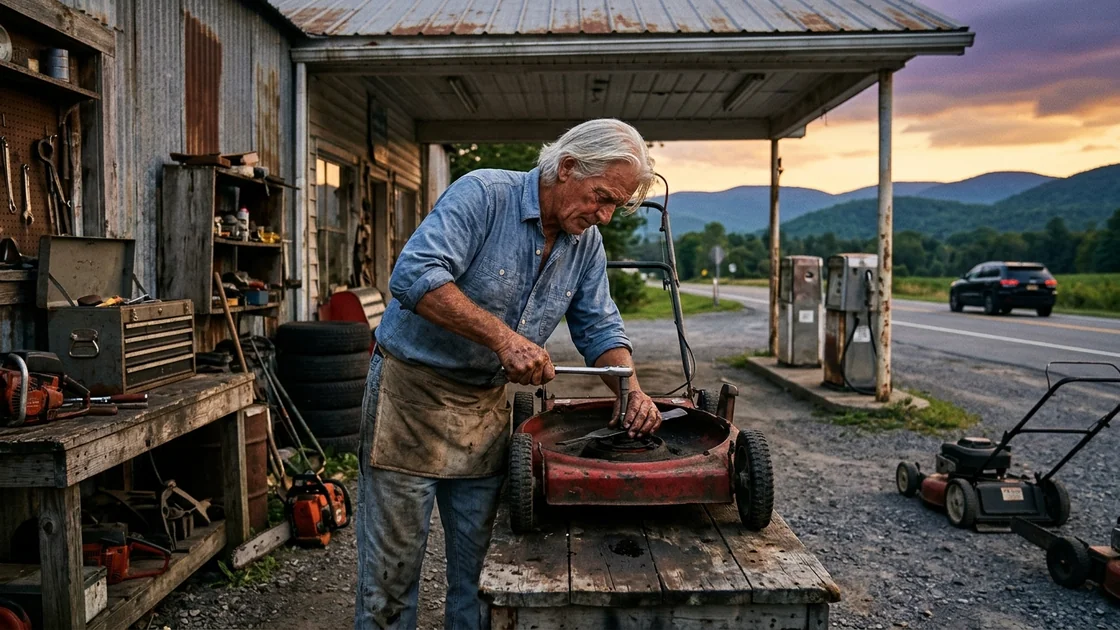
Arthur stood in the shade of an aluminum awning attached to a pre-fab metal building outside a small, forgotten river town two hours north of the city. He was wearing faded jeans, the same scuffed work boots, and a blue chambray shirt with the sleeves rolled up. His hair was longer now, entirely white, and his skin had browned to the color of walnut from four months of working outdoors.
He was wiping down the blade of a refurbished lawnmower with an oily rag when the bells on the gas pump out front chimed.
An glossy black Range Rover, looking entirely out of place among the rusted pickups and dented sedans of the county, pulled up to the curb, avoiding the gravel near the pumps. The tinted passenger window rolled down halfway.
It wasn't Genevieve. It was Clara, his former assistant.
She got out of the car, smoothing her charcoal business skirt, looking around the small hardware and repair shop with a mixture of fascination and horror. She walked under the awning, stopping a few feet from the workbench.
"Mr. Pendelton," she said softly.
"It's just Arthur now, Clara," he said, not stopping the rhythmic wiping of the steel blade. "How did you find me? I thought the NDA with the Brooklyn lawyer was ironclad."
"It was," she said. "Mr. Davis spent two hundred thousand dollars on private investigators during the proxy fight in April to make sure you weren't secretly orchestrating a hostile takeover from Zurich. When they found you working at a hardware store upstate, living in a boarding house over a pharmacy, he decided to bury the report. He thought if the street found out the founder of Pendelton Global had gone full Tolstoy, the stock would tank."
"Smart kid, Davis," Arthur said, setting the rag down and picking up a socket wrench. "How is the stock?"
"Up twelve percent this quarter," Clara said. She hesitated, reaching into her leather tote bag and pulling out a glossy magazine. It was Architectural Digest. On the cover was the drawing room of his old townhouse, completely redecorated in stark, minimalist whites. Genevieve was standing by the fireplace, her arm linked through the arm of the tech billionaire who wanted to live forever. "The divorce was finalized by default judgment on Tuesday. You didn't show up, so the judge awarded her the totality of the domestic marital assets. I… I thought someone should tell you in person, instead of just letting the notice sit at that lawyer's office in Brooklyn."
Arthur glanced at the magazine cover. He looked at the woman he had been married to, standing in the house he had bought, next to a man who was terrified of dying. He waited for the stab of jealousy, or regret, or humiliation.
Nothing came. Only a vast, quiet relief, like the feeling of taking off a pair of shoes that had been two sizes too small after walking a hundred miles.
"Keep it," Arthur said, nodding at the magazine. "I don't have a coffee table anymore anyway."
Clara slid the magazine back into her bag. She looked at him closely—at the grease under his fingernails, the sweat staining the collar of his twenty-dollar shirt, the deep, weathered lines around his eyes.
"Why, sir?" she asked, the professional mask slipping to reveal a young woman who was genuinely frightened by what she was seeing. "I worked for you for six years. I watched you build an empire. Everyone in that building is killing themselves, working eighty hours a week, sacrificing their marriages and their twenties, just to get a fraction of what you threw in the trash. If it wasn't worth it for you… what are the rest of us doing?"
Arthur set the wrench down on the scarred wooden bench. He wiped his hands on a clean corner of his apron and looked out past the gas pumps, toward the blue-green roll of the Catskill mountains in the distance.
"When I was a kid, Clara, I was starving," Arthur said, his voice quiet beneath the drone of the cicadas. "And when you're starving, you think that the meaning of life is food. So you spend your whole life building a machine that buries you in banquets. And once you're buried in it, and you can't eat another bite, you realize that food was never the point. Food is just what keeps the body going so you can actually live. I spent forty years stockpiling the fuel, and I never took the car out of the garage."
He picked up the lawnmower blade, testing its balance in his calloused hands. It was heavy. It had weight. When he bolted it back onto the chassis, a man down the road would use it to cut his grass before his grandchildren came over for a barbecue on Sunday. It was a small, microscopic link in a chain of real things.
"Quit your job, Clara," Arthur said, looking back at her. "Before Davis promotes you."
Clara stared at him for a long time. A slow, sad smile touched her lips. "Goodbye, Arthur."
"Goodbye, Clara. Tell Marcus I hope his daughter does well at NYU this fall."
She got back into the Range Rover. Arthur watched the black SUV pull out onto the two-lane highway, accelerating smoothly until it disappeared around the bend, heading south toward the glass towers and the roaring, invisible numbers.
"Arthur!" a voice yelled from inside the dark interior of the shop. It was Miller, the seventy-year-old man who owned the place and paid Arthur fourteen dollars an hour in cash every Friday. "You done with that Toro yet? Mrs. Gable’s waiting out back with a seized carburetor on her chainsaw, and I ain't getting any younger!"
"Coming, Miller!" Arthur called back.
He bolted the blade into place, gave it one final, solid wrench with the socket until his shoulder ached with the effort, and wiped the sweat from his forehead with the back of his arm. The sun was dropping behind the mountains, painting the humid sky in streaks of bruised purple and violent, untouchable gold—a wealth no man could buy, and no man could lose.
Arthur picked up his toolbox, the metal handle biting comfortably into his palm, and walked back into the shop.