The Ghosts of Oakhaven
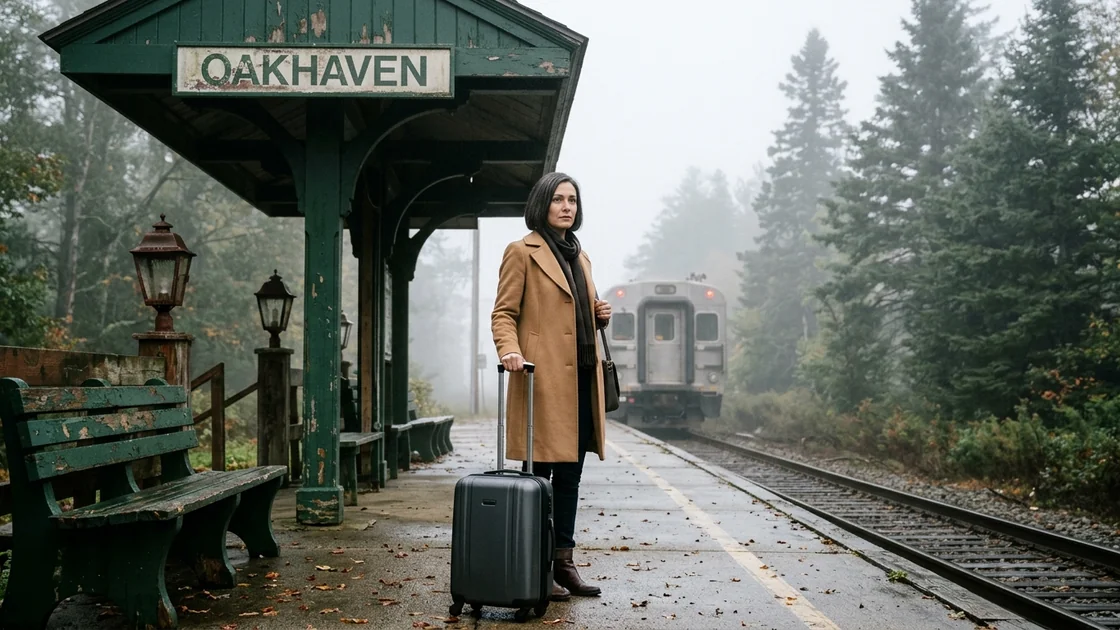
After twenty years of chasing ambitions in a bustling metropolis, Clara Vance returns to her sleepy coastal hometown of Oakhaven expecting to step back into the warm embrace of her past, only to discover that time has not stood still in her absence. As she walks the familiar streets, she confronts the heartbreaking reality that the people she once cherished have built entirely new lives without her, her former lover is happily married to a stranger, her childhood best friend barely recognizes her face, and her aging mentor has lost all memory of their shared history to the cruel fog of dementia. Through a series of poignant encounters and quiet revelations, Clara is forced to mourn the ghost of the girl she used to be and the static world she foolishly believed was waiting for her return, ultimately learning that while you can never truly go home again, confronting the emptiness of the past is the only way to finally set yourself free to live in the present.
The train pulled into Oakhaven Station with a long, metallic sigh that sounded altogether too much like a dying breath. Clara Vance stood in the narrow aisle of the commuter car, her fingers gripped tightly around the telescopic handle of her charcoal-gray suitcase. Through the salt-streaked glass of the window, the platform emerged from the mid-October fog. It was smaller than she remembered. Everything was. The peeling forest-green paint on the wooden benches, the rusted wrought-iron lamps that hung from the Victorian canopy, even the towering pine trees that bordered the tracks seemed to have shrunk, compressed by the sheer weight of two decades.
When the doors hissed open, the smell hit her first. It was an unmistakable alchemy of brine, rotting kelp, damp cedar, and the faint, sweet undertone of woodsmoke. In the city, air was merely a medium for exhaust and hurried conversations; here, the air had substance. It coated the back of her throat, tasting of nineteen-ninety-eight, of cheap cherry lip gloss, of wool sweaters damp with sea spray, of promises made under the bleachers of the high school football field.
Clara stepped down onto the concrete platform. Her leather ankle boots, sleek and expensive, clicked with an almost offensive sharpness in the quiet afternoon. She was the only passenger to disembark. A young conductor in an oversized uniform glanced at her briefly, blew a silver whistle, and waved a lantern. Within moments, the train groaned, lurched forward, and clattered away down the single track, leaving Clara standing alone in the mist.
For twenty years, Oakhaven had existed in her mind as a diorama preserved behind glass. Whenever the relentless pace of her life in Chicago threatened to pull her under—during the eighty-hour weeks at the architectural firm, the sterile collapse of her three-year marriage to a corporate litigator, the quiet, suffocating loneliness of her fortieth birthday spent in a high-rise apartment overlooking a frozen lake—she had retreated to the Oakhaven in her head. In that sanctuary, the sun was always setting in a blaze of amber over the harbor. In that sanctuary, Julian was still leaning against the hood of his beat-up Ford Bronco, waiting for her shift at the diner to end. Mara was still sitting on the porch swing of her parents' house, painting her toenails and laughing at some private joke. And Arthur was still behind the counter of the bookshop, peering over his half-moon spectacles with a mug of Earl Grey in his hand.
She had never consciously believed they were frozen in time, of course. She was a rational woman. Yet, beneath the surface of her rationality lived a stubborn, childish vanity: the belief that she was the protagonist of Oakhaven’s story, and that the curtain had simply remained drawn while she was offstage.
Now, looking at the empty parking lot beyond the station, the first hairline fracture appeared in that delusion.
There were no taxis waiting. There was no payphone by the ticket booth—only a rectangle of unfaded brick where the blue Bell Atlantic sign had once hung, and a cluster of severed wires protruding from the wall like dead nerves. Clara pulled her smartphone from her trench coat pocket. A single bar of service flickered in the top corner. She opened a ride-share app, stared at the blank map devoid of little black cars, and let out a short, humorless laugh.
"Welcome home," she murmured to the fog.
It was a two-mile walk into the center of town. She adjusted the strap of her handbag, tilted her suitcase onto its back wheels, and began to walk along the shoulder of Depot Road. The asphalt was cracked, weeds thrusting up through the fissures, yellow and brittle with autumn. As she walked, she cataloged the changes with an architect’s eye. The old lumber mill on the left had been razed, replaced by a sprawling, corrugated-metal storage facility surrounded by chain-link fencing. The fields where the summer carnivals used to pitch their tents were now occupied by a subdivision of identical, beige vinyl-sided colonials, their lawns manicured to a uniform, soulless green.
Yet, as the road curved toward the water, the familiar bones of the town began to reassert themselves. The white steeple of the Congregational Church pierced the low-hanging clouds. The brick facade of the municipal building stood unchanged, its clock tower still stubbornly four minutes fast, just as it had been when she was seventeen and racing to beat curfew.
She had booked a room for a week at the Harborview Inn, a three-story clapboard structure that sat on a bluff overlooking the stone jetty. When she pushed open the heavy oak door of the inn, a brass bell jangled overhead. The lobby smelled of lemon polish and old carpets, a comforting, musty scent that made her shoulders drop an inch.
Behind the mahogany reception desk stood a woman in her mid-twenties, her hair twisted into a messy bun, her eyes fixed on the glowing screen of a tablet. Above her head hung a framed, faded photograph of the harbor after the great blizzard of 1978. Clara remembered that photograph; her father had pointed himself out in it a hundred times, one of the blurry figures holding a snow shovel near the docks.
"Afternoon," the young woman said, looking up with a practiced, polite smile that held zero recognition. "Checking in?"
"Yes. Clara Vance."
The girl tapped at a keyboard. "Ah, yes. Room 204. Ocean view. We have you down for seven nights." She held out a plastic keycard—the heavy brass keys attached to wooden buoys were gone, it seemed. "Just need a credit card for incidentals and an ID."
Clara handed them over. She watched the girl’s face as she looked at the driver’s license, half-expecting a flicker of realization. Vance? Any relation to Thomas Vance who used to run the hardware store? In a town of four thousand people, names used to be currency. They carried histories, debts, and alliances.
"Here you go, Ms. Vance," the girl said, handing the cards back without a second glance. "Breakfast is from seven to nine in the sunroom. Wi-Fi password is on the inside of your key sleeve. Elevator’s at the end of the hall, though it’s a bit slow."
"Thank you," Clara said. She hesitated, her hand resting on the smooth wood of the counter. "Is Mrs. Higgins still around? Her family used to own this place."
The girl blinked, her polite smile faltering into mild confusion. "Higgins? Um, I’m not sure. I’ve only worked here for two years. The inn is owned by a hospitality group out of Portland now."
"Oh. Right. Of course."
Clara took her suitcase and bypassed the elevator, climbing the wide, creaking staircase to the second floor. Room 204 was clean and aggressively nautical in a way that felt curated by someone from out of state—navy blue striped curtains, mass-produced prints of seashells on the walls, a bed buried under a mountain of decorative pillows. She set her luggage down by the closet and walked straight to the window.
Below her, the harbor stretched out like a sheet of hammered pewter. A few lobster boats bobbed at their moorings, their hulls scarred with rust. At the end of the stone jetty, the small red lighthouse stood sentinel against the gray expanse of the Atlantic. For a long moment, Clara pressed her forehead against the cool glass. Why had she come back?
Her therapist in Chicago had suggested it, though not in so many words. You talk about your past as if it’s an unfinished building, Clara, Dr. Aris had said during their last session. You keep trying to design a future, but you haven't cleared the site. You left Oakhaven in the middle of the night when you were twenty, and you’ve never gone back. Not even when your parents passed.
That was the sharpest thorn in her side. Her parents had retired to Florida five years after she left for college. When her father died of a stroke in Sarasota, and when her mother followed him two years later after a brief battle with cancer, the funerals had taken place under mercilessly bright southern skies, surrounded by palm trees and retirees in pastel golf shirts. There had been no reason to return to Maine. Her parents had sold the hardware store and the family home on Elm Street long before their deaths. Clara had taken her bereavement leave, signed the estate papers via courier, and buried herself deeper in blueprints and zoning laws.
She had told herself she was too busy to visit Oakhaven. The truth, she now realized as she looked out at the unforgiving gray water, was that she had been terrified. If she didn't look in the box, everything inside it remained alive.
She unpacked methodically, hanging her wool trousers, cashmere sweaters, and silk blouses in the cedar-lined closet. She washed her face in the small pedestal sink, staring at her reflection in the mirror. At forty, she was still a striking woman, perhaps more so than she had been at twenty. Her cheekbones were sharper, her dark hair cut in a sleek, chin-length bob with only a few silver threads near the temples. She looked successful. She looked armored. She wondered, suddenly, if that armor would make her unrecognizable, or if the people here would look right through it and see the terrified, ambitious girl who had boarded a Greyhound bus with two hundred dollars and a scholarship letter, leaving behind a half-written note on Julian Miller’s windshield.
It was four o'clock. The daylight was already beginning to bruise into dusk. Clara pulled on a heavy cream fisherman’s sweater under her trench coat, slipped her phone and wallet into her pocket, and went back downstairs.
Her first stop was unintentional, guided entirely by muscle memory. Her feet carried her down the hill from the inn, onto Main Street, and three blocks north to Elm.
Main Street had undergone a strange, uneven metamorphosis. Half of it looked as though it were trying desperately to appeal to summer tourists from Boston; there was an artisanal soap shop where the pharmacy used to be, and a café with Edison bulbs strung in the window that sold seven-dollar lattes. The other half looked hollowed out. The movie theater with its marquee was boarded up, plywood painted a dull gray over the ticket booth. Her father’s old hardware store—Vance & Sons, though there had never been any sons, only Clara—was now an insurance agency. Through the plate-glass window, she saw drop ceilings, fluorescent lights, and empty cubicles. Every trace of the wooden bins that had held nails, screws, and copper fittings, every trace of the smell of machine oil and sawdust that had clung to her father’s flannel shirts, had been scrubbed from existence.
She turned onto Elm Street. The maples that lined the sidewalk were massive, their roots heaving the concrete slabs into treacherous angles, just as they always had. She walked slower now, her heart beginning to thud against her ribs.
Number 42 Elm Street sat in the middle of the block.
It was a two-story Victorian with a wrap-around porch. When Clara lived there, it had been painted a pale, buttery yellow with white trim. Her mother had kept Boston ferns hanging from the eaves, and in the autumn, rows of pumpkins always lined the steps.
Now, the house was painted a stark, modern slate-blue with black shutters. The wrap-around porch was bare save for two plastic Adirondack chairs and a tangled heap of children's scooters and plastic dump trucks. Most jarring of all was the massive maple tree in the front yard—or rather, the absence of it. Where the tree had stood, the tree whose lowest branch had held her wooden swing, whose bark bore the carved initials C.V. + J.M. inside a lopsided heart, there was only a wide, flat expanse of freshly sodded grass. Not even a stump remained.
Clara stood on the sidewalk, her hands shoved deep into her pockets. The front door opened, and a woman in her early thirties stepped out, holding a laundry basket against her hip. She had bright red hair and wore gray sweatpants. She stopped at the top of the steps, her eyes landing on Clara.
For a second, neither of them spoke. The woman’s gaze dropped to Clara’s tailored coat and expensive boots, then back up to her face. There was a polite wariness in her expression, the look of a homeowner wondering if the stranger on the pavement was a realtor, a solicitor, or a threat.
"Can I help you?" the woman asked. Her voice wasn't unkind, just guarded.
"I'm sorry," Clara said, her throat unexpectedly tight. "I didn't mean to stare. I used to live here. A long time ago."
The woman’s face softened marginally, though the wariness didn't entirely vanish. "Oh! Before the Hendersons?"
"Before them, I think. My parents sold it in two thousand and three. The Vances."
"Ah. Well, my husband and I bought it from the Hendersons four years ago," the woman said, shifting the laundry basket. "We had to gut the whole downstairs. Terrible layout. Small rooms, you know? We knocked down the wall between the kitchen and the dining room. Opened it right up."
Clara pictured the dining room wall—the floral wallpaper her mother had agonized over, the wainscot her father had installed by hand on weekends, the doorframe where her height had been marked in pencil every birthday from age three to eighteen. Knocked it right down. All those pencil marks, reduced to plaster dust and hauled away in a dumpster.
"I'm sure it looks lovely," Clara lied. Her eyes drifted back to the patch of sod in the yard. "The tree... did it come down in a storm?"
"The maple? No, the roots were getting into the sewer line," the woman said matter-of-factly. "Cost us a fortune to have it ground out, but it was either that or replace the whole main pipe. Plus, we get so much more light in the living room now."
A young boy, maybefour or five, banged open the screen door and ran out onto the porch, tugging at the woman's sweatpants. "Mom, I'm hungry."
"In a minute, Leo. Go back inside, it's freezing." The woman looked back at Clara, offering a brief, dismissive smile that signaled the conversation was over. "Well, nice meeting you. Have a good evening."
"You too," Clara said.
She turned and walked away before the screen door had even clicked shut. A strange, hollow ache had opened up beneath her sternum. It was absurd to feel angry at that woman—the house belonged to her now, she had every right to tear down walls and cut down trees—yet Clara felt as if she had just witnessed a desecration. She had spent twenty years imagining that her childhood still existed somewhere in physical space, tucked away inside the yellow house on Elm Street. To find out it had been demolished to make room for an open-concept kitchen felt like a personal erasure.
She needed to see someone who knew her. She needed an anchor.
By the time she reached the harbor district, the streetlamps had flickered on, casting pools of amber light onto the damp cobblestones. She walked past the bait shops and the marine supply store until she reached a narrow alley that smelled of fried clams and stale beer. At the end of the alley sat The Crow’s Nest.
It was a low-ceilinged tavern with dark wood paneling and portholes for windows. In high school, before they were legal, she and Mara and Julian used to sneak into the back booths because the bartender, old Pete, was half-blind and didn't care as long as they tipped well and didn't start fights. Later, the summer before she left, it had been their nightly haunt.
And Mara still worked near here. At least, she had ten years ago, the last time Clara had indulged in a late-night, wine-fueled check of social media before deleting her accounts entirely. Back then, Mara had owned a small pottery studio and gift shop two doors down from the tavern.
Clara walked past the tavern first, peering into the windows of the adjacent storefronts. The pottery shop was dark, a Closed sign hanging in the window, though shelves of glazed mugs and bowls were still visible inside. Her pulse quickened. A light was on in The Crow's Nest. If Mara had just closed up shop for the evening, there was a decent chance she was having a drink next door.
Clara pushed open the heavy wooden door of the bar.
The warmth and noise hit her instantly. A country song she didn't recognize was playing on the jukebox. Four men in Carhartt jackets and mud-spattered boots sat at the bar, watching a pre-season hockey game on a flat-screen television mounted where a taxidermied marlin used to hang. Behind the bar was a woman with thick, braided gray hair and broad shoulders, wiping down taps with a bar rag.
Clara froze just inside the doorway.
It took her brain several seconds to reconcile the woman behind the bar with the girl in her memory. The girl in her memory was nineteen, rail-thin, with hair dyed the color of a bruised plum, wearing combat boots and a vintage velvet dress. That girl had a laugh like shattering glass and a habit of biting her fingernails until they bled.
The woman behind the bar was forty. She was solid, her face lined around the eyes and mouth, wearing a faded flannel shirt over a gray thermal tee. Yet, as she turned to set a pint glass in the sink, Clara saw the familiar, stubborn tilt of her chin, and the small crescent-shaped scar above her left eyebrow—the permanent souvenir of a ninth-grade bicycle crash that Clara had witnessed firsthand.
"Mara," Clara whispered.
She walked toward the bar, choosing a stool at the far end, away from the men in the Carhartt jackets. Her heart was hammering so loud she was sure the whole room could hear it. What would Mara do? Scream? Drop the glass? Come around the bar and crush her in a hug, demanding to know where the hell she had been for two decades? Or would she be furious? Clara had stopped returning Mara’s calls during her sophomore year at Columbia. It hadn't been a single, malicious decision; it had been death by a thousand omissions. Mara’s stories about town gossip and shift drama at the grocery store had begun to feel small, suffocatingly so, when Clara was surrounded by professors discussing brutalism and classmates who summered in Milan. One missed call turned into three, three turned into six months of silence, and eventually, the guilt of not calling became an insurmountable wall.
Mara walked down the length of the bar, tossing the damp rag over her shoulder. She stopped in front of Clara, placing both hands flat on the scarred mahogany surface.
"Evening, hon," Mara said. Her voice was deeper than it used to be, raspy from years of smoke or shouting over bar noise. She looked directly into Clara’s eyes, her expression pleasant, tired, and completely blank. "What can I get for you?"
Clara stared at her. She opened her mouth, waiting for the spark of recognition to ignite in Mara’s hazel eyes. She waited for the double-take, the gasp.
Nothing happened. Mara just raised her eyebrows slightly, waiting for an order, glancing briefly at the television screen over Clara’s shoulder.
"I..." Clara’s voice caught. She cleared her throat. "Do you have Pinot Noir?"
"We’ve got house red and house white," Mara said with a dry chuckle. "It comes out of a box, if I’m being honest with you. The gin is safe, though, and we’ve got local IPA on tap."
"Gin and tonic, please," Clara said numbly.
"You got it." Mara turned, scooped ice into a short glass, and poured a generous measure of gin from the speed rail. She worked with the unconscious efficiency of someone who had been doing this for decades. She dropped a lime wedge on top, slid the glass across the wood on a cardboard coaster, and tapped the register. "Six bucks. You want to start a tab or close out?"
"Mara," Clara said, louder this time.
Mara paused, her fingers hovering over the register keys. She looked back at Clara, squinting slightly. "Yeah? Sorry, do I know you?"
The words were a physical blow. Do I know you?
They had shared a bedroom for an entire summer when Mara’s parents were getting divorced. They had pierced each other’s ears with a sewing needle and an apple in seventh grade. They had sworn, sitting on the roof of the dugout at two in the morning, that they would be bridesmaids at each other’s weddings, godmothers to each other’s children.
"It’s me," Clara said, offering a trembling smile that felt grotesque on her face. "It’s Clara. Clara Vance."
Mara stared at her. The silence stretched for five seconds, ten seconds. Slowly, the confusion on Mara’s face gave way to a look of mild, distant surprise—not the earth-shattering shock of a long-lost soulmate returning from the dead, but the expression one makes when running into a former coworker from three jobs ago at the supermarket.
"Well, I’ll be damned," Mara said softly. She leaned back against the stainless-steel cooler, crossing her arms. "Clara Vance. Look at you. I wouldn't have known you in a million years. You cut your hair."
"A long time ago," Clara said, trying to laugh. "I saw the pottery shop next door. I thought you were still running it, so I came in here hoping to catch you."
"Oh, God, the studio," Mara said, waving a hand dismissively. "Yeah, that’s my sister-in-law’s place now. I sold my half to her six years ago when my husband bought this place. Turns out tourists would rather buy six-dollar beers than forty-dollar soup bowls. Better margins, fewer broken dishes."
"Your husband?"
"Yeah, Greg. Greg Kowalski. You remember him? He was two years behind us. Played offensive line."
Clara searched her memory and came up with a vague image of a beefy kid with a buzzcut. "I think so. That’s... that’s wonderful, Mara. How long have you been married?"
"Fourteen years in June," Mara said. She picked up the bar rag again and began wiping down an already clean section of the counter. There was no hostility in her movements, no simmering resentment waiting to boil over. There was just a polite, impenetrable distance. "We’ve got three kids. Oldest just started at UMaine Orono. Engineering. Makes me feel ancient."
"Three kids," Clara repeated. "Wow."
"What about you? What brings you back to this neck of the woods? Someone die?" Mara asked the question with blunt, small-town pragmatism.
"No. No, I just... I had some vacation time. Realized I hadn't been back since I left for school."
"Twenty years," Mara noted. It wasn't an accusation; it was just math. "You’re in New York still?"
"Chicago, actually. For the last twelve years. I’m an architect."
"Huh. Always knew you’d do something fancy like that. You had the brains for it." One of the men down the bar raised an empty bottle. Mara nodded at him. "Hang on a sec, Dave." She pulled a bottle of Budweiser from the cooler, popped the cap, and slid it down the bar before returning to within a few feet of Clara, though she stayed angled toward the rest of the room, keeping an eye on the door.
Clara wrapped her cold fingers around the gin and tonic. She felt a desperate urge to bridge the chasm between them, to reach across the mahogany and grab Mara’s wrist, to say, Remember when we stole your brother’s Camaro and drove to the quarry? Remember when you cried for three days over Billy Peterson and I read you your horoscope until you laughed?
"Mara," Clara said quietly, "I'm so sorry I fell out of touch. When I went to New York, everything just moved so fast, and then by the time I looked up, so much time had passed that I didn't know how to—"
Mara held up a hand, stopping her. A gentle, almost pitying smile touched her lips. "Clara, hon, you don't need to apologize. Really."
"I do. We were best friends. I was terrible to just disappear like that."
"We were eighteen," Mara said, her voice entirely devoid of melodrama. "Kids grow up. You went one way, I went another. Truth be told, after the first year or two, I figured you’d found your people out there in the big city. You never really fit here anyway. You were always chomping at the bit to get out."
After the first year or two. Clara swallowed hard, the gin burning the back of her throat. She had carried the guilt of abandoning Mara like a heavy stone in her pocket for two decades, imagining her friend hurt and betrayed. And the reality was that Mara had shrugged it off by the time she was twenty, married Greg Kowalski, had three kids, and built a whole life in which Clara Vance was nothing more than a footnote in a high school yearbook.
The door of the tavern swung open, letting in a blast of damp air. A group of four people walked in, laughing loudly, shaking rain from their umbrellas.
"Ah, the trivia crowd is starting to roll in," Mara said, already turning toward the taps. "Listen, it’s real good to see you, Clara. Glad you’re doing well in Chicago. That drink’s on the house, okay?"
"Mara, maybe we could get coffee tomorrow? Or lunch? Before your shift?"
Mara paused, two pint glasses in her hand. For the first time, she looked slightly uncomfortable, the way one looks when a persistent acquaintance tries to force an intimacy that isn't there. "Oh, jeez, tomorrow’s crazy. I’ve got to run the distributor order in the morning, and then my youngest has a dentist appointment in Rockland, and we’ve got a septic guy coming out to the house at two. This whole week is just a circus. If you stop back in before you leave, though, definitely say hi."
It was a brush-off. A polite, small-town brush-off, delivered with a warm smile.
"Of course," Clara said, her cheeks burning. "I understand. You’re busy."
She took two more sips of her drink while Mara served the newcomers at the other end of the bar. Mara was laughing with them now, leaning over the counter, trading jokes about someone’s boat motor. She belonged to them. She belonged to Greg, and the three kids, and Dave with his Budweiser, and the septic guy coming at two.
Clara pulled a twenty-dollar bill from her wallet, tucked it under the coaster despite Mara’s offer, and slipped off the stool. She didn't say goodbye. Mara didn't notice her leave; she was too busy writing the trivia categories on the chalkboard by the kitchen door.
Outside, the mist had thickened into a cold, steady drizzle. Clara stood under the narrow awning of the tavern, pulling the collar of her trench coat tight around her neck. The street was empty. The neon beer signs in the window behind her cast a sickly red and blue glow over the wet cobblestones.
She had never felt more like a ghost. In Chicago, she was lonely, yes, but she had a role. When she walked into her office, junior associates scrambled to hand her coffee and schematic revisions; contractors called her cell phone ten times a day asking for her sign-off; the doorman in her building greeted her by name every morning and evening. She had weight there. She displaced water.
Here, in the place that had formed her, she was completely weightless. She had walked back into her childhood home and her best friend’s life, and she hadn't even left footprints on the floor.
She walked back to the Harborview Inn in the rain, refusing to run for cover, letting the cold water soak into her hair and run down her face. When she got back to Room 204, she stripped off her wet clothes, took a scalding shower that failed to warm the chill in her bones, and ordered a bowl of clam chowder from room service. She ate half of it sitting on the edge of the bed, watching the red beam of the lighthouse sweep across the dark harbor every six seconds. One, two, three, four, five, six. Flash. One, two, three, four, five, six. Flash.
She lay down under the stiff hotel sheets and stared at the ceiling.
Julian.
She had been saving his name in the back of her mind all day, rationing the thought of him like water in a desert.
Julian had been different from Mara. Mara had been her childhood; Julian had been her awakening. They had been together from the autumn of their junior year until the night she left. He was a year older, quiet where she was restless, steady where she was volatile. His father owned the boatyard at the north end of the cove, and Julian had hands that were permanently stained with fiberglass resin and pine tar, hands that were impossibly gentle when they touched her face.
He hadn't wanted her to stay in Oakhaven—not at first. He had been proud when she got the scholarship to Columbia. You're going to build skyscrapers, Clara, he had told her, lying on the bed of his truck looking up at the Perseid meteor shower in August. I'll come down on the train once a month. Four years is nothing. And when you're done, maybe I'll move down there too. They have boats in New York, right?
It was that last sentence that had terrified her. Maybe I'll move down there too. She had pictured Julian in Manhattan, suffocating in concrete, hating it for her sake, and she had pictured herself suffocating under the weight of his sacrifice. Or worse, she had pictured herself coming home for Thanksgiving, slipping back into the warm, easy current of his love, and never getting back on the train. Her ambition had been a fragile, ferocious thing at eighteen; she had believed, with the ruthless absolutism of youth, that to survive, it required a clean amputation.
So two days before she was supposed to leave—before the tearful goodbye dinner her parents had planned with his parents, before the long drive to the station where he would kiss her on the platform and make her swear to call every night—she had packed her bags at three in the morning. She had walked to his house, slipped a folded piece of notebook paper under the wiper blade of his Bronco, and taken the five-fifteen bus to Portland.
I can't do long distance, the note had said. And I can't ask you to wait for someone who isn't coming back. Don't try to find me, Julian. I'm sorry. Please have a good life.
He had tried, of course. For the first six months at Columbia, the dorm hallway phone had rung constantly. Her roommate had taken messages from him—at first frantic, then confused, then angry, and finally just quiet requests to hear her voice for five minutes so he knew she was okay. Once, in November of her freshman year, she had looked down from the fourth-floor window of Avery Hall and seen him standing by the iron gates on Broadway in his heavy wool peacoat, looking utterly lost among the hurrying students, holding a paper coffee cup and scanning the faces of every dark-haired girl who walked past.
She had stepped back from the window and hidden in the stairwell for two hours until he was gone. It was the single cruelest thing she had ever done in her life, and she had spent twenty years telling herself it had been necessary. She had sacrificed him on the altar of her future. And because she had never loved anyone since with even a fraction of that terrifying intensity—not her ex-husband, not the string of polite, sophisticated men she had dated in her thirties—she had secretly, selfishly believed that the scar on Julian’s heart must match the one on hers. You don't stand outside the gates of Columbia in the November rain for a girl and then just forget her.
Eventually, exhaustion pulled her under, the rhythmic flash of the lighthouse following her into a dreamless sleep.
The next morning dawned clear and sharp, the rain having washed the sky a brilliant, aching blue. The wind off the water carried the first real bite of coming winter.
Clara dressed with care—dark jeans, leather riding boots, a camel-hair coat, a cashmere scarf looped around her neck. She skipped the inn’s sunroom breakfast and walked into town, buying a black coffee and a croissant at the new café with the Edison bulbs. The barista was a boy with a nose ring and a Boston accent who looked at her as if she were just another rich weekender up from Massachusetts to look at the foliage.
She drank her coffee walking down the hill toward the water, heading north along Harbor Road.
Before she allowed herself to walk all the way to the boatyard, she had one more stop to make. Halfway up the hill on Water Street sat a narrow, crooked building painted a faded barn-red, wedged between a real estate office and a maritime museum. A wooden sign hung from wrought-iron brackets above the door, painted with a picture of an owl perched on a compass: The Mariner’s Page — Rare & Used Books.
Arthur Pendelton’s shop.
Arthur had been her sanctuary before Julian, before she even knew what she wanted to be. He was an old bachelor, a retired merchant marine who had settled in Oakhaven in the seventies and filled three floors of a crumbling eighteenth-century house with books. When Clara was twelve, thirteen, fourteen, hiding from the relentless mediocrity of middle school, she had spent every afternoon sitting on the worn Persian rug in the back corner of Arthur’s shop.
It was Arthur who had put a copy of The Fountainhead in her hands when she was fifteen—and then, two weeks later, laughing at her earnest, adolescent devotion to it, handed her Jane Jacobs’ The Death and Life of Great American Cities to cure her of it. It was Arthur who had ordered books on Frank Lloyd Wright and Zaha Hadid through interlibrary loan, who had cleared off a drafting table in his back room so she could practice her perspective drawings, and who had written her letter of recommendation for Columbia. He had been seventy when she left. Doing the math made her stomach clench; if he were still alive, he would be ninety.
When she reached the shop, she breathed a sigh of relief. There were still books stacked inside the bay window, their dust jackets faded to pale blues and yellows by decades of sunlight. The gold lettering on the glass door—A. Pendelton, Prop.—was chipped in the exact same spot on the 'P' as it had been in 1998.
She turned the brass knob and pushed the door open. The familiar little silver bell tinkled overhead.
The smell of the shop was intact—a glorious, intoxicating perfume of decaying lignin, vanilla, leather bindings, and dust. The shelves still rose from floor to ceiling, crammed double-deep, with rolling wooden ladders hooked to brass rails.
"Just a moment!" a woman’s voice called from the back room.
A woman in her sixties emerged from behind the velvet curtain that separated the shop floor from the office. She wore a thick cardigan covered in cat hair and had reading glasses perched on the end of her nose. She was carrying a cardboard box of paperbacks.
"Good morning," the woman said warmly, setting the box down on the counter by the old brass cash register. "Let me know if you’re looking for anything specific. The organization system is... well, it’s aspirational at best."
"Good morning," Clara said, her eyes scanning the dim corners of the shop, looking for the shock of white hair and the tweed vest. "I was actually hoping to see Arthur. Does he still come in?"
The woman’s smile faded into a gentle, sympathetic expression. "Oh, are you an old customer of my uncle’s?"
"His niece?" Clara remembered Arthur mentioning a niece who taught school in Augusta. "I'm Clara Vance. I used to spend a lot of time here when I was in high school. Arthur practically raised me on the architecture section."
"Oh, how lovely," the woman said, extending a hand across the counter. "I’m Evelyn. I retired from teaching three years ago and moved here to take over the shop—and to look after Arthur."
"He's still alive, then?" Relief flooded through Clara.
"He is. Ninety-one in November. His body is remarkably stubborn—the doctor says he has the heart of a sixty-year-old." Evelyn’s eyes clouded slightly. "His mind, unfortunately, hasn't kept pace. He has Lewy body dementia. It progressed quite rapidly over the last two years."
Clara felt the familiar cold weight settle back into her chest. "I'm so sorry to hear that. Is he... is he in a facility?"
"No, thank goodness. He lives upstairs in his apartment, just like always. I live up there with him now, and we have a wonderful home health aide who comes in during the mornings while I’m down here. Actually, he’s awake right now, sitting in the sunroom. He loves having visitors, even if he gets a bit muddled. Would you like to go up and say hello?"
"Yes," Clara said immediately. "Yes, please. I’d love that."
"Go right on through the back room. You know the way, if you used to hang around here," Evelyn said with a kind smile. "The aide’s name is Maria. Just knock on the door at the top of the stairs."
Clara pushed past the velvet curtain into the back office. Her eyes went straight to the corner under the window. The old drafting table was still there, buried under stacks of invoices, bubble wrap, and shipping tape. She brushed her fingertips over the scarred wooden edge as she walked past, then opened the narrow door that led to the upstairs apartment.
The stairs were steep and carpeted in a threadbare runner. At the top, she knocked lightly. A middle-aged woman in floral scrubs opened the door, smiling when Clara explained who she was, and gestured toward the back of the apartment where the enclosed porch overlooked the harbor.
"Mr. Pendelton, you have a visitor," the aide said gently before retreating into the kitchen to give them privacy.
Clara stepped into the sunroom. It was warm, heated by a small electric radiator that clicked softly in the corner, and filled with dozens of jade plants in terracotta pots.
Sitting in a rattan armchair by the window, wrapped in a tartan lap blanket, was Arthur.
He looked fragile, as if he had been carved out of dried driftwood and tissue paper. The broad shoulders she remembered had collapsed inward, and the thick mane of white hair was now a few wispy strands combed across a liver-spotted scalp. His hands, resting on top of the blanket, were gnarled with arthritis, the skin translucent over blue veins.
"Arthur?" Clara said softly.
He turned his head slowly toward the sound of her voice. His eyes, once a sharp, piercing blue behind his spectacles, were milky at the edges, though they still held a gentle warmth.
"Hello there," he said. His voice was a dry rustle, like dead leaves blowing across pavement, yet the cadence—that polite, slightly formal New England rhythm—was unmistakably his. "Please, come in. Don't stand in the doorway, you'll let the draft in."
Clara walked over and pulled a wooden Windsor chair close to his, sitting down so they were at eye level. She reached out, hesitating for a fraction of a second before placing her hand over his cold, knotted fingers. "It’s so good to see you, Arthur."
He looked down at her hand, then up at her face. He studied her for a long time, his brow furrowing as if he were trying to read a page written in very small print in a dim room.
"You're a very handsome woman," he said finally, offering a courtly little smile. "Are you from the historical society? I told Evelyn I already signed the papers for the maritime maps. You can take the whole box."
A lump formed in Clara’s throat. "No, Arthur. I’m not from the historical society. It’s Clara. Clara Vance."
"Clara," he repeated, testing the syllables on his tongue. He looked out the window at the gulls wheeling over the slate roofs, then back at her. "Vance. Tom Vance’s wife? From the hardware store?"
"His daughter," she said gently, squeezing his hand. "I used to come into the shop every day after school. You taught me how to draw elevations on your drafting table in the back. You gave me books on cathedrals and bridges. Remember? When I got into Columbia, we drank sherry out of tea cups so my mother wouldn't know if she walked in."
She watched his face with an almost desperate intensity, praying for a crack in the fog. If Mara had forgotten her out of indifference, out of the natural erosion of time, surely Arthur wouldn't. Arthur had seen her soul when she was just an angry, restless teenager. She needed him to know that she had done it—that she had built the things they had talked about.
"I went to New York, Arthur," she continued, her voice trembling slightly. "And then Chicago. I became an architect, just like you said I would. Last year, my firm designed a library in Evanston. All glass and limestone, with a central atrium modeled after that book on nineteen-twenties civic buildings you gave me for my seventeenth birthday. I put a reading alcove in the east wing with a bay window, and the whole time I was drawing it, I was thinking of your shop."
Arthur listened politely, nodding along with the pleasant, practiced attentiveness of a man who had no idea what was being said to him, only that the person speaking was earnest and meant well.
When she finished, a tear spilled over her lower lashes and tracked down her cheek. She wiped it away quickly with her free hand.
Arthur looked at her damp cheek with mild concern. He patted her hand with his other, trembling palm. "Well, that sounds like a very fine building, my dear. A library is a noble thing. People need places to be quiet." He paused, looking past her toward the kitchen doorway. "Have you met my niece, Evelyn? She makes a very good soup at noon. You're welcome to stay, though you'll have to forgive me, I’m rather tired today. We took the steamer in from Halifax this morning and the swell was dreadful."
Clara closed her eyes for a brief second, letting the defeat wash over her. He hadn't been on a steamer from Halifax since 1968. The girl who had drunk sherry from a teacup in his back room was gone, erased not by malice or distance, but by the slow, indiscriminate misfiring of neurons in an old man’s brain. All those afternoons, all those conversations that had shaped the entire trajectory of her adult life—she was the only one left alive who remembered them. And when a memory is held by only one person, does it even really exist anymore, or does it become indistinct from a dream?
"I can't stay for soup today, Arthur," she said softly, standing up and leaning down to press a kiss to his papery cheek. He smelled of lavender soap and peppermint. "You get some rest."
"Thank you for stopping by, Mrs. Vance," he murmured, already turning his gaze back to the window, his eyes tracking a gull as it dove toward the water. "Do tell Tom I need a half-inch brass fitting for the radiator when he gets a chance..."
Clara walked back down the steep stairs, thanked Evelyn with a voice that barely functioned, bought the first hardcover book her hand touched on the counter just to have an excuse to leave a hundred-dollar bill, and stumbled back out into the bright, cold air of Water Street.
She leaned against the brick wall of the maritime museum next door, clutching the book to her chest, and breathed in deep, ragged gulps of salt air until the tightness in her chest subsided.
Two down.
The childhood best friend didn't care. The mentor didn't remember.
There was only one person left. And suddenly, the prospect of seeing Julian wasn't a bittersweet romantic pilgrimage anymore; it was an existential necessity. She needed someone in this goddamn town to look at her face and feel the earth move, even if it was in anger. She would take his hatred. She would take him yelling at her in the middle of the boatyard, calling her a coward for leaving that note, telling her she had ruined his life for years. Anything was better than this polite, ghostly erasure.
She began to walk faster, her boots striking the pavement in a determined rhythm as she followed Harbor Road out of the commercial district and around the curve of the cove.
The road narrowed here, bordered on one side by granite ledges overgrown with wild rugosa roses—their hips fat and blood-red in the October sun—and on the other by the rocky beach where the tide was currently out, exposing acres of glistening brown rockweed and mudflats.
Half a mile around the bend, the metal roofs of Miller & Son Boatworks came into view.
At first glance, the boatyard looked encouragingly familiar. The big corrugated steel shed where they did the winter hull repairs still loomed over the wooden pier. The travel lift—a giant blue metal gantry on monstrous rubber tires—was parked near the slipway. Up on the gravel lot, a dozen sailboats and lobster boats already sat on wooden blocks and jack-stands, winterized and wrapped in white shrink-wrap like giant cocoons.
Yet, as she walked past the wooden sign at the entrance, she noticed the subtle upgrades. The gravel lot had been paved near the office. There were three shiny new Ford F-250 pickups parked in a row, all bearing the Miller Boatworks logo in sleek, modern lettering on the doors—Noticeably, the & Son had been dropped. Julian’s father must have retired or passed away. The old clapboard shack that had served as the office had been replaced by a neat, cedar-shingled building with a wrap-around deck and solar panels on the roof.
Clara stopped at the edge of the boatyard, her heart beating in her throat, her palms damp inside her coat pockets.
The sounds of the yard drifted across the lot: the high-pitched whine of an orbital sander from inside the shed, the clang of metal rigging slapping against an aluminum mast in the wind, the chatter of a marine radio somewhere near the dock.
And then, walking out of the darkness of the big repair shed into the brilliant sunlight, came Julian.
Clara’s breath left her in a silent rush.
He hadn't shrunk like the train station, or softened into unrecognizable middle age like Mara. If anything, time had been infuriatingly kind to him. At forty-one, he had filled out; the lanky, whipcord-lean boy she had known had become a broad-shouldered, powerful-looking man. He wore faded Carhartt work pants, steel-toed boots, and a navy blue heavy-knit sweater with the sleeves pushed up to his elbows, revealing forearms that were still corded with muscle. His dark hair was thicker than most men’s at his age, shot through with silver at the temples and slightly messy from the wind, and he wore a neatly trimmed beard that was mostly gray around the chin.
He was holding a clipboard in one hand and talking to a younger worker in coveralls, gesturing toward the stern of a thirty-foot sloop propped up on stands. Even from fifty yards away, Clara recognized the exact way he stood—weight shifted onto one hip, head tilted slightly as he listened.
Every cell in Clara’s body remembered him. The twenty years in between evaporated like mist on a hot stove. Looking at him, she felt twenty years old again, raw and terrified and desperately in love.
The younger worker nodded and walked back into the shed. Julian turned, looking down at his clipboard, and began walking across the lot toward the cedar-shingled office—directly toward her.
Clara couldn't move. Her feet were leaden on the asphalt. She pulled her hands out of her pockets, letting them hang at her sides, feeling completely exposed in the sharp autumn sunlight.
Ten yards away, Julian looked up from his clipboard.
His eyes—that striking, pale sea-glass green that had haunted her dreams in Chicago—landed on her.
He stopped walking.
For three heart-stopping seconds, nobody breathed. The whine of the sander in the shed cut off, leaving only the sound of the wind and the lapping of waves against the pilings.
Julian stared at her. She watched the muscles in his jaw tighten beneath his beard. She saw the shock register in his eyes—a genuine, unmistakable jolt of recognition that went straight through him. He knew her. Immediately, without a word, without her having to explain who she was or whose daughter she was, he knew her.
A fierce, dizzying wave of relief crashed over Clara. He remembers.
Slowly, Julian lowered the clipboard to his side. He took two steps closer, squinting slightly in the bright sun as if making sure she wasn't a mirage.
"Clara?" he said. His voice was a low baritone, deeper than the boy’s voice she remembered, carrying the rough edge of the coast.
"Hi, Julian," she said. Her voice was barely above a whisper, trembling with twenty years of unsaid words.
He looked her up and down, taking in the camel-hair coat, the sleek haircut, the leather boots, before returning to her face. The initial shock in his eyes was already receding, replaced by a complex, shifting tide of emotions that she couldn't quite read—surprise, curiosity, a flicker of old wariness, and then, settling over it all like calm water over a stone, a quiet, steady composure.
"Well," he said, letting out a long breath that turned into a faint plume of white vapor in the cold air. "I have to admit, of all the people I might have expected to walk into the yard on a Wednesday morning, you weren't on the list."
"I know," she said, taking a tentative step toward him. "I'm sorry to just show up here unannounced. I got into town yesterday."
"Everything alright?" he asked, his brow furrowing slightly with automatic small-town concern. "Your folks... I heard about your dad a few years back, and your mom. I was sorry to hear that, Clara."
"Thank you. No, nothing's wrong. I just... I realized it had been twenty years. I needed to come back. I needed to see the town. And I needed to see you."
Julian studied her face for a quiet moment. He didn't look angry. He didn't look devastated. He looked like a man who had just been handed a puzzle he had solved a decade ago and was mildly surprised to see it on his desk again.
"It's cold out here in the wind," he said, gesturing with his clipboard toward the cedar office. "I was just about to put a pot of coffee on. You want a cup?"
"Yes," she said quickly. "I’d like that."
She followed him up the wooden steps and into the office. Inside, it was warm and smelled of cedar wood, fresh coffee, and marine varnish. It was a clean, well-organized space—nautical charts of Penobscot Bay framed on the walls, a tidy L-shaped desk with two computer monitors, a leather sofa under the window for customers.
"Have a seat," Julian said, tossing his clipboard onto the desk and walking over to a small kitchenette in the corner. He scooped grounds into a filter and poured water into the machine with steady, unhurried hands. There was no tremor in his fingers. He wasn't rattled at all.
Clara didn't sit. She was too wound up to sit. She walked slowly along the wall, looking at the framed photographs hanging beside the charts.
At first, they were photos of boats—a classic wooden schooner under full sail, a massive lobster boat being christened with champagne. There was a photo of Julian and his father standing in front of the old shed, both of them grinning, arms around each other’s shoulders. Below it was a brass plaque with dates: Robert Miller, 1945–2016.
"I'm sorry about your dad," Clara said softly, touching the edge of the frame. "He was a good man."
"Thanks," Julian said from the kitchenette, leaning back against the counter while the coffee maker began to gurgle and hiss. "Heart attack. Right down on the dock, actually. The way he wanted to go, if he had to pick."
Clara nodded, moving to the next cluster of photographs near the desk.
And there, her heart stopped.
In the center of a silver frame was a photograph taken on the beach at sunset. Julian was in it, wearing a linen shirt, laughing with his head thrown back. Wrapped in his arms was a woman with long, sun-streaked blonde hair, crinkles around her bright blue eyes, and a wide, gap-toothed smile that radiated effortless warmth. Standing in front of them were two girls—one around twelve, the other maybe nine—both with their mother’s blonde hair and Julian’s sea-glass green eyes, holding golden retriever puppies.
Surrounding that central photo were a dozen others. Julian teaching the older girl how to weld in the shed, both of them wearing oversized safety goggles. The blonde woman standing at the helm of a sailboat, wind whipping her hair across her face. A Christmas card photo on the steps of a renovated farmhouse.
Clara stared at the photographs until the edges of the frames blurred.
Of course he had gotten married. She wasn't an idiot; she knew that men like Julian didn't become monks because a girl broke their heart at nineteen. Yet knowing a fact in the abstract and seeing the vibrant, undeniable proof of his happiness in high-resolution color were two entirely different things. The woman in the photograph didn't look like a consolation prize. She didn't look like someone Julian had settled for because Clara had left. She looked like the sun. And Julian, in every single frame, looked at her as if he were the luckiest bastard on the coast of Maine.
"That's Sarah," Julian said, his voice softening with an unmistakable, reflexive tenderness as he walked over and handed Clara a ceramic mug of black coffee. He glanced at the photo on the wall and smiled—a quiet, private smile that went straight into Clara’s ribs like a stiletto. "And that’s Maya and Nora. Maya’s thirteen now, Nora’s ten. That picture’s a couple years old. The dogs are about eighty pounds heavier now."
Clara took the mug with both hands, using the heat to ground herself. "She’s beautiful, Julian. Your girls, too. They have your eyes."
"God help me when they start driving," he said with a chuckle, taking a sip from his own mug and leaning against the edge of the desk, crossing his boots at the ankles. "Sarah’s the elementary school principal over in Camden. Moved up here from Vermont fifteen years ago. Her sailboat lost its rudder in a squall off Monhegan and the Coast Guard towed her into my yard. Took me three weeks to get the part in from Boston, and by the time the boat was fixed, I’d talked her into staying for dinner."
Fifteen years ago. Five years after Clara left.
"How have you been, Clara?" he asked, looking at her with genuine, friendly interest. "Did you do it? Build the skyscrapers?"
"Some," she said, her voice sounding hollow and thin to her own ears. "Mostly civic buildings and commercial developments. I’m a partner at a firm in Chicago now."
"Chicago. Windy City." He nodded approvingly. "Good for you. I always knew you’d make it big. Whenever Sarah and I take the girls down to Boston or New York, I find myself looking up at the new buildings, wondering if one of them has your name on the blueprints."
He said it so easily. There was no bitterness in it, no sharp edge of irony. He was genuinely happy for her, the way a former high school teacher is happy to hear that a promising student made good.
Clara set her coffee mug down on the corner of his desk before she dropped it. The composure she had fought so hard to maintain all morning was cracking under the unbearable weight of his kindness.
"Julian," she said, taking a step closer to him, her hands clenching at her sides. "How can you be so nice to me?"
Julian blinked, his smile fading into mild surprise. He straightened up slightly from the desk. "What do you mean?"
"I mean..." Her voice rose, cracking in the quiet office. "I left you a five-sentence note under a windshield wiper in the middle of the night! We were together for two years, we talked about getting married, and I vanished like a thief! And then when you came to New York—I saw you, Julian. In November. Standing outside the gates on Broadway in the rain. I looked right at you from my dorm window, and I didn't come down."
The confession hung in the air between them. She had kept that secret locked in a vault for twenty years, a toxic little jewel of guilt and twisted pride. She braced herself for the impact—for the flash of betrayal in his green eyes, for the realization that she had watched him suffer and done nothing.
Julian was quiet for a long moment. He looked down at his coffee mug, turning it slowly in his scarred, calloused hands, and then looked back up at her.
When he spoke, his voice wasn't angry. It was devastatingly gentle.
"Yeah," he said softly. "I kind of figured you might have seen me that day."
Clara froze. "You knew?"
"Well, I knew which dorm was yours from the envelopes you sent your parents in August," he said, a wry, distant smile touching the corner of his mouth. "And I knew you weren't dead, because your mom told my mom you were getting straight A's. So when I stood out there for four hours and you didn't come out, and you didn't answer the phone... I got the message, Clara."
"You must have hated me," she whispered, a tear finally breaking free and rolling down her cheek. "I’ve spent twenty years thinking about how badly I hurt you. I came back here to tell you how sorry I am, and to tell you that... that I never stopped thinking about what would have happened if I had walked down those stairs."
There. It was out. The pathetic, desperate fantasy that had sustained her through her divorce, through the cold nights in her high-rise apartment, laid bare on the floor of his office.
Julian looked at her, and the expression in his eyes was the worst thing she could have possibly imagined. It was pity. Deep, sorrowful, unmistakable pity.
He set his mug down and pulled a clean paper towel from a roll on the counter, holding it out to her. She took it mechanically and dabbed at her face.
"Clara," he said quietly, leaning back against the desk again, keeping a respectful, unbridgeable three feet of space between them. "I was nineteen years old. Did it hurt? Hell yes, it hurt. For about a year, I was a miserable bastard. Ask anyone in town. I drank too much at the Crow's Nest, picked a couple of fights I lost, and felt real sorry for myself."
He paused, glancing toward the window where the sunlight was glittering on the water of the cove.
"And then I turned twenty-one," he continued simply. "My dad had his first heart scare, and I had to step up and run the yard. I started taking business classes at night in Rockland. I dated a girl from Belfast for a couple years—didn't work out, but we had fun. And then Sarah’s boat broke down."
He looked back at Clara, his sea-glass eyes clear and completely untroubled.
"When I think about that day in New York now, Clara, you know what I feel?" he asked softly. "I feel grateful you didn't come down those stairs."
The breath went out of her lungs as if he had struck her across the chest with an oar. "Grateful?"
"Think about it," Julian said, his tone entirely reasonable, devoid of cruelty. "We were kids. If you had come down those stairs, either I would have moved to New York and hated every waking second of my life, resenting you for taking me away from the water, or you would have dropped out, moved back here, and hated me for keeping you from your buildings. We would have torn each other to pieces before we were twenty-five. Leaving that note was a rough way to do it, sure, because you were nineteen and scared. I forgave you for that fifteen years ago."
I forgave you for that fifteen years ago.
"You've been carrying this around all this time?" he asked, tilting his head, looking at her with genuine sympathy. "Clara, I haven't thought about that note in a decade. You were my first love, and that's a special thing, I'll never say it wasn't. When I think of you—which isn't often, if I'm being honest, life gets pretty loud with two kids and a business—I just hope you're happy. I don't hold a grudge. There's nothing left to forgive."
The silence in the office was absolute, save for the ticking of a tide clock on the wall.
Clara stood there in her expensive coat, holding a crumpled paper towel, and felt the last wall of the imaginary Oakhaven collapse into rubble inside her head.
She had built a monument to her own guilt. For twenty years, whenever she felt empty or unlovable or terrified that she had traded her humanity for her career, she had comforted herself with the tragic romance of Julian Miller. She had cast herself as the unforgettable woman who had broken a good man’s heart for her art. It had made her pain feel important. It had made her loneliness feel operatic.
And the reality was that he had gotten over it when he was twenty-one. While she was agonizing in therapy at thirty-eight about the boy she had left behind on the pier, Julian was probably arguing with his wife about who was picking up Nora from soccer practice and worrying about the price of marine diesel. She wasn't the tragic heroine of his life; she was a brief prologue before the actual book began.
Just then, the bell on the office door jingled, and the door swung open.
A golden retriever bounded in first, its tail wagging furiously, nails clicking on the wood floor, followed immediately by the woman from the photograph.
Sarah was even more striking in person than in the picture. She wore faded jeans, duck boots, and a quilted vest over a cream sweater. Her blonde hair was pulled back in a loose ponytail, and her cheeks were flushed pink from the autumn wind. She was carrying a brown paper bag from the bakery in town that smelled heavenly of cinnamon and warm apples.
"Jules, you forgot your phone on the kitchen counter again, and the crane guy from Bangor called twice—" Sarah stopped mid-sentence as she saw Clara standing by the desk, her eyes slightly red, holding the paper towel.
For a fraction of a second, Clara braced for awkwardness—for the territorial bristling of a wife encountering her husband’s infamous first love.
Instead, Julian’s entire posture relaxed even further, a warm smile spreading across his face as he reached out and took the bakery bag from her hand. "Thanks, babe. Tell me those are the cider donuts."
"Only if you call Bangor back before noon," Sarah said, smiling back at him with the easy, bone-deep intimacy of fifteen years of marriage before turning her bright blue eyes to Clara. "Hi there! Sorry to barge in."
"Sarah, this is Clara Vance," Julian said, his hand coming to rest naturally on the small of his wife’s back. "She grew up here. Just in town visiting from Chicago. Clara, this is my wife, Sarah."
Clara watched Sarah’s face closely. Surely Julian had told her about Clara. Surely the name Clara Vance would elicit a flicker of recognition—Oh, the girl who broke your heart? The girl you went to New York for?
Sarah’s smile didn't waver by a millimeter. There was a tiny pause as she searched her memory, and then a polite, slightly apologetic look crossed her face. "Vance! Did your parents own the hardware store on Main? Julian mentioned them once when we were renovating the farmhouse. It’s so nice to meet you, Clara."
He hadn't even told her. Or if he had, twenty years ago when they were first dating, it had been such a minor detail that Sarah didn't even connect the name to the woman standing in front of her.
Clara looked from Sarah’s open, welcoming face to Julian’s calm, steady eyes. A strange, hysterical laugh bubbled up in the back of her throat, though she managed to turn it into a polite smile.
"Yes, that was my father's store," Clara said, extending her hand to shake Sarah’s. Sarah’s grip was warm and firm. "It’s wonderful to meet you, Sarah. And I was just leaving, actually. I just wanted to stop by and say hello to Julian while I was walking the harbor."
"Well, take a donut for the road!" Sarah insisted, opening the top of the paper bag and holding it out. "They just came out of the fryer ten minutes ago."
"No, thank you, I just had a croissant," Clara said, backing toward the door. She looked at Julian one last time. "It was really good to see you, Julian. I'm glad... I'm so glad everything turned out so well for you."
And the strangest thing was, as the words left her mouth, she realized she meant them. The sharp, narcissistic need to see him wounded was gone, lanced like an infection by the sheer, undeniable goodness of the life he had built.
"You too, Clara," Julian said warmly, raising a hand in farewell. "Take care of yourself out in Chicago. Drive safe going back."
"Bye!" Sarah called out cheerfully as Julian was already reaching into the bag for a donut.
Clara stepped out onto the cedar deck and closed the door behind her. Through the glass pane, she saw Sarah lean up to kiss the corner of Julian’s beard, laughing as she swatted his hand away from a second donut before he made his phone call.
Clara turned and walked down the steps, out of the boatyard, and back onto Harbor Road.
She didn't cry. She felt wrung out, completely hollowed, like a shell tumbled by the surf until all the meat inside had been washed away, leaving only clean, white calcium.
She walked past the rocky beach where the tide was beginning to turn, the cold Atlantic water creeping back over the mudflats and the rockweed, erasing the tracks of the gulls and the herons. She walked past Arthur’s bookshop, where an old man sat in a sunny room waiting for a steamer that had docked fifty years ago. She walked past The Crow’s Nest, where Mara was probably unloading cases of beer with her husband, not giving a single thought to the woman in the trench coat who had bought a gin and tonic the night before. She walked up Main Street past the insurance office that had once smelled of her father’s sawdust, and she didn't even look down Elm Street toward the slate-blue house with the missing maple tree.
When she reached the Harborview Inn, she climbed the stairs to Room 204.
She stood in the center of the nautical-themed room and looked around. She had paid for six more nights. What on earth was she going to do here for six more nights? Walk the streets like a phantom, knocking on the doors of people who had no room for her in their present because she had refused to be part of their past?
There was no Oakhaven left for her. The town she had carried in her head—the golden amber sanctuary where she was loved and missed and waited for—had never been a real place. It had been a waiting room she had constructed in her mind so she wouldn't have to fully inhabit the life she had actually chosen. She had kept one foot in 1998, using the ghosts of Julian, Mara, and Arthur as an excuse for why her life in Chicago felt temporary, why she kept people at arm's length, why she hadn't planted a single root since she was twenty years old.
You haven't cleared the site, Dr. Aris had said.
Well, the site was clear now. The maple tree was ground down to the roots. The dining room wall was gone. The people had moved on. Nobody was waiting for Clara Vance.
And standing there in the quiet hotel room, listening to the gulls crying over the jetty, she felt a terrifying, exhilarating realization bloom in the empty space inside her chest: if nobody here was waiting for her, and nobody here was hurting because of her, then she was finally free. Her debt to the past was paid in full, not because she had earned forgiveness, but because the ledger had been thrown away years ago.
She walked over to the closet, pulled out her charcoal-gray suitcase, and laid it open on the bed.
With calm, methodical movements, she took her cashmere sweaters, her wool trousers, and her silk blouses off the wooden hangers and folded them neatly into the case. She zipped her toiletries into their leather pouch. She picked up the random hardcover book she had bought from Evelyn—it turned out to be a 1954 treatise on lighthouse construction in the Outer Hebrides—and tucked it into the front pocket.
She looked at her watch. It was eleven-thirty in the morning. The afternoon train to Portland—and the connecting flight from Portland back to O'Hare—left at twelve-fifteen.
She zipped the suitcase shut, pulled the handle up, and took one last look out the window at the gray harbor and the little red lighthouse at the end of the stone jetty. In the daylight, the lighthouse didn't need to flash; it was just an ordinary, weather-beaten tower of painted iron and brick, standing against the wind.
Clara turned away from the window, walked down the creaking stairs to the lobby, and dropped her plastic keycard on the mahogany counter in front of the twenty-something girl with the messy bun.
"Checking out already, Ms. Vance?" the girl asked in surprise, looking up from her tablet. "Was everything okay with the room? I can't refund the remaining nights on an advance-purchase rate, I'm afraid."
"The room was fine," Clara said, adjusting the strap of her bag on her shoulder. For the first time since she had stepped off the train yesterday, her smile felt entirely real. "Keep the deposit. I just realized I have things to do at home."
She pushed open the heavy oak door of the inn, stepped out into the bright, cold Maine morning, and began the two-mile walk back to the station, her boots clicking a steady, forward rhythm on the pavement, not looking back once.