The Geometry of Salt
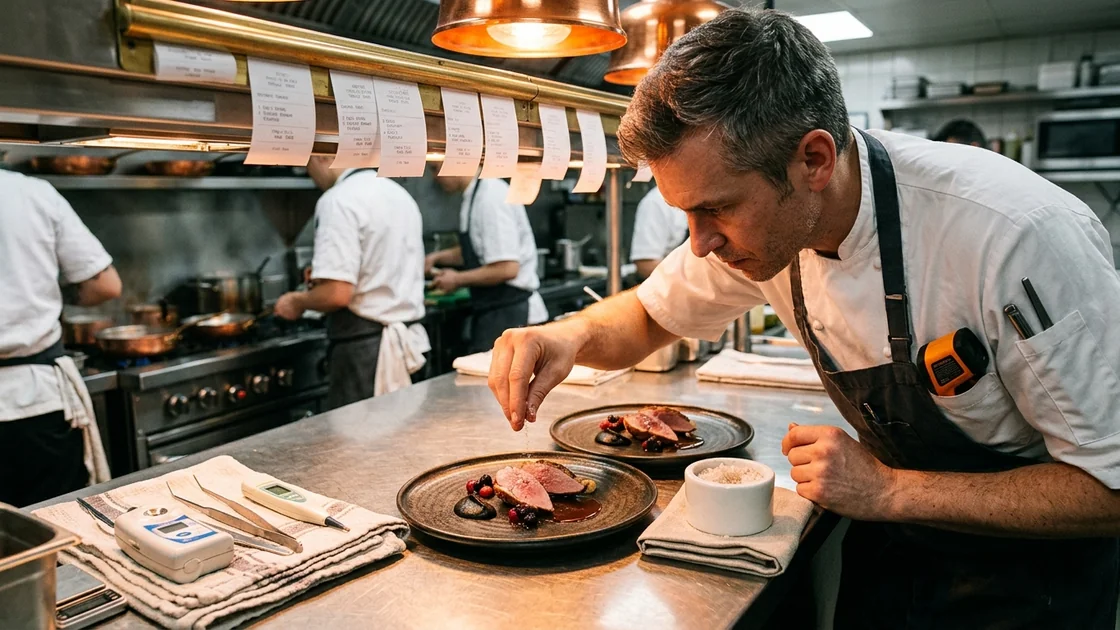
Julian Vance was once the celebrated visionary behind L'Ortolan, a Michelin-starred sanctuary of modern gastronomy, until a brutal bout of viral meningitis severed his olfactory nerves and left his palate entirely dead. Stripped of the twin senses that had defined his existence since childhood, Julian refused to abandon the kitchen, terrified that admitting his disability would destroy his life's work and scatter his loyal staff. Instead, he transformed his relationship with food from an intuitive, passionate art into a cold discipline of chemistry, weight, and thermal geometry. Over the course of several grueling months, Julian watched his beloved craft decay into joyless mechanical labor, forcing him to rely on pocket scales, refractometers, and the borrowed palates of his increasingly suspicious sous-chefs to design a pivotal autumn menu. This is the story of his silent descent into sensory isolation, the slow erosion of his spirit beneath the stainless-steel heat lamps, and the agonizing night a single, unmeasured mistake forced him to confront the hollow machinery his life had become.
The stockpot on the back burner was reducing at a rate of four milliliters per minute. Julian knew this not because the air in the prep kitchen was thickening with the caramelized, marrow-rich perfume of roasted veal bones and charred shallots, as it had for the first twenty-two years of his career, but because the digital timer velcroed to the range hood read 04:12:00, and the laser thermometer in his right hand registered the surface temperature of the liquid at a steady ninety-four degrees Celsius.
He depressed the trigger of the thermometer again. Ninety-four point two.
Around him, the subterranean kitchen of L'Ortolan was waking up to its morning rhythm. The concrete floor hummed with the low, industrial vibration of three walk-in compressors and the distant thrum of the dishwasher heating element. At the butcher's block, twenty feet away, Mateo was breaking down a saddle of venison, the thin blade of his boning knife zipping through silver skin with a wet, fibrous shhhk-shhhk that Julian felt in the fillings of his molars. Beside Mateo, Clara was washing chanterelles in a perforated steel colander, the cold tap water drumming a hollow staccato against the aluminum sink basin.
It was ten in the morning. In the old days—a period of time Julian now privately categorized as Before the Static—ten in the morning was the hour of foundation. It was when the aromatics hit the fat. It was the hour when the heavy, cellar-damp air of the basement kitchen was chased away by the sharp, green sting of crushed coriander seed, the warm hay-like sweetness of steeping saffron, and the aggressive, sulfurous bloom of garlic hitting clarified butter. Back then, Julian would walk through the back door from the alley, shed his wool coat, and know within three breaths whether the bread starter was overly acetic, whether the fish delivery had been packed in fresh ice or melting slush, and whether the night crew had properly degreased the grease traps under the plancha.
Now, Julian breathed in, and the air was simply a volume of gas moving through his nasal passages at room temperature. It had weight, humidity, and thermal value, and nothing else. It was like breathing through a clean PVC pipe.
"Chef," Clara said, her voice cutting across the clatter of steel hotel pans. She was standing by the pass, holding a small porcelain tasting spoon over a quart container of greenish emulsion. "The lovage oil is spinning a little thin. We got the late-season bunches from Miller's farm, and the stems are woodier than last week's. Do you want me to bump the xantham, or blanched spinach for body?"
Julian slipped the infrared thermometer into the breast pocket of his whites, right next to his titanium tweezers and his digital pH meter. He walked over to her station. His posture was erect, his apron strings tied with surgical symmetry at the small of his back. At forty-one, he had the lean, slightly stooped shoulders of a man who had spent two decades leaning over cutting boards, and the gray-streaked temples of a man who owed four hundred thousand dollars to a consortium of impatient restaurant investors.
"Show me," Julian said.
Clara dipped a fresh spoon into the container and held it out.
Julian took the spoon. He did not bring it to his nose first, though he had to consciously arrest the muscle memory in his bicep that tried to lift it there. Instead, he looked at the surface of the oil. Under the harsh, high-rendering LED strips he had installed above the prep tables in August, the emulsion was a slightly muddied celadon. The oil droplets were beginning to coalesce at the very edge of the porcelain, forming a microscopic halo of clear grapeseed oil around the green suspended solids.
He placed the tip of the spoon on his tongue.
What he felt was viscosity: a slick, medium-weight coating that sheared easily against the roof of his mouth. He felt temperature: sixty-two degrees Fahrenheit, slightly too warm from friction in the Vita-Prep blender, which explained the separation. He felt a faint, herbaceous astringency on the sides of his tongue—the tannins from the woody stems contracting his salivary glands—and a minor, gritty friction of pulverized cellulose that hadn't passed cleanly through the chinois.
As for the lovage itself—that soaring, celery-on-steroids, mountain-air brightness with its back-note of anise and wet stone—there was nothing. A blank wall. He might as well have been licking warm axle grease thickened with chalk.
"You ran the blender for three minutes," Julian said, keeping his voice flat, authoritative, and entirely devoid of inflection. "The friction heated the base past seventy degrees. The chlorophyll is oxidizing and the emulsion is breaking from thermal shear, not the woody stems."
Clara blinked, looking down at the quart container. "I... yeah, I walked away to grab the ice bath while it was on high."
"Re-chill the blender jar in the blast chiller for ten minutes," Julian said, dropping the spoon into the dirty utensil bain-marie with a sharp clink. "Blanch forty grams of baby spinach for twelve seconds to correct the color degradation. Re-spin with fifty milliliters of cold oil over an ice bath. Pass it through a double layer of cheesecloth, not the fine mesh. Your particulate size is too high. I can feel the fiber on my palate."
"Yes, Chef. Sorry, Chef."
Clara hurried away toward the walk-in, her clogs slapping against the rubber floor mats. Julian watched her go. His heart was beating at a steady, unpleasant eighty-eight beats per minute. Every interaction like that was a tightrope walk over an abyss. He had deduced the error through visual cues and tactile mouthfeel, reverse-engineering a culinary flaw the way a forensic accountant reconstructs a fraud from ledger discrepancies. It had worked. It had worked yesterday with the over-reduced pigeon jus, which he had diagnosed by the speed at which it coated the back of a cold spoon, and it had worked on Tuesday with the halibut cure, which he had checked by weighing the moisture loss on a jeweler's scale rather than tasting the flesh for salinity.
How long he could keep doing this before someone realized the emperor was cooking in the dark, he didn't know.
He turned back to his station, picked up a Wüsthof chef's knife, and began to brunoise a mound of peeled celery root into exact two-millimeter cubes.
Tap. Tap. Tap. Tap.
The blade met the high-density polyethylene board with a rhythm that used to soothe him. Once, the act of cutting celeriac would release a damp, earthy, nutty aroma that reminded him of autumn cellars in Lyon, where he had staged as a starving twenty-year-old with burns up both forearms and a dictionary in his back pocket. The smell would trigger an idea—maybe pairing the root with smoked bone marrow, or folding it into a brown-butter sabayon with shaved white truffles—and his mouth would water in anticipation of the dish.
Now, the celeriac was simply white matter. He used a stainless-steel ruler to check the first dozen cubes. Two millimeters by two millimeters by two millimeters. When he was satisfied that his muscle memory was calibrated to the correct geometry, he swept the ruler aside and processed the rest of the root with the cold, unblinking efficiency of a CNC milling machine.
The illness had not seemed dramatic at the time. In late May, during the transition from the spring pea-and-morel menu to the early summer shellfish dishes, Julian had caught what he assumed was a vicious summer flu from a dishwasher who had come to work shivering and gray-faced. For four days, Julian had lain in his spare, high-ceilinged apartment three blocks from the restaurant, sweating through his Egyptian cotton sheets while a white-hot spike of pain drove itself repeatedly through the base of his skull. His neck had stiffened until he couldn't touch his chin to his chest. Light from the streetlamp outside his window felt like crushed glass rubbed into his corneas.
His ex-wife, Elena, who still managed the restaurant's wine program and front-of-house operations despite their amicable divorce three years prior, had found him delirious on the bathroom tile and called an ambulance.
Viral meningitis, the neurologist at Mount Sinai had said. Less lethal than its bacterial cousin, mostly requiring supportive care, intravenous fluids, and dark quiet rooms. Julian had spent six days in a hospital bed, listening to the rhythmic beep of an infusion pump and worrying about whether Mateo was properly scoring the duck breasts so the fat rendered without greying the meat.
On the fifth day, the fever broke. The headache receded to a dull, manageable throb behind his eyes. A nurse brought him a plastic tray containing a cup of generic chicken broth, a packet of saltine crackers, and a container of bright red gelatin.
Julian had peeled back the foil lid on the broth. A curl of steam rose into his face. He inhaled, expecting the cheap, familiar, monosodium-glutamate-and-celery-powder comfort of hospital bouillon.
Nothing happened.
He frowned, leaning closer to the plastic cup, and snorted hard through his nostrils. The steam warmed his upper lip. There was no scent. He tore open the saltines and shoved one into his mouth. He heard the dry crunch in his inner ear. He felt the paste form as his saliva broke down the starch. On the tip of his tongue, there was a sharp, stinging prickle—the sodium chloride hitting his salt receptors—followed by an eerie, cavernous silence. No toasted wheat. No yeast. No shortening.
He picked up the plastic spoon and ate the red gelatin. It was cold. It was slippery. It triggered a dull, monolithic sensation of sweetness at the front of his tongue, like a single low note played on a broken synthesizer, entirely stripped of the artificial cherry or strawberry ester that should have accompanied it.
"Inflammation of the cribriform plate and the olfactory bulb," Dr. Aris Thorne had explained two weeks later in a quiet office overlooking Central Park. A high-resolution MRI of Julian's sinuses and brain glowed on a dual-monitor setup on the mahogany desk. "The virus caused significant localized edema right where the olfactory nerve fibers pass through the ethmoid bone from your nasal cavity into the brain. Think of those nerves like thousands of tiny telephone wires passing through a stony sieve. When the tissue swelled, the wires were crushed against the bone."
Julian had sat in the leather chair, his hands gripping his knees so hard his knuckles turned the color of bleached almonds. "And my tongue? I can't taste food, Doctor. I'm a chef. I have two Michelin stars. I can't taste a goddamn thing."
"Technically, you can taste," Dr. Thorne said gently, tapping his pen against his lower lip. "Your glossopharyngeal and facial nerves are completely intact. During our exam, you correctly identified sucrose, sodium chloride, citric acid, quinine, and monosodium glutamate. Sweet, salty, sour, bitter, umami. Your tongue is working fine, Mr. Vance."
"Don't give me semantics," Julian snapped, his voice cracking with a panic he hadn't felt since his father died. "When I put a piece of dry-aged ribeye in my mouth, it feels like I'm chewing a wet leather glove dipped in salt water."
"Because eighty to ninety percent of what human beings call flavor is actually retronasal olfaction," Thorne said. He turned the monitor slightly so Julian could see the gray, cloudy smear at the base of his frontal lobe. "When you chew and swallow, volatile organic compounds travel up the back of your pharynx into your nasal cavity. Your tongue only gives you the five basic dimensions—the wireframe of the house, if you will. Your nose paints the walls, hangs the curtains, and puts furniture in the rooms. Without the olfactory bulb, you just have the wireframe. Salt. Acid. Sugar. Bitter. Broth."
"When does the swelling go down?" Julian asked. "What steroids do I take? I'll do prednisone. Injections. Whatever it takes."
Dr. Thorne looked at him with the practiced, professional pity that doctors reserve for pianists with arthritis and marathoners with shattered knees. "We did a course of high-dose corticosteroids in the hospital. The edema has already resolved, Mr. Vance. What we're looking at on this scan is scarring. Gliosis."
The air conditioner in the corner of the office hummed. Outside, a yellow cab honked twice on Fifth Avenue.
"Olfactory neurons are unique in the central nervous system because they can regenerate from basal stem cells," Thorne continued, though his tone offered very little rope to cling to. "We do see spontaneous recovery in some patients over six months to two years. You can try olfactory training—sniffing four distinct essential oils twice a day while visualizing the scents. Rose, eucalyptus, clove, lemon. It tries to force neuroplasticity. To re-map the broken wires."
"And if they don't re-map?"
"Then this is your new baseline," Thorne said softly. "I'm very sorry."
Julian had walked out of the medical building into the humid June afternoon. He had walked past a street cart selling roasted nuts; he saw the blue smoke billowing from the tin chimney, saw a tourist couple sigh with pleasure as they walked through the plume, and smelled nothing as the smoke washed over his face. He had walked past an overflowing municipal garbage can baking in the eighty-five-degree sun, buzzing with green bottle flies, and smelled nothing. He had gone home, locked his door, opened a four-hundred-dollar bottle of 2010 Domaine Jamet Côte-Rôtie—a wine famous for its intoxicating aromas of black pepper, smoked meat, violets, and crushed raspberries—and poured a glass.
He had buried his nose in the Riedel crystal and inhaled until his lungs ached. Nothing. He had drunk half the glass in one gulp. It was sour, astringent, slightly bitter, and burned his throat with fourteen percent ethanol. It tasted like vinegar mixed with rubbing alcohol and oak chips.
He had poured the rest of the bottle down the kitchen sink, watched the dark purple liquid swirl into the stainless-steel drain, and decided that he would tell no one. Not Elena. Not Mateo. Not the investors who were currently negotiating the lease on a second concept in Tribeca. A deaf composer could still read sheet music; Beethoven had written the Ninth Symphony with his ear pressed against the floorboards to feel the vibrations of the piano. Cooking was just physics and chemistry applied to biological matter. If he couldn't smell the music, he would simply measure the vibrations.
By October, the lie had become an elaborate, exhausting architecture of stainless steel and notebooks.
Julian stood in his glass-walled office at the back of the kitchen during the two-hour lull between afternoon prep and the five-thirty staff meal. The door was locked. The venetian blinds were drawn tight so the line cooks couldn't see inside.
On his desk sat four small amber glass vials: Rose, Eucalyptus, Clove, Lemon.
Dutifully, with the grim determination of an atheist saying the rosary, Julian uncapped the first vial. Lemon. He held it half an inch from his right nostril and inhaled for five seconds. He closed his eyes and tried to summon the ghost of an Amalfi lemon—the bright, oily spray of zest when you twist a peel over a cocktail, the sharp, clean floor-cleaner tang of limonene. Nothing came. Even the memory of the smell was beginning to fray around the edges, like an old photograph left out in the sun. He could remember that he used to love the smell of lemons, the way one remembers a childhood phone number without remembering the house it rang inside, but the sensory data itself was corrupting in his hippocampus.
He capped the lemon and uncapped the clove. He inhaled. Nothing. Eucalyptus produced a faint, cool prickle inside his nasal cavity—that was the trigeminal nerve reacting to menthol, Dr. Thorne had explained, the same nerve that detected the burn of chili peppers, the coolness of mint, and the sting of ammonia, completely separate from smell. It was a sensation, not a scent.
He swept the vials back into his desk drawer and slammed it shut.
In front of him lay a black leather-bound Moleskine notebook, its pages covered in dense, tiny handwriting and columns of numbers. This was his Bible now. His prosthetic palate.
Over the past four months, Julian had quietly converted every intuitive recipe in L'Ortolan's repertoire into strict ratios and chemical parameters. Where his old recipe cards said Season to taste with Maldon and lemon juice until bright, the black notebook said: 1.4% NaCl by total weight of protein; titrate with 0.3% citric acid solution until pH reaches 4.65.
On the desk beside the notebook sat his secret arsenal: a digital pocket refractometer for measuring the Brix sugar levels of fruit reductions and root vegetables; a laboratory-grade pH meter with a spear-tip probe designed for testing semi-solid foods like cheese and meat; a jeweler's scale accurate to a hundredth of a gram; and a moisture analyzer he had bought off a food-science supply website using a prepaid credit card shipped to his apartment.
A sharp knock rattled the glass door.
Julian quickly slid the refractometer and the pH meter under a stack of vendor invoices. "Come in," he called, unlocking the latch.
Elena stepped into the small office, bringing with her a draft of cool air from the dining room. She was wearing a charcoal silk blouse and tailored trousers, her dark hair pulled back into the severe, elegant chignon she wore for service. In her hands, she carried two long-stemmed burgundy glasses and a uncorked bottle of Pinot Noir.
Even without his nose, Julian knew the routine. It was Wednesday. Wine pairing day for the new autumn tasting menu that was scheduled to launch on Friday.
"You have the blinds closed again," Elena said, setting the glasses down on the corner of his desk. She looked at him closely, her dark brown eyes narrowing with that familiar, perceptive scrutiny that had once made her the only person in New York who could tell when he was manic versus when he was actually inspired. "Are you getting another migraine? You look gray, Julian."
"Fluorescent lights are bothering my eyes," Julian lied smoothly, leaning back in his chair and lacing his fingers over his stomach. "And I'm trying to price out the white truffle allocation from Alba. The margins are disgusting this year. Two thousand a pound for thirty-gram pebbles that are half dirt."
"Well, don't use them on the turbot then," Elena said, pouring two ounces of pale ruby liquid into each glass. "Use the matsutake from Oregon. They have that incredible spicy pine-needle thing going on right now, and it won't destroy our food cost."
Spicy pine-needle thing. Julian felt a dull ache behind his sternum. Last autumn, he had spent twenty minutes with his face buried in a cedar box of Oregon matsutake, intoxicated by their weird, funky marriage of Red Hots cinnamon candy and damp Pacific Northwest forest floor. Yesterday, when the first box of the season had arrived, he had picked one up, squeezed the cap to verify its turgidity and freshness, and smelled nothing at all.
"The matsutake goes with the squab," Julian said, because his notes from 2021 said matsutake went with squab. "What are we pouring with the venison?"
"That's why I'm here," Elena said, sliding one of the glasses across the desk toward him. "We're doing the venison saddle with the fermented blackberry jus and the toasted juniper oil, right? I was going to pour a northern Rhône, like a Cornas, as usual. All that blood and iron and black olive. But my distributor brought by six cases of this—it's a 2017 Savigny-lès-Beaune from a tiny producer who uses fifty percent whole-cluster fermentation. Smell this. The stem inclusion gives it this wild, sappy, herbal lift that hits the exact same note as your juniper oil, and the sour cherry acid cuts right through the venison fat."
She raised her glass, swirled it expertly, and closed her eyes as she inhaled. A small, genuine smile touched the corners of her mouth—the involuntary expression of pure hedonic pleasure that Julian saw on the faces of his cooks and diners fifty times a day, and which now felt like an obscenity performed in front of a eunuch.
"Go on," she said, opening her eyes and nodding at his glass. "Tell me that doesn't smell like the floor of a pine forest after it rains."
Julian picked up the glass by the stem. He swirled it, watching the viscosity of the legs sheeting down the crystal. Thirteen percent alcohol, low residual sugar. He lifted the glass to his nose, tilted his head down, and inhaled deeply.
Air. Cool, slightly damp air. A faint, sharp tingle at the very top of his nasal passage from the evaporating alcohol.
He held his face over the glass for three seconds—the exact duration a sommelier takes to evaluate a bouquet—and then took a small sip, drawing air across his tongue to aerate the wine in his mouth with a soft slurp.
His tongue registered high acidity—malic and tartaric—causing an immediate, sharp salivation under his jaw. He felt the drying, puckering grip of green tannins on his gums and the insides of his cheeks, which confirmed what Elena had just told him about the whole-cluster stems. The body was light-to-medium. There was no cherry. No pine forest. No rain. Just sour, bitter water with an alcoholic bite.
He swallowed. Now he had to speak. He had to reflect her own words back to her, slightly remixed into chef-speak, to prove he had experienced the same universe she had.
"The stems are aggressive," Julian said, setting the glass down and looking at the ruby ring it left on a stray piece of paper. "A lot of green tannin on the finish. If we pair this with the venison as it's currently plated, the blackberry jus is going to make the wine taste metallic. Too much acid on acid."
Elena paused, swirling her glass again, her brow furrowing as she reconsidered the pairing through his critique. She took another sip, chewing the wine thoughtfully. "Metallic? You think the fermented blackberry is too tart for the Savigny?"
"The blackberry ferment sits at a pH of three point four," Julian said. He caught himself—nobody normal talked in pH numbers during a wine tasting—and quickly pivoted. "It's sharp, Elena. Like raw underripe bramble. If you want to pour whole-cluster Burgundy, I'll need to round out the jus with ten percent more roasted bone marrow and maybe a touch of dark muscovado to bridge the gap to those stem tannins. Otherwise, the dish and the wine are going to fight each other."
Elena stared at him for a moment, then slowly nodded, a look of reluctant admiration replacing her concern. "You're right. The acid in the ferment would strip the fruit right out of the wine. If you add the muscovado and marrow, it'll pull out the baking spice notes from the oak and soften the stems. God, your palate is terrifying sometimes, Julian. You barely even tasted that."
"I know my sauce," Julian said quietly.
"Okay. Let's do that. I'll lock in the six cases." She picked up the bottle and her glass, leaving his half-full on the desk. At the door, she paused, her hand on the brass handle. "Hey. Come out into the dining room tonight after the second seating. Jonathan Gold's old editor from LA is at table four with a publisher from Phaidon. They're still talking about doing the monograph next fall. You need to be seen. You've been hiding in the galley like a troll for three months."
"I'm launching a menu in forty-eight hours, Elena. I belong on the pass."
"You belong in the restaurant you built," she said softly. "You used to love talking about the food, Julian. Lately you look like you're serving a prison sentence back here. Just... five minutes at table four. Please?"
"Five minutes," he agreed, looking down at his invoices. "After the nine o'clock push."
When the door clicked shut behind her, Julian reached out, picked up his wine glass, and poured the remaining Burgundy into the small potted fern sitting on his filing cabinet. The fern had died three weeks ago from root rot and ethanol poisoning, its fronds brown and brittle, though Julian kept trimming the dead leaves with his plating scissors so nobody would notice and replace it.
Service at L'Ortolan was not loud. That was a point of pride Julian had inherited from the three-star kitchens of Europe where he had trained. There was no screaming, no throwing of sautéed pans, no theatrical television-chef tantrums. There was only the hiss of gas, the rhythmic clack of tongs, the whisper of tickets sliding into the aluminum rail, and Julian's voice calling orders followed by a chorus of crisp Oui, Chefs.
At 7:45 PM, the dining room was full. Sixty-four covers, each paying three hundred and eighty dollars for twelve courses of precise, seasonal minimalism.
Julian stood at the center of the pass, beneath the infrared heat lamps that bathed the stainless-steel counter—and the back of his neck—in a relentless, dry, orange warmth. Before him, arranged in a neat semicircle on a folded linen napkin, were his tools: two pairs of offset plating tweezers, a slotted spoon, a stack of tasting spoons, and a small plastic squeeze bottle of ninety-percent isopropyl alcohol for wiping plate rims.
"Ordering, table twelve, two covers, second course," Julian called out, his eyes scanning the thermal paper ticket. "Two scallop, one allergy to alliums on seat two. Mateo, confirm the Seat Two broth is the ginger-dashi, not the charred scallion."
"Oui, Chef, ginger-dashi working for Seat Two," Mateo called back from the saucier station, where six small copper Windsor pans were nested over blue rings of flame.
"Pick up table seven, four covers, fourth course," Julian continued. "Four turbot, four sunchoke, walking in ninety seconds. Clara, your sunchoke purée looked stiff on table five. Thin it with five milliliters of warm brown butter whey before you plate."
"Oui, Chef!"
Julian turned his attention to the four plates waiting under the heat lamps for Table Two: the signature dish of the outgoing late-summer menu, poached Maine lobster tail glazed in toasted lobster-roe butter, served with pickled white strawberries and a verbena foam.
It was a dish he had invented two years ago in a moment of pure, synesthetic joy. He had been walking through the Union Square Greenmarket in June, eating a container of slightly underripe, tart pineberries while the smell of lemon verbena from an herb vendor's stall drifted past on a humid breeze, mingling with the briny, iodine scent of the fishmonger's truck twenty yards away. In his mind, the three smells had snapped together like magnets. Within four hours, he had been in the kitchen emulsifying raw green lobster coral into sweet cream butter and infusing heavy cream with bruised verbena leaves.
Now, looking down at the four warm ceramic bowls, Julian saw only an assembly of components that required quality control.
He picked up a tasting spoon and dipped it into the small copper pot of verbena foam sitting at the edge of the pass. He touched the foam to his tongue.
Temperature: fifty-eight degrees Celsius. Correct. Texture: fine micro-bubbles, lecithin holding stable without weeping at the base. Taste: sweet, slightly creamy, a sharp citric sourness from the lime juice he used to set the pH, and a faint, grassy bitterness at the back of his throat from the steeped leaves.
He couldn't smell the lemon verbena. For all he knew, the nocturnal prep cook had accidentally steeped mint, or basil, or torn-up lawn clippings from Central Park. Last month, terrified of exactly that scenario, Julian had instituted a new rule: all herbs had to be weighed into labeled, color-coded vacuum bags during the day shift while Mateo and Clara were present, and checked off on a clipboard with two signatures before being added to any infusion. The cooks thought he had developed obsessive-compulsive disorder after his illness; Julian let them think it. Madness was preferable to incompetence.
Next, he examined the lobster tails. He didn't need to taste them. He pressed the tip of his right index finger gently against the thickest cross-section of the tail meat on plate one. By the resistance of the muscle fibers—a specific, bouncy yield that lay halfway between the raw jelly of an uncooked crustacean and the rubbery bounce of an overcooked one—he knew the internal temperature had peaked at fifty-three degrees Celsius in the butter bath.
Using his tweezers, he placed three translucent slices of pickled white strawberry atop each medallion of lobster, spacing them exactly twelve millimeters apart, angled at forty-five degrees toward the restaurant's logo on the bottom of the bowl. He spooned the coral glaze in a tight crescent to the left, and dropped a quenelle of white foam to the right.
"Service, table two," Julian said.
Two backwaiters in bespoke linen aprons materialized behind him, lifted the four plates with white-gloved hands, and vanished through the heavy soundproofed doors into the dining room.
Julian wiped the pass with a damp sanitizer towel. Left to right. Top to bottom. Fold the towel into quarters. Wipe again.
This was the part that was killing him. It wasn't the fear of being caught, though that was a constant, cold stone in his stomach. It was the boredom.
No—boredom was too soft a word. It was a profound, existential nausea.
For twenty-five years, cooking had been an act of communion. When he seared a piece of sweetbread in foaming butter with thyme and garlic, the smell rising from the pan was a conversation between the ingredient and his brain. He would smell the Maillard reaction—the amino acids and reducing sugars colliding at three hundred degrees to create hundreds of complex flavor compounds—and his nervous system would light up with dopamine. The kitchen was a roaring furnace of sensory feedback. Every sizzling pan, every cracked peppercorn, every reduction was a vibrant, living thing that spoke to him in a language richer and more immediate than English.
Now, he was an assembly-line foreman in a factory that manufactured expensive biological waste.
He looked down the line. He saw Mateo basting four breasts of squab in a carbon-steel pan, tipping the pan toward the flame, spooning foaming brown fat over the skin, a look of intense, sensual concentration on his sweat-sheened face as he inhaled the aroma of roasting game bird and crushed juniper. Julian watched the smoke rise from the pan. To Julian, it was just aerosolized lipids polluting the air filtration system. The squab was just a dead bird undergoing protein denaturation. The people in the dining room were just sixty-four mammalian digestive tracts waiting to macerate his geometry with their molars, dissolve it in hydrochloric acid, and flush it into the Manhattan sewer system twelve hours later.
Without the transcendent illusion of flavor, the entire enterprise of fine dining revealed itself as a grotesque, pretentious farce. He was charging four hundred dollars to arrange dead animals and boiled roots into pretty circles with tweezers, ten hours a day, six days a week, under harsh lights in a windowless basement.
"Chef?"
Julian blinked. Mateo was standing at the pass, holding up a small sauté pan containing the jus for table eight.
"Sorry, Chef, I called twice," Mateo said, a flicker of confusion in his dark eyes. "The pigeon jus for the two-top VIPs. The bones in this batch were roasted a little darker by the morning crew. Can you taste it? I think it's riding the line between caramelized and bitter, and I don't want to mount the butter until you sign off."
The kitchen seemed to quiet down, though perhaps that was just the blood rushing in Julian's ears. This was the trap. Riding the line between caramelized and bitter.
Bitterness was one of the five basic tastes his tongue could still detect. In fact, without the volatile aromas of roasted meat, caramelized mirepoix, and Madeira wine to mask and balance it, bitterness was all Julian could taste in a dark reduction. Every brown sauce tasted like burnt coffee to him now. He had lost his ability to judge where pleasant roasted complexity ended and acrid carbon began, because both registered as the same harsh, quinine-like slap at the base of his tongue.
If he tasted it and said it was burned when it was actually just deeply complex, Mateo would know something was wrong. If he said it was fine and it was actually scorched, he would serve burnt sauce to a food writer at table eight.
Julian picked up a clean spoon. He dipped it into the glossy, dark mahogany liquid.
First, he looked at the viscosity and color against the white porcelain of a spare saucer. He tipped the saucer. The sauce ran slowly, leaving a translucent amber trail that held its edges without bleeding water. There were no black flecks of carbonized fond suspended in the liquid.
He put the spoon in his mouth.
Immediately, his tongue recoiled at the bitterness. It was sharp, astringent, and heavily salty, with a thick, gelatinous mouthfeel that glued his lips slightly together as the collagen cooled. To his broken brain, it tasted atrocious—like salted tar with a splash of sour wine.
He kept his face an absolute mask of stone. He looked at Mateo's face instead.
Mateo had been his sous-chef for four years. Mateo was cautious, almost pathologically afraid of failure, and tended to under-roast his bones unless pushed. If Mateo thought a sauce was "riding the line," it meant the sauce was probably ninety-five percent of the way to perfection, right on the aggressive, savory edge that Julian used to champion before his illness, and Mateo was simply nervous about taking responsibility for it.
"It's right on the edge," Julian said calmly, dropping the spoon into the wash bin. "The fond got hot, yes. Another thirty seconds in the oven and we'd be throwing it out. Drop two grams of cold unsalted butter in right now to coat the tannins on the finish, and add three drops—not four—of the aged sherry vinegar to lift the middle. Don't reduce it another second. Keep it off the direct flame."
Mateo let out a long breath, his shoulders dropping an inch. He dipped his own spoon in after whisking in the butter and vinegar, tasted it, and his eyes widened slightly. "Yeah. Damn. The vinegar just hid the bitter note completely. Oui, Chef. Thank you."
Julian nodded once and turned back to the tickets. Beneath his crisp white double-breasted jacket, cold sweat was trickling down his ribs, soaking into the waistband of his hounds-tooth check trousers.
At 9:30 PM, true to his word, Julian stripped off his apron, checked his reflection in the stainless-steel door of the walk-in to ensure there were no smudges of purée on his collar, and pushed through the heavy doors into the dining room.
The transition from the kitchen to the front of the house was always jarring, like stepping from the engine room of a submarine into a quiet cathedral. The dining room of L'Ortolan was all muted dove-gray velvet, warm walnut paneling, and tables spaced far enough apart that no diner could hear their neighbor's hedge-fund gossip. A pinpoint halogen spotlight shone directly down onto the center of each white tablecloth, illuminating the food like jewelry in a museum case while leaving the diners' faces in flattering, romantic shadow.
Julian walked the perimeter of the room, his hands clasped behind his back. Diners looked up as he passed; a man in a bespoke Tom Ford suit nodded deferentially; a woman in emeralds whispered to her companion and pointed subtly with her butter knife. Julian offered them all the same slight, enigmatic half-smile he had practiced in his bathroom mirror—the smile of a genius too burdened by his craft for small talk.
He reached Table Four. The former editor from Los Angeles, a silver-haired man named Arthur Pendelton who had written three thousand words about Julian's use of fermented porcini back in 2018, stood up immediately, extending a soft, manicured hand.
"Julian! Look at you, you've lost weight, you bastard. Don't tell me you're running marathons like the rest of these neurotic young chefs."
"Just running the pass, Arthur," Julian said, shaking his hand and nodding to the woman beside him, Sarah Vance-Sterling from Phaidon Press. "Good to see you both. Elena tells me we're taking care of you."
"Taking care of us?" Arthur laughed, gesturing toward the empty ceramic bowl in front of him, which was streaked with the pale green remnants of the lovage oil and the dark smear of charred onion ash from the third course. "Julian, this charred leek and razor clam dish is obscene. Truly. I was just telling Sarah, nobody in America understands the architecture of aromactics the way you do. When the waiter poured the smoked dashi at the table, the way the woodsmoke hit the anise in that lovage oil... I swear to God, it smelled like a clam bake on the coast of Maine inside an herb garden. How did you get the lovage so vibrant this late in October?"
Julian looked down at the green smear on the plate. Blanch forty grams of baby spinach for twelve seconds to correct the color degradation.
"It's all about temperature control during the emulsification," Julian said, his voice sounding to his own ears as if it were coming from a speaker in the ceiling. "If the blades heat the herb past seventy degrees, you lose the volatile top notes and the chlorophyll oxidizes. We spin it over dry ice now."
That last part was a lie—they used a regular ice bath—but food writers loved hearing about dry ice.
Sarah leaned forward, her pen hovering over a small leather notebook next to her bread plate. "That's exactly the kind of obsession we want to capture in the book, Julian. Not just recipes, but the philosophy of perception. Elena mentioned you're rolling out the full autumn menu on Friday. What's the centerpiece? What's making you excited right now?"
Julian stood beside the table. A sommelier walked past carrying a decanter of old Nebbiolo; Arthur's nostrils flared appreciatively as the wine passed, his eyes tracking the bottle. On the table, a beeswax candle flickered in a glass hurricane, no doubt releasing a faint honeyed warmth that Julian couldn't detect. Across from him sat two people whose entire careers were built on translating sensory pleasure into language, asking him what made him excited.
He felt a sudden, violent urge to reach down, pick up the heavy silver water pitcher from the waiter's station, and smash it through the center of their table. He wanted to tell them that the green oil they were raving about was half supermarket baby spinach because the lovage was dead and woody, and that he couldn't tell the difference between his four-hundred-dollar tasting menu and a bowl of warm wallpaper paste salted to 1.4 percent.
"Precision," Julian said instead, his jaw tight. "I'm interested in removing the noise. When you strip away the unnecessary garnishes, you're left with the structural truth of the ingredient. Friday's menu is very pared back. Very honest."
"Monastic," Arthur murmured, delighted by the word. "Yes! I can taste it already. A move away from maximalism toward pure essence. I'll be back next week to review it properly."
"I look forward to it," Julian said.
He excused himself thirty seconds later, ignoring Elena's questioning look from the maître d' stand, and retreated back through the padded doors into the kitchen. He didn't stop at the pass. He walked straight past the line, down the tiled hallway past the dry storage cages, pushed open the heavy steel fire door that led to the alley, and stepped out into the October night.
The alley smelled of nothing, which was a mercy, because three dumpsters shared by L'Ortolan and a neighboring steakhouse sat ten feet away under the fire escape.
Julian leaned the back of his skull against the cold, damp brick wall and closed his eyes. The brick was forty-eight degrees. He could feel the grit of the mortar against his scalp. Above him, between the narrow canyon walls of the Manhattan tenement buildings, a strip of sky showed a pale, smog-blurred smear of clouds illuminated by the city lights.
He reached into his pocket, pulled out a pack of Japanese menthol cigarettes he had started buying in July, and lit one with a disposable lighter. He didn't smoke for the nicotine. He smoked because when he inhaled two cigarettes back-to-back as hard as he could, the heavy dose of menthol and hot smoke triggered the trigeminal pain receptors in his sinuses and throat, producing an icy, burning ache that felt, for three or four seconds, like an actual sensory experience. It was the culinary equivalent of cutting himself with a razor blade just to prove he still had nerves under his skin.
He sucked the smoke deep into his lungs until he coughed, his chest spasming, tears springing to the corners of his eyes from the chemical burn of the menthol. He spat onto the asphalt beside his black leather kitchen clogs and stared at the glowing orange tip of the cigarette.
Forty-one years old, he thought. Thirty more years of this.
Thursday was the final test run for the new autumn menu.
In the afternoon, before the restaurant opened for the final night of the summer menu, Julian gathered Mateo, Clara, and the two senior chef de parties around the stainless-steel prep island. In the center of the table sat four versions of the new fifth course: Poached Quail Chest with Black Trumpet Mushroom Purée, Pickled Elderberries, and a Sauce Périgueux made with Madeira and black winter truffles.
This was the dish that was supposed to anchor the savory progression of the menu. It was classic French technique updated with modern lactic fermentation—the elderberries had been fermenting in a two-percent salt brine in the dark corner of the dry-aging room since late August.
"Walk me through the adjustments from Tuesday's test," Julian said, standing at the head of the table with his arms crossed, his black notebook open beside his elbow.
"Okay," Mateo said, pointing with the tip of a paring knife at the four small plates. "On Tuesday, you said the black trumpet purée had too much water activity and was bleeding onto the plate, so we reduced the mushroom cooking liquid down to a glace before blending it with the roasted trumpets and ten percent butter by weight, plus zero-point-two percent gellan gum for heat stability. The quail is brined in a four-percent salt, two-percent sugar solution for ninety minutes, cooked sous-vide at fifty-eight degrees for forty minutes, then flashed skin-side down on the plancha for twenty seconds."
"And the sauce?" Julian asked.
"Base of roasted quail carcasses, veal jus, reduced by two-thirds," Clara chimed in. "Finished with Sercial Madeira, forty grams of minced Périgord truffle per liter, and ten milliliters of the elderberry fermenting brine for acidity."
"Spoons," Julian said.
The four cooks picked up their tasting spoons and dug into the sample plates. Julian picked up his own spoon. He did not eat the quail—he knew what fifty-eight-degree poultry breast felt like; he had set the immersion circulator himself. Instead, he took a small amount of the black mushroom purée, a single pickled elderberry, and a spoonful of the truffle sauce, putting them all into his mouth at once.
He chewed slowly, his eyes fixed on the stainless-steel shelving unit on the opposite wall.
His tongue mapped the wireframe: Salt: medium-high, hitting the sides of the tongue immediately from the elderberry brine and the reduced veal glace. Acid: sharp, lactic tang when the tiny elderberry popped between his premolars, followed by the acetic bite of the Madeira. Umami: massive, heavy, coating the entire oral cavity—the glutamate from the black trumpets and the inosinate from the veal bones creating a synergistic weight that made his jaw ache slightly. Sweet: very low, just a whisper from the caramelized mirepoix in the stock. Texture: the purée was velvety, completely smooth thanks to the gellan gum; the sauce was glossy; the minced truffle provided tiny, firm, slightly cartilaginous nuggets against his teeth.
And the flavor? The heady, erotic, musky perfume of black winter truffles meeting nutty Madeira and the apricot-like forest aroma of black trumpets?
Zero. Darkness. A silent movie played by ghosts.
He looked at his cooks. He had become an expert at reading micro-expressions over the last sixteen weeks. He didn't need a nose when he had four healthy twenty-somethings standing in front of him whose faces were open books.
Clara was chewing with her eyes raised toward the ceiling, nodding slowly—she liked it, she was impressed by the richness. The two line cooks looked pleased, though they would have looked pleased if Julian had served them boiled boot leather, out of sheer intimidation.
Mateo, however, had stopped chewing. His brow was slightly knitted. He took a second small spoonful of just the black trumpet purée and the elderberry together, rolling it around his tongue, his upper lip curling down by a millimeter.
"Mateo," Julian said sharply. "Speak."
Mateo looked up, startled. "Chef, the texture on the purée is perfect now. No weeping at all. And the quail is spot on."
"I didn't ask what was right," Julian said, stepping closer. "Tell me why you just tasted the purée and the elderberry twice."
Mateo swallowed, glancing nervously at Clara before looking back at Julian. "It's... the elderberry brine took on a really heavy wild-yeast funk in the last week, Chef. Like brettanomyces. Barnyard. On its own it's cool, it's interesting, and with the truffle sauce it works because the truffle is already funky. But when you hit the elderberry right next to the black trumpets, the earthy notes in the mushroom and the barnyard note in the berry kind of... pile up on each other. It makes the middle of the dish taste a little muddy. Like wet leaves that have been sitting in a gutter too long."
Brettanomyces. Wet leaves in a gutter.
Julian stared at the small black berry on his plate. That was volatile phenol territory—4-ethylphenol and 4-ethylguaiacol, chemical compounds produced by wild yeast that existed entirely in the olfactory realm. They didn't change the pH of the brine. They didn't change the salinity on the refractometer. They didn't change the texture or the color. To Julian's instruments, and to Julian's tongue, a clean lacto-fermented berry and a berry contaminated with barnyard-smelling wild yeast were chemically identical.
His system had failed. A variable had slipped through the sieve of scales and probes because it lived entirely in the air between the throat and the nose.
"Clara," Julian said coldly, turning his head toward her. "Did you smell the elderberry jar before you pulled the brine for the sauce?"
Clara flushed crimson from her collarbone to her hairline. "I—yes, Chef, I mean, I thought it was supposed to have that funky lacto smell, you told us in August we wanted it aggressive—"
"Aggressive lactic acidity is clean," Julian said, his voice dropping an octave into the quiet register that made line cooks drop pans. "Ethylphenol is spoilage. We are not serving natural wine garbage on a two-star plate. Why didn't you bring the jar to me before you ruined two liters of truffle Périgueux with contaminated brine?"
"Because you tested the brine on Monday!" Clara blurted out, her hands balling into fists against her apron.
The kitchen went dead silent. Even the dishwasher in the back corner stopped loading racks for a moment.
Julian froze. Monday.
He remembered Monday afternoon. He had gone into the walk-in with his clipboard, dipped his pH probe into the four fermentation crocks on the top shelf, verified that the elderberries were sitting at a safe, stable 3.6 pH with three-point-eight percent salinity, logged it in his book, and put a green tape label on the lid that said APPROVED BY CHEF - 10/14. He had even popped one berry into his mouth to make sure they hadn't gone mushy. They had been firm and sour.
"On Monday," Julian said slowly, his heart hammering against his ribs like a trapped bird, "the yeast hadn't bloomed into the secondary phenolic stage. Did you leave the crock out on the counter while you were portioning for prep on Tuesday?"
Clara opened her mouth, then hesitated. Doubt flickered across her eyes—the gaslighting of an authority figure who was never wrong. "I... I had it out for maybe forty minutes while I was straining the blackberries next to it."
"Forty minutes at seventy-eight degrees kitchen ambient temperature," Julian said with icy contempt, seizing the lifeline with both hands. "That's all it takes for surface kahm yeast to oxidize the top layer of brine. Dump the crock. Dump the two liters of Périgueux. Mateo, pull the backup veal glace from the freezer and rebuild the sauce from scratch before five o'clock. Use aged balsamic and raw verjus for the acid correction instead of the elderberry brine. For the garnish, we'll switch to pickled huckleberries from the walk-in—the ones in the vinegar pickling liquid, not the lacto-ferment."
"Oui, Chef," Mateo said quietly, already reaching for the hotel pan of ruined sauce.
Clara didn't move for two seconds. She was staring at Julian's face, her eyes wide, shiny with humiliated tears, but underneath the humiliation there was a tiny, sharp glint of confusion. She knew—somewhere deep in her gut—that a sealed glass crock doesn't develop a full-blown brettanomyces infection in forty minutes on a prep table. She knew that jar had smelled like a horse blanket on Monday when he put the green tape on it.
"Do you have a problem with my instructions, Clara?" Julian asked softly.
"No, Chef," she whispered, grabbing the quart container of fermented elderberries and turning toward the trash bin. "Sorry, Chef."
Julian turned on his heel and walked back to his office, his knees feeling strangely hollow, as if the marrow had been sucked out of his femurs.
He didn't go home that night after service.
The restaurant closed at midnight. The cleaning crew came in with their hoses and bleach buckets at twelve-thirty. Mateo and Clara left at one, walking out into the rain together under a single black umbrella—Julian watched them from the dark upstairs hallway window and saw them talking intensely on the sidewalk by the streetlight, Clara gesturing with her hands, Mateo shaking his head and looking back toward the restaurant's darkened façade.
By two in the morning, Julian was completely alone in the building.
He went down to the kitchen, turned on a single bank of low-wattage prep lights, and tied on a clean apron. The stainless-steel room gleamed in the half-dark, sterile as an operating theater. The smell of bleach from the night porters' mops was strong enough that its chlorine fumes made Julian's eyes water slightly—another trigeminal irritation—though he couldn't smell the chemical itself.
Friday was sixteen hours away. The new autumn menu. Twelve courses. Arthur Pendelton had called Elena at ten o'clock to say he had managed to move his reservation up to Friday night after all, because he couldn't wait a week to experience Julian's "monastic turn."
Julian walked into the walk-in cooler and began pulling every single mise-en-place container for the new menu onto a rolling metro cart.
Thirty-six plastic quart containers. Fourteen squeeze bottles. Eight vacuum-sealed bags of purées and glazes.
He wheeled the cart out to the center prep island. He went to his office and brought out the jeweler's scale, the pH meter, the refractometer, and his black notebook.
Then he began to check them all again.
It was an act of pure madness, because he already knew the numbers were right, and he already knew the numbers couldn't save him from another elderberry crock.
He uncapped the green sunchoke oil. He measured its specific gravity. He uncapped the roasted chestnut velouté. He stuck the glass bulb of the pH meter into the beige liquid. 6.12. He dipped the refractometer prism into the quince reduction and held it up to the fluorescent light tube, squinting through the eyepiece at the blue shadow line on the Brix scale. 42% sucrose.
At three-thirty in the morning, his hands were shaking so badly he dropped the glass pipette for the refractometer onto the tile floor, where it shattered into a dozen glittering splinters.
"Fuck," Julian whispered to the empty room.
He stood over the cart of plastic containers. He pulled the lids off all thirty-six of them.
There they sat: the distilled essence of autumn in the Hudson Valley, prepared by some of the finest young cooks in New York. Braised red cabbage with star anise. Smoked duck fat caramel. Fermented black garlic emulsion. Celeriac silk. Pickled spruce tips. Quince gastrique. Roasted bone marrow custard.
In the old days, standing over thirty-six open containers of this caliber would have been an olfactory symphony so overwhelming, so rich and layered and intoxicating, that it would have made him dizzy with creative euphoria. The room would have been thick with woodsmoke, vinegar, sweet baking spices, earthy roots, pine resin, and caramelized meat.
Julian leaned over the cart, lowered his face until his chin was two inches above the containers, and crawled slowly down the line on his elbows, inhaling as hard as he could over every single quart.
Shhhk. Hhhhhh. Shhhk. Hhhhhh.
His breath sounded loud and ragged in the quiet basement, like a dying dog sniffing at an empty bowl.
Over the braised cabbage: nothing. Over the smoked duck fat: nothing. Over the black garlic: nothing. Over the pickled spruce tips: a tiny, sharp sting of acetic acid in his left nostril. Nothing else.
Panic, cold and greasy, rose up from his stomach and closed around his windpipe. Any one of these containers could be rancid. The duck fat could have oxidized in the smoker. The black garlic could have gone moldy in the fermenter. The chestnut velouté could be scorched at the bottom of the pot from when the afternoon commis reheated it, carrying that unmistakable, acrid stench of burnt nut starch that ruins an entire dish with a single drop—and which doesn't change the pH, the Brix, or the salt percentage by a single decimal point.
He grabbed a clean spoon and began to eat.
He shoved a spoonful of cold chestnut velouté into his mouth. Thick, starchy, sweet, salty. Was it burnt? There was a slight bitterness at the back of his throat, or was that just the natural tannin of the chestnut skins? He couldn't tell.
He didn't spit it out. He shoved a spoonful of black garlic emulsion in right behind it. Sticky, intensely sweet, sour, high umami. Was it moldy? He couldn't tell.
He grabbed the quince gastrique, the spruce tips, the bone marrow custard, shoveling cold, congealed restaurant prep into his mouth with both hands like a starving animal rooting in a trough. He chewed the cold fat, the gelatinous sauces, the sour pickles, his jaw working furiously as he tried to force the volatile molecules up the back of his throat into his dead cribriform plate by sheer mechanical violence.
Taste it, he screamed inside his skull, tears finally breaking over his lower eyelids and running down his cheeks into the corners of his mouth, adding his own salt to the slurry on his tongue. Smell it, you broken piece of shit, just smell one fucking thing!
His mouth was full of cold grease, acid, salt, and sugar. It was revolting. It was a gray, noisy sludge of basic chemical reactions sliding down his esophagus.
He gagged, leaned over the stainless-steel trash can at the end of the prep island, and vomited the entire mixture into the black plastic liner.
He stayed there for a long time, his hands gripping the rolled steel rim of the garbage can, a string of bile and black garlic hanging from his lower lip. When his stomach finally stopped heaving, he wiped his mouth on the sleeve of his chef's jacket, walked over to the hand-washing sink, and rinsed his face with cold tap water.
He looked at himself in the small stainless-steel mirror bolted above the paper towel dispenser. The metal was warped and scratched from years of scouring pads, distorting his reflection into a blurry, gray smear with two dark hollows for eyes.
He thought about the second restaurant in Tribeca. He thought about the Phaidon book. He thought about Friday night service, twelve hours away, and then Saturday night service, and then next Tuesday, and next December, and the spring menu in April when the ramps and morels would arrive from the catskills, smelling of wild garlic and damp moss for everyone in the world except him.
He turned off the water. Slowly, methodically, he put the plastic lids back on all thirty-six quart containers, wheeled the cart back into the walk-in cooler, swept up the broken glass from the pipette with a dustpan, and locked the restaurant doors behind him.
Friday night began with a crisis in dry storage.
When Julian arrived at 11:00 AM after three hours of dreamless, pharmaceutical sleep on his sofa, the health department inspector wasn't there, thankfully, but the porter who handled the morning organization had quit without notice after an argument with the night crew. Before walking out at six in the morning, the porter had half-finished transferring the bulk dry goods from their paper delivery sacks into the clear polycarbonate Cambro bins on the bakers' racks, leaving the labeling gun sitting on a crate of canned San Marzano tomatoes.
Julian walked past the dry storage alcove at noon and saw four identical twelve-quart bins sitting on the third shelf, all filled with fine, white crystalline or powdery substances. Only two had tape labels: CASTER SUGAR and KOSHER SALT. The other two—one containing bulk citric acid powder used for scaling the espresso machines and acidulating fruit gels, the other containing sodium citrate used for emulsifying cheese sauces—were unlabeled, along with a smaller fifth bin of curing salt (Prague Powder #1, which had been dyed a very pale, almost imperceptible pink that faded to white under the fluorescent bulbs) and a sixth bin of pure monosodium glutamate.
"Mateo!" Julian barked down the hall.
Mateo came jogging out of the prep kitchen, wiping his hands on a side towel. "Chef?"
Julian pointed at the shelf. "Who left unlabeled white powders on an active prep shelf? If somebody grabs citric acid thinking it's caster sugar for the pastry station, we lose thirty covers of desserts. Fix this right now. Taste and label every bin."
"Yes, Chef, fucking Javier walked out at six, I didn't see he left the bins unfinished. I'll get the label maker right now."
Julian walked away toward the pass, assuming it was handled. He didn't know that three minutes later, before Mateo had finished labeling the bins, a delivery driver from the seafood purveyor dropped a forty-pound styrofoam box of live sea urchins down the basement stairs, cracking twelve hundred dollars' worth of Santa Barbara uni across the concrete landing and drawing Mateo, Clara, and every prep cook away from the dry storage hallway for forty-five minutes of frantic salvage.
And he didn't know that during those forty-five minutes, the new pastry commis—a nineteen-year-old culinary school graduate named Lucas who was terrified of asking questions on his third day—had walked into dry storage to refill the small ceramic salt cellar that sat exclusively at Julian's personal station on the pass.
Julian didn't use flaky Maldon sea salt at the pass anymore. Flaky salt had irregular crystal geometry; a "three-finger pinch" of Maldon could weigh anywhere from zero-point-eight grams to two-point-five grams depending on how large the pyramids had formed in the evaporation pans. In August, Julian had switched his pass station to Diamond Crystal kosher salt, which had a uniform, hollow-flake density that allowed him to know, through sheer tactile volume between his thumb and forefinger, that a standard pinch equaled exactly 1.1 grams of sodium chloride.
Lucas had looked at the shelf. He had seen the bin labeled KOSHER SALT, which was nearly empty at the bottom, and right next to it, an identical full bin of white crystalline granules with the exact same grain size—coarse mesh citric acid, which the restaurant bought in fifty-pound chemical sacks from a brewing supply company for the dish pit and the modernist hydrocolloid station. Lucas had scooped two cups of the coarse white crystals into Julian's white ceramic cellar, carried it out to the pass, and set it neatly beside Julian's tweezers under the orange heat lamps.
At 6:00 PM, the doors of L'Ortolan opened for the premiere of the autumn menu.
By 7:30 PM, the machine was running at full throttle. The kitchen was hot—eighty-six degrees on the line, ninety-four at the pass under the lamps. The tickets were printing in a steady, staccato chatter.
Julian was in the zone. Or rather, he was in the cold, hyper-vigilant computational state that had replaced the zone. His eyes darted constantly from the ticket rail to the digital timers, to the thermometer probes hanging from the combi-ovens, to the plates arriving at the pass.
"Ordering, Table Four," Elena said, stepping into the kitchen herself to hand Julian the VIP ticket for Arthur Pendelton and Sarah Vance-Sterling from Phaidon. "They just finished the razor clam course. Arthur is already taking notes on his napkin, Julian. They're having the full twelve courses with the reserve pairings. Please make sure you send out the quail yourself when they get to the fifth course?"
"I won't leave the kitchen while the board is full, Elena," Julian said, clipping the ticket to the brass VIP magnet at the center of his rail. "You know that. Tell Arthur I'll come out for coffee and mignardises at ten."
Elena sighed, her eyes scanning his rigid posture and the five empty espresso cups stacked beside his water pitcher. "Fine. Just... make sure the quail is transcendent. Phaidon's editorial board meets in London on Tuesday to approve the advance."
She vanished back into the dining room.
Forty minutes later, Table Four was ready for the fifth course: the Poached Quail Chest with Black Trumpet Purée, Pickled Huckleberries, and the rebuilt Sauce Périgueux.
"Pick up Table Four, VIPs, two quail!" Julian called out. "Mateo, bring me the whole pan of breasts, I'm carving and plating Table Four myself. Clara, huckleberries and purée to the pass now."
"Oui, Chef!"
Mateo brought the copper sauté pan to the pass. Inside rested four glistening, golden-brown halves of quail breast, the skin rendered paper-thin and crisp over the fifty-eight-degree pink meat beneath.
Julian used his long offset tweezers to lift the two finest breasts onto a warm cutting board. With a freshly stropped sujihiki slicing knife, he took off the wing drumette joint with a single, surgical stroke, then sliced each breast lengthwise down the exact center to expose the blushing, homogeneous interior.
The protein was unseasoned on the cut face—brining only seasoned the exterior and the first millimeter of muscle fiber; the interior of any carved bird at L'Ortolan always received a final, crucial pinch of salt from Julian's hand right before it hit the plate, so that the diner's tongue met a burst of pure salinity the moment they bit into the meat.
Julian didn't taste the quail. He didn't taste the sauce—Mateo had already rebuilt and approved the Périgueux at four o'clock, and Julian had measured its Brix and pH at four-fifteen. He didn't taste his salt cellar, because why on earth would a chef taste his own salt?
While Clara piped two sleek teardrops of jet-black mushroom purée onto the heated charcoal-ceramic plates, Julian reached his right hand into the white ceramic cellar beside his tweezers.
His thumb, index, and middle finger closed around the crystals.
Wait.
For a fraction of a second, a tiny nerve ending in the pad of his thumb registered an anomaly. Diamond Crystal kosher salt had a dry, fragile, chalky crumble when squeezed between the fingers; you could crush the hollow pyramids into powder with a light pinch. These crystals felt hard. Dense. Glassy, like coarse raw sugar or sand, refusing to crush under his thumb pressure.
"Chef, Table Nine is asking if they can add the supplemental truffle course before the venison," a backwaiter said at his left elbow, holding out a handwritten PosiTouch slip.
The distraction lasted less than two seconds—just long enough to override the faint tactile warning signal from Julian's calloused thumb. He assumed the humidity from the dish pit had slightly caked the salt crystals under the heat lamp.
"Yes on Table Nine, fire two truffle supplements on the fly, Mateo," Julian said, and as he spoke, he held his hand twelve inches above the two carved quail breasts for Table Four and rained a generous, two-point-two-gram snowfall of pure, coarse anhydrous citric acid directly onto the exposed pink meat and across the glossy surface of the Périgueux sauce.
"Service, Table Four. VIPs," Julian said, wiping a tiny smudge of mushroom purée from the rim of the left plate with his alcohol rag. "Walk it straight there. Do not stop at the service station."
The runner lifted the two black plates and pushed through the swinging doors into the dining room.
Julian turned back to the rail, pulled the next ticket, and reached into the white ceramic cellar again to season four portions of roasted monkfish for Table Eleven.
This time, nobody was talking to him. His fingers closed on the crystals. He rubbed his thumb against his index finger over the monkfish.
The crystals didn't crush. They rolled against each other like tiny ball bearings of quartz.
Julian stopped. He frowned, looking down at the white ceramic dish under the orange lamp. Under the angled light, the crystals didn't have the dull, opaque matte white finish of kosher salt. They were translucent, catching the halogen glare like crushed ice.
He licked the tip of his left pinky finger, touched it to the crystals in the bowl, and placed his finger on the center of his tongue.
Even with a dead olfactory bulb, there was no mistaking what happened next.
His sour receptors—the ion channels on the lateral edges of his tongue designed to detect hydrogen ions—detonated like a flashbang grenade. A violent, chemical wave of pure acidity clamped down on his salivary glands so hard it felt like someone had jabbed two sewing needles into the hinge of his jaw. His eyes watered instantly. The pH of pure citric acid dissolved in saliva was roughly 1.8—almost as acidic as battery acid or gastric juice.
It wasn't salt. It was two grams of industrial descaling acid sitting on top of raw-centered poultry and black truffle reduction.
Julian didn't breathe. He looked up at the double doors leading to the dining room.
The runner had left with Table Four's plates forty-five seconds ago. It took twenty seconds to walk from the kitchen door to Table Four. It took fifteen seconds for the waiter to set the plates down and recite the description of the dish.
"Wait," Julian whispered, and then tore himself away from the pass, shoving past the backwaiter at the door and bursting out into the dining room at a dead run.
He was too late.
Across the hushed, velvet-draped room, under the pinpoint spotlight of Table Four, Arthur Pendelton and Sarah Vance-Sterling had both just placed the first forkfuls of poached quail breast into their mouths.
Julian stopped ten feet from their table, right beside the sommelier's gueridon station. Elena, who was pouring champagne at Table Two, looked up in shock at the sight of Julian standing in the middle of the dining room in a sweat-stained apron with his plating towel still tucked into his waistband.
At Table Four, Arthur Pendelton chewed once. Twice.
Then his entire face collapsed inward.
It wasn't the polite grimace of a critic encountering an slightly over-salted sauce. It was the involuntary, violent physiological rejection of a human body thinking it has just ingested poison. Arthur's eyes bulged; his hand flew to his mouth with his linen napkin, and he spat the half-chewed quail and black truffle purée directly back out into the cloth, coughing as the concentrated citric acid burned the back of his throat. Across from him, Sarah made a choked, gagging sound, dropped her fork with a loud clatter against the ceramic plate, and grabbed her water goblet with both hands, gulping it down as tears of chemical irritation streamed through her mascara.
"What the hell is this?" Arthur gasped, his voice loud enough to cut through the quiet murmur of the entire dining room. Heads turned at every table. Conversations died. He looked at the white crystals still dissolving in little frothy craters on the remaining half of his quail breast, then looked up and saw Julian standing ten feet away under the chandelier.
"Julian?" Arthur wheezed, clutching his throat, his face purple. "What is on this bird? My tongue feels like it's blistering!"
Elena was at the table in three strides, snatching the two plates off the white tablecloth before Sarah could look at hers again. "I am so sorry, Arthur, Sarah—somebody bring two glasses of milk and fresh bread immediately—" She spun toward Julian, her eyes wide with horror and utter bewilderment. "Julian, what happened? You plated this yourself!"
Julian stood frozen on the gray carpet. Every eye in the sixty-four-seat room was fixed on him. Through the small glass porthole of the kitchen door behind him, he could see Mateo's and Clara's faces pressed against the window, staring out at the catastrophe.
"It's citric acid," Julian said. His voice was completely flat, quiet, and clear in the sudden silence of the room. "From the dry storage bin. It was put into my salt cellar at the pass."
Arthur took a shaky sip of water, wiping his mouth with the ruined napkin, staring at Julian as if the chef had lost his mind. "You put pure citric acid on a quail Périgueux? Didn't you taste the pan before it left the pass?"
"The pan wasn't the problem," Julian said, though he knew how insane the defense sounded even as it left his lips. "I seasoned the cut meat after carving."
"With two tablespoons of sour salt?" Arthur demanded, his critic's instinct overriding his shock as he looked down at the plate in Elena's hands. "Julian, citric acid doesn't even look like kosher salt! It doesn't feel like kosher salt! And why didn't you taste the bird after you dressed it? How could a kitchen of this caliber send out a plate that hasn't been tasted at the pass?"
Elena was staring at him now, too. And as she looked at his pale, hollow face, at the mechanical stiffness of his shoulders, a dozen tiny, unconnected puzzle pieces from the last four months suddenly clicked together behind her eyes.
The dead fern in his office that smelled of poured-out Burgundy. The pH números he had quoted during the wine tasting when he hadn't actually commented on a single aroma in the glass. The four vials of essential oils the cleaning crew had mentioned finding in his desk drawer. The way he hadn't eaten a single bite of staff meal since he came out of Mount Sinai in June.
Her lips parted slightly. The color drained from her cheeks. "Julian," she whispered, so softly that only he could hear her over Arthur's coughing. "After the hospital... you told me your senses came back."
Julian looked at his ex-wife. Then he looked around the dining room—at the crystal glasses glowing with wine he couldn't smell, at the plates of food arranged with tweezers that tasted to him like wet cardboard and battery acid, at the wealthy strangers waiting for him to perform a miracle of perception he could no longer even remember how to feel.
Something inside his chest—a taut, rusted steel cable that had been ratcheted tighter and tighter every morning since June—simply snapped. And in its place came a sudden, terrifyingly vast silence that was, for the first time in four months, accompanied by relief.
He didn't answer Arthur. He didn't apologize to Sarah Vance-Sterling from Phaidon Press. He reached behind his back, untied the strings of his white apron, folded it once into a neat square, and laid it down on the corner of the sommelier's walnut gueridon.
Then he turned around and walked back into the kitchen.
The line had stopped completely.
Six cooks and four backwaiters stood motionless in the harsh fluorescent glare, watching him walk down the center aisle. Mateo was standing by the pass, holding the white ceramic salt cellar in his hands; he had clearly just tasted it himself, and his face was ashen with guilt and confusion.
"Chef," Mateo began, his voice trembling. "Lucas refilled your cellar during the uni spill, I didn't check the bin he pulled from, I swear to God I'll fire him right now—"
"Don't fire him," Julian said.
He stopped at the pass. The ticket printer was still chattering urgently, spitting out a long white ribbon of paper that curled onto the stainless-steel counter and spilled toward the floor. Table 14, fire main course. Table 6, allergy mod. Table 11, where is the monkfish?
Julian reached out and switched the thermal printer off. The mechanical chattering died.
He looked at Mateo, then at Clara, who was standing by the garde-manger station with a pair of plating tweezers held like a scalpel in her hand.
"Take that bowl of citric acid and dump it in the sink," Julian said to Mateo. "Refill the cellar with kosher salt. Refire Table Four's quail from the backup pan, taste the sauce yourself, and send it out with Elena's apologies."
Mateo blinked. "Chef?"
"Finish the service, Mateo," Julian said, reaching up to unbutton the top snap of his double-breasted chef's jacket. "You and Clara. And when you plate the fifth course for the rest of the room, drop the pickled huckleberries by half. You were right yesterday about the purée. It doesn't need the extra acid."
Clara stared at him, her hand dropping to her side. "Chef, where are you going? It's eight-fifteen on a Friday night. We have forty covers still on the board."
Julian pulled his arms out of the sleeves of his white jacket. Beneath it, he was wearing a plain gray cotton t-shirt, dark with sweat between the shoulder blades. He folded the jacket neatly—sleeves in, collar flat, the way he had been taught in Lyon twenty-one years ago—and set it on top of his black leather notebook at the end of the pass. Beside the jacket, he emptied his breast pocket: the infrared laser thermometer, the titanium tweezers, and the spear-tip digital pH meter. They clattered softly against the steel.
"You have palates," Julian said, looking at the two of them under the orange glow of the heat lamps. "Use them. Stop measuring the food and just cook it."
He didn't go to his office to get his coat. He walked past the line, down the long tiled corridor past the unlabeled bins of white powder in dry storage, and pushed his shoulder against the heavy steel crash bar of the back door.
It had stopped raining outside. The alley was damp and cool, fifty-two degrees Fahrenheit, with a light wind blowing in from the Hudson River three blocks west.
Julian walked out past the dumpsters to the mouth of the alley where it met the sidewalk of Tenth Avenue. A city bus hissed past, its brakes squealing, throwing up a fine mist of dirty street water from a puddle near the curb. Down on the corner, the neon sign of a twenty-four-hour gyro shop buzzed in the fog, and through the steamed-up window, Julian could see a teenager in a backwards baseball cap shaving strips of browned lamb off a vertical spit onto a piece of aluminum foil.
He stood on the wet pavement in his t-shirt and kitchen clogs, his hands shoved deep into his pockets, and took a long, deep breath through his nose.
He smelled nothing. Not the wet asphalt, not the diesel exhaust of the bus, not the roasting lamb fat and oregano drifting from the corner stand, not the Hudson River. The world was completely, irrevocably silent, an empty white room scrubbed clean of memory and desire.
For the first time since the fever broke in June, Julian didn't try to imagine what the air smelled like. He just felt the cold wind hit the sweat on his neck, turned left onto the avenue, and began to walk home through the odorless night.