The Geometry of Nowhere
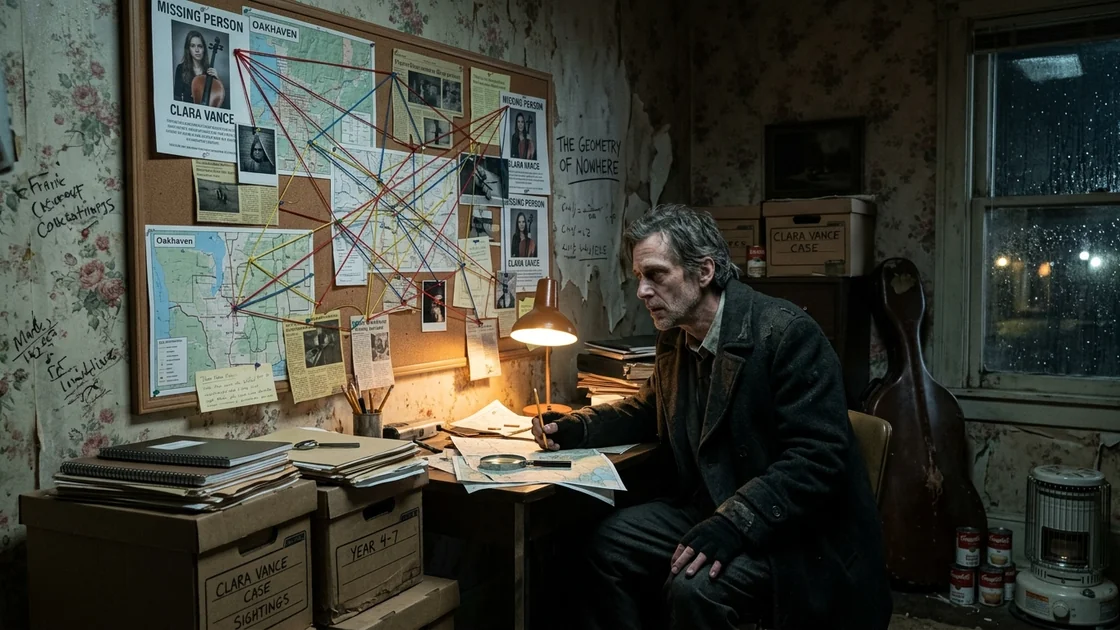
Detective Arthur Pendelton spends seven years consumed by the vanishing of Clara Vance, a young cellist who disappeared from a locked room in the rain-soaked town of Oakhaven. As he chases phantom sightings and deciphers meaningless patterns across the Pacific Northwest, his obsession slowly destroys his twenty-year marriage to his wife, Sarah, and alienates him from the police force. Ultimately, Arthur trades his badge, his love, and his grip on reality for a sprawling labyrinth of dead ends, realizing too late that the void he was hunting had completely swallowed him instead.
The rain in Oakhaven did not fall so much as it hung in the air, suspended like a cold, gray curtain between the living and the lost. On the third of November, a Tuesday that smelled of wet cedar and rotting river weeds, Clara Vance failed to show up for her evening rehearsal with the civic symphony. She was twenty-four years old. Her cello, an eighteen-hundreds German instrument worth more than the car Arthur Pendelton drove, was found resting on its side in the center of her studio apartment on Fourth Street. The door was deadbolted from the inside. The windows, painted shut decades ago by a succession of lazy landlords, remained sealed. Her kettle was burned black on the stove, the water long since boiled away into the damp plaster of the ceiling, leaving only a scorching smell of dry copper that greeted the building superintendent when he finally took a crowbar to the jamb on Thursday morning.
Arthur had been the first detective through the splintered frame. He was forty-six then, a man who still ironed his shirts on Sunday nights and remembered his anniversary without checking a calendar. He had stood on the worn hardwood floor, careful not to step on the mahogany ribs of the cello, and looked at the tea mug sitting on the counter. There was a dry teabag inside, the string draped neatly over the porcelain rim. Everything in the room suggested a pause—a breath taken between one movement of a sonata and the next. She had simply stepped out of the measure.
"She didn't go out the window, Artie," Officer Miller had said, tapping the thick crust of cream-colored paint sealing the sash. Three stories down, the alleyway was a river of mossy cobblestones and overflowing galvanized trash cans. "And nobody came through the door unless they brought a carpenter with 'em to fix the lock from the inside on their way out."
Arthur hadn't answered. He was looking at the sheet music on the stand. Suites for Unaccompanied Cello. There was a pencil mark—a tiny, sharp 'V' in gray lead—above a sixteenth note in the third bar. An up-bow indicator. It was the last mark she had made on the physical world. He felt a strange, cold tug behind his ribs, like a fishhook catching on deep tissue. It wasn't the theatrical hunch that television detectives talked about; it was a sudden, intolerable intolerance for the impossibility of the room. People had weight. They displaced air and water. They left footprints in the dust and skin cells on brass doorknobs. They did not evaporate like the water in the blackened kettle.
That night, Arthur went home to the yellow Craftsman bungalow on Maple Street where Sarah had kept a pot roast warm in the oven. They had been married for fourteen years. The house smelled of rosemary, furniture polish, and the lavender soap Sarah bought in bulk from the farmers' market.
"You're late," she said, though there was no edge to it. She was used to the rhythms of homicide and missing persons—the way death and absence refused to punch a time clock. She kissed his cheek, her fingers lingering on the wool lapel of his coat. "Your coat is soaked through, Artie. Hang it by the radiator."
"Girl went missing on Fourth," he said, his voice sounding distant even to his own ears. He sat at the kitchen table, his eyes fixing on the salt shaker. If he moved the salt shaker into his pocket, Sarah would look for it. She would ask where it went. There would be a trajectory, a logical chain of custody from the table to his hand to the wool lining of his coat. "Locked room. Third floor."
"She'll turn up," Sarah said, setting a plate before him. The gravy was beginning to skin over under the yellow kitchen light. "They usually go to a boyfriend's house when they want to disappear, don't they? Or Portland. Everybody goes to Portland when they get tired of the rain here."
"It rains in Portland, too," Arthur said. He picked up his fork, then set it down. He was thinking about the cello. A musician didn't leave an instrument like that on the bare floor where the draft from the hallway could warp the spruce top. He knew that because his father had played the violin—badly, mostly Scottish airs when he’d had too much scotch—and the old man had treated the cheap Sears fiddle like it was made of spun glass. Clara Vance had loved that cello more than she loved her own skin, according to the conductor he’d interviewed at four o'clock.
By December, the file on Clara Vance was four inches thick, and every page was a monument to nothing. The forensic sweep of the apartment had yielded only Clara’s prints, a few smudged latents from the superintendent on the radiator valves, and the hairs of a long-dead cat that had belonged to the previous tenant. Her bank account—containing four thousand, two hundred and twelve dollars—remained untouched. Her passport was in the top drawer of her dresser, tucked inside an old velvet jewelry box alongside a silver cross and three spare cello bridges.
The department had rules about the allocation of time. Captain Halloway, a man whose belly preceded him into rooms by three seconds and who viewed policing primarily as an exercise in municipal budget management, called Arthur into his office three days before Christmas. The miniature plastic fir tree on Halloway’s credenza was blinking with an erratic, dying red bulb.
"Give it to the state boys for the cold pile, Artie," Halloway said, not looking up from his overtime authorization forms. "We got two dead transients under the highway viaduct and a string of pharmacy robberies on the east side. The Vance girl is either in the river or she’s in Tijuana with a guy who doesn't care about her cello."
"The river's been dragged twice from the dam to the estuary," Arthur said. He was holding the brown accordion folder against his chest like a shield. "And the bus depot cameras were clear for seventy-two hours before and after the kettle boiled dry. I watched the tapes myself."
"You watched seventy-two hours of Greyhound footage?" Halloway looked up then, his small eyes narrowing behind his bifocals. "On city time?"
"On my time," Arthur lied. It had been half and half. He had started bringing the VHS cassettes home in his briefcase, watching the grain-snowy black-and-white images on the small television in the den while Sarah slept upstairs. He had memorized the gait of every drifter, every runaway teenager, every tired commuter stepping off the local from Seattle. None of them had the slight curvature of the left shoulder that Clara’s mother had described—the permanent postural tax of holding a cello neck for six hours a day since the age of seven.
"Let it breathe," Halloway said, his tone softening into something meant to be paternal. "Cases like this, they’re like knots in wet rawhide. The harder you pull, the tighter they get. Wait for the spring thaw. Wait for a hunter’s dog to find a femur in the logging tracts up by Black Rock. Until then, clear your desk. Take Sarah to that bed-and-breakfast up on the peninsula you’re always talking about."
Arthur nodded, walked back to his desk, and instead of logging the accordion folder into the basement archive, he slid it into the bottom drawer of his filing cabinet, beneath a stack of old phone books from neighboring counties.
That night was the first time he lied to Sarah about where he had been. He told her he was caught in a briefing on the pharmacy robberies. In reality, he had bribed the superintendent of the Fourth Street building with forty dollars and a bottle of Jim Beam to let him back into Apartment 3B before the new tenant moved in.
The yellow police tape had been peeled off the doorframe, leaving sticky gray rectangles on the varnished wood. The room was empty now—Clara’s parents had come down from Bellingham in a rented U-Haul two weeks prior, weeping quietly as they loaded her mattress, her boxes of sheet music, and the German cello into the back of the truck. Without furniture, the room seemed smaller, the water stains on the ceiling above the stove more pronounced.
Arthur sat in the center of the floor, right where the cello had lain. He turned off his flashlight. The streetlamp outside cast a skewed, amber parallelogram across the floorboards, bisected by the shadow of the window sash. He stayed there for three hours as the cold seeped through his trousers into his kneecaps. He listened to the building. He heard the pipes knocking in the walls; he heard the muffled bass of a television in 2B; he heard the wind whistling through a gap in the exterior brickwork somewhere near the roofline.
Where is the seam? he thought. Every magic trick had a seam. A false bottom in the box, a mirror tilted at forty-five degrees, a twin brother waiting in the wings. He crawled on his hands and knees along the baseboards, his fingers probing the crack between the quarter-round molding and the oak planks. He found a rusted straight pin, a dried pea, and a 1983 Lincoln penny green with verdigris. He put them all into a plastic sandwich bag and labeled it with a Sharpie in the dark.
When he got home at two in the morning, the house was dark, save for the small amber light over the kitchen range. His dinner was in the refrigerator, covered in plastic wrap that had fogged with condensation from the cooling meat. Upstairs, Sarah was lying on her side, facing the window. As he slid beneath the sheets, his skin radiating the damp chill of the empty apartment, she didn't turn around, though he knew by the rigid line of her shoulders that she was awake.
"You smell like dust, Artie," she whispered into the dark. "Like an old basement."
"Archive duty," he said, staring at the ceiling where the headlights of a passing car swept across the plaster like a searchlight. "Just clearing out the old files before the new year."
By the second year, the Vance file was no longer a single accordion folder; it was four cardboard banker's boxes stacked in the corner of the spare bedroom that Sarah had once planned to turn into a sewing room, and before that, a nursery. After the third miscarriage in their late thirties, they had stopped talking about the nursery, and the room had remained a neutral territory of floral wallpaper and unpacked cartons of books. Now, it belonged to Clara.
Arthur had bought a large corkboard from an office supply liquidator and mounted it over the cabbage-rose wallpaper, driving four-inch toggle bolts directly through the plaster lath. Sarah had come home from her job at the library to the sound of the power drill and the smell of pulverized gypsum.
"What are you doing?" she had asked from the doorway, her arms full of groceries. A baguette was sticking out of the top of the brown paper bag. Arthur remembered that baguette years later with a terrifying clarity—how fresh it had looked, how ordinary and wholesome, belonging to a world he was rapidly vacating.
"I need to see the geography," he had said, blowing gray dust off his knuckles. "The reports are too linear. When you read them in a binder, one thing follows another just because of the dates on the paper. I need to see them all at once."
"In the house, Artie?" Her voice had that small, tight vibrato that usually preceded an argument they wouldn't actually have because neither of them liked to shout. "Can't you do this at the precinct?"
"Halloway thinks the case is dead. If I put this up in the squad room, he'll have me walking a beat by Friday." He took the groceries from her hands and set them on the hall table, kissing her forehead with a practiced, mechanical affection that made her flinch slightly. "Just for a few weeks. There's a pattern in the sightings. I'm sure of it."
The sightings were the lifeblood of his obsession, and like bad blood, they poisoned everything they touched. Because Clara Vance’s face had been on billboards along Interstate 5 for six months—a slightly overexposed photograph from her college graduation where she was squinting into the sun, her dark hair tucked behind one ear—everyone in the Pacific Northwest had seen her.
A trucker saw her at a weigh station outside Chehalis, climbing into the cab of a green Peterbilt. A waitress in Astoria swore she served her coffee and a slice of marionberry pie at three in the morning; she remembered her because the girl had long, calloused fingers and kept tapping them on the Formica as if playing an invisible keyboard. A park ranger in the Olympics thought he saw her hiking the Hoh River trail alone in the rain without a pack.
They were ghosts generated by grief and the power of suggestion, Halloway said. People wanted to be part of the story. They saw a girl with dark hair and pale skin—half the girls in Washington State looked like Clara Vance in the rain—and their brains filled in the rest from the billboard.
Arthur didn't believe in ghosts, which meant he had to believe in the waitress, the trucker, and the park ranger. He spent his vacation days driving a circular route through the region, his 1998 Ford Taurus smelling permanently of stale drive-thru coffee and wet wool.
In the third summer after the disappearance, he took two weeks of accumulated leave and told Sarah he was going to help his brother rebuild a fishing cabin up on Lake Chelan. Instead, he checked into the Starlight Motel on the outskirts of Aberdeen, fifty miles southwest of Oakhaven, because an anonymous caller had left a message on the tip line saying a girl who played the cello was living in a commune of cedar-shake splitters up the Wishkah River.
The motel room had green indoor-outdoor carpeting that felt damp against his bare feet and a color television bolted to a swivel mount on the dresser. He spent six days driving logging roads that weren't on the Rand McNally atlas, his undercarriage scraping against washboard gravel and potholes filled with yellow clay water. The cedar splitters were mostly Vietnam vets who wanted to be left alone and skinny kids with meth sores on their forearms who looked at his badge with a dull, animal hostility.
On the fourth day, deep in a second-growth fir forest where the canopy was so thick it felt like twilight at noon, he found a shack made of corrugated tin and salvaged railroad ties. An old woman with a milky cataract in her left eye was sitting on an overturned five-gallon bucket, skinning a rabbit with a paring knife.
"She was here," the old woman said when he held up the laminated flyer. The flyer was dog-eared now, the plastic peeling at the corners from the humidity of his breast pocket.
Arthur’s heart gave a violent, painful thud against his sternum. The sound of the river below the bluff seemed to roar in his ears. "When?"
"Before the blackberries came in," the woman said, peeling the gray fur back from the rabbit's hind leg with a wet schlick. "Maybe June. Maybe the June before. Time don't mean much up the creek. She had a big wooden box on her back. Like a coffin for a child."
"Did she say her name?"
"Called herself Mary. Or Martha. One of the Bible ones." The woman spat into the ferns. "Played a song for my old man before he passed. Sounded like a cow dying in a bog, you ask me. Low and mournful."
"Where did she go?" Arthur was down on one knee in the mud now, not caring that the slush of pine needles and rabbit blood was soaking into his Sears slacks. He grabbed the woman’s wrist; it felt like a bundle of dry sticks wrapped in parchment. "Which way did she go, ma'am? Did someone pick her up?"
"Man in a white van," she said, squinting at him with her good eye. "Or maybe it was blue. Had a dog with three legs. They went south. Toward California. Everybody goes to California when the rain gets in their bones."
He gave her twenty dollars—all he had in his wallet—and practically ran back to the Taurus. He drove south on Highway 101 at eighty miles an hour, his eyes scanning every turnout, every rusted van in every trailer park between Aberdeen and Ilwaco. He didn't sleep for thirty-six hours, chewing caffeine pills he bought at a truck stop and washing them down with lukewarm Pepsi.
It took him three days of manic cross-referencing with the Pacific County Sheriff’s department to find the man in the blue van with the three-legged dog. He was a sixty-year-old itinerant chainsaw sharpener named Earl who lived in a trailer behind a tavern in Raymond. The girl he had given a ride to was his niece, Brenda, who had a congenital hip deformity and carried her clothes in a surplus army duffel bag. She didn't know what a cello was. The old woman up the Wishkah was known to the local deputies for reporting Bigfoot sightings twice a month so the county social worker would come out and bring her tins of snuff.
Arthur sat in the parking lot of the Raymond tavern as the dusk settled over the mudflats of the Willapa River. The neon sign in the window buzzed—Oly, Oly, Oly—casting a sickly pink glow over his steering wheel. He put his head down on his arms and wept. It was not the clean, hot weeping of bereavement; it was a dry, choking spasm of rage at the sheer size of the world. There were too many trees. There were too many gravel roads, too many rusted vans, too many lying old women, too many girls who weren't Clara.
His cell phone—a heavy Motorola flip phone—rang on the passenger seat. He looked at the small green screen. HOME.
He let it ring until it went to voicemail. Then he turned it off, walked into the tavern, and ordered a double rye. He didn't call Sarah for another two days. When he finally walked through the front door of the house on Maple Street, his stubble gray and his eyes bloodshot to the color of raw liver, Sarah was sitting in the living room with his brother, Frank.
Frank had driven down from Chelan to surprise him for his birthday.
The silence in the living room was the heaviest thing Arthur had ever encountered. It was heavier than the locked door on Fourth Street. Frank stood up, his face red beneath his fisherman’s tan, looking from Arthur’s mud-caked shoes to Sarah’s hands, which were folded tightly in her lap over a crumpled tissue.
"I think I'll head back north, Sarah," Frank said quietly. As he passed Arthur in the hallway, he didn't look at him. He just said, very low, "You're a goddamn fool, Artie. She's the best thing that ever happened to this family, and you're throwing her in the dirt for a ghost."
After Frank’s truck pulled out of the driveway, Arthur stood in the archway of the living room. Sarah didn't look up.
"Where were you?" she asked. She didn't think there was another woman—or rather, she knew the other woman didn't have a body.
"Grays Harbor," he said. "I had a lead."
"Four years, Arthur," she said. She never called him Arthur unless someone had died. "It has been four years. Her parents have had a memorial service. They put a stone in the cemetery up in Bellingham. Empty ground, Artie, just a stone so they have somewhere to put flowers on her birthday. Even her mother has stopped calling you."
"Her mother gave up," Arthur said, and the cruelty in his own voice surprised him. It sounded like someone else talking through his mouth. "Somebody has to stay on the wall, Sarah. If I stop looking, then whoever did this—whoever figured out how to take a human being out of a locked room without leaving a hair behind—he wins. The world doesn't work like that. There are laws. Physical laws."
"There are laws in a marriage, too," she said, finally looking at him. Her eyes were dry; she had done her crying while Frank was there. "You aren't here anymore. You sit across from me at dinner and you're calculating mileage between rest stops. You touch me in bed and your fingers are tapping that rhythm—that stupid da-da-dum from her sheet music. You think you're looking for her, Artie, but you're not. You're hiding from us. Ever since we lost the last baby, you've been looking for something you couldn't fix so you'd have an excuse to stay broken."
He opened his mouth to tell her she was wrong, to tell her about the pencil mark on the Bach suite and the three-inch gap in the chimney flue he’d discovered in the architectural blueprints of the Fourth Street building down at the city hall annex, but she stood up and walked past him up the stairs.
That night, he slept on the sofa in the den. Or rather, he lay on the sofa with his eyes open, listening to the grandfather clock in the hall ticking away the seconds: Where-is-she, where-is-she, where-is-she. At three in the morning, he got up and went into the spare bedroom. He turned on the single desk lamp, casting shadows across the hundreds of red and blue pushpins on the corkboard.
He had begun connecting them with lengths of cotton twine. Red for sightings, blue for unexplained bank transactions in towns along the coast, yellow for unidentified female remains that didn't match her dental records (he tracked them anyway, on the theory that the dental records from Bellingham might have been switched by an accomplice in the orthodontist's office). The board looked like a map of a nervous system drawn by a madman.
The fifth year brought the demotion, though Halloway called it a "lateral reassignment to Property and Evidence." It happened after the incident with the cello teacher.
Arthur had become convinced that the key lay in the music itself. That pencil mark—the up-bow 'V'—was in the wrong place. He had paid a graduate student from the university music department fifty dollars to play the passage for him both ways. Played with a down-bow, as standard editions suggested, the phrase was resolved, grounding the melody. Played with an up-bow, as Clara had marked it, the note hung in the air, thin and questioning, moving away from the body of the instrument.
A code, Arthur had written in his notebook. He was on his nineteenth spiral-bound Mead notebook by then. His handwriting, once the neat, blocky print of a patrolman filling out citations, had degenerated into a cramped, microscopic scrawl that crept into the margins and wrapped around the wire bindings. She was signaling someone in the orchestra. Someone who sat close enough to see her bowing.
That meant the second cellist, a fifty-two-year-old middle school music teacher named Marcus Lindqvist.
Lindqvist had been interviewed twice during the initial investigation. He was a mild, balding man who lived with his sister and bred Golden Retrievers. He had an ironclad alibi for the week Clara vanished: he had been in a hospital in Seattle having his gallbladder removed.
Arthur decided the gallbladder surgery was a cover, or that Lindqvist had hired someone while under anesthesia, or that the hospital records had been falsified. He began parking his Taurus across the street from Lindqvist’s house in the evenings, watching the yellow light of the music room through binoculars. He followed Lindqvist to the grocery store, noting what he bought (extra-lean ground beef, canned peaches, bulk kibble—too much kibble for two dogs? Check the basement).
One rainy afternoon in October, five years almost to the day since Clara’s kettle had boiled dry, Arthur saw Lindqvist loading a large, heavy wooden crate into the back of his Subaru station wagon.
Arthur didn't call for backup. He didn't even put on his seatbelt. He slammed the Taurus into drive, jumped the curb, and blocked Lindqvist’s driveway, his tires tearing two deep ruts into the wet turf of the man’s manicured lawn. He was out of the car with his service Glock drawn before the station wagon’s brake lights had even flickered on.
"Step away from the tailgate, Marcus!" Arthur screamed. The rain was running into his eyes, stinging with the salt of his own sweat. His hands were shaking so badly the front sight of the Glock was dancing in figure-eights against Lindqvist’s beige cardigan. "Hands where I can see 'em! Open the box!"
Lindqvist had dropped his car keys into the mud and raised his hands, his face grey with terror, thinking he was being carjacked by a derelict. Arthur didn't look like a detective anymore; he had lost thirty pounds over the last two years, his clothes hung off his frame like rags on a scarecrow, and he had forgotten to shave for three days.
Neighbors were coming out onto their porches. A woman across the street was screaming into a cordless phone. Arthurholstered his weapon with one hand, shoved the weeping music teacher against the wet rear quarter-panel of the Subaru, and used his pocketknife to pry open the latches of the wooden crate.
Inside, nestled in foam peanuts and bubble wrap, were four reconditioned brass tubas from a repair shop in Tacoma, bound for the middle school band room.
During the disciplinary hearing, the union rep had pleaded exhaustion, citing the psychological toll of long-term missing persons work. Halloway, looking older and sadder than he had five years ago, didn't fire him, only because Arthur was eighteen months shy of his twenty-year pension vestment. They took his gold shield, gave him a silver one that didn't allow him to carry a firearm off-duty, and put him in the cage in the sub-basement of the municipal building.
His job was to log confiscated bicycles, bags of weed, and bloody clothing from Saturday night stabbings in and out of the wire mesh lockers. It was quiet down there. The only sound was the hum of the industrial dehumidifiers and the occasional gurgle of the city sewer main running beneath the concrete slab.
Arthur loved it.
He loved it because nobody looked at him down in the cage. Between ten in the morning and two in the afternoon, scarcely a soul came down the stairs. He could spread his notebooks out on the steel sorting table. He had access to the old microfiche machines and the department’s unrestricted Teletype terminal. He began running searches across international borders, convinced now that the locked room was a professional extraction—perhaps Russian human traffickers operating out of the container ships in the Port of Tacoma, or a witness protection relocation carried out by rogue federal marshals who hadn't notified the locals.
When he came home on the Friday after his demotion, the house on Maple Street felt strangely resonant, like the Fourth Street apartment had after Clara’s parents took the furniture.
The umbrella stand by the front door was gone. The small watercolour of the San Juan Islands that hung in the foyer was gone, leaving a clean pale square on the paint.
"Sarah?" he called out. His voice echoed off the bare hardwood of the living room. She had taken the rug. She had left the sofa—the one he slept on—and the television, and the kitchen table with two of the four chairs.
On the counter, right beside the salt shaker, was an envelope with his name written in her neat librarian's hand, and beside that, her wedding ring. The gold band had a tiny nick on the inside from the summer they had built the cedar deck together in the backyard.
He didn't open the letter right away. He stood by the counter for a long time, his fingers resting lightly on the ring, though he didn't pick it up. He was thinking about the geometry of the house. If he went upstairs right now, her closet would be empty, except for the wire hangers. People always left the wire hangers; they tangled together on the rod and made a high, metallic singing sound when you brushed against them.
Instead of going upstairs to look at her closet, he went into the spare bedroom.
She hadn't touched the corkboard. All four banker's boxes were still stacked neatly by the radiator, which was clanking as the evening chill triggered the thermostat. He let out a long, ragged breath that was almost a sigh of relief. He had been terrified, in the five seconds it took him to climb the stairs, that she had thrown the notebooks away.
He sat down at the small desk in the spare room and finally opened the letter.
Artie, it read. I am staying with my sister in Eugene. Don't come down here. The lawyer will send the papers to the precinct next week. I left half the savings in the joint account. Please eat something warm at night, and please, for God's sake, let that poor girl stay dead. Love, Sarah.
He folded the letter precisely along its original creases and slid it into Box 4, under the section labeled Corroborating Timelines - Year Five. Then he picked up a red pencil and turned back to the map of the Port of Tacoma. If a container ship left berth 4 at midnight on November third, taking into account the tide tables in the Puget Sound, where would it have been when the superintendent took the crowbar to the door on Thursday morning?
Without Sarah in the house, time lost its edges. The days no longer had meals or conversations to divide them into morning, afternoon, and night; there was only the shift in the basement cage and the shift in the spare bedroom.
Arthur stopped paying for the garbage service after the city raised the rates, stacking his empty soup cans—he ate almost exclusively cold Campbell’s Chunky Beef straight from the tin now—in neat pyramids on the back porch. When the furnace broke in the January of the sixth year, he didn't call the repairman because he didn't want a stranger walking past the door of the spare bedroom. He bought two kerosene space heaters from the hardware store and lived entirely on the second floor, wearing his wool overcoat and fingerless gloves while he worked at the corkboard.
The smell of kerosene and unwashed bedding soaked into the cabbage-rose wallpaper, which was beginning to peel away from the plaster in long, curling strips due to the dampness rising from the unheated ground floor.
He found the connection on a Tuesday in March. He had been awake for forty hours, his mind sharpened to a terrifying, brittle diamond-point by the fumes of the heater and a pot of boiled coffee that had reduced to the consistency of motor oil.
He was looking at the original crime scene photographs—specifically Photo #14, a close-up of the kitchen counter where the tea mug sat. Next to the mug was a grocery receipt from the Thriftway on Eighth Street, dated November 2nd, 6:14 PM. Clara had bought one quart of 2% milk, a box of Earl Grey tea, and a single yellow onion.
The total was $4.19. She had paid with a five-dollar bill, receiving eighty-one cents in change.
Arthur stared at the numbers through a plastic magnifying glass he had stolen from the evidence room.
11/02. 6:14. 4.19. .81.
If you added the digits of the time (6+1+4), you got 11. The month was 11. If you subtracted the change (.81) from the total (4.19), you got 3.38. Apartment 3B. Three and the second letter of the alphabet: 32. The difference between 3.38 and 32 was... no, wait.
He scribbled furiously on the wallpaper beside the corkboard, having run out of Mead notebooks three days ago. His pencil lead snapped. He grabbed a blue ballpoint pen, licking the tip to get the frozen ink flowing.
The onion hadn't been in the apartment.
He dropped the pen. It rolled across the floorboards and dropped into a heating vent with a hollow clack.
He pulled Box 1 from the bottom of the stack, spilling folders across the floor like dry leaves. He found the property inventory sheet signed by Officer Miller on November 5th.
Kitchen contents: 1 copper kettle (damaged). 1 ceramic mug. 1 box Twinings Earl Grey (23 bags remaining). 1 carton Darigold 2% milk (approx. 3/4 full, spoiled).
No onion. There were no onion skins in the trash can under the sink; the trash can had been empty, lined with a fresh white plastic bag. There was no chopped onion in the refrigerator. There were no dirty pans, no cutting board with the acrid smell of sulfur on the wood.
Why did a girl buy a single yellow onion at six-fourteen in the evening on a rainy Tuesday, walk four blocks home to a third-floor apartment, lock the door from the inside, put the milk and the tea away, and do something with the onion that left no trace?
"She didn't eat it," Arthur whispered to the empty room. His breath plumed white in the beam of the desk lamp. "Nobody eats a raw onion like an apple. And she didn't throw it out the window, because the windows were painted shut."
He began to laugh, a high, wheezing sound that turned into a coughing fit. Halloway was an idiot. Miller was a blind fool. The FBI profiling guide didn't know shit. It was all about the onion. The onion was the mass that didn't balance in the equation.
If the onion wasn't in the apartment, then Clara hadn't gone home after the Thriftway.
Wait. The milk and the tea were in the apartment. And the receipt was on the counter.
That meant someone else had gone to the Thriftway. Or someone had come into the apartment with her, eaten the onion—or taken the onion as a trophy—and then taken Clara out through a passage that wasn't the door or the window.
He needed to go back to 3B.
He looked at his watch. It was four in the morning. He didn't have a car anymore; the Taurus had thrown a rod on the highway outside Centralia four months ago while he was chasing a rumor about a street musician in Chehalis, and he had simply taken the license plates off it and walked away, leaving it on the shoulder for the state patrol to tow.
Fourth Street was three miles from Maple.
Arthur walked down the dark stairs of his house, his boots crunching on the pile of unopened mail and junk flyers that had accumulated beneath the mail slot over the winter. Outside, the Oakhaven rain was falling—that same eternal, needle-fine drizzle that had been falling for six years, as if the sky had snagged on the Cascade mountains and torn open.
He walked down the center of the residential streets, ignoring the sidewalks, his coat flapping around his shins. His knees ached with a deep, grinding arthritis that had set in during the winter, giving him a lurching, asymmetrical gait. When a patrol car passed him on Division Street, slowing down to sweep its alley-light over his hunched figure, Arthur didn't look up. The young rookie behind the wheel recognized him—everyone on the force knew about "Crazy Artie" down in the property cage—and sped up, embarrassed to see a veteran detective walking in the gutter at four in the morning like a wet dog.
The building on Fourth Street had been painted blue two years ago, a cheap latex job that was already blistering in the damp air. A sign in the lower window read OAKHAVEN REALTY - NO VACANCY.
Arthur went around the back, into the alley where the galvanized trash cans had been replaced by a single blue municipal dumpster. The fire escape was rusted, the counterweighted lower ladder hanging ten feet above the cobblestones. He climbed onto the lid of the dumpster, the plastic bowing beneath his weight with a loud boom that set a dog barking behind a fence down the block. Jumping up, he caught the bottom rung of the iron ladder with his gloved hands.
The shock of the cold iron nearly tore the sockets of his shoulders out, his sixty-year-old tendons screaming as his dead weight pulled the ladder down with a screech of rusted pulleys. He scrambled up like a spider, his boots slipping on the wet iron grates, past the dark windows of the first and second floors until he reached the third-floor landing.
That wasn't Clara’s window; the fire escape served the hallway. Her window was six feet to the left, across a stretch of slick red brick.
He didn't hesitate. He used a crowbar he’d carried inside his coat sleeve—a small, twelve-inch pry bar from the evidence cage, still tagged with a yellow case number from a 1999 burglary in the industrial park—and jammed it into the frame of the third-floor hallway window. The wood was rotten; the latch snapped with the sound of a breaking carrot.
He tumbled into the third-floor corridor, landing hard on his hip on the worn institutional carpet. For a minute he just lay there, gasping, smelling the familiar, sickening odor of boiled cabbage and cheap pine cleaner that lived in the walls of the building.
He crawled to the door of 3B. There was a small brass nameplate screwed into the wood where the police tape had once been: M. RODRIGUEZ.
Arthur stood up and knocked. Not a polite tap, but the heavy, four-beat cadence of a warrant squad. Bam-bam-bam-bam.
"Police!" he shouted, his voice cracking like an adolescent's. "Open the door! Missing persons!"
From inside came the sudden thump of feet hitting the floor, a woman’s frightened murmur in Spanish, and then the scrape of the chain. The door opened two inches, held by the brass security chain, revealing the dark, sleep-swollen eye of a young man in a white undershirt.
"What?" the man said. "What's happening? Is there a fire?"
Arthur threw his shoulder against the wood. He weighed only a hundred and forty pounds now, a skeleton wrapped in wet wool, so the chain didn't break, though the screws pulled slightly out of the soft pine jamb. He shoved his silver property-room badge through the gap, pressing it right against the young man’s nose.
"Clear the room!" Arthur barked, his eyes wide and white in the dim hallway light. "Crime scene! Don't touch the kitchen counter! Don't touch the trash!"
Terrified by the wild-eyed old man with the badge and the iron bar in his hand, the young man fumbled the chain off. Arthur pushed past him into the apartment.
It was wrong. Everything was wrong. They had put down linoleum over the hardwood floor—a hideous yellow pattern of faux-Spanish tiles. A playpen stood in the exact spot where the German cello had lain, filled with plastic rattles and a stuffed bear with one eye missing. On the wall where the Bach suites had stood on the music stand, there was a framed print of the Last Supper with holographic foil behind Christ’s head that shifted as Arthur stumbled past.
"Where is it?" Arthur demanded, spinning around in the tiny kitchenette. The copper kettle was gone; a white plastic Mr. Coffee sat on the counter next to a microwave. "Where did it go?"
"Where did what go, mister?" Rodriguez was backing toward the bedroom where his wife was holding a crying infant, her hand already reaching for a cellular phone on the nightstand. "Look, you smell like gasoline. I'm calling the station."
"The onion!" Arthur screamed, dropping to his knees on the yellow linoleum and tearing open the cabinet doors beneath the sink. Bottles of bleach, a yellow sponge, a mouse trap—empty. He began pulling at the baseboard beneath the sink with his bare hands, his fingernails splitting and bleeding against the caulk. "There's a hole! There has to be a drop-chute! A dumbwaiter! They took the building blueprints down at the annex and they lied about the framing! You can't take a girl through a solid wall!"
The pry bar clattered against the drainpipe as he jammed it behind the plywood backing of the sink cabinet and pulled with all his remaining strength. The rotten particle board gave way with a dry shriek, exposing the brick exterior wall and a nest of dead cockroaches and gray fibreglass insulation.
There was no chute. There was no secret passage. There was only four inches of dead air, sixty-year-old brick mortar, and the cold March rain beating against the other side of the wall.
When the two uniformed patrolmen came through the open door of 3B ten minutes later, Arthur wasn't fighting anymore. He was sitting in the playpen, his long legs tangled awkwardly over the mesh side, holding a handful of pink fibreglass insulation in his bleeding fingers and staring at the holographic Jesus on the wall.
"Come on, Artie," the older patrolman—it was Miller, now a sergeant with gray at his temples—said softly, holstering his Taser. He reached down and hooked his hands under Arthur’s armpits, shocked by how light the old detective was, like lifting a coat off a hook. "Let's get you out of here. You're scaring the folks."
"The receipt said four-nineteen, Jim," Arthur murmured as Miller led him down the stairs without handcuffs, just a firm hand on the back of his soggy wool collar. "She bought an onion. You didn't put it on the sheet."
"Sure, Artie," Miller said, his voice thick with a pity that was worse than any beating. "My mistake. We'll look into it down at the hospital."
The seventh year was very white at first, and then very gray.
The white part lasted three months at the county psychiatric facility up in Steilacoom, where they gave him little orange pills in paper cups and made him wear slippers with rubber treads on the bottom so he wouldn't slide on the waxed linoleum. The doctor was a young woman who looked nothing like Clara Vance—she was short, with blonde hair cut like a boy’s and glasses with thick tortoiseshell frames—which made it easier for Arthur to talk to her.
He learned very quickly what the doctor wanted to hear. He was a detective, after all; interrogation was just a matter of figuring out what the person across the table needed in order to close the file and go home for dinner.
She needed him to say that Clara Vance was likely deceased, a victim of an opportunistic crime after leaving her apartment voluntarily, and that the locked door was a mechanical anomaly—a faulty spring in the Schlage deadbolt that had caused the bolt to drop into the strike plate when the door was slammed hard from the outside.
"A gravity drop," Arthur said during their tenth session, sitting with his hands folded neatly on his knees. He had gained twelve pounds on the hospital food, and his face was shaved, though his skin had taken on the papery, translucent quality of an onion skin. "Happens with those old brass cylinders when the pins get worn down. You slam it hard enough, the vibration jiggles the thumb-turn past the center point and the weight of the bolt carries it home. I saw it once in a burglary on Tenth Street back in eighty-eight."
The doctor smiled and wrote something down on her legal pad. "That sounds very plausible, Arthur. Why do you think you couldn't accept that explanation seven years ago?"
"Grief," Arthur said, giving her the line Sarah had given him in the living room before she left for Eugene. "My wife and I... we lost a child. A few of them, actually. When you can't save your own, you get it in your head you have to save somebody else's. Even when there's nobody left to save."
It was a good confession. It was clean, psychologically sound, and entirely false. He didn't care about the babies anymore—they were just names they had picked out in books and never used—and he didn't believe for a second that a Schlage B160 deadbolt could gravity-drop from a horizontal ninety-degree throw. You needed torque for that. You needed a thumb on the inside.
They discharged him in July, with a prescription for the orange pills, a full medical disability pension that Halloway had quietly pushed through the city council to avoid a lawsuit from the Rodriguez family, and a court order prohibiting him from coming within five hundred feet of Fourth Street or Marcus Lindqvist.
The house on Maple Street was gone—sold at a county tax auction while he was in Steilacoom to pay off the municipal liens and the divorce settlement. A young couple who worked at the software park out by the interstate had bought it; Arthur walked past it once on his way from the bus stop and saw that they had painted the yellow Craftsman a trendy slate gray and put cedar planter boxes on the front porch.
He wondered what they had done with the four banker's boxes and the corkboard in the spare bedroom. Taken them to the county landfill out on Meridian Road, probably. He spent two days walking the perimeter of the landfill fence before he realized that the garbage from April would be buried under forty feet of compacted clay and rotting summer grass clippings by July.
It didn't matter. He didn't need the boxes anymore. He had the entire board behind his eyes now. When he closed them at night in his room at the Starlight Motel—he had moved permanently into the place in Aberdeen, paying by the month with his pension check—he could see every red pin, every blue thread, every six-digit case number in the green glow of the dark.
He stopped taking the orange pills in August because they made the strings on the mental board look fuzzy, like wool yarn that had been washed too many times. Within two weeks of flushing them down the motel toilet, the sharpness returned. The geometry of the world snapped back into focus.
He had a new method now. It didn't require a badge, or a car, or the Teletype terminal in the basement cage. It was purely observational.
Clara hadn't been taken by the Russians, and she hadn't crawled into the wall behind the kitchen sink. She had simply stepped into the blind spot. Every town had one—the angle between two mirrors where the light doesn't hit, the five minutes between the changing of the shifts when nobody watches the monitor. If she was in the blind spot, the only way to find her was to stand in the blind spot himself and wait for his eyes to adjust to the dark.
Every morning at six, Arthur put on his gray suit—the one the hospital social worker had bought him at the Goodwill before his discharge—and walked four blocks to the Aberdeen bus depot. He bought a senior citizen day-pass and rode the #40 regional transit bus up to Olympia, then transferred to the #12 back through Oakhaven, and finally the #60 out to the coast at Westport, returning to Aberdeen by nine at night.
He sat in the third row behind the driver, right by the window. He carried a small pocket notebook—a ten-cent memo pad from the drugstore—and a stub of a carpenter’s pencil.
He wasn't looking for Clara’s face anymore. Faces changed. Seven years in the rain would change a girl; she would be thirty-one now. She might have cut her hair, dyed it blonde, gained weight, lost teeth. Instead, he looked at the hands and the shoulders of every woman on the streets, in the crosswalks, at the bus stops.
Left shoulder slightly lower than the right, he wrote in the memo pad as the bus hissed to a stop in front of the Oakhaven library on a Tuesday in November. It was the anniversary again, though he only knew that because the Christmas decorations were going up on the lampposts along Main Street. Calluses on the pads of the four fingers of the left hand. Thumb callused on the side from the frog of the bow.
Through the rain-streaked glass of the bus window, he saw Sarah come out of the staff entrance of the library.
He froze, his carpenter's pencil hovering over the page. He hadn't known she had moved back from Eugene; she must have gotten her old job back after the divorce was final and he was safely locked up in Steilacoom, or maybe she had never gone to Eugene at all and had only told him that so he wouldn't come knocking on her apartment door at four in the morning with a pry bar.
She was wearing a red raincoat he didn't recognize. A man was waiting for her by the curb under a large black golf umbrella—a tall man in a tan corduroy jacket with silver hair and a clean, sensible face. Probably a high school principal, or an accountant. The kind of man who remembered to buy salt shakers and didn't drill toggle bolts into the cabbage-rose wallpaper.
Sarah laughed at something the man said, reaching up to tuck her hair under the collar of her red coat. Her left shoulder was perfectly level with her right. Her fingers, as they took the man’s arm, were smooth and uncalloused, save for the faint pale indentation on her third finger where the gold ring with the nick on the inside had sat for twenty years.
The bus driver pulled the lever, the pneumatic doors folded shut with a wet sigh, and the diesel engine roared as they pulled away from the curb.
Arthur didn't turn his head to watch them as the bus passed. He felt nothing—not anger, not jealousy, not even the dull ache he used to get in his chest when he saw his dinner wrapped in plastic in the refrigerator. They were people who lived in the rooms with doors that unlocked from the outside. They belonged to the world of trajectories, where things went from Point A to Point B and stayed where you put them.
He looked back down at his notebook. Two seats ahead of him, a woman had just gotten on at the corner of Fourth and Main. She was wearing a green army surplus parka with the hood pulled up, dripping water onto the ribbed rubber floor of the aisle. She didn't have a cello case, only a plastic grocery bag from the Thriftway tied shut at the handles.
As the bus lurched into gear, she reached up with her left hand to grab the stainless-steel overhead rail.
Arthur leaned forward, his heart giving that familiar, violent thud against his ribs, the fishhook pulling tight in the deep tissue of his chest.
The sleeves of the parka fell back an inch. Her wrist was thin, pale as milk, and as her fingers curled around the cold metal bar, the fingertips looked flat, the skin on the pads thick and yellowed, as if they had spent years pressing steel strings down against an ebony fingerboard. And as she sat down, turning her face toward the window so he couldn't see her profile, her left shoulder dipped—just half an inch, a tiny postural memory of a weight she wasn't carrying anymore.
Inside the white plastic Thriftway bag on her lap, resting against the wet fabric of her coat, was the unmistakable round, papery bulge of a single yellow onion.
Arthur smiled, his bleeding gums showing in the gray reflection of the window glass. He carefully licked the tip of his carpenter's pencil and wrote down the bus number, the time—6:14 PM—and the mileage marker on the highway sign flashing past outside in the fog.
"Got you," he whispered to the glass, though there was no one sitting beside him, and the woman in the green parka was actually a sixty-five-year-old cannery worker named Mrs. Gable who had severe rheumatoid arthritis in her left collarbone and was bringing home a large grapefruit for her breakfast.
When Mrs. Gable pulled the cord three miles out of town at the trailer park by the river, Arthur stood up, adjusted his Goodwill suit jacket, and followed her off the bus into the dark and the pouring rain, his notebook open in his hand, ready to see where the road went next.