The Fraying Seam
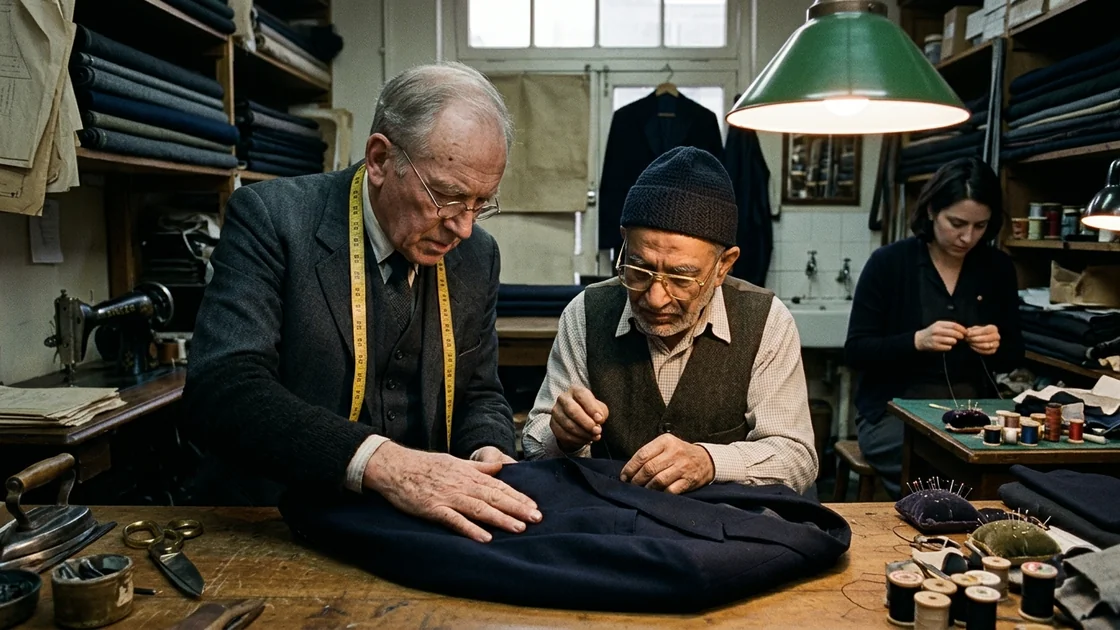
Arthur Pendelton, a seventy-two-year-old bespoke tailor on Savile Row's periphery, hides an essential tremor that has begun to ruin his life's work. As his hands shake too violently to thread a needle or cut a straight line, he resorts to desperate measures to conceal his decline from his loyal clientele, his ambitious landlord, and his perceptive niece. Over the course of several punishing months, Arthur takes on one final, monumental commission for a difficult aristocrat, pushing his failing body to its absolute limit as his business, his pride, and his identity slowly unravel until he is forced to confront the truth of his frailty.
The morning light in London rarely arrived all at once; instead, it seeped through the grime of the high Victorian transom windows on Conduit Street like weak tea staining a linen napkin. Inside Pendelton & Sons—though there had never been any sons, only Arthur and the ghost of his father—the air smelled permanently of scorched wool, beeswax, and the damp, metallic tang of the big forty-pound goose irons resting dead and cold on their iron stands.
Arthur stood before the massive cutting table, a slab of scarred prime beechwood ten feet long and four feet wide, polished to a dull, amber sheen by eight decades of friction. Beside his right hand lay a pair of thirteen-inch Wilkinson Sword brass-handled shears. They weighed nearly four pounds. For fifty-six years, they had felt like a natural extension of his radius and ulna, balanced so exquisitely that the heavy lower blade seemed to glide through fifteen-ounce worsted wool of its own accord.
Today, the brass handle clattered softly against the wood.
Tap-tap-tap.
Arthur stared down at his right hand. The skin was translucent, mapped with raised blue veins and liver spots the color of dried tobacco leaf. The index finger was permanently hooked from half a century of tensioning basting thread, the side of the tip calloused into gray horn. And it was oscillating. Not a violent spasm, not yet, not at seven in the morning, but a rhythmic, insistent tremor—roughly six cycles per second—that turned the finest instruments of his trade into noisy informants.
He took a slow breath through his nose, puffing out his spare, neatly shaved cheeks, and clamped his left hand over his right wrist. He pressed down hard, pinning the heel of his palm into the beechwood until the cartilage in his shoulder complained. The tapping stopped, replaced by a dull, isometric ache that radiated up his forearm into his neck.
"Not today," he whispered to the empty shop. His voice was papery, dry from sleeping with his mouth open. "We have the Montgomery trousers to strike. Behave yourself."
He released the pressure. For four seconds, the hand remained quiescent, resting beside the heavy shears like a startled small animal. Then, the little finger twitched, the ring finger followed, and the insidious metronome resumed its beat.
Arthur turned away from the cutting table, his posture rigidly upright despite the grinding arthritic protest in his lumbar spine. He wore what he wore every day: a three-piece suit of charcoal birdseye, cut thirty years ago when his chest was an inch broader and his waist two inches trimmer,though he had let the waistcoat back out so skillfully that not even another master cutter could have spotted the alteration without turning the lining inside out. Around his neck hung his yellow silk tape measure, the edges slightly frayed between the thirty-eight and forty-two-inch marks, draped over a pristine white stiffer-collared shirt held together by a gold collar pin. A tailor whose own clothes were slovenly was like a bald barber selling hair tonic; appearances were the foundation upon which the entire theatre of bespoke clothing rested.
He walked to the back of the shop, past the towering bolts of Dormeuil, Holland & Sherry, and Loro Piana fabric stacked like structural columns in their dark mahogany cubbies. Behind a heavy green baize curtain lay the workshop—the "back shop," in the vernacular of the trade, though for ten years Arthur had been both front-of-house cutter and back-shop tailor, a one-man band playing in an increasingly empty concert hall.
He plugged in the electric kettle next to the small enameled sink, ignoring the bottle of beta-blockers sitting behind a tin of French chalk. Dr. Patel had prescribed them four months ago. Essential tremor, Mr. Pendelton. Very common at your age. Benign, medically speaking, though I understand for a man of your profession, "benign" is a poor choice of word. The pills slowed his heart down until he felt as though he were wading through cold treacle, and worse, they made his fingertips numb. A tailor could work—slowly, agonizingly—with a tremor if he braced his wrists. He could not work at all if he could not feel the thickness of a silk thread between his thumb and forefinger.
Instead of the pills, Arthur reached beneath the sink and drew out a flat half-pint flask of cheap blended Scotch. He didn't like the taste of whisky—he had been a chapel-going teetotaler until his seventieth birthday—but alcohol was a central nervous system depressant that worked in fifteen minutes and didn't deaden the nerves in the skin. He unscrewed the cap, poured two fingers into a chipped Coronation mug, and swallowed it neat. He shuddered as the raw spirit burned a path down his esophagus, his eyes watering behind his half-moon spectacles.
He stood completely still for ten minutes, staring out the barred back window into the tiny, mossy airshaft, waiting for the chemistry to take hold.
Slowly, the internal vibration began to dampen. The high-frequency hum in his forearms subsided into a heavy, warm stillness. He raised his right hand to the level of his face, spreading the fingers wide. Only the faintest flutter remained at the very tips, no worse than the tremble of a man who had drunk one cup of coffee too many. He had perhaps two hours in this window before the alcohol wore off and the rebound tremor came back twice as fierce.
Moving with practiced, economical haste, Arthur went to the sewing table under the green-shaded industrial lamp. Before the cutting, before the pressing, came the basting and the felling—the handwork that no machine could replicate. He needed to finish the hand-stitched buttonholes on the lapel of a midnight-blue dinner jacket for Mr. Julian Vance, a barrister who had been coming to Pendelton & Sons since he took silk in the nineties.
The jacket lay draped over a tailor's ham. Everything was ready, except the needle was unthreaded.
During the night, the silk twist had slipped out of the eye of the size-nine Betweens needle he had left pinned to the baize mat. A size-nine Betweens is barely an inch long, fine as an eyelash, with an eye so microscopic that even young apprentices with twenty-twenty vision sometimes squinted to find it.
Arthur sat on his wooden stool, adjusting the lamp until the sixty-watt bulb glared directly onto the green mat. He picked up the needle with his left hand and the spool of heavy black silk gimp with his right. With his teeth, he bit off an eighteen-inch length of thread, waxing the end by drawing it swiftly across a lump of dark beeswax until it stood stiff as a bristle.
He brought the thread toward the needle.
At a distance of three inches, both hands were steady. At one inch, the terrible self-consciousness of the act triggered the neurological short-circuit in his cerebellum. The harder he looked at the minuscule silver eye, the more violently the point of the thread danced around it.
Up, down, left, right. It stabbed at the solid shaft of the steel. It curved over the top. It poked uselessly at the air half a millimeter to the left.
"Come on," Arthur hissed through clenched teeth. A bead of sweat broke out along his hairline despite the morning chill of the shop. "Come on, you wretched thing."
He rested both elbows firmly on the table, locking his forearms together from wrist to funny bone, turning his upper body into a human tripod. He closed his left eye. He held his breath. He moved the needle toward the stationary thread instead of the thread toward the needle—an old blind-man's trick his father had taught him when the elder Pendelton was dying of dropsy in 1978.
The waxed point touched the rim of the eye, buckled, and frayed into three microscopic strands.
Arthur dropped the needle. It vanished instantly into the dark nap of the green baize. He sat back, his chest heaving, a sudden, terrifying rage boiling up from his stomach. He wanted to sweep the heavy iron goose off its stand and smash the worktable into splinters. He wanted to tear the midnight-blue barathea wool in half. Instead, he gripped his knees under the table, digging his blunt fingernails into the birdseye wool of his trousers until the anger receded into a cold, hollow nausea.
He reached into his waistcoat pocket and pulled out a small, cheap plastic device shaped like a flat coin with a tiny diamond of flexible wire protruding from one end. A needle-threader. A tool for clumsy housewives and children in primary school sewing classes. He had bought a packet of ten at a market stall in Whitechapel six months ago, wearing a flat cap and a scarf pulled up to his chin so no one from the Row would recognize him.
Even with the wire loop, it took him four tries to catch the silk and pull it through. When it was done, he hid the plastic disk back in his pocket as quickly as if it were stolen jewelry, terrified that the ghosts in the shop had seen him use it.
The brass shop bell above the street door gave its bright, two-tone chime.
Arthur froze, then quickly swept the bottle of Scotch behind the heavy bolts of lining silk, popped a strong peppermint lozenge into his mouth, and smoothed his hair in the spotted gilt mirror by the curtain. When he stepped out into the front shop, his hands were clasped loosely behind his back—the classic posture of the deferential English tradesman, and the most convenient way on earth to hide a pair of rebellious thumbs.
"Morning, Uncle Artie," a brisk voice called out.
It wasn't a client. It was Clara.
His late sister's daughter stood by the cutting table, unwinding a thick oatmeal-colored muffler from her neck. She was thirty-four, an structural engineer for the local borough council, with her mother's sharp chin and an unsettling habit of looking at rooms as if she were calculating their load-bearing capacity. In her gloved hand, she carried a brown paper bag from the Danish bakery on Regent Street and a thick bundle of unopened mail she had clearly scooped up from the brass letterbox on the floor.
"Clara, my dear," Arthur said, inflecting his voice with a cheerful buoyancy he was far from feeling. "You're out early. Don't the bridges of Westminster require your attention at this hour?"
"Site inspection on Oxford Street at nine," she said, setting the pastries down on a clear corner of the beechwood table and sifting through the envelopes. "Thought I'd drop in and make sure you hadn't been buried alive under an avalanche of Harris Tweed. It's freezing in here, Artie. Have you got the storage heaters on?"
"A cool room keeps the damp out of the shears and the lethargy out of the tailor," he recited automatically. "Besides, once the big iron is hot, the back shop is like the tropics."
Clara didn't look convinced. Her dark eyes moved over him with that structural-engineer's scan, lingering on the slight grayness beneath his cheekbones and the way his collar, once snug, now stood a quarter-inch clear of the corded tendons in his neck.
"You've left these by the door since at least Tuesday," she said, holding up three brown window envelopes and one printed on thick, cream-colored bond paper. "Two of these are final reminders from the electricity board, Artie. And this one is from Sterling & Vance Property Management."
"Leave them by the ledger, there's a good girl," Arthur said smoothly, not bringing his hands out from behind his back. "I do the books on Friday afternoons. You know my system. A place for everything, and a time for every unpleasantness."
"Today is Friday," Clara said quietly.
"Friday afternoons," he corrected gently. "Are those cinnamon whirls? I'll put the kettle back on."
He made to move past her toward the green curtain, but she didn't step aside. Instead, she looked down at the cutting table. The Montgomery trouser pattern—cut from stout brown manila paper—was pinned to a length of heavy cavalry twill. Along the outseam, where Arthur had begun chalking the line before the tremor grew too violent the previous evening, the white French chalk mark didn't run in the clean, sweeping parabola of a master cutter. It looked like a seismograph reading—a jagged, stuttering white scrawl that wandered an eighth of an inch off the edge of the wooden rule.
Arthur saw where she was looking. His heart gave a heavy, sickening thud against his ribs.
"What's this?" Clara asked, touching the wobbly chalk line with the tip of her leather glove.
"Blasted chalk was damp," Arthur lied instantly, his voice tight. "Crumbled right in my fingers as I drew it down the rule. Cheap foreign stuff the trimmings merchant sent over last month. You can't get proper French tailors' chalk anymore; it's all pressed gypsum and tallow."
He reached out with his left hand—the steadier one—and briskly brushed the offending line away with the stiff horsehair brush that hung from the table's corner, erasing the evidence in three swift strokes.
Clara watched his left hand, and then her gaze dropped to his right wrist, which he had immediately tucked back behind the skirt of his coat.
"Let me see your hands, Artie."
"Don't be ridiculous, girl. My hands are covered in graphite and fuller's earth."
"Arthur." She rarely used his full name. When she did, she sounded frighteningly like her mother, who had been the only person in the world capable of making Arthur eat his greens or go to the dentist. "Show me."
"I haven't time for parlour games, Clara," he said, allowing a rare note of sharp frost to enter his tone. "Mr. Vance is coming in at eleven for his final fitting on the barathea jacket, and I have three pairs of trousers to strike before lunch. Drink your tea if you're staying, or go and inspect your girders, but do not come into my shop and play the nursemaid."
A flush of hurt colored Clara's cheeks, though she held her ground for a long second. The silence in the shop stretched, broken only by the muffled rumble of a number 94 bus grinding its gears out on the street.
"The lease renewal is in that cream envelope," she said, her voice dropping its lightness. "I know the commercial rates on this street went up forty percent in the spring assessment. You haven't taken on an apprentice since Johnny quit to work at Gieves & Hawkes five years ago, and whenever I walk past here in the evening, the lights are on until nine o'clock, and you're still working on the same three coats I saw on the dummies in October."
"Bespoke tailoring cannot be rushed like pouring concrete, my dear," Arthur said, softening his voice now that he had deflected her from his hands. "My gentlemen don't come here for factory speed. They come for the Pendelton shoulder."
"They come if you let them through the door," she said, setting the envelopes down with a deliberate smack against the wood. "Mrs. Higgins at the dry cleaner's down the lane told me you turned away two walk-in customers last week. Told them your books were full until Easter."
Arthur felt a cold draft around his ankles. He hadn't known Mrs. Higgins was watching him, nor that the two young hedge-fund managers he had politely dismissed had gone down the street complaining. How could he have measured them? To measure a new client required draping the tape around their chest, holding it firm between thumb and index finger right beneath their chin while calling out numbers—except there was no one to call the numbers out to anymore, which meant he had to write them down in the measurement book himself while the customer stood there watching his pen dance across the page like a spider on a hot griddle.
"They wanted skinny lapels and low-rise trousers that look like riding breeches," Arthur said with a dismissive sniff. "Let them go to Soho and buy glued-together Italian rubbish. I am seventy-two years old, Clara. I have earned the right to be selective."
Clara sighed, the mist of her breath visible in the unheated air of the shop. "Have the cinnamon whirl, Artie. Eat both of them; you look like a gust of wind would blow you down Regent Street. I'll come by on Sunday and take you to lunch at the pub."
"Sunday is spoken for," he lied. "I'm... dining with Hilbert. From the Woollen Merchants' Guild." Hilbert had been in a nursing home in Surrey for two years, a fact Arthur prayed Clara didn't remember.
She looked at him with an expression that was far worse than anger; it was a helpless, encroaching pity. She rose onto her tiptoes, kissed his papery cheek—he held his breath so she wouldn't smell the peppermint masking the Scotch—and walked out, the brass bell clanging behind her.
As soon as the door clicked shut, Arthur sagged against the edge of the cutting table. His legs felt like wet wool.
He walked over to the stack of mail she had left behind and picked up the cream envelope from Sterling & Vance. Using his brass paper-knife, he slit the top and unfolded the heavy sheet.
He didn't need to read the legal boilerplate in the middle paragraphs; his eyes went straight to the bolded figures at the bottom. Beginning in the new quarter—less than nine weeks away—the rent on Number 14B Conduit Street would rise from two thousand eight hundred pounds a month to four thousand five hundred. Furthermore, the landlord required a six-month security deposit to be lodged in escrow by the first of the month to guarantee the five-year renewal term. Twenty-seven thousand pounds down, just for the privilege of keeping his name on the glass.
Arthur walked to the high desk in the corner and opened his leather-bound cashbook.
The numbers inside were written in a script that had grown progressively larger and more erratic over the past eighteen months. In his bank account at Coutts—kept open only because they didn't charge fees to grandfathered business accounts from the 1950s, no matter how meager the balance—there was six thousand, four hundred and twelve pounds. In the petty cash tin, there was eighty-five pounds and some silver. Outstanding invoices for work currently on the rails totaled another four thousand, assuming he could actually finish the garments and deliver them without ruining the cloth.
He was twenty thousand pounds short of survival. And even if a miracle fell through the transom and paid the deposit, how was he to clear forty-five hundred a month before rates, electricity, and cloth merchants' bills, when it now took him eighty hours to make a coat that used to take forty?
He looked around the shop. His father had opened this room in 1947 with his demob money and two bolts of surplus RAF serge. Arthur had come here at sixteen in short trousers, spending his first two years doing nothing but sweeping clippings, boiling the glue pot, and carrying steaming irons back and forth until the skin on his palms turned into leather. Every nick in the beechwood table was a calendar entry of his life. The burn mark near the corner was from the day in 1966 when England won the World Cup and his father had set the iron down without its trivet while listening to the wireless. The deep gouge by the yardstick was from 1983, the morning Arthur learned his wife, Margaret, had an inoperable tumor, and his shears had slipped for the first time in his life.
If he lost the shop, there was nothing else. He lived in a dark two-room flat over a laundrette in Maida Vale where the walls vibrated twelve hours a day from the spin cycles below. He had no children. His friends from the Row were either dead, senile, or retired to bungalows in Eastbourne where they sat in conservatories waiting for their hearts to stop.
This room was not where Arthur worked. This room was what Arthur was.
At ten minutes to eleven, he took another swallow of Scotch—just a half-ounce this time, enough to bridge the gap—and sucked on two more peppermints. He returned to the back shop and wrestled with Mr. Vance's buttonhole.
A Savile Row buttonhole is a miniature feat of engineering. The cloth is slit, and the raw edge is reinforced with a stiff cord called gimp. Then, using a silk twist waxed and smoothed with a hot iron, the tailor works dozens of tiny, identical knotted stitches—purl stitches—around the perimeter, pulling each one upward with a sharp, precise flick of the wrist so that the tiny knots line up along the very lip of the slit like a row of microscopic black pearls.
Arthur managed four stitches that looked like his old work. On the fifth, his right thumb spasmed. He pulled too hard and at the wrong angle, yanking the gimp cord out of alignment and burying the knot into the face of the cloth instead of perching it on the edge. On the seventh stitch, the needle missed the slit entirely and stabbed a tenth of an inch deep into the surrounding wool, creating a fat, ugly loop like a beetle's leg.
He couldn't pick it out; once silk twist is drawn tight into fine barathea, unpicking it leaves pockmarks that no amount of steaming will ever completely close.
Arthur looked at the clock. Five minutes to eleven.
With a cold, pragmatic despair that felt like treason against his own soul, he reached under the table and pulled out a tin of matte black fabric paint—something used by theatrical costumers to hide repairs on stage clothes—and a fine sable brush. He dabbed a microscopic dot of black pigment over the protruding white core of the frayed silk where the stitch had gapped, then pressed the ragged buttonhole flat with the nose of the heavy iron, crushing the flawed purl stitches into a uniform, dead line.
To ninety-nine men out of a hundred, it looked like a perfectly serviceable buttonhole. To Arthur, it looked like an open wound.
The shop bell rang precisely on the stroke of eleven.
Mr. Julian Vance KC entered, bringing with him the scent of Floris No. 89 cologne and the brisk, effortless confidence of a man who charged eight hundred pounds an hour to argue about maritime insurance in the High Court. Behind him, however, came a second man—taller, younger, dressed in an olive-green Loro Piana cashmere overcoat that clearly hadn't been made in London, though it had cost as much as a small car.
"Morning, Pendelton!" Vance boomed, stripping off his overcoat and tossing it carelessly onto the mahogany bentwood chair. "Brought a spectator today, hope you don't mind. This is Lord Allendale—Marcus, this is Arthur Pendelton, the last honest man between Regent Street and Piccadilly."
"My Lord," Arthur said, executing a slight, sixty-year-old bow from the neck while keeping his hands lightly tucked behind the vents of his charcoal coat. "An honor, sir."
Marcus, twelfth Baron Allendale, was perhaps forty, with the pale, slightly dissipated handsomeness of an eighteenth-century portrait and eyes the color of cold pewter. He didn't offer to shake hands—for which Arthur thanked God—but instead wandered along the cutting table, looking down his long nose at the dusty bolts of cloth and the antiquated brass gas fittings that still protruded from the wainscoting.
"Julian tells me you still do the entire coat on the premises, Mr. Pendelton," Allendale said. His voice was soft, effortless, and carried the slight, nasal drawl of Eton and the Household Cavalry. "Every other house on the Row farm their coats out to outworkers in Chinatown or Battersea these days, don't they? Even Huntsman."
"A gentleman's coat shouldn't travel on the Underground in a plastic bag before he's even worn it, my Lord," Arthur replied smoothly, stepping into the back shop to retrieve the midnight-blue dinner jacket on its broad wooden hanger. "Every stitch under this roof is mine. That way, if there is a fault, I don't have to go looking for a subcontractor in Soho to blame."
He emerged holding the jacket by the hook of the hanger—a gripped fist vibrated far less than an open hand. "Shall we try the silk, Mr. Vance?"
Vance stepped onto the low dais before the three-way triptych mirror. Arthur stood behind him, holding the jacket open. This was a moment of acute danger: sliding the silk-lined armholes over a client's shirt cuffs required holding the weight of the coat suspended in mid-air for several seconds.
Arthur hooked his elbows tight against his own ribs, using his torso to stabilize his arms, and lifted the coat smoothly onto Vance's broad shoulders. As soon as the collar settled against Vance's neck, Arthur let his hands drop to the lapels, grabbing the heavy cloth firmly and drawing it downward to settle the chest. So long as he was gripping or pulling against resistance, the tremor was invisible; it was only in hover, in the delicate mid-air transitions, that the betrayal occurred.
"Ah," Vance murmured, turning slightly before the glass. "Look at that roll on the silk facing, Marcus. Not a bubble in the canvas. You see what I mean about the shoulder?"
Allendale stepped closer, his pewter eyes narrowing as he inspected the dinner jacket. He wasn't just a rich dilettante; Arthur realized with a sudden prickle of unease that the man actually knew what he was looking at. Allendale reached out and pinched the sleeve-head of Vance's coat, feeling the hand-padded horsehair and domenette wadding inside, then looked down at the lapel.
His eyes passed within six inches of the sabotaged buttonhole.
Arthur stopped breathing. He watched Allendale's gaze travel down the left peak lapel, pausing right at the silk-corded slit. For three agonizing seconds, the Baron stared right at the crushed, painted stitches.
Then Allendale looked up, meeting Arthur's eyes in the mirror.
"My grandfather had his shooting coats made here," Allendale said quietly. "In the sixties. The ninth Baron. I found three of them in the gunroom closet at the Abbey after my father died last winter. The moths had eaten the linings out, of course, but the seams on the thornproof tweed were still so tight you couldn't force a penknife between them."
"I remember your grandfather well, my Lord," Arthur said, his heart resuming its beat at a frantic clip. "A forty-four chest, very square on the right shoulder from forty years of twelve-bore recoil. My father cut for him, and I struck the coats myself when I was twenty."
"Yes," Allendale said, a slow, peculiar smile touching the corners of his thin mouth. "Well. My grandfather was a stout man, and I am not, so his tweeds are no use to me. However, I am getting married at the Abbey on the twelfth of December. Eight weeks from Saturday."
Arthur inclined his head politely. "My felicitations, my Lord."
"Don't felicitate me yet, Mr. Pendelton; you haven't heard what I want," Allendale said. "The wedding is a three-day affair in Northumberland. I require a full trousseau, done in the old manner. A morning coat and waistcoat in black herringbone with cashmere-striped trousers for the service. A heavy highland evening tailcoat in Barathea with silk facings for the ball. Two three-piece shooting suits in twenty-two-ounce Lovat estate tweed with plus-fours and matching caped Ulster overcoats. And three lounge suits for traveling."
The silence in the shop became absolute. Even Julian Vance turned in surprise, half-buttoned into his dinner jacket.
Nine garments. Not just nine garments, but the absolute pinnacle of the bespoke tailor's art: a morning coat, full evening dress tails, and heavy estate tweeds with caped overcoats. Each coat represented at least sixty to seventy hours of handwork for a man in his prime. Nine pieces in eight weeks was nearly six hundred hours of labor—seventy-five hours a week, every week, without a single mistake, for a man working completely alone.
"Marcus, my dear fellow," Vance chuckled, "even an army of elves couldn't turn out a full ducal wardrobe by December. That's nine weeks away."
"Eight," Allendale corrected mildly, never taking his cold eyes off Arthur. "And I am aware of the unreasonable nature of the schedule. Which is why I am prepared to pay double the standard Savile Row tariff, with fifty percent on the table this morning by bank transfer, and the balance upon delivery on the tenth of December. Call it... thirty-six thousand pounds. Eighteen thousand today."
Arthur felt the room tilt slightly.
Eighteen thousand pounds today. Added to the six thousand in his Coutts account and Vance's final payment of three thousand, it was twenty-seven thousand pounds to the penny. The exact sum required by Sterling & Vance Property Management to secure his lease for another five years. And the second eighteen thousand in December would cover his higher rent for nearly half a year, buying him time to... to do what? To find a cure that didn't exist? To hire a cutter who would instantly see his secret?
He didn't care about January. Right now, the cliff edge was at the end of the month, and this arrogant young peer was holding out a rope made of gold thread.
"Of course," Allendale added, his voice dropping half an octave into something silky and dangerous, "there is a condition in the contract. If the clothes are late—even by twenty-four hours—or if a single seam is touched by a sewing machine where hand-felling was promised, or if the work is sub-contracted out of this building, the deposit is returned in full and I pay nothing. I want the ninth Baron's tailor, Mr. Pendelton. Not a factory."
Arthur looked down at the floor for a moment. Behind his back, his right hand was beginning to hum again as the morning's Scotch faded into his bloodstream. The thumb beat a tiny, frantic tattoo against the knuckles of his left hand. Run, run, run, it seemed to tap. Tell him you are old. Tell him your hands are broken. Lock the door and go home to Maida Vale.
He thought of the spin-dryers rattling the plaster in his tiny sitting room. He thought of his father's brass name-plate being pried off the brickwork outside by workmen in high-visibility vests to make way for an artisanal coffee shop or a mobile phone showroom.
Arthur raised his head. He drew his shoulders back until his spine popped.
"I have a bolt of twenty-two-ounce Lovat green cheviot in the basement that has been maturing in brown paper since 1994, my Lord," Arthur said, his voice ringing clear and steady in the quiet room. "You won't find wool like it in Britain today; the mill in Hawick closed twenty years ago. If your Lordship will step onto the dais after Mr. Vance, I will take your measures."
Getting the measurements without exposing himself required the choreography of a stage magician.
While Vance was dressing in the fitting cubicle, Arthur ducked into the back shop, poured three full ounces of Scotch into the mug, and drank it down in two gulps, chasing it with cold tap water. It was far too much on an empty stomach—he hadn't touched Clara's pastries—and by the time he returned to the front with his measurement ledger, a warm, slightly swimming haze had settled behind his eyes.
"Now then, my Lord," Arthur said. Instead of picking up a pencil to write while standing, he walked over to a dusty cassette recorder sitting on the high shelf—an old Sony Dictaphone he hadn't used since 1998—and pressed the heavy mechanical Record key with his knuckle. "My eyes aren't fond of going back and forth from the tape to the ledger in this autumn light, sir. If you don't mind, I shall call the measures to the machine and enter them in the book with my reading glasses later."
Allendale merely raised his arms slightly from his sides, looking straight ahead into the triptych mirror. "Carry on."
Arthur stepped behind him. With the heavy dose of alcohol hitting his cerebellum, his hands were miraculously, eerie calm—almost wooden. He whipped the yellow silk tape around Allendale's chest with the crisp, snapping motion of fifty years' muscle memory.
"Chest, thirty-nine and a half," Arthur intoned in the ancient, rhythmic chant of the Row. "Waist, thirty-three. Seat, forty. Cross-back, seven and three-quarters, continuing to seventeen, continuing to thirty-three and a quarter to the cuff. Slight drop on the left shoulder—half an inch, perhaps five-eighths—from the polo mallet, I expect, my Lord?"
A flicker of genuine respect crossed Allendale's reflection in the glass. "A bad fall at Cowdray Park three years ago. Broke the collarbone. The fellow at Anderson & Sheppard didn't notice it until the second basted fitting."
"A blind man could see it in the hang of your overcoat, sir, if you'll pardon the observation," Arthur murmured, kneeling slowly—his knees cracking like dry kindling—to take the inside leg measurement.
Getting back up was harder. Without a second person in the shop, he had to use the corner of the cutting table to lever himself upright, disguising the effort by pretending to reach for a swatch book on the low shelf. By the time Allendale and Vance departed forty minutes later—having arranged for the first basted fitting in precisely fourteen days—Arthur had the bank sort code and a signed confirmation of order sitting on the beechwood table.
He locked the street door, flipped the hanging card from Open to Closed, and drew the heavy velvet privacy curtain across the glass.
Then he fell onto the bentwood chair, put his head between his knees, and vomited the Scotch and peppermint into the brass wastepaper basket.
He stayed there for twenty minutes on the threadbare Wilton carpet, shivering in the unheated room, wiping his mouth with a clean pocket handkerchief. When he finally sat up and looked at his hands in the gray afternoon light leaking around the edges of the velvet curtain, they were shaking so violently that his fingernails clicked against each other like castanets.
The rebound had arrived.
The next fourteen days ceased to be measured in hours or dates; they were measured in yards of canvas, ounces of whisky, and the excruciating geography of seams.
Arthur knew he could not drink throughout the day. If he drank enough to keep the tremor suppressed for twelve hours at a stretch, he would either pass out over the cutting board or pickle his liver before November was out, to say nothing of the haze that alcohol cast over his spatial judgment. Cutting a bespoke pattern from scratch—drafting the intricate geometry of inlays, darts, and balance marks onto brown rock-paper—required a mind like a laser, even if the hands holding the chalk were rebellious.
So he divided his life into two distinct phases: the Shaking Hours and the Still Hours.
From six in the morning until four in the afternoon were the Shaking Hours. During this time, he touched neither alcohol nor the fine needles. Instead, he used engineering to defeat biology.
To draft Allendale's patterns, Arthur went to an ironmonger on the Edgware Road and bought four heavy lead sash-weights and two carpenter's C-clamps. Instead of holding the wooden L-square and the curved tailor's rules steady with his left hand while drawing the chalk line with his right, he clamped the wooden rulers directly to the beechwood table, locking them down so hard the wood groaned. Then, he took a thick lump of tailor's chalk, lashed it with twine into the end of a heavy steel pipe-wrench to give it three pounds of dead inertia, and dragged the weighted wrench tight along the clamped wooden edge.
It took him ten minutes to draw a single seam line that used to take three seconds. It left clamp scars on his father's prized beechwood table that made him want to weep.
Cutting the cloth was worse. He could not clamp the shears. If he allowed his shaking right hand to close the blades of the thirteen-inch Wilkinson Swords unassisted, the heavy steel would chew the twenty-two-ounce Lovat tweed into a jagged dog's breakfast.
He spent an entire Tuesday night staring at the shears until he devised a harness. He took an old leather luggage strap, bolted one end to the underside of the cutting table, and looped the other over his right forearm just below the elbow, pulling it down until his arm was pinned flat against the table surface under thirty pounds of downward tension. With his forearm immobilized against the wood by the strap, he couldn't lift the lower blade of the shears at all; he could only slide it forward like a plowshare, using his left hand on top of the brass upper handle to press the blade down with his whole body weight rather than squeezing with his fingers.
By the end of the first week, the skin on his right forearm was rubbed completely raw by the leather strap, bleeding through his white shirt sleeve until he had to wrap his arm in gauze bandages and wear an old black alpaca oversleeve to hide the bloodstains. His right shoulder socket felt as though someone had driven a rusty railroad spike into the joint.
Then, at four o'clock in the afternoon, came the Still Hours.
He would eat two pieces of dry toast and a tin of sardines—to line his stomach—and then begin the carefully titrated regimen of Scotch. One ounce every ninety minutes, measured in a glass apothecary beaker he had bought at Boots, accompanied by two aspirin for his screaming shoulder.
During the Still Hours, from half-past four until midnight, he did the basting, the padding of the lapels, and the fine work.
Even with the alcohol, his endurance was a fraction of what it had been. After three hours of hand-padding a lapel—driving thousands of tiny diagonal blind-stitches through horsehair canvas and melton undercollar cloth to build a permanent curve into the wool—the tremor would break through the chemical barrier of the whisky.
He began to cheat in ways that nobody would ever see unless they took a razor blade to the coat.
Where a traditional bespoke coat had its internal linen pocket-stays felled entirely by hand, Arthur dragged out the ancient, dust-covered Singer treadle machine from the back corner after midnight, oiled its rusted shuttle, and machine-stitched the internal structural pockets hidden behind the lining. If a single seam is touched by a sewing machine where hand-felling was promised, Allendale had said. Well, Allendale couldn't see inside the breast lining without destroying his own coat. Even so, every clack of the Singer's needle felt to Arthur like a hammer driving a nail into his father's coffin.
The hardest problem remained the simplest one: threading the needles.
Even during the Still Hours, the tiny eye of a needle defeated him once his eyes grew tired under the sixty-watt lamp. A tailor preparing a coat for a first "skeleton" basted fitting uses miles of white cotton basting thread, constantly breaking off lengths, knotting them, and re-threading as he moves from shoulder to gorge to side-seam. Stopping for five minutes every quarter of an hour to wrestle with a plastic wire needle-threader was costing him two hours a night.
On the tenth day, Clara came by at six in the evening.
She rattled the brass handle of the front door, which Arthur had kept locked all day to prevent walk-in repairs from interrupting him. When he didn't answer, she didn't go away. She went down into the narrow area steps by the pavement, peered through the barred basement grating where the light from the back-shop trapdoor was visible, and hammered on the glass with her house keys until he was forced to come up and unbolt the street door.
"What on earth is going on?" she demanded, pushing past him into the dim front shop. The velvet curtain was still drawn across the display window, and the air smelled thick and sour—a mixture of scorched tweed, liniment, stale sweat, and old whisky. "Your phone has been off the hook since Wednesday! I had to call Mrs. Higgins at the cleaner's just to find out if she'd seen milk bottles being taken in!"
"I am working on a rush commission, Clara," Arthur said, standing between her and the green baize curtain that led to the workshop. He was in his shirtsleeves and waistcoat, the black alpaca oversleeve pulled down to his knuckles on the right arm to hide the bloody gauze beneath. "Lord Allendale's wedding trousseau. I left the receiver off the cradle because I cannot afford to have my concentration broken by dry-cleaning salesmen and wrong numbers."
Clara stopped and looked around the front shop.
The cutting table looked like a medieval torture bench. Two heavy iron C-clamps were still screwed into its edge, and the leather luggage strap hung down like a noose from the underside of the beechwood plank. On the floor around the table, dozens of white basting clippings and jagged triangles of green tweed lay un-swept—a shocking departure for a man who had once lectured her for ten minutes when she dropped a biscuit crumb on his carpet at the age of eight.
"Artie," she whispered, her eyes widening. "What is that strap for?"
"It holds the bolt of twenty-two-ounce tweed from rolling off the board while I draw the grain," he lied, his voice cracking slightly from exhaustion. "It's heavy estate cloth, girl. Springy as sheet iron. Now, I really must ask you to excuse me. The first fitting is on Friday morning, and I have four coats and three pairs of breeches to bring to the baste."
Clara didn't listen. Before he could move to block her, she stepped briskly around him and pulled back the green baize curtain.
Arthur closed his eyes.
Under the harsh glare of the green-shaded lamp sat the apothecary beaker, the half-empty bottle of Bell's Scotch, a saucer heaped with chewed peppermint wrappers, and four broken plastic wire needle-threaders whose flimsy wire loops had snapped under the force of his trembling fingers.
For a long time, Clara didn't say a word. She stood in the doorway of the back shop, her back rigid beneath her navy-blue wool coat. Then she walked slowly over to the worktable and picked up one of the broken plastic disks.
"How long?" she asked, without turning around.
Arthur leaned his shoulder against the doorframe. Suddenly, he was too tired to hold his spine straight. All seven decades of his life seemed to come down on the back of his neck at once.
"It started two winters ago," he said softly, looking down at the worn linoleum. "Just in the mornings, before the shop warmed up. I thought it was the cold. Then I thought it was my eyes making me strain. I went to Patel in June."
She turned around, holding the broken threader in her palm. Her eyes were bright with unshed tears, though her jaw was set hard. "Parkinson's?"
"No. Essential tremor, he calls it. Says my brain just forgets how to keep the brakes on the nerves when I try to do something small. If I'm carrying a bucket of coal, steady as a rock. If I try to pick up a pin..." He finally brought his right hand out from behind his back and held it out into the cone of light under the lamp.
Unbraced, with his adrenaline spiking from the confrontation, the hand danced violently in the air, the fingers fluttering like a bird trapped in a chimney.
Clara let out a small, choked sound and stepped forward, taking his shaking hand between both of her warm, steady ones. She pushed up the black alpaca sleeve and saw the stiff, blood-spotted gauze wrapped around his raw forearm where the leather strap had chewed away the skin.
"Oh, Artie," she breathed, a tear finally spilling over her lashes and dropping onto his knuckles. "Oh, you stubborn, ridiculous old fool. Why didn't you tell me? Look at your arm!"
"And what would telling you have accomplished, my dear?" he asked gently, pulling his hand back and tucking it into his waistcoat. "Can your structural engineers build a bridge across a worn-out nerve? If the word gets out on the Row that Arthur Pendelton has the shakes and drinks cheap Scotch at four in the afternoon to hold his shears, my name is dead before the week is out. Tailor's talk is worse than a village sewing circle."
"Let the shop go, Artie!" she cried, gesturing toward the front room. "You're seventy-two! Give up the lease, sell the stock to the merchants for whatever they'll give you, and retire! You have your state pension, and I have a spare room in my flat in Clapham—"
"And what would I do in your spare room in Clapham, Clara?" Arthur asked, his voice rising with a sudden, fierce dignity that made her step back. "Sit in an armchair by the radiator and watch daytime television while my hands shake in my lap? Wait for you to come home from work and cut up my meat for me? My father died with a pair of shears in his hand at seventy-eight! I have made coats for prime ministers, for judges, for dukes! I am not going to end my life as a piece of broken furniture in my niece's spare bedroom!"
"You're going to kill yourself in here instead!" she shouted back, pointing at the whisky bottle and the bloody bandage. "Nine garments in eight weeks? I don't know anything about tailoring, Artie, and even I know that's insane! Why did you take this order?"
"Because he paid eighteen thousand pounds down, and he pays eighteen thousand more on December the tenth," Arthur said flatly. "Which pays the five-year lease bond on this shop and clears my debts. Once the lease is signed for five years, the lease itself becomes a salable asset. I can sell the goodwill and the five-year term to a young cutter from Anderson's or Poole's for fifty thousand pounds in the spring, and walk out the front door with my head up and my name intact, instead of being thrown into the street by the bailiffs on quarter-day."
Clara stared at him, her chest rising and falling rapidly. The cold engineer's brain behind her wet eyes was clearly running the numbers, weighing the structural stress on the man standing before her against the load he had sworn to carry.
She looked at the clock on the wall. It was half-past six. Then she looked at the four skeleton coats hanging on the wooden rail—basted together in places, gaping open at the armholes and collars where hundreds of yards of white tacking thread still needed to be sewn before Friday morning.
Without another word, Clara unbuttoned her navy coat, took it off, and hung it neatly on the peg behind the door. She walked over to the sink, picked up the bottle of cheap Scotch, and poured half of it down the drain—stopping only when Arthur made a sharp, desperate lunge forward.
"Leave the rest," he pleaded, all his pride vanishing in an instant. "Clara, please. If I don't have an ounce at eight o'clock, I won't be able to get the sleeves into the morning coat. I'll have the horrors too bad to hold the chalk."
She looked at him, her heart breaking in her face, and set the half-full bottle back beside the sink without emptying the rest. Then she walked over to the worktable, pulled up the spare three-legged wooden stool from beneath the pressing board, and sat down under the lamp.
"I can't sew a bespoke coat," she said, picking up the big wooden spool of white basting cotton and a packet of size-seven needles. "My home economics teacher in year nine said my hem-stitch looked like barbed wire. Put twenty needles on the mat, Artie."
Arthur blinked at her. "What?"
"Put twenty needles on the green mat," she repeated firmly, licking the end of the white cotton thread between her lips and sliding it effortlessly through the eye of a needle on the first try. She pulled an eighteen-inch tail through, bit it off with her teeth, tied a neat quilter's knot in the end, and stuck the threaded needle upright into the front of the pincushion like a miniature silver lance. "If you don't have to stop to thread them, and you don't have to unpick basting threads or sweep the floor or work the steam press, how much time does that save you every night?"
Arthur stared at the upright needle glinting in the green pincushion. A strange, tight pain constricted his throat, making it impossible to swallow.
"About three hours," he whispered.
"Right," Clara said, already drawing another length of cotton off the spool. "Then sit down and put those sleeves in, Uncle Artie. I've got until eleven o'clock every night, and all weekend."
With Clara threading a forest of fifty needles every evening—arranging them in neat, military rows across three velvet pincushions: white cotton for basting, black silk for felling, waxed linen thread for buttons—the bottleneck broke.
More than the needles, she took over the heavy mechanical labor that was destroying his upper body. Under his hawk-eyed, finicky supervision, she learned how to handle the forty-pound goose iron and the steam press, using her young shoulders to drive the damp heat into the twenty-two-ounce tweed to shrink the fullness out of the trouser seats and stretch the curves into the calves—a process called "iron-work" that gave a bespoke garment its three-dimensional sculptural shape before a single seam was closed.
When the first fitting arrived on Friday morning, Clara stayed hidden in the basement, keeping the kettle boiling and five threaded needles waiting on the trapdoor stairs in case an emergency alteration was needed on the spot.
Lord Allendale arrived alone this time, punctual to the minute.
A first "basted" fitting Looks nothing like a finished suit to an layman. The coats had no linings, no buttons, and only one sleeve basted in; the lapels were raw horsehair canvas covered in hundreds of zig-zag white tacking stitches, and the shoulders were marked with white cross-lines of chalk like a butcher's diagram of a side of beef.
Arthur got through the forty-five-minute session on a single morning ounce of whisky and sheer theatrical bravado. Whenever he needed to mark a correction on Allendale's back or chest—where a shaking piece of chalk would give him away—he didn't use chalk at all. Instead, he kept a mouthful of brass steel pins between his lips, plucking them out and driving them straight into the heavy cloth with a quick, stabbing motion of his thumb, using the resistance of the fabric to hide the tremor.
"The balance on the morning coat is extraordinary, Pendelton," Allendale admitted, turning sideways to study the sweep of the cutaway tails in the three-way glass. Even in its raw, ghost-stitched state, the black herringbone hung from his shoulders as if it had been poured over him in liquid form; the half-inch drop in his broken left collarbone had been completely erased by a sculpted buildup of linen wadding inside the shoulder pad. "The man at Huntsman took three fittings to stop the collar gaping when I raised my arms. This doesn't budge a millimeter."
"Your Lordship has a military carriage," Arthur murmured around two brass pins clamped in the corner of his mouth. "Most young cutters today draft for men who slump over computer screens all day; if you put a straight-backed gentleman into a modern pattern, the collar stands away from the neck like a horse-collar. My father drafted for officers who rode horses. The geometry hasn't changed."
Allendale looked down at Arthur's hands as the old man knelt to adjust the drape of the striped cashmere trousers. Arthur had removed the bloody gauze that morning and wore a clean white shirt with tight cuffs buttoned firmly around his wrists. His hands were bruised a deep, mottled purple across the backs of the knuckles from the leather strap, and the fingernails were split from fighting the heavy tweed.
"You've bruised your hand, Mr. Pendelton," Allendale observed quietly.
"Dropped the small sleeve-iron on the edge of the board on Wednesday night, my Lord," Arthur said smoothly, not looking up. "Clumsy of me. Fortunately, an old tailor's bones are mostly calcium and spite; nothing broken."
Allendale said nothing more, though his cool gray eyes lingered on the back of Arthur's thin neck as the old man struggled to rise from his knees without grabbing the Baron's leg for support.
November descended on London like a wet gray blanket. The rain fell sideways down Conduit Street, glazing the pavements with black grease and driving the damp chill straight through the single-paned Victorian glass of the shopfront.
By the fifth week, the human body's capacity to absorb punishment began to reach its absolute mathematical limit.
A tolerance to the alcohol had developed with terrifying speed. Where one ounce of Scotch had once bought Arthur ninety minutes of relative stillness, it now bought forty-five, and the rebound tremor during the morning Shaking Hours had progressed from a six-cycle-per-second hum to a violent, jerking oscillation that rattled the teacup against his teeth even when he held it with both hands. Worse, the combination of sixty-hour workweeks, four hours of broken sleep a night on the horsehair sofa in the back shop, and half a bottle of spirits a day had begun to affect his heart. He would wake at three in the morning drenched in icy sweat, his pulse fluttering in his throat like a moth against a lampshade, a crushing band of iron tightening across his sternum.
He didn't tell Clara about the chest pains. She was already pale and dark-eyed herself, coming straight from eight hours at the borough council offices to spend five hours every night breathing wool-dust under his work-lamp.
Together, they had conquered the two tweed shooting suits, the three lounge suits, and the caped Ulster overcoats. Tweed was a forgiving mistress; its rough, hairy surface and thick, springy yarns swallowed up slightly uneven hand-stitching, and once Clara beat the seams flat under a wet press-cloth with the forty-pound iron, the stitches vanished completely into the pile of the wool.
By the seventh week—with nine days remaining until the December tenth deadline—all seven daytime garments hung finished and brushed on their cedar hangers, shrouded in crisp white calico dust-covers.
Only two coats remained on the worktable: the black herringbone morning coat for the ceremony, and the highland evening dress tailcoat for the wedding ball.
And here, the forgiving nature of tweed vanished.
The evening tailcoat was cut from superfine midnight-black Barathea wool and faced on the lapels with sheer, unblemished grosgrain silk. Barathea has no hair, no pile, no camouflage. Every prick of a needle leaves a permanent hole; every fraction of a millimeter of uneven tension in a felling stitch puckers the matte silk like a scar across a mirror. And on the lapels of an evening tailcoat and a morning coat sit the four most visible square inches in all of men's tailoring: the silk-faced lapel buttonholes, meant to hold the bridegroom's white carnation in the morning and his highland heather at night.
On the night of December the seventh—seventy-two hours before delivery—Clara had to go to Birmingham for an overnight structural audit on a municipal car park. Before she left at five o'clock, she filled four pincushions with two hundred threaded needles—black silk twist, fine buttonhole gimp, and basting cotton—and left three thermos flasks of hot chicken broth on the counter.
"Don't touch the silk facings on the tailcoat tonight, Artie," she warned him at the door, her umbrella already dripping in the hallway. "You've been up since four. Just do the trouser waistbands and the sleeve linings, and go to sleep by ten. I'll be back on the six-o'clock train tomorrow evening to help you press the tails."
"Yes, my dear," Arthur lied. "Off you go, or you'll miss the train from Euston."
He waited until her umbrella disappeared into the driving rain on Conduit Street. Then he bolted the door and walked back to the worktable.
He couldn't wait until tomorrow night. His body was failing him by the hour; he could feel a strange, creeping numbness spreading from his right elbow down into his ring and little fingers—the ulnar nerve finally surrendering after seven weeks of being crushed beneath the leather tension strap. Tomorrow, he might not be able to close his thumb and forefinger at all. Tonight, he still had grip.
He poured two ounces of Scotch into the apothecary glass, drank it, and waited twenty minutes.
Nothing happened.
He held his right hand under the green lamp. It continued to shake—a steady, mocking rat-tat-tat against the table mat. He poured another ounce and a half. Waited ten minutes. The tremor slowed to a heavy, drunken sway, like water sloshing in a bucket, while the room around the edges of the green lamp shade began to spin gently in a slow clockwise circle.
He sat down before the morning coat and picked up one of Clara's pre-threaded needles loaded with waxed silk twist.
"Four buttonholes," he whispered aloud, his tongue feeling thick and dry in his mouth. "Just four buttonholes and the silk facings on the gorge, Dad. Then we're home."
He hadn't called out to his father since he was nineteen years old and had accidentally burned a hole in a Lord Mayor's waistcoat the night before the Guildhall banquet.
He braced his elbows into his ribs, locked his wrists against the edge of the beechwood table, and drove the needle into the left lapel of the black morning coat.
For an hour, he worked in a tunnel of blinding, agonizing concentration. Every purl stitch was a pitched battle between his eye, his failing brain, and the rebellious muscle fibers of his thumb. Sweat ran down the bridge of his nose, dripping onto his spectacles until he was looking at the black wool through distorting lenses of salt water. He didn't dare let go of the coat to wipe his glasses; if he broke his isometric grip, he knew he would never get it back.
He finished the morning coat lapel at nine o'clock. It wasn't his finest work from thirty years ago—the purl knots had a slight, drunken wave along the top lip if you looked at them through a magnifying glass—but it was genuine hand-stitched silk over gimp, and it would hold a white carnation without blushing.
Now, the evening tailcoat.
All that remained was to fell the raw edge of the black grosgrain silk facing down onto the wool lapel along the "bridle"—the invisible seam where the silk turns over the edge of the collar—and work the final ceremonial buttonhole through the silk itself.
Arthur stood up to stretch his cramped back before starting the silk, and the back shop tilted forty-five degrees to the left.
His foot caught the base of the iron stand. He didn't fall, but as he threw out his left hand to catch himself against the edge of the worktable, his cuff swept cleanly across the row of three velvet pincushions Clara had prepared.
All three cushions tumbled off the table. As they hit the edge of the cast-iron treadle base below, dozens of tiny silver needles bounced out of the velvet upon impact, scattering like silver rain into the dark pile of the carpet, into the clippings bin, and down between the wide cracks of the floorboards. Worse, as the cushions rolled through the dust and wool-fluff under the table, the long trailing tails of black silk thread knotted together into a single, hopeless, greasy bird's nest of tangled silk and floor sweepings.
Arthur stood frozen, staring down into the shadows beneath the table.
Every single threaded needle was gone or ruined in the tangle.
Slowly, painfully, he got down on his hands and knees under the table. His heart was hammering against his ribs with that terrible, irregular flutter again, and a dull ache was radiating down his left arm into his jaw. He pawed through the dusty wool clippings, his shaking fingers pricking themselves half a dozen times on invisible points buried in the carpet until he managed to salvage three needles, pulling them free of the tangled web of thread.
He crawled back out, climbed onto his stool, and looked at the clock. Ten-thirty.
He had three needles. A spool of black silk twist. And no plastic wire needle-threaders left—the last one had snapped on Tuesday, and because Clara had been there every night, he hadn't braved the market in Whitechapel to buy more.
"Just one needle," Arthur wheezed, wiping the sweat and dust from his forehead with his sleeve, leaving a smear of dark blood from his pricked fingertips across his brow. "Thirty inches of silk on one needle will finish the facing. Just one."
He bit off thirty inches of black silk from the spool. He waxed the end. He picked up the needle in his left hand and the thread in his right.
He couldn't even bring his hands within two inches of each other.
With the shock of the fall, the panic, and the sheer exhaustion of eighteen hours without sleep, his nervous system had gone into total revolt. Both hands—not just the right, now, but the left as well—were jerking violently in opposite directions. The little silver needle glinted mockingly under the sixty-watt bulb, its microscopic eye looking no larger than a bacterium.
He poured the last two ounces of Scotch from the bottle into his mouth directly from the neck, choking as half of it ran down his chin onto his white collar. It didn't touch the tremor; it only made his vision blur into double images, so that now there were two silver needles dancing in the air and two black threads stabbing wildly at nothing.
Eleven o'clock. Midnight. One in the morning.
Arthur sat alone under the green lamp in the silent heart of London, trying to pass a piece of silk through a hole half a millimeter wide.
He tried holding the needle in a pair of pliers clamped to the table. His right hand couldn't find the stationary eye; it stabbed the thread against the jaws of the pliers over and over until the waxed silk crumpled like wet tissue paper. He bit it off, re-waxed it, and tried again.
Stab. Miss. Stab. Miss. Stab. Miss.
He tried holding the thread in his teeth and bringing the needle up on a block of wood. His head shook on his neck from the strain in his shoulders.
At two o'clock in the morning, a sound came out of Arthur Pendelton's throat that had never been heard inside Number 14B Conduit Street in seventy-six years: a ragged, helpless sob.
The pride that had sustained him for fifty-six years—the quiet, arrogant certainty that he was a master of the material world, a man who could take a flat piece of dead sheep's wool and turn it into armor for kings—shattered into a thousand pieces on the scarred beechwood table. He was not a master. He was a broken, dying old man sitting in the dark in his own filth, defeated by an inch of steel wire.
He swept his arm across the table, sending the spool of silk, the beeswax, the shears, and the empty Scotch bottle crashing into the corner. Then he laid his head down on the unfinished black silk lapel of Lord Allendale's tailcoat and wept until the grey light of December the eighth began to stain the transom window above the street door.
Clara found him at seven in the morning, having taken the five-o'clock milk train down from Birmingham instead of the evening express because she had a bad feeling in her stomach.
He was sitting on the wooden stool, staring blankly at the wall, his shirt front stained with whisky and blood from his pricked fingers, the unfinished evening tailcoat still draped across his knees with its right silk lapel hanging half-detached, gaping open to show the white linen bridle tape inside.
She didn't scold him. She didn't cry. She took one look at the grey, putty-like color of his skin and the way he was holding his left elbow pressed tightly against his ribs, and she knelt beside the stool.
"Artie," she said quietly. "I'm calling an ambulance."
"No," he whispered. His voice was barely audible, a dry rustle like dead leaves. "Tomorrow is the tenth. Ten o'clock tomorrow morning. Three hours of work left on the silk facing and the buttonhole. If they aren't on the rail at ten o'clock tomorrow, he takes back the eighteen thousand, and the bailiffs take the shop before Christmas."
"I don't care about the eighteen thousand, and I don't care about Lord bloody Allendale!" Clara said fiercely, pulling her mobile phone from her pocket. "Look at yourself! You're having a heart attack!"
"It's angina," he murmured, closing his eyes. "Patel gave me the little spray bottle in the drawer... took two puffs at four. The pain's gone. Just... my hands won't stop, Clara. Even with the drink. They won't stop anymore. I can't put the silk down."
Clara looked at the gaping black silk lapel on the tailcoat. It required what Arthur had told her was a "stoted" edge and a blind-felled facing—stitches so small and so precisely tensioned that they caught only half the thickness of the wool threads beneath, leaving the face of the silk completely smooth and dimple-free. She couldn't do it; if she tried to sew silk grosgrain, it would pucker like a cheap curtain. And the machine would leave a row of tracks down the lapel that Allendale would spot from across the street.
"Wait here," Clara said suddenly, putting her phone away and standing up. "Don't move from that chair. Drink the broth."
"Where are you going?"
"To find someone with hands," she said, and ran out of the shop before he could stop her.
Arthur sat alone for forty minutes, too weak to move, listening to the city wake up outside. He wondered vaguely where she had gone. To one of the big houses on the Row? No cutter on Savile Row would touch another house's half-finished coat on twenty-four hours' notice, and certainly not without telling the whole trade that old Pendelton had finally lost his mind.
At eight o'clock, the front door bell rang, and Clara came back through the green curtain.
Behind her walked a tiny, stooped Pakistani man in an oversized Barbour jacket and a knitted woollen skullcap, carrying a battered leather spectacle case in his small brown hand.
Arthur blinked through his crusted eyelids, then slowly tried to stand up out of sheer reflex.
It was Tariq Mahmood.
For thirty years, Tariq had been the premier coat-maker in the back shops of Anderson & Sheppard, a legendary "rock of eye" tailor who had worked four doors down in the basement of Old Burlington Street until his wife went blind five years ago and he retired to care for her in East Ham. Arthur and Tariq hadn't spoken more than twenty words to each other since 1985—just a polite nod across the pavement at six in the morning when both men were sweeping their steps, the silent acknowledgment of two samurai serving different warlords.
"Mrs. Higgins at the cleaner's had his address from the old outworkers' delivery book," Clara said breathlessly, peeling off her wet gloves. "I took a black cab to East Ham and banged on his door."
Tariq didn't look at Arthur's whisky-stained shirt, or the broken bottles in the corner, or the leather torture-strap hanging from the cutting table. He took off his Barbour jacket, folded it neatly over the back of a chair, and stepped up to the worktable, adjusting a pair of thick gold-rimmed spectacles on his nose.
He picked up the unfinished evening tailcoat and looked at the left lapel—the one Arthur had finished before the pincushions fell. Then he turned the coat over and looked at the canvas padding inside the open right breast, and the hand-set sleeve-head where Arthur had worked with his arm strapped to the table in agony.
"Lovat estate tweed on the rail outside," Tariq murmured in his soft, melodic Urdu-inflected English, running his small, dry thumb over the black Barathea. "Hawick mill, 1994. I remember when the traveler brought that bale to the Row. Nobody could afford it except Huntsman and your father."
"Mr. Mahmood," Arthur croaked, shame burning hotter than the angina in his chest. "I... you shouldn't see the shop like this. I had a touch of the flu this week."
Tariq looked up over the rims of his spectacles. He looked at Arthur's right hand, which was resting on his knee, jerking and trembling in the cold morning light.
Tariq didn't offer pity. Instead, he held out his own left hand. The index and middle fingers were twisted thirty degrees sideways at the knuckles by severe rheumatoid arthritis, frozen into permanent hooks like the roots of an old olive tree.
"My left hand went in two thousand and nineteen, Mr. Pendelton," Tariq said quietly. "Cannot hold the canvas flat anymore. Cannot work the big iron. That is why I went home to East Ham." He held up his right hand. It was small, brown, and completely steady. "My right hand still remembers how to hold a size-ten needle. And your right hand still remembers how to cut a coat better than any man left alive in London."
Tariq sat down on the second stool beside Arthur, pulling the unfinished right lapel across his knee until the work spanned the space between both old men's laps.
"My left hand is dead, and your right hand is dancing," Tariq said, picking up a size-ten Betweens needle and threading it with black silk twist in a single, fluid motion that took less than two seconds. "Hold the bridle tension with your left thumb, Mr. Pendelton. Let us finish the gentleman's coat before the girl has to call the doctor."
Arthur stared at the little coat-maker for a long moment. Then, slowly, he leaned forward and placed his broad, calloused left thumb firmly onto the silk facing, drawing the bias of the grosgrain taut across the tailor's ham to the exact millimeter of tension required to make the lapel roll inward toward the chest.
As Arthur's left hand clamped down onto the wool, holding the cloth in a vise-like grip, Tariq's tiny right hand darted in with the silver needle—pick, draw, pick, draw, pick, draw—thirty stitches to the inch, faster than the eye could follow, four hands belonging to two broken seventy-year-old men combining to form one complete, immortal master tailor.
At ten minutes to ten on the morning of December the tenth, the shop was unrecognizable.
Clara had spent twelve hours the previous day scrubbing every inch of the floorboards, polishing the beechwood table with beeswax until the clamp-scars faded into dark antique dimples, and airing out the rooms with lavender water and fresh coal in the small front grate. The nine garments of Lord Allendale's wedding trousseau hung along the polished brass presentation rail, brushed to perfection, every silk facing gleaming like obsidian, every horn and mother-of-pearl button standing proud on its hand-whipped linen shank.
Arthur stood behind the cutting table. He wore his freshly pressed charcoal birdseye suit, a clean stiff collar, and his yellow silk tape measure around his neck. His hands were tucked neatly behind the vents of his coat. He felt weightless, hollow, and strangely serene, like a glass vessel that had been emptied of water and set on a high shelf.
The street door opened, the brass bell chimed, and Lord Allendale walked in, accompanied by his valet carrying four leather garment bags.
Allendale didn't waste time with pleasantries. He walked straight to the brass rail.
For twenty minutes, nobody spoke. Allendale examined the garments with the ruthless, forensic coldness of a man who had hoped, perhaps even expected, to win his bet and keep his thirty-six thousand pounds. He turned the Lovat tweed shooting coats inside out to check the hand-felling of the plaid wool linings. He bent the lapels of the morning coat back to look for machine-stitching under the collar gorge. He held the evening tailcoat up to the cruel grey morning light coming through the clean front window, bringing the silk-faced lapels within three inches of his nose to inspect the buttonholes and the felled bridle edges.
The left lapel—Arthur's work—and the right lapel—Tariq and Arthur's work—matched so seamlessly that not even the eye of an adversarial aristocrat could detect where one man's agony had ended and another's grace had begun.
Finally, Allendale lowered the tailcoat and handed it to his valet. He turned to face Arthur across the beechwood table.
"You missed a pocket stay inside the left breast of the grey flannel travelling coat, Mr. Pendelton," Allendale said quietly.
Arthur didn't flinch. "Indeed, my Lord?"
"Yes," Allendale said, reaching into his breast pocket and drawing out his leather cheque-book and a heavy Montblanc fountain pen. "You used a lock-stitch machine on the internal linen stay where the handkerchief pocket joins the canvas. I felt the ridge through the silk lining."
Arthur kept his chin level, though he heard Clara draw a sharp, terrified breath behind the green curtain in the back shop. According to the letter of the contract they had signed, a single machine-stitched seam forfeited the entire thirty-six thousand pounds.
"A machine lock-stitch on an internal pocket stay prevents a heavy gold cigarette case from tearing the linen canvas over thirty years of wear, my Lord," Arthur lied with magnificent, unflinching calm. "Your grandfather's shooting coats had the exact same stay. If you open the lining on the ones in your gunroom at the Abbey, you will find my father's Singer treadle-stitch in the exact same place."
Allendale stared at him for five long seconds. He knew it was a lie. And Arthur knew that he knew.
Slowly, a faint, grudging smile touched the Baron's thin lips. He uncapped his fountain pen, laid the cheque-book on the beechwood table, and wrote out a draft for eighteen thousand pounds in a long, slashing aristocrat's hand. He tore it out and laid it beside the brass Wilkinson shears.
"My grandfather always said the old man on Conduit Street was the sharpest devil in London," Allendale said, capping his pen. "I shall have some summer linens for the South of France to discuss in March, Pendelton. See that you're still here to cut them."
"We shall see what the spring brings, my Lord," Arthur said, inclining his head. "I wish your Lordship great happiness on Saturday."
When the valet had carried the last leather garment bag out to the waiting Bentley and the brass door-bell gave its final, fading ring, the silence settled back over Number 14B.
Clara came out from behind the green curtain. Behind her stepped Tariq Mahmood, holding his tea mug.
Arthur walked slowly around the cutting table and looked down at the cheque lying beside his heavy brass shears. Twenty-seven thousand pounds to secure the five-year lease was now his. He was safe. The shop was safe.
He brought his right hand out from behind his back and reached down to pick up the cheque.
His fingers trembled so badly that he couldn't pinch the edge of the stiff bank paper against the smooth wood; his fingernails just scraped across the cheque, pushing it an inch further away toward the middle of the table.
He stopped. He looked at his shaking hand. Then he looked at the thirteen-inch shears that he would never again be able to lift without a leather strap tearing the skin off his arm. And for the first time since the tremor had begun two winters ago, he didn't feel angry, and he didn't feel ashamed. He just felt finished.
Arthur turned his head and looked at Tariq Mahmood.
"Tariq," Arthur said softly. "You have two grandsons who finished their cutting apprenticeships at Gieves & Hawkes last year, don't you?"
Tariq blinked behind his thick gold spectacles. "Imran and Yusuf. Yes, Mr. Pendelton. Good boys. Fast with the shears, though they don't know how to shrink a trouser seat with the big iron yet. Nobody teaches the big iron anymore."
"I have a five-year lease renewal on the table," Arthur said, resting his steady left hand flat on the warm, scarred beechwood of his father's board. "And thirty-six thousand pounds in working capital. I can still draft a pattern with a pencil if someone holds the square, and my eyes can still tell when a collar is a sixteenth of an inch out of balance on a gentleman's neck. And your right hand can still sew silk."
Tariq looked around the old shop—at the dark mahogany cubbies filled with vintage wool, at the high transom windows, at the brass nameplate gleaming backwards through the glass of the street door.
"Pendelton & Sons," Tariq murmured, testing the words on his tongue. "Though you never had any sons, Arthur."
"Neither did you, Tariq," Arthur said gently. "Only grandsons. It seems a terrible waste of good paint to change the sign now, when all we need to do is teach the boys how to hold the iron."
Arthur didn't try to pick up the cheque again. He left it lying on the table for Clara to put in the ledger, took the yellow silk tape measure from around his neck, and draped it carefully over the hook of the wooden L-square. Then he walked into the back shop, sat down in the warm armchair by the stove, and let his hands rest, open and unhidden, in the light.