The Forty Octobers of Clara Vance
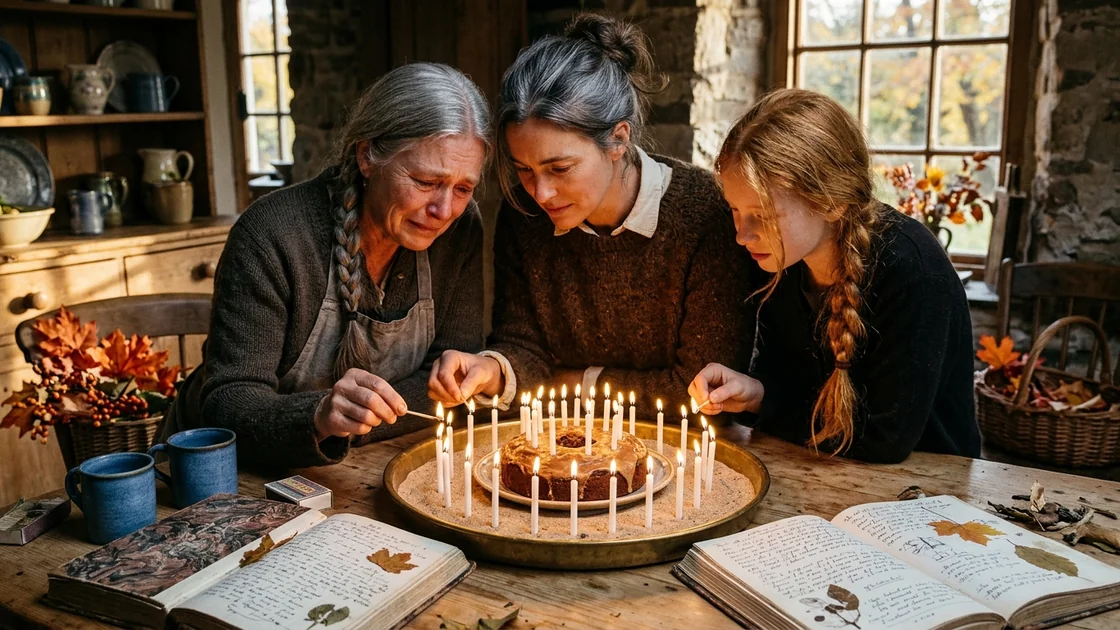
Clara Vance was only seventeen when she surrendered her newborn daughter to the closed adoption system of 1983, a decision forced by poverty, societal shame, and the stern architecture of her parents' pride. For the next four decades, she built a quiet, respectable life as an archivist and botanical illustrator, yet she remained secretly tethered to the ghost of the child she held for only twelve minutes. Every year on the fourteenth of October, Clara retreated from the world to bake a solitary cake, light a progressively growing forest of candles, and write an unsent letter to a girl whose face she could only assemble from fragments of her own reflection. This is the chronicle of a lifetime defined by the weight of an absence, the slow evolution of grief over forty autumns, and the unexpected afternoon when the silence of four decades was finally broken by the chime of a bell.
Part I: The Ledger of Ash and Ink (1983)
The rain in Oakhaven did not fall so much as it settled, like a damp gray wool shawl pulled tight over the shoulders of the mill houses and the clapboard churches. In October of 1983, the rain smelled of coal smoke and rotting maple leaves. Inside the St. Jude Home for Unwed Mothers—a brick Victorian monstrosity that had once belonged to a timber baron and still retained the dark, varnished wainscoting of men who believed in quiet misery—Clara Vance sat by a radiator that clanked like an iron chain being dragged down a stairwell.
She was seventeen years old. Her ankles were swollen to the size of cider jugs, and her fingers were perpetually stained with the blue-black ink of the fountain pen she used to keep her ledger of hours.
"Stop looking out the window, Clara," Sister Agnes said, not unkindly, though her voice had the dry, rasping quality of sandpaper over pine. "The rain won’t stop because you watch it, and the car won’t come until Friday."
"I’m not looking for the car," Clara lied. She was looking at the sugar maple by the iron gate. It had lost half its leaves since Tuesday. She had made a bargain with nothing in particular that the baby would not come until the tree was bare, believing, with the desperate superstition of the very young, that she could measure out her remaining time in yellow foliage.
Her father, Arthur Vance, was a deacon at the First Baptist Church down in the valley and the head bookkeeper for the regional hardware distributor. He was a man who understood the world through two columns: Credit and Debit. When Clara had stood in the linoleum-floored kitchen in May, her hand pressed against the flat of her stomach as if she could push the secret back into her spine, Arthur had not shouted. He had simply taken off his wire-rimmed spectacles, wiped them with a corner of his cardigan, and looked at her as though she were a column of figures that refused to reconcile.
"Your mother has her sister’s girl getting married in June," he had said. "We will tell them you are in Scranton with Aunt Maeve, helping with the upholsteryafter her hip surgery. Maeve doesn't talk to the cousins on your mother's side. You will come back in November, and you will finish your correspondence courses, and we will not speak of the boy."
The boy was Thomas. Thomas had red hair that curled behind his ears when he sweated, and he had worked the summer shift at the lumberyard before his uncle got him a spot on a surveyor’s crew in Montana. By the time Clara realized her body no longer belonged solely to her, Thomas was somewhere near Bozeman, unreachable by telephone, existing only as a blurry memory of sawdust, cheap peppermint, and the crushing weight of his wool jacket in the back of a borrowed Plymouth.
The pain began on the thirteenth of October, just as the kitchen girls were clearing away the tapioca pudding. It started as a dull tug behind her navel, like a fishing line being tested by something heavy at the bottom of a pond. By midnight, the pond had turned into an ocean of iron.
In 1983, girls like Clara were not given Lamaze classes or gentle encouragement; they were given twilight sleep or they were given a leather strap to bite and a sheet pinned up between their knees and their chin so they would not be tempted to look upon what they could not keep. Clara refused the heavy sedative after the first dose made the ceiling spin like a greased wheel. She wanted to be there. She knew, with a clarity that terrified her, that this hurt was the only thing she would ever be allowed to give the child.
The girl was born at four-twelve in the morning on October fourteenth.
Through the haze of ether and exhaustion, Clara heard a sound like a wet kitten mewing in an alley, followed by the brisk, professional slap of linen.
"It's a girl," the doctor said, his back to her as he worked at a stainless-steel basin. "Seven pounds, three ounces. Ten fingers, ten toes. Sister, get the paperwork before the anaesthetic wears off entirely."
"Please," Clara whispered. Her throat felt as though she had swallowed crushed glass. "Let me see her."
"It’s better if you don’t, dear," the nurse said, her hands warm and smelling of carbolic soap as she pressed down on Clara’s ruined abdomen. "The agency people find it goes much smoother when there isn't a face to remember."
"I won't sign," Clara said. The voice didn't sound like hers; it sounded like her grandmother’s—an old woman from the hills who had buried three sons before she was forty. "I won't put my name on the paper until you put her in my arms."
Sister Agnes looked at the doctor. The doctor sighed, looked at his wristwatch, and nodded once.
They gave her twelve minutes. Clara knew it was twelve minutes because there was a round Seth Thomas clock on the tiled wall above the sterilizer, its black minute hand jerking forward with an audible clack every sixty seconds.
The bundle was heavier than she expected, wrapped in faded flannel that had been boiled so many times the nap was gone. The baby was not pink, as Clara had imagined from the Ivory soap advertisements; she was a deep, bruised plum color, her skin slick with remnants of vernix in the creases of her neck. She had a shock of dark, wet hair that stood straight up on her crown, and right below her left collarbone, where the flannel had slipped loose, was a tiny, jagged birthmark the shape of an oak leaf.
The baby didn't cry. She opened one eye—a dark, slate-blue slit that couldn't possibly see anything beyond light and shadow—and rooted blindly against Clara’s damp cotton hospital gown.
"You were born on the fourteenth," Clara whispered into the smell of blood and warm tallow. "Remember the fourteenth. My name is Clara. Your father knew the names of all the trees."
Clack. The clock took the twelfth minute.
Sister Agnes’s hands were pale and firm. When she lifted the bundle away, the flannel caught for a second on Clara’s thumb, pulling a hangnail until it bled. Then the door swung shut, the brass latch clicked into its housing, and Clara was left alone in a room that smelled of bleach and rainwater, with a Parker fountain pen laid neatly across a blue carbon-copy form on her bedside table.
She signed Clara Elizabeth Vance three times. Her hand shook so badly on the third signature that the 'V' looked like a bird diving into the ground.
Part II: The First Decade—The Era of Milk and Phantoms (1984–1993)
When Clara returned to her parents' house on Maple Street in November, her bedroom had been painted. The yellow wallpaper with the tiny forget-me-nots—the paper she had looked at while she waited for her period to return in April—was gone, replaced by a flat, matte colonial blue.
Her mother, Martha, stood in the doorway holding a stack of fresh pillowcases. "Your father thought the yellow was getting dingy," she said, her eyes fixed on a point three inches above Clara’s left ear. "And Mrs. Gable down at the library said they need someone in the basement to help transfer the parish registries onto the new microfiche machines. Twenty hours a week. It’s quiet down there. Not many people come down the stairs."
For the first six months, Clara’s body refused to believe the baby was gone. Her breasts were bound tight with strips of torn bedsheets, a medieval torture her mother helped administer every morning in the bathroom while the water ran in the sink to cover the sound of Clara’s ragged breathing. Even so, when she was walking past the A&P and heard a baby cry inside a parked station wagon, the front of her wool coat would grow warm and damp, the sudden, aching let-down of milk for a mouth that was fifty—or five hundred—miles away.
October 14, 1984 (One Year Old)
The first birthday fell on a Sunday. In the Vance household, Sundays were rigidly choreographed: church at nine, pot roast at one, quiet reading until the evening service at six.
Clara waited until eleven o'clock that night, when her father’s rhythmic, rattling snores vibrated through the floorboards and her mother had taken her Sominex. She slipped down the back stairs in her stocking feet, carrying a single birthday candle she had stolen from the celebratory box in the pantry—left over from her father’s fifty-fifth in July—and a saucer.
She didn't dare turn on the oven. Instead, she took a single Hostess cupcake she had bought at the Texaco station on Friday and hidden inside a winter boot in her closet. She set it on the cold porcelain top of the washing machine in the basement laundry room, stuck the pink candle into the chocolate icing with its loop of white squiggles, and struck a match.
In the small, wavering circle of yellow light, the concrete walls of the basement looked vast and subterranean. Clara sat on an upturned plastic milk crate, her knees pulled to her chest.
She would be walking now, Clara thought, or maybe just pulling herself up by the fringe of a sofa. Whose sofa? Was it velvet? Was it leather? The agency had told her only one sentence about the couple, a crumb dropped by the social worker to ensure her compliance: He is an engineer, and she teaches piano, and they have a large yard with fruit trees.
In Clara’s mind, those fruit trees grew to the size of redwoods. She saw a little girl with dark hair standing in high grass under a pear tree, reaching up for something yellow.
"Happy birthday," Clara whispered to the water heater. When the candle burned down to the frosting, sizzling slightly in the sugar, she pinched it out between her wet thumb and forefinger so the smoke wouldn't rise through the floorboards and wake her mother. She couldn't eat the cupcake. She wrapped it in four layers of paper towels and buried it at the very bottom of the galvanized trash can in the alley.
By the time the girl turned five in 1988, Clara had moved out of the house on Maple Street. She had used her microfiche wages and a small inheritance from the very Aunt Maeve in Scranton who had unknowingly provided her alibi to rent a three-room apartment over a watch repair shop on the edge of the county seat, thirty miles from Oakhaven.
She had discovered a talent for drawing. Not grand landscapes or portraits—faces terrified her, because every child’s face she sketched ended up with Thomas’s wide, slightly crooked mouth and her own heavy-lidded eyes—but plants. She drew for the state agricultural extension at first: the precise venation of blight on a potato leaf, the hairy stem of the spotted knapweed, the intricate, chambered heart of a walnut. Botanical illustration required absolute fidelity to what was in front of her. There was no room for imagination, and for ten hours a day, that was a mercy.
October 14, 1988 (Five Years Old)
Five was a terrifying number. Five meant kindergarten. Five meant the girl was stepping out of the private, walled garden of the engineer and the piano teacher and into the world where anyone might see her.
Clara took the bus into the city that Friday. She bought a small yellow cake with white buttercream from a German bakery where nobody knew the Vance name. Before going home, she stood across the street from St. Mark’s Elementary School at three-fifteen.
The air was crisp, smelling of diesel exhaust and new crayons. When the double doors burst open, a flood of small bodies in bright nylon jackets spilled down the concrete steps. Clara gripped the iron railing of the public library across the street so hard her knuckles turned white.
She looked at every dark-haired girl. Is that her? No, that one’s chin is too pointed. What about the one in the red corduroy jumper dropping her lunchbox? Her ears are set too low; Thomas had high ears, like a fox.
A crossing guard in an orange vest looked at Clara twice—a thin woman of twenty-two in a drab trench coat, staring with wild, starved intensity at the five-year-olds while clutching a bakery box to her ribs. Clara turned and walked away rapidly, her heart hammering against her ribs like a trapped starling.
That night, she began the letters.
She bought a heavy ledger with a marbled cover from a stationer’s shop—the kind of book her father would have used for accounts, though this one had no vertical lines, only faint blue rules.
October 14, 1988, she wrote in her neat, draftman’s hand. Today you are five. I bought a yellow cake with five blue candles. I stood outside a school today and watched the children come out. I wondered if you like the smell of paste, and if you cried when your mother—your other mother—left you at the door. I hope you have a yellow raincoat with buckles like little frogs. When I was five, I was afraid of the neighbor’s Dalmatian. If you are afraid of dogs, please know that it comes from me, and you will grow out of it by the time you are nine.
October 14, 1991 (Eight Years Old)
During her twenty-fifth year, a man tried to love Clara. His name was David Miller, and he managed the university press that published the botanical monographs she illustrated. David was thirty, gentle, with soft brown hair and a habit of bringing her honeycrisp apples in his coat pockets.
They had been seeing each other for seven months when October arrived. David knew nothing of 1983. In 1991, you still didn't tell a man from a good family that you had spent a summer in a Catholic home for fallen girls unless you were prepared to watch his eyes go polite and distant before he remembered an early meeting the next morning.
"Come up to the lake this weekend," David said on the Tuesday before the fourteenth. "My brother’s closing up the cabin for the season. The foliage on the ridge is incredible right now. We’ll bring some wine, build a fire."
"I can't this Friday," Clara said, her pen hovering over a stippled drawing of a trillium root. "I have a deadline for the forestry department."
"Do it Saturday morning. Just come up Friday night."
"I can't, David. Really. I have a migraine coming on, I can feel it behind my eyes."
He came to her apartment on the night of the fourteenth anyway, worried about her. He had a key she had given him in a moment of August bravery.
When he opened the door at nine o'clock, the apartment was dark save for the kitchen table. There sat Clara in her slip, her hair unpinned and hanging down her back like dark water, staring at an eight-inch spice cake ablaze with eight flickering tapers. The marbled ledger was open beside her elbow. Her face was wet, though she was making no sound at all.
"Clara?" David stood in the hallway, holding a brown paper bag of pharmacy painkillers and ginger ale. "Whose birthday is it? Yours isn't until March."
Clara looked up at him. In the candlelight, her eyes were huge, dark cavities. For a second—one dizzying, precipice of a second—the words rose into her throat. She is eight years old tonight, David. She might be missing her two front teeth. Help me blow them out.
Instead, she remembered her father’s spectacles coming off in the kitchen. She remembered the nurse’s hand pressing down on her empty stomach.
"It's nobody's," Clara said, her voice flat and cold as a pond in January. She leaned forward and blew out the candles in one sharp gust, plunging them into darkness and the thick, sweet smell of beeswax and cinnamon. "I told you I wanted to be alone, David. Give me back the key."
He left it on the hall table. By November, she heard he was seeing a girl from the history department. Clara felt a dull ache at his departure, like a bruise hit against a doorframe, but it was nothing compared to the chronic amputation she carried in her core. A man was just a visitor; the child was the architecture of the room itself.
Part III: The Second Decade—The Era of Mirrors and Ghosts (1994–2003)
In her thirties, Clara’s life settled into the quiet, dust-mote rhythm of the university herbarium, where she was eventually hired as a full-time curator and archivist of dried specimens. It was a world of brittle brown leaves pressed onto rag paper a century ago by dead clergymen and amateur naturalists. She loved the work. Dried plants did not change; if you kept the beetles and the dampness away from them, a fern collected in 1883 looked precisely the same in 1996.
Her parents died within eighteen months of each other at the turn of the millennium—her father of a massive coronary while balancing the church building-fund books, her mother of a slow, bewildered decline in a nursing home where she frequently mistook Clara for her younger sister Maeve.
Before her mother lost the thread of language entirely, Clara sat beside her bed on a Tuesday in 1998. The television was playing Wheel of Fortune with the sound turned off.
"Mama," Clara said, holding the old woman’s papery, blue-veined hand. "What was the name of the agency?"
Martha’s eyes shifted from the glowing screen to Clara’s face. For a terrifying moment, the fog cleared entirely, leaving behind the sharp, defensive housewife of 1983.
"The lawyer in Harrisburg handled it," Martha whispered, her mouth drawing into a purse. "Your father burned the receipt when the final decree came through in the spring of '84. Let it be, Clara. You’ve got a nice job at the college. Why do you want to dig up the yard when the grass has finally grown over?"
October 14, 1999 (Sixteen Years Old)
Sixteen. One year younger than Clara had been when the rain fell on the sugar maple at St. Jude’s.
That year, the terror changed shape. Throughout the girl’s childhood, Clara had feared accidents: swimming pools, drunken drivers, meningitis, the thousand small traps the world sets for soft bodies. Now, as the girl entered the territory of her own youth, Clara feared history repeating itself.
She baked a lemon poppyseed cake that year—two tiers, iced with a spatula she had warmed in hot water until the frosting was as smooth as porcelain. Sixteen white candles made a small bonfire in the center of her small dining room.
October 14, 1999, she wrote in the second marbled ledger (the first had been filled by the twelfth birthday). You are sixteen today. You can drive a car. Perhaps your father—the engineer—taught you in an empty church parking lot on Sunday afternoons, the way other girls’ fathers do. I am thirty-three now. I have three gray hairs over my left temple, and I wear reading glasses when I do the small stippling on the stamen drawings. Listen to me, wherever you are: do not get into the back of a boy’s car because you are lonely, or because the rain is loud on the roof, or because he tells you your hair smells like apples. Be selfish. Please, God, let the piano teacher have taught you how to be selfish. Keep yourself for yourself until you are strong enough that nobody can take anything out of your hands while you are sleeping.
In the late nineties, the internet had begun to arrive in the university basement—first as green text on black screens, then as the slow, screeching dial-up of the World Wide Web.
Late at night, after the graduate assistants had gone home to their cheap beer and loud apartments, Clara would lock the door of the herbarium office and type words into AltaVista and Yahoo.
Pennsylvania closed adoption 1983. St. Jude Home Oakhaven records. Search registry October 14 1983 female.
She found message boards populated by women like herself—ghost mothers, they called themselves on the early forums. Women who had given up babies in Boston in 1968, in Seattle in 1975, in Atlanta in 1981. They wrote in long, unpunctuated blocks of grief at three in the morning. Reading their stories made Clara feel as though she had walked into a room full of mirrors after living for sixteen years in a cave.
She registered her details on three different mutual-consent registries. Birth date: 10/14/83. Place: Oakhaven, PA (St. Jude). Identifying marks: Small jagged birthmark below left collarbone, shaped like an oak leaf.
Nothing came back. Of course nothing came back; a sixteen-year-old girl couldn't legally register on those sites anyway. She had to wait until the girl was eighteen. Or twenty-one, under Pennsylvania’s ironclad statutes, which treated original birth certificates like state secrets from the Cold War, sealed in vaults in New Castle to protect the fiction that a human being could be born from a piece of legal parchment rather than a body.
October 14, 2001 (Eighteen Years Old)
It was a month after the towers fell in New York. The whole world smelled of fear and jet fuel, and envelopes arriving in the mail were suddenly objects of suspicion.
For the eighteenth birthday, Clara took three days of vacation time. She spent thirty dollars on fancy ingredients from the specialty market: Madagascar vanilla beans, European butter, dark cocoa from Holland. Eighteen was the threshold. At midnight on the fourteenth, the legal locks did not spring open—Pennsylvania remained stubbornly closed—but the moral locks dissolved. The girl was an adult. The contract Clara had signed with a shaking hand between her father and the Catholic Church had expired in spirit, if not in law.
Clara sat by her telephone from six in the morning until midnight. It was a heavy black rotary phone on a small mahogany stand in the hallway; she had refused to get a cordless one because she was afraid the battery would die at the exact second the circuit connected.
At two in the afternoon, the phone rang.
Clara’s tea mug shattered on the hardwood floor. She lunged for the receiver, skidding on the wet wood, slicing the ball of her foot on a shard of stoneware without feeling it.
"Hello?" she gasped into the mouthpiece. "Hello, I'm here!"
"Hello, is this Mrs. Vance?" a bored voice asked through a crackle of call-center static. "I’m calling from the circulation department at the Sunday Gazette to offer a fall discount on—"
Clara hung up so hard the brass bell inside the housing chimed. She sat down on the floor in the puddle of Earl Grey and blood, pulled her knees to her chin, and wept with a violence she hadn't known since the milk dried up in 1984.
Why would the girl call on her eighteenth birthday? If the engineer and the piano teacher had done their job well—and Clara had spent eighteen years praying until her knees were calloused that they had done it well—then on her eighteenth birthday, the girl would be surrounded by friends with bright teeth, opening boxes containing a silver bracelet or a laptop for college, laughing in a kitchen that smelled of warm bread. A happy girl does not go looking for a ghost in a mill town on the night she comes of age. Only a miserable girl does that.
I want her to be happy, Clara wrote in the ledger that night, her left foot bandaged in gauze, eighteen candles reflecting in the dark windowpane like a constellation that had fallen into the trees. Even if her happiness means she never wonders what my voice sounds like. I will take the silence if the silence means she is whole.
Part IV: The Third Decade—The Era of Shifting Earth (2004–2013)
Time behaves strangely after forty. For Clara, the years between her daughter’s twentieth and thirtieth birthdays did not pass like pages turning; they accumulated like sediment at the bottom of a river.
She bought a small cottage on the edge of the college town in 2005—a stone house built by a stone-mason in the 1890s, with three-quarters of an acre of overgrown pasture behind it. She spent her weekends clearing the brambles and planting trees. She planted a sugar maple for the one outside the iron gate at St. Jude’s. She planted four varieties of pear trees, because of the social worker’s offhand remark twenty-two years earlier. She planted a white oak.
People in the town knew her as "Miss Vance from the herbarium." She was the woman you brought a strange mushroom to if your dog ate it in the woods; she was the woman who sat in the third pew at the Unitarian chapel on rainy Sundays, wearing hand-knitted shawls in the colors of lichen and bark. Men occasionally asked her to dinner—a widower who taught geology, a divorcee who owned the local frame shop. She went once or twice, polite and attentive, listening to them talk about their grown children’s divorces or their grandchildren’s soccer games.
"You never had children, Clara?" the geologist asked over halibut at the town’s one white-tablecloth restaurant in 2009.
Clara looked down at her water glass. A slice of lemon floated near the rim, its seeds suspended in the pulp.
"I have a daughter," she said quietly. It was the first time she had spoken the sentence aloud to another living human being since her mother died. "We aren't in touch. She lives quite far away."
"Ah," the geologist said, wincing with immediate, embarrassed sympathy, assuming a family rift, a bad marriage, a prodigal child lost to drugs or California. "That’s hard. My sister’s boy hasn't called her since the Bush administration. Kids today don't understand what they owe."
"She doesn't owe me anything," Clara said, so sharply that the geologist stopped buttering his roll.
October 14, 2008 (Twenty-Five Years Old)
A quarter of a century. The silver anniversary of the twelve minutes.
That year, the St. Jude Home for Unwed Mothers was torn down. Clara read about it in a tiny four-line item at the back of the regional newspaper: the diocese had sold the land to a developer who was putting up a CVS pharmacy and a strip of townhomes.
On the morning of October fourteenth, Clara drove back to Oakhaven for the first time since her mother’s funeral. The town had shrunk and grayed, the hardware distributor long since shuttered by a big-box store out on the interstate.
She parked her Subaru across from the construction site on Hill Street. The Victorian mansion was already gone, reduced to a massive crater of red mud and splintered pine joists. Yellow excavators sat idle in the drizzle.
The iron gate was gone too, ripped out by the roots of its stone pillars.
Clara got out of the car, ignoring the cold rain soaking into the shoulders of her wool coat. She walked to the edge of the chain-link fence. The sugar maple was still there, though a bright orange ribbon was tied around its trunk—the forester’s mark for removal. One massive lower limb had already been sawed off to let the dump trucks through, leaving a pale, weeping disk of raw wood exposed to the wet air.
Clara reached through the links of the fence and picked up a handful of fallen leaves from the mud. They were mottled yellow and scarlet, bruised brown at the edges.
She took them home, pressed them between sheets of blotting paper in her heaviest botanical press, and when they were dry, she glued the largest one onto the page for 2008 in the third marbled ledger.
October 14, 2008, she wrote beneath the dried maple leaf. They tore down the house where you were born today. I was afraid that when the walls came down, the memory would go thin, the way old photographs fade when you take them out of the drawer and leave them in the sun. So I went and got a piece of the tree you didn't wait for. You are twenty-five. When I was twenty-five, I was so lonely I thought my ribs would crack open. I hope you are in a crowded room tonight. I hope someone is holding your hand under the table.
October 14, 2012 (Twenty-Nine Years Old)
In 2012, the world of secrets began to fracture. It didn't happen in the marble halls of the state legislature in Harrisburg, where the old men still argued about the privacy rights of mothers who didn't want privacy; it happened in laboratories in Utah and California.
A graduate student working in the herbarium—a bright, chatterbox girl named Chloe who was sequencing the DNA of native orchids—was eating lunch at the worktable across from Clara in September.
"My mom just did one of those spit tests," Chloe said, peeling a clementine. "Ancestry or whatever. She thought we were a hundred percent Italian, and it turns out my great-grandmother had a very friendly milkman from Dublin. Half the family isn't speaking to my aunt."
Clara’s hand stopped moving over her ink wash. "It matches you to people?"
"Oh, yeah," Chloe said. "If they’re in the database. Second cousins, third cousins, parents. It’s wild. You can't hide anything anymore. It’s all right there in the saliva."
For three weeks, Clara walked around the idea as though it were an unexploded shell dropped into her garden.
To register on an adoption forum was one thing; it was passive, like leaving a porch light on in the middle of the woods. To put her DNA into a commercial machine felt violent. What if the engineer and the piano teacher had never told her? In 1983, doctors still told adoptive parents, Take her home, love her, and never mention it; she’s yours as if you bore her. What if a twenty-nine-year-old woman took a test out of curiosity about whether she was Scottish or German, and instead the sky fell down on her head and broke her family in two?
On the night of the twenty-ninth birthday, after she had blown out twenty-nine candles on a dark chocolate torte and scraped the wax off the platter, Clara sat before her computer screen until three in the morning.
She thought of the twelve minutes. She thought of the oak-leaf birthmark below the left collarbone. She thought of her own mother dying in a room that smelled of urine and peppermint, still guarding the name of a lawyer in Harrisburg as if it were the crown jewels. Secrets were rot. She had spent her whole life curating things that were preserved in the light; she knew what happened to specimens kept in dark, damp boxes.
She clicked Order.
When the little cardboard box arrived four days later, she spat into the plastic tube until her mouth was dry, sealed the blue stabilizing liquid over her genetic code, and dropped it into the blue mailbox outside the post office before she could lose her nerve.
When the results came back in December, there was no daughter.
There was a second cousin on her father’s side whom she didn't know, living in Ohio, and a scattering of fourth cousins in Virginia. Nothing closer.
Clara let out a breath she felt she had been holding since Thanksgiving. She felt a strange, sharp cocktail of crushing disappointment and vast relief. The porch light was on. Now, she had done everything a woman could do without breaking a vow. If the girl ever walked down the road looking for the house, the door was unlocked.
Part V: The Fourth Decade—The Era of Long Shadows (2014–2022)
As Clara entered her fifties, the girl in her mind stopped aging cleanly.
It had been easy, somehow, to imagine a five-year-old, a ten-year-old, even a twenty-year-old. The world was full of students at the university; Clara could look at the girls walking across the quad in their scarves and boots and borrow their hair, their posture, the way they laughed into their phones, to clothe the phantom.
But a thirty-five-year-old woman? A thirty-eight-year-old woman?
By 2018, her daughter was older than Clara had been during the entire first half of her mourning. In Clara’s dreams—which came most frequently in late September, when the light began to slant low and golden through the pear trees in her yard—the child was never a woman with a mortgage and crow’s feet around her eyes. In the dreams, Clara was always walking through the basement of the Oakhaven library, and behind the stacks of microfiche cabinets, she would hear a baby crying. Or she would be standing at the crosswalk outside St. Mark’s Elementary in 1988, and the little girl in the red corduroy jumper would turn around, and she would have no face at all, just the smooth, blank curve of an egg.
October 14, 2017 (Thirty-Four Years Old)
That year, the state of Pennsylvania finally relented. After decades of lobbying by adoptees whose hair had gone gray waiting to know their own medical histories, the law changed. Starting in November of 2017, adults adopted in the state could apply for their original, unamended birth certificates—the ones with the mother’s real name typed in the box before the white-out and the fiction were applied.
Clara read the news on her tablet while eating toast in her sunroom.
Clara Elizabeth Vance. That was what was on the paper in the vault in New Castle. And under Father’s Name: Unknown. She had protected Thomas to the last, or perhaps she had simply known that putting a nineteen-year-old lumberyard boy’s name on the form would only delay the Friday car while the lawyers hunted for him in Montana.
She spent the winter of 2018 in a state of low-grade cardiac arrhythmia. Every time the mail carrier’s jeep crunched on the gravel at the end of her lane, Clara had to sit down on the bottom step of the stairs until the spots cleared from her vision.
Spring came. The pear trees bloomed in a froth of white petals, dropped their snow onto the grass, and set hard green fruit. Summer hummed with cicadas. Nothing came in the mail except electric bills, botanical journals, and catalogs for heritage seeds.
By October of 2018, the thirty-fifth birthday, Clara understood what the silence meant, or at least she constructed an explanation she could live inside without going mad.
There were three possibilities. One: Her daughter did not know she was adopted, or did not care to know who had borne her. Two: Her daughter was angry—furious at the seventeen-year-old girl who had traded her away for a coat of colonial blue paint and a quiet life in a basement—and wanted nothing to do with the name Clara Elizabeth Vance. Three: Her daughter was dead.
Clara never allowed herself to look directly at the third possibility for more than three seconds at a time, the way you do not look directly at a solar eclipse lest it burn the retinas out of your skull. Instead, she chose the first two. She preferred to be forgotten, or even hated, so long as the person doing the forgetting or the hating was breathing the air of the world.
October 14, 2020 (Thirty-Seven Years Old)
The pandemic year. The university was closed; Clara worked from her stone cottage, digitizing nineteenth-century pressed wildflowers from high-resolution photographs on her computer screen. She had not touched another human being since a nurse had given her a flu shot in late February.
Isolation was not new to Clara—she had been practicing quarantine of the heart since the Reagan administration—but the global quietness made that October unbearable. The world felt as though it were ending in a slow, sterile whisper.
She couldn't find birthday candles at the local grocery store; the shelves were strange and bare that autumn, stocked with twenty brands of mustard and no flour. She had to drive to three different pharmacies before she found a pack of novelty candles shaped like stars, meant for a child’s party, in neon pinks and greens.
Thirty-seven neon stars looked absurd stuck into the top of a small homemade carrot cake.
October 14, 2020, she wrote at the end of the fourth marbled ledger. Her handwriting was no longer the flawless copperplate of her twenties; there was a touch of arthritis in her right index finger from forty years of holding a rapidograph pen, making the downstrokes slightly jagged. The world is sick this year, my darling. I hope you are somewhere safe where the air is clean. If you have children of your own, I hope you are not going crazy trying to teach them fractions at the kitchen table. I realized today that if you had a child at the age I had you, that child would be twenty years old now. I could be a grandmother to a grown woman and pass her in the produce aisle without knowing the shape of her chin. I am fifty-four. Sometimes, when I wake up before dawn, I cannot remember the weight of you in the flannel. I only remember the clock on the wall. I am terrified that before I die, the clock will be the only thing left.
Part VI: The Fortieth October (2023)
October fourteenth, 2023, fell on a Saturday.
Clara woke at five-thirty, before the sun had cleared the ridge behind the pasture. She was fifty-seven years old. Her hair, which she still wore in a long braid down her back when she was working, was the color of pewter, streaked with the white of birch bark.
Forty years.
In the Bible, forty years was the time it took to cross a wilderness until everyone who remembered Egypt had died off. In Clara’s life, Egypt was as sharp as if she had left it yesterday morning.
She moved through the rituals of the day with the solemn, unhurried precision of a priestess tending an altar in a temple where the god had never once spoken.
First, she stripped the bed and washed the linens, hanging them out on the line between thewhite oak and the woodshed because the forecast promised a dry, crisp afternoon with a high of fifty-eight degrees.
Second, at nine o'clock, she began the cake. For the fortieth birthday, she made a burnt-sugar cake from a recipe that had belonged to her hill-country grandmother—a heavy, golden sponge that smelled of caramel and nutmeg, frosted with a brown-butter icing that hardened into a glaze like maple candy.
Forty candles could not fit on an eight-inch cake without melting into a single wax lake and setting the tablecloth on fire. Clara knew this from the thirty-ninth year, which had nearly scorched her ceiling. So she had bought a wide, shallow brass tray at an antique shop in July, filled it with white river sand, and arranged the cake in the center. Twelve candles went on the cake itself—one for every minute Sister Agnes had given her—and the remaining twenty-eight were planted in a ring in the sand around the porcelain plate, like a palisade of thin white birch trees.
At noon, she walked out into the pasture to gather what was left of the autumn for the table. She clipped three branches of red berries from the winterberry bush, a handful of dried goldenrod, and a branch from the sugar maple by the stone wall, whose leaves had turned the exact, piercing shade of cadmium orange she remembered from the window of St. Jude’s.
She was standing by the gate to the driveway, pruning shears in her hand, her basket over her arm, when a car turned off the county road and slowed down at the mouth of her gravel lane.
Clara stopped. Nobody came down her lane on Saturdays except the FedEx driver, and he drove a white van like a battering ram.
This was a dark blue Volvo station wagon with out-of-state plates—Maryland, white with a little crest in the center. It crept over the ruts of the gravel as if the driver were afraid of waking someone, then pulled to a halt twenty feet from the stone wall.
The engine died. For a long minute, nobody got out.
Through the windshield, softened by the glare of the October sun reflecting off the hood, Clara could see two people in the front seat. The driver was a woman. The passenger was a girl of perhaps twelve or thirteen, looking down at a phone in her lap.
The driver’s door opened.
The woman who stepped out onto the gravel was wearing a camel-hair coat over jeans and leather boots. She was tall—taller than Clara by three inches, Thomas’s height—and she had thick, dark hair with a few threads of silver at the temples, pulled back into a loose knot at the nape of her neck.
When she turned her face toward the pasture gate, Clara’s pruning shears slipped from her fingers and buried their points two inches into the soft turf.
It was like looking into a pond where her own reflection had been braided together with a ghost from a lumberyard in 1983. The woman had Thomas’s high, fox-like ears and his wide, generous mouth. Everything from the cheekbones up—the heavy-lidded, slate-dark eyes, the slight, permanent furrow between the brows as if she were trying to read small print in a dim room, the sharp cut of the bridge of the nose—belonged to Clara.
The woman stood by the fender of the Volvo, her hands shoved deep into the pockets of her coat. She looked terrified. She looked like a five-year-old standing on the steps of St. Mark’s Elementary while the doors locked behind her.
"Miss Vance?" the woman said. Her voice was a contralto, richer than Clara’s, trained and clear.
Clara could not speak. Her tongue was a dry leaf stuck to the roof of her mouth. She reached out with one hand and gripped the top rail of the cedar gate to keep her knees from folding backward.
"I know I shouldn't have just shown up," the woman said, the words tumbling out too fast, her breath making small white plumes in the fifty-degree air. "I wrote six letters over the summer, and I threw them all away because they sounded like I wanted something from you, and I don't. I got the birth certificate from New Castle three years ago, and then my daughter—Maya wanted to do the Ancestry kit for a seventh-grade biology project in August, and when the results came back last week, you were right there at the top of the screen, and I saw you only lived three hours from Bethesda, and today is—"
She stopped, swallowing hard, her eyes dropping to the basket of maple leaves on Clara’s arm.
"Today is my birthday," the woman whispered. "I’m forty. I just wanted to see what you looked like. If you want me to get back in the car, I swear to God I will turn around right now and you’ll never hear from me again."
Clara looked at her. Forty years of words—four marbled ledgers packed from margin to margin with ink, fourteen thousand six hundred days of rehearsed speeches—evaporated into the bright autumn sky, leaving only the absolute, stunned simplicity of the truth.
"I baked a cake," Clara said. Her voice cracked right down the middle, like an old plate finally giving way. "It's burnt sugar. With forty candles."
The woman’s hands came out of her pockets. A sound escaped her—half a sob, half a laugh—and she pressed the heels of her palms against her eyes, just the way Clara did when she had been working at the microscope too long.
"You baked a cake?" the woman repeated behind her hands.
"Every year," Clara said, her hand finally finding the iron latch of the gate and pushing it open. "Every single year."
Part VII: The Naming of the Trees
Her name was Hannah.
"Hannah Claire," she said twenty minutes later, sitting at the scrubbed pine table in Clara’s kitchen, her hands wrapped around a blue stoneware mug of tea she hadn't yet sipped.
The thirteen-year-old girl, Maya—who had Thomas’s red-gold hair in a long, messy braid and Clara’s own small, square hands—had been politely dispatched after the initial introductions to look at the pressed flower specimens and the microscope in Clara’s sunlit studio off the parlor, though she kept glancing back through the open doorway with wide, solemn eyes to make sure the two strange, crying women in the kitchen were alright.
"They kept the Clara?" Clara asked. She was sitting on the opposite side of the table, so close she could smell the wool of Hannah’s coat and the faint, clean scent of lavender soap. She was afraid to blink; she had the irrational conviction that if her eyelids closed for a tenth of a second, she would wake up on the milk crate in the basement on Maple Street in 1984.
"My mom—my adoptive mom, Evelyn—she asked the social worker if you had called me anything in the hospital," Hannah said, looking down at the steam rising from her mug. "The sister at the home told her you hadn't named me, because it wasn't allowed, but that your name was Clara. Evelyn thought a girl shouldn't have her whole history erased just to make the paperwork neat. So she made it Claire."
Evelyn, Clara thought. For forty years she had called the woman the piano teacher in her prayers, a faceless silhouette sitting on a mahogany bench. Thank you, Evelyn.
"Were they good to you?" Clara asked. It was the question that had lived in the marrow of her femur since she was seventeen.
Hannah looked up. Her dark eyes were wet, rimmed with red, and entirely steady. "They were wonderful, Clara. My dad built me a treehouse in the backyard when I was seven—it had real shingled eaves and a pulley for a bucket. We had three pear trees and a golden retriever named Barnaby. My mom taught me Chopin, though I didn't have the hands for it; I ended up playing the cello instead. I teach music theory at a high school in Maryland now."
Clara reached across the pine table, her hand trembling so violently that her knuckles tapped against the wood, and touched the sleeve of Hannah’s sweater. Just the wool at first. Then Hannah turned her palm upward, and her warm, strong cellist’s fingers closed around Clara’s arthritic ones.
"Your father," Clara whispered, the tears finally spilling over her silver eyelashes and tracking down the deep creases beside her mouth, "was nineteen. His name was Thomas Callahan. He had red hair just like Maya’s, and he was very kind, even though we were both too young to know how to be brave. He knew the name of every tree in the woods by its bark in the winter."
Hannah’s thumb moved across the back of Clara’s hand. "I always wondered why I looked at forests the way other people look at churches."
"And why didn't you—" Clara stopped, terrified of sounding like she was asking for a debt to be paid. "When the law changed in 2017. I waited by the mailbox."
Hannah looked down at their joined hands. A flush rose up her neck—and as the collar of her cream silk blouse shifted slightly against her throat, Clara saw it: the tiny, faded, pale-brown jagged mark just below the left collarbone. The oak leaf. It had grown with her, stretching slightly over four decades, no longer the size of a ladybug, now the size of a thumbprint.
"My mom—Evelyn—got sick in 2016," Hannah said softly. "Ovarian cancer. It took three years. When I got the paper from New Castle with your name on it, she was in hospice at home. I loved her so much, Clara. Even though she was the one who told me when I was little that I had another mother who had loved me enough to let me go when she couldn't keep me—I couldn't bear for her to spend her last months thinking she wasn't enough. That I was already replacing her before she was even in the ground. And then after she died, grief made me a coward. I looked you up online. I saw your illustrations for the university. I bought the book on Pennsylvania ferns you illustrated in 2015—I have it on my coffee table right now. I was just so afraid that if I knocked on your door, I would be an explosion in a life you had worked forty years to put back together."
Clara stood up. She didn't let go of Hannah’s hand until she reached the counter by the pantry.
From the bottom shelf of the Welsh dresser, where they were stacked behind a linen curtain like family Bibles, Clara lifted the four marbled ledgers. They were heavy—twenty pounds of rag paper, dried maple leaves, pressed violets, and forty years of blue-black ink.
She set them down on the table in front of Hannah with a dull thump.
"What are these?" Hannah asked.
"Open them," Clara said. "Anywhere."
Hannah pulled the second volume toward her—the one covering 1996 to 2006. It fell open to a page where a dried, brown four-leaf clover was taped at the top corner.
October 14, 2000, Hannah read aloud, her voice dropping to a whisper. Today you are seventeen, the exact age I was on the morning you were born. I baked a white cake with coconut frosting today because my mother used to make that when company came, and you are the only company I ever wanted in my soul. Wherever you are tonight, I hope nobody is making you sign your name to anything you don't understand. I love you. I have loved you for six thousand two hundred and nine days.
Hannah flipped to the back of the book. Then she opened the first ledger, her fingers tracing the shaky, twenty-two-year-old handwriting of 1988. Then the fourth.
In the doorway of the studio, Maya had appeared, holding a magnifying glass she had been using to look at a beetle wing. "Mom?" the girl asked, her voice small and worried.
Hannah didn't answer at first. She had laid her forehead down against the open pages of 1994, her shoulders heaving silently as forty years of imagined orphanhood dissolved into the ink beneath her cheek. Every year she had blown out candles on Evelyn’s dining room table and felt, beneath the genuine joy of her life, a tiny, cold draft at the back of her neck—the phantom chill of the Friday car, the belief that the first person who ever met her had put her down and walked away without looking back.
"Come here, Maya," Hannah choked out, lifting her head and holding out one arm toward her daughter. "Come look at this."
The girl walked over and stood beside her mother’s chair, leaning against her shoulder.
"What is it?" Maya asked, looking at the dense, neat script and the small pencil sketches of wildflowers in the margins.
"It's me," Hannah said. She looked up at Clara, who was standing by the stove with her apron twisted in her hands, looking as though her heart might literally burst through the cotton of her dress. "She never forgot a single one."
Part VIII: The Twelve Candles and the Twenty-Eight
The sun was beginning to drop toward the ridge by the time they lit the tray.
Clara carried the wide brass platter from the pantry to the center of the kitchen table, setting it down beside the four open ledgers. In the fading afternoon light of the stone cottage, the forty white tapers stood like a miniature forest in the river sand, surrounding the golden mound of the burnt-sugar cake.
"Wait," Clara said, reaching into her pocket for the box of wooden kitchen matches. "There aren't enough of us with one match. It'll burn down before we get to forty."
She handed three long matches to Maya, three to Hannah, and kept three for herself.
They stood around the table, three generations of women with the same square hands and the same slant to their eyebrows, striking the matches in unison. The smell of sulfur flared sharp and brief, immediately overtaken by the warm scent of beeswax and brown butter.
Clara lit the twelve candles on the cake first—one, two, three, up to twelve, counting them silently in her head as the Seth Thomas clock on the wall of St. Jude’s had counted the minutes at four-twelve in the morning in 1983. Beside her, Hannah and Maya worked their way around the ring in the sand until the whole center of the kitchen table was a roaring, golden crown of fire.
The heat of forty flames rose against their faces, painting the low plaster ceiling with dancing yellow light and turning the pewter in Clara’s braid to gold.
"Make a wish, Mom," Maya said, smiling in the glow.
Hannah looked across the ring of fire at Clara.
"I don't have anything left to wish for," Hannah said softly. "Clara. Will you blow them out with me?"
Clara leaned forward over the table. For thirty-nine years, the breath she had used to put out the candles had been an exhalation of grief, a solitary puff of air into an empty room that left behind only smoke and another three hundred and sixty-four days of waiting.
She looked at the woman with Thomas’s mouth and her own dark eyes. She looked at the girl with the red-gold braid.
Together, they drew in the autumn air of the stone house, and together they blew the fire out.
The room did not go dark. Outside the window, the last light of October fourteenth was still holding fast in the branches of the pear trees, bright and clear and completely unafraid of the winter.