The Fading Chalk
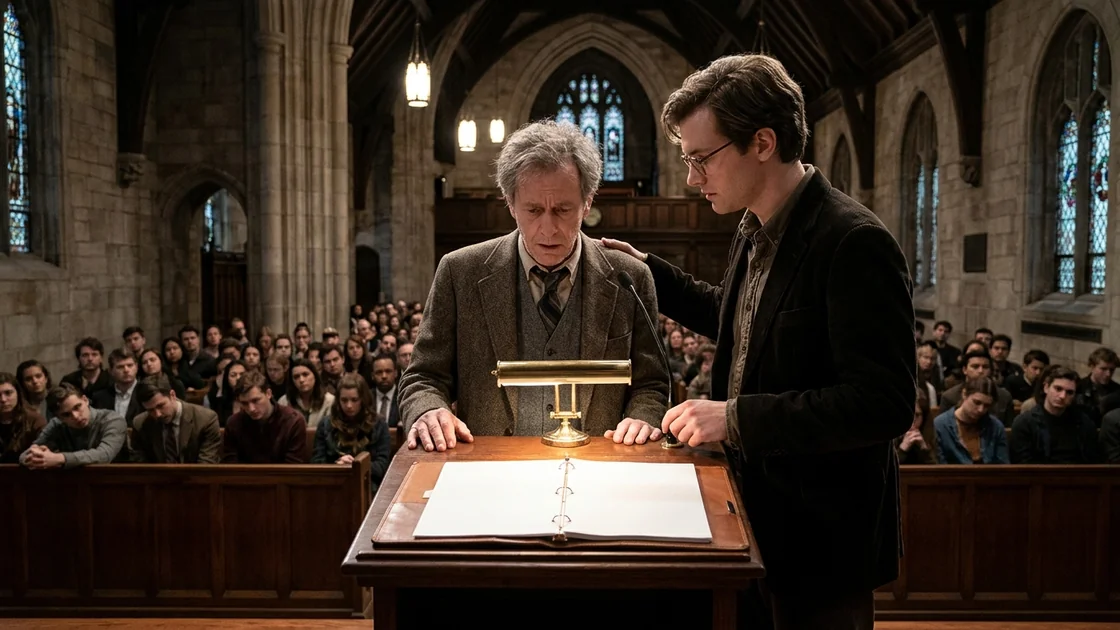
This story chronicles the heartbreaking decline of Dr. Arthur Pendelton, a revered professor of theoretical history at Blackwood University, as he battles the insidious onset of early-stage dementia. Once celebrated for his ability to weave complex historical narratives entirely from memory, Arthur begins to experience terrifying cognitive lapses right at the lectern, losing words, dates, and his train of thought in the middle of his lectures. As the autumn semester progresses into winter, he is forced to witness his own intellectual unraveling reflected in the shifting expressions of his undergraduate and graduate students, whose awe gradually turns to confusion, awkward silence, and finally, devastating pity. Ultimately, through a catastrophic failure during a major departmental symposium and the gentle intervention of his most devoted teaching assistant, Arthur must confront the loss of his identity and find the grace to step away from the chalkboard before the fragments of his life's work vanish entirely.
The chalk always felt the same between his thumb and forefinger: cool, dusty, and remarkably solid. It was the only thing in Lecture Hall 3B that still possessed weight. Everything else—the tiered rows of oak seats, the tall gothic windows framing the turning leaves of the campus quad, the hundred and forty upturned faces of the undergraduate body—had begun to feel thin, like theatrical scrims painted to resemble a university, liable to tear if the wind blew too hard through the floorboards.
Dr. Arthur Pendelton stood before the triple-tiered green slate board, his suit jacket unbuttoned, a vest of heather-gray wool hugging his slight frame. He was sixty-two years old, though in the high-ceilinged echoing chamber of 3B, he had for thirty years felt entirely ageless. When one lived inside the seventeen-hundreds, time became an elastic, forgiving medium. One could stretch a decade of parliamentary debate into an entire semester or compress the fall of an empire into a brisk Tuesday morning fifty-minute block.
He turned to the board and wrote the year 1789 in his characteristic cursive—tall, slightly slanted, the seven crossed in the continental style he had picked up during his fellowship at the Sorbonne four decades ago.
"We are told," Arthur began, turning back to the room, his baritone voice naturally projecting to the back rows without the aid of the clip-on microphone the audiovisual department constantly tried to foist upon him, "that history hinges upon great, violent ruptures. The guillotine's blade. The storming of the fortress. The burning of the châteaux. We like our transitions loud. We prefer to believe that the old world died in a single afternoon because it absolves us of studying the slow, agonizing rot that preceded it."
He paced the length of the wooden dais, six steps to the left, six steps to the right. It was a rhythm his students knew well. In the front row, Clara Vance, a sophomore with terrifyingly neat handwriting, was already transcribing his words verbatim into a leather-bound notebook. Behind her, a sea of glowing laptop screens hummed.
"Consider the price of grain in the Loire Valley," Arthur continued, raising a chalk-whitened finger. "Not in July of eighty-nine, when the Parisian mobs were already hunting for muskets, but three years prior. Look at the parish registries of seventeen-eighty-six. The tax collectors of the Ancien Régime were not blind men. On the contrary, the intendant of Tours, a man by the name of..."
Arthur stopped on his fourth step to the right.
The name was right there. It sat on the tip of his tongue, heavy and round, beginning with an L or perhaps a D. He had written a forty-page monograph on the man’s correspondence in 1998. The book was on the syllabus. He could see the cover of the Oxford University Press edition in his mind’s eye—a muted maroon jacket with a woodcut of a wheat sheaf.
"...a man by the name of..." Arthur repeated, his hand still raised in the air like a conductor holding an orchestra at a fermata before the downbeat.
The silence in Lecture Hall 3B was, at first, the silence of anticipation. Dr. Pendelton was famous for his dramatic pauses. He had won the university’s Distinguished Teaching Award three times precisely because he treated historiography like a parlor mystery, withholding the crucial witness until the undergraduates were leaning over their desks.
Arthur blinked at the stained-glass transom above the double doors at the back of the hall. Come now, he told himself, a light, amused irritation pricking at the base of his skull. You know his wife’s maiden name. You know what he ate for breakfast in the winter of eighty-seven. You read his letters in the municipal archives while the rain leaked through the roof onto your coat.
Four seconds passed. Then six.
The quality of the silence in the room began to curdle. The scratching of Clara Vance’s fountain pen ceased. She looked up, her pen poised a millimeter above the paper, her brow furrowing just slightly.
"The intendant of Tours," Arthur said a third time, though his voice had lost its theatrical resonance, dropping half an octave into the register of a man searching his pockets for his house keys. He turned back to the chalkboard, as if the name might be hiding behind the numbers 1789.
His heart gave a heavy, irregular thud against his ribs. Looking at the green slate, he realized with a sudden, arctic rush of terror that not only was the intendant’s name gone, he was no longer entirely sure why he had brought up the Loire Valley at all. Was this the Tuesday lecture on agrarian taxation, or the Thursday lecture on the Assembly of Notables? What month was it? Outside the window, the maple leaves were scarlet and gold. October, then. If it was October, they should still be in the Seven Years' War. Why had he written 1789?
He looked down at the lectern. His yellow legal pad was there, covered in his own spidery shorthand, but when he stared at the ink, the letters seemed to swim and rearrange themselves like iron filings under a shifting magnet. Turgot. Necker. Calonne. He knew those names, they were the great finance ministers, the titans, not the provincial intendant of Tours. Why had he walked down the blind alley of Tours?
From the third row, a voice spoke up—quiet, hesitant, almost apologetic.
"D’Aine, Professor?"
Arthur looked up sharply. It was Julian Reed, his graduate teaching assistant, sitting on the aisle seat with the attendance clipboard balanced on his knee. Julian wasn’t looking at Arthur; he was staring intently at the eraser tray of the chalkboard, his neck flushed pink with the embarrassment of correcting a titan in front of a hundred sophomores. "Marius-Jean-Baptiste Nicolas d'Aine. Intendant from seventy-four to ninety."
"D'Aine," Arthur said. The name hit his ears like a stone dropped into a well—familiar in sound, yet entirely detached from the vast subterranean reservoir of knowledge he had spent forty years filling. "Yes. Of course. D'Aine. Thank you, Mr. Reed. It appears the morning coffee at the faculty club has lost its teeth."
A ripple of polite, relieved laughter moved through the room. It was the laughter of young people who desperately wanted the world to remain orderly, who needed the man at the front of the room to merely be a charmingly absent-minded professor.
Arthur forced a smile, the muscles of his cheeks feeling stiff, like dried leather. He did not return to the Loire Valley. He couldn't remember the end of the anecdote. Instead, he pivoted to Jacques Necker’s Compte rendu au Roi, a topic so broad and elementary that he could have recited it under general anesthesia. Yet as he spoke, his eyes remained fixed on the students in the first three rows.
Clara Vance was writing again, her head bent low, her dark hair falling forward to hide her face. Beside her, a boy in a varsity rowing jacket—Miller, or perhaps Mitchell—was leaning slightly toward the girl on his left. They didn't whisper. They didn't need to. Their eyes met for a fraction of a second: a wide, raised-eyebrow glance that slid toward Arthur and then quickly dropped back to their screens.
It was not the look students gave a professor who had made a joke. It was the look passengers on a train exchanged when the engine made a grinding, metallic shriek in the middle of a dark tunnel.
The walk from Lecture Hall 3B to Robinson Hall, where the History Department was housed, took seven minutes at a brisk pace. Arthur had walked it six thousand times. He knew which flagstones on the central path tilted when it rained, squirting muddy water onto one's cuffs; he knew that the bronze statue of the university’s founder had a robin’s nest tucked inside the crook of its left elbow every spring.
Today, he walked slowly, his hands shoved deep into the pockets of his tweed overcoat, his fingers clenching and unclenching around a stub of white chalk he had inadvertently carried out of the lecture hall.
"The midterms are nearly graded, Dr. Pendelton," Julian said, walking half a step behind him, matching his slowed pace. Julian was twenty-six, a brilliant boy from Chicago who had come to Blackwood specifically to study under Arthur. He had the pale, slightly underfed look of all promising archivists, and he wore wire-rimmed glasses that he was constantly pushing up the bridge of his nose. "The average is hovering around a B-plus. They really grasped the section on the physiocrats. Well, most of them. The athletes in the back row still think Quesnay was a French general, I’m afraid."
"Quesnay," Arthur murmured, watching their shoes strike the wet gray slate of the path. François Quesnay. Physician to Madame de Pompadour. Wrote the Tableau économique in 1758. The facts came to him with crystal clarity now, marching in neat, disciplined ranks. Why hadn't d'Aine come when called? And why had he skipped two weeks of the syllabus to talk about 1789 in the second week of October?
"Julian," Arthur said, stopping beneath the great stone archway of Robinson Hall. The ivy here had turned the color of dried blood, thick and woody where it clung to the mortar. "Did I lecture on the Seven Years' War last Thursday?"
Julian stopped too, clutching his canvas messenger bag to his chest. The pink flush returned to his neck. He pushed his glasses up. "Yes, sir. Well—for the first half. Then you transitioned into the crisis of the parlements under Maupeou."
"And did I mentioned d'Aine then?"
"Briefly, sir. As a footnote to the grain riots." Julian looked at the stone wall over Arthur’s shoulder, refusing to meet the older man's eyes. "You... you told the story about the parish registries of Tours last Tuesday as well, Dr. Pendelton. The students didn't mind, of course. It’s a crucial primary source."
A cold draft seemed to blow straight through Arthur’s overcoat, chilling the sweat that had gathered beneath his wool vest. He had told the same story three times in two weeks. And today, on the third telling, the punchline had vanished while he was standing in the middle of the stage.
"I see," Arthur said softly. "I have been revising the footnotes for the third edition of the Monarchy in Twilight text. My mind is cluttered with proofs, Julian. When one spends one's evenings arguing with copyeditors over the placement of semicolons in the eighties, the seventies tend to bleed together."
It was a lie. There was no third edition in progress. Oxford had not asked for revisions in a decade.
"Of course, Dr. Pendelton," Julian said quickly, too quickly, seizing the excuse like a lifeline thrown to a drowning man. "The publishing schedules are brutal right now. If you'd like, I can type up a master outline of where we’ve been so far this term—just to help keep the sections aligned with my Friday discussion groups."
"That won't be necessary, Julian. I have my legal pads."
"Right. Yes, of course. See you Thursday, Professor."
Julian hurried up the worn marble stairs of Robinson Hall, taking them two at a time, eager to escape the suffocating gravity of the archway.
Arthur climbed the stairs alone, his hand trailing along the cool brass banister. His office was on the third floor, a corner room with a turret window that overlooked the library quadrangle. Every inch of wall space was lined with floor-to-ceiling oak bookshelves that sagged slightly in the middle under the weight of three thousand volumes—French, German, English, Latin. The room smelled of vanilla and decay, the twin perfumes of aging paper.
He locked the door behind him—something he never did during office hours—and sat down in his green leather swivel chair.
From his desk drawer, he took out a small, silver-framed photograph. It was Eleanor, taken at their cottage in Maine six years ago, the summer before the pancreatic cancer had taken her in twelve weeks flat. She was wearing an oversized cable-knit sweater, holding a mug of tea with both hands, laughing at something Arthur had said just before he clicked the shutter.
"Three times in two weeks, Nell," he whispered to the glass.
If Eleanor were still alive, he wouldn't be able to hide it. Eleanor had been a botanist; she noticed when a fern on the porch had two brown fronds among a hundred green ones. She would have noticed that he had left the kettle on the gas burner until the copper bottom melted last month. She would have noticed that he had driven home from the grocery store three weeks ago and parked in the driveway of the house two doors down, sitting there for ten minutes wondering why the hydrangeas by the garage were blue instead of white.
Without her, the house on Maple Street was simply a museum of his own habits, and a man could live by habit for a remarkably long time after the pilot light of his intellect had begun to sputter. He made toast at seven. He brewed Darjeeling at seven-ten. He walked to campus at eight. The tracks were laid deep in the mud of forty years; the wheels of his body stayed in the ruts even when the driver was asleep at the switch.
Arthur pulled the yellow legal pad from his briefcase and laid it on the blotter. He flipped back through the pages.
September 14: The Regency of Philippe d'Orléans. Neat, structured, three Roman numerals with five sub-points each.
September 28: The War of the Austrian Succession. The handwriting was slightly larger, the margins wandering inward.
October 5: The page was half-blank. At the top, he had written The Estates-General, crossed it out violently until the paper tore, and beneath it written 1786—Tours—Grain. And then, in the bottom right corner, a geometric doodle of a church steeple surrounded by three question marks.
He didn't remember drawing the steeple. He didn't remember crossing out the Estates-General. It was as if a stranger had broken into his office at night, used his Montblanc pen, and left mocking little clues of his trespass.
A knock sounded at the door, sharp and brassy.
Arthur shoved the legal pad back into his briefcase as if it were contraband and unlocked the door.
Dr. Marcus Vance stood in the corridor. He was the department chair—no relation to little Clara Vance in the front row, thank God—a fifty-year-old specialist in cold war diplomacy who wore charcoal suits that looked like they were tailored out of sheet metal and who spoke exclusively in the language of enrollment metrics and grant deliverables.
"Arthur," Vance said, leaning against the doorframe, a manila folder tucked under his arm. "Your door was latched. Taking a nap? I don't blame you. The radiator in my office sounds like a dying submarine."
"Just reviewing some notes, Marcus. Come in."
Vance stepped just inside the threshold, his eyes scanning the chaotic piles of monographs on Arthur's carpet with the mild distaste of a man who read everything on an iPad. "I won't keep you. Just wanted to touch base about the Founders' Symposium in December. The Provost is bringing in three trustees and that donor from the heritage foundation—what's his name, Sterling. Since you're delivering the keynote on the Enlightenment curriculum, my administrative assistant needs your abstract and title by the first of November for the printed programs."
The Founders' Symposium. Arthur felt his stomach drop another inch. He had agreed to the keynote in April. In April, he had only been forgetting where he put his reading glasses.
"November first," Arthur said, keeping his voice level, clasping his hands behind his back so Vance wouldn't see the slight tremor in his right thumb. "Yes. I had planned on expanding my paper on the encyclopedists and the censorship bureau."
"Wonderful. Classic Pendelton," Vance said, flashing a bright, bureaucratic smile. Then, his expression shifted, softening by a fraction of a degree as he looked closer at Arthur’s face. "Everything alright, Arthur? You look a bit peaked. Julian mentioned in the mailroom last week that you've been reworking the structure of the 204 survey on the fly. Experimenting with a non-linear chronology?"
Arthur’s breath caught. Julian mentioned in the mailroom. So the boy was talking. Not maliciously, of course—Julian worshipped him. He had probably bragged about it to the other graduate students: Pendelton is throwing out the calendar this term, doing thematic loops, it’s brilliant.
"Chronology is a crutch for the unimaginative, Marcus," Arthur said coldly, drawing himself up to his full height, summoning the imperious tone that had terrified junior faculty members at hiring committees since the Reagan administration. "The undergraduates memorize dates like telephone numbers and understand nothing of causation. I am forcing them to look at the structural fractures of the regime before we march through the battles."
Vance held up a placating hand, stepping back into the hall. "Hey, no need to defend the method to me, Arthur. Your course evaluations are the highest in the humanities division. You could read them the Paris phonebook and they’d give you a four-point-nine. Just get me that abstract by the first, yes?"
"It will be on your desk, Marcus."
When Vance’s footsteps had faded down the stairwell, Arthur sat back down at his desk. He didn't look at Eleanor’s photograph this time. He turned the frame face-down on the green felt blotter. He couldn't bear the way she was laughing at him.
The strategy he devised over the weekend was one of sheer, brute-force preparation. If his memory was becoming a sieve, he would simply stop relying on water and carry stones instead.
For thirty years, Arthur had lectured from skeleton outlines—five or six words scrawled on a yellow page, enough to spark an hour of extemporaneous prose. Now, sitting in the pools of yellow light cast by his study lamp on Maple Street, he began to write scripts.
He wrote out every word. He wrote out the transitions. He wrote out the jokes he had been making since 1994—(Pause here. Look over spectacles. Say: 'King Louis was very fond of locks, though tragically less fond of keys.') He printed them in fourteen-point Times New Roman, double-spaced, with bold headers indicating what he should write on the chalkboard and when he should erase it.
For two weeks, the dam held.
In Lecture Hall 3B, Arthur stood behind the oak lectern, gripping its edges with both hands, his eyes glued to the printed sheets. He did not pace six steps to the left and six steps to the right. If he left the lectern, he left his words behind, and the floor beyond the wooden dais looked to him now like deep, black water.
The students noticed the change immediately, though at first they didn't know what to make of it.
"Dr. Pendelton is reading," he overheard a girl in a yellow scarf say to her friend as they filed out of the hall on the third Tuesday of October. "He never reads. My brother took this class four years ago and said he used to act out the Tennis Court Oath by standing on a chair."
"Maybe his back hurts," her friend replied, shifting her backpack. "He’s super old, Emma. My grandpa had a hip replacement and stopped golfing."
He’s super old. The words drifted back to Arthur as he stood at the chalkboard, methodically erasing the word Physiocrats with slow, vertical strokes. He wasn't old. Sixty-two was the prime of a historian's life. Fernand Braudel had written his masterpieces in his sixties and seventies. Across the hall, Dr. Harrison in Classics was seventy-eight and still biked to campus in the rain.
This wasn't age. Age was a stiffness in the knees, a need for brighter lamps when reading sixteenth-century microfiche.
This was a thief in the house.
The thief came back on the fourth Thursday of October, during a rainstorm that lashed the gothic windows of 3B with wet, dead leaves.
Arthur was on page seven of his script. The topic was the Cahiers de Doléances—the lists of grievances drawn up by each of the three Estates in the spring of 1789. It was a magnificent lecture on paper, rich with the voices of French peasants complaining about the lord’s pigeons eating their seed-corn and the salt tax ruining their winter pork.
"...and so we see in the parish of Brutelles," Arthur read aloud, his finger tracking the bold black type on the page, "that the third estate was not demanding the execution of the monarch, nor even the abolition of the nobility, but rather a rationalization of the seigneurial dues that..."
A draft from the high windows caught the corner of page eight, which was lying loose beside the binder clip. The sheet lifted, fluttered like a wounded gull, and slid off the slanted edge of the lectern, planing down onto the carpet at the base of the dais.
Arthur stopped speaking. He looked down at the white rectangle lying near the front row, just inches from Clara Vance’s rain-spattered boots.
Clara leaned forward immediately, reaching out to pick it up for him, her face arranged in an expression of helpful politeness.
"Leave it," Arthur said.
His voice came out far too loud, sharp as a pistol shot in the quiet hall. Clara flinched, pulling her hand back as if the paper were red-hot. She looked up at him, her wide brown eyes startled and hurt.
Arthur felt a hot flush of shame rise from his collar, but beneath the shame was a frantic, clawing panic. If he bent down to take the paper from her, they would all know he couldn't finish the sentence without it. And worse—as he looked back down at the lectern, he realized that in looking at the falling sheet, he had lost his place on page seven.
Wait. No. It was worse than that.
In reaching to stop page eight from falling, his left elbow had knocked the remainder of the loose stack. Pages nine, ten, and eleven had slid into the stack of already-read pages—pages one through six—which he hadn't bothered to number because he had printed them at two in the morning in a state of exhausted fugue.
He shuffled the papers with trembling fingers.
"...a rationalization of the seigneurial dues," he repeated, his eyes darting frantically across a page that began mid-sentence: —which Necker himself had warned would bankrupt the marine ministry by December. No, that was page three. He shoved it aside.
The next page read: Consider the salt tax, the hated gabelle. Had he already done the salt tax? He looked up at the chalkboard behind him. The word GABELLE was written there in six-inch block letters. He had written it ten minutes ago.
The room was dead silent save for the thrumming of the rain against the glass and the dry, rasping sound of sheets of twenty-pound bond paper sliding over one another in Arthur’s shaking hands.
Just talk, he screamed at himself. Forget the damn paper! You know the Cahiers! You translated thirty of them for the Bedford reader! Just talk about the pigeons! Talk about the hunting rights!
He looked out at the hundred and forty faces.
They were no longer looking at their laptops. Nobody was typing. In the fifth row, a girl with braids had her hand over her mouth, her eyes fixed on Arthur's hands as he fumbled with the messy sheaf of paper. Beside her, the boy in the rowing jacket—Mitchell—was staring down at his desk, his jaw clenched in that terrible, vicarious agony people feel when an actor forgets his lines on opening night and stands naked under the spotlight.
"The seigneurial dues," Arthur said, his voice cracking slightly. "As we discussed earlier... the salt tax, the gabelle, was varied by province. The pays de grandes gabelles paid upwards of..."
He heard the collective, silent intake of breath in the room.
He had read that exact paragraph twenty minutes ago. Word for word.
In the second row, two girls looked at each other. There was no smirk this time, no undergraduate cruelty. One of them—a history major named Sarah who had come to his office hours in September to ask about graduate schools—slowly closed her laptop screen until it clicked shut. She folded her hands on top of the aluminum casing and looked down at her lap. She was refusing to watch him bleed.
Julian Reed stood up from his aisle seat in the third row.
He didn't ask permission. He walked quietly up the three wooden steps of the dais, bent down, and picked up page eight from the floor by Clara Vance’s feet. Then he stepped to the side of the lectern, standing shoulder-to-shoulder with Arthur—a breach of academic protocol so profound it was almost violent in its intimacy.
"I think the projector bulb is finally fixed, Dr. Pendelton," Julian said, his voice loud, cheerful, and utterly artificial, like a nurse speaking to a frightened child in a hospital ward. While he spoke, his nimble, twenty-six-year-old fingers reached onto the lectern, deftly plucked the duplicate pages out of Arthur's hands, and slipped page eight directly in front of Arthur's nose, tapping his index finger silently against the third paragraph. "If you want, I can pull up the map of the gabelle provinces for the last ten minutes while you take a breath. My throat's been killing me all week with this weather, too."
Arthur looked at Julian’s finger on the page. Then he looked at Julian’s face.
Behind the wire-rimmed glasses, the boy’s eyes were shining with unshed tears. He was terrified for him. This brilliant, ambitious young scholar, who should have been looking at Arthur as a monument to climb or a rival to eventually surpass, was looking at him the way Arthur had looked at Eleanor during the final week at the hospice, when she had asked when her mother was coming to pick her up from school.
Pity.
It was warm, it was gentle, it was meant entirely out of love, and it felt like nitric acid poured directly over Arthur’s scalp.
"I do not require the projector, Mr. Reed," Arthur said. His voice was a dry whisper. He closed the leather folder over the disorganized pages, trapping Julian’s hand for a second before the boy pulled it back. "And I do not require a map. We have covered sufficient ground for today. Read the Sieyès pamphlet for Tuesday. Class is dismissed."
It was ten forty-two. There were eight minutes left in the period. In thirty-two years at Blackwood University, Dr. Arthur Pendelton had never dismissed a class early. He had once lectured through a fire alarm in 2007 until the campus safety officers physically escorted him onto the lawn.
Nobody moved for three seconds. Then, with a subdued, muffled rustle of zippers and raincoats—none of the usual chatter, none of the scraping of chairs or barked plans for lunch at the dining hall—the hundred and forty students filed out of the room as if they were leaving a funeral service.
Clara Vance lingered by the front row for a moment, looking up at the dais as if she wanted to say something, perhaps apologize for reaching for the paper. She caught Arthur’s eye, saw the rigid, stony fury in his posture, and hurried after the others.
When the double doors clicked shut, Julian remained on the edge of the stage.
"Dr. Pendelton—"
"Get out, Julian."
"Sir, please. My grandfather had—he started having these spells when I was in high school. There are medications now that can slow down the—"
"I said get out!" Arthur roared, slamming his palm down on the oak lectern so hard the water glass jumped and spilled across the wood. "You are a graduate assistant! Your duties consist of grading blue-books and taking attendance, not playing amateur neurologist in the middle of my lecture hall! If you ever step onto this dais while I am speaking again, I will have you stripped of your stipend before the afternoon mail is delivered! Do you understand me?"
Julian flinched, stepping back until his heel caught the edge of the stairs. He steadied himself, his face pale and set. He didn't argue. He just looked at Arthur with that same unbearable, grieving gentleness, nodded once, and walked out the side door.
Arthur stood alone in the vast, empty room. The water from the overturned glass dripped steadily off the edge of the lectern—plink, plink, plink—onto the floorboards.
He turned around to face the chalkboard, wanting to erase GABELLE so the next professor wouldn't see it. He picked up the felt eraser.
As he raised his arm, he caught sight of the far-left panel of the slate, over by the window—a section of the board he didn't remember walking over to during the hour.
Written there, in his own unmistakable continental script, was not a French tax term, nor a date from the eighteenth century.
Written there were the words: Milk. Bread. Call Nell at 4.
Arthur dropped the eraser. His knees gave out, and he sat down heavily on the dusty wooden step of the dais, burying his face in his chalk-stained hands, and wept until his ribs ached.
November arrived like an iron gate slamming shut. The scarlet leaves rotted into black mulch on the flagstones; the sky over Blackwood turned the color of an old pewter mug and stayed that way for twenty days straight.
Arthur did not go to a doctor.
He knew what a doctor would do. A doctor would ask him to count backward from one hundred by sevens. A doctor would ask him to draw the face of a clock showing ten minutes past eleven. A doctor would tell him to remember three words—apple, penny, table—and then ask him for them five minutes later, and when Arthur could only remember penny, the doctor would type a single diagnostic code into an electronic chart. And once that code existed in the ether of the university’s insurance network, Arthur Pendelton would cease to be the Chair of Eighteenth-Century Studies and would become a liability to be managed by Human Resources and a sympathetic dean.
Instead, he retreated into a bunker of paranoiac routine.
He stopped eating lunch at the Faculty Club, where colleagues might ask him his opinion on a new biography or, worse, ask him about a committee meeting he had forgotten to attend. He ate dry cheese sandwiches in his turret office behind a locked door. He bought a digital voice recorder and carried it in his breast pocket, whispering reminders to himself in the bathroom stalls: It is Tuesday. You are wearing the blue tie. You have already told the story about the grain in Tours. Do not mention Tours.
In Lecture Hall 3B, a strange, unspoken pact formed between the professor and his students.
Julian still came to class—Arthur had not stripped him of his stipend; he wasn't sure he remembered the administrative procedure for doing so anyway—but the boy sat in the very back row now, near the exit, his head down.
The undergraduates, however, did something Arthur had not anticipated. They began to protect him.
Young people, Arthur realized with a mixture of wonder and humiliation, were fiercely conservative when it came to the rituals of their own lives. They did not want their professor to fall apart in front of them; it violated the sanctity of the classroom, turning their education into a tragedy they hadn't signed up to witness. And because he had been kind to them in September, because he had made history sing for them before the thief broke in, they conspired to keep him upright.
When Arthur lost a word now—standing at the lectern, his eyes glazing over as he searched for the name of the river where the royal family was captured—he no longer had to endure six seconds of agonizing silence.
Within two seconds, Clara Vance in the front row would speak up, her voice conversational and light, as if she were asking a question rather than feeding a line to a drowning actor: "Was that on the road to Varennes, Professor, or had they already crossed the Meuse?"
"Varennes," Arthur would say, latching onto the noun like a spar in a shipwreck. "Precisely, Miss Vance. Varennes. June of ninety-one."
And when he lost his place in his notes, repeating a point about the Girondins that he had made five minutes prior, nobody closed their laptops in shame anymore. Nobody exchanged wide-eyed glances. Instead, the boy in the rowing jacket—Mitchell, whose name Arthur now had written in black permanent marker on the palm of his left hand so he could see it when he gripped the lectern—would raise his hand and say, "Professor, going back to what you said a second ago about Brissot’s foreign policy, does that mean they actually wanted war with Austria?"
They were steering him. A hundred and forty nineteen-year-olds were gently nudging an old man down the hallway by his elbows, pretending they were just walking beside him for the company.
Every time they did it, Arthur wanted to die.
He hated them for their kindness. He wanted them to challenge him, to argue with his thesis on the Jacobin clubs the way students had argued with him in the eighties and nineties. He wanted the intellectual combat that had been the oxygen of his life. Instead, they treated him like porcelain. When he handed back their midterms—which Julian had graded—not a single student came to his office hours to argue for a higher mark. They took their B-pluses and A-minuses in silence, tiptoeing past his office door on the third floor of Robinson Hall as if a man were dying on the sofa inside.
And in a sense, he was.
The world outside the French Revolution was shrinking at a terrifying rate. By Thanksgiving, Arthur could no longer remember his bank PIN. He lived on two hundred dollars in cash he had found in Eleanor’s jewelry box, buying soup cans and bread at the corner bodega where he didn't have to swipe a card. He stopped driving his Volvo after he found himself parked at a green light in the middle of town with horns blaring behind him, unable to remember whether the pedal on the right made the car go or stop.
Yet, through some perverse trick of neural architecture, the deepest canyons of his memory remained untouched when he wasn't under the pressure of the spotlight. Sitting in his dark living room at three in the morning, he could still recite sixty lines of Racine in flawless Alexandrine French. He could still picture the exact shelf in the Bibliothèque nationale where the police reports of 1750 were bound in green calfskin.
I am still in here, he told the dark house, his hands gripping the arms of his armchair. I am still Arthur Pendelton. It’s just the doors that are jammed. If I can just get through the Founders' Symposium on December third, I can take a sabbatical in the spring. I’ll tell Marcus I have a bronchial infection. I’ll rest. The doors will open again.
The first of December brought six inches of wet snow that turned the Blackwood campus into an engraving from a Dickens novel.
The Founders' Symposium was held not in a lecture hall, but in the Chapel of St. Jude—a deconsecrated Victorian gothic edifice at the center of the university that had been converted into an auditorium for visiting heads of state, poet laureates, and major donor events. It had a vaulted timber ceiling, a raised mahogany stage, and a towering stone gothic arch behind the podium.
At four o’clock on that Friday afternoon, the chapel was packed to capacity.
In the front pews sat the Provost, the Board of Trustees, Marcus Vance in his metallic charcoal suit, and the billionaire donor from the heritage foundation, a man with silver hair and a permanent sunburn. Behind them sat the entire faculty of the humanities division. And behind them, filling the wooden pews all the way to the stained-glass narthex and standing three-deep along the radiator-lined walls, were the students.
Clara Vance was there, wearing a neat black blazer over her sweater. Mitchell was there, his huge rower's shoulders crammed into a tweed jacket that was two sizes too small. Julian Reed stood in the very back by the vestry door, his arms crossed tightly over his chest.
Arthur sat on the stage in one of three high-backed velvet chairs, waiting for Marcus Vance to finish introducing him.
It had been a bad day since dawn. He had woken up at five in the morning on the floor of his upstairs hallway, fully dressed in the clothes he had worn the day before, with no memory of lying down there. When he tried to tie his silk bowtie in the bathroom mirror, his fingers had forgotten the loop-and-pull sequence he had performed ten thousand times since graduate school; after twenty minutes of weeping frustration, he had put on a regular four-in-hand necktie, though looking down at his lap now, under the hot television lights of the chapel, he realized with a cold jolt that he had buttoned his dress shirt misaligned by one hole. The left side of his collar stuck up an inch higher than the right, exposing the bare skin of his throat.
Nobody on the stage had told him. Marcus Vance had shaken his hand ten minutes ago, looked right at his crooked collar and the dried shaving cut on his chin, and said nothing, his smile tight and waxy.
"...a scholar whose name is synonymous with Blackwood University itself," Vance was saying into the podium microphone, his voice booming through the chapel’s brass speakers. "His 1994 work, The Architecture of Collapse, remains the definitive text on late-Bourbon administration, and for more than three decades, his lectures in Hall 3B have been a rite of passage for generations of Blackwood historians. Please join me in welcoming Dr. Arthur Pendelton, delivering our keynote address: The Censor’s Scissors: Information and Panic in the Year 1788."
The applause rose like a flock of pigeons beating their wings against the timber rafters.
The trustees stood. The faculty stood. In the back, Mitchell and the other undergraduates applauded furiously, cheering as if Arthur were a prize fighter entering the ring.
Arthur stood up from the velvet chair. His legs felt like they were filled with wet sand. He walked across the mahogany stage, holding his leather binder against his chest like a breastplate.
Inside the binder was the speech. Twenty pages. Eighteen-point font. Numbered in the top right corner in red ink, and hole-punched into a three-ring brass clasp so the pages could not possibly fall on the floor. He had read it aloud to Eleanor’s empty chair four times last night.
He reached the podium, laid the binder flat under the small brass reading lamp, and opened the cover.
The applause died down. Four hundred people settled back into the oak pews, the wood creaking in the winter stillness.
Arthur looked down at Page 1.
It was blank.
He blinked, leaning closer to the brass lamp, adjusting his spectacles with a trembling forefinger. No, not blank—he had put the sheets in backward, or upside down? He flipped the page over. Blank on the other side too. He turned to the second sheet in the three-ring binder. Blank. Third sheet. Blank. Twenty sheets of pristine, unprinted white printer paper, neatly hole-punched and numbered 1 through 20 in red ink in the top corners.
The printer, a distant, clinical voice whispered in the back of his skull. The toner ran out last night when you printed the big-font copy. Look at the pages, Arthur. You numbered twenty blank sheets of paper at midnight and put them in the binder without reading a single word on them.
A sound came out of Arthur’s mouth—a small, wet hitch of breath that the high-gain gooseneck microphone picked up and broadcast to every corner of the chapel.
He looked out at the audience. The television lights blinded him, turning the four hundred faces into pale, featureless ovals swimming in a dark soup. He could only see the front two rows clearly. The Provost was smiling expectantly, his program folded in his lap. Beside him, Marcus Vance had his head tilted slightly to one side, his smile fading as the silence stretched past five seconds.
Just do the lecture, Arthur told himself, his hands clamping onto the sides of the mahogany podium until his fingernails turned purple. You don't need the paper. You wrote the paper in October! No—you wrote the paper in 2012 for the conference in Geneva! Just do the Geneva paper! The Censor's Scissors! Lamoignon de Malesherbes! He was the Director of the Book Trade!
He opened his mouth.
"In the winter of seventeen-fifty..." he began.
Wait. The title on the program said 1788. Malesherbes was the 1750s. If he talked about Malesherbes, Marcus would know he was giving the wrong speech.
"Forgive me," Arthur said into the microphone, his voice echoing back to him from the stone walls like the voice of a ghost. "In the winter of seventeen-eighty-eight, the Royal Censorship Bureau under the direction of..."
Who was the director of the book trade in 1788?
There was a roaring sound in Arthur’s ears now, like the surf at the beach in Maine when a nor'easter was blowing in. The heat from the stage lights was unbearable; sweat broke out along his hairline and trickled down into the corner of his eye, stinging like salt.
He flipped through the blank pages in the binder again, mechanically, frantically—flip, flip, flip—as if the ink might magically appear if he turned them fast enough. The microphone caught the loud, crisp snapping of the paper.
In the front row, Marcus Vance leaned forward, his elbows on his knees, his face draining of color as he realized what was happening in front of the trustees and the billionaire donor.
"The censorship bureau," Arthur said again. "As we saw in the Loire Valley... when the price of grain in the parish registries of Tours..."
A murmur rippled through the back half of the chapel—the student section.
Even from the stage, through the blinding glare of the spotlights, Arthur could feel the collective flinch of the undergraduates from History 204. He had brought them back to Tours. For the fourth time this semester, the needle on the scratched phonograph record had jumped back to the only groove left in the wax.
"The intendant of Tours," Arthur said, his voice rising in pitch, thin and reedy with terror as the walls of the chapel seemed to tilt inward toward the stage. "A man by the name of..."
He looked down at the front row of the student section, twenty feet back from the stage, searching desperately through the gloom. Where was Clara Vance? Why wasn't she saying the name? Why wasn't Mitchell raising his hand to ask about the Austrian war?
He found Clara. She was sitting on the aisle, her hands gripping the back of the pew in front of her. Her face was wet with tears. She was mouthing the name to him—D'Aine, D'Aine—her lips forming the syllables with exaggerated, desperate clarity, unable to shout it out in the middle of a formal university symposium, praying he could read her lips across the divide.
Arthur stared at her moving mouth, and a horrifying thing happened.
He knew her face, he knew she sat in the front row, he knew she was kind—but as he looked around the vast stone room, at the gothic arches and the men in dark suits in the front pew, the context of the afternoon shattered completely, like a sugar-glass window struck with a hammer.
Why was he standing at a pulpit in a church?
He wasn't a clergyman.Wait—was this Eleanor’s funeral? Yes. Of course. St. Jude’s. The dark suits in the front row. The girl crying in the pews. They were waiting for him to give the eulogy, and he had forgotten to write it down, and Eleanor was going to be so angry with him because he hadn't buttoned his shirt properly.
"She always preferred the white hydrangeas," Arthur said into the microphone.
The silence in the Chapel of St. Jude became absolute. Not a cough, not the rustle of a wool coat, not the hum of a lens. Four hundred people were frozen in amber.
"The ones by the garage," Arthur continued, his voice trembling, small and bewildered as he looked down at his blank white pages. "I parked in the wrong driveway, you see, because the bushes were blue. I told her I would pick up the milk at four, before the rain started in Tours, because the grain... the parish registries have to be signed by the intendant, and I can't..."
He looked up at the blinding lights, raising one hand to shield his eyes, a slight, grey-haired man in a crooked collar lost in the middle of a vast mahogany stage.
"I can't find my coat," Arthur whispered into the microphone. "Nell? Where did we put the coats?"
In the front pew, Marcus Vance finally stood up, his movements stiff and jerky, panic written across every line of his face.
For further details on cognitive decline and support resources, you can visit the Alzheimer's Association website.
Before Vance could reach the steps of the stage, someone else was already there.
Julian Reed had come down the side aisle at a dead run, his canvas bag left behind in the back of the chapel, his wire-rimmed glasses askew. He didn't look at the Provost. He didn't look at the billionaire donor or the department chair. He bounded up the three mahogany steps, crossed the stage in three long strides, and stepped directly between Arthur and the microphone, switching the little brass toggle at the base of the gooseneck to OFF with a decisive click.
The hum of the speakers died.
"I've got you, Dr. Pendelton," Julian said softly, his voice meant only for the two of them now that the amplification was dead. He put his arm firmly around Arthur’s shoulders—how thin the old man had gotten since September, like a bird inside a wool vest—and closed the leather binder over the twenty blank pages. "The archives are closing early for the snow. We have to get our coats before they lock the turret."
Arthur looked into Julian’s face. The panic in his chest began to subside, replaced by a deep, bone-weary exhaustion that pulled at his eyelids like lead weights. He knew this boy. This was a good boy. His essay on the physiocrats had been the best in the seminar.
"Did I finish the lecture, Julian?" Arthur asked quietly, allowing the boy to turn him away from the podium, away from the four hundred pairs of eyes that were now looking down at their programs, at the floor, at the stained-glass windows—anywhere to grant their teacher the last shred of his dignity as he left the stage.
"Every word, Professor," Julian whispered, his voice breaking only slightly as he guided Arthur toward the heavy velvet curtains of the backstage exit, waving off Marcus Vance’s outstretched hand with a fierce, protective glare. "You covered the whole century. Come on. Let's go home."
As they passed through the wings into the quiet, dimly lit corridor behind the chapel wall, the applause began.
It didn't start in the front pew with the trustees. It started in the back row, by the radiators, where Mitchell and Clara Vance and a hundred and forty sophomores from Lecture Hall 3B stood up in the dim gothic light and clapped—not a roar, not a cheer, just a steady, rhythmic, deafening wall of sound that followed the old man out into the falling snow, thanking him for the light before the dark took the room.