The Edge of the Salt
This is the story of Clara Vance, the last descendant of a multi-generational fishing and boat-building family in the fading coastal village of Oakhaven. Over the course of one brutal autumn and winter, Clara refuses to abandon Gull’s Perch, the ancestral timber-framed house perched precariously on a crumbling chalk and clay cliffside. As the relentless North Sea devours the land foot by foot, she contends with the ghosts of her heritage, the well-meaning interference of the town's remaining residents, and the inevitable grief of watching her family's entire physical history slip into the churning gray water, ultimately forcing her to discover what remains of a legacy when its monument is gone.
I. The Iron Stakes
Clara Vance began her mornings not with coffee, but with a brass-bound leather tape measure and a hammer.
The grass at the edge of the headland was stiff with salt-rime, crunching beneath her heavy rubber boots like spun glass. The wind coming off the North Sea didn't blow so much as it leaned, a constant, freezing tonnage that pressed her wool coat flat against her shins and made her eyes water. Out beyond the brown foam of the breakers, the water was the color of old pewter, heavy and slow, lifting and dropping under a sky that looked like a bruised knuckle.
She knelt in the wet turf twenty paces behind the kitchen garden wall. Driven deep into the clay soil was an iron stake, its rounded head rusted to the color of dried blood. Her father had driven a stake like it forty years ago; her grandfather had done the same before the war. None of those stakes existed anymore. They were currently rolling somewhere along the seabed two hundred yards out, tumbled smooth by the shingle and the dark, freezing currents.
Clara hooked the brass loop of the tape over the stake she had driven in May. She walked toward the brink, the leather ribbon whistling softly as it unspooled from its metal casing.
The edge was not a neat line. It was a ragged, weeping wound of yellow clay and grey chalk, undercut by the high tides and softened by the subterranean trickles of land-springs. Where the turf ended, the roots of sea-pinks and tough marathon grass dangled into open air like the frayed threads of an old carpet. Below them, the cliff dropped seventy feet to a narrow, violent shelving of black rock and flint boulders, where the waves were currently retreating with a sound like a thousand tons of gravel being dragged across an iron sheet.
She stopped when the toes of her boots were six inches from the nothingness. She looked down at the tape.
Fourteen feet, two inches.
In May, it had been nineteen feet. In August, after the unseasonable gales that tore the canvas off the roof of the Methodist chapel down in the village, it had been sixteen feet, eight inches. Two and a half feet had gone in the three nights since the October spring tides had begun to peak. It hadn't even gone with a roar; she hadn't heard a fall in the night. It had simply slumped away in the dark, melting into the rising water like tallow near a grate.
Clara reeled the tape back in, her fingers stiff and red around the small folding crank. She stood and turned back toward the house.
Gull’s Perch did not look like a house that belonged to the land; it looked like an ark that had run aground and decided to stay. Its framing was pickled ships' timber—oak ribs taken from brigantines and schooners that had broken their backs on the Dogger Bank two centuries ago. The walls were lime-washed cob and lath, repaired in patches with grey Portland cement that looked like scarring on old skin. The roof was heavy slate, dipped in the center like the spine of an old workhorse, weighted down near the eaves with heavy boulders lashed to the rafters by tarred rope to keep the winter gales from peeling it off like the lid of a sardine tin.
From the iron stake to the low flint wall of the kitchen garden, there were thirty feet of rough tussock grass. From the wall to the back scullery door, another forty feet of sour cabbages, salt-burned rosemary bushes, and the brick path her mother had laid using salvaged pavers from the old brickworks down the coast.
Eighty-four feet, two inches. That was the total distance between the back doorstep of the Vance family and the seventy-foot drop into the North Sea.
When Clara was ten, you could not hear the pebbles grinding on the beach unless the wind was from the east. There had been an orchard behind the garden—six twisted Medlar trees and four stubborn Russets that grew sideways away from the gale—and beyond the orchard, a paddock where her grandfather kept the blind pony that hauled the shrimp carts up from the slipway. Now, the pony’s bones, the roots of the apple trees, and the stone well that had given them sweet water for a hundred and sixty years were all gone, swallowed by the gray water that never seemed to get any fuller no matter how much of Suffolk it ate.
She walked back through the garden gate, latching it carefully behind her out of habit, though there were no longer any stray sheep on the cliff path to wander in and eat the greens. The cliff path itself had been closed by the parish council three years back; the yellow plastic signs warning of DANGER: UNSTABLE CLIFFS were currently stacked behind her woodshed because they kept blowing down and cluttering up her cabbages.
Inside the scullery, the air smelled of damp flagstones, coal smoke, and the sharp, clean tang of turpentine. The house was never entirely quiet. Even with the thick shutters bolted and the heavy oak door dropped into its iron bar, the draft found its way through the lime-ash floors and the shrunken window frames, making the oilskin coats hanging on the pegs sway slightly, as if invisible men were shrugging into them before going out to the boats.
Clara set the tape measure on the dresser beside the blue-and-white willow pattern plates. Beside the plates lay a thick leather ledger, its spine cracked and mended with sailcloth tape. She opened it, dipped a steel nib into a squat bottle of Quink, and wrote the date in her small, upright hand.
Oct 14. Stake 4 to edge: 14’ 2”. Wind NNE, Force 6. High water 04:30. Clay slumping at the north corner by the old lime kiln.
She paused, the nib hovering over the blotting paper. If she flipped back thirty pages, she would see her father’s handwriting—large, looping, impatient with the pen—recording the loss of the orchard wall in 1994. Twenty pages before that, her grandmother’s violet ink noted the afternoon the sea took the smokehouse during the great flood of '53.
It was a book of subtractions. Every entry left them with less than they had the week before.
As she closed the ledger, a dull thump vibrated through the soles of her boots. It wasn't a sound you heard with your ears; it was a pressure that traveled through the deep chalk beds, up through the brick foundations, and into the marrow of the shinbones. A six-foot roller had just hit the base of the cliff directly beneath the scullery, compressing the air in the sea-caves hollowed out of the soft marl. A second later, the tallcase clock in the hall gave a tiny, sympathetic chime as its brass weights swung against the inside of its wooden case.
"Steady on," Clara murmured to the house. She filled the heavy iron kettle from the brass tap over the sink—the water came by pipe from the village reservoir now, tasting faintly of chlorine and iron—and set it on the range.
II. The Village on the Ledge
Oakhaven was not dying; it had largely finished the process twenty years ago and was now merely waiting for someone to come along and close its eyes.
When Clara walked down the lane into the village at mid-morning, the tide had turned, leaving a wide expanse of greasy mud and shining wet shingle exposed below the remnants of the sea wall. The village sat in a shallow dip between two headlands, a collection of flint-faced cottages that huddled together like sheep in a storm. Half of them had the blank, dead-eyed look of second homes, their windows dark until June, their brass door knockers green with verdigris. The other half belonged to the old people who couldn't afford to move to the new estates outside Ipswich, or who simply didn't know how to live where the air didn't taste of kelp and diesel.
The High Street had once been half a mile long, stretching east toward the old church of St. Jude. Now, the street ended abruptly at a barricade of rusted iron beams and concrete blocks. Beyond the barricade, the tarmac simply stopped, hanging over a forty-foot drop like a broken diving board. St. Jude’s was out there somewhere under the gray rollers, along with three pubs, the coastguard station, and four rows of fishermen’s cottages. Sometimes, after a three-day gale from the east, the tide would scour the sand away from the lower beach and expose the black, petrified stumps of the medieval market cross and the brick foundations of the old brewery, looking like the broken teeth of a drowned jaw.
Clara turned into the only shop left open—a narrow room that smelled of paraffin, damp newspapers, and bacon, presided over by Arthur Pendelton. Arthur was seventy-eight, had one lung left from his decades in the boat-sheds, and wore three cardigans regardless of the season.
"Two loaves of the tin, Arthur, and a pound of salt butter," Clara said, shaking the rain from her oilskin hat.
Arthur didn't move toward the bread bin immediately. He was leaning on the counter, a mug of tea steamed between his spotted hands, talking to a younger man in a high-visibility yellow jacket that seemed offensively bright in the dim shop.
"Here she is now," Arthur wheezed, nodding his chin toward Clara. "Ask her yourself, Mr. Miller. She won't listen to me, and she certainly won't listen to the Rector, so I don't fancy your chances with a clipboard."
The man turned. It was David Miller from the District Council’s Coastal Management Office. Clara knew him. He was thirty-five, earnest, with the soft, pale hands of someone who worked in a heated building in Melton, and he had been coming out to Gull’s Perch once a month since the spring.
"Morning, Miss Vance," Miller said, offering a tentative, apologetic smile. He looked like a man who had been sent to tell a dog it had to be put down.
"Mr. Miller," Clara said neutrally. She looked back at Arthur. "The bread, Arthur, if you please. The wind’s backing round to the east, and I want to get the shutters up on the east gable before dark."
"Clara," Miller began, stepping away from the counter so he stood between her and the stacks of tinned peas. "I was just coming up the hill. We had the drone survey results back from the Environment Agency this morning. The ones we flew after the equinoctial gales."
"I saw the thing," Clara said, taking the brown-paper parcel of butter from Arthur. "Buzzing around the chimney pots like a bluebottle. If I’d had my father’s twelve-bore loaded, I’d have brought it down in the kale patch."
"It’s not a joke, Miss Vance," Miller said, his voice dropping an octave into his professional register. He reached into his canvas bag and pulled out a laminated aerial photograph. He laid it on the glass top of the bacon slicer. "Look at this. Please."
Clara didn't want to look, which meant she had to. The Vances were not cowards, even if they were mules.
The photograph was taken from directly above, looking straight down with a cold, godlike clarity. Gull’s Perch looked tiny, a grey-roofed cross of timber and stone set in a scrap of dark green turf. To the right of the house, the cliff was not a straight line; it was a great, raw crescent bitten out of the land, like a mouthful taken from a slice of bread. The yellow clay was streaked with dark grey seams where the water was running out of the ground. A red dotted line had been drawn across the photograph by a computer. It cut directly through the back scullery, the kitchen, and the corner of the parlor where her mother’s piano sat.
"The saturation in the lower marl bed is forty percent higher than it was in March," Miller said, tapping the red line with a bitten fingernail. "The sea isn't just taking the toe of the cliff anymore, Clara. The rainwater from the wet summer has got down behind the chalk layer. It’s lubricating the slip-plane. The next big surge won't just take two feet of grass. The whole shelf behind your garden wall is undermined. When that goes, it’s going to go in a single rotational slump. Thirty, maybe forty feet at once."
"That wall has stood since eighteen-seventy," Clara said, though her stomach gave a cold, small turn at the sight of the red line slicing through her kitchen range. "My great-grandfather built the foundations four feet down into the blue clay."
"The blue clay is what’s sliding into the sea," Miller said gently. "I have the condemnation order in the van, Clara. The Council has signed off on the emergency housing allocation. There’s a bungalow in Westleton—two bedrooms, a little bit of garden at the back, five miles inland. You can hear the sea when the wind’s right, they tell me, and you won't have to wake up wondering if the bedroom floor is still attached to the parish."
"A red-brick box on a cul-de-sac," Clara said, her voice flat. "With a concrete path and five square yards of lawn next to a lamppost."
"It has central heating and a foundation that’ll be there in a hundred years," Miller countered. "If I serve this notice, you have twenty-eight days to vacate before the structure is declared an immediate hazard to life. After that, the insurers won't cover the contents, the power company will come out and disconnect the pole in the lane, and if it looks like going over, we’ll have to bring a JCB up there to pull it down ourselves so the timber doesn't become a shipping hazard in the bay."
The shop was very quiet, save for the rhythmic tick-thump of the paraffin heater in the corner and the wheeze of Arthur’s single lung.
"A JCB," Clara repeated softly. "You’d put an iron bucket through oak ribs that came out of the Star of Lowestoft in 1790. My grandfather’s father adzed those beams by hand on the shingle."
"I don't want to pull your house down, Miss Vance," Miller said, rubbing his forehead. "I want you to not be in it when it goes down seventy feet into three fathoms of freezing water at two in the morning. There’s nobody up that lane to hear you if it goes. By the time the coastguard got a boat round the point from Southwold, there wouldn't be anything left but matchwood."
Clara picked up her two loaves of bread and tucked them into her canvas bag alongside the butter. She laid a five-pound note on the counter beside the laminated photograph.
"Keep the change, Arthur. I’ll be down Friday for the milk."
"Clara—" Miller started, reaching for a buff-colored envelope in his bag.
"If you bring that paper up my lane, Mr. Miller," Clara said, stopping with her hand on the shop latch, the brass bell jangling once overhead, "I’ll put it in the range to start the morning kindling. The gate’s locked, and the dog’s dead, so I have to do my own biting now. Good morning to you."
She stepped out into the street before he could answer. The wind caught her immediately, smelling of rotting bladderwrack and the deep, metallic stink of churned mud. Her heart was hammering against her ribs—not with fear of the sea, which she had known all her fifty-eight years, but with the sudden, suffocating terror of the bungalow in Westleton.
III. The Archive of Salt
By four o'clock, the light was already dying, drained out of the sky into the gray sponge of the sea.
Clara spent the afternoon with a grease-gun and a heavy iron wrench, going round the exterior of the house to check the storm-shutters. Every window at Gull’s Perch had two skins: the salt-clouded Georgian panes on the inside, and three-inch-thick pine shutters on the outside, hung on wrought-iron pintles forged by her uncle Tom in the village smithy before it fell over the cliff in the seventies.
As she worked around the north gable, her boots sank ankle-deep into the sodden turf. Miller wasn't lying about the water in the ground. Even up here, seventy feet above the beach, the earth felt spongy, almost elastic, as if she were walking across the skin of a giant drum filled with cold gravy. Twenty yards from the north wall stood the remains of her father’s boat-shed. Only half of it was left; the seaward end had been dismantled by Clara and Arthur Pendelton six years ago when the cliff came within ten feet of the slip-rails. The remaining half was now a woodstore, crammed to the rafters with silvered drift-timber, tarred fence posts, and broken lobster pots that smelled permanently of ancient bait.
She went inside the house as the first squall of sleety rain rattled against the slates like flung handfuls of rice.
With the shutters bolted from the inside, the house became a ship under hatches. She lit the brass oil lamp on the parlor table—she had electricity, brought up on sagging wires from the village, but when the wind rose above Force 7, the lines usually slapped together and tripped the transformer down by the marshes, so she preferred the steady, yellow certainty of paraffin.
The parlor was the oldest part of the house. The central beam running across the low ceiling still had the broad-arrow mark of the King’s Navy carved into the oak, salvaged from a breaking yard in Harwich two centuries back. At the center of the beam, directly over the hearthrug, was a row of small notches cut into the black wood with a pocket-knife.
Clara stood on a horsehair footstool and ran her thumb along them.
They were the heights of the Vances. Not the children's growth marks—those were on the back of the pantry door—but the high-water marks of the men who had gone out from this room and never come back through the door. Each notch had a pair of initials and a year burned beneath it with a hot poker.
J.V. 1881. Her great-grandfather, lost when the lugger Mary Ann was run down by a Newcastle collier in the fog. E.V. 1914. A great-uncle, blown to pieces on a minesweeper off Lowestoft before the first Christmas of the war. T.V. 1941. Another uncle, his trawler machine-gunned by an E-boat near the Gabbard lightship. W.V. 1979. Her brother, William.
Clara’s thumb stopped on the last notch. It was cleaner than the others; the wood inside the cut wasn't quite as black with lamp-soot and pipe-smoke. William had been nineteen. He hadn't even died in a gale. He had gone out in the sixteen-foot beach boat on a calm November afternoon to haul six cod-lines he’d set off the Barnard sands. A sudden sea-fret had rolled in, thick as wool, and when the fog lifted at midnight, the boat was found bumping against the groynes at Southwold with the oars shipped and the kettle still sitting on the stern sheets, dry.
After William went, her mother had stopped speaking above a whisper, as if she were afraid that making a noise might draw the sea’s attention back to the house to see who was left. And her father had stopped going out in the boats altogether. Instead, he had turned his back on the water and begun his long, losing war with the cliff.
For twenty years, until his heart gave out in the cabbage patch in 2002, Thomas Vance had spent every waking hour trying to hold the headland together with his bare hands. He had dragged hundreds of old car tires down the cliff face on ropes, pegging them into the clay with six-foot iron bars and filling them with rammed chalk. He had planted five hundred willow cuttings along the slip-planes, hoping their thirsty roots would drink the land-springs dry and bind the marl togetherlike reinforcing mesh. He had wheeled barrow-load after barrow-load of builder’s rubble down the donkey-track, dumping broken bricks and concrete lintels into the gullies where the high tide chewed at the chalk.
The sea had taken the tires in a single night during the gale of '87, spitting them up all along the beach as far as Aldeburgh like black lifebelts. The willows had died of the salt-spray before they reached three feet high. The bricks had simply been used by the waves as ammunition, hurled back against the soft base of the cliff at high water to batter the chalk down twice as fast.
"You can't fight tonnage with a wheelbarrow, Tom," her mother had told him from her chair by the fire, her voice like dry leaves rustling in a ditch. "It wants the ground, and it’ll have the ground."
"It won't have it while I’m standing on it," he had answered, his hands permanently split and grey with chalk-lime.
Now Clara stood on the hearthrug, looking round the room in the yellow lamplight. Every square inch of the parlor was weighted with the things the Vances had dragged up out of the water or kept dry against the rain. In the alcove beside the chimney breast sat three ship’s bells, their bronze green and pitted, salvaged from wrecks on the Long Sand. On the mantelpiece stood a pair of whale’s ear-bones, heavy and grey as cobbles, brought back from the Davis Strait by a Vance who had sailed on the Hull whalers in the 1840s. Inside the glass-fronted cabinet were forty-two clay pipes, three sextants in mahogany boxes whose brass fittings had seized solid with salt-air, a bundle of parchment indentures for apprentices dead a hundred and fifty years, and seventeen family Bibles, their flyleaves crammed with the cramped, fading records of births, marriages, and drownings.
If she moved to the bungalow in Westleton, what would these things be?
Here, in this room whose floor sloped three inches toward the east because the foundations had settled in 1890, they were the marrow of the house. In a brick bungalow with plasterboard walls and radiator pipes, they would be clutter. They would be "curios." She would be an eccentric old woman in a housing estate, dusting whale bones on a laminate windowsill while delivery vans reversed past her front gate.
She went to the piano in the corner—the corner where Miller’s red dotted line had cut through the photograph—and lifted the lid. The keys were yellowed ivory, several of them chipped at the edges. She pressed middle C. The note came out flat, accompanied by a faint, metallic zing from the rusted strings inside the frame. The damp had got into the soundboard years ago.
She didn't play. She just kept her finger on the key until the vibration died away, drowned out by the rising roar of the shingle below the garden. The tide was coming back in, and the wind was behind it now.
IV. The Crack in the Flagstone
The storm broke at two in the morning.
It didn't arrive with thunder, which was a summer thing for inlanders, for people who worried about their wheat flattened or their marquees blown down. A winter gale on the Suffolk coast was a steady, methodical siege engine.
Clara lay in the high brass bed in the front bedroom—the room that looked back down the lane toward the village—and listened to the house working. Because it was built of ships' timber, jointed with oak pegs rather than iron nails that would rust out in the salt air, Gull’s Perch had a degree of give in it. When a sixty-mile-an-hour gust came straight off the water with nothing between the Ural Mountains and her chimney stack to slow it down, the whole frame leaned slightly into the hill, groaning like a basket under a heavy load, before righting itself as the pressure dropped.
Creak-thump. Creak-thump.
Down below, the sea had stopped sounding like gravel. When the water reached the base of the cliff at half-tide with an onshore gale driving it, the waves didn't break on the beach; they broke directly against the vertical clay face. Each roller struck the cliff like a battering ram made of lead. The impact compressed the air in the hollows and fissures of the chalk, and when the wave fell back, the air exploded outward again, sucking out boulders, flints, and great gouts of wet marl.
At three-thirty, half an hour before high water, a sound came that brought Clara out of the feathers and onto the cold floorboards in one movement.
It wasn't the dull thud of a wave. It was a sharp, rifle-shot crack from directly beneath her feet, followed by a sound like a sack of coal being emptied down a wooden chute.
She pulled her heavy wool dressing gown over her flannel nightdress, jammed her feet into her clogs, and took the electric torch from the washstand.
Going down the narrow, winding staircase was like descending into the bilges of a ship in a heavy sea. The draft coming up from the hall was freezing, carrying a smell that didn't belong inside the house: the raw, earthy, ancient smell of deep blue clay that hadn't been exposed to the air since the glaciers retreated ten thousand years ago.
She shone the torch beam down the passage toward the kitchen and the back scullery.
The kitchen was intact, the range still warm, throwing a faint red glow through its iron grate onto the rag rug. She pushed open the ledged oak door into the scullery.
The beam of the torch cut through a faint haze of lime-dust.
The scullery floor was made of two-inch-thick Yorkshire flagstones, laid directly onto a bed of rammed earth and cinders a century and a half ago. Yesterday, those stones had been level, worn smooth in the center by five generations of women standing at the sink to gut herrings and wash shirts.
Now, a jagged black fissure ran diagonally across the room, starting beneath the copper boiler in the corner and passing directly under the sink to disappear beneath the back door. The stone on the seaward side of the crack had dropped half an inch. Through the gap, which was wide enough for Clara to slip her fingers into, came a steady, whistling draft of wet, freezing air that smelled of the beach.
As she watched, the brass tap over the sink gave a sudden, violent shudder. There was a metallic twang from somewhere deep in the earth outside, like an over-tightened piano wire snapping, and the tap stopped dripping. The main water pipe coming up from the lane had been sheared through by the shifting soil.
Then came the real sound.
Outside, beyond the bolted scullery door, the earth gave a long, low, shuddering sigh. It was a terrifyingly quiet noise for the amount of weight involved—not a crash, not an explosion, just an immense, wet slither, as if the whole hillside had suddenly turned to grease and decided to lie down in the surf. It lasted for perhaps ten seconds. During those ten seconds, the glass in the scullery window bowed inward until it cracked from corner to corner, and every plate on the dresser slid two inches to the left and stopped against the wooden guard-rail.
Then the sigh ended, swallowed up by the booming applause of the next wave hitting the fresh fall.
Clara stood in the doorway, the torch shaking in her hand, her breath coming in white puffs in the frigid air. Her hand went to the iron bolt of the back door. Some instinct—the house-proud instinct of her mother and grandmother—told her to go out and see to the garden, to check if the gate had been left unlatched, to see if the cabbages were alright.
"Don't be a fool," she said aloud. Her voice sounded small and thin against the roar of the sea, which suddenly sounded much louder, as if someone had opened a door between the room and the water.
She didn't pull the bolt. Instead, she backed out of the scullery, closed the heavy oak door between it and the kitchen, and wedged a wooden chair under the latch, as if that would keep the North Sea from coming in for breakfast if it wanted to.
She sat by the kitchen range until dawn, feeding it small pieces of drift-oak and watching the pendulum of the wall clock swing slightly out of true, ticking with a newly acquired limp: tick... tock-tick... tock.
V. The New Edge
It took until nine o'clock for the light to fight its way through the salt-scum on the kitchen windows. The wind had dropped from a gale to a hard, gusty breeze, shifting round to the north-west, which flattened the tops of the rollers and sent the rain driving horizontally in brief, vicious squalls.
Clara didn't go out through the scullery. She went out the front door, facing the lane, and walked around the south side of the house, keeping close to the lime-washed wall where her boots were on the solid brick plinth of the main foundation.
When she rounded the corner by the parlor window, she stopped.
The sky had come down to meet the ground. That was the first confusion of the eye; where there had always been the dark line of the flint garden wall, the grey-green fuzz of the rosemary bushes, and the four-foot wooden frame of the cold-frames, there was now only a flat, empty expanse of grey water and dirty white sky.
She walked forward slowly, her hand trailing along the rough cob of the kitchen wall until she reached the corner of the scullery.
The thirty feet of rough tussock grass where her iron stake had been was gone. The flint garden wall was gone. Thirty-five feet of the kitchen garden—the cabbages, the rosemary, the brick path her mother had laid, the buried skeletons of four generations of sheepdogs, the rhubarb patch that had come up every spring since Victoria was on the throne—was gone.
The cliff edge was now eleven feet from the back scullery door.
Clara stood by the rainwater butt at the corner of the house and looked down. The slump wasn't a clean vertical drop anymore. A gigantic wedge of the headland, sixty yards wide and forty feet deep, had simply detached itself along the wet blue clay seam Miller had shown her on his photograph and slid down the face of the cliff like a dropped plate of porridge.
Forty feet below her, a chaotic terrace of ruin rested just above the high-water mark, already being licked and dissolved by the receding tide. She could see the flint garden wall lying on its side, remarkably intact, with three yards of the brick path still sitting beside it at a forty-five-degree angle. Sticking out of a mountain of yellow marl was the rusted iron head of her measuring stake, and beside it, the shattered wooden frame of her father’s cold-frames. Even as she watched, a grey wave rolled in over the rocks, lifted a section of her cabbages on a crest of yellow foam, and sucked them out into the deep water, leaving only a dark brown stain of soil spreading across the surf like blood.
Closer in, right at the new lip of the precipice, the severed end of the lead water pipe stuck out of the raw clay like a cut vein, a thin trickle of reservoir water still dribbling from it to wash a miniature gully down the fresh face. And at the north corner of the scullery, the ground had fallen away so sharply that the outermost bricks of the foundation plinth were exposed to the air, their mortar crumbling and damp, hanging six inches out over a raw, vertical drop.
"Clara! Good God, Clara!"
She turned her head. Down the lane, splashing through the puddles in his yellow council van, came David Miller. He didn't even wait for the van to stop completely before he was out of the cab, his high-visibility jacket flapping wildly, slogging up the muddy track toward the front gate with Arthur Pendelton’s nephew, young Luke from the coastguard auxiliary, ten yards behind him.
Miller reached the garden gate, saw the open sky behind the house where the orchard wall used to be, and went the color of lard.
"Stay back from the gable!" Luke shouted, breaking into a run as he saw Clara standing near the rain-butt. He was a big lad in heavy rubber waders, his face red with the wind. He grabbed Clara by the elbow—not roughly, but with the unmistakable authority of a man used to hauling sheep and drunk yachtsmen out of ditches—and walked her ten paces back toward the front of the house, onto the gravel drive.
"I’m on the main foundation, Luke," Clara said, pulling her arm free and smoothing her coat. "The main chimney stack goes down twelve feet into the chalk. I know where my own ground is."
"You haven't got any ground left, Miss Vance," Luke said, breathing hard as he looked past the house to the raw yellow wound of the cliff. "Christ Almighty. We saw the plume in the water from the lookout at seven o'clock. The whole bay down to the sluice is yellow with your garden."
Miller hadn't said a word. He had walked halfway along the south wall, stopped twenty feet short of where Clara had been standing, and was staring at the corner of the scullery where the bricks hung out over the grease-slick clay. He looked back at Clara, and the professional sympathy was gone from his face, replaced by genuine, pale anger.
"The back of your house is hanging over a seventy-foot drop, Clara," he said, his voice shaking slightly against the wind. "The scullery wall has lost its footing. If that gable falls outward, it’ll pull the main ridge-beam of the roof with it. The whole lot could come down on your head if a seagull lands hard on the chimney."
"The scullery was added in 1890," Clara said, though her voice sounded hollow even to her own ears. "It isn't tied into the main oak frame. My grandfather always said the bond was poor. If it goes, it’ll shear off clean along the kitchen wall."
"Listen to yourself!" Miller shouted, gesturing wildly at the house. "You're talking about which rooms of your house are going to fall into the sea first while you're still living in the parlor! That’s it. I’m not arguing with you about notice periods anymore. Luke, get on the radio to the police at Leiston. Tell them we need an immediate section closure under the Building Act—dangerous structure, imminent risk to life."
"Luke Pendelton," Clara said sharply, turning her grey eyes on the young man as his hand went to the radio clipped to his shoulder. "Your grandfather built the sea-chest in my hallway when he was an apprentice to my father. If you call the police to have me dragged out of my own front door like a tinker, don't you ever set foot in the churchyard where my people are buried."
Luke’s hand froze two inches from the radio. He looked miserably from Clara’s granite face to Miller’s furious one. In Oakhaven, the Council was an abstraction that lived in an office twelve miles away and emptied the bins every fortnight; the Vances and the Pendeltons had been pulling each other out of the surf since the Armada went past.
"Mr. Miller," Luke muttered, looking at his boots. "Give her twenty-four hours to get her traps out. The tide’s four hours past the ebb now, and the wind’s dropping off. That clay’s found its angle of repose for the day. It won't go again until the next high water at four tomorrow morning, and even then the springs have peaked—it’ll be two feet lower on the beach than last night."
Miller stared at Luke as if the boy had started speaking Norse. "Are you an engineer now, Luke?"
"No, sir," Luke said stubbornly. "I’m a fisherman’s son who’s watched this cliff fall down for thirty years. If you bring the police up here with blue lights, she’ll lock herself in the coal-cellar and you’ll need a crowbar to get her out, and my granddad won't speak to me until Christmas. Give her till tomorrow morning. I’ll bring my flatbread lorry up at eight o'clock, and me and the boys from the lifeboat crew will shift her furniture down to the parish hall before the midday tide makes."
Miller looked at the house. As if to make his point for him, a small lump of mortar fell from beneath the scullery corner, bounced once on the yellow clay slope below, and vanished over the lip.
He looked back at Clara. She was standing very straight by the gatepost, her grey hair whipping across her weathered cheek, her hands buried deep in the pockets of her wool coat. She looked less like a woman and more like one of the old tarred oak groynes down on the beach—something split and salted and hammered so deep into the shore that you couldn't pull it up without tearing the beach apart around it.
"Eight o'clock tomorrow morning," Miller said through his teeth. "I’m having the electricity company pull the fuse at the transformer down the lane at noon today, so you won't have power, and the water’s already gone. If you aren't loading that lorry at eight tomorrow morning, Clara, I swear to God I will come back here with two constables and a court order, and you’ll watch your grandfather’s furniture go over the cliff from the back of a police car."
He didn't wait for an answer. He turned and stalked back to his yellow van, slamming the door hard enough to make the gulls rise off the plough-land across the lane.
Luke lingered by the gate, shifting his weight from one massive rubber boot to the other.
"He’s right, Miss Vance," the boy said quietly. "I know you don't want to hear it from me, neither. But I just looked down under the scullery from the bank yonder. There’s a cave washed out in the chalk right under your well-shaft. The whole house is sitting on an arch of marl no thicker than a church vault. One more easterly blow before Christmas and there won't be enough of Gull’s Perch left on the turf to make a hen-house."
Clara looked past him, down the muddy lane toward the village roof-tops huddled in the hollow. "Bring the lorry at eight, Luke," she said, her voice dropping so low he had to lean in to hear it over the wind in the hawthorns. "And bring some sacks for the books. I won't have the parish council putting their fingers on my mother’s linen."
VI. The Weight of Things
When the van had gone, a strange, dead silence settled over the headland.
At midday, just as Miller had promised, the small red light on the front of the immersion switch in the hall blinked once and went out. The faint, sixty-cycle hum of the refrigerator in the kitchen—a sound so constant Clara hadn't heard it in twenty years—died away with a final, rattling sigh.
Without the electricity and the ticking of the water meter, the house had gone back to the nineteenth century.
Clara stood in the center of the parlor. She had twenty hours.
How do you pack two hundred and forty years into the back of a flatbed lorry between breakfast and high tide?
She started with the cabinet. She fetched two wooden fish-boxes from the half-shed outside, lined them with old copies of the East Anglian Daily Times, and began taking down the family Bibles. As she lifted each one, a rectangle of darker, cleaner wood was left behind on the shelf where the light hadn't reached for forty years.
The books were heavy, smelling of mildew, pressed fern-fronds, and old calfskin. She didn't just pack them; she couldn't help opening them. Here was the Bible of Caleb Vance, Master Mariner, 1812. Tucked between the pages of the Book of Job was a lock of yellow hair tied with black silk thread—a child who had died of the croup in the hard winter of 1820—and a receipt from a timber-merchant in Yarmouth for three loads of Danzig oak, used to build the very bedroom floor above Clara’s head.
She put the books in the crate. Then the sextants. Then the whale bones.
By three o'clock, she had filled four fish-boxes, and the parlor didn't look any emptier. The big things—the things that actually were the house—looked back at her with a heavy, wooden reproach. The twelve-foot oak dresser that her great-grandfather had built inside the kitchen because it was too wide to go through the doors; if that was to leave, it would have to leave with an axe. The horsehair sofa where her father had died after they carried him in from the garden. The piano, whose iron frame weighed three hundredweight and would sink Luke’s lorry to the axles in the lane mud.
She went upstairs to the bedrooms.
In the small back room—William’s room, though its window now looked straight down into the churning grey cauldron seventy feet below rather than out over the apple trees—nothing had been moved since November 1979. His heavy Guernsey sweater still lay folded on the walnut chest of drawers. A model of a Lowestoft smack he had been carving from a block of yellow pine still sat on the windowsill, its hull half-scraped, the wood-shavings still curled inside an old tobacco tin beside his pocket-knife.
Clara picked up the half-finished boat. It was light, warm to the touch compared to the stone and iron downstairs. She put it in the pocket of her apron. She took the Guernsey, shook it out—a tiny cloud of grey moth-dust rose in the grey afternoon light—and laid it over her arm.
As she turned to leave the room, the floor gave a distinct, sickening lurch.
It wasn't a big movement—perhaps the thickness of a penny—but it was accompanied by a long, groaning pop from the corner of the ceiling, where the plaster cornice met the outer wall. A shower of white lime-wash and dried horsehair rained down onto William’s counterpane. Outside the window, a three-ton block of chalk had just fallen from the under-cliff, hitting the boulders below with a dull boom that sent half a dozen gulls screaming out from the ledges.
The house was tipping. Very slowly, by fractions of an inch every hour, the back wall was settling toward the sea as the clay beneath the scullery dried in the wind and crumbled away. If she dropped a marble on the bedroom landing now, it would roll straight under William’s door and bump against the skirting board above the cliff.
She went back downstairs, her knees aching from the slight, unnatural slant of the treads.
She didn't pack any more crates. A strange clear-headedness had come over her, the kind her father used to talk about having when a boat was broaching-to in a heavy surf and you knew that hauling on the tiller wouldn't do any more good—all you could do was lash yourself to the thwart and wait to see where the water put you down.
If she took the dresser, the tables, the beds, the forty oil-paintings of schooners, the chests of linen, and the brass fenders down to the parish hall tomorrow, what would happen to them? They wouldn't fit in the Westleton bungalow. They would go into storage in some corrugated-iron unit on an industrial estate outside Saxmundham, or they would be sold off in lots at the auction rooms in Halesworth—Lot 44: An antique ship's bell and two whalebones, provenance local, some salt damage—bought by London people to put on the mantelpieces of their weekend cottages down in the village.
They would become dead things. Relics without a church.
Instead of packing, Clara went into the kitchen, took the heavy iron poker from the range, and dragged a wooden chair into the parlor, setting it directly under the main central beam with the King’s broad-arrow mark.
She climbed onto the chair. From her pocket she took William’s bone-handled pocket-knife, opened the heavy sheep-foot blade, and looked at the row of notches above the hearth.
J.V. 1881. E.V. 1914. T.V. 1941. W.V. 1979.
The men the sea had taken.
She pressed the thumb of her left hand against the black, rock-hard oak beside William’s mark, and with her right hand, she drove the point of the knife into the timber.
Two hundred years of seasoning had made the wood nearly as hard as iron. It took her twenty minutes of hard, patient whittling, her breath whistling through her teeth in the cold room, her shoulder aching as the shavings fell onto her grey hair, before she had cut a fifth notch, deeper and wider than the others.
She didn't go back to the kitchen to heat the poker to burn initials beneath it. She didn't carve C.V.
With the point of the knife, scratching deep into the soot-blackened surface of the beam, she carved two letters and a year.
G.P. 2024.
Gull’s Perch. The house itself was the last of the crew to go overboard.
When she climbed down from the chair, it was five o'clock and nearly dark. She didn't light the oil lamps in the upper rooms; she didn't want the coastguard down at the point seeing lights in the house and sending Luke back up the hill in the dark. She lit a single stump of tallow candle, set it in a saucer on the kitchen table, and pulled her father’s armchair up to the range.
She piled the last bucket of Welsh steam-coal onto the fire, along with three dry oak logs from the boat-shed. Then she sat down, wrapped William’s Guernsey around her shoulders over her coat, and listened to the house talk to itself in the dark.
VII. The Night Watch
There is a particular kind of darkness that only exists on a coast when the power is out and the moon is behind wool. It isn't black; it is a vast, roaring emptiness outside the glass that makes a room with a fire in it feel as small and fragile as a hazelnut shell floating on a mill-race.
By ten o'clock, the wind had backed around to the north-east again—the worst quarter for Oakhaven, the direction where the waves had five hundred miles of deep, unobstructed water to build their shoulders before they hit the shallow shelf of the Suffolk sandbanks.
Clara didn't sleep. She sat with the leather ledger on her knee, reading it from the beginning by the red light of the range grate and the guttering yellow flame of the candle.
The first entry was in 1864, written by her great-great-grandfather, Joshua Vance, after the winter gale that took the lime-kilns and the parish boundary stone.
Nov 22. The sea came into the Low Meadow and took forty rods of turf and the hurdles. The well is brackish at the top of the flood. Moved the pig-sties back behind the elder-hedge. The Rector preached on the foundations of the earth being out of course, which did no good for the turnips.
Page after page, the voices of dead Vances spoke up from the yellowing paper. They weren't poetic people. They didn't write about the majesty of the ocean or the tragedy of time; they wrote about turnips, and the price of tar, and how many yards of ditch they had to dig to drain the salt-water out of the pasture after a spring tide. They were practical people who had spent two centuries slowly stepping backward across two hundred acres of heavy clay, dragging their pigs and their cabbages and their dead memories behind them, yard by yard, until there was nowhere left to step back to because the parish lane was at their front gate.
At midnight, the scullery went.
It didn't go with a sudden crash. Clara had been listening to the prelude for two hours: the slow, rhythmic tick-tick-tick of bricks pulling apart from their lime mortar behind the wedged kitchen door; the occasional sharp ping as a pane of glass in the scullery window was squeezed out of its putty by the twisting frame; the steady, dry hiss of sand and plaster running down the inside of the wall cavities like sand in an hourglass.
Then, as the tide reached half-flood and the rollers began to strike the fallen heap of yesterday's garden at the foot of the cliff, there came a deep, grinding roar from beneath the back of the house.
The kitchen floor tilted sharply—only an inch, perhaps two, but enough to make the heavy iron kettle slide across the polished top of the range with a loud screech and tip a splash of hot water onto the hearthstone, sending up a cloud of white steam that smelled of wet ash.
Behind the wedged oak door, there was a sound of tearing wood—a great, splintering shriek as the scullery rafters pulled their iron nails out of the main kitchen wall-plate. For a fraction of a second, the draft under the door sucked inward so hard it pulled the ash out of the fire-grate and sent it swirling across Clara’s boots.
Then came the fall.
Whump.
The whole headland shuddered as fifty tons of brick, Yorkshire flagstone, copper boiler, and slate roof dropped seventy feet down the wet clay chute into the breakers. A moment later, the sound of the sea changed completely.
The muffle was gone. There was no longer a room between the kitchen and the abyss. The roar of the surf was right there on the other side of the inch-thick oak planks of the scullery door, accompanied by the whistling howl of the north-east wind blowing directly against the interior lime-plaster of what had been, ten seconds ago, an inside wall. Through the keyhole of the door came a fine, cold mist of salt-spray, driven upward from the base of the cliff like smoke from a chimney.
Clara gripped the arms of the chair, her knuckles white, her heart thumping slow and heavy in her throat like an old pump.
The tallcase clock in the hall had stopped. The sudden tilt of the main house frame had jammed the long brass pendulum against the side of its mahogany case.
In the silence that followed the fall—the silence inside the room, set against the triumphant bellowing of the water outside—the house gave two more long, creaking groans as the main oak ribs settled into their new load. The old ship's timbers were doing what they had been built to do in the shipyards of two hundred years ago: holding the box together when the keel was pounding on a shoal.
Clara didn't get up to look through the keyhole. She knew what was on the other side of that door. There was nothing on the other side of that door until you hit the coast of Holland a hundred miles away.
She reached down, picked up the iron kettle from the hearthrug with a corner of her apron, set it back on the warmer plate of the range, and Wedged a flat piece of kindling under its side so it wouldn't slide off again.
"Not yet," she whispered to the dark.
She gathered the four wooden fish-boxes containing the Bibles, the sextants, the whale-bones, and the ledger, and dragged them one by one down the sloping hall to stack them just inside the front door—the door that faced the land, the lane, and the village. Then she sat on the bottom step of the stairs, facing the front door, with her coat buttoned to the chin and her oilskin hat on her head, waiting for the grey light to come through the fanlight.
VIII. The Salvage Crew
When Luke Pendelton’s flatbed Bedford lorry ground its way up the lane in first gear at twenty to eight, the rain had stopped, leaving the air raw and clear as gin.
There were four of them in the cab and on the flatbed: Luke, his brother Billy, old Arthur’s cousin Sam who drove the tractor for the lifeboat launch, and David Miller following behind in his yellow council van. None of them spoke as the lorry cleared the last bend in the hawthorn hedge and Gull’s Perch came into view against the bright, hard line of the morning sea.
From the front, the house looked almost as it always had—a low, wide-shouldered cottage of grey slate and cream cob, its front garden of salt-bitten tamarisk bushes still neat behind the whitewashed picket fence.
Until you looked at the roofline.
The eastern chimney stack leaned five degrees toward the beach, and behind the main ridge of the roof, the sky was much too bright. The low slant of the scullery roof was simply gone. Around the north side of the house, where the boat-shed had stood, raw yellow clay was visible right up to the corner post of the kitchen, and a great brown cloud of gulls was wheeling and diving right behind the parlor windows, riding the updraft from the cliff-face that now rose directly into the eaves.
Before Luke had even pulled the handbrake on, the front door opened.
Clara stepped out onto the gravel path. She looked smaller in the hard morning light, her face grey with lack of sleep and coal-soot, her boots caked with dry lime-plaster. In her arms she carried the first of the wooden fish-boxes.
Luke jumped down from the cab, leaving the engine running—nobody wanted to turn an engine off up here today in case it didn't start again—and hurried through the gate to take the box from her.
"Miss Vance," he said, his voice thick with relief as he took the weight of the books. "We saw the fall from the beach road. Half your slate’s down on the shingle by the groynes. We thought—well, Mr. Miller had the coastguard cutter standing off the point at dawn."
"A waste of diesel," Clara said, her voice hoarse from the cold air she’d been breathing since midnight. "There are three more boxes in the hall, Luke, and the sea-chest. You and Billy can take the chest between you. Don't go beyond the bottom of the stairs."
Miller had come up behind Luke, stopping at the garden gate. He looked at the house, where a fresh crack the width of a man’s fist ran down the lime-wash of the south wall from the eaves to the ground, and then he looked at Clara. Whatever lecture he had rehearsed in the van on the way out from Melton died on his lips. You didn't lecture a survivor who had just walked off a wreck.
"Is there anything else, Clara?" Miller asked quietly. "The furniture in the front room—"
"The furniture stays," Clara said, turning back toward the open front door. "If your lads go walking into the parlor, the vibration will bring the chimney breast down through the floor. The hearthstone dropped two inches at four o'clock when the tide made. Take the boxes and the chest, and take the model boat on the hall table. The rest belongs to the house."
It took them ten minutes. Luke and Billy moved with the quick, quiet efficiency of men boarding a sinking vessel in a swell, stepping lightly on the hall floorboards, which groaned under their heavy boots and sloped noticeably down toward the back of the passage. At the end of the hall, the kitchen door was closed, and from behind it came the loud, hollow roar of the sea and the crying of the gulls, sounding terrifyingly close, as if the beach were in the next room.
When they lifted the heavy oak sea-chest—iron-bound, painted sea-green a hundred years ago—a framed daguerreotype of a bearded man in a pilot’s pea-jacket fell off the wall beside the stairs, its cord snapping as the house gave a tiny, settling tremor.
Billy reached down to pick it up from the splintered glass.
"Leave it, Billy," Clara said from the doorway. "That’s old Joshua. He never liked going further inland than the pub anyway."
They slid the chest and the four fish-boxes onto the flatbed of the lorry and threw a green canvas tarpaulin over them to keep off the salt-spray blowing over the roof.
Clara stood on the gravel path inside the gate. She reached into her pocket and pulled out the heavy iron key to the front door—six inches of hand-forged wrought iron that had turned in that oak lock ten thousand times since George III was king.
She pulled the front door shut. Because the frame had twisted in the night, the latch wouldn't catch; the heavy oak edge stuck against the jamb with a half-inch gap at the top. She had to put her shoulder against the wood and shove with all her weight before the iron tongue clicked home into its keeper for the last time.
She locked it, turned, and walked down the path to the gate.
As she passed Miller, she didn't look at his clipboard or his high-visibility jacket. She held out the iron key and dropped it into his soft, pale hand.
"You said you needed to secure the site, Mr. Miller," she said. "It’s locked. Though I don't think the bailiffs will have much trouble getting in by the back door if they come round at high water."
She climbed up into the high passenger seat of Luke’s lorry, refusing Billy’s offered hand, and sat with the half-carved hull of William’s toy boat in her lap and his Guernsey wrapped round her shoulders. She didn't look in the wing-mirror as Luke reversed the lorry three hundred yards down the narrow lane between the hawthorns, away from the roaring edge of the parish.
IX. The View from the Shingle
They didn't take her to Westleton that day. Arthur Pendelton wouldn't hear of it.
They unloaded the sea-chest and the four fish-boxes into the back parlor behind the village shop, and Arthur’s sister, Mrs. Gidney, who was eighty-two and deaf as a post, made up the spare bed under the eaves where the roof didn't leak unless the wind was due south.
For two days, the gale blew itself out, shifting back into the east and bringing with it a low, suffocating ceiling of grey cloud that pressed down on the marshes and turned the sea into a cauldron of brown soup. The village was cut off by road on the Wednesday afternoon when the tide overtopped the shingle bank by the sluice and flooded the low lane toward Leiston with two feet of salt water and dead reeds.
In Oakhaven, nobody talked about Gull’s Perch directly to Clara, which meant nobody talked about anything else when she wasn't in the room. Every two hours, one of the retired fishermen who spent their days leaning against the flint wall by the old lifeboat slip would walk slowly up to the shop to buy a packet of tobacco or a tin of soup they didn't need, and would murmur something to Arthur over the bacon slicer.
"Chimney’s leaning another foot, Arthur. You can see the daylight under the north gable from the beach."
"The well-shaft’s exposed halfway down. Looks like a brick chimney standing in the mud."
"It’ll be the Friday morning tide, if the wind holds in the east. The surge is coming down from the Wash."
Clara sat in Arthur’s back parlor by the coal fire, a cup of sweet tea untouched at her elbow, going through the leather ledger. She wasn't reading it anymore; she was indexing it on a pad of lined writing paper Arthur had given her from the shop stock, listing the dates of the great falls and the names of the fields that had gone, as if she were preparing an inventory for a lawyer who was going to sue the North Sea for trespass.
On Thursday night, the wind rose again.
It wasn't the sharp, whistling gale of earlier in the week; it was a heavy, booming ground-swell driven by a deep depression sitting over the Dogger Bank. Even down in the hollow of the village, half a mile from the headland, the cottage windows rattled continuously in their lead cames, and the roar of the shingle being dragged up and down the steep beach sounded like an express train passing through the back gardens without ever coming to the end of its carriages.
At five o'clock on Friday morning, an hour before dawn and twenty minutes before the top of the spring tide, Clara got out of bed.
She didn't put on her good wool coat. She put on her stiff, yellow oilskin coat—the one that had belonged to her father, which came down to her ankles and smelled permanently of linseed oil and dried salt—pulled her rubber boots on over two pairs of wool socks, and went quietly down the narrow stairs behind the shop.
In the shop doorway, she nearly walked into Arthur. He was standing by the glass-paned door in his three cardigans and a flat cap, his hand on the latch, his single lung whistling softly in the dark.
"You're going down the beach," he said. It wasn't a question.
"It’s high water at five-thirty, Arthur," she said.
"Wait a minute, then," the old man wheezed, reaching behind the counter for a heavy rubber torch and his own oilskin coat. "I’m not having you Break your ankle on the groynes in the dark and me having to explain it to Luke."
They didn't go up the lane; Miller had put steel Heras fencing across the track two hundred yards below the house on Wednesday, weighted down with sandbags and festooned with red-and-white tape. Instead, they walked down the High Street to the concrete barricade where the road ended over the drop, and took the steep fisherman’s steps down to the lower beach, staying well back behind the high shingle ridge where the old boats were drawn up among the rusted winches and clumps of frosted sea-kale.
They weren't the only ones there.
Standing in the shelter of the upturned hull of the Boy John—a boat that hadn't been in the water since 1998—were Luke, Billy, and four of the older men from the village. Nobody said good morning; on the beach in a blow, you saved your breath for standing up. Luke simply shifted sideways half a pace so Clara had the lee of the oak stem-post against her back to break the force of the wind.
They looked north, up the curve of the bay toward the headland.
It was that grey, sour half-light before the sun comes up behind a winter cloud-bank, when everything has lost its color but gained a sharp, black edge. The sea was tremendous. Driven by the surge, the water was six feet higher than the normal spring mark, burying the narrow beach completely and breaking directly against the clay cliffs in great, exploding towers of dirty white foam that shot forty feet into the air and drifted inland over the fields like snow.
Up on the crest of the headland, seventy feet above the boiling cauldron of the point, stood Gull’s Perch.
From down on the shingle, looking up at its underbelly, you could see how impossible it was that the house was still there at all. The cliff hadn't just receded; it had been hollowed out like a rotten tooth. Nearly half of the main house—the entire kitchen and the back half of the parlor—was jutting out into empty space over a raw, curving overhang of yellow marl and chalk. The brick foundation plinth under the kitchen had fallen away during the night, leaving the massive, black oak sill-beams of the original eighteenth-century frame sticking out into the sky like the bowsprit of a ship.
Through the gap where the scullery had been, they could see straight into the open back of the house. The kitchen door had finally fallen off its hinges, and in the dim grey light, the whitewashed wall of the passage was visible, a pale square of domesticity hanging absurdly above seventy feet of sheer space and a hundred tons of crashing grey water.
Every time a big roller hit the base of the cliff below the overhang, a white geyser of spray shot straight up past the open kitchen floor, wetting the undersides of the bedroom joists.
"Look at the timber," old Sam muttered beside Arthur, squinting through the salt-rime on his spectacles. "Half the ground’s gone out from under her keel, and she hasn't even cracked her ridge-tiles. They knew how to peg an oak frame when they built that, Clara. A modern brick house would have gone down like a box of dominoes on Tuesday."
"The chimney’s holding it," Luke said quietly, pointing a gloved finger.
He was right. The massive central chimney stack—twelve feet square at the base, built of five thousand small red Tudor bricks laid in lime and horsehair—was acting as a counterweight near the front of the house, pinning the landward end of the oak frame down into the turf even as the seaward end hung over the abyss like a seesaw with a heavy man on one end and a ghost on the other.
Then came the seventh wave—not a myth of the storybooks, but the real rhythm of the North Sea when two wave-trains from different parts of the basin meet on the shallow bar off Oakhaven and double their height.
It came in out of the grey gloom like a moving hillside of lead, its crest ragged and yellow with churned sand. It didn't break on the outer bar; there was too much water over the sandbanks today. It carried its whole unbroken weight right across the bay and struck the headland with a dull, booming concussion that Clara felt through three feet of shingle and the thick rubber soles of her boots.
For a moment, the lower forty feet of the cliff vanished entirely behind a wall of solid water and flying flint boulders.
When the wave sucked back—dragging with it a sound like the world’s largest iron chain being hauled through a hawse-pipe—it took the overhang with it.
A thousand tons of wet chalk and blue clay at the base of the cliff simply dissolved into the backwash. Above it, a vertical crack ten yards wide opened up from the beach to the turf, passing directly behind the front chimney stack of Gull’s Perch.
For three seconds, nothing happened. The house stood on its island of detaching earth, completely still against the flying grey scud of the clouds.
Then, with a slow, stately grace that made it look less like a collapse and more like a ship sliding down the greased ways at a launching, the entire headland gave way.
The great central chimney stack bowed seaward first. As its foundation dropped into the slip, the massive oak frame of the house twisted once, groaned loud enough to be heard half a mile away down the wind—a single, tremendous crack like a mainmast going by the board—and the slate roof folded inward along its spine.
Gull’s Perch didn't tumble headlong; it rode the slumping cliff-face down toward the surf upright for the first thirty feet, its whitewashed walls still square, its front door still locked with the iron latch Clara had clicked shut on Tuesday. Then the toe of the landslide hit the black boulders at the water’s edge, the brickwork shattered into a rising cloud of red dust and white lime-smoke, and the heavy slate roof-timbers pitched forward into the trough of the next incoming wave.
The sea didn't even pause.
A second roller, twenty feet high from trough to crest, curled over the heap of yellow clay, red brick, and black ship's oak, buried it in ten feet of churning grey water, and dragged the whole ruin outward as it retreated.
By the time the third wave broke, the silhouette of the headland had changed forever. Where the square shoulder of the house and the wind-bent thorn bushes had stood against the northern sky for eight generations, there was only a smooth, raw slope of wet yellow clay, shining like tallow in the dawn light, and above it, a flat, empty line of grey grass that ended in nothing.
Down in the surf, bobbing wildly among the white foam and the brown clouds of dissolving Suffolk earth, dark shapes were already beginning to drift southward with the coastal current toward the sluice: a white-painted garden gate; the broken lid of the piano; a dozen split rafters; and the great, black oak beam from the parlor ceiling, turning over and over in the breakers like the back of a surfacing whale.
On the beach behind the Boy John, the five men took off their caps in the freezing wind, just as their fathers had done when a lugger went down on the bar within sight of the slipway.
Nobody looked at Clara. They gave her the privacy of the beach, staring straight out at the brown water while she stood with her hands deep in the pockets of her father’s oilskins, her face wet with salt-spray that wasn't entirely from the surf.
She had thought, in the dark hours behind Arthur’s shop, that seeing it go would feel like a death. And it did—her chest felt hollow and cold, as if the wind were blowing straight through her ribs just as it had blown through the scullery door.
Yet beneath the grief, there was something else, something unexpected and strangely light, like a boat rising six inches in the water when a heavy deck-load of soaked nets is cut away in a gale.
The vigil was over. The measuring tape was no longer needed. For eighty years, since the orchard wall first began to lean toward the beach in her grandfather’s time, the Vances had lived with one ear cocked toward the dark, waiting for the other shoe to drop, spending their lives shoring up a monument that was already condemned by the tides. Now the sea had taken the ground, and because it had taken the ground, it had nothing left to threaten her with.
X. High Water Mark
The tide went out at noon, leaving a beach that Oakhaven hadn't seen in a hundred years.
Because the enormous mass of clay from the headland had slumped out across the foreshore like a temporary groin, the scouring current had been deflected for six hours, stripping four feet of sand off the lower beach half a mile south of the village. Black, peaty marsh-clay from the Bronze Age lay exposed between the tide-lines, studded with the petrified roots of oak forests that had drowned four thousand years ago, and sticking out of the mud near the low-water mark were the flint footings of the medieval church of St. Jude, covered in green bladderwrack and barnacles.
Clara walked down the shingle alone after dinner.
The wind had dropped away to a cold, flat calm, the way it often did after a three-day blow had done its work. The sea was still heavy, rolling in with a long, greasy swell the color of gunmetal, but the malice had gone out of it; it merely rose and fell against the new yellow foot of the headland, digesting what it had eaten in the night, turning the bricks of the chimney stack into red pebbles and the lime-plaster of the parlor into grey silt that would go to build up the salt-marshes ten miles down the coast at Orford.
The beach for a mile was a salvage yard of her life.
Every ten yards, something lay stranded on the line of dead kelp and cuttlefish bones left by the high water. She passed a broken leg of the kitchen dresser, its blue paint already scoured half off by the flint shingle. She passed three sodden pillows from her parents' bed, heavy as sacks of wet cement. She passed the cast-iron door of the kitchen range, lying half-buried in the sand with the maker’s name—Garrett & Sons, Leiston—still clear in the wet iron.
She didn't pick any of them up. To carry broken legs of chairs back up the beach was to do what her father had done with the car tires and the wheelbarrows of rubble: it was refusing to admit when a voyage was finished.
Halfway toward the foot of the headland, where the yellow stain in the surf was thickest, she saw something larger resting against the black timbers of the last wooden groyne.
She walked over to it, her boots sinking slightly in the wet sand.
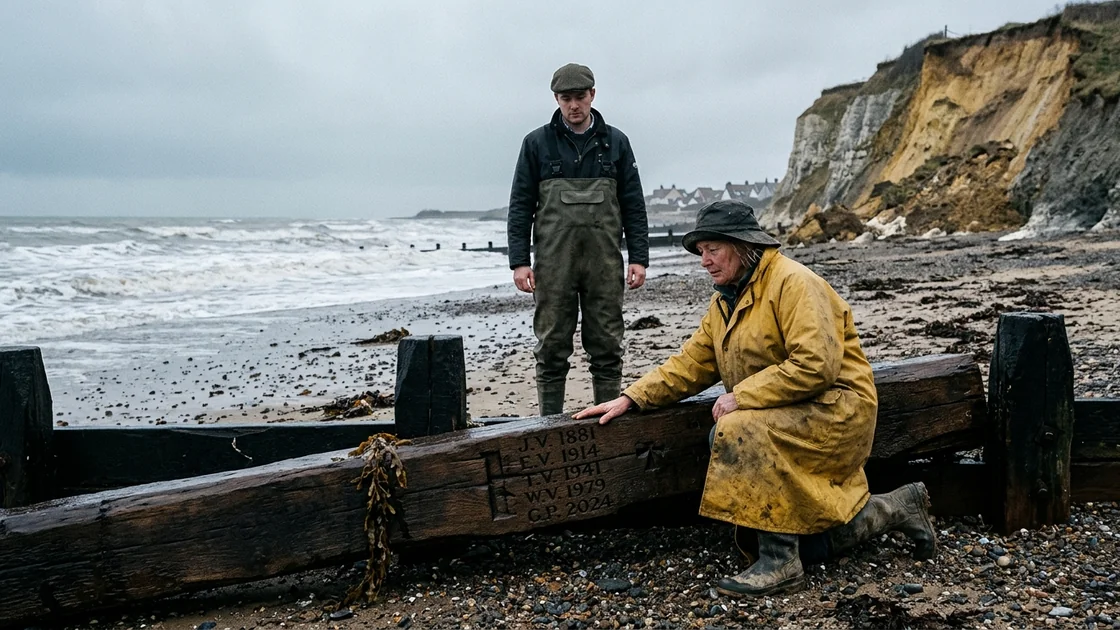
It was the central beam from the parlor ceiling—fourteen feet of prime heart-of-oak, a foot square, so dense with age and resin and two centuries of wood-smoke that it barely floated, riding low in the wash until the receding tide had grounded it against the pilings.
Because it was ships' timber, it hadn't broken when the house fell. The modern bricks had turned to powder; the nineteenth-century deal floorboards had splintered into matchwood; the slates had shattered into shards. But the oak rib that had started life in a royal dockyard in 1780, survived a wreck on the Dogger Bank, and held up the Vance roof for two hundred and forty years didn't have a single split in it. Its ends were merely bruised where the stone walls had torn away from their mortises.
Clara walked along the length of the wet black timber until she reached the center.
There, washed clean of two centuries of lamp-soot by six hours in the surf, was the King’s broad-arrow mark. And beside it, clear and sharp in the wet wood, were the five notches.
J.V. 1881. E.V. 1914. T.V. 1941. W.V. 1979. G.P. 2024.
She knelt on the wet shingle beside the beam and laid her bare hand flat on the wood over the marks. It was icy cold, slick with salt water and a single strand of brown oarweed that had wrapped itself around the timber.
As she knelt there, she heard footsteps crunching across the gravel behind her. She didn't have to turn around to know it was Luke; nobody else in the village walked with that long, heavy, wading stride.
"Me and Billy brought the tractor down to the slip, Miss Vance," Luke said, stopping a few paces back out of respect, as if she were standing by a grave in the churchyard. "We thought, before the tide comes back at five and takes the rest of the drift out to the sands, we could get a chain round this main beam and haul it up behind the sea-wall for you. If you're going into that little place at Westleton next week, we could cut a six-foot length out of the middle here—the bit with the marks on—and set it up along your garden wall for a bench, or over the fireplace if the wall’s strong enough."
Clara looked down at the beam. She thought of the six-foot piece of black, salted oak sitting on a neat square of turf in a red-brick cul-de-sac five miles inland, drying out in the sun where the sea-fret never reached, turning grey and splitting down the grain until the initials faded away into cracks, an ornament for the neighbors to ask polite questions about over the fence.
Then she looked out at the water. Two hundred yards offshore, the low tide had exposed the outer sandbar, where a long line of white surf was breaking over the place where her great-grandfather had been born, where St. Jude’s church bell still lay buried in twelve feet of sand, and where William had gone out on a calm November afternoon forty-five years ago.
This oak had come out of the North Sea in 1790. It had only been borrowing the land for a little while.
She stood up, brushing the wet sand from the knees of her oilskins.
"Leave the tractor on the slip, Luke," Clara said, her voice clear and steady in the quiet afternoon air. "Wait till you see what comes ashore after the next easterly. If the timber’s sound and the beach crew wants to cut it up for chocks for the lifeboat carriage, or use it to mend the pilings on the lower groyne, you have my leave to take the saw to it. It’s good Danzig oak; it’ll hold a spike better than that soft pine the council buys."
Luke blinked at her, surprised. "Even the bit with the names on, Miss Vance?"
"If you bolt that piece to the seaward end of the groyne," Clara said, looking back up the beach toward the grey roofs of the village, "then the Vances will still be holding the shingle together when you and I are up the hill in the new churchyard. That’s work enough for an old piece of wood."
She reached into the deep pocket of her coat, where her fingers touched the cold brass case of her father’s leather tape measure. She pulled it out, looked at the rusted steel loop at the end of the ribbon for a second, and then tossed it underhand into the deep pool of grey water scoured out behind the groyne pilings. It sank without a ripple, settling among the flints and the small green shore-crabs at the bottom.
"Come on, then," she said to the young man, turning her back on the raw yellow slope of the headland. "Arthur’s sister has a meat pudding on the boil, and if we don't get up the steps before the light goes, she’ll have burnt the crust off it."
Behind them, the first long roller of the turning tide slid quietly up the wet shingle, lifted the end of the black oak beam half an inch off the stones, and settled it back down again with a low, contented thud, waiting for the water to deepen.