The Echoes in the Glass
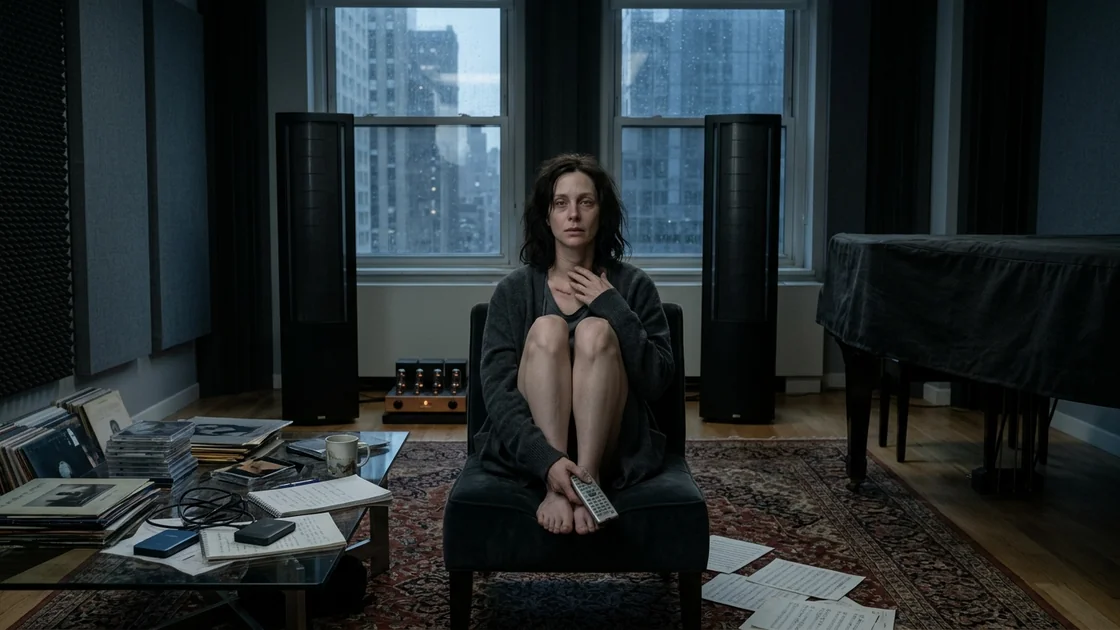
Clara Vance was once the most celebrated soprano of her generation, a vocalist whose four-octave range could fill the grandest concert halls without the aid of a microphone. When a routine microsurgery to remove a benign vocal nodule goes catastrophically wrong due to nerve damage, Clara wakes up to a permanent, breathy whisper. Stripped of her identity, her career, and the very medium through which she understood the world, she retreats into her soundproofed Manhattan apartment. There, surrounded by the ghosts of her former glory, she descends into a profound and paralyzing despair, spending her hollow days and sleepless nights obsessively playing back her old studio recordings and live performances. As the weeks bleed into months, the chasm between the radiant woman trapped in the audio files and the silent ghost sitting in the dark threatens to swallow her whole, forcing her into a harrowing psychological confrontation with her own grief, the phantom sensations of melodies she can no longer produce, and the terrifying silence of an unwritten future.
The rain against the double-paned glass of the twelfth-floor apartment made no sound at all. It was a feature Clara had paid a fortune for three years ago, back when silence was a luxury she bought to protect her instrument from the grinding roar of Manhattan traffic. The walls were lined with dense acoustic foam concealed behind tasteful panels of slate-gray fabric. The floors were layered with thick Persian rugs over cork underlayment. The heavy oak doors had rubber gaskets that sealed with a soft, pneumatic sigh whenever they were closed. It was a sanctuary designed to keep the world out so that her voice could exist in pure, unadulterated isolation.
Now, the room was a tomb.
Clara sat in the center of the living room on a low velvet armchair, her knees pulled tightly to her chest. In her right hand, she held a heavy silver remote control. Across from her stood a pair of towering electrostatic speakers, their matte-black grilles staring back at her like twin monoliths. Between them, an amplifier glowed with the warm, amber light of vacuum tubes—the only illumination in the twilight gloom of the apartment.
She pressed play.
For two seconds, there was only the faint, velvety hiss of the master tape transfer—a sound she had always loved because it held the anticipation of breath. Then, the piano entered. It was Julian’s touch, unmistakable in its delicate, rolling arpeggios, recorded four years ago at Abbey Road during the sessions for Nocturnes in Amber.
Clara closed her eyes. She knew the exact millisecond she would enter. She felt the muscle memory engage in her abdomen: the low, expansive drop of the diaphragm, the widening of the lower ribs, the subtle lifting of the soft palate at the back of her throat, creating the cathedral dome where the sound would resonate. Her body prepared for the physical act of singing, an automatic reflex honed by twenty-five years of relentless discipline.
Then, from the speakers, the voice emerged.
It began on a middle G, so soft it seemed to materialize out of the air rather than vibrate through it, before swelling into a long, arching phrase that climbed effortlessly toward a high B-flat. The tone was liquid gold, rich with overtones, possessing that rare, paradoxical quality the critics had always struggled to describe—a sound that was simultaneously warm and piercingly clear, like sunlight refracting through an icicle.
In the dark armchair, Clara opened her mouth and tried to join her past self.
What came out of her throat was a dry, scraping wheeze, like dead leaves being dragged across concrete. It wasn't even a note. There was no pitch, no resonance, no core. Just the sound of air leaking furiously through a broken valve, accompanied by a sharp, pulling ache on the left side of her larynx where the scar tissue had tethered her paralyzed vocal fold in an open, useless position.
She clamped her mouth shut instantly, her teeth clicking together. Her hand flew to her throat, fingers pressing against the small, pale ridge of the external incision just above her collarbone—the site where the surgeon had gone in after the initial endoscopic approach had resulted in sudden, unexplained bleeding.
In the room, the other Clara—the real Clara, the one immortalized in twenty-four-bit digital perfection—reached the climax of the aria. The high note bloomed, filling the soundproofed apartment, pressing against the acoustic panels, vibrating in the floorboards beneath Clara’s bare feet. The recorded voice was utterly fearless. It didn't know about the recurrent laryngeal nerve. It didn't know about the stainless-steel scalpel slipping a fraction of a millimeter in a field obscured by capillary blood. It only knew how to soar.
Clara sat frozen, letting the sound wash over her, each note acting like a physical blow that drove her deeper into the cushions of the chair. This was her ritual. Every day since the bandages had come off six months ago, she had drowned herself in the archives of her own existence.
Before the surgery, Doctor Harrison had drawn a simple diagram on a whiteboard in his pristine Upper East Side office. He was a man in his late fifties with silver hair, manicured hands, and walls covered in framed photographs of Broadway stars and Metropolitan Opera regulars who had trusted him with their livelihoods.
"It's a classic singer's nodule, Clara," he had said, tapping the marker against a small dot on the schematic of two V-shaped bands. "Right at the junction of the anterior and middle thirds. You’ve been pushing through a grueling European tour, singing Tosca and Traviata back-to-back, and the tissue has formed a small callus. We go in with a micro-flap technique, cold steel, no laser—we don't want any thermal damage to the lamina propria. Twenty minutes under general anesthesia. Two weeks of absolute vocal rest, four weeks of graduated therapy, and you’ll have your pianissimo back for the Carnegie Hall residency in the fall."
She had been terrified, of course. Every vocalist lives in perpetual terror of anything entering their throat. She didn't even like swallowing large vitamin pills. Her voice wasn't just a career; it was the architecture of her soul. Since she was seven years old, standing in the choir stalls of a drafty church in Ohio, she had understood that when she sang, she became larger than her frail, anxious self. Speaking had always felt clumsy to her, a dull instrument for imprecise thoughts. Singing was truth.
"What are the risks?" she had asked, her speaking voice then a resonant, melodic contralto that made people turn their heads in restaurants.
Harrison had smiled, a practiced, paternal expression designed to soothe high-strung artists. "In my hands? Negligible. Less than half a percent chance of significant scarring. We do ten of these a week, Clara. It's like trimming a cuticle."
She remembered the coldness of the operating room. She remembered the anesthesiologist telling her to think of her favorite place to sing—she had chosen the Musikverein in Vienna, with its gilded caryatids and shoebox acoustics that made a singer feel as though they were inside the body of a Stradivarius violin. She remembered the chemical taste of the propofol at the back of her tongue.
Then, nothing. Until the waking.
She had known immediately that something was wrong. It wasn't just the pain, which was far deeper and sharper than the mild sore throat she had been promised. It was the presence of the drain tube taped to her neck, and the look on the recovery nurse's face when Clara opened her eyes. The surgery was supposed to be entirely endoscopic, through the mouth. Why was there a dressing on her neck?
Later, Harrison had come to her bedside. The paternal smile was gone, replaced by a tight, gray mask of professional liability. He spoke in careful, passive sentences that sounded as though they had been vetted by a hospital legal team in the hallway outside.
An anomalous vascular malformation. Unexpected hemorrhage obscuring the surgical field. Necessity of an emergency open thyrotomy to control the bleeding. Inadvertent traction and subsequent transection of the left recurrent laryngeal nerve.
"We attempted a primary re-anastomosis of the nerve before closing," Harrison had said, looking at the monitor beside her bed rather than into her eyes. "There is a possibility of some regeneration over the next six to twelve months. Even if the left fold remains paralyzed, there are medialization procedures—thyroplasty, injections—that can bring the cord closer to the midline so the right cord can meet it."
Clara couldn't speak. She was on strict vocal rest, and a heavy band of terror was constricting her chest. She had grabbed the small dry-erase board they had given her and scrawled across it with a shaking hand, the black marker squeaking violently: WILL I SING?
Harrison had finally looked at her. In his eyes, she saw the death of her life.
"We are going to focus on restoring a functional speaking voice first, Clara," he had said quietly. "Let's take this one step at a time."
The weeks of vocal rest had been a period of suspended animation, a purgatory where hope still flickered like a dying candle. Clara had followed every instruction with fanatical devotion. She didn't whisper, because she knew whispering put more strain on the vocal folds than soft speech. She didn't clear her throat. She drank gallons of room-temperature water. She slept with two humidifiers running at full blast, turning her bedroom into a damp, tropical cave. She communicated with her fiancé, Julian, and her manager, Eleanor, entirely through text messages and notebooks.
Julian had tried to be brave for both of them. A concert pianist with a thriving career of his own, he had canceled three recitals in Chicago and London to stay with her in the apartment. He would sit at the Steinway grand in the corner of the living room—now draped in a heavy dust cover she refused to let anyone remove—and play Bach partitas softly, trying to fill the oppressive quiet with structure and mathematical grace.
The nerve will heal, he would tell her, kissing her forehead while she stared at the ceiling. You have the strongest constitution of anyone I know. And even if it takes a year, the world will wait for Clara Vance.
Then came the day of the first stroboscopy, four weeks post-op.
She had gone to a different specialist—she couldn't bear to set foot in Harrison’s office again, leaving that communication to the team of malpractice attorneys Eleanor had assembled. The new doctor, a quiet woman named Dr. Patel with gentle hands, had fed the flexible fiber-optic scope through Clara’s numbed nostril and down into her pharynx.
On the high-definition monitor to Clara’s left, her larynx had appeared, illuminated by the pulsing xenon light.
Clara knew what healthy vocal cords looked like. She had seen her own dozens of times during routine checkups over the years: two pearly white ribbons, smooth and symmetrical, rippling like silk flags in the breeze as they came together to vibrate hundreds of times per second.
What she saw on Dr. Patel’s screen made her stomach heave.
The right cord was white, though slightly swollen. The left cord was bowed, shrunken, and pale gray, lying slack and motionless off to the side like a dead slug. Worse, across the anterior commissure where the two cords met, a thick, jagged web of fibrotic scar tissue had formed from the emergency incision, tethering the mucosa down to the underlying ligament.
"Say 'eeee' for me, Clara," Dr. Patel had said softly.
It was the first sound Clara had been permitted to make in twenty-eight days. She closed her eyes, summoned her breath, and tried to intone a simple, easy middle C.
Hhhhhhh-khhhh.
On the screen, the right vocal cord swung toward the center, searching for its partner. The left cord didn't even twitch. Between them remained a gaping, triangular chasm through which her breath escaped in a useless, turbulent rush. And where the scar tissue lay, the mucosal wave—the delicate, fluid rippling that actually produces the human voice—was completely absent. The tissue was stiff as shoe leather.
Clara had pulled away from the scope so violently that her nose began to bleed, bright red drops splashing onto the white paper lining the examination chair. She had tried to scream, to sob, to wail, to release the volcanic pressure of grief that had been building inside her chest for a month.
Nothing came out but the sound of wind through a keyhole. A wheezing, asthmatic rattle that left her dizzy and gasping for oxygen because her glottis could no longer close to regulate the air leaving her lungs.
That was the afternoon she had come home, walked past Julian in the foyer without looking at him, locked herself in the master bedroom, and begun her descent.
The album Nocturnes in Amber ended. The final chord of the piano decayed into nothingness, and the amplifier clicked softly as the digital playlist paused.
In the dark living room, the silence rushed back in to fill the void. It was a heavy, pressurized silence, thick with the ghosts of the notes that had just died.
Clara didn't move for a long time. Her legs were numb from sitting in the same position for three hours. On the low glass coffee table beside her sat a half-empty mug of cold chamomile tea, a bottle of prescription sleeping pills she hadn't opened, and stacks of glossy jewel cases, vinyl sleeves, and portable hard drives.
Every recording she had ever made was piled on that table. Her debut album of Schubert lieder from when she was twenty-two, still raw in technique but bursting with youthful radiance. Her studio recording of Mahler’s Fourth Symphony with the Berlin Philharmonic. The bootleg DAT tapes of her Covent Garden debut as Violetta, recorded from the prompter's box. Even a microcassette from 1998, labeled in her mother's neat cursive: Clara, Senior Recital, First Baptist Church.
She reached out with a trembling hand and picked up a hard drive. It contained the raw, unedited stems from her last studio project—a cycle of contemporary songs written specifically for her by the French composer Henri Dutilleux’s final protégé, Laurent Moreau. The album was never finished. They had recorded the vocal tracks for four of the six movements in Paris two weeks before she flew back to New York for the surgery.
She plugged the drive into the laptop connected to her DAC, navigated the folders with mechanical precision, and opened the Pro Tools session file for the third movement, L'Ombre de la Voix.
She soloed her vocal mic. A Neumann U47, positioned eight inches from her lips in a wooden booth in the 16th arrondissement. Because it was the raw stem, nothing had been edited out.
She pressed the spacebar.
First came the rustle of sheet music being adjusted on the stand. Then, a tiny, wet click as she moistened her lips. And then, her speaking voice, addressing Laurent in the control room.
"Laurent, on bar forty-two, do you want me to take the breath before the appoggiatura, or carry it all the way through to the F-sharp? I have plenty of air if we keep the tempo moving."
A tear, hot and heavy, spilled over Clara’s lower lashes and tracked slowly down her hollowed cheek.
It wasn't even the singing that broke her in this moment; it was the speaking. That casual, effortless richness. The way she had said I have plenty of air with a light laugh at the end, her voice bouncing off the studio walls with such casual vitality. She sounded so alive. She sounded like a person who belonged to the world, who could walk into a bakery and order a croissant, who could argue about tempos, who could whisper in a lover's ear without sounding like a dying machine.
In the recording, the talkback mic clicked off, and the take began. Since the orchestral tracks were muted, it was purely a cappella.
Clara listened to the breath intake. It was silent, deep, a vacuum of pure potential. Then came a long, unaccompanied vocalise that started in her chest register—dark, smoky, resonant as a cello—and slid upward through the passaggio without a single seam or break, opening into a blindingly bright high C that hung in the air for twelve full seconds before diminishing to a thread of sound so delicate it was like a spiderweb catching the light.
When the note finally ended, you could hear her exhale a tiny, satisfied breath on the recording, followed by the faint sound of Laurent cheering through the glass of the control room.
Clara hit the spacebar to stop the playback. She hit the left arrow key. She hit the spacebar again.
"...I have plenty of air if we keep the tempo moving."
Silence. Breath. The cello chest voice. The seamless climb. The blinding high C. The twelve-second diminuendo.
Stop. Rewind. Play.
"...I have plenty of air..."
She played those ninety seconds seventeen times in a row.
As she listened, a strange and terrifying dissociation began to take hold of her—a sensation that had grown stronger with each passing week in her isolation. The voice coming from the speakers was so intensely familiar, so intimately tied to the physical sensations of her own body, that she began to feel as though her soul had been amputated and trapped inside the hard drive. The woman sitting in the velvet chair—thirty-four years old, twenty pounds underweight, wearing a stained cashmere cardigan, with a dead nerve in her neck—was a counterfeit. A husk discarded on the floor of the operating room at Mount Sinai. The real Clara Vance lived in the magnetic particles of the tape and the binary code of the WAV files.
She stood up, her joints popping in the quiet room, and walked over to the right speaker. She pressed her ear and her cheek directly against the cold metal grille, letting the vibrations of the high C buzz against her cheekbone. If she closed her eyes and pressed hard enough, the bone conduction almost tricked her brain into believing the resonance was coming from inside her own skull again.
"Give it back," she whispered into the black mesh.
It sounded like Hhh-vuh ihhh baaah. The plosive consonants—the 'g', the 'b'—were impossible for her to form cleanly because they required building up air pressure behind closed vocal folds before releasing it. Without glottal closure, her speech was a slush of unvoiced fricatives and wasted breath. After three words, she had to inhale again, her chest heaving with the effort of simple phonation.
She slid down the side of the speaker until she was sitting on the floor, her forehead resting against her knees, her hands tangled in her unwashed hair. She wanted to cry out loud. More than anything, she wanted the primal, animal relief of a scream. Even infants had that. Even dogs had that. When a creature is in agony, nature grants it a voice to expel the poison of the pain into the air.
Clara had to swallow her agony back down through the very throat that had betrayed her. She rocked back and forth on the Persian rug, her shoulders shaking violently in absolute, suffocating silence, save for the ragged, whistling gasps of her lungs trying to catch up with her heartbreak.
The sound of a key turning in the heavy front door latch made her flinch.
A moment later, the pneumatic seal broke with its soft sigh, and the hallway light spilled into the dark foyer. Clara didn't get up from the floor beside the speaker. She simply pulled her knees tighter and stared at the glowing amber tubes of the amplifier.
"Clara?"
It was Julian. His voice was hesitant, carrying that careful, walking-on-eggshells cadence that everyone used around her now—the voice people use in intensive care units and funeral parlors. She heard the rustle of grocery bags being set on the kitchen counter, followed by the soft thud of his leather messenger bag hitting the bench by the door.
He walked into the living room and stopped. In the dim light from the foyer, she saw his silhouette sag slightly when he spotted her huddled on the floor next to the speaker tower.
"You're in the dark again," he said softly, crossing the room to turn on a small table lamp with a warm parchment shade.
Clara shielded her eyes as the dim yellow light revealed the state of the room. Coffee mugs from three days ago littered the side tables. Music scores—Der Rosenkavalier, Knoxville: Summer of 1915, Britten's Les Illuminations—were scattered across the floor where she had thrown them during a fit of silent rage two nights prior, their spines cracked and pages crumpled.
Julian knelt beside her on the rug. He smelled of October rain, wool, and the faint, woody scent of the rosin from the violinists he had been rehearsing with at Lincoln Center that afternoon. He smelled of the world. The world where music was still happening, where rehearsals started at ten, where people complained about reed canes and conductor tempos and went out for drinks afterward.
She hated him for smelling like that. And she hated herself for hating him.
"Sweetheart, come sit on the sofa," he murmured, reaching out to put a hand under her elbow. "You're freezing. Have you eaten anything I left in the fridge?"
She pulled her arm away from his touch, shaking her head once. Her eyes drifted back to the laptop screen, where the waveform of her Paris vocal stem looked like a mountain range glowing in neon blue.
Julian followed her gaze. When he saw the Pro Tools window open on the laptop, his jaw tightened. Without a word, he stood up, walked over to the coffee table, and snapped the laptop shut. The glowing amber light of the DAC blinked twice and went red as the signal died.
Clara scrambled to her feet with a sudden, frantic burst of energy, lunging for the computer as if he had just closed the lid on a coffin while someone was still breathing inside. Julian caught her by the wrists before she could open it again.
"Stop it, Clara!" he said, his voice rising for the first time in months, cracking under the strain of his own exhaustion. "Just stop! You sit in here for twelve hours a day torturing yourself with these recordings! Dr. Kessler said this is the worst possible thing you could be doing for your mental state. It’s self-harm!"
She wrenched her wrists out of his grip, her eyes blazing in her pale, sunken face. She pointed a shaking finger at her throat, then at the closed laptop, and then beat her fist against her own chest.
That's me! she tried to shout at him. That's the only place I still exist!
What came out was a strangled, wet hiss: Hhhh-thuh... mmm... hhhh! The effort caused a violent spasm in her neck, sending a coughing fit tearing through her chest—a terrible, hollow, bovine cough that lacked the sharp bark of closure, sounding instead like someone clearing a clogged drainpipe. She doubled over, clutching the back of the velvet armchair as her face turned a mottled, desperate red.
Julian’s anger vanished instantly, replaced by a wave of guilt and helplessness. He stepped forward, rubbing her back as she struggled to regulate her breathing, grabbing a glass of water from the table and holding it to her lips once the spasm subsided.
"I'm sorry," he whispered, his own voice thick with tears as she took a tiny, trembling sip. "I'm so sorry, Clara. I just... I don't know how to reach you anymore. You won't go to the speech therapist. You won't talk to the surgeon in Boston about the thyroplasty. You won't let your mother visit. You just sit in this dark room listening to ghosts."
Clara pushed the water glass away and walked over to the legal pad lying on the dining table. She picked up a heavy Montblanc pen—a gift from the Vienna State Opera—and wrote in large, slashing capitals that tore through the thin yellow paper:
A THYROPLASTY WILL NOT LET ME SING.
She ripped the page off and shoved it against Julian’s chest.
He looked down at the paper, his shoulders slumping. "No," he admitted, his voice barely above a whisper. "Dr. Patel said it wouldn't give you back your operatic range. Because of the anterior web and the nerve damage, the tension mechanisms are compromised. We know that, Clara. I'm not lying to you about that." He looked up, his dark eyes pleading with her. "But it would close the gap. It would stop you from running out of breath every time you try to say three words. It would give you back a voice to speak with. To talk to me. To live a life."
Clara grabbed the pen again. Her hand was shaking so badly the ink blotched on the page.
WHAT LIFE? SOUNDING LIKE A GRAVEL TRUCK? HAVING PEOPLE Pity ME EVERY TIME I OPEN MY MOUTH? I WAS CLARA VANCE.
"You ARE Clara Vance!" Julian cried, taking a step toward her. "You are a brilliant musician! You know more about phrasing, about diction, about the architecture of nineteenth-century repertoire than anyone alive! Juilliard has already called Eleanor twice asking if you would consider a chair in the vocal arts department when you're ready. You could coach. You could conduct. You could write—"
Clara let out a sound then—a low, guttural groan from deep in her pharynx that made Julian stop dead in his tracks. She picked up the stack of scores from the edge of the dining table—a thick leather-bound edition of Verdi’s Otello—and hurled it across the room. It hit the dust-covered Steinway grand with a resonant, metallic thud that made the piano strings hum in sympathetic protest inside the closed lid.
She grabbed the pen again, pressing so hard the gold nib splayed open, leaking black ink across her fingers.
WATCHING TWENTY-YEAR-OLDS DO WHAT WAS STOLEN FROM ME? LISTENING TO OTHER PEOPLE SING MY ROLES WHILE I CROAK AT THEM FROM A CHAIR? I WOULD RATHER BE DEAD.
She dropped the pen and walked rapidly toward the bedroom, slamming the heavy, gasket-sealed door behind her and turning the deadbolt.
Through the thick, soundproofed wood, she couldn't hear Julian at all. She didn't know if he was crying, if he was picking up the scores, or if he was standing in the foyer looking at the front door, wondering how much longer he could stay chained to a corpse.
She lay down on the unmade bed, curling into a tight ball atop the duvet, and stared at the ink stains on her fingers until the darkness outside the window was absolute.
At three in the morning, when she knew Julian was asleep in the guest room at the far end of the hall—having moved there a month ago because her restless tossing and the loud mist of the humidifiers kept him awake during his concert season—Clara crept back out into the living room.
She didn't turn on any lights. She didn't use the big electrostatic speakers. Instead, she took a pair of open-back studio reference headphones, plugged them into the headphone jack of her audio interface, and sat on the floor with her back against the cold radiator.
With the headphones clamped over her ears, the world shrank to the diameter of her own skull.
She opened a folder on her computer that she rarely touched, even in the depths of her masochism. It was labeled Archive - Early Years.
She clicked on a file from twelve years ago: Juilliard Opera Center - Giulio Cesare - Act II.
The audio quality was mediocre, captured by a single stereo microphone hanging above the orchestra pit of the Peter Jay Sharp Theater. The harpsichord sounded a bit tinny, the student strings slightly ragged in the opening ritornello of Se pietà di me non senti.
Then, twenty-two-year-old Clara entered.
Listening through the headphones, present-day Clara felt a physical jolt in her solar plexus. She remembered that night with terrifying clarity. She remembered the cheap gold lame costume that scratched under her arms; she remembered the smell of pancake makeup and spirit gum in the basement dressing rooms; she remembered standing in the wings before her entrance, bouncing on the balls of her feet, feeling that intoxicating, electrical hum in her blood that only performers know—the certainty that you are about to walk out under hot lights and bend six hundred strangers to your will using nothing but the column of air in your lungs.
In the recording, the young voice was mourning over what she believed to be the dead body of Julius Caesar. The B-minor melody was jagged, full of wide, weeping intervals and sudden drops into the lower register.
As Clara listened, her mind began to dissect the performance with the ruthless precision of the master technician she had become, yet with the aching nostalgia of a ghost watching home movies. There, she thought, as the young soprano floated a high G on the word morir. I was slightly sharp on the attack because my ribs collapsed a fraction too early, so I covered it by darkening the vowel into an 'oh' and adding vibrato at the end of the bar.
Nobody in the audience that night had known she did that. Only she knew. It was the secret language between her brain and her larynx—the thousands of microscopic, lightning-fast adjustments of cartilage, muscle, and air pressure that happened every minute she was on stage. The cricothyroid muscle tilting the thyroid cartilage forward to stretch the cords for high notes; the thyroarytenoid muscle thickening them for the rich, dark chest tones; the intercostals holding back the subglottic pressure so the fragile vocal folds wouldn't blow apart on a pianissimo.
It had been like flying a fighter jet with her eyes closed, feeling the wind resistance on the wings through her fingertips.
And then came the da capo section of the aria. In baroque opera, when the first section repeats, the singer is expected to improvise ornaments—to rewrite the composer's melody in real time to reflect heightened emotion.
That night at Juilliard, she hadn't sung the ornaments she had rehearsed with her coach. Caught up in the devastation of Handel's music, she had taken a massive risk. Instead of climbing up to the high A at the cadence, she had leaped to a sustained high D, held it on a hairline thread of sound for four beats, and then cascaded down two full octaves in a dizzying, chromatic run of thirty-second notes that landed squarely on a low B-natural in her chest voice.
In the headphones, she heard the collective gasp of the audience before the final orchestral chords had even finished.
Clara pulled the headphones off her ears, letting them drop around her neck like a heavy collar. From the small speaker cups resting against her collarbones, the tinny sound of twelve-year-old applause buzzed faintly against her skin.
She looked down at her hands in the moonlight filtering through the sheer curtains.
Who was she if she couldn't do that?
People who weren't singers—even musicians like Julian, whose instrument existed outside his body in eighty-eight keys of wood and ivory—could never truly comprehend the existential horror of vocal loss. If Julian’s Steinway were dropped from a crane and smashed into ten thousand pieces on 57th Street, he would grieve, certainly. He loved that piano. He knew its quirks, the slight heaviness of the action in the middle octave, the singing tone of its treble.
But the next day, Julian could walk into Steinway Hall, sit down at another nine-foot concert grand, place his hands on the keyboard, and he would still be Julian. His music lived in his nervous system and his fingers; the box of wood and wire was merely the translator.
A singer is the box of wood and wire.
When the box breaks, there is no going to the store to buy another one. You carry the shattered wreck of your instrument inside your own flesh for the rest of your life. Every time you swallow saliva, you feel the broken strings. Every time you breathe cold air, you feel the cracked soundboard. Every time someone asks you what floor you want in the elevator, you have to take the broken instrument out of its case and display its ruin to a stranger just to say "Twelfth, please."
Clara stood up slowly. The applause on the Juilliard recording had faded into the next scene's recitative, another student singing the role of Sesto in a bright, healthy mezzo-soprano. Clara unplugged the headphones, silencing the file, and walked into the bathroom.
She flipped on the vanity lights. They were blindingly bright, ringed around a large bevel-edged mirror.
She leaned over the marble sink and stared at herself. She looked ten years older than the woman on the posters for the Carnegie Hall residency—posters that had been pasted over with CANCELED stickers across the city two months ago. Her dark hair, usually kept in a glossy, dramatic sweep, hung limp and dull around her shoulders, with silver threads beginning to show at the temples. Her collarbones jutted out sharply above the scoop neck of her t-shirt.
And right between them, in the hollow of the suprasternal notch, was the scar.
It was about two inches long, horizontal, fading from angry red to a bruised, purplish pink.
Clara raised her right hand and pressed two fingers directly against the scar, pushing inward until it hurt, until she could feel the hard cartilage of her trachea shift slightly beneath the pressure.
"Do something," she rasped at the woman in the mirror. Duhhh sss-uhm-thhh-ing.
She opened her mouth wide, sticking her tongue out and down the way she used to when checking her throat for redness before a performance in dry hotel rooms. In the mirror, she could only see the uvula and the back wall of her pharynx. The ruin was hidden deeper down, around the corner of the epiglottis, invisible to the naked eye. So close—literally two inches beneath her chin—and yet as unreachable as the bottom of the Mariana Trench.
She tried to sing a scale. Just a five-note scale in the easiest, lowest part of her voice, where the cords barely needed to stretch at all.
Ah-ah-ah-ah-ah.
What came out of the mirror-woman’s mouth was a horrific, bifurcated sound—what Dr. Patel had clinically termed diplophonia. Because her right cord had tension and her paralyzed left cord was a floppy sack of tissue, when she forced enough air through them to make the left one vibrate at all, they vibrated at two completely different frequencies simultaneously.
It sounded like a broken kazoo layered over a death rattle. A harsh, multiphonic gurgle that wasn't human, let alone musical. It lasted for barely two seconds before her lungs emptied through the unclosed glottic gap, leaving her lightheaded and clutching the edge of the marble sink.
She stared at her reflection in horror. That sound—that grotesque, monstrous noise—was her voice now. If she went through with the medialization surgery, where they would cut her neck open again while she was awake under local anesthesia and shove a block of Gore-Tex or carved silicone into her larynx to push the dead cord toward the center, would it just make that monstrous rattle louder?
Her gaze dropped from the mirror to the medicine cabinet.
Inside were three bottles of pills: the Ambien for sleep, the proton pump inhibitors Dr. Patel prescribed to keep stomach acid from irritating the scar tissue, and a nearly full bottle of oxycodone left over from the first week after the emergency surgery.
Clara opened the mirrored door of the cabinet. The hinges were well-oiled; they didn't even squeak.
She picked up the orange plastic cylinder of oxycodone and shook it lightly. The dry rattle of the white tablets was crisp, rhythmic, almost like a maraca in a Ravel score.
If she couldn't be the woman on the hard drive, why continue being the ghost in the bathroom? The ghost had no purpose. The ghost was just a burden on Julian, an embarrassment to her colleagues, a tragic cautionary tale whispered about in the practice rooms at Juilliard ("Did you hear what happened to Clara Vance? Never let Harrison touch your throat..."). If she ended it now, at least the narrative would be complete. She would be like Maria Callas dying alone in Paris while listening to her old recordings of La Sonnambula—an operatic tragedy, clean and absolute, rather than forty more years of rasping orders at grocery store clerks and nodding silently at dinner parties.
She unscrewed the childproof cap. It took a bit of effort; her hands were weak.
"Clara?"
Julian stood in the doorway of the bathroom, wearing a gray t-shirt and pajama pants, his hair rumpled from sleep. He wasn't looking at her face; he was looking directly at the open medicine cabinet and the uncapped orange bottle in her hand.
For three seconds, neither of them breathed.
Then Julian crossed the tiled floor in two strides. He didn't wrench the bottle from her the way he had closed the laptop earlier. Instead, he wrapped his arms around her from behind, enveloping her skeletal frame against his warm chest, and gently, finger by finger, pried her hand open until the plastic bottle dropped into the sink, scattering a dozen small white pills across the porcelain and down into the drain trap.
Clara didn't fight him. The sudden rush of adrenaline left her legs completely hollow. She sagged against him as he guided her down to sit on the edge of the cold bathtub, burying his face in the crook of her neck and sobbing—deep, racking, voiced sobs that vibrated against her skin with all the healthy, resonant glottal closure she no longer possessed.
The next morning, the rain had stopped, leaving the Manhattan sky a flat, blinding sheet of white iron.
Julian hadn't gone to his rehearsal. While Clara sat motionless at the kitchen island wrapped in a heavy wool blanket, he had stood at the sink washing every single dirty dish, scrubbing the crusted coffee mugs, gathering the scattered music scores from the living room floor and stacking them neatly on the shelves, and finally opening the heavy velvet curtains for the first time in a month.
The harsh morning light exposed every speck of dust floating in the stale air of the apartment.
When he was finished, he sat down across from her at the island. His eyes were bloodshot and ringed with dark bruises of exhaustion, his face pale. Between them lay a business card he had pulled from his wallet.
"I called Eleanor at seven this morning," Julian said. His voice was completely stripped of the careful, tiptoeing fragility he had used for months. It was quiet, level, and terrifyingly firm. "And then I called Dr. Patel. We can't go on like this, Clara. After last night... if you stay in this apartment for another week listening to those tapes, I'm going to come home and find you dead. And I can't survive that."
Clara looked down at the business card on the granite countertop.
Arthur Vance-Sterling, Ph.D., CCC-SLP. Voice Rehabilitation & Laryngeal Biomechanics. Massachusetts General Hospital / Boston Conservatory.
She knew the name, though they were no relation. Sterling was legendary in the vocal world—a former baritone who had transitioned into clinical voice pathology thirty years ago. He was the man who had rehabilitated rock singers after vocal hemorrhages and worked with throat cancer survivors who had lost part of their vocal cords to radiation. Eleanor had mentioned him in August, right after the diagnosis, when Clara had refused to see anyone at all.
"He doesn't just work with singers trying to get back on stage," Julian continued, watching her face closely. "He works with performers who have permanent, career-ending injuries. People who have to learn how to inhabit their bodies again when their instrument is gone. I spoke to him personally an hour ago. He knows who you are, Clara. He told me he was in the audience for your Alcina at the Met two years ago."
At the mention of Alcina—arguably the greatest triumph of her career, the night the audience had refused to leave the auditorium for twenty-five minutes of curtain calls—Clara flinched as if he had flicked boiling water into her face. She reached for her legal pad on the counter, her fingers twitching for the pen.
Julian placed his hand flat over the yellow paper before she could pick up the pen.
"Wait," he said softly. "Before you write NO, let me finish. Because I have to be honest with you about where I am."
He took a deep, shaky breath, looking down at his pianist's hands—broad, strong, calloused at the tips.
"I love you more than my own life," he said, his voice cracking slightly. "When the surgery went wrong, I swore to myself that I would carry both of us for as long as it took. If you can never sing another note, I don't care. If your speaking voice is a whisper forever, I will learn to read your lips in crowded rooms for the next fifty years. I didn't fall in love with a voice box, Clara. I fell in love with the woman who laughed when we got caught in that thunderstorm in Salzburg, the woman who argues with me about Brahms tempos, the woman who exists between the performances."
He looked up, and a tear slid down his cheek.
"But you are killing her in front of me every day," he whispered. "You're treating the woman in front of me like garbage because you're only in love with the voice in that computer. And if you won't fight for her—if you won't even go to Boston to talk to someone who understands what you're going through, or let the doctors try to give you back a voice to speak to me—then I have to leave. Not because you lost your voice. Because I cannot sit in this tomb and watch you worship a ghost until you swallow a bottle of pills."
The silence that followed was different from the silence of the night before. It wasn't the acoustic deadness of the foam panels; it was the sharp, ringing silence of an ultimatum.
Clara stared at him. For the past six months, she had been so entirely submerged in the black ocean of her own catastrophe that Julian had become little more than a blurry silhouette standing on the shore, waving his arms. Now, looking at the gray exhaustion in his thirty-six-year-old face, at the way his hands were trembling against the yellow legal pad, she realized with a cold shock that she had been pulling him under the water with her.
She didn't want to live. That much was still true; the void inside her chest where her music used to live was an unbearable, sucking vacuum.
But looking at Julian, she realized she didn't want to murder him on her way out, either.
Slowly, she pulled the legal pad out from under his hand. She didn't use the ruined Montblanc; she picked up a cheap blue ballpoint pen from the fruit bowl and wrote two words in small, shaky letters.
ONE APPOINTMENT.
Beneath that, she wrote: AND YOU CANNOT TOUCH MY HARD DRIVES.
Julian let out a long, shuddering breath that seemed to deflate his entire upper body. He reached across the counter and covered her ink-stained hand with his own.
"One appointment," he agreed, his voice thick. "We'll take the train up to Boston on Thursday. Just to talk to him."
When Thursday came, leaving the apartment felt like walking onto the surface of Mars without a helmet.
Clara hadn't been outside the building since her final checkup with Dr. Patel seven weeks ago. As soon as the elevator doors opened into the lobby and the doorman—a kindly man in his sixties named Hector who used to ask her for opera recommendations for his wife—saw her, his face underwent that terrible, instant transformation she dreaded more than physical pain.
First came the surprise: Oh, it's Miss Vance! Then, the memory of the news articles: Oh God, the surgery. And finally, the suffocating, mournful pity that turned his eyes soft and wet, as if he were looking at a three-legged dog in a shelter.
"Good morning, Miss Vance," Hector said in a hushed, reverent tone, rushing to hold the heavy brass door open for her. "Lovely to see you out. The weather is nice and crisp today."
Clara couldn't even look at him. She pulled her heavy cashmere scarf up until it covered her mouth and nose, ducked her head under the brim of her wool fedora, and hurried past him onto the sidewalk with a tiny, pathetic nod.
Outside, the noise of Manhattan assaulted her senses after months in her soundproofed cocoon. It wasn't just loud; it was obscene in its wastefulness of sound. Construction workers on the corner of 72nd Street were shouting at each other over the roar of a cement mixer—healthy, resonant baritones and tenors abusing their vocal folds without a second thought, barking over eighty decibels of street noise and probably going home without so much as a tickle in their throats. Two teenagers walked past her laughing at something on a phone, their voices bright, clear, and effortless. A mother scolded a toddler in a stroller.
Everyone had a voice. Seven billion people on the planet were walking around with two functioning recurrent laryngeal nerves, flapping their pearly white vocal cords together millions of times a day to complain about the subway, to order lattes, to yell at taxi drivers, to hum off-key in the shower. They treated this miraculous biological symphony like dirt, while she—who had treated her larynx like the Ark of the Covenant for twenty-five years, who had forgone alcohol, dairy, late nights, smoky bars, and loud restaurants in service of pure art—had been struck mute on an operating table.
By the time they boarded the Acela at Penn Station and settled into the quiet car, Clara was shaking from head to toe, drenched in a cold sweat beneath her coat.
She plugged her earbuds into her phone before the train even pulled out of the tunnel.
Julian watched her do it, his eyes tightening with worry, but he kept his promise. He didn't say a word as she opened her music library and selected her 2019 recording of Richard Strauss’s Four Last Songs with the Dresden Staatskapelle.
As the train gathered speed through the industrial wastelands of New Jersey and out toward the Connecticut coastline, Clara stared out the window at the blur of autumn trees—russet, gold, and dying brown—while her own glorious, unblemished soprano poured into her ears.
Frühling. September. Beim Schlafengehen. Im Abendrot.
It was music written by an eighty-four-year-old man at the very end of his life, looking back at the sunset of Romanticism and the ruin of postwar Europe, asking at the very end: Ist dies etwa der Tod? Is this perhaps death?
When she had recorded it at the Lukaskirche in Dresden at age twenty-nine, critics had marveled at how such a young woman could capture the autumnal weight of mortality in her tone. Now, listening to the soaring violin solo in the third song give way to her own entrance—Und die Seele unbewacht, will in freien Flügen schweben (And the unguarded soul wants to soar in free flight)—Clara realized she had known nothing about death at twenty-nine. She had just been a brilliant technician painting with dark colors.
Now she knew death. Death was sitting on a train in silence, listening to your twenty-nine-year-old self sing about an unguarded soul while a dead nerve kept your throat locked in chains.
Arthur Sterling’s office was not in the main hospital tower at Mass General, which Clara was grateful for; the smell of antiseptic and the sight of surgical scrubs in an elevator would have sent her into a full panic attack. Instead, his private practice was housed in a nineteenth-century brownstone on Beacon Hill, with tall windows overlooking the bricks and gas lamps of Mount Vernon Street.
The waiting room looked more like a professor's study than a clinic. There were no medical posters of cross-sectioned heads on the walls; instead, there were framed playbills from the 1970s, rows of leather-bound books on acoustics and neurology, and a small upright piano in the corner with stacks of repertoire sitting on the music rack.
When the inner door opened, the man who stepped out was in his late sixties, tall and slightly stooped, wearing a tweed vest over a blue oxford shirt with the sleeves rolled up. He had a thick shock of white hair and sharp, observant gray eyes behind wire-rimmed glasses.
"Clara Vance," he said. His voice wasn't the honeyed, careful murmur of Dr. Patel or the defensive monotone of Harrison. It was a resonant, slightly weathered baritone, warm and direct. "And Julian. Come in, please."
Clara stood up, clutching her leather notebook to her chest like a shield. Before stepping into the office, she stopped and looked at Julian, gesturing toward the waiting room chairs with her chin.
I want to go in alone, her eyes said. She couldn't bear for Julian to watch whatever humiliation awaited her inside.
Julian hesitated, looking at Dr. Sterling, who gave a small, understanding nod. "There's a coffee shop two doors down, Julian, or you're welcome to read in here. We'll be about an hour."
Once the heavy mahogany door clicked shut behind them, Clara sat down in a leather wingback chair opposite Sterling’s cluttered desk. She kept her scarf wrapped tightly around her neck and placed her open notebook and pen on her knee, ready for the usual interrogation.
Sterling sat down in his swivel chair, leaned back, and folded his hands over his vest. He didn't look at the thick manila folder of medical records Dr. Patel had sent over, which sat unopened on the corner of his desk.
"I've already read Patel's stroboscopy report and the operative notes from New York," Sterling said calmly. "And I don't have an endoscope in this room, Clara. Nobody is putting anything down your nose today, and I'm not going to ask you to sing scales for me."
Clara blinked, her posture relaxing by a fraction of an inch.
"In fact," Sterling continued, "you don't have to use your voice at all if you don't want to, and you don't even have to write on that pad unless you have a specific question. For the first twenty minutes, you can just listen. You're good at listening—though from what Julian tells me, you've been using that skill as a medieval torture device lately."
Clara’s eyes narrowed. She reached for the pen, wrote rapidly, and turned the pad toward him.
IF YOU ARE GOING TO TELL ME TO BE GRATEFUL THAT I AM ALIVE OR THAT I CAN TEACH AT JUILLIARD, I AM LEAVING NOW.
Sterling read the note and let out a short, genuine bark of laughter.
"God forbid," he said, shaking his head. "When people told me that after my hemorrhage in '88, I wanted to put my fist through their teeth. Non-singers think singing is something you do, like playing tennis or doing accounting. If you blow out your knee and can't play tennis, you take up golf. They don't understand that for someone at your level, singing isn't an activity. It's an ontological state. It's how you metabolize oxygen and emotion. Telling an operatic soprano at the peak of her powers to 'just teach' right after her nerve is severed is like telling a freshly blinded painter that they can still work at an art supply store selling brushes to teenagers. It's an insult to the magnitude of the death that has occurred."
Clara froze. Her pen hovered half an inch above the paper.
In six months—through doctors, lawyers, her weeping mother, her shell-shocked manager, and even Julian—nobody had used the word death. Everyone had used words like transition, setback, adjustment, new chapter. They had tried to put band-aids over a decapitation.
Hearing this old baritone sit across from her and call it a death—an ontological death—made something tighten violently behind her eyes.
"Let's call it what it is, Clara," Sterling said, leaning forward and resting his elbows on the desk. "On April fourteenth, in an operating room on the Upper East Side, the singer Clara Vance died on the table. She was murdered by negligence and bad luck. And she is not coming back. Not with nerve grafts, not with Gore-Tex implants, not with vocal therapy. That four-octave instrument with the seamless passaggio and the spun-silver high C is gone from the physical world forever."
It was everything she already knew—everything she had yelled at Julian on her legal pad two nights ago. Yet hearing an authority figure speak it aloud with such cold, unvarnished finality felt like having the air sucked out of the room. A single tear escaped her eye and dropped onto the yellow paper, smudging the ink of the word JUILLIARD.
"So," Sterling said quietly, "you have every right to grieve her as if she were buried in a cemetery. Because she is. The problem—and the reason you're sitting in my office thirty pounds underweight with pill bottles in the sink—is that you haven't buried her. You've propped her corpse up in your living room, plugged her into a pair of twenty-thousand-dollar speakers, and you're demanding that she animate your body every day. And every time she sings a high B-flat on a hard drive while you can only make a breathy wheeze, you hate yourself for surviving the crash that killed her."
Clara stared at him, her chest rising and falling rapidly. She grabbed the pen and scribbled furiously:
THOSE RECORDINGS ARE THE ONLY PROOF THAT I WASN'T A HALLUCINATION. WHEN I LISTEN TO THEM I CAN STILL FEEL WHAT IT WAS LIKE IN MY BODY. IF I STOP LISTENING I HAVE NOTHING.
She didn't turn the pad around; she ripped the sheet off and slid it across the oak desk toward him.
Sterling picked up the paper and looked at it for a long time. Then, he opened the top drawer of his desk and pulled out a small, silver tuning fork.
"Do you know what neurology calls what you're experiencing when you listen to those tapes?" he asked. He struck the tuning fork against the heel of his shoe—producing a pure, humming A-440—and placed the base of the stem directly onto the wood of the desk between them. Immediately, the entire desktop began to hum, amplifying the faint vibration of the metal tines into a warm, resonant tone that filled the quiet study.
"Phantom limb syndrome," Sterling said over the hum of the desk. "When a soldier loses an arm or a leg, the motor cortex and the sensory cortex in the brain don't immediately know the limb is gone. The neural pathways that spent thirty years sending and receiving signals to those muscles are still wired and firing. The soldier feels their missing fingers clenching into a fist, often with excruciating pain, because the brain is screaming out a command—move!—and receiving zero proprioceptive feedback in return."
The tuning fork faded into silence. Sterling set it down on the blotter.
"Your brain has one of the most hyper-developed auditory-motor loops on the planet, Clara," he said softly. "Since you were a child, every time you heard a pitch, your superior temporal gyrus communicated instantly with your laryngeal motor cortex, which sent signals down your vagus nerve to adjust your vocal folds to match that pitch. It is an involuntary, hardwired neurological reflex called audiation-coupled phonation. When you sit in your apartment and play your own recordings—recordings where your brain knows every single breath, every muscular micro-adjustment, every subglottic pressure change intimately—your motor cortex fires at one hundred percent capacity. Your brain is literally trying to sing along with the ghost. And every single millisecond, the signal hits the severed stump of your left recurrent laryngeal nerve and bounces back as an error message. Dead. Broken. Empty."
Clara’s hand rose slowly to her throat, her fingers brushing the cashmere scarf.
She thought of sitting in the dark velvet chair. She thought of how her diaphragm dropped automatically before the first note on the Abbey Road recording, how her soft palate lifted, how her throat ached with a phantom, straining exhaustion after hours of just listening without making a sound. She hadn't just been sad when listening to her old recordings; she had been putting her nervous system through an electrical short-circuit for twelve hours a day, forcing her brain to slam into the brick wall of her paralysis thousands of times an hour.
"You aren't keeping yourself alive with those recordings, Clara," Sterling said gently. "You're electrocuting your central nervous system with phantom pain. You are comparing a memory fixed in amber against a wounded animal in a cage, and punishing the animal for not being amber."
Clara looked down at her lap. For the first time in months, she didn't have a furious, defensive sentence ready to scrawl on the legal pad. Her hand lay limp against the yellow paper.
"I want to hear your voice," Sterling said after a long pause.
Clara stiffened, shaking her head sharply. Her eyes darted toward the door.
"Not singing," Sterling said quickly, holding up a hand. "Never singing. Just say your name. Or count to three. I want to hear what the air is doing, not just look at Dr. Patel's photographs."
Clara swallowed hard. Even swallowing felt loud and clunky in the quiet room. The humiliation rose in her chest like hot bile. To make that hideous, breathy, two-pitched gargle in front of a man who had heard her sing Handel's Alcina at the Metropolitan Opera felt worse than stripping naked in the middle of Times Square.
Sterling waited. He didn't offer platitudes. He just looked at her with those calm, weathered gray eyes that had heard every kind of brokenness a human throat could produce.
Clara pulled the cashmere scarf down from her chin. She took a shallow breath—she was always afraid to take a deep singer's breath now, because having too much air just made the turbulent rushing sound louder—and tried to say her name.
"Khhhh-laaa-hhh..."
On the second syllable, the diplophonia kicked in—that grotesque, rattling buzz as the floppy left cord flapped chaotically against the air stream before giving out completely into a dry wheeze.
She clamped her lips shut, her face burning crimson, and stared fixedly at the Persian rug between their chairs, waiting for the wince she always saw on people's faces.
Sterling didn't wince. In fact, he leaned forward with sudden, sharp professional interest.
"Do that again," he said. "Say 'Clara', and this time, don't pull your stomach in like you're trying to support a high C. Just sigh it out like you're exhausted."
Clara looked up at him in bewilderment. Don't support? Every vocal teacher she had ever had since age twelve had drilled breath support into her bones. Appoggio. Lean on the breath. Engage the core.
"Trust me," Sterling said. "Right now, you're still using operatic subglottic pressure on a larynx with an incompetent valve. You're trying to blow a hurricane through a broken screen door, which is why the paralyzed cord is flapping around and creating that double pitch, and why you're exhausting your lungs in two seconds. Drop your ribs. Let your belly go completely slack. Use ten percent of the air you think you need, and turn your head forty-five degrees to the left."
Clara hesitated. Then, slowly, she turned her chin toward her left shoulder—toward the paralyzed side. Moving her head in that direction felt strange against the tight scar tissue on the front of her neck.
She inhaled a tiny, lazy breath, consciously forcing her abdominal muscles to stay soft—a sensation that felt entirely foreign and wrong to her trained body—and sighed her name.
"Clara."
Clara’s eyes flew wide open.
It was still quiet. It was still breathy and slightly husky, lacking the rich, ringing core of her old speaking voice.
But the monstrous, rattling double-pitch was completely gone. And there was an actual fundamental frequency there—a soft, low, smoky tone that sounded like a human woman speaking in a quiet bedroom, not wind whistling through a skull.
Her hand flew to her throat, her eyes locking onto Sterling’s in shock.
Sterling smiled, a warm, crinkly expression that reached his eyes. "Biomechanics, Clara. Turning your head to the left compresses the thyroid lamina against the paralyzed left vocal fold, manually pushing it two millimeters closer to the midline so the healthy right cord can actually touch it without you having to force a gallon of air through the glottis. And by dropping the operatic breath pressure, you stop blowing the slack cord out of alignment."
Clara kept her head turned to the left. Slowly, testing the waters as if stepping onto thin ice, she took another small, un-supported breath.
"How..." she whispered, and heard the actual vowel sound ow vibrate in her pharynx. She swallowed, adjusted her chin a fraction more to the left, and tried again. "How did that work?"
Four words. Four continuous, intelligible words on a single breath, without coughing, without choking, and without the kazoo rattle.
A violent shiver ran down her spine. Hearing her own thoughts exit her mouth as recognizable human speech after six months of writing on yellow paper felt like a magic trick—and simultaneously like a devastating heartbreak, because the voice she heard was a stranger's. It was low, fragile, and intimate, bearing no resemblance to the golden horn that had filled Carnegie Hall.
"That," Sterling said softly, "is what an injection laryngoplasty or a medialization thyroplasty does permanently, so you don't have to walk around looking over your left shoulder for the rest of your life. The implant simply acts as a permanent shim behind that paralyzed cord, doing internally what turning your neck just did externally. And then, my job—if you choose to work with me—is to help you unlearn twenty-five years of operatic muscle memory that is currently fighting against your new anatomy."
Clara slowly turned her head back to the center. She knew that if she tried to speak facing forward, the gap would open again and the wheeze would return.
She picked up her pen. Her hand was trembling, not with rage this time, but with a fragile, terrifying vulnerability.
IT STILL ISN'T ME.
She held the pad up.
"No," Sterling agreed, his voice serious again. "It isn't the soprano on the Deutsche Grammophon albums. It will never be her. It's smaller. It gets tired in noisy restaurants. It can't project across a street, and it certainly can't sing Tosca."
He stood up from his desk, walked over to the tall window overlooking Beacon Hill, and looked out at the autumn sunlight filtering through the elms.
"When I had my hemorrhage on stage in Seattle," he said, his back to her, "and the subsequent surgery left a sulcus—a deep groove of scar tissue—down the length of my right cord, I spent two years doing exactly what you're doing. I had reel-to-reel tapes of my Don Giovanni and my Winterreise. I would get drunk on Scotch and play them at two in the morning until my wife packed her bags and left me. I thought that because the God-given gift was gone, I had been reduced to zero."
He turned back to look at her.
"It took me a long time to realize the arrogance of that despair, Clara. And singers are arrogant—we have to be, to stand in front of three thousand people and believe our breath deserves their silence. We begin to believe that the vessel is the music. That because our larynx can vibrate at eight hundred hertz with rich overtones, we own beauty."
He walked back to her chair and looked down at her.
"The voice in your recordings is a masterpiece, Clara. One of the greatest of this century. Nothing that happened in that operating room in April can erase a single note you put onto tape over the last fifteen years. That art is safe. It belongs to history now. But if you let the masterpiece murder the woman who made it, then the surgeon didn't just take your nerve—he took everything. And frankly, Harrison doesn't deserve that kind of victory."
On the train ride back to New York that evening, Clara didn't put her earbuds in.
The sun was setting over the Long Island Sound, painting the water and the marshes in streaks of bruised purple and deep, burning copper. Inside the quiet car, the overhead lights were dimmed, and the rhythmic clack-clack of the rails provided a steady, hypnotic pulse.
Julian sat beside her, reading a score of Brahms’s Second Piano Concerto on his iPad, though she noticed he hadn't turned the digital page in twenty minutes. He was trying desperately to give her space, having asked only a few gentle questions when she had walked out of Sterling’s office two hours earlier with tear-stained cheeks and a slip of paper containing a referral to a laryngeal surgeon at Mass Eye and Ear.
Clara looked at her reflection in the dark train window, superimposed over the passing twilight of the Connecticut coast.
slowly, carefully, she turned her chin forty-five degrees to the left, facing Julian’s shoulder. She let her stomach muscles go completely soft, releasing the iron corset of operatic support she had held in her abdomen since she was a teenager. She inhaled a tiny sip of air.
"Julian," she said.
Julian froze. His iPad slipped from his knees and hit the carpeted floor between his feet with a soft thud.
He turned to look at her, his eyes wide in the dim light of the train car, his breath caught in his throat. He hadn't heard her say his name since the morning of April fourteenth, when they were walking into the admissions lobby of Mount Sinai Hospital and she had asked him to hold her wedding ring before she put on the surgical gown.
For six months, his name had existed between them only as six letters scratched onto yellow paper or typed into an iPhone screen.
Clara kept her chin turned toward him. Her throat felt tight, and the scar tissue pulled slightly against the cartilage, reminding her of the narrow, fragile boundary of this temporary trick.
"I'm tired," she murmured in that new, low, breathy voice—a voice made of smoke and ash rather than gold and silver, a voice that couldn't carry past the row of seats ahead of them, yet reached across the two feet between them with startling intimacy.
Julian couldn't speak. He reached out with both hands, cupping her face as gently as if she were made of blown glass, his thumbs brushing away the tears that had begun to spill down her cheeks. He leaned his forehead against hers, his eyes squeezed shut, breathing in the shaky exhales that followed her words.
She didn't try to say anything else for the rest of the journey. Two words had cost her more emotional currency than singing all three acts of Norma at La Scala ever had. When her head returned to the center position, she was silent again, leaning her temple against his shoulder as the lights of Queens and the towering, indifferent skyline of Manhattan rose out of the dark horizon.
They reached the apartment on 72nd Street just after nine o'clock.
When Julian unlocked the heavy front door and broke the pneumatic seal, the familiar, dead silence of the soundproofed rooms greeted them. In the morning light, Julian had cleaned the kitchen and picked up the scores, but the living room still held the centerpiece of her obsession: the velvet armchair facing the twin black monoliths of the electrostatic speakers, the glowing vacuum tubes of the amplifier, and the coffee table piled high with two decades of Clara Vance.
Julian set their overnight bag down in the foyer and hung up his coat, watching her cautiously from the doorway.
Clara walked slowly into the center of the living room. She took off her wool hat and her cashmere scarf, letting them drop onto the back of the sofa.
She looked at the laptop sitting on the glass table, next to the portable hard drives and the jewel cases of Nocturnes in Amber, the Berlin Mahler, the Covent Garden bootlegs, the Paris stems.
Even without pressing play, her brain immediately began the torture loop Dr. Sterling had described. Just looking at the blue cover of the Schubert album caused her temporal lobe to conjure the opening piano chord of Gretchen am Spinnrade; instantly, she felt her diaphragm drop, her ribs widen, her soft palate lift, and the sharp, sickening jolt in her neck as the motor signal slammed into the severed nerve ending.
Meine Ruh' ist hin, mein Herz ist schwer, ich finde, ich finde sie nimmer und nimmermehr. My peace is gone, my heart is heavy; I shall find it never and nevermore.
For six months, she had used her own voice as a knife to carve that truth into her flesh every hour of the day. She had worshiped the amber and hated the wounded animal.
Clara walked over to the table.
Julian tensed in the doorway, taking a half-step forward, perhaps afraid she was going to smash the equipment or collapse onto the rug beside the speaker tower again.
Instead, Clara reached down and gently closed the lid of the laptop. She unplugged the USB cables connecting the hard drives to the digital-to-analog converter. Then, she walked over to the mahogany credenza against the far wall, opened a deep lower drawer that was currently empty, and began carrying the hard drives, the CDs, the DAT tapes, and the vinyl records across the room, one stack at a time.
She didn't throw them in the trash. Sterling was right: the art was safe, and it hadn't done anything wrong. Those recordings were the monument of the first thirty-four years of her life, the proof that for a brief window of time, she had touched the sublime. Perhaps in five years, or ten years, when the scar on her neck was white and flat and her brain had rewired its pathways around the silence, she would be able to open this drawer and listen to the young woman at Abbey Road with gratitude rather than suicidal agony.
But not today. And not tomorrow.
When the coffee table was completely bare, she closed the heavy mahogany drawer. She took the small brass key that was taped to the inside of the cabinet door, locked the drawer, and walked over to Julian, placing the key into the palm of his hand.
She turned her head forty-five degrees to the left, dropped her ribs, let her breath go slack, and looked up into his eyes.
"Keep this," she whispered in the quiet, smoky voice of the woman who had survived.
Julian closed his fingers tightly around the brass key, pulling her into his arms.
Clara stood in the center of the room that had been built to keep the world out. After a moment, she stepped gently out of Julian’s embrace, walked over to the tall, double-paned windows overlooking 72nd Street, and grasped the heavy metal latch she hadn't touched in three years. With both hands, she pulled the lever down and pushed the casement window wide open.
Instantly, the acoustic seal of the tomb was broken.
The cold October wind rushed into the warm apartment, billowing the sheer curtains and carrying the smell of damp asphalt, roasted chestnuts, and river water. With the wind came the sound of the city—the distant wail of a siren on Amsterdam Avenue, the rumble of a crosstown bus shifting gears, the indistinct murmur of strangers laughing under an awning twelve stories below, and the rustle of dry leaves scraping across the stone balcony.
It was messy, un-tuned, chaotic, and completely alive.
Clara stood before the open window, letting the cold air hit her face and fill her lungs, listening to a world that no longer required her to sing in order to exist.